
1. Introduction to Work, Energy, and Power: The Real Funda
Hey future doctors! Ready to tackle one of the most fundamental chapters in physics? Don't stress, yaar—the terms 'work', 'energy', and 'power' might sound simple because we use them every day, but in physics, they carry a definite and precise meaning. You might say a student studying for NEET has large energy, but in physics, energy is defined strictly as the capacity to do work.
Let's clear up this funda right away. You might push hard against a rigid brick wall, using up all your strength (internal energy), but in the eyes of physics, if the displacement ($d$) is zero, the work done ($W$) is also zero.
Relatable Indian Example: Imagine trying to move a heavy rickshaw stuck in mud. You apply a huge force ($\mathbf{F}$), but if it doesn't budge even an inch, physics says the work done by your force is $0$. Even if you deliver a "powerful" kabaddi move, the term 'power' in physics is related to the rate at which work is done, which is close to the everyday meaning of speed and effectiveness.
Mastering the Scalar Product
To calculate work, you absolutely need a mathematical prerequisite: the scalar product (or dot product) of two vectors. Since quantities like force ($\mathbf{F}$) and displacement ($\mathbf{d}$) are vectors, their product (Work, $W$) is a scalar.
The scalar product of vectors $\mathbf{A}$ and $\mathbf{B}$ is defined as:
\mathbf{A} \cdot \mathbf{B} = A B \cos \theta
$$
where $\theta$ is the angle between them. Notice this: if $\mathbf{F}$ and $\mathbf{d}$ are mutually perpendicular ($\theta = 90^\circ$), then $\cos 90^\circ = 0$, meaning $W = 0$. That’s the core concept for calculating work done.
NEET Checkpoint:
For unit vectors, what is the value of $\hat{i} \cdot \hat{j}$?
(a) 1
(b) 0
(c) $\cos \theta$
(d) $A B$
✅ Answer: (b) 0 — Arre! Remember $\hat{i}$ and $\hat{j}$ are perpendicular ($90^\circ$), so their dot product is $0$.
The Scope Ahead
This chapter will take us on a journey, applying this math to master the Work-Energy Theorem, which links the change in kinetic energy to the work done by the net force. We will differentiate between forces like gravity (which are conservative) and friction (which is non-conservative). This distinction helps us understand the principle of conservation of mechanical energy. Finally, we’ll analyze collisions—from elastic ones (like two billiard balls) to completely inelastic ones (where mass sticks together).
NEET Checkpoint:
The SI unit of work and energy is the joule ($J$). What are the dimensions of work?
(a) $[MLT^{-2}]$
(b) $[ML^2T^{-2}]$
(c) $[ML^2T^{-3}]$
(d) $[MLT^{-1}]$
✅ Answer: (b) $[ML^2T^{-2}]$ — Work and energy share the same dimensions.
NEET Checkpoint:
When a weightlifter holds a $150 \text{ kg}$ mass steady on his shoulder for $30 \text{ s}$, how much work does he do on the load?
(a) $1500 \text{ J}$
(b) $45000 \text{ J}$
(c) $0 \text{ J}$
(d) $150 \text{ J}$
✅ Answer: (c) $0 \text{ J}$ — Since the displacement is zero, no work is done on the load.
Practice Questions:
- Work done by a constant force $\mathbf{F}$ on an object undergoing displacement $\mathbf{d}$ is defined as:
(a) $F + d$
(b) $\mathbf{F} \times \mathbf{d}$
(c) $\mathbf{F} \cdot \mathbf{d}$
(d) $F/d$
✅ Answer: (c) $\mathbf{F} \cdot \mathbf{d}$ — Work is the scalar product of force and displacement.
2. If force $\mathbf{F} = (2\hat{i} + 3\hat{j}) \text{ N}$ acts on a particle and causes a displacement $\mathbf{d} = (4\hat{i} - 2\hat{j}) \text{ m}$, the work done is:
(a) $14 \text{ J}$
(b) $8 \text{ J}$
(c) $2 \text{ J}$
(d) $-6 \text{ J}$
✅ Answer: (c) $2 \text{ J}$ — We use $W = F_x d_x + F_y d_y$. $W = (2)(4) + (3)(-2) = 8 - 6 = 2 \text{ J}$.
Key Takeaway:
| Concept | Definition | Formula/Dimension |
|---|---|---|
| Work ($W$) | Product of force component along displacement and displacement magnitude. | $W = \mathbf{F} \cdot \mathbf{d}$, Unit: $J$ |
| Energy ($E$) | The capacity to do work. | Dimension: $[ML^2T^{-2}]$, Unit: $J$ |
| Scalar Product | Mathematical tool required for calculating work. | $\mathbf{A} \cdot \mathbf{B} = A B \cos \theta$ |
2. Mathematical Prerequisite: The Scalar Product
Hey future doctors! Before we dive into the cool concepts of work and energy, we need to clear up one super important funda—how to multiply vectors! We learned about addition and subtraction, but vector multiplication has two types. Right now, let's master the one that gives a scalar: The Scalar Product (or Dot Product). Don't stress, yaar—it's easier than it looks.
The scalar product of any two vectors, $\mathbf{A}$ and $\mathbf{B}$ (read as $\mathbf{A}$ dot $\mathbf{B}$), is defined using the angle $\theta$ between them:
Notice this: since the magnitudes $A$ and $B$, and $\cos \theta$ are all scalar quantities, the result of the dot product $\mathbf{A} \cdot \mathbf{B}$ is a scalar quantity. It has magnitude but absolutely no direction. No direction, no confusion!.
Geometrically, this definition is awesome. The scalar product is the product of the magnitude of one vector ($\mathbf{A}$) and the component of the other vector ($\mathbf{B}$) along the first vector. Imagine a weightlifter holding a $150 \, \text{kg}$ mass steadily on their shoulder. The force is vertical, but the displacement is zero, so the work done (which is a scalar product $\mathbf{F} \cdot \mathbf{d}$) is zero, making the effort invisible to physics.
NEET Checkpoint:
If the angle $\theta$ between two vectors is $90^\circ$, what is their scalar product?
(a) $AB$
(b) $-AB$
(c) $1$
(d) $0$
✅ Answer: (d) $0$ — Since $\cos 90^\circ = 0$, the product $\mathbf{A} \cdot \mathbf{B}$ is zero. This happens when two vectors are mutually perpendicular.
Rules and Unit Vectors
The scalar product is super well-behaved. It follows the commutative law ($\mathbf{A} \cdot \mathbf{B} = \mathbf{B} \cdot \mathbf{A}$) and the distributive law ($\mathbf{A} \cdot (\mathbf{B} + \mathbf{C}) = \mathbf{A} \cdot \mathbf{B} + \mathbf{A} \cdot \mathbf{C}$).
When dealing with unit vectors ($\hat{i}, \hat{j}, \hat{k}$) along the coordinate axes, the rules simplify beautifully. The dot product of a unit vector with itself is 1, as the angle is $0^\circ$ ($\cos 0^\circ = 1$):
If you dot product two different unit vectors, they are perpendicular ($\theta = 90^\circ$), so the result is zero:
This is the trick to remember when calculating the dot product using components: $\mathbf{A} \cdot \mathbf{B} = A_{x} B_{x} + A_{y} B_{y} + A_{z} B_{z}$.
Relatable Indian Example: Suppose you are pushing a heavy vegetable rickshaw with force $\mathbf{F}$, but you are pushing slightly downwards (due to angle $\theta$). Only the component of your force that is along the displacement $\mathbf{d}$ (i.e., $F \cos \theta$) actually contributes to the work done ($\mathbf{F} \cdot \mathbf{d}$)!
NEET Checkpoint:
Which law does the scalar product follow?
(a) Only Commutative Law
(b) Only Associative Law
(c) Both Commutative and Distributive Laws
(d) Only Distributive Law
✅ Answer: (c) Both Commutative and Distributive Laws — The scalar product obeys $\mathbf{A} \cdot \mathbf{B} = \mathbf{B} \cdot \mathbf{A}$ and $\mathbf{A} \cdot (\mathbf{B} + \mathbf{C}) = \mathbf{A} \cdot \mathbf{B} + \mathbf{A} \cdot \mathbf{C}$.
NEET Checkpoint:
The scalar product of two vectors is always a:
(a) Vector quantity
(b) Positive scalar quantity
(c) Scalar quantity
(d) Quantity with direction
✅ Answer: (c) Scalar quantity — Since $A, B$, and $\cos \theta$ are scalars, the result $\mathbf{A} \cdot \mathbf{B}$ has no direction. (Note: It can be positive, negative, or zero).
Practice Question:
If $\mathbf{P} = 2\hat{i} + 3\hat{j} - \hat{k}$ and $\mathbf{Q} = \hat{i} - 2\hat{j} + 5\hat{k}$, what is the scalar product $\mathbf{P} \cdot \mathbf{Q}$?
(a) $2$
(b) $-9$
(c) $13$
(d) $0$
✅ Answer: (b) You multiply the corresponding components and add them up.
$
\mathbf{P} \cdot \mathbf{Q} = (2)(1) + (3)(-2) + (-1)(5) = 2 - 6 - 5 = -9
$
Key Takeaway:
Formula Summary
The scalar product is defined as: $\mathbf{A} \cdot \mathbf{B} = AB \cos \theta$
For unit vectors: $\hat{i} \cdot \hat{i} = 1$ and $\hat{i} \cdot \hat{j} = 0$.
3. Notions of Work and Kinetic Energy: The Work-Energy Theorem Motivation
Let's decode the funda behind Work and Kinetic Energy. This concept starts with something you already know from kinematics, but we give it a cool vector makeover!
We begin with the basic rectilinear motion equation we encountered earlier:
Here, $u$ and $v$ are the initial and final speeds, and $s$ is the distance traversed. Now, watch the magic! If we multiply both sides by $m/2$, where $m$ is the mass, and remember Newton's Second Law ($F = ma$), we get:
Now, why does this matter? Because physics wallahs needed a definition that works everywhere—not just in one dimension. So, they generalised this kinematic relation to three dimensions using vectors.
Here's the trick: When generalized to three dimensions, the equation becomes:
The equation on the left side, $\frac{1}{2}mv^{2}$, is so important it gets its own name: Kinetic Energy (K). Kinetic energy is essentially the capacity of an object to do work by virtue of its motion. The left side, therefore, represents the difference between the final and initial kinetic energy ($\Delta K$).
NEET Checkpoint:
Kinetic Energy is defined as:
(a) $mv$
(b) $\frac{1}{2}mv^{2}$
(c) $F.d$
(d) $ma$
✅ Answer: (b) $\frac{1}{2}mv^{2}$ — Correct! Kinetic Energy $K$ is half the mass times the square of the speed.
Now look at the right side, $F.d$. This quantity, defined as the product of the displacement and the component of the force along the displacement, is called Work (W). Work refers to the force acting on the body over a certain displacement.
Imagine a rickshaw-puller applying a force ($F$) while moving the rickshaw a displacement ($d$). The work done by his effort is $W=F.d$. This work directly translates to the increase in the rickshaw's speed!
This fundamental vector generalisation gives us the mighty Work-Energy (WE) Theorem:
Or, simply put, the change in kinetic energy ($\Delta K$) of a particle equals the work done ($W$) on it by the net force. This is a special case of the WE theorem, providing its motivation.
Relatable Indian Example: Suppose a cricket batsman hits a fast-moving ball of mass $m$. If the ball enters the bat contact area with speed $u$ and leaves with speed $v$, the Work Done by the bat on the ball ($W$) is exactly equal to the change in the ball's kinetic energy, $\frac{1}{2}mv^{2}-\frac{1}{2}mu^{2}$. It’s physics in action, yaar!
NEET Checkpoint:
Work ($W$) is what kind of physical quantity?
(a) Vector
(b) Scalar
(c) Tensor
(d) Pseudo-vector
✅ Answer: (b) Scalar — Although defined using the dot product of two vectors ($\vec{F}$ and $\vec{d}$), Work is a scalar quantity.
NEET Checkpoint:
The Work-Energy Theorem connects the net work done to the change in:
(a) Potential Energy
(b) Momentum
(c) Kinetic Energy
(d) Displacement
✅ Answer: (c) Kinetic Energy — The theorem states that $\Delta K = W$, where $W$ is the work done by the net force.
Practice Question:
A $2~\text{kg}$ object initially moving at $5~\text{m~s}^{-1}$ is acted upon by a net force that does $15~\text{J}$ of positive work. What is its final kinetic energy ($K_{f}$)?
(a) $25~\text{J}$
(b) $40~\text{J}$
(c) $15~\text{J}$
(d) $6.25~\text{J}$
✅ Answer: (b) $40~\text{J}$ — First, find initial kinetic energy: $K_{i} = \frac{1}{2}mv^2 = \frac{1}{2}(2~\text{kg})(5~\text{m~s}^{-1})^2 = 25~\text{J}$. According to the WE Theorem, $K_{f} = K_{i} + W = 25~\text{J} + 15~\text{J} = 40~\text{J}$
Now that we know how these two concepts are linked, let's look closer at the different ways work is calculated.
Key Takeaway: |
|---|
| Kinetic Energy (K): $K=\frac{1}{2}mv^{2}$ (Energy due to motion). |
| Work (W): $W=F.d$ (Product of displacement and force component along displacement). |
| Work-Energy Theorem (WE): The change in Kinetic Energy equals the net work done: $\Delta K=W$ or $K_{f}-K_{i}=W$ |
4. Work Done by a Constant Force and Conditions for Zero Work
Hey NEET aspirant! Let's clear up the funda of work done by a constant force. In physics, 'work' isn't just about getting tired; it’s precise, yaar!
When a constant force $\mathbf{F}$ acts on an object and causes a displacement $\mathbf{d}$, the work ($W$) done is strictly defined using the scalar product (or dot product) of these two vectors.
Here, $\theta$ is the angle between the force vector $\mathbf{F}$ and the displacement vector $\mathbf{d}$. Notice this: $W$ is calculated from the product of the magnitude of the displacement ($d$) and the component of the force ($F \cos \theta$) that acts along the direction of the displacement. Since the dot product of two vectors gives a value without direction, work done is a scalar quantity. Its SI unit is the joule ($J$).
Conditions for Zero Work (The Three Ways to Be Busy but Do Nothing!)
Work done is exactly zero in three crucial scenarios. Master these, and you'll ace those concept-based questions!
- Zero Displacement ($\mathbf{d}=0$): If the object doesn't move, no work is done, even if the force exerted is huge. Think about when you push hard against a rigid brick wall or, in a relatable scenario, you try to move a giant pani puri stall, but it stays put. Despite your muscles using internal energy and you getting tired, the work done on the stall is $W=0$. Similarly, a weightlifter holding a heavy load steadily does no work on the load.
NEET Checkpoint:
A student holds their 5 kg backpack steady on their shoulder for five minutes while waiting for the bus. How much work is done by the student on the backpack?
(a) $50 J$
(b) $250 J$
(c) $0 J$
(d) Depends on the height
✅ Answer: (c) $0 J$ — Since the backpack undergoes zero displacement ($\mathbf{d}=0$), the work done is zero.
2. Zero Force ($\mathbf{F}=0$): If there is no force acting on the object (or the net force is zero), the work done is zero. For example, a block moving on an ideal smooth horizontal table is not acted upon by a horizontal force (as there is no friction), yet it may undergo a large displacement. This is the ideal case of frictionless motion.
3. Force and Displacement are Mutually Perpendicular ($\theta=90^\circ$): Since $\cos(\pi/2)$ (or $\cos 90^\circ$) equals zero, $W = F d (0) = 0$.
-
- Relatable Example: You are carrying your heavy dabba (lunch box) horizontally across the classroom. Your displacement is horizontal, but the gravitational force ($\mathbf{mg}$) acts vertically downwards. Since the force and displacement are at $\theta=90^\circ$, the work done by the gravitational force on the dabba is zero.
- Classic Physics Example: The Earth's gravitational force on the Moon (assuming a circular orbit) does no work, as the force is radially inwards ($\mathbf{F}$) and the Moon's instantaneous displacement is tangential ($\mathbf{d}$), making $\theta=90^\circ$.
NEET Checkpoint:
For the work done to be negative, the angle $\theta$ between force and displacement must be:
(a) $0^\circ < \theta < 90^\circ$
(b) $\theta = 90^\circ$
(c) $90^\circ < \theta \leq 180^\circ$
✅ Answer: (c) $90^\circ < \theta \leq 180^\circ$ — Work is negative when $\cos \theta$ is negative, which happens when $\theta$ is between $90^\circ$ and $180^\circ$.
NEET Checkpoint:
The work done by the centripetal force in uniform circular motion is always zero. Why?
(a) Force is zero.
(b) Displacement is zero.
(c) Force and displacement are perpendicular.
✅ Answer: (c) Force and displacement are perpendicular. — Centripetal force acts towards the centre, while displacement is tangential, meaning $\theta=90^\circ$.
Practice Question:
A constant force $F = (2\hat{i} + 3\hat{j}) N$ causes a displacement $d = (4\hat{i} - a\hat{j}) m$. If the work done is zero, the value of $a$ is:
(a) 8/3
(b) -8/3
(c) 3/8
(d) 0
✅ Explanation: (a) Since work done $W = \mathbf{F} \cdot \mathbf{d}$ must be zero, the dot product must be zero.
$\mathbf{F} \cdot \mathbf{d} = (2)(4) + (3)(-a) = 8 - 3a = 0$.
Thus, $3a = 8$, so $a = 8/3$.
Key Takeaway:
Work done by a constant force is defined as the scalar product $W = \mathbf{F} \cdot \mathbf{d}$. Work done is zero if the force is zero, the displacement is zero, or the force and displacement are perpendicular ($\theta=90^\circ$).
5. Positive, Negative Work, Units, and Dimensions
When we talk about Work ($W$), don't just think magnitude; you have to think about the sign too. Work is a scalar quantity, but unlike mass or kinetic energy, it can definitely be positive or negative. The sign depends completely on the angle ($\theta$) between the force ($\mathbf{F}$) and the displacement ($\mathbf{d}$).
The core funda is the scalar product:
.Positive Work: If the angle $\theta$ between $\mathbf{F}$ and $\mathbf{d}$ is acute ($0^{\circ} \le \theta < 90^{\circ}$), then $\cos \theta$ is positive, and boom! You get positive work ($W > 0$). This means the force is helping the motion.
Negative Work: If the angle $\theta$ is obtuse ($90^{\circ} < \theta \le 180^{\circ}$), then $\cos \theta$ is negative, resulting in negative work ($W < 0$). This force opposes the displacement. For example, the work done by frictional force is often negative because friction acts opposite to the displacement, making $\theta = 180^{\circ}$. Even friction needs a break sometimes!
Imagine pulling a heavy thela (cart) loaded with textbooks for your NEET prep. The force you apply is doing positive work. But the ground's friction acting on the wheels is doing negative work to resist your effort.
NEET Checkpoint :
A cyclist comes to a skidding stop over $10~m$. If the frictional force opposing the motion is $200~N$, what is the work done by the road on the cycle?
(a) $2000~J$
(b) $0~J$
(c) $-200~J$
(d) $-2000~J$
✅ Answer: (d) $-2000~J$ — Since the frictional force opposes the displacement, $\theta=180^{\circ}$. $W = F d \cos 180^{\circ} = 200 \times 10 \times (-1) = -2000~J$.
Now let's nail the dimensions and units! Work and energy share the same fundamental dimensions:
The SI unit for work is the joule ($J$). Since work and energy are widely used physical concepts, alternative units abound. Here's a quick funda check on those alternatives, which often pop up in numericals:
- erg: $10^{-7}~J$
- electron volt ($eV$): $1.6 \times 10^{-19}~J$
- calorie ($cal$): $4.186~J$
- kilowatt hour ($kWh$): $3.6 \times 10^{6}~J$ (Remember, $kWh$ is a unit of energy, not power!).
NEET Checkpoint :
The dimensions of work ($[ML^2T^{-2}]$) are the same as the dimensions of which other quantity?
(a) Force
(b) Power
(c) Kinetic Energy
(d) Momentum
✅ Answer: (c) Kinetic Energy — Both work and kinetic energy have the dimension $[ML^2T^{-2}]$.
NEET Checkpoint :
A body is moving on a smooth horizontal table. What is the work done by the gravitational force on the body?
(a) Positive
(b) Negative
(c) Maximum
(d) Zero
✅ Answer: (d) Zero — The gravitational force (vertically downwards) is mutually perpendicular ($\theta=90^{\circ}$) to the horizontal displacement, so $W=0$.
Practice Questions:
- When a weightlifter holds a $150~kg$ mass steadily on his shoulder for $30~s$, what is the work done by him on the load?
(a) $4500~J$
(b) $1500~J$
(c) $0~J$
(d) Depends on the height lifted.
✅ Explanation: (c) The work done on the load is zero because the displacement ($\mathbf{d}$) is zero. If there is no displacement, no work is done, even if a large force is exerted.
2. Which unit represents the largest amount of energy?
(a) $1~erg$
(b) $1~Joule$
(c) $1~calorie$
(d) $1~kilowatt~hour$
✅ Explanation: (d) $1~kWh = 3.6 \times 10^{6}~J$, which is the largest value among the options listed.
Key Takeaway:
| Concept | Condition ($\theta$ = angle between $\mathbf{F}$ and $\mathbf{d}$) | Result |
|---|---|---|
| Positive Work | $0^{\circ} \le \theta < 90^{\circ}$ | $W > 0$ |
| Negative Work | $90^{\circ} < \theta \le 180^{\circ}$ | $W < 0$ |
| Zero Work | $\theta = 90^{\circ}$ or $\mathbf{d} = 0$ | $W = 0$ |
| Dimensions | - | $[ML^2T^{-2}]$ |
| SI Unit | - | Joule ($J$) |
6. Kinetic Energy: Detailed Definition and Measurement
Let's clear up the funda of Kinetic Energy ($K$). This concept is super important, especially when you apply the work-energy theorem.
Kinetic energy is basically the energy an object possesses because it is moving. If you have an object with mass $m$ and it's zooming with velocity $v$, its kinetic energy, $K$, is defined as:
Notice this, yaar: Kinetic energy is a scalar quantity. Even though velocity ($v$) is a vector, $K$ doesn't have a direction. Since mass ($m$) is always positive and speed ($v$) is squared, kinetic energy is always a positive scalar quantity. It truly measures the object's capacity to do work due to its motion.
Dimensions and Units
Let’s talk dimensions, a favourite topic for NEET questions! The dimensions of kinetic energy are the same as work, which are $\text{[ML}^2\text{T}^{-2}\text{]}$. The standard SI unit is the joule (J), named after James Prescott Joule.
NEET Checkpoint:
If an object’s velocity is doubled, how does its kinetic energy change?
(a) Halves
(b) Doubles
(c) Quadruples
(d) Remains the same
✅ Answer: (c) Quadruples — Since $K$ is proportional to $v^{2}$ (i.e., $K \propto v^{2}$), doubling the speed makes the kinetic energy four times greater.
Relatable Examples (Desi Funda)
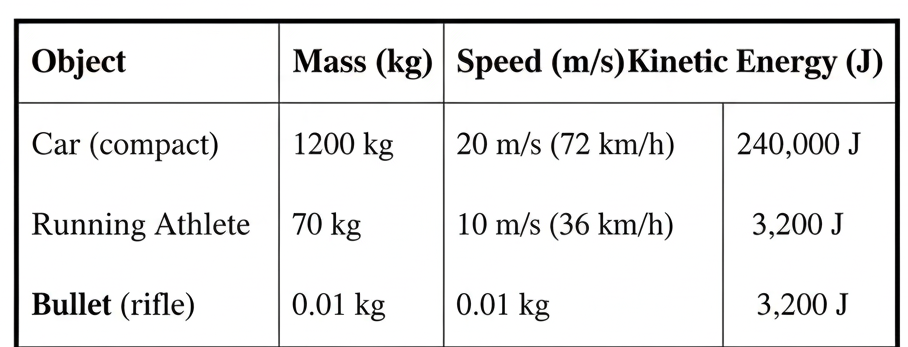
Imagine you are having pani puri! The kinetic energy of a small, fast cricket ball (low $m$, high $v$) can be surprisingly large, enough to smash a wicket. Contrast this with a heavy, slow goods-carrying rickshaw (high $m$, low $v$). Both possess kinetic energy by virtue of their motion.
Figure below:
A table showing typical kinetic energies for various objects, including cars, running athletes, and bullets, contrasting their mass, speed, and resulting kinetic energy in Joules.
NEET Checkpoint:
Kinetic energy is a measure of an object's capacity to do work by virtue of its:
(a) Position
(b) Motion
(c) Configuration
(d) Force applied
✅ Answer: (b) Motion — Potential energy relates to position/configuration; Kinetic energy relates strictly to motion.
Practice Questions:
-
The dimensions of kinetic energy $\text{[K]}$ are:
(a) $\text{[ML}^2\text{T}^{-1}\text{]}$
(b) $\text{[ML}^2\text{T}^{-2}\text{]}$
(c) $\text{[MLT}^{-2}\text{]}$
(d) $\text{[ML}^2\text{T}^{-3}\text{]}$
✅ Answer: (b) $\text{[ML}^2\text{T}^{-2}\text{]}$ — This is the same dimension as work.
2. A bullet of mass $50.0~g$ moving at $200~m~s^{-1}$ has an initial kinetic energy of $1000~J$. If the bullet emerges from plywood with only $10\%$ of its initial kinetic energy, what is the final kinetic energy in joules?
(a) $10~J$
(b) $50~J$
(c) $100~J$
(d) $200~J$
✅ Answer: (c) $100~J$ — $10\%$ of $1000~J$ is $0.1 \times 1000~J = 100~J$.
NEET Checkpoint:
Which of these quantities is always positive:
(a) Work
(b) Gravitational Force
(c) Kinetic Energy
(d) Potential Energy?
✅ Answer: (c) Kinetic Energy — Work and potential energy can be negative, but kinetic energy and mass are positive scalar quantities.
Key Takeaway:
The kinetic energy ($K$) of an object is defined as:
It is a positive scalar quantity with dimensions $\text{[ML}^2\text{T}^{-2}\text{]}$.
7. Work Done by a Variable Force
Let's face it, finding a truly constant force in the real world is rare, yaar. Most forces we deal with, like the spring force or the complex drag on a missile, are variable forces which change with position. Mastering the work done by these guys is crucial for NEET prep!
Since the force $F$ keeps changing as the object moves, we can't use the simple $W = F \cdot d$ formula. The smart trick is to look at a super tiny displacement, say $\Delta x$. Over this small stretch, we can totally assume the force $F(x)$ is approximately constant. The small amount of work done, $\Delta W$, is thus defined by:
NEET Checkpoint:
For a variable force $F(x)$, the work done over a very small displacement $\Delta x$ is calculated by treating $F(x)$ as:
(a) The average force
(b) The constant force in that interval
(c) The maximum force in the interval
(d) $\Delta W / \Delta x$
✅ Answer: (b) The constant force in that interval — When $\Delta x$ is small, we treat the variable force $F(x)$ as approximately constant for that segment.
To get the total work done ($W$) when moving from an initial position $x_i$ to a final position $x_f$, we simply sum up all these tiny bits of work ($\Delta W$). Now, notice this—when these small displacements $\Delta x$ are allowed to approach zero, the summation turns into the powerhouse of calculus: the definite integral. This gives us the accurate work done:
And that’s cool, right? This means the total work done by a variable force $F(x)$ is exactly equal to the area under the $F(x)$ versus $x$ curve. Visualizing this area is the funda you need for solving graphical problems!
Figure below:
A clear diagram showing the graph of a varying force F(x) versus displacement x. Illustrate that the total work done ($W$) is the area under the curve between the initial position $x_i$ and the final position $x_f$.
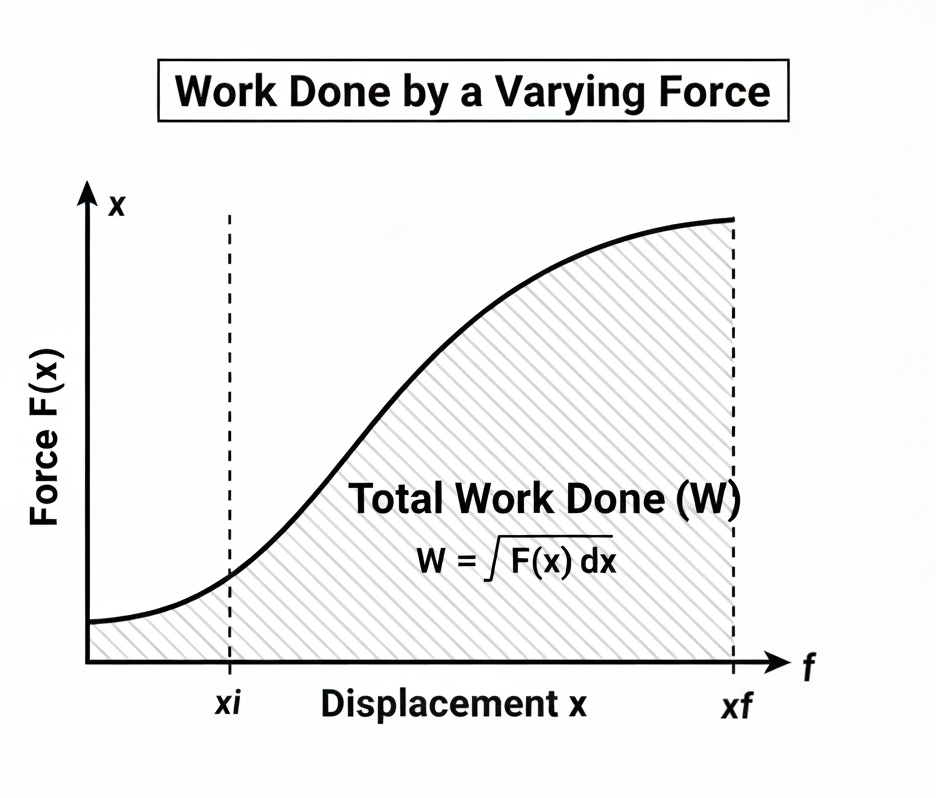
Think of a cricket bowler slowing down a practice roller. He initially applies a strong opposing force, but it reduces as the roller slows down due to friction. To find the total negative work done by him, you plot his pushing force versus the distance the roller covers, and calculate the area! Even friction needs a break sometimes!
NEET Checkpoint:
If the $F-x$ graph lies entirely below the $x$-axis (negative force values), the work done $W$ will be:
(a) Always positive
(b) Always negative
(c) Zero
(d) Dependent on acceleration
✅ Answer: (b) Always negative — The area on the negative side of the force axis has a negative sign, representing negative work (like work done by a retarding force).
Practice Question:
The total work done by a variable force $F(x)$ over a large displacement is found by using which mathematical operation on the small work segments $\Delta W$?
(a) Finding the cross product
(b) Applying the definite integral
(c) Calculating the derivative
(d) Using only $F_{average} \cdot d$
✅ Answer: (b) Applying the definite integral. The total work is the summation of small work done segments, which becomes the definite integral $\int F(x)dx$ as $\Delta x \rightarrow 0$.
NEET Checkpoint:
If the force applied by a woman pushing a trunk decreases linearly from $100~N$ to $50~N$ over $10~m$, the shape used to calculate the work done for that interval on the $F-x$ plot is a:
(a) Rectangle
(b) Triangle
(c) Trapezium
(d) Parabola
✅ Answer: (c) Trapezium — Since the force reduces linearly, the area under the curve for that displacement range forms a trapezium.
Key Takeaway: |
|---|
| Formula Summary: The work done by a variable force $F(x)$ over a displacement from $x_i$ to $x_f$ is given by the definite integral:
$$W = \int_{x_{i}}^{x_{f}}F(x)dx$$
|
| Graphical Interpretation: This work $W$ is mathematically equal to the area under the $F$ versus $x$ curve. |
8. The Work-Energy Theorem for a Variable Force
Alright, smart folks, let’s tackle the Work-Energy (WE) Theorem in its full glory, handling those tough variable forces we just discussed! This theorem is an absolute boss idea because it offers a scalar shortcut to complex dynamics. It formally states that the change in kinetic energy ($\Delta K$) of a body is exactly equal to the work done ($W$) on it by the net force.
Now, why does this matter? Because we can derive it directly from Newton’s Second Law ($F=ma$). Here's the trick: we look at the instantaneous rate of change of kinetic energy ($K$) with respect to time ($t$):
Differentiating that gives us:
Using Newton's Second Law, $m\frac{dv}{dt}$ is the force $F$, and $v$ is $\frac{dx}{dt}$. So,
This is awesome! When we rearrange it slightly to $dK=Fdx$ and integrate it from the initial position ($x_i$) to the final position ($x_f$), we get:
The left side is $K_f - K_i$, and the right side is simply the definition of work ($W$) done by a variable force. Boom! The Work-Energy Theorem ($K_{f}-K_{i}=W$) is proved for a variable force.
NEET Checkpoint:
The Work-Energy Theorem is derived by integrating the instantaneous rate of change of kinetic energy:
(a) $\frac{dK}{dx}$
(b) $\frac{dK}{dt}$
(c) $F \cdot d$
(d) $\frac{dE}{dt}$
✅ Answer: (b) $\frac{dK}{dt}$ — The proof starts by analyzing the time rate of change of kinetic energy, $\frac{dK}{dt}$.
But wait, there’s a catch! The Work-Energy theorem is an integral form of Newton's second law. Think of it like a simplified result. Because we used an integral over a time interval, the theorem loses the temporal (time) information. Also, Newton's second law is a vector equation, but the WE theorem is a scalar form. This means it lacks the full directional (vector) information contained in the second law.
Imagine a delivery rider going through traffic: their speed and the net force (engine power minus variable friction and air resistance) keep changing. Using the WE theorem, you can calculate the final speed based on the work done by the net force, but you can’t explicitly find when they reached that speed, because the time information is integrated out!
NEET Checkpoint:
Compared to Newton's Second Law, the Work-Energy theorem does not explicitly contain:
(a) Mass information
(b) Scalar information
(c) Temporal information
(d) Momentum information
✅ Answer: (c) Temporal information — Since the theorem involves an integral over an interval of time, the time information is 'integrated over' and is not explicitly available.
NEET Checkpoint:
The Work-Energy theorem is considered the scalar form of Newton’s Second Law because:
(a) It deals only with speeds, not velocities.
(b) The result $W$ is a scalar quantity.
(c) It holds only in two dimensions.
(d) It uses the dot product.
✅ Answer: (b) The result $W$ is a scalar quantity — The work done is a scalar, meaning the theorem lacks the directional (vector) information of the Second Law.
Practice Question:
If the work done by the net force on an object moving from $x_i$ to $x_f$ is negative, what happens to the object's kinetic energy?
(a) It increases.
(b) It decreases.
(c) It stays constant.
(d) Cannot be determined.
✅ Answer: (b) It decreases. Since $W = K_f - K_i$, a negative $W$ means $K_f < K_i$.
Key Takeaway:
Formula Summary
Work-Energy Theorem (Variable Force): The change in kinetic energy is equal to the total work done by the net force.
Key Insight: This is the integral, scalar form of Newton's Second Law, which means it loses explicit time and directional information.
9. The Concept of Potential Energy (PE): Stored Energy ka Funda!
Don't stress, yaar, the concept of potential energy is quite straightforward! Potential energy ($V$ or PE) is basically stored energy, or the capacity for action a body has just by virtue of its position or configuration. Think of it like saving up energy for later use. A stretched bow-string, for example, possesses potential energy, and when released, this stored energy instantly converts into kinetic energy to launch the arrow.
Let’s focus on gravitational potential energy first, which is the most common funda. If you raise an object of mass $m$ to a height $h$ near the Earth’s surface (where the variation of acceleration due to gravity, $g$, is negligible), the work done against gravity gets stored. We define this gravitational potential energy as:
When this object is released, its potential energy manifests entirely as kinetic energy on reaching the ground, such that $\frac{1}{2}mv^2 = mgh$.
Imagine you are holding a plate of piping hot pani puri high above the ground. You are essentially storing $mgh$ potential energy in that plate (don't drop it!) If you accidentally release it, that PE converts straight into KE right before it hits the ground—and then you have a mess!
NEET Checkpoint:
For the concept of potential energy $V(x)$ to be defined, the force $F(x)$ must satisfy which condition?
(a) $F(x) = dV/dx$
(b) $F(x) = -\frac{dV}{dx}$
(c) $F(x) = constant$
(d) $F(x) = 0$
✅ Answer: (b) $F(x) = -\frac{dV}{dx}$ — This mathematical relation defines forces (conservative forces) for which a potential energy function can exist.
Here's the trick: potential energy is only defined for forces that can be expressed as the negative derivative of the potential energy function, meaning the force must be conservative. This is why friction, being non-conservative, does not have an associated potential energy.
We must also remember that the zero of potential energy is arbitrary. We set it according to our convenience. For gravitational calculations, we usually take $V=0$ at the ground level, but once fixed in a problem, you must adhere to it consistently.
NEET Checkpoint:
The dimensions of potential energy are the same as:
(a) Force
(b) Power
(c) Work
(d) Momentum
✅ Answer: (c) Work — Potential energy, kinetic energy, and work all share the dimension $[ML^2T^{-2}]$ and the unit joule ($J$).
Practice Questions:
-
When a block of mass $m$ slides down a frictionless inclined plane of height $h$, its speed at the bottom is independent of the angle of inclination. Which equation justifies this outcome?
(a) $W = F \cdot d$
(b) $F = -k x$
(c) $\frac{1}{2}mv^2 = mgh$
(d) $\Delta K = W_{net}$
✅ Answer: (c) $\frac{1}{2}mv^2 = mgh$ — The conservation of mechanical energy shows that the initial potential energy ($mgh$) dictates the final kinetic energy ($\frac{1}{2}mv^2$) irrespective of the path angle.
2. If the gravitational potential energy of an object at height $H$ is $E$, what is the PE at height $H/2$, assuming $V=0$ at the ground?
(a) $2E$
(b) $E/2$
(c) $4E$
(d) $E$
✅ Answer: (b) $E/2$ — Since $V=mgh$ is linear with height $h$, halving the height halves the potential energy.
Key Takeaway:
Potential energy (V) is the stored energy based on position/configuration. For conservative forces, F(x)=−dVdx. Gravitational PE near Earth is V(h)=mgh.
10. Conservative and Non-Conservative Forces
Let's clear up this crucial funda: how forces affect energy conservation. This distinction between conservative and non-conservative forces is pure scoring material for NEET, ya know?
A force is called conservative if the work done by it in moving an object depends only on the initial and final positions ($x_{i}$ and $x_{f}$) of the object. The path taken doesn't matter, yaar! Because the work done $W$ is path-independent, the total work done by a conservative force in a closed path is zero. Think of the gravitational force and the spring force ($F_{s}=-kx$) as your conservative buddies. For these forces, we can define a potential energy function, $V(x)$, such that the force is the negative derivative of $V(x)$.
NEET Checkpoint:
For a conservative force, the work done in a cyclic process (closed path) is:
(a) Maximum
(b) Dependent on velocity
(c) Zero
(d) Always positive
✅ Answer: (c) Zero — The work depends only on the endpoints. If $x_{i}=x_{f}$, the work done is zero.
Now, meet the rule-breaker: the non-conservative force. The work done by this type of force depends on the particular path taken by the object. The prime example is friction. Imagine you are carrying a bag straight to the cash counter (gravity is conservative). Now, imagine dragging that heavy bag in a zigzag path across a rough floor. The longer the path, the more work friction does! Friction causes mechanical energy loss (usually as heat), and this lost energy is path-dependent.
Crucially, friction has no associated potential energy. The work done by friction over a closed path is not zero. If non-conservative forces are doing work ($W_{nc}$), the total mechanical energy $E=K+V$ changes according to $E_{f}-E_{i}=W_{nc}$. And that’s cool, right? It shows where the energy went!
NEET Checkpoint:
Which force is explicitly mentioned as a non-conservative force that cannot have an associated potential energy?
(a) Gravitational force
(b) Spring force
(c) Normal force
(d) Frictional force
✅ Answer: (d) Frictional force — Friction is non-conservative, and no potential energy can be associated with it.
Practice Question:
If the work done by a force is $W_{path}$, and $W_{path} \ne W_{i \to f}$ (where $W_{i \to f}$ depends only on initial and final points), the force is:
(a) Conservative
(b) Gravitational
(c) Non-conservative
(d) Always proportional to displacement
✅ Explanation: If the work done depends on the particular path taken, the force is classified as non-conservative.
NEET Checkpoint:
If an object is moved up an inclined plane (height $h$), the work done by gravity is $-mgh$, regardless of the inclination angle. This demonstrates:
(a) Path dependence
() Non-conservative nature
(c) Path independence
(d) Energy dissipation
✅ Answer: (c) Path independence — The work depends only on the vertical separation, $h$, showing the conservative nature of gravity.
Got the difference between conservative and non-conservative forces clear? Bade aaram se! Now that we know mechanical energy is only conserved with conservative forces, let's dive into the specifics of elastic and inelastic collisions.
Key Takeaway:
| Force Type | Work Dependence | Work in Closed Path | Potential Energy ($V$) | Examples |
|---|---|---|---|---|
| Conservative | Initial and Final Position Only | Zero | Yes, $F = -\frac{dV}{dx}$ | Gravity, Spring Force |
| Non-Conservative | Depends on the Path Taken | Not necessarily zero | No | Friction |
11. The Conservation of Mechanical Energy
Hey future doctors! Let's clear up the funda of mechanical energy conservation. This is pure gold for NEET, so pay attention, yaar—it’s easier than it looks!
First off, what's Total Mechanical Energy ($E$)? It's just the sum of the Kinetic Energy ($K$) and the Potential Energy ($V$) of a system. Simple funda:
The magic happens when the forces doing work on the system are purely conservative (like gravity or the spring force). When only conservative forces are around, the change in kinetic energy is exactly balanced by the negative change in potential energy, $\Delta K = -\Delta V$. Notice this: $\Delta (K+V) = 0$.
This simple equation means the total mechanical energy $E$ stays a constant. Even if $K$ and $V$ vary from point to point, their sum is always conserved. The principle of conservation of mechanical energy is a direct consequence of the Work-Energy (WE) theorem applied specifically to conservative forces.
NEET Checkpoint:
If a body is subjected only to gravitational force, the quantity $K+V$ must be
(a) increasing
(b) decreasing
(c) zero
(d) constant.
✅ Answer: (d) constant — Gravity is a conservative force, so the total mechanical energy ($E=K+V$) is conserved.
But what if non-conservative forces crash the party? If friction ($F_{nc}$) or air resistance are involved, the mechanical energy is not conserved. The total mechanical energy ($E$) changes by the work done by these non-conservative forces ($W_{nc}$):
The frictional force always opposes motion, so $W_{nc}$ is usually negative, meaning energy is typically lost from the mechanical system. Even friction needs a break sometimes!
Relatable Indian Example: Imagine riding your scooter and coasting up a slight incline. If the road was perfectly smooth (no friction), your initial $K$ would be converted fully to $V$ (conservative case). But because of tyre friction and air resistance ($W_{nc}$), you don't reach the height you theoretically should have—the lost mechanical energy was dissipated as heat, forcing you to use your engine again!
Motion in a vertical circle, like a simple pendulum bob, is a perfect application of energy conservation. Why? Because the tension ($T$) in the string does no work on the bob, as the displacement of the bob is always normal ($90^\circ$) to the string. Since $W_{tension}=0$, mechanical energy is conserved.
Figure below:
A clear diagram showing a pendulum bob of mass $m$ suspended by a string of length $L$, illustrating points A (bottom), B (middle height L), and C (top height 2L), with relevant velocities $v_0$, $v_B$, and $v_C$ and forces (gravity $mg$ and tension $T$).
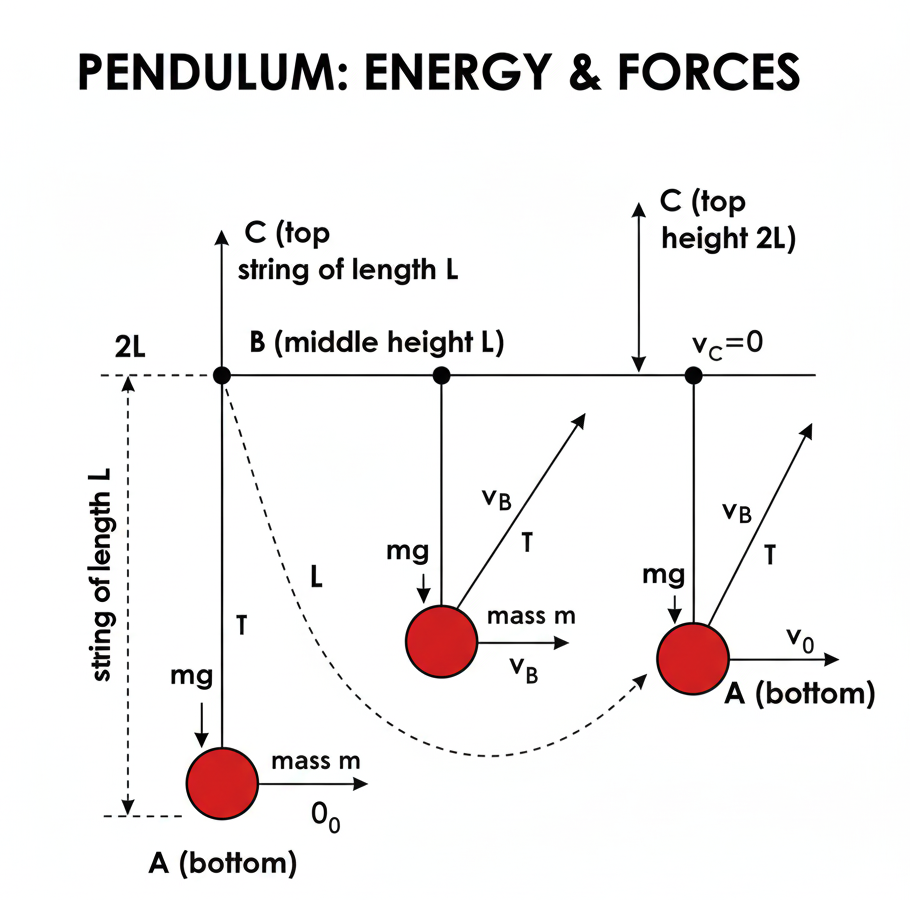
To complete a full semi-circular trajectory, the minimum speed required at the lowest point $A$ is $v_o = \sqrt{5gL}$.
NEET Checkpoint:
If non-conservative forces do $10~J$ of work on a system, what is the change in the system's total mechanical energy?
(a) $0~J$
(b) $10~J$
(c) $-10~J$
(d) Cannot be determined.
✅ Answer: (b) $10~J$ — $\Delta E = W_{nc}$. The change is equal to the work done by the non-conservative forces, assuming the work done by them is positive $10~J$.
Practice Questions:
1. The total mechanical energy of a falling stone increases by $20~J$ during its descent. This suggests:
(a) The stone is experiencing zero force.
(b) Non-conservative forces are doing positive work ($W_{nc} > 0$).
(c) Gravitational force is non-conservative.
(d) The potential energy of the stone remained zero.
✅ Answer: (b) Non-conservative forces are doing positive work ($W_{nc} > 0$) — If $\Delta E > 0$, then $W_{nc}$ must be positive, as $E_{f} - E_{i} = W_{nc}$.
2. For a mass $m$ attached to a string of length $L$ completing a vertical loop, why is the total mechanical energy conserved?
(a) Gravity is always zero.
(b) Tension is always perpendicular to velocity.
(c) The path is circular.
(d) The velocity is constant.
✅ Answer: (b) Tension is always perpendicular to velocity — Tension does no work ($W_T=0$), and gravity is conservative, so $E$ is conserved.
NEET Checkpoint:
If an object slides down a rough inclined plane, which statement is true about its total mechanical energy $E$?
(a) $\Delta E = 0$
(b) $\Delta E < 0$
(c) $\Delta E > 0$
(d) $\Delta K = \Delta V$.
✅ Answer: (b) $\Delta E < 0$ — The frictional force (non-conservative) does negative work ($W_{nc} < 0$), causing the total mechanical energy to decrease ($\Delta E = W_{nc}$).
Now that you've got this, wait till you see how the spring force relates to potential energy!
Key Takeaway: |
|---|
| Total Mechanical Energy: $E = K + V$. |
| Conservation Condition: If only conservative forces act, $\Delta E = 0$, meaning $E$ is constant. |
| Non-Conservative Forces: The change in mechanical energy equals the work done by non-conservative forces: $E_{f} - E_{i} = W_{nc}$. |
| Vertical Circle Tip: Tension does no work on the bob, simplifying the analysis. |
12. The Potential Energy of a Spring
Listen up, future engineers! When dealing with springs, we're entering the territory of variable forces that are super disciplined—they are conservative. This means they obey some strict rules. The main rule for an ideal spring is Hooke's Law.
The Funda of Hooke's Law and Spring Force
The spring force, $F_s$, is directly proportional to the displacement $x$ of the block from its equilibrium position ($x=0$). But wait, there's a catch (and a negative sign!):
This means if you stretch the spring (positive $x$), the spring force $F_s$ pulls back (negative direction). If you compress it (negative $x$), $F_s$ pushes out (positive direction). The constant $k$ is the spring constant or stiffness. If $k$ is large, the spring is stiff (like the suspension of a heavy truck), and its unit is $\text{N}\,\text{m}^{-1}$.
NEET Checkpoint:
If a spring has a large spring constant kkk, what does it indicate about the spring?
(a) The spring is very soft
(b) The spring is very stiff
(c) The spring is easily stretched
(d) The spring has zero restoring force
✅ Answer: (b) A spring with a large spring constant kkk requires more force to stretch or compress it by the same amount. Since it resists deformation strongly, it is considered stiff, not soft.
Work Done and Potential Energy
Since the spring force is conservative, the work done against it gets stored as potential energy. The work done by the spring force when displaced from equilibrium ($x=0$) to a final extension $x_m$ is:
The work done by the spring force depends only on the end points, which confirms it's a conservative force.
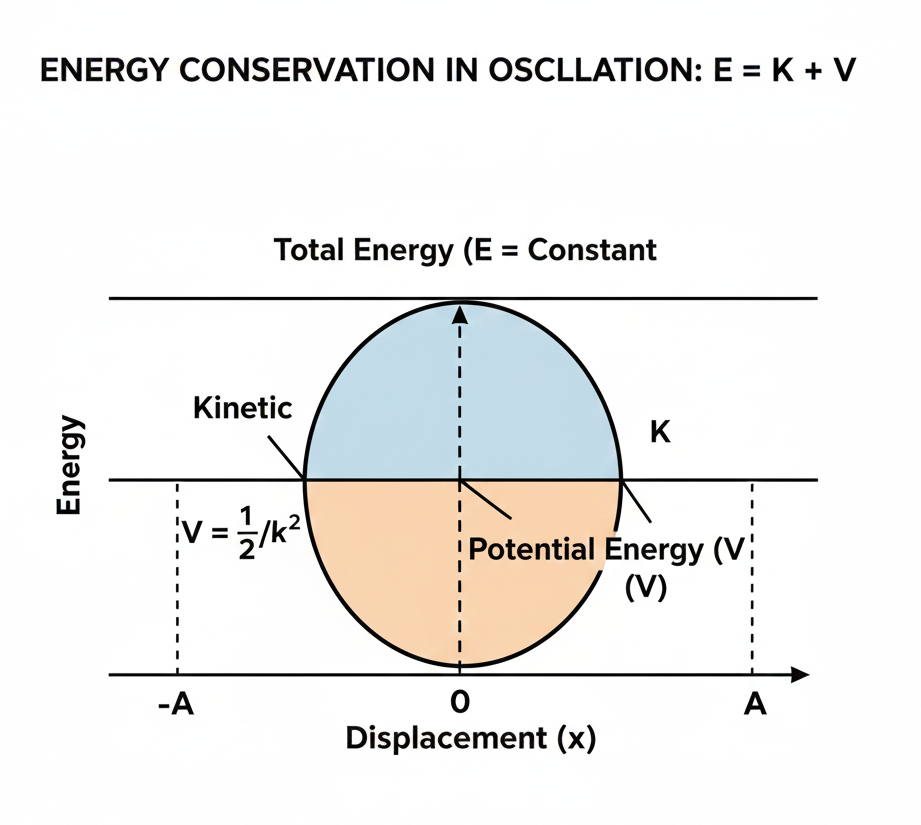
We define the potential energy $V(x)$ of the spring to be zero at the equilibrium position ($x=0$). For any extension or compression $x$, the potential energy stored is:
Relatable Indian Example: Imagine a shopkeeper using a spring balance (like those seen at vegetable or pani puri stalls). When the spring is stretched by $x$, the energy stored in it is $\frac{1}{2}k x^2$. This stored energy represents its capacity to snap back!
Figure below:
A clear diagram showing the potential energy V (parabolic plot) and kinetic energy K (inverted parabolic plot) versus displacement x, illustrating that their sum E=K+V remains constant.
Conservation of Mechanical Energy
When a mass $m$ attached to the spring is released from an extension $x_m$, the total mechanical energy $E = K + V$ remains constant, provided no non-conservative forces like friction are involved. The kinetic energy $K$ and potential energy $V$ constantly convert into each other .
NEET Checkpoint:
A block oscillates between $x=-x_m$ and $x=+x_m$. Where is its speed maximum?
(a)At x=+xm
(b)At x=−xm
(c) At x=0
(d) Same at all positions
✅ Answer: At $x=0$ (equilibrium) — At the maximum compression/extension ($\pm x_m$), $V(x)$ is maximum, so the kinetic energy $K$ is zero (momentarily at rest). At $x=0$, $V(x)$ is zero, so $K$ (and speed $v$) must be maximum.
The conservation equation is:
This shows the maximum potential energy stored at $x_m$ equals the sum of potential and kinetic energy at any arbitrary position $x$.
Practice Question:
If a car of mass $M$ moving with speed $V$ compresses a spring (constant $k$) by $x_m$, which equation correctly relates these values (assuming a smooth road)?
(a) $\frac{1}{2}MV^2 = kx_m$
(b) $\frac{1}{2}MV^2 = \frac{1}{2}kx_m^2$
(c) $MV = kx_m$
(d) $M = kx_m/V^2$
✅ Answer: (b) $\frac{1}{2}MV^2 = \frac{1}{2}kx_m^2$ — At maximum compression, the initial kinetic energy of the car is entirely converted into the potential energy stored in the spring, based on the conservation of mechanical energy.
Key Takeaway:
| Concept | Formula | Notes |
|---|---|---|
| Spring Force (Hooke's Law) | $F_s = -kx$ | Conservative, variable force. |
| Work Done by Spring (from $0$ to $x_m$) | $W_s = -\frac{1}{2}k x_m^2$ | Negative work as $F_s$ opposes displacement. |
| Potential Energy of Spring | $V(x) = \frac{1}{2}k x^2$ | Assumes $V=0$ at equilibrium $x=0$. |
| Conservation of Energy | $K+V$ = constant | $\frac{1}{2}k x_m^2 = \frac{1}{2}k x^2 + \frac{1}{2}m v^2$. |
13. Power: Definition, Calculation, and Units
Listen up, future doctors! When studying Work, Energy, and Power, many students confuse the last two, but the funda of power is super simple: it's all about speed. Power ($P$) is defined as the time rate at which work is done or energy is transferred.
Think about two construction workers lifting bricks: if both do the exact same amount of work ($W$), but one finishes in half the time ($t$), who is more powerful? The one who climbed faster, right? Because they completed the work at a higher rate!
We define the average power ($P_{av}$) of a force as the ratio of the total work done ($W$) to the total time taken ($t$):
Now, for calculations where the force or speed keeps changing, we need the instantaneous power ($P$). This is the limiting value of the average power as the time interval approaches zero:
And that's cool, right? Using the relationship between work ($dW = F\cdot dr$) and velocity ($v = dr/dt$), we can express instantaneous power as the dot product of force ($F$) and instantaneous velocity ($v$):
Since the dot product of two vectors is a scalar, power is a scalar quantity.
Relatable Indian Example: Imagine a rickshaw-puller covering a distance ($d$). If he applies a constant force ($F$) and maintains a steady velocity ($v$), his power output ($P=F\cdot v$) tells you instantly how much effort he is putting in! A powerful motor means a high power output, allowing a greater speed for the same force.
NEET Checkpoint:
What are the dimensions of power?
(a) $[MLT^{-2}]$
(b) $[ML^{2}T^{-2}]$
(c) $[ML^{2}T^{-3}]$
(d) $[MLT^{-3}]$
✅ Answer: (c) $[ML^{2}T^{-3}]$ — Don't stress, yaar! Work has dimensions of $[ML^{2}T^{-2}]$, and power is work per time ($T^{-1}$), so it's $[ML^{2}T^{-3}]$.
The SI unit of power is the watt (W), named after James Watt. One watt is defined as one joule per second ($1 \text{ W} = 1 \text{ J s}^{-1}$).
NEET Checkpoint:
How many watts are equal to one horsepower ($hp$)?
(a) $3600 \text{ W}$
(b) $746 \text{ W}$
(c) $1000 \text{ W}$
(d) $3.6 \times 10^6 \text{ W}$
✅ Answer: (b) $746 \text{ W}$ — This classic conversion is $1 \text{ hp} = 746 \text{ W}$, often used for describing motor output.
A Key Distinction: Energy vs. Power
Here’s the trickiest funda related to units: the kilowatt hour (kWh) is frequently seen on electricity bills, but it is not a unit of power. It is a unit of energy.
$1 \text{ kilowatt hour}$ ($1 \text{ kWh}$) is the energy consumed by a $1000 \text{ W}$ device running for one hour. In Joules, this converts to $3.6 \times 10^{6} \text{ J}$. Remember this distinction for numericals!
NEET Checkpoint:
Kilowatt hour (kWh) is a unit of:
(a) Power
(b) Force
(c) Energy
(d) Momentum
✅ Answer: (c) Energy — Despite having 'watt' in the name, $1 \text{ kWh}$ measures the total energy transferred or consumed, not the rate.
Practice Question :
A motor delivers a minimum power of $44000 \text{ W}$ to lift an elevator with a constant speed of $2 \text{ m/s}$. What is the total downward force (gravity + friction) opposing the motion?
(a) $88000 \text{ N}$
(b) $22000 \text{ N}$
(c) $44000 \text{ N}$
(d) $11000 \text{ N}$
✅ Answer: (b) $22000 \text{ N}$ — Use the instantaneous power formula: $P = F \cdot v$. Since the speed is constant, $F = P/v$. $F = 44000 \text{ W} / 2 \text{ m/s} = 22000 \text{ N}$.
Key Takeaway: Formula Summary |
|---|
| Power Definition: Time rate of work/energy transfer. |
| Average Power: $P_{av}=\frac{W}{t}$ |
| Instantaneous Power: $P=\frac{dW}{dt} = F\cdot v$ |
| SI Unit: watt ($W$) ($1 \text{ J s}^{-1}$). |
| Key Conversions: $1 \text{ hp} = 746 \text{ W}$; $1 \text{ kWh} = 3.6 \times 10^{6} \text{ J}$ (Energy unit). |
14. Collisions in One Dimension
Collisions might seem complicated, but they boil down to just two major conservation laws. Once you grasp the funda here, numerical problems become super easy, promise.
First, the universal truth (yaar, this is crucial): In all collisions—whether elastic, inelastic, or completely messy—the total linear momentum is conserved. Why? Because the impulsive forces exchanged between the particles ($F_{12}$ and $F_{21}$) are equal and opposite (Newton's Third Law), so the total change in momentum is zero ($\Delta p_{1}+\Delta p_{2}=0$).
Next, we check energy. In an elastic collision, the total kinetic energy is also conserved (before and after the impact). Think of perfect billiard balls or maybe that satisfying click when you break the carrom pieces! But usually, some energy is lost (transformed into heat, sound, or deformation)—that's an inelastic collision.
If the colliding objects stick together and move as one combined mass after the hit, that's a completely inelastic collision. For this 1D scenario, if mass $m_1$ hits a stationary mass $m_2$, their final velocity ($v_f$) is determined only by momentum conservation:
Which gives the final common velocity as:
NEET Checkpoint:
When two bodies undergo a completely inelastic collision, is the total energy of the system conserved?
(a) Yes, always
(b) No, because kinetic energy is lost
(c) Yes, but only linear momentum is conserved
(d) No, only momentum is conserved.
✅ Answer: (a) Yes, always — Total energy is always conserved, but the kinetic energy is converted into other forms (heat/sound/internal energy), making the collision inelastic. We only say kinetic energy is lost.
For a 1D elastic collision, we solve both momentum and kinetic energy conservation equations simultaneously. Assuming $m_2$ is initially at rest, the final velocities ($v_{1f}$ and $v_{2f}$) are:
Here's the trick: If the masses are equal ($m_{1}=m_{2}$), the equations simplify immensely! They simply exchange velocities. The incoming mass stops ($v_{1f}=0$), and the stationary mass takes off with the original speed ($v_{2f}=v_{1i}$). Memorise this case, pakka!
NEET Checkpoint:
In an elastic collision where a body of mass $m$ collides with an identical stationary body, the fractional kinetic energy lost by the incoming body is:
(a) 1
(b) 0
(c) $1/2$
(d) Cannot be determined.
✅ Answer: (b) 0 — If $m_1=m_2$, the first body comes to rest ($v_{1f}=0$) and transfers all its kinetic energy to the second body.
Practice Question:
A $1~kg$ scooter tire rolling down a slope at $10~m/s$ hits a stationary $500~kg$ rickshaw. If the collision is roughly inelastic, will the tire bounce back or stick?
(a) Stick, $v_f \approx 0.02~m/s$
(b) Bounce back strongly
(c) Stick, $v_f \approx 10~m/s$
(d) The rickshaw is too heavy to move.
✅ Explanation: (a) The collision is highly inelastic if they stick. The final velocity $v_{f}=\frac{1}{(1+500)} \times 10 \approx 0.02~m/s$. They move together at a tiny speed .
NEET Checkpoint:
During the actual short duration ($\Delta t$) when two bodies are in contact during an elastic collision, is the total kinetic energy constant?
(a) Yes
(b) No
(c) Only if the force is conservative
(d) Only for equal masses.
✅ Answer: (b) No — Even in an elastic collision, kinetic energy is momentarily converted into potential energy (like a "compressed spring" of deformation) during the impact phase ($\Delta t$), meaning KE is not constant at every instant.
Key Takeaway
| Collision Type | Momentum (P) | Kinetic Energy (K) | Final State |
|---|---|---|---|
| All Collisions | Conserved | Not necessarily conserved | N/A |
| Elastic | Conserved | Conserved (before/after) | Separated |
| Completely Inelastic | Conserved | Lost ($\Delta K > 0$) | Stick together ($v_{f}$) |
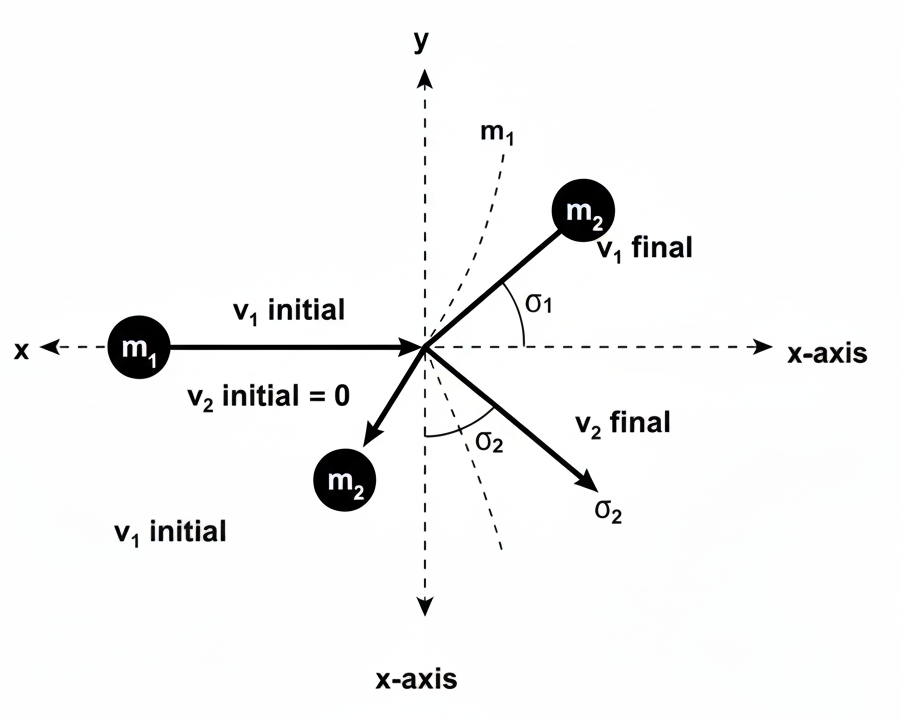
15. Collisions in Two Dimensions: The Angle Game
Two dimensions just means you have to handle components! When collisions are not head-on, they are generally two-dimensional. Think about when you hit a cricket ball slightly off-centre; it flies off both forward and sideways. This is where the fun begins, because we rely on the powerful laws of conservation.
Since momentum ($\mathbf{P}$) is a vector, its conservation requires us to look at components along the $x$ and $y$ axes (assuming the collision lies in the $x$-$y$ plane). Conservation of linear momentum requires two separate equations:
(For the $x$-component) [81, 5.28]
(For the $y$-component) [81, 5.29]
Notice this: You usually know the initial parameters, but after the collision, you have four unknowns to find: the two final speeds (${v_{1f}, v_{2f}}$) and the two final angles (${\theta_{1}, \theta_{2}}$). But we only have two momentum equations.
NEET Checkpoint:
In a general two-dimensional collision problem (elastic or inelastic), how many final unknowns are typically present?
(a) Two
(b) Three
(c) Four
(d) Six
✅ Answer: (c) Four — The two final speeds ($v_{1f}, v_{2f}$) and the two angles ($\theta_{1}, \theta_{2}$).
If the collision is elastic, we gain a third equation: the conservation of kinetic energy (KE).
Here's the trick: Even with three equations (momentum $x$, momentum $y$, and KE), you are still one equation short for the four unknowns. Therefore, to solve the problem completely, at least one angle ($\theta_{1}$ or $\theta_{2}$) must be known. If you are given the angle, bhai, the problem is solvable!
Imagine trying to pocket a pani puri on a frictionless table (our masses $m_1$ and $m_2$). If your pani puri masses are equal ($m_{1}=m_{2}$) and the collision is perfectly elastic, they will move at right angles ($90^{\circ}$) to each other after the glancing hit. This key result simplifies life dramatically!
NEET Checkpoint:
What must be known to solve a 2D elastic collision problem given masses and initial speed?
(a) The time duration
(b) The coefficient of restitution
(c) The final velocity vector
(d) One of the final angles
✅ Answer: (d) One of the final angles — Since there are four unknowns and only three equations (momentum $x$, momentum $y$, KE), one piece of information must be provided.
Figure below:
A clear diagram showing an initial moving mass $m_1$ hitting a stationary mass $m_2$. After collision, $m_1$ moves away at angle $\theta_1$ and $m_2$ moves away at angle $\theta_2$ relative to the initial $x$-axis, illustrating the two-dimensional collision.
Practice Question:
In a glancing elastic collision between two masses of $m_{1}=m_{2}$, where $m_2$ is initially stationary, what is the angle between their final velocity vectors?
(a) $0^{\circ}$
(b) $45^{\circ}$
(c) $90^{\circ}$
(d) Depends on the initial velocity
✅ Explanation: (c) For equal masses in a glancing elastic collision, they move away at $90^{\circ}$ to each other. This is a standard result you should memorize!
Now that you've got this two-dimensional funda cleared, wait till you see how it connects with motion in a vertical circle!
Key Takeaway:2D Collisions |
|---|
| Conservation of Momentum requires two equations (for $x$ and $y$ components). |
| Elastic Collisions provide a third equation (KE conservation). |
| If $m_{1}=m_{2}$ (equal masses) in a glancing elastic collision, the particles move off at $90^{\circ}$ to each other. |