
1. Introduction and Scope of Thermodynamics
Future doctors! Ready to tackle the funda that runs the universe—Thermodynamics? Don't stress, yaar—it's easier than it looks!
This awesome branch of physics deals with heat and temperature, and how these concepts relate to the inter-conversion of heat and other forms of energy. Think about rubbing your palms together in winter; the work you do converts directly into 'heat', making you feel warmer. Conversely, in a steam engine, the 'heat' of the steam is used to do useful work by moving pistons.
Notice this: Thermodynamics is a macroscopic science. This means we look at the big picture—bulk systems—and we totally avoid the messy details of molecular constitution (that's for Kinetic Theory, maybe!). We specify the state of a gas using easily measurable macroscopic variables like pressure ($P$), volume ($V$), and temperature ($T$).
Here's the trick: Don't confuse it with classical mechanics, which cares about the motion of the system as a whole (like a cricket ball flying). Thermodynamics is concerned only with the internal macroscopic state of the body. When a bullet stops after piercing wood, its kinetic energy gets converted into heat, changing the temperature of the bullet and the wood. This temperature change relates to the energy of internal, disordered molecular motion, not the overall motion of the bullet.
Relatable Indian Example: Imagine your scooter zooming down the road. The engine uses chemical energy (heat) from the fuel to perform work (motion). If you suddenly slam on the brakes near a pani puri stall, the friction (work done against motion) generates immense heat in the brake pads. That’s thermodynamics in action—converting energy forms!
NEET Checkpoint:
Thermodynamics primarily deals with:
(a) The microscopic coordinates of individual molecules.
(b) The internal macroscopic state of bulk systems.
(c) The motion of the system as a whole under forces.
✅ Answer: (b) The internal macroscopic state of bulk systems — Thermodynamics is a macroscopic science focusing on bulk properties like $P$, $V$, and $T$.
Fun Fact: Before the modern view, scientists thought heat was a strange invisible fluid called caloric that flowed from hot to cold bodies. We are way past that caloric nonsense now, thanks to experiments proving that heat is a form of energy convertible from work.
NEET Checkpoint:
Which of the following describes the nature of thermodynamics?
(a) It is concerned with defining motion of particles.
(b) It is a microscopic science dealing with molecular constitution.
(c) It is a macroscopic science dealing with bulk systems.
(d) It is primarily focused on Newton’s laws of motion.
✅ Answer: (c) It is a macroscopic science dealing with bulk systems — It focuses on macroscopic variables and avoids molecular details.
NEET Checkpoint:
When a gas inside a closed container has fixed values of pressure, volume, and temperature that do not change over time, the system is in a state of:
(a) Mechanical non-equilibrium
(b) Thermal transit
(c) Thermodynamic equilibrium
(d) Caloric balance
✅ Answer: (c) Thermodynamic equilibrium — This is defined by the macroscopic variables characterizing the system remaining constant in time.
Practice Questions:
1. The concepts and laws of thermodynamics were primarily formulated:
(a) After the molecular picture of matter was firmly established.
(b) Before the molecular picture of matter was firmly established.
(c) Only after the invention of the Carnot engine.
(d) To analyze the disordered motion of individual molecules.
✅ Explanation: The concepts and laws were formulated in the nineteenth century, before the molecular picture of matter was firmly established. Option (b).
2. When a moving body comes to a stop due to friction, the loss of its mechanical energy results in:
(a) A decrease in its overall velocity but no change in temperature.
(b) A conversion of mechanical energy into heat, increasing internal energy.
(c) A violation of the First Law of Thermodynamics.
(d) The body achieving mechanical equilibrium without thermodynamic change.
✅ Explanation: Dissipative effects like friction convert mechanical energy (work) into heat, leading to a corresponding gain in the internal energy of the system and surroundings. Option (b).
Key Takeaway: |
|---|
| Thermodynamics is the branch studying the inter-conversion of heat and energy, focusing on the macroscopic state (defined by variables like $P, V, T$) of bulk systems. Heat is a form of energy, and its historical "caloric fluid" view was discarded. |
2. Thermal Equilibrium and Walls (Adiabatic vs. Diathermic)
Let's clear up this core thermodynamic funda—what happens when systems finally chill out and stop exchanging energy?
The State of Equilibrium
In thermodynamics, equilibrium isn't just about forces balancing, like in mechanics. We say a system has achieved thermodynamic equilibrium when its macroscopic variables stop changing over time. Think of variables like pressure ($P$), volume ($V$), and temperature ($T$). If you have a gas sealed inside a rigid container and everything is fixed—no changes in $P$, $V$, or $T$—you've hit the jackpot: an equilibrium state. Don't stress, yaar, this just means the system’s state is stable!
NEET Checkpoint:
Which of these is not typically considered a macroscopic variable characterizing thermodynamic equilibrium?
(a) Pressure ($P$)
(b) Volume ($V$)
(c) Velocity of the centre of mass
(d) Temperature ($T$)
✅ Answer: (c) Velocity of the centre of mass — Thermodynamics deals with the internal macroscopic state, not the motion of the system as a whole.
The Role of Walls
The ability of two systems (say, gases $A$ and $B$) to reach equilibrium depends entirely on what’s separating them—the wall. Walls come in two main flavours:
-
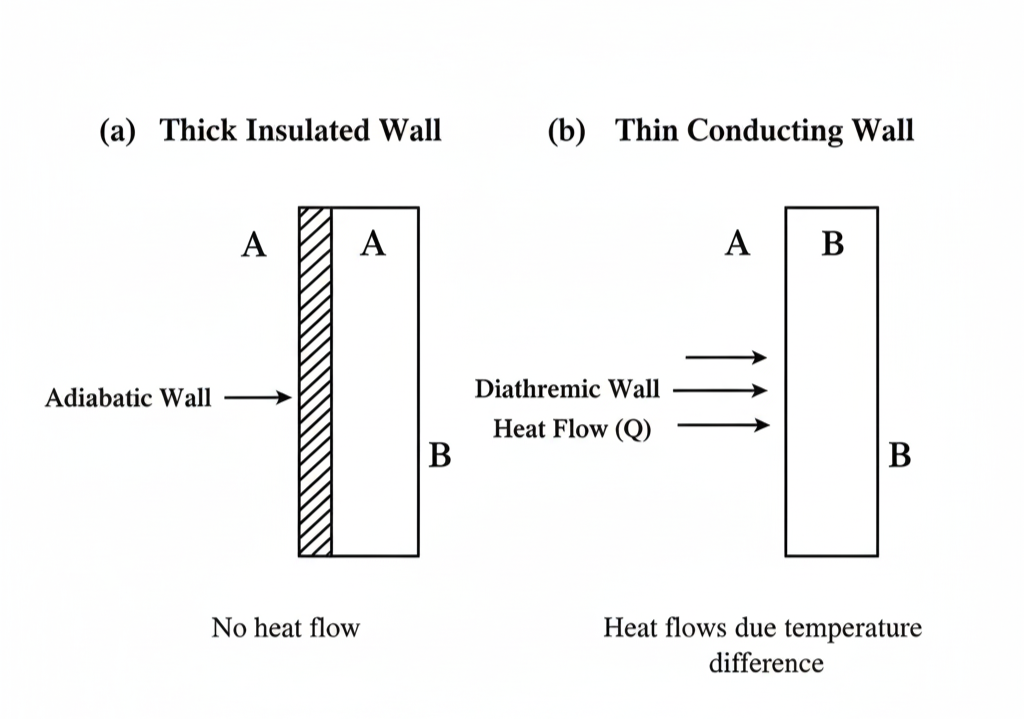
Adiabatic Wall: Imagine a super-strict bouncer who won't let anyone pass! An adiabatic wall is an insulating wall that does not allow the flow of energy (heat) between systems. If gases $A$ and $B$ are separated by an adiabatic wall and insulated from the surroundings, they can have any pair of $(P_A, V_A)$ and $(P_B, V_B)$ values and still be in equilibrium, because they can’t influence each other thermally. It’s like keeping ice cream sealed tight in a high-end flask—no heat exchange!
-
Diathermic Wall: This wall is the opposite—a total conductor! A diathermic wall is a conducting wall that allows energy flow (heat) from one system to the other.
Figure below:
A clear diagram showing two systems, A and B, side-by-side. Panel (a) shows them separated by a thick, insulated (adiabatic) wall. Panel (b) shows them separated by a thin, conducting (diathermic) wall, indicating heat flow.
Achieving Thermal Equilibrium
When you separate systems $A$ and $B$ with a diathermic wall, their macroscopic variables will change spontaneously until they both attain equilibrium states. This process, where systems separated by a conducting wall cease to exchange energy and their states stabilize, is called attaining thermal equilibrium.
Notice this: When thermal equilibrium is attained, the crucial characteristic is that the temperatures of the two systems are equal ($T_A = T_B$). It’s like placing a hot chai cup on a metal counter; heat flows until their temperatures equalise, and the energy exchange stops!
NEET Checkpoint:
If system $X$ and system $Y$ are separated by an adiabatic wall, what is the key restriction between them?
(a) $P_X = P_Y$
(b) $V_X = V_Y$
(c) $\Delta Q = 0$
(d) $T_X = T_Y$
✅ Answer: (c) $\Delta Q = 0$ — The adiabatic wall prevents any flow of heat ($\Delta Q$) between the systems.
NEET Checkpoint:
What happens to the states of two systems separated by a diathermic wall if they are not initially in thermal equilibrium?
(a) Their temperatures remain constant.
(b) Their variables change spontaneously until they stabilize.
(c) They spontaneously exchange work, but not heat.
(d) They remain separated, unaffected.
✅ Answer: (b) Their variables change spontaneously until they stabilize — A conducting (diathermic) wall allows energy flow, leading to spontaneous changes until equilibrium is attained.
Practice Question:
A closed system is characterized by macroscopic variables ($P$, $V$, $T$, etc.) that do not change over time. This condition describes:
(a) Mechanical equilibrium
(b) Chemical equilibrium
(c) Quasi-static process
(d) Thermodynamic equilibrium
✅ Answer: (d) Thermodynamic equilibrium — This is the defining feature of a thermodynamic equilibrium state, where $P$, $V$, $T$, mass, and composition are fixed in time.
Key Takeaway:
Thermal equilibrium requires equal temperatures (T) and is established via a diathermic (conducting) wall. An adiabatic (insulating) wall blocks heat flow and prevents thermal equilibrium between systems.
3. Zeroth Law and the Concept of Temperature
The Zeroth Law of Thermodynamics is super important because it gives us the fundamental funda behind the concept of temperature.
What's the Fickle Law?
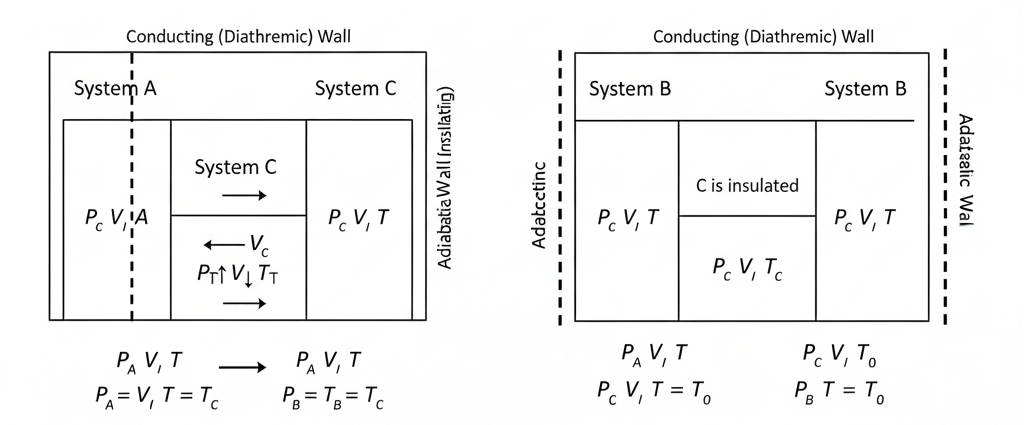
Imagine three systems: A, B, and C. The Zeroth Law states that if two systems (say, A and B) are separately in thermal equilibrium with a third system (C), then A and B are in thermal equilibrium with each other. Don't stress, this seems like common sense, but it provides the essential basis for using a thermometer! Interestingly, R.H. Fowler formulated this law in 1931, long after the First and Second Laws were already stated and numbered, hence its "Zeroth" designation.
This observation clearly suggests that when two systems A and B are in thermal equilibrium, there must be a physical quantity that has the same value for both. This thermodynamic variable whose value is equal for two systems in thermal equilibrium is called temperature ($T$). Thus, if system A is in equilibrium with C ($T_A = T_C$) and system B is in equilibrium with C ($T_B = T_C$), then $T_A = T_B$, meaning A and B are also in thermal equilibrium. Bade aaram se!
NEET Checkpoint:
Who formulated the Zeroth Law of Thermodynamics?
(a) Sadi Carnot
(b) R.H. Fowler
(c) Kelvin-Planck
(d) Clausius
✅ Answer: (b) R.H. Fowler — He stated this law in 1931, retroactively numbering it Zeroth.
The Marker of Hotness
Temperature is essentially a marker of 'hotness'. It’s the deciding factor for heat flow; heat always flows from a body at a higher temperature ($T$) to one at a lower temperature ($T$). The flow stops only when the temperatures equalise, which is when they achieve thermal equilibrium.
Relatable Indian Example: Think of an office canteen! You use the same digital thermometer (System C) to check the temperature of two staff members, Suresh (System A) and Priya (System B). If the thermometer reads $37^\circ C$ for both, then Suresh and Priya are thermally equivalent—even if they haven’t physically touched each other! The thermometer (C) establishes the common temperature ($T$).
The process of assigning numerical values to temperatures and constructing a reliable scale is the domain of Thermometry.
Figure below:
A clear diagram showing two systems A and B separated by an adiabatic wall, each connected to a third system C via a conducting (diathermic) wall, demonstrating that the variables change until A and B are in thermal equilibrium with C. Also show the subsequent arrangement where the adiabatic wall between A and B is replaced by a conducting wall, while C is insulated, confirming that A and B remain in thermal equilibrium.
NEET Checkpoint:
If system X is at $100~K$ and system Y is at $200~K$, in which direction will heat spontaneously flow when they are brought into contact?
(a) From X to Y
(b) From Y to X
(c) No flow occurs
(d) Depends on pressure
✅ Answer: (b) From Y to X — Heat flows from the body at a higher temperature ($200~K$) to the one at a lower temperature ($100~K$).
Practice Question :
The Zeroth Law of Thermodynamics directly establishes which concept?
(a) The conservation of energy ($\Delta Q = \Delta U + \Delta W$).
(b) The direction of work done.
(c) The thermodynamic variable $T$ (temperature).
(d) The ratio of specific heats ($\gamma$).
✅ Answer: (c) The thermodynamic variable $T$ (temperature). — The observation of thermal equilibrium leads formally to the concept of temperature.
NEET Checkpoint:
What process deals with assigning numerical values to temperatures?
(a) Thermostatics
(b) Calorimetry
(c) Thermometry
(d) Adiabatics
✅ Answer: (c) Thermometry — Thermometry deals with constructing temperature scales.
Key Takeaway:
The Zeroth Law is crucial as it formalizes Temperature ($T$) as the state variable that is equal for systems in thermal equilibrium, governing the direction of heat flow.
4. Heat, Internal Energy, and Work: The Thermodynamic Trio
Hey, NEET aspirant! Ready to tackle the three most crucial 'fundas' in Thermodynamics: Internal Energy ($U$), Heat ($Q$), and Work ($W$)? Don't stress, yaar—once you get the distinction, the First Law of Thermodynamics will be a piece of cake!
Let's first clear up Internal Energy ($U$). This is the energy stored inside your system. Specifically, $\mathbf{U}$ is the sum of the kinetic energies (KE) and potential energies (PE) of all the molecular constituents of that system. Notice this: $U$ excludes the overall kinetic energy related to the motion of the system as a whole. If your gas cylinder is moving across the room, that bulk movement's $\text{KE}$ is irrelevant to its internal energy $U$. Because it depends only on the current macroscopic state (like $P, V, T$), $U$ is a state variable.
Now, for the energy that moves: Heat ($\mathbf{Q}$) and Work ($\mathbf{W}$). These are not stored—they are energy in transit.
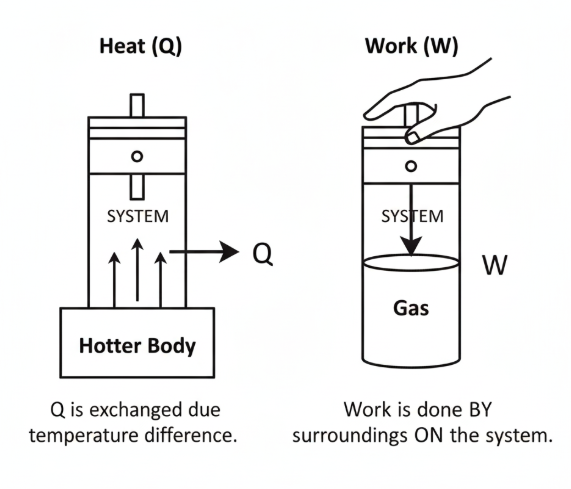
Heat ($\mathbf{Q}$) is defined as the energy transfer that arises solely due to a temperature difference between the system and its surroundings. Picture a hot cup of chai cooling down—that's heat flowing because of a $\Delta T$.
NEET Checkpoint:
Internal energy $U$ of a system is a state variable?
(a) True
(b) False
✅ Answer: (a) True — $U$ depends only on the state (like $P, V, T$), not the path taken to reach that state.
Work ($\mathbf{W}$) is any energy transfer brought about by means other than a temperature difference. This usually means mechanical methods, like pushing a piston into a cylinder.
Let’s use a quick example: Suppose you are rapidly inflating a bicycle tyre near a pani puri stall. The Work ($W$) you do by pushing the pump increases the air's internal energy $U$. If the pump casing gets warm and transfers energy to the air outside because the air temperature is lower, that transfer is Heat ($Q$).
Here's the trick you must remember: Both heat ($Q$) and work ($W$) are merely modes of energy transfer. They are not state variables. Saying "a gas has a certain amount of heat" is scientifically meaningless, just like saying "a gas has a certain amount of work". Only $U$ characterises the state.
Figure below:
A clear diagram showing two cylinders with pistons: one exchanging Heat (Q) due to a temperature difference with surroundings (a hotter body), and the other showing Work (W) being done by pushing the piston down.
NEET Checkpoint:
Which statement is meaningful in Thermodynamics?
(a) The system has $100$ J of heat.
(b) The system has $100$ J of internal energy.
✅ Answer: (b) The system has $100$ J of internal energy. — Heat and work are only energy transfers; $U$ is the energy stored in the state.
NEET Checkpoint:
Heat is transferred from System A to System B. This transfer must be due to:
(a) Volume change.
(b) Pressure difference.
(c) Temperature difference.
✅ Answer: (c) Temperature difference. — Heat ($Q$) flow is defined only by $\Delta T$.
Practice Question:
Which of the following is an energy transfer mode but not a thermodynamic state variable?
(a) Internal Energy ($U$)
(b) Temperature ($T$)
(c) Heat ($Q$)
(d) Volume ($V$)
✅ Answer: (c) Heat ($Q$) — Both $U$ and $T$ (along with $P$ and $V$) are state variables. $Q$ and $W$ are modes of transfer, not variables of state.
Key Takeaway:
| Concept | Definition | State Variable? |
|---|---|---|
| Internal Energy ($U$) | Sum of molecular KE and PE, excluding overall system KE. | Yes |
| Heat ($Q$) | Energy transfer due to $\Delta T$. | No |
| Work ($W$) | Energy transfer by means other than $\Delta T$ (e.g., pushing a piston). | No |
5. Thermodynamic State Variables and Equation of State
Let's clear up this funda—what exactly defines the state of your system? In thermodynamics, we deal with state variables (or macroscopic variables). These are bulk properties like pressure ($P$), volume ($V$), temperature ($T$), and mass ($m$). Now, here's the trick: the value of a state variable depends only on the specific state the system is currently in, and not on the path taken to reach it.
Think of it like getting your NEET rank. The final rank is the state variable. Whether you studied 18 hours a day for two years or crammed in the last three months, the final rank is the same! The journey (the path) doesn't matter, only the final destination (the state).
Internal energy ($U$) is the best example of a state variable. Since its value is fixed by the system's state (defined by $P, V, T$), it doesn't matter whether you supplied heat ($\Delta Q$) or did work ($\Delta W$) to reach that state. Remember, heat and work themselves are not state variables; they are modes of energy transfer.
NEET Checkpoint:
Which of these is NOT a thermodynamic state variable?
(a) $P$
(b) $T$
(c) $U$
(d) $\Delta W$
✅ Answer: (d) $\Delta W$ — Work done is a path function, meaning its value depends on how the change occurred, not just the start and end points.
The state variables are not all independent. The relation connecting these different state variables is called the Equation of State. For an ideal gas, we have the most famous relation:
Notice this: if you know the pressure ($P$) and volume ($V$) of a fixed amount of ideal gas ($\mu$), the temperature ($T$) is automatically fixed.
We also classify these variables as extensive (dependent on the system size, like $U, V,$ or $M$) and intensive (independent of size, like $P, T,$ or density $\rho$).
NEET Checkpoint:
If you divide a gas container into two equal halves, which variable remains unchanged?
(a) Volume ($V$)
(b) Internal Energy ($U$)
(c) Pressure ($P$)
✅ Answer: (c) Pressure ($P$) — Pressure is an intensive variable, meaning it doesn't depend on the size of the system.
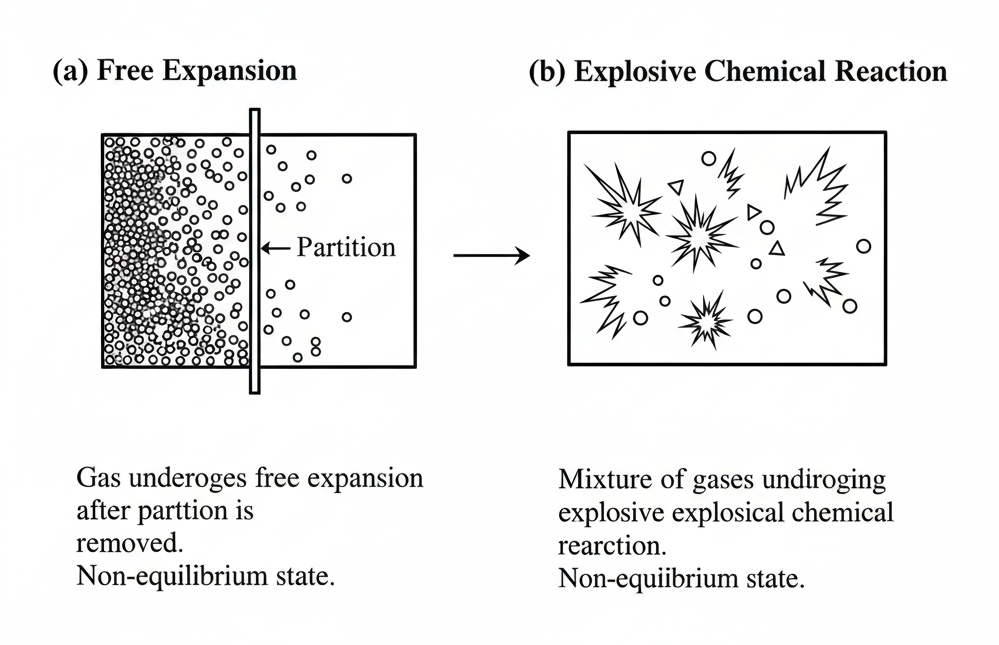
A huge caveat here, my friend. This entire funda applies only to equilibrium states. If the system is undergoing rapid, non-uniform changes, like a gas expanding freely against a vacuum or an explosive chemical reaction, the system passes through non-equilibrium states. In these rapid processes, macroscopic variables like $P$ and $T$ are not uniform throughout the system and, therefore, the state cannot be described by state variables.
NEET Checkpoint:
Can state variables describe a system during a rapid expansion against a vacuum?
(a) Yes, all state variables remain well-defined
(b) No, the system is not in equilibrium
(c) Yes, but only pressure remains constant
(d) Yes, but only temperature remains uniform
✅ Answer: (b)No — Rapid expansion is a non-equilibrium process where pressure and temperature are not uniform, hence they cannot be described by uniform state variables.
Figure below:
A clear diagram showing two boxes. (a) A box with a partition holding gas, and the partition is removed, leading to free expansion. (b) A container showing a mixture of gases undergoing an explosive chemical reaction. Label both as non-equilibrium states.
Practice Question:
Which statement is true regarding the thermodynamic description of a non-equilibrium state?
(a) The internal energy ($U$) is zero.
(b) The equation of state ($P V = \mu R T$) is always applicable.
(c) The pressure ($P$) and temperature ($T$) are generally not uniform throughout.
(d) The process must be quasi-static.
✅ Answer: (c) The pressure ($P$) and temperature ($T$) are generally not uniform throughout. — In non-equilibrium states, such as free expansion, the macroscopic variables are not uniform, meaning state variables cannot be used to describe them. Quasi-static processes, conversely, are idealised slow processes that do remain in equilibrium.
6. Extensive and Intensive Variables
This section is super important for NEET! It's how we classify the properties of a thermodynamic system. Think of it like differentiating between the quantity and the quality of your setup.
When we describe a system in equilibrium, we rely on thermodynamic state variables. These variables fall into two fundamental types: Extensive and Intensive.
Extensive Variables: The 'Size' Indicators
Extensive variables are those properties that literally indicate the 'size' or extent of the system. Here’s the trick (or the "funda," as we call it): Imagine your entire system is in equilibrium, and you divide it exactly into two equal parts. If the value of the variable gets halved in each new part, it’s extensive.
The key extensive variables you need to remember are Internal energy ($U$), Volume ($V$), and total mass ($M$). If you have a large container of gas (say, for a $CNG$ rickshaw), and you could somehow split the gas mass equally into two smaller containers, both the mass ($M$) and the volume ($V$) would be halved in each container. Similarly, the total Internal energy ($U$) of the gas is also halved.
NEET Checkpoint:
If a large flask of water is divided into two equal glasses, what happens to the total mass ($M$) in each glass?
(a) It is doubled
(b) It is halved
(c) It remains the same
(d) It becomes zero
✅ Answer: (b) It is halved — Mass ($M$) is an extensive variable, so its value is proportional to the size of the system and is halved upon division.
Intensive Variables: Independent of Size
Intensive variables are independent of the 'size' of the system. These variables tell you the condition, not the amount! If you divide the system into two equal parts, the values of these variables remain unchanged for each part.
The most important intensive variables are Pressure ($P$), Temperature ($T$), and density ($\rho$). For a relatable Indian example, think about a pot of water boiling vigorously on a stove (at $100^{\circ}C$). If you ladle half of that water into another smaller pot, the temperature ($T$) of the water in both pots is still $100^{\circ}C$. $T$ is intensive, so it doesn't change! Similarly, the density ($\rho$) of the water remains constant.
NEET Checkpoint:
When a system is divided into two, the property that remains the same for both parts is:
(a) Volume ($V$)
(b) Internal Energy ($U$)
(c) Temperature ($T$)
(d) Total Heat Absorbed ($\Delta Q$)
✅ Answer: (c) Temperature ($T$) — Temperature is an intensive variable and remains unchanged regardless of the size division.
And that's cool, right? This classification helps maintain consistency in thermodynamic equations. For example, in the First Law: $\Delta Q = \Delta U + P\Delta V$. Notice that the term $P\Delta V$ is extensive, because it's the product of an intensive variable ($P$) and an extensive quantity ($\Delta V$).
NEET Checkpoint:
The density ($\rho$) of a gas is classified as a:
(a) State variable
(b) Path function
(c) Extensive variable
(d) Intensive variable
✅ Answer: (d) Intensive variable — Density is independent of the total mass or volume; it characterizes the state regardless of size.
Practice Questions:
- Which set contains only intensive variables?
(a) $P$, $V$, $M$
(b) $U$, $T$, $\rho$
(c) $P$, $T$, $\rho$
(d) $P$, $U$, $V$
✅ Answer: (c) $P$, $T$, $\rho$. Pressure ($P$), Temperature ($T$), and density ($\rho$) are all properties that do not change when the system size is altered.
2. When $1~kg$ of Iron is heated from $20^{\circ}C$ to $30^{\circ}C$, its temperature ($T$) increases, and its volume ($V$) increases slightly. Which statement is correct regarding these variables?
(a) Both $T$ and $V$ are extensive.
(b) $T$ is intensive, and $V$ is extensive.
(c) $T$ is extensive, and $V$ is intensive.
(d) Both $T$ and $V$ are intensive.
✅ Answer: (b) $T$ is intensive, and $V$ is extensive. Temperature ($T$) remains unchanged if the $1~kg$ is conceptually split, while Volume ($V$) would be halved.
Key Takeaway: |
|---|
|
Extensive variables ($U$, $V$, $M$) depend on the system's size and are halved if the system is split. Intensive variables ($P$, $T$, $\rho$) are independent of size and remain unchanged if the system is split. State variables (P,V,T,M,U) depend only on the system's current state, not the path taken. The Equation of State (PV=μRT for ideal gases) links them. Non-equilibrium states (like rapid expansion) cannot be described by uniform state variables. |
7. The First Law of Thermodynamics: The Ultimate Energy Funda
The First Law of Thermodynamics is arguably the most fundamental concept in this chapter because it’s simply the general law of conservation of energy applied specifically to systems exchanging heat and work. Don't stress, it just means that energy supplied to a system can't vanish—it has to be conserved, pakka!.
We express this powerful law mathematically as:
Let’s quickly clear up this funda. $\Delta Q$ is the heat supplied to the system by the surroundings. $\Delta W$ is the work done by the system on the surroundings (like a gas pushing outwards). And $\Delta U$ is the resulting change in internal energy of the system. This means that the energy you supply ($\Delta Q$) either goes into boosting the internal energy ($\Delta U$) or doing external work ($\Delta W$).
NEET Checkpoint:
Which principle forms the basis of the First Law of Thermodynamics?
(a) Conservation of Momentum
(b) Conservation of Mass
(c) Conservation of Energy
(d) Conservation of Heat
✅ Answer: (c) Conservation of Energy — The First Law applies the general law of conservation of energy to systems involving heat and work transfer.
Here’s the trick for exams: Internal energy, $U$, is a state variable. This means $\Delta U$ depends only on the initial and final states of the system, not on the path it took to get there. If we rewrite the First Law as $\Delta Q - \Delta W = \Delta U$, we immediately see that the combination $\Delta Q - \Delta W$ must also be path-independent because it equals $\Delta U$. Notice this: $\Delta Q$ and $\Delta W$ individually do depend on the path, but their difference does not!
Imagine you are heating a pani puri stall's stove. The heat supplied ($\Delta Q$) either raises the internal energy ($\Delta U$) of the oil (making it hotter) or the expansion of gas does some work ($\Delta W$) against the environment (if the container wasn't rigid). Even if you reach the final oil temperature through different paths (slow heating vs. quick burst), the net change in internal energy ($\Delta U$) for the final temperature change remains the same.
NEET Checkpoint:
Why is the combination $\Delta Q - \Delta W$ path-independent?
(a) Both $\Delta Q$ and $\Delta W$ are state variables.
(b) $\Delta Q$ is zero in most processes.
(c) The combination equals $\Delta U$, which is a state variable.
(d) It depends on the volume change only.
✅ Answer: (c) The combination equals $\Delta U$, which is a state variable — Since $\Delta Q - \Delta W = \Delta U$, and $\Delta U$ depends only on the state (path-independent), the combination must also be path-independent.
If the system undergoes a special process where $\Delta U=0$ (like the isothermal expansion of an ideal gas), then all the heat supplied is converted entirely into work done by the system. In this case, $\Delta Q = \Delta W$. This is the energy tracking you need to master!
Practice Questions:
1. If an ideal gas is compressed adiabatically, the work done on the gas ($\Delta W < 0$) causes:
(a) $\Delta Q$ to decrease
(b) $\Delta U$ to increase
(c) $T$ to decrease
(d) $\Delta Q$ to become negative
✅ Answer: (b) $\Delta U$ to increase — In an adiabatic process, $\Delta Q=0$. The First Law becomes $0 = \Delta U + \Delta W$, or $\Delta U = -\Delta W$. If work is done on the gas, $\Delta W$ is negative (convention used in sources), making $\Delta U$ positive, thus increasing the internal energy.
Now that you've got this, wait till you see how the laws define special processes like adiabatic, where $\Delta Q=0$.
Key Takeaway:
Formula Summary
The First Law of Thermodynamics is the application of conservation of energy.
Where $\Delta U$ is the change in internal energy (a state variable), $\Delta Q$ is the heat supplied, and $\Delta W$ is the work done by the system. Since $U$ is path-independent, the term $\Delta Q - \Delta W$ is also path-independent.
8. Work Done and Applications of the First Law
The First Law is just the conservation of energy applied to thermodynamic systems. When we supply heat ($\Delta Q$) to a system, it partly increases the internal energy ($\Delta U$) and the rest is used to do work ($\Delta W$) on the environment.
Now, consider a gas pushing a piston in a cylinder. If the gas expands and moves the piston against a constant external pressure $P$, the work done by the system ($\Delta W$) is calculated as the product of pressure and the change in volume ($\Delta V$).
Notice this: Work ($\Delta W$) and heat ($\Delta Q$) are modes of energy transfer, not state variables, but they result in a change in the internal energy ($\Delta U$), which is a state variable.
NEET Checkpoint:
If work is done on the system by the surroundings, what is the sign of $\Delta W$?
(a) Positive
(b) Negative
(c) Zero
✅ Answer: (b) Negative — Arre! Work done by the system is positive ($W>0$), so work done on the system is negative ($W<0$).
Substituting the expression for work done by a gas at constant pressure into the First Law (Eq. 11.1) gives us the crucial equation:
This form is super useful for processes where pressure is constant, like boiling water in an open pan.
Here's the trick: If the process is an isothermal expansion of an ideal gas, the internal energy change ($\Delta U$) is zero ($\Delta U=0$), because the internal energy of an ideal gas depends only on temperature, and temperature is constant.
If $\Delta U = 0$, the equation simplifies dramatically: $\Delta Q = \Delta W$. This means the entire amount of heat supplied ($\Delta Q$) is completely converted into the work done by the system ($\Delta W$). Imagine your tuition fees (heat supplied) being entirely converted into good rank (work done)!
Relatable Indian Example: Think of a balloon vendor filling balloons on a sunny day. If the gas expands isothermally ($\Delta U=0$ by design), the air supplied by the pump (work done on the gas, or $\Delta W$) is exactly balanced by the heat released to keep the temperature constant ($\Delta Q$ released). If it were an ideal gas, the heat supplied (if expanding) would exactly equal the work done.
The Phase Change Power Move
Let's apply this funda to a phase change, like water boiling into steam at atmospheric pressure. This is a classic example where $\Delta Q$ is the latent heat supplied, and the volume change is huge.
For $1~g$ of water changing from liquid to vapour, the heat supplied ($\Delta Q$) is the latent heat, $2256~J$.
Initial volume ($V_L$) is $1~cm^3$, and final volume ($V_V$) is $1671~cm^3$. We use atmospheric pressure $P \approx 1.013 \times 10^5~N/m^2$.
The work done ($\Delta W$) by the water pushing the atmosphere back is calculated first:
Note that $1~cm^3 = 10^{-6}~m^3$. The source calculates $\Delta W \approx 169.2~J$.
Now, we calculate the change in internal energy ($\Delta U$) using the First Law:
Wow! Most of the heat supplied (about $2087~J$ out of $2256~J$) actually goes into increasing the internal energy of the water molecules, separating them further and increasing their kinetic energy, rather than just doing external work.
NEET Checkpoint:
During the change of $1~g$ of water into steam at atmospheric pressure, what accounts for the largest fraction of the supplied latent heat?
(a) External work
(b) Increase in internal energy
(c) Temperature increase
✅ Answer: (b) Increase in internal energy — Around $2087~J$ out of $2256~J$ goes into $\Delta U$. A minimal amount ($169.2~J$) does external work.
NEET Checkpoint:
When an ideal gas undergoes an isothermal expansion, where does the supplied heat go?
(a) To increase pressure
(b) To increase internal energy
(c) To do external work
✅ Answer: (c) To do external work — Since $T$ is constant for an ideal gas, $\Delta U=0$, so $\Delta Q=\Delta W$.
Practice Questions:
-
A gas expands against a constant pressure of $2.0 \times 10^5~Pa$. If its volume changes by $1.0 \times 10^{-3}~m^3$, what is the work done by the gas?
(a) $20~J$
(b) $200~J$
(c) $2000~J$
(d) $0.2~J$✅ Explanation: The work done is $\Delta W = P \Delta V$. $W = (2.0 \times 10^5~Pa) \times (1.0 \times 10^{-3}~m^3) = 200~J$. This uses the formula $\Delta W=P\Delta V$.
-
If $500~J$ of heat is supplied to a system during a process where the change in internal energy is zero, what is the work done by the system?
(a) $0~J$
(b) $500~J$
(c) $-500~J$
(d) Cannot be determined✅ Explanation: Since $\Delta U = 0$, according to the First Law ($\Delta Q = \Delta U + \Delta W$), we have $\Delta Q = \Delta W$. Thus, $\Delta W = 500~J$.
Key Takeaway:
For a gas expanding against constant pressure $P$, the work done is$\Delta W=P\Delta V$. The First Law becomes$\Delta Q=\Delta U+P\Delta V$. If $\Delta U=0$ (like in an isothermal ideal gas expansion), then $\Delta Q=\Delta W$.
9. Specific and Molar Heat Capacities: The Heat Funda!
Let's talk about how much heat a substance can actually handle before its temperature shoots up. This is super important, especially for things like coolants!
We start with the basic idea: Heat capacity ($S$). Think of it as the substance's overall ability to absorb heat. It is defined as the ratio of heat supplied ($\Delta Q$) to the resulting change in temperature ($\Delta T$):
Notice this: Since $S$ is proportional to the mass of the substance, it’s not truly characteristic of the material itself.
To get a constant characteristic that’s independent of the amount, we introduce Specific heat capacity ($s$). This is the heat capacity per unit mass.
Specific heat capacity ($s$) is defined as $s = \frac{S}{m} = (\frac{1}{m})\frac{\Delta Q}{\Delta T}$, where $m$ is the mass. The unit for $s$ is $J~kg^{-1}K^{-1}$. Now, that’s a real funda!
If you want to deal with moles (which we often do in thermodynamics, yaar!), we use Molar specific heat capacity ($C$). This is the heat capacity per mole ($\mu$) of the substance.
Molar specific heat capacity ($C$) is defined as $C = \frac{S}{\mu} = \frac{1}{\mu}\frac{\Delta Q}{\Delta T}$. The unit for $C$ is $J~mol^{-1}K^{-1}$.
Relatable Example: You know why coastal cities like Mumbai have such pleasant climates? The high specific heat capacity of water ($4186~J~kg^{-1}K^{-1}$ in SI units) means the sea absorbs and releases vast amounts of heat slowly, stabilizing the local temperature. Imagine if the Arabian Sea had the low specific heat of sand—Mumbai would feel like the Thar desert every night! Even friction needs a break sometimes!.
NEET Checkpoint:
What is the specific heat capacity ($s$) of water in $J~g^{-1}K^{-1}$?
(a) $4186$
(b) $4.186$
(c) $1$
(d) $418.6$
✅ Answer: (b) $4.186$ — Arre! $4186~J~kg^{-1}K^{-1}$ is the SI unit, which is $4.186~J~g^{-1}K^{-1}$.
For gases, things get tricky because the specific heat capacity depends on the process—like whether volume or pressure is kept constant. That's why we define two special molar specific heats: $C_{p}$ (at constant pressure) and $C_{v}$ (at constant volume).
The trick is the simple relation for an ideal gas: Molar specific heats at constant pressure ($C_{p}$) and constant volume ($C_{v}$) are related by $C_{p}-C_{v}=R$, where $R$ is the universal gas constant. This relation is proved using the First Law of Thermodynamics and the ideal gas equation.
NEET Checkpoint:
The relation $C_{p}-C_{v}=R$ is most accurately applied to:
(a) Real gases
(b) Solids
(c) Ideal gases
(d) Liquids
✅ Answer: (c) Ideal gases — This relation is a simple result derived specifically for an ideal gas.
NEET Checkpoint:
For an ideal gas undergoing a temperature change, which quantity is independent of the path taken?
(a) $\Delta Q$
(b) $\Delta W$
(c) $\Delta U$
(d) $C_{p}$
✅ Answer: (c) $\Delta U$ — Internal energy ($\Delta U$) is a state variable and depends only on the initial and final states, not the path taken.
Practice Question:
If $R$ is the universal gas constant, the difference between the molar specific heat capacity at constant pressure ($C_{p}$) and constant volume ($C_{v}$) for 1 mole of an ideal gas is:
(a) $R/2$
(b) $\gamma$
(c) $R$
(d) $2R$
✅ Answer: (c) $R$ — This is the famous relation $C_{p}-C_{v}=R$ for an ideal gas.
Key Takeaway:
| Term | Definition/Formula | Unit |
|---|---|---|
| Heat Capacity ($S$) |
$$S = \frac{\Delta Q}{\Delta T}$$
|
$J~K^{-1}$ (Implied from formula) |
| Specific Heat ($s$) |
$$s = \frac{1}{m}\frac{\Delta Q}{\Delta T}$$
|
$J~kg^{-1}K^{-1}$ |
| Molar Specific Heat ($C$) |
$$C = \frac{1}{\mu}\frac{\Delta Q}{\Delta T}$$
|
$J~mol^{-1}K^{-1}$ |
| Ideal Gas Relation |
$$\mathbf{C_{p}-C_{v}=R}$$
|
10. The Slow Lane to Success: Quasi-static Processes (Infinitely Slow Funda)
A system is undergoing a thermodynamic process when it changes its state, meaning its variables like pressure ($P$), volume ($V$), and temperature ($T$) shift. Notice this: if these changes happen quickly—say, you suddenly remove a heavy weight from a piston or you have a gas undergoing an explosive chemical reaction—the process is super rapid.
In these quick, non-equilibrium states, the pressure and temperature are actually not uniform throughout the system. You can’t assign a single, well-defined value for $P$ or $T$. Mazza nahi aaya, right? We can't use our standard equations easily here.
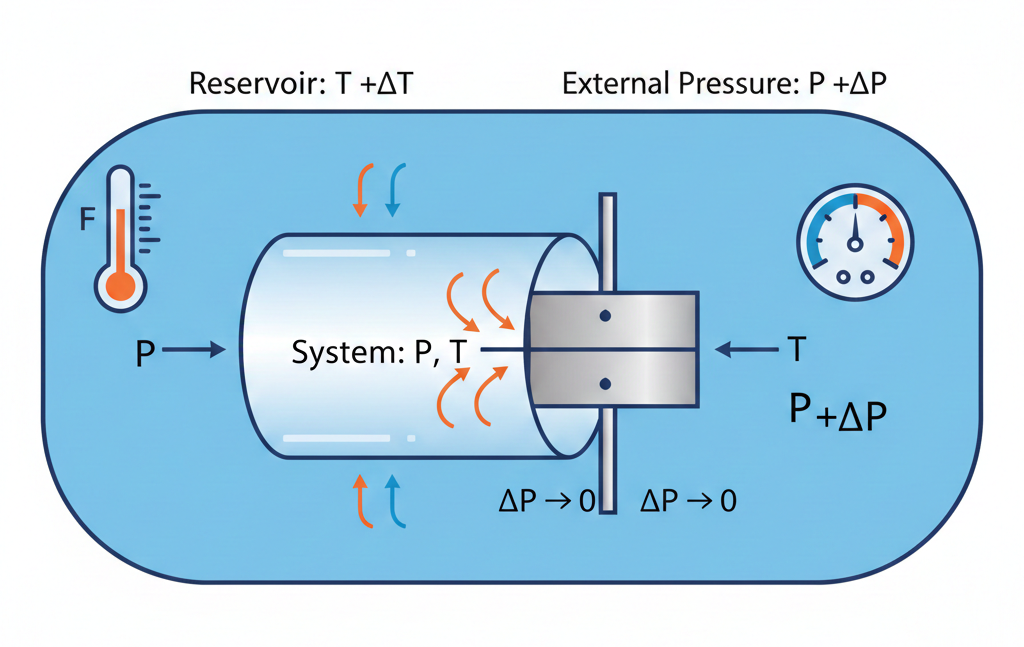
To deal with this jugaad (or rather, to simplify things), physicists invented the quasi-static process. This is an idealized, hypothetical construct that is, in principle, infinitely slow. This slowness ensures that the system always remains in thermal and mechanical equilibrium throughout the entire change.
NEET Checkpoint:
A rapid expansion of gas into a vacuum results in a non-equilibrium state because:
(a) The process is isothermal.
(b) The system’s pressure and temperature are not well-defined.
(c) Work done is always zero.
(d) It violates the First Law of Thermodynamics.
✅ Answer: (b) The system’s pressure and temperature are not well-defined — In rapid, non-equilibrium processes, variables like $P$ and $T$ are non-uniform.
Think of it like this: if you have a gas container and you want to reduce the external pressure quasi-statically, you don't just lift the weight. You reduce the external pressure by an infinitesimally small amount, wait for the system to equalize perfectly, and repeat this infinitely slowly. The key is that the system's internal pressure and temperature only differ infinitesimally from the surroundings at every step. This is the reason why a quasi-static process is often considered a perfect approximation of a reversible process, provided no dissipative effects like friction are present.
Relatable Indian Example: Imagine your favourite roadside pani puri stall. If the seller prepares 10 plates simultaneously in 5 seconds (rapid process), the consistency and quality (the thermodynamic state) of each plate might be non-uniform (non-equilibrium). If, however, they took an hour to prepare one plate, meticulously adjusting the ingredients by infinitesimal amounts to ensure perfect flavour balance at every micro-stage, that would be quasi-static! Of course, no one would wait that long, yaar!
Figure below:
A clear diagram showing a cylinder/piston system where the surrounding reservoir temperature ($T+\Delta T$) and external pressure differ only infinitesimally ($\Delta P$) from the system's internal temperature ($T$) and pressure ($P$).
NEET Checkpoint:
What is the defining characteristic of a quasi-static process regarding system variables?
(a) $P$ and $V$ must remain constant.
(b) The system remains in mechanical equilibrium only.
(c) The system is always in an equilibrium state.
(d) The system is completely insulated.
✅ Answer: (c) The system is always in an equilibrium state — The process is infinitely slow to ensure the system remains in both thermal and mechanical equilibrium at every step.
NEET Checkpoint:
In a quasi-static process, the difference between the system temperature ($T$) and the surrounding temperature ($T_{sur}$) must be:
(a) Equal to the critical temperature.
(b) Infinitesimally small.
(c) Finite but constant.
(d) $\Delta T = 0$ exactly.
✅ Answer: (b) Infinitesimally small — This infinitesimal difference allows energy exchange while maintaining continuous equilibrium.
Practice Question:
A thermodynamic change occurs so slowly that the difference between the system’s pressure and the external pressure is always negligible. Such a process is required to ensure:
A. The total internal energy change ($\Delta U$) is zero.
B. The system passes only through non-equilibrium states.
C. The system is always in equilibrium with its surroundings.
D. The process must be adiabatic.
✅ Answer: C. The system is always in equilibrium with its surroundings. — The infinitely slow nature of a quasi-static process ensures that the system variables are uniform and it remains in thermal and mechanical equilibrium throughout.
Key Takeaway:
A quasi-static process is an idealization where the system changes state ($P, V, T$) infinitely slowly, remaining in thermal and mechanical equilibrium throughout. This means the system's state variables differ only infinitesimally from the surroundings. Rapid changes lead to non-equilibrium states where $P$ and $T$ are undefined.
11. Isothermal Processes
Hey future doctors! Ready to tackle the coolest (literally!) thermodynamic process? We're diving into the Isothermal process. Don't stress, yaar—the name gives away the whole funda!
An isothermal process is defined by the condition that the temperature ($T$) of the system remains constant throughout. This constancy means that the change in temperature, $\Delta T$, is fixed at zero. A classic example is the expansion of a gas inside a metallic cylinder that is placed within a huge reservoir, which maintains a fixed temperature. The reservoir must have a very large heat capacity so that the heat transferred doesn't change its temperature significantly.
For an ideal gas undergoing this steady, quasi-static process, the relation $\mathbf{P V = \text{constant}}$ holds. This is simply the application of Boyle's Law to the fixed mass of the gas at a fixed temperature.
Here's the trick: For an ideal gas, the internal energy ($U$) depends only on its temperature ($T$). Since the temperature is held constant ($\Delta T = 0$), the change in internal energy ($\Delta U$) must be zero. This is the central concept for solving isothermal problems!
NEET Checkpoint:
In an isothermal compression of an ideal gas, what is the value of the change in internal energy ($\Delta U$)?
(a) Positive
(b) Negative
(c) Zero
(d) Depends on pressure change
✅ Answer: (c) Zero — Arre! For an ideal gas, $U$ only cares about $T$. If $T$ is constant, $\Delta U=0$, whether expanding or compressing.
Now, let's bring in the First Law of Thermodynamics, which states $\Delta Q = \Delta U + \Delta W$. Since $\Delta U = 0$ in an isothermal process for an ideal gas, the equation simplifies dramatically:
This means that any heat absorbed ($Q$) by the system is used entirely by the system to perform work ($W$) on the environment, or vice versa.
Relatable Indian Example: Imagine blowing air into a balloon (doing work on the system) while dipping it into a giant water cooler tank (our fixed-temperature reservoir). If you push the air in (compression, $W < 0$), the gas should heat up, but the tank immediately absorbs the released heat ($Q < 0$), keeping $T$ constant and thus $\Delta U=0$.
The work done ($W$) when an ideal gas isothermally changes volume from $V_1$ to $V_2$ is calculated as:
Notice this: In isothermal expansion ($V_2 > V_1$), $W$ is positive, so the gas absorbs heat ($Q > 0$) to do the work. In isothermal compression ($V_2 < V_1$), $W$ is negative (work done on the gas), and the gas releases heat ($Q < 0$).
NEET Checkpoint:
If an ideal gas undergoes isothermal expansion, what is the relationship between heat ($Q$) and work ($W$)?
(a) $Q > W$
(b) $Q < W$
(c) $Q = W$
(d) $Q = -W$
✅ Answer: (c) $Q = W$ — Since $\Delta U=0$ for an ideal gas isothermally, the heat supplied equals the work done by the gas ($\Delta Q = \Delta W$).
NEET Checkpoint:
An isothermal process can be an approximation of a reversible process only if which condition is met?
(a) Pressure remains constant.
(b) The process is quasi-static.
(c) The process is adiabatic.
(d) The gas is monatomic.
✅ Answer: (b) The process is quasi-static — A reversible process requires the process to be quasi-static (infinitely slow) and non-dissipative.
Practice Questions:
During an isothermal process involving an ideal gas, $400~J$ of heat is supplied to the system. What is the work done by the system?
(a) $0~J$
(b) $200~J$
(c) $400~J$
(d) $-400~J$
✅ Answer: (c) $400~J$ — Since $\Delta U=0$ in an isothermal process for an ideal gas, the First Law gives $\Delta Q = \Delta W$. If $\Delta Q = 400~J$, then $\Delta W = 400~J$.
Key Takeaway:
| Property | Condition | Ideal Gas Result |
|---|---|---|
| Fixed Variable | $T = \text{constant}$ | $\Delta T = 0$ |
| Gas Law | Boyle's Law | $\mathbf{P V = \text{constant}}$ |
| Internal Energy | Change is zero | $\mathbf{\Delta U = 0}$ |
| First Law | Heat equals work | $\mathbf{\Delta Q = \Delta W}$ |
12. Adiabatic Processes
Hey champs! Let's tackle the adiabatic process, which is super crucial for NEET prep. This process is the exact opposite of isothermal—it’s all about speed and isolation!
The core funda here is simple: An adiabatic process involves no heat flow between the system and the surroundings. Think of the system as being perfectly insulated, like putting your gas cylinder inside a super-premium thermos flask. Mathematically, this means:
Now, why does this matter? If we look at the First Law of Thermodynamics, $\Delta Q = \Delta U + \Delta W$. Since $\Delta Q = 0$, the equation simplifies to $\Delta U = -\Delta W$. This is the trick: any work done must come directly from the internal energy of the gas.
If the gas expands quickly and does work ($\Delta W > 0$), the internal energy ($\Delta U$) must decrease, causing the gas temperature to drop. Conversely, if work is done on the gas ($\Delta W < 0$), the temperature rises.
Relatable Indian Example: Have you ever rapidly pumped up a tyre for your scooter or bicycle? The pump handle and the valve area get hot immediately! That rapid compression is an almost adiabatic process. The work done on the gas ($\Delta W$ is negative) has no time to escape as heat, so it increases the air's internal energy, making the temperature rise ($T_2 > T_1$). Don't stress, yaar—it’s easier than it looks!
For an ideal gas undergoing an adiabatic change, the key relationship connecting pressure and volume is:
Here, $\gamma$ (gamma) is the ratio of the molar specific heats at constant pressure and constant volume, $\gamma = \frac{C_{p}}{C_{v}}$.
NEET Checkpoint:
During a rapid adiabatic expansion of a gas, its internal energy:
(a) Increases
(b) Stays constant
(c) Decreases
(d) Becomes zero
✅ Answer: (c) Decreases — Work is done by the gas ($W>0$), so $\Delta U = - \Delta W$, meaning $\Delta U$ decreases.
The work done by an ideal gas during an adiabatic change from state $T_{1}$ to $T_{2}$ is given by:
Where $\mu$ is the number of moles and $R$ is the universal gas constant.
NEET Checkpoint:
Which process uses the relation $P V^{\gamma} = \text{constant}$?
(a) Isothermal
(b) Isobaric
(c) Isochoric
(d) Adiabatic
✅ Answer: (d) Adiabatic — This specific power law relation holds true only for ideal gases undergoing adiabatic changes.
NEET Checkpoint:
In an adiabatic process, if the gas is compressed, what happens to its final temperature $T_{2}$ compared to $T_{1}$?
(a) $T_{2} < T_{1}$
(b) $T_{2} = T_{1}$
(c) $T_{2} > T_{1}$
(d) Cannot be determined
✅ Answer: (c) $T_{2} > T_{1}$ — Compression means work is done on the gas ($W<0$), which increases the internal energy and thus the temperature.
Practice Question:
If an ideal gas expands adiabatically from an initial state $(P_{1}, V_{1}, T_{1})$ to a final state $(P_{2}, V_{2}, T_{2})$, which statement is correct according to the First Law?
(a) $Q = W$
(b) $\Delta U = \Delta W$
(c) $W = -\Delta U$
(d) $\Delta U = 0$
✅ Answer: (c) $W = -\Delta U$ — Since $\Delta Q=0$, the First Law $\Delta Q = \Delta U + \Delta W$ simplifies to $0 = \Delta U + \Delta W$, or $W = -\Delta U$.
Key Takeaway:
| Concept | Relation | Details |
|---|---|---|
| Heat Flow |
$$\Delta Q = 0$$
|
System is perfectly insulated. |
| First Law |
$$\Delta U = -\Delta W$$
|
Work done changes internal energy. |
| Adiabatic Relation |
$$P V^{\gamma} = \text{constant}$$
|
$\gamma = C_{p}/C_{v}$. |
| Work Done |
$$W=\frac{\mu R(T_{1}-T_{2})}{\gamma-1}$$
|
Work depends only on temperature change. |
13. Isobaric, Isochoric, and Cyclic Processes
Alright, NEET aspirants! Let’s break down these three very important thermodynamic processes. Don't stress, yaar—if you know the First Law, $\Delta Q = \Delta U + \Delta W$, these are basically cheat codes!
The Isochoric Fundo (Volume Constant)
First up is the Isochoric process, where the volume ($V$) is kept constant. Notice this: if the volume doesn't change, the gas cannot push the piston or be compressed, right? This means the change in volume ($\Delta V$) is zero. Since work done is given by $W = P\Delta V$, the work done ($\Delta W$) is also zero.
And that's cool, right? Because the First Law simplifies beautifully! If you supply heat ($\Delta Q$) to the system, where does it go? Entirely to change the internal energy ($\Delta U$) of the gas and raise its temperature.
Relatable Indian Example: Think of heating chhole in a pressure cooker (before the whistle blows!). The volume is fixed. All the heat from the chulha (stove) just increases the internal energy (and temperature and pressure!) of the steam inside.
NEET Checkpoint:
During an isochoric process of an ideal gas, which quantity is zero?
(a) $\Delta Q$
(b) $\Delta U$
(c) $\Delta W$
(d) $\Delta T$.
✅ Answer: (c) $\Delta W$ — Since volume ($V$) is constant, $\Delta V = 0$, so work done ($\Delta W$) is zero.
Isobaric Process (Pressure Constant)
Next is the Isobaric process, where the pressure ($P$) is fixed. This is the most common process in our daily lives, like when a system is open to the atmosphere! Since $P$ is fixed but $V$ changes, work is done. The work done by the gas is given by:
Here, the heat absorbed ($\Delta Q$) goes partly to increase the internal energy ($\Delta U$) and partly to do work ($W$).
Relatable Indian Example: Imagine an auto-rickshaw tyre slowly expanding on a hot day. The pressure inside might change slightly, but let's assume it stays fixed against the atmospheric pressure while it expands slightly, doing work on the surroundings. The heat absorbed increases both $W$ and $\Delta U$.
The Cyclic Path ($\Delta U$ is Zero, Boss!)
Finally, the Cyclic process is one where the system returns exactly to its initial state. Now, why does this matter? Remember that internal energy ($U$) is a state variable. A state variable's value depends only on the current state, not on the path taken.
Since the initial and final states are identical in a cyclic process, the change in internal energy ($\Delta U$) must be zero.
The First Law then tells us that the total heat absorbed ($\Delta Q$) must equal the total work done ($W$) by the system over the entire cycle.
This is the trick to remember!
NEET Checkpoint:
If a system completes a cyclic process and $100\text{ J}$ of heat is supplied, what is the net work done by the system?
(a) $0\text{ J}$
(b) $50\text{ J}$
(c) $100\text{ J}$
(d) $200\text{ J}$.
✅ Answer: (c) $100\text{ J}$ — For a cyclic process, $\Delta U = 0$, so $\Delta Q = W$.
NEET Checkpoint:
Internal energy ($U$) is a:
(a) Path function
(b) Intensive variable
(c) State variable
(d) Work function.
✅ Answer: (c) State variable — The internal energy ($U$) depends only on the state of the system, not the path taken to achieve it.
Practice Question:
A gas undergoes a process where its volume remains constant at $2.0 \text{ m}^3$ while its pressure increases from $100 \text{ N/m}^2$ to $300 \text{ N/m}^2$. The work done by the gas during this process is:
(a) $200\text{ J}$
(b) $400\text{ J}$
(c) $0\text{ J}$
(d) Cannot be determined.
✅ Answer: (c) $0\text{ J}$ — The volume ($V$) is constant, making this an isochoric process. In an isochoric process, $\Delta V = 0$, so the work done $\Delta W = 0$.
Key Takeaway:
The Process Fundas
Process Constant Variable Condition First Law Implication Isochoric Volume ($V$) $\Delta W = 0$ $\Delta Q = \Delta U$ Isobaric Pressure ($P$) $W = P(V_2 - V_1)$ $\Delta Q = \Delta U + W$ Cyclic State Variables ($P, V, T$) return to initial $\Delta U = 0$ $\Delta Q = W$
14. The Second Law of Thermodynamics
The First Law of Thermodynamics is super important—it tells us energy is conserved ($\Delta Q = \Delta U + \Delta W$). But if energy conservation was the only rule, we’d see some seriously weird stuff! For instance, a book lying on a table could spontaneously cool the table (converting internal energy) and hop into the air!. Since that never happens, clearly, some additional, basic principle of nature is needed to stop these processes.
This ultimate gatekeeper is the Second Law of Thermodynamics. It provides a fundamental restriction, forbidding processes that conserve energy but are never observed. Bade aaram se (very easily), the Second Law tells us that a perfectly efficient world is just a dream, placing a fundamental limitation on the efficiency ($\eta$) of a heat engine.
Let's clear up the two major fundas (basics) of the Second Law:
-
Kelvin-Planck Statement: This statement defines the limits of energy conversion in an engine. It dictates: No process is possible whose sole result is the absorption of heat from a reservoir and the complete conversion of the heat into work. This implies that the efficiency ($\eta$) of any heat engine can never be unity ($100\%$).
Relatable Indian Example: Think about your scooter engine on a hot day. Even if it’s running perfectly, you can feel waste heat coming off the engine casing. That wasted heat is exactly why $\eta < 1$, as required by Kelvin-Planck.
-
Clausius Statement: This defines the required direction of spontaneous heat flow. It says: No process is possible whose sole result is the transfer of heat from a colder object to a hotter object. Heat flows naturally from hot to cold. To make heat jump from a cold object to a hotter one (like your refrigerator does), you must supply external work.
Notice this: The sources state that the Kelvin-Planck and Clausius statements are completely equivalent.
NEET Checkpoint:
The Second Law implies that a perfect heat engine must have an efficiency ($\eta$) equal to:
(a) $0$
(b) $1$
(c) $\eta < 1$
(d) $\eta = \infty$
✅ Answer: (c) $\eta < 1$ — The law explicitly states that efficiency can never be unity.
NEET Checkpoint:
Which statement primarily explains why heat spontaneously flows from a hot tava (griddle) to the cold air, and not the reverse?
(a) First Law
(b) Zeroth Law
(c) Kelvin-Planck
(d) Clausius
✅ Answer: (d) Clausius — It forbids the spontaneous transfer of heat from a colder object (air) to a hotter object (tava) as a sole result.
NEET Checkpoint:
Processes that satisfy the First Law but are prohibited by the Second Law often involve the concept of:
(a) Energy creation
(b) Complete conversion of heat to work
(c) Volume change
(d) Constant pressure
✅ Answer: (b) Complete conversion of heat to work — The Second Law (Kelvin-Planck) specifically forbids the complete conversion of heat absorbed from a reservoir into work.
Practice Question:
A hypothetical engine absorbs $200~J$ of heat from a hot reservoir and performs $200~J$ of work on the surroundings in a cyclic process. Which law of thermodynamics is violated?
(a) Zeroth Law
(b) First Law
(c) Second Law (Kelvin-Planck)
(d) Second Law (Clausius)
✅ Answer: (c) Second Law (Kelvin-Planck) — The engine's sole result is the complete conversion of absorbed heat into work ($\eta=100\%$), which is forbidden by the Kelvin-Planck statement.
Key Takeaway:
The Second Law provides the fundamental limits on thermal processes: No engine can be $100\%$ efficient ($\eta=1$) (Kelvin-Planck), and heat cannot spontaneously flow from cold to hot (Clausius).
15. Reversible/Irreversible Processes and the Carnot Engine: The Ideal Limit
This funda of reversibility seems complex, but it's really about ideal versus real life. We define a process as reversible if, once completed, it can be perfectly reversed so that both the system and the surroundings return to their original states with no other change anywhere else in the universe. Think of it as hitting the perfect rewind button—it's an idealised notion. For a process to be reversible, it must be quasi-static and have no dissipative effects like friction or viscosity.
Now, why is life irreversible? Because, in reality, irreversibility is the rule! It happens mainly for two reasons: one, when the system passes through non-equilibrium states (like a gas doing a sudden free expansion into a vacuum), and two, because dissipative effects—like friction when a tyre rubs against the road, or viscosity in fluids—are always present and convert useful mechanical energy into heat. Even diffusion of cooking gas that has leaked cannot spontaneously reverse and go back into the cylinder; that's irreversibility in action.
NEET Checkpoint:
Which thermodynamic process is generally considered irreversible?
(a) Isothermal expansion
(b) Quasi-static process
(c) Free expansion of gas
(d) Adiabatic compression
✅ Answer: (c) Free expansion of gas — Arre! Free expansion takes the system to non-equilibrium states, which is a major cause of irreversibility.
The Funda of the Carnot Engine
We talk about reversibility because an idealised reversible engine achieves the highest efficiency possible. This theoretical champion is the Carnot engine. It is a reversible engine that operates between just two temperature reservoirs: a hot reservoir (source) at temperature $T_{1}$ and a cold reservoir (sink) at temperature $T_{2}$.
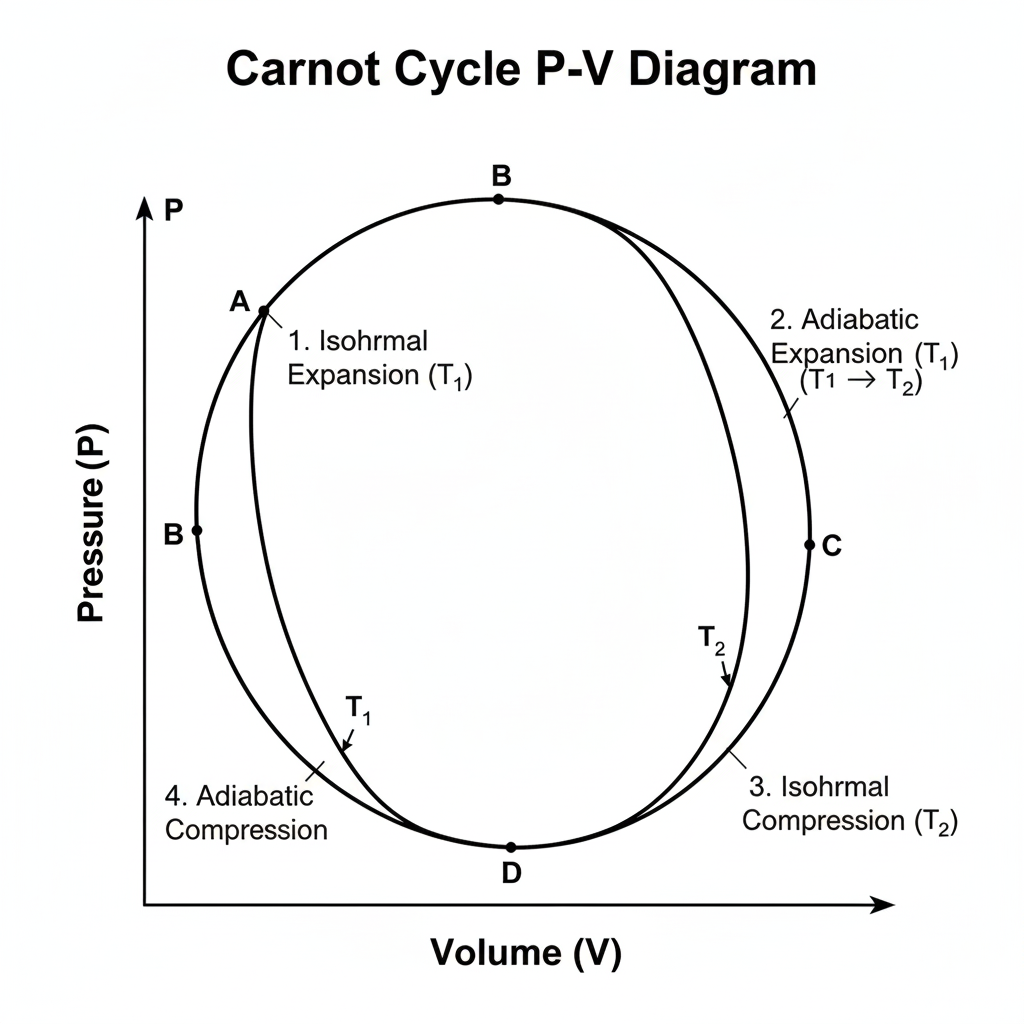
The sequence of steps that the Carnot engine follows is called the Carnot cycle. It's super simple: it consists of two isothermal processes connected by two adiabatic processes.
Figure below:
A clear diagram showing the P-V curve for the Carnot cycle, which includes an initial isothermal expansion ($T_1$), followed by an adiabatic expansion ($T_1 \rightarrow T_2$), an isothermal compression ($T_2$), and a final adiabatic compression ($T_2 \rightarrow T_1$).
NEET Checkpoint:
If heat $Q_{1}$ is absorbed by the Carnot engine, at which point in the cycle does this absorption occur?
(a) Adiabatic expansion
(b) Isothermal compression
(c) Isothermal expansion
(d) Adiabatic compression
✅ Answer: (c) Isothermal expansion — Heat $Q_{1}$ is absorbed isothermally from the hot reservoir at temperature $T_{1}$ during the expansion step.
The total work done by the gas in one complete cycle ($W$) determines its efficiency ($\eta$). This maximum possible efficiency for any engine working between these two temperatures is given by:
Notice this: for $\eta$ to be 1 (or 100%), $T_{2}$ must be zero (which is impossible). That’s the Second Law putting a limit on us! This formula is incredibly important because the maximum efficiency is independent of the nature of the working substance.
NEET Checkpoint:
If a Carnot engine rejects half the heat absorbed, what is its efficiency?
(a) $0.25$
(b) $0.5$
(c) $0.75$
(d) $1.0$
✅ Answer: (b) $0.5$ — Efficiency $\eta = 1 - \frac{Q_{2}}{Q_{1}}$. If heat released ($Q_{2}$) is half the heat absorbed ($Q_{1}$), then $\eta = 1 - 0.5 = 0.5$.
If you ever see a question asking for maximum efficiency between two temperatures, this is your go-to formula. Now that we've covered the ideal process, let's peek at how these laws link to the concept of disorder!
Key Takeaway:
Reversibility is an ideal, quasi-static process with no dissipative effects. Irreversibility (the real world!) arises from non-equilibrium states and friction/viscosity. The maximum efficiency of a Carnot engine (a reversible engine operating between $T_{1}$ and $T_{2}$) is:
$$\eta=1-\frac{T_{2}}{T_{1}}$$