
1. Introduction: Systems of Particles and Rigid Body Motion
Remember those earlier chapters where we treated everything like a simple point mass? That idealised model, called a particle, represents a mass with absolutely no size. But let’s be real, any object you see daily—from a pen to a planet—is an extended body with finite dimensions. For these real bodies, the particle model is often totally inadequate. We need to start treating them as a system of particles.
The best model for many problems is the rigid body. What's the basic funda here? A rigid body has a perfectly definite and unchanging shape. This means the distance between any pair of particles within the body must remain constant, even when forces are applied. Don't stress, while no real body is truly rigid (everything bends a little!), we treat things like steel beams, wheels, or molecules as rigid bodies for simplicity.
The motion of a rigid body generally falls into three types:
- Pure Translational Motion: This is simple! Imagine a fully loaded rickshaw moving straight on a flat road. If the body is in pure translation, all its particles have the same velocity at any given instant. The orientation of the body remains unchanged, meaning it doesn't spin or tilt.
NEET Checkpoint:
A rectangular block slides down an incline without rotation. If a point $P_1$ has velocity $v$, what is the velocity of point $P_2$?
(a) $2v$
(b) $0$
(c) $v$
(d) Varies with time.
✅ Answer: (c) $v$ — In pure translational motion, all particles share the same instantaneous velocity.
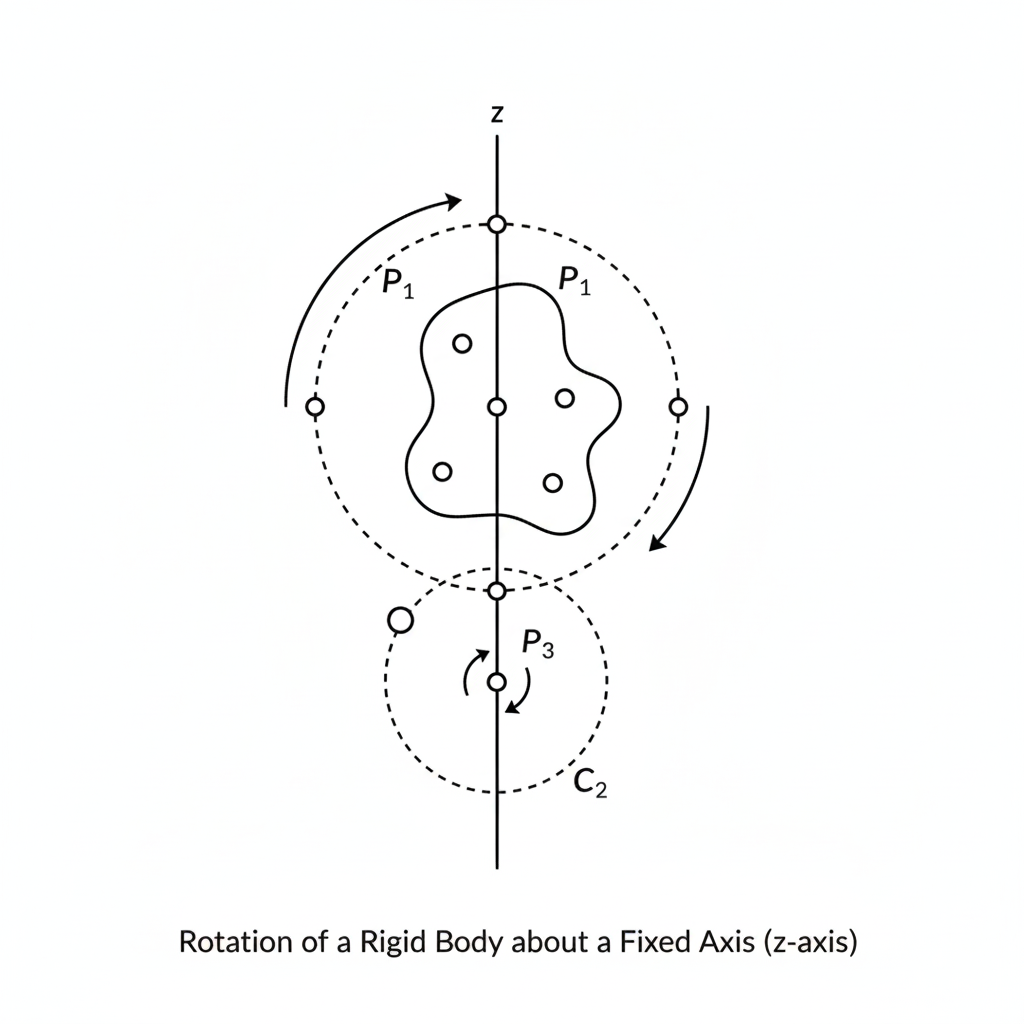
2. Pure Rotational Motion: This happens when a body is fixed along a straight line, known as the axis of rotation. Think of a ceiling fan. Every particle moves in a circle, and the plane of that circle is perpendicular to the axis of rotation. Notice this: Any particle that happens to be located precisely on the fixed axis (where its perpendicular distance $r$ is $0$) remains stationary.
3. Combined Motion: This is where things get interesting! It’s a mix of translation plus rotation. A perfect example is a scooter wheel rolling along the road. It moves forward (translation) while spinning (rotation). In this case, the particles do not all have the same velocity at every instant.
Figure below:
A rigid body rotating about the z-axis. The diagram should clearly show particles $P_1$ and $P_2$ moving in circles $C_1$ and $C_2$ respectively, with centres on the fixed axis, and a particle $P_3$ on the axis remaining stationary.
NEET Checkpoint:
For pure rotational motion about a fixed axis, where are the centres of the circular paths described by the particles located?
(a) At the origin
(b) On the axis of rotation
(c) In different planes
(d) Perpendicular to the axis.
✅ Answer: (b) On the axis of rotation — Each particle describes a circle with its centre located exactly on the axis.
NEET Checkpoint:
If a body is undergoing pure translation, what remains constant across all particles at any instant?
(a) Force
(b) Acceleration
(c) Velocity
(d) Position vector.
✅ Answer: (c) Velocity — In pure translational motion, all particles have the same velocity.
Practice Questions:
-
Which motion best describes a solid cylinder rolling without slipping down a slope?
(a) Pure translation, zero angular acceleration
(b) Pure rotation about a fixed point
(c) A combination of translation and rotation
(d) Pure rotation about a moving axis✅ Answer: (c) A combination of translation and rotation — Rolling involves linear motion down the slope (translation) combined with spinning (rotation).
-
If we treat a large, spinning top as a rigid body, and its tip (point of contact) is fixed, is its axis of rotation fixed?
(a) Yes, the axis is fixed.
(b) No, the axis is not fixed but passes through the fixed point.
(c) Yes, but only if there is no precession.
(d) No, because the body must also translate.✅ Answer: (b) No, the axis is not fixed but passes through the fixed point — In general cases like a spinning top, one point is fixed, but the axis itself may move (precession) through that point.
Key Takeway:
A rigid body has unchanging particle separation. Motion is classified as Pure Translation (all particles have same velocity $v$) or Rotation (particles move in circles perpendicular to the axis) or a Combination of both (like rolling motion).
2. Centre of Mass of Particle Systems
Let’s clear up the funda of the Centre of Mass (CM). Don’t stress, yaar—it’s easier than it looks! The CM is the specific point where, for the purpose of analyzing translational motion, we can imagine the entire mass of the system is concentrated.
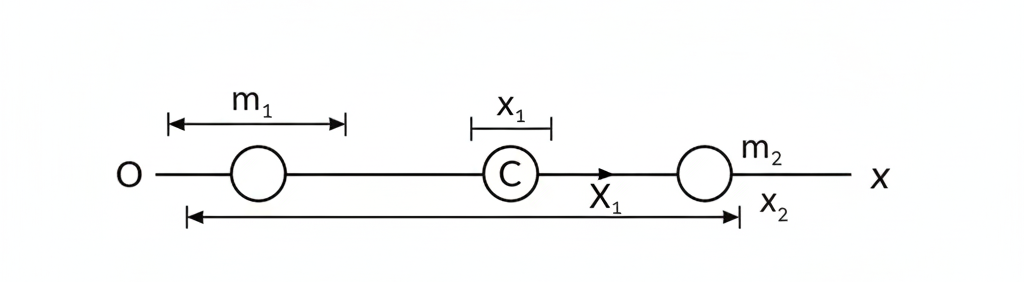
We start with the simplest case: a two-particle system of masses $m_{1}$ and $m_{2}$ placed along the $x$-axis at positions $x_{1}$ and $x_{2}$ respectively. The position of the CM, $X$, is defined as the mass-weighted mean of their distances from the origin $O$. This is a super important formula, so lock it in:
Notice this trick: If the two particles have equal mass ($m_{1}=m_{2}$), the CM lies exactly midway between them, calculated simply as $X=\frac{x_{1}+x_{2}}{2}$.
Relatable Example: Imagine two friends riding a scooter. If they have equal weight (mass), the CM of the system is right in the middle. But if one friend carrying a heavy dabba (lunchbox) is much heavier, the CM shifts closer to that friend—the CM always gravitates toward the greater mass!
NEET Checkpoint 1:
For a two-particle system, the CM is defined as the:
(a) Geometric mean
(b) Simple mean
(c) Mass-weighted mean
(d) Centre of gravity
✅ Answer: (c) Mass-weighted mean — $X$ is the mass-weighted mean of $x_1$ and $x_2$.
We can generalize this definition for a system of $n$ particles distributed in space. If $r_{i}$ is the position vector of the $i^{th}$ particle (mass $m_{i}$), and $M$ is the total mass ($\sum m_{i}$), the position vector of the CM, $R$, is given by:
This single vector equation is really economical, covering the $X, Y,$ and $Z$ coordinates simultaneously. Now, here's a crucial CM property: If you choose the origin of your coordinate system to be the Centre of Mass itself, then the sum of the mass-position products is zero: $\sum m_{i}r_{i}=0$. This property is often useful in solving tricky numerical problems quickly!
Figure below:
A clear diagram showing a two-particle system (masses $m_1$ and $m_2$) along the x-axis, located at $x_1$ and $x_2$ from the origin O, with the Centre of Mass $C$ located at $X$.
NEET Checkpoint 2:
If two particles of equal mass are along the $x$-axis, where is their CM located?
(a) At the position of the first particle
(b)At the position of the second particle
(c)Exactly midway between the two particles
(d)At the origin, irrespective of their positions
✅ Answer: (c)Exactly midway between them — The CM formula simplifies to a simple average of positions when masses are equal.
Practice Question:
The position vector of the CM of a system of particles is $R$. If the total mass of the system is $M$, what does the product $M R$ represent?
(a) Total linear momentum
(b) Total kinetic energy
(c) Sum of individual mass moments
(d) Total force
✅ Answer: (c) Sum of individual mass moments — Rearranging $R=\frac{\sum m_{i}r_{i}}{M}$ gives $M R = \sum m_{i}r_{i}$.
NEET Checkpoint 3:
What happens to the vector sum $\sum m_{i}r_{i}$ if the origin is shifted to coincide with the CM?
(a)It becomes zero
(b)It becomes equal to total mass
(c)It becomes twice the total mass
(d)It becomes undefined
✅ Answer: It becomes zero — If the position vector $R$ of the CM is zero (at the origin), the sum $\sum m_{i}r_{i}$ must also be zero.
Now that you’ve got this fundamental CM funda, wait till you see how it connects with the motion of the entire system in the next section!
Key Takeaway: Formula Summary
| System | CM Position ($X$) | CM Position (Vector Form) |
|---|---|---|
| Two Particles (1D) |
$$X=\frac{m_{1}x_{1}+m_{2}x_{2}}{m_{1}+m_{2}}$$
|
N/A |
| N Particles (3D) |
$$X=\frac{\sum m_{i}x_{i}}{M}, Y=\frac{\sum m_{i}y_{i}}{M}, Z=\frac{\sum m_{i}z_{i}}{M}$$
|
$$R=\frac{\sum m_{i}r_{i}}{M}$$
|
If the origin is the CM, then $\sum m_{i}r_{i}=0$.
3. Centre of Mass of Continuous Rigid Bodies
We've aced finding the CM for a handful of discrete particles. But what happens when we look at a rigid body—like a metre stick or a flywheel? It's a system where the particles (atoms or molecules) are closely packed, and the number is astronomically large.
Since the particle spacing is tiny, we treat the body as a continuous distribution of mass. This is where calculus becomes our best friend. The trusty summation ($\sum$) we used for discrete systems gets replaced by an integral ($\int$) over the mass distribution ($dm$).
The total mass of the system, $M$, becomes:
The Integration Funda
The coordinates of the Centre of Mass ($X$, $Y$, $Z$) for a continuous body are calculated by integrating the position of each tiny mass element ($dm$):
This means we’re finding the mass-weighted average position using integration instead of simple summation.
NEET Checkpoint:
If the CM is chosen as the origin of the coordinate system, what is the value of $\int r~dm$?
(a) $M$
(b) $R$
(c) $0$
(d) Cannot be determined.
✅ Answer: (c) $0$ — If $R=0$ (meaning the CM is the origin), then $R=\frac{1}{M}\int r~dm$ implies $\int r~dm=0$.
The Symmetry Shortcut
Notice this awesome shortcut! When dealing with homogeneous bodies of regular shapes, like thin rods, rings, discs, or spheres, calculating the integral is often unnecessary. Due to reflection symmetry, the CM coincides with their geometric centre.
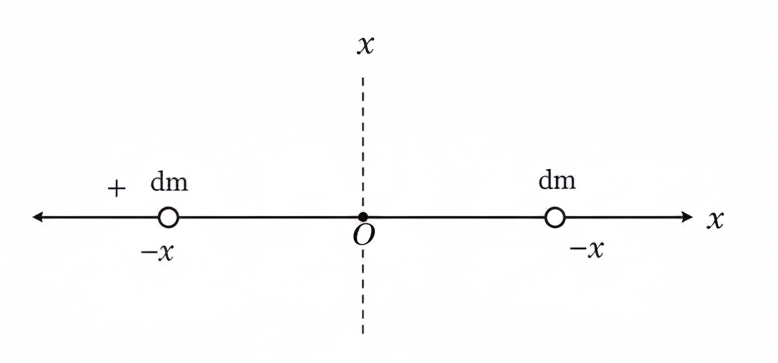
Phew, even physicists need shortcuts! If you take a uniform steel rod, for every mass element dm at a distance $x$ from the centre, there is another dm at $-x$. Their contributions cancel out, making ∫x dm=0.
Relatable Indian Example: Imagine a perfectly uniform, standard Tiffin box (rectangular lamina). Since it's homogeneous and regular, you know instantly that its CM is dead in the middle, right where the diagonals cross—no need for complex integration! In contrast, consider a loaded cricket bat; its CM is closer to the heavier, thicker end, meaning you cannot rely on geometric symmetry alone.
Figure below:
A clear diagram showing a thin rod along the $x$-axis with the origin at the geometric centre. Show two small mass elements $dm$ located symmetrically at $x$ and $-x$, demonstrating how reflection symmetry causes their contributions to cancel out.
The overall position vector for the continuous rigid body’s CM is given by:
NEET Checkpoint:
The CM of a homogeneous ring coincides with its:
(a) Edge
(b) Total mass
(c) Geometric centre
(d) Point where external force acts.
✅ Answer: (c) Geometric centre — This is a direct result of reflection symmetry for regular, homogeneous bodies.
NEET Checkpoint:
For calculating the CM of a continuous rigid body, $\int dm$ represents:
(a) Density
(b) Total mass ($M$)
(c) Linear momentum
(d) Moment of inertia.
✅ Answer: (b) Total mass ($M$) — The sum of all small mass elements $\Delta m_i$ yields the total mass of the body $M$.
Practice Question:
For a rigid body that is considered a continuous distribution of mass, which set of expressions correctly gives the CM coordinates?
(a) $X=\sum m_i x_i / M$, $Y=\sum m_i y_i / M$, $Z=\sum m_i z_i / M$
(b) $X=M\int x~dm$, $Y=M\int y~dm$, $Z=M\int z~dm$
(c) $X=\frac{1}{M}\int x~dm$, $Y=\frac{1}{M}\int y~dm$, $Z=\frac{1}{M}\int z~dm$
(d) $X=\int \frac{x}{m}~dm$, $Y=\int \frac{y}{m}~dm$, $Z=\int \frac{z}{m}~dm$
Explanation: The coordinates of the centre of mass require dividing the integrated mass moment ($\int x~dm$) by the total mass ($M$). Thus, (c) is correct.
Key Takeaway:
| Concept | Continuous Body CM Formulae | Symmetry Rule |
|---|---|---|
| Scalar Coordinates |
$$X=\frac{1}{M}\int x~dm$$
|
CM of homogeneous, regular shapes (like rods or spheres) is at the geometric centre. |
| Vector Position |
$$R=\frac{1}{M}\int r~dm$$
|
This eliminates complex integration in simple cases! |
4. Motion and Dynamics of the Centre of Mass
Don't stress, yaar, this funda is super important and actually makes complex system motion much simpler! Once you've defined the position vector $\mathbf{R}$ for the Centre of Mass ($\mathbf{CM}$), understanding its motion is just a matter of calculus.
We start by differentiating the $\mathbf{CM}$ position equation ($M\mathbf{R} = \sum m_i \mathbf{r}_i$) with respect to time, assuming masses are constant. This immediately gives us the velocity of the Centre of Mass ($\mathbf{V}$):
The total mass ($M$) times the velocity of the $\mathbf{CM}$ ($\mathbf{V}$) is equal to the vector sum of the linear momenta of all individual particles. If we differentiate this again, we get the acceleration of the Centre of Mass ($\mathbf{A}$):
NEET Checkpoint:
The velocity $\mathbf{V}$ of the $\mathbf{CM}$ is related to the individual velocities $\mathbf{v}_i$ by $M\mathbf{V} = \sum m_i \mathbf{v}_i$. This relationship is analogous to the total:
(a) Kinetic Energy
(b) Linear Momentum
(c) Angular Momentum
(d) Torque
✅ Answer: (b) Linear Momentum — The term $\sum m_i \mathbf{v}_i$ is the total linear momentum $\mathbf{P}$ of the system, so $\mathbf{P} = M\mathbf{V}$.
Now, for the dynamics part. Since $m_i \mathbf{a}_i$ is simply the force $\mathbf{F}_i$ acting on the $i^{th}$ particle (Newton's Second Law), the total mass times $\mathbf{A}$ equals the vector sum of all forces acting on the system. Here’s the trick: The internal forces within the system—the forces the particles exert on each other—cancel out due to Newton’s third law. So, internal forces contribute nothing to the acceleration of the $\mathbf{CM}$. Even friction needs a break sometimes!
This means the actual dynamic equation simplifies beautifully, depending only on the sum of all external forces ($\mathbf{F}_{ext}$):
The ultimate takeaway? The $\mathbf{CM}$ moves exactly as if all the mass of the extended body was concentrated at that single point, and all external forces were applied right there. This is true even if the body is rotating or if the particles are flying around internally.
For example, when a cricket ball, moving in a perfect parabolic arc, suddenly bursts into two pieces due to a flaw, the pieces scatter wildly. But the overall Centre of Mass of those pieces will continue to follow the exact same parabolic path, because the explosion forces are internal, and gravity is the only external force acting.
NEET Checkpoint:
To determine the motion of the CM, knowledge of which forces is required?
(a) Internal forces
(b) Gravitational forces
(c) External forces
(d) Both internal and external forces
✅ Answer: (c) External forces — We only need $\mathbf{F}_{ext}$ to find the motion of the CM, as internal forces cancel out.
Practice Question:
If a system of particles has a net external force $\mathbf{F}_{ext} = 0$, its Centre of Mass will:
(a) Remain stationary.
(b) Move with uniform velocity.
(c) Accelerate in the $x$-direction.
(d) Undergo zero displacement.
✅ Answer: (b) Move with uniform velocity. — If $\mathbf{F}_{ext}=0$, then $M\mathbf{A}=0$. This means the acceleration is zero, so the velocity $\mathbf{V}$ must be constant (uniform motion in a straight line), although $\mathbf{V}$ itself might be non-zero.
NEET Checkpoint:
The concept that the $\mathbf{CM}$ moves as if all external forces are applied there is useful for determining the translational component of motion for:
(a) Only rigid bodies
(b) Only systems of particles
(c) Both rigid bodies and systems of particles
(d) Only bodies undergoing pure rotation
✅ Answer: (c) Both rigid bodies and systems of particles — The relationship $M\mathbf{A} = \mathbf{F}_{ext}$ holds true regardless of the nature of the system or its internal motions.
Now that you know how the dynamics of the CM are controlled solely by external forces, let's connect this to the formal definition of momentum and see how this leads to a powerful conservation law.
Key Takeaway: Motion and Dynamics of CM
| Quantity | Formula | Insight |
|---|---|---|
| CM Velocity |
$$M\mathbf{V} = \sum m_{i}\mathbf{v}_{i}$$
|
Total momentum of the system ($\mathbf{P}$) equals $M\mathbf{V}$. |
| CM Dynamics |
$$\mathbf{F}_{ext} = M\mathbf{A}$$
|
The CM moves as if all mass is concentrated there, acted upon only by external forces. |
| Internal Forces |
$$\sum \mathbf{F}_{int} = 0$$
|
Internal forces cancel out and do not affect the CM motion. |
5. Linear Momentum and Conservation of Momentum
Hey future physicists! Let's talk about linear momentum ($\mathbf{p}$)—this is a super important funda for understanding motion. For a single particle, the linear momentum is simply defined as the product of its mass ($m$) and velocity ($\mathbf{v}$). Don't stress, yaar—it’s easier than it looks!
And guess what? Newton's Second Law for a single particle links this momentum directly to the force ($\mathbf{F}$) acting on it: $\mathbf{F}=\frac{d\mathbf{p}}{dt}$.
Now, when we deal with a system of $n$ particles, we find the total linear momentum ($\mathbf{P}$) by vectorially adding up the individual momenta ($\mathbf{p}_i$) of all particles.
Here’s the trick: the total momentum ($\mathbf{P}$) of the system is also equal to the product of the system’s total mass ($M$) and the velocity of its Centre of Mass ($\mathbf{V}$).
Notice this: The rate of change of this total momentum is determined only by the total external force ($\mathbf{F}_{ext}$) acting on the system, because internal forces cancel out. This is Newton's second law for a system of particles:
The Conservation Funda
This brings us straight to the Law of Conservation of Linear Momentum. If the total external force acting on the system is zero ($\mathbf{F}_{ext}=0$), then the total linear momentum ($\mathbf{P}$) must remain Constant.
What’s cool, right? Because $\mathbf{P}=M\mathbf{V}$, if the total external force is zero, the velocity of the Centre of Mass ($\mathbf{V}$) must remain constant. The CM moves uniformly in a straight line, regardless of complicated internal motions of the particles.
Relatable Indian Example: Imagine a cracked cricket ball flying towards a fielder. If it suddenly breaks into two pieces (internal forces) mid-air, the fragments fly off in different directions, but the imaginary point where all the mass seems concentrated—the CM—will continue moving along the exact same parabolic path as if the ball were whole. Even explosions need a break from external change sometimes!
NEET Checkpoint:
In the equation $\frac{d\mathbf{P}}{dt} = \mathbf{F}{ext}$, what happens if you include internal forces ($\mathbf{F}{int}$?
(a) $\mathbf{F}{int}$ is added to $\mathbf{F}{ext}$
(b) $\mathbf{F}{int}$ affects P
(c) $\mathbf{F}{int}$ is zero in the vector sum
(d) $\mathbf{F}_{int}$ is negligible only in rigid bodies
✅ Answer: (c) $\mathbf{F}_{int}$ is zero in the vector sum — Internal forces occur in equal and opposite pairs (Newton's Third Law), so their vector sum contribution to the motion of the CM is zero.
NEET Checkpoint:
If $\mathbf{F}_{ext}$ acting on a system is zero, what can be definitively said about the motion of the CM?
(a) It remains stationary.
(b) Its acceleration is zero.
(c) Its velocity constantly changes.
(d) Its trajectory is always parabolic.
✅ Answer: (b) Its acceleration is zero. — Since $\mathbf{F}{ext}=M\mathbf{A}$ , if $\mathbf{F}{ext}=0$, the acceleration $\mathbf{A}$ must be zero, meaning the CM velocity ($\mathbf{V}$) is constant.
Practice Question:
A system of particles is isolated (no external forces). Which of the following statements must be true?
(A) The total mass of the system changes.
(B) The total linear momentum of the system is zero.
(C) The individual velocities of particles must be constant.
(D) The velocity of the Centre of Mass ($\mathbf{V}$) is constant.
Explanation: Since the system is isolated, $\mathbf{F}_{ext}=0$. The Law of Conservation of Linear Momentum states $\mathbf{P} = \text{Constant}$. Since $\mathbf{P}=M\mathbf{V}$, if $\mathbf{P}$ is constant (assuming $M$ is constant), then $\mathbf{V}$ must be constant. Individual particle velocities ($\mathbf{v}_i$) can still change due to internal collisions.
✅ Correct Option: (D) The velocity of the Centre of Mass ($\mathbf{V}$) is constant.
Key Takeaway: Linear Momentum Funda
| Concept | Single Particle | System of Particles | Conservation Condition |
|---|---|---|---|
| Momentum Definition | $\mathbf{p} = m\mathbf{v}$ | $\mathbf{P} = M\mathbf{V}$ | If $\mathbf{F}_{ext}=0$, then $\mathbf{P} = \text{Constant}$ |
| Newton's Second Law | $\mathbf{F} = d\mathbf{p}/dt$ | $\mathbf{F}_{ext} = d\mathbf{P}/dt$ | CM moves with constant $\mathbf{V}$ |
6. Vector Product (Cross Product)
Hey NEET aspirants! Ready to tackle the Vector Product, or the Cross Product? Don't stress, yaar—it’s easier than it looks, and mastering this funda is key for understanding rotational dynamics. Unlike the scalar (dot) product that yields a number (like work done), the vector product of two vectors, say $\mathbf{a}$ and $\mathbf{b}$, gives us a new vector, $\mathbf{c}$, written as $\mathbf{c} = \mathbf{a} \times \mathbf{b}$. Moments of force (torque) and angular momentum, two big bosses in rotational motion, are defined using this product.
The magnitude of the resultant vector $\mathbf{c}$ is given by $c = ab \sin\theta$. Here, $a$ and $b$ are the magnitudes of $\mathbf{a}$ and $\mathbf{b}$, and $\theta$ is the smaller angle (less than $180^\circ$) between them. Now, the tricky part is direction. The vector $\mathbf{c}$ is always perpendicular to the plane containing both $\mathbf{a}$ and $\mathbf{b}$.
How do we find the exact direction? Use the famous Right-Hand Rule or the Right-Handed Screw Rule. Imagine you are tightening a screw on your scooter tyre (the plane of $\mathbf{a}$ and $\mathbf{b}$). If you turn the screw head from $\mathbf{a}$ towards $\mathbf{b}$, the direction the tip of the screw advances is the direction of $\mathbf{c}$.
NEET Checkpoint 1:
If two vectors $\mathbf{A}$ and $\mathbf{B}$ are parallel, what is the magnitude of their vector product?
(a) $AB$
(b) $AB \cos\theta$
(c) $0$
(d) $1$
✅ Answer: (c) $0$ — If they are parallel, $\theta = 0^\circ$, and since $\sin 0^\circ = 0$, the magnitude $AB \sin\theta$ is zero.
A super important property: the cross product is not commutative. This means the order matters, yaar! If you reverse the order, the magnitude stays the same ($ab \sin\theta$), but the direction flips entirely. We write this anti-commutative property as:
The elementary cross products using unit vectors ($\hat{\mathbf{i}}, \hat{\mathbf{j}}, \hat{\mathbf{k}}$) are super useful. If you cross a unit vector with itself, the result is the null vector, because $\theta=0^\circ$:
For different unit vectors, remember the cyclic order ($\hat{\mathbf{i}} \rightarrow \hat{\mathbf{j}} \rightarrow \hat{\mathbf{k}}$). Cyclic products are positive:
If you go anti-cyclic, you get a negative result:
NEET Checkpoint 2:
Which rotational quantity is defined as a vector product of two vectors?
(a) Work done
(b) Angular momentum
(c) Kinetic Energy
(d) Mass
✅ Answer: (b) Angular momentum — Angular momentum ($\mathbf{l}$) is defined as $\mathbf{r} \times \mathbf{p}$. Torque ($\tau$) is also a vector product: $\mathbf{r} \times \mathbf{F}$.
NEET Checkpoint 3:
If $\mathbf{A} \times \mathbf{B} = 0$, and neither $\mathbf{A}$ nor $\mathbf{B}$ is a null vector, what can be concluded about their orientation?
(a) They are perpendicular.
(b) They are antiparallel only.
(c) They are parallel or antiparallel.
(d) They form an angle of $45^\circ$.
✅ Answer: (c) They are parallel or antiparallel — Since the magnitude is $AB \sin\theta$, for the product to be zero, $\sin\theta$ must be zero, meaning $\theta=0^\circ$ (parallel) or $\theta=180^\circ$ (antiparallel).
Practice Question:
Given the elementary cross products, what is $\hat{\mathbf{k}} \times \hat{\mathbf{i}}$?
(a) $0$
(b) $-\hat{\mathbf{j}}$
(c) $\hat{\mathbf{j}}$
(d) $\hat{\mathbf{i}}$
✅ Explanation: The order $\hat{\mathbf{k}}$ to $\hat{\mathbf{i}}$ is the correct cyclic path in the sequence ($\hat{\mathbf{i}} \rightarrow \hat{\mathbf{j}} \rightarrow \hat{\mathbf{k}} \rightarrow \hat{\mathbf{i}}$). Therefore, $\hat{\mathbf{k}} \times \hat{\mathbf{i}} = \hat{\mathbf{j}}$.
Now that you've got this vector product sorted, wait till you see how it connects with angular velocity to describe rotational motion!
Key Takeaway:
| Concept | Definition | Property |
|---|---|---|
| Vector Product ($\mathbf{a} \times \mathbf{b}$) | A vector $\mathbf{c}$ perpendicular to the plane of $\mathbf{a}$ and $\mathbf{b}$. | Used to define torque and angular momentum. |
| Magnitude |
$$c = ab \sin\theta$$
|
Maximum when vectors are perpendicular ($\theta=90^\circ$). |
| Commutativity |
$$\mathbf{a} \times \mathbf{b} = -(\mathbf{b} \times \mathbf{a})$$
|
It is anti-commutative. |
| Unit Vectors |
$$\hat{\mathbf{i}} \times \hat{\mathbf{j}} = \hat{\mathbf{k}}$$
|
Crossing parallel unit vectors gives zero. |
7. Angular Velocity and Rotational Kinematics
Hey future doctors, let’s tackle the funda of rotational motion: Angular Velocity ($\mathbf{\omega}$). When a rigid body is rotating about a fixed axis, yaar, life becomes simple! Every particle in that body spins in a circle. Importantly, these circles all lie in a plane perpendicular to the axis of rotation, and their centres are always on the axis.
The best part? At any given instant, all particles share the same angular velocity ($\mathbf{\omega}$), even though their linear speeds ($v$) might differ depending on how far they are from the axis.
NEET Checkpoint:
If two particles are rotating about a fixed axis, how does the ratio of their angular velocities ($\omega_1 : \omega_2$) compare?
(a) $r_1 : r_2$
(b) $1:1$
(c) $\omega_1 \neq \omega_2$
✅ Answer: (b) $1:1$ — Simple! For a rigid body rotating about a fixed axis, the angular velocity $\omega$ is the same for every particle.
Linear vs. Angular Speed
This is where the magic (and the math) happens. The magnitude of a particle's linear velocity ($v$) is directly linked to the magnitude of the angular velocity ($\omega$) and its perpendicular distance ($r_{\perp}$) from the axis:
(Where $r$ here stands for $r_{\perp}$, the radius of the circle).
Think of a fan: A particle near the tip of the blade has a large distance $r$ and hence a very high linear speed $v$, but its angular speed ($\omega$) is the same as a particle closer to the fan's centre!
Angular Velocity as a Vector
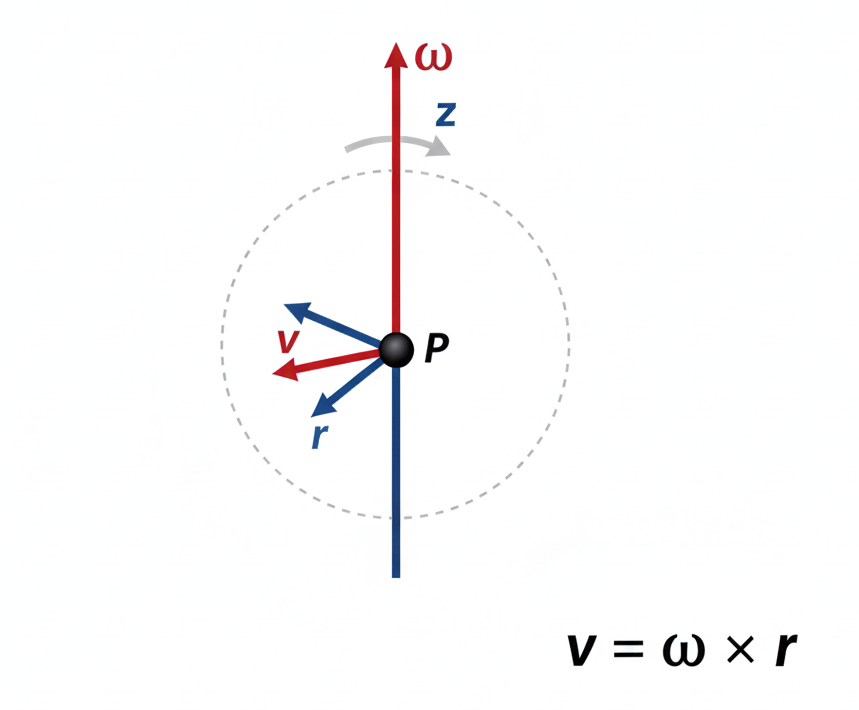
Don't treat angular velocity like a simple scalar; it’s a vector! The $\mathbf{\omega}$ vector lies right along the axis of rotation.
To find its direction, we use the right-hand rule: Curl the fingers of your right hand in the direction of rotation. Your stretched thumb points in the direction of the angular velocity vector $\mathbf{\omega}$. Notice this: The magnitude is defined as $\omega = \frac{d\theta}{dt}$.
Relatable Example: Imagine you are tightening a screw on your scooter engine. When you rotate the screw head clockwise (from top view), the screw advances into the engine. That "advance direction" is the direction of the angular velocity vector $\mathbf{\omega}$.
The linear velocity vector ($\mathbf{v}$) itself can be elegantly expressed using the vector product we studied previously:
Here $\mathbf{r}$ is the position vector of the particle (taken from an origin on the fixed axis). This cross product automatically ensures that $\mathbf{v}$ is perpendicular to both $\mathbf{\omega}$ (the axis) and $\mathbf{r}$, which means $\mathbf{v}$ is tangent to the particle's circular path.
Figure below:
A clear diagram showing rotation about the z-axis, illustrating the angular velocity vector $\mathbf{\omega}$ along the axis and the linear velocity vector $\mathbf{v}$ tangent to the circle described by particle P, such that $\mathbf{v} = \mathbf{\omega} \times \mathbf{r}$.
NEET Checkpoint:
For a rigid body rotating about a fixed axis, if the radius vector $\mathbf{r}$ and angular velocity vector $\mathbf{\omega}$ are given, the linear velocity $\mathbf{v}$ is:
(a) Parallel to $\mathbf{r}$
(b) Perpendicular to $\mathbf{\omega}$
(c) Parallel to $\mathbf{\omega} \times \mathbf{r}$
(d) Both (b) and (c)
✅ Answer: (d) Both (b) and (c) — The vector product $\mathbf{v} = \mathbf{\omega} \times \mathbf{r}$ is perpendicular to the plane containing $\mathbf{\omega}$ and $\mathbf{r}$. Since $\mathbf{\omega}$ is along the axis, $\mathbf{v}$ must be perpendicular to $\mathbf{\omega}$.
Angular Acceleration
Just like linear acceleration ($\mathbf{a}$) tells you how linear velocity ($\mathbf{v}$) changes, Angular Acceleration ($\mathbf{\alpha}$) tells you how angular velocity ($\mathbf{\omega}$) changes over time. Don't stress, it's a direct analogy!
It is defined as the time rate of change of angular velocity:
Since we are focusing on a fixed axis, the direction of $\mathbf{\omega}$ (and therefore $\mathbf{\alpha}$) is also fixed. In this special case, we can often treat it as a scalar magnitude: $\alpha = \frac{d\omega}{dt}$.
NEET Checkpoint:
In fixed-axis rotation, if the angular speed is constant, what is the angular acceleration ($\mathbf{\alpha}$)?
(a) Positive
(b) Negative
(c) Zero
✅ Answer: (c) Zero — If the angular speed $\omega$ is constant, its time rate of change $d\omega/dt$ is zero, meaning $\alpha=0$.
Practice Question:
A particle on a ceiling fan blade is $0.5 \text{ m}$ from the centre, and the fan rotates at an angular speed of $2 \pi \text{ rad/s}$. What is the magnitude of the particle's linear velocity?
(a) $2\pi~m/s$
(b) $\pi~m/s$
(c) $0.5~m/s$
(d) $2.5\pi~m/s$
✅ Answer: (b) $\pi~m/s$ — We use $v = \omega r$. Given $\omega = 2\pi \text{ rad/s}$ and $r = 0.5 \text{ m}$. Thus, $v = (2\pi)(0.5) = \pi~m/s$.
Key Takeaway:
Rotational motion about a fixed axis is described by angular velocity $\mathbf{\omega}$ (vector along the axis) and angular acceleration $\mathbf{\alpha}$. The linear velocity of a particle is given by the crucial formula:
$$\mathbf{v} = \mathbf{\omega} \times \mathbf{r}$$
while the rotational equivalent of Newton's second law involves $\mathbf{\alpha} = d\mathbf{\omega}/dt$.
8. Torque (Moment of Force)
Arre yaar, we've seen that force ($\mathbf{F}$) changes the translational state of a body, right? But if we want to produce a rotational effect, we need the superstar: Torque ($\tau$), which is the rotational analogue of force in linear motion. Don't stress, this funda is super important for NEET, and it's easier than it looks.
The moment of force, or torque, acting on a single particle is defined as the vector product (or cross product) of the position vector ($\mathbf{r}$) and the force ($\mathbf{F}$):
Notice this vector product. This means torque ($\tau$, pronounced 'tau') is itself a vector quantity, and its direction is perpendicular to the plane containing both $\mathbf{r}$ and $\mathbf{F}$, following the right-hand screw rule.
Let's talk magnitude! The magnitude of the torque is given by:
Here, $r$ is the magnitude of the position vector, $F$ is the magnitude of the force, and $\theta$ is the angle between $\mathbf{r}$ and $\mathbf{F}$. (P.S. The SI unit for torque is the $\text{newton metre}$ ($\text{Nm}$). Remember that while its dimensions are the same as work ($[L^2 T^{-2}]$), $\tau$ is a vector, while work is a scalar!).
NEET Checkpoint:
Torque is mathematically defined using which type of product?
(a) Scalar product
(b) Dot product
(c) Vector product
(d) Simple multiplication
✅ Answer: (c) Vector product — It is $\mathbf{r} \times \mathbf{F}$.
You can simplify the magnitude using the concept of $r_{\perp}$ (read as 'r perp'):
Where $r_{\perp} = r \sin \theta$ is the crucial perpendicular distance of the line of action of $\mathbf{F}$ from the origin (the axis of rotation).
Think about opening a heavy door in your coaching centre. Applying a force near the handle (where $r_{\perp}$ is large) is most effective at producing rotation. If you try pushing the door right at the hinge line (where $r_{\perp} \approx 0$), no matter how hard you push, there is no rotation!
Figure below:
A clear diagram showing the position vector $\mathbf{r}$ originating from O, the force vector $\mathbf{F}$ acting at the tip of $\mathbf{r}$, and the angle $\theta$ between them. Also show the perpendicular distance $r_{\perp}$ from O to the line of action of F.
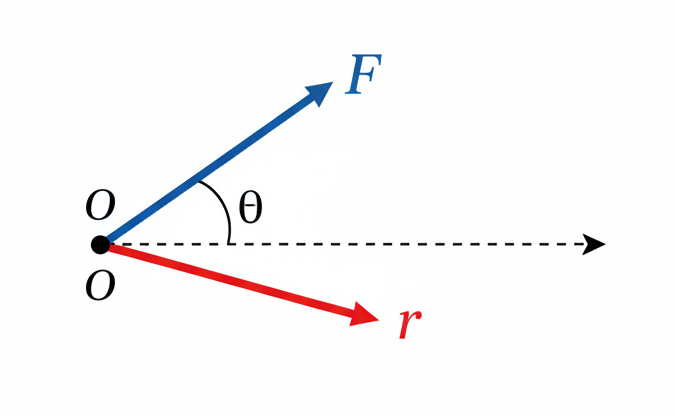
So, when does the torque vanish ($\tau=0$)? This is a must-know funda:
1. The force magnitude is zero ($\mathbf{F}=0$).
2. The distance from the origin is zero ($\mathbf{r}=0$).
3. The line of action of the force passes through the origin (i.e., $\theta=0^\circ$ or $180^\circ$).
Example Time: Imagine an electrician trying to unscrew a tight fuse box bolt using a spanner. If he applies force by pulling the spanner handle directly outward ($\theta=180^\circ$), the force $F$ is high, but the torque is zero. He needs to push or pull perpendicularly to the spanner handle for maximum $\tau$.
NEET Checkpoint:
For rotation about a fixed axis, if the line of action of the force passes through the axis of rotation, the torque will be:
(a) Maximum
(b) Minimum
(c) Non-zero
(d) Zero
✅ Answer: (d) Zero — If the line of action passes through the origin, $\theta$ is $0^\circ$ or $180^\circ$, meaning $\tau=r F \sin\theta = 0$.
Practice Question:
If $\mathbf{r} = 5\hat{i}$ and $\mathbf{F} = 10\hat{i}$, what is the torque $\tau$ produced about the origin?
(a) $50\hat{k}$
(b) $50\hat{j}$
(c) $0$
(d) $15\hat{i}$
✅ Explanation: Since $\mathbf{r}$ and $\mathbf{F}$ are both along the $\hat{i}$ direction, they are parallel ($\theta=0^\circ$). The cross product of parallel vectors is zero ($\hat{i} \times \hat{i}=0$), so $\tau=0$.
Thus, the answer is (c) $0$.
Now that you've got this, wait till you see how the 'moment of force' connects with the 'moment of momentum'—our next topic, Angular Momentum.
Key Takeaway: Formula Summary |
|---|
| Vector Definition: $\tau = \mathbf{r} \times \mathbf{F}$ |
| Magnitude: $\tau = r F \sin \theta = r_{\perp} F$ |
| Condition for $\tau=0$: Line of action of $\mathbf{F}$ passes through the origin. |
9. Hashing out Angular Momentum ($\mathbf{l}$) and its Time Rate ($\mathbf{\tau}$)
Hey future doctors! Let's clear up this funda about Angular Momentum ($\mathbf{l}$). Just like linear momentum ($\mathbf{p}$) governs translational motion, $\mathbf{l}$ is its cool, rotating twin—the rotational analogue of linear momentum. Easy peasy, right? We even call it the moment of (linear) momentum.
For a single particle with mass $m$ and linear momentum $\mathbf{p}$ at a position $\mathbf{r}$ relative to the origin $O$, the definition is a vector product, so buckle up:
Since $\mathbf{p} = m\mathbf{v}$, the magnitude is $l = r p \sin \theta$, where $\theta$ is the angle between $\mathbf{r}$ and $\mathbf{p}$. Notice this: if the particle is at the origin ($r=0$), or if its line of momentum passes directly through the origin ($\theta=0^{\circ}$ or $180^{\circ}$), then $\mathbf{l}$ vanishes.
NEET Checkpoint:
Angular momentum is also known by which descriptive term?
(a) Rotational Mass
(b) Rotational Force
(c) Moment of Linear Momentum
(d) Angular Impulse
✅ Answer: (c) Moment of Linear Momentum — This term is explicitly used to describe the definition of angular momentum.
Now for the main event: the time rate of change. The most crucial dynamic relationship in rotational dynamics is that the time rate of change of the angular momentum of a particle is equal to the torque ($\tau$) acting on it. This gives us the rotational version of Newton's second law ($\mathbf{F} = d\mathbf{p}/dt$):
And that’s cool, right? When we derive this from $\mathbf{l} = \mathbf{r} \times \mathbf{p}$, the term involving the particle's velocity ($\frac{d\mathbf{r}}{dt} \times \mathbf{p}$) conveniently vanishes because $\mathbf{v}$ and $\mathbf{p}$ are parallel vectors, leaving us with $\mathbf{r} \times \mathbf{F}$, which is $\mathbf{\tau}$.
Relatable Indian Example: Picture a rickshaw pulling away from a stand. If a tiny stone gets stuck in the tyre and flies out, its linear momentum vector $\mathbf{p}$ (at the instant it leaves the tyre) might briefly align exactly with its position vector $\mathbf{r}$ relative to the centre of the wheel. At that specific micro-instant, the stone’s angular momentum about the centre of the wheel would be zero ($l=0$). Zero spin moment, full speed ahead!
NEET Checkpoint:
If the angular momentum $\mathbf{l}$ of a particle is constant, what must be true about the torque $\mathbf{\tau}$ acting on it?
(a) $\mathbf{\tau}$ is constant and non-zero.
(b) $\mathbf{\tau}$ is zero.
(c) $\mathbf{\tau}$ is perpendicular to $\mathbf{l}$.
(d) $\mathbf{l}$ is always parallel to $\mathbf{p}$.
✅ Answer: (b) $\mathbf{\tau}$ is zero. — Since $\frac{d\mathbf{l}}{dt} = \mathbf{\tau}$, if $\mathbf{l}$ is constant, its time derivative is zero, meaning $\mathbf{\tau}=0$.
Practice Question:
The rotational analogue of the force-momentum relation in translational motion ($\mathbf{F} = d\mathbf{p}/dt$) is:
(a) $\mathbf{l} = \mathbf{r} \times \mathbf{F}$
(b) $\mathbf{\tau} = \mathbf{r} \times \mathbf{p}$
(c) $\frac{d\mathbf{\tau}}{dt} = \mathbf{l}$
(d) $\mathbf{\tau} = \frac{d\mathbf{l}}{dt}$
✅ Answer: (d) $\mathbf{\tau} = \frac{d\mathbf{l}}{dt}$ — This equation directly parallels Newton's second law, relating the time rate of change of the momentum analogue ($\mathbf{l}$) to the force analogue ($\mathbf{\tau}$).
NEET Checkpoint:
What are the dimensions of angular momentum?
(a) $[MLT^{-1}]$
(b) $[ML^2T^{-2}]$
(c) $[ML^2T^{-1}]$
(d) $[ML^{-1}T^{-2}]$
✅ Answer: (c) $[ML^2T^{-1}]$ — Angular momentum $\mathbf{l}$ has SI units of $J \cdot s$ (Joule-second).
Key Takeaway:
| Quantity | Formula | Analogue of | Dynamic Relation |
|---|---|---|---|
| Angular Momentum ($\mathbf{l}$) | $\mathbf{l} = \mathbf{r} \times \mathbf{p}$ | Linear Momentum ($\mathbf{p}$) | $\mathbf{\tau} = \frac{d\mathbf{l}}{dt}$ |
10. Angular Momentum of a System and Conservation
Hey NEET aspirants! Ready to tackle the funda of Angular Momentum for a whole system? Don't stress, yaar—it’s just the rotational cousin of linear momentum, and the maths follows the same logic.
The total angular momentum ($L$) of a system made up of $n$ particles is the vector sum of all their individual angular momenta ($l_i$). Mathematically, we write this elegant summation as:
The rate at which this total angular momentum changes over time ($\frac{dL}{dt}$) is equal to the total torque ($\tau$) acting on the system. The force ($F_i$) on any particle includes both external ($F_i^{ext}$) forces (from outside the system) and internal ($F_i^{int}$) forces (from other particles inside).
NEET Checkpoint:
Under which condition does the internal torque ($\tau_{int}$) of a system become zero?
(a) $F_{ext} = 0$
(b) Internal forces are unequal
(c) Internal forces act along the line joining the particles
(d) System is in translational equilibrium.
✅ Answer: (c) Internal forces act along the line joining the particles — This crucial assumption ensures the torque produced by every internal action-reaction pair cancels out.
Because we assume those internal forces act along the line joining particles, the total internal torque ($\tau_{int}$) is zero. This means the change in total angular momentum depends only on the external torque ($\tau_{ext}$):
This equation is the rotational analogue of Newton's second law for systems ($\frac{dP}{dt} = F_{ext}$).
Now, for the big conservation idea: If the total external torque on the system is zero ($\tau_{ext} = 0$), what happens? Simple! The time rate of change of angular momentum must be zero ($\frac{dL}{dt}=0$).
This leads to the Law of Conservation of Angular Momentum: If the total external torque on a system is zero, then the total angular momentum ($L$) remains conserved ($L = \text{constant}$). This conservation law is comprehensive, meaning all three components of $L$ ($L_x$, $L_y$, and $L_z$) are constant.
Relatable Example (The Spinning Dancer): Imagine a Bharatanatyam dancer performing a rapid spin or chakkar. When they pull their arms close to their body, they are decreasing their moment of inertia ($I$). Since the friction (external torque) is negligible at the pivot point (their toe), $L = I\omega$ must be conserved (constant). Decreasing $I$ forces the angular speed ($\omega$) to instantly increase! That’s angular momentum conservation in action, making their spin super fast!
NEET Checkpoint:
If $\tau_{ext}$ is zero, which component of $L$ is conserved?
(a) Only $L_z$
(b) Only $L_x$
(c) Only $L_y$
(d) All three components ($L_x, L_y, L_z$).
✅ Answer: (d) All three components ($L_x, L_y, L_z$) — If the vector $L$ is constant, its scalar components must also be constants ($L_x=K_1$, $L_y=K_2$, $L_z=K_3$).
NEET Checkpoint:
If the total external torque on a system is zero, the total angular momentum is
(a) Zero
(b) Increasing
(c) Decreasing
(d) Constant
✅ Answer: (d) Constant — Zero external torque means $\frac{dL}{dt}=0$, so $L$ must be constant.
Practice Question:
The rotational analogue of Newton's second law ($\frac{dP}{dt} = F_{ext}$) for a system of particles is:
(a) $L = I\omega$
(b) $\tau = I\alpha$
(c) $\frac{dL}{dt} = \tau_{ext}$
(d) $P = \tau\omega$
✅ Answer: (c) $\frac{dL}{dt} = \tau_{ext}$ — This equation directly relates the rate of change of total angular momentum ($L$) to the total external torque ($\tau_{ext}$).
Key Takeaway:
The total angular momentum ($L$) of a system is conserved if and only if the net external torque ($\tau_{ext}$) acting on the system is zero. This means that $\frac{dL}{dt} = \tau_{ext}$.
11. Equilibrium of Rigid Bodies
Alright, future doc, let's nail this funda of mechanical equilibrium for a rigid body. Don't stress, yaar—it’s easier than it looks!
When a rigid body is truly steady, it means it's not changing its translational motion and it's not changing its rotational motion. Essentially, a rigid body is in mechanical equilibrium if its linear momentum ($P$) and angular momentum ($L$) are both constant. In simpler terms, it has neither linear acceleration ($A=0$) nor angular acceleration ($\alpha=0$).
We need two primary conditions to be satisfied:
- Condition for Translational Equilibrium: The vector sum of all external forces acting on the body must be zero. This is what keeps the centre of mass from accelerating:
$$\sum_{i=1}^{n}F_{i}=0$$
Example: Think of a heavy box of ladoos resting perfectly still on a shop counter. The upward normal force must perfectly cancel the downward force of gravity. If this holds, the total linear momentum is constant.
NEET Checkpoint:
If a rigid body's total external force is zero, its total linear momentum must be:
(a) Zero
(b) Increasing
(c) Constant
(d) Changing direction
✅ Answer: (c) Constant — When the total external force ($F_{ext}$) is zero, $\frac{dP}{dt}=0$, meaning $P$ is constant.
2. Condition for Rotational Equilibrium: The vector sum of all external torques about any point must be zero. This stops the body from spinning or tilting:
If this condition is met, the total angular momentum remains constant.
Now, here’s a crucial insight for solving numericals: If the translational equilibrium condition ($\sum F_{i}=0$) already holds, the rotational equilibrium condition ($\sum \tau_{i}=0$) becomes independent of the choice of origin (the point about which you calculate the torques). Mast shortcut, right?
These two vector equations—one for force and one for torque—actually provide us with six independent scalar conditions for complete mechanical equilibrium (three corresponding to force components and three corresponding to torque components). Remember, a body can be in partial equilibrium—like a rod being pushed by two equal and opposite forces creating rotation (a couple); here $\sum F=0$, but $\sum \tau \neq 0$!
NEET Checkpoint:
A system undergoing rotation without translation is subject to a couple. Is the system in mechanical equilibrium?
(a) Yes, because net force is zero.
(b) No, because net torque is non-zero.
(c) Yes, because it has zero linear acceleration.
(d) No, because both conditions must be zero.
✅ Answer: (b) No, because net torque is non-zero — A couple results in $\sum F=0$ (translational equilibrium) but $\sum \tau \neq 0$ (no rotational equilibrium), so the body is not in full mechanical equilibrium.
NEET Checkpoint:
If the total external force on a rigid body is zero, the rotational equilibrium condition $\sum \tau_{i}=0$ is:
(a) Dependent on the choice of axis.
(b) Independent of the choice of origin.
(c) Always zero regardless of the forces.
(d) Applicable only to symmetric bodies.
✅ Answer: (b) Independent of the choice of origin — If translational equilibrium is satisfied, shifting the origin does not invalidate the rotational equilibrium condition.
Practice Questions:
-
Which statement correctly describes a rigid body in mechanical equilibrium?
(a) Its linear acceleration is zero, but its angular acceleration can be non-zero.
(b) Both its linear momentum ($P$) and angular momentum ($L$) are zero.
(c) Its linear momentum ($P$) and angular momentum ($L$) are constant.
(d) The total force and total torque components along the z-axis must be zero.✅ Answer: (c) Its linear momentum ($P$) and angular momentum ($L$) are constant. — Mechanical equilibrium requires both linear and angular momentum to be constant (zero linear and angular acceleration).
-
For a rigid body where all forces are coplanar, how many scalar conditions must be satisfied for mechanical equilibrium?
(a) Two
(b) Three
(c) Four
(d) Six✅ Answer: (b) Three — For coplanar forces, we need two conditions for translational equilibrium (along two perpendicular axes in the plane) and one condition for rotational equilibrium (torque along the axis perpendicular to the plane), totaling three conditions.
Key Takeaway: Mechanical Equilibrium Conditions |
|---|
| Translational Equilibrium: Total Force is zero:
$$\sum F_{i}=0$$
(Ensures constant$P$) |
| Rotational Equilibrium: Total Torque is zero:
$$\sum \tau_{i}=0$$
(Ensures constant$L$) |
12. Couple, Lever, and Centre of Gravity: The Balancing Act!
Hey future doctors! Ready to tackle the funda behind things that rotate but don't move forward, or vice versa? Don't stress, yaar—understanding equilibrium is easier than it looks.
First things first: a rigid body is in mechanical equilibrium only if both its linear momentum (translation) and angular momentum (rotation) are constant (i.e., zero acceleration and zero angular acceleration). But sometimes, you get partial equilibrium. For example, if the total force ($\sum F_{i}$) on a light rod is zero, it's in translational equilibrium. However, if the total torque ($\sum \tau_{i}$) is non-zero, it's not in rotational equilibrium and will start rotating, even without moving its centre of mass.
Here's the trick: this is exactly what a Couple does! A couple is defined as a pair of forces that are equal in magnitude but opposite in direction, acting along different lines of action. Notice this: A couple ensures the net external force is zero, so it produces rotation without translation. And that's cool, right?
NEET Checkpoint:
If a body is subjected only to a couple, what type of equilibrium is achieved?
(a) Complete mechanical
(b) Translational
(c) Rotational
(d) Neither
✅ Answer: (b) Translational — The total force is zero ($\sum F=0$), but the net torque is non-zero, preventing rotational equilibrium.
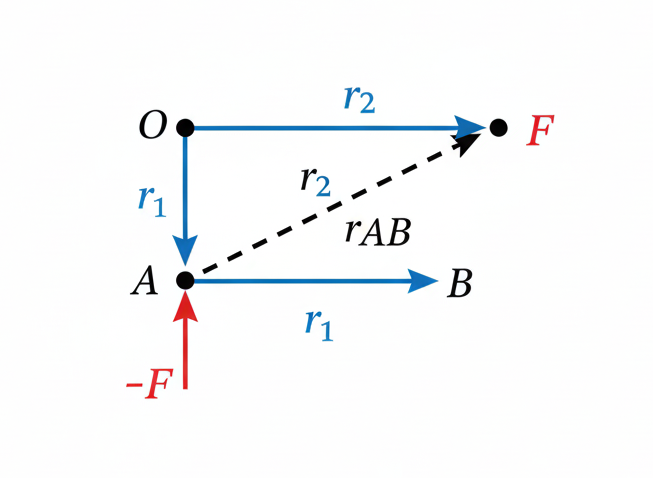
Now, why does this matter? The moment of a couple, calculated as $\vec{AB} \times \vec{F}$ (where $\vec{AB}$ is the vector connecting the points of action of the forces $\vec{F}$ and $-\vec{F}$), is independent of the point about which you take the moments. This is super important for calculations!
Figure below:
A clear diagram showing two equal and opposite forces, $\vec{F}$ and $-\vec{F}$, acting at points B and A respectively, with position vectors $\vec{r}{1}$ and $\vec{r}{2}$ taken from an arbitrary origin O. Show that the moment of the couple is $\vec{AB} \times \vec{F}$, independent of O.
Let's switch to the Lever. A lever is essentially a light rod pivoted at a point called the fulcrum. When a lever is in rotational equilibrium about the fulcrum, we apply the Principle of Moments. This foundational concept states:
If $F_{1}$ is the load, $d_{1}$ is the load arm, $F_{2}$ is the effort, and $d_{2}$ is the effort arm, the condition for equilibrium is $d_{1}F_{1}=d_{2}F_{2}$. Think about using a spanner to tighten a screw; a longer handle (effort arm, $d_{2}$) means you need less force (effort, $F_{2}$) to apply a large load.
NEET Checkpoint:
If the effort arm ($d_{2}$) of a lever is half the load arm ($d_{1}$), what is the Mechanical Advantage ($M.A. = F_{1}/F_{2}$)?
(a) 2
(b) 1
(c) 0.5
(d) 4
✅ Answer: (c) 0.5 — Mechanical Advantage is $M.A. = d_{2}/d_{1}$. If $d_{2}=d_{1}/2$, then $M.A.=0.5$.
Finally, we hit the Centre of Gravity (CG). The CG is that unique point where the total gravitational torque ($\tau_g$) on the entire body is zero. Imagine balancing a pakka irregular-shaped cardboard on a finger tip—that balance point is the CG. The total torque due to all the individual particle weights ($m_{i}g$) is zero about this point: $\tau_{g}=\sum r_{i}\times m_{i}g=0$.
In a uniform gravitational field (which is usually assumed for small bodies like our cardboard), the CG coincides with the Centre of Mass (CM). Remember, CM is purely about mass distribution, while CG is related to the gravitational field strength.
NEET Checkpoint:
The Centre of Gravity (CG) differs from the Centre of Mass (CM) if:
(a) The body is spinning
(b) The body is accelerating
(c) The body is extended such that $\vec{g}$ varies significantly
(d) The body is non-uniform in mass distribution
✅ Answer: (c) The body is extended such that $\vec{g}$ varies significantly — They coincide only if $\vec{g}$ is uniform across the body.
Practice Questions:
A body is in equilibrium when the sum of forces is zero and the sum of torques is zero. If a $10 \text{ N}$ force and a $5 \text{ N}$ force are applied in opposite directions at the ends of a rigid rod, which type of equilibrium is impossible?
(a) Translational equilibrium
(b) Rotational equilibrium
(c) Partial equilibrium
(d) Neither translational nor rotational equilibrium
✅ Answer: (a) Translational equilibrium — Since the forces are unequal (10 N and 5 N) and opposite, the net force is $5 \text{ N}$ (non-zero). Therefore, translational equilibrium ($\sum F=0$) cannot be achieved.
Key Takeaway: |
|---|
| Couple: Equal and opposite forces with different lines of action; produces rotation but no translation. |
| Principle of Moments: $d_{1}F_{1}=d_{2}F_{2}$ for rotational equilibrium of a lever. |
| CG: The point where total gravitational torque is zero. It matches CM for small bodies in uniform gravity. |
13. Moment of Inertia
The Moment of Inertia ($I$) is super important because it’s the rotational analogue of mass in linear motion. Just like mass resists linear acceleration, $I$ resists angular acceleration—it's essentially the measure of rotational inertia. Don't stress, once you get the concept of mass distribution, this topic is easier than it looks!
For a system of $n$ particles rotating about a fixed axis, the Moment of Inertia ($I$) is defined mathematically as the sum of the products of the mass ($m_{i}$) of each particle and the square of its perpendicular distance ($r_{i}$) from the axis:
Notice this: $r_{i}$ is the perpendicular distance of the $i^{th}$ particle from the axis. Since $r_{i}$ is squared, mass located farther away contributes much more to $I$ than mass near the axis. That's why $I$ is a measure of how mass is distributed relative to the axis of rotation.
The rotational kinetic energy ($K$) is also defined perfectly analogously to linear kinetic energy ($K = \frac{1}{2} m v^{2}$):
Here, $\omega$ is the angular velocity.
Relatable Indian Example: Think of an expert street food chaat vendor spinning a large circular tray of pani puri ingredients. If they put the heavy containers near the centre, the $I$ is low, and it's easy to spin quickly. If they push all the heavy chhole and aloo containers right to the edge, the Moment of Inertia becomes huge, and it’s way tougher to get that quick rotation going! This large $I$ helps the flywheel of a steam engine resist sudden speed changes, ensuring a smooth ride.
NEET Checkpoint:
The Moment of Inertia depends on:
(a) Total mass and angular velocity
(b) Total mass and axis of rotation
(c) Angular acceleration only
(d) Linear velocity and mass
✅ Answer: (b) Total mass and axis of rotation — $I$ depends on the mass, the body's shape/size, and the distribution of mass about the axis. It is independent of the magnitude of angular velocity ($\omega$).
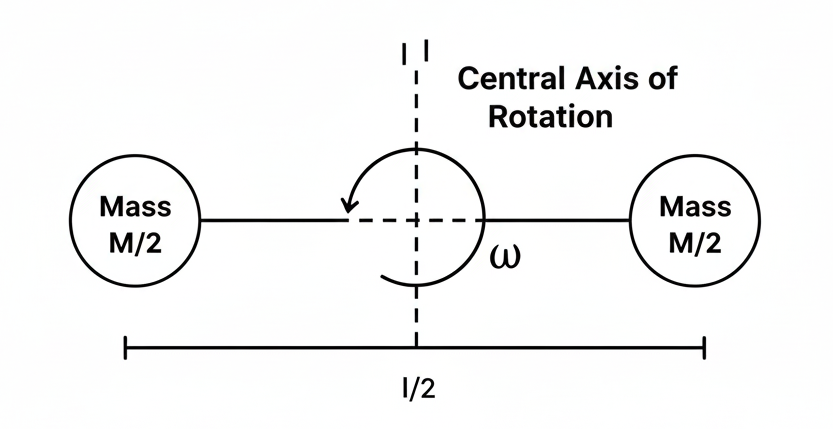
Quick Calculations: For a simple case, consider a light rod of length $l$ with two small masses, $M/2$ each, at the ends, rotating about an axis through the centre perpendicular to the rod (Fig. 6.28). The distance $r_{i}$ for each mass is $l/2$.
NEET Checkpoint:
What are the dimensions of Moment of Inertia ($I$)?
(a) $[MLT^{-2}]$
(b) $[ML^{2}T^{-1}]$
(c) $[ML^{2}]$
(d) $[ML^{3}]$
✅ Answer: (c) $[ML^{2}]$ — Since $I = \sum m_{i} r_{i}^{2}$, the dimensions are mass times length squared.
The dimensions of $I$ are $\mathbf{[ML^{2}]}$ and the SI unit is $\mathbf{kg~m^{2}}$.
Figure below:
A clear diagram showing a light rod of length $l$ with a mass $M/2$ at each end, rotating about a central axis perpendicular to the rod, illustrating the setup for calculating $I=Ml^2/4$.
Practice Question:
If a thin circular ring of mass $M$ and radius $R$ rotates in its own plane about its centre, its moment of inertia $I$ is:
(a) $MR^{2}/2$
(b) $MR^{2}$
(c) $ML^{2}/12$
(d) $2MR^{2}/5$
✅ Answer: (b) $MR^{2}$ — For a thin ring rotating about an axis perpendicular to the plane through its centre, all mass elements are at distance $R$.
NEET Checkpoint:
If you double the radius $R$ of a solid sphere without changing its mass $M$, how does its Moment of Inertia about its diameter change?
(a) Doubles
(b) Quadruples
(c) Halves
(d) Stays the same
✅ Answer: (b) Quadruples — Since $I$ is proportional to $R^{2}$ (e.g., $I = \frac{2}{5} MR^{2}$ for a solid sphere), doubling $R$ means $I$ increases by $2^{2}=4$ times.
Now that we know what resists rotation, let's figure out what causes rotation—the dynamics of rotational motion!
Key Takeaway: Formula Summary
The Moment of Inertia ($I$) is the rotational equivalent of mass.
Definition:
Rotational Kinetic Energy:
Units: $\text{kg m}^{2}$
14. Radius of Gyration and Specific Moments of Inertia
The Moment of Inertia ($I$) is the rotational analogue of mass, but unlike mass, $I$ isn't fixed. It depends on the total mass of the body ($M$), its shape and size, the distribution of that mass around the axis of rotation, and the specific position/orientation of the axis itself. Remember that the dimensions of $I$ are $\text{ML}^{2}$ and its SI units are $\text{kg}~\text{m}^{2}$.
Now, let's talk about the Radius of Gyration ($k$). This parameter helps us measure how the mass of a rotating rigid body is distributed concerning the axis of rotation. We define $k$ using the simple relation:
The radius of gyration ($k$) is a geometric property of the body and the axis of rotation. It represents the theoretical distance from the axis where you could concentrate a single mass point equal to the total mass ($M$) of the body, and this single point would have the exact same moment of inertia ($I$) as the actual body.
NEET Checkpoint:
Which factor does NOT influence the Moment of Inertia ($I$) of a rigid body?
(a) Total mass
(b) Angular velocity
(c) Axis orientation
(d) Mass distribution.
✅ Answer: (b) Angular velocity — Notice this! The parameter $I$ is independent of the magnitude of the angular velocity ($\omega$).
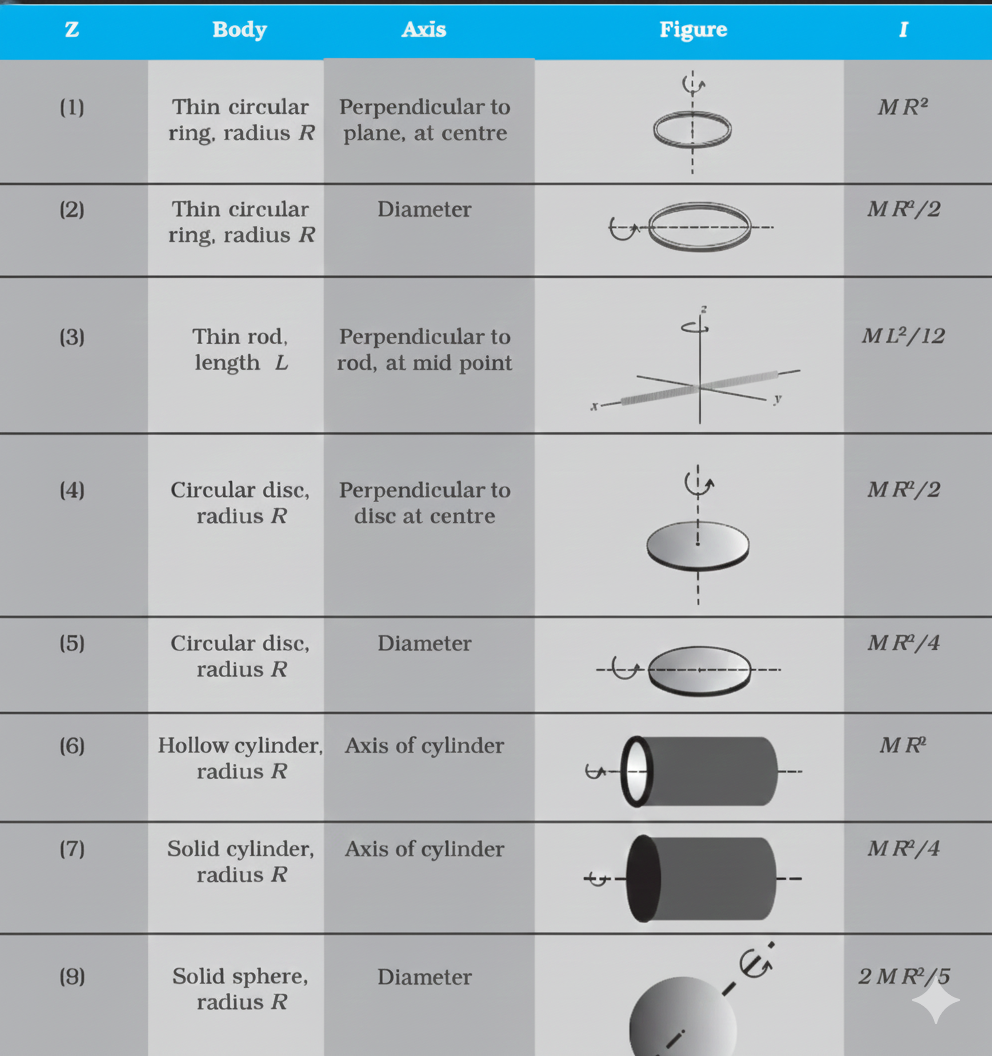
We don't need to derive the $I$ for every shape, thankfully! We often rely on tabulated values for simple geometrical objects. For example, for a thin circular ring of radius $R$ rotating perpendicular to its plane at the centre, $I=MR^{2}$. However, if that same ring rotates about its diameter, $I$ reduces to $MR^{2}/2$. See? The axis matters! For a thin rod of length $L$ rotating perpendicular to the rod at its midpoint, $I=ML^{2}/12$.
Figure below:
Table showing moments of inertia for a thin circular ring (perpendicular axis and diameter), thin rod (perpendicular axis at midpoint), circular disc (perpendicular axis at center and diameter), hollow cylinder (axis of cylinder), solid cylinder (axis of cylinder), and solid sphere (diameter), along with the formulae $MR^2, MR^2/2, ML^2/12, MR^2/2, MR^2/4, MR^2, MR^2/2, 2MR^2/5$ respectively.
Relatable Indian Example: Think about a potter spinning a chak (potter's wheel). If the clay (mass) is spread widely ($k$ is large), the wheel is harder to start and stop. If the mass is concentrated near the centre, it spins much faster with the same effort, illustrating that mass distribution (which determines $I$ and $k$) resists changes in rotational motion.
This idea of large inertia resisting sudden speed changes is put to practical use in a device called a flywheel. Machines like steam engines and automobile engines use flywheels—which are discs with a large moment of inertia—to resist sudden increases or decreases in speed. This ensures a smooth ride and prevents jerky motions.
NEET Checkpoint:
For a circular disc of mass $M$ and radius $R$ rotating about its diameter, the radius of gyration $k$ is:
(a) $R$
(b) $R/\sqrt{2}$
(c) $R/2$
(d) $R/\sqrt{4}$
✅ Answer: (c) $R/2$ — For a disc about its diameter, $I=MR^2/4$. Since $I=Mk^2$, $k^2 = R^2/4$, so $k=R/2$.
NEET Checkpoint:
Why does a flywheel resist sudden changes in angular speed?
(a) Low friction
(b) High angular velocity
(c) Large moment of inertia
(d) Uniform mass density.
✅ Answer: (c) Large moment of inertia — A large $I$ provides rotational inertia, which specifically resists sudden changes in rotational motion.
Practice Questions:
- If the moment of inertia of a solid cylinder of mass $M$ and radius $R$ rotating about its axis is $I_{cyl}$, and the moment of inertia of a solid sphere of the same mass and radius rotating about its diameter is $I_{sph}$, what is the ratio $I_{cyl} / I_{sph}$?
(a) $2/5$
(b) $5/4$
(c) $5/2$
(d) $4/5$
✅ Answer: (b) $5/4$ — For a solid cylinder about its axis, $I_{cyl}=MR^2/2$. For a solid sphere about its diameter, $I_{sph}=2MR^2/5$.
2. The dimensions of the radius of gyration ($k$) are:
(a) $ML^{2}$
(b) $L$
(c) $T^{-1}$
(d) $MLT^{-1}$
✅ Answer: (b) $L$ — Since $I=Mk^2$ and $I$ has dimensions $ML^2$, $k^2$ must have dimensions $L^2$, meaning $k$ has the dimension of length, $L$.
Key Takeaway:
The Moment of Inertia ($I$) measures rotational inertia, depending heavily on how mass is distributed. The Radius of Gyration ($k$) simplifies this distribution: $I=Mk^2$. A large $I$ (like in a flywheel) means resistance to speed changes.
15. Rotational Dynamics: The Linear Motion Remix!
The key to mastering the dynamics and kinematics of a rigid body rotating about a fixed axis is recognizing the beautiful analogies between translational and rotational motion.
The Kinematics Connection
When a body rotates with uniform angular acceleration ($\alpha$), the equations are exactly analogous to the constant acceleration equations you already know:
| Linear Motion ($a$ = constant) | Rotational Motion ($\alpha$ = constant) |
|---|---|
|
$$v = v_0 + at$$
|
$$\omega = \omega_0 + \alpha t$$
|
|
$$x = x_0 + v_0 t + \frac{1}{2}at^2$$
|
$$\theta = \theta_0 + \omega_0 t + \frac{1}{2}\alpha t^2$$
|
|
$$v^2 = v_0^2 + 2ax$$
|
$$\omega^2 = \omega_0^2 + 2\alpha (\theta - \theta_0)$$
|
Notice this: displacement ($x$) becomes angular displacement ($\theta$), and velocity ($v$) becomes angular velocity ($\omega$). Simple, right?
Dynamics: Force, Mass, and Torque
Now for the dynamics! The biggest trick here is knowing the rotational analogues for force and mass. In rotational motion about a fixed axis, the rotational analogue of Force ($F$) is Torque ($\tau$), and the analogue of Mass ($M$) is the Moment of Inertia ($I$).
NEET Checkpoint:
Which quantity plays the role of mass in rotational motion?
(a) Angular Momentum ($L$)
(b) Moment of Inertia ($I$)
(c) Angular Acceleration ($\alpha$)
(d) Power ($P$)
✅ Answer: (b) Moment of Inertia ($I$) — Mass is a measure of linear inertia, while Moment of Inertia ($I$) is the measure of rotational inertia. It resists changes in rotational motion.
This analogy gives us Newton's Second Law for Rotation:
Just as force produces acceleration ($F=ma$), torque produces angular acceleration ($\alpha$).
Work and Power in Rotation
When a torque ($\tau$) acts on a body, the work done ($dW$) for a small angular displacement ($d\theta$) is:
This is completely analogous to $dW = F~ds$ in linear motion.
The instantaneous Power ($P$) delivered by the torque is the rate of work done:
(This is analogous to $P = Fv$).
Relatable Indian Example: Think about a potter speeding up his wheel to make a pot! He applies torque ($\tau$) to the large, heavy wheel (high Moment of Inertia, $I$). The total power ($P$) he delivers is determined by how hard he pushes ($\tau$) and how fast the wheel is spinning ($\omega$). If he doubles the speed, he doubles the power needed to maintain that torque, yaar.
NEET Checkpoint:
If the external torque ($\tau$) on a system is zero, what quantity is conserved?
(a) Linear Momentum ($p$)
(b) Angular Acceleration ($\alpha$)
(c) Angular Momentum ($L$)
(d) Moment of Inertia ($I$)
✅ Answer: (c) Angular Momentum ($L$) — If $\tau_{ext}=0$, then $\text{d}L/\text{d}t = 0$, meaning $L$ is constant (conserved).
The analogy extends right up to momentum: Linear Momentum ($p = Mv$) is analogous to Angular Momentum ($L = I\omega$).
NEET Checkpoint:
What is the SI unit of power delivered by a torque?
(a) $\text{Nm}$
(b) $\text{J}$
(c) $\text{W}$
(d) $\text{rad}~\text{s}^{-1}$
✅ Answer: (c) $\text{W}$ (Watt) — Power is calculated as $P = \tau\omega$. Since $\tau$ is $\text{Nm}$ and $\omega$ is $\text{rad}~\text{s}^{-1}$, the unit is $\text{Nm}~\text{s}^{-1}$, which is the unit of power (Watt).
Practice Question:
A stationary machine rotor requires an engine to transmit a torque of $180~\text{Nm}$ to maintain a uniform angular speed of $200~\text{rad}~\text{s}^{-1}$ against friction. What is the minimum power required by the engine?
(a) $360~\text{W}$
(b) $3600~\text{W}$
(c) $36,000~\text{W}$
(d) $360~\text{J}$
✅ Solution: The power ($P$) required is given by $P = \tau\omega$. Substituting the values, $P = (180~\text{Nm}) \times (200~\text{rad}~\text{s}^{-1}) = 36000~\text{W}$. Option (c) is correct.
Key Takeaway:
| Formula Summary |
|---|
| Kinematics: $\omega = \omega_0 + \alpha t$ |
| Newton's Second Law: $\tau = I\alpha$ |
| Work Done: $dW = \tau~d\theta$ |
| Power: $P = \tau\omega$ |
| Linear Momentum Analogue: $L = I\omega$ |