1. Introduction to Properties of Matter & Learning Outcomes
Welcome back, future doctors! Let’s clear up a major funda: in our earlier mechanics chapters, we often imagined "rigid bodies," but in the real world, no material is perfectly rigid. Even a heavy steel bridge girder can be stretched or bent if the force is high enough. A solid has a definite shape and size, but fluids (liquids and gases) are the "free spirits" of physics—they flow and take the shape of whatever container you put them in.
Think of a local Pani Puri stall. The crispy puri is a solid (until you crush it—that's deformation!), while the chatpata water is a fluid, flowing instantly into the bowl. While solids fight to keep their shape, fluids offer very little resistance to shear stress—about a million times less than solids!
NEET Checkpoint:
Which of the following are classified as fluids?
(a) Solids and Liquids
(b) Liquids and Gases
(c) Gases and Solids
(d) Only Liquids
✅ Answer: (b) — Fluids are substances that can flow, which includes both liquids and gases.
By the end of this journey, you’ll be able to solve complex problems in calorimetry and elasticity, and even understand how fluid dynamics keeps an aeroplane in the sky and blood pumping through your heart.
NEET Checkpoint:
The property of a body to regain its original shape after a deforming force is removed is called:
(a) Plasticity
(b) Rigidity
(c) Elasticity
(d) Fluidity
✅ Answer: (c) — This is elasticity. If a body stays deformed (like mud), it's called plastic.
NEET Checkpoint:
Why are fluids essential to biological systems?
(a) They are perfectly rigid
(b) They mediate all living processes
(c) They do not experience pressure
(d) They have fixed shapes
✅ Answer: (b) — Every mammalian body is mostly water, and all processes in living beings are mediated by fluids.
Practice Question:
Unlike solids, the key property of fluids is that:
(a) They have a definite shape
(b) They are completely incompressible
(c) They offer very little resistance to shear stress
(d) They do not change volume under pressure
✅ Answer: (c) Fluids change their shape under very small shear stress, which is why they flow.
Key Takeaway:
- Solids: Definite shape/size; can be elastic (regain shape) or plastic (permanent deformation).
- Fluids: Liquids and gases; they lack a definite shape and are essential for life processes.
2. Elasticity: Stress and Strain
Hello, junior! Ready to dive into why some materials "snap back" while others just give up? Let’s clear up this funda.
In Physics, Elasticity is the property by which a body tends to regain its original size and shape once the deforming force is removed. If a body gets permanently deformed—like a lump of putty or mud—it is called Plasticity. Think of your Roti dough (Atta); once you press it, it stays that way—classic plastic behaviour!.
When you apply a force, an internal restoring force develops inside the body, equal and opposite to your applied force. This restoring force per unit area is called Stress.
The SI unit is $N~m^{-2}$ or Pascal ($Pa$), and its dimensions are $[ML^{-1}T^{-2}]$.
NEET Checkpoint:
What is the dimensional formula for Stress?
(a) [M L^-1 T^-2]
(b) [M L T^-2]
(c) [M L^-2 T^-1]
(d) [M L^2 T^-2]
✅ Answer: (a) $[ML^{-1}T^{-2}]$ — Same as pressure, yaar, so don't get confused!.
Now, notice this: Strain is just the fractional change in dimension. Since it's a ratio, it has no units.
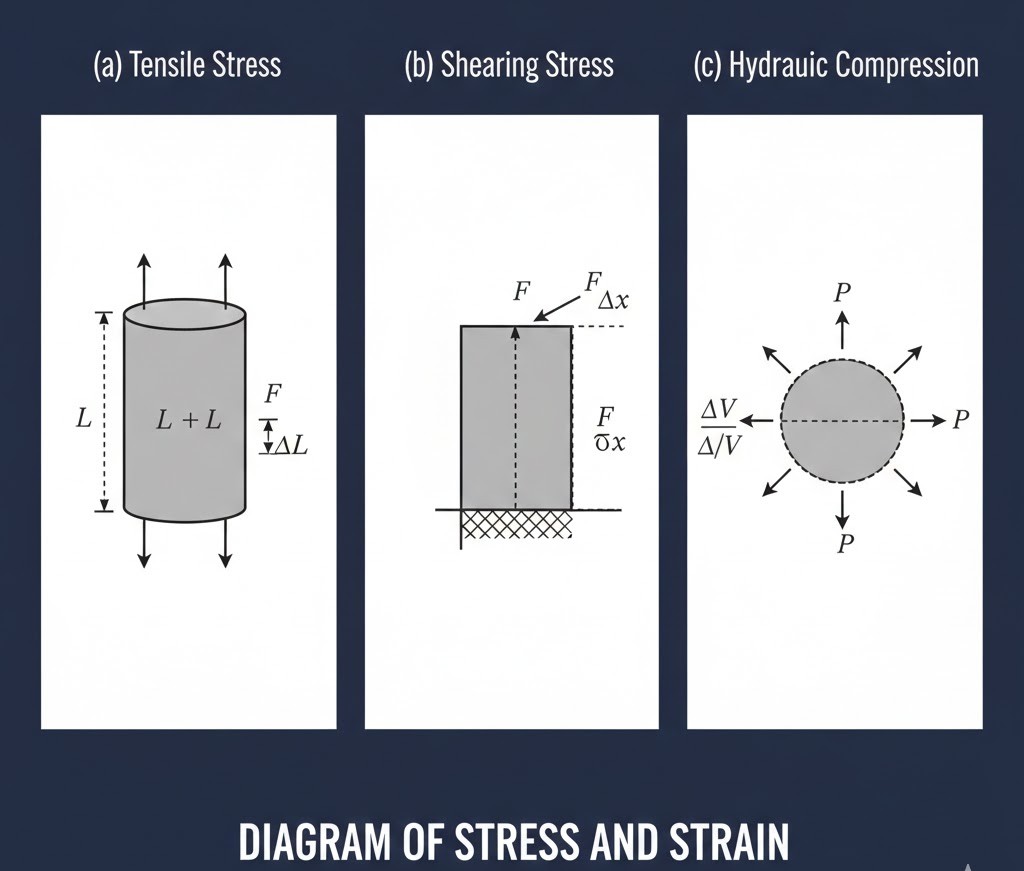
1. Longitudinal Strain: Change in length $\Delta L$ divided by original length $L$.
2. Shearing Strain: Calculated as $\tan \theta \approx \theta$, where $\theta$ is the angular displacement.
3. Volume Strain: Ratio of change in volume $\Delta V$ to original volume $V$.
NEET Checkpoint:
If you stretch a wire, what type of stress are you applying?
(a) Compressive stress
(b) Tensile stress
(c) Shear stress
(d) Bulk stress
✅ Answer: (b) Tensile Stress — Because you are increasing its length normal to the cross-section.
Imagine a Cricket ball being hit. The momentary compression it undergoes is compressive stress, but because it's elastic, it regains its shape to fly for a six!. If the force is applied parallel to the surface, like pushing a book across a table, that’s Shearing Stress.
Figure below:
A clear diagram showing three cases: (a) a cylinder under tensile stress stretching by $\Delta L$, (b) a cylinder under shearing stress deforming by an angle $\theta$, and (c) a solid sphere under hydraulic compression showing volume strain $\Delta V/V$.
NEET Checkpoint:
Does strain have a unit?
(a) Yes, in N/m²
(b) Yes, in meters
(c) No, it is dimensionless
(d) Yes, in kg/m³
✅ Answer: (c) No — It's a dimensionless quantity as it's a ratio of similar dimensions.
Practice Questions:
1. A force of $50~N$ is applied normal to a cross-section of $2~m^{2}$. The stress is:
(a) $100~Pa$
(b) $25~Pa$
(c) $50~Pa$
(d) $10~Pa$
✅ Answer: (b) $25~Pa$ — Stress is $F/A = 50/2 = 25~Pa$.
2. Which of the following is an example of a nearly ideal plastic body?
(a) Steel
(b) Copper
(c) Putty
(d) Rubber
✅ Answer: (c) Putty — It shows no tendency to regain its shape.
Key Takeway
Formula Summary
- Stress: $\sigma = \frac{F}{A}$ (Unit: $Pa$ or $N~m^{-2}$)
- Longitudinal Strain: $\epsilon = \frac{\Delta L}{L}$
- Shearing Strain: $\theta \approx \frac{\Delta x}{L}$
- Volume Strain: $\frac{\Delta V}{V}$
3. Hooke’s Law and the Stress-Strain Curve
Hey junior! Let’s clear up this fundamental 'funda' of how solids behave under pressure. Hooke’s Law is basically the "golden rule" for materials that haven't given up yet. It states that for small deformations, the stress is directly proportional to the strain. Imagine the spring in a local ball-point pen—you click it, it deforms slightly, and it works perfectly because it’s obeying Hooke’s Law.
Mathematically, we write it as:
Here, $k$ is the modulus of elasticity.
NEET Checkpoint:
Is Hooke's law a universal law for all deformations?
(a) Yes, for all materials and deformations
(b) No, only valid within the elastic limit
(c) Yes, but only for metals
(d) No, only valid for plastic deformations
✅ Answer: (b) No — It is an empirical law valid only for small deformations.
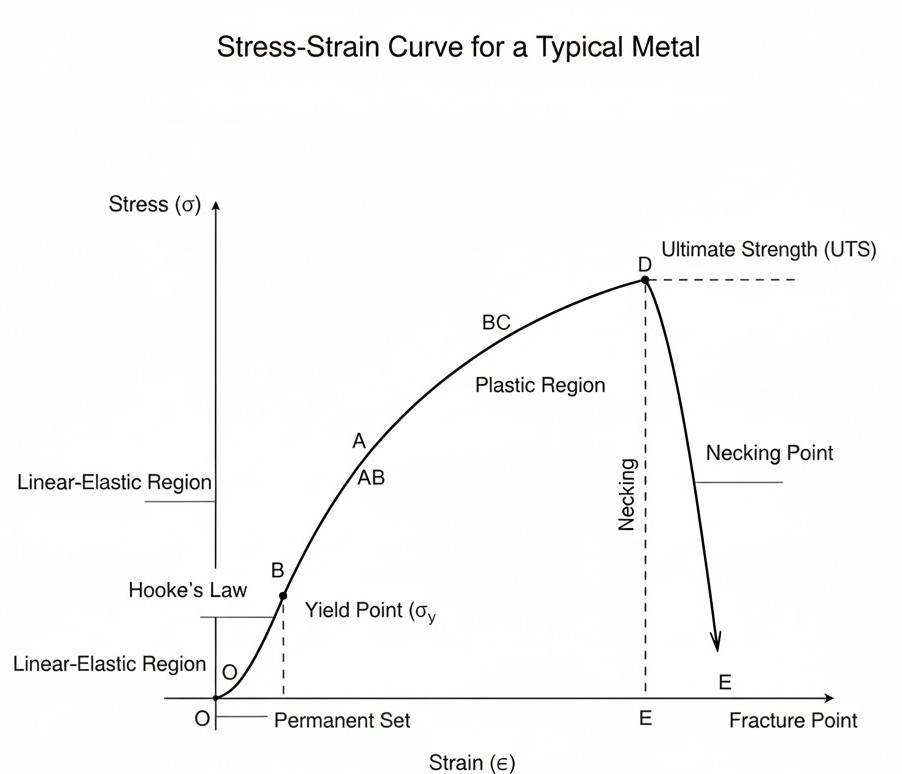
Now, check out the Stress-Strain Curve for metals. It’s like a journey:
1. Region OA: The graph is a straight line. Point $A$ is the proportional limit where Hooke’s Law is king.
2. Point B: This is the yield point or elastic limit. If you remove the load here, the material still snaps back to its original shape.
3. Beyond B: Things get messy. The material gets a permanent set, meaning it's permanently "stretched out" like an old pair of gym socks.
4. Point D: The ultimate tensile strength.
5. Point E: The fracture point where the material finally snaps.
Figure below:
A clear, professional stress-strain graph for a typical metal, labelling the linear region OA, yield point B, permanent set, ultimate strength D, and fracture point E.
NEET Checkpoint:
What happens to a material if the load is removed at the yield point?
(a) It returns completely to its original shape
(b) t regains its original dimensions
(c) It fractures immediately
(d) It becomes more elastic
✅ Answer: (b) It regains its original dimensions — Point B marks the end of the elastic behavior.
We also categorise materials based on this curve. If points $D$ and $E$ are far apart, the material is ductile (like the copper wires in your home). If they are close, it's brittle (like a glass chai cup). Then we have elastomers like rubber or the tissue of the Aorta in our heart; they can stretch a lot but don't follow Hooke's law.
NEET Checkpoint:
Why is rubber called an elastomer?
(a) It is very hard and rigid
(b) It can undergo large elastic deformation
(c) It melts easily
(d) It is a good conductor of electricity
✅ Answer: (b) Because it can be stretched to cause large strains and returns to its original shape, even though it doesn't obey Hooke's law.
Practice Question:
A material that breaks immediately after the elastic limit is reached is likely:
(a) Ductile
(b) Brittle
(c) Elastomer
(d) Plastic
✅ Answer: (b) Brittle — For brittle materials, the ultimate strength and fracture points are very close.
Key Takeaway
Formula Summary
- Hooke's Law: $Stress \propto Strain$ (for small deformations).
- Modulus of Elasticity ($k$): $k = \frac{Stress}{Strain}$.
- Ductile: Large gap between $D$ and $E$.
- Brittle: Small gap between $D$ and $E$.
4. Moduli of Elasticity: Young’s, Shear, and Bulk Modulus
Ready to master the three "Bhais" of elasticity? In the proportional region of a stress-strain curve, the ratio of stress to strain is a constant called the Modulus of Elasticity, and it’s a total "DNA" characteristic of the material.
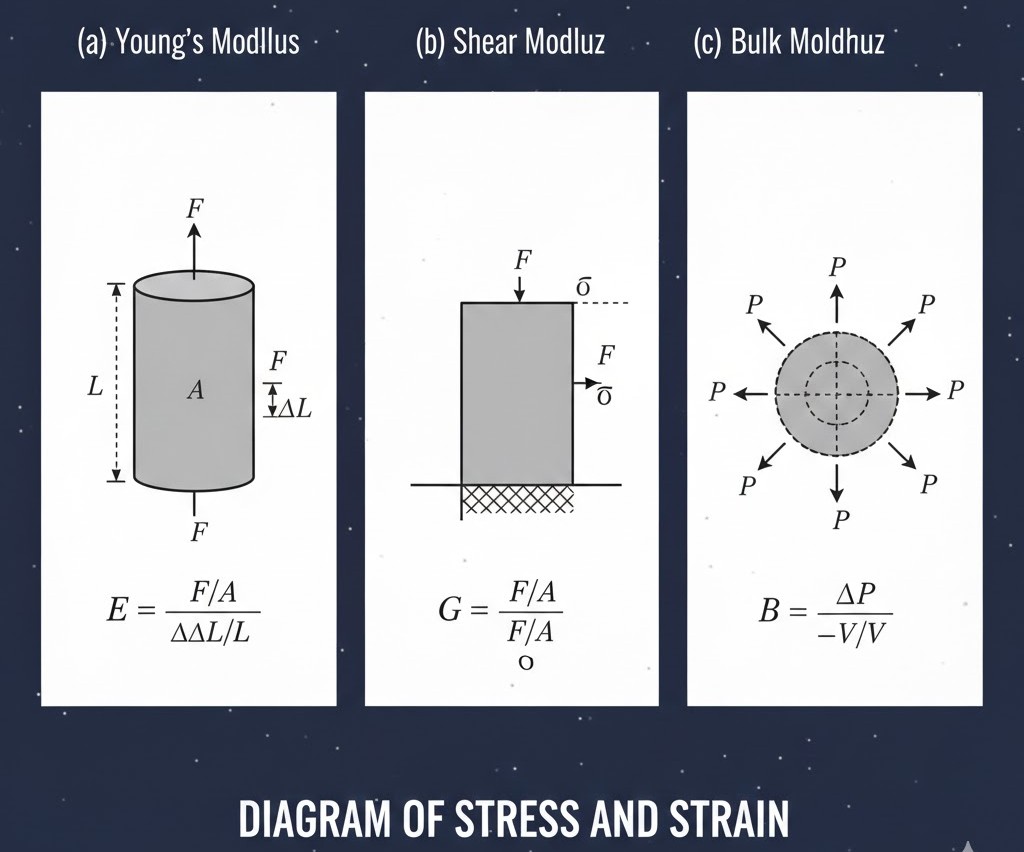
First up is Young’s Modulus ($Y$). It handles longitudinal stress and strain. If you’re stretching a wire to hang a cricket net, $Y$ tells you how much it'll elongate.
NEET Checkpoint:
What is the SI unit of Young's Modulus?
(a) Pascal (Pa)
(b) Newton (N)
(c) Newton per meter (N/m)
(d) Joule (J)
✅ Answer: (a) Pascal ($Pa$) — Since strain is dimensionless, the unit of the modulus is the same as stress.
Now, why is steel more elastic than copper or brass? In physics, "more elastic" means a material requires more force to produce the same strain. To stretch a thin wire by $0.1\%$, steel needs $2000 N$, while copper only needs $1100 N$ and brass $900 N$. Steel is the "strong, silent type" that resists change, making it perfect for heavy-duty bridges!
Next is the Shear Modulus ($G$), or the Modulus of Rigidity. This happens when you apply a tangential force—like sliding a heavy biryani pot across a table.
Usually, for most materials, $G \approx Y/3$.
NEET Checkpoint:
Which modulus is relevant only for solids?
(a) Bulk modulus
(b) Young's modulus
(c) Shear modulus
(d) All of the above
✅ Answer: (c) Shear Modulus — Only solids have a definite length and shape to be stretched or sheared!
Finally, we have the Bulk Modulus ($B$) for hydraulic stress.
The negative sign means as pressure ($p$) goes up, volume ($V$) goes down. Its reciprocal is Compressibility ($k = 1/B$). Solids are the most "stubborn" (least compressible), while gases are about a million times more compressible than solids because their molecules are barely coupled!
Figure below:
A clear diagram showing (a) a cylinder being stretched for Young’s Modulus, (b) a block tilting for Shear Modulus, and (c) a sphere being compressed from all sides by fluid for Bulk Modulus.
NEET Checkpoint:
What does a large Bulk Modulus indicate?
(a) High compressibility
(b) Low compressibility
(c) High elasticity
(d) Low elasticity
✅ Answer: (b) Low compressibility — A large $B$ means the material is very "incompressible," like water compared to air.
Practice Question:
If the Bulk Modulus of a metal is $160 \times 10^{9} Pa$, its compressibility ($k$) is:
(a) $1.6 \times 10^{-11} Pa^{-1}$
(b) $6.25 \times 10^{-12} Pa^{-1}$
(c) $160 \times 10^{-9} Pa^{-1}$
(d) $10^{9} Pa^{-1}$
✅ Answer: (b) $6.25 \times 10^{-12} Pa^{-1}$ — Use $k = 1/B$. Arre, just divide 1 by 160 and adjust the powers of 10!.
Key Takeaway
Formula Summary
* Young’s Modulus ($Y$): $Y = \frac{FL}{A \Delta L}$ (Longitudinal)
* Shear Modulus ($G$): $G = \frac{F}{A \theta}$ (Shape change)
* Bulk Modulus ($B$): $B = - \frac{p V}{\Delta V}$ (Volume change)
* Compressibility ($k$): $k = \frac{1}{B}$
5. Fluid Statics: Pressure and Pascal’s Law
Listen up, junior! Ever wonder why a sharp needle pokes you easily but a blunt spoon doesn't? It’s all about the Pressure, which is just the normal force per unit area: $P = F/A$. Remember, pressure is a scalar quantity—it has no specific direction, just like your confusion before a mock test!. The SI unit is the Pascal ($Pa$), and don't forget that it only cares about the force component normal to the surface.
Now, let’s clear up the Pascal’s Law funda. It states that pressure in a fluid at rest is the same at all points at the same height. But here’s the real magic: any pressure change applied to an enclosed fluid is transmitted undiminished to every single point of the fluid. Think of a crowded Mumbai local train—if a giant uncle at the door pushes forward, everyone inside feels that "pressure" equally!
NEET Checkpoint:
Why is pressure considered a scalar quantity?
(a) It has a specific direction
(b) It acts normally to any surface
(c) It is a vector sum of forces
(d) It depends on the area's orientation
✅ Answer: (b) — Arre, even though force is a vector, pressure at a point in a fluid at rest acts equally in all directions, so no unique direction is assigned.
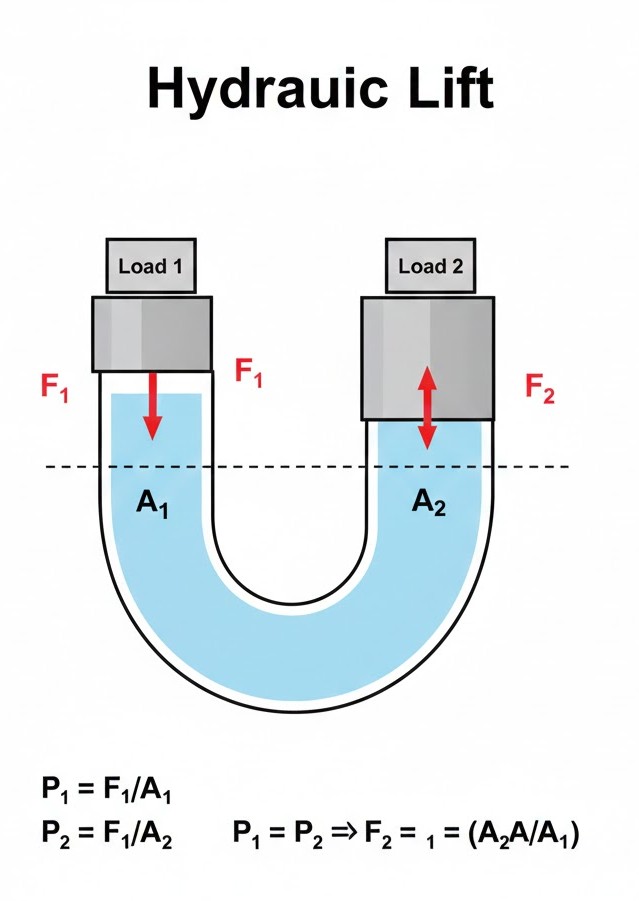
This principle gives us amazing Hydraulic Machines. In a hydraulic lift, you apply a small force $F_1$ on a small area $A_1$ to create a massive force $F_2$ on a larger area $A_2$ because the pressure ($P = F_1/A_1 = F_2/A_2$) stays the same. It’s like using one finger to lift a whole heavy cricket kit bag! Hydraulic brakes work similarly, ensuring equal "stopping power" reaches all four wheels simultaneously.
To measure this, we use Barometers (a mercury column that balances against atmospheric pressure $P_a = \rho g h$) and Manometers (U-tubes that measure gauge pressure, which is just the pressure difference $P - P_a$).
Figure below:
A clear diagram of a hydraulic lift showing a U-shaped container with a small piston of area A1 on the left and a large piston of area A2 on the right, filled with an incompressible liquid.
NEET Checkpoint:
A barometer uses mercury because:
(a) It's colourful
(b) It has high density
(c) It’s a solid
(d) It’s cheap
✅ Answer: (b) — High density ($13.6 \times 10^3 kg/m^3$) keeps the column height manageable at roughly $76~cm$ for $1~atm$.
NEET Checkpoint:
What is "gauge pressure"?
(a) $P + P_a$
(b) $P - P_a$
(c) $\rho g h + P_a$
(d) Only atmospheric pressure
✅ Answer: (b) — It’s the excess pressure above atmospheric pressure, calculated as $P_g = \rho g h$.
Practice Question:
In a hydraulic lift, if the area of the output piston is $20$ times the input piston, how much force is needed to lift a $1000~N$ load?
(a) $1000~N$
(b) $200~N$
(c) $50~N$
(d) $20000~N$
✅ Answer: (c) $50~N$. Since $F_1 = F_2 \times (A_1/A_2)$, we get $1000 \times (1/20) = 50~N$. That's the mechanical advantage, boss!.
Key Takeaway
Formula Summary:
- Average Pressure: $P_{av} = \frac{F}{A}$
- Pascal's Law (Lift): $F_2 = F_1 \left(\frac{A_2}{A_1}\right)$
- Pressure at Depth: $P = P_a + \rho g h$
- Atmospheric Pressure: $1~atm = 1.013 \times 10^5 Pa$
6. Variation of Pressure with Depth and Gravity
Hey junior! Ever wondered why deep-sea divers look like they’re wearing heavy-duty space suits? It’s all about the pressure, yaari! Let's clear up this funda.
When a fluid is at rest, gravity pulls every drop down, creating a weight that presses on everything below it. Imagine a vertical cylinder of fluid with area $A$ and height $h$. The pressure difference between the top ($P_1$) and bottom ($P_2$) must balance the weight of that fluid.
The Formula to Remember:
The pressure at depth $h$ is given by:
Here, $P_a$ is the atmospheric pressure at the surface, $\rho$ is the fluid density, and $g$ is acceleration due to gravity. The extra pressure you feel, $P - P_a$, is called gauge pressure.
NEET Checkpoint:
What is the pressure on a swimmer $10~m$ below the surface of a lake? (Take $g = 10~m~s^{-2}$, $P_a = 10^5~Pa$)
(a) $1~atm$
(b) $2~atm$
(c) $3~atm$
(d) $4~atm$
✅ Answer: (b) $2~atm$ — At $10~m$ depth, the water adds $1~atm$ of pressure to the $1~atm$ already at the surface.
The Hydrostatic Paradox:
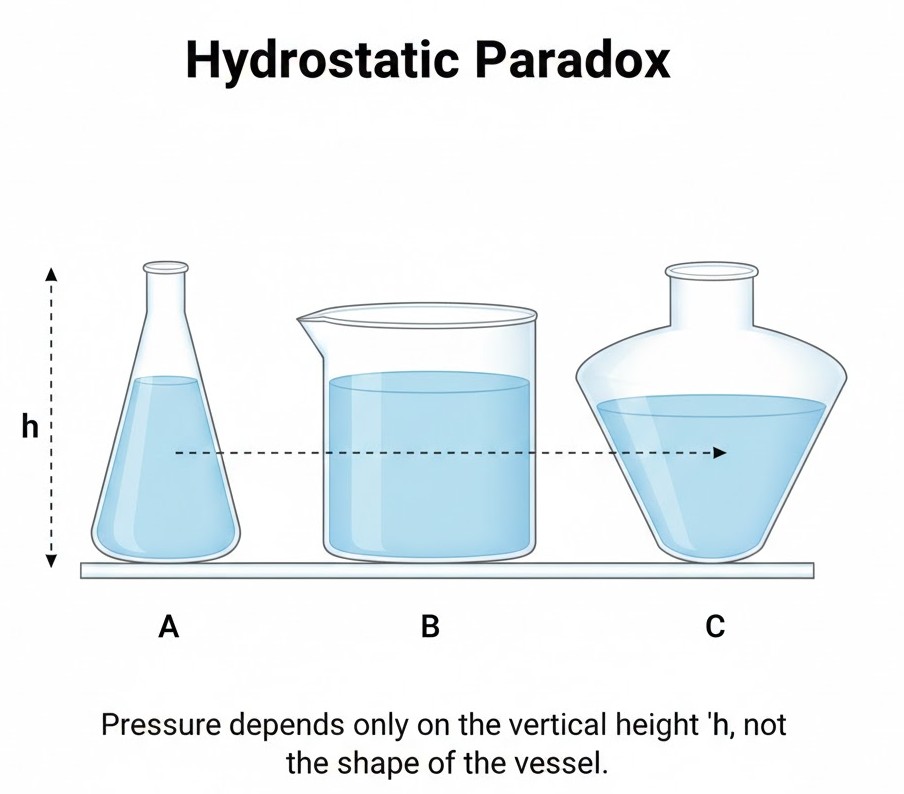
Here’s a twist that trips many students: Pressure doesn't care about the shape of your container!. Whether you use a skinny test tube or a giant bucket, if the liquid height $h$ is the same, the pressure at the bottom is identical. This is the Hydrostatic Paradox.
Relatable Indian Example: Imagine a stack of hot samosas at a roadside stall. The samosa at the bottom feels the "pressure" of the entire stack above it, regardless of whether the stall is round or square!
NEET Checkpoint:
The pressure at a point inside a liquid in equilibrium depends on:
(a) Shape of container
(b) Amount of liquid
(c) Depth below surface
(d) Base area
✅ Answer: (c) Depth — Only $h$, $\rho$, and $g$ matter; shape and area are irrelevant.
Figure below:
A clear diagram showing three vessels of different shapes (A, B, and C) connected at the bottom, all filled with liquid to the same vertical height $h$, illustrating the Hydrostatic Paradox.
Density & Relative Density:
Density ($\rho$) is just mass ($m$) per unit volume ($V$).
Relative density is the ratio of a substance's density to the density of water at $4^{\circ}C$. It’s a pure number with no units—don't let that confuse you in the exam!. Mercury is a heavy hitter with a relative density of $13.6$.
NEET Checkpoint:
The unit of relative density is:
(a) $kg~m^{-3}$
(b) $g~cm^{-3}$
(c) $Pa$
(d) Dimensionless
✅ Answer: (d) Dimensionless — It's a ratio of two similar quantities, so the units cancel out, boss!.
Practice Question:
If the density of an oil is $800~kg~m^{-3}$, what is its relative density?
(a) 0.8
(b) 1.25
(c) 8.0
(d) 0.08
✅ Answer: (a) $0.8$. Divide the oil's density by the density of water ($1000~kg~m^{-3}$).
Now that you've mastered how pressure builds up, wait till you see how we use this to lift entire cars with just one finger!
Key Takeaway
Formula Summary
- Pressure at Depth:
$$P = P_a + \rho gh$$- Gauge Pressure:
$$P_g = \rho gh$$- Density:
$$\rho = \frac{m}{V}$$- Relative Density:
$$\frac{\rho_{substance}}{\rho_{water~at~4^{\circ}C}}$$
7. Dynamics of Fluid Flow: Streamlines and Continuity
Listen up, junior! Ever noticed how water flows smoothly from a tap when it's just barely open, but becomes a messy, foamy splash when you turn it full? That's the difference between steady (streamline) and turbulent flow. In steady flow, every particle passing a certain point behaves exactly like the one before it, following a smooth path called a streamline.
NEET Checkpoint:
Do streamlines ever cross each other in steady flow?
(a) Yes, always
(b) Yes, sometimes
(c) No, never
(d) Only at the boundaries
✅ Answer: (c) No — If they crossed, an oncoming particle wouldn't know which way to go, and the flow wouldn't be steady anymore.
The tangent to a streamline at any point tells you the direction of the fluid velocity right there. But when the speed hits a limiting value called critical velocity, the flow loses its "chill" and becomes turbulent, forming those chaotic whirlpools you see in white-water rapids. It’s like a disciplined school assembly suddenly turning into a chaotic canteen rush!
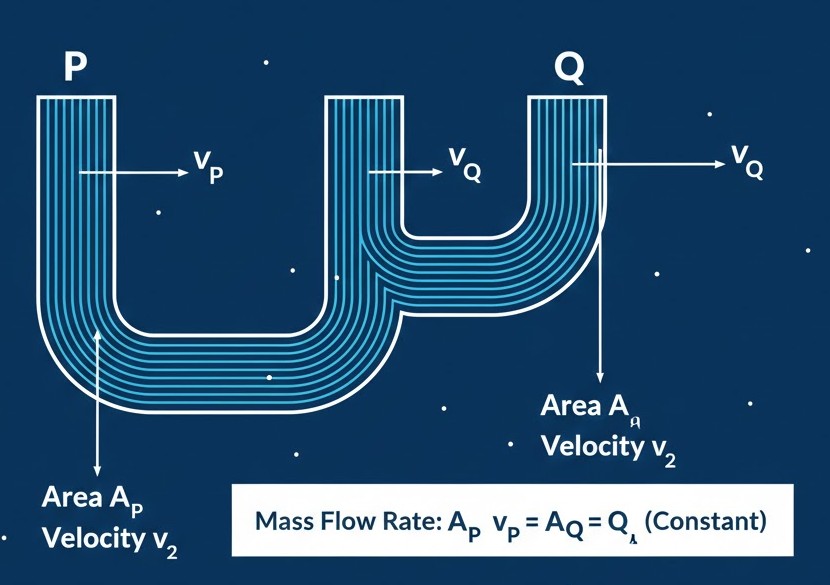
Now, let's clear up this funda: The Equation of Continuity. Since mass is conserved, what goes in must come out. For incompressible fluids, the product of the cross-sectional area ($A$) and the flow speed ($v$) stays constant:
NEET Checkpoint:
What is the product $Av$ called in fluid dynamics?
(a) Pressure
(b) Velocity head
(c) Volume flux / Flow rate
(d) Streamline
✅ Answer: (c) Volume flux or flow rate — It represents the volume of fluid crossing a section per unit time.
Notice this: at narrow constrictions where streamlines are crowded, the fluid speed increases. Think of a pani puri bhaiya squeezing the nozzle of his chutney bottle; the smaller the hole, the faster the delicious water shoots out!
NEET Checkpoint:
What happens to the flow speed when a pipe widens?
(a) Flow speed increases
(b) Flow speed decreases
(c) Flow speed remains the same
(d) Flow stops
✅ Answer: (b) Flow speed decreases — According to $Av = \text{constant}$, if Area $A$ increases, velocity $v$ must decrease.
Figure below:
A clear diagram showing streamlines entering a wide pipe section (Area $A_R$, Velocity $v_R$) and exiting through a narrower section (Area $A_Q$, Velocity $v_Q$), where streamlines are spaced widely in the first part and crowded together in the narrow part.
Practice Questions:
1. If the radius of a pipe is doubled, the speed of steady flow becomes:
(a) 2 times
(b) 4 times
(c) 1/2 times
(d) 1/4 times
✅ Answer: (d) 1/4 times — Area is proportional to $r^2$. If $r$ doubles, $A$ becomes 4 times. Since $Av$ is constant, $v$ must become $1/4$.
2. The Equation of Continuity is a statement of:
(a) Conservation of Energy
(b) Conservation of Mass
(c) Conservation of Momentum
(d) Bernoulli’s Theorem
✅ Answer: (b) Conservation of Mass — It ensures the mass of liquid flowing out equals the mass flowing in.
Now that you’ve mastered the flow, wait till you see how this connects with the legendary Bernoulli's Principle!
Key Takeaway
Formula Summary
- Equation of Continuity: $A_1 v_1 = A_2 v_2$
- Volume Flux: $Av = \text{constant}$
- Steady Flow: $v$ is constant at a point over time.
8. Bernoulli’s Principle and Its Applications
Listen up, junior! Ever wonder why a cricket ball swings or why massive aircraft don't just fall out of the sky? It's all Bernoulli’s magic! At its heart, Bernoulli’s principle is just conservation of energy dressed up for fluids. For a non-viscous, incompressible fluid in steady flow, the sum of pressure ($P$), kinetic energy per unit volume ($\frac{1}{2}\rho v^2$), and potential energy per unit volume ($\rho gh$) remains constant along a streamline.
The legendary equation is:
NEET Checkpoint:
Is Bernoulli's equation valid for turbulent flow?
(a) Yes, always
(b) No, only for viscous flow
(c) No, only for steady, incompressible, and non-viscous flow
(d) Yes, but only at high velocity
✅ Answer: (c) No — It strictly applies only to steady, streamline flow of non-viscous fluids.
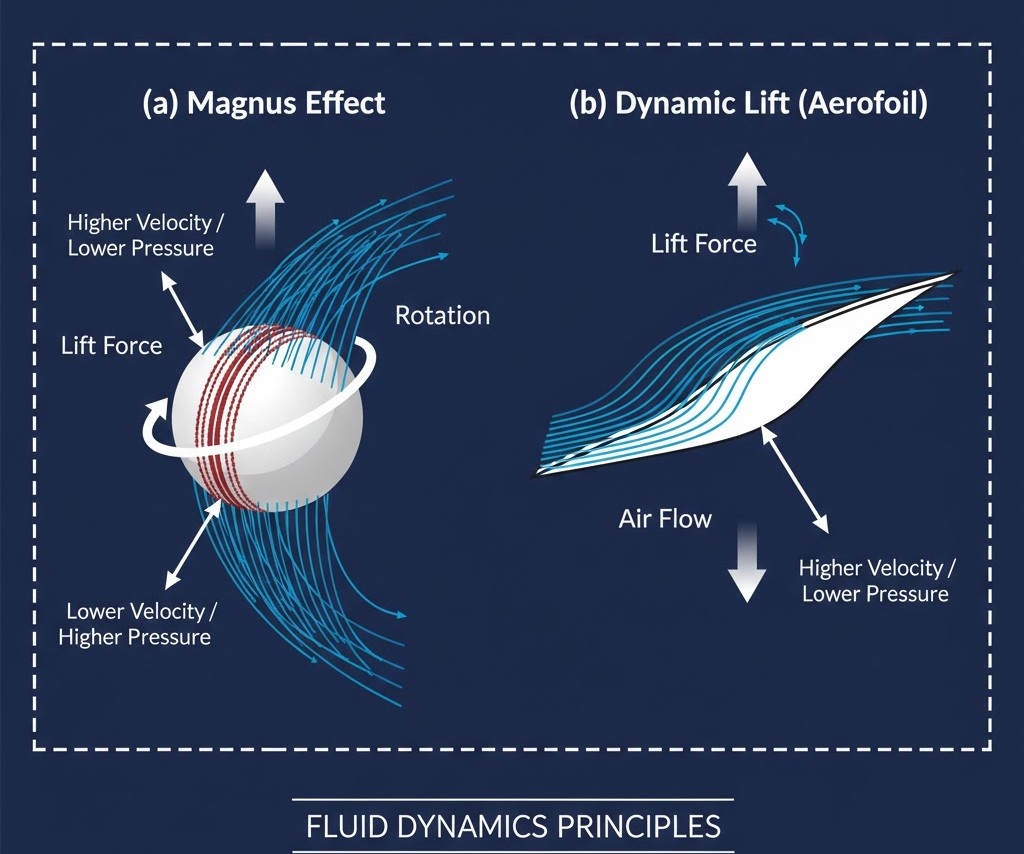
Think of a local gully cricket match. When a bowler spins the ball, it drags the surrounding air. This creates a velocity difference between the top and bottom of the ball, leading to a pressure gap. This "kick" that makes the ball deviate from its path is called the Magnus effect. Similarly, an aircraft wing (or aerofoil) is shaped so air moves faster on top than below, creating a pressure difference that provides dynamic lift to keep the plane soaring.
NEET Checkpoint:
What is the speed of efflux ($v_1$) for an open tank at depth $h$?
(a) $v_1 = \sqrt{gh}$
(b) $v_1 = gh$
(c) $v_1 = 2gh$
(d) $v_1 = \sqrt{2gh}$
✅ Answer: $v_1 = \sqrt{2gh}$ — This is Torricelli’s Law, and it's identical to the speed of a freely falling body.
Figure below:
A clear diagram showing streamlines crowded above a spinning cricket ball (Magnus effect) and an aerofoil wing showing higher velocity/lower pressure on top for dynamic lift.
NEET Checkpoint:
If fluid velocity increases in a horizontal pipe, what happens to the pressure?
(a) Pressure increases
(b) Pressure decreases
(c) Pressure remains the same
(d) Pressure becomes zero
✅ Answer: (b) Pressure decreases — Since height is constant, if kinetic energy goes up, pressure must go down to keep the total energy constant.
Practice Question:
1. Bernoulli's principle is a restatement of:
(a) Conservation of momentum
(b) Conservation of mass
(c) Conservation of energy
(d) Newton's Third Law
✅ Answer: (c) Conservation of energy — Arre, it’s basically the work-energy theorem for flowing liquids!.
2. For an open tank, the speed of efflux does NOT depend on:
(a) Acceleration due to gravity ($g$)
(b) Height of the liquid column ($h$)
(c) Area of the hole ($A_1$)
(d) Density of the liquid ($\rho$)
✅ Answer: (d) Density of the liquid — Look at the formula $v = \sqrt{2gh}$, density just cancels out!.
Key Takeaway
Formula Summary
* Bernoulli’s Equation: $P + \frac{1}{2}\rho v^2 + \rho gh = \text{constant}$
* Torricelli’s Law (Speed of Efflux): $v = \sqrt{2gh}$
* Dynamic Lift Force: $F = \Delta P \times A$
9. Viscosity, Stokes’ Law, and Terminal Velocity
Listen up, junior! Ever tried pouring cold honey on a hot paratha? It’s a struggle because of Viscosity—basically the internal friction that resists motion within a fluid. Think of it as liquid layers sliding over each other like the pages of your thick NCERT textbook when you push the cover.
For a flowing fluid, the Coefficient of Viscosity ($\eta$) is the "thickness" funda. It’s the ratio of shearing stress to strain rate:
The SI unit is the Poiseuille ($Pl$), though you’ll also see $N \cdot s \cdot m^{-2}$ or $Pa \cdot s$.
NEET Checkpoint:
What is the SI unit of the coefficient of viscosity?
(a) Pascal (Pa)
(b) Poiseuille (Pl)
(c) Newton (N)
(d) Poise (P)
✅ Answer: (b) Poiseuille ($Pl$) — Don't let the name confuse you, it's just $Pa \cdot s$!
Now, why don't raindrops hit us like bullets? That’s thanks to Stokes’ Law. When a sphere zooms through a fluid, it feels a retarding drag force:
As the raindrop speeds up, this drag increases until the upward forces (drag + buoyancy) perfectly balance the weight ($mg$). The drop then hits a constant Terminal Velocity ($v_t$).
NEET Checkpoint:
If a raindrop's radius doubles, its terminal velocity becomes?
(a) 2 times
(b) 4 times
(c) 8 times
(d) 16 times
✅ Answer: (b) 4 times — Because $v_t \propto a^2$, it's a square relationship, yaar!
The significance? Without terminal velocity, even a small drizzle would be deadly! The math works out to:
NEET Checkpoint:
Stokes' viscous force depends on which power of the velocity?
(a) v⁰ (independent of velocity)
(b) v¹ (directly proportional)
(c) v² (proportional to square of velocity)
(d) v³ (proportional to cube of velocity)
✅ Answer: (b) $v^1$ (directly proportional) — It’s directly proportional to velocity, not velocity squared!
Practice Question:
A small lead shot reaches a terminal velocity $v$ in glycerine. If you use a shot with half the radius, the new terminal velocity is?
(a) $v/2$
(b) $v/4$
(c) $2v$
(d) $4v$
✅ Answer: (b) $v/4$ — Since $v_t \propto a^2$, halving the radius $(1/2)^2$ gives $1/4$ the velocity.
Key Takeaway
Formula Summary
* Viscosity Force: $F = \eta A (v/l)$
* Stokes’ Law: $F = 6\pi\eta av$
* Terminal Velocity: $v_t = \frac{2a^2(\rho-\sigma)g}{9\eta}$
10. Surface Tension, Surface Energy, and Contact Angle
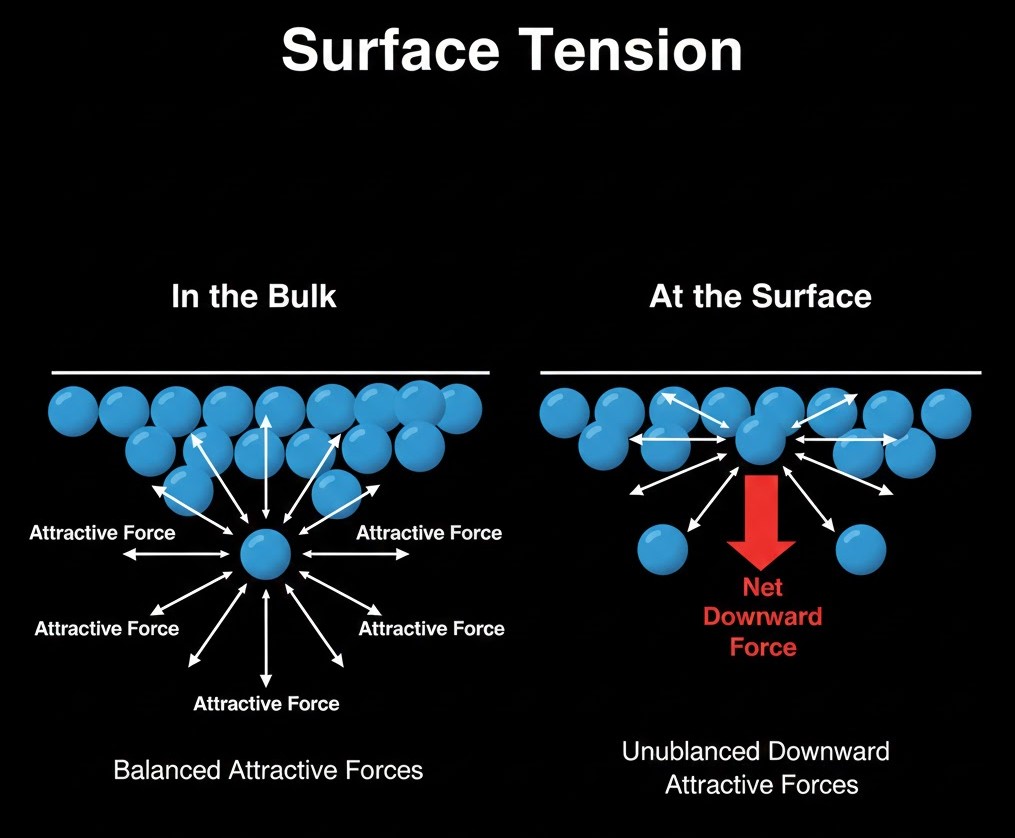
Arre junior, ever wondered why raindrops are round or why water beads up on your freshly waxed scooter? Let’s clear up this funda! It’s all about the "surface tension" game. Inside a liquid, a molecule is surrounded by "friends" pulling it from all sides, resulting in a balanced state. But a molecule at the surface is "lonely"—it only has neighbours below it, giving it extra potential energy compared to those in the bulk.
NEET Checkpoint:
What is the SI unit of surface tension ($S$)?
(a) $N~m^{-2}$
(b) $J~m^{-2}$
(c) $kg~m~s^{-1}$
(d) $N~m^2$
✅ Answer: (b) $J~m^{-2}$ — Arre! Surface tension is both force per unit length ($N~m^{-1}$) AND energy per unit area ($J~m^{-2}$).
Surface tension ($S$) acts like a stretched elastic membrane. For a liquid film, the relation is:
where $F$ is the force and $l$ is the length.
Figure below
A clear diagram showing two liquid molecules; one in the bulk with balanced attractive forces in all directions, and one at the surface with unbalanced downward attractive forces.
Now, why does water wet some surfaces but not others? Meet the Angle of Contact ($\theta$). It’s the angle between the tangent to the liquid surface and the solid surface inside the liquid. If $\theta$ is acute ($< 90^\circ$), like water on plastic, the liquid "wets" the solid. But if $\theta$ is obtuse ($> 90^\circ$), like water on a lotus leaf, it refuses to spread and forms droplets instead.
NEET Checkpoint:
What happens to surface tension as temperature increases?
(a) Increases
(b) Decreases
(c) Remains constant
(d) Becomes zero
✅ Answer: (b) Decreases — As things heat up, molecules get more mobile and the "tension" falls.
Factors to remember:
1. Temperature: $S$ usually falls as temperature rises.
2. Detergents: These are "wetting agents" that reduce $\theta$ so water can penetrate your clothes and wash away that pani puri stain!
NEET Checkpoint:
A liquid does not wet a solid if the angle of contact is:
(a) $0^\circ$
(b) $45^\circ$
(c) $60^\circ$
(d) $120^\circ$
✅ Answer: (d) $120^\circ$ — Obtuse angles mean the liquid molecules are attracted more to themselves than to the solid.
Practice Question:
Which relation correctly represents the equilibrium of interfacial tensions?
(a) $S_{la} = S_{sa} + S_{sl}$
(b) $S_{la} \cos \theta + S_{sl} = S_{sa}$
(c) $S_{sl} \cos \theta + S_{la} = S_{sa}$
(d) $S_{sa} \cos \theta + S_{sl} = S_{la}$
✅ Answer: (b) — This is the standard equilibrium formula for the line of contact.
Key Takeaway
Formula Summary
* Surface Tension ($S$): $S = \text{Force} / \text{Length} = \text{Energy} / \text{Area}$
* Contact Angle Relation: $S_{la} \cos \theta + S_{sl} = S_{sa}$
* Wetting Condition: $\theta < 90^\circ$ (Acute); Non-wetting: $\theta > 90^\circ$ (Obtuse)
11. Surface Phenomena: Drops, Bubbles, and Capillary Rise
Hey there, junior! Ready to understand why nature loves spheres and how water pulls off a "climbing" act? Let's clear up this surface tension funda once and for all!
Ever wondered why raindrops are spherical? It’s because the liquid-air interface has energy, and a sphere is the best shape to keep that area (and energy) at a minimum. Inside these tiny spheres, things get intense. The pressure inside a liquid drop ($P_i$) is higher than the pressure outside ($P_o$). This excess pressure for a drop (or an air bubble in liquid) is:
where $S$ is surface tension and $r$ is the radius. Now, don’t get confused with a soap bubble—it has two surfaces (inner and outer), so the extra pressure doubles to:
NEET Checkpoint:
Why is a soap bubble harder to blow than a drop?
(a) Because surface tension of the bubble is lower
(b) Because surface tension of the bubble is higher
(c) Because the bubble has two surfaces
(d) Because air pressure inside the bubble is lower
✅ Answer: (c) Because of the two interfaces, you need double the excess pressure ($4S/r$) to keep it stable!
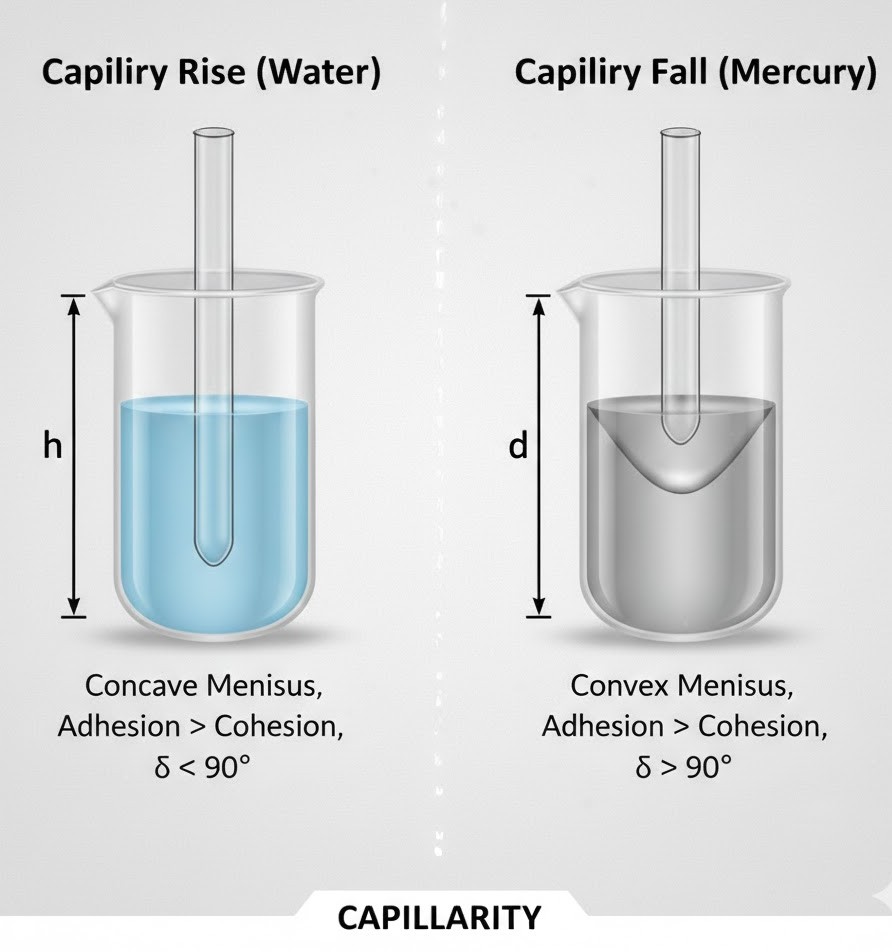
Imagine you're at a local pani puri stall. Notice how the spicy water slightly climbs the sides of the bowl? That's the start of capillary rise! When you dip a very narrow tube (radius $a$) into water, the water level shoots up. This happens because the contact angle $\theta$ for water-glass is acute, making the surface concave. The pressure just below this curve is less than atmospheric pressure, so the liquid rises to a height $h$ to balance things out:
Mercury, however, is a bit of a rebel. It has an obtuse contact angle, making its meniscus convex. Since $\cos \theta$ becomes negative, mercury actually depresses (goes down) in the tube instead of rising!.
NEET Checkpoint:
If a capillary tube is very thin (tiny $a$), what happens to $h$?
(a) h increases
(b) h decreases
(c) h remains the same
(d) h becomes zero
✅ Answer: (a) h increases! Since $h \propto 1/a$, the "hair-thin" tubes give the biggest rise.
NEET Checkpoint:
What is the pressure on the concave side of a liquid-gas interface?
(a) Less than the pressure on the convex side
(b) Equal to the pressure on the convex side
(c) Greater than the pressure on the convex side
(d) Zero
✅ Answer: (c) It is always higher than the pressure on the convex side.
Figure below:
A clear diagram showing a vertical capillary tube in a beaker of water with a concave meniscus and height h, and another tube in mercury showing a convex meniscus and depression below the main level.
Practice Questions:
1. A soap bubble of radius $r$ has surface tension $S$. The excess pressure is:
(a) $S/r$
(b) $2S/r$
(c) $4S/r$
(d) $8S/r$
✅ Answer: (c) — Soap bubbles have two liquid-air interfaces.
2. Water rises in a capillary because its contact angle is:
(a) Obtuse
(b) Acute
(c) $180^\circ$
(d) $90^\circ$
✅ Answer: (b) — Acute angles create a concave meniscus that leads to rise.
Key Takeaway
Formula Summary
- Excess Pressure (Drop):
$$P_i - P_o = \frac{2S}{r}$$- Excess Pressure (Soap Bubble):
$$P_i - P_o = \frac{4S}{r}$$- Capillary Rise:
$$h = \frac{2S \cos \theta}{\rho g a}$$
12. Heat, Temperature, and Ideal Gas Laws
Listen up, junior! Ever wondered why your hot ginger chai eventually goes cold if you're too busy scrolling? That’s heat transfer in action. Temperature is basically just a relative measure or indication of how "hot" or "cold" a body is. While our "temperature sense" by touch is a bit unreliable, heat is the actual energy that flows between systems simply because there is a temperature difference. Arre, it's like a run-rate difference in a cricket match—energy always flows to close the gap!
NEET Checkpoint:
What is the SI unit of heat energy?
(a) Joule (J)
(b) Calorie (cal)
(c) Electronvolt (eV)
(d) Watt (W)
✅ Answer: (a) Joule ($J$) — Don't get confused with calories, yaarr; stay focused on SI units!
We measure this "hotness" using thermometers, which often track how a liquid’s volume changes with temperature. You’ve got the Celsius ($^\circ C$) and Fahrenheit ($^\circ F$) scales, but the real boss in physics is the Kelvin ($K$) scale. You can convert between the first two using this straight-line relationship:
NEET Checkpoint:
At what temperature does pure water freeze under standard pressure on the Fahrenheit scale?
(a) $0^\circ F$
(b) $32^\circ F$
(c) $100^\circ F$
(d) $212^\circ F$
✅ Answer: (b) $32^\circ F$ — This is known as the ice point.
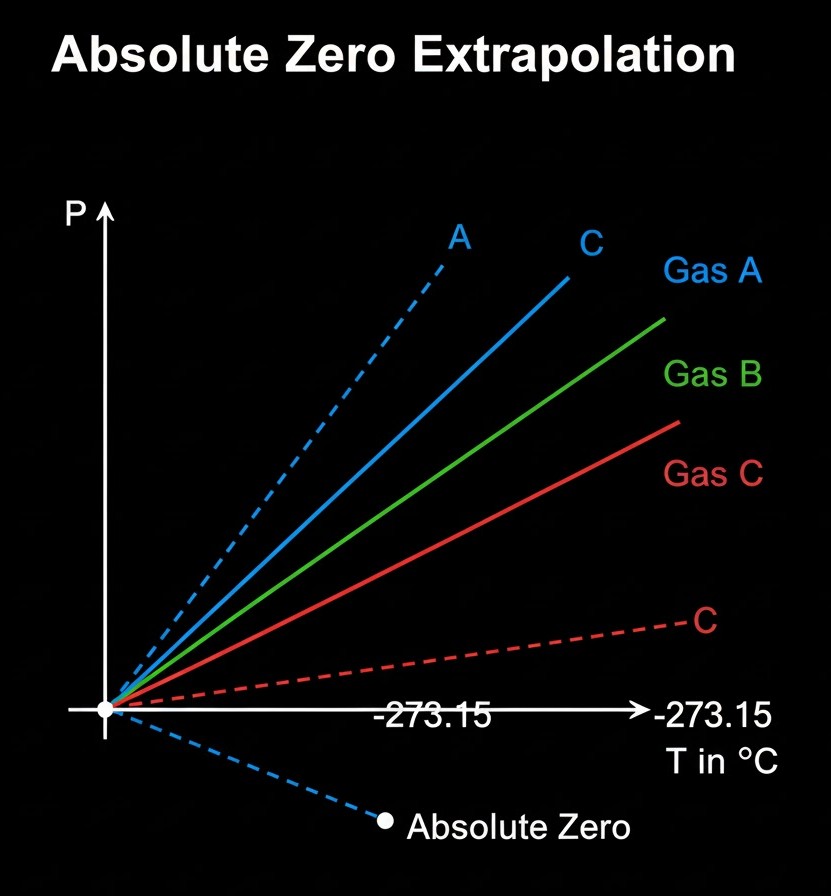
Now, liquid thermometers can be moody, so scientists use gas thermometers because all gases at low densities behave the same way. If you plot pressure versus temperature and extrapolate the line down to zero pressure, you hit a magic floor: $-273.15^\circ C$. This is Absolute Zero ($0\text{ K}$), the foundation of the Kelvin scale.
NEET Checkpoint:
How do you convert Celsius to Kelvin?
(a) $T = t_c + 273.15$
(b) $T = t_c - 273.15$
(c) $T = t_c * 273.15$
(d) $T = t_c / 273.15$
✅ Answer: (a) $T = t_c + 273.15$ — Just add $273.15$ to your Celsius reading.
Low-density gases follow the Ideal Gas Equation:
Here, $P$ is pressure, $V$ is volume, $\mu$ is the number of moles, and $R$ is the universal gas constant ($8.31\text{ J mol}^{-1}\text{ K}^{-1}$).
Figure below:
A clear graph showing Pressure on the y-axis and Temperature in Celsius on the x-axis, with multiple linear plots for different gases (Gas A, B, and C) all extrapolating back to meet at -273.15 degrees Celsius on the x-axis.
Practice Questions:
1. If a gas is at absolute zero ($0\text{ K}$), what is its temperature in Celsius?
(a) $273.15^\circ C$
(b) $0^\circ C$
(c) $-273.15^\circ C$
(d) $100^\circ C$
✅ Answer: (c) $-273.15^\circ C$ — This is the absolute minimum temperature where pressure ideally hits zero.
2. In the equation $PV = \mu RT$, what does $R$ represent?
(a) Relative Density
(b) Universal Gas Constant
(c) Rate of expansion
(d) Refractive index
✅ Answer: (b) Universal Gas Constant — Its value is $8.31\text{ J mol}^{-1}\text{ K}^{-1}$ for all low-density gases.
Key Takeaway
Formula Summary
- Temperature Conversion: $\frac{t_F - 32}{180} = \frac{t_c}{100}$
- Kelvin Scale: $T = t_c + 273.15$
- Ideal Gas Equation: $PV = \mu RT$
- Gas Constant: $R = 8.31\text{ J mol}^{-1}\text{ K}^{-1}$
13. Thermal Expansion: Why Things Get "Extra" When Heated!
Listen up, junior! Ever wonder why those railway tracks have tiny gaps or why a tight metallic jam jar lid opens up after a quick hot water bath? It’s all about Thermal Expansion. Basically, most substances are like us after a heavy biryani—they need more space when they heat up!
We measure this "extra-ness" using three coefficients:
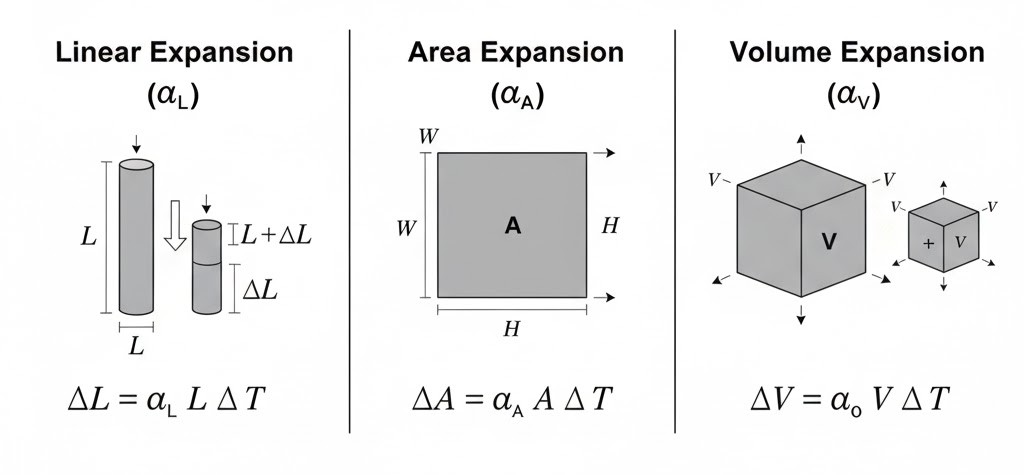
1. Linear Expansion ($\alpha_l$): For long rods. $\frac{\Delta l}{l} = \alpha_l \Delta T$.
2. Area Expansion ($\alpha_a$): For flat sheets. $\frac{\Delta A}{A} = \alpha_a \Delta T$.
3. Volume Expansion ($\alpha_v$): For 3D objects. $\frac{\Delta V}{V} = \alpha_v \Delta T$.
NEET Checkpoint:
What is the ratio of $\alpha_l : \alpha_a : \alpha_v$ for an isotropic solid?
(a) $1:1:1$
(b) $1:2:3$
(c) $3:2:1$
(d) $4:2:1$
✅ Answer: (b) $1:2:3$ — Because $\alpha_a = 2\alpha_l$ and $\alpha_v = 3\alpha_l$!
Now, water is the "backbencher" of Physics—it doesn't follow the rules! Between $0^{\circ}C$ and $4^{\circ}C$, water contracts on heating instead of expanding. This anomalous expansion means water has maximum density at $4^{\circ}C$. This is a lifesaver for our fishy friends; ice forms at the top of lakes, while the denser $4^{\circ}C$ water stays at the bottom, keeping aquatic life safe during winter.
NEET Checkpoint:
At what temperature is the density of water maximum?
(a) $0^{\circ}C$
(b) $100^{\circ}C$
(c) $25^{\circ}C$
(d) $4^{\circ}C$
✅ Answer: (d) $4^{\circ}C$ — Below this, it starts expanding again as it cools!
Lastly, don't forget Thermal Stress. If you fix a rod between two rigid walls and heat it, it tries to expand but can't. This develops a massive internal "tension" called thermal stress.
Relatable Indian Example: Think of a blacksmith fitting an iron ring on a wooden bullock cart wheel. He heats the ring to make it expand, slips it on, and as it cools, it grips the wheel with crazy force!
NEET Checkpoint:
A rod is fixed between two walls. If temperature increases, the thermal stress is:
(a) Compressive
(b) Tensile
(c) Zero
(d) Shearing
✅ Answer: (a) Compressive — The rod wants to grow, but the walls push it back!
Figure below:
A clear diagram showing a long rod expanding linearly (delta L), a square sheet expanding in area (delta A), and a cube expanding in volume (delta V) with labels for alpha_l, alpha_a, and alpha_v.
Practice Question:
If the temperature of a gas is increased at constant pressure, its coefficient of volume expansion $\alpha_v$ is:
(a) $T$
(b) $1/T$
(c) $T^2$
(d) Constant
✅ Answer: (b) $1/T$ — For an ideal gas, $\alpha_v = \frac{1}{T}$, showing it decreases as temperature rises!
Key Takeaway
Formula Summary
- Linear: $\Delta l = \alpha_l l \Delta T$
- Relationship: $\alpha_l = \frac{\alpha_a}{2} = \frac{\alpha_v}{3}$
- Thermal Stress: $\sigma = Y \alpha_l \Delta T$
14. Calorimetry: Specific Heat and Latent Heat
Calorimetry is just the science of measuring heat, much like counting how many laddoos disappear at a wedding. When you mix hot and cold things in an isolated container, the Principle of Calorimetry says that the heat lost by the hot body must equal the heat gained by the cold body. It’s a simple energy exchange funda: what one loses, the other gains, provided no heat escapes to the surroundings.
Every substance has a "patience level" for heat, called Specific Heat Capacity ($s$). It is the heat needed per unit mass to change the temperature by one unit. The formula is $s = \frac{1}{m} \frac{\Delta Q}{\Delta T}$. If you measure it per mole ($\mu$) instead of mass ($m$), we call it Molar Specific Heat Capacity ($C$), where $C = \frac{1}{\mu} \frac{\Delta Q}{\Delta T}$. Water has a massive specific heat ($4186 \, J \, kg^{-1} K^{-1}$), which is why it’s great for hot water bags—it stays warm forever!
NEET Checkpoint:
What is the SI unit of molar specific heat capacity $C$?
(a) $J \, kg^{-1} K^{-1}$
(b) $J \, K^{-1}$
(c) $J \, mol^{-1} K^{-1}$
(d) $cal \, g^{-1}$
✅ Answer: (c) $J \, mol^{-1} K^{-1}$ — It represents the heat required per mole per unit temperature change.
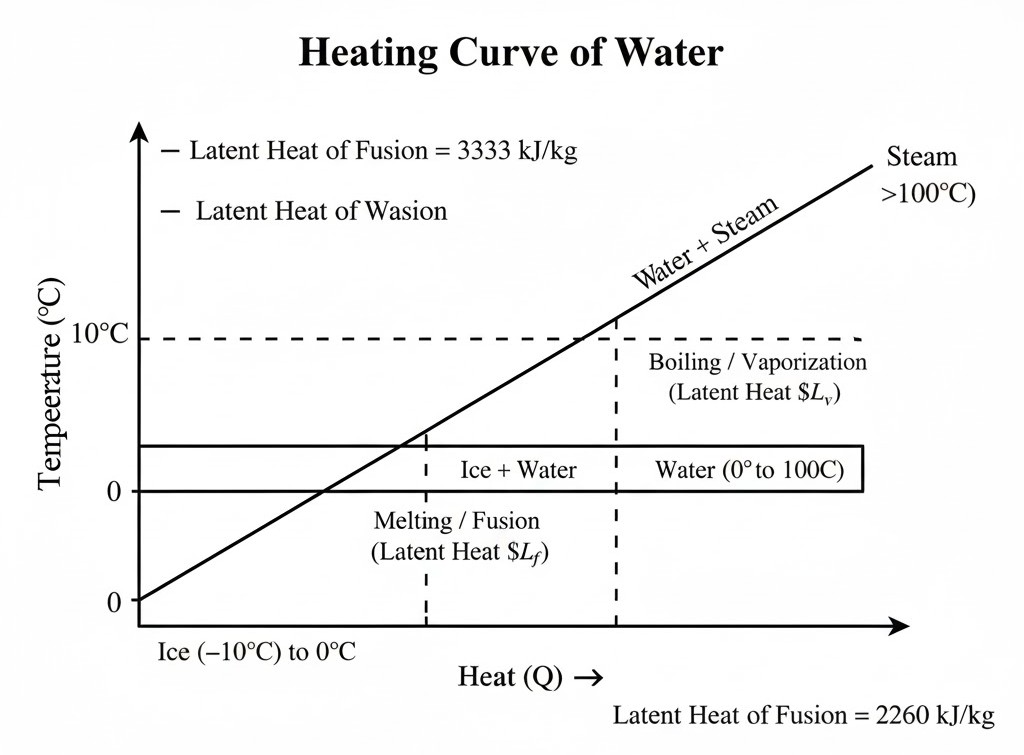
Sometimes, heat doesn't change the temperature at all; it just changes the "state" of matter. During melting (solid to liquid) or boiling (liquid to gas), the temperature stays constant while the substance absorbs Latent Heat ($L$) to break molecular bonds. The heat required is $Q = mL$. Some substances even skip the liquid phase entirely, going from solid to vapour—this is called sublimation.
NEET Checkpoint:
During a phase change from ice to water, the temperature:
(a) Increases
(b) Decreases
(c) Remains constant
(d) Fluctuates
✅ Answer: (c) Remains constant — The heat energy is used entirely for the change of state.
Relatable Indian Example:
1. Imagine a juice-wala adding ice to your ganne ka juice (sugarcane juice). The heat lost by the warm juice equals the heat gained by the melting ice.
2. Ever noticed how a steam burn from a pressure cooker feels much worse than a splash of boiling water? That’s because steam at $100^{\circ}C$ carries $22.6 \times 10^5 \, J \, kg^{-1}$ of extra "hidden" latent heat!
NEET Checkpoint:
Why is steam at $100^{\circ}C$ more dangerous than water at $100^{\circ}C$?
(a) It is hotter
(b) It has higher specific heat
(c) It carries latent heat of vapourisation
(d) It is less dense
✅ Answer: (c) It carries latent heat of vapourisation — Steam carries significantly more energy per kilogram than boiling water at the same temperature.
Figure below:
A clear, scientific graph showing Temperature vs Heat for water, illustrating constant temperature plateaus during melting at 0°C and boiling at 100°C.
Practice Question:
How much heat is required to melt $2 \, kg$ of ice at $0^{\circ}C$? (Take $L_f = 3.33 \times 10^5 \, J \, kg^{-1}$)
(a) $1.66 \times 10^5 \, J$
(b) $3.33 \times 10^5 \, J$
(c) $6.66 \times 10^5 \, J$
(d) $0 \, J$
✅ Answer: (c) $6.66 \times 10^5 \, J$. Calculation: $Q = mL = 2 \times 3.33 \times 10^5 = 6.66 \times 10^5 \, J$.
Key Takeaway
Formula Summary
* Principle of Calorimetry: $Heat \, Lost = Heat \, Gained$
* Specific Heat Capacity: $s = \frac{1}{m} \frac{\Delta Q}{\Delta T}$
* Molar Specific Heat: $C = \frac{1}{\mu} \frac{\Delta Q}{\Delta T}$
* Latent Heat of Fusion/Vapourisation: $Q = mL$
15. Modes of Heat Transfer: Conduction, Convection, and Radiation
Listen up, junior! Heat doesn't just sit there; it loves to travel. There are three main ways it moves: Conduction, Convection, and Radiation. Understanding these fundas is the secret to cracking thermal physics, so let's dive in!
Conduction is the "shaking hands" mode. Heat flows through a body via molecular collisions without the matter itself moving. In a steady state, the rate of heat flow (heat current) $H$ through a bar is:
Here, $K$ is the thermal conductivity. Metals like silver have a high $K$, while gases like air are poor conductors—that's why we use glass wool for insulation.
NEET Checkpoint:
What is the SI unit of thermal conductivity $K$?
(a) J·s⁻¹·m⁻¹·K⁻¹
(b) W·m⁻¹·K⁻¹
(c) Both (a) and (b)
(d) J·m⁻²·s⁻¹
✅ Answer: (c) $\text{J s}^{-1} \text{ m}^{-1} \text{ K}^{-1}$ and $\text{W m}^{-1} \text{ K}^{-1}$ — Use the formula $H = KA \Delta T / L$ to derive it!.
Convection involves the actual bulk motion of matter, so it only happens in fluids. Natural convection is driven by gravity; hot fluid expands, becomes less dense, and rises. This creates sea breezes during the day and trade winds that blow towards the equator. Forced convection uses a pump, like your heart circulating blood to maintain body temperature.
Radiation is the superstar that needs no medium. It travels via electromagnetic waves at the speed of light. Blackbody radiation has a continuous spectrum. We use Wien’s Displacement Law to find the peak wavelength:
The total power radiated is given by the Stefan-Boltzmann Law:
where $\sigma \approx 5.67 \times 10^{-8} \text{ W m}^{-2} \text{ K}^{-4}$.
NEET Checkpoint:
Does heat transfer by radiation require a medium?
(a) Yes, always
(b) No, it can occur through a vacuum
(c) Only in liquids
(d) Only in solids
✅ Answer: (b) No — It can travel through a vacuum, which is how the Sun's heat reaches Earth!.
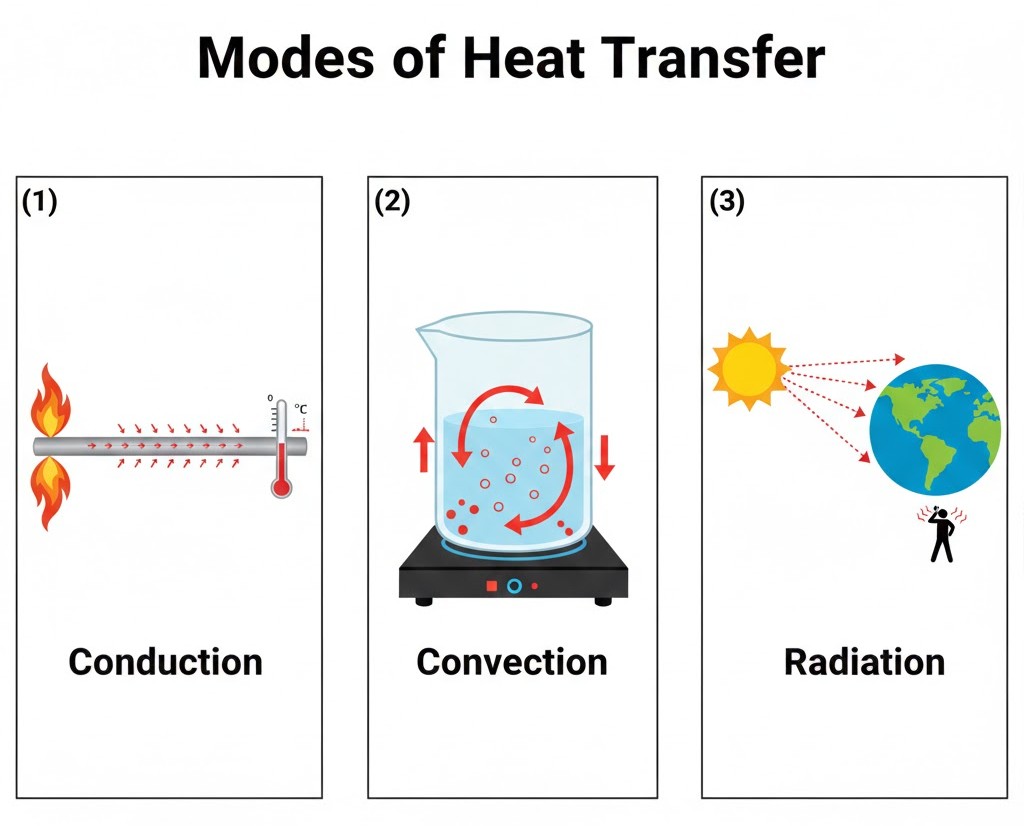
Relatable Indian Example: Imagine a halwai making jalebis. The heat moving through the long metal handle of his ladle is conduction. The hot oil rising in the kadai is convection. The warmth you feel on your face while standing a few feet away is radiation! Don't get burnt, yaar!
NEET Checkpoint:
Why is the bottom of a cooking pot often blackened?
(a) To increase its strength
(b) To absorb more heat
(c) To reduce weight
(d) To make it look attractive
✅ Answer: (b) Black bodies are better absorbers of radiant energy.
Figure below:
A clear diagram showing three panels: (1) A metal rod being heated at one end illustrating conduction, (2) A beaker of water with arrows showing a circular convection current, and (3) The sun emitting wavy lines towards Earth representing radiation.
Practice Question:
If the absolute temperature of a blackbody is doubled, by what factor does the radiated power increase?
(a) 2
(b) 4
(c) 8
(d) 16
✅ Answer: (d) 16 — According to the Stefan-Boltzmann Law, $H \propto T^4$. So, $2^4 = 16$.
Key Takeaway:
Heat Transfer Summary
- Conduction: $H = KA \frac{\Delta T}{L}$ (Needs a medium, no bulk motion).
- Convection: Natural (buoyancy) vs. Forced (pumps).
- Radiation: $H = Ae \sigma T^4$ (No medium needed, EM waves).
- Wien's Law: $\lambda_m T = 2.9 \times 10^{-3} \text{ m K}$.