1. Introduction to Measurement and Fundamental Units
The foundation of Physics is measurement. Without measuring things precisely, we're just guessing!
So, what is measurement exactly? It’s simply the process of comparison. You compare the physical quantity you are measuring (like your height) with a basic, accepted reference standard called a unit. Remember, every physical quantity you measure is expressed by a number (or numerical measure) accompanied by a unit.
The Funda of Units
Notice this: although there are loads of physical quantities (like force, speed, work, etc.), we only need a limited number of fundamental or base quantities because all others are inter-related.
- Fundamental (Base) Units: These are the units for the base quantities.
- Derived Units: These are units for derived quantities, obtained by combining the base units.
A complete set, comprising both base units and derived units, is known as the system of units.
Relatable Indian Example: Imagine a pani puri vendor measuring out $1~L$ of water. The quantity is volume. $L$ (litre) is a derived unit, but it’s based on the base unit of length ($m$), since $1~L = 1~dm^{3} = 10^{-3}~m^{3}$.
NEET Checkpoint:
The process of measurement fundamentally involves comparison with an accepted standard called a:
(a) Dimension
(b) Unit
(c) Prefix
(d) Scale.
✅ Answer: (b) Unit — Measurement involves comparison with a basic, internationally accepted unit.
Enter SI: The Global Standard
For international usage in scientific, technical, industrial, and commercial work, the Systeme Internationale Unites (SI) is the accepted system. Since SI uses the decimal system, conversions are super simple, which is cool, right?.
The SI system relies on seven base units. These seven dimensions describe the physical world:
- Length: metre ($m$)
- Mass: kilogram ($kg$)
- Time: second ($s$)
- Electric Current: ampere ($A$)
- Thermodynamic Temperature: kelvin ($K$)
- Amount of Substance: mole ($mol$)
- Luminous Intensity: candela ($cd$)
Besides these, units for plane angle (radian, $rad$) and solid angle (steradian, $sr$) are also defined, though both are dimensionless quantities.
NEET Checkpoint:
Which of the following is not an SI base quantity?
(a) Time
(b) Force
(c) Temperature
(d) Electric Current.
✅ Answer: (b) Force — Force has derived units ($kg~m~s^{-2}$) and is not one of the seven base quantities.
NEET Checkpoint:
The SI unit of luminous intensity is:
(a) Ampere
(b) Mole
(c) Kelvin
(d) Candela.
✅ Answer: (d) Candela — The unit for luminous intensity is the candela ($cd$).
Practice Questions:
1. Speed is calculated as $\text{distance}/\text{time}$. What kind of unit is the SI unit of speed ($m/s$)?
(a) Fundamental unit
(b) Base unit
(c) Derived unit
(d) Dimensionless unit
✅ Explanation: (c) Derived unit. Since speed is a combination of length ($m$) and time ($s$), its unit is a combination of base units, making it a derived unit.
2. If the mass of a cricket ball is $156~g$, and its speed is $35~m/s$, the unit of its momentum ($\text{mass} \times \text{velocity}$) is $kg~m~s^{-1}$. This unit is a:
(a) Base unit
(b) System of units
(c) Derived unit
(d) Numerical measure
✅ Explanation: (c) Derived unit. $kg~m~s^{-1}$ is a combination of the base units $kg$, $m$, and $s$, and is therefore a derived unit.
Key Takeaway:
| Measurement Foundation | Measurement is comparison against a standard unit. A complete set of units (base and derived) forms a system of units. |
| The SI Base Seven | Length (m), Mass (kg), Time (s), Electric Current (A), Temperature (K), Amount of Substance (mol), and Luminous Intensity (cd) are the seven fundamental base units. |
2. The International System of Units (SI)
Hey future doctors! Before we settled on a uniform system of measurement, the world of physics was a bit chaotic, with scientists using different unit systems across countries. Let's clear up this funda about how we landed on the system you use daily!
Historically, three major systems were extensively used:
1. CGS System: Based on $centimetre$, $gram$, and $second$ for length, mass, and time, respectively.
2. FPS System: Also known as the British system, using $foot$, $pound$, and $second$ for length, mass, and time.
3. MKS System: Utilized $metre$, $kilogram$, and $second$ for length, mass, and time.
Notice this: While the base quantities (length, mass, time) were the same, the units differed, causing conversion headaches.
NEET Checkpoint:
The base units of length, mass, and time in the CGS system are:
(a) metre, kilogram, second
(b) foot, pound, second
(c) centimetre, gram, second
(d) second, metre, kilogram
✅ Answer: (c) centimetre, gram, second — Arre, C, G, S stands for centimetre, gram, second, yaar!
The Boss System: SI
The system of units which is presently accepted internationally for measurement is the Système Internationale d’Unités, universally abbreviated as SI. This system, which provides a standard scheme of symbols and units, was developed by the Bureau International des Poids et Mesures (BIPM). Here’s the trick for your GK: The SI was recently revised by the General Conference on Weights and Measures in November 2018.
Now, why is SI the best? SI units are highly convenient because they use the decimal system. This makes conversions within the system quite simple, which is a major relief in complex calculations. Imagine a local rickshaw driver giving you a fare of $10000~paise$; you quickly know that's $100~rupees$ because we use the decimal system. This decimal magic makes physics conversion a breeze!
The SI system consists of seven base units (like $metre$, $kilogram$, $second$, etc.). Besides these seven, we have two special dimensionless quantities for angles:
* Plane Angle: $radian$ (symbol $rad$), defined as the ratio of arc length $ds$ to radius $r$: $d\theta=ds/r$.
* Solid Angle: $steradian$ (symbol $sr$), defined as the ratio of intercepted area $dA$ of a spherical surface to the square of its radius $r$: $d\Omega=dA/r^{2}$.
NEET Checkpoint:
The SI system is considered highly convenient globally primarily because:
(a) It was developed in France
(b) It uses the decimal system
(c) It has only three base units
(d) It uses pounds and feet
✅ Answer: (b) It uses the decimal system — Since SI uses the power of 10, calculations and conversions are straightforward.
NEET Checkpoint:
The SI system was most recently revised in:
(a) 1971
(b) November 2018
(c) 2020
(d) 1999
✅ Answer: (b) November 2018 — The SI developed in 1971 was recently revised in November 2018.
Practice Questions:
-
Which of the following is defined as the ratio of the intercepted area $dA$ of the spherical surface to the square of its radius $r$?
(a) Plane angle
(b) Candela
(c) Solid angle
(d) Radian
✅ Answer: (c) Solid angle — The solid angle is $d\Omega=dA/r^{2}$, measured in $steradian$ ($sr$). -
Which old system used $foot$ as the base unit for length and $pound$ as the base unit for mass?
(a) CGS
(b) MKS
(c) SI
(d) FPS
✅ Answer: (d) FPS — The FPS (Foot, Pound, Second) system used these specific base units.
Key Takeaway:
The globally accepted SI system, revised in November 2018, is convenient because it's decimal-based. It uses seven base units plus $radian$ and $steradian$ for angles.
3. Defining the Seven SI Base Units
Hello, future doctors! Let's clear up the funda behind the seven SI Base Units. This set is the rock-solid foundation for all physical measurements globally, adopted for international scientific and commercial work. Knowing these seven is the ultimate base camp for physics, yaar!
The International System of Units ($SI$) is built upon exactly seven base units that correspond to seven fundamental or base quantities. Every other unit in physics is just a combination of these base seven.
Here is the essential list of base quantities and their corresponding $SI$ units and symbols:
1. Length: metre ($m$)
2. Mass: kilogram ($kg$)
3. Time: second ($s$)
4. Electric Current: ampere ($A$)
5. Thermodynamic Temperature: kelvin ($K$)
6. Amount of Substance: mole ($mol$)
7. Luminous Intensity: candela ($cd$)
In modern science, these base units are defined by taking fixed numerical values of fundamental constants. It’s super precise! For example, the metre ($m$) is defined by setting the fixed numerical value of the speed of light in vacuum ($c$) to $299792458~m~s^{-1}$. Similarly, the kilogram ($kg$) is defined using the fixed numerical value of the Planck constant ($h$).
NEET Checkpoint:
Which unit is defined by fixing the numerical value of the speed of light ($c$)?
(a) Second
(b) Ampere
(c) Metre
(d) Kilogram
✅ Answer: (c) Metre — Jaldi dekho! The metre ($m$) uses the fixed value of $c$ for its definition.
The definition of the mole ($mol$) is especially cool for chemistry aspirants. One $mole$ contains exactly $6.02214076 \times 10^{23}$ elementary entities. This specific number is the fixed numerical value of the Avogadro constant ($N_{A}$). Think of it this way: when a pani puri stall owner measures a $kg$ of potatoes, they are using a base unit, and when they calculate how many individual puri shells they need, that count is analogous to the Avogadro number!
NEET Checkpoint:
The $SI$ unit for thermodynamic temperature is:
(a) Joule
(b) Kelvin
(c) Hertz
(d) Candela
✅ Answer: (b) Kelvin — $Kelvin$ ($K$) is one of the seven $SI$ base units.
The candela ($cd$), the unit for Luminous Intensity, is defined based on the fixed numerical value of the luminous efficacy of monochromatic radiation. Even tiny measurements, like the $second$ ($s$), are defined by a frequency constant (the caesium frequency, $\Delta Vcs$).
NEET Checkpoint:
The fixed numerical value of the Avogadro constant ($N_{A}$) is used to define which $SI$ base unit?
(a) Ampere
(b) Kilogram
(c) Mole
(d) Candela
✅ Answer: (c) Mole — The fixed number of elementary entities ($6.02214076 \times 10^{23}$) defines the $mole$.
Practice Questions:
-
Which of the following derived units uses the base units $kg~m^{2}s^{-2}$?
(a) Metre
(b) Second
(c) Joule
(d) Ampere
✅ Answer: (c) Joule — The definition of the kelvin ($K$) mentions that $J~K^{-1}$ is equal to $kg~m^{2}s^{-2}k^{-1}$, implying that $J$ has dimensions of $kg~m^{2}s^{-2}$. -
If a physical quantity is expressed using the dimension of mass, $[M]$, and the dimension of length, $[L]$, what dimensional quantity might it represent?
(a) Speed
(b) Volume
(c) Force
(d) Density
✅ Answer: (d) Density — Mass density has the dimensional formula $[M~L^{-3}T^{0}]$, which depends on mass $[M]$ and length $[L]$.
Key Takeaway:
The $SI$ system uses seven base quantities and units (Length ($m$), Mass ($kg$), Time ($s$), Electric Current ($A$), Thermodynamic Temperature ($K$), Amount of Substance ($mol$), and Luminous Intensity ($cd$)). These are defined by fixing fundamental constants, like the speed of light ($c$) for the $metre$ and the Planck constant ($h$) for the $kilogram$.
4. Supplementary Units and Other Retained Units
Hey, future doctors! We just finished the seven base units, the absolute essentials of measurement. But wait, there are two units that act as indispensable supporting actors in the SI system: the supplementary units. Don't stress, yaar—these two are conceptually simple, and they clear up an important funda about dimensions!
The Dimensionless Duo
Besides the seven base units given in Table 1.1, the SI system defines two additional units: the radian ($\text{rad}$) and the steradian ($\text{sr}$).
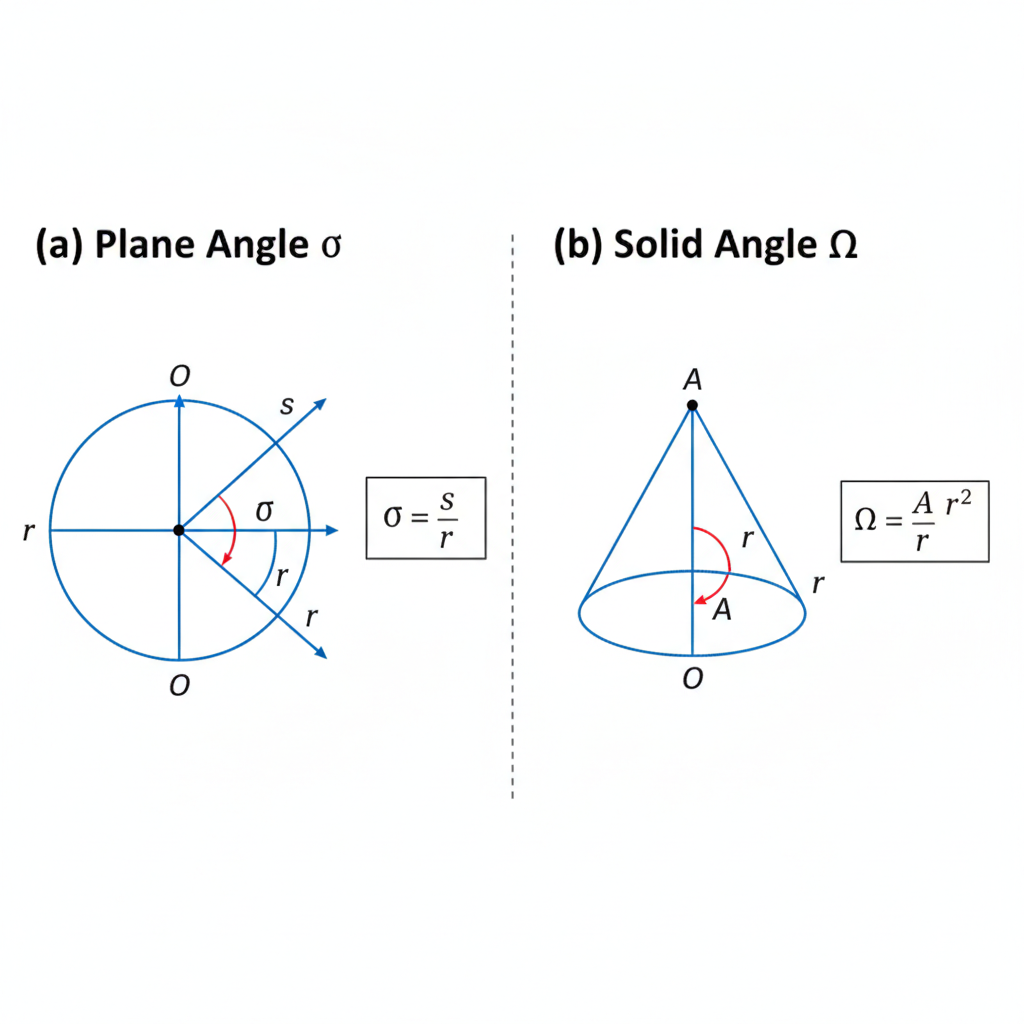
- Plane Angle: The unit for the plane angle ($d\theta$) is the radian ($\text{rad}$). It is defined as the ratio of the length of arc ($ds$) to the radius ($r$).
$$d\theta = \frac{ds}{r}$$ - Solid Angle: The unit for the solid angle ($d\Omega$) is the steradian ($\text{sr}$). This is defined as the ratio of the intercepted area ($dA$) on a spherical surface to the square of its radius ($r^2$).
$$d\Omega = \frac{dA}{r^{2}}$$
Notice this, and keep it safely tucked in your memory for NEET: both plane angle and solid angle are dimensionless quantities. Since they are ratios of two lengths (or area and area), their dimensions cancel out!
Relatable Example: Think of a tiny $pani puri$$ shop. The angle formed by two lines from your eye to the edges of one puri is a plane angle ($d\theta$). Now, imagine the whole shop counter disappearing as you walk away—the angle subtended by the entire counter at your eye is a solid angle ($d\Omega$).
Figure below:
A clear diagram showing (a) plane angle $d\theta$ defined by arc length $ds$ divided by radius $r$, and (b) solid angle $d\Omega$ defined by intercepted area $dA$ divided by radius squared $r^2$.
NEET Checkpoint:
What are the dimensions of the solid angle ($d\Omega$)?
(a) $[L^{2}]$
(b) $[M^{1}L^{1}T^{-1}]$
(c) $[M^{0}L^{0}T^{0}]$
(d) $[T^{1}]$
✅ Answer: (c) $[M^{0}L^{0}T^{0}]$ — Both the solid angle and plane angle are ratios of similar quantities, making them dimensionless.
Retained Units: Old Habits Die Hard
Even though the SI system is the standard, some units are so rooted in our general, everyday usage that they are retained for general use (even though they are outside SI).
These 'veteran' units include time standards like the minute ($\text{min}$) ($60~s$), the hour ($\text{h}$) ($60~\text{min}=3600~s$), and the day ($\text{d}$) ($24~\text{h}=86400~s$). We also use the litre ($\text{L}$) for volume, which is $10^{-3}m^{3}$, and the tonne ($\text{t}$) for mass, which is equivalent to $10^{3}kg$.
NEET Checkpoint:
Which unit is retained for general use and is equivalent to $10^{3}kg$?
(a) Litre
(b) Carat
(c) Tonne
(d) Quintal
✅ Answer: (c) Tonne — The tonne ($\text{t}$) is retained for general use (outside SI) and equals $10^{3}kg$.
To make calculations easy, especially when dealing with massive objects like Jupiter or tiny quantities like the size of a hydrogen atom, we widely employ SI prefixes (for multiples and sub-multiples) to simplify notation. This helps us avoid writing long chains of zeroes!
NEET Checkpoint:
What is the SI unit equivalent of one litre ($\text{L}$)?
(a) $10^{2}m^{3}$
(b) $1~dm^{3}$
(c) $10^{3}kg$
(d) $10^{-4}m^{3}$
✅ Answer: (b) $1~dm^{3}$ — The litre ($\text{L}$) is equal to $1~dm^{3}$ or $10^{-3}m^{3}$.
Practice Questions:
-
The radian ($\text{rad}$) is the supplementary unit for plane angle. It is calculated by dividing arc length ($ds$) by radius ($r$). Based on this definition, what type of quantity is the plane angle?
(a) A fundamental quantity
(b) A dimensional quantity
(c) A derived quantity
(d) A dimensionless quantity
✅ Answer: (d) A dimensionless quantity — The plane angle is defined by the ratio of two lengths ($ds/r$), and the ratio of similar physical quantities results in a dimensionless quantity.
2. Which of the following is not retained for general use alongside the SI system, according to Table 1.2?
(a) day
(b) hour
(c) second
(d) litre
✅ Answer: (c) second — The second ($\text{s}$) is one of the seven primary SI base units, while the day, hour, and litre are non-SI units retained for general use.
Key Takeaway:
The SI system relies on seven base units and two dimensionless supplementary units: the radian ($\text{rad}$) for plane angle and the steradian ($\text{sr}$) for solid angle. Remember that common units like the hour ($\text{h}$) and tonne ($\text{t}$) are retained for general use even though they are outside SI.
5. Core Concepts of Significant Figures and Precision
Hey future doctors! Let's talk about Significant Figures (SF), the backbone of reporting physics experiments accurately. Don't stress, yaar—it’s easier than it looks, and mastering this is crucial for calculations in NEET!
Every measurement we take involves some errors, right?. That’s why we must report the result in a way that clearly indicates the precision of our measurement. This precision fundamentally depends on the least count of the measuring instrument we use.
So, what exactly are significant figures? They are defined as all the digits in a number that are known reliably (the certain digits) plus the first digit that is uncertain. If you measure the period of oscillation of a simple pendulum as $1.62~s$, the digits 1 and 6 are reliable and certain, while the digit 2 is the uncertain one. Thus, this measurement has three significant figures.
Notice this: Reporting a result that includes more digits than the significant ones is superfluous and actually misleading. It gives everyone a wrong idea about how precise your measurement actually was. Stick to what your instrument can truly measure!
Relatable Indian Example: Imagine timing a 100-meter dash during your school sports day. If your stopwatch reads to $0.1~s$ (say, $11.5~s$), but you decide to write $11.537~s$, you’re adding digits that are completely uncertain. You are giving a false impression of precision, like claiming you can calculate a cricket run rate to five decimal places based on just two overs!
NEET Checkpoint:
Significant figures are made up of:
(a) Only the reliable digits.
(b) Reliable digits plus the first uncertain digit.
(c) Reliable digits plus the last uncertain digit.
✅ Answer: (b) Reliable digits plus the first uncertain digit — This is the core funda that defines SF.
Here’s the trick you need to remember for unit conversions: a change of different units does not alter the number of significant digits in a measurement. This is super important! For example, if a length is reported as $2.308~cm$, it has four significant figures (2, 3, 0, 8). If you write this in different units—like $0.02308~m$ or $23.08~mm$—it still has four significant figures. The location of the decimal point is of no consequence when determining the number of SF.
NEET Checkpoint:
The precision indicated by a measurement depends primarily on:
(a) The type of physical quantity being measured.
(b) The least count of the measuring instrument.
(c) The location of the decimal point in the number.
✅ Answer: (b) The least count of the measuring instrument — The precision hinges on how fine the scale is on your instrument.
Practice Question:
A substance has a mass of $5.74~g$. If this mass is expressed in kilograms ($0.00574~kg$), how many significant figures does the mass have in kilograms?
(a) Two
(b) Three
(c) Four
(d) Five
✅ Explanation: The measured mass $5.74~g$ has three significant figures (5, 7, 4). Since changing units does not change the number of significant figures, the value $0.00574~kg$ also retains three significant figures.
NEET Checkpoint:
Why is reporting extra digits beyond the significant figures considered misleading?
(a) It makes calculations easier.
(b) It gives a wrong idea about the measurement's precision.
(c) It only matters in multiplication and division.
✅ Answer: (b) It gives a wrong idea about the measurement's precision — Extra digits imply a higher precision than the measuring instrument allows.
Now that you've got this core funda clear, wait till you see how rounding off these digits ensures accuracy in multi-step calculations!
Key Takeaway:
Core Concept Summary
Significant figures (SF) = Reliable digits + First uncertain digit.
Precision is linked to the instrument's least count.
Reporting extra digits is superfluous and misrepresents precision.
Unit changes do not alter the total number of significant figures.
6. Rules for Determining Significant Figures (Non-Zero and Intervening Zeros)
Measurement yaar, it always involves some uncertainty. That’s why significant figures (SF) are such an important funda—they tell us exactly how precise our measurement is. Remember, SF are all the digits you know reliably, plus that crucial first uncertain digit. Let’s quickly lock down the first three rules, which are super simple!
Rule 1: All non-zero digits are significant.
This is the easiest rule, boss! If it’s not zero, it’s count-able. If you measure the length of a cricket bat to be $85.34~cm$, all four digits (8, 5, 3, 4) are significant. Simple!
Example: The length $2.308~cm$ has four significant figures. See? The $2$, $3$, and $8$ are definite rockstars here!
NEET Checkpoint:
How many significant figures are in a mass measurement of $123.45~g$?
(a) 3
(b) 4
(c) 5
(d) 6
✅ Answer: (c) 5 — Since all digits are non-zero, they are all significant. Don't stress, yaar!
Rule 2: Intervening Zeros are Always Significant (The Trapped Zero Rule)
Now, what about zeros that get stuck between two non-zero digits? They are always significant! It doesn't matter if there's a decimal point chilling somewhere or not. They’re 'sandwiched' and hence, must be counted.
- Rule 2: All the zeros between two non-zero digits are significant, no matter where the decimal point is, if at all.
- Example: The value $2.308~cm$ has four SF (2, 3, 0, 8), proving that the zero stuck between 3 and 8 is definitely significant.
- Relatable Example: If a distance is recorded as $10.005~km$, all 5 digits are significant because those three zeros are sandwiched between $1$ and $5$.
Rule 3: Leading Zeros (Zeros to the left) are Not Significant
If you are dealing with a number that is less than $1$ (like measuring the thinness of a sheet of paper or a tiny scratch), the zeros right after the decimal point, but before the first non-zero digit, are just placeholders. They are not significant. They only exist to locate the decimal point, which itself has "no consequence in determining the number of significant figures".
- Rule 3: If the number is less than $1$, the zero(s) on the right of decimal point but to the left of the first non-zero digit are not significant.
- Example: In $0.002308$, the underlined zeroes are not significant. Only the digits 2, 3, 0, and 8 are significant, giving this measurement four SF.
NEET Checkpoint:
What is the number of significant figures in the measurement $0.007~m^{2}$?
(a) 1
(b) 4
(c) 2
(d) 7
✅ Answer: (a) 1 — The leading zeros ($0.00$) are not significant. Only the non-zero digit $7$ counts.
Practice Questions:
Identify the number of significant figures in $40.09~g$ and $0.0031~kg$.
(A) 4 and 2
(B) 5 and 3
(C) 3 and 4
(D) 4 and 4
✅ Answer: (A) 4 and 2 — In $40.09~g$, the zero is intervening (trapped between 4 and 9) so it is significant (Rule 2), giving 4 SF. In $0.0031~kg$, the zeros are leading zeros (Rule 3) and are not significant, giving 2 SF.
Now that you’ve mastered the zeros trapped inside and the ones leading the pack, let’s tackle the most confusing part: the trailing zeros!
Key Takeaway:
Significant Figure Rules (Non-Zero & Intervening Zeros)
| Rule | Description (Funda) | Example (SF Count) |
|---|---|---|
| Rule 1 | Non-zero digits are always significant. | $453.2~m$ (4 SF) |
| Rule 2 | Zeros between non-zero digits are significant. | $3.007~kg$ (4 SF) |
| Rule 3 | Zeros leading a number less than 1 are not significant. | $0.0051~m$ (2 SF) |
7. Rules for Determining Significant Figures (Trailing Zeros)
Zeros are tricky. They can be lazy placeholders or super important witnesses to your measurement's precision. Let's clear up this funda—when are trailing zeros significant and when are they just chilling in the background? Don't stress, this is an easy scoring zone in NEET!
The whole game depends on one tiny thing: the decimal point.
The Trailing Zero Dilemma
Rule 4 (No Decimal): Terminal or trailing zero(s) in a number without a decimal point are NOT significant.
Why? Because these zeros are just setting the magnitude, they don't necessarily reflect the actual precision of the measurement.
- Example (Source): If we measure $123000$ mm (without a decimal point explicitly shown), it only has three significant figures (the digits 1, 2, and 3). The trailing zeros are not significant.
- Relatable Indian Example: Imagine a rickshaw meter reads 5000 metres. Unless the meter explicitly shows $5000. \text{ m}$, those three zeros are just telling you the magnitude; you only know the '5' is reliable. It has just one significant figure.
Rule 5 (With Decimal): Trailing zero(s) in a number with a decimal point ARE significant.
Now, why the sudden importance? Because when a decimal is present, explicitly writing those zeros is meant to convey the precision of measurement. If they weren't important, you wouldn't write them.
- Example (Source): The number $\text{3.500}$ has four significant figures. Similarly, $0.06900$ also has four significant figures (remember, the leading zeros to the left of the first non-zero digit are never significant).
Here's the trick: Generally, the location of the decimal point is of no consequence in determining the number of significant figures. However, the presence of trailing zeros makes the decimal point absolutely crucial! Changing units doesn't change the SF count. Using scientific notation, like $4.700\times10^{3} \text{ mm}$, eliminates all confusion, as all digits in the base number ($4.700$) are significant, giving four SF.
NEET Checkpoint:
How many significant figures are there in $25000 \text{ kg}$ (assuming no decimal)?
(a) Five
(b) Four
(c) Two
(d) Three
✅ Answer: (c) Two — Without a decimal point, the trailing zeros are placeholders and are not significant.
NEET Checkpoint:
Why are trailing zeros significant in $10.50 \text{ cm}$?
(a) They are surrounded by non-zero digits
(b) They are placeholders
(c) They convey the precision of measurement
(d) The number is greater than 10
✅ Answer: (c) They convey the precision of measurement — Trailing zeros after a decimal indicate the exactness of the measuring instrument.
NEET Checkpoint:
Does writing a measurement in scientific notation change the number of significant figures?
(a) Always
(b) Yes, if the power is negative
(c) No, the power of 10 is irrelevant
(d) Only if there are leading zeros
✅ Answer: (c) No, the power of 10 is irrelevant — The exponent (power of 10) does not affect the SF count in scientific notation.
Practice Question:
If a cricket pitch length is reported as $22.00 \text{ metres}$ and then converted to $2200 \text{ cm}$. Considering the rules for trailing zeros, what is the number of significant figures in both measurements respectively?
(a) 4 and 4
(b) 4 and 2
(c) 2 and 4
(d) 2 and 2
✅ Answer: (b) 4 and 2 — The measurement $22.00 \text{ metres}$ has a decimal, so the trailing zeros are significant, giving four SF. If $2200 \text{ cm}$ is written without a decimal point, the trailing zeros are not significant, giving only two SF (the 2 and 2). A simple change of units should not change the SF, which is why scientific notation is ideal to show four SF: $2.200 \times 10^{3} \text{ cm}$.
Key Takeaway:
Trailing zeros only count if a decimal point is explicitly present. No decimal, no significance for the trailing zeros (Rule 4). Decimal present, they are significant because they prove the measurement was precise (Rule 5).
8. Scientific Notation and Order of Magnitude
To remove the ambiguity that arises from trailing zero(s) when units are changed (like converting $4.700\text{ m}$ to $4700\text{ mm}$), the best way to report every measurement is in scientific notation (in the power of 10).
In this format, every number is expressed as $a \times 10^{b}$. Here, $a$ must be a number between $1$ and $10$ ($1 \le a < 10$), and $b$ is any positive or negative exponent (power) of $10$.
Here’s the trick for NEET: The power of $10$ ($b$) is completely irrelevant to determining the significant figures (SFs). However, all digits appearing in the base number $a$ (the part between $1$ and $10$) are always significant. This means that in scientific notation, no confusion arises about trailing zero(s) in $a$; they are always significant. For example, the measurement $4.700\text{ m}$ is clearly written as $4.700 \times 10^{0}\text{ m}$ or $4.700 \times 10^{3}\text{ mm}$, and in all cases, the base number $4.700$ guarantees four significant figures.
NEET Checkpoint:
How many significant figures does the measurement $6.022 \times 10^{23}$ have?
(a) 4
(b) 23
(c) 27
(d) Infinite
✅ Answer: (a) 4 — The power of $10$ is ignored! Only the digits in $6.022$ are counted, which is four.
Now, let's talk about the Order of Magnitude! This is super useful when you just need a rough andaaza (estimate). To get an approximate idea of a quantity, you can round off the base number $a$:
- If $a$ is less than or equal to $5$ ($a \le 5$), you round $a$ down to $1$.
- If $a$ is greater than $5$ but less than or equal to $10$ ($5 < a \le 10$), you round $a$ up to $10$.
The number is then approximately expressed as $10^{b}$ (since $1 \times 10^{b}$ or $10 \times 10^{b}$ simplifies), and the exponent $b$ of $10$ is called the order of magnitude of the physical quantity.
Relatable Indian Example: Imagine the estimated mass of a microscopic grain of sand is $2.4 \times 10^{-6}\text{ kg}$. Since $2.4$ is $\le 5$, we approximate it as $1 \times 10^{-6}\text{ kg}$. The order of magnitude is $-6$. If the biggest truck on the highway has a mass of $1.5 \times 10^{4}\text{ kg}$ (order of magnitude $4$), you can easily tell the difference in scale (10 orders of magnitude!).
NEET Checkpoint:
What is the order of magnitude of the number $7.8 \times 10^{15}$?
(a) 15
(b) 16
(c) 7
(d) 8
✅ Answer: (b) 16 — Since $a = 7.8$ is greater than $5$, we round it to $10$. The approximation is $10 \times 10^{15} = 10^{16}$. The order of magnitude is $16$.
Finally, remember Exact Numbers! These are multiplying or dividing factors that are defined by a formula or are pure counts (like the $2$ in calculating circumference $C = 2\pi r$, or the $n$ when finding the average time $T=t/n$). These exact numbers are considered to have an infinite number of significant digits.
NEET Checkpoint:
The factor $\pi$ in the formula for time period $T = 2\pi\sqrt{l/g}$ is considered to have:
(a) 3 significant figures
(b) 4 significant figures
(c) Infinite significant figures
(d) Zero significant figures
✅ Answer: (c) Infinite significant figures — Factors like $\pi$ or $2$ in formulae are exact numbers, which means they have infinite SFs.
Practice Questions:
-
A student measures the diameter of the Earth as $1.28 \times 10^{7}\text{ m}$ and the diameter of a hydrogen atom as $1.06 \times 10^{-10}\text{ m}$. Based on the rules of scientific notation, what is the number of significant figures in the Earth's diameter measurement?
(a) 7
(b) 1
(c) 3
(d) 10
✅ Answer: (c) 3 — Only the digits in $a$ ($1.28$) are counted. The power of $10$ is irrelevant to the determination of significant figures.
2. Which quantity is defined as having an infinite number of significant figures?
(a) A measured length of $5.00\text{ m}$
(b) The number $4.2$ in the definition of a calorie
(c) The factor $\frac{1}{2}$ in the kinetic energy formula
(d) The speed of light $c = 3.00 \times 10^{8}\text{ m/s}$
✅ Answer: (c) The factor $\frac{1}{2}$ in the kinetic energy formula — Exact numbers (like factors in formulas or counts) are considered to have an infinite number of significant digits, unlike measured values.
Key Takeaway:
| Concept | Definition/Rule |
|---|---|
| Scientific Notation | Best method to report measurements as $a \times 10^{b}$ ($1 \le a < 10$), eliminating ambiguity regarding trailing zeros. |
| SFs in $a \times 10^{b}$ | The exponent $b$ is irrelevant; all digits in $a$ are significant. |
| Order of Magnitude | The exponent $b$ in the approximate expression $10^{b}$, found by rounding $a$ to $1$ or $10$. |
| Exact Numbers | Non-measured factors (like $2$ in formulas) or counts have an infinite number of significant digits. |
9. Arithmetic Operations: Multiplication and Division
Calculating with significant figures (SF) in physics is just about being honest regarding the precision of your instruments. When you perform multiplication or division, your final answer can never pretend to be more accurate than the least accurate measurement you started with. This is the fundamental funda behind this rule!
Here’s the trick: In multiplication or division, the final result must retain the same number of significant figures as the original number with the least significant figures.
Notice this: Unlike addition/subtraction, here we ignore decimal places and focus purely on the total count of SFs.
Let’s look at the classic example from the book: Imagine you measure the mass ($m$) of an object as $4.237~g$ (which has 4 SF) and its volume ($V$) as $2.51~cm^3$ (which has only 3 SF).
The density $\rho$ is calculated using the formula:
The raw calculation gives $\rho \approx 1.6880478...~g/cm^3$.
But wait! Since the volume ($2.51~cm^3$) is the number with the least SFs (3 SF), your final density must be rounded to match that precision.
The final result is reported to 3 SF, consistent with the volume measurement.
NEET Checkpoint:
A jet plane's speed is given as $3.00 \times 10^8~m~s^{-1}$. How many significant figures is this value known to?
(a) 1
(b) 2
(c) 3
(d) 8
✅ Answer: (c) 3 — In scientific notation ($a \times 10^b$), the power of 10 is irrelevant for SFs. All zeroes listed in the base number ($3.00$) are significant.
Let's try a relatable scenario, like calculating the density of pakoras (just kidding, let's stick to simple geometry!). Say you measure the dimensions of a textbook. Length ($L$) is $28.52~cm$ (4 SF) and thickness ($T$) is $2.1~cm$ (2 SF). To find the area ($A = L \times T$), the minimum SF is 2. The arithmetic product is $59.892~cm^2$. Since the least precise input has 2 SF, we must round the final area to 2 SF, giving $60.~cm^2$. That’s rough rounding, but precision lost is precision lost!
NEET Checkpoint:
If the mass of a substance is $5.74~g$ (3 SF) and its volume is $1.2~cm^3$ (2 SF), how many significant figures must the calculated density contain?
(a) 4
(b) 3
(c) 2
(d) 1
✅ Answer: (c) 2 — The volume measurement ($1.2~cm^3$) has the lowest number of significant figures (2 SF), so the result must be limited to 2 SF.
Practice Question:
A student calculates density ($\rho$) using measured mass $m = 5.74~g$ and volume $V = 1.2~cm^3$. What is the density reported to the correct significant figures?
(a) $4.78~g~cm^{-3}$
(b) $4.8~g~cm^{-3}$
(c) $4.783~g~cm^{-3}$
(d) $5.0~g~cm^{-3}$
✅ Answer: (b) $4.8~g~cm^{-3}$ — Mass ($5.74~g$) has 3 SF. Volume ($1.2~cm^3$) has 2 SF. The result must have 2 SF. Arithmetic $\rho = 4.7833...~g~cm^{-3}$. Rounding to 2 SF yields $4.8~g~cm^{-3}$.
NEET Checkpoint:
What is the rule for determining the SFs in the result of the calculation $\frac{5.74}{1.2}$?
(a) Use the smallest number of decimal places.
(b) Use the smallest number of significant figures.
(c) Use the largest number of decimal places.
(d) Use the largest number of significant figures.
✅ Answer: (b) Use the smallest number of significant figures — This is a division problem, so the rule is governed by the least number of SFs, not decimal places.
Key Takeaway:
For multiplication and division, the final answer must be rounded off to the same number of significant figures as the measurement with the least number of significant figures.
10. Arithmetic Operations: Addition and Subtraction
Let's clear up this funda for adding and subtracting measured values, because it’s totally different from multiplication, yaar! Remember, when you add or subtract physical quantities, the final result can never be more precise than your least precise input measurement.
The Decimal Place Rule
For addition or subtraction, we focus entirely on decimal places. The golden rule here is: the final result must retain as many decimal places as are present in the number with the least decimal places. Notice this: we are not counting significant figures like we do in multiplication/division.
For example, suppose we are adding three masses: $436.32~\text{g}$ (two decimal places), $227.2~\text{g}$ (one decimal place), and $0.301~\text{g}$ (three decimal places). The least precise measurement is $227.2~\text{g}$, which is only correct to one decimal place.
The simple arithmetic sum is $663.821~\text{g}$.
Since the least precise measurement had only one decimal place, the final result must be rounded off to $663.8~\text{g}$. Simple, right?
NEET Checkpoint:
What is the result of adding $10.12~\text{m}$ and $5.5~\text{m}$ to the correct precision?
(a) $15.62~\text{m}$
(b) $16~\text{m}$
(c) $15.6~\text{m}$
(d) $15.7~\text{m}$
✅ Answer: (c) $15.6~\text{m}$ — $5.5~\text{m}$ has the least decimal places (one), so the arithmetic sum ($15.62~\text{m}$) is rounded to one decimal place: $15.6~\text{m}$.
The Subtraction Trap
Subtraction can sometimes reduce the number of significant figures dramatically. This is a frequent trap in NEET calculations!
Consider the subtraction example from the sources: we take the difference in length between $0.307~\text{m}$ and $0.304~\text{m}$. Both numbers have three decimal places.
The result, $0.003~\text{m}$, retains three decimal places, but it now has only one significant figure (the leading zeros are not significant). You should not use the significant figures rule from multiplication here and write $3.00 \times 10^{-3}~\text{m}$, as that doesn't convey the proper precision of the measurement.
Here’s another example: subtracting $7.06~\text{g}$ from $12.9~\text{g}$. Both are specified to three significant figures.
Since $12.9~\text{g}$ has the least decimal places (one), we round $5.84~\text{g}$ to $5.8~\text{g}$. We started with measurements having three significant figures and ended up with a result having only two significant figures! This loss of precision is inherent to subtraction.
NEET Checkpoint:
If $A = 12.9~\text{g}$ (three sig figs) and $B = 7.06~\text{g}$ (three sig figs), why is $A - B$ properly reported as $5.8~\text{g}$ (two sig figs)?
(a) The calculation is wrong.
(b) The result must match the number with the fewest significant figures.
(c) The result must match the number with the fewest decimal places.
✅ Answer: (c) The result must match the number with the fewest decimal places — The rule for addition/subtraction focuses on decimal places, and $12.9~\text{g}$ has only one decimal place.
Practice Question
A student measures two temperature readings during an experiment: $T_1 = 305.52~\text{K}$ and $T_2 = 290.1~\text{K}$. What is the temperature difference $\Delta T$ reported to the appropriate precision?
(a) $15.42~\text{K}$
(b) $15.4~\text{K}$
(c) $15~\text{K}$
(d) $16~\text{K}$
✅ Answer: (b) $15.4~\text{K}$ — The numbers are $305.52~\text{K}$ (two decimal places) and $290.1~\text{K}$ (one decimal place). The least decimal places is one. The arithmetic difference is $305.52 - 290.1 = 15.42$. Rounding to one decimal place gives $15.4~\text{K}$.
Key Takeaway:
| Arithmetic Operation | Rule for Final Result | Precision Focus |
|---|---|---|
| Addition/Subtraction | Retain as many decimal places as the number with the least decimal places. | Decimal Places |
11. Rules for Rounding Off and Handling Intermediate Uncertainty
Hey aspirants! So, you've done the tough calculation, but now you have too many digits, and you need to match the precision of your input data (the least precise one, remember?). This is where rounding off comes in, and it's super important for NEET physics because reporting extra digits is misleading. Don't stress, yaar—it’s easier than it looks!
The Rounding Game
The result of a computation with approximate numbers should be rounded off if it contains more than one uncertain digit. Here are the key fundas (rules) for rounding a number to the appropriate significant figures:
Rule 1: Simple Cases (Digit $> 5$ or $< 5$)
- If the insignificant digit to be dropped is more than 5, the preceding digit is raised by 1.
- Example: Rounding $2.746$ to three significant figures gives $2.75$.
- If the insignificant digit to be dropped is less than 5, the preceding digit is left unchanged.
- Example: Rounding $1.743$ to three significant figures gives $1.74$.
Rule 2: The Even/Odd Convention (Digit $= 5$)
This is the trickiest one, but essential when the digit to be dropped is exactly 5. This convention ensures that, over many calculations, rounding errors cancel out:
- If the digit to be dropped is exactly 5, and the preceding digit is even, the preceding digit is simply dropped and left unchanged.
- If the digit to be dropped is exactly 5, and the preceding digit is odd, the preceding digit is raised by 1.
Notice this: For $2.735$ rounded to three significant figures, the preceding digit (3) is odd, so we raise it by 1, making it $2.74$ (though the source itself uses a slightly confusing example that results in $1.74$). For $2.745$, the preceding digit (4) is even, so we leave it unchanged, making it $2.74$.
NEET Checkpoint:
Round $12.85$ to three significant figures.
(a) $12.8$
(b) $12.9$
(c) $13.0$
(d) $12.7$
✅ Answer: (a) $12.8$ — Since the dropped digit is 5 and the preceding digit (8) is even, we drop the 5 and leave 8 unchanged.
Handling Accumulating Errors in Complex Calculations
Imagine you're calculating the efficiency of a scooter engine over several steps: mass, speed, distance, etc. If you round off too early in each intermediate step, the small rounding errors will build up and make your final answer completely unreliable.
Here's the trick: In any complex, multi-step calculation, you must retain one digit more than the significant digits present in the least precise measurement throughout the intermediate steps. Only at the end of the calculation should you round off the final result to the proper number of significant figures. This extra digit is like padding on a cricket bat—it absorbs the shock of error accumulation.
NEET Checkpoint:
Why do we retain extra digits during intermediate steps?
(a) To increase the overall accuracy.
(b) To prevent rounding errors from accumulating.
(c) To match the precision of the most precise data.
(d) To simplify the final step.
✅ Answer: (b) To prevent rounding errors from accumulating — If you round off prematurely, the errors build up, leading to an inaccurate final result.
Example: If the least precise measurement in your calculation has three significant figures, you should carry four significant figures in all intermediate calculations before reporting the final three-significant-figure result.
Practice Questions:
-
A scientist calculates a value as $X = 5.675$ and needs to round it to three significant figures according to convention. What is the correct rounded value?
(a) $5.67$
(b) $5.68$
(c) $5.70$
(d) $5.65$
✅ Answer: (b) $5.68$ — The dropped digit is 5. The preceding digit (7) is odd, so it must be raised by 1.
2. In calculating the volume of a sphere using the measured radius, which rule should be followed for the constant $\pi$?
(a) $\pi$ must be rounded to two significant figures.
(b) $\pi$ must be taken as $3.14$ or $3.142$ depending on the need, as it is known to a large number of significant figures.
(c) $\pi$ must always be treated as a number with infinite significant figures.
(d) $\pi$ must be rounded to match the number of significant figures in the radius measurement.
✅ Answer: (b) $\pi$ must be taken as $3.14$ or $3.142$ depending on the need, as it is known to a large number of significant figures — While $\pi$ is an exact number, the value used in computation is often taken with a limited number of significant figures as required for the specific case.
Key Takeaway:
| Rounding Rule | Dropped Digit ($D$) | Preceding Digit ($P$) | Action |
|---|---|---|---|
| General | $D > 5$ | Any | $P$ raised by 1 |
| General | $D < 5$ | Any | $P$ left unchanged |
| Convention | $D = 5$ | Even | $P$ left unchanged |
| Convention | $D = 5$ | Odd | $P$ raised by 1 |
| Intermediate | N/A | N/A | Retain one extra digit until the final step |
12. Errors in Measurement: Uncertainty Combination
You know every measurement has a chhota-sa (small) error, right? When you multiply or divide these measurements, the errors don't disappear—they gang up! This section is all about how to handle this Uncertainty Combination so your final answer is honest about its precision.
Absolute vs. Relative Error
First, we express a measurement using its absolute uncertainty ($\Delta$). This is usually based on the least count of the instrument. For example, if you measure length $l$ as $16.2 \text{ cm}$ using a scale with a least count of $0.1 \text{ cm}$, you write it as:
Here, $\pm 0.1 \text{ cm}$ is the absolute uncertainty.
Now, the error alone isn't enough; we need the Relative Error (or Percentage Error). This is the ratio of the uncertainty to the measured value. It tells you how significant the error is compared to the measurement itself.
For the length above, the relative error works out to $\pm 0.6\%$. A breadth $b=10.1 \pm 0.1 \text{ cm}$ has a relative error of $\pm 1\%$.
NEET Checkpoint:
The relative error in measuring $1.02 \text{ g}$ with an uncertainty of $\pm 0.01 \text{ g}$ is approximately $1\%$. The relative error in measuring $9.89 \text{ g}$ with the same absolute uncertainty ($\pm 0.01 \text{ g}$) is approximately:
(a) $\pm 10\%$
(b) $\pm 0.1\%$
(c) $\pm 1\%$
(d) $\pm 0.01\%$
✅ Answer: (b) $\pm 0.1\%$ — The relative error is $(\pm 0.01 / 9.89) \times 100\%$, which is much smaller than $1\%$. This shows that a $0.01 \text{ g}$ error is less significant for a larger mass.
The Product Rule: Combining Errors
Here's the trick for NEET: when you multiply or divide quantities (like calculating area or density), the errors combine in a specific way!
The core funda is: The error of a product of two (or more) experimental values is found by summing their relative errors.
Imagine you are calculating the area ($A = l \times b$) of a cricket pitch marker. If the relative error in length $l$ is $0.6\%$ and the relative error in breadth $b$ is $1\%$, then the area $A$ has a total relative error of approximately $0.6\% + 1\% = 1.6\%$.
The source shows that if $l \cdot b = 163.62 \text{ cm}^2$, and the combined error is $1.6\%$, the area is quoted as $164 \pm 3 \text{ cm}^2$, where $3 \text{ cm}^2$ is the final absolute uncertainty. This is the uncertainty we must report!
NEET Checkpoint:
When calculating the resistance ($R = V/I$), if the voltage ($V$) has $2\%$ relative error and current ($I$) has $3\%$ relative error, the relative error in $R$ is:
(a) $1\%$
(b) $5\%$
(c) $6\%$
(d) $2\%$
✅ Answer: (b) $5\%$ — In both multiplication and division, relative errors are combined by summing them ($2\% + 3\% = 5\%$).
NEET Checkpoint:
If a length measurement is expressed as $116.2 \pm 0.1 \text{ cm}$, what is the absolute uncertainty?
(a) $116.2 \text{ cm}$
(b) $0.6\%$
(c) $0.1 \text{ cm}$
(d) $1 \text{ cm}$
✅ Answer: (c) $0.1 \text{ cm}$ — The absolute uncertainty is the term following the $\pm$ sign.
Practice Questions:
-
The density of a substance is calculated by dividing mass $m = 5.74 \text{ g}$ (3 significant figures) by volume $V = 1.2 \text{ cm}^3$ (2 significant figures). The final density result should match the precision of the least precise measurement. What is the correct calculated density to the appropriate number of significant figures?
(a) $4.783 \text{ g} \text{ cm}^{-3}$
(b) $4.78 \text{ g} \text{ cm}^{-3}$
(c) $4.8 \text{ g} \text{ cm}^{-3}$
(d) $5.0 \text{ g} \text{ cm}^{-3}$
✅ Answer: (c) $4.8 \text{ g} \text{ cm}^{-3}$ — In multiplication or division, the final result retains as many significant figures as the number with the least significant figures. Volume ($1.2 \text{ cm}^3$) has two significant figures, so the result must be rounded to two significant figures.
2. In finding the area of a rectangle, the error combination rule dictates that you should combine the errors by:
(a) Summing the absolute errors.
(b) Multiplying the percentage errors.
(c) Summing the relative errors.
(d) Finding the average of the relative errors.
✅ Answer: (c) Summing the relative errors — The combination of errors rule for a product (like area) involves summing the relative errors (or percentage errors).
Key Takeaway:
| Error Type | Definition/Rule (Product/Quotient) | Example |
|---|---|---|
| Absolute Error | $\Delta l$ (Value after $\pm$) | $l = 16.2 \pm 0.1 \text{ cm}$ |
| Relative/Percentage Error | $\frac{\Delta l}{l} \times 100\%$ | $l = 16.2 \text{ cm} \pm 0.6\%$ |
| Combination Rule | Sum the relative errors to find the final relative error. | Area $A$: Relative Error ($A$) = $\text{Rel. Error}(l) + \text{Rel. Error}(b)$ |
13. Dimensions of Physical Quantities – The Funda of $[L], [M], [T]$
Hey future doctors! Let's clear up the funda of dimensions. When we talk about the nature of any physical quantity—like speed or force—we describe it using its dimensions. Dimensions are basically the fundamental building blocks, the DNA of every measurement in physics.
We use square brackets $[~]$ to denote these fundamental dimensions. While there are seven base quantities (like mass, temperature, current, etc.), in mechanics, we often focus on the big three: Length $[L]$, Mass $[M]$, and Time $[T]$.
The crucial concept here is that the dimensions of a physical quantity are simply the powers (or exponents) to which these base quantities are raised to represent that quantity.
Relatable Example: Imagine you are trying to find the volume ($V$) of a rectangular sweet box at the local mithai shop. Volume is length $\times$ breadth $\times$ height. Since breadth and height are also forms of length, the dimensions of volume are $[L] \times [L] \times [L] = [L^3]$. Because volume is independent of mass and time, its dimension in mass is zero $[M^0]$ and in time is zero $[T^0]$.
NEET Checkpoint:
What does using square brackets, $[L]$, around a quantity signify?
(a) The magnitude of the quantity
(b) The unit of the quantity
(c) The dimensions of the quantity
✅ Answer: (c) The dimensions of the quantity — Using the brackets means we are dealing with the 'quality' or type of the physical quantity, not its magnitude or specific unit.
Dimensional Formulae and Equations
When we formalize this expression, we get two key terms:
-
Dimensional Formula: This is the expression that shows how and which base quantities represent the dimensions.
- For Volume, the dimensional formula is $[M^0 L^3 T^0]$.
- For Speed (or velocity), which is length/time, the formula is $[M^0 L T^{-1}]$.
-
Dimensional Equation: This is simply an equation where we equate the physical quantity with its dimensional formula.
- For Volume $[V]$, the dimensional equation is:
$$[V]=[M^0 L^3 T^0]$$
- For Volume $[V]$, the dimensional equation is:
Example: Force's Falsafa
Let's look at Force ($F$), which is mass multiplied by acceleration. Acceleration is (length)/(time)$^2$.
Notice this: Force has one dimension in mass, one in length, and minus two dimensions in time.
Relatable Example: Think of a cricket fast bowler during his run-up. His initial velocity (when he starts) and his average speed during the run are different numbers (magnitudes), but dimensionally, they are identical! Both are just $[L T^{-1}]$. Only the type of physical quantity matters, not the specific magnitude.
NEET Checkpoint:
The dimensional formula for acceleration is:
(a) $[M L T^{-1}]$
(b) $[M^0 L T^{-2}]$
(c) $[L^2 T^{-1}]$
✅ Answer: (b) $[M^0 L T^{-2}]$ — Acceleration is length divided by time squared, and it has zero dimensions in mass.
NEET Checkpoint:
In the context of dimensions, which of these is considered equivalent?
(a) Force and Speed
(b) Mass and Density
(c) Initial Velocity and Average Velocity
✅ Answer: (c) Initial Velocity and Average Velocity — Both are dimensions of $[L T^{-1}]$. Magnitudes are ignored; only the quality/type matters.
Practice Questions:
-
The expression showing how base quantities represent the dimensions of a physical quantity is called the:
(a) Dimensional Unit
(b) Dimensional Formula
(c) Dimensional Analysis
(d) Dimensional Magnitude
✅ Explanation: (b) This expression is formally defined as the Dimensional Formula.
2. If the dimensional equation for mass density $[\rho]$ is $[M L^{-3} T^0]$, how many dimensions does mass density have in length?
(a) 1
(b) 0
(c) -3
(d) 3
✅ Explanation: (c) The exponent of $[L]$ in the formula $[M L^{-3} T^0]$ is $-3$, meaning it has $-3$ dimensions in length.
Key Takeaway:
Dimension: Describes the nature of a physical quantity, denoted by base quantities raised to certain powers (exponents).
Dimensional Formula: The specific expression showing the combination of base quantities (e.g., $[M^0 L^3 T^0]$ for Volume).
Dimensional Equation: Equating the quantity with its dimensional formula (e.g., $[F]=[M L T^{-2}]$).
14. Application: Checking Dimensional Consistency (Homogeneity)
Let's clear up one of the most essential applications of dimensional analysis: Checking Dimensional Consistency, often called the Principle of Homogeneity of Dimensions. This funda is super useful for quickly verifying if a derived equation even stands a chance of being correct.
The core principle is simple, yaar: you can only add together or subtract physical quantities if they have the exact same dimensions. If you are adding two terms in an equation, they must both represent the same physical quantity. For instance, you absolutely cannot add $5 \text{ kg}$ (mass, $[M]$) to $10 \text{ metres}$ (length, $[L]$)!
NEET Checkpoint:
Can kinetic energy, $K$ ($[M L^2 T^{-2}]$), be added to force, $F$ ($[M L T^{-2}]$), in an equation?
(a) Yes, because both involve mass and time.
(b) No, because their dimensional formulae are different.
(c) Only if they are multiplied by a dimensionless constant.
(d) Yes, if the result is a scalar.
✅ Answer: (b) No, because their dimensional formulae are different — By the principle of homogeneity, only similar physical quantities can be added or subtracted.
If an equation fails this dimensional consistency test, it is immediately proven wrong. Imagine you are calculating your total time for a cricket match, $T$. You can add the time spent batting, $t_1$ ($[T]$), to the time spent fielding, $t_2$ ($[T]$). But you cannot add the distance the ball travelled, $d$ ($[L]$), directly to the time! The equation $T = t_1 + t_2 + d$ would be dimensionally inconsistent.
Here's the trick: If an equation passes the dimensional test, it is not proved right. Why? Dimensional analysis is uncertain to the extent of dimensionless quantities or functions. For example, the formulas $K = (1/2)mv^2$ and $K = (3/16)mv^2$ both yield the dimension $[M L^2 T^{-2}]$, so dimensional analysis can't distinguish which constant ($1/2$ or $3/16$) is correct.
We also have a special rule for functions: the arguments of special functions, like trigonometric, logarithmic, and exponential functions, must always be dimensionless. Notice that a pure number, or a ratio of similar physical quantities (like an angle, which is length/length, or refractive index, which is speed/speed) has no dimensions.
NEET Checkpoint:
In the equation $y = A e^{-\lambda x}$, if $x$ is distance, the dimension of $\lambda$ is:
(a) $[L]$
(b) $[L^{-1}]$
(c) $[M L T^{-1}]$
(d) $[M^0 L^0 T^0]$
✅ Answer: (b) $[L^{-1}]$ — Since the exponent $(-\lambda x)$ must be dimensionless $[M^0 L^0 T^0]$, and $[x] = [L]$, we must have $[\lambda][L] = [M^0 L^0 T^0]$. Thus, $[\lambda] = [L^{-1}]$.
Practice Question:
Consider the equation $v = A t^2 + B$, where $v$ is velocity ($[L T^{-1}]$) and $t$ is time ($[T]$). What are the dimensions of $A$?
(a) $[L T^{-1}]$
(b) $[L T^{-2}]$
(c) $[L T^{-3}]$
(d) $[L T^{-4}]$
✅ Explanation: (c) For dimensional homogeneity, the dimension of the term $At^2$ must equal the dimension of $v$ (and $B$).
Key Takeaway:
The Principle of Homogeneity states that terms added or subtracted in an equation must share the same dimensions. While a dimensionally incorrect equation is definitely wrong, a dimensionally correct equation is not guaranteed to be physically right, as it ignores dimensionless constants. Arguments of functions like $\sin(\dots)$ or $e^{(\dots)}$ must be dimensionless.
15. Application: Deducing Relations Using Dimensions
Hey future doctors, let’s tackle one of the most useful applications of dimensional analysis: deducing relationships between physical quantities! This is where dimensional analysis truly becomes the jugad (solution) for deriving formulas.
The method of dimensions can be used to deduce relations among physical quantities, but there’s a major condition: you must know the dependence of the physical quantity on others (and this works reliably for up to three physical quantities). Crucially, we must assume the relationship is of a product type.
The Funda of Deducing Relations
Suppose a physical quantity $Q$ depends on quantities $A$, $B$, and $C$. We start by writing the dependence as:
Here, $k$ is a dimensionless constant, and $x$, $y$, and $z$ are the exponents we need to find. The process involves writing the dimensions for both sides of the equation and then equating the exponents of the base quantities (like $[M]$, $[L]$, and $[T]$) to solve for $x$, $y$, and $z$.
Let’s quickly look at the classic example: determining the time period ($T$) of a simple pendulum, which depends on length ($l$), mass ($m$), and acceleration due to gravity ($g$). We write $T = k l^x g^y m^z$.
The dimensional comparison looks like this:
Equating the exponents yields: $x+y=0$, $-2y=1$, and $z=0$. Solving this gives $x=1/2$, $y=-1/2$, and $z=0$.
Notice this means $T$ does not depend on the mass $m$ of the bob, and the final derived relation is $T = k l^{1/2} g^{-1/2}$, or $T = k\sqrt{\frac{l}{g}}$. That's cool, right?
NEET Checkpoint:
In the derived formula $T = k\sqrt{\frac{l}{g}}$, the exponent of mass $m$ is:
(a) 1
(b) $1/2$
(c) $-1/2$
(d) 0
✅ Answer: (d) 0 — By equating the exponent of $[M]$ on both sides, we get $z=0$, meaning the time period is independent of mass.
Major Limitations (Where the Method Fails)
Even though this method is fantastic, it has crucial blind spots that NEET loves to test.
- Dimensionless Constants are Unknown: The major limitation is that dimensional analysis cannot determine the value of the dimensionless constant $k$. For the pendulum, $k$ is actually $2\pi$, but you need advanced physics or experiment to find that out; dimensions won't tell you this.
- Same Dimensions, Same Result: This method also cannot distinguish between physical quantities that happen to have the same dimensions. For instance, if you tried to find a relationship involving work or torque, since both have the dimensions $[M L^{2} T^{-2}]$, the analysis won't tell you which one you're dealing with, because they share the same dimensional formula.
Suppose you are calculating the formula for the frequency of vibration of a guitar string. Even if you use dimensions to get the powers right, you won’t know the exact numerical coefficient, $k$—it’s like knowing all the ingredients for biryani but not knowing the exact ratio for perfect masala!
NEET Checkpoint:
Why can't dimensional analysis find the exact formula for Kinetic Energy ($K = \frac{1}{2} m v^2$) but can rule out $K=m a$?
(a) It cannot handle three quantities.
(b) It cannot determine the dimensionless factor $1/2$.
(c) It fails for exponential terms.
✅ Answer: (b) It cannot determine the dimensionless factor $1/2$ — Dimensional analysis is uncertain to the extent of dimensionless quantities and constants.
NEET Checkpoint:
Which of the following physical quantities can the method of dimensions not differentiate?
(a) Force and Pressure
(b) Length and Time
(c) Work and Energy
(d) Mass and Temperature
✅ Answer: (c) Work and Energy — If two physical quantities have the same dimensions, this method cannot distinguish between them.
Practice Question:
If the velocity ($v$) of sound in a medium depends on the modulus of elasticity ($E$) ($[M L^{-1} T^{-2}]$) and the density ($\rho$) ($[M L^{-3}]$), which relationship is dimensionally correct?
(a) $v = k E \rho$
(b) $v = k \sqrt{E/\rho}$
(c) $v = k E / \rho^2$
(d) $v = k \sqrt{\rho/E}$
✅ Explanation: (b) If $v = k E^x \rho^y$, equating dimensions $[L T^{-1}] = [M L^{-1} T^{-2}]^x [M L^{-3}]^y$.
For $[M]$: $0 = x+y \implies y = -x$.
For $[T]$: $-1 = -2x \implies x = 1/2$.
Therefore, $y = -1/2$.
So, $v = k E^{1/2} \rho^{-1/2} = k \sqrt{E/\rho}$.
Now that you've got this method clear, wait till you see how it connects with checking the actual dimensional consistency of full equations!
Key Takeaway:
Deducing Relations: Works for product-type dependence on up to three quantities by equating exponents: $Q = k A^x B^y C^z$.
Limitations: Cannot find dimensionless constants ($k$) and cannot distinguish quantities with identical dimensions.