
1. Introduction to Oscillations and Wave Motion
Hey junior! Ready to master the "to and fro" of Physics? Don't stress, yaar—let's clear up this funda once and for all.
First, let's distinguish between periodic and oscillatory motion. A motion that repeats itself at regular intervals of time is periodic (like the Earth orbiting the Sun). However, oscillatory motion is a special type where an object moves "to and fro" about a mean position, like a child on a swing or a rocking cradle. Remember: every oscillatory motion is periodic, but every periodic motion (like circular motion) is not necessarily oscillatory.
NEET Checkpoint:
Is a ball bouncing between your palm and the ground a periodic motion?
(a) Yes
(b) No
✅ Answer: (a) Yes—it repeats identically over regular intervals $T$.
When oscillations are simple, we call it Simple Harmonic Motion (S.H.M.). Here, the displacement $x(t)$ is modelled using sinusoidal functions:
The total energy in S.H.M. is constant and shared between kinetic ($K$) and potential energy ($U$), given by $E = \frac{1}{2} k A^2$.
NEET Checkpoint:
What is the SI unit of angular frequency $\omega$?
(a) Hertz (Hz)
(b) radian per second $rad\ s^{-1}$
(c) second (s)
(d) revolutions per minute (rpm)
✅ Answer: (b) radian per second $rad\ s^{-1}$ — It represents $2\pi$ times the frequency.
In the world of waves, transverse waves (like a plucked Sitar string) have particles oscillating perpendicular to the wave direction. Longitudinal waves (like sound in air) have particles moving parallel to the wave. When two waves meet, we apply the principle of superposition, adding their displacements algebraically to find the resultant wave, which leads to interference, standing waves, and beats.
Relatable Indian Example:
Imagine you're at a busy Pani Puri stall. The vendor's hand moving "to and fro" to dip the puri is oscillatory, but a rickshaw moving in a perfect circle around a traffic island is just periodic!
NEET Checkpoint:
What happens to the period $T$ of a simple pendulum if its length $L$ is quadrupled?
(a) It becomes double
(b) It becomes four times
(c) It becomes half
(d) I remains the same
✅ Answer: (a) It doubles — Since $T = 2\pi \sqrt{L/g}$, if $L$ becomes $4L$, $T$ becomes $2T$.
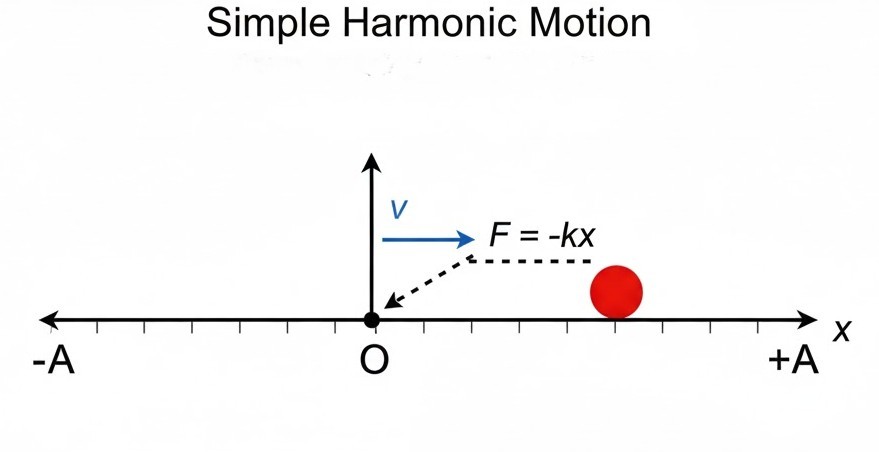
Figure below:
A clear diagram showing a particle oscillating on an x-axis between limits +A and -A, passing through a mean position at the origin O, illustrating simple harmonic motion.
Practice Questions:
1. A particle oscillates with $x = A \cos(\omega t)$. At what position is its speed maximum?
(a) $x = A$
(b) $x = -A$
(c) $x = 0$
(d) $x = A/2$
✅ Answer: (c) $x = 0$ — Speed is maximum at the mean position where displacement is zero.
2. If two waves of equal amplitude $a$ are in phase ($\phi = 0$), the resultant amplitude is:
(a) $0$
(b) $a$
(c) $2a$
(d) $a^2$
✅ Answer: (c) $2a$ — This is constructive interference where amplitudes add up.
Key Takeaway & Formula Summary
- Oscillatory Motion: To and fro about an equilibrium position.
- S.H.M. Displacement: $x(t) = A \cos(\omega t + \phi)$.
- Time Period (Spring): $T = 2\pi \sqrt{\frac{m}{k}}$.
- Time Period (Pendulum): $T = 2\pi \sqrt{\frac{L}{g}}$.
- Total Energy: $E = \frac{1}{2} k A^2$.
- Beat Frequency: $\nu_{beat} = |\nu_1 - \nu_2|$.
2. Periodic Motion, Period, and Frequency
Hey juniors! Let’s clear up a basic funda that runs our universe. Whether it’s the Earth revolving around the Sun or a fan spinning in your room, some motions just love to repeat themselves. Any motion that repeats itself at regular intervals of time is called periodic motion.
The smallest interval of time after which this repetition happens is called the period, denoted by the symbol $T$. In the SI system, we measure it in seconds ($s$). If a motion is super fast, like a quartz crystal vibrating, we might use microseconds ($\mu s$); if it’s slow, like Halley’s comet, the period is $76$ years!.
NEET Checkpoint:
What is the SI unit of the time period $T$?
(a) $Hz$
(b) $s^{-1}$
(c) $s$
(d) $min$
✅ Answer: (c) $s$ — Time period is just the "time" for one cycle, so its unit is seconds.
Next up is frequency ($\nu$). This is simply the reciprocal of the period:
It tells us how many repetitions happen in one second. We measure it in Hertz ($Hz$), where $1\text{ Hz} = 1\text{ oscillation per second}$.
Relatable Indian Example: Think of a Pani Puri uncle. If he dips his hand into the spicy water and serves you one puri every $2\text{ s}$ exactly, his motion is periodic! Here, $T = 2\text{ s}$, and his frequency $\nu = 1/2 = 0.5\text{ Hz}$. Fast service, right?
NEET Checkpoint:
If a particle completes $20$ oscillations in $2\text{ s}$, what is its frequency?
(a) $20\text{ Hz}$
(b) $10\text{ Hz}$
(c) $0.1\text{ Hz}$
(d) $2\text{ Hz}$
✅ Answer: (b) $10\text{ Hz}$ — Frequency is oscillations per second, so $20/2 = 10\text{ Hz}$.
NEET Checkpoint:
Is a heartbeat periodic?
(a) Yes, it is periodic
(b) No, it is non-periodic
(c) It is random
(d) It is oscillatory but not periodic
✅ Answer: (a) Yes — On average, it beats $75$ times a minute, making it periodic with $T = 0.8\text{ s}$.
Don't let the terms confuse you, yaar. High frequency means a low period, and vice-versa. Even your boredom in a long lecture might feel periodic if it hits every Monday at 9 AM sharp!
Practice Question:
A hummimgbird beats its wings with a period of $0.02\text{ s}$. What is the frequency of the wingbeats?
(a) $20\text{ Hz}$
(b) $50\text{ Hz}$
(c) $100\text{ Hz}$
(d) $0.02\text{ Hz}$
✅ Answer: (b) Since $\nu = 1/T$, we calculate $1/0.02 = 50\text{ Hz}$.
Now that you’ve mastered how things repeat, let's see what happens when they go "to and fro" about a centre.
Key Takeaway
Formula Summary
* Periodic Motion: Repeats at regular intervals.
* Period ($T$): Smallest time for repetition ($s$).
* Frequency ($\nu$): $\nu = 1/T$.
* Unit: $1\text{ Hz} = 1\text{ s}^{-1}$.
3. Displacement Variables and Periodic Functions
Listen up, junior! In our NEET journey, we need to broaden our horizons. Forget just "moving from point A to point B." In the world of oscillations, displacement is a general term for any physical property that changes with time. Whether it’s the angle of a pendulum in your school’s old wall clock, the voltage in an AC circuit powering your study lamp, or even the pressure variations in the air when your friend shouts "Goal!" during a football match, they are all "displacement variables". Arre, even the electric and magnetic fields in a light wave are just forms of displacement!
NEET Checkpoint:
Can the voltage across a capacitor be a displacement variable?
(a) Yes
(b) No
(c) Only for AC circuits
(d) Only for DC circuits
✅ Answer: (a) Yes! — In AC circuits, voltage changes with time and acts as a displacement variable.
Mathematically, we represent these using periodic functions like $f(t) = A \cos \omega t$ or $f(t) = A \sin \omega t$. These functions are the "basic spices" of physics. They repeat identically after a time period $T = \frac{2\pi}{\omega}$. But what if the motion looks messy, like the sound of a crowded pani puri stall? Don't worry, Jean Baptiste Joseph Fourier has our back! He proved that any periodic function can be represented as a superposition (a fancy word for sum) of sine and cosine functions with suitable coefficients.
NEET Checkpoint:
Who proved that any periodic function can be expressed as a superposition of sine and cosine terms?
(a) James Clerk Maxwell
(b) Joseph Fourier
(c) Isaac Newton
(d) Heinrich Hertz
✅ Answer: (b) Joseph Fourier — He's the mathematician who gave us this mega "funda".
NEET Checkpoint:
What is the mathematical condition for a function to be periodic with period $T$?
(a) $f(t − T) = 0$
(b) $f(t) = f(t + T)$
(c) $f(T) = 0$
(d) $f(t) = T$
✅ Answer: (b) $f(t) = f(t + T)$ — The function must repeat its value after every interval $T$.
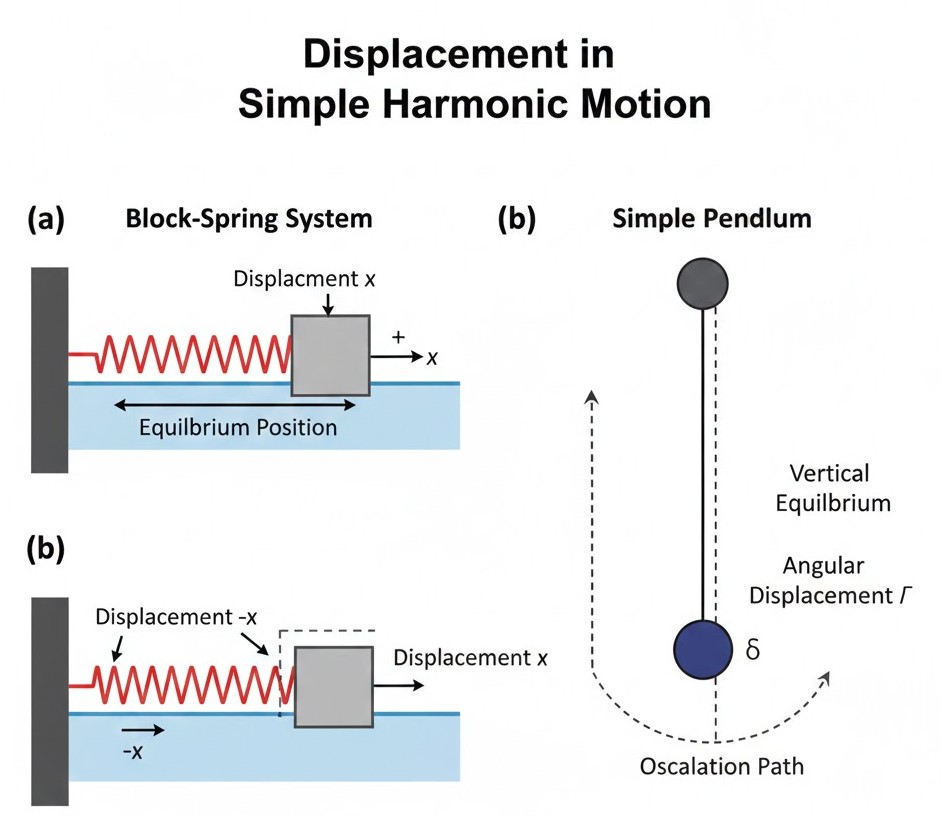
Figure below:
A clear diagram showing (a) a block on a spring with displacement $x$ from equilibrium and (b) a simple pendulum with angular displacement $\theta$ from the vertical, representing different types of displacement variables.
Practice Question:
Which of the following functions of time is non-periodic?
(a) $\sin \omega t + \cos \omega t$
(b) $\sin^2 \omega t$
(c) $e^{-\omega t}$
(d) $\sin \omega t + \cos 2\omega t$
✅ Answer: (c) $e^{-\omega t}$ — This function decreases monotonically and never repeats its value, so it cannot be periodic.
Key Takeaway
Formula Summary
* General Displacement: $x(t), \theta(t), V(t), P(t)$
* Periodic Function: $f(t) = A \cos \omega t$ or $A \sin \omega t$
* Time Period: $T = \frac{2\pi}{\omega}$
* Fourier's Result: Any periodic function = $\sum (\text{sine and cosine terms})$
4. Geometry of Simple Harmonic Motion (S.H.M.)
Arre students, let’s clear up this S.H.M. funda! Simple Harmonic Motion isn't just any random "to and fro" movement; it is a very specific type of periodic motion where the displacement is a sinusoidal function of time. Imagine a particle dancing back and forth about the origin, perfectly bounded between $+A$ and $-A$.
The mathematical "face" of this motion is the displacement equation:
In this formula, $x(t)$ tells you where the particle is at any time $t$. $A$ is the amplitude, which is just the magnitude of the maximum displacement from the equilibrium point. The whole argument $(\omega t + \phi)$ is the phase, while $\phi$ is the phase constant that tells us where the particle was exactly at $t = 0$.
NEET Checkpoint:
In the equation $x(t) = A \cos(\omega t + \phi)$, what does $A$ represent?
(a) Acceleration
(b) Amplitude
(c) Angular frequency
(d) Average speed
✅ Answer: (b) Amplitude — It is the maximum distance the particle travels from its mean position.
Now, why do we call some systems linear harmonic oscillators? It’s because the restoring force is strictly proportional to the displacement, $F = -kx$. If the force starts behaving weirdly with extra terms like $x^2$ or $x^3$, we call them non-linear oscillators. For NEET, we mostly stick to the linear ones because they are well-behaved, yaar!
Indian Example: Think of a local pani puri stall’s hanging bell. If you give it a small nudge, it swings back and forth smoothly—that’s your linear S.H.M.. But if a rowdy student hits it so hard that the spring support starts acting up with extra force terms, it goes non-linear!
NEET Checkpoint:
Which force law defines a linear harmonic oscillator?
(a) $F = -kx^2$
(b) $F = -kx$
(c) $F = -k/x$
(d) $F = -k \sqrt{x}$
✅ Answer: (b) $F = -kx$ — "Linear" means the displacement $x$ is to the power of 1.
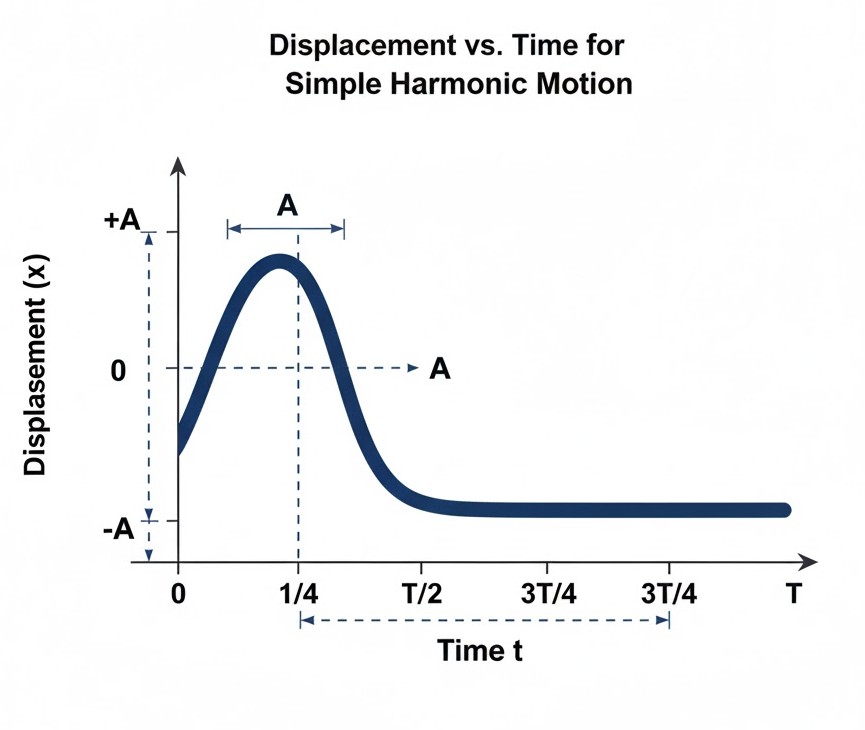
Figure below:
A clear displacement-time graph for S.H.M. showing a smooth cosine wave oscillating between $+A$ and $-A$ over time $t$, with the amplitude $A$ and time period $T$ clearly marked.
NEET Checkpoint:
What is the SI unit of angular frequency $\omega$?
(a) $m/s$
(b) $Hz$
(c) $rad \ s^{-1}$
(d) $s$
✅ Answer: (c) $rad \ s^{-1}$ — Don't confuse it with regular frequency $v$, which is in $Hz$.
Practice Question:
Which of the following functions represents a non-periodic motion?
(a) $\sin \omega t + \cos \omega t$
(b) $\sin^2 \omega t$
(c) $\log(\omega t)$
(d) $A \cos(\omega t + \phi)$
✅ Answer: (c) $\log(\omega t)$ — This function keeps increasing and never repeats its value, so it can't be periodic.
Key Takeaway
- S.H.M. Equation: $x(t) = A \cos(\omega t + \phi)$.
- Linear Oscillator: Restoring force $F = -kx$.
- Non-linear Oscillator: Force involves higher powers of $x$ (like $x^2$ or $x^3$).
5. Parameters of S.H.M.: Amplitude, Phase, and Frequency
Hey, juniors! Ready to decode the DNA of Simple Harmonic Motion (S.H.M.)? Every oscillation has its own personality, and we define it using four "super-parameters" from the master equation:
Let's break down this funda!
1. Amplitude ($A$): This is the magnitude of the maximum displacement from the mean position. Think of a kid on a swing at your local maidan—the furthest point they reach before swinging back is the amplitude. In the equation, $x(t)$ varies between $+A$ and $-A$.
NEET Checkpoint:
What is the maximum value of displacement for a particle in S.H.M.?
(a) $\omega$
(b) $\phi$
(c) $A$
(d) $T$
✅ Answer: (c) $A$ — Simple as that! Amplitude represents the extreme limits of the motion.
2. Phase ($\omega t + \phi$): This time-dependent argument is the "GPS" of S.H.M. It determines the state of motion (position and velocity) at any time $t$.
3. Phase Constant ($\phi$): Also called the initial phase, this is the value of the phase at $t = 0$. If you know the amplitude, $\phi$ is determined by where the particle was at the exact moment you started your stopwatch.
NEET Checkpoint:
Two S.H.M.s have the same $A$ and $\omega$ but different starting positions. What differs?
(a) Time period
(b) Frequency
(c) Phase constant
(d) Amplitude
✅ Answer: (c) The phase constant ($\phi$) — It defines the initial state of motion.
4. Angular Frequency ($\omega$): This represents how fast the phase changes. It’s related to the time period $T$ by:
Its SI unit is $rad \ s^{-1}$. Even a pendulum in a temple clock needs a steady $\omega$ to keep correct time!
NEET Checkpoint:
If the time period $T$ is doubled, what happens to the angular frequency $\omega$?
(a) It becomes double
(b) It becomes half
(c) It becomes one-fourth
(d) It remains the same
✅ Answer: (b) It becomes half — Since $\omega = \frac{2\pi}{T}$, they are inversely proportional.
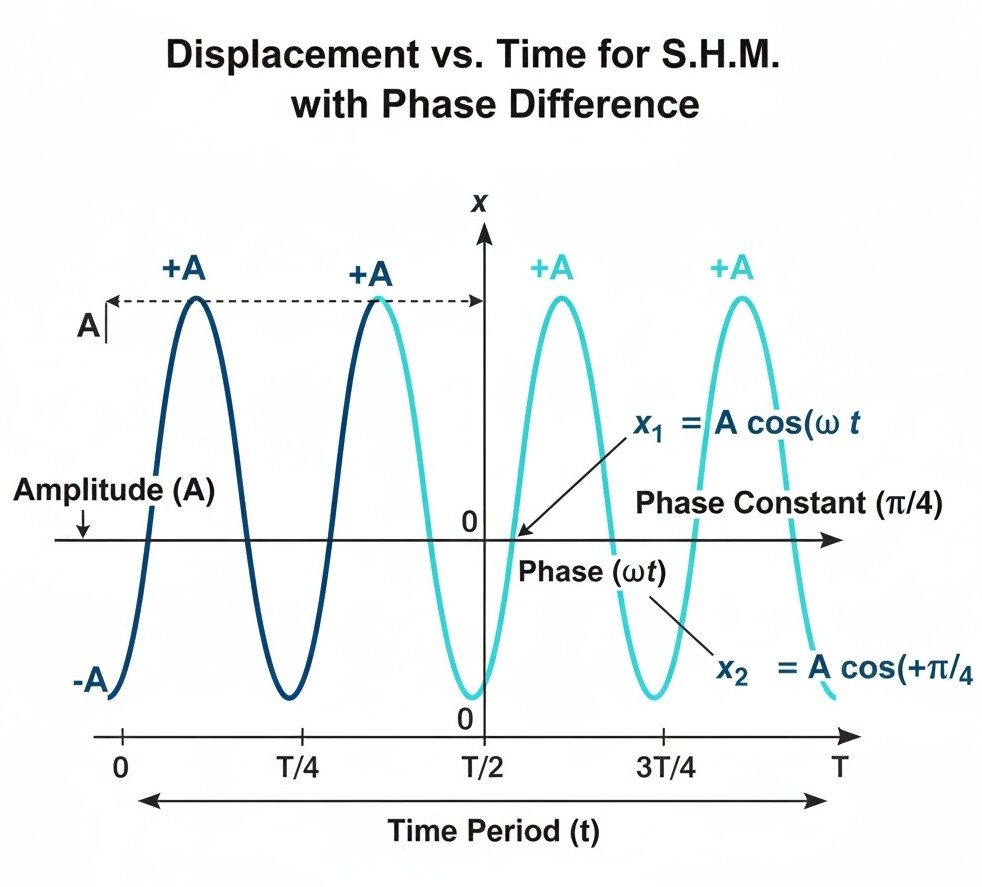
Figure below:
A clear diagram showing a displacement-time graph for S.H.M. Label the Amplitude (A), the time-dependent Phase, and show two curves with a Phase Constant difference of $\pi/4$.
Practice Questions:
1. A particle executes S.H.M. with $\phi = \pi/2$. At $t = 0$, its displacement is:
(a) $A$
(b) $0$
(c) $-A$
(d) $A/2$
✅ Answer: (b) $0$ — Because $\cos(\pi/2) = 0$. The particle starts at the mean position.
2. The S.I. unit of angular frequency is:
(a) $Hz$
(b) $s$
(c) $rad \ s^{-1}$
(d) $m \ s^{-1}$
✅ Answer: (c) $rad \ s^{-1}$ — Don't confuse it with regular frequency $v$, which is in $Hz$.
Key Takeaway
Formula Summary
S.H.M. Displacement: $x(t) = A \cos(\omega t + \phi)$
Angular Frequency: $\omega = \frac{2\pi}{T} = 2\pi v$
Phase at $t=0$: $\phi$ (Phase Constant)
6. S.H.M. and Uniform Circular Motion
Hey junior! Don't stress, yaar—this concept is actually a total "cheat code" for solving tough problems. Let's clear up this funda: Simple Harmonic Motion (S.H.M.) is essentially just the projection of uniform circular motion on the diameter of a circle.
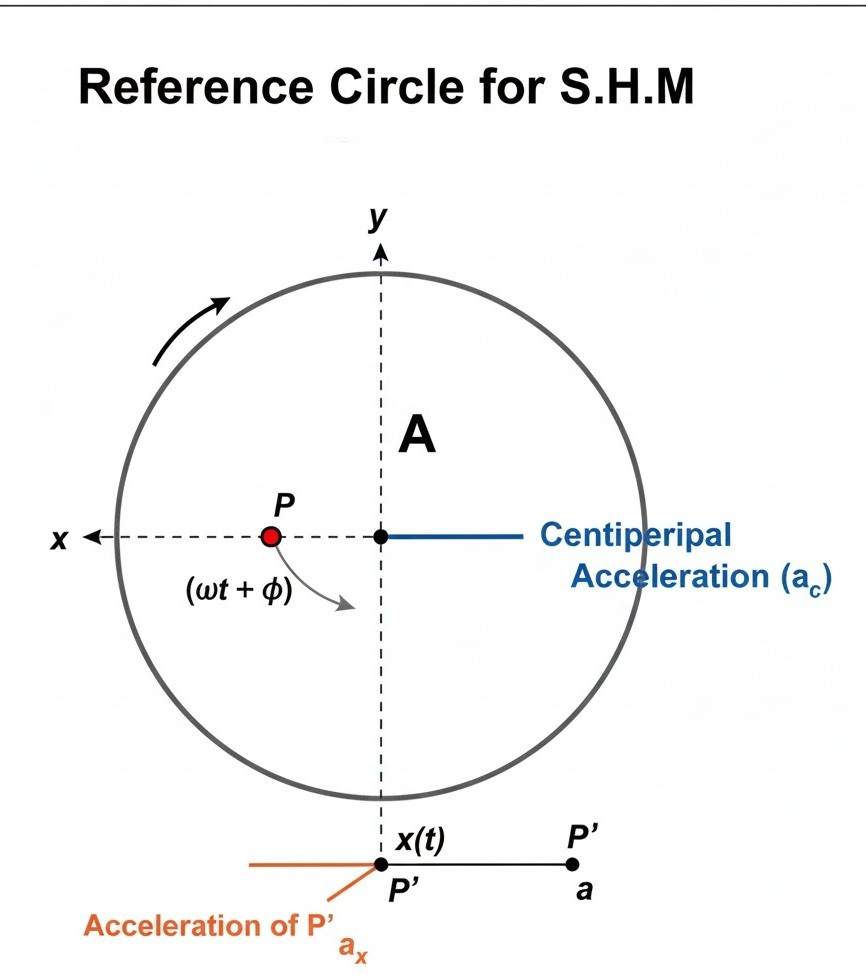
Imagine a reference particle $P$ moving at a constant angular speed $\omega$ on a reference circle of radius $A$. If you shine a light from above, the shadow (projection) $P'$ on the horizontal diameter moves to and fro. While the actual particle $P$ is just going in circles, its shadow $P'$ is performing pure S.H.M..
NEET Checkpoint:
If a particle moves in U.C.M., is its motion oscillatory?
(a) Yes
(b) No
(c) Only along a diameter
(d) Only in one direction
✅ Answer: (b) No — Circular motion is periodic but not oscillatory.
Mathematically, the position of this shadow at any time $t$ is:
where $A$ is the radius (amplitude) and $\omega$ is the angular frequency.
Relatable Indian Example: Think of a Giant Wheel at a local mela. If you stand far away and look at your friend’s seat edge-on, it looks like they are just moving up and down in a straight line. That "up-and-down" look is S.H.M.!
Comparing Forces: Here’s the trick: in circular motion, the particle $P$ feels a centripetal force directed towards the centre. However, for the projection $P'$ executing S.H.M., we talk about a restoring force. Even though they are connected, they are physically "very different". The acceleration of $P'$ is the projection of the centripetal acceleration, given by:
This shows the acceleration is always directed towards the mean position.
NEET Checkpoint:
What is the phase difference between the $x$-projection and $y$-projection of the same U.C.M.?
(a) 0
(b) $\pi/4$
(c) $\pi/2$
(d) $\pi$
✅ Answer: (c) $\pi/2$ radians — They are both S.H.M.s but shifted.
Figure below:
A clear diagram of a reference circle with radius A. A particle P is at an angle (ωt + φ) from the x-axis, and its projection P' is shown on the x-axis at distance x(t). Arrows should indicate the centripetal acceleration of P towards the centre and the corresponding acceleration of P'.
NEET Checkpoint:
In the equation $x(t) = A \cos(\omega t + \phi)$, what does $A$ represent in the reference circle?
(a) Angular velocity
(b) Radius of the reference circle
(c) Phase angle
(d) Time period
✅ Answer: (b) The radius of the circle — The maximum displacement in S.H.M. equals the circle's radius.
Practice Questions:
1. A particle $P$ rotates in a circle of radius $5\ cm$ with a period of $2\ s$. What is the amplitude of its projection on the diameter?
(a) $2\ cm$
(b) $5\ cm$
(c) $10\ cm$
(d) $2.5\ cm$
✅ Answer: (b) $5\ cm$ — The amplitude of S.H.M. is exactly the radius of the reference circle.
2. The projection of uniform circular motion on a diameter is:
(a) Periodic but not S.H.M.
(b) Rectilinear motion with constant acceleration
(c) Simple Harmonic Motion
(d) Non-periodic motion
✅ Answer: (c) Simple Harmonic Motion — This is the core definition provided in the sources.
Key Takeaway
- Reference Circle: The circular path used to derive S.H.M..
- Reference Particle: The particle moving in U.C.M..
- Projection Formula: $x(t) = A \cos(\omega t + \phi)$.
- Acceleration: $a = -\omega^2 x$; always points to the centre.
7. Kinematics of S.H.M.: Velocity and Acceleration
Hey junior! Ready to see how fast that oscillating particle actually moves? In Simple Harmonic Motion (S.H.M.), we don't just care about where it is, but how fast it's zooming and how hard it's being pulled back to the centre. Let's clear this funda!
1. Velocity: The Zoom Factor
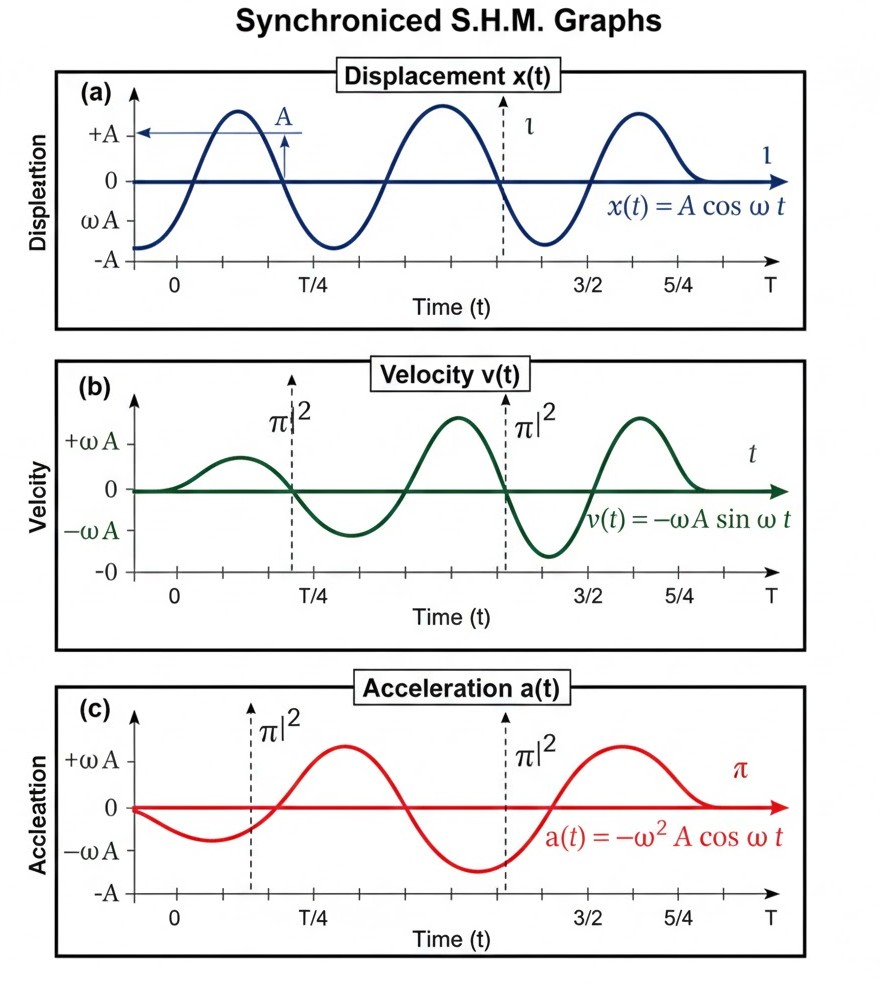
To find the instantaneous velocity $v(t)$, we simply take the time derivative of displacement. If our displacement is $x(t) = A \cos(\omega t + \phi)$, then:
Notice the negative sign? It shows $v(t)$ is directed opposite to the positive x-axis when the sine term is positive. The maximum speed, or velocity amplitude, is $v_{max} = \omega A$.
NEET Checkpoint:
At what position is the speed of a particle in S.H.M. maximum?
(a) Extreme position
(b) Mean position
(c) $x = A/2$
(d) $x = A/\sqrt{2}$
✅ Answer: (b) Mean position — Arre, look at the formula! When $x = 0$, the speed hits its peak $v_{max} = \omega A$.
2. Acceleration: The Pull-Back Force
Differentiate velocity again, and you get acceleration $a(t)$:
Here’s the cool part: since $x(t) = A \cos(\omega t + \phi)$, we can write $a(t) = -\omega^2 x(t)$. This proves acceleration is always proportional and opposite to displacement. It's like an angry parent always pulling you back to the "mean" position!
NEET Checkpoint:
If displacement is positive, what is the direction of acceleration?
(a) Positive
(b) Negative
(c) Zero
(d) Same as displacement
✅ Answer: (b) Negative — Acceleration is always a "restoring" quantity directed towards the centre.
3. Phase Relations
Phase is just a fancy way of saying who is ahead in the race.
* Velocity leads displacement by $\pi/2$.
* Acceleration leads displacement by $\pi$.
Relatable Example: Imagine a local rickshaw in Bengaluru. He speeds up at the green light (mean position) but slams the brakes (acceleration opposite to motion) as he reaches the next stop (extreme position).
Figure below:
A set of three synchronised sinusoidal graphs plotted against time $t$. Graph (a) shows displacement $x(t) = A \cos \omega t$, graph (b) shows velocity $v(t) = -\omega A \sin \omega t$, and graph (c) shows acceleration $a(t) = -\omega^2 A \cos \omega t$. Clearly label the phase differences of $\pi/2$ and $\pi$.
NEET Checkpoint:
What is the phase difference between velocity and acceleration in S.H.M.?
(a) 0
(b) $3\pi/2$
(c) $\pi$
(d) $\pi/2$
✅ Answer: (d) $\pi/2$ — Velocity leads $x$ by $\pi/2$, and $a$ leads $v$ by another $\pi/2$.
Practice Question:
A particle executes S.H.M. with $x = 5 \cos(2\pi t)$. Its maximum acceleration is:
(a) $10\pi$
(b) $20\pi^2$
(c) $5\pi^2$
(d) $4\pi^2$
✅ Answer: (b) $20\pi^2$ — Max acceleration is $\omega^2 A$. Here $\omega = 2\pi$ and $A = 5$. So, $(2\pi)^2 \times 5 = 20\pi^2$.
Key Takeaway
Formula Summary
* Velocity: $v(t) = -\omega A \sin(\omega t + \phi)$
* Acceleration: $a(t) = -\omega^2 x(t)$
* Max Speed: $v_{max} = \omega A$
* Max Accel: $a_{max} = \omega^2 A$
8. Force Law for S.H.M. and Spring Oscillations
Listen up, junior! In SHM, Newton’s Second Law ($F = ma$) works with a cool twist. Since we know acceleration in SHM is $a(t) = -\omega^2 x(t)$, the force acting on a mass $m$ must be $F(t) = -m \omega^2 x(t)$. To make our lives easier, we define a force constant $k = m \omega^2$, which gives us the famous restoring force law:
This force is always trying to pull the particle back to the mean position—it’s like that one friend who always drags you back to the library when you try to bunk class!
NEET Checkpoint:
What is the SI unit of the force constant $k$?
(a) $N \cdot m$
(b) $N/m$
(c) $kg/s$
(d) $J \cdot m$
✅ Answer: (b) $N/m$ — Since $k = F/x$ (ignoring the sign), the units are Newtons per metre.
Think of a Mumbai local train during rush hour. If you get pushed out of your spot (displacement $x$), the "pressure" of the crowd (restoring force) pushes you right back. If the crowd is super tight, the $k$ is very high!
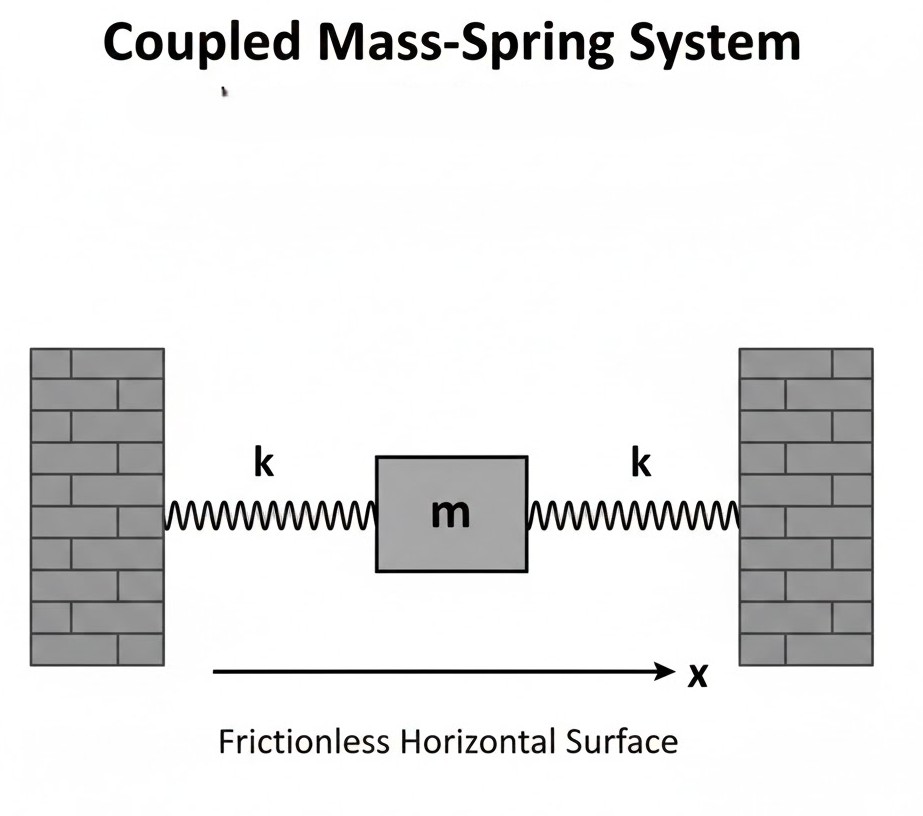
When a block of mass $m$ is placed between two identical springs of constant $k$, things get interesting. If you move the block by $x$, one spring pulls and the other pushes, resulting in a net force $F = -2kx$. The time period for such a setup is:
NEET Checkpoint:
If the mass $m$ of an oscillator is quadrupled ($4m$), the time period $T$ will:
(a) Double
(b) Half
(c) Quadruple
(d) Remain the same
✅ Answer: (a) Double — Because $T \propto \sqrt{m}$, so $\sqrt{4} = 2$. Don't let the square root trip you up, yaar!
Figure below:
A clear diagram showing a block of mass m on a frictionless horizontal surface, connected to a rigid wall on the left by one spring and a rigid wall on the right by another spring, both with spring constant k.
NEET Checkpoint:
A "stiff" spring has a:
(a) Small $k$
(b) Large $k$
(c) Zero $k$
(d) Negative $k$
✅ Answer: (b) Large $k$ — A larger force constant means it takes more force to cause displacement.
Practice Question:
A $2\ kg$ block is attached to a spring with $k = 50\ N/m$. Calculate its angular frequency $\omega$.
(a) $25\ rad/s$
(b) $10\ rad/s$
(c) $5\ rad/s$
(d) $100\ rad/s$
✅ Answer: (c) $5\ rad/s$. Use the funda $\omega = \sqrt{k/m} = \sqrt{50/2} = \sqrt{25} = 5\ rad/s$.
Key Takeaway
Formula Summary
- Restoring Force: $F = -kx$
- Angular Frequency: $\omega = \sqrt{\frac{k}{m}}$
- Time Period: $T = 2\pi \sqrt{\frac{m}{k}}$
9. Energy Transformations in S.H.M.
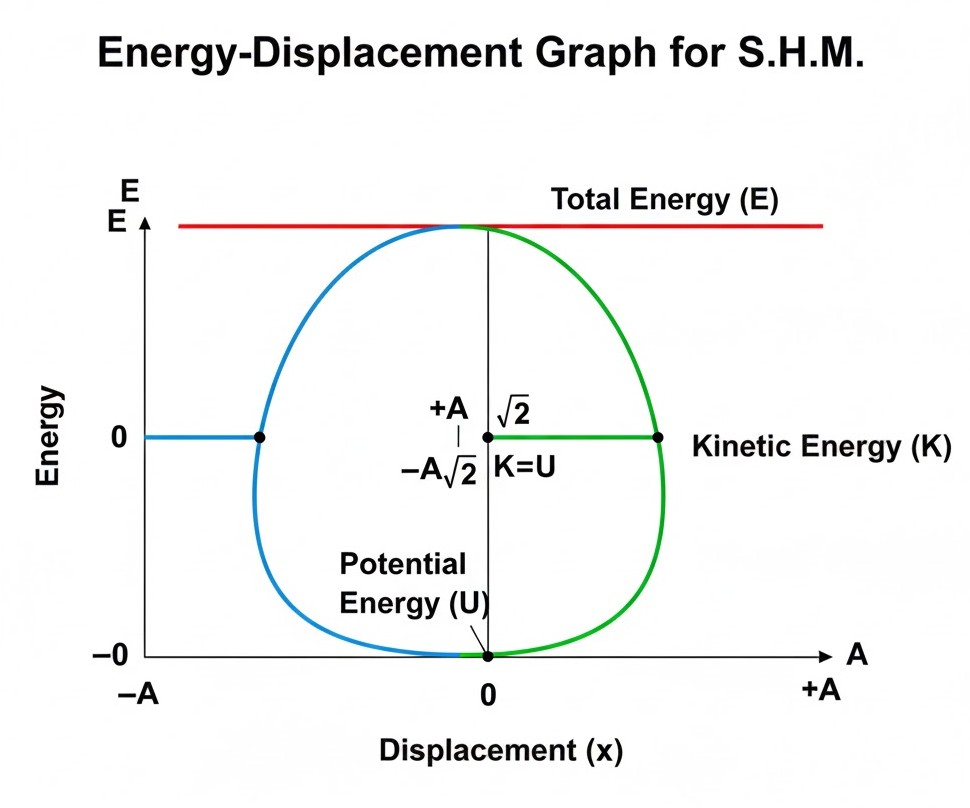
Hey junior! Let’s clear up this energy funda in SHM. Think of it as a constant, rhythmic "pass-the-parcel" game between Kinetic Energy ($K$) and Potential Energy ($U$).,
At the mean position ($x = 0$), the particle is zooming at its maximum speed. Naturally, its $K$ is at its peak here, while $U$ is zero.,
NEET Checkpoint:
At what position is the Potential Energy of an SHM oscillator maximum?
(a) At mean position
(b) At extreme positions
(c) At half-amplitude position
(d) At quarter-amplitude position
✅ Answer: (b) At the extreme positions ($x = \pm A$) — Because displacement is maximum, and $U = \frac{1}{2} k x^2$.
As the particle moves towards the extreme positions, it slows down, and $K$ is converted into $U$. At the very edge ($x = A$), the particle stops for a micro-second to turn back. Here, speed is zero, so $K = 0$, while $U$ hits its maximum value of $\frac{1}{2} k A^2$.,
NEET Checkpoint:
If the time period of SHM is $T$, what is the period of its Kinetic Energy?
(a) T
(b) 2T
(c) T/2
(d) 4T
✅ Answer: (c) $T/2$ — Because $K$ (and $U$) peaks twice during every single full oscillation!,
The Total Mechanical Energy ($E$) is the sum of both, and for conservative forces, it remains constant regardless of time or position:,
Imagine a kid on a jhoola (swing) in your colony park. At the highest point (extreme), they pause for a split second (max $U$). As they rush through the bottom (mean), they are at top speed (max $K$). The total energy stays the same—unless someone stops the swing!
NEET Checkpoint:
How does the Total Energy $E$ of a harmonic oscillator vary with time?
(a) It increases linearly with time
(b) It decreases linearly with time
(c) It oscillates between 0 and maximum
(d) It remains constant
✅ Answer: (d) It remains constant — It is independent of time and displacement.
Figure below:
A clear energy-displacement graph for SHM. The x-axis shows displacement from -A to +A. A U-shaped parabola represents Potential Energy U, an inverted U-shaped parabola represents Kinetic Energy K, and a flat horizontal line at the top represents the constant Total Energy E.
Practice Questions:
- A block of mass $1 kg$ is attached to a spring with $k = 50 N m^{-1}$. If the amplitude is $10 cm$, what is the total energy of the system?
(a) $0.125 J$
(b) $0.25 J$
(c) $0.5 J$
(d) $0.0625 J$
✅ Answer: (b) — Using $E = \frac{1}{2} k A^2 = \frac{1}{2} \times 50 \times (0.1)^2 = 0.25 J$.,
2. In SHM, the kinetic energy is maximum when:
(a) Displacement is maximum
(b) Acceleration is maximum
(c) Velocity is maximum
(d) Force is maximum
✅ Answer: (c) — $K = \frac{1}{2} m v^2$, so it peaks when velocity is at its maximum at the mean position.
Key Takeaway
Formula Summary
- Kinetic Energy: $K = \frac{1}{2} k A^2 \sin^2(\omega t + \phi)$
- Potential Energy: $U = \frac{1}{2} k A^2 \cos^2(\omega t + \phi)$
- Total Energy: $E = \frac{1}{2} k A^2$ (Constant)
10. The Simple Pendulum
Remember swinging on a jhoola in the park? That's basically a simple pendulum in action! In our physics world, we describe this system as a small bob of mass $m$ tied to an inextensible, massless string of length $L$ that is fixed to a rigid support. When the bob is at the mean position, the angle $\theta = 0$.
NEET Checkpoint:
Does the time period of a simple pendulum depend on the mass of the bob?
(a) Yes, directly proportional
(b) Yes, inversely proportional
(c) No, it is independent of mass
(d) Only for very large masses
✅ Answer: (c) No — Look at the formula $T = 2\pi\sqrt{L/g}$; there is no $m$ in it! So, whether it's a heavy stone or a light plastic ball, $T$ remains the same.
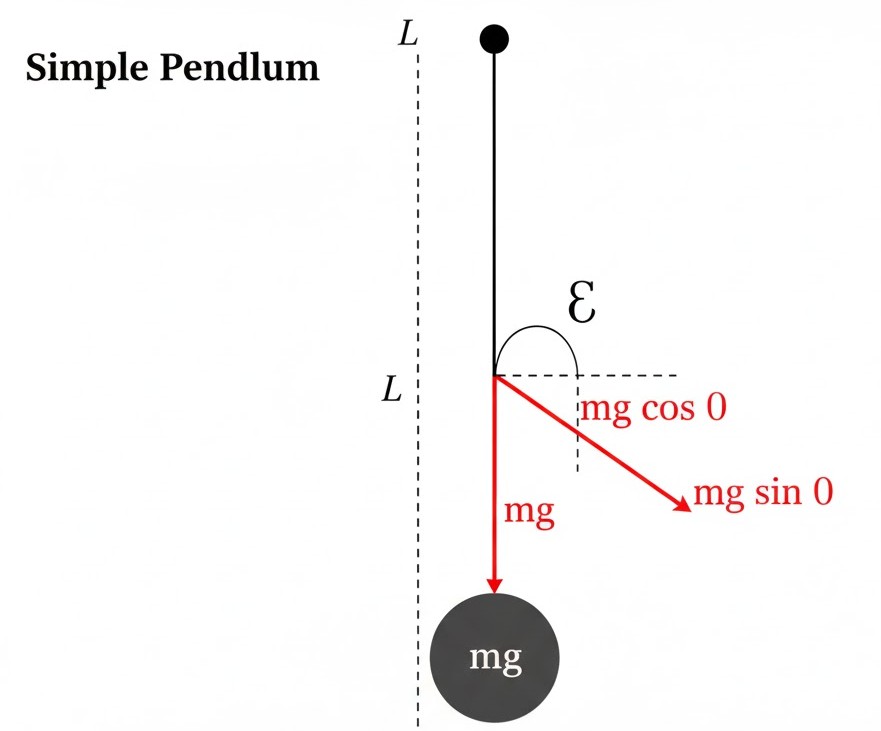
Here’s the trick: when you displace the bob, gravity provides a restoring force. The component $mg \sin \theta$ acts perpendicular to the string, creating a restoring torque $\tau$ about the support. We calculate it as:
The negative sign shows it’s trying to bring the bob back to the centre.
Figure below:
A clear diagram of a simple pendulum showing a bob of mass $m$ at an angle $\theta$, string length $L$, and the force $mg$ resolved into $mg \cos \theta$ along the string and $mg \sin \theta$ perpendicular to it.
NEET Checkpoint:
Why do we assume the angle $\theta$ is small?
(a) To make the motion faster
(b) To neglect air resistance
(c) To approximate $\sin \theta \approx \theta$
(d) To increase amplitude
✅ Answer: (c) For small angles, we can use the approximation $\sin \theta \approx \theta$, which makes the restoring torque proportional to the displacement.
Using the small angle approximation ($\sin \theta \approx \theta$ in radians), the angular acceleration $\alpha$ becomes proportional to the angular displacement $\theta$. This proves the motion is Simple Harmonic Motion (S.H.M.). By comparing this to the standard SHM equations, we get the expression for the time period $T$:
NEET Checkpoint:
If you take a pendulum to the Moon where gravity is weaker, what happens to $T$?
(a) T becomes smaller
(b) T becomes larger
(c) T remains the same
(d) T becomes zero
✅ Answer: (b) T increases — Since $T$ is inversely proportional to $\sqrt{g}$, a smaller $g$ means the pendulum swings more slowly.
Think of a heavy jhumka (earring) or a nimbu-mirchi hanging from a truck's bumper. If the string is long, it sways slowly; if short, it vibrates quickly! Clear your fundas: only length and gravity matter here.
Practice Question:
A "seconds pendulum" ticks exactly every second (meaning $T = 2 s$). What happens to its period if its length is quadrupled?
(a) $2 s$
(b) $4 s$
(c) $8 s$
(d) $1 s$
✅ Answer: (b) $4 s$ — Since $T \propto \sqrt{L}$, if $L$ becomes $4L$, the period $T$ doubles from $2 s$ to $4 s$.
Key Takeaway
Formula Summary
- Restoring Torque: $\tau = -Lmg \sin \theta$
- Small Angle Approximation: $\sin \theta \approx \theta$
- Time Period: $T = 2\pi\sqrt{\frac{L}{g}}$
11. Introduction to Wave Motion
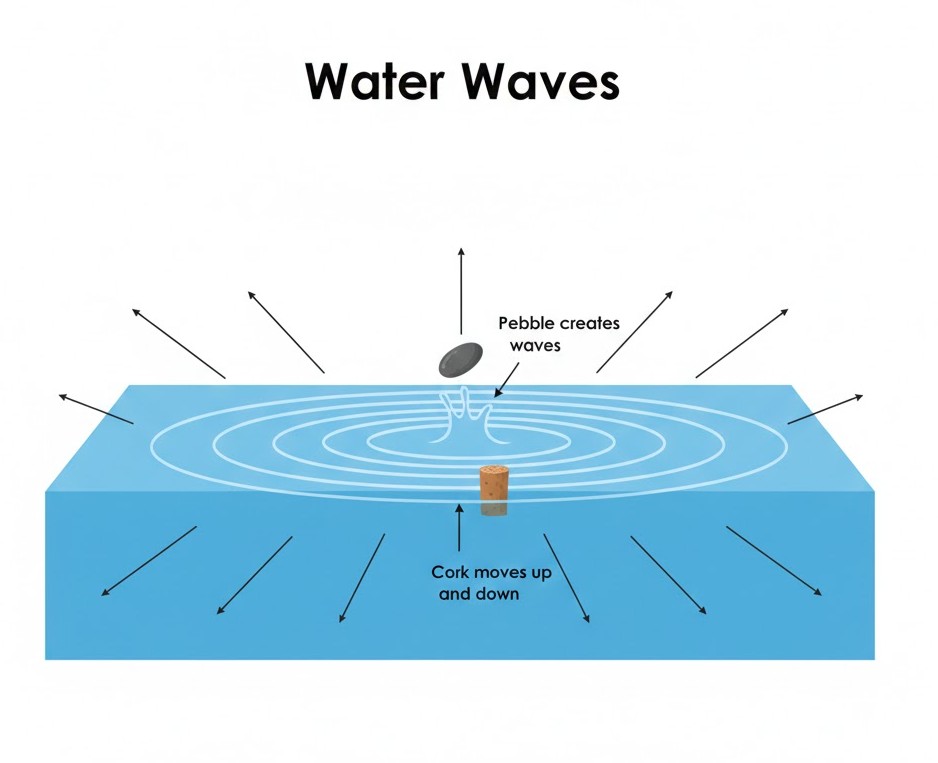
Ever seen a crowd doing 'the wave' at a cricket stadium? The people just stand up and sit down, but the 'wave' travels all around the stadium. That’s exactly the funda of wave motion! Waves are patterns of disturbance that move without any actual physical transfer or flow of matter as a whole. Even though the water or air doesn't travel from A to B, the energy and information surely do.
NEET Checkpoint:
In a wave, what is transported from one point to another?
(a) Bulk matter
(b) Particles
(c) Energy
(d) All of these
✅ Answer: (c) Energy — Matter just does a 'to-and-fro' dance in its own spot; only energy and information travel the distance!
We classify these beauties into three main types:
1. Mechanical Waves: They are high-maintenance—they need a material medium like air or a string to travel.
2. Electromagnetic (EM) Waves: These are the rebels. They don't need a medium and can zoom through a vacuum at a speed of $c = 299,792,458~m~s^{-1}$.
3. Matter Waves: A bit abstract, but these are associated with the constituents of matter like electrons and protons.
NEET Checkpoint:
Which of these is an example of a Mechanical wave?
(a) Light
(b) X-rays
(c) Sound
(d) Radio waves
✅ Answer: (c) Sound — Sound waves are longitudinal mechanical waves that cannot travel through a vacuum.
Imagine a long line at a pani puri stall. If someone at the back gives a push, that 'push' travels to the front, even if everyone stays in their spot. That's a wave for you!
NEET Checkpoint:
Matter waves are famously used in which of these?
(a) Radio
(b) Electron Microscope
(c) Sitar
(d) Wall Clock
✅ Answer: (b) Electron Microscope — Matter waves associated with electrons are the secret sauce here!
Figure below:
A clear diagram showing a pebble being dropped into a still pond, with concentric circular ripples (waves) spreading outwards, while a small cork piece on the surface moves only up and down without moving away from the centre.
Practice Questions:
1. What is the defining characteristic of an electromagnetic wave?
(a) Requires an elastic medium
(b) Can propagate through vacuum
(c) Involves bulk matter transfer
(d) Moves slower than sound
✅ Answer: (b) Can propagate through vacuum — Unlike mechanical waves, EM waves like light don't need a medium.
2. Mechanical waves depend on which properties of the medium?
(a) Only temperature
(b) Only colour
(c) Inertial and elastic properties
(d) None of these
✅ Answer: (c) Inertial and elastic properties — The medium's properties like mass density and bulk modulus determine how the wave travels.
Now that you've got this, wait till you see how these waves actually move—it's either a side-to-side dance or a front-back hustle in our next topic: Transverse and Longitudinal Waves!
Key Takeaway
- Wave: Disturbance pattern moving through a medium (or vacuum) without bulk matter transfer.
- Transport: Waves carry energy and information.
- Types: Mechanical (needs medium), EM (vacuum okay), and Matter (subatomic).
12. Transverse and Longitudinal Waves
Hey junior! Don't get bogged down by the definitions—let’s clear up this funda once and for all. Waves are basically just disturbances having a bit of a travel bug. But how do the medium's particles "party" while the wave passes?
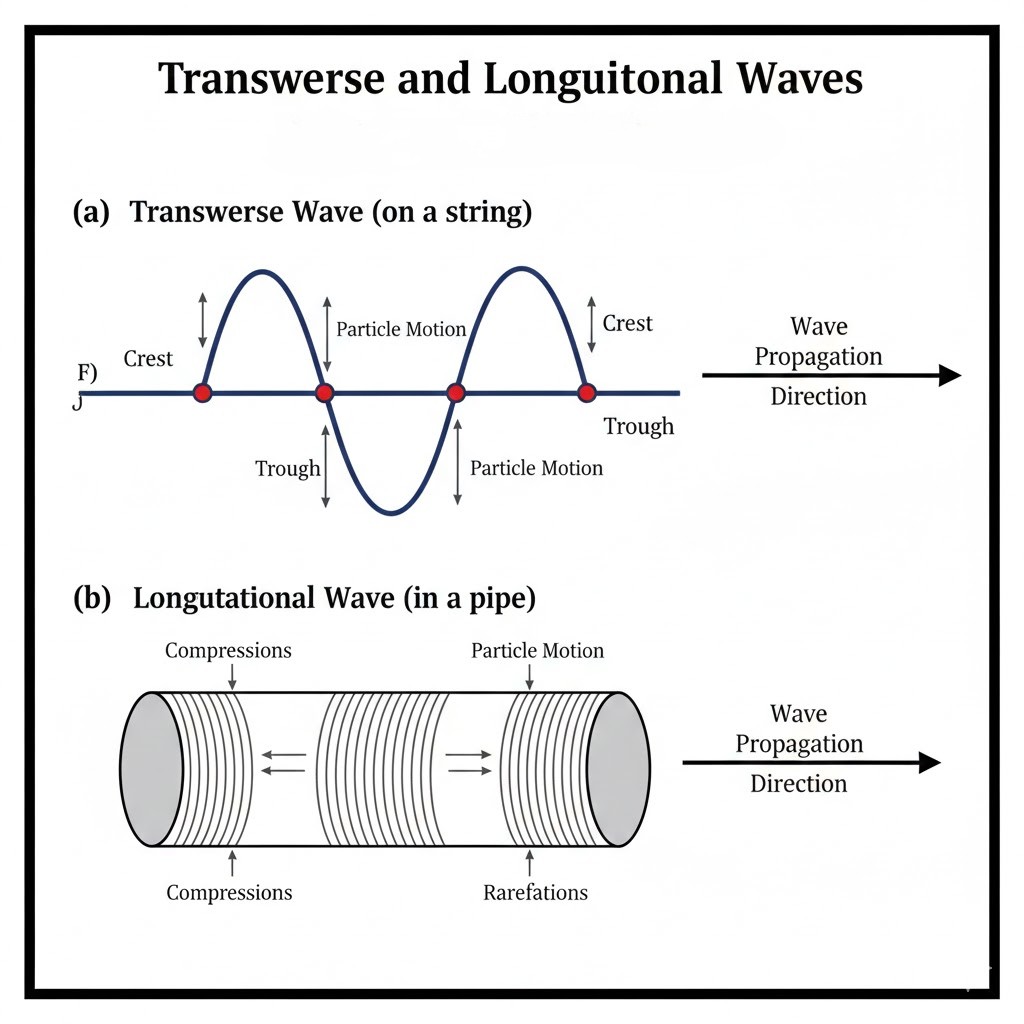
In transverse waves, the constituents of the medium oscillate perpendicular to the direction of wave propagation. Think of a "Mexican Wave" at the Wankhede Stadium—you stand up and sit down (vertical motion), but the wave moves sideways around the stands (horizontal propagation)! That’s exactly what happens on a stretched string.
NEET Checkpoint:
In which wave type do particles move at $90^{\circ}$ to the wave's path?
(a) Longitudinal wave
(b) Transverse wave
(c) Surface wave
(d) Stationary wave
✅ Answer: (b) Transverse waves — Think of "T" for "Transverse" and "Top-to-bottom" wiggles.
Now, longitudinal waves are the "push-pull" type. Here, particles oscillate along (parallel to) the direction of propagation. Imagine the rush-hour crowd at a Mumbai local station—everyone is pushing and pulling back-and-forth in the same direction they are trying to move. That’s how sound travels through air via compressions and rarefactions.
NEET Checkpoint:
Can sound waves travel through a vacuum?
(a) Yes
(b) No
(c) Only at high frequencies
(d) Only at low frequencies
✅ Answer: (b) No — Mechanical waves like sound require a material medium to propagate.
Here is the "NEET-essential" secret: Transverse waves require shear strength, meaning they can only travel through solids. Fluids (liquids and gases) can't handle that sideways wiggle! However, longitudinal waves involve compressive strain, so they are the ultimate travellers, moving through all elastic media—solids, liquids, and gases alike. Even water waves are a cheeky combination of both!
Figure below:
A dual-panel diagram showing (a) a transverse wave on a string with particles moving up/down while the wave moves right, and (b) a longitudinal wave in a pipe with air layers showing regions of compression and rarefaction oscillating left/right.
NEET Checkpoint:
Why can't transverse waves travel through air?
(a) Air has no elasticity
(b) Air cannot support shear stress
(c) Air is too light
(d) Air is compressible
✅ Answer: (b) Air cannot support shear stress — Fluids cannot sustain the shearing stress required for transverse motion.
Practice Questions:
1. A motorboat sailing in water produces:
(a) Only longitudinal waves
(b) Only transverse waves
(c) Both longitudinal and transverse waves
(d) Matter waves
✅ Answer: (c) — Waves on the surface and within water involve complex motions that combine both types.
2. Which property allows longitudinal waves to travel through gases?
(a) Shear modulus
(b) Bulk modulus
(c) High density
(d) Transverse elasticity
✅ Answer: (b) — Gases can sustain compressive strain, which is linked to the bulk modulus.
Key Takeaway
- Transverse: Oscillation $\perp$ Propagation. Needs shear strength (Solids only).
- Longitudinal: Oscillation $\parallel$ Propagation. Needs bulk modulus (All media).
13. Progressive Waves and Speed of Propagation
Hey there, future doctor! Ready to catch the wave? Unlike your childhood "stadium wave" at an IPL match where you just stand up and sit down, a progressive wave actually moves from one point to another, carrying energy like a delivery boy on a scooter.
To describe this motion mathematically, we use a function of both position $x$ and time $t$. The most common displacement relation for a sinusoidal wave travelling along the positive $x$-axis is:
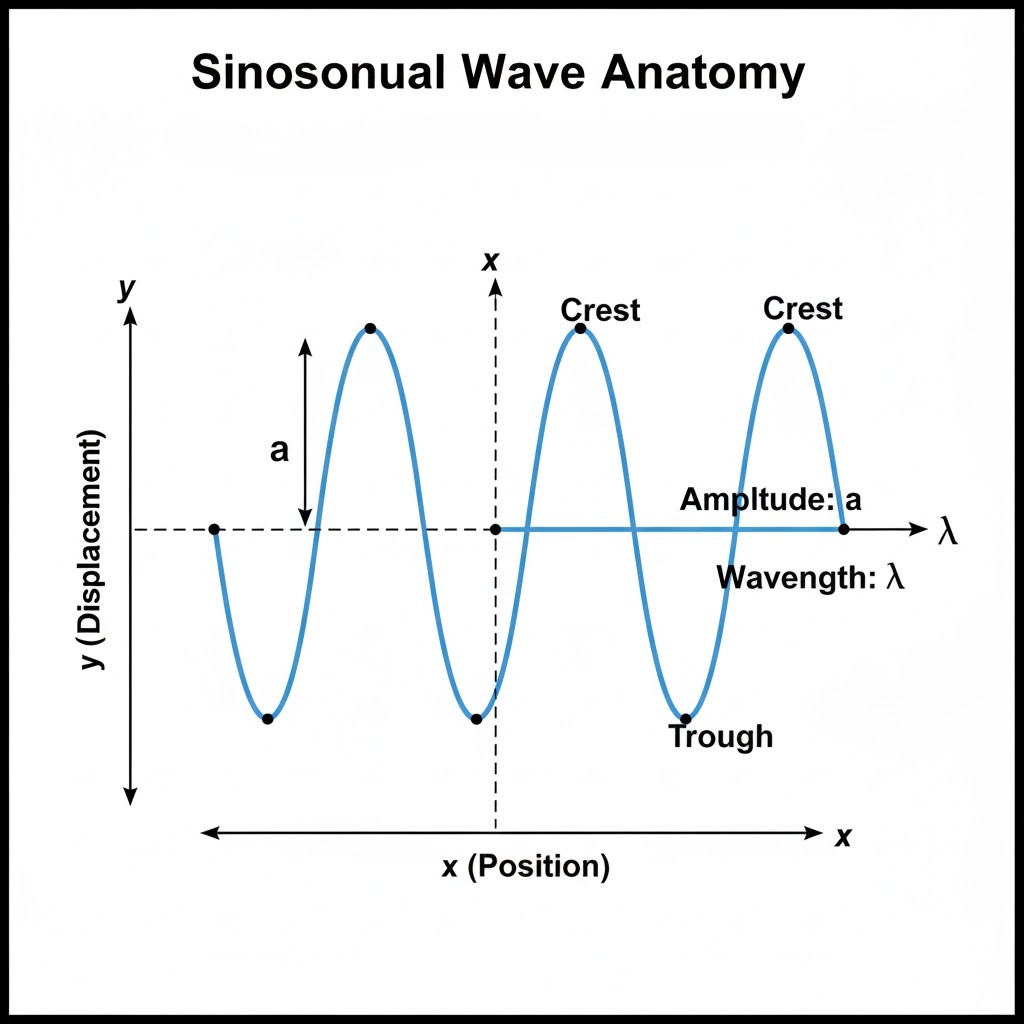
Here, $a$ is the amplitude (maximum displacement), while $(kx - \omega t + \phi)$ is the phase.
NEET Checkpoint:
If a wave is moving in the negative $x$-direction, what changes in the equation?
(a) The sign becomes positive
(b) The sign becomes negative
(c) Amplitude changes
(d) Frequency changes
✅ Answer: (a) The sign becomes positive: $y(x,t) = a \sin(kx + \omega t + \phi)$.
Let's clear the funda on some key terms:
* Wavelength ($\lambda$): The minimum distance between two points with the same phase (like crest to crest).
* Angular Wave Number ($k$): It’s related to wavelength by $k = \frac{2\pi}{\lambda}$.
* Wave Speed ($v$): The speed at which the wave pattern travels, given by $v = \frac{\omega}{k}$ or $v = \lambda \nu$.
NEET Checkpoint:
What is the SI unit of the angular wave number $k$?
(a) meter (m)
(b) $meter^{-1}$ ($m^{-1}$)
(c) radian (rad)
(d) $second^{-1}$ ($s^{-1}$)
✅ Answer: (b) $m^{-1}$ - wavelength λ is in meters, k has units of inverse meters $m^{-1}$.
Now, speed isn't just a number—it depends on the medium! For a transverse wave on a string, speed depends on tension ($T$) and linear mass density ($\mu$):
Imagine pluckng a sitar string; the tighter you stretch it, the faster the wave travels. For longitudinal waves (like sound), the speed depends on the Bulk modulus ($B$) and density ($\rho$):
In a solid bar, we use Young’s modulus ($Y$) instead: $v = \sqrt{\frac{Y}{\rho}}$.
NEET Checkpoint:
Why does sound travel faster in steel than in air?
(a) Steel is denser than air
(b) Steel is less dense than air
(c) Steel is more elastic than air
(d) Steel has higher temperature than air
✅ Answer: (c) Because the Bulk modulus of solids is much higher than gases, outweighing the higher density.
Figure below:
A clear diagram showing a sinusoidal wave with labels for amplitude 'a', wavelength '$\lambda$', and points showing crests and troughs on an x-y axis.
Practice Question:
A string has a tension of $60 \ N$ and a linear mass density of $6.9 \times 10^{-3} \ kg \ m^{-1}$. What is the speed of a transverse wave on it?
(a) $330 \ m/s$
(b) $93 \ m/s$
(c) $280 \ m/s$
(d) $140 \ m/s$
✅ Answer: (b) $93 \ m/s$ — Just use $v = \sqrt{T/\mu} = \sqrt{60 / 6.9 \times 10^{-3}} \approx 93 \ m \ s^{-1}$.
Key Takeaway
Formula Summary
* Wave Equation: $y(x,t) = a \sin(kx - \omega t + \phi)$
* Wave Speed: $v = \nu \lambda = \frac{\omega}{k}$
* String Speed: $v = \sqrt{\frac{T}{\mu}}$
* Sound Speed (Fluid): $v = \sqrt{\frac{B}{\rho}}$
14. Superposition and Reflection of Waves
Arre junior, ever wondered what happens when two waves bump into each other? They don't crash like rickshaws in a Mumbai gully; they just overlap and add up! This is the Principle of Superposition. The net displacement $y(x,t)$ is simply the algebraic sum of individual displacements:
When two waves with the same frequency and amplitude $a$ meet, it’s an interference party! If they are in phase ($\phi = 0$), we get Constructive Interference where the amplitude peaks at $2a$. But if they are out of phase by $\phi = \pi$, it’s Destructive Interference—total silence, $y = 0$!
NEET Checkpoint:
If two waves with amplitude $a$ meet with a phase difference of $\pi$, what is the resultant amplitude?
(a) $2a$
(b) $a$
(c) $0$
(d) $a/2$
✅ Answer: (c) 0 — Arre, it's destructive interference! The waves cancel each other out completely.
Relatable Funda: Imagine a wedding Baaraat. If two groups of dhol-walas play in perfect sync, the energy is double (constructive). If they are off-beat, the noise just interferes and sounds like a mess!
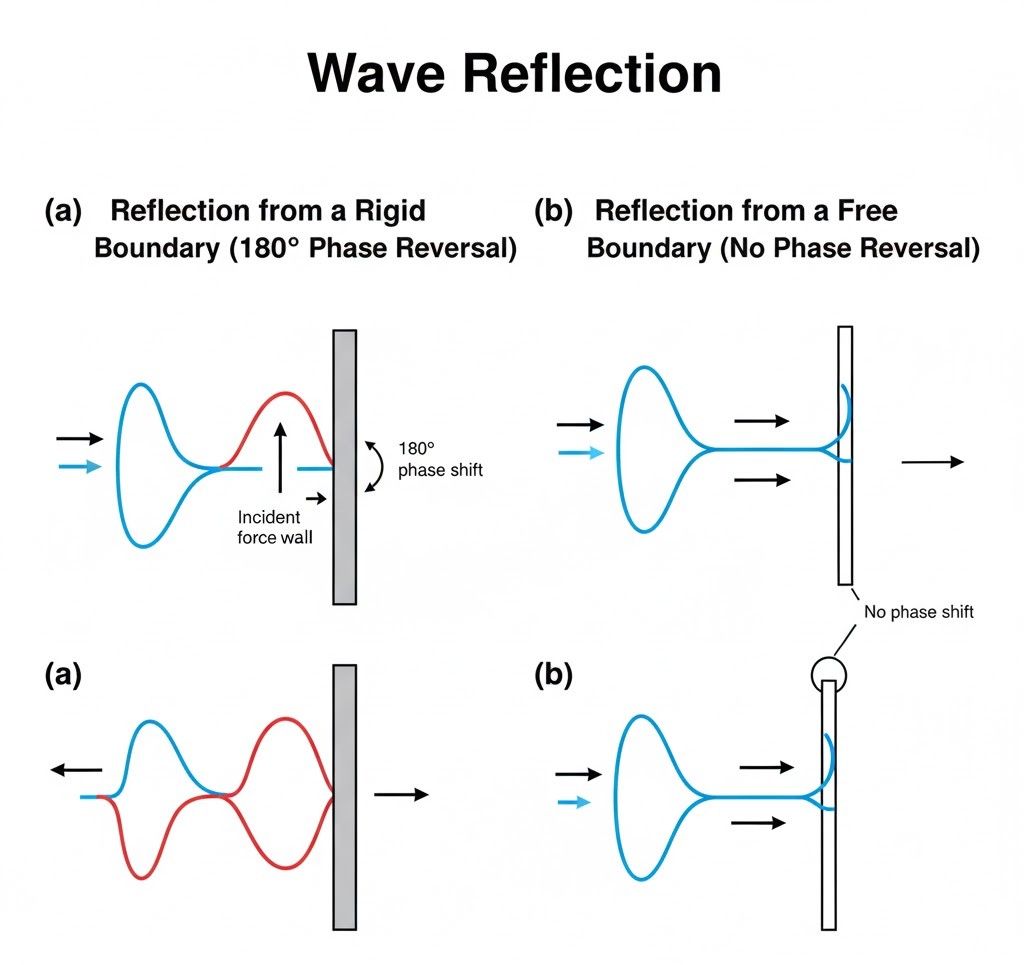
Now, let's talk Reflection. When a wave hits a rigid boundary, it gets a "slap" from the wall and suffers a phase reversal of $\pi$ ($180^\circ$). However, at an open boundary, the wave reflects like a hero making a smooth U-turn with no phase change.
NEET Checkpoint:
A wave reflects from a rigid support. What is the phase change?
(a) $0$
(b) $\pi/2$
(c) $\pi$
(d) $2\pi$
✅ Answer: (c) $\pi$ — Rigid boundaries always flip the phase, remember that!.
NEET Checkpoint:
At an open boundary, the reflected wave:
(a) Flips $180^\circ$
(b) Has no phase change
(c) Disappears
(d) Becomes longitudinal
✅ Answer: (b) Has no phase change — It's a free end, so it just slides back without a flip.
Figure below:
A clear two-part diagram showing (a) a wave pulse reflecting from a rigid wall with a 180-degree phase reversal and (b) a pulse reflecting from a free ring on a rod with no phase change.
Practice Question:
Two harmonic waves $y_1 = a \sin(kx - \omega t)$ and $y_2 = a \sin(kx - \omega t + \phi)$ superimpose. The resultant amplitude is:
(a) $2a \sin(\frac{\phi}{2})$
(b) $2a \cos(\frac{\phi}{2})$
(c) $a \cos(\phi)$
(d) $2a$
✅ Answer: (b) $2a \cos(\frac{\phi}{2})$ — This is the standard formula for the resultant amplitude of two interfering waves.
Key Takeaway
Formula Summary
- Superposition: $y = y_1 + y_2$
- Resultant Amplitude: $A(\phi) = 2a \cos(\frac{\phi}{2})$
- Rigid Boundary: $\Delta \phi = \pi$
- Open Boundary: $\Delta \phi = 0$
15. Standing Waves, Harmonics, and Beats
Listen, yaar, forget about waves that travel for a second. Imagine two identical waves moving in opposite directions and crashing into each other. Instead of a mess, they create a standing wave—a pattern that looks like it’s vibrating in place without moving left or right. The displacement for this cool pattern is $y(x,t) = 2a \sin kx \cos \omega t$.
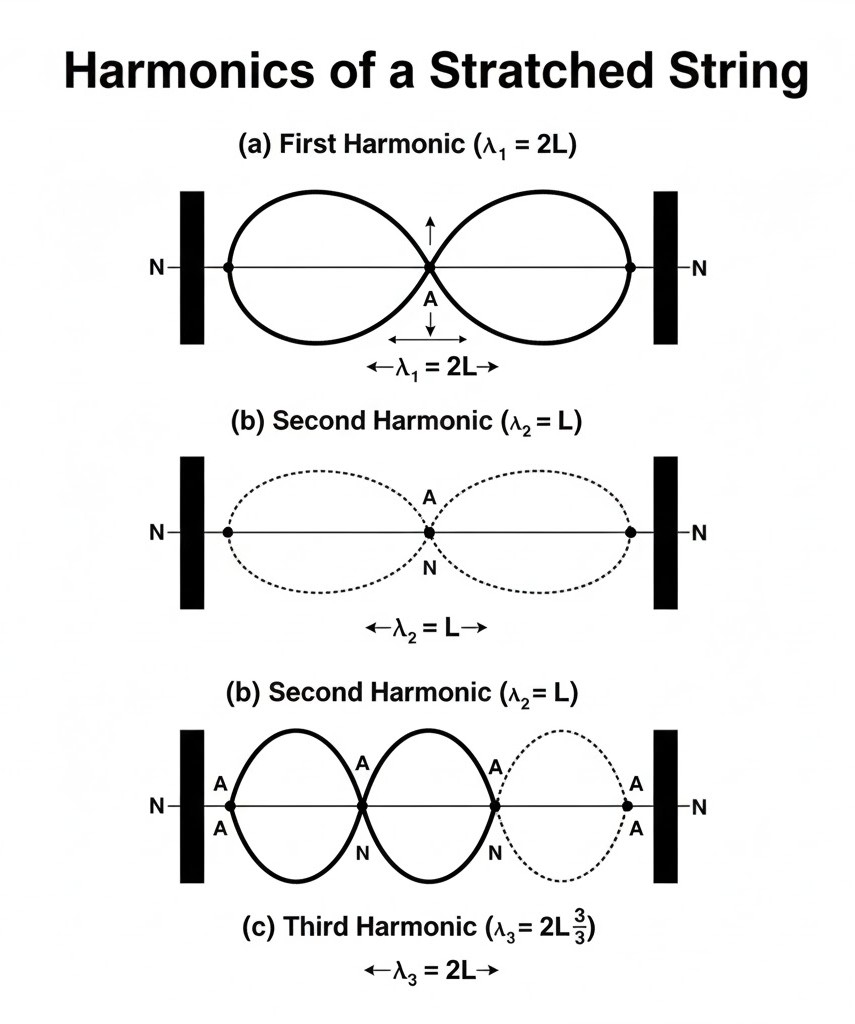
In this setup, some points are totally lazy and stay at zero displacement; we call these nodes. Others are high-energy spots jumping with maximum amplitude, known as antinodes. The distance between two consecutive nodes or antinodes is always $\lambda/2$. Think of it like a Sitar string or a Bansuri (flute). For a string fixed at both ends, we get all harmonics: $v_n = \frac{nv}{2L}$ for $n=1, 2, 3...$. But careful, beta! A closed organ pipe is a bit of a rebel; it only supports odd harmonics, meaning $v = (n + \frac{1}{2})\frac{v}{2L}$.
NEET Checkpoint:
What is the distance between a node and the next consecutive antinode?
(a) $\lambda$
(b) $\lambda/2$
(c) $\lambda/4$
(d) $2\lambda$
✅ Answer: (c) $\lambda/4$ — Since nodes and antinodes are alternate, the distance is half of the $\lambda/2$ gap between two nodes.
When you hear two sounds with nearly equal frequencies, you’ll notice a "wa-wa" waxing and waning of sound intensity. This is the beats phenomenon, often used by musicians to tune their instruments. The beat frequency is simply the difference: $v_{beat} = |v_1 - v_2|$.
Figure below:
A clear diagram showing the first three harmonics of a stretched string fixed at both ends, clearly labelling nodes (N) at the fixed ends and antinodes (A) in the centre loops.
NEET Checkpoint:
Which harmonics are present in a pipe closed at one end?
(a) All harmonics
(b) Only even
(c) Only odd
(d) No harmonics
✅ Answer: (c) Only odd — The boundary conditions for a closed pipe only allow frequencies like $1, 3, 5...$ times the fundamental.
NEET Checkpoint:
Two tuning forks of $400~Hz$ and $405~Hz$ are sounded together. The beat frequency is:
(a) $805~Hz$
(b) $5~Hz$
(c) $2.5~Hz$
(d) $10~Hz$
✅ Answer: (b) $5~Hz$ — Just subtract the two frequencies: $405 - 400 = 5~Hz$.
Practice Question:
A pipe $30.0~cm$ long is open at both ends. If the speed of sound is $330~m~s^{-1}$, what is the fundamental frequency?
(a) $275~Hz$
(b) $550~Hz$
(c) $1100~Hz$
(d) $825~Hz$
✅ Answer: (b) $550~Hz$. For an open pipe, $v_1 = \frac{v}{2L}$. Plugging in the values: $v_1 = \frac{330}{2 \times 0.3} = 550~Hz$. Arre, always convert cm to metres first!
Key Takeaway
Formula Summary
* Standing Wave: $y(x,t) = [2a \sin kx] \cos \omega t$
* String/Open Pipe Harmonics: $v_n = \frac{nv}{2L}~(n=1,2,3...)$
* Closed Pipe Harmonics: $v_n = (n + \frac{1}{2})\frac{v}{2L}~(n=0,1,2...)$
* Beat Frequency: $v_{beat} = v_1 - v_2$