1. Introduction to Optics: The Ray and Wave Pictures of Light
Hey there, future doctor! Ready to dive into the world of light? It’s not just about switches and bulbs; it’s the reason we interpret the beautiful world around us. Chalo, let's clear up this funda: Light is basically electromagnetic radiation detected by our eyes, ranging from approximately $400~nm$ to $750~nm$.
Usually, we think light travels in straight lines—we call these paths rays, and a bunch of them make a beam. Why the straight lines? Because light's wavelength is tiny compared to everyday things, like your thick NEET coaching modules. This "ray picture" is what we call Geometrical Optics.
NEET Checkpoint:
What is the approximate wavelength range of visible light?
(a) $100-400~nm$
(b) $400-750~nm$
(c) $750-1000~nm$
(d) $200-800~nm$
✅ Answer: (b) $400-750~nm$ — Keep this range in your heart (and brain) for the exam!.
But wait, there's a twist! In 1678, Huygens argued that light is actually a wave. While Newton's "corpuscular" model (the particle one) wrongly predicted light speeds up in water, the wave model correctly predicted it slows down. Foucault finally proved Huygens right in 1850.
Imagine a laser pointer at a wedding—the sharp, straight beam is the ray picture. But if you look at a pani puri stall’s light reflecting off a rainy road, the way it spreads out hints at its wave nature!
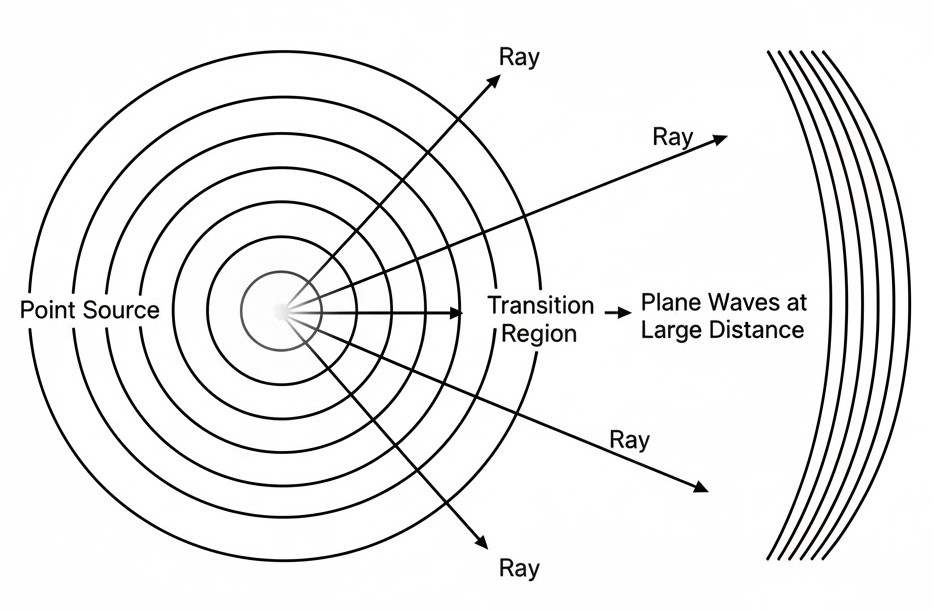
Figure below:
A diagram showing a point source emitting spherical wavefronts that transition into plane waves at a very large distance, with straight arrows representing rays perpendicular to the wavefronts.
NEET Checkpoint:
Who proposed the wave theory of light in 1678?
(a) Newton
(b) Huygens
(c) Maxwell
(d) Young
✅ Answer: (b) Huygens — He was the real "wave-maker" of the 17th century!.
NEET Checkpoint:
What happens to the speed of light in a denser medium according to the wave model?
(a) Increases
(b) Decreases
(c) Remains same
(d) Becomes infinite
✅ Answer: (b) Decreases — Even light has to slow down when the "traffic" (density) increases!.
Don't stress, yaar—optics is just about looking at the same thing from different angles. When the wavelength is treated as nearly zero, waves act just like rays.
Practice Question:
Geometrical optics is an approximation valid when:
(a) The wavelength is much larger than the object size.
(b) The wavelength is comparable to the object size.
(c) The wavelength is very small compared to the object size.
(d) Light travels only in vacuum.
✅ Explanation: (c) Light can be assumed to travel in straight lines because its wavelength is extremely small compared to ordinary objects.
Key Takeaway
- Visible Range: $400~nm$ to $750~nm$.
- Ray (Geometrical) Optics: Approximates light as straight lines when wavelength $\lambda$ is negligible.
- Wave Optics: Necessary for explaining speed changes in media and interference.
- Speed of Light ($c$): $\approx 3 \times 10^8~m~s^{-1}$ in vacuum.
2. Reflection of Light and Spherical Mirrors
Let's clear the funda of how light bounces back. Whether you’re looking into a bathroom mirror or a shiny new steel thali after a hearty meal, the rules of the game remain exactly the same!
First, let's talk about the Laws of Reflection. They are pretty straightforward: the angle of incidence $i$ (the angle between the incident ray and the normal) always equals the angle of reflection $r$. Also, the incident ray, the reflected ray, and the normal at the point of incidence all lie in the same plane. Don't stress, yaar—these laws aren't just for flat mirrors; they work perfectly for curved surfaces too!
NEET Checkpoint:
If a ray strikes a mirror at an angle of $30^\circ$ to the normal, what is the angle of reflection?
(a) $15^\circ$
(b) $30^\circ$
(c) $45^\circ$
(d) $60^\circ$
✅ Answer: (b) $30^\circ$ — Because $\angle i = \angle r$, simple logic!
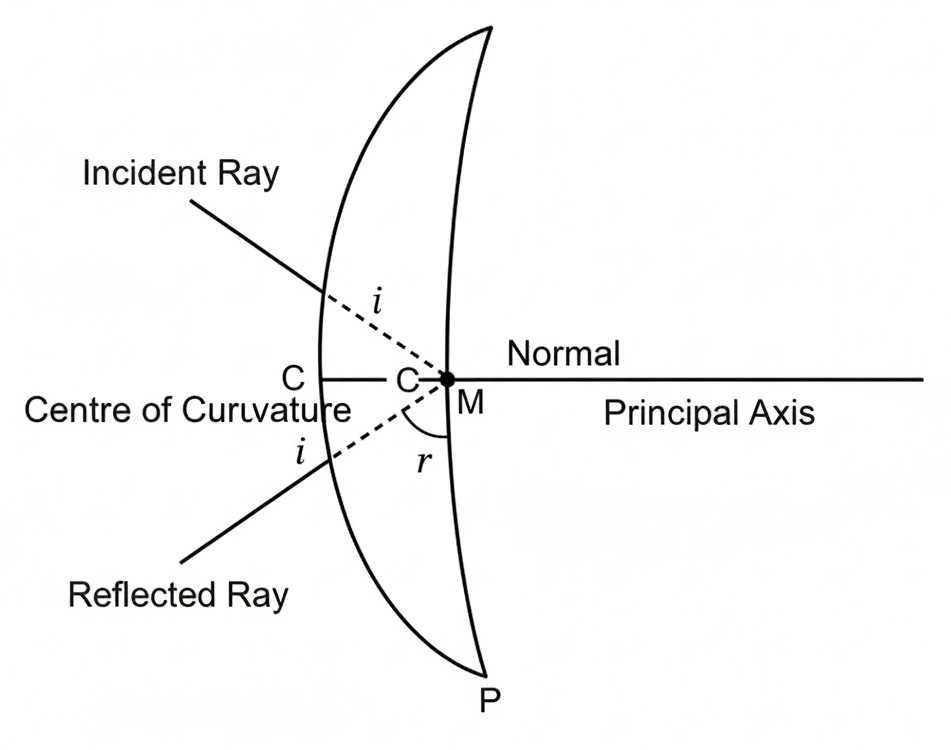
Now, for spherical mirrors, we have some specific "landmarks." The geometric centre of the mirror is called its Pole ($P$). The line joining this pole and the Centre of Curvature ($C$) is known as the Principal Axis.
NEET Checkpoint:
What is the geometric centre of a spherical mirror called?
(a) Centre of curvature
(b) Pole
(c) Principal focus
(d) Aperture
✅ Answer: (b) Pole ($P$) — It's the central point on the reflecting surface.
Here’s a trick to remember: for any spherical surface, the normal is simply the line along the radius, connecting the centre of curvature ($C$) to the point where the light hits. Think of it like a spoke on a cycle wheel reaching the rim!
NEET Checkpoint:
Where does the normal to a spherical mirror always pass through?
(a) Pole
(b) Principal focus
(c) Centre of curvature
(d) Aperture
✅ Answer: (c) Centre of Curvature ($C$) — The normal is always along the radius.
Indian Example: Imagine a batsman playing a fine leg glance. The way the ball "reflects" off the bat depends on the angle he holds it. If the bat was curved like a kadhai, the ball would still follow $\angle i = \angle r$ at the exact point of contact!
Practice Questions:
The line joining the pole and the centre of curvature of a spherical mirror is the:
(a) Normal axis
(b) Principal axis
(c) Radial line
(d) Focal axis
✅ Answer: (b) Principal axis — This is the standard definition for the line connecting $P$ and $C$.
Figure below:
A clear diagram of a concave mirror showing the Pole (P), the Centre of Curvature (C), and the Principal Axis. Include an incident ray hitting the mirror at point M, with a dashed normal line connecting M to C, showing angles i and r.
Key Takeaway
Formula Summary
- Law of Reflection: $\angle i = \angle r$
- Principal Axis: Line joining $P$ and $C$
- Normal: Radial line from $C$ to the point of incidence
3. Cartesian Sign Convention and Focal Length
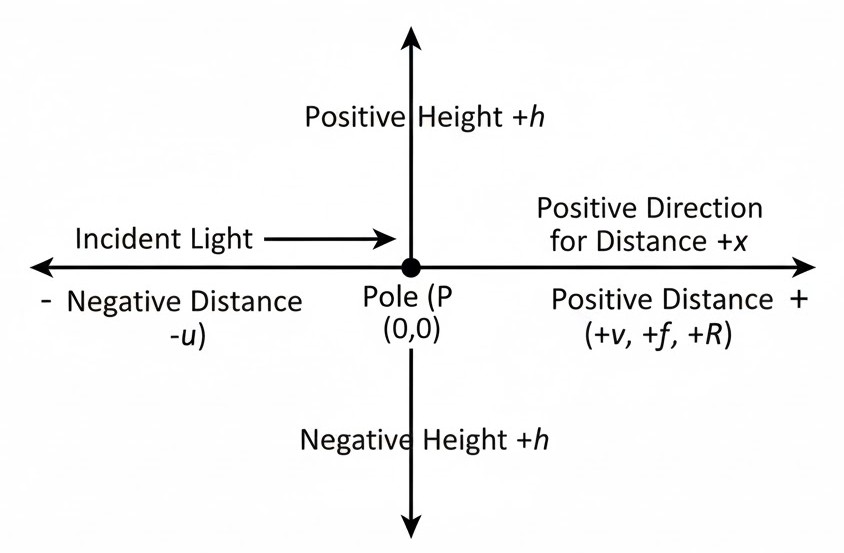
Listen up, junior! Before we tackle mirror numericals, we need to clear the funda of how we measure distances, or you'll end up with a negative mark in NEET. We use the Cartesian Sign Convention, where we treat the pole ($P$) of the mirror as our origin ($0,0$). Any distance measured in the same direction as the incident light is taken as positive ($+$), while distances measured against the light are negative ($-$).
NEET Checkpoint:
From which point are all distances in a spherical mirror measured?
(a) Focus
(b) Centre of Curvature
(c) Pole
(d) Object
✅ Answer: (c) Pole — It’s the starting point for every measurement on the principal axis!
When it comes to height, anything measured upwards and normal to the principal axis (the $x$-axis) is positive, while downward heights (like those inverted images) are negative. Imagine a cricketer: his height above the pitch is positive, but his reflection in a puddle would be negative!
Figure below:
A clear diagram showing the Cartesian Sign Convention for a spherical mirror. It should feature the pole as the origin, incident light moving from left to right, positive distances along the light, negative distances against the light, and arrows showing positive height upwards and negative height downwards from the principal axis.
Next, let's look at the Principal Focus ($F$). For a concave mirror, paraxial rays (rays very close to the axis) actually converge at $F$. For a convex mirror, they appear to diverge from $F$—kind of like how a mirage tricks you on a hot highway!. The distance from the pole to this focus is the focal length ($f$).
NEET Checkpoint:
What is the relationship between the focal length ($f$) and radius of curvature ($R$)?
(a) f = R
(b) R = 1 / f
(c) f=2R
(d) f = R / 2
✅ Answer: (d) $f = R/2$ — For spherical mirrors, the focus is always halfway to the centre of curvature!
For small angles, the math is simple:
Remember, $f$ is negative for a concave mirror and positive for a convex mirror. If you're using a convex mirror on your scooter, the focus is "behind" the mirror in the positive zone.
NEET Checkpoint:
A concave mirror has a radius of curvature of $40~cm$. What is its focal length?
(a) 10 cm
(b) - 20 cm
(c) 40 cm
(d) - 80 cm
✅ Answer: $-20~cm$ — Because $f = R/2$ and the focal length of a concave mirror is always negative!
Practice Questions:
1. According to the Cartesian Sign Convention, the height of an erect virtual image is:
(a) Negative
(b) Positive
(c) Zero
(d) Infinite
✅ Answer: (b) Positive — Erect means it’s pointing upwards from the axis!
2. If a paraxial beam of light appears to diverge from a point after reflection, the mirror is:
(a) Concave
(b) Plane
(c) Convex
(d) Cylindrical
✅ Answer: (c) Convex — Convex mirrors make parallel rays spread out from the focus!
Key Takeaway
Formula Summary
- Pole ($P$) = Origin ($0,0$).
- Direction of incident light = Positive ($+$).
- Opposite to incident light = Negative ($-$).
- Height upwards = Positive ($+$); Height downwards = Negative ($-$).
- Mirror Focal Length:$$f = \frac{R}{2}$$
4. The Mirror Equation and Linear Magnification
Listen up, junior! Don't let the math scare you—optics is just a game of tracing lines. An image is formed where rays from a point on an object actually meet (real image) or just appear to diverge from (virtual image) after reflection.
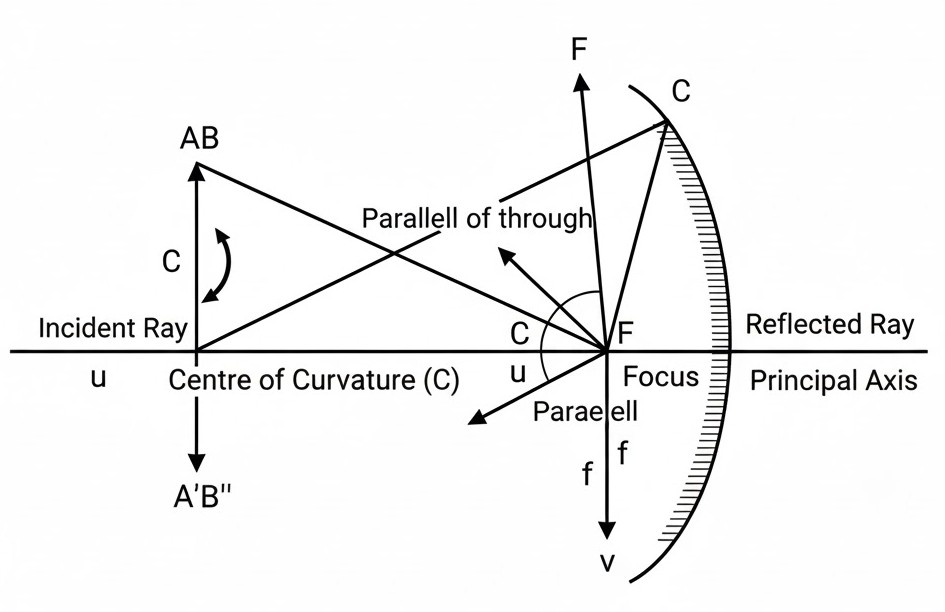
To find where the image hides, we use "convenient" rays. For example, a ray parallel to the principal axis always passes through the focus $F$, and a ray passing through the centre of curvature $C$ simply retraces its path. It's like a cricketer hitting a ball straight back to the bowler!
NEET Checkpoint:
A ray passing through the centre of curvature of a concave mirror reflects back along the same path. Why?
(a) It strikes the mirror normally
(b) The angle of incidence is maximum
(c) The mirror surface is flat at that point
(d) The ray passes through the focus
✅ Answer: (a) Because it hits the mirror normally (along the radius), making the angle of incidence $0^\circ$.
Here is the "Big Boss" formula, the Mirror Equation, which relates object distance $u$, image distance $v$, and focal length $f$:
NEET Checkpoint:
If an object is at infinity, where is the image formed?
(a) At the centre of curvature
(b) At the focus
(c) Between focus and pole
(d) At infinity
✅ Answer: (b) At the focus $F$ — Parallel rays from infinity always converge at the focal plane.
Then we have linear magnification $m$. This tells you if your image looks like a giant or an ant! It’s the ratio of image height $h'$ to object height $h$:
Imagine you're at a pani puri stall looking at your reflection in a shiny steel container. If your face looks upside down and tiny, that's a negative magnification $m$ at work!
NEET Checkpoint:
A magnification of $m = -3$ implies what about the image?
(a) Virtual, erect, and diminished
(b) Real, inverted, and magnified
(c) Virtual, erect, and magnified
(d) Real, erect, and diminished
✅ Answer: (b) The image is real, inverted, and three times larger than the object.
Figure below:
A clear ray diagram for a concave mirror showing an object AB, rays parallel to the axis passing through F, rays through C retracing their path, and rays meeting to form an inverted image A'B', with labels for u, v, and f.
Practice Question:
An object is placed $10\text{ cm}$ in front of a concave mirror with $f = -7.5\text{ cm}$. What is the magnification?
(a) $+3$
(b) $-3$
(c) $+1.5$
(d) $-1.5$
✅ Answer: (b) $-3$. Using $\frac{1}{v} + \frac{1}{-10} = \frac{1}{-7.5}$ gives $v = -30\text{ cm}$. Then $m = -(-30/-10) = -3$.
Key Takeaway
Formula Summary
* Mirror Equation:$$\frac{1}{v} + \frac{1}{u} = \frac{1}{f}$$
* Focal Length:$$f = \frac{R}{2}$$
* Magnification:$$m = \frac{h'}{h} = -\frac{v}{u}$$
5. Refraction of Light: Laws, Refractive Index, and Apparent Depth
Hey junior! Ready to dive into Refraction? It’s basically what happens when light tries to move from one transparent medium to another and gets a bit "distracted," changing its direction at the interface. Think of it like a cricketer running from the smooth pitch into the heavy grass of the outfield—the change in "surface" makes the ball (or light) change its path!
The rulebook here is Snell’s Law. It says the ratio of the sine of the angle of incidence ($i$) to the sine of the angle of refraction ($r$) is a constant for a pair of media:
Here, $n_{21}$ is the refractive index of medium 2 with respect to medium 1. If $n_{21} > 1$, medium 2 is optically denser, and the light ray bends towards the normal. Arre, don't confuse optical density with mass density! Turpentine has less mass density than water, but it's optically denser.
NEET Checkpoint:
A ray of light enters an optically denser medium. Does it bend towards or away from the normal?
(a) Away from the normal
(b) Towards the normal
(c) Along the normal
(d) No bending occurs
✅ Answer: (b) Towards the normal — In a denser medium, the angle of refraction $r$ is smaller than $i$.
A classic funda is Apparent Depth. Ever noticed a coin in a bucket of water looking closer to the surface than it actually is? That's refraction making the bottom of the tank appear raised. For viewing near the normal, the apparent depth ($h_{1}$) is the real depth ($h_{2}$) divided by the refractive index ($n$):
NEET Checkpoint:
If the refractive index of medium 1 w.r.t. 2 is $n_{12}$, what is its relation to $n_{21}$?
(a) n12=n21
(b) $n_{12} = \frac{1}{n_{21}}$
(c) $n_{12} = n_{21}^2$
(d) n12+n21=1
✅ Answer: (b) $n_{12} = \frac{1}{n_{21}}$ — It’s a simple reciprocal relationship, yaar!.
Figure below:
A clear diagram showing a ray of light traveling from an object at the bottom of a water tank, refracting at the water-air interface by bending away from the normal, and a dotted line tracing back to show the object's apparent position at a shallower depth.
NEET Checkpoint:
The speed of light in vacuum is $c$. If the refractive index of a medium is $n$, what is the speed $v$ in that medium?
(a) v=cn
(b) $v = \frac{n}{c}$
(c) $v = \frac{c}{n}$
(d) v=c−n
✅ Answer: (c) $v = \frac{c}{n}$ — The medium slows light down by a factor of its refractive index!.
Practice Question:
A swimming pool has a real depth of $4 \text{ m}$. If the refractive index of water is $1.33$, what is its apparent depth?
(a) $5.32 \text{ m}$
(b) $3.01 \text{ m}$
(c) $4 \text{ m}$
(d) $2.5 \text{ m}$
✅ Answer: (b) $3.01 \text{ m}$ — Just use $h_{1} = \frac{h_{2}}{n} = \frac{4}{1.33} \approx 3.01 \text{ m}$.
Key Takeaway
Formula Summary
* Snell’s Law: $\frac{\sin i}{\sin r} = n_{21}$
* Reciprocity: $n_{12} = \frac{1}{n_{21}}$
* Apparent Depth: $h_{1} = \frac{h_{2}}{n}$
6. Total Internal Reflection (TIR) and the Critical Angle
Listen up, NEET aspirants! Ever wondered why a diamond sparkles so much or how high-speed internet travels through thin glass wires? It’s all down to a "light-magic" trick called Total Internal Reflection (TIR).
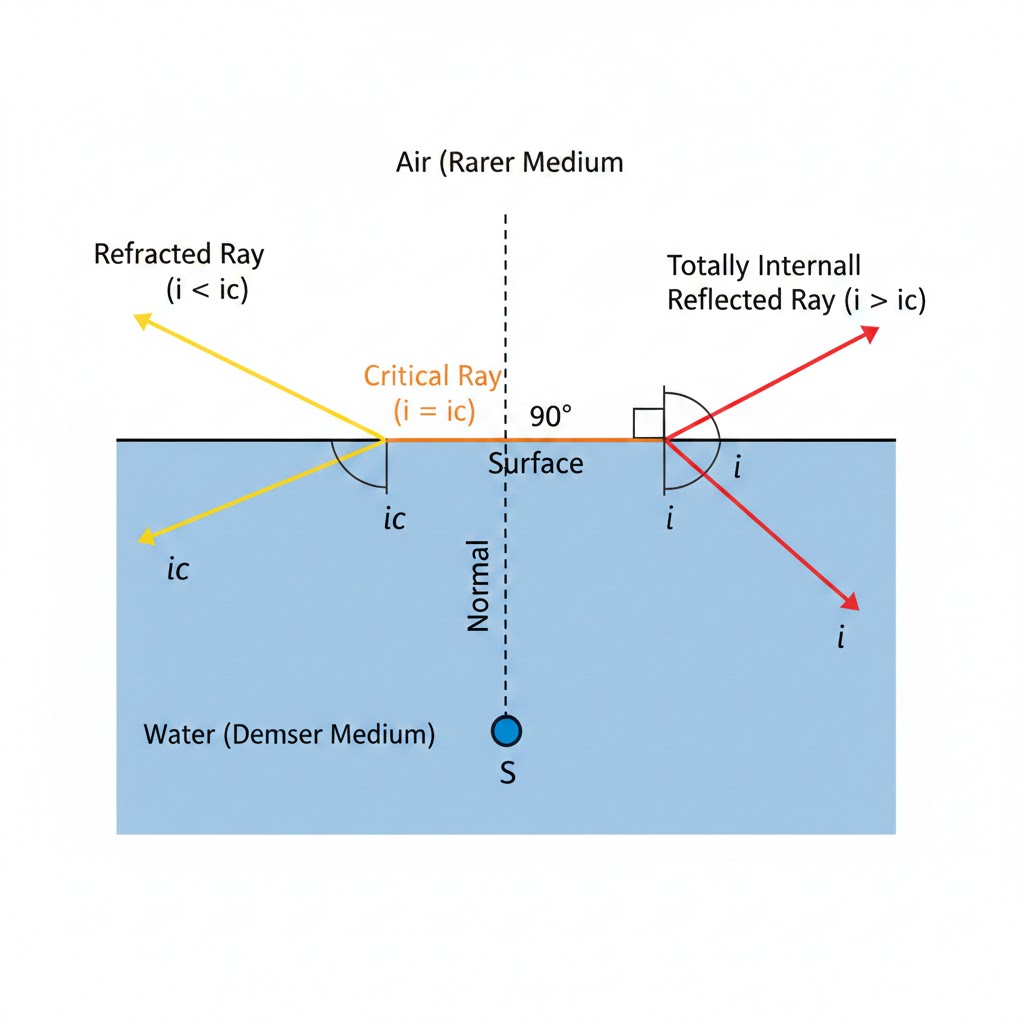
When light tries to jump from an optically denser medium (like water) to a rarer medium (like air), it bends away from the normal. As you increase the angle of incidence ($i$), the refracted ray bends further until it eventually "grazes" the surface.
NEET Checkpoint:
For TIR to occur, light must travel from:
(a) Rarer to Denser
(b) Denser to Rarer
(c) Vacuum to Denser
(d) Air to Glass
✅ Answer: (b) Denser to Rarer — Light needs to "feel the freedom" to bend away from the normal!.
The Critical Angle ($i_c$) is that "sweet spot" angle of incidence where the angle of refraction ($r$) becomes exactly $90^\circ$. If you push $i$ even a tiny bit beyond $i_c$, the light doesn't escape at all; it gets "trapped" and reflects back into the denser medium. That’s TIR for you!
NEET Checkpoint:
What is the angle of refraction when the incident ray is at the critical angle?
(a) $0^\circ$
(b) $45^\circ$
(c) $90^\circ$
(d) $180^\circ$
✅ Answer: (c) $90^\circ$ — The ray is literally skimming the surface interface.
Here’s the math funda you’ll need for those MCQs:
Where $n_{21}$ is the refractive index of the rarer medium with respect to the denser one. If medium 2 is air, then the refractive index of the denser medium ($n_1$) is:
Relatable Example: Imagine you're at a Pani Puri stall. If you look into the large vessel of teekha pani from a very sharp, flat angle, you won't see the bottom—you’ll just see the reflection of the puris floating on top. Your line of sight is hitting the water-air interface at an angle greater than $i_c$!
Figure below:
A clear diagram showing a point source in a denser medium (water) with multiple rays: one refracting away from the normal, one grazing the surface at the critical angle (90 degrees), and one undergoing total internal reflection back into the water for i > ic.
NEET Checkpoint:
If the refractive index of a medium is $\sqrt{2}$, what is its critical angle with air?
(a) $30^\circ$
(b) $45^\circ$
(c) $60^\circ$
(d) $90^\circ$
✅ Answer: (b) $45^\circ$ — Since $\sin i_c = 1/n$, $\sin i_c = 1/\sqrt{2}$, so $i_c = 45^\circ$.
Practice Questions:
1. Total Internal Reflection is possible only when:
(a) $i < i_c$
(b) $i = i_c$
(c) $i > i_c$
(d) $r < 90^\circ$
✅ Answer: (c) $i > i_c$ — Beyond the critical angle, refraction stops and reflection takes over!.
2. Optical fibres work on the principle of:
(a) Refraction
(b) Dispersion
(c) Total Internal Reflection
(d) Interference
✅ Answer: (c) Total Internal Reflection — Light travels through the core by bouncing off the cladding repeatedly.
Key Takeaway
Formula Summary
* Condition 1: Light must go Denser $\rightarrow$ Rarer.
* Condition 2: Angle of incidence $i > i_c$.
* Critical Angle Formula: $\sin i_c = \frac{n_{rarer}}{n_{denser}}$.
7. Applications of Total Internal Reflection: Prisms and Optical Fibres
Arre, welcome back! Now that we’ve cracked the Total Internal Reflection (TIR) code, let's see where this magic actually happens in real life. It’s not just bookish knowledge; it’s the reason your internet is fast and why some binoculars are so crisp!
The Prism Power-Up
Prisms are designed to be redirection experts. By using TIR, they can bend light by $90^{\circ}$ or a full $180^{\circ}$. Some are even used to invert images without changing their actual size. Here's the catch: for this to work, the critical angle $i_c$ of the material must be less than $45^{\circ}$. Notice this? Crown glass and dense flint glass fit the bill perfectly.
NEET Checkpoint:
To bend light by $90^{\circ}$ in a prism, the critical angle must be?
(a) $> 45^{\circ}$
(b) $< 45^{\circ}$
✅ Answer: (b) — If $i_c$ was larger than $45^{\circ}$, the light would just refract out instead of reflecting back!
Think of it like a carrom board—if you hit the striker at the right angle, it zips across the board. In a prism, light is the striker!
Optical Fibres: The Information Highway
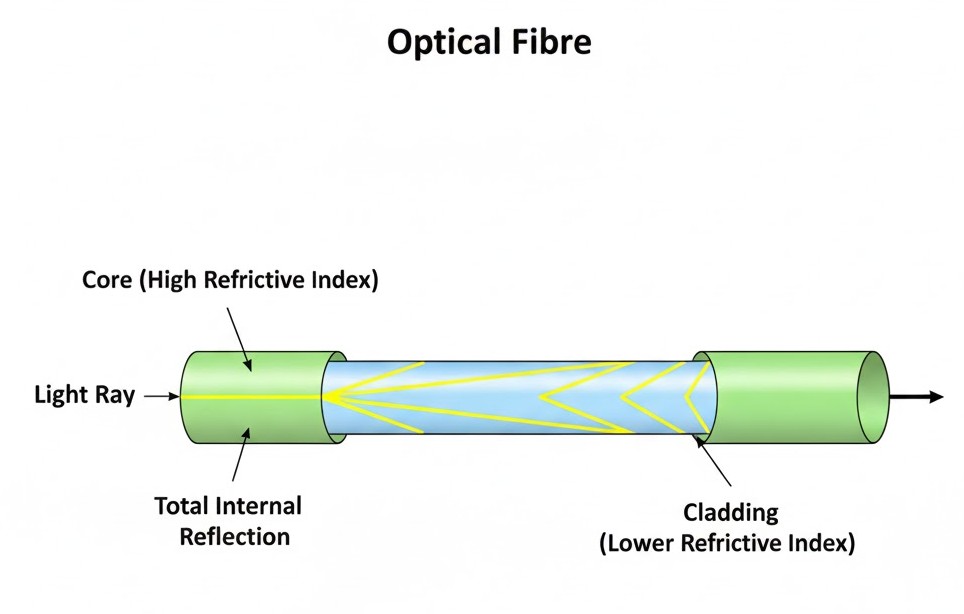
These are the real MVPs. Optical fibres are tiny, high-quality glass or quartz strands that act as 'light pipes'. They have a core with a higher refractive index ($n_1$) and a cladding with a lower refractive index ($n_2$).
NEET Checkpoint:
In an optical fibre, which part has the higher refractive index?
(a) Core
(b) Cladding
(c) Protective jacket
(d) Outer coating
✅ Answer: (a) The Core — TIR only happens when moving from a denser (core) to a rarer (cladding) medium.
When a signal enters at a suitable angle, it undergoes repeated TIR along the length of the fibre. Even if you bend the fibre, the light follows the curve! Because there is no appreciable loss of intensity, they are perfect for high-speed internet or doctors doing an endoscopy to check your stomach.
Figure below:
A diagram of an optical fibre showing a central core and outer cladding, with a light ray undergoing multiple zig-zag total internal reflections inside the core as it travels from one end to the other.
NEET Checkpoint:
Why are optical fibres better than copper wires for signals?
(a) They have higher electrical conductivity
(b) They are immune to electromagnetic interference
(c) They produce more heat
(d) They require higher signal power
✅ Answer: (b) There is no appreciable loss of intensity during TIR, allowing signals to travel long distances.
Practice Questions:
In silica glass fibres, what percentage of light can be transmitted over a distance of $1~km$?
(a) 10%
(b) 50%
(c) 95%
(d) 100%
✅ Answer: (c) 95% — Special purification of quartz makes them incredibly efficient.
Key Takeaway
- Prisms: Use TIR to bend light by $90^{\circ}, 180^{\circ}$ or to invert images. $i_c$ must be $< 45^{\circ}$.
- Optical Fibres: Use repeated TIR to transmit signals.
- Structure: High $n$ Core + Low $n$ Cladding.
- Usage: Communication and medical visual exams.
8. Refraction at Single Spherical Surfaces, Lenses, and Lens Maker's Formula
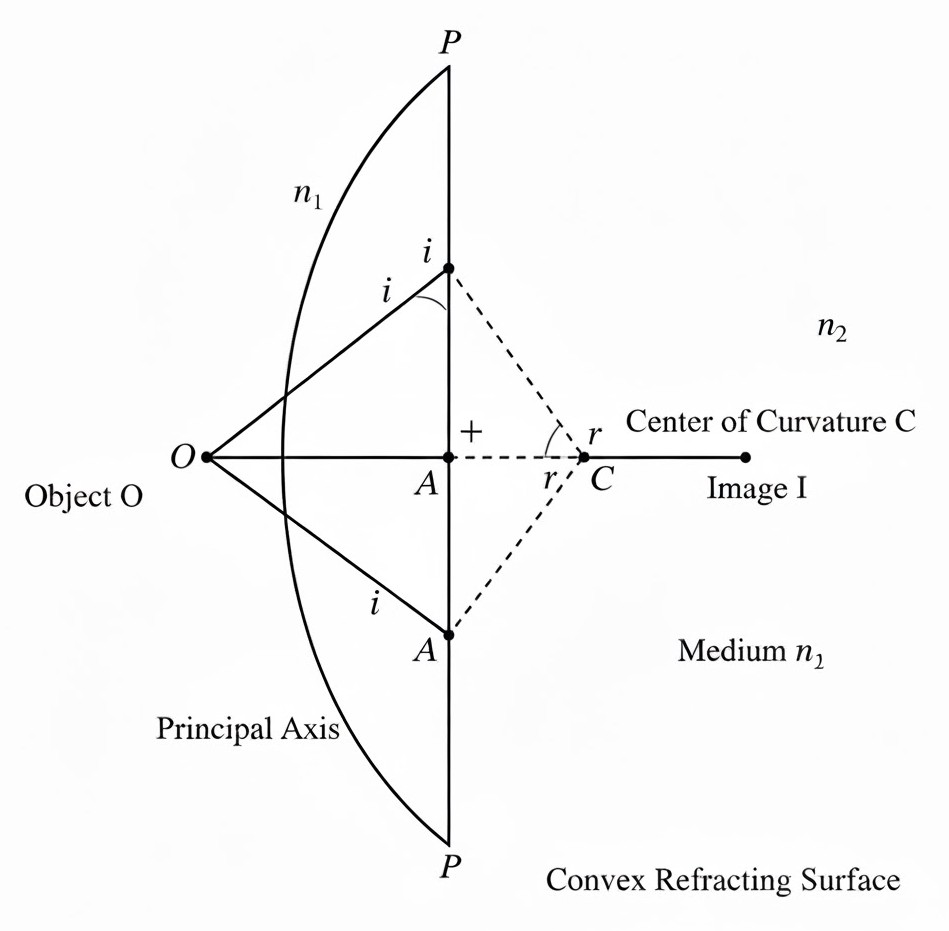
Arre junior, let’s get into the curvy side of life! We’ve seen light hitting flat glass, but what happens when it hits a spherical surface like a glass paperweight?. When light moves from medium $n_1$ to $n_2$ across a curved surface with radius $R$, we use this classic funda:
Don't panic about the derivation; just remember that the Cartesian sign convention is your best friend here—measure everything from the pole!.
NEET Checkpoint:
If a ray passes through the centre of curvature of a spherical refracting surface, what is the angle of refraction?
(a) $0^\circ$
(b) $30^\circ$
(c) $45^\circ$
(d) $90^\circ$
✅ Answer: (a) $0^\circ$ — Any ray passing through the centre of curvature is normal to the surface, so it passes undeviated.
Now, let's talk lenses. A thin lens is just a transparent sandwich of two spherical surfaces. The trick to understanding them? The image formed by the first surface acts as the virtual object for the second surface. This logic leads us to the Lens Maker’s Formula, used by opticians to design your cool shades:
Relatable Example: Imagine looking at a Gulab Jamun inside a curved glass bowl at a local sweet shop. The light travels from the syrup ($n_1$) through the curved glass ($n_2$), making the jamun look bigger. That's single-surface refraction in action, yaar!
NEET Checkpoint:
What happens to the focal length $f$ if a lens is placed in a liquid with the same refractive index as the glass?
(a) Focal length decreases
(b) Focal length increases
(c) Focal length becomes infinite
(d) Focal length becomes zero
✅ Answer: (c) It becomes infinite ($f \to \infty$) — The lens effectively disappears and acts like a plain glass sheet.
Figure below:
A clear diagram showing refraction at a single convex spherical surface separating media of refractive indices $n_1$ and $n_2$, with a point object O on the principal axis and its real image I.
NEET Checkpoint:
Is the focal length of a concave lens positive or negative?
(a) Positive
(b) Negative
(c) Zero
(d) Depends on medium
✅ Answer: (b) Negative — By convention, the focal length of a diverging (concave) lens is taken as negative.
Practice Questions:
For a thin lens, if the object is at infinity, the image is formed at:
(a) Optical centre
(b) $2f$
(c) Focus
(d) Between $f$ and $2f$
✅ Answer: (c) Focus — This is the definition of the principal focus for a lens.
Key Takeaway
Formula Summary
- Spherical Surface: $\frac{n_2}{v} - \frac{n_1}{u} = \frac{n_2 - n_1}{R}$
- Lens Maker’s Formula: $\frac{1}{f} = (n_{21} - 1) \left( \frac{1}{R_1} - \frac{1}{R_2} \right)$
- Thin Lens Formula: $\frac{1}{v} - \frac{1}{u} = \frac{1}{f}$
9. The Thin Lens Formula, Magnification, and Power of a Lens
Arre junior, ready to master the "chashma" math? Whether you are checking out a tiny cricket score on an old mobile or getting new specs, these formulas are the real funda!. The Thin Lens Formula is your go-to tool for finding where an image will land:
Where $u$ is the object distance, $v$ is the image distance, and $f$ is the focal length.
NEET Checkpoint:
If a lens forms a virtual, erect image, is the magnification positive or negative?
(a) Positive
(b) Negative
(c) Zero
(d) Infinite
✅ Answer: (a) Positive — By convention, erect images have a positive height, making $m$ positive.
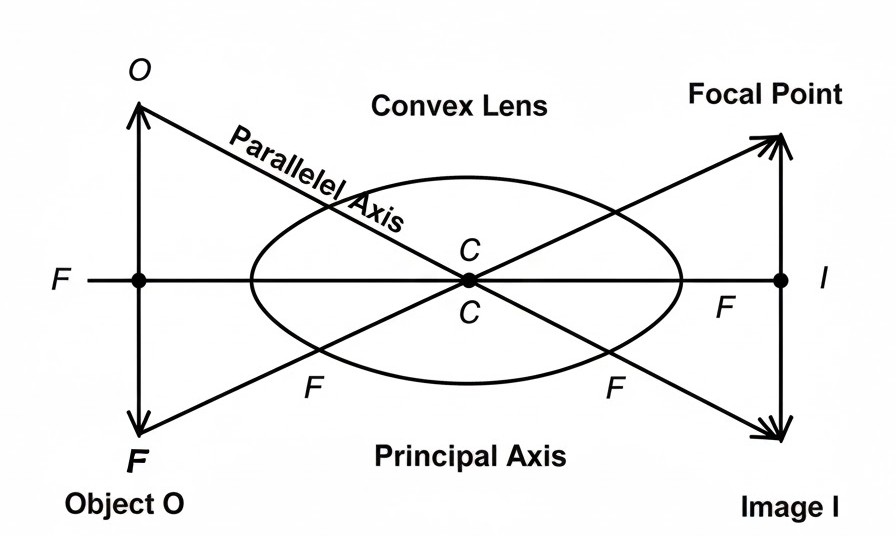
To trace these images, remember the senior's trick: a ray passing through the optical centre emerges without any deviation. Easy, right? If you want to know how much your lens "zooms," use linear magnification ($m$):
If $m$ is negative, the image is real and inverted; if positive, it's virtual and erect.
Relatable Example: Imagine using a magnifying glass to read the tiny "Total Price" on a faded Pani Puri stall receipt. If the lens makes the text look three times bigger, your $m = 3$!
Now, let's talk Power ($P$). It’s just a measure of how much the lens bends light. Shorter focal length means more bending, so:
Crucial Point: For this formula, $f$ MUST be in metres! The SI unit is the dioptre ($D$), where $1 D = 1 m^{-1}$.
Figure below:
A clear ray diagram of a convex lens forming a real, inverted image of a finite object, showing a ray parallel to the principal axis passing through the focus and a ray through the optical centre passing undeviated.
NEET Checkpoint:
What is the power of a plane glass sheet?
(a) +1 D
(b) −1 D
(c) 0 D
(d) Infinite
✅ Answer: (c) $0 D$ — A plane sheet has an infinite focal length ($f \to \infty$), so $P = 1/\infty = 0$.
NEET Checkpoint:
An optician prescribes a lens of $+2.5 D$. Is it for a concave or convex lens?
(a) Concave lens
(b) Convex lens
(c) Cylindrical lens
(d) Bifocal lens
✅ Answer: (b) Convex lens — Positive power always indicates a converging (convex) lens.
Practice Questions:
A convex lens has a focal length of $20 cm$. Its power is:
(a) $2 D$
(b) $5 D$
(c) $-5 D$
(d) $0.5 D$
✅ Answer: (b) $5 D$ — Convert $f$ to metres: $20 cm = 0.2 m$. Then $P = 1/0.2 = 5 D$.
Key Takeaway
Formula Summary
- Thin Lens Formula: $\frac{1}{v} - \frac{1}{u} = \frac{1}{f}$
- Magnification: $m = \frac{h'}{h} = \frac{v}{u}$
- Power: $P = \frac{1}{f (\text{in metres})}$
10. Combination of Thin Lenses in Contact
Arre junior, listen up! This topic is a real scoring area for NEET, and the funda is simpler than choosing your favourite IPL team. When we place thin lenses in contact, the entire system behaves like a single equivalent lens. The main reason we do this is to get that perfect magnification and to make the image sharp enough to see every detail, just like a high-definition replay of a Kohli cover drive!
Here is the math you need to memorize:
1. Focal Length: The reciprocal of the effective focal length ($f$) is the sum of the reciprocals of the individual focal lengths ($f_1, f_2, \dots$):
2. Power: This is the best part—Powers just add up algebraically! So, $P = P_1 + P_2 + P_3 + \dots$.
3. Magnification: Total magnification ($m$) is the product of individual magnifications: $m = m_1 \times m_2 \times m_3 \dots$.
NEET Checkpoint:
If two lenses of power $+5\text{ D}$ and $-2\text{ D}$ are in contact, what is the net power?
(a) $+7\text{ D}$
(b) $+3\text{ D}$
(c) $-3\text{ D}$
(d) $+10\text{ D}$
✅ Answer: (b) $+3\text{ D}$ — Just add them algebraically: $+5 + (-2) = +3\text{ D}$.
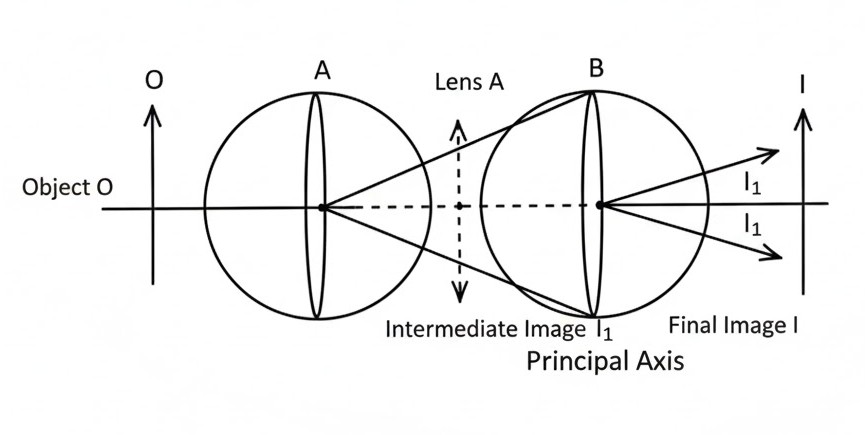
Think of this like a pani puri stall assembly line. The first person makes the hole, the second fills the potato, and the third adds the teekha pani. Each person (lens) does their bit, and the final "deliciousness" (magnification) is the result of all their work combined! In physics terms, the image formed by the first lens acts as a virtual object for the second lens.
NEET Checkpoint:
Why do we combine lenses in optical instruments like cameras?
(a) To increase the weight of the instrument
(b) To correct optical defects (aberrations) and improve image quality
(c) To reduce the focal length to zero
(d) To block unwanted light
✅ Answer: (b) To obtain desired magnification and enhance the sharpness of the image.
Figure below:
A clear ray diagram showing two thin lenses A and B in contact, with an object O on the principal axis, showing the path of rays forming an intermediate image I1 and a final image I.
NEET Checkpoint:
If two lenses have magnifications of $2$ and $3$, what is the total magnification?
(a) 5
(b) 6
(c) 1
(d) 0
✅ Answer: (b) $6$ — Remember, magnification is multiplied ($2 \times 3$), not added!
Don't let the signs trip you up, yaar. For a convex lens, $f$ is positive, and for a concave lens, $f$ is negative.
Practice Questions:
Two thin lenses of focal lengths $f_1 = 10\text{ cm}$ and $f_2 = -20\text{ cm}$ are in contact. The effective focal length is:
(a) $20\text{ cm}$
(b) $-20\text{ cm}$
(c) $10\text{ cm}$
(d) $6.67\text{ cm}$
✅ Answer: (a) $20\text{ cm}$. Calculation: $\frac{1}{f} = \frac{1}{10} - \frac{1}{20} = \frac{1}{20}$. Thus, $f = 20\text{ cm}$.
Key Takeaway
Formula Summary
* Effective Focal Length: $\frac{1}{f} = \sum \frac{1}{f_i}$
* Net Power: $P = P_1 + P_2 + \dots$ (Algebraic sum)
* Total Magnification: $m = m_1 \times m_2 \times \dots$
11. Refraction Through a Prism: Deviation and Minimum Deviation
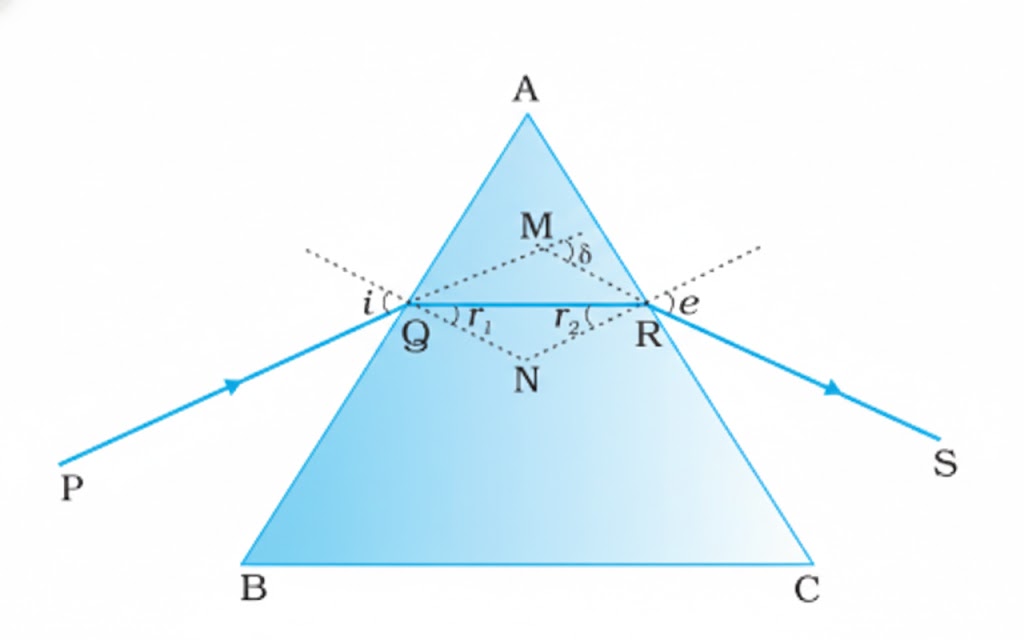
Hey junior! Ready to see how a prism pulls a "U-turn" on light? When a ray enters a triangular prism with a refracting angle $A$, it doesn't just pass through straight; it gets bent at both faces. The total angle between the original incident ray direction and the final emergent ray is called the angle of deviation ($\delta$).
Think of it like a Mumbai auto-rickshaw taking a sharp shortcut through a narrow galli. It enters at one angle, zig-zags inside, and exits at a completely different angle! That total change in direction is your $\delta$.
Inside the prism, geometry is your best friend. Two key relations to remember are:
where $i$ is the angle of incidence, $e$ is the angle of emergence, and $r_1, r_2$ are the internal refraction angles.
NEET Checkpoint:
What is the relationship between the internal angles of refraction and the prism angle?
(a) r1−r2=A
(b) r1+r2=A
(c) r1r2=A
(d) $\dfrac{r_1}{r_2} = A$
✅ Answer: $r_1 + r_2 = A$ — This is a constant geometric property for any ray passing through the prism.
As you change the angle of incidence $i$, the deviation $\delta$ also changes. It reaches a "sweet spot" called minimum deviation ($D_m$). At this point, the ray inside the prism is perfectly parallel to the base, and we get the symmetry $i = e$ and $r_1 = r_2$.
NEET Checkpoint:
At the position of minimum deviation, how does $i$ relate to $e$?
(a) i>e
(b) i
(c) i+e = A
(d) i = e
✅ Answer: (d) $i = e$ — The angles of incidence and emergence become equal at minimum deviation.
Figure below:
A clear ray diagram of a triangular glass prism $ABC$ showing an incident ray $PQ$ at angle $i$, the refracted ray $QR$ parallel to the base $BC$, and the emergent ray $RS$ at angle $e$. Label the prism angle $A$, internal angles $r_1$ and $r_2$, and the angle of deviation $\delta$.
Using the minimum deviation, we can calculate the refractive index ($n_{21}$) of the prism material:
This is a super important funda for your labs and NEET exams!.
NEET Checkpoint:
If a prism is "thin" (small angle $A$), what is the simplified formula for deviation?
(a) $D_m = \mu A$
(b) $D_m = (\mu - 1)A$
(c) $D_m = (\mu + 1)A$
(d) $D_m = \dfrac{A}{\mu}$
✅ Answer: (b ) $D_m = (n_{21} - 1)A$ — For small angles, the sine functions simplify, making the math much easier.
Practice Questions:
- A prism has a refracting angle $A = 60^\circ$ and produces a minimum deviation of $30^\circ$. What is the angle of incidence $i$?
(a) $30^\circ$
(b) $45^\circ$
(c) $60^\circ$
(d) $15^\circ$
✅ Answer: (b) $45^\circ$ — At minimum deviation, $i = (A + D_m)/2 = (60 + 30)/2 = 45^\circ$.
2. For a thin prism of angle $4^\circ$ and refractive index $1.5$, find the angle of minimum deviation.
(a) $2^\circ$
(b) $4^\circ$
(c) $6^\circ$
(d) $1^\circ$
✅ Answer: (a) $2^\circ$ — Using $D_m = (n - 1)A = (1.5 - 1) \times 4 = 0.5 \times 4 = 2^\circ$.
Key Takeaway
Formula Summary
- Prism Geometry: $r_1 + r_2 = A$
- Total Deviation: $\delta = i + e - A$
- Refractive Index: $n_{21} = \frac{\sin[(A + D_m)/2]}{\sin(A/2)}$
- Thin Prism Approximation: $D_m = (n_{21} - 1)A$
12. Optical Instruments I: Simple and Compound Microscopes
Arre, biology students! You spend half your life looking through microscopes in the lab, but do you know the physics funda behind those lenses? Let’s break it down so you can ace those NEET optics questions.
A simple microscope is just a single converging lens with a small focal length $f$. When you hold it close to an object, it creates an erect, magnified, and virtual image. If you want the most "zoom" while keeping the image at your near point ($D = 25~cm$), the magnification is:
But if you want a "relaxed eye" view (image at infinity), the magnification is slightly less: $m = D/f$. It’s like using a magnifying glass to check if your pani puri has any "extra" ingredients!
NEET Checkpoint:
A simple microscope has $f = 5~cm$. What is the magnification for a relaxed eye?
(a) 5
(b) 6
(c) 1
(d) 4
✅ Answer: (a) 5 — Since the eye is relaxed, image is at infinity, so $m = D/f = 25/5 = 5$.
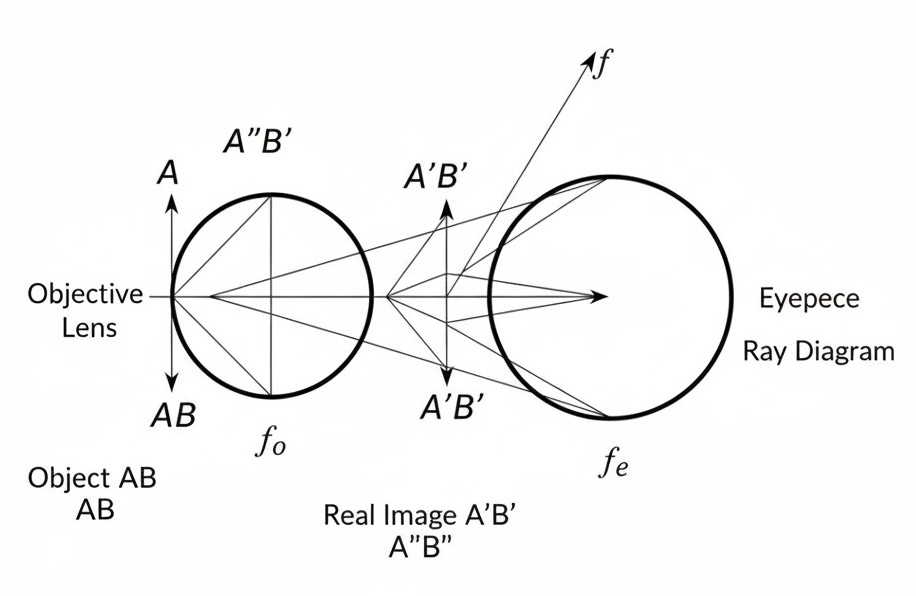
When a single lens isn't enough, we use a compound microscope. This is like a relay race: the objective lens (short $f_o$) creates a real, inverted image, and then the eyepiece (short $f_e$) magnifies that image even further.
Figure below:
A clear ray diagram of a compound microscope showing an objective lens and an eyepiece. Show the object $AB$ near the objective, the intermediate real image $A'B'$, and the final magnified virtual image $A''B''$ formed by the eyepiece.
The total magnification $m$ is the product of the individual magnifications:
For the final image at infinity, the approximate formula is:
Here, $L$ is the tube length—the distance between the focal points of the two lenses.
NEET Checkpoint:
To increase the magnifying power of a compound microscope:
(a) Increase $f_o$
(b) Decrease $f_o$ and $f_e$
(c) Decrease $L$
(d) Use a concave eyepiece
✅ Answer: (b) Decrease $f_o$ and $f_e$ — Looking at the formula, $f_o$ and $f_e$ are in the denominator, so smaller focal lengths give bigger magnification!
NEET Checkpoint:
In a compound microscope, the intermediate image is:
(a) Virtual and erect
(b) Real and erect
(c) Real and inverted
(d) Virtual and inverted
✅ Answer: (c) Real and inverted — The objective forms a real, inverted, and magnified image.
Practice Question:
A compound microscope has $L = 20~cm$, $f_o = 1~cm$, and $f_e = 2~cm$. What is the total magnification for a relaxed eye?
(a) 100
(b) 200
(c) 250
(d) 500
✅ Answer: (c) 250 — Arre, just plug it in! $m = (20/1) \times (25/2) = 20 \times 12.5 = 250$. Don't stress, yaar—it's easier than it looks!
Key Takeaway
Formula Summary
- Simple Microscope (Near Point): $m = 1 + \frac{D}{f}$
- Simple Microscope (Infinity): $m = \frac{D}{f}$
- Compound Microscope (Total): $m = m_o \times m_e$
- Compound Microscope (Infinity): $m \approx \left(\frac{L}{f_o}\right)\left(\frac{D}{f_e}\right)$
13. Optical Instruments II: Astronomical Telescopes
Hey there, future doctor! Ready to peek at the stars? While a microscope looks at the tiny "shaitans" close by, a telescope provides angular magnification of distant giants like planets and stars.
In a refracting telescope, the objective is a big lens with a large focal length ($f_o$) and a large aperture to gulp down as much light as possible. The eyepiece is smaller, with a shorter focal length ($f_e$).
NEET Checkpoint:
In a telescope, which lens has a larger focal length?
(a) Eyepiece
(b) Objective
(c) Both are equal
(d) Depends on the star
✅ Answer: (b) — The objective must have a large $f_o$ to provide high magnification.
For normal adjustment (when your eyes are relaxed and the final image is at infinity), the magnifying power $m$ is the ratio of the angle subtended by the image ($\beta$) to that of the object ($\alpha$):
At this setting, the length of the telescope tube is:
Relatable Example: Imagine you’re at the very back of a massive pandal during a festival. You can barely see the idol! A telescope acts like your personal front-row pass, making that distant "darshan" look huge and clear.
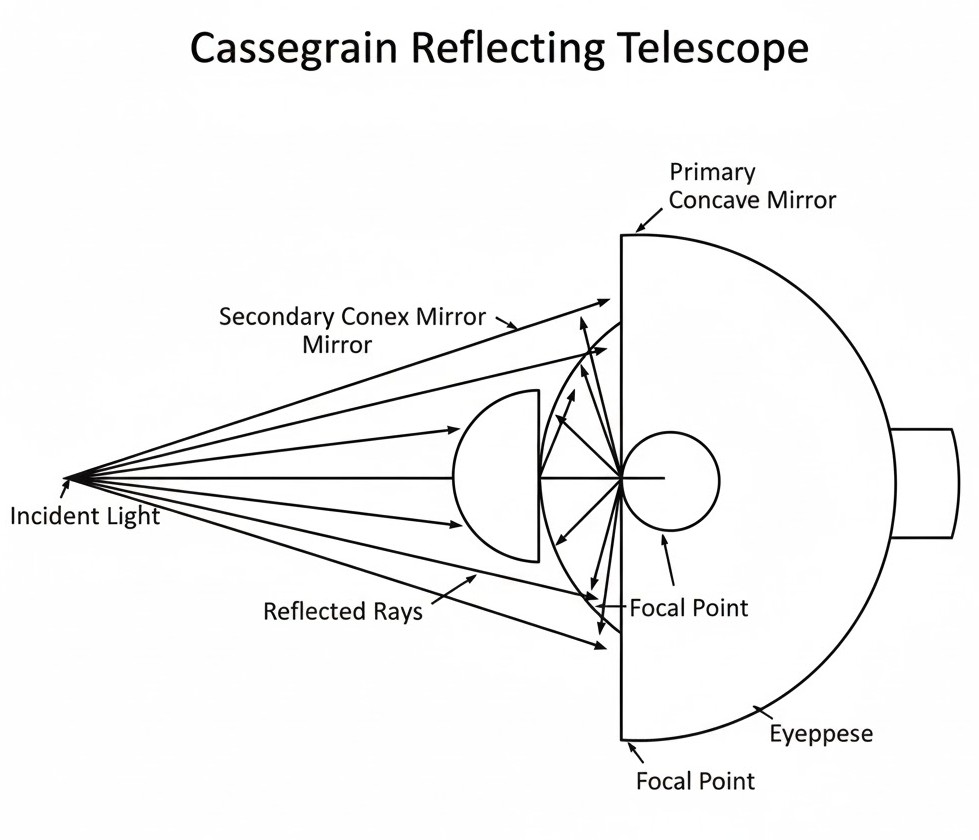
Refracting telescopes have a few "headaches"—they are heavy and suffer from chromatic aberration (colour blurring). To solve this, we use Reflecting Telescopes like the Cassegrain. These use a large concave mirror as the objective, meaning no chromatic aberration and way better support since the mirror is held from the back.
Figure below:
A schematic ray diagram of a Cassegrain reflecting telescope showing a primary concave mirror with a central hole, a secondary convex mirror, and light rays being focused towards the eyepiece.
NEET Checkpoint:
What is an advantage of a reflecting telescope?
(a) Suffers from chromatic aberration
(b) Uses lenses only
(c) No chromatic aberration
(d) Has very small aperture
✅ Answer: (c) No chromatic aberration — Mirrors reflect all colours the same way, unlike lenses!
Practice Question:
A telescope has an objective of focal length $144 \text{ cm}$ and an eyepiece of $6 \text{ cm}$. What is its magnifying power?
(a) 12
(b) 24
(c) 150
(d) 864
✅ Answer: (b) 24 — Use $m = f_o/f_e = 144/6 = 24$.
Key Takeaway
Formula Summary
* Magnifying Power (Normal): $m = \frac{f_o}{f_e}$
* Tube Length: $L = f_o + f_e$
* Reflecting Advantage: No chromatic aberration; better mechanical support.
14. Wave Optics Fundamentals: Wavefronts, Huygens' Principle, and Derivation of Laws
Listen up, junior! While Ray Optics treats light like a simple arrow, Wave Optics is where the real magic happens. Think of a wavefront as a "surface of constant phase"—basically, a locus of points all oscillating in the same rhythm at the same time. If you have a tiny point source, like a single bulb in a dark galli, you get spherical wavefronts. But if that source is super far away, like a distant star, the small portion reaching us looks like a plane wavefront.
NEET Checkpoint:
What is the shape of a wavefront originating from a point source?
(a) Plane
(b) Spherical
(c) Cylindrical
(d) Linear
✅ Answer: (b) Spherical — Points at equal distance from a point source vibrate in the same phase, forming a sphere!
Now, Huygens' Principle is the main funda here: every point on a wavefront acts as a source of secondary wavelets. The new wavefront at a later time is simply the forward envelope (common tangent) of these mini-waves. Arre, don't worry about the "backwave"—Huygens argued it doesn't exist, and rigorous theory later backed him up!.
Figure below:
A clear geometrical diagram showing Huygens' construction for a plane wave incident on a reflecting surface, with secondary wavelets of radius $v\tau$ forming a reflected wavefront at angle $r$ equal to angle $i$.
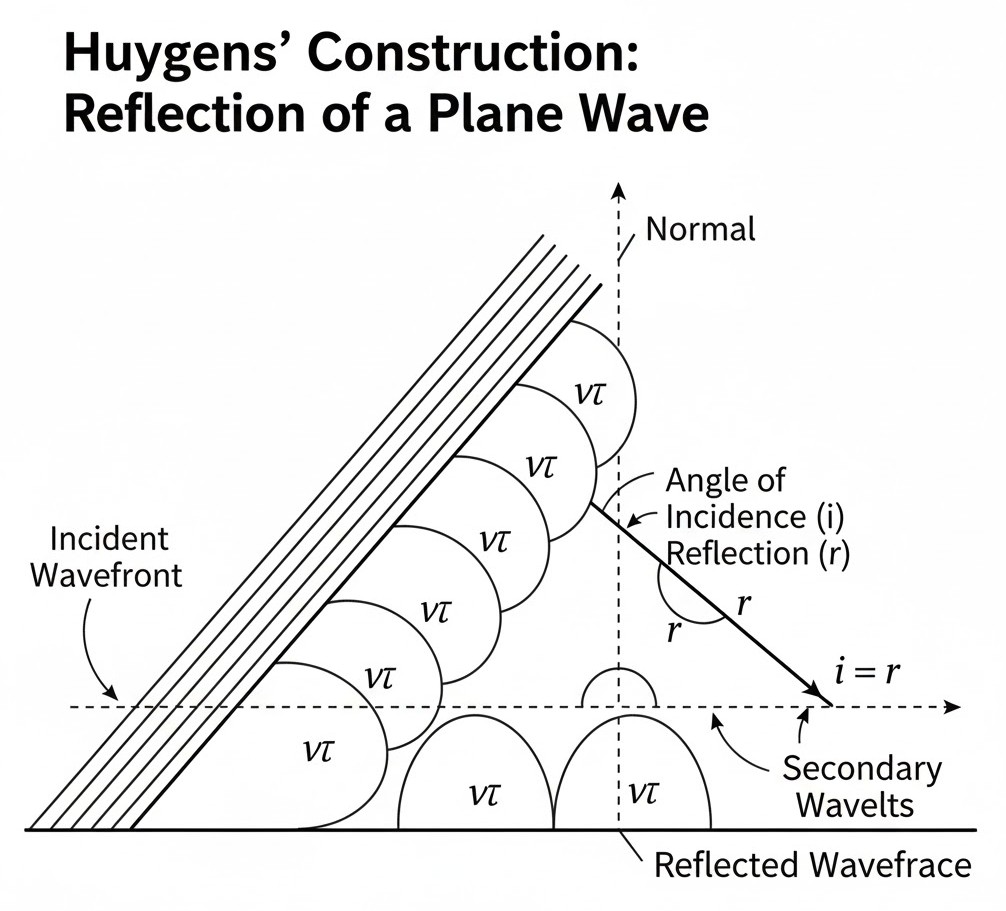
Using this geometry, we can actually derive the Law of Refraction (Snell's Law):
This confirmed that light slows down in denser media ($v_2 < v_1$), which totally proved Newton's corpuscular model wrong!. The Law of Reflection ($\angle i = \angle r$) is also derived using congruent triangles from this construction.
NEET Checkpoint:
When a wave gets refracted into a denser medium, which property remains constant?
(a) Speed
(b) Wavelength
(c) Frequency
(d) Velocity
✅ Answer: (c) Frequency — Speed and wavelength both decrease, but frequency $v$ is the signature of the source!
Imagine a baraat (wedding procession) moving together. If the front row stays aligned, they are like a wavefront. If one side hits a muddy patch (denser medium), they slow down and the whole line tilts—that’s exactly how refraction works, yaar!
NEET Checkpoint:
According to Huygens' principle, light energy travels:
(a) Parallel to the wavefront
(b) Perpendicular to the wavefront
(c) In a random direction
(d) Opposite to the wavefront
✅ Answer: (b) Perpendicular to the wavefront — The direction of energy propagation (the ray) is always normal to the wavefront.
Key Takeaway: Wavefront Formulas
- Snell’s Law: $\frac{\sin i}{\sin r} = \frac{v_1}{v_2}$
- Refractive Index: $n = \frac{c}{v}$
- Wavelength Change: $\frac{\lambda_1}{\lambda_2} = \frac{v_1}{v_2}$
- Law of Reflection: $i = r$
15. Wave Optics II: Interference, Diffraction, and Polarization
Arre, welcome back! Ready to dive into the world of Wave Optics? It is basically when light waves decide to hang out together—sometimes they help each other out (Constructive Interference), and sometimes they just cancel each other out (Destructive Interference). For this to be significant, your sources must be coherent, meaning they share the same frequency and a stable phase difference.
Think of it like two friends walking in perfect sync on a busy Mumbai platform. If they step together, the 'thud' is louder (path difference $\Delta p = n\lambda$ for constructive). But if one steps while the other lifts, they cancel out ($\Delta p = (n + \frac{1}{2})\lambda$ for destructive). Don't stress, yaar—it’s just the Superposition Principle at work!
NEET Checkpoint:
Can two independent sodium lamps produce a stable interference pattern?
(a) Yes, because they have the same wavelength
(b) Yes, if placed very close together
(c) No, because they are incoherent sources
(d) No, because sodium light is monochromatic
✅ Answer: (b) No — They are incoherent because they undergo abrupt phase changes every $10^{-10}$ seconds.
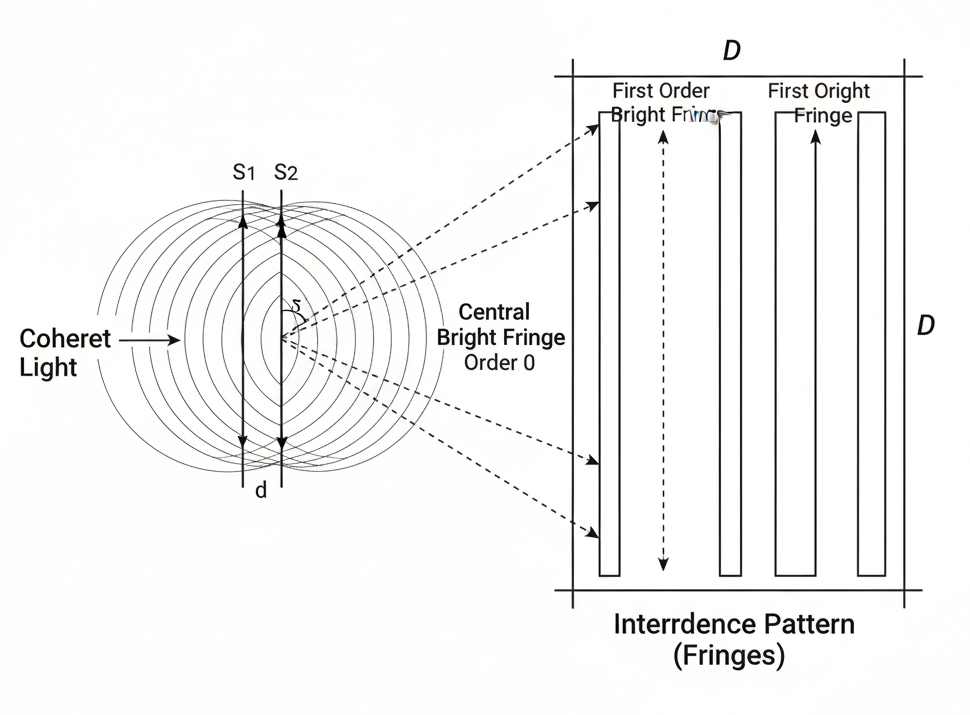
In Young’s double-slit experiment (YDSE), we get lovely equally spaced bright and dark fringes. The positions for bright fringes are given by:
where $n = 0, \pm 1, \pm 2...$. Then we have Diffraction, where light acts like a nosy neighbour, spreading around corners and narrow holes. For a single slit of width $a$, the minima (zero intensity) hit at angles:
where $n = \pm 1, \pm 2...$. Notice that the central maximum is twice as wide as the others!
NEET Checkpoint:
What is the path difference for the 2nd dark fringe in YDSE?
(a) $\lambda$
(b) $2\lambda$
(c) $3\lambda$
(d) $1.5\lambda$
✅ Answer: (d) $1.5\lambda$ — Using the formula $(n + \frac{1}{2})\lambda$ where $n=1$ for the second dark spot.
Finally, let’s talk Polarization, the VIP pass for transverse waves only! Unpolarised light is a bit messy, with its electric vector oscillating randomly in all directions. A Polaroid acts like a filter, letting only one component through to create linearly (plane) polarized light. Malus’ Law tells us exactly how the intensity $I$ changes when passing through a second polaroid at an angle $\theta$:
where $I_0$ is the initial polarized intensity.
NEET Checkpoint:
Does polarization happen in sound waves?
(a) Yes, because sound waves are electromagnetic
(b) Yes, in all types of sound waves
(c) No, because sound waves are longitudinal
(d) No, because sound has no wavelength
✅ Answer: (c) No — Sound waves are longitudinal; polarization is a characteristic only of transverse waves.
Figure below:
A clear diagram of Young's Double Slit Experiment showing two coherent sources S1 and S2, the distance d between them, the distance D to the screen, and the resulting pattern of equally spaced bright and dark fringes.
Practice Questions:
- In a single-slit diffraction experiment, if the slit width is doubled, the width of the central maximum:
(a) Doubles
(b) Halves
(c) Stays the same
(d) Quadruples
✅ Answer: (b) Halves — Since the angle $\theta \approx \frac{\lambda}{a}$, increasing the width $a$ reduces the spread of the central peak.
2. If the angle between the pass-axes of two polaroids is $60^\circ$, the transmitted intensity is:
(a) $I_0/2$
(b) $I_0/4$
(c) $3I_0/4$
(d) Zero
✅ Answer: (b) $I_0/4$ — Using Malus’ Law: $I = I_0 \cos^2 60^\circ = I_0 (\frac{1}{2})^2 = \frac{I_0}{4}$.
Key Takeaway
Formula Summary
- Constructive Interference: $\Delta p = n\lambda$
- Destructive Interference: $\Delta p = (n + \frac{1}{2})\lambda$
- YDSE Bright Fringes: $x_n = \frac{n\lambda D}{d}$
- Single Slit Minima: $\theta \approx \frac{n\lambda}{a}$
- Malus’ Law: $I = I_0 \cos^2 \theta$