
1. Introduction and The Lorentz Force
The marriage of Electricity and Magnetism, known since Danish physicist Hans Christian Oersted's awesome discovery in 1820. He noticed that a current in a straight wire (that means moving charges) caused a nearby magnetic compass needle to deflect. This simple observation led to the crucial conclusion that moving charges or currents produced a magnetic field ($B$) in the surrounding space. If he reversed the current? Boom! The needle reversed its orientation too.
Now, why does this matter? Because this newly discovered magnetic field $B$ exerts a force on other moving charges. The total force ($F$) acting on a point charge $q$ moving with velocity $v$ in a region where both electric ($E$) and magnetic ($B$) fields exist, is defined by the Lorentz force equation:
Notice this: the total force is the vector sum of the electric force ($F_{electric}=qE$) and the magnetic force ($F_{magnetic}=q(v \times B)$). Let's clear up the funda of the magnetic part, $F_{magnetic}$!
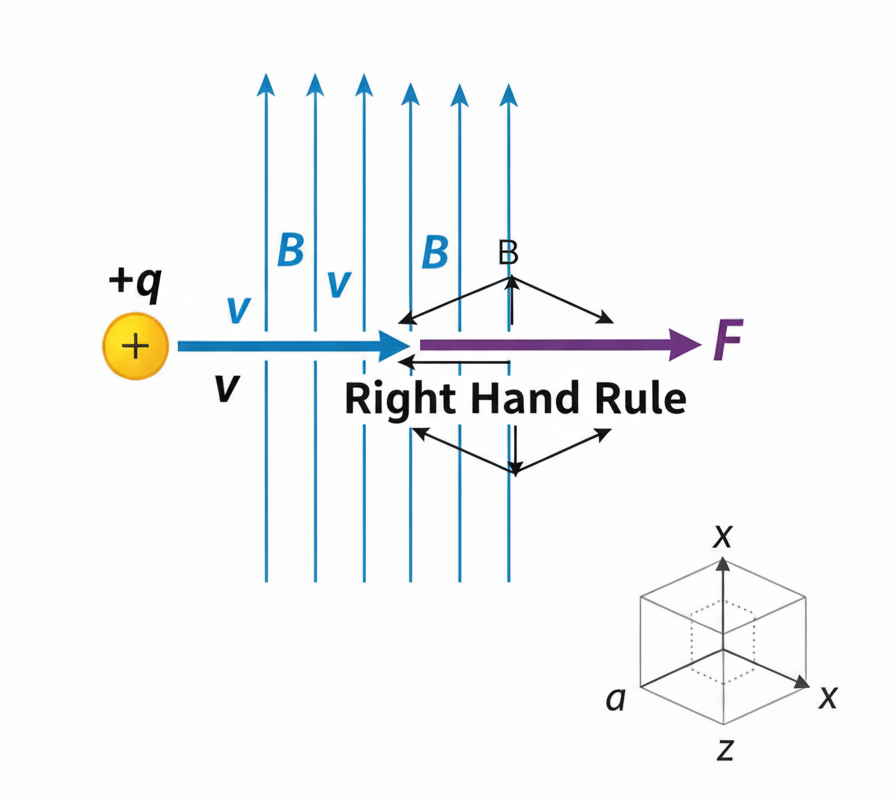
The magnetic force is zero if the charge is stationary (if $|v|=0$). Only a moving charge feels the magnetic force. Furthermore, the force $F_{magnetic}$ is always perpendicular to both the velocity $v$ and the magnetic field $B$. This perpendicular direction is found using the screw rule or the right-hand rule.
NEET Checkpoint:
A stationary positive charge is placed in a uniform magnetic field $B$. What is the magnetic force experienced?
(a) $qvB$
(b) Zero
(c) Maximum
(d) Dependent on E
✅ Answer: (b) Zero — Magnetic force is zero if the charge is not moving ($|v|=0$).
Because $F_{magnetic}$ is perpetually perpendicular to the velocity $v$, it does no work on the charged particle and therefore cannot change its speed (only its direction). It's like a cricket fielder who catches the ball and changes its direction perfectly—he stops its forward momentum, but the force he applied was instantaneously perpendicular to the final movement!
The magnetic field $B$ is measured in units of Tesla (T) in SI. This unit is equivalent to $\text{Newton second} / (\text{coulomb metre})$.
NEET Checkpoint:
If the velocity $v$ of a charged particle is parallel to the magnetic field $B$, what happens to the magnitude of the magnetic force?
(a) It is maximum
(b) It is zero
(c) It is halved
(d) It depends on $E$
✅ Answer: (b) It is zero — The magnetic force depends on $v \times B$. If $v$ and $B$ are parallel, $\sin \theta=0$, making $F_{magnetic}$ vanish.
NEET Checkpoint:
Which statement about the magnetic force is correct?
(a) It changes the particle's kinetic energy.
(b) It is perpendicular to $B$.
(c) It acts only on static charges.
(d) It is independent of the charge's sign.
✅ Answer: (b) It is perpendicular to $B$ — The magnetic force $q(v \times B)$ is perpendicular to both $v$ and $B$. It does not change kinetic energy (no work), acts only on moving charges, and its direction depends on the sign of $q$.
Figure below:
A clear diagram showing a positively charged particle ($+q$) moving with velocity $v$ in a magnetic field $B$, illustrating that the resulting magnetic force $F$ is perpendicular to both $v$ and $B$, typically using the right-hand rule to show the force direction.
Practice Questions:
1. If a magnetic force of magnitude $F$ acts on a charge $q$ moving with speed $v$ perpendicular to a field $B$, the magnitude of $F$ is given by:
(a) $q(v \cdot B)$
(b) $qvB$
(c) $\frac{qB}{v}$
(d) $q(E+vB)$
✅ Answer: (b) $qvB$ — When $v$ is perpendicular to $B$, the angle $\theta=90^{\circ}$, so the magnetic force magnitude $|F|=qvB \sin \theta$ simplifies to $qvB$.
2. If the charge $q$ is negative, how does the direction of the magnetic force $F_{magnetic}$ relate to the direction obtained from the right-hand rule for $v \times B$?
(a) It is the same.
(b) It is opposite.
(c) It is perpendicular.
(d) It depends on $E$.
✅ Answer: (b) It is opposite — The force is $F = q(v \times B)$. If $q$ is negative, the direction of $F$ is opposite to the direction of the vector product $v \times B$.
Key Takeaway:
Formula Summary
The Lorentz Force is the total force on a charge $q$:
$$F = q[E + v \times B]$$The Magnetic Force Magnitude is $|F_{magnetic}| = qvB \sin \theta$. Crucially, the magnetic force is perpendicular to velocity $v$ and does zero work.
2. Properties of Magnetic Force and Magnetic Field Units
Let's clear up the funda behind the magnetic force ($\mathbf{F}$) and how we measure the magnetic field ($\mathbf{B}$). Remember, magnetism is all about movement, so the magnetic force ($\mathbf{F}_{magnetic}$) is inherently different from the simple electrostatic force.
First funda: If the charge is not moving, the magnetic force is zero. Imagine a static pani puri stall (the charge, $q$). No matter how strong the external magnetic field ($\mathbf{B}$) is, if the stall is stationary (velocity $|\mathbf{v}|=0$), nothing happens! Only a moving charge feels this magnetic force. Notice this unique dependence on velocity, $\mathbf{F}_{magnetic} = q(\mathbf{v} \times \mathbf{B})$.
Next, the direction funda! Since the magnetic force involves a vector product ($\mathbf{v} \times \mathbf{B}$), its direction is always perpendicular to both the velocity ($\mathbf{v}$) and the magnetic field ($\mathbf{B}$). We use the screw rule or right-hand rule to figure out where the force is heading. But here’s the trick: The magnetic force vanishes if velocity $\mathbf{v}$ and magnetic field $\mathbf{B}$ are parallel or anti-parallel. If you're riding your scooter straight along a magnetic field line, $\sin 0^{\circ}$ (or $\sin 180^{\circ}$) kicks in, making the force zero.
NEET Checkpoint:
A stationary proton is placed in a strong uniform magnetic field $\mathbf{B}$. What is the magnetic force experienced?
(a) Maximum
(b) Zero
(c) Depends on $q$
✅ Answer: (b) Zero — Since the charge is not moving ($|\mathbf{v}|=0$), the magnetic force is zero, yaar!.
NEET Checkpoint:
If an electron moves exactly parallel to a uniform magnetic field $\mathbf{B}$, the magnetic force direction is:
(a) Perpendicular to $\mathbf{v}$
(b) Zero
(c) Parallel to $\mathbf{B}$
✅ Answer: (b) Zero — When $\mathbf{v}$ and $\mathbf{B}$ are parallel, the vector cross-product vanishes.
Now for the units, which are super important for calculation speed! The SI unit of magnetic field $\mathbf{B}$ is the tesla ($\mathbf{T}$). This unit is formally defined as $\text{Newton second} / (\text{coulomb metre})$.
Tesla is quite a large unit, so a smaller non-SI unit called the gauss ($\mathbf{G}$) is also often used. Keep this conversion factor in mind: $1 \text{ G} = 10^{-4} \text{ T}$.
NEET Checkpoint:
Which unit is larger: Tesla or Gauss?
(a) Gauss
(b) Tesla
(c) They are equal
✅ Answer: (b) Tesla — Tesla is $10^4$ times larger than Gauss.
Practice Questions:
- If the magnetic force is given by $\mathbf{F}_{magnetic} = q(\mathbf{v} \times \mathbf{B})$, which property of the force determines its direction?
(a) Coulomb's Law
(b) Lorentz transformation
(c) Screw rule or right-hand rule
(d) Newton's third law
✅ Answer: (c) Screw rule or right-hand rule — The direction of the vector product $\mathbf{v} \times \mathbf{B}$ is determined by the screw rule or right-hand rule.
2. A magnetic field is measured to be $5 \text{ G}$. What is this field strength in SI units?
(a) $5 \times 10^4 \text{ T}$
(b) $5 \times 10^{-4} \text{ T}$
(c) $5 \times 10^{-5} \text{ T}$
(d) $5 \times 10^{5} \text{ T}$
✅ Answer: (b) $5 \times 10^{-4} \text{ T}$ — Since $1 \text{ G} = 10^{-4} \text{ T}$, multiplying $5 \text{ G}$ gives $5 \times 10^{-4} \text{ T}$.
Key Takeaway:
The magnetic force, $\mathbf{F}_{magnetic} = q(\mathbf{v} \times \mathbf{B})$, is weird because it only acts on moving charges and does zero work. It vanishes if the charge is stationary ($|\mathbf{v}|=0$) or if the velocity is parallel/anti-parallel to the field. The direction is found using the right-hand rule, and its SI unit is the $\text{tesla (T)}$.
3. Magnetic Force on a Current-Carrying Conductor: The Wire's Workout
We've already figured out the funda of the Lorentz force on a single moving charge $q$. Now, picture a long wire—it's basically just a highway jam-packed with moving charges (current $I$). It makes total sense that if a magnetic field $B$ pushes one charge, it's going to push the whole wire, right? Absolutely!
We can extend the analysis for force on a single moving charge to an entire straight conductor carrying a steady current. Imagine a conducting rod of length $l$. When this rod, carrying current $I$, is placed in a uniform external magnetic field $B$, the total force $F$ it experiences is given by the fantastic vector cross product:
Notice this: Current $I$ itself isn't a vector, but $l$ definitely is! This vector $l$ has a magnitude exactly equal to the length of the rod, $l$. Most importantly for solving problems, its direction is identical to the direction of the current $I$. Always remember that $B$ here must be the external magnetic field acting on the rod, not the field the rod produces itself.
NEET Checkpoint:
The vector $l$ in the force formula $F=I l\times B$ is directed:
(a) Perpendicular to the current
(b) The same as the current
(c) Opposite to the current
(d) Based on the magnetic field
✅ Answer: (b) The same as the current — The direction of the vector $l$ is defined to be identical to the direction of the steady current $I$.
What happens if you have an oddly shaped wire, maybe shaped like the winding road up to a Dhaba? Don't stress, yaar! For an arbitrarily shaped wire, we calculate the Lorentz force by simply chopping the wire into infinitesimally small linear strips, $dl_j$, and performing a summation (which usually turns into an integral in advanced maths). The force expression looks like this:
Relatable Indian Example: Think of an electrician running a straight cable (length $l$) in a building near a huge magnet (field $B$). If he runs the cable parallel to the magnet's field lines, the force is zero—the cable just relaxes. But if he runs it perpendicularly, he’ll feel the maximum sideways push $F$ on the cable, strong enough to knock over his chai cup!
NEET Checkpoint:
If a straight wire of length $l$ is parallel to the external magnetic field $B$, the magnitude of the force $F$ experienced is:
(a) $IlB$
(b) $IlB/2$
(c) Zero
(d) Maximum
✅ Answer: (c) Zero — Since $F=IlB \sin\theta$, if $l$ is parallel to $B$, the angle $\theta=0^\circ$ and $\sin 0^\circ = 0$.
This cross-product means the resulting magnetic force $F$ is always applied perpendicular to both the current direction ($l$) and the magnetic field ($B$). Use your right-hand rule to nail the direction!
NEET Checkpoint:
The direction of the magnetic force on an arbitrarily shaped current-carrying wire in a uniform field is found by the vector sum, but the force on any individual segment $dl$ is always perpendicular to:
(a) $I$ only
(b) $B$ only
(c) Both $I$ and $B$
(d) The length $l$ of the full wire
✅ Answer: (c) Both $I$ and $B$ — The force comes from the cross product $IdI \times B$, making the force vector perpendicular to both vectors defining the segment and the field.
Practice Questions:
-
The maximum magnetic force experienced by a straight conductor of length $l$ carrying current $I$ in a uniform magnetic field $B$ occurs when the wire is oriented:
(a) Parallel to $B$
(b) Anti-parallel to $B$
(c) Perpendicular to $B$
(d) At an angle of $45^\circ$ to $B$✅ Answer: (c) Perpendicular to $B$ — The force $F=IlB \sin\theta$ is maximized when $\sin\theta=1$, which happens at $90^\circ$ (perpendicular).
-
If the current $I$ in the straight rod is doubled, how does the magnetic force $F$ change, assuming $l$ and $B$ remain constant?
(a) $F$ remains the same
(b) $F$ is halved
(c) $F$ is doubled
(d) $F$ is quadrupled✅ Answer: (c) $F$ is doubled — The force magnitude is linearly proportional to the current $I$ ($F=IlB \sin\theta$), as shown in Eq. (4.4).
Key Takeaway:Formula Summary |
|---|
| Force on a Straight Wire:$F=I l\times B$ |
| Vector $l$: Magnitude is the wire length $l$; direction is the current direction $I$. |
| Force on Arbitrary Shape: Sum of forces on linear strips:
$$F=\sum_{j}IdI_{j}\times B$$
|
4. Motion of a Charge in Uniform Magnetic Fields
This section clears up a major confusion point! When a charge $q$ moves with velocity $\mathbf{v}$ in a uniform magnetic field $\mathbf{B}$, the physics is actually pretty chill, thanks to the nature of the Lorentz magnetic force.
Here’s the trick: The magnetic force, $\mathbf{F}_{magnetic} = q(\mathbf{v} \times \mathbf{B})$, is always perpendicular to the velocity $\mathbf{v}$ of the particle. Think of it like a perfectly managed pani puri stall: the force keeps moving the tray (changing direction), but it never accelerates or slows down the vendor (the charged particle’s speed). Because the force is perpendicular to the motion, no work is done by the magnetic field, and the magnitude of the velocity (speed) remains constant. Notice this—the direction changes, but the speed stays steady.
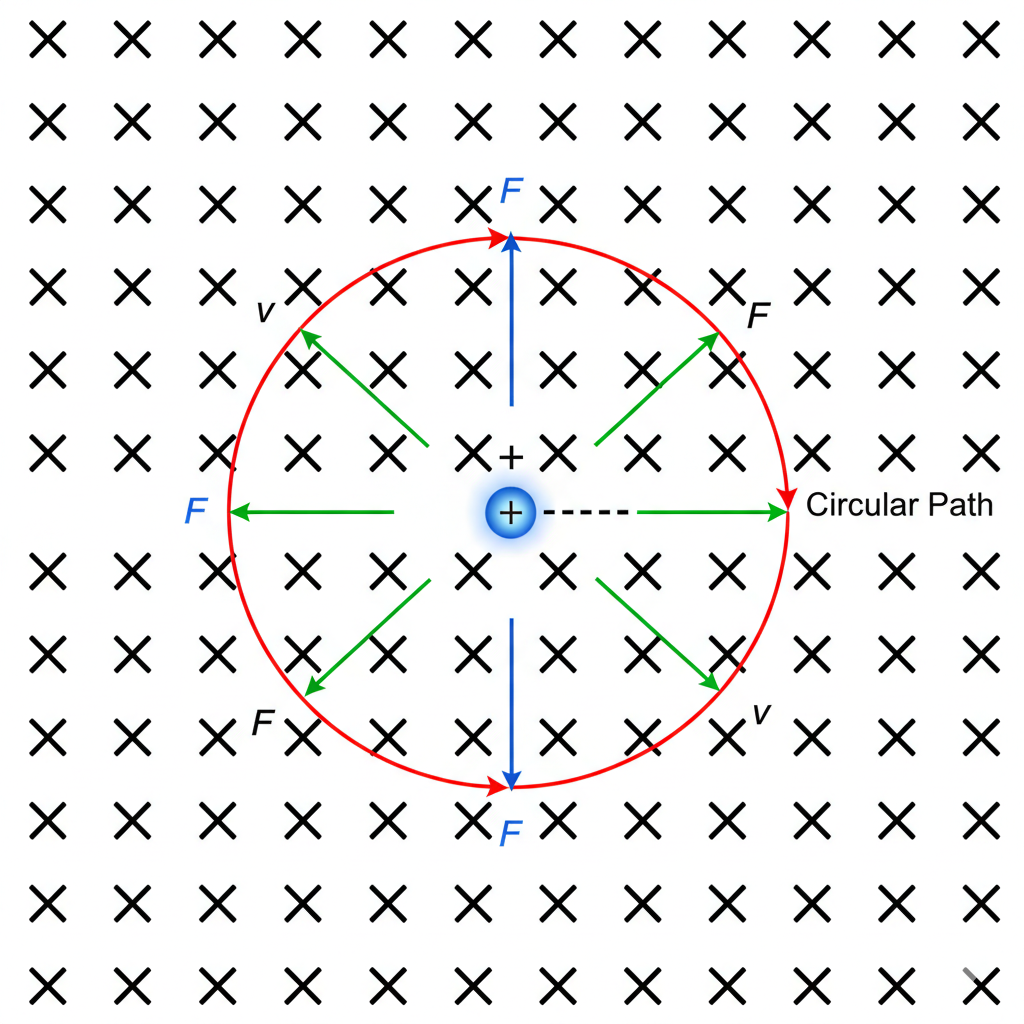
If the velocity $\mathbf{v}$ is completely perpendicular to $\mathbf{B}$ (i.e., $\theta = 90^\circ$ between $\mathbf{v}$ and $\mathbf{B}$), the force acts entirely as a centripetal force. This forces the particle into uniform circular motion in a plane perpendicular to the magnetic field.
The radius ($r$) of this circular path is super important for NEET. By equating the centripetal force ($\frac{m v^{2}}{r}$) and the magnetic force ($q v B$), we get the formula for the radius:
Figure below:
A clear diagram showing a positively charged particle moving in a uniform magnetic field (indicated by X’s, representing the field pointing into the page), showing the velocity vector $\mathbf{v}$ and the force vector $\mathbf{F}$ always perpendicular to $\mathbf{v}$, resulting in a circular path.
NEET Checkpoint:
What happens to the speed of a proton when it enters a uniform magnetic field?
(a) Increases
(b) Decreases
(c) Stays constant
(d) Depends on the angle.
✅ Answer: (c) Stays constant — Since the magnetic force is always perpendicular to velocity, no work is done, and speed is conserved.
The angular frequency of this rotation, often called the cyclotron frequency ($\omega$), is independent of both the particle’s velocity and its energy! This is a major funda:
This independence is the genius behind cyclotrons, where particles are accelerated.
Now, what if your velocity has a component parallel to $\mathbf{B}$ ($v_{||}$)? This parallel component is unaffected by the magnetic field and remains constant, making the particle move along the field direction. Combine this constant forward motion with the circular motion (due to the perpendicular velocity component), and what do you get? A helical path (like a spring or a Slinky!).
NEET Checkpoint:
The cyclotron frequency is proportional to:
(a) Velocity
(b) Radius
(c) Mass
(d) Magnetic field strength.
✅ Answer: (d) Magnetic field strength — The formula $\omega = qB/m$ shows that it only depends on $q$, $B$, and $m$.
The distance moved along the magnetic field during one complete rotation is known as the pitch ($P$).
NEET Checkpoint:
A charged particle moves along a helical path in a magnetic field. Which velocity component is responsible for the motion along the field direction?
(a) $v_{\perp}$
(b) $v_{||}$
(c) Both
(d) None.
✅ Answer: (b) $v_{||}$ — The component of velocity parallel to $\mathbf{B}$ remains unchanged and causes movement along the field.
Practice Questions:
- A proton and an electron enter a region of uniform magnetic field perpendicular to their paths with the same speed. If $m_p \gg m_e$, which particle follows a path with a larger radius?
(a) Electron
(b) Proton
(c) Both have the same radius
(d) Impossible to determine
✅ Answer: (b) Proton — The radius $r = mv/qB$ is directly proportional to mass ($m$). Since the proton is much heavier and all other factors ($v, q, B$) are the same or proportional, the proton's radius is larger.
2. If a charged particle moving perpendicular to a uniform magnetic field suddenly triples its speed, how does its angular frequency change?
(a) It triples
(b) It decreases by one-third
(c) It remains unchanged
(d) It increases by $\sqrt{3}$
✅ Answer: (c) It remains unchanged — The angular frequency $\omega = qB/m$ is independent of the velocity (or energy) of the particle.
Key Takeaway:
Perpendicular Force, Constant Speed: $\mathbf{F} \perp \mathbf{v}$, so no work is done.
Circular Motion ($\mathbf{v} \perp \mathbf{B}$): Radius $r = \frac{m v}{q B}$.
Cyclotron Frequency ($\omega$): $\omega = \frac{q B}{m}$, independent of $v$ or energy.
Helical Motion: Occurs if the velocity has a component parallel to $\mathbf{B}$.
5. Biot-Savart Law and Current Elements
Hey there, future physicist! We know the basic funda—moving charges or currents produce magnetic fields ($\vec{B}$). But how do we actually calculate that field? We need a foundational law, and that’s where the super important Biot-Savart Law steps in. This law is our guide to relating the current $I$ flowing in a conductor to the infinitesimal magnetic field $dB$ it generates in the surrounding space.
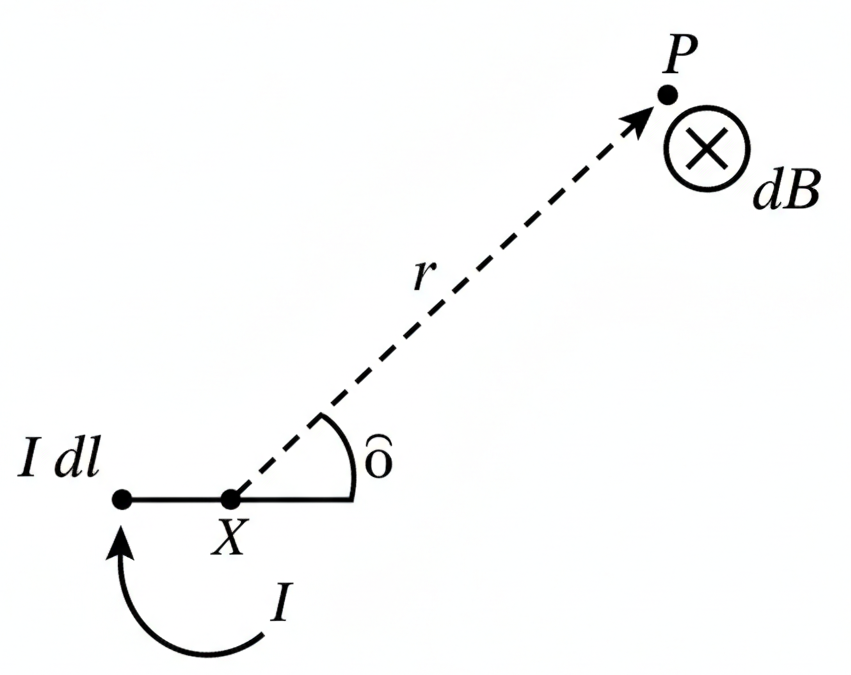
All magnetic fields originate from currents (moving charges) or from the intrinsic magnetic moments of particles. Now, imagine a long wire carrying current $I$. We focus on a tiny, infinitesimal piece of this conductor, $\vec{dl}$, which acts as our current element. The magnetic field, $\vec{dB}$, produced by this current element at a point $P$ located at a displacement vector $\vec{r}$ away is determined by three main factors: the current $I$, the length of the element $\vec{dl}$, and the inverse square of the distance $r$.
Here's the trick: Since the magnetic field is a vector quantity, its direction matters! The resulting field $\vec{dB}$ is always perpendicular to the plane containing both the current element $\vec{dl}$ and the position vector $\vec{r}$. This is why we use a cross product!
In vector notation, the Biot-Savart Law for the magnetic field in a vacuum is:
The term $\mu_{0}/4\pi$ is the proportionality constant, which has an exact value of $10^{-7} T~m/A$ in SI units. $\mu_{0}$ itself is called the permeability of free space. Don't stress, yaar—the magnitude simplifies beautifully:
The magnitude of the magnetic field is:
Here, $\theta$ is the angle between $\vec{dl}$ (the direction of current flow) and $\vec{r}$.
Relatable Indian Example: Imagine a tiny segment of wire carrying $I$ (maybe the last $1~cm$ of the extension cord running to your fan). If you measure the field directly in front of or behind that segment ($\theta=0^{\circ}$), the field contribution is zero, because $\sin(0^{\circ})=0$. You only get the maximum $\vec{dB}$ when you are perpendicular to that wire segment ($\theta=90^{\circ}$).
Figure below:
A clear diagram showing an infinitesimal current element $I~dl$ at $X$, pointing right, the displacement vector $r$ extending to point $P$ above the element, showing the angle $\theta$ between $dl$ and $r$, and the magnetic field $dB$ vector pointing into the page at $P$ (indicated by an $\otimes$ sign).
NEET Checkpoint :
If $\vec{dl}$ and $\vec{r}$ are parallel, what happens to the magnetic field $\vec{dB}$?
(a) It is maximum
(b) It is zero
(c) It is proportional to $1/r^3$
(d) It points along $\vec{dl}$
✅ Answer: (b) It is zero — When $\vec{dl}$ and $\vec{r}$ are parallel, $\theta=0^{\circ}$, making $\sin\theta=0$ and thus $|dB|=0$.
NEET Checkpoint :
The magnetic field due to a current element follows an inverse square dependence on distance $r$. This feature is also shared by which fundamental law?
(a) Ampere's Law
(b) Gauss's Law
(c) Coulomb's Law
(d) Lorentz Force
✅ Answer: (c) Coulomb's Law — Both the Biot-Savart Law for magnetism and Coulomb's Law for electrostatics are long range laws that depend inversely on the square of the distance from the source.
NEET Checkpoint :
The Biot-Savart law utilizes a vector source, $I~dl$. What kind of source produces an electrostatic field?
(a) A vector source
(b) A scalar source
(c) A time-varying source
(d) A dipole
✅ Answer: (b) A scalar source — The electrostatic field is produced by a scalar source, namely, the electric charge.
Practice Question :
Which statement correctly describes the nature of the magnetic field lines derived from the Biot-Savart Law (and seen generally)?
(a) They originate from positive charges and terminate at negative charges.
(b) They always form continuous closed loops.
(c) They are always parallel to the current element $\vec{dl}$.
(d) They only exist when charges are at rest.
✅ Explanation: Unlike electrostatic field lines (which begin and end on charges), magnetic field lines produced by currents always form closed loops.
Now that we know how a tiny current element contributes, we just need to add up (integrate) all these $\vec{dB}$ vectors to find the total field $\vec{B}$ for the whole conductor!
Key Takeaway:
The Biot-Savart Law, $\vec{dB} = \frac{\mu_{0}}{4\pi}\frac{I~\vec{dl} \times \vec{r}}{r^{3}}$, is the foundational equation for calculating the magnetic field $\vec{dB}$ produced by an infinitesimal current element $I~\vec{dl}$. The magnitude $|dB|$ is proportional to $\sin\theta/r^2$.
6. Application of Biot-Savart Law: Circular Current Loop
Don't stress, yaar—when you look at a current loop, it might seem complicated, but thanks to the Biot-Savart Law, figuring out its magnetic field ($B$) is just a fancy process of addition!. We calculate the magnetic field by summing up (integrating) the contributions from every tiny, infinitesimal current element ($I d \mathbf{l}$) across the entire loop.
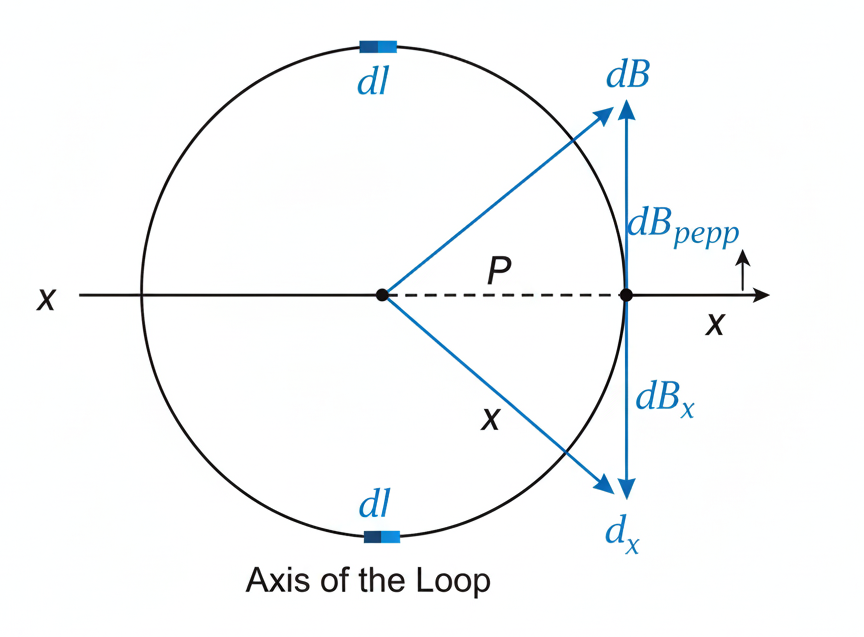
Let's clear up this funda. We consider a circular loop of radius $R$ carrying a steady current $I$. We want the field on the central axis, at a distance $x$ from the centre. When we analyze the field ($d\mathbf{B}$) generated by one small segment, we find it has components. But here’s the trick: the components perpendicular to the axis ($d B_{\perp}$) cancel out perfectly due to contributions from diametrically opposite elements. Only the component along the axis ($d B_x$) survives the cancellation game!.
The net magnetic field $B$ at an axial distance $x$ from the centre is a key formula you must remember for NEET:
Notice this field is directed along the axis ($\hat{i}$).
NEET Checkpoint:
When summing contributions from infinitesimal elements across a circular current loop, which field components cancel out?
(a) Axial components.
(b) Perpendicular components.
(c) Both components.
(d) Neither component.
✅ Answer: (b) Perpendicular components — Due to symmetry, the components perpendicular to the axis cancel out completely.
If we want the magnetic field right at the centre of the loop (super important!), we simply set the axial distance $x = 0$. The equation simplifies dramatically to:
Now, for direction! The direction of $B$ is found using the right-hand thumb rule: Curl your fingers around the wire in the direction of the current $I$, and your extended thumb points towards the direction of the magnetic field.
Imagine you are winding thread onto a lattu (spinning top). If you curl your fingers in the direction the current flows in the loop, your thumb instantly tells you which way the magnetic field points—easy peasy!.
NEET Checkpoint:
The magnetic field strength at the centre of a circular loop is inversely proportional to:
(a) $I$
(b) $R$
(c) $R^2$
(d) $x$
✅ Answer: (b) $R$ — From the formula $B_{0} = \frac{\mu_{0}I}{2R}\hat{i}$, $B_0$ is inversely proportional to the radius $R$.
NEET Checkpoint:
If the centre of the loop is the origin and the axis is the $x$-axis, what must be true about the current element $d\mathbf{l}$ and the displacement vector $\mathbf{r}$ used in the Biot-Savart calculation?
(a) They must be parallel.
(b) They must be anti-parallel.
(c) They must be perpendicular.
(d) They must lie in the $x-y$ plane.
✅ Answer: (c) They must be perpendicular — For a loop in the $y-z$ plane, any element $d\mathbf{l}$ is perpendicular to the displacement vector $\mathbf{r}$ running from $d\mathbf{l}$ to the axial point $P$.
Figure below:
A clear diagram showing a circular current loop (radius R) in the y-z plane. Show the x-axis (axis of the loop). Label a point P on the x-axis at distance x. Show an infinitesimal current element dl and the resulting magnetic field dB, clearly illustrating the cancellation of the dB_perp component due to a diametrically opposite element, leaving only the axial component dB_x.
Practice Question:
A closely wound coil of radius $R$ carries a current $I$. The magnetic field on the axis at a point $P$ located at distance $x = 2R$ from the center is $B_p$. What is the ratio of $B_p$ to the field at the centre, $B_0$?
(a) $1/(5\sqrt{5})$
(b) $1/\sqrt{5}$
(c) $2/(5\sqrt{5})$
(d) $4/(5\sqrt{5})$
✅ Answer: (a) $1/(5\sqrt{5})$ — The ratio $B/B_0$ is $\frac{R^{3}}{(x^{2}+R^{2})^{3/2}}$. Substituting $x=2R$: $B_p/B_0 = \frac{R^{3}}{((2R)^{2}+R^{2})^{3/2}} = \frac{R^{3}}{(5R^{2})^{3/2}} = \frac{R^{3}}{R^{3} (5)^{3/2}} = \frac{1}{5\sqrt{5}}$.
Key Takeaway:
| Location | Magnetic Field Formula |
|---|---|
| Axial Distance $x$ |
$$B=\frac{\mu_{0}I R^{2}}{2(x^{2}+R^{2})^{3/2}}$$
|
| At the Center ($x=0$) |
$$B_{0}=\frac{\mu_{0}I}{2R}$$
|
7. Ampere's Circuital Law
If Biot-Savart law looks complicated. Ampere's Circuital Law is the jugaad (shortcut) way to express the same physics when you have high symmetry! It's an alternative, appealing method, much like Gauss's Law simplifies electrostatics.
Here’s the funda: Ampere’s law relates the magnetic field $B$ integrated around a closed path (called an Amperian loop) to the total steady current $I$ passing through the surface bounded by that loop.
The law states: the line integral of the magnetic field $\vec{B}$ around any closed loop $C$ is equal to $\mu_{0}$ times the total current $I$ passing through the surface enclosed.
Notice this: The law involves a sign convention, determined by the right-hand rule. Curl the fingers of your right hand in the direction you traverse the loop; your thumb then points in the direction considered positive for the current $I$.
NEET Checkpoint:
Ampere’s Circuital Law is strictly valid only for:
(a) Varying currents
(b) Steady currents
(c) Displacement currents
✅ Answer: (b) Steady currents — The law holds specifically for currents which do not fluctuate with time.
In cases of high symmetry, where you can choose a smart Amperian loop such that $\vec{B}$ is constant and tangential to the loop over a certain length $L$ (or zero/normal elsewhere), the complex integral simplifies drastically.
Here, $I_{e}$ is the net current enclosed by the loop. Imagine calculating the magnetic field for an infinitely long straight wire—Ampere's Law makes it an instant calculation, giving $B=\frac{\mu_{0}I}{2\pi r}$.
Relatable Indian Example: Think of traffic control on a busy expressway. Biot-Savart is calculating the field from every single car element ($I\,dl$). Ampere’s law is just calculating the total toll collected (total current $I$) at a circular check post (the Amperian loop) to determine the traffic density ($B$).
NEET Checkpoint:
In the simplified form $BL=\mu_{0}I_{e}$, what condition must $B$ satisfy over the length $L$?
(a) $B$ must be zero
(b) $B$ must be normal to $d\vec{l}$
(c) $B$ must be tangential and constant
✅ Answer: (c) $B$ must be tangential and constant — This condition (i) allows the line integral to simplify from $\oint B\cdot dl$ to $BL$.
NEET Checkpoint:
Which principle is Ampere’s Law analogous to in electrostatics?
(a) Coulomb’s Law
(b) Gauss’s Law
(c) Ohm’s Law
✅ Answer: (b) Gauss’s Law — Both relate the field quantity on a closed boundary (periphery) to the source quantity (current or charge) in the interior.
Figure below:
A clear diagram showing an open surface bounded by a closed Amperian loop C, with a current I passing through the enclosed surface.

Practice Question:
Ampere's law generally does not help in easily finding the magnetic field for:
(a) An infinitely long straight wire.
(b) The magnetic field on the axis of a circular current loop.
(c) A long solenoid.
✅ Answer: (b) The magnetic field on the axis of a circular current loop — Ampere's law may not facilitate an easy evaluation of $B$ in situations lacking the required symmetry, like calculating the field on the axis of a circular loop.
Key Takeaway:
Ampere's Circuital Law is not independent of the Biot-Savart law; it's a parallel formulation that proves highly efficient for calculating magnetic fields in systems possessing cylindrical or translational symmetry (like long wires and solenoids).
8. Application of Ampere's Law: Infinite Straight Wire
Don't stress, yaar, Ampere's Circuital Law is a superhero when systems have high symmetry. The classic application is finding the magnetic field ($B$) due to an infinitely long straight current-carrying wire.
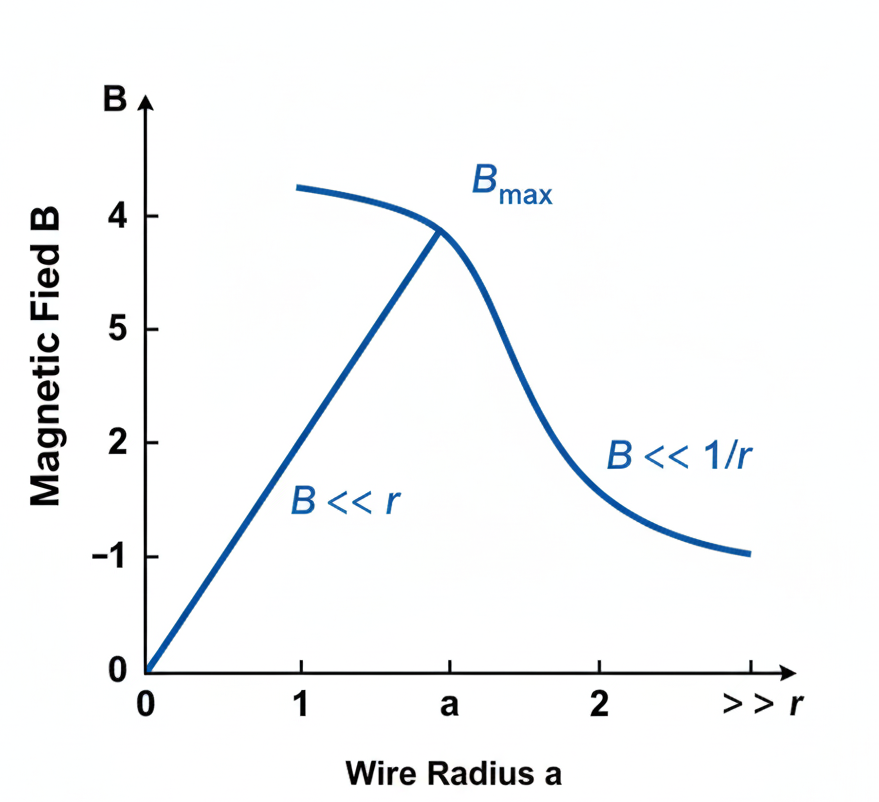
Because the wire is long and straight, the magnetic field exhibits cylindrical symmetry, meaning the field magnitude depends only on the distance $r$ from the axis. The magnetic field lines form concentric circles around the wire.
Outside the Wire ($r > a$)
To find the field at a distance $r$ outside the wire, we choose an Amperian loop that is a circle of radius $r$, concentric with the wire. Since $B$ is constant in magnitude and tangential along the entire loop, Ampere's Law, $\oint \vec{B}\cdot d\vec{l}=\mu_{0}I$, simplifies immensely:
The magnitude of the magnetic field outside the wire ($r>a$) is:
Notice this: the field is inversely proportional to the distance from the wire ($B \propto 1/r$).
NEET Checkpoint:
The magnetic field lines due to a long straight wire:
(a) Originate at a charge
(b) Form radial lines
(c) Form continuous closed loops
✅ Answer: (c) Form continuous closed loops — This is unlike electrostatic field lines.
Inside the Wire ($r < a$)
For a wire with a finite radius $a$, where the steady current $I$ is uniformly distributed across its cross-section, the field inside ($r
Applying Ampere's Law: $B(2\pi r)=\mu_{0}I_{e}$ leads to the field inside ($r
This shows that the magnetic field magnitude is directly proportional to the distance from the centre ($B \propto r$).
Relatable Indian Example: Think about the long overhead power lines in your city! The calculation of the magnetic field due to the current they carry simplifies rapidly using Ampere's Law, treating them as infinitely long straight wires.
Figure below:
A clear graph showing the magnetic field magnitude $B$ vs distance $r$ from the centre of a thick wire (radius $a$): $B$ increases linearly ($B \propto r$) from the centre to $r=a$, and then decreases hyperbolically ($B \propto 1/r$) for $r>a$.
NEET Checkpoint:
For a solid cylindrical conductor carrying uniform current $I$, where is the magnetic field maximum?
(a) At the centre ($r=0$)
(b) At the surface ($r=a$)
(c) Infinitely far away
✅ Answer: (b) At the surface ($r=a$) — Since $B \propto r$ inside and $B \propto 1/r$ outside, the maximum value occurs exactly at the boundary ($r=a$).
Practice Question:
If the radius of a solid straight wire is doubled, but the total current $I$ remains the same, how does the magnetic field magnitude at the surface ($r=a$) change?
(a) It remains the same.
(b) It doubles.
(c) It is halved.
✅ Answer: (c) It is halved. — At the surface, $B=\frac{\mu_{0}I}{2\pi a}$. If $a$ is doubled, $B$ is halved.
NEET Checkpoint:
The direction of the magnetic field due to a straight wire is given by:
(a) Fleming’s Left-Hand Rule
(b) Screw Rule or Right-Hand Rule
(c) Lorentz Force equation
✅ Answer: (b) Screw Rule or Right-Hand Rule — Grasp the wire with the right hand; the thumb points to $I$, and the fingers curl in the direction of $B$.
Key Takeaway:
Formula Summary
| Location | Field Dependence | Formula |
|---|---|---|
| Outside ($r > a$) | $B \propto 1/r$ | $B=\frac{\mu_{0}I}{2\pi r}$ |
| Inside ($r < a$) | $B \propto r$ | $B=\frac{\mu_{0}I~r}{2\pi a^{2}}$ |
This powerful simplification helps us tackle the next big calculation—the magnetic field inside a solenoid.
9. Ampere's Law: The Solenoid: The Secret Magnet
A solenoid is just a long wire wound up like a helix where the neighbouring turns are closely spaced. Think of it as approximating many tiny circular current loops placed side-by-side. Enamelled wires are used so the turns are electrically insulated from each other.
For an ideal, long solenoid (meaning its length is huge compared to its radius), the magnetic field outside is super weak—it practically approaches zero. Don't stress, yaar—zero is easy to handle! Inside, the field $B$ is the complete opposite: it is uniform, strong, and runs parallel to the axis of the solenoid.
To find this uniform $B$ inside, we bust out Ampere's circuital law: $\oint B\cdot dl = \mu_{0}I_{e}$. We choose a rectangular Amperian loop $abcd$.
Figure below:
A diagram showing a long solenoid carrying current, with a rectangular Amperian loop (abcd) drawn across the axis, illustrating that the uniform field B is parallel to segment ab inside, and zero outside (segment cd).
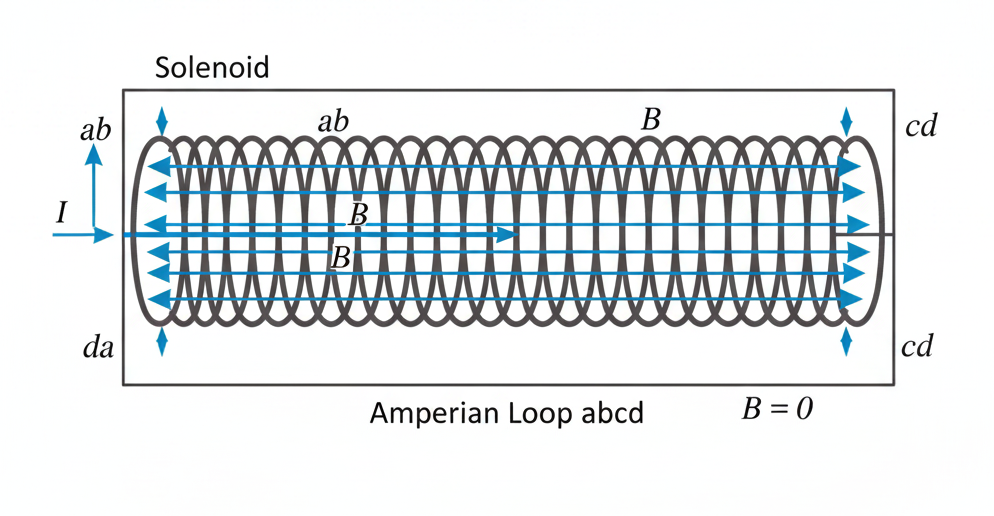
Only the segment $ab$ (of length, say, $h$, running inside the solenoid) contributes to the integral because the external field along $cd$ is zero, and the field components along the transverse sides ($ad$ and $bc$) are zero. The integral simplifies to $B L = \mu_0 I_e$. If $n$ is the number of turns per unit length, and the segment is $h$, the enclosed current $I_e$ is $I(nh)$.
NEET Checkpoint:
Which part of the Amperian loop contributes to the magnetic field calculation for a long solenoid?
(a) The external part
(b) The transverse sides
(c) The internal part parallel to the axis
(d) All parts equally.
✅ Answer: (c) The internal part parallel to the axis — Because $B$ is zero outside, and perpendicular (zero component) on the transverse sections.
Plugging that into Ampere's law, we get $B h = \mu_0 I (n h)$. The length $h$ cancels out, giving us the crucial formula:
This formula tells us that the magnetic field $B$ inside is directly proportional to the current $I$ and the density of windings $n$. Think of $n$ like the density of cars rushing through a narrow street (the current density, in a way). More turns per metre means a stronger field inside! The direction of this internal field is determined easily using the right-hand rule: curl your fingers in the direction of the current flow in the windings, and your extended thumb points in the direction of $B$.
NEET Checkpoint:
The magnetic field inside a long ideal solenoid is always:
(a) Zero
(b) Non-uniform and strong
(c) Uniform and strong
(d) Uniform and perpendicular to the axis.
✅ Answer: (c) Uniform and strong — This is the key characteristic of an ideal solenoid used in applications.
NEET Checkpoint:
If you double the current $I$ flowing through a solenoid, the internal magnetic field $B$ is:
(a) Halved
(b) Doubled
(c) Quadrupled
(d) Unchanged.
✅ Answer: (b) Doubled — Since $B$ is directly proportional to $I$ ($B=\mu_{0}nI$).
Practice Question:
A solenoid has $n = 1000$ turns/m and $I = 5$ A. Given $\mu_{0}=4\pi\times10^{-7}~T~m/A$, calculate $B$ inside.
(a) $2\pi\times10^{-3}T$
(b) $6.28\times10^{-3}T$
(c) $20\pi\times10^{-4}T$
(d) All of the above.
✅ Answer: (d) All of the above. — Calculating $B = (4\pi \times 10^{-7}) \times 1000 \times 5 = 20\pi \times 10^{-4} T$. Since $20\pi \times 10^{-4} T = 2\pi \times 10^{-3} T$, and $2\pi \times 10^{-3} T \approx 6.28 \times 10^{-3} T$, all options are numerically correct representations of the result.
That’s the solenoid funda cleared! Now let's see how putting a soft iron core inside these windings makes the field even more massive.
Key Takeaway:Magnetic Field Inside a Long Solenoid |
|---|
| The field $B$ inside a long solenoid is uniform and given by:
$$B = \mu_{0}nI$$
where $n$ is the number of turns per unit length. The field outside is essentially zero. |
10. Force Between Parallel Currents and the Definition of Ampere
Let's talk about how two current-carrying conductors react when they are chilling near each other. This funda is super important because it ties back everything we've studied about fields and forces.
We already know that a current-carrying wire produces a magnetic field (thanks, Biot-Savart and Ampere!). We also know that a magnetic field exerts a force on another current-carrying wire (that's the Lorentz force in action). So, it's totally logical to expect that if Wire 'a' is carrying current, its field will push or pull on Wire 'b'. Don't stress, yaar—it's just action and reaction!
Consider two long, straight parallel conductors, 'a' and 'b', separated by a distance $d$, carrying steady currents $I_a$ and $I_b$. The field $B_a$ generated by conductor 'a' creates a magnetic force $F_{ba}$ on a segment of length $L$ of conductor 'b'.
The magnitude of this force on length $L$ is given by:
The force that matters most for defining units is the force per unit length ($f_{ba}$), which we get by dividing the total force $F_{ba}$ by the length $L$:
Here’s the absolute trick to remember for NEET: Parallel currents attract, and antiparallel currents repel. This is totally opposite to electrostatics, where like charges repel! Think of two power lines running parallel to each other over your colony (parallel currents). They experience a mutual, attractive pull towards each other.
NEET Checkpoint:
If current $I_a$ is pointing North and current $I_b$ is pointing South, the force between the wires is:
(a) Attractive
(b) Repulsive
(c) Zero
(d) Variable.
✅ Answer: (b) Repulsive — Oppositely directed (antiparallel) currents always repel.
Defining the Ampere (A)
This crucial expression for force per unit length ($f_{ba}$) is what we use to define the SI unit of current: the ampere (A). This definition is a theoretical benchmark adopted in 1946.
The ampere (A) is defined as the value of that steady current which, when maintained in each of the two very long, straight, parallel conductors (with negligible cross-section), and placed one metre apart in vacuum, would produce on each conductor a force equal to $2\times10^{-7}$ newtons per metre of length.
NEET Checkpoint:
When defining 1 Ampere, the required force per unit length between the wires is:
(a) $10^{-7}~N~m^{-1}$
(b) $2\times10^{-7}~N~m^{-1}$
(c) $4\pi\times10^{-7}~N~m^{-1}$
(d) $1~N~m^{-1}$.
✅ Answer: (b) $2\times10^{-7}~N~m^{-1}$ — This specific force value is the cornerstone of the Ampere definition.
NEET Checkpoint:
If two parallel wires carry currents $I_a$ and $I_b$ in the same direction, the field $B_a$ at wire 'b' is directed such that the resultant force $F_{ba}$ is:
(a) Attractive
(b) Repulsive
(c) Zero
(d) Perpendicular to both wires.
✅ Answer: (a) Attractive — Same direction currents result in attraction.
Practice Question:
If the magnitude of the currents $I_a$ and $I_b$ flowing in two parallel wires is doubled, how does the force per unit length $f_{ba}$ change?
✅ Explanation: Since $f_{ba} \propto I_a I_b$, if both currents are doubled, the force per unit length $f_{ba}$ will increase by a factor of four.
Key Takeaway:Force between Parallel Wires |
|---|
| Formula for Force per Unit Length: $f_{ba}=\frac{\mu_{0}I_{a}I_{b}}{2\pi d}$ |
| Interaction Rule: Parallel currents attract; antiparallel currents repel. |
| Definition of Ampere: 1A is the current producing $2\times10^{-7}~\text{N/m}$ force between parallel conductors $1~\text{m}$ apart. |
11. Torque on a Current Loop and Magnetic Dipole: The Magnetic Funda!
When a current-carrying rectangular loop is placed in a uniform magnetic field $\mathbf{B}$, a super cool thing happens: it experiences a torque ($\tau$), (τ) but the net force on the entire loop is zero. Don't stress, yaar, this behaviour is exactly analogous to how an electric dipole acts in a uniform electric field.
Think of it like spinning a stubborn rickshaw wheel—you apply forces on opposite sides to make it turn, but the average forward push (net force) might be zero. In our loop, forces $\mathbf{F}_1$ and $\mathbf{F}_2$ acting on the parallel arms (like AB and CD) are equal and opposite, forming a couple that causes rotation.
We define the magnetic moment $\mathbf{m}$ of the current loop as $\mathbf{m} = I\mathbf{A}$, where $I$ is the current and $\mathbf{A}$ is the area vector (whose magnitude is $A$, the area of the loop, in units of $A~m^2$). If your coil has $N$ closely wound turns, the magnetic moment simply scales up: $\mathbf{m} = N I \mathbf{A}$.
The magnitude of the torque experienced by the loop is given by:
Here, $\theta$ is the crucial angle between the normal (area vector $\mathbf{A}$) and the magnetic field $\mathbf{B}$. When the normal is perpendicular to $\mathbf{B}$ ($\theta=90^\circ$), the torque is maximum ($\tau_{max} = IAB$), and when the normal is parallel ($\theta=0^\circ$), the torque is zero.
Figure below:
A clear diagram showing a rectangular current loop (ABCD) in a uniform magnetic field B, where the area vector A (normal to the coil) makes an angle $\theta$ with B. Show the equal and opposite forces $F_1$ and $F_2$ acting on sides AB and CD creating the torque.
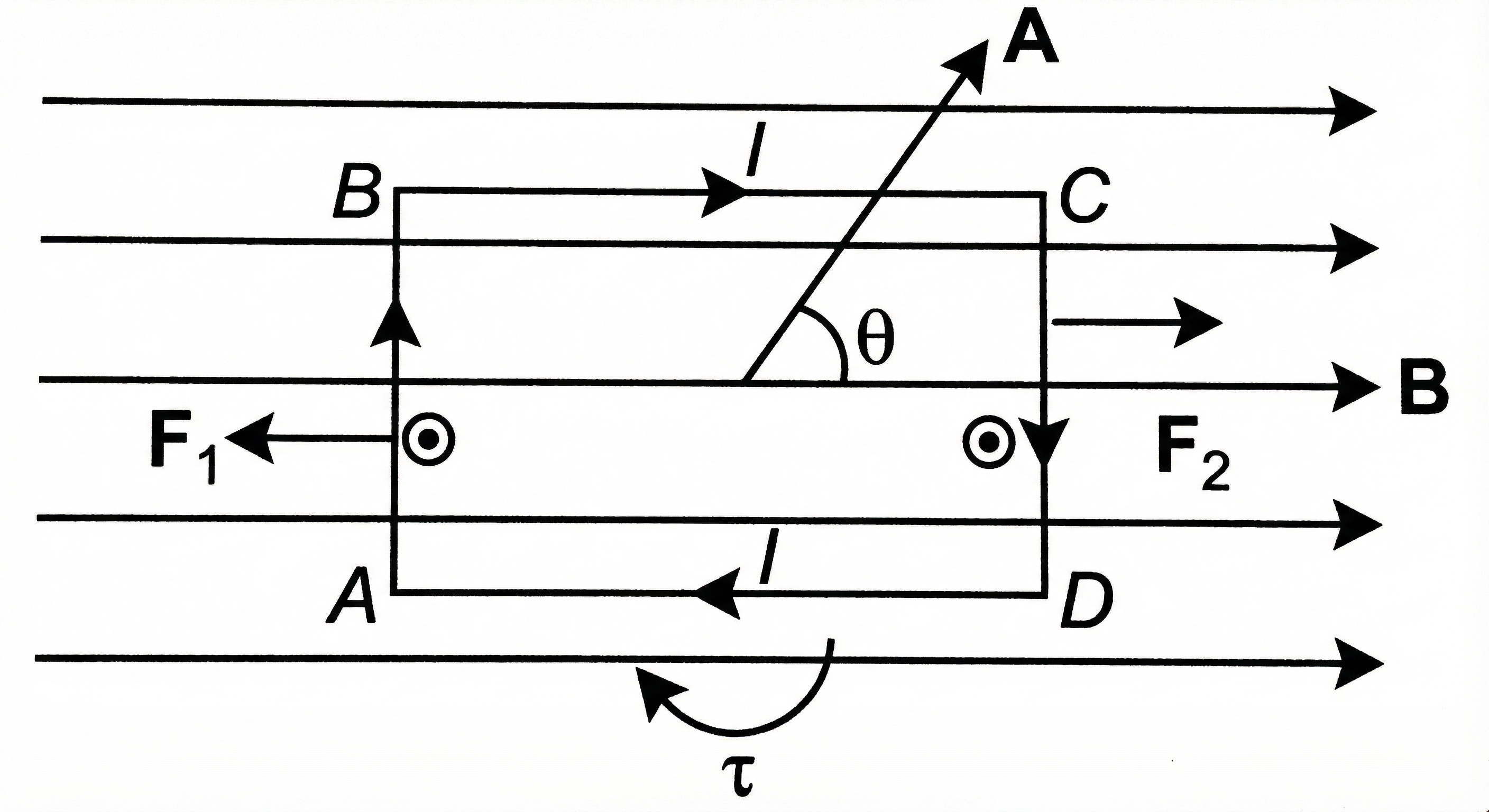
Vectorially, the torque $\tau$ is expressed perfectly using the cross product:
NEET Checkpoint:
For maximum torque, what must be the angle $\theta$ between the area vector $\mathbf{A}$ and $\mathbf{B}$?
(a) $0^\circ$
(b) $45^\circ$
(c) $90^\circ$
(d) $180^\circ$
✅ Answer: (c) $90^\circ$ — Notice this! Torque is $m B \sin \theta$, so $\sin \theta$ must be maximum, which is 1 at $90^\circ$.
This expression also tells us about equilibrium. The torque vanishes when $\mathbf{m}$ is parallel ($\theta=0^\circ$) or anti-parallel ($\theta=180^\circ$) to $\mathbf{B}$. Stable equilibrium occurs when $\mathbf{m}$ is parallel to $\mathbf{B}$ ($\theta=0^\circ$), because any small rotation generates a torque that pulls the loop back. Unstable equilibrium is when they are anti-parallel.
And that's cool, right? A circular current loop, especially when viewed from a distance, behaves exactly like an elementary magnet or a magnetic dipole. Its far-field strength is $B=\frac{\mu_{0}}{4\pi}\frac{2m}{x^{3}}$ along the axis, drawing a direct analogy with the electric field generated by an electric dipole $p_e$. The whole magnetic show can often be explained using these circulating currents, though remember: magnetic monopoles are not known to exist, unlike electric charges.
NEET Checkpoint:
If the magnetic moment $\mathbf{m}$ is anti-parallel to the external field $\mathbf{B}$, the system is in:
(a) Stable equilibrium
(b) Unstable equilibrium
(c) No equilibrium
(d) Maximum torque
✅ Answer: (b) Unstable equilibrium — The torque is zero, but any small disturbance will cause it to rotate further away.
Practice Question:
A coil with $N$ turns, area $A$, and current $I$ is placed in uniform field $B$. If the field is in the plane of the coil, the magnitude of the magnetic moment is:
(a) $\tau/B$
(b) $I A$
(c) $N I A$
(d) $I A B$
✅ Answer: (c) $N I A$ — The magnetic moment definition is $m = NIA$ regardless of the field orientation. Option (a) equals $m$ only if $\sin \theta=1$. Option (d) is the magnitude of the torque, $\tau_{max}$, not the moment.
Now that you've got this torque funda cleared, wait till you see how these dipoles help us classify materials like diamonds and iron in the next chapter!
Key Takeaway:
The torque on a current loop is $\tau = \mathbf{m} \times \mathbf{B}$. The magnetic moment is $\mathbf{m} = N I \mathbf{A}$. Stable equilibrium is when $\mathbf{m}$ is parallel to $\mathbf{B}$.
12. The Moving Coil Galvanometer (MCG)
Ready to tackle the Moving Coil Galvanometer (MCG)? This device is super useful—it helps us detect or measure currents and voltages, acting like a physics detective. The whole funda relies on one core principle: the torque experienced by a current loop when it's chilling in a magnetic field. Don't stress, yaar, it’s easier than it looks!
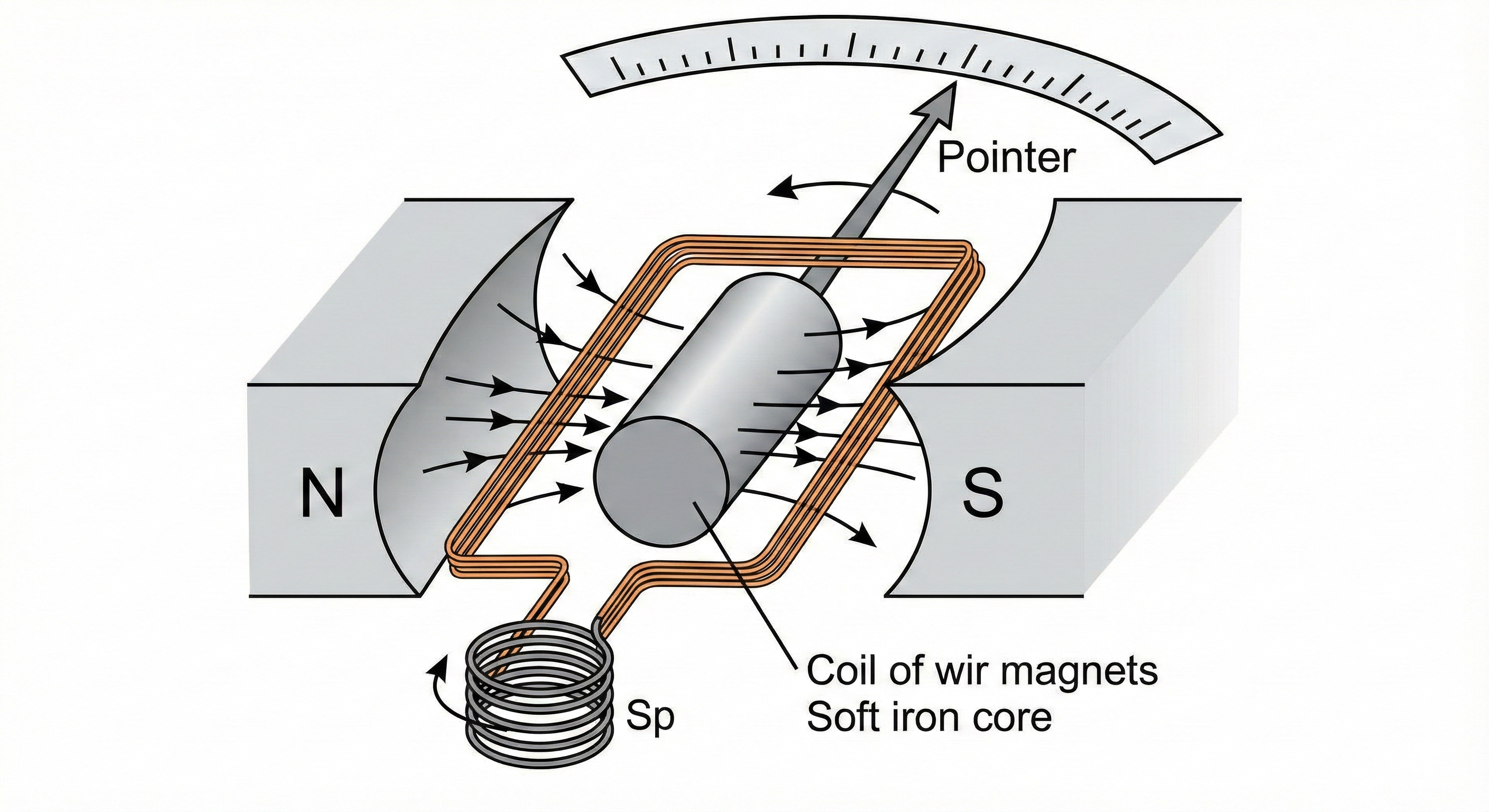
The MCG setup consists of a coil with many turns, free to rotate about a fixed axis. This coil is placed in a strong, uniform radial magnetic field. Here’s the trick: we use a cylindrical soft iron core in the centre. This core ensures two things: first, it makes the magnetic field perfectly radial; and second, it increases the overall strength of the magnetic field, boosting the performance.
When a current $I$ flows through the coil, it experiences a magnetic torque ($\tau$). Since the field is radial by design, the angle between the area vector and the magnetic field is always $90^{\circ}$, meaning $\sin \theta = 1$.
Thus, the magnetic torque is maximized:
(where $N$ is the number of turns, $A$ is the area of the coil, and $B$ is the magnetic field magnitude).
This magnetic torque tends to rotate the coil. But wait, the rotation is controlled! A spring ($S_p$) attached to the coil provides a counter torque that balances the magnetic torque. This counter torque is proportional to the resulting angular deflection $\phi$.
(where $k$ is the torsional constant of the spring, defined as the restoring torque per unit twist).
In equilibrium, the torques balance out:
This gives us the final deflection: $\phi = (\frac{NAB}{k})I$. Notice this: the angular deflection $\phi$ is proportional to the current $I$.
NEET Checkpoint 1:
Which component in the MCG is primarily responsible for ensuring the magnetic field is radial?
(a) The coil
(b) The spring
(c) The soft iron core
(d) The pivot.
✅ Answer: (c) The soft iron core — It makes the field radial and boosts its strength.
Relatable Indian Example: Think of a delivery executive balancing parcels ($NIAB$) on a bike that has stiff suspension ($k$). The angle the bike leans ($\phi$) is directly proportional to the weight of the parcels ($I$). If the suspension is too stiff (high $k$), a small weight difference won't even show a lean!
The most important funda for measuring performance is Current Sensitivity. It’s defined as the deflection per unit current:
A manufacturer can increase sensitivity, usually by increasing the number of turns $N$.
NEET Checkpoint 2:
For a given current $I$, if the torsional constant $k$ is doubled, what happens to the deflection $\phi$?
(a) It doubles
(b) It remains unchanged
(c) It is halved
(d) It is quadrupled.
✅ Answer: (c) It is halved — Since $\phi \propto 1/k$, doubling $k$ halves the deflection.
NEET Checkpoint 3:
Why is the term $\sin\theta$ taken as unity when calculating the magnetic torque in an MCG? (a) The coil is always perpendicular to the axis
(b) The magnetic field is radial
(c) The current is steady
(d) The net force is zero.
✅ Answer: (b) The magnetic field is radial — The radial field design ensures that the torque remains maximized, effectively setting $\sin \theta = 1$.
Figure below:
A clear diagram showing the components of the Moving Coil Galvanometer, including the soft iron core, permanent magnets (N and S), the coil, the spring ($S_p$), and the pointer moving over a scale.
Practice Question:
A galvanometer is too sensitive to be used directly as an ammeter for measuring large currents because:
(a) It changes the direction of the current in the circuit.
(b) It has a large resistance and gives full-scale deflection for currents of the order of $\mu A$.
(c) It measures voltage, not current.
(d) The magnetic field $B$ is not uniform.
✅ Answer: (b) It has a large resistance and gives full-scale deflection for currents of the order of $\mu A$. — Galvanometers are highly sensitive (full scale for $\mu A$ currents) and have high resistance, which would drastically alter the circuit current if connected in series.
Key Takeaway:
| Concept | Formula Summary |
|---|---|
| Equilibrium Condition |
$$\tau_{magnetic} = \tau_{spring} \implies NIAB = k\phi$$
|
| Deflection |
$$\phi = \left(\frac{NAB}{k}\right)I$$
|
| Current Sensitivity |
$$\frac{\phi}{I} = \frac{NAB}{k}$$
|
13. Conversion of Galvanometer to Ammeter and Voltmeter
The moving coil galvanometer (MCG) is super cool because it detects tiny currents and voltages using the torque ($\tau = NIAB$) generated by a magnetic field. But remember this fundamental difference: a galvanometer is a detector; to make it a precise measuring device (an ammeter or a voltmeter), we need some jugaad (modification).
Why the conversion, you ask? Because the MCG is too sensitive (full-scale deflection for $\mu A$ currents) and usually has a large internal resistance ($R_G$).
Ammeter: The Current Bypass Strategy
An ammeter must measure current without changing the original circuit current. Since it must be connected in series, its total resistance must be extremely small (ideally zero).
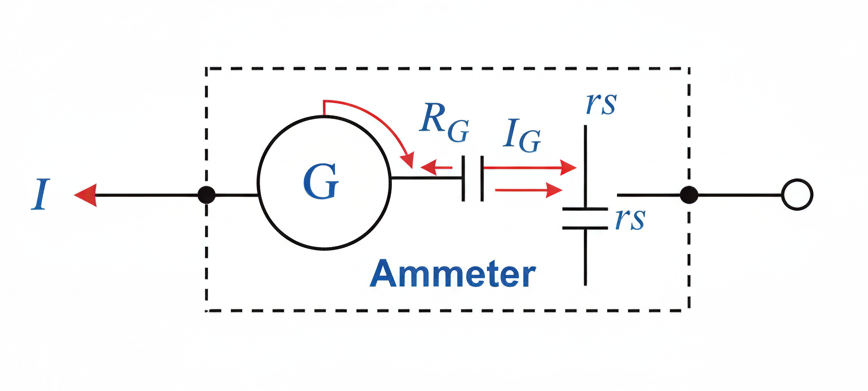
Here’s the trick to convert your MCG into an ammeter: you connect a very small resistance ($r_s$)—called a shunt resistance—in parallel with the galvanometer coil.
- Fundamenta: This small shunt resistance acts like an express lane so that most of the current bypasses the delicate galvanometer coil.
- The resulting resistance of the ammeter is approximately equal to the shunt resistance $r_s$ (assuming the galvanometer resistance $R_G \gg r_s$). Since $r_s$ is small, the ammeter introduces minimal resistance, ensuring the current measurement is accurate. Total disturbance minimized.
Relatable Example: Imagine a highway (the main circuit) that needs a current count. The toll booth ($R_G$) slows everyone down! To prevent traffic (current) disruption, you open a tiny, free side road ($r_s$). Most cars take the side road, leaving only a small, measurable flow through the toll booth.
Figure below:
A clear diagram showing a galvanometer coil ($R_G$) connected in parallel with a small shunt resistance ($r_s$), forming an Ammeter.
NEET Checkpoint 1:
For accurate current measurement, a shunt resistance is connected in parallel with the galvanometer. Why is the shunt value typically very small?
(a) To increase the sensitivity of the galvanometer
(b) To ensure the combined ammeter resistance remains very low and does not alter the circuit current
(c) To increase the potential difference across the galvanometer
(d) To protect the external circuit from short-circuit
✅ Answer: (b) To ensure the combined ammeter resistance is minimal, preventing it from significantly changing the current in the circuit when connected in series.
Voltmeter: The Voltage Limit Strategy
A voltmeter measures the potential difference across a circuit section and must be connected in parallel. Critically, it must draw a very small current itself, otherwise it severely disturbs the voltage being measured.
To achieve this, we convert the galvanometer by connecting a large resistance ($R$) in series with the coil.
- Funda: This large series resistance creates a high total resistance for the voltmeter, approximately $R_G + R \approx R$. When placed in parallel across the circuit, this large resistance ensures only a negligible current is drawn.
NEET Checkpoint 2:
Which configuration is required for converting a galvanometer into a voltmeter?
(a) A small resistance connected in parallel
(b) A large resistance connected in series
(c) A variable resistance connected in parallel
(d) A large resistance connected in parallel
✅ Answer: (b) A large resistance ($R$) connected in series. This modification makes the total resistance large, limiting the current drawn by the voltmeter.
Sensitivity Secrets
The current sensitivity is the deflection per unit current:
The voltage sensitivity is the deflection per unit voltage:
.
Here’s a vital observation for NEET: Increasing current sensitivity does not necessarily increase voltage sensitivity. If a manufacturer doubles the number of turns ($N \rightarrow 2N$) to double the current sensitivity ($\frac{\phi}{I} \rightarrow 2\frac{\phi}{I}$), the resistance of the galvanometer ($R_G$) is also likely to double ($R_G \rightarrow 2R_G$). If $R$ includes $R_G$, doubling both $N$ and $R$ means the voltage sensitivity $\frac{\phi}{V}$ remains unchanged! Don't fall for this trick on test day!
NEET Checkpoint 3:
If the number of turns in an MCG coil is doubled, and assuming the resistance doubles, what happens to the voltage sensitivity?
(a) It becomes double
(b) It becomes half
(c) It remains unchanged
(d) It becomes four times
✅ Answer: (c) It remains unchanged — While the current sensitivity doubles, the simultaneous doubling of the galvanometer resistance means the ratio $\frac{N}{R}$ (and hence $\frac{\phi}{V}$) is constant.
Practice Questions:
- To measure the current in a section of a circuit accurately, the total resistance of the measuring instrument must be:
(a) Large
(b) Small
(c) Equal to $R_G$
(d) Maximum
✅ Answer: (b) Small — The ammeter must have a very small resistance (achieved by using a small shunt in parallel) so it does not alter the current in the main circuit.
2. A galvanometer with internal resistance $R_G$ is converted into an ammeter using a shunt $r_s$. The relationship governing the magnitude of the current sensitivity is:
(a) proportional to $r_s$
(b) inversely proportional to $R_G$
(c) proportional to $N$
(d) inversely proportional to $NAB$
✅ Answer: (c) proportional to $N$ — Current sensitivity is $\frac{\phi}{I} = \frac{NAB}{k}$, making it directly proportional to the number of turns $N$.
Key Takeaway:
| Instrument | Conversion | Component Connection | Purpose |
|---|---|---|---|
| Ammeter | Small $r_s$ (Shunt) | Parallel | To bypass current; minimize resistance. |
| Voltmeter | Large $R$ | Series | To limit current drawn; maximize resistance. |
14. Bar Magnet, Magnetic Dipole Fields, and Gauss's Law
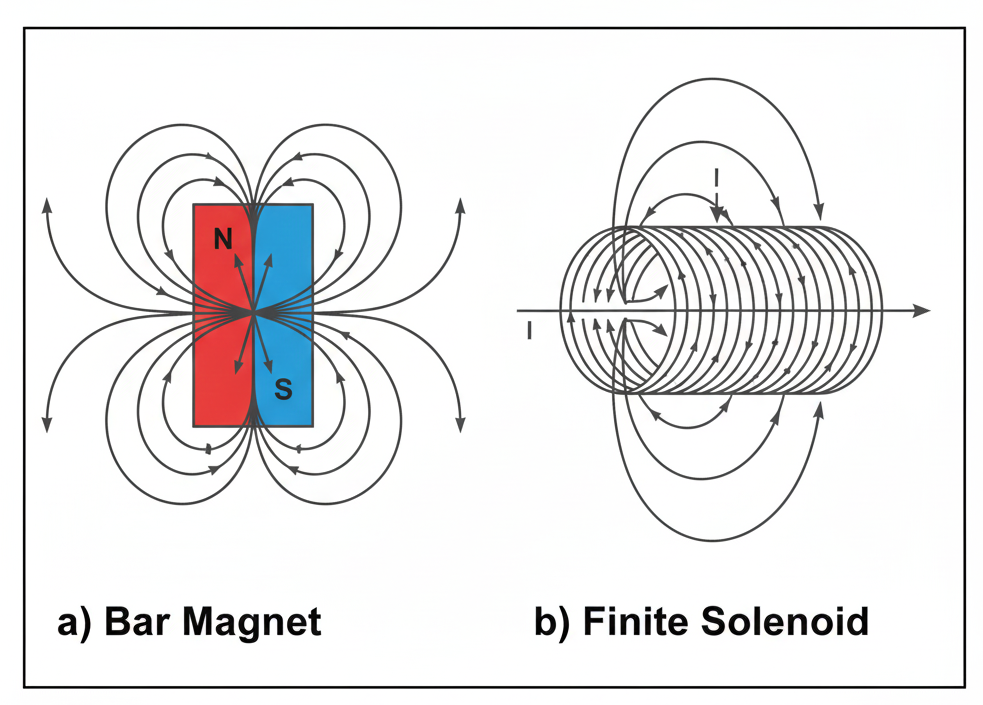
Think of a bar magnet not as some magical chunk of metal, but just an equivalent current-carrying solenoid, loaded with circulating currents. The resemblance between the magnetic field lines of a bar magnet and a solenoid is so strong that we treat them identically.
Notice this cool detail: Magnetic field lines due to a magnet or a solenoid always form continuous closed loops. This is totally unlike electric field lines, which start at positive charges and end on negative ones.
Figure below:
A clear diagram showing the continuous closed magnetic field lines surrounding a bar magnet and a current-carrying finite solenoid.
Now, let's talk about the fields themselves. For a short bar magnet of magnetic moment $m$, the fields fall off rapidly with distance $r$. On the axis (axial field, $B_A$), the field is strong:
On the equator (equatorial field, $B_E$), the magnitude is half that, and the direction is opposite:
NEET Checkpoint:
If you double the distance $r$ from a short bar magnet along the axis, the magnetic field strength becomes:
(a) Half
(b) Quarter
(c) One-eighth
(d) One-sixteenth
✅ Answer: (c) One-eighth — Since $B_A \propto 1/r^3$, doubling $r$ gives $1/(2^3)=1/8$. Don't forget that cube!
What happens when you put a magnetic dipole (like a small compass needle) into a uniform magnetic field $B$? It doesn't experience a net force, but it definitely feels a rotational torque:
The magnetic potential energy of this dipole in the field is:
The energy is minimum (most stable position) when $m$ is parallel to $B$ ($\theta=0^{\circ}$), and maximum (most unstable) when antiparallel ($\theta=180^{\circ}$).
Relatable Example: Imagine you are riding a scooter (magnetic moment $m$) and you park it perfectly aligned with the Earth's magnetic field ($B$). You are in the most stable energy state. If you somehow park it exactly anti-parallel, that's the most unstable state—like trying to balance a full glass of chai on a bumpy rickshaw ride!
Finally, the biggest funda of magnetic fields: Gauss's Law for Magnetism. This critical law states that the net magnetic flux ($\phi_B$) through any closed surface is zero:
Why zero? Because isolated magnetic monopoles do not exist. Every North pole is inseparable from a South pole, ensuring that whatever flux enters a closed surface must also leave it.
NEET Checkpoint:
If a bar magnet is cut into two pieces transversely, what happens to the resulting poles? (a) North pole is isolated
(b) South pole is isolated
(c) Two smaller magnets are formed
(d) Magnetic moment disappears
✅ Answer: (c) Two smaller magnets are formed — Magnetic poles cannot be isolated; cutting a magnet gives two new magnets, each with N and S poles.
Practice Questions:
1. The most stable orientation for a magnetic dipole $m$in a uniform external magnetic field $B$ is when the angle $\theta$ between them is:
(a) $90^{\circ}$
(b) $180^{\circ}$
(c) $0^{\circ}$
(d) $45^{\circ}$
✅ Answer: (c) $0^{\circ}$ — Stable equilibrium occurs when potential energy $U_m = -m\cdot B$ is minimum, which happens when $\cos\theta = 1$, or $\theta=0^{\circ}$.
- Gauss's Law for magnetism, $\oint B\cdot dS=0$, is a direct reflection of:
(a) The principle of superposition.
(b) The conservation of momentum.
(c) The non-existence of magnetic monopoles.
(d) The inverse square law dependence of B.
✅ Answer: (c) The non-existence of magnetic monopoles — Zero net flux implies no source or sink (monopole charge) is enclosed.
Now that you've got this dipole funda clear, wait till you see how it connects with how materials behave in a magnetic field!
Key Takeaway:
Bar Magnet & Dipole Formulas
| Concept | Formula | Notes |
|---|---|---|
| Axial Field ($r>>l$) | $B_{A}=\frac{\mu_{0}}{4\pi}\frac{2m}{r^{3}}$ | Field is strongest along the axis. |
| Equatorial Field ($r>>l$) | $B_{E}=-\frac{\mu_{0}m}{4\pi r^{3}}$ | Field is half the magnitude of $B_A$. |
| Torque | $\tau=m\times B$ | Causes rotation but zero net force. |
| Potential Energy | $U_{m}=-m\cdot B$ | Minimum at $0^{\circ}$ (stable), Maximum at $180^{\circ}$ (unstable). |
| Gauss's Law | $\oint B\cdot dS=0$ | Signifies the absence of isolated magnetic monopoles. |
15. Magnetization and Classification of Magnetic Materials
Ready to dive into the funda of how materials actually respond to a magnetic field, yaar? It's all about classifying substances based on how they react when an external field hits them! Don't stress, this section is key for NEET prep, so let’s get this concept cleared up quickly and wittily.
First up is Magnetisation ($\mathbf{M}$). Think of a substance having tiny, inherent magnetic moments. Magnetisation is simply the net magnetic moment per unit volume of that sample. It’s a vector quantity, defined as:
Its dimensions are $[L^{-1} A]$ and its units are $A~m^{-1}$.
Now, when you place a material inside a solenoid carrying current, the total magnetic field ($\mathbf{B}$) inside isn't just the solenoid's field ($\mathbf{B_0}$). It's enhanced by the material's own response, $\mathbf{B_m}$. We introduce Magnetic Intensity ($\mathbf{H}$) to represent the external factors (like the current creating the initial field). $\mathbf{H}$ has the same units as $\mathbf{M}$, $A~m^{-1}$. Here's the core equation defining the total magnetic field ($\mathbf{B}$):
Notice this: $\mathbf{H}$ is the field due to external currents, and $\mathbf{M}$ is the material's contribution.
NEET Checkpoint:
What is the defining equation for the total magnetic field $\mathbf{B}$ inside a magnetic material?
(a) $B = \mu_0 H$
(b) $B = H + M$
(c) $B = \mu_0 (H+M)$
(d) $B = \mu H / M$
✅ Answer: (c) $B = \mu_0 (H+M)$ — This relationship properly partitions the total field $\mathbf{B}$ into the contribution from external sources ($\mathbf{H}$) and the material's response ($\mathbf{M}$).
To quantify the material's response, we use Magnetic Susceptibility ($\mathbf{\chi}$), a dimensionless quantity. It measures how much magnetisation ($\mathbf{M}$) the material gets for a given magnetic intensity ($\mathbf{H}$):
This $\chi$ tells us how "eager" a material is to be magnetised. This leads directly to Relative Magnetic Permeability ($\mathbf{\mu_r}$), which is also dimensionless and is related to susceptibility by:
The magnetic permeability of the substance itself is then $\mu = \mu_0 \mu_r$.
Classification of Materials
Based on the value of $\chi$, materials fall into three main buckets:
-
Diamagnetic Substances: These guys are the anti-social ones! They have a slight tendency to move from stronger to the weaker part of the field; essentially, they are repelled by magnets. For them, $\chi$ is negative and small (e.g., $\chi < 0$). This means their relative permeability, $\mu_r$, is slightly less than 1 ($0 \le \mu_r < 1$). Examples include bismuth, copper, nitrogen (at STP), and water. Relatable Example: Imagine trying to use a powerful magnet to pick up a droplet of water—it would weakly push the water away, not attract it!
-
Paramagnetic Substances: These are weakly attracted, behaving like polite acquaintances. They get weakly magnetised and move from a region of weak magnetic field to a strong magnetic field. Their $\chi$ is positive and small. They have $\mu_r > 1$. Examples include aluminium, sodium, and oxygen (at STP).
-
Ferromagnetic Substances: These are the strong, intense ones! They get strongly magnetised and move emphatically toward the region of high field (strongly attracted). Their $\chi$ is large and positive ($\chi \gg 1$), meaning $\mu_r \gg 1$ (often $>1000$). Their individual atoms align spontaneously into macroscopic regions called domains. This strong property is temperature-dependent: if you heat a ferromagnet high enough, the domain structure disintegrates, and the material becomes paramagnetic.
NEET Checkpoint:
If a material has a magnetic susceptibility $\chi = -5 \times 10^{-5}$, what type of material is it?
(a) Paramagnetic
(b) Diamagnetic
(c) Ferromagnetic
✅ Answer: (b) Diamagnetic — Since $\chi$ is negative and small, the material is diamagnetic, characterized by being repelled by external fields.
NEET Checkpoint:
What happens to a ferromagnetic material when its temperature is raised significantly?
(a) It becomes diamagnetic.
(b) It retains its ferromagnetism.
(c) It becomes paramagnetic.
✅ Answer: (c) It becomes paramagnetic — The domain structure breaks down at high temperatures, causing the strong alignment to disappear.
Practice Questions:
-
A material sample has a relative magnetic permeability of $\mu_r = 0.9998$. This material is:
(a) Diamagnetic
(b) Paramagnetic
(c) Ferromagnetic
(d) Non-magnetic
✅ Answer: (a) Diamagnetic. Since $\mu_r = 1 + \chi$, a value less than 1 (like $0.9998$) means $\chi$ is negative ($-0.0002$), which is characteristic of diamagnetic substances. -
Which of the following defines magnetic susceptibility $\chi$?
(a) $\chi = M/H$
(b) $\chi = B/\mu_0 H$
(c) $\chi = \mu_r - 1$
(d) Both (a) and (c)
✅ Answer: (d) Both (a) and (c). Susceptibility is defined by $M = \chi H$, so $\chi = M/H$. Also, $\mu_r = 1 + \chi$, so $\chi = \mu_r - 1$.
Key Takeaway:
Magnetisation ($\mathbf{M}$) is the dipole moment per unit volume, while Magnetic Intensity ($\mathbf{H}$) represents external field factors. The material's response is measured by Susceptibility ($\mathbf{\chi}$), determining if it is Diamagnetic ($\chi < 0$, repelled), Paramagnetic ($\chi$ small and positive, weakly attracted), or Ferromagnetic ($\chi$ large and positive, strongly attracted, depends on temperature).