
1. Introduction to Force, Inertia, and Aristotle's Fallacy
Hey future doctors, welcome to Dynamics—the chapter where things actually move! Before we dive into Newton's laws (the ultimate funda of motion), let’s clear up some age-old confusion about why things move and stop.
So, what exactly is a Force? Simple yaar, it's that external agency required to either put a stationary body in motion or stop a moving body. Think of kicking a football or applying brakes to your scooter. This external agency doesn't always need to be in contact; gravitational pull on a falling stone or magnetic attraction are forces acting from a distance. Notice this: The goal of force is to change the state of motion or rest.
NEET Checkpoint:
Which of the following is NOT necessarily required to exert a force?
(a) Mass of the body
(b) An external agency
(c) Contact between the agency and the body
(d) Change in momentum.
✅ Answer: (c) Contact between the agency and the body — Guru, gravity and magnetic attraction are non-contact forces!.
The Aristotleian Blunder: The Great Fallacy
For ages, people believed something called Aristotle’s Fallacy. This Greek thinker held the view that if a body is moving, something external must be continuously required to keep it moving. This view seems natural based on our daily experience, right? If you stop pulling your toy car, it stops.
Relatable Indian Example: Imagine a vendor pushing a pani puri thela (cart). If he stops pushing, the thela quickly comes to rest. Aristotle would say he needs constant force to maintain constant speed. But wait! The thela stops because of friction acting against its motion.
Here's the trick: The real flaw is that Aristotle didn't account for opposing forces like friction. If that vendor was pushing his thela on an ideal, frictionless ice rink, once he got it moving, he wouldn't need to apply any net force to keep it going at a uniform velocity. Mind blown, right?
Galileo and the Birth of Inertia
It took Galileo to get to the true law of nature. He imagined an ideal world without frictional forces. By studying balls on inclined planes, he demonstrated a revolutionary insight: An object moving on a frictionless horizontal plane would neither accelerate nor retard; it would move with constant velocity indefinitely.
Figure below:
A clear diagram showing Galileo's double inclined plane experiment, where a ball rolls down one incline and climbs the second. Show the third case where the second incline is replaced by a zero-slope horizontal plane, implying infinite travel distance.
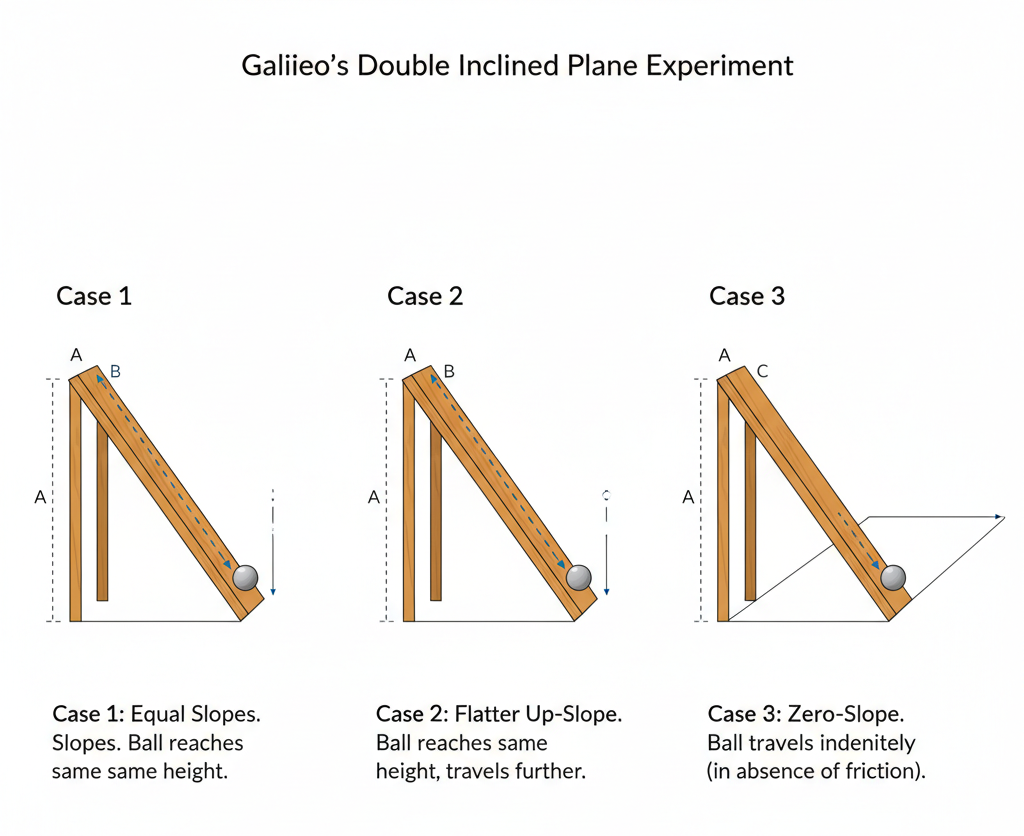
Galileo concluded that the state of rest and the state of uniform linear motion (constant velocity) are equivalent. Both states exist when there is zero net external force acting on the body.
This resistance a body shows to changing its state of rest or uniform motion is called Inertia. Inertia literally means 'resistance to change'. This fundamental concept became the basis for Newton's First Law.
NEET Checkpoint:
If a body is moving uniformly on a horizontal plane, the net external force acting on it in an ideal, frictionless environment is:
(a) Directed forward
(b) Required to overcome gravity
(c) Zero
(d) Non-zero, but constant.
✅ Answer: (c) Zero — In uniform motion without friction, the net force is zero. That's the law of inertia!.
NEET Checkpoint:
What did Galileo's inclined plane experiment reveal about ideal motion?
(a) Force is proportional to velocity
(b) Friction is impossible to eliminate
(c) Uniform motion continues indefinitely in the absence of friction
(d) Bodies naturally come to rest.
✅ Answer: (c) Uniform motion continues indefinitely in the absence of friction — He showed that on a horizontal, frictionless plane, the motion never ceases.
Practice Question:
A cricket ball is rolling across perfectly level, smooth, dry pitch (assume ideal frictionless surface) at $5~m/s$. What external force is required to keep the ball moving at $5~m/s$?
(a) A constant pushing force
(b) A small retarding force
(c) Zero net force
(d) Force proportional to its mass.
✅ Answer: (c) Zero net force — The state of uniform motion is equivalent to the state of rest when net external force is zero. No force is required to maintain uniform motion if friction is absent..
Key Takeaway:
| Concept | Definition/Funda |
|---|---|
| Force | An external agency needed to start or stop motion. |
| Aristotle's Fallacy | Incorrect belief that an external force is required to keep a body in uniform motion. |
| Inertia | The property of a body defined as 'resistance to change' of its state of rest or uniform motion. |
| Equivalence | The state of rest and the state of uniform linear motion are physically equivalent when net external force is zero. |
2. Newton's First Law of Motion: The Law of Inertia
Let's nail the most fundamental concept in Dynamics: Newton's First Law of Motion, which is essentially a formal statement of Galileo's Law of Inertia.
Every body continues to be in its state of rest or of uniform motion in a straight line unless compelled by some external force to act otherwise. The property of a body to resist any change in its state of motion or rest is called inertia.
We can express this law simply using the concept of acceleration ($\mathbf{a}$): If the net external force ($\mathbf{F}$) on a body is zero, its acceleration ($\mathbf{a}$) is zero.
\text{If net } \mathbf{F} = 0 \text{, then } \mathbf{a} = 0
$$
When a body is unaccelerated—meaning it’s either chilling at rest or moving with constant velocity—it means that the net external forces acting on it must perfectly cancel out (sum up to zero).
NEET Checkpoint:
Which ancient Greek thinker mistakenly believed that a continuous external force was required to keep a body in uniform motion?
(a) Newton
(b) Galileo
(c) Aristotle
(d) Archimedes
✅ Answer: (c) Aristotle — He held the view that something external is required to keep a body moving, a concept that Galileo later proved flawed by considering the effect of friction.
Think about traveling in a crowded local bus. The law of inertia is why you get thrown forward when the driver suddenly brakes, or thrown backward when the bus suddenly accelerates. Your body, due to inertia, resists the change in motion until external muscular or frictional forces bring it into alignment with the vehicle.
Relatable Indian Example: Imagine you are standing at a busy pani puri stall. If the person next to you suddenly sprints off, your upper body (due to inertia) wants to stay right where it is, making you feel momentarily pulled in the opposite direction!
Here's the trick: In the real world, like when a car moves with constant velocity ($v$), the engine applies an external force to exactly counter the opposing forces like friction and viscous drag, resulting in a zero net external force. If friction wasn't present, no engine power would be needed to maintain that uniform motion.
NEET Checkpoint:
If an astronaut in interstellar space, far from any gravitational influence, throws a wrench, what happens to the wrench?
(a) It slows down gradually.
(b) It moves with constant acceleration.
(c) It continues moving with uniform velocity.
(d) It stops instantly.
✅ Answer: (c) It continues moving with uniform velocity — Since the net external force ($\mathbf{F}$) is zero, its acceleration ($\mathbf{a}$) must be zero, as required by the First Law.
Practice Question:
A marble is rolling across a frictionless, perfectly horizontal table with a constant speed of $0.5~m/s$. What is the magnitude of the net external force acting on the marble?
(A) $0~N$
(B) $5~N$
(C) $0.5~N$
(D) $m \times 0.5~N$
✅ Explanation: (A)The marble is moving with constant speed in a straight line (uniform motion), meaning its acceleration is zero. According to Newton's First Law, the net external force ($\mathbf{F}$) must therefore be $0~N$.
NEET Checkpoint:
In the equation $F=0 \implies a=0$, what does $F$ represent?
(a) Any single applied force
(b) The total internal forces
(c) The net external force
(d) The force due to friction
✅ Answer: (c) The net external force — The First Law states that the acceleration ($\mathbf{a}$) is zero only if the net external force ($\mathbf{F}$) on the body is zero.
Key Takeaway:
Newton's First Law defines inertia: zero net external force means zero acceleration. A body maintains its state (rest or constant velocity) unless compelled by a non-zero net external force.
3. Linear Momentum: Definition and Importance
Hey future doctors! Ready to clear up a fundamental funda that governs how forces actually act on bodies? We've talked about inertia, but now we're dealing with what happens when the net external force is not zero. That is the realm of Momentum.
The concept is surprisingly neat, yaar. Momentum of a body is defined as the product of its mass ($m$) and its velocity ($v$), and we denote it by $p$. You must remember this equation:
Notice this: Since velocity ($v$) is a vector quantity, Momentum ($p$) is also clearly a vector quantity. Its direction is the same as the velocity's direction!
Now, why does this matter? Momentum is the key variable that helps us understand the effect of a force on motion.
Let’s think about real life, like navigating Indian traffic. If a heavy, loaded truck and a tiny cycle are both moving towards a signal at the same speed, which one needs a greater opposing force to stop it in the same time? Obviously, the truck! This proves that mass ($m$) is super important.
NEET Checkpoint:
A fixed force is applied for a certain time interval on two bodies of different masses, initially at rest. What is the relation between the acquired momenta?(a) (a)The heavier body acquires greater momentum
(b) The lighter body acquires greater momentum
(c) Both bodies acquire the same momentum
(d) Momentum acquired depends on their masses
✅ Answer: (c) They acquire the same momentum - Observations confirm that the same force applied for the same time causes the same change in momentum for different bodies.
Similarly, consider a small pebble versus a fast-moving cricket ball. For a given mass, the greater the speed ($v$), the greater the opposing force needed to stop it. Taken together, $m v$ is everything!
Here's the trick: Force isn't just about the total change in momentum, but about how fast that change occurs. This is crucial! The greater the rate of change of momentum, the greater the force that needs to be applied.
Relatable Indian Example: Imagine a pani puri vendor trying to move his heavy, fully-loaded cart. A much greater force is needed to push that heavy cart to achieve the same speed in the same time as pushing an empty hand trolley. The mass ($m$) demands more force!
NEET Checkpoint:
Why does a seasoned cricketer draw their hands backward while catching a fast ball?
(a) To increase the momentum of the ball
(b) To reduce the force experienced by the hands
(c) To stop the ball instantly
(d) To decrease the time of contact
✅ Answer: (b) To reduce the applied force — Drawing the hands back increases the time ($\Delta t$) over which the momentum changes, resulting in a smaller average force ($F \propto 1/\Delta t$).
Practice Question:
Abody of mass $2\text{ kg}$ is moving with velocity $v = (5\hat{i} - 2\hat{j})\text{ m}\text{ s}^{-1}$. What is the magnitude of its linear momentum?
(a) $10\text{ kg}\text{ m}\text{ s}^{-1}$
(b) $4\text{ kg}\text{ m}\text{ s}^{-1}$
(c) $2\sqrt{29}\text{ kg}\text{ m}\text{ s}^{-1}$
(d) $10.77\text{ kg}\text{ m}\text{ s}^{-1}$
✅ Answer: (d) $10.77\text{ kg}\text{ m}\text{ s}^{-1}$ — Momentum $\vec{p} = m\vec{v} = 2(5\hat{i} - 2\hat{j}) = (10\hat{i} - 4\hat{j})$. Magnitude $|\vec{p}| = \sqrt{10^2 + (-4)^2} = \sqrt{100 + 16} = \sqrt{116} \approx 10.77\text{ kg}\text{ m}\text{ s}^{-1}$.
Key Takeaway:
Momentum ($p$) is the product of mass ($m$) and velocity ($v$): $p = mv$. It is a vector quantity. The effect of force depends directly on the product of mass and velocity.
4. Newton's Second Law of Motion: Force and Rate of Change of Momentum
The First Law of Motion was all about what happens when the net force is zero ($\mathbf{F}=0$)—basically, nothing changes! But the Second Law of Motion jumps into the real dynamics: the general situation where there is a net external force acting on a body. Don't stress, this is where the real funda begins!
Before we define the law, let's clarify momentum ($\mathbf{p}$). Momentum is defined as the product of a body's mass ($m$) and its velocity ($\mathbf{v}$). It’s a crucial vector quantity.
Momentum helps us understand how hard it is to stop or move something.
Statement and Formula Focussed
The fundamental statement of the Second Law is: The rate of change of momentum of a body is directly proportional to the applied force and takes place exactly in the direction of the force.
NEET Checkpoint:
If a cricket ball's momentum changes by $10~N~s$ over $0.1~s$, what is the average force applied?
(a) $10~N$
(b) $1~N$
(c) $100~N$
(d) $0.1~N$
✅ Answer: (c) $100~N$ — Since $F = \Delta p / \Delta t$, $F = 10~N~s / 0.1~s = 100~N$.
Mathematically, force ($\mathbf{F}$) is proportional to the rate of change of momentum ($\frac{d\mathbf{p}}{dt}$). By choosing the constant of proportionality $k=1$ (which we do for SI units), we get the equation that rules mechanics:
For a fixed mass ($m$), we know $\frac{d\mathbf{p}}{dt} = m\frac{d\mathbf{v}}{dt} = m\mathbf{a}$. Thus:
Notice this: $\mathbf{F}$ here is always the net external force acting on the particle.
Vector Nature and Units
The Second Law is a vector law. This is super important because it means forces and accelerations can be resolved into components. For example, along the $x$-axis, $F_{x}=ma_{x}$. Here’s the trick: if a force acts in the $x$-direction, it changes only the $x$-component of the velocity; the component normal to the force remains unchanged.
Imagine you are driving a scooter and apply the brakes (a force opposite to motion). That force only reduces your forward velocity; it doesn't suddenly make you float upwards!
The official SI unit of force is the newton ($N$). We define it such that:
NEET Checkpoint:
The Second Law is a local relation. This means acceleration depends on:
(a) the body's previous speeds
(b) the force acting far away
(c) the force acting at that instant and location
(d) the internal forces of the body.
✅ Answer: (c) the force acting at that instant and location — The acceleration here and now is determined by the force here and now, regardless of its history.
Relatable Example
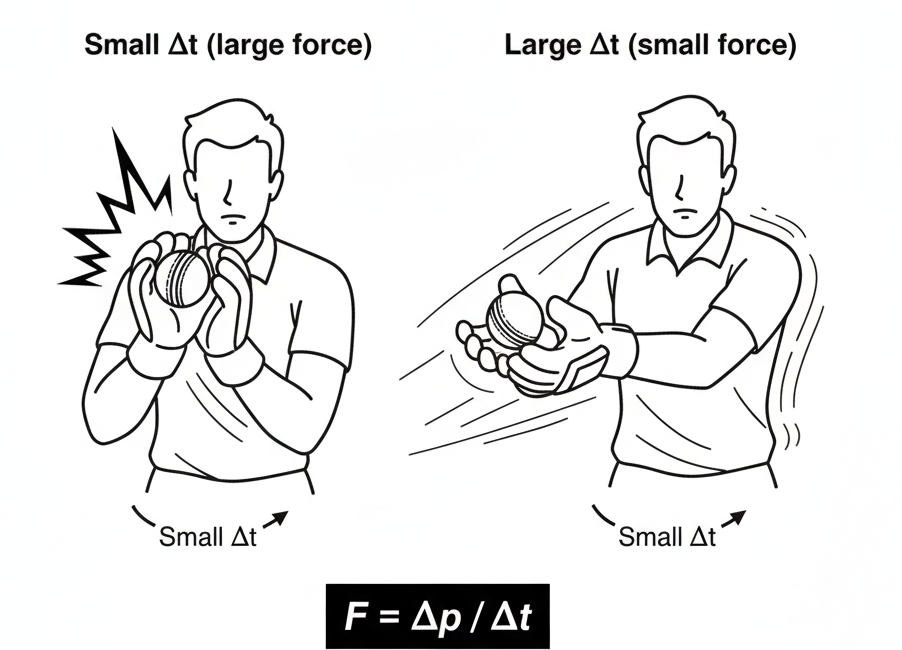
Think about pushing a heavy cart full of books to the tuition centre. If you apply a fixed force for a certain time ($\Delta t$), the change in momentum ($\mathbf{F} \Delta t$) will be constant. Since the cart is heavy (large $m$), it will only pick up a small final velocity ($\mathbf{v}$), because momentum $p=mv$ must remain the same. If you push a small, light trolley with the same force for the same time, the light trolley (small $m$) will zoom away with a huge speed! Same impulse, but different effects depending on mass.
Figure below:
Recreate a diagram (like Fig 4.3 from the textbook) showing a cricketer drawing his hand back while catching a fast ball, illustrating that increasing the time ($\Delta t$) reduces the required force ($\mathbf{F}$).
Practice Question:
A force of $25~N$ acts on a body of mass $5~kg$. What is the magnitude of the acceleration of the body?
(a) $5~m/s$
(b) $5~m/s^{2}$
(c) $125~m/s^{2}$
(d) $25~m/s^{2}$
✅ Explanation: Using $F=ma$, we get $a = F/m$. $a = 25~N / 5~kg = 5~m~s^{-2}$ (since $1~N = 1~kg~m~s^{-2}$).
NEET Checkpoint:
If the net external force on a particle is zero, what does the Second Law imply about its acceleration?
(a) Acceleration is constant but non-zero
(b) Acceleration is zero
(c) Velocity must be zero
(d) Acceleration is infinite.
✅ Answer: (b) Acceleration is zero — When $\mathbf{F}=0$, then $m\mathbf{a}=0$, so $\mathbf{a}=0$. This confirms consistency with Newton’s First Law.
Key Takeaway:
Formula Summary
The Second Law is defined by the rate of change of momentum, which simplifies for fixed mass to the famous force-acceleration relationship.
| Concept | Equation | Notes |
|---|---|---|
| Momentum ($\mathbf{p}$) |
$$\mathbf{p} = m\mathbf{v}$$
|
Vector quantity |
| Second Law (General) |
$$\mathbf{F} = \frac{d\mathbf{p}}{dt}$$
|
$\mathbf{F}$ is the net external force |
| Second Law (Fixed Mass) |
$$\mathbf{F} = m\mathbf{a}$$
|
The force and acceleration vectors are parallel. |
5. Impulse and Impulsive Forces
Hey, NEET aspirants! Ever wondered why a sudden shock feels so much worse than a steady push? The funda behind this is Impulse. Impulse is what happens when a large force ($F$) acts on a body for a very short duration ($\Delta t$). Mathematically, it’s simply the product of the force and the time duration.
Notice this: Impulse is physically equal to the change in momentum ($\Delta p$) of the body.
Since impulse is defined as the change in momentum, it is a vector quantity, and its units are $\text{N} \text{ s}$ or $\text{kg} \text{ m } \text{s}^{-1}$.
This concept is super useful in scenarios like quick collisions, where the exact magnitude of the force ($F$) and the precise duration of contact ($\Delta t$) are hard to figure out separately. But, yaar, the overall change in momentum ($\Delta p$) is always measurable!.
NEET Checkpoint:
The concept of impulse is most useful when measuring:
(a) Mass and velocity
(b) Force and time separately
(c) Change in momentum
(d) Acceleration
✅ Answer: (c) Change in momentum — Impulse is defined as the change in momentum, which is measurable even when $F$ and $\Delta t$ are not easily determined in a collision.
A large force acting briefly is called an impulsive force. But don't stress—an impulsive force is not a new type of force conceptually different from ordinary forces in Newtonian mechanics; it's just a regular force that is large and acts quickly.
Now, why does your cricket bat feel a huge shock if you hit a fast ball right on the edge, compared to the 'sweet spot'? The impulse (change in the ball's momentum) is roughly the same, but hitting the edge reduces the contact time ($\Delta t$) slightly, meaning the peak force ($F$) exerted on your hands is much greater! Similarly, when you hammer a nail, the massive force generated over the fraction of a second is an impulsive force that drives the nail forward.
NEET Checkpoint:
An impulsive force, compared to an ordinary force, is fundamentally:
(a) Different in nature
(b) The same, but large and short-acting
(c) Always gravitational
(d) Always magnetic
✅ Answer: (b) The same, but large and short-acting — Newtonian mechanics makes no distinction in kind; impulsive forces are just large forces acting briefly.
NEET Checkpoint:
If a body's momentum changes by $10 \text{ kg} \text{ m } \text{s}^{-1}$, what is the magnitude of the impulse imparted?
(a) $10 \text{ N}$
(b) $10 \text{ N} \text{ s}$
(c) $5 \text{ N} \text{ s}$
(d) $20 \text{ N} \text{ s}$
✅ Answer: (b) $10 \text{ N} \text{ s}$ — Impulse is equal to the change in momentum, and $1 \text{ N} \text{ s}$ is equivalent to $1 \text{ kg} \text{ m } \text{s}^{-1}$.
Practice Question:
A hockey player hits a stationary ball of mass $0.2 \text{ kg}$, giving it a velocity of $20 \text{ m } \text{s}^{-1}$. What is the impulse imparted to the ball?
(a) $4 \text{ N}$
(b) $0.4 \text{ N} \text{ s}$
(c) $4 \text{ N} \text{ s}$
(d) $20 \text{ N} \text{ s}$
✅ Answer: (c) $4 \text{ N} \text{ s}$ — Impulse equals the change in momentum ($\Delta p$). Initial momentum ($p_i$) is zero (stationary). Final momentum ($p_f$) is $m \times v = 0.2 \text{ kg} \times 20 \text{ m } \text{s}^{-1} = 4 \text{ kg} \text{ m } \text{s}^{-1}$. Thus, Impulse = $\Delta p = 4 \text{ N} \text{ s}$.
Key Takeaway:
| Formula Summary |
|---|
| Definition: Impulse is the product of force and the time it acts for. |
| Equation:$\text{Impulse} = F \Delta t = \Delta p$ |
| Use: It is useful for collisions where $\Delta p$ is easily measured, even if $F$ and $\Delta t$ are not. |
6. Newton's Third Law of Motion: Action-Reaction Pairs
Uou’ve mastered the First and Second Laws; now let's hit the foundation of dynamics: the Third Law! This one is super intuitive but often misunderstood. Don't stress, the core funda is that force never occurs singly in nature. Force is always a mutual interaction between two bodies, and it always occurs in pairs.
The formal, crisp statement by Newton is: "To every action, there is always an equal and opposite reaction". What this means is that if body A exerts a force on body B, then body B simultaneously exerts a force of equal magnitude and opposite direction back on body A.
Here’s the trick: These "action" and "reaction" forces are simply two names for simultaneous mutual forces. There is no cause-effect relation implied; they happen at the exact same instant.
NEET Checkpoint:
Does the action force occur before the reaction force?
(a) Yes, action is the cause and reaction is the effect.
(b) No, they are simultaneous.
(c) Only in non-contact forces.
✅ Answer: (b) No, they are simultaneous — Notice this! The third law implies no time delay; they act at the same instant.
Crucially, always remember that action and reaction forces act on different bodies. This is the golden rule for NEET prep! Because they act on separate bodies (say, $A$ and $B$), they cannot cancel each other out in terms of calculating the net force on a single body (like $A$ alone or $B$ alone).
Mathematically, if $\vec{F}{AB}$ is the force on body $A$ by body $B$, and $\vec{F}{BA}$ is the force on body $B$ by body $A$, then:
Let’s clear up this core concept with a relatable Indian example. Imagine you’re enjoying a hot plate of pani puri and you lean against the counter (Body B) of the stall. Your body (Body A) exerts a force on the counter (Action). The counter exerts an equal and opposite force back on your body (Reaction). These two forces act on different bodies (you and the counter).
NEET Checkpoint:
You stand on the ground. The force of gravity ($W$) pulling you down and the Normal force ($R$) from the ground pushing you up form an action-reaction pair.
(a) True
(b) False
✅ Answer: (b) False — Don't get confused! $W$ and $R$ both act on you (the same body) and only cancel out if you are in equilibrium. They are not an action-reaction pair.
If we consider the entire system (you + counter), these mutual forces become internal forces and they sum up to zero, but for individual motion analysis, they are separate.
NEET Checkpoint:
If a stone exerts a gravitational force of $10 \text{ N}$ on the Earth, what force does the Earth exert on the stone?
(a) $0 \text{ N}$
(b) $10 \text{ N}$ upwards
(c) $10 \text{ N}$ downwards
✅ Answer: (b) $10 \text{ N}$ upwards — By the Third Law, the mutual forces are equal and opposite, even if the Earth is too massive to show a noticeable effect.
Practice Questions:
- If you push a stationary scooter (Body S) with force $\vec{F}$, the force that the scooter exerts back on you (Body Y) is:
(a) Greater than $\vec{F}$.
(b) Equal to $\vec{F}$ but opposite in direction.
(c) Equal to $\vec{F}$ and in the same direction.
(d) Zero, because the scooter is stationary.
✅ Answer: (b) Equal to $\vec{F}$ but opposite in direction. — This is the Third Law in action: forces occur in equal and opposite pairs between two interacting bodies.
2. What is the fundamental requirement for two forces to be considered an action-reaction pair according to Newton's Third Law?
(a) They must be non-contact forces.
(b) They must act sequentially (cause and effect).
(c) They must be equal, opposite, and act on different bodies.
(d) They must act on the same body to ensure net force is zero.
✅ Answer: (c) They must be equal, opposite, and act on different bodies. — The forces are mutual, equal, opposite, and always distributed across two different bodies.
Key Takeaway:
Newton's Third Law: Forces are mutual interactions that always occur in pairs (Action = Reaction).
Vector Form: $\vec{F}{AB} = -\vec{F}{BA}$.
Crucial Concept: These forces always act on different bodies and therefore never cancel out when analyzing the motion of a single body.
7. Law of Conservation of Linear Momentum
After crunching those massive $F=ma$ problems, you deserve a break! But guess what? The Law of Conservation of Momentum is not some tough new funda; it’s actually a super cool result that drops out directly from Newton's Second and Third Laws. Don't stress, yaar—it's easier than it looks!
The official statement you need to memorize is: The total momentum of an isolated system of interacting particles is conserved.
An isolated system is simply one where the net external force is zero. Now, why does this matter? Notice this: inside the system, particles are busy interacting and hitting each other, changing their individual momenta. But according to Newton’s Third Law, the mutual forces between any pair of interacting particles are always equal and opposite. This means that the momentum changes caused by these internal forces cancel out in pairs. This neat cancellation keeps the total momentum of the entire system constant.
NEET Checkpoint:
The Law of Conservation of Momentum is derived from which combination of Newton's Laws?
(a) First Law only
(b) Second and Third Laws
(c) Third Law only
(d) First and Second Laws
✅ Answer: (b) Second and Third Laws — This principle is derived by combining the vector nature of force ($\mathbf{F}=\frac{d\mathbf{p}}{dt}$) and the equal/opposite mutual forces ( $\mathbf{F}{AB}=-\mathbf{F}{BA}$).
A classic application is the firing of a bullet from a gun. Initially, the gun and bullet are at rest, so the total momentum is zero. When the bullet is fired, it gains momentum ($P_{b}$). To keep the total momentum zero (conserved), the gun must recoil backward, gaining an equal and opposite momentum ($P_{g}$), such that $P_{b} + P_{g} = 0$.
Think of a street thela (cart) full of pani puri ingredients parked on a smooth surface. If the vendor suddenly throws a heavy bag of puffed rice forward (giving it momentum $P_{rice}$), the cart (system) will instantly roll slightly backward ($P_{cart}$) to ensure the total momentum remains zero!
This law is also vital for analyzing collisions between two bodies. For two bodies, A and B, the total momentum before collision ($\mathbf{P}{A} + \mathbf{P}{B}$) must equal the total momentum after collision ($\mathbf{P}'{A} + \mathbf{P}'{B}$):
And that’s cool, right? This conservation rule holds true whether the collision is elastic or inelastic. Remember to treat momentum ($\mathbf{P}$) as a vector!
NEET Checkpoint:
For an isolated system of colliding particles, the internal forces sum up to:
(a) The change in momentum.
(b) The total external force.
(c) Zero.
(d) The impulse.
✅ Answer: (c) Zero — Internal forces always cancel out in pairs within the system, resulting in a null force.
Practice Question :
A body A of mass $m$ moving with velocity $v$ collides with a stationary body B of mass $2m$. If they stick together after collision, what is the final common velocity $v'$?
(a) $v/2$
(b) $v/3$
(c) $2v$
(d) $3v$
✅ Explanation: Total initial momentum is $m v + 2m (0) = m v$. Total final momentum is $(m + 2m) v' = 3m v'$. Since initial = final momentum, $m v = 3m v'$. Thus, $v' = \frac{v}{3}$. Option (b) is correct.
NEET Checkpoint:
An isolated system is defined as one where the net external force is:
(a) Constant
(b) Increasing
(c) Zero
(d) Non-zero
✅ Answer: (c) Zero — Conservation of momentum relies on the absence of a net external force.
Key Takeaway: |
|---|
| Law of Conservation of Momentum : $\mathbf{P}{\text{initial}} = \mathbf{P}{\text{final}}$) |
| The total momentum of an isolated system (net external force zero) is always conserved, derived from Newton's Second and Third Laws. |
| Formula Summary (Collision):$P'_{A} + P'_{B} = P_{A} + P_{B}$ |
8. Equilibrium of Concurrent Forces
Ready to clear up a major funda for NEET, yaar? When we talk about the equilibrium of a particle in mechanics, it sounds super serious, but the basic idea is simple: the net external force acting on that particle must be zero. This means the particle is either happily at rest or moving with uniform motion (constant velocity). Notice this—zero net force means zero acceleration.
If you have just two forces, say $F_1$ and $F_2$, acting on a tiny particle, achieving equilibrium requires them to be exactly equal in magnitude and acting in opposite directions, like a perfect tug-of-war stalemate. Mathematically, this is written as:
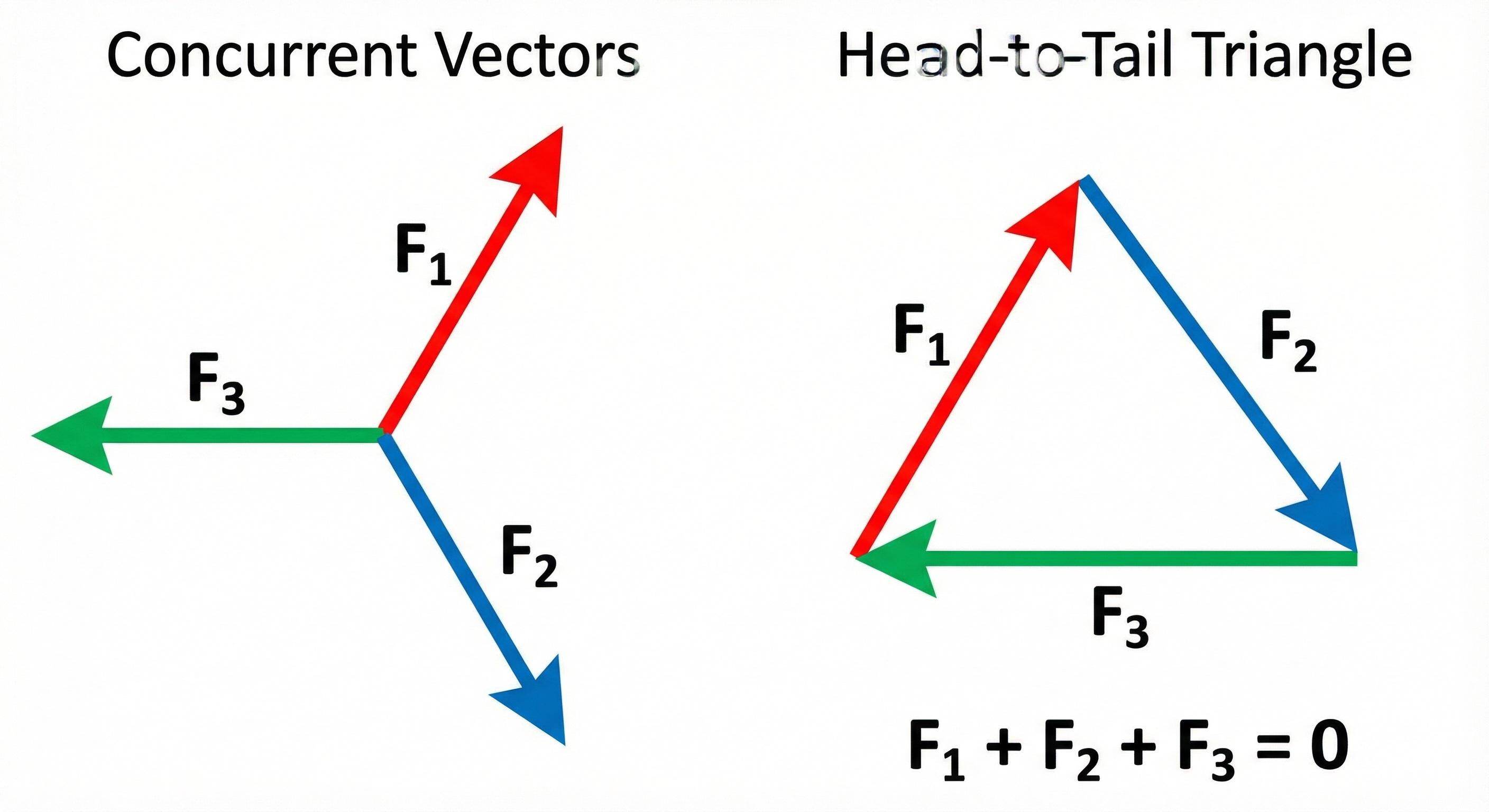
Now, things get fun when we introduce three or more concurrent forces (forces acting at the same point). For equilibrium under concurrent forces, their vector sum must be zero. For forces $F_1, F_2, F_3,$ the condition is:
And that’s cool, right? Geometrically, if a particle is in equilibrium under three forces, those forces can be represented by the sides of a closed triangle, provided the vector arrows are taken in the same sense (head-to-tail). This concept extends to any number of forces; they must form a closed n-sided polygon.
NEET Checkpoint:
If a particle is moving with constant velocity, is the net external force on it zero?
(a) Yes
(b) No
(c) Depends on mass
✅ Answer: (a) Yes — Equilibrium means zero net external force, which covers both being at rest and moving uniformly.
Here’s the trick for solving problems: you use the component form. Since the total vector sum is zero, the sum of the components of all forces must be zero separately in the $x$, $y$, and $z$ directions. For three forces, this means:
Imagine a sign for a pani puri stall hanging motionless by two ropes, slightly angled. The three concurrent forces acting on the point where the ropes meet are the tension in the two ropes and the weight of the sign (acting downwards). Because the sign is stationary (in equilibrium), the vector sum of these three forces must be zero!
NEET Checkpoint:
For three forces $F_1, F_2,$ and $F_3$ to be in equilibrium, $F_1$ must be equal and opposite to:
(a) $F_2$
(b) $F_3$
(c) $F_2 + F_3$
(d) $F_2 - F_3$
✅ Answer: (c) $F_2 + F_3$ — Since $F_1 + F_2 + F_3 = 0$, this implies $F_1 = -(F_2 + F_3)$, meaning $F_1$ is equal and opposite to the resultant of $F_2$ and $F_3$.
Figure below:
A clear diagram showing three force vectors, $F_1, F_2,$ and $F_3$, meeting at a single point (concurrent). Also show how these three vectors, when placed head-to-tail, form a closed triangle, demonstrating $F_1 + F_2 + F_3 = 0$.
Practice Question:
If a particle is in equilibrium, what must be true about its acceleration, $a$?
(a) $a > 0$
(b) $a = 0$
(c) $a$ is constant but non-zero
(d) $a$ is inversely proportional to mass
✅ Answer: (b) $a = 0$ — Equilibrium requires the net external force to be zero ($F_{net}=0$). By Newton's Second Law ($F=ma$), if $F=0$, then acceleration $a$ must also be zero.
NEET Checkpoint:
Action and reaction forces (Newton's Third Law) cannot cancel each other out because:
(a) They are unequal in magnitude.
(b) They act on different bodies.
(c) They are not simultaneous.
✅ Answer: (b) They act on different bodies — Only forces acting on the same body can be summed to determine the net force.
Key Takeaway:
Translational Equilibrium (Equilibrium of a particle) means zero net external force ($\sum \mathbf{F} = 0$). This ensures the body has zero acceleration, maintaining a state of rest or constant velocity.
9. Static and Kinetic Friction: Principles and Definitions
Hey future NEET doc! Let's clear up this foundational funda—Friction. Friction is the ultimate speed bump in classical mechanics, but it's essential for getting around! It is defined as the component of the contact force that acts parallel to the surfaces that are touching. Notice this: Friction’s primary role is to oppose the impending or actual relative motion between the two surfaces.
Static Friction: The Gatekeeper
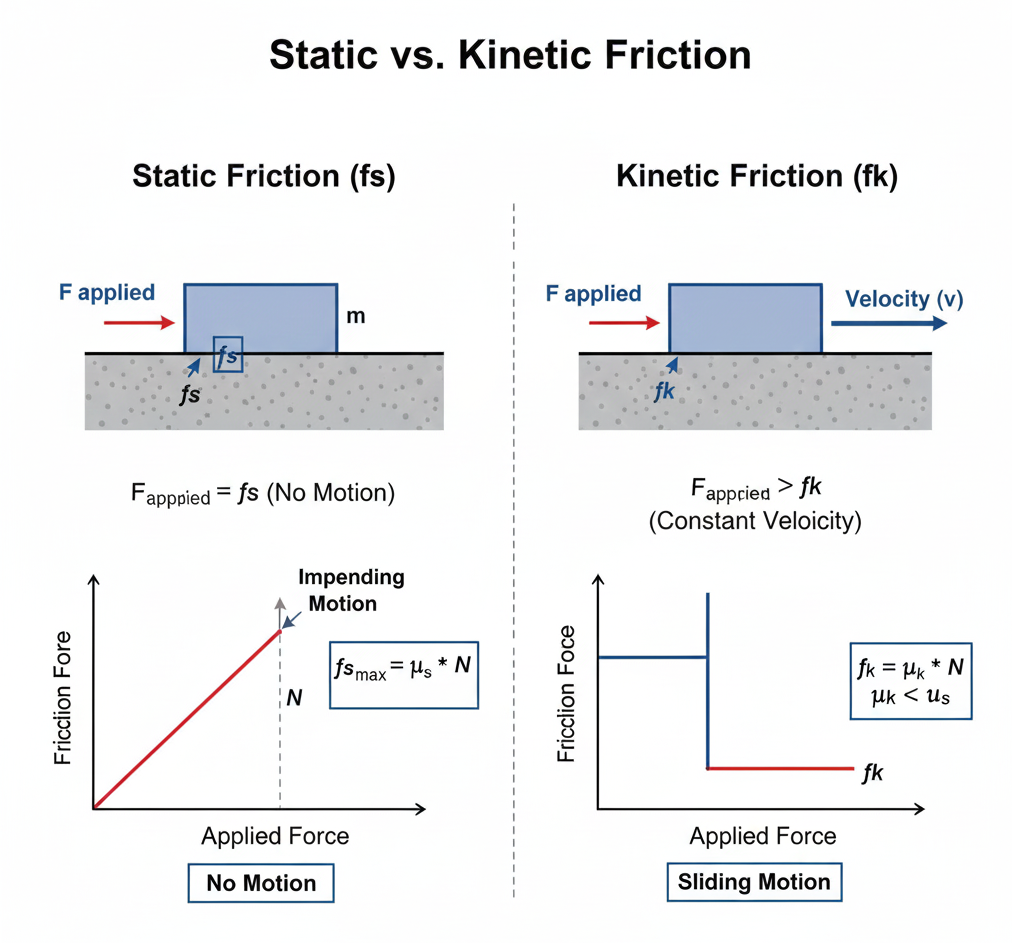
When you apply a small horizontal force, say $F$, to a heavy box, and it refuses to budge, static friction ($f_{s}$) is the gatekeeper holding it back. Static friction specifically opposes impending motion—the motion that would occur if the surface was frictionless. And that's cool, right? The static friction force ($f_{s}$) is a self-adjusting force. It remains exactly equal and opposite to the applied force $F$ up to a certain critical limit, keeping the net external force zero.
NEET Checkpoint:
What must be true for static friction ($f_{s}$) to exist?
(a) The body must be moving uniformly.
(b) An external force must be applied.
(c) The body must be accelerating.
✅ Answer: (b) An external force must be applied — $f_{s}$ does not exist by itself; it only comes into play the moment there is an applied force $F$.
This limit, known as the maximum static friction, is given by the formula $(f_{s}){max} = \mu{s}N$, where $\mu_{s}$ is the coefficient of static friction and $N$ is the normal reaction. Therefore, $f_{s}$ satisfies the law $f_{s} \le \mu_{s}N$.
Kinetic Friction: Once You Start Sliding
If you increase your applied force $F$ just past the maximum limit $(f_{s}){max}$, (fs)max, the body begins to slide, and a new frictional force takes over: kinetic friction (or sliding friction), denoted by.fkk Kinetic friction opposes the actual relative motion between the surfaces.
Imagine trying to push a fully loaded pani puri stall (non-wheeled, for maximum difficulty). The initial massive heave needed to start it moving is fighting $(f_{s}){max}$. Once it starts sliding, keeping it moving requires slightly less effort. Why? Because the kinetic friction)(fkk) is experimentally found to be less than the maximum static friction $(f_{s}){max}$. That is why the coefficient of kinetic friction, μk{k}$, is less than μs. Kinetic friction is calculated using fk=μkN. Even friction needs a break sometimes!
Figure below:
A clear diagram showing a block on a horizontal surface, illustrating the difference between static friction ($f_s$) opposing applied force $F$ when impending motion occurs, and kinetic friction ($f_k$) opposing motion when sliding occurs.
NEET Checkpoint:
Which coefficient of friction is typically larger for a given pair of surfaces?
(a) $\mu_{k}$
(b) $\mu_{s}$
(c) They are always equal.
✅ Answer: (b) $\mu_{s}$ — The coefficient of static friction ($\mu_{s}$) is greater than the coefficient of kinetic friction ($\mu_{k}$).
Practice Question:
A $5~\text{kg}$ box rests on a table. The applied horizontal force is $20~\text{N}$. If the maximum static friction is $30~\text{N}$, what is the magnitude of the static friction ($f_{s}$)?
(a) $30~\text{N}$
(b) $50~\text{N}$
(c) $20~\text{N}$
(d) $0~\text{N}$.
✅ Answer: (c) 20 N — S ince fs is self-adjusting and the body is at rest ($F < (f_{s}){max}$), fs{s}$ must equal the applied force, F=20 N.
NEET Checkpoint:
The frictional force is defined as the component of the contact force that is:
(a) Normal to the surface
(b) Parallel to the surface
(c) Perpendicular to the applied force.
✅ Answer: (b) Parallel to the surface — Friction acts parallel to the surfaces in contact.
Key Takeaway:
Friction is the component of the contact force parallel to the surfaces. Static friction (fs) is a self-adjusting force opposing impending motion, with a maximum value $(f_{s}){max} = \mu{s}N$. Kinetic friction (fk=μkN) opposes actual relative motion.
10. Laws of Static and Kinetic Friction
Friction is both a headache and a necessity in mechanics, and we need specific rules to handle it. We deal with static friction ($\text{f}{s}$) when motion is only impending (about to happen), and kinetic friction ($\text{f}{k}$) when there is actual relative motion.
Notice this: The limiting value of static friction $\left(f_{s}\right){\max}$ is determined by two major factors. Firstly, it is independent of the area of contact. Secondly, it is proportional to the normal force (N). The proportionality constant is the coefficient of static friction, $\mu_{s}$.
The Law of Static Friction is written as:
This inequality is key because static friction is a self-adjusting force that increases only up to its maximum limit $\left(\mu_{s} N\right)$ to oppose the applied force.
NEET Checkpoint:
The limiting value of static friction $\left(f_{s}\right)_{\max}$ depends upon:
(a) Velocity
(b) Area of contact
(c) Normal force
✅ Answer: (c) Normal force — $\left(f_{s}\right)_{\max}$ is proportional to the normal force ($N$) and is independent of the area of contact.
Once the applied force exceeds $\left(f_{s}\right){\max}$, the body begins to slide, and we deal with kinetic friction ($\text{f}{k}$). Kinetic friction, also called sliding friction, opposes the relative motion between surfaces. Like its static cousin, kinetic friction is found to be independent of the area of contact and is nearly independent of the velocity. The Law of Kinetic Friction is written as:
Here, $\mu_{k}$ is the coefficient of kinetic friction.
Here's the trick: Experimentally, the coefficient of kinetic friction ($\mu_{k}$) is usually less than the coefficient of static friction ($\mu_{s}$). This means overcoming the initial resistance is harder than maintaining the slide! Even friction needs a break sometimes!
Relatable Indian Example: Imagine shifting a heavy gas cylinder. The initial push required to get it moving across the floor (overcoming $\left(f_{s}\right){\max}$) is significant. But once it starts sliding, keeping it going requires a noticeably smaller, constant effort because you are now fighting the smaller $\text{f}{k}$.
NEET Checkpoint:
To keep a body moving with constant velocity, the required applied force must be equal to:
(a) $\left(f_{s}\right){\max}$
(b) fkk
(c) $\mu_{s} N$
✅ Answer: (b) $f_{k}$ — For constant velocity, the net external force must be zero. Thus, the applied force must equal the kinetic friction, $F = f_{k}$.
Remember this crucial point: These established relationships for friction are empirical relations. They are derived from observation and are highly useful in practical mechanics, but they do not have the status of fundamental laws like those for gravity or electrical forces.
NEET Checkpoint:
The laws of static and kinetic friction are classified as:
(a) Fundamental laws
(b) Empirical relations
(c) Based on Newtonian calculus
✅ Answer: (b) Empirical relations — They are approximately true relations found experimentally, not fundamental laws.
Practice Question:
A block of mass $10~kg$ is sliding on a rough horizontal surface with $\mu_{k}=0.2$. What is the magnitude of the kinetic friction acting on the block? (Take $g=10~m~s^{-2}$)
(a) $2~N$
(b) $20~N$
(c) $100~N$
(d) $0.2~N$
✅ Answer: (b) $20~N$ — The kinetic friction is $f_{k} = \mu_{k} N$. Since the surface is horizontal, $N = mg = (10~kg)(10~m~s^{-2}) = 100~N$. Thus, $f_{k} = 0.2 \times 100~N = 20~N$.
Key Takeaway:
Laws of Friction
The limiting static friction $\left(f_{s}\right){\max}$ is proportional to the normal force (N), fs≤μsN. The kinetic friction fk is fk=μkN. These laws are empirical, and μk<μs.
11. Rolling Friction and its Characteristics
Hey NEET aspirants! Let's clear up the funda about Rolling Friction, which is way cooler (and smaller!) than its cousin, sliding friction.
The idea of rolling motion starts with a super idealised situation: Imagine a perfect sphere or ring rolling without slipping over a smooth horizontal plane. In principle, there is no friction whatsoever. Why? Because at any instant, there is only a single point of contact between the body and the plane, and this point has zero relative motion relative to the surface. So, ideally, the body should roll forever with constant velocity!.
NEET Checkpoint:
In ideal rolling without slipping, what is the relative motion at the point of contact?
(a) Maximum
(b) Zero
(c) Equal to center velocity
(d) Infinite
✅ Answer: (b) Zero — Yaar, if there was relative motion, it wouldn't be rolling without slipping!.
But in the real world (the one with gravity and exams!), resistance always occurs. This resistance is called rolling friction. This happens because when a body rolls, the surfaces in contact get momentarily deformed a little. Instead of a perfect point, you end up with a finite area of contact. This deformation creates a small component of the contact force parallel to the surface that ends up opposing the motion.
Here's the trick: While it exists, rolling friction is incredibly small. For the same weight, rolling friction is typically much smaller than static or sliding friction, often by 2 or 3 orders of magnitude. That massive difference is why the discovery of the wheel was such a huge milestone in human history!
Imagine you’re carrying heavy luggage at the railway station (Relatable Indian Example!). If you slide the suitcase (kinetic friction), you use massive energy. But the moment you turn it over and use the wheels (rolling friction), it's a breeze! The small magnitude of this frictional force is why technologies like ball bearings are so effective in machinery; they drastically reduce power dissipation (lost as heat) between moving parts.
NEET Checkpoint:
Why is rolling friction smaller than kinetic friction?
(a) It is independent of weight
(b) The force is always parallel to motion
(c) It results from momentary surface deformation
(d) Rolling velocity is higher
✅ Answer: (c) It results from momentary surface deformation — This deformation converts the ideal 'point contact' into a resistive force, but its mechanism is fundamentally less opposing than the constant sliding contact.
NEET Checkpoint:
What technique utilizes rolling friction to reduce power loss in machines?
(a) Lubricants
(b) Ball bearings
(c) Air cushion systems
(d) Both (b) and (c)
✅ Answer: (b) Ball bearings — These work because the friction involved is rolling friction, which is inherently tiny. (Lubricants reduce kinetic friction, and air cushions reduce drag/contact friction generally).
Practice Questions:
1. If $\mu_s$ is the coefficient of static friction, $\mu_k$ is the coefficient of kinetic friction, and $\mu_r$ represents rolling friction characteristics, what is the correct approximate relationship between their magnitudes?
(a) $\mu_s \approx \mu_k > \mu_r$
(b) $\mu_r > \mu_s > \mu_k$
(c) $\mu_s > \mu_k \approx \mu_r$
(d) $\mu_s > \mu_k >> \mu_r$
✅ Explanation: Static friction is the maximum limit, kinetic friction is slightly less ($\mu_k < \mu_s$), and rolling friction is much, much smaller (by orders of magnitude). Thus, (d) is the most accurate representation.
2. A 50 kg car tyre is rolling without slipping. If the same tyre were instead dragged (sliding) across the road, how would the frictional force change?
(a) It would become zero, as friction opposes relative motion.
(b) It would increase, likely by 100 to 1000 times.
(c) It would slightly decrease, as kinetic friction is less than rolling friction.
(d) It would remain the same, as the weight ($N$) is constant.
✅ Explanation: Since rolling friction is 2 or 3 orders of magnitude smaller than sliding (kinetic) friction, switching from rolling to sliding would increase the resistance dramatically, hence (b).
Key Takeaway:
Rolling friction arises because surfaces momentarily deform, creating a small resistance. Its main characteristic is that it is significantly smaller than static or kinetic friction, making applications like ball bearings highly efficient for reducing power loss.
12. Dynamics of Uniform Circular Motion
Don't stress, yaar—Uniform Circular Motion ($UCM$) is super easy once you get the funda of acceleration and force!
When a body of mass $m$ moves in a circle of radius $R$ with a uniform speed $v$, the magnitude of its velocity doesn't change, but its direction is constantly changing. Because the velocity vector changes, acceleration is present. This acceleration is known as centripetal acceleration, and it is always directed inward towards the centre of the circle.
Now, why does this matter? According to Newton's Second Law ($F=ma$), if there is acceleration, there must be a net external force. The force required to produce this inward radial acceleration $a = v^2/R$ is called the centripetal force ($f_c$). The formula that defines this required force is:
NEET Checkpoint:
The acceleration of a body moving in a circle with uniform speed $v$ is proportional to:
(a) $vR$
(b) $v/R^2$
(c) $v^2/R$
(d) $R/v^2$
✅ Answer: (c) $v^2/R$ — The magnitude of centripetal acceleration is $a = v^2/R$.
Here's the trick you must notice: The centripetal force should not be treated as yet another kind of fundamental force. It is simply a name given to whatever existing material force is providing the necessary inward pull.
For example, when you whirl a stone (mass $m$) tied to a string (length $R$) in a horizontal circle, the centripetal force is supplied by the tension in the string. If a loaded truck takes a sharp circular turn on a level road, the $f_c$ needed to keep it from skidding is provided by the static friction between the tyres and the road surface. Even the planets orbiting the sun use the gravitational force of the sun as their centripetal force.
NEET Checkpoint:
Centripetal force for a car taking a circular turn on a horizontal road is supplied by:
(a) Gravitational force
(b) Normal reaction
(c) Frictional force
(d) Reactionary force
✅ Answer: (c) Frictional force — On a level road, static friction provides the centripetal force.
NEET Checkpoint:
Centripetal force $f_c$ is always directed:
(a) Parallel to velocity
(b) Opposite to velocity
(c) Towards the centre
(d) Away from the centre
✅ Answer: (c) Towards the centre — Since the acceleration is directed towards the centre, the force $F=ma$ must also be directed towards the centre.
Practice Question:
A particle of mass $m$ is rotated by a string of length $R$ at a speed $v$. If the radius $R$ is doubled but the speed $v$ is kept the same, how does the required centripetal force change?
(a) Doubles
(b) Halves
(c) Quarters
(d) Quadruples
✅ Explanation: Since $f_{c}=\frac{mv^{2}}{R}$, if $R$ is doubled, $f_c$ is inversely halved. The force required is $\frac{1}{2}$ the original force.
Key Takeaway
| Concept | Formula | Notes |
|---|---|---|
| Centripetal Acceleration ($a$) | $a = \frac{v^2}{R}$ | Directed towards the centre. |
| Centripetal Force ($f_c$) |
$$f_{c}=\frac{mv^{2}}{R}$$
|
This force is a name, supplied by forces like tension, friction, or gravity. |
13. Centripetal Force and its Applications
Circular motion can seem tricky, but the main funda you need to clear up is the Centripetal Force. This force is not some new, mysterious force; it’s just the name we give to whatever existing force is pulling a body toward the centre to keep it moving in a circle. Without it, the body would just fly off tangentially!
The required centripetal force, denoted $f_{c}$, is always directed towards the centre. You calculate it using the simple formula:
Here, $m$ is the mass, $v$ is the speed, and $R$ is the radius of the circle. Notice this: the force is always required to make the body accelerate towards the centre at a rate of $a=v^{2}/R$.
Now, who provides this zabardast force? It depends on the scenario:
- Stone on a string: The tension in the string is the centripetal force.
- Planetary motion: The gravitational force exerted by the Sun provides the centripetal force for a planet.
- Car on a horizontal road: The force of friction between the tyres and the road acts as the centripetal force. Even friction needs a break sometimes, but here, it’s the real hero!
The circular motion of cars on both flat (level) and banked roads are super important applications in the laws of motion. For a car taking a turn on a level road, static friction provides the necessary $f_{c}$. This means there is a maximum speed limit, $v_{max}$, you can’t cross, which is independent of the mass of the car: $v_{max}=\sqrt{\mu_{s}Rg}$.
Relatable Indian Example: Imagine a pani puri stall owner spinning a circular tray of sauces. If he spins it too fast (large $v$) or if the radius is too small (sharp spin, small $R$), the sauces fly outward because the force holding them (friction/normal force) wasn't enough to provide the required $f_{c}$. Total mess, yaar!
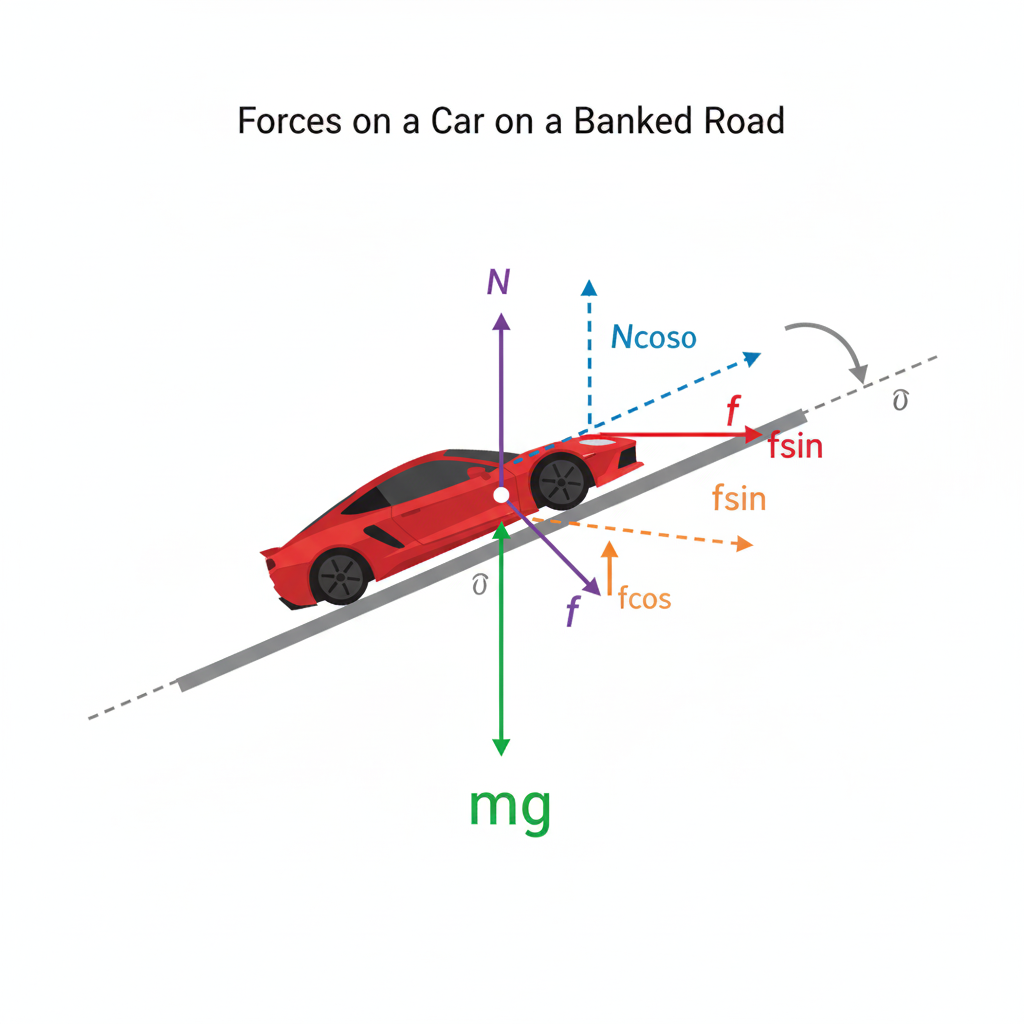
When a road is banked, we reduce the reliance on friction. The horizontal component of the normal force ($N$) starts contributing to the centripetal force along with friction ($f$).
Figure below:
A clear diagram showing a car on a banked road (inclined surface $\theta$) detailing the forces: weight $mg$ downwards, Normal force $N$ perpendicular to the surface (resolved into $N\cos\theta$ and $N\sin\theta$), and Frictional force $f$ along the surface (resolved into $f\cos\theta$ and $f\sin\theta$).
NEET Checkpoint:
What force provides the centripetal acceleration for a satellite orbiting the Earth?
(a) Tension
(b) Friction
(c) Gravitational force
(d) Normal Reaction
✅ Answer: (c) Gravitational force — For celestial bodies like planets or satellites, gravity is the force pulling them inwards.
For a banked road, there is an optimum speed ($v_{o}$) where friction is not needed at all, minimizing tyre wear and tear. This happens when $\mu_{s}=0$ in the full equation, giving:
NEET Checkpoint:
If a car on a banked road drives at the optimum speed ($v_o$), what is the magnitude of the frictional force required?
(a) $\mu_s N$
(b) $\frac{mv^2}{R}$
(c) Zero
(d) $N \sin\theta$
✅ Answer: (c) Zero — At the optimum speed, the centripetal force is perfectly provided by the component of the normal force, meaning friction is not needed.
If you go faster than $v_{o}$, friction pulls you down the slope; if you go slower, friction pushes you up the slope.
NEET Checkpoint:
If the speed of rotation ($v$) of a stone attached to a string is doubled, how does the required centripetal force change? (Assume $m$ and $R$ are constant).
(a) Halves
(b) Doubles
(c) Remains same
(d) Quadruples
✅ Answer: (d) Quadruples — Since $f_{c}$ is proportional to $v^2$ ($f_{c} \propto v^{2}$), doubling $v$ means quadrupling $f_{c}$.
Practice Questions
- On a level road, a car of mass $m$ takes a circular turn of radius $R$. If the maximum possible speed without slipping is $v_{max}$, which factor is irrelevant in determining $v_{max}$?
(a) Coefficient of static friction ($\mu_s$)
(b) Radius of the turn ($R$)
(c) Acceleration due to gravity ($g$)
(d) Mass of the car ($m$)
✅ Answer: (d) Mass of the car ($m$) — The formula for maximum speed on a level road, $v_{max}=\sqrt{\mu_{s}Rg}$, shows that it is independent of the car's mass.
2. A driver takes a circular turn of radius $R$ at a speed $v$. If the centripetal force required is $F$, what force is required if the driver takes a turn of radius $2R$ at speed $2v$?
(a) $2F$
(b) $4F$
(c) $8F$
(d) $\frac{F}{2}$
✅ Answer: (a) $2F$ — Using $f_{c}=\frac{mv^{2}}{R}$. The new force $F' = \frac{m(2v)^2}{2R} = \frac{4mv^2}{2R} = 2 \frac{mv^2}{R} = 2F$.
Key Takeaway: |
|---|
| Centripetal Force ($f_c$) is always directed towards the centre and is provided by specific forces like friction, tension, or gravity. |
| Level Road Maximum Speed: $v_{max}=\sqrt{\mu_{s}Rg}$. |
| Banked Road Optimum Speed (No Friction): $v_{o}=(R~g~tan~\theta)^{\frac{1}{2}}$. |
14. Application: Vehicle on a Level Circular Road
Driving in circles might look chill, but physics is secretly doing some heavy lifting! This topic covers the Dynamics of uniform circular motion and how Newton's laws apply when your vehicle takes a turn. Let's clear up this funda of a car taking a circular turn on a level road (meaning, no banking—just a flat surface).
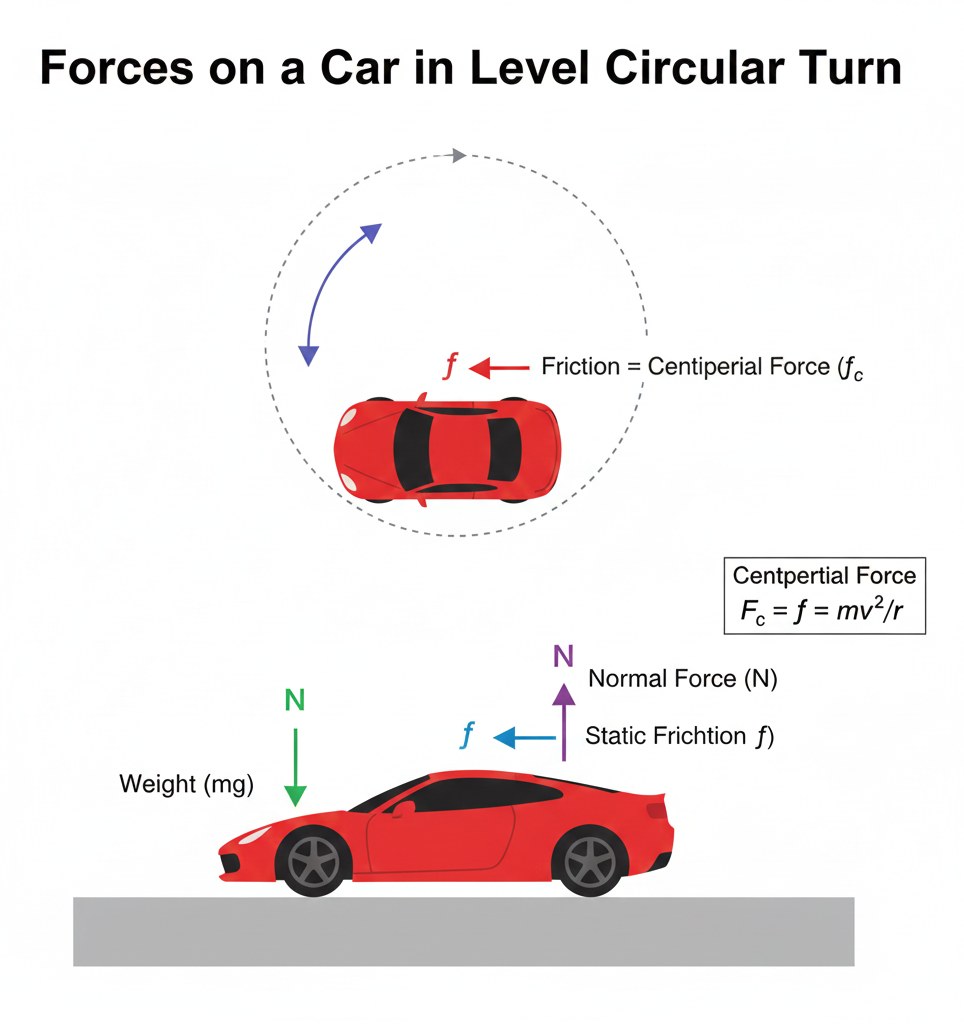
Notice this: three main forces act on the car. First, the weight ($\mathbf{mg}$) pulling it down. Second, the normal reaction ($\mathbf{N}$) from the road pushing up. Since there is zero vertical acceleration, these forces must cancel out. This means that the normal force equals the weight: $N = mg$. Easy peasy!
NEET Checkpoint:
In the vertical direction for a car on a level road, what is the net external force?
(a) $mg$
(b) $N$
(c) $N - mg$
(d) Zero
✅ Answer: (d) Zero — Since there is no vertical acceleration, the net vertical force is zero, meaning $N$ balances $mg$.
Now, where does the centripetal force ($f_c$), which is mandatory for circular motion, come from? Here’s the trick: It is provided entirely by the static friction ($\mathbf{f}$) between the tyres and the road. This static friction is crucial because it opposes the impending motion of the car trying to slip outwards, away from the centre of the circle.
For the car not to slip, the required centripetal force ($\frac{mv^2}{R}$) must be less than or equal to the maximum static friction ($\mu_s N$).
Since $N = mg$, we get the condition for safe turning: $\frac{mv^2}{R} \le \mu_s mg$. And that’s cool, right? Because the mass ($m$) cancels out! The maximum safe speed ($v_{max}$) is therefore independent of the mass of the car!
Figure below:
A clear diagram showing a car taking a level circular turn , labeling the three forces: Normal reaction ($N$) up, Weight ($mg$) down, and Frictional force ($f$) horizontally towards the centre, representing the centripetal force.
NEET Checkpoint:
If the mass of a large truck doubles, how does its theoretical maximum safe speed on a given level turn change?
(a) Doubles
(b) Halves
(c) Remains the same
(d) Increases by $\sqrt{2}$
✅ Answer: (c) Remains the same — The maximum safe speed, $v_{max} = \sqrt{\mu_s R g}$, is independent of the mass of the car.
Imagine a local auto-rickshaw rider taking a tight, quick turn near a pani puri stall. The only thing keeping that three-wheeler from skidding out is the static friction! If the road is wet (low $\mu_s$), even a slow turn can be dangerous because $v_{max}$ drops drastically. Even friction needs a break sometimes!
Practice Question:
A car is taking a circular turn of radius $4~m$ on a level road. If the coefficient of static friction is $0.4$ (take $g=10~m/s^2$), what is the maximum safe speed it can maintain?
(a) $2~m/s$
(b) $4~m/s$
(c) $8~m/s$
(d) $16~m/s$
✅ Explanation: Maximum speed is $v_{max} = \sqrt{\mu_s R g}$. Substituting the values: $v_{max} = \sqrt{0.4 \times 4 \times 10} = \sqrt{16} = 4~m/s$. (Option b).
Key Takeaway:
Motion on a Level Circular Road
The required centripetal force ($\frac{mv^2}{R}$) is supplied solely by the static friction ($f$). The maximum safe speed is given by the formula:
This speed is independent of the mass ($\mathbf{m}$) of the vehicle.
15. Application: Vehicle on a Banked Road
Ever wondered why those cool race tracks and highway curves are always tilted? That’s banking! Banking the road is the ultimate pro move in physics because it significantly reduces the reliance on friction to provide the necessary centripetal force for circular motion. This means less strain on your tyres and safer, faster turns.
Let's break down the funda of forces acting on a car on a banked road (angle $\theta$). We have three main forces: weight ($mg$), the normal reaction ($N$), and the frictional force ($f$).
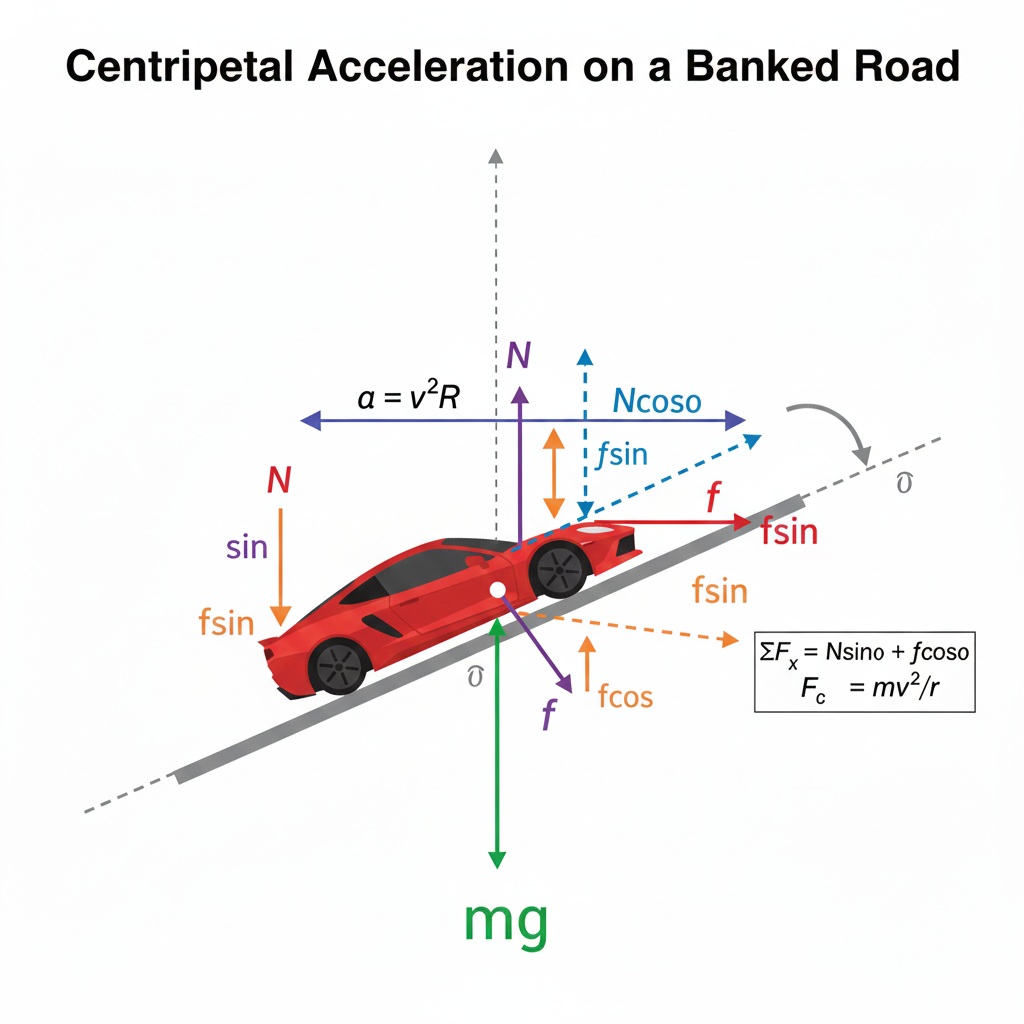
For vertical forces, since the car has no acceleration in that direction, the forces must balance. The vertical forces are balanced by the vertical component of the normal reaction ($N\cos\theta$) offsetting the weight ($mg$) and the upward component of friction ($f\sin\theta$).
Notice this: $N$ is perpendicular to the road, so we resolve it into components.
The centripetal force ($F_c$), which is $\frac{mv^2}{R}$, is provided by the horizontal components of the normal force and friction ($N~\sin~\theta + f~\cos~\theta$).
NEET Checkpoint:
For a banked road, which two forces contribute their components to the required centripetal force?
(a) Weight and Friction
(b) Normal Reaction and Weight
(c) Normal Reaction and Friction
✅ Answer: (c) Normal Reaction and Friction — Here’s the trick: The horizontal components of $N$ ($N\sin\theta$) and $f$ ($f\cos\theta$) combine to pull the car towards the centre.
Figure below:
A clear diagram showing a car on a banked road (angle $\theta$), indicating the forces: weight ($mg$) vertically down, normal reaction ($N$) perpendicular to the surface, and friction ($f$) along the slope. Show the resolution of $N$ and $f$ into horizontal and vertical components, with $a=v^2/R$ directed horizontally towards the center.
Optimum Speed (The Tyre-Saver)
The optimum speed ($v_{o}$) is the speed at which frictional force is not needed at all ($f=0$). Driving at this speed on a banked road causes little wear and tear on the tyres. If you set $\mu_s=0$ in the general formula, you get the expression for $v_o$:
NEET Checkpoint:
If a race car is driving exactly at the optimum speed ($v_o$) on a banked turn, what is the direction of the frictional force required?
(a) Up the slope
(b) Down the slope
(c) Zero
✅ Answer: (c) Zero — By definition, at $v_o$, friction is not required to provide the necessary centripetal force.
Maximum Speed (Pushing the Limit)
To find the maximum permissible speed ($v_{max}$) to avoid slipping, we assume maximum static friction $f = \mu_{s}N$. This condition lets you tackle the turn at the fastest safe velocity:
This $v_{max}$ is clearly greater than what’s possible on a flat road. Think of a delivery boy on a scooter ($m$) taking a sharp flyover turn (radius $R$): the banking saves him from relying purely on the static friction between his worn tyres and the asphalt!
NEET Checkpoint:
For a car parked on a banked road, what must be true about the tangent of the banking angle ($\theta$)?
(a) $\tan\theta > \mu_s$
(b) $\tan\theta \le \mu_s$
(c) $\tan\theta = 0$
✅ Answer: (b) $\tan\theta \le \mu_s$ — A car can only be parked (speed $v=0$) if the angle is shallow enough such that $\tan~\theta\le\mu_{s}$.
Practice Question:
A banked curve has an angle $\theta$. If a car moves slower than the optimum speed ($v < v_o$), the frictional force will act:
(a) Towards the center of the circle.
(b) Up the slope.
(c) Down the slope.
(d) Perpendicular to the plane.
Explanation ✅ : The friction force is needed to adjust the motion. If $v < v_o$, the tendency of the car is to slip down the slope (as the normal force component is too large for the speed), so friction must act up the slope to prevent this.
The correct option is (b).
Key Takeaway:
For a banked road, we balance the vertical forces (net force is zero vertically) and equate the total horizontal force (from $N$ and $f$) to the centripetal force ($\frac{mv^2}{R}$). Don't stress, just remember the optimum speed formula $v_{o}=(R~g~tan~\theta)^{\frac{1}{2}}$! Now that you've got this banked road funda cleared, wait till you see how it connects with how objects behave when moving along inclined surfaces.