
1. Introduction to Kinetic Theory
Let's clear the air—literally. Kinetic Theory of Gases (KTG) is that cool bridge between the tiny world of atoms and the big world we see. Back in the 19th century, legends like Maxwell and Boltzmann decided to stop looking at gases as just "stuff" and started seeing them as a crowd of rapidly moving atoms or molecules.
This theory was a total hit! It explains everything from basic gas laws to Avogadro's hypothesis and even why different gases have different specific heat capacities. Why do we care? Because KTG relates measurable properties like viscosity, conduction, and diffusion directly to molecular parameters like size and mass. It's like knowing exactly how many spices are in a biryani just by smelling it from the next room!
NEET Checkpoint:
Kinetic theory treats gas molecules as being in what kind of motion?
(a) Random motion
(b) Circular motion
(c) Oscillatory motion
(d) Uniform straight-line motion
✅ Answer: (a) Random motion — They never sit still, yaar!
NEET Checkpoint:
Which forces are neglected in kinetic theory for gases?
(a) Inter-atomic forces
(b) Gravitational forces
(c) Electrostatic forces
(d) Nuclear forces
✅ Answer: (a) Inter-atomic forces — Because molecules are usually far apart, these short-range forces don't matter much.
Think of a busy Mumbai local train. If everyone is standing still, it’s a solid. If they’re walking slowly, it’s a liquid. But if everyone is sprinting randomly and bumping into walls, that’s your gas! To calculate the state of this "crowd," we use the Ideal Gas Equation:
NEET Checkpoint:
When was the actual scientific "Atomic Theory" established?
(a) 1808 AD
(b) 1897 AD
(c) 1913 AD
(d) 1926 AD
✅ Answer: (a) More than 150 years after Boyle's law — Science takes its own sweet time!
Practice Question:
Kinetic theory relates which macroscopic property to molecular parameters?
(a) Colour
(b) Viscosity
(c) Taste
(d) Shine
✅ Answer: (b) Viscosity — It links bulk properties to tiny molecular sizes and masses.
Key Takeaway
Formula Summary:
- Boltzmann Constant: $k_{B} = R/N_{A} \approx 1.38 \times 10^{-23} J K^{-1}$
- Ideal Gas Equation: $PV = \mu RT = k_{B}NT$
- Success: Explains gas laws, specific heats, and Avogadro's number.
2. Molecular Nature of Matter & Atomic Theory
Listen up, junior! If you had to save just one bit of scientific knowledge from a global catastrophe, Richard Feynman says it should be the Atomic Hypothesis: everything is made of atoms—tiny particles in constant, perpetual motion. These little guys attract each other when they are a small distance apart, but they get really "grumpy" and repel the moment you try to squeeze them into one another.
Before Dalton became the face of modern atomic theory to explain the laws of definite and multiple proportions, ancient legends were already on the case. In India, Acharya Kanada (6th century B.C.) founded the Vaiseshika school and proposed that matter consists of Paramanu (indivisible particles). He cleverly argued that if matter could be divided forever, there would be no difference between a tiny mustard seed and the massive Meru mountain!. Meanwhile, Democritus in Greece coined the term "atom," meaning indivisible, and even imagined "hooked" atoms to explain why some things are hard while others flow.
NEET Checkpoint:
Which ancient Indian text contains an estimate of atomic size close to modern values?
(a) Rigveda
(b) Vaisheshika Sutra
(c) Lalitavistara
(d) Arthashastra
✅ Answer: (c) Lalitavistara — It estimated the size to be of the order of $10^{-10} m$, which is remarkably accurate.
Think of atoms like fans at a packed Cricket stadium. In the "Solid" stands, everyone is tightly packed with a separation of only about $2 \text{ \AA}$ ($2 \times 10^{-10} m$). In the "Gas" section, people are much freer, staying "socially distanced" at tens of Angstroms apart.
NEET Checkpoint:
According to Dalton, what are the smallest constituents of an element?
(a) Molecules
(b) Atoms
(c) Ions
(d) Protons
✅ Answer: (b) Atoms — Dalton suggested that atoms of one element are identical but differ from those of other elements.
NEET Checkpoint:
What is the typical size of an atom?
(a) 10⁻¹⁵ m
(b) 10⁻¹⁴ m
(c) 10⁻¹⁰ m
(d) 10⁻⁶ m
✅ Answer: (c) $10^{-10} m$ — This is the standard scale for atomic diameters.
Practice Questions:
1. Dalton’s atomic theory was primarily proposed to explain:
(a) The speed of sound
(b) The laws of definite and multiple proportions
(c) The theory of relativity
(d) Gravity
✅ Answer: (b) — Dalton used the atomic viewpoint to explain how elements combine into compounds in fixed mass ratios.
2. If the interatomic distance in a gas is "tens of Angstroms," how does it compare to a solid?
(a) It is smaller
(b) It is about the same
(c) It is much larger
(d) There is no distance
✅ Answer: (c) — In solids, atoms are packed at $\approx 2 \text{ \AA}$, whereas in gases, the distance is much larger, allowing them to move freely.
Key Takeaway
- Atomic Size: $\approx 10^{-10} m$.
- Interatomic Distance: $\approx 2 \text{ \AA}$ (Solids/Liquids) vs. Tens of $\text{\AA}$ (Gases).
- Dalton's Rule: Atoms are identical for the same element and combine in small integer ratios.
3. Avogadro’s Number & The Mole Concept
Listen up, junior! Let’s clear up this funda once and for all. Imagine you’re at a pani puri stall. Whether you want a "dozen" puris or a "dozen" onions, the count is always twelve, right? In the world of gases, the "dozen" is called a mole, and the count is way bigger.
Avogadro’s Law tells us that if you have equal volumes of different gases at the same temperature and pressure, they contain the same number of molecules. It doesn't matter if it's light Hydrogen or heavy Oxygen; if the volume is the same, the "crowd" inside is the same! At S.T.P. (Standard Temperature $273$ K and Pressure $1$ atm), $22.4$ litres of any gas contains exactly one mole of molecules. This magical number is Avogadro’s Number ($N_A$):
NEET Checkpoint:
If we have two identical $5$ litre cylinders, one with $He$ and one with $O_2$ at the same $P$ and $T$, which has more molecules?
(a) Helium cylinder
(b) Oxygen cylinder
(c) Both have the same number of molecules
(d) Cannot be determined
✅ Answer: (c) Both have the same! — That’s Avogadro’s hypothesis in action, yaar!
To find the number of moles ($\mu$), we use this simple relationship:
Where $M$ is the total mass, $M_0$ is the molar mass, and $N$ is the number of molecules.
NEET Checkpoint:
What is the mass of $22.4$ litres of a gas at STP?
(a) 1 g
(b) Equal to its atomic mass (in g)
(c) Equal to its molecular mass in grams
(d) 22.4 g
✅ Answer: (c) It equals its molecular weight in grams — This is the basic definition of a mole.
NEET Checkpoint:
How are the universal gas constant ($R$), $N_A$, and Boltzmann constant ($k_B$) related?
(a) R = Nₐ / kᴮ
(b) R = Nₐ × kᴮ
(c) R = kᴮ / Nₐ
(d) R = Nₐ − kᴮ
✅ Answer: (b) $R = N_A k_B$ — They are all connected in the perfect gas equation!
Practice Question:
A vessel contains $2$ moles of Helium. What is the total number of molecules?
(a) $3.01 \times 10^{23}$
(b) $6.02 \times 10^{23}$
(c) $1.204 \times 10^{24}$
(d) $22.4 \times 10^{23}$
✅ Answer: (c) — Just multiply $\mu$ by $N_A$. $2 \times 6.02 \times 10^{23} = 1.204 \times 10^{24}$.
Key Takeaway
Formula Summary
* Mole Calculation: $\mu = \frac{M}{M_0} = \frac{N}{N_A}$
* Avogadro’s Number: $N_A = 6.02 \times 10^{23}$ molecules/mole
* Molar Volume: $22.4$ litres at STP
4. Equation of State of a Perfect Gas
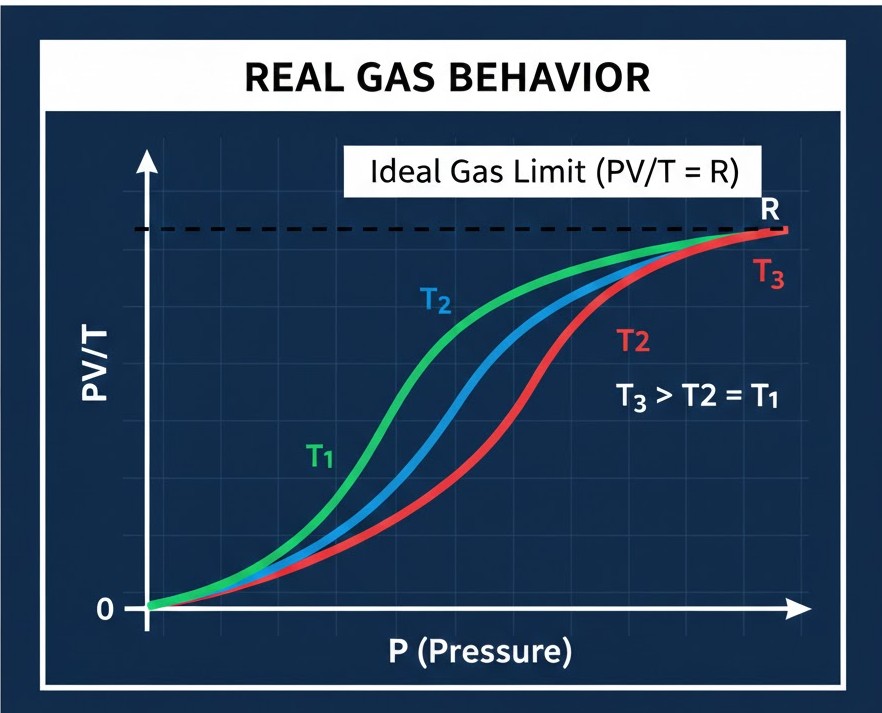
Listen up, junior! Ever wondered why a bicycle tyre feels like it might burst if left out in the scorching May heat? It’s all about the Equation of State! An ideal gas is a theoretical model that satisfies this equation exactly at all pressures and temperatures. Real gases are a bit like us—they only follow the "ideal" rules when the pressure is low and the temperature is high enough.
The most famous version of this "funda" is the Ideal Gas Equation:
where $P$ is pressure, $V$ is volume, and $T$ is the absolute temperature in Kelvin. Here, $\mu$ is the number of moles. If you’re counting individual molecules instead of moles, we use the Boltzmann Constant ($k_B$):
where $N$ is the total number of molecules.
NEET Checkpoint:
Under what conditions does a real gas behave most like an ideal gas?
(a) High $P$, Low $T$
(b) Low $P$, High $T$
(c) High $P$, High $T$
(d) Low $P$, Low $T$
✅ Answer: (b) — At low pressure and high temperature, molecules are far apart and their interactions become negligible.
Don't let the constants confuse you, yaar! The Universal Gas Constant $R$ is $8.314 \text{ J mol}^{-1} \text{ K}^{-1}$. The Boltzmann Constant $k_B$ is much smaller, at $1.38 \times 10^{-23} \text{ J K}^{-1}$. You can also relate pressure directly to mass density ($\rho$) using:
where $M_0$ is the molar mass.
NEET Checkpoint:
What is the relationship between $R$, $k_B$, and Avogadro’s number $N_A$?
(a) R = kᴮ / Nₐ
(b) R = Nₐ / kᴮ
(c) R = Nₐ × kᴮ
(d) R = Nₐ − kᴮ
✅ Answer: (c) $R = N_A k_B$ — It’s just the gas constant per molecule!
NEET Checkpoint:
If you double the absolute temperature of an ideal gas at constant volume, what happens to the pressure?
(a) It becomes half
(b) It remains the same
(c) It doubles
(d) It becomes four times
✅ Answer: (c) It doubles — Since $P \propto T$ for fixed $V$ and $\mu$.
Think of a crowded Mumbai local train. If the coach (volume) is massive and there are only two commuters (low pressure), they can move freely without bumping into each other—that's the "ideal" gas life!
Figure below:
A clear graph showing $PV/T$ on the y-axis and $P$ on the x-axis for a real gas at different temperatures, showing how the curves converge to the horizontal ideal gas limit as pressure approaches zero.
Practice Questions:
1. A cylinder contains $22.4 \text{ L}$ of an ideal gas at $273 \text{ K}$ and $1 \text{ atm}$. How many moles are present?
(a) $1 \text{ mol}$
(b) $2 \text{ mol}$
(c) $0.5 \text{ mol}$
(d) $10 \text{ mol}$
✅ Answer: (a) — One mole of any ideal gas occupies $22.4 \text{ L}$ at STP.
2. If the number density of a gas is $n$, which equation is correct?
(a) $P = k_B nT$
(b) $P = nRT$
(c) $PV = nT$
(d) $P = \mu nT$
✅ Answer: (a) — Since $n = N/V$, the equation $PV = k_B NT$ becomes $P = k_B nT$.
Key Takeaway
Formula Summary
• Ideal Gas Equation: $PV = \mu RT$ or $PV = k_B NT$
• Universal Gas Constant ($R$): $8.314 \text{ J mol}^{-1} \text{ K}^{-1}$
• Boltzmann Constant ($k_B$): $1.38 \times 10^{-23} \text{ J K}^{-1}$
• Pressure & Density: $P = \frac{\rho RT}{M_0}$
5. Behaviour of Real Gases & Gas Laws
Listen up, junior! Real gases are a bit like us—they only act "ideal" when they have plenty of space and things are heating up. In the real world, gases follow the equation $PV = \mu RT$ only as an approximation. A real gas approaches this ideal behaviour specifically at low pressures and high temperatures. Why? Because that’s when molecules are so far apart that their mutual "social distancing" (interactions) becomes negligible.
NEET Checkpoint:
Under which conditions does a real gas act most like an ideal gas?
(a) High $P$, Low $T$
(b) Low $P$, High $T$
(c) High $P$, High $T$
(d) Low $P$, Low $T$
✅ Answer: (b) Low $P$, High $T$ — At low pressure, molecules are far apart, making their interactions tiny, just like the textbook says!
Let’s talk laws. Boyle’s Law tells us that if you keep the temperature constant ($T = \text{fixed}$), then $PV = \text{constant}$. This means pressure is inversely proportional to volume. Think of a cycle pump: when you push the handle down (decreasing volume), the pressure inside shoots up—classic Boyle’s Law! Then we have Charles’ Law, where at fixed pressure ($P = \text{fixed}$), volume is directly proportional to absolute temperature ($V \propto T$).
NEET Checkpoint:
If the absolute temperature of a gas is doubled at constant pressure, what happens to its volume?
(a) It becomes half
(b) It remains the same
(c) It doubles
(d) It becomes four times
✅ Answer: (c) It doubles! — According to Charles' Law ($V \propto T$), they are best friends; where one goes, the other follows.
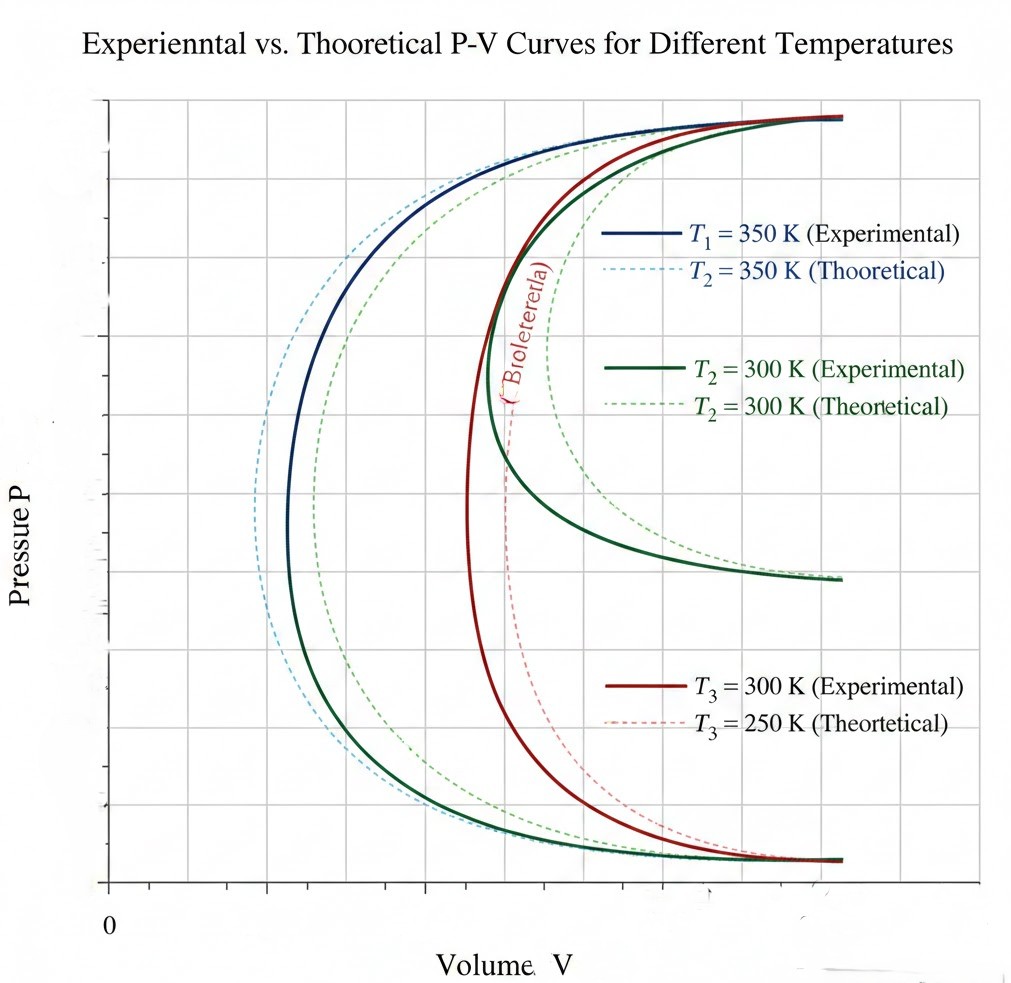
Experimental curves for $P-V$ and $T-V$ show that real gases (like steam or $CO_2$) deviate from these ideal straight lines, especially when the pressure is high.
Figure below:
A clear line graph showing experimental P-V curves (solid lines) compared to theoretical Boyle's law curves (dotted lines), with different curves for different temperatures.
NEET Checkpoint:
What is Dalton’s Law of partial pressures?
(a) The pressure of a gas is inversely proportional to its volume
(b) The total pressure of a gas mixture equals the sum of the partial pressures of individual gases
(c) Equal volumes of gases contain equal numbers of molecules
(d) Gas pressure is proportional to absolute temperature
✅ Answer: (b) The total pressure of a mixture of non-interacting ideal gases is the sum of their partial pressures ($P = P_1 + P_2 + \dots$).
Practice Question:
A gas occupies $V$ at $27^{\circ}C$. If the pressure is held constant, at what temperature will its volume be $2V$?
(a) $54^{\circ}C$
(b) $300 K$
(c) $600 K$
(d) $273 K$
✅ Answer: (c) $600 K$ — Arre, remember to use Kelvin! $T_1 = 27 + 273 = 300 K$. Since $V \propto T$, doubling $V$ means $T_2 = 2 \times 300 = 600 K$.
Key Takeaway
Formula Summary
* Ideal Gas Equation: $PV = \mu RT$
* Boyle’s Law: $PV = \text{constant}$ (at constant $T$)
* Charles’ Law: $\frac{V}{T} = \text{constant}$ (at constant $P$)
* Dalton’s Law: $P_{total} = \sum P_i$
6. Dalton’s Law of Partial Pressures
Imagine you and your buddies are at a pani puri stall. Each one of you is gobbling down puris at your own pace. The total number of puris the vendor serves is just the sum of what each person ate. Dalton’s Law is exactly like that but for gas pressures!
Partial pressure is the pressure a gas would exert if it alone occupied the entire vessel at the same temperature. When you mix non-interacting ideal gases, the total pressure $P$ is simply the sum of these individual partial pressures:
NEET Checkpoint:
Does Dalton’s law apply to reacting gases?
(a) Yes, always
(b) Yes, only at high pressure
(c) No, it applies only to non-reacting gases
(d) Only for ideal gases at low temperature
✅ Answer: (c) No — The sources specify it applies to non-interacting (non-reactive) ideal gases.
Mathematically, for a mixture with $\mu_1, \mu_2, \dots$ moles, the equation of state becomes:
Since $V$ and $T$ are the same for all gases in the container, the pressure $P_1$ of gas 1 is $P_1 = \mu_1 \frac{RT}{V}$.
NEET Checkpoint:
If you double the moles of one gas in a mixture (keeping $V, T$ constant), what happens to its partial pressure?
(a) It becomes half
(b) It remains the same
(c) It doubles
(d) It becomes four times
✅ Answer: (c) It doubles — $P_1$ is directly proportional to the number of moles $\mu_1$.
Take a mixture of neon and oxygen. Since both share the same $V$ and $T$, the ratio of their partial pressures is simply the ratio of their number of moles:
NEET Checkpoint:
In a mixture of $H_2$ and $He$ at $300\ K$, which gas has a higher average kinetic energy per molecule?
(a) H₂
(b) He
(c) Both are equal
(d) Depends on their masses
✅ Answer: (c) Both are equal — Average KE depends only on temperature $T$, not the nature of the gas.
Practice Question:
A vessel has neon and oxygen in a $3:2$ pressure ratio. What is the ratio of their molecules?
(a) $2:3$
(b) $3:2$
(c) $1:1$
(d) $9:4$
✅ Answer: (b) $3:2$ — Since $\frac{P_1}{P_2} = \frac{\mu_1}{\mu_2}$ and $\mu = \frac{N}{N_A}$, the ratio of molecules $N_1/N_2$ is the same as the pressure ratio.
Key Takeaway
Formula Summary
- Total Pressure: $P = P_1 + P_2 + \dots$
- Mole Fraction Relation: $\frac{P_1}{P_2} = \frac{\mu_1}{\mu_2} = \frac{N_1}{N_2}$
- Kinetic Form: $P = (n_1 + n_2 + \dots)k_BT$
7. Assumptions of Kinetic Theory of Gases
Listen up, junior! Before we start calculating the pressure of a gas, we need to understand the "rules of the game." Think of these assumptions as the basic funda that makes the Kinetic Theory of Gases (KTG) work. Don't worry, it's not rocket science—just some clever simplifications to make our lives easier!
First, imagine a massive crowd at a busy pani puri stall—except these "people" (molecules) never stand still! A gas is simply a collection of a large number of molecules in incessant random motion. Because they are usually spaced quite far apart—about $10$ times their own typical size of $2$ $\text{\AA}$—they don't really bother each other. Their intermolecular forces are negligible, except for those brief moments when they actually bump into one another.
NEET Checkpoint:
Are intermolecular forces considered significant between collisions in KTG?
(a) Yes, they dominate the motion
(b) Yes, but only at high temperature
(c) No, they are neglected except during collisions
(d) Only attractive forces are considered
✅ Answer: (c) No — They are assumed to be negligible because molecules are far apart.
Between these "bumping" sessions, molecules are quite disciplined: they move in straight lines according to Newton's first law. And here’s the kicker: every collision is perfectly elastic. This means total kinetic energy and momentum are conserved. No energy is lost as "heat" during the hit; it’s a perfect bounce-back, just like a pro cricketer timing a shot!
NEET Checkpoint:
What is conserved during a molecule-wall collision?
(a) Both Kinetic energy and momentum
(b) Only kinetic energy
(c) Only momentum
(d) Neither kinetic energy nor momentum
✅ Answer: (a) Both momentum and kinetic energy — because the collision is perfectly elastic.
NEET Checkpoint:
What path does a molecule follow between two successive collisions?
(a) Circular path
(b) Straight-line path
(c) Random zig-zag path
(d) Spiral path
✅ Answer: (b) A straight line — Molecules move freely until they experience a force during a collision.
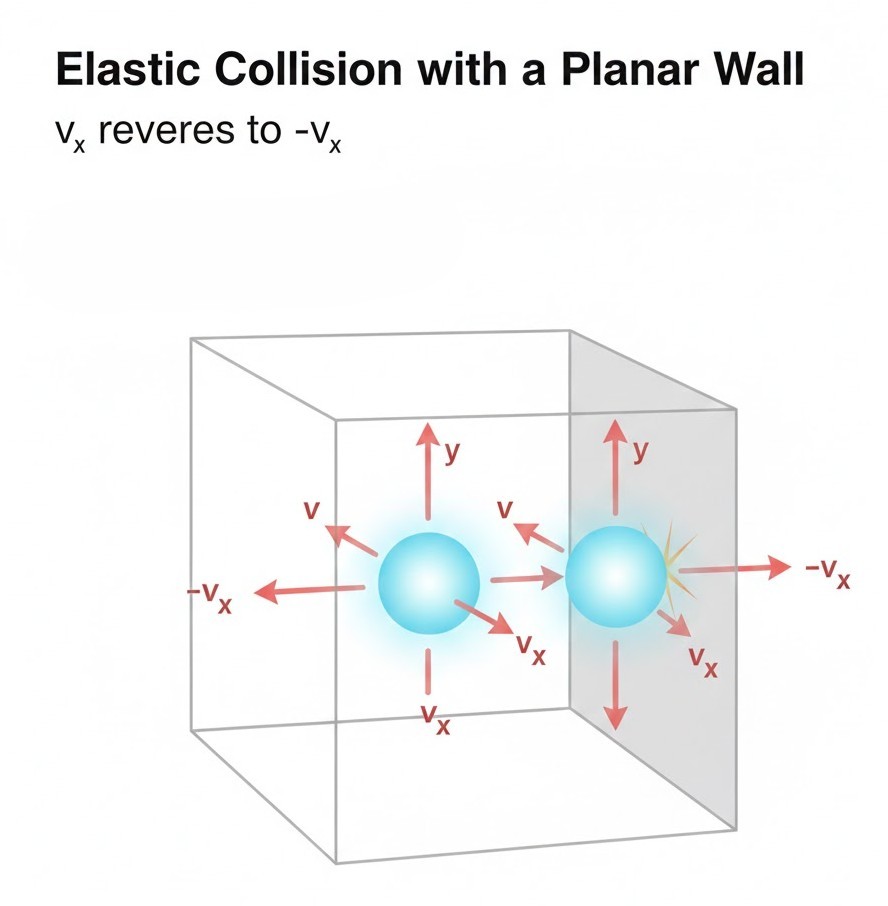
Figure below:
A clear diagram showing a gas molecule in a cubic container hitting a planar wall and rebounding, illustrating an elastic collision with velocity components $v_x$ reversing to $-v_x$.
Practice Question:
According to KTG, the time spent during a molecular collision compared to the time between collisions is:
(a) Equal
(b) Much larger
(c) Negligible
(d) Half
✅ Answer: (c) Negligible — The theory assumes molecules spend almost all their time moving straight and free.
Key Takeaway
- Motion: Large number of molecules in constant, random motion.
- Forces: Intermolecular forces are zero (except during hits).
- Path: Straight-line motion between collisions.
- Collisions: Perfectly elastic (KE and momentum are conserved).
8. The Concept of Pressure
Ever wondered why a balloon stays tight or how a bicycle tyre holds your weight? It’s not magic, yaar—it’s just billions of tiny molecules playing a high-speed game of "hit the wall"!. In Kinetic Theory, pressure arises because gas molecules are in incessant random motion, constantly colliding with the container walls.
NEET Checkpoint:
What type of collisions do molecules undergo with the walls in an ideal gas?
(a) Elastic collisions
(b) Inelastic collisions
(c) Perfectly plastic collisions
(d) Partially elastic collisions
✅ Answer: (a) Elastic collisions — This means total kinetic energy and momentum are conserved.
When a molecule of mass $m$ and velocity $(v_x, v_y, v_z)$ hits a wall parallel to the $yz$-plane, its $x$-component of velocity reverses to $-v_x$. The momentum imparted to the wall per collision is $2mv_x$. Imagine a cricket ball hitting a wall and bouncing back with the same speed; the "push" the wall feels is the momentum transfer.
Now, the Microscopic Formula for pressure is:
Here, $n$ is the number density and $\overline{v^2}$ is the mean square speed. Notice the $\frac{1}{3}$ factor? That’s because pressure is isotropic, meaning there is no preferred direction in a gas at equilibrium; the molecules move equally in $x, y,$ and $z$ directions, so $\overline{v_x^2} = \overline{v_y^2} = \overline{v_z^2} = \frac{1}{3} \overline{v^2}$.
NEET Checkpoint:
Does the pressure of a gas depend on the shape of the container?
(a) Yes, it increases for irregular shapes
(b) No, it depends only on volume, temperature, and number of moles
(c) Yes, it decreases in wider containers
(d) Only at very high pressures
✅ Answer: (b) No — Pressure is a bulk property and is the same everywhere in a gas at equilibrium.
Think of a crowded Mumbai local train. If everyone starts jumping randomly, they’ll push against the doors and walls equally in all directions. That’s isotropy for you!. Don’t stress the derivation, just keep the funda clear: more hits or heavier molecules mean more pressure.
NEET Checkpoint:
If the number density $n$ of a gas is doubled, what happens to the pressure $P$?
(a) It becomes half
(b) It remains the same
(c) It doubles
(d) It becomes four times
✅ Answer: (c) It doubles — Since $P \propto n$, more molecules mean more frequent wall collisions.
Practice Question:
A gas molecule of mass $m$ hits a wall elastically with velocity $v_x$. The momentum change of the molecule is:
(a) $mv_x$
(b) $2mv_x$
(c) $-2mv_x$
(d) zero
✅ Answer: (c) $-2mv_x$ — The initial momentum is $mv_x$ and final is $-mv_x$. So, final minus initial is $-2mv_x$.
Key Takeaway
Pressure Formula:
$$P = \frac{1}{3} n m \overline{v^2}$$
Isotropy: $\overline{v_x^2} = \overline{v_y^2} = \overline{v_z^2}$
Momentum per hit: $2mv_x$
9. Kinetic Interpretation of Temperature
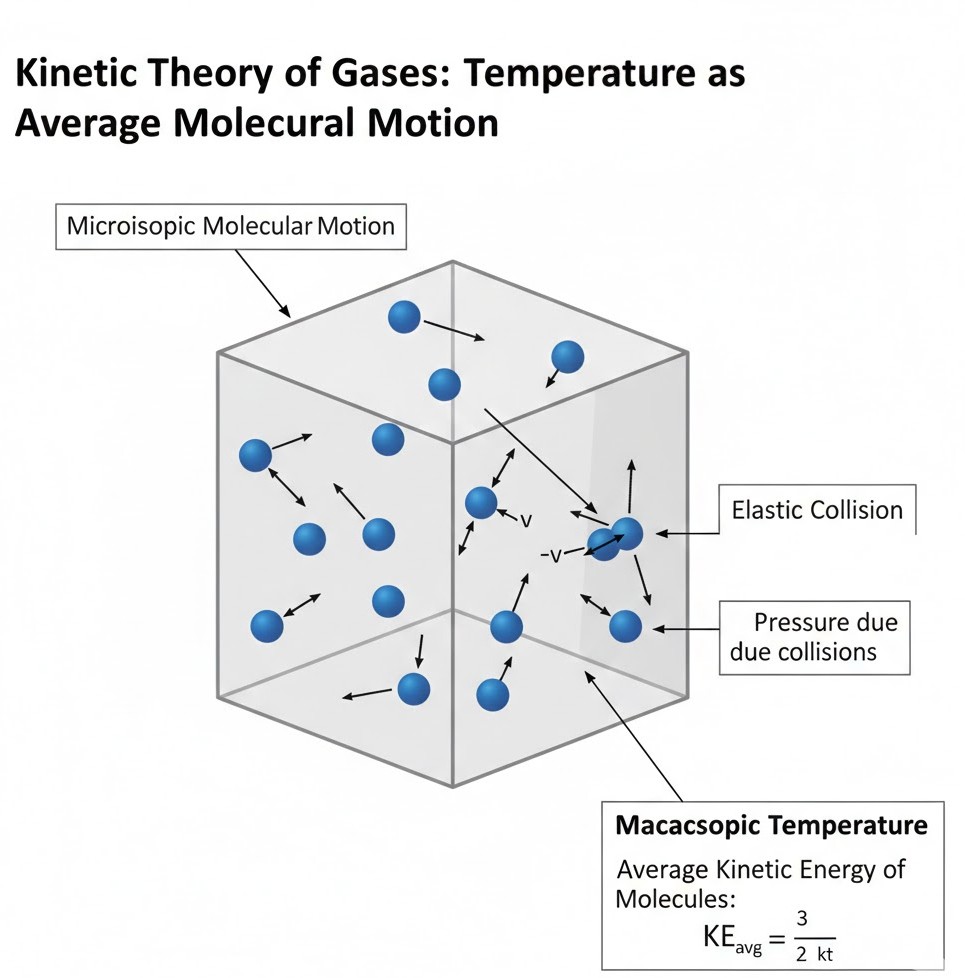
Let’s clear up this funda: Temperature isn't just a reading on a thermometer; it's the macroscopic "avatar" of microscopic chaos!. According to the kinetic theory, the average translational kinetic energy of a molecule is given by the elegant formula:
This means absolute temperature $T$ is a direct measure of the average molecular kinetic energy. Notice this: it doesn't matter if the gas is light Helium or heavy Oxygen; if they are at the same temperature, their molecules have the same average kinetic energy.
NEET Checkpoint:
If the absolute temperature of an ideal gas is doubled, what happens to the average translational kinetic energy of its molecules?
(a) Remains same
(b) Becomes half
(c) Doubles
(d) Quadruples
✅ Answer: (c) Doubles — Since average KE is directly proportional to $T$, they are best friends; where one goes, the other follows!.
The internal energy of an ideal gas is purely kinetic and depends only on temperature, not on pressure or volume. The Boltzmann constant $k_B$ acts as the fundamental "bridge" or shagun that connects the macroscopic world (what we can measure, like $T$) to the microscopic world (the energy of a single molecule).
Relatable Indian Example:
1. Imagine a Mumbai local platform during rush hour. When the "urgency" (temperature) goes up, everyone (the molecules) starts sprinting faster to catch the train. The "temperature" of the station is basically a measure of how fast everyone is zig-zagging!.
2. Think of a Pani Puri stall. If the teekha (heat/energy) is too high, you’ll see customers jumping around—that’s exactly how molecules behave when $T$ rises!.
NEET Checkpoint:
At the same temperature, which molecule has higher average kinetic energy: $H_2$ or $O_2$?
(a) H₂
(b) O₂
(c) Both have the same average kinetic energy
(d) Depends on their masses
✅ Answer: (c) Both have the same average KE! Remember, average KE depends only on $T$, not the mass of the molecule. Don't let the examiner trick you, yaar!.
NEET Checkpoint:
Internal energy of an ideal gas is a function of:
(a) $V$ only
(b) $P$ only
(c) $T$ only
(d) $P$ and $V$
✅ Answer: (c) $T$ only — For an ideal gas, $U$ is purely kinetic and temperature is the boss.
Figure below:
A clear diagram of a cubical container showing several small spherical molecules with velocity vectors of different lengths, highlighting one molecule hitting a wall and rebounding to illustrate the microscopic motion that defines macroscopic temperature.
Practice Questions:
1. The root mean square (rms) speed of gas molecules at temperature $T$ is $v$. If the temperature is increased to $4T$, the new rms speed will be:
(a) $2v$
(b) $4v$
(c) $v/2$
(d) $16v$
✅ Answer: (a) $2v$. Since $v_{rms} = \sqrt{\frac{3k_B T}{m}}$, if $T$ becomes $4$ times, the speed increases by $\sqrt{4} = 2$.
2. A flask contains Argon and Chlorine at the same temperature. The ratio of the average kinetic energy per molecule of Argon to that of Chlorine is:
(a) $1:1$
(b) $39.9:70.9$
(c) $\sqrt{39.9}:\sqrt{70.9}$
(d) $70.9:39.9$
✅ Answer: (a) $1:1$. Arre, we just discussed this! Average KE per molecule is $(3/2)k_B T$ for any ideal gas at the same $T$.
Key Takeaway
Formula Summary
- Average KE per molecule: $E/N = \frac{3}{2}k_B T$.
- Internal Energy of $N$ molecules: $E = \frac{3}{2}k_B NT$.
- Micro-Macro Link: $k_B = 1.38 \times 10^{-23} J K^{-1}$.
10. RMS Speed of Gas Molecules
Hey junior! Ever wondered how fast those invisible gas molecules are actually zooming around you? Spoiler alert: they’re moving at "bullet train" speeds! Let’s clear up this RMS speed funda once and for all.
The Core Concept
From our kinetic theory derivation, we know the average translational kinetic energy of a molecule is proportional to the absolute temperature $T$. Specifically:
The Root Mean Square (RMS) speed, denoted as $v_{rms}$, is simply the square root of the mean of the squared speeds $(\overline{v^2})$. By rearranging the energy formula, we get the main "hero" formula for your exams:
NEET Checkpoint:
Does $v_{rms}$ depend on the pressure of an ideal gas if the temperature is kept constant?
(a) Yes, it increases with pressure
(b) Yes, it decreases with pressure
(c) No, it depends only on temperature and molecular mass
(d) Only at very high pressures
✅ Answer: (c) No! — The formula shows $v_{rms}$ only depends on the absolute temperature $T$ and the mass of the molecule $m$.
Why "Lighter is Faster"
Notice that $v_{rms}$ is inversely proportional to the square root of the mass ($1/\sqrt{m}$). At the same temperature, lighter molecules have greater RMS speeds than heavier ones.
Relatable Example: Imagine a crowded pani puri stall. A small kid (light molecule) can weave through the crowd much faster than a heavy uncle carrying three bags of groceries (heavy molecule), even if they both have the same "hunger energy" (temperature)!
Speed Comparison & A Crucial Distinction
Did you know? For Nitrogen at $300$ K, $v_{rms}$ is about $516$ $m/s$. This is of the order of the speed of sound in air.
Also, don't get confused, yaar: $\overline{v^2}$ (the average of squares) is not necessarily equal to $(\overline{v})^2$ (the square of the average). In physics, the order of operations matters!
NEET Checkpoint:
If the absolute temperature of a gas is quadrupled, what happens to the $v_{rms}$?
(a) It becomes half
(b) It remains the same
(c) It doubles
(d) It becomes four times
✅ Answer: (c) It doubles — Since $v_{rms} \propto \sqrt{T}$, $\sqrt{4} = 2$. Don't let the square root trick you!
NEET Checkpoint:
Between Oxygen ($O_2$) and Hydrogen ($H_2$) at $27^\circ C$, which has the higher $v_{rms}$?
(a) O₂
(b) H₂
(c) Both have the same v_rms
(d) Depends on pressure
✅ Answer: (b) $H_2$ — Because it is lighter, and lighter molecules are the real sprinters!
Practice Question:
The ratio of $v_{rms}$ of Argon (atomic mass $\approx 40$ u) to Helium (atomic mass $\approx 4$ u) at the same temperature is:
(a) $1:10$
(b) $1:\sqrt{10}$
(c) $10:1$
(d) $\sqrt{10}:1$
✅ Answer: (b) $1:\sqrt{10}$ — Since $v_{rms} \propto 1/\sqrt{m}$, the ratio is $\sqrt{4/40} = 1/\sqrt{10}$.
Key Takeaway
Formula Summary
- RMS Speed Formula: $v_{rms} = \sqrt{\frac{3k_B T}{m}}$
- Dependence: $v_{rms} \propto \sqrt{T}$ and $v_{rms} \propto \frac{1}{\sqrt{m}}$
- Fact: $v_{rms}$ is of the same order as the speed of sound.
11. Work Done on Compressing a Gas
Arre, have you ever wondered why a bicycle pump gets warm after some heavy-duty pumping? It’s not just your muscles working hard, yaar—it’s the gas molecules getting a serious boost! Let’s clear up this kinetic funda.
Think of a gas molecule as a cricket ball and the piston as a massive bat. If you hold the bat firmly and a ball hits it, the ball rebounds with the same speed. But what if you swing the bat towards the ball? Boom! The ball flies back much faster.
In a cylinder, when you compress a gas, the piston (our "bat") moves towards the molecules. If a molecule with speed $u$ hits a piston moving at speed $V$, it rebounds with a speed of $2V + u$. This increase in speed means the molecule's kinetic energy shoots up. Since we know temperature is just the average kinetic energy of molecules ($\frac{1}{2} m \overline{v^2} = \frac{3}{2} k_B T$), the gas temperature rises during compression.
Conversely, if the gas expands, the molecules hit a receding piston. It’s like trying to hit a ball while the bat is moving away—the ball loses energy and slows down, causing the gas to cool.
NEET Checkpoint:
During gas compression, why does the temperature increase?
(a) Gas loses kinetic energy
(b) Work is done on the gas, increasing kinetic energy of molecules
(c) Gas molecules slow down
(d) Pressure decreases
✅ Answer: (b) Because molecules gain kinetic energy from the moving piston — just like a ball gaining speed from a swinging bat!
NEET Checkpoint:
What is the correspondence for a gas molecule in the kinetic explanation?
(a) A liquid droplet
(b) A tiny spring
(c) A ball
(d) A wave
✅ Answer: (c) It is treated like a ball — specifically, an elastic ball hitting a massive object.
NEET Checkpoint:
If a piston moves away from the gas, what happens to the molecules?
(a) They gain energy and the gas heats up
(b) They lose energy and the gas cools down
(c) Their speed remains constant
(d) They stop moving
✅ Answer: (b) They lose energy and the gas cools down — expansion is a "chilling" process!
Relatable Example: The Kohli Cover Drive
Imagine Virat Kohli stepping out to meet a ball. Because his bat is moving towards the ball, the rebound speed is massive! If the ball represents a gas molecule, this "meeting the ball" is exactly like compression, leading to high energy (and high temperature).
Practice Question:
A gas is compressed by a piston moving at speed $V$. A molecule hits it with speed $u$. The rebound speed is:
(a) $u$
(b) $u + V$
(c) $2V + u$
(d) $V - u$
✅ Answer: (c) $2V + u$. As the sources explain, the relative speed increases because the bat (piston) is moving towards the ball (molecule).
Key Takeaway: Compression vs. Expansion
- Compression: Piston moves IN $\rightarrow$ Molecules gain energy $\rightarrow$ $T$ increases.
- Expansion: Piston moves OUT $\rightarrow$ Molecules lose energy $\rightarrow$ $T$ decreases.
12. Degrees of Freedom
Hey junior! Let’s clear the funda of Degrees of Freedom ($f$). It is simply the number of independent coordinates required to specify the location and orientation of a molecule. Imagine a fly buzzing around your tuition class; it needs three coordinates ($x, y, z$) to tell you exactly where it is—that’s 3 translational degrees of freedom.
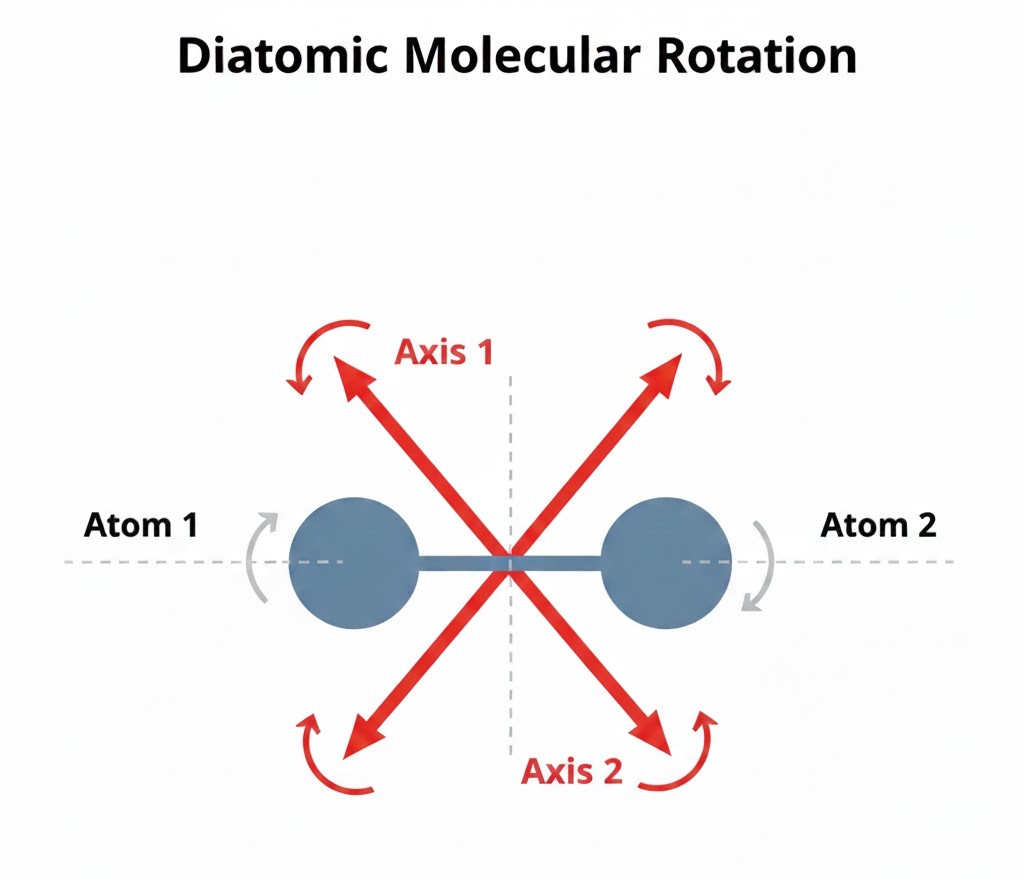
Monatomic gases, like the chill atoms of Argon, only have these 3 translational modes. But diatomic gases like $O_{2}$ are like a jodi of cricketers running between wickets while spinning their bats; they have 3 translational modes plus 2 rotational modes about axes perpendicular to the line joining them, making a total of 5. Don't stress, yaar—at moderate temperatures, we treat them as "rigid rotators".
NEET Checkpoint:
How many degrees of freedom does a Neon atom have?
(a) 1
(b) 2
(c) 3
(d) 6
✅ Answer: (c) 3 — Neon is monatomic, so it only has translational motion in space.
At very high temperatures, molecules start vibrating like a phone on silent mode! Each vibrational mode is a "double bonus" because it contributes two squared terms—kinetic and potential energy—so it counts as 2 degrees of freedom.
Figure below:
A clear diagram showing a diatomic molecule with two independent axes of rotation perpendicular to the interatomic axis.
NEET Checkpoint:
Why does a vibrational mode count as 2 degrees of freedom?
(a) Because it involves both translation and rotation
(b) Because it involves both kinetic and potential energy
(c) Because it occurs in two directions
(d) Because it counts double for polyatomic molecules
✅ Answer: (b) Because it includes both kinetic and potential energy modes.
NEET Checkpoint:
Total degrees of freedom for a rigid diatomic molecule?
(a) 3
(b) 5
(c) 6
(d) 7
✅ Answer: (b) 5 — It has 3 translational and 2 rotational degrees.
Practice Question:
For a non-rigid diatomic gas with one vibrational mode, the total degrees of freedom ($f$) is:
(a) 3
(b) 5
(c) 6
(d) 7
✅ Answer: (d) 7 — Calculation: $3$ (trans) + $2$ (rot) + $2$ (vib) $= 7$. Remember, vibration always counts for two!
Key Takeaway
Formula Summary
- Monatomic Gas: $f = 3$
- Diatomic (Rigid): $f = 5$
- Diatomic (with Vibration): $f = 7$
- Average Energy per Molecule: $\frac{f}{2} k_{B} T$
13. Law of Equipartition of Energy
Listen up, junior! Ever wondered how a gas molecule decides which "pocket" to put its energy into? According to the Law of Equipartition of Energy, it’s all about fair play. In thermal equilibrium at absolute temperature $T$, the total energy is distributed equally among all possible energy modes.
Think of it like a group of friends sharing a plate of samosas at a local stall. If everyone is equally hungry, they each get an equal share. In our physics world, each "degree of freedom" (or energy mode) is like a friend who gets exactly $\frac{1}{2} k_B T$ of energy.
NEET Checkpoint:
What is the average energy associated with each degree of freedom for a gas at temperature $T$?
(a) $k_B T$
(b) $\frac{1}{2} k_B T$
(c) $\frac{3}{2} k_B T$
(d) $2 k_B T$
✅ Answer: (b) $\frac{1}{2} k_B T$ — Straight from the rulebook, yaar! Each mode gets exactly half of $k_B T$.
Here is the breakdown of the "energy accounts":
* Translational & Rotational Modes: Each of these contributes exactly one "squared term" to the energy expression (like $\frac{1}{2} mv_x^2$ or $\frac{1}{2} I \omega^2$), so they each get $\frac{1}{2} k_B T$.
* Vibrational Modes: These are the "VIP" modes. A single vibrational frequency includes both kinetic and potential energy terms. Because it has two squared terms, it grabs $2 \times \frac{1}{2} k_B T = k_B T$.
NEET Checkpoint:
A vibrational mode contributes how much energy to the molecule?
(a) $\frac{1}{2} k_B T$
(b) $k_B T$
(c) $\frac{3}{2} k_B T$
(d) Zero
✅ Answer: (b) $k_B T$ — Remember, vibration is a "double-decker" mode with both KE and PE.
Imagine a cricketer playing a shot. His movement across the crease is translational, his bat's swing is rotational, and if his muscles are shivering in the winter chill, that's vibrational! Each movement has its own energy "cost."
NEET Checkpoint:
Does the law of equipartition apply if the system is not in thermal equilibrium?
(a) Yes, always
(b) No, it requires thermal equilibrium
(c) Only at very high temperatures
(d) Only for monatomic gases
✅ Answer: (b) No — The sources specify this principle holds only for a system in thermal equilibrium.
Practice Questions:
1. For a rigid diatomic molecule (no vibration), what is the total average energy per molecule?
(a) $\frac{3}{2} k_B T$
(b) $\frac{5}{2} k_B T$
(c) $3 k_B T$
(d) $\frac{7}{2} k_B T$
✅ Answer: (b) A rigid diatomic molecule has 3 translational and 2 rotational degrees of freedom ($3+2=5$). Total energy = $5 \times \frac{1}{2} k_B T = \frac{5}{2} k_B T$.
2. If a gas molecule has $f$ vibrational modes in addition to 3 translational and 3 rotational modes, what is its internal energy per mole?**
(a) $(3+f) RT$
(b) $(6+f) RT$
(c) $(\frac{3}{2} + f) RT$
(d) $(3 + \frac{f}{2}) RT$
✅ Answer: (b) Total energy $U = (\frac{3}{2} k_B T + \frac{3}{2} k_B T + f k_B T) N_A$, which simplifies to $(3+f) RT$.
Key Takeaway: Formula Summary
- Energy per Degree of Freedom: $E_{avg} = \frac{1}{2} k_B T$
- Translational/Rotational Contribution: $\frac{1}{2} k_B T$ per mode
- Vibrational Contribution: $k_B T$ per frequency (contains 2 modes)
- Internal Energy ($U$) for 1 mole: $U = \frac{f}{2} RT$ (where $f$ is total degrees of freedom, counting vibrational as 2)
14. Specific Heat Capacities of Gases & Solids
Hey junior! Ready to crack the code on how substances "soak up" heat? It all depends on how many ways their molecules can dance—or what we call degrees of freedom. Let's clear up this funda once and for all!
Monatomic Gases: Imagine a single Argon atom. It’s like a lonely cricketer running between wickets—it only has 3 translational degrees of freedom. Its total internal energy is $U = \frac{3}{2}RT$.
* Molar Specific Heats: $C_v = \frac{3}{2}R$ and $C_p = \frac{5}{2}R$.
* The Ratio ($\gamma$): $\gamma = \frac{C_p}{C_v} = \frac{5}{3} \approx 1.67$.
NEET Checkpoint:
What is the value of $C_p - C_v$ for any ideal gas?
(a) R
(b) 2R
(c) 0
(d) Depends on the gas
✅ Answer: (a) $R$ — This is Mayer’s formula, and it stays true whether the gas is monatomic or a complex mess!
Diatomic Gases (Rigid): Now, think of an $O_2$ molecule as a rigid dumbbell. It can run (3 ways) and spin (2 ways), giving it 5 degrees of freedom.
* Molar Specific Heats: $U = \frac{5}{2}RT$, so $C_v = \frac{5}{2}R$ and $C_p = \frac{7}{2}R$.
* The Ratio ($\gamma$): $\gamma = \frac{7}{5} = 1.40$.
NEET Checkpoint:
If a diatomic molecule has a vibrational mode, what is its $C_v$?
(a) (5/2) R
(b) 3 R
(c) (7/2) R
(d) 4 R
✅ Answer: (c) $\frac{7}{2}R$ — Vibration adds two "squared terms" (kinetic and potential), adding $R$ to the $C_v$.
Specific Heat of Solids: In a solid, atoms are like fans in a packed stadium—they can’t move around, but they vibrate like crazy in 3D. Each atom has 3 vibrational modes, and since each mode counts for two degrees of freedom (kinetic + potential), the energy is $3k_B T$ per atom. For a mole, $U = 3RT$.
* Predicted Specific Heat: $C = \frac{\Delta U}{\Delta T} = 3R$.
Relatable Example: Think of a Pani Puri stall. The vendor (monatomic) just moves his hands. But a couple (diatomic) moves their hands to eat and rotates to talk to each other! More motion means they need more "energy" (heat) to raise their "excitement" (temperature).
NEET Checkpoint:
Why is $C$ for carbon (diamond) much lower than $3R$ at room temperature?
(a) Diamond has low density
(b) Only a few vibrational modes are excited at room temperature
(c) Carbon atoms are heavy
(d) Diamond is a poor conductor of heat
✅ Answer: (b) It's an exception! While most solids follow the $3R$ rule, carbon doesn't fit the classical prediction at ordinary temperatures.
Practice Questions:
1. A gas has a ratio of specific heats $\gamma = 1.33$. This gas is likely:
(a) Monatomic
(b) Rigid Diatomic
(c) Polyatomic
(d) A Solid
✅ Answer: (c) Polyatomic — Table 12.1 shows triatomic/polyatomic gases have $\gamma \approx 1.33$.
2. The molar specific heat of a solid at constant pressure is approximately:
(a) $R$
(b) $3R$
(c) $\frac{3}{2}R$
(d) $5R$
✅ Answer: (b) $3R$ — For solids, the volume change is negligible, so $C \approx C_v = 3R$.
Key Takeaway
Formula Summary
* Mayer’s Formula: $C_p - C_v = R$
* Monatomic: $C_v = \frac{3}{2}R, \gamma = 1.67$
* Rigid Diatomic: $C_v = \frac{5}{2}R, \gamma = 1.40$
* Solids: $C = 3R$
15. Mean Free Path
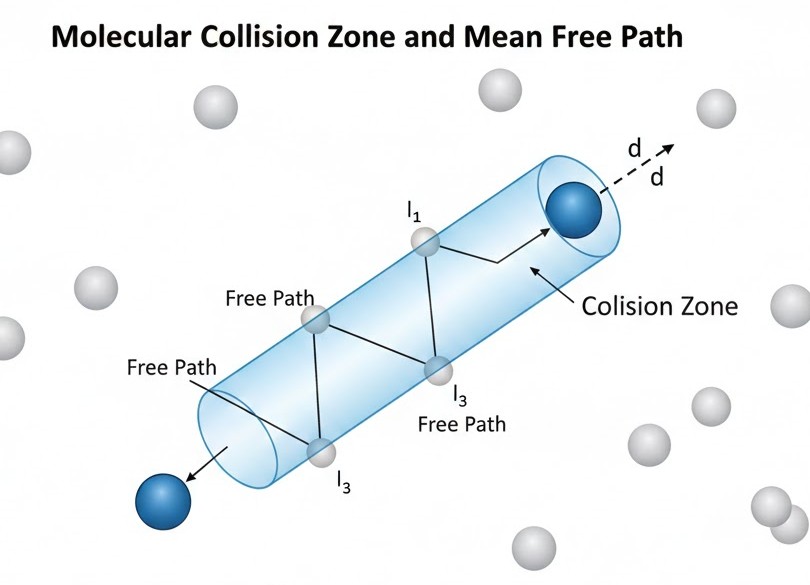
Ever wondered why the mouth-watering smell of biryani takes a few minutes to reach your room, even though gas molecules move as fast as a jet plane?. It's because the poor molecules are in a constant state of "bumper cars"! They can't move in a straight line for long before hitting a neighbor. The average distance a molecule travels between two successive collisions is called the Mean Free Path, denoted by $l$.
NEET Checkpoint:
What is the average distance between two successive collisions called?
(a) Displacement
(b) Mean Free Path
(c) Collision Diameter
(d) Free length
✅ Answer: (b) Mean Free Path — This is the standard definition from the kinetic theory.
Here is the "funda": in a busy Indian bazaar, the distance you can walk before bumping into someone depends on how crowded it is ($n$) and how wide your shopping bags are ($d$). Similarly, the formula for mean free path is:
Where:
- $n$ is the number density (molecules per unit volume).
- $d$ is the diameter of the molecule.
Notice the trick here: $l$ is inversely proportional to both $n$ and the square of $d$. If you increase the crowd or the size of the molecules, the "free path" shrinks faster than your pocket money before an exam! For air molecules at STP, $l$ is about $2.9 \times 10^{-7} \text{ m}$, which is roughly 1500 times their diameter.
NEET Checkpoint:
If the number density of a gas is doubled, the mean free path becomes?
(a) Double
(b) Half
(c) Four times
(d) Unchanged
✅ Answer: (b) Half — Since $l \propto 1/n$, doubling the crowd halves the distance you can travel freely.
Figure below:
A clear diagram showing a single molecule moving in a zigzag path through a field of other molecules, with a highlighted cylindrical volume of radius $d$ being swept out to illustrate the collision zone.
NEET Checkpoint:
How does the mean free path $l$ depend on the molecular diameter $d$?
(a) $l \propto d$
(b) $l \propto 1/d$
(c) $l \propto 1/d^2$
(d) $l \propto d^2$
✅ Answer: (c) $l \propto 1/d^2$ — Don't forget the square, yaari! The collision cross-section depends on the area, which involves $d^2$.
Practice Question:
In a highly evacuated tube, the number density $n$ is very small. What happens to the mean free path?
(a) It becomes very small.
(b) It can become as large as the length of the tube.
(c) It remains $1500d$.
(d) It becomes zero.
✅ Answer: (b) — With fewer molecules to hit, the mean free path grows significantly.
Key Takeaway
Formula Summary
- Mean Free Path ($l$):$$l = \frac{1}{\sqrt{2} n \pi d^2}$$.
- Dependence: $l \propto \frac{1}{n}$ and $l \propto \frac{1}{d^2}$.
- Key Logic: Explains why diffusion is slow despite high molecular speeds.