
1: Introduction to Kinematics and Rectilinear Motion
Motion! Everything is moving in this universe, yaar. Seriously, even when you're chilling and reading this, air is moving into your lungs, and blood is flowing through your body. Even the Earth is revolving around the Sun, and the Sun itself is zooming through the Milky Way!
The Kinematics Funda
So, what exactly is motion? Simply put, Motion is defined as the change in the position of an object with time. To describe this change accurately, we use a branch of Physics called Kinematics. Here’s the asli trick: Kinematics is the study of how to describe motion (using concepts like velocity and acceleration) without diving into the causes of motion.
Kinematics forms the foundation, and in this section, we are focusing specifically on motion along a straight line, which is called rectilinear motion.
Point Object Approximation: For NEET questions, you often need to treat large objects as point objects. This approximation is totally valid when the size of the object is much smaller than the distance it moves. Imagine a train travelling from Delhi to Bengaluru—we treat the whole train as a single point because the journey distance is huge compared to the train's length.
NEET Checkpoint:
Which scenario is unsuitable for approximating the object as a point mass?
(a) A bullet traveling 500 m.
(b) A car traveling 20 km.
(c) A spinning cricket ball turning sharply on impact.
(d) The Earth revolving around the Sun.
✅ Answer: (c) A spinning cricket ball turning sharply on impact — When the size and rotation of the object significantly affect the analysis (like a ball turning on hitting the ground), it cannot be simply treated as a point object.
Real Talk and Calculations
We need a reference frame to define position. For straight-line motion, we typically pick an origin, where position to the right is positive and to the left is negative.
NEET Checkpoint:
Kinematics describes motion using velocity and acceleration. What does it intentionally ignore?
(a) Time
(b) Position
(c) The cause (force) of motion
(d) The path length.
✅ Answer: (c) The cause (force) of motion — Kinematics describes how an object moves, not why (the forces).
Imagine your friend is riding a scooter on a straight highway. When analyzing their movement, we are tracking their change in position $x$ over time $t$. We are dealing only with a set of coordinates, perhaps just $x$ and $t$.
NEET Checkpoint:
If an object's size is $1~m$ and it moves $1000~km$, can it be considered a point object?
(a) Yes
(b) No
(c) Only if the motion is uniform.
✅ Answer: (a) Yes — The approximation is valid when the object's size is much smaller than the distance it moves.
Practice Question:
In the study of motion, if we define the change in position of a car as $\Delta x$, and the time taken as $\Delta t$, the field of study that focuses on analyzing the relationship between $\Delta x$ and $\Delta t$ without considering the engine's force is:
(a) Dynamics
(b) Statics
(c) Kinematics
(d) Quantum Physics
✅ Answer: (c) Kinematics — Kinematics studies the description of motion, like the change in position or velocity, without investigating the forces causing the motion.
Key Takeaway:
Kinematics sets the stage for everything else! Remember that motion is just position changing over time, and we simplify things by treating objects as point objects when their size is negligible compared to the distance covered. Now that we have the basic setup, let’s get into the specifics: measuring how fast that change happens using velocity!
2: Instantaneous Velocity and Speed: The Need for Speed (At an Instant)
Average Velocity ($\overline{v}$) is cool, but let's be honest—it doesn't tell you how fast you were going when you spotted that pani puri stall at t=5 seconds. That’s where the real hero, instantaneous velocity ($v$), steps in!
Instantaneous velocity, or simply the velocity $v$ at a specific instant $t$, is defined by taking the average velocity and shrinking the time interval ($\Delta t$) until it becomes infinitesimally small. It’s physics flexing its calculus muscles!
Mathematically, we write this limit as:
And that means $v$ is nothing but the differential coefficient of position ($x$) with respect to time ($t$):
This is the fundamental funda—it gives you the rate of change of position with respect to time at that exact moment.
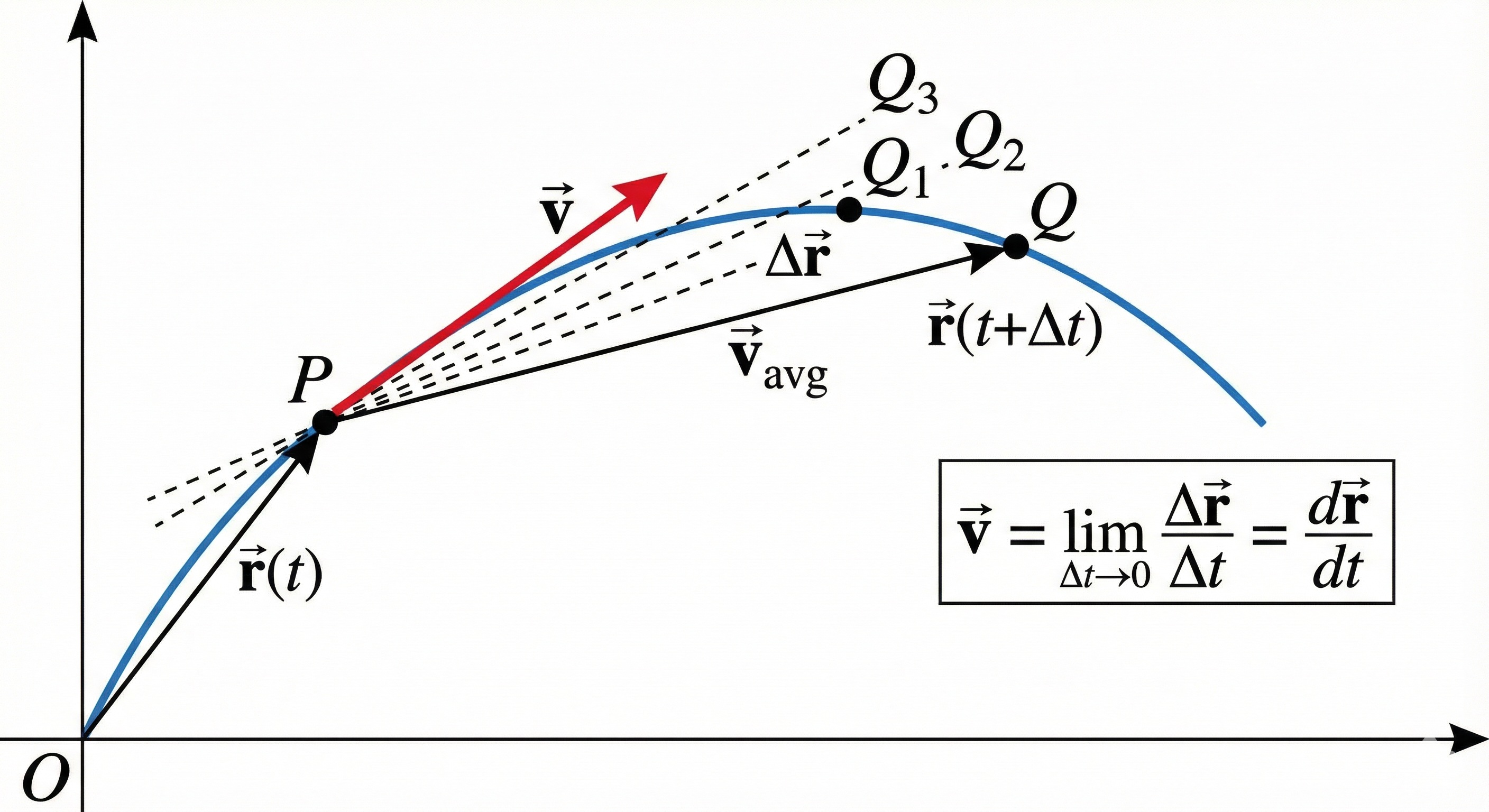
Notice this: Graphically, if you have a position-time ($x-t$) curve, the instantaneous velocity at any point $P$ is simply the slope of the tangent drawn to the curve at $P$. Imagine your scooter’s position changing over time; the tangent tells you your speed at that split second!
Figure below:
A clear diagram showing a curved position-time graph where a secant line becomes a tangent line at point P as the time interval approaches zero, illustrating that the slope of the tangent is the instantaneous velocity.
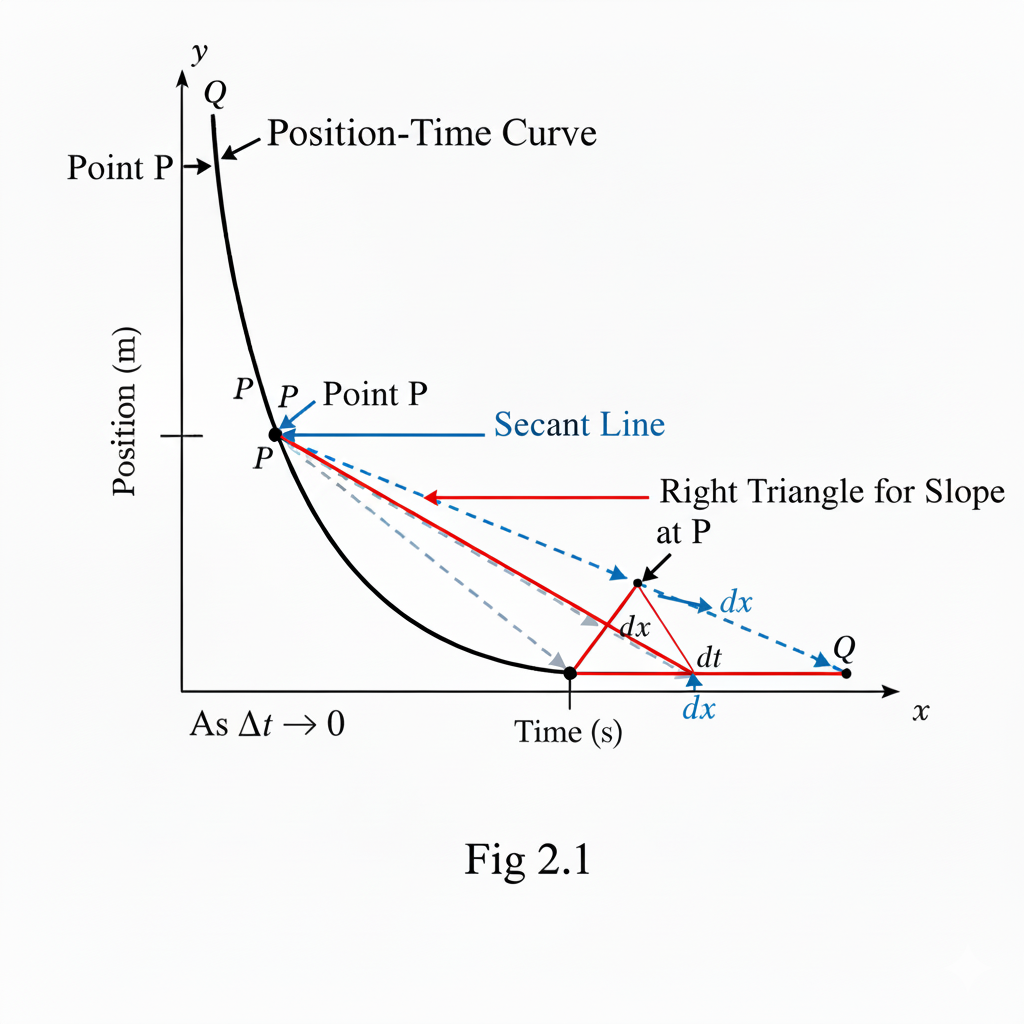
Instantaneous speed (or just speed) is defined purely as the magnitude of the instantaneous velocity. Since velocity is already calculated for an infinitesimally small time interval, instantaneous speed is always equal to the magnitude of instantaneous velocity, $v$. So, if the velocity of your cricket ball is $+24.0$ m $s^{-1}$ or $-24.0$ m $s^{-1}$, the instantaneous speed is just $24.0$ m $s^{-1}$. Don't stress, this part is simpler than it looks!
NEET Checkpoint:
Instantaneous velocity is obtained by finding the limit of the average velocity as:
(a) $\Delta x \rightarrow 0$
(b) $\Delta t \rightarrow 0$
(c) $\Delta x / \Delta t \rightarrow 0$
(d) $\Delta x \rightarrow \infty$
✅ Answer: (b) $\Delta t \rightarrow 0$ — It's defined as the time interval becoming infinitesimally small.
NEET Checkpoint:
Graphically, instantaneous velocity on a position-time graph is represented by the:
(a) Area under the curve
(b) Slope of the tangent
(c) Slope of the secant
(d) Intercept
✅ Answer: (b) Slope of the tangent — Remember, the derivative $\frac{dx}{dt}$ is the slope of the tangent line.
NEET Checkpoint:
Instantaneous speed is:
(a) Always greater than instantaneous velocity.
(b) Always equal to the magnitude of instantaneous velocity.
(c) Equal to the average velocity.
(d) Always greater than instantaneous velocity magnitude.
✅ Answer: (b) Always equal to the magnitude of instantaneous velocity — This equality holds true only at an instant, unlike the average values.
Practice Question:
If the position of a car is given by $x=a+bt^{2}$, where $a=8.5$ m and $b=2.5$ m $s^{-2}$, what is the instantaneous velocity at $t=2.0$ s?
(a) $5.0$ m $s^{-1}$
(b) $10.0$ m $s^{-1}$
(c) $15.0$ m $s^{-1}$
(d) $20.0$ m $s^{-1}$
✅ Answer: (b) $10.0$ m $s^{-1}$ — The velocity $v=\frac{dx}{dt}$ is $\frac{d}{dt}(a+bt^{2})=2bt$. Plugging in $t=2.0$ s and $b=2.5$ m $s^{-2}$, we get $v=2(2.5)(2.0)=10.0$ m $s^{-1}$.
Now that you know how to calculate velocity at a specific moment, let’s see what happens when that velocity itself starts changing!
Key Takeaway:
Formula Summary
| Quantity | Definition (Limit) | Calculus Form | Magnitude Relation |
|---|---|---|---|
| Instantaneous Velocity ($v$) | $v=lim_{\Delta t\rightarrow0}\frac{\Delta x}{\Delta t}$ | $v=\frac{dx}{d~t}$ | Sign indicates direction. |
3: Average Velocity, Average Speed, and Uniform Motion
Hey future NEET doctors! Let's clear up a super crucial funda: the difference between average velocity and average speed. Don't stress, this concept is easier than scoring a free six in cricket!
First up, Average Velocity ($\overline{v}$). This vector quantity is formally defined as the ratio of the displacement ($\Delta x$ or $\Delta r$) to the corresponding time interval ($\Delta t$). It tells you the net change in position over time. Mathematically, for a given time interval, it is expressed as:
or, in vector form for motion in a plane or space:
Now, for Average Speed. Average speed is defined as the total path length covered by a particle divided by the time interval. Remember this key distinction: the average speed of an object is always greater than or equal to the magnitude of the average velocity over a given time interval. This is because the path length is either greater than or equal to the magnitude of the displacement. Equality only holds true if the path length is exactly equal to the magnitude of the displacement, which happens when the object does not change its direction during the course of motion.
NEET Checkpoint:
If a scooter travels along a curved road, which quantity is likely larger?
(a) Displacement
(b) Magnitude of Average Velocity
(c) Average Speed
✅ Answer: (c) Average Speed — Since the path is curved, the total path length is greater than the magnitude of displacement, making the average speed greater than the magnitude of average velocity.
Next, let's look at motion types. In Uniform Motion, the velocity is constant. In this ideal scenario, the velocity is the same as the average velocity at all instants. Notice this trick: when velocity is constant (uniform motion), the acceleration is zero.
If the velocity changes during the course of motion, either in magnitude or direction or both, then the object is in Non-Uniform Motion. This change in velocity leads to acceleration.
Imagine a local auto-rickshaw driver who takes you from the tuition centre to your home $5$ km away, but he takes a circuitous route of $7$ km. If the trip takes $15$ minutes ($0.25$ h): His average speed is $\frac{7 \text{ km}}{0.25 \text{ h}} = 28 \text{ km/h}$, but the magnitude of his average velocity (based on $5$ km displacement) is only $20 \text{ km/h}$. See, average speed is greater!
NEET Checkpoint:
For an object moving in uniform rectilinear motion, how does the velocity at $t=2~\text{s}$ compare to the average velocity over $t=0$ to $t=5~\text{s}$?
(a) Instantaneous velocity is zero.
(b) They are equal.
(c) Average velocity is greater.
✅ Answer: (b) They are equal — For uniform motion, velocity is constant and equals the average velocity at all instants.
NEET Checkpoint:
What condition must change for an object's motion to be classified as non-uniform?
(a) Position
(b) Time
(c) Velocity
(d) Path Length
✅ Answer: (c) Velocity — Non-uniform motion occurs when the velocity of an object changes during its course of motion.
Practice Question:
A runner completes a full lap on a $400~\text{m}$ track in $50~\text{s}$. What is the magnitude of the average velocity in $\text{m}~\text{s}^{-1}$?
(a) $8.0~\text{m}~\text{s}^{-1}$
(b) $0~\text{m}~\text{s}^{-1}$
(c) $4.0~\text{m}~\text{s}^{-1}$
(d) $400~\text{m}~\text{s}^{-1}$
✅ Answer: (b) $0~\text{m}~\text{s}^{-1}$ — Completing a full lap means the final position is the same as the initial position, resulting in zero displacement ($\Delta x = 0$) and thus zero average velocity ($\overline{v}$).
Key Takeaway:
Average velocity, defined as $\frac{\Delta x}{\Delta t}$, depends on displacement, while average speed depends on total path length. Always remember: Average Speed $\ge |$Average Velocity.
Uniform motion means constant velocity and zero acceleration. Now that you've mastered the averages, let's see how these relate to the rate of change in motion itself, which is acceleration!
4: Acceleration: Average and Instantaneous
Hey, future doctor! Now that we’ve sorted out velocity, it’s time to tackle its big brother: acceleration. Don't stress, yaar, this concept is essentially just asking: How fast is your velocity changing? Acceleration is formally defined as the rate of change of velocity with time. Galileo figured this funda out, concluding that the rate of change of velocity with time is constant for objects in free fall.
Average Acceleration ($\overline{a}$)
If you measure the velocity at two points, say $v_{1}$ at time $t_{1}$ and $v_{2}$ at time $t_{2}$, the average change is super simple! Average acceleration ($\overline{a}$) is defined as the change of velocity ($\Delta v$) divided by the time interval ($\Delta t$).
This $\overline{a}$ tells you the average change per unit time. The SI unit for acceleration is $m~s^{-2}$. Imagine you are on your scooter—if you went from $10~m/s$ to $20~m/s$ in $5$ s, that's your average acceleration.
NEET Checkpoint:
If an object is moving with constant acceleration, the average acceleration over any time interval is:
(a) Equal to zero
(b) Equal to the instantaneous acceleration
(c) Always positive
✅ Answer: (b) Equal to the instantaneous acceleration — If acceleration is constant, $\overline{a}$ must be equal to the constant value of acceleration, $a$.
Instantaneous Acceleration ($a$)
But what about the acceleration exactly when you twist the throttle harder? That’s where instantaneous acceleration ($a$) comes in. It’s defined by taking the limit of the average acceleration as the time interval $\Delta t$ becomes infinitesimally small (tends to zero).
Notice this: This definition tells us that instantaneous acceleration is the slope of the tangent to the velocity-time ($v-t$) curve at that specific instant.
The Funda of Changing Velocity
Remember that velocity is a vector quantity, meaning it has both magnitude (speed) and direction. Therefore, acceleration, which is the rate of change of velocity, may result from three factors:
1. A change in speed (magnitude). (Like flooring the pedal on a straight road.)
2. A change in direction. (Like a car taking a sharp turn, even if the speed is constant—that’s acceleration!)
3. A change in both speed and direction.
NEET Checkpoint:
A particle moving in a circle at a constant speed:
(a) Has zero acceleration
(b) Has an acceleration changing in direction
(c) Has zero velocity
✅ Answer: (b) Has an acceleration changing in direction — Since the direction of velocity continuously changes in circular motion, the object undergoes acceleration, even if the speed is uniform.
And here's a crucial checkpoint, junior: the acceleration can be non-zero even if the velocity is zero momentarily. Think of a cricket ball thrown vertically upwards—at the very top point, the velocity is zero, but the acceleration due to gravity (g) is still acting downwards!
NEET Checkpoint:
If a particle has zero velocity at a given instant, it must have zero acceleration at that instant.
(a) True
(b) False
✅ Answer: (b)False — A particle thrown up has zero velocity at its highest point, but its acceleration continues to be $g$ (non-zero).
Practice Question:
The position of a particle moving along the x-axis is given by $x = a + bt^2$ where $b = 2.5~m~s^{-2}$. What is the instantaneous acceleration of the particle?
(a) $5.0~m~s^{-2}$
(b) $2.5~m~s^{-2}$
(c) $0~m~s^{-2}$
(d) $1.5~m~s^{-2}$
✅ Answer: (a) $5.0~m~s^{-2}$ — The velocity is $v = \frac{dx}{dt} = 2bt$. The acceleration is $a = \frac{dv}{dt} = 2b$. Substituting $b = 2.5~m~s^{-2}$, we get $a = 2(2.5) = 5.0~m~s^{-2}$.
Key Takeaway:
Acceleration is the rate of change of velocity. You can accelerate by changing your speed OR by changing your direction (or both!).
5: Graphical Analysis of 1D Motion (x-t, v-t, a-t)
Welcome back, future doctor! Today, we're unlocking the secret language of motion graphs—the $x-t$, $v-t$, and $a-t$ curves. Mastering these graphs is a huge funda for NEET, so pay close attention, yaar! They let us figure out velocity, acceleration, and displacement just by looking at slopes and areas.
The Slope Story: From Velocity to Acceleration
Remember how the instantaneous velocity is the slope of the tangent to the position-time ($x-t$) graph? We apply the same logic to acceleration! The instantaneous acceleration ($a$) is simply the slope of the tangent to the velocity-time ($v-t$) curve at that specific instant. Mathematically, that's defined as:
If the $v-t$ graph is a straight line, the slope (and thus acceleration) is constant. If the $v-t$ curve bends, the slope changes, meaning the acceleration is non-uniform. Notice this: acceleration's SI unit, $m~s^{-2}$, comes directly from taking the derivative of velocity ($m/s$) with respect to time ($s$).
NEET Checkpoint:
If a particle's $v-t$ graph is horizontal, what is its acceleration?
(a) Positive
(b) Negative
(c) Zero
(d) Increasing
✅ Answer: (c) Zero — A horizontal line has a slope of zero, and the slope of the $v-t$ graph gives acceleration!
Uniform Acceleration Graphs: Straight Lines and Parabolas
When motion has uniform acceleration (constant $a$), the graphs have clear shapes that are vital for quick analysis.
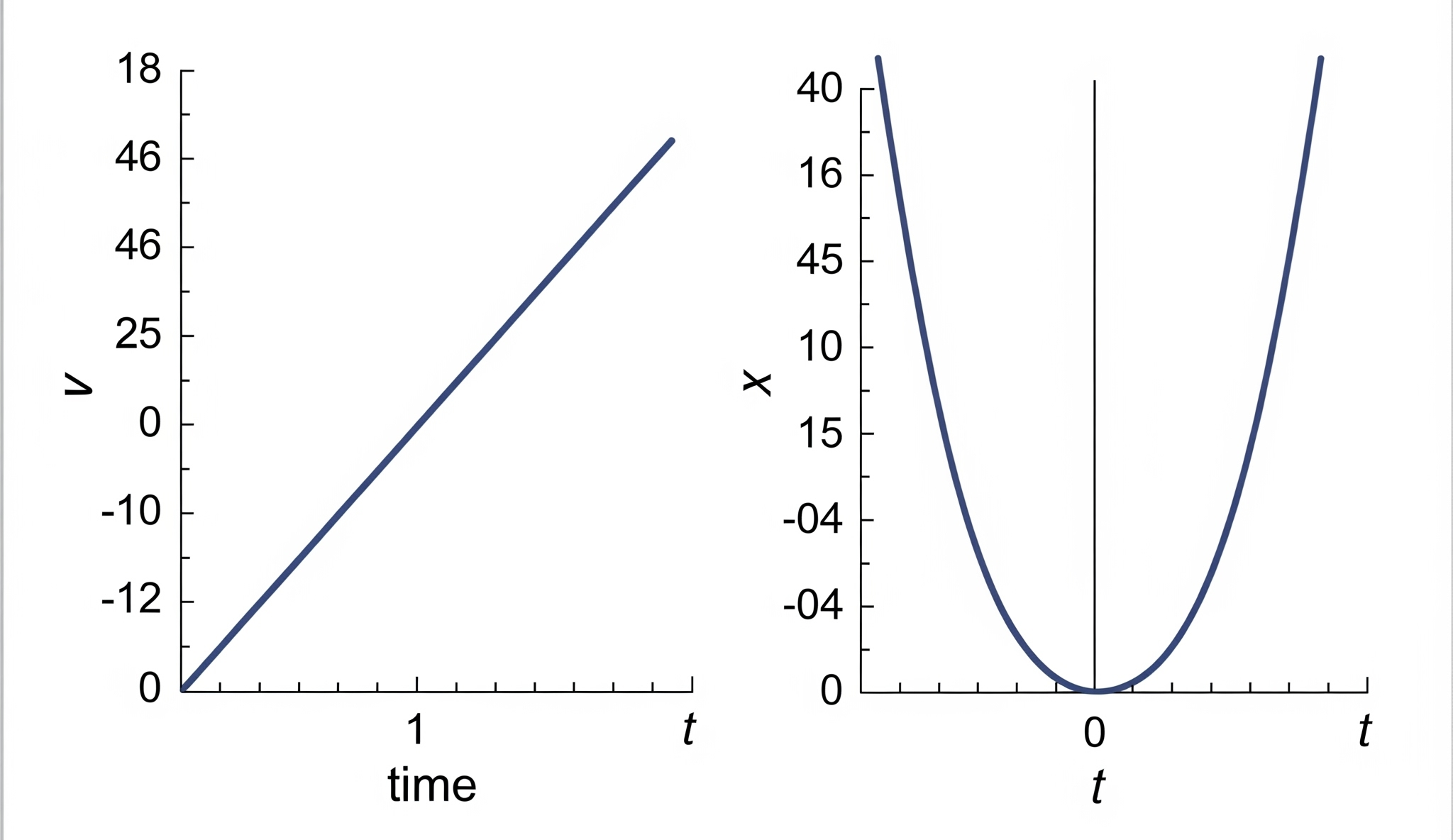
For uniform acceleration, the velocity-time ($v-t$) graph is a straight line inclined to the time axis. This makes sense, right? Constant acceleration means a constant slope on the $v-t$ graph!
However, the position-time ($x-t$) graph for uniform acceleration is a parabola. Think of a cricket ball hit straight up: its $x-t$ graph curves downward (like a negative acceleration parabola). Don't mix this up!
Figure below:
A clear diagram showing the $v-t$ graph for uniform acceleration (a straight line inclined to the time axis, similar to Fig 2.5) and the corresponding $x-t$ graph.
Area: The Displacement Decoder
Here's the cool part: the area under the curve holds the key to displacement. The area under the velocity-time curve between any two times ($t_{1}$ and $t_{2}$) is equal to the displacement ($\Delta x$) of the object during that time interval. This works even if the acceleration isn't uniform, but it’s easiest to calculate when acceleration is constant (since the area becomes a simple trapezium or a combination of a triangle and a rectangle).
Relatable Example: A pani puri vendor on his scooter increases his velocity uniformly from $5~m/s$ to $15~m/s$ in $4~s$. The area under this trapezoidal $v-t$ graph gives you the total displacement—how far he travelled to set up his stall!
NEET Checkpoint:
The position-time graph for free fall (uniform negative acceleration) is shaped like a:
(a) Horizontal line
(b) Straight line inclined to time axis
(c) Parabola
(d) Hyperbola
✅ Answer: (c) Parabola — For any motion with uniform acceleration, the $x-t$ graph is a parabola.
Practice Questions:
- In a $v-t$ graph, the area bounded by the curve, the time axis, and two ordinates represents the:
(a) Average velocity
(b) Acceleration
(c) Displacement
(d) Instantaneous speed
✅ Answer: (c) Displacement — The area under the velocity-time curve always gives the displacement.
2. If the slope of the tangent to the $x-t$ graph at $t=5~s$ is $10~m/s$, what physical quantity does this represent?
(a) Average acceleration
(b) Instantaneous acceleration
(c) Average speed
(d) Instantaneous velocity
✅ Answer: (d) Instantaneous velocity — The slope of the tangent to the $x-t$ graph gives the instantaneous velocity.
Key Takeaway:
For graphical analysis, remember the mantra: Slope of $x-t$ is $v$, Slope of $v-t$ is $a$, and Area under $v-t$ is displacement. Now that you've got the graphical funda, let's connect these graphs directly to the kinematic equations!
6.Kinematic Equations: The Funda for Uniform Acceleration
Future doctors! Ready to master the three essential equations that rule rectilinear motion with constant acceleration? Don't stress, yaar—these equations are your best friends for solving almost any problem involving constant acceleration, whether it's a car braking or a ball falling.
When an object moves along a straight line with uniform (constant) acceleration $a$, and we assume its initial position $x_0 = 0$ at time $t=0$, the five key quantities (initial velocity $v_0$, final velocity $v$, acceleration $a$, time $t$, and displacement $x$) are connected by the following "Three Musketeers" of Kinematics:
Calculus: The Proving Ground
Ever wondered where these formulas come from? We use the power of calculus to derive these relations, showing that they are fundamentally linked to the definitions of velocity and acceleration.
-
Velocity-Time Relation: Since acceleration is defined as the rate of change of velocity, $a = \frac{dv}{dt}$. Assuming $a$ is constant, integrating this from time $0$ to $t$ gives us the first equation (linking $v$ and $t$):
$$\int_{v_{0}}^{v} dv = \int_{0}^{t} a dt \implies v - v_{0} = at$$ -
Position-Time Relation: Velocity is the rate of change of position, $v = \frac{dx}{dt}$. Substituting the first equation into this and integrating gives us the position relation (linking $x$, $t$, and $v_0$):
$$\int_{x_{0}}^{x} dx = \int_{0}^{t} (v_{0} + at) dt \implies x - x_{0} = v_{0}t + \frac{1}{2}at^{2}$$ -
Velocity-Displacement Relation: We can also write acceleration as $a = v \frac{dv}{dx}$. Integrating this (from $x_0$ to $x$ and $v_0$ to $v$) directly yields the third equation (linking $v$ and $x$):
$$\int_{v_{0}}^{v} v dv = \int_{x_{0}}^{x} a dx \implies \frac{v^{2}-v_{0}^{2}}{2} = a(x - x_{0})$$
NEET Checkpoint:
If an object is moving with constant acceleration, what does the slope of the velocity-time ($v-t$) graph represent?
(a) Displacement
(b) Instantaneous velocity
(c) Constant acceleration
(d) Average speed
✅ Answer: (c) Constant acceleration — For uniform acceleration, the $v-t$ graph is a straight line, and its slope is the acceleration $a$, which is constant.
The General Case (When Origin Shifts)
In many problems, the particle doesn't start at the origin ($x=0$). When the initial position coordinate at $t=0$ is non-zero, say $x_0$, we simply replace the displacement $x$ in the equations with the change in position, $(x - x_0)$.
The general kinematic equations become:
Notice this: The second and third relations derived using calculus naturally lead to these general forms, as the limits of integration for position were $x_0$ to $x$.
NEET Checkpoint:
A particle starts at $x_0 = 5$ m with $v_0 = 0$ and constant acceleration $a$. After $t$ seconds, its position is given by which equation?
(a) $x = 5 + \frac{1}{2}at^2$
(b) $x = \frac{1}{2}at^2$
(c) $v^2 = 2a(x-5)$
✅ Answer: (a) $x = 5 + \frac{1}{2}at^2$ — We must use the general form $x = x_0 + v_0 t + \frac{1}{2} a t^2$.
Relatable Example: Imagine you are riding your scooter from home (position $x_0 = 100$ m away from the tuition centre, which is the origin) with an initial velocity $v_0$ and you accelerate constantly ($a$) to reach the main road (position $x$). You’ll use these general equations, $x = x_{0} + v_{0}t + \frac{1}{2}at^{2}$, because your starting position $x_0$ was definitely not zero! Arre, physics is everywhere, even in traffic!
NEET Checkpoint:
The kinematic equations are valid only if:
(a) Velocity is constant
(b) Position is zero at $t=0$
(c) Acceleration is constant
(d) Time is positive
✅ Answer: (c) Acceleration is constant — These equations are specifically called Kinematic equations for uniformly accelerated motion.
Practice Question:
A car moving along a straight highway with a speed of $126$ km $h^{-1}$ is brought to a stop within a distance of $200$ m. What is the uniform retardation ($-a$) of the car?
(a) $3.06$ m $s^{-2}$
(b) $2.76$ m $s^{-2}$
(c) $1.57$ m $s^{-2}$
(d) $5.51$ m $s^{-2}$
Hint: Convert speed to $m~s^{-1}$
first and use the third kinematic equation.
✅ Answer: (a) $3.06$ m $s^{-2}$ —
First, $v_0 = 126$ km $h^{-1} = 126 \times \frac{5}{18} = 35$ m $s^{-1}$. Final velocity $v=0$. Displacement $x = 200$ m.
Using $v^{2}=v_{0}^{2}+2ax$:
$0 = (35)^2 + 2a(200)$
$0 = 1225 + 400a$
$a = -1225/400 = -3.0625$ m $s^{-2}$. Retardation is $3.06$ m $s^{-2}$.
Key Takeaway:
Formula Summary
Remember these basic forms (assuming $x_{0}=0$):
| Equation | Relates |
|---|---|
|
$$v = v_{0} + at$$
|
$\mathbf{v}$, $\mathbf{v_{0}}$, $\mathbf{a}$, $\mathbf{t}$ |
|
$$x = v_{0}t + \frac{1}{2}at^{2}$$
|
$\mathbf{x}$, $\mathbf{v_{0}}$, $\mathbf{a}$, $\mathbf{t}$ |
|
$$v^{2} = v_{0}^{2} + 2ax$$
|
$\mathbf{v}$, $\mathbf{v_{0}}$, $\mathbf{a}$, $\mathbf{x}$ |
7.Free Fall: Mastering Motion Under Gravity
Free fall might sound scary, but it’s the simplest case of motion with constant acceleration. When we say free fall, we mean the motion of an object solely under the influence of gravity, completely neglecting air resistance.
Here’s the funda: Since the acceleration due to gravity, magnitude $g$, is constant (typically $9.8 \ m \ s^{-2}$ for heights small compared to Earth’s radius), free fall is a prime example of motion with uniform acceleration. If you choose the vertically upward direction as positive, the acceleration due to gravity is always downward, meaning $a = -g = -9.8 \ m \ s^{-2}$. This sign convention is your secret weapon for NEET problems!
Key Trick for Complex Kinematics:
Solving problems where a ball is thrown upwards from a height (like Example 2.3) requires strict adherence to algebraic signs. Imagine you are standing on a $25 \ m$ high balcony and throw a cricket ball straight up with initial velocity $v_{0} = +20 \ m \ s^{-1}$. If the ground is $y=0$ and upward is positive, you must use $a = -10 \ m \ s^{-2}$ (if approximating $g$). When the ball finally hits the ground, its final position $y$ is $0$, and its initial position $y_{0}$ is $25 \ m$. Substituting these values with the proper signs into the equation of motion,
simplifies the whole journey, letting you calculate the total time instantly without splitting the path.
NEET Checkpoint:
A stone is thrown upward. At its highest point, its velocity is zero. Is its acceleration also zero?
(a) Yes
(b) No
(c) Depends on mass
✅ Answer: (b) No — Arre! Velocity is momentarily zero, but the acceleration is still $a = -g$ (or $a = -9.8 \ m \ s^{-2}$), pulling it down.
Galileo's Law of Odd Numbers: The Proof!
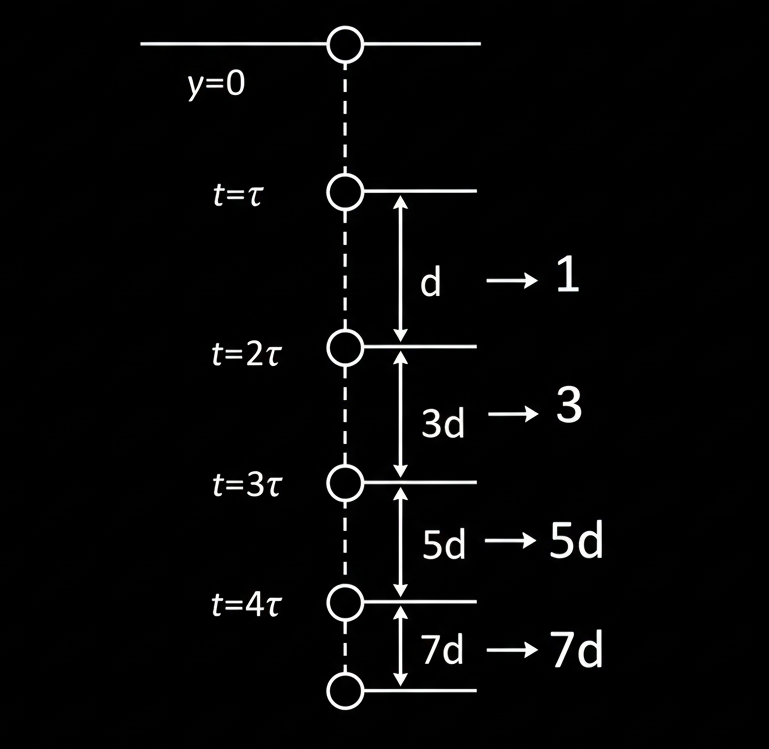
Galileo Galilei (1564-1642) established a cool pattern for bodies falling from rest. His law states that the distances traversed during equal intervals of time stand to one another in the ratio of the odd numbers beginning with unity: $1:3:5:7...$.
Let the object start from rest ($v_{0}=0$) at $t=0$. The position $y$ after time $t$ is given by $y = -\frac{1}{2}gt^{2}$.
Let's take equal time intervals, $\tau$. If we define $y_{0} = (-\frac{1}{2})g\tau^{2}$ (the distance covered in the first interval):
| Time ($t$) | Total Position (in terms of $y_{0}$) | Distance Traversed in Successive Intervals | Ratio |
|---|---|---|---|
| $0$ | $0$ | - | - |
| $\tau$ | $y_{0}$ | $y_{0}$ | $1$ |
| $2\tau$ | $4y_{0}$ | $4y_{0} - y_{0} = 3y_{0}$ | $3$ |
| $3\tau$ | $9y_{0}$ | $9y_{0} - 4y_{0} = 5y_{0}$ | $5$ |
Notice this! The distance covered in successive time intervals follows the simple ratio $1:3:5:7...$, thus proving Galileo's law. This is the classic funda behind free fall!
Figure below:
A diagram showing an object falling from rest (y=0) marked at equal time intervals $\tau, 2\tau, 3\tau$ and illustrating the successive distances traveled in the ratio 1:3:5.
NEET Checkpoint:
A body falls from rest. The ratio of the distance it covers in the 2nd second to the distance covered in the 4th second is:
(a) 3:7
(b) 1:4
(c) 1:16
✅ Answer: (a) 3:7 — The successive distance ratios are $1:3:5:7...$. The distance in the 2nd interval is proportional to 3, and in the 4th interval, it's proportional to 7.
Practice Questions:
- A stone is dropped from a cliff ($490 \ m$ high, $g=9.8 \ m \ s^{-2}$). Assuming it falls from rest, what is the time taken for it to hit the ground?
(a) $5 \ s$
(b) $10 \ s$
(c) $20 \ s$
(d) $49 \ s$
✅ Answer: (b) $10 \ s$ — Using $y = -\frac{1}{2} g t^{2}$ (where $y=-490 \ m$ and $g=9.8 \ m \ s^{-2}$), we get $490 = 4.9 t^{2}$, so $t^{2} = 100$, and $t = 10 \ s$.2.
2. A cricket ball is thrown vertically upward with initial velocity $v_{0}$. The equation used to find its maximum height $h_{m}$ is $v^{2}=v_{0}^{2}+2a(y-y_{0})$. Which set of signs is correct for this case (assuming upward positive)?
(a) $v_{0} (+)$, $v (+)$, $a (+)$
(b) $v_{0} (+)$, $v (0)$, $a (-)$
(c) $v_{0} (-)$, $v (0)$, $a (+)$
(d) $v_{0} (+)$, $v (-)$, $a (-)$
✅ Answer: (b) $v_{0} (+)$, $v (0)$, $a (-)$ — Initial velocity $v_0$ is upward (+), final velocity $v$ at max height is $0$, and acceleration $a$ (gravity) is always downward (-).
Key Takeaway:
For any motion under free fall, the acceleration is constant, $a = -g$ (when upward is positive). Remember that the distances covered in successive equal time intervals follow Galileo's Law of Odd Numbers ($1:3:5:7...$). Now that you've got this, wait till you see how these kinematic equations connect with Projectile Motion!
8: Application: Stopping Distance and Reaction Time
Stopping distance ($d_s$) is defined as the distance a vehicle travels after the brakes are applied until it finally comes to a stop. This distance is absolutely crucial for road safety, influencing things like setting speed limits in school zones.
The stopping distance, $d_s$, depends mainly on the vehicle's initial velocity ($v_0$) and the vehicle's braking capacity, or deceleration ($-a$). We can calculate this using the kinematic equation: $v^{2} = v_{o}^{2} + 2ax$. Since the final velocity ($v$) when the vehicle stops is zero, and we replace the displacement ($x$) with $d_s$, we get:
(Remember, $a$ here is the effective acceleration, which is negative for braking, hence the negative sign disappears in the derivation below.)
Solving for $d_s$, we find:
Notice this: The stopping distance ($d_s$) is proportional to the square of the initial velocity ($v_0$). This means if you double the initial velocity ($v_0$), the stopping distance quadruples (increases by a factor of 4), assuming the deceleration ($a$) remains the same. This is why speeding is so dangerous!
NEET Checkpoint:
If a car's speed is halved, how does its theoretical stopping distance change (assuming constant deceleration)?
(a) Halved
(b) Quartered
(c) Doubled
(d) Quadrupled
✅ Answer: (b) Quartered — Since $d_s \propto v_0^2$, $(v_0/2)^2 = v_0^2/4$. Funda clear!
Imagine you are driving your scooter at $20~km/h$ and it takes $5~m$ to stop. If you suddenly decide to zoom at $40~km/h$, it will take $20~m$ to stop! That’s four times the distance—crazy, right?
Reaction Time ($t_r$)
But wait, stopping distance isn't the whole story. Before the brakes even engage, there's a delay called reaction time ($t_r$). Reaction time is the time a person takes to observe, think, and act (like slamming the brakes). This critical time depends on the complexity of the situation and the individual.
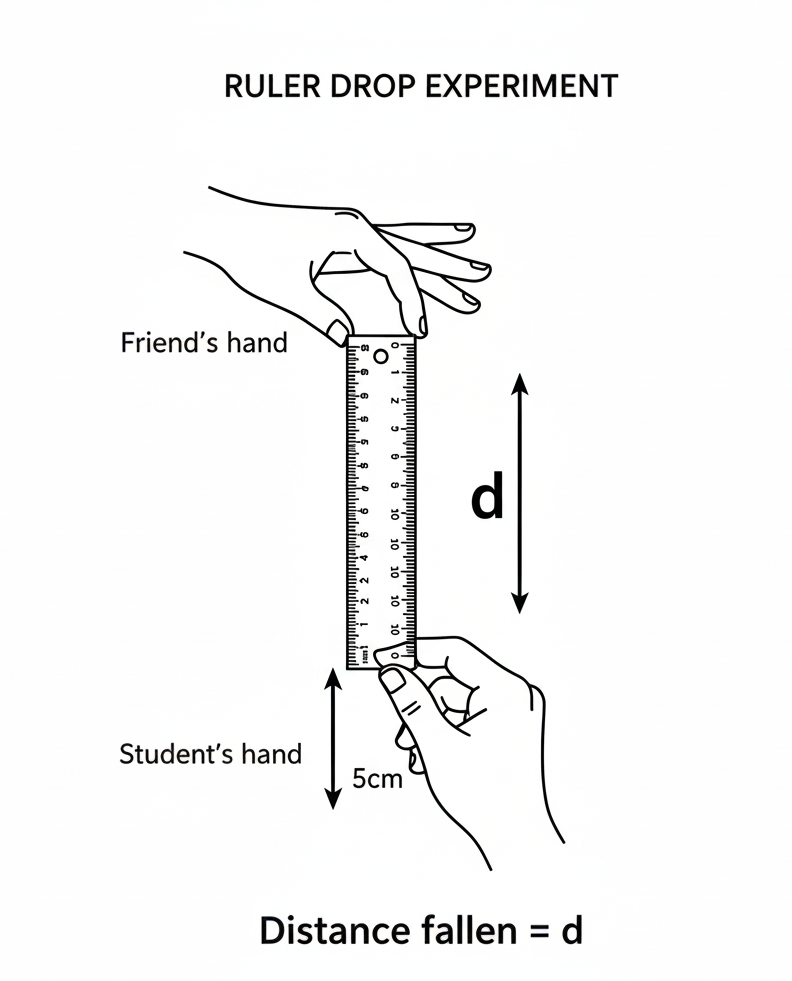
We can estimate $t_r$ using a simple free-fall experiment with a ruler. If a ruler is dropped and travels a distance $d$ before being caught, the ruler falls under free fall with initial velocity $v_0=0$ and acceleration $a=-g$.
The distance $d$ travelled is related to the reaction time ($t_r$) by:
(Note: $g$ is the magnitude of acceleration due to gravity, $9.8~m~s^{-2}$).
Solving for $t_r$, we get the calculation for reaction time:
For instance, if you catch the ruler after it drops $21.0~cm$ ($0.21~m$), your reaction time is approximately $0.2~s$, which is super fast.
Figure below:
A clear diagram showing two hands: a friend's hand dropping a ruler vertically and a student's hand with thumb and forefinger catching the ruler after it has fallen a distance 'd'. Label 'd' clearly.
NEET Checkpoint:
What factors influence a person's reaction time?
(a) Vehicle speed and mass
(b) Complexity of the situation and the individual
(c) Deceleration magnitude
(d) Road friction
✅ Answer: (b) Complexity of the situation and the individual — These are the human factors mentioned in the source for reaction time.
NEET Checkpoint:
A vehicle moving at an initial velocity $v_0$ requires a stopping distance $d_s$. If the deceleration is uniform, what initial velocity is required to increase the stopping distance to $9d_s$?
(a) $3v_0$
(b) $9v_0$
(c) $v_0/3$
(d) $2v_0$
✅ Answer: (a) $3v_0$ — Since $d_s \propto v_0^2$, to get $9d_s$, the velocity must be $\sqrt{9}v_0 = 3v_0$.
Practice Question:
In the ruler drop experiment to measure reaction time, if the ruler drops $d$, the relationship between reaction time $t_r$ and distance is $t_{r}=\sqrt{2d/g}$. This formula holds because:
(a) The ruler has a large mass
(b) The acceleration $a$ is equal to $g$
(c) Air resistance is neglected
(d) The initial velocity is zero
✅ Answer: (d) The initial velocity is zero — The object is dropped from rest ($v_0=0$) under free fall, which simplifies the equation of motion.
Key Takeaway:
Formula Summary
| Concept | Definition | Formula | Key Proportionality |
|---|---|---|---|
| Stopping Distance ($d_s$) | Distance covered after braking until stopping. |
$$d_{s}=\frac{-v_{0}^{2}}{2a}$$
|
$$d_s \propto v_0^2$$
|
| Reaction Time ($t_r$) | Time elapsed between observing and acting. |
$$t_{r}=\sqrt{\frac{2d}{g}}$$
|
$t_r$ is determined by distance fallen, $d$. |
9: Scalars and Vectors: Definitions and Representation
Hey future doctors! Before diving deep into $2D$ motion, we must sort out the crucial vocabulary: who is a Scalar, and who is a Vector? This difference is fundamental, so pay close attention, yaar.
What’s the Farak (Difference)?
Scalar Quantities: These are the simple ones; they are defined entirely by their magnitude only. They are specified completely by a single number along with the proper unit. The key thing to remember is that scalars combine according to the rules of ordinary algebra (addition, subtraction, multiplication, and division, just like simple numbers). Examples of these simple quantities include mass, speed, distance, and time.
NEET Checkpoint:
Which physical quantity must be added using ordinary algebra?
(a) Velocity
(b) Displacement
(c) Force
(d) Temperature
✅ Answer: (d) Temperature — Temperature is a scalar and follows simple algebraic rules.
Vector Quantities: These quantities are more complex. A vector must possess both a magnitude and a direction. But the real test for a quantity to be a vector is that it must obey the triangle law of addition or equivalently the parallelogram law of addition. If it has direction but doesn't obey these special addition rules, it’s not a vector! Classic examples are velocity, acceleration, displacement, and force.
Relatable Indian Example: When your tuition teacher gives you a displacement problem, they aren’t just worried about the $10~km$ magnitude; they also care if that displacement is $10~km$ North or $10~km$ South-East. Direction is everything for a vector!
Representing the Players
How do we write these directional quantities? To represent a vector, you either use bold face type (e.g., $\mathbf{A}$) or, when writing by hand, you place an arrow over a letter (e.g., $\vec{A}$). The magnitude (or absolute value) of a vector $\mathbf{v}$ is written using light face type, $v$, or as $| \mathbf{v} |$.
NEET Checkpoint:
Which rule is mandatory for a quantity with magnitude and direction to be classified as a vector?
(a) It must be positive.
(b) It must obey the parallelogram law of addition.
(c) It must be dimensionless.
(d) It must be uniform.
✅ Answer: (b) It must obey the parallelogram law of addition — Vectors are defined by obeying either the triangle or parallelogram law of addition.
The Location Funda: Position ($\mathbf{r}$) and Displacement ($\Delta \mathbf{r}$)
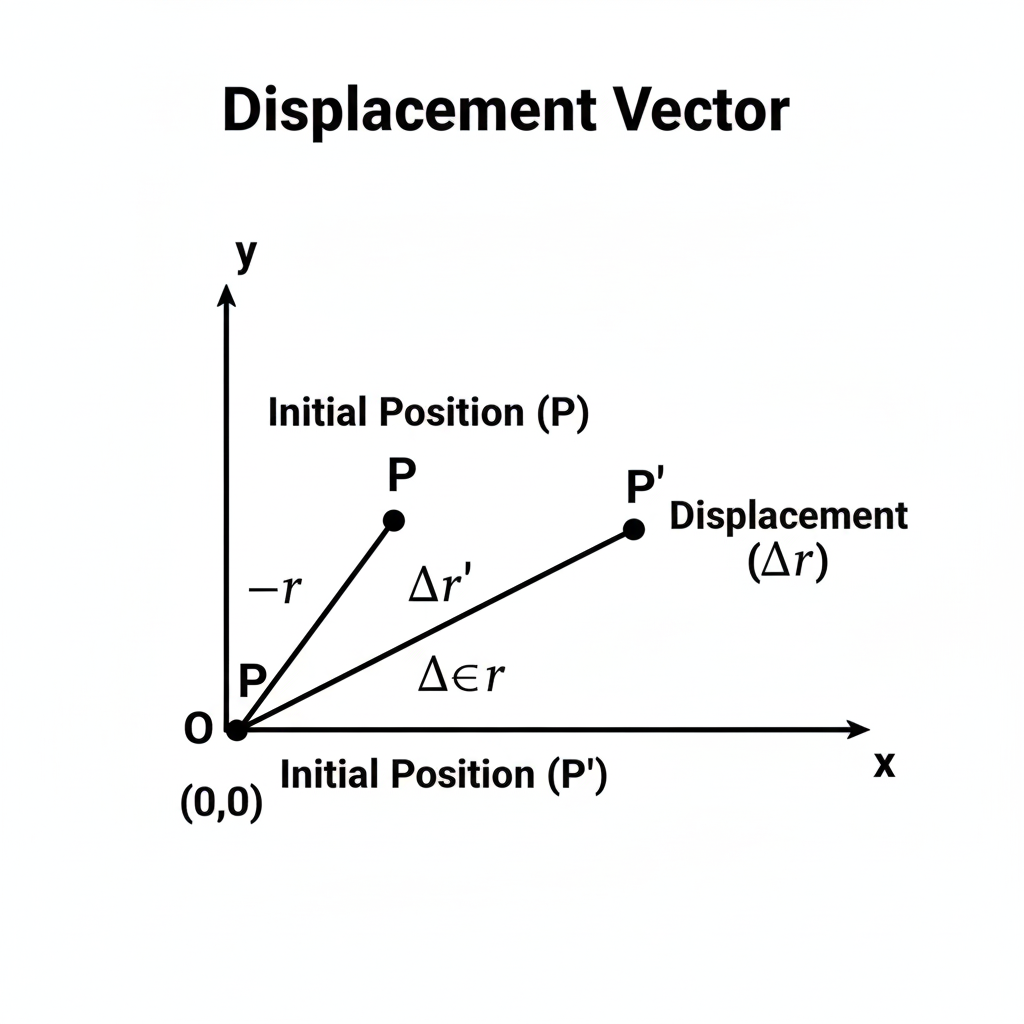
When describing motion in a plane, we set up an origin $O$.
The Position Vector ($\mathbf{r}$): This is the vector $\mathbf{OP}$ that joins the origin $O$ to the object's position $P$ at time $t$. It is often represented by the symbol $\mathbf{r}$. The length of the vector $\mathbf{r}$ gives the magnitude, and the direction is how $P$ is seen from $O$.
The Displacement Vector ($\Delta \mathbf{r}$): If the object moves from an initial position $P$ (at time $t$) to a final position $P'$ (at time $t'$), the vector $\mathbf{PP'}$ is the displacement vector, denoted as $\Delta \mathbf{r}$. It represents the change in position: $\Delta \mathbf{r} = \mathbf{r}' - \mathbf{r}$. Crucially, the displacement vector is the straight line joining the initial and final positions and does not depend on the actual path taken.
Figure below:
A clear diagram showing the origin $O$, the initial position vector $\mathbf{r}$ to $P$, the final position vector $\mathbf{r}'$ to $P'$, and the displacement vector $\Delta \mathbf{r}$ connecting $P$ to $P'$.
NEET Checkpoint:
The magnitude of displacement is equal to the path length only if the object:
(a) Moves at constant speed.
(b) Does not change its direction.
(c) Moves under constant acceleration.
(d) Moves in a plane.
✅ Answer: (b) Does not change its direction — The two are equal only if the path length equals the magnitude of displacement (i.e., motion is along a straight line without changing direction).
Practice Questions:
- Given the variables mass ($m$), time ($t$), velocity ($\mathbf{v}$), and acceleration ($\mathbf{a}$), how should the physical law $\mathbf{F} = m\mathbf{a}$ be represented using manual notation for a vector?
(a) $F = m a$
(b) $F = m \vec{a}$
(c) $\vec{F} = \vec{m} \vec{a}$
(d) $\vec{F} = m \vec{a}$
✅ Answer: (d) $\vec{F} = m \vec{a}$ — Force and acceleration are vectors ($\vec{F}$, $\vec{a}$), while mass ($m$) is a scalar. All variables must be in LaTeX format.
2. If an object starts at position $\mathbf{r}$ and moves to position $\mathbf{r}'$, what quantity defines the vector $\Delta \mathbf{r} = \mathbf{r}' - \mathbf{r}$?
(a) Position vector
(b) Initial velocity
(c) Total path length
(d) Displacement vector
✅ Answer: (d) Displacement vector — The change in position $\Delta \mathbf{r}$ is defined as the displacement vector.
Key Takeaway
| Concept | Defining Criteria | Representation |
|---|---|---|
| Scalar | Magnitude only; follows ordinary algebra. | Light face (e.g., $m, t$) |
| Vector | Magnitude, Direction; MUST obey $\Delta$ or $\parallel$ Law. | Bold ($\mathbf{A}$) or Arrow ($\vec{A}$). |
10. Vector Operations: Addition and Subtraction – The Basics Funda!
Hey future doctors! Now that we know what vectors are—quantities with both magnitude and direction—it’s time to learn how to add and subtract them. You can’t just use ordinary algebra, yaar, because direction matters here. Don't stress, this graphical method is super visual!
Graphical Addition: Head-to-Tail and Parallelogram Methods
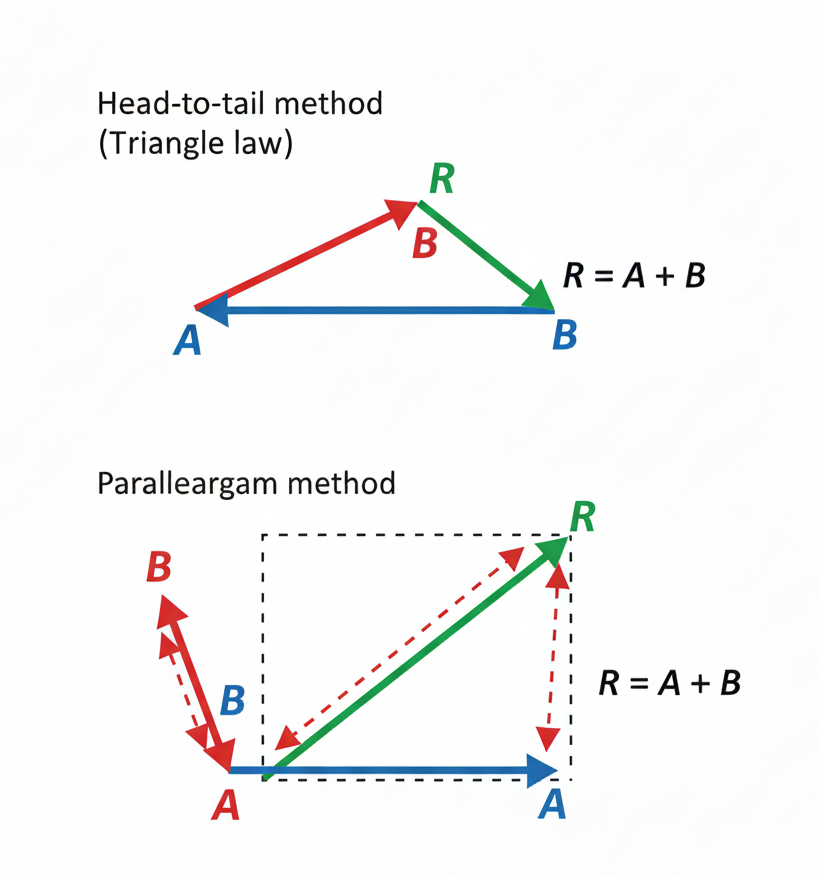
Vectors, by definition, must obey the triangle law of addition or, equivalently, the parallelogram law of addition.
- Head-to-Tail (Triangle Law): To find the sum $\mathbf{R} = \mathbf{A} + \mathbf{B}$, you take vector $\mathbf{B}$ and place its tail at the head (tip) of vector $\mathbf{A}$. The resultant vector $\mathbf{R}$ is the line that joins the tail of $\mathbf{A}$ to the head of $\mathbf{B}$. Easy peasy!
- Parallelogram Law: Alternatively, bring the tails of vectors $\mathbf{A}$ and $\mathbf{B}$ to a common origin $O$. Complete the parallelogram using these two vectors as adjacent sides. The resultant vector $\mathbf{R}$ is the diagonal drawn from the common origin $O$ to the opposite corner of the parallelogram. Both methods yield the exact same resultant $\mathbf{R}$.
Figure below:
A clear diagram showing vector addition using both the head-to-tail (triangle law) method and the parallelogram method, with the resultant R shown as the sum $A+B$.
NEET Checkpoint :
Which property states that the order of adding vectors doesn't change the result?
(a) Associative Law
(b) Distributive Law
(c) Commutative Law
(d) Identity Law
✅ Answer: (c) Commutative Law — Vector addition is commutative: $\mathbf{A} + \mathbf{B} = \mathbf{B} + \mathbf{A}$.
Vector Subtraction and the Null Vector
Vector subtraction is cleverly defined as vector addition involving a negative vector. The difference between two vectors $\mathbf{A}$ and $\mathbf{B}$ is defined as the sum of $\mathbf{A}$ and $-\mathbf{B}$:
Remember that the vector $-\mathbf{B}$ has the same magnitude as $\mathbf{B}$ but points in the opposite direction.
The null vector (or zero vector), denoted by $\mathbf{0}$, is super important! It is the result of adding two equal and opposite vectors, $\mathbf{A} + (-\mathbf{A})$.
Null Vector Fundas:
It has zero magnitude ($|\mathbf{0}|=0$).
Since its magnitude is zero, its ** direction cannot be specified**.
Its key properties are: $\mathbf{A} + \mathbf{0} = \mathbf{A}$, $\lambda \mathbf{0} = \mathbf{0}$, and $\mathbf{0} \mathbf{A} = \mathbf{0}$.
Relatable Indian Example (Null Vector): Think of a cricket batsman hitting a six! If the ball starts at point $P$ and, after a parabolic flight, lands back exactly on the boundary rope at point $Q$, the displacement vector is $\mathbf{P}\mathbf{Q}$. But if the ball starts at $P$ and then, due to some weird trick, returns to the exact spot $P$ where it started, the displacement is a null vector.
NEET Checkpoint :
The addition of vectors $\mathbf{A}$ and $\mathbf{B}$ first, and then adding $\mathbf{C}$, is the same as adding $\mathbf{A}$ to the sum of $\mathbf{B}$ and $\mathbf{C}$. This is the:
(a) Distributive law
(b) Associative law
(c) Law of Sines
(d) Triangle law
✅ Answer: (b) Associative law — Vector addition is associative: $(\mathbf{A} + \mathbf{B}) + \mathbf{C} = \mathbf{A} + (\mathbf{B} + \mathbf{C})$.
NEET Checkpoint :
If $\mathbf{A}$ is a non-zero vector, what is the magnitude of the vector resulting from $\mathbf{A} + (0) \mathbf{A}$?
(a) $|\mathbf{A}|$
(b) $0$
(c) $2|\mathbf{A}|$
(d) Direction cannot be specified
✅ Answer: (a) $|\mathbf{A}|$ — The property $0 \mathbf{A} = \mathbf{0}$ means the result is $\mathbf{A} + \mathbf{0}$, and $\mathbf{A} + \mathbf{0} = \mathbf{A}$.
Practice Questions:
- If A and B are two non-zero, non-parallel vectors lying in the x-y plane, and R1=A+B and R2=A−B. which of the following statements is correct ?
(a) R1 and R2 must have the same magnitude.
(b) R1 is obtained by adding the vector −B to A.
(c) R1 and R2 are always parallel.
(d) R2 is the sum of A and B.
✅ Answer: (b) Vector subtraction rule: Subtracting a vector is equivalent to adding its negative: A−B=A+(−B) Given: R2=A−B So, R2=A+(−B).
2. How is the subtraction $\mathbf{A} - \mathbf{B}$ graphically represented?
(a) By joining the head of $\mathbf{A}$ to the tail of $\mathbf{B}$.
(b) By joining the tail of $\mathbf{A}$ to the head of $\mathbf{B}$.
(c) As the sum of $\mathbf{A}$ and a vector that is equal in magnitude to $\mathbf{B}$ but opposite in direction.
(d) Only using the parallelogram method.
✅ Answer: (c) As the sum of $\mathbf{A}$ and a vector that is equal in magnitude to $\mathbf{B}$ but opposite in direction. — This is the exact definition given for vector subtraction: $\mathbf{A} - \mathbf{B} = \mathbf{A} + (-\mathbf{B})$.
Key Takeaway:
Vector addition can be visualized using the head-to-tail method (Triangle Law) or the parallelogram method. Vector addition is both commutative ($\mathbf{A} + \mathbf{B} = \mathbf{B} + \mathbf{A}$) and associative. Subtraction is defined by adding the negative vector: $\mathbf{A} - \mathbf{B} = \mathbf{A} + (-\mathbf{B})$. Remember the null vector ($\mathbf{0}$): it has zero magnitude and properties like $\mathbf{A} + \mathbf{0} = \mathbf{A}$.
11: Resolution of Vectors and Unit Vectors
Hey future doctor! Don't worry about complex movements; the funda behind them is just breaking a big vector problem into smaller, easier pieces. That process is called Resolution of Vectors. But first, let’s meet the rockstar that makes resolution possible: the Unit Vector!
A unit vector ($\hat{n}$) is the most dedicated vector out there, as it’s strictly defined as a vector of unit magnitude (i.e., magnitude = 1). Its only purpose is to specify a direction. Notice this, students: it has no dimension and no unit. We use it to represent the direction of any general vector $\mathbf{A}$ using the formula: $\mathbf{A}=|\mathbf{A}|\hat{n}$.
For the standard rectangular coordinate system (like the $x-y$ plane), we use specific unit vectors: $\hat{i}$ along the $x$-axis, $\hat{j}$ along the $y$-axis, and $\hat{k}$ along the $z$-axis. Since they are unit vectors, we know that $|\hat{i}|=|\hat{j}|=|\hat{k}|=1$.
NEET Checkpoint:
What is the primary function of a unit vector?
(a) To carry physical units
(b) To define magnitude
(c) To specify direction only
(d) To define a null vector
✅ Answer: (c) To specify direction only — It has unit magnitude (1), no dimension, and no unit; its sole purpose is direction.
Breaking Down Vectors (Resolution)
If you have any vector $\mathbf{A}$ lying in the $x-y$ plane, we can easily break (resolve) it into two component vectors, $\mathbf{A}_1$ and $\mathbf{A}_2$, along the perpendicular axes. This means the main vector is the sum of its components: $\mathbf{A} = \mathbf{A}_1 + \mathbf{A}_2$.
Since $\mathbf{A}_1$ is parallel to $\hat{i}$ and $\mathbf{A}_2$ is parallel to $\hat{j}$, we write the vector in component form:
Here, $A_x$ and $A_y$ are real numbers known as the $x$- and $y$- components of vector $\mathbf{A}$. Remember, $A_x$ itself isn't a vector, but $A_x\hat{i}$ is the component vector.
Relatable Indian Example: Imagine a cricket fielder throwing the ball with velocity $\mathbf{V}$. The horizontal part (the part that makes the ball travel toward the wicket) is $V_x\hat{i}$, and the vertical part (the part that makes it go up and down) is $V_y\hat{j}$. The actual throw $\mathbf{V}$ is the resultant of these two actions!
The Trigonometry Connection
The components are directly related to the magnitude ($A=|\mathbf{A}|$) and the angle ($\theta$) that the vector $\mathbf{A}$ makes with the $x$-axis. Using simple trigonometry (SOH CAH TOA, basic funda!), we get:
Component along the $x$-axis (adjacent side):
Component along the $y$-axis (opposite side):
NEET Checkpoint:
If a vector $\mathbf{A}$ has a component $A_y$ that is negative, in which quadrant might the vector lie (assuming $\theta$ is measured from the positive $x$-axis)?
(a) First or Second
(b) First or Fourth
(c) Third or Fourth
(d) Second or Third
✅ Answer: (c) Third or Fourth — Since $A_y = A \sin \theta$, for $A_y$ to be negative, $\sin \theta$ must be negative, which occurs in the third ($180^\circ$ to $270^\circ$) and fourth ($270^\circ$ to $360^\circ$) quadrants.
If you know the components, you can find the magnitude and direction using Pythagoras and tangent laws:
Practice Question:
A force vector $\mathbf{F}$ has components $F_x=3$ N and $F_y=4$ N. What is the magnitude of the force $F$?
(a) 1 N
(b) 5 N
(c) 7 N
(d) 25 N
✅ Answer: (b) 5 N — We use the magnitude formula: $F = \sqrt{F_x^2 + F_y^2} = \sqrt{3^2 + 4^2} = \sqrt{9 + 16} = \sqrt{25} = 5$ N.
NEET Checkpoint:
If $\mathbf{A} = A_x\hat{i} + A_y\hat{j}$, what quantity is $A_x\hat{i}$?
(a) A scalar component
(b) The magnitude of A
(c) A vector component
(d) A unit vector
✅ Answer: (c) A vector component — $A_x$ is the scalar component, but when multiplied by the unit vector $\hat{i}$, $A_x\hat{i}$ becomes the vector component.
Key Takeaway:
Formula Summary
| Concept | Formula |
| Unit Vector Definition | $\mathbf{A} = |\mathbf{A}|\hat{n}$ |
| Vector Resolution | $\mathbf{A} = A_x\hat{i} + A_y\hat{j}$ |
| Components (Trig) |
$A_x = A \cos \theta$ A_y = A \sin \ |
12. Analytical Vector Addition and Products: The Component Method Fanda
Hey future doctor! We've seen how to add vectors graphically using the Triangle and Parallelogram Laws, but drawing diagrams every time is super tedious and often inaccurate—ek dum limited accuracy, yaar. That’s why we switch to the analytical method! This is where components save the day!
The main funda is simple: When adding two vectors, say A and B, you just add their corresponding components separately.
If vector A is given by $A=A_{x}\hat{i}+A_{y}\hat{j}$ and vector B by $B=B_{x}\hat{i}+B_{y}\hat{j}$, and their resultant is R, then:
The components of the resultant vector R are:
Thus, $\mathbf{R}=(A_{x}+B_{x})\hat{i}+(A_{y}+B_{y})\hat{j}$, which means $R=R_{x}\hat{i}+R_{y}\hat{j}$. This method can be easily extended to the addition or subtraction of any number of vectors, even in three dimensions.
NEET Checkpoint 1:
If two vectors $\mathbf{A}=3\hat{i}$ and $\mathbf{B}=-2\hat{i}$ are added, the resultant is:
(a) $\hat{i}$
(b) $5\hat{i}$
(c) $1\hat{j}$
(d) $-5\hat{i}$
✅ Answer: (a) $\hat{i}$ — Arre, just add the components: $R_x = 3 + (-2) = 1$. The resultant is $\hat{i}$!
Finding Magnitude and Direction
Once you have the resultant components ($R_x$ and $R_y$), finding the magnitude ($R$) and direction ($\theta$) is a piece of cake. Imagine a scooter moving $5$ km East ($R_x$) and $12$ km North ($R_y$). The actual straight-line displacement, the magnitude, is found using Pythagoras theorem, which is what the formula below represents:
The direction $\theta$ that $\mathbf{R}$ makes with the x-axis (e.g., East direction) is given by the ratio of the components:
NEET Checkpoint 2:
If a resultant vector $\mathbf{R}$ has components $R_x=6$ and $R_y=8$, its magnitude is:
(a) 14
(b) 10
(c) 2
(d) $\sqrt{28}$
✅ Answer: (b) 10 — Magnitude $R = \sqrt{6^2 + 8^2} = \sqrt{36+64} = \sqrt{100} = 10$. Easy peasy!
The Law of Cosines: Two-Vector Shortcut
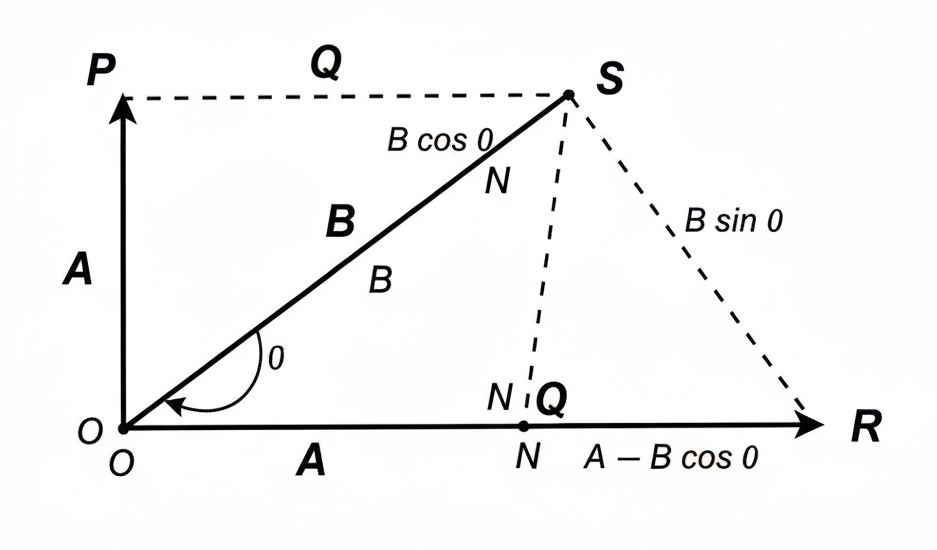
Sometimes, especially when dealing with forces or velocities, you only have the magnitudes of two vectors (A and B) and the angle ($\theta$) between them. Instead of breaking them into components, you can directly find the magnitude of the resultant (R) using the Law of Cosines.
This is super helpful for quick calculations. For instance, if a cricket batsman hits a ball with force A and the wind provides force B at an angle $\theta$, this formula gives the net force immediately.
NEET Checkpoint 3:
The Law of Cosines is used to find the resultant magnitude of two vectors when their magnitudes and the angle between them are known.
(a) True
(b) False
✅ Answer: (a) True — This law, $R=\sqrt{A^{2}+B^{2}+2AB\cos\theta}$, directly links the magnitude of the resultant to the magnitudes and the angle between the two constituent vectors.
Figure below:
A clear diagram showing two vectors A (OP) and B (OQ) originating from the origin O, separated by angle $\theta$. The diagonal of the parallelogram (OS) represents the resultant R. Show the geometric construction used to derive the Law of Cosines
Practice Question:
If vector $\mathbf{A} = 4\hat{i} - 3\hat{j}$, what is the direction $\theta$ it makes with the x-axis?
(a) $\tan^{-1}(4/3)$
(b) $\tan^{-1}(-3/4)$
(c) $\tan^{-1}(3/4)$
(d) $\tan^{-1}(-4/3)$
✅ Answer: (b) $\tan^{-1}(-3/4)$ — Remember, $\tan~\theta = \frac{A_{y}}{A_{x}}$. Here $A_y = -3$ and $A_x = 4$. So $\tan~\theta = -3/4$.
Key Takeaway:
The analytical method is faster and more precise than the graphical method. Always use components ($R_x = \sum A_x$) to calculate the resultant vector, and use the Pythagorean form to find its magnitude $R$.
13: Kinematics in a Plane: Position, Velocity, and Acceleration
Now that you've mastered vectors, let's apply them to the coolest part: describing motion in a plane. Unlike motion in a straight line where directions are just positive or negative, here, vectors are your best buddies. Don't stress, yaar—breaking motion into $x$ and $y$ components clears up the whole funda!
Position, Displacement, Velocity, and Acceleration Vectors
To locate an object moving in the $x-y$ plane, we use the position vector $\mathbf{r}$ (with respect to the origin). We express it beautifully using unit vectors $\hat{i}$ and $\hat{j}$ along the axes:
If the object moves from $\mathbf{r}$ to $\mathbf{r'}$, the displacement vector $\Delta \mathbf{r}$ is simply the change: $\Delta \mathbf{r} = \mathbf{r'} - \mathbf{r}$. In component language, that's just the change in $x$ and $y$ separately:
NEET Checkpoint:
Which path does the displacement vector depend on?
(a) Actual path
(b) Initial and final positions only
(c) Time interval
(d) Velocity
✅ Answer: (b) Initial and final positions only — Displacement is the straight line joining the endpoints, irrespective of the winding path taken (like taking a scooter through dense Delhi traffic!).
Now, for speed! The instantaneous velocity vector $\mathbf{v}$ is the rate of change of the position vector: $\mathbf{v} = \frac{d\mathbf{r}}{dt}$. Just like position, we get its components:
where $v_x = \frac{dx}{dt}$ and $v_y = \frac{dy}{dt}$.
Here's the trick: The velocity vector $\mathbf{v}$ is always tangent to the path of the object at that specific point. Think of a car taking a tight turn—its velocity points straight ahead along the curve's edge, not towards the centre!
Figure below:
A clear diagram showing an object moving along a curved path. At a point P, the velocity vector $\mathbf{v}$ should be drawn tangent to the curve, illustrating the limiting process as $\Delta t \rightarrow 0$.
Similarly, the instantaneous acceleration vector $\mathbf{a}$ is the rate of change of velocity. We calculate it using components:
where $a_x = \frac{dv_x}{dt}$ and $a_y = \frac{dv_y}{dt}$.
Motion with Constant Acceleration
When the acceleration $\mathbf{a}$ is constant, we can use simple kinematic equations, adapted for vectors. These are super important for problems like projectile motion, where $a_x$ is zero and $a_y$ is constant (due to gravity)!
The vector equations relating initial velocity ($\mathbf{v_0}$) and position ($\mathbf{r_0}$) at $t=0$ to the velocity ($\mathbf{v}$) and position ($\mathbf{r}$) at time $t$ are:
-
Velocity-Time Relation:
$$\mathbf{v} = \mathbf{v_0} + \mathbf{a}t$$ -
Position-Time Relation:
$$\mathbf{r} = \mathbf{r_0} + \mathbf{v_0}t + \frac{1}{2}\mathbf{a}t^2$$
This confirms that motion in two dimensions is really just two independent one-dimensional motions happening simultaneously along perpendicular axes (the $x$ and $y$ directions).
Example: Imagine a cricket ball thrown obliquely. Its horizontal motion is constant velocity (since $a_x=0$), and its vertical motion is constantly accelerated (due to $a_y=-g$). We solve them separately and combine the results!
NEET Checkpoint:
If a particle starts at $\mathbf{r_0}$ with velocity $\mathbf{v_0}$ and constant acceleration $\mathbf{a}$, which vector equation describes its position $\mathbf{r}$?
(a) $\mathbf{r} = \mathbf{v_0}t + \frac{1}{2}\mathbf{a}t^2$
(b) $\mathbf{r} = \mathbf{r_0} + \mathbf{v_0}t + \frac{1}{2}\mathbf{a}t^2$
(c) $\mathbf{r} = \mathbf{v_0} + \mathbf{a}t$
✅ Answer: (b) $\mathbf{r} = \mathbf{r_0} + \mathbf{v_0}t + \frac{1}{2}\mathbf{a}t^2$ — If the particle starts at a non-zero position $\mathbf{r_0}$, you must include it in the calculation.
Practice Question:
A particle's velocity is given by $\mathbf{v} = 3.0\hat{i} + 4.0t\hat{j}$ in $\text{m/s}$. What is the magnitude of its acceleration?
(a) $3.0\text{ m/s}^2$
(b) $4.0\text{ m/s}^2$
(c) $5.0\text{ m/s}^2$
(d) $7.0\text{ m/s}^2$
Explanation: Acceleration $\mathbf{a} = \frac{d\mathbf{v}}{dt}$. $a_x = \frac{d}{dt}(3.0) = 0$. $a_y = \frac{d}{dt}(4.0t) = 4.0\text{ m/s}^2$. Thus $\mathbf{a} = 4.0\hat{j}$. The magnitude $|\mathbf{a}| = 4.0\text{ m/s}^2$.
✅ Answer: (b) $4.0\text{ m/s}^2$
NEET Checkpoint:
For an object moving on a curved path, the acceleration vector is parallel to the velocity vector.
(a)True
(b)False
✅ Answer:(b) False — Velocity is tangential, but acceleration might point inwards (like in circular motion) or at any angle between $0^\circ$ and $180^\circ$ (unless it's 1D motion).
Now that you've got the vector foundation, let's use these equations to conquer Projectile Motion next!
Key Takeaway:
Formula Summary
* Position: $\mathbf{r} = x\hat{i} + y\hat{j}$
* Displacement: $\Delta \mathbf{r} = \Delta x\hat{i} + \Delta y\hat{j}$
* Velocity is always tangent to the path.
* Kinematic Equations (Constant $\mathbf{a}$): $\mathbf{v} = \mathbf{v_0} + \mathbf{a}t$ and $\mathbf{r} = \mathbf{r_0} + \mathbf{v_0}t + \frac{1}{2}\mathbf{a}t^2$.
14. Projectile Motion: Path, Maximum Height, and Range
Ready to tackle one of Kinematics' coolest topics? Projectile motion looks complex, but the funda (fundamental concept) is super simple: it’s just two independent motions happening simultaneously. Don't stress, yaar, this concept is easier than it looks!
Imagine launching a cricket ball, which is our classic projectile. The movement is split into two parts that don't affect each other (Galileo said this first!):
1. Horizontal Motion: This is movement along the $x$-axis. Since we neglect air resistance, there is zero acceleration along this axis ($a_x = 0$). The horizontal velocity, $v_x = v_o \cos\theta_o$, remains constant throughout the flight.
2. Vertical Motion: This is movement along the $y$-axis, and it's governed only by constant acceleration due to gravity ($a_y = -g$). The vertical velocity, $v_y = v_o \sin\theta_o - g t$, keeps changing.
NEET Checkpoint:
What is the acceleration vector of a projectile during flight (neglecting air resistance)?
(a) $a=0$
(b) $a=-g\hat{i}$
(c) $a=-g\hat{j}$
(d) $a=a_x\hat{i} + a_y\hat{j}$
✅ Answer: (c) $a=-g\hat{j}$ — Arre! Since $a_x=0$ and gravity acts only vertically downwards, the acceleration vector is $\mathbf{a} = -g\hat{j}$.
The Parabolic Path (Trajectory)
Now, why does the path look like a rainbow? We can eliminate time ($t$) from the position equations, $x$ and $y$. The horizontal position is $x=(v_{o}cos~\theta_{o})t$ and the vertical position is $y=(v_{o}sin~\theta_{o})t-(\frac{1}{2})g~t^{2}$.
The resulting equation of the path (trajectory) is:
Notice this! Since this equation is in the form of $y = ax + bx^2$, the path of the projectile is always a parabola. This is the classic "U" shape you see when a bowler throws a cricket ball in the air (minus air friction, of course!).
Time and Height Calculations
Let's nail the formulas for NEET. The movement stops rising when the vertical velocity is momentarily zero ($v_y=0$).
The Time of Maximum Height ($t_m$) is:
The Maximum Height ($h_m$) is found by substituting $t_m$ back into the vertical displacement equation:
NEET Checkpoint:
What is the velocity vector of a projectile exactly at its maximum height, if launched from the origin?
(a) $v=v_{oy}\hat{j}$
(b) $v=v_{ox}\hat{i}$
(c) $v=0$
(d) $v=v_{o}\hat{i}$
Answer: (b) $v=v_{ox}\hat{i}$ — At maximum height, $v_y=0$, but the horizontal velocity $v_x = v_{ox} = v_o \cos\theta_o$ remains constant and non-zero (unless $\theta_o=90^\circ$).
Horizontal Range (R)
The Horizontal Range ($R$) is the total distance covered along the $x$-axis until the projectile returns to the same initial height ($y=0$). This takes the total time of flight, $T_f$. Since the path is symmetrical, $T_f = 2t_m$.
The range is calculated using constant horizontal velocity over $T_f$: $R = v_{ox} T_f$:
Maximum Range: To get the maximum range ($R_m$) for a given initial speed ($v_o$), the term $\sin(2\theta_o)$ must be maximum (which is 1). This happens when $2\theta_o = 90^\circ$, meaning $\theta_o = 45^\circ$.
This is why, if you are throwing a javelin or a shot put (or just tossing a chapati), you aim for $45^\circ$ to make it go farthest!
Practice Question:
If a projectile is launched such that its maximum horizontal range ($R_{m}$) is $100$ m, what is the maximum height ($h_{m}$) it can achieve if launched at the same initial speed? (Assume the optimal angle for range was used for $R_m$).
(a) $25$ m
(b) $50$ m
(c) $100$ m
(d) $200$ m
✅ Answer: (a) 25 m. — For maximum range, $\theta_o = 45^\circ$. $R_{m} = v_{o}^{2}/g = 100$ m. $h_m$ at $45^\circ$ is $h_{m}=\frac{(v_{o}\sin 45^{\circ})^{2}}{2g} = \frac{(v_{o}(1/\sqrt{2}))^2}{2g} = \frac{v_{o}^{2}}{4g}$. Since $v_{o}^{2}/g = 100$ m, $h_{m} = 100/4 = 25$ m.
Key Takeaway
Projectile motion is the superposition of independent uniform velocity ($a_x=0$) horizontally and uniformly accelerated motion ($a_y=-g$) vertically. The path is a parabola. Remember these core formulas for quick calculations:
| Quantity | Formula |
|---|---|
| Time of Max Height ($t_m$) |
$$t_{m}=\frac{v_{o}sin~\theta_{o}}{g}$$
|
| Maximum Height ($h_m$) |
$$h_{m}=\frac{(v_{o}sin~\theta_{o})^{2}}{2g}$$
|
| Horizontal Range ($R$) |
$$R=\frac{v_{o}^{2}sin~2\theta_{o}}{g}$$
|
15: Uniform Circular Motion (UCM) and Relative Velocity Funda
Hey NEET aspirants! Ready to tackle two super important, high-scoring concepts? Don't stress, yaar—this funda is easier than it looks! We're mixing constant speed with changing direction, and figuring out who sees what when everyone's moving.
Uniform Circular Motion (UCM)
UCM is defined as the motion of an object along a circular path at a constant speed. Notice this: the speed is constant, but the velocity direction changes continuously since velocity is always tangential to the path. Since the velocity vector is constantly changing direction, the object must be undergoing acceleration.
This special acceleration is always directed towards the centre of the circle. That's why we call it centripetal acceleration ($a_c$), which literally means 'centre-seeking'.
The magnitude of this crucial acceleration is given by:
where $v$ is the constant linear speed and $R$ is the radius of the circle.
Relatable Indian Example (UCM): Imagine a pani-puri vendor swinging a small basket of mint leaves attached to a string above his head at a steady rate. Though the basket's speed is constant, its direction changes every millisecond, so it experiences a centripetal acceleration aimed straight at the vendor's hand (the centre)!
We also have angular speed ($\omega$), which measures the time rate of change of angular distance. Linear speed ($v$) and angular speed ($\omega$) are related by:
Substituting this into the $a_c$ equation, we get the acceleration in terms of angular speed:
NEET Checkpoint:
In UCM, which vector remains constant?
(a) Position vector
(b) Velocity vector
(c) Acceleration vector
(d) Speed magnitude
✅ Answer: (d) Speed magnitude — The magnitude of acceleration is constant, but its direction changes continuously, meaning the acceleration vector itself is not constant.
Relative Velocity
Now let's switch gears to the concept of Relative Velocity. This simply helps us find the resultant motion between two moving objects or vectors. When dealing with motion in a plane (2D), we apply the concepts of vector addition or subtraction.
A classic example is the wind and rain scenario. Suppose rain is falling vertically ($v_r$) and wind is blowing horizontally ($v_w$). If a boy is standing still (relative to the ground), the resulting velocity ($R$) he observes is the vector sum of the rain's velocity and the wind's velocity, using the triangle or parallelogram law of addition.
If $v_r$ and $v_w$ are perpendicular, the magnitude of the resultant speed is found using Pythagoras, $R=\sqrt{v_{r}^{2}+v_{w}^{2}}$. This resultant direction tells the boy where to hold his umbrella (towards the east if the wind is east-to-west).
NEET Checkpoint:
A girl walking North at $5~\text{m/s}$ sees a scooter moving East at $12~\text{m/s}$. The magnitude of the scooter's velocity relative to the ground is:
(a) $17~\text{m/s}$
(b) $7~\text{m/s}$
(c) $13~\text{m/s}$
(d) $10~\text{m/s}$
✅ Answer: (c) $13~\text{m/s}$ — Wait, this is a trick question, yaar! The velocity of the scooter ($12~\text{m/s}$ East) and the girl ($5~\text{m/s}$ North) are already referenced to a common frame (the ground). The scooter's velocity relative to the ground is given as $12~\text{m/s}$.
NEET Checkpoint:
To find the velocity of object 1 relative to object 2 ($v_{12}$), you perform which vector operation, given both velocities ($v_1$ and $v_2$) are measured in a common frame?
(a) $v_1 + v_2$
(b) $v_1 - v_2$
(c) $v_2 - v_1$
(d) $v_1 \times v_2$
✅ Answer: (b) $v_1 - v_2$ — Relative velocity is defined by vector subtraction: $v_{12} = v_1 - v_2$.
Practice Question:
A motorboat is racing North at $v_b = 25~\text{km/h}$. The water current ($v_c$) is $10~\text{km/h}$ directed $60^{\circ}$ East of South. What is the approximate magnitude of the resultant velocity of the boat?
(a) $35~\text{km/h}$
(b) $22~\text{km/h}$
(c) $15~\text{km/h}$
(d) $26~\text{km/h}$
✅ Answer: (b) 22 km/h — $\text{Use Law of Cosines: } R=\sqrt{v_{b}^{2}+v_{c}^{2}+2\nu_{b}\nu_{c}cos~\theta}$
$\text{Angle }\theta \text{ between North and } 60^{\circ} \text{ East of South is } 120^{\circ} \text{ }$
$R=\sqrt{25^{2}+10^{2}+2\times25\times10(-1/2)}$
The calculation yields $R \cong 22~\text{km/h}$.
Key Takeaway:
In Uniform Circular Motion, while speed $v$ is constant, acceleration $a_{c} = v^{2}/R = \omega^{2}R$ is always present and directed towards the centre (centripetal). Relative velocity involves vector addition or subtraction to find resultant motion, crucial for scenarios like wind and rain. Now that you've got this vector-based motion down, wait till you see how it connects with gravity's pull in the next chapters!