1. Introduction to Gravitation
Early on, the Italian physicist Galileo recognised a major funda: all bodies, whether it's a heavy cricket bat or a light tennis ball, are attracted to Earth with constant acceleration, regardless of their mass.
NEET Checkpoint:
Who first demonstrated that all bodies fall with constant acceleration regardless of mass?
(a) Isaac Newton
(b) Galileo Galilei
(c) Johannes Kepler
(d) Aristotle
✅ Answer: (b) Galileo Galilei — He proved this through experiments with bodies rolling down inclined planes.
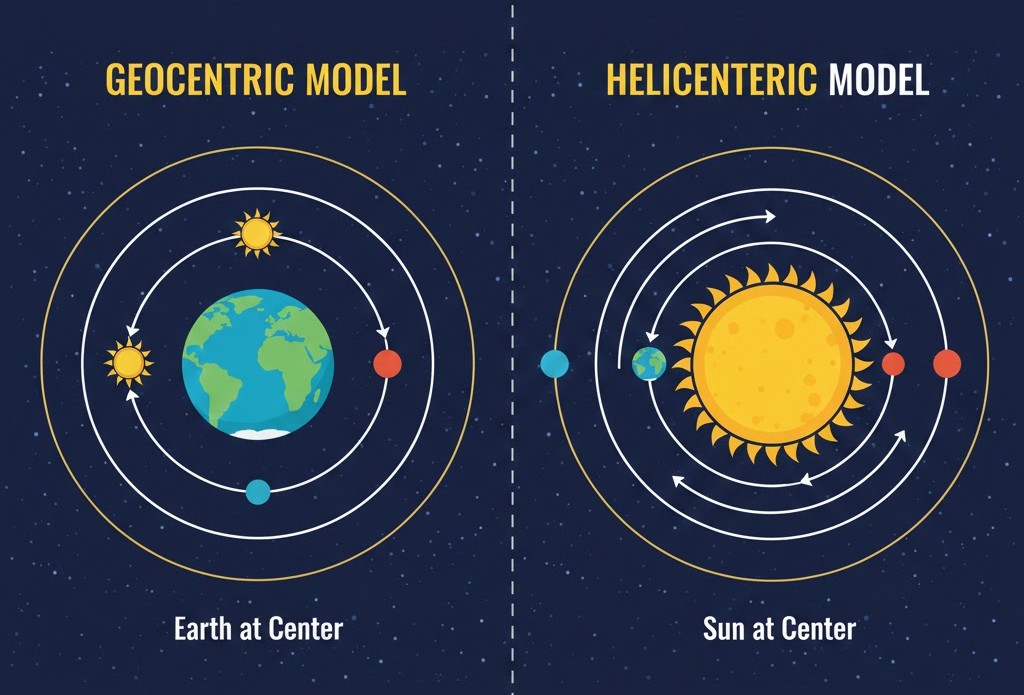
Historically, we didn't always have it right. Around 2,000 years ago, Ptolemy proposed the geocentric model, claiming Earth was the centre of the universe. But wait, our own Indian astronomer Aryabhatta was way ahead of his time, mentioning a heliocentric model where the Sun is the centre!. Later, Copernicus and Tycho Brahe provided the observations that allowed Johannes Kepler to extract three elegant laws of planetary motion.
NEET Checkpoint:
Which model places the Sun at the centre of planetary motion?
(a) Ptolemaic model
(b) Geocentric model
(c) Heliocentric model
(d) Quantum model
✅ Answer: (c) Heliocentric model — Mentioned by Aryabhatta and later developed by Copernicus.
NEET Checkpoint:
Galileo faced prosecution for supporting the heliocentric theory.
(a) True
(b) False
✅ Answer: (a) True — His support for Copernicus's model led to trouble with the state.
Figure below:
A side-by-side comparison diagram showing the Geocentric model (Earth at the centre with the Sun and planets orbiting in circles) and the Heliocentric model (Sun at the centre with planets like Earth and Mars orbiting it).
Think of it like this: if you drop a samosa and a laddu at the same time from your tuition balcony, they’d hit the ground together (ignoring the wind, of course)!. This universal tendency of attraction is what keeps our feet on the ground and the Moon in its orbit.
Practice Question:
Brahe's assistant, who extracted three laws of planetary motion from his data, was:
(a) Newton
(b) Galileo
(c) Johannes Kepler
(d) Ptolemy
✅ Answer: (c) Johannes Kepler — He analysed Brahe’s lifelong observations to form his three laws.
Key Takeaway
Gravitation is a universal attractive force. Science evolved from the Geocentric (Earth-centred) view to the Heliocentric (Sun-centred) model, paved by Galileo, Aryabhatta, and Kepler.
2. Kepler’s First Law: The Law of Orbits
Arre junior, let’s clear up a major funda. For a long time, everyone (including Copernicus) was obsessed with perfect circles. But Johannes Kepler, after raiding Tycho Brahe’s data, realised Nature is a bit more stylish. He proposed the Law of Orbits, which says planets don't move in circles, but in elliptical orbits.
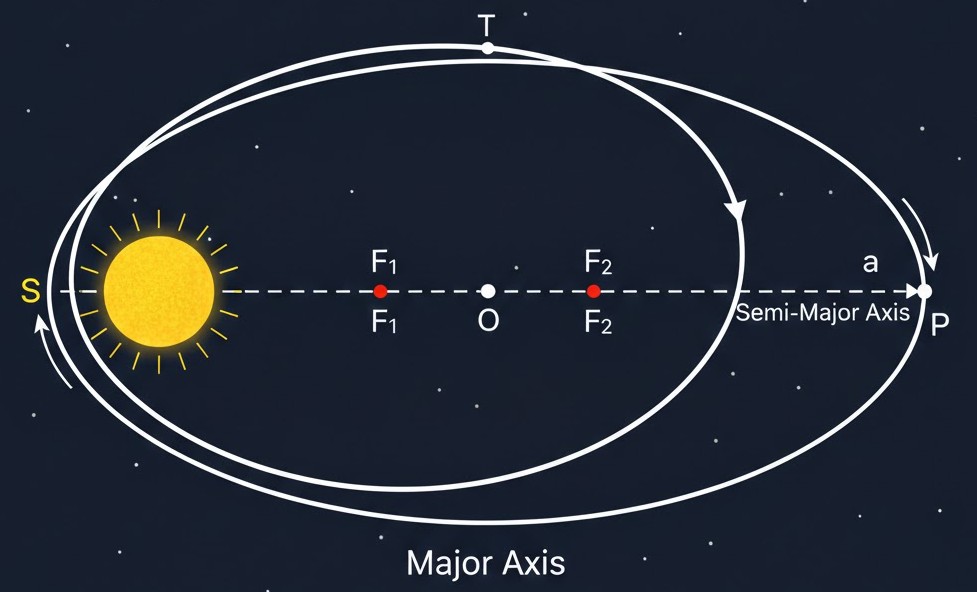
Think of an ellipse like a circle that’s been slightly squashed. Instead of one centre, it has two special points called foci, denoted as $F_1$ and $F_2$. Kepler’s big reveal? The Sun doesn’t sit at the centre; it stays at one of the foci.
NEET Checkpoint:
Which model did Kepler’s first law specifically deviate from?
(a) Copernican model
(b) Ptolemaic model
(c) Newtonian model
(d) Quantum model
✅ Answer: (a) The Copernican model — Copernicus only allowed circular orbits, but Kepler introduced ellipses.
To draw this, imagine fixing two pins (the foci) on a board, looping a string around them, and tracing a curve with a taut pencil. That’s your ellipse! For any point $T$ on this curve, the sum of distances from $F_1$ and $F_2$ is always constant.
NEET Checkpoint:
Where is the Sun located in a planet's orbit?
(a) At the center of the orbit
(b) At one of the two foci
(c) At both foci of the ellipse
(d) Outside the orbital plane
✅ Answer: (b) At one of the two foci — It is not at the centre of the ellipse.
Figure below:
A clear diagram of an elliptical orbit with two points $F_1$ and $F_2$ marked as foci. The Sun is placed at $F_1$. A planet is shown at a point T on the curve. A horizontal line marks the major axis, with the semi-major axis '$a$' labelled from the centre O to the edge P.
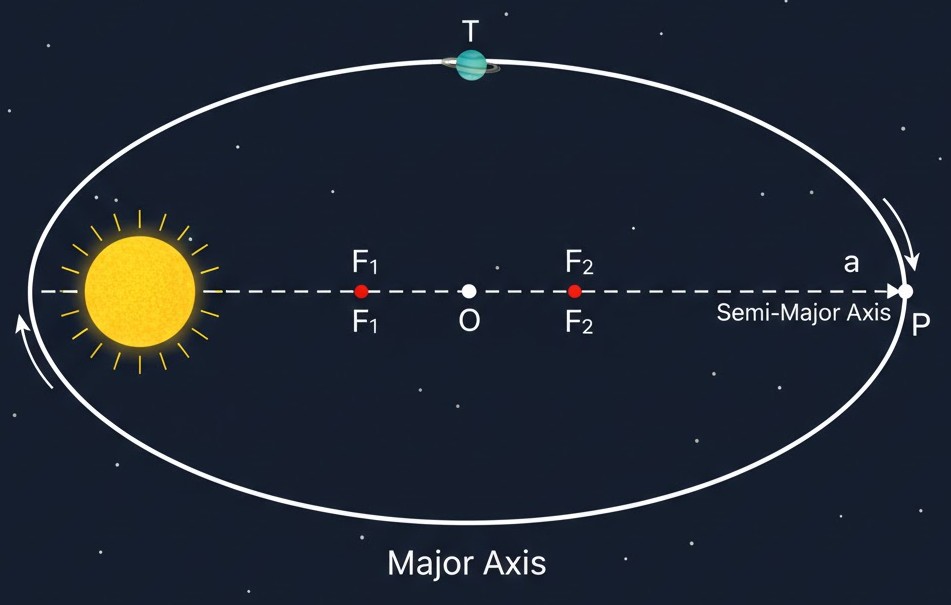
Relatable Example: Imagine you are making a roti. If it’s perfectly round, the two foci have merged into one single point—the centre! In this case, the semi-major axis ($a$) simply becomes the radius ($R$) of your circular roti. But if your roti comes out oval (elliptical), those foci pull apart!
NEET Checkpoint:
What does a circle represent in the context of ellipses?
(a) An ellipse with very high eccentricity
(b) An ellipse with zero eccentricity
(c) An ellipse with two foci at different points
(d) A special parabola
✅ Answer: (b) An ellipse with zero eccentricity — In a circle, the two foci merge into one point.
Practice Question:
According to Kepler's First Law, the path of a planet is:
(a) Circular
(b) Parabolic
(c) Elliptical
(d) Hyperbolic
✅ Answer: (c) Elliptical — Kepler proved that planetary paths are closed elliptical curves.
Key Takeaway
Law of Orbits: Planets move in ellipses with the Sun at one focus. A circle is just a "special" ellipse where the two foci meet at the centre, and the semi-major axis $a$ equals the radius $R$.
3. Kepler’s Second Law: The Law of Areas
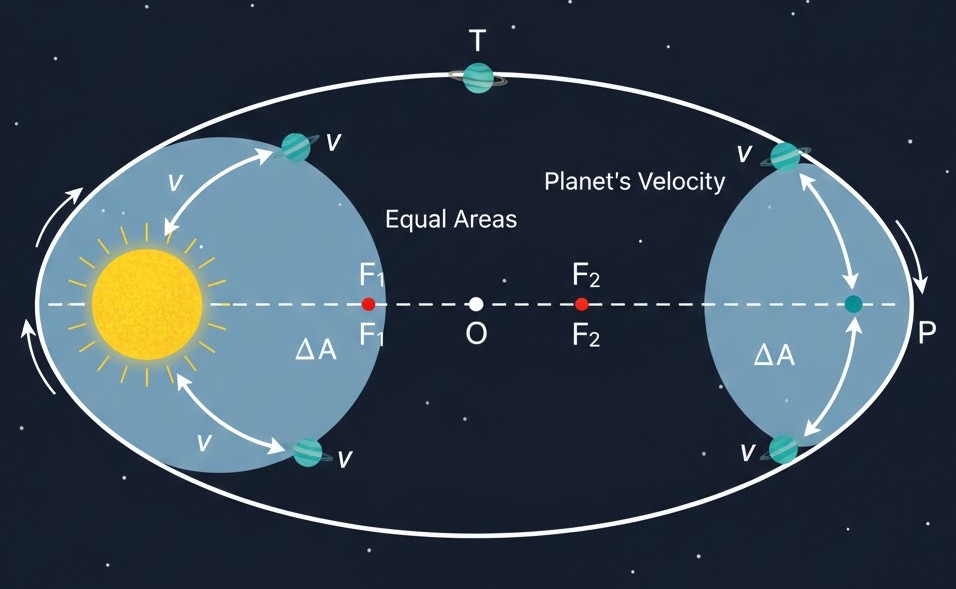
Arre, listen up, junior! This law is like a cosmic balance sheet for planets. It states that the line joining a planet to the Sun sweeps out equal areas in equal intervals of time. Basically, if you give a planet 30 days, it will always cover the same "slice of the orbital pie" (area), no matter where it is in its journey.
To make this "equal area" thing happen, the planet has to be a bit of a speedster. Observations show that planets move faster when they are near the Sun (at the perihelion) and take a lazy stroll, moving slower, when they are further away (at the aphelion).
NEET Checkpoint:
Does a planet move with a constant linear speed in its elliptical orbit?
(a) Yes, always constant
(b) No, it varies along the orbit
(c) Constant only at perihelion
(d) Constant only at aphelion
✅ Answer: (c) No — It speeds up near the Sun and slows down far away to keep the area sweep constant.
Now, why does this happen? It’s not magic; it’s a direct consequence of the conservation of angular momentum ($L$). This conservation is valid here because gravity is a central force. A central force is one where the force on the planet is always directed along the vector joining the Sun and the planet. Since the force is along the position vector, there is no torque, so $L$ stays constant!
Relatable Indian Example: Imagine you're at a crowded Pani Puri stall. When you're far away, you walk slowly, but as soon as you see the vendor about to finish the last batch, you sprint! The closer you get to the "Sun" (the stall), the faster you move to secure your "area" (the plate).
NEET Checkpoint:
Kepler's Second Law is a consequence of the conservation of which quantity?
(a) Energy
(b) Linear Momentum
(c) Angular Momentum
(d) Mass
✅ Answer: (c) — Spot on! Because the gravitational force is central, angular momentum remains constant.
Figure below:
A clear diagram of an elliptical orbit with the Sun at one focus. Two different sectors of the ellipse are shaded to represent equal areas $\Delta A$. One sector is near the Sun (short radius, long arc) and the other is far from the Sun (long radius, short arc), showing the planet's velocity vectors $v$ being larger at the perihelion than at the aphelion.
NEET Checkpoint:
What is the formula for the constant areal velocity?
(a) $\Delta A/\Delta t = mv^2$
(b) $\Delta A/\Delta t = m/L$
(c) $\Delta A/\Delta t = L/m$
(d) $\Delta A/\Delta t = L/(2m)$
✅ Answer: (d) $\Delta A/\Delta t = L/(2m)$ — Where $L$ is angular momentum and $m$ is the planet's mass.
Practice Question:
For a planet orbiting the Sun, the ratio of the area swept to the time taken ($\Delta A/\Delta t$) is:
(a) Proportional to $r$
(b) Proportional to $v$
(c) Constant
(d) Zero
✅ Answer: (c) — Constant! This is the fundamental definition of the Law of Areas.
Key Takeaway
Formula Summary
* Areal Velocity: $\frac{\Delta A}{\Delta t} = \frac{L}{2m} = \text{constant}$
* Angular Momentum Conservation: $m_p r_p v_p = m_p r_A v_A$ (at perihelion and aphelion)
4. Kepler’s Third Law: The Law of Periods
Listen up, junior! Kepler’s third law is the ultimate funda for understanding how planets manage their timetables. Known as the Law of Periods, it states that the square of the time period of revolution ($T$) of a planet is proportional to the cube of the semi-major axis ($a$) of its elliptical orbit.
Mathematically, we express this relationship as:
or
where $k$ is a constant. Notice this: if a planet's orbit is a circle, the semi-major axis simply becomes the radius ($R$).
NEET Checkpoint:
If the semi-major axis of a planet's orbit increases by a factor of $4$, by what factor does the time period increase?
(a) 2
(b) 4
(c) 8
(d) 16
✅ Answer: (c) $8$ times — Since $T \propto a^{3/2}$, the new period is $4^{3/2} = \sqrt{64} = 8$.
Think of it like a local rickshaw route in a busy Indian market. If the rickshaw has to circle a small sabzi mandi, it finishes quickly. But if the route expands to a massive city bypass, the time taken increases much faster than the distance does! Don't stress, yaar—it's just celestial geometry!
This law isn't just theory; Table 7.1 in the sources confirms it using data for all eight planets. By calculating the quotient $Q = T^2/a^3$, scientists found it stays nearly constant (around $2.95$ to $3.01 \times 10^{-34} y^2 m^{-3}$) for everything from Mercury to Neptune.
NEET Checkpoint:
Does Kepler’s Third Law apply to artificial satellites orbiting the Earth?
(a) No
(b) Yes
(c) Only for circular orbits
(d) Only for planets
✅ Answer: (b) Yes — The law is equally applicable to all satellites, natural or artificial, revolving around a central body.
Figure below:
A clear diagram showing an elliptical orbit with a planet 'P', the Sun at one focus 'S', the semi-major axis 'a' labelled, and an arrow indicating the time period 'T' for one full revolution.
NEET Checkpoint:
What determines the value of the constant $k$ in the equation $T^2 = k R^3$?
(a) Mass of the satellite
(b) Mass of the planet
(c) Mass of the central body
(d) Orbital speed
✅ Answer: (c) The mass of the central body — For Earth’s satellites, $k = 4\pi^2/GM_E$.
Practice Question:
If the distance between the Earth and the Sun were to become one-fourth of its present value, the number of days in a year would be:
(a) $45.6$ days
(b) $63.5$ days
(c) $91.25$ days
(d) $182.5$ days
✅ Answer: (a) $45.6$ days — Using $T_2/T_1 = (a_2/a_1)^{3/2}$, we get $T_2 = 365 \times (1/4)^{3/2} = 365/8 \approx 45.6$.
Key Takeaway
Formula Summary
- The Law:$$T^2 \propto a^3$$
- For Satellites:$$T = \frac{2\pi(R_E+h)^{3/2}}{\sqrt{GM_E}}$$
- Constant $k$:$$k = \frac{4\pi^2}{GM_s}$$(for planets) or$$k = \frac{4\pi^2}{GM_E}$$(for Earth satellites).
5. Newton’s Universal Law of Gravitation
Listen up, junior! Ever wonder why that falling apple didn't just float away? Newton bhai figured it out for us with the Universal Law of Gravitation. He realized that every single body in this universe attracts every other body. Whether it’s you and your smartphone or two planets in space, there is a pull!
Here's the trick: this force is directly proportional to the product of the masses and inversely proportional to the square of the distance between them. Mathematically, for two point masses $m_1$ and $m_2$ at a distance $r$:
The constant $G$ is the Universal Gravitational Constant, valued at $6.67 \times 10^{-11} N m^2/kg^2$. It’s a tiny number, which is why you don't go flying towards a heavy rickshaw when you walk past it—the masses are just too small for the force to be felt!
NEET Checkpoint:
If the distance $r$ between two bodies is doubled, what happens to the force $F$?
(a) Doubles
(b) Becomes one-fourth
(c) Halves
(d) Remains the same
✅ Answer: (b) It becomes $F/4$ — Since $F \propto 1/r^2$, doubling the distance means $2^2 = 4$ in the denominator.
NEET Checkpoint:
Is the gravitational force between two objects affected by the medium (like water) between them?
(a) Yes
(b) No
(c) Only for dense media
(d) Only for liquids
✅ Answer: (b) No — $G$ is a universal constant and doesn't depend on the medium.
NEET Checkpoint:
What is the direction of the force $F_{12}$ on body 1 due to body 2?
(a) Away from body 2
(b) Towards body 2
(c) Perpendicular to the line joining the bodies
(d) Depends on mass 1
✅ Answer: (b) It is along the line joining the two, directed towards body 2.
Figure below:
A clear diagram showing two point masses $m_1$ and $m_2$ separated by a distance $r$, with attractive force vectors $F_{12}$ and $F_{21}$ pointing towards each other along the line connecting their centres.
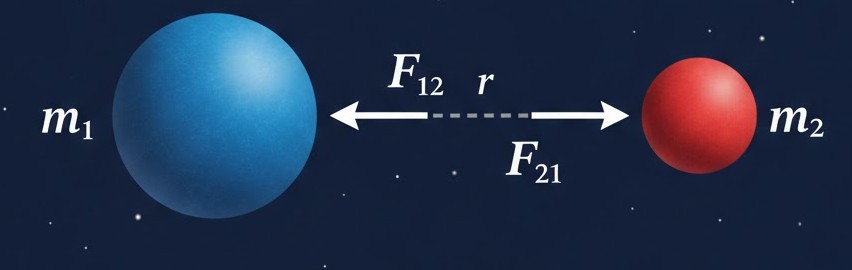
Notice this: the force is always attractive and acts along the line joining the bodies. It's a "central force," much like how a cricket captain is the centre of all field placements.
Practice Question:
Two spheres of $100 kg$ each are kept $1 m$ apart. The force between them is:
(a) $G$
(b) $10^2 G$
(c) $10^4 G$
(d) $10^{-4} G$
✅ Answer: (c) $10^4 G$ — Arre, simple calculation! $F = G \times (100 \times 100) / 1^2 = 10^4 G$.
Key Takeaway
Formula Summary
Universal Law of Gravitation:$$F = G \frac{m_1 m_2}{r^2}$$
Universal Constant ($G$): $6.67 \times 10^{-11} N m^2/kg^2$.
6. The Gravitational Constant ($G$)
Arre, think about this: if the value of $G$ was a large number, you’d be sticking to your tuition bench like a magnet! But in reality, $G$ is incredibly tiny—about $6.67 \times 10^{-11} \, N \, m^2/kg^2$ tiny. This "Universal" tag means it doesn't care if you're on Earth, the Moon, or even sitting at a pani puri stall; its value stays the same throughout the universe.
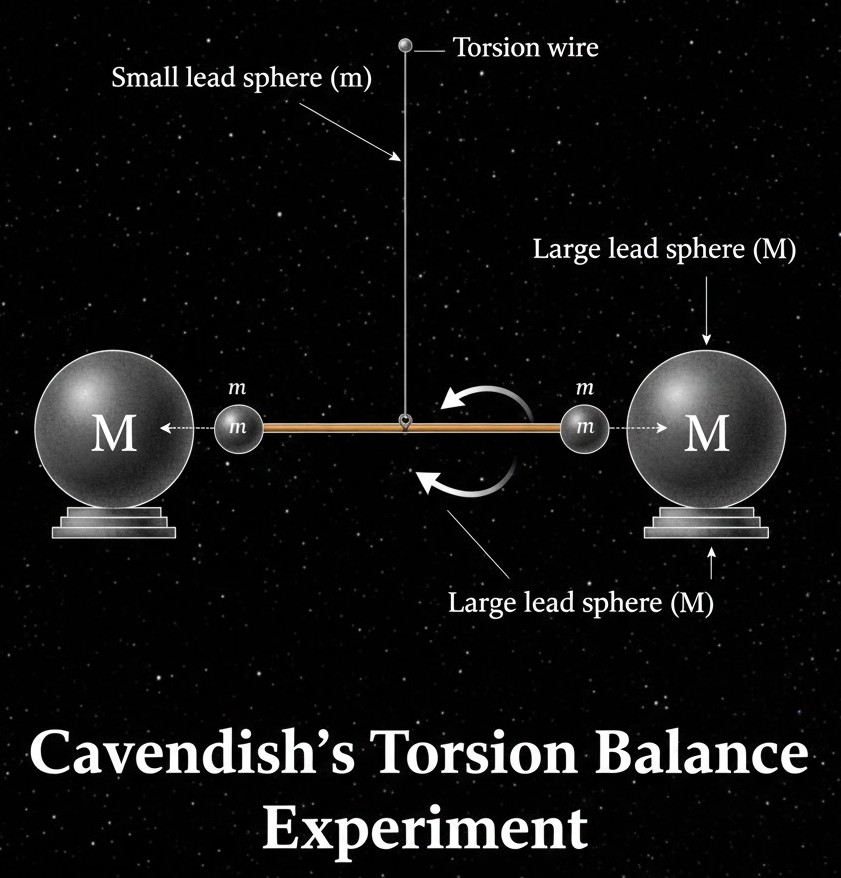
Henry Cavendish was the first genius to measure this value experimentally in 1798. He used a clever device called a torsion balance, which consisted of a bar with two small lead spheres suspended by a fine wire. When two larger lead spheres were brought close, the gravitational pull created a tiny torque, twisting the wire by an angle $\theta$.
NEET Checkpoint:
Who first performed the measurement of the universal gravitational constant?
(a) Newton
(b) Henry Cavendish
(c) Galileo
(d) Kepler
✅ Answer: (b) Henry Cavendish in 1798 — Remember this year, yaar, it’s a classic trivia for exams!
Here is the funda: the gravitational torque is balanced by the restoring torque of the wire. Mathematically, at equilibrium:
Relatable Indian Example: Imagine two laddoos on a plate. Even though they have mass, you don’t see them zooming towards each other to form one giant mega-laddoo. That’s because the force is so weak due to the smallness of $G$!
NEET Checkpoint:
What are the dimensions of the gravitational constant?
(a) $[M^{-1} L^3 T^{-2}]$
(b) $[M L T^{-2}]$
(c) $[M L^2 T^{-1}]$
(d) $[M^{2} L^{-2} T^{2}]$
✅ Answer: (a) $[M^{-1} L^3 T^{-2}]$ — You can derive this using $G = \frac{F r^2}{m_1 m_2}$.
Figure below:
A schematic drawing of Cavendish's torsion balance experiment showing a horizontal bar with small lead spheres at its ends suspended by a wire, with two large lead spheres placed on opposite sides to create a twisting torque.
NEET Checkpoint:
If the distance between the lead spheres is doubled, the gravitational force becomes?
(a) One-fourth
(b) One-half
(c) Twice
(d) Four times
✅ Answer: One-fourth — It follows the inverse square law, so $F \propto 1/d^2$.
Practice Question:
In the Cavendish experiment, the angle of rotation $\theta$ is measured to find $G$. If the restoring couple per unit angle of twist is $\tau$, what does $\tau \theta$ represent?
(a) Gravitational Force
(b) Gravitational Torque
(c) Restoring Torque
(d) Mass of the bar
✅ Answer: (c) Restoring Torque — At equilibrium, the gravitational torque $F \times L$ is exactly balanced by this restoring torque $\tau \theta$.
Key Takeaway
- Accepted Value: $G = 6.67 \times 10^{-11} \, N \, m^2/kg^2$
- Dimensions: $[M^{-1} L^3 T^{-2}]$
- History: First measured by Henry Cavendish (1798) using a torsion balance.
7. Superposition and Extended Objects
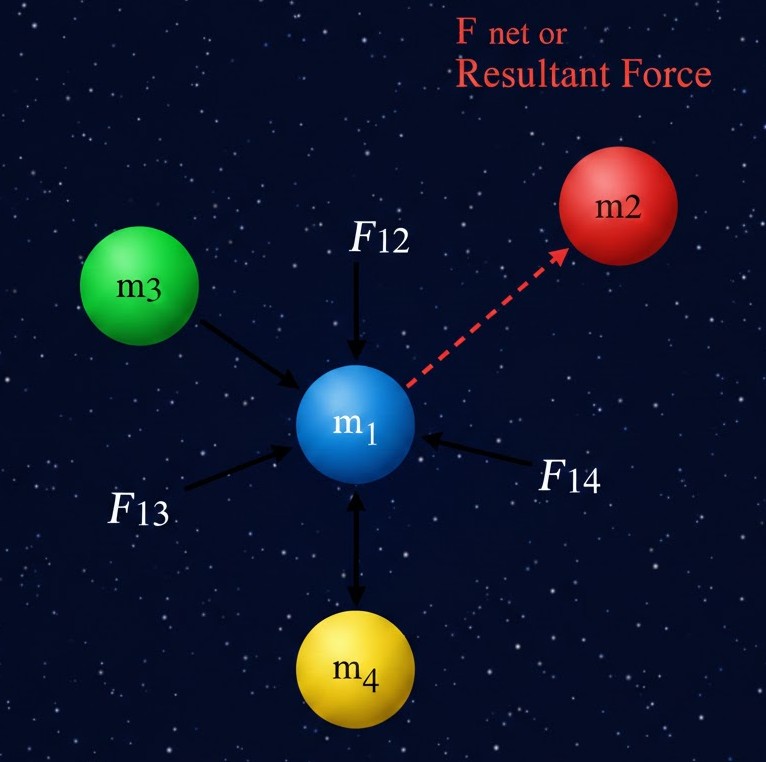
Listen up, junior! Ever wonder what happens when multiple masses try to play tug-of-war with one poor particle? We use the Principle of Superposition. Each mass exerts its force independently, and the net force is just the vector sum of all those individual pulls. Think of it like a group of friends pulling you towards different pani puri stalls—you’ll end up moving in the direction of the resultant "hunger vector"!
Mathematically, the total force $\vec{F}{1}$ on mass $m{1}$ is:
NEET Checkpoint:
If three equal masses are at the corners of an equilateral triangle, what is the net force on a mass at the centroid?
(a) Maximum and directed upward
(b) Non-zero and directed toward one vertex
(c) Zero
(d) Depends on the side of the triangle
✅ Answer: (c) Zero — Due to symmetry, the individual force vectors cancel each other out completely!.
Now, let’s clear up the Extended Object funda. Newton’s law is for point masses, but planets are huge! For a uniform hollow spherical shell, two cool rules apply:
1. Outside the shell: It treats you like a point mass at its centre.
2. Inside the shell: The force is exactly zero!.
Imagine you are a tiny spice particle inside a hollow crusty kachori. The different parts of the shell pull you in every direction, and it all cancels out to nothing. How relaxing, right?
NEET Checkpoint:
A point mass $m$ is at a distance $r$ from the centre of a shell of radius $R$. If $r < R$, the force is?
(a) GmM / r^2
(b) GmM / R^2
(c) Zero
(d) Proportional to r
✅ Answer: (c) Zero — Inside a uniform hollow shell, the gravitational pull is nil.
For any spherically symmetric body (like Earth), the force on an external particle is central—it acts as if the entire mass is concentrated at the centre.
NEET Checkpoint:
Does a shell shield a particle inside from the gravity of other outside bodies?
(a) Yes
(b) No
(c) Only for uniform shells
(d) Only for point masses
✅ Answer: (b) No — Gravitational shielding isn't possible; the shell only cancels its own internal pull.
Figure below:
A clear diagram showing a point mass m1 being pulled by three other point masses m2, m3, and m4, with force vectors F12, F13, and F14 originating from m1 and pointing towards the other masses to illustrate the vector sum principle.
Practice Question:
A shell has mass $M$ and radius $R$. The force on a point mass $m$ at a distance $r = 2R$ from the centre is:
(a) Zero
(b) $\frac{GmM}{R^2}$
(c) $\frac{GmM}{4R^2}$
(d) $\frac{GmM}{2R^2}$
✅ Answer: (c) $\frac{GmM}{4R^2}$ — Outside the shell, we use the distance from the centre, so $F = \frac{GmM}{(2R)^2} = \frac{GmM}{4R^2}$.
Key Takeaway: Superposition & Shells
- Superposition: Net force is the vector sum $\vec{F}{net} = \sum \vec{F}{i}$.
- Hollow Shell (Inside): Force $F = 0$.
- Hollow Shell (Outside): $F = \frac{GmM}{r^{2}}$, where $r$ is the distance from the centre.
- Symmetric Bodies: Act as point masses for external particles.
8. Acceleration Due to Gravity ($g$) of the Earth
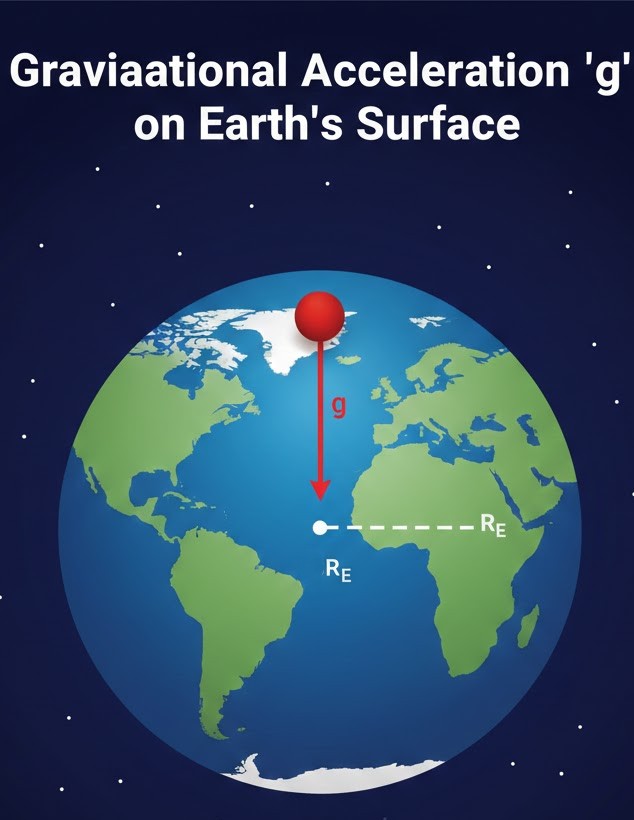
Settle down, junior! Let’s clear up a major funda: how does this massive planet actually pull us? To simplify things, Earth acts like a bit of a show-off—it behaves as if its entire mass $M_E$ is concentrated right at its centre for any point outside its surface. Think of it like a giant ladoo where all the sweetness (and mass) is packed into one tiny point at the middle.
When you're standing on the surface, your distance from this "point mass" is just the Earth's radius $R_E$. Using Newton's second law ($F = mg$), we can find the acceleration $g$. Here is the golden formula you'll need for NEET:
Notice something? Your own mass $m$ is nowhere to be found! Whether you drop a heavy cricket bat or a light tennis ball from a tuition balcony, they both accelerate at the same rate.
NEET Checkpoint:
If Earth's mass $M_E$ were to suddenly double (and radius stayed the same), what would happen to your weight?
(a) It would remain the same
(b) It would double
(c) It would halve
(d) It would quadruple
✅ Answer: (b) It would double! Since $g \propto M_E$, the acceleration due to gravity would double, making you feel twice as heavy.
Now, why did people say Cavendish "weighed the Earth"? Because once $g$ was measured and $G$ was known from his experiment, we could calculate $M_E$ using:
It’s like finding the weight of a huge bag of rice just by looking at how fast a grain falls!.
NEET Checkpoint:
Does the value of $g$ on the surface depend on the object's mass?
(a) Yes
(b) No
(c) Only for heavy objects
(d) Only for light objects
✅ Answer: (b) No, $g$ is independent of the mass of the falling body. Arre, Galileo already proved this by rolling balls!.
NEET Checkpoint:
Where is Earth's mass considered to reside for calculations involving a satellite?
(a) Evenly throughout the Earth
(b) At the center of the Earth
(c) At the surface of the Earth
(d) At the equator
✅ Answer: (b) At the center of the Earth . For external points, Earth behaves as a point mass.
Figure below:
A clear diagram showing a large sphere representing Earth with a point 'C' at the centre, a mass 'm' on the surface at distance 'R_E' from 'C', and an arrow pointing from 'm' to 'C' labelled 'g'.
Practice Question:
If the Earth's radius $R_E$ were to shrink by $1\%$ (mass $M_E$ remaining constant), the value of $g$ would:
(a) Decrease
(b) Increase
(c) Stay the same
(d) Become zero
✅ Answer: (b) Increase — Since $g$ is inversely proportional to $R_E^2$, a smaller radius means a stronger pull!.
Key Takeaway
Formula Summary
- Acceleration at surface:$$g = \frac{G M_E}{R_E^2}$$
- Mass of Earth:$$M_E = \frac{g R_E^2}{G}$$
9. Variation of $g$ with Altitude
Hey there, future doctor! Ready to level up? We’re going high—literally! Ever wondered why anything thrown up eventually falls back to Earth? Well, besides the workout, gravity is playing its own game. As you move away from the Earth's surface, the acceleration due to gravity, $g$, starts to drop. Think of Earth like a slightly clingy friend; the further you go, the weaker the pull becomes.
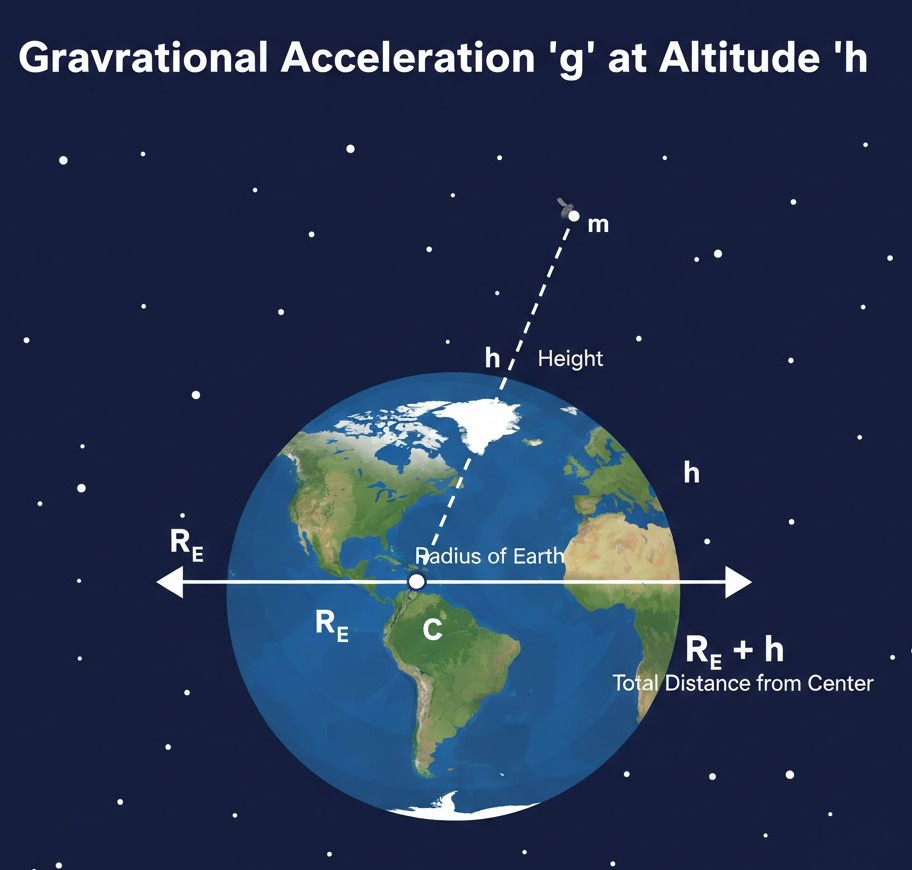
The general formula for $g$ at a height $h$ above the surface is:
Since $(R_E + h)$ is in the denominator, as $h$ increases, the value of $g(h)$ must decrease. It’s a simple inverse-square relationship, yaar!.
NEET Checkpoint:
If you go from a pani puri stall at sea level to a tuition centre on top of a mountain.
(a) Increases
(b) Decreases
(c) Remains the same
(d) Becomes zero
✅ Answer: (b) Decrease — Gravity hates heights! As the distance from the centre increases, the pull weakens.
If you're just hopping onto the roof of a local rickshaw where the height $h$ is very small compared to the Earth's radius ($h \ll R_E$), we use a nifty shortcut called the binomial expansion:
This approximation is a total life-saver for quick NEET calculations!. Imagine hitting a massive six in a cricket match at the Dharamshala stadium. Because it's at a high altitude, $g$ is slightly lower than in a coastal city like Mumbai. Your ball might stay in the air just a tiny bit longer—but don't try to use that as an excuse with the umpire!
NEET Checkpoint:
At what distance from the Earth's centre is $g$ considered to be zero?
(a) At the Earth's surface (r = R)
(b) At a height equal to Earth's radius (r = 2R)
(c) At the centre of the Earth (r = 0)
(d) At infinity (r → ∞)
✅ Answer: (d) At $r = \infty$ — Only at an infinite distance does the Earth finally let go.
NEET Checkpoint:
Which formula is more accurate for large heights?
(a) g_h = g(1 - h/R)
(b) g_h = g / (1 + h/R)^2
(c) g_h = g(1 + h/R)
(d) g_h = g e^(-h/R)
✅ Answer: (b) $g_h = g / (1 + h/R)^2$ — The binomial shortcut only works when $h$ is tiny compared to $R_E$.
Figure below:
A clear diagram showing a sphere representing Earth with radius $R_E$, and a point mass $m$ at a height $h$ above the surface, with a vector indicating the total distance from the centre as $R_E + h$.
Practice Question:
If you climb to a height $h = R_E$ above the Earth's surface, what will be the value of $g$ at that point?
(a) $g/2$
(b) $g/4$
(c) $g/9$
(d) $zero$
✅ Answer: (b) $g/4$. Arre, look: if $h = R_E$, the distance from the centre is $R_E + R_E = 2R_E$. Squaring that in the denominator gives $4R_E^2$, so gravity becomes one-fourth.
Key Takeaway
Formula Summary
* General Formula: $g(h) = \frac{GM_E}{(R_E + h)^2}$
* Approximation ($h \ll R_E$): $g(h) \approx g(1 - \frac{2h}{R_E})$
* Note: Gravitational intensity is maximum at the surface and decreases as you go upward.
10. Variation of g with Depth
Listen up, junior! Most people think gravity is a "the-closer-the-better" situation, but Earth has a little surprise for you. Arre, if you decide to travel to the centre of the Earth—maybe in a super-fast underground rickshaw—you’ll notice something strange: the acceleration due to gravity actually decreases as you go deeper.
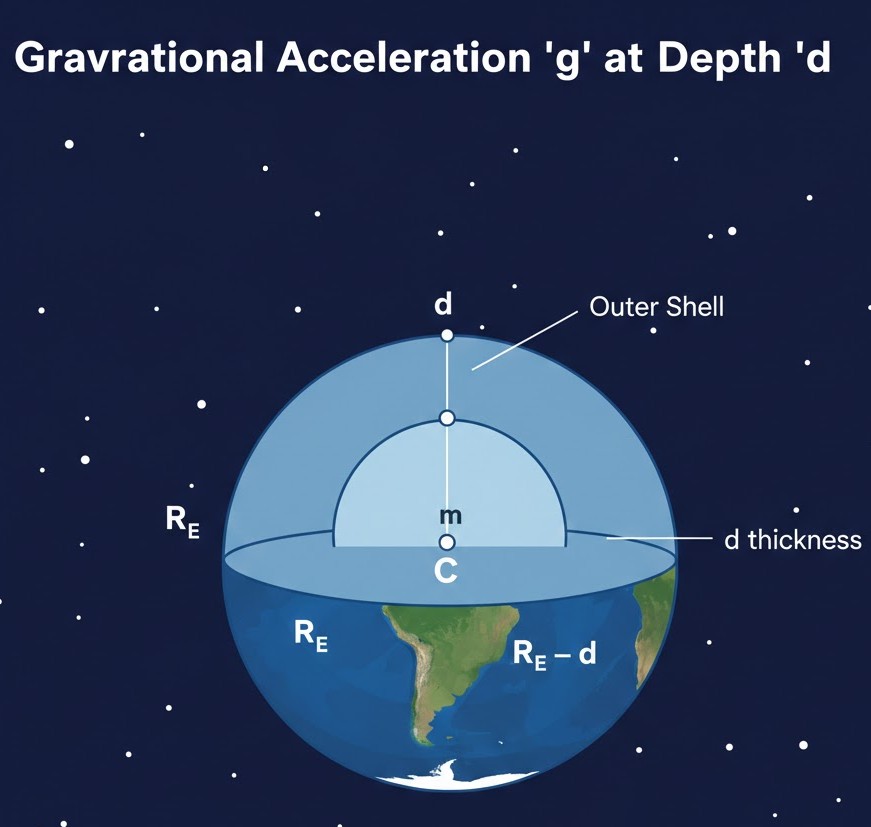
Here’s the funda: when you are at a depth $d$ below the surface, your distance from the centre is only $(R_E - d)$. The thick outer shell of the Earth above you is actually quite "kind"—its total gravitational pull on you is exactly zero! Only the mass of the smaller sphere interior to your position contributes to the force pulling you down.
NEET Checkpoint:
Where is the value of $g$ maximum?
(a) At the centre of the Earth
(b) At the surface of the Earth
(c) At the top of a mountain
(d) At the equator
✅ Answer: (b) At the surface of the Earth — The source confirms that $g$ is maximum on the surface and decreases whether you go up or down.
The formula for acceleration due to gravity at depth $d$ is:
Figure below:
A clear diagram of a cross-section of Earth with radius $R_E$, showing a point mass $m$ at a depth $d$ from the surface, highlighting the inner sphere of radius $(R_E - d)$ and the outer shell of thickness $d$.
Think of a deep coal mine in Dhanbad. As you descend, the "effective" Earth beneath your feet gets smaller, so $g$ drops. If you ever reach the very centre ($d = R_E$), the formula gives you $g(1 - 1) = 0$. Even gravity needs a break sometimes!
NEET Checkpoint:
At what depth does $g$ become zero?
(a) At the surface
(b) At the centre of the Earth
(c) At half the radius of the Earth
(d) At the equator
✅ Answer: (b) At the centre of the Earth ($d = R_E$) — Putting $d = R_E$ in the formula makes the term $(1 - d/R_E)$ zero.
NEET Checkpoint:
If you are halfway to the centre ($d = R_E/2$), what is the value of $g(d)$?
(a) g / 2
(b) g / 4
(c) g / 8
(d) g
✅ Answer: (a) $g/2$ — Using the formula, $g(1 - 0.5) = 0.5g$, so gravity is halved.
Practice Question:
A body weighs $250\ N$ on the surface. How much would it weigh half way down to the centre?
(a) $250\ N$
(b) $125\ N$
(c) $500\ N$
(d) $0\ N$
✅ Answer: (b) $125\ N$ — Since weight $W = mg$ and $g$ becomes half at $d = R_E/2$, the weight also halves.
Key Takeaway
Formula Summary
* Gravity at depth $d$: $g(d) = g(1 - d/R_E)$.
* At the centre ($d = R_E$): $g = 0$.
11. Gravitational Potential Energy
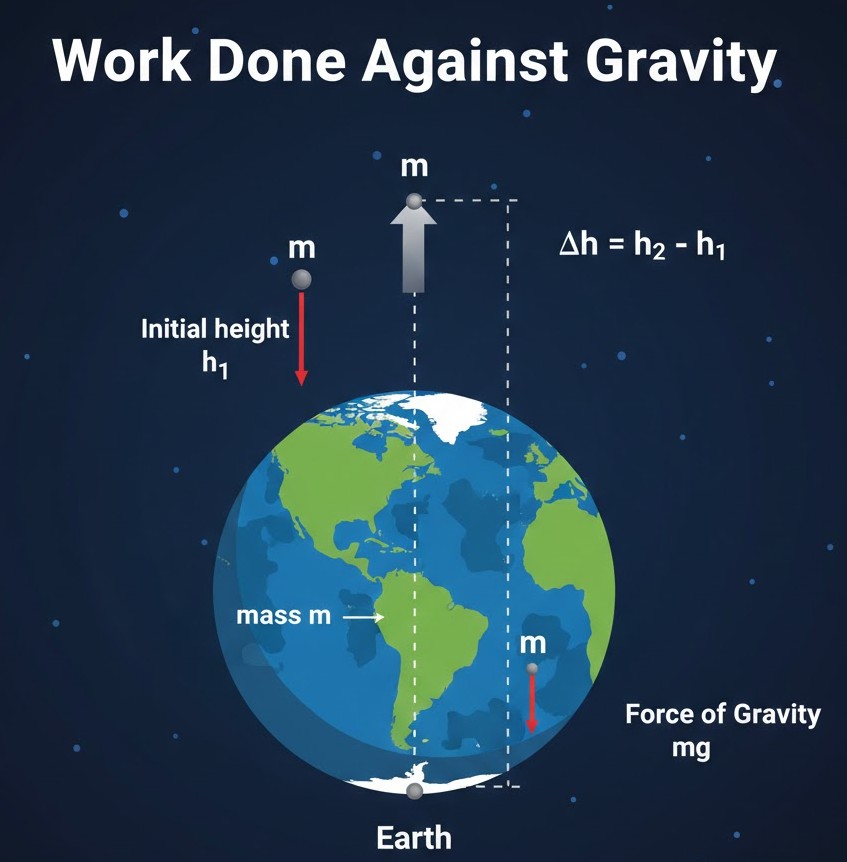
Listen, junior, don't let the name scare you—Gravitational Potential Energy ($V$) is just the "stored" energy a body has due to its position in a gravitational field. The big secret? Gravity is a conservative force, which means the work done in moving an object depends only on where you start and where you finish, not the curvy path you took to get there!
NEET Checkpoint:
If you carry a $10 \text{ kg}$ rice bag up a spiral staircase versus a straight ladder to the same height, is the work done by gravity different?
(a) Yes, more on the staircase
(b) Yes, more on the ladder
(c) No, it is the same
(d) It depends on speed
✅ Answer: (c) No — Gravity is a conservative force, so work is independent of the path!
When we are close to the Earth's surface, we use the familiar funda:
where $W_0$ is the potential energy at the surface ($h=0$). But for the "big picture" (like satellites or planets), the force isn't constant, so we use:
We set the zero point at infinity ($r \to \infty$) by convention. This makes the potential energy negative, signifying that the masses are "bound" to each other.
Relatable Indian Example: Imagine you're pulling a bucket of water out of a deep village well. As you pull it up, you're doing work against gravity, increasing its potential energy. If the rope snaps (don't let it!), that stored energy turns into a splash of kinetic energy!
NEET Checkpoint:
What is the gravitational potential energy of a particle at an infinite distance from Earth?
(a) Zero
(b) Negative
(c) Positive
(d) Infinite
✅ Answer: (a) Zero ($0$) — This is our conventional reference point.
NEET Checkpoint:
If you double the distance $r$ between two stars, what happens to their potential energy?
(a) Doubles
(b) Halves
(c) Quadruples
(d) Becomes zero
✅ Answer: (b) It becomes half — Since $V$ is inversely proportional to $r$ ($V \propto 1/r$).
Figure below:
A clear diagram showing a mass m being lifted from height h1 to h2 above the Earth's surface, with an arrow indicating the force of gravity mg acting downwards.
Practice Question:
Two masses $M$ and $m$ are separated by distance $r$. If the zero of potential energy is at infinity, the potential energy of the system is:
(a) $G M m / r$
(b) $-G M m / r$
(c) $-G M m / r^2$
(d) $mgh$
✅ Answer: (b) $-G M m / r$ — This is the standard formula derived from work done.
Key Takeaway
Formula Summary
* Near Surface: $W(h) = mgh + W_0$
* Universal: $V = -\frac{G m_1 m_2}{r}$
* At Infinity: $V = 0$
12. Gravitational Potential and Systems
Arre, don't get confused between Potential Energy and Gravitational Potential. Think of the potential ($U(r)$) as the "gravitational vibe" created by a mass $M$. It is simply defined as the potential energy of a particle of unit mass at a specific point.
The formula is a total NEET favourite:
It is a scalar quantity, so your life is easy—just add the values together like your marks in a mock test without worrying about vectors!
NEET Checkpoint:
What is the value of gravitational potential at an infinite distance?
(a) Zero
(b) Negative
(c) Positive
(d) Infinite
✅ Answer: (a) Zero — Conventionally, we set the potential to be zero at $r = \infty$.
NEET Checkpoint:
If the gravitational potential at a point is $U$, what is the P.E. of a mass $m$ placed there?
(a) U / m
(b) m + U
(c) m × U
(d) U - m
✅ Answer: $m \times U$ — Since potential is energy per unit mass, just multiply by the mass!
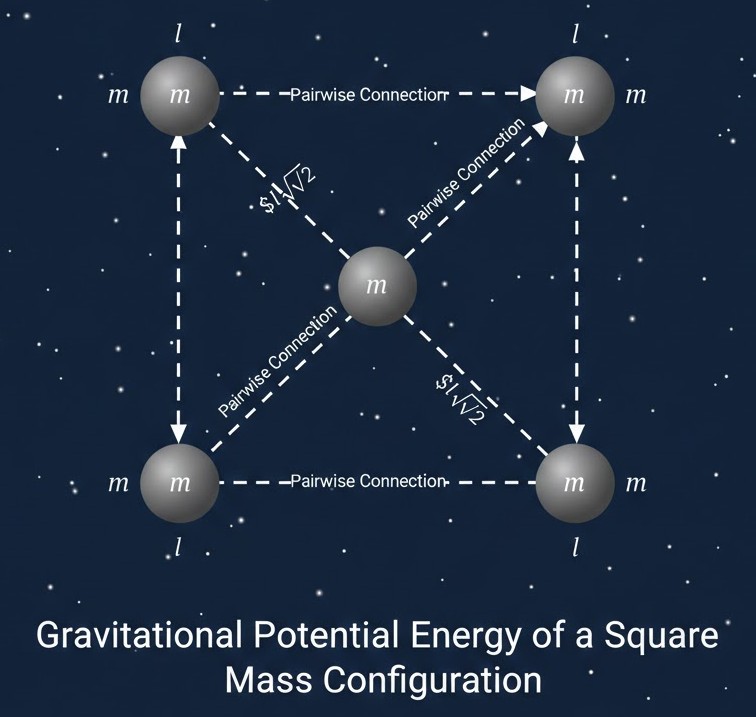
When dealing with a system of particles, the total potential energy is the sum of energies for all possible pairs of its constituent particles.
Indian Example: Imagine four friends at a tuition center standing at the corners of a square. To find the total "bond" (energy) of this group, you don't just look at the whole square; you sum up the energy between every possible duo—the four pairs along the sides and the two pairs across the diagonals!
Figure below:
A clear diagram showing four equal masses $m$ at the vertices of a square of side $l$, with lines connecting all six possible pairs (four sides and two diagonals) to illustrate the calculation of total potential energy.
NEET Checkpoint:
Does the gravitational potential of a system depend on the direction of the masses?
(a) Yes
(b) No
(c) Only for satellites
(d) Only for large masses
✅ Answer: (b) No — Both potential and potential energy are scalars!
Practice Queation:
The gravitational potential due to a mass $M$ at a distance $r$ is:
(a) $GM/r^2$
(b) $-GM/r$
(c) $-GmM/r$
(d) $mgh$
✅ Answer: (b) $-GM/r$ — Remember, potential is per unit mass, so the $m$ of the test particle cancels out!
Key Takeaway:
Formula Summary:
- Gravitational Potential: $U(r) = -\frac{GM}{r}$
- Potential Energy: $V = -\frac{Gm_1m_2}{r}$
- Both are scalar quantities and are typically negative relative to infinity.
13. Escape Speed
Ever wondered if you could hit a cricket ball so hard it never comes back to the stadium? That’s the funda of Escape Speed, yaaro!. It is the minimum speed an object needs to reach infinity and escape the Earth’s gravitational pull forever.
We derive this using the principle of conservation of mechanical energy. For an object to reach infinity, its total energy (kinetic + potential) must be at least zero. If we launch it from the surface ($h = 0$), the formula is:
NEET Checkpoint:
Does escape speed depend on the mass of the projected object?
(a) Yes
(b) No
(c) Only for planets
(d) Only for rockets
✅ Answer: (b) No — Look at the formula, the mass of the object $m$ is nowhere to be found! It only depends on the planet's mass $M_E$ and radius $R_E$.
Since we know $g = \frac{GM_E}{R_E^2}$, we can also write the formula using the acceleration due to gravity:
For our Earth, this numerical value is approximately $11.2\text{ km/s}$. That’s incredibly fast—even the fastest Mumbai local train would look like a snail in comparison!
NEET Checkpoint:
Why does the Moon have no atmosphere?
(a) No water
(b) Too cold
(c) Low escape speed
(d) High pressure
✅ Answer: (c) Low escape speed — The Moon’s escape speed is only $2.3\text{ km/s}$, so gas molecules formed there have speeds larger than this and just run away into space.
NEET Checkpoint:
If a body is projected at a speed higher than the escape speed, it:
(a) Falls back
(b) Becomes a satellite
(c) Reaches infinity with non-zero speed
(d) Stops at infinity
✅ Answer: (c) Reaches infinity with non-zero speed — If total energy is positive ($E > 0$), it keeps some kinetic energy even at infinity.
Don't let the math scare you; it's just energy bookkeeping!. Whether it's a pebble or a massive rocket, the escape speed remains the same for a given planet.
Practice Question:
A projectile is launched from a planet with $g$ and $R$ both half that of Earth. Its escape speed will be:
(a) Half of Earth's
(b) Double of Earth's
(c) Same as Earth's
(d) One-fourth of Earth's
✅ Answer: (a) Half of Earth's — Since $v_e = \sqrt{2gR}$, if both $g$ and $R$ are halved, the term becomes $\sqrt{2(g/2)(R/2)} = \frac{1}{2}\sqrt{2gR}$.
Key Takeaway
Formula Summary
- Escape Speed (from surface):
$$(V_i)_{min} = \sqrt{\frac{2GM_E}{R_E}} = \sqrt{2gR_E}$$- Value for Earth: $\approx 11.2\text{ km/s}$
- Value for Moon: $\approx 2.3\text{ km/s}$
14. Motion of Earth Satellites
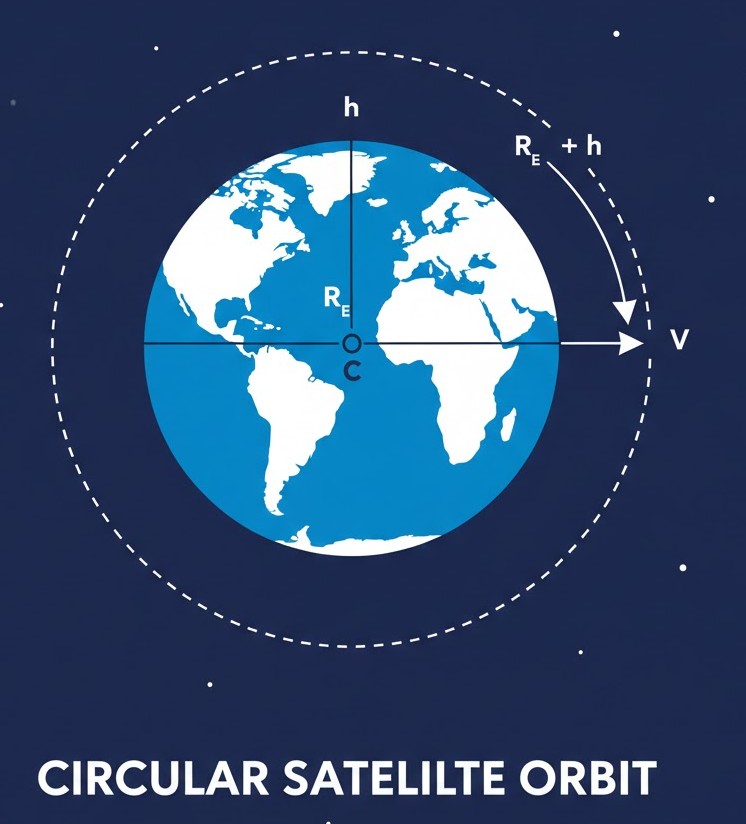
Hey junior, don't let the word "satellite" intimidate you! Whether it is the Moon (our natural neighbor) or the high-tech artificial ones India launches, they all follow the same rules of the game. Think of a satellite like a cricket ball hit so hard it keeps falling but never hits the ground because the Earth curves away—now that's a sixer for the ages!.
To stay in a circular orbit at a height $h$, the satellite needs a centripetal force. Who provides this? Our very own Earth’s gravity, of course!. We equate these forces:
Notice this: the satellite’s mass $m$ cancels out!. This gives us the orbital velocity $V$:
NEET Checkpoint:
If you replace a $100\text{ kg}$ satellite with a $500\text{ kg}$ one at the same height, does the orbital speed change?
(a) Yes, it increases
(b) Yes, it decreases
(c) No, it remains the same
(d) It becomes zero
✅ Answer: (c) No! — The formula $V = \sqrt{\frac{GM_E}{R_E + h}}$ shows speed depends only on Earth's mass and the orbit radius, not the satellite's mass.
Here's the trick: as the height $h$ increases, the speed $V$ decreases. It's like a slow-moving rickshaw in heavy traffic—the further out you are, the slower you need to cruise.
NEET Checkpoint:
What provides the centripetal force for a satellite?
(a) Tension in a string
(b) Electromagnetic force
(c) Gravitational force
(d) Nuclear force
✅ Answer: (c) Gravitational attraction — Earth's pull acts as the necessary central force.
The time taken for one full round is the Time Period $T$. After some math, we find $T^2 = k(R_E + h)^3$, which is basically Kepler’s Law of Periods. For a satellite "hugging" the Earth ($h \approx 0$), the period $T_0$ is:
This comes out to about 85 minutes—faster than a typical Bollywood movie!.
Figure below:
A clear diagram showing Earth of radius $R_E$ with a satellite of mass $m$ moving in a circular orbit at height $h$. Include arrows for orbital velocity $V$ and the gravitational/centripetal force $F$ directed towards Earth's centre.
NEET Checkpoint:
If a satellite is very close to Earth, what is its approximate orbital period?
(a) 85 minutes
(b) 12 hours
(c) 24 hours
(d) 7 days
✅ Answer: (a) 85 minutes — Calculated using $T_0 = 2\pi\sqrt{R_E/g}$ with $g = 9.8\text{ m s}^{-2}$.
Practice Question:
Two satellites orbit Earth at radii $R$ and $4R$. What is the ratio of their time periods $T_1/T_2$?
(a) 1:2
(b) 1:4
(c) 1:8
(d) 1:1
✅ Answer: (c) 1:8 — Since $T^2 \propto R^3$, then $T \propto R^{3/2}$. So, $(1/4)^{3/2} = 1/8$.
Key Takeaway
Formula Summary
- Orbital Velocity: $V = \sqrt{\frac{GM_E}{R_E + h}}$
- Time Period: $T = \frac{2\pi(R_E + h)^{3/2}}{\sqrt{GM_E}}$
- Kepler's Connection: $T^2 = \left(\frac{4\pi^2}{GM_E}\right)(R_E + h)^3$
15. Energy of an Orbiting Satellite
Arre junior, let's look at the "wallet" of a satellite! Just like you need a specific budget to stay in a hostel, a satellite needs a very particular energy profile to stay in orbit. Notice this: a satellite has both Kinetic Energy ($K.E$) because it's zooming around, and Potential Energy ($P.E$) because it's sitting in Earth's gravitational field.
The $K.E$ of a satellite of mass $m$ at a distance $(R_E + h)$ from the centre of the Earth is:
But the $P.E$ is a bit of a "debt"—it's negative because we consider the potential energy at infinity to be zero. It is given by:
NEET Checkpoint:
What is the ratio of $K.E$ to $P.E$ for a satellite in a circular orbit?
(a) 1 : 1
(b) 1 : -2
(c) 2 : 1
(d) 1 : 4
✅ Answer: (b) $1 : -2$ — In magnitude, the $P.E$ is exactly twice the $K.E$, but with a negative sign.
When you sum them up, the total mechanical energy $E$ is:
Here's the trick: the total energy is negative! This isn't "bad vibes"; it just means the satellite is in a bound system. It’s like a cricketer being "bound" to the crease—it cannot escape the Earth's pull unless its total energy is increased to zero or becomes positive. If $E \ge 0$, the object escapes to infinity.
NEET Checkpoint:
If a satellite's orbit is elliptical rather than circular, does the total energy change?
(a) Yes, it increases
(b) Yes, it decreases
(c) No, total energy remains the same
(d) It becomes zero
✅ Answer: (c) No — While $K.E$ and $P.E$ vary individually from point to point, the total energy remains a constant negative value.
Relatable Example: Think of a satellite like a persistent rickshaw-wallah doing rounds around a local colony. He is "bound" to that route because he doesn't have the "extra fuel" (energy) to exit to the highway and leave the city!
NEET Checkpoint:
A satellite has a $K.E$ of $100\text{ J}$. What is its total energy $E$?
(a) 50 J
(b) 100 J
(c) -100 J
(d) -200 J
✅ Answer: (c) $-100\text{ J}$ — For a circular orbit, $E = -K.E$. Just flip the sign, yaar!.
Practice Questions:
1. Why is the total energy of an orbiting satellite negative?
(a) Because it is losing speed
(b) Because it is a bound system
(c) Because gravity is a weak force
(d) Because it's moving in a vacuum
✅ Answer: (b) — Negative energy indicates the object is trapped in the gravitational well and cannot escape to infinity.
2. If a satellite's height $h$ increases, what happens to its total energy $E$?
(a) Becomes more negative
(b) Becomes less negative (increases)
(c) Remains same
(d) Becomes zero
✅ Answer: (b) — As $(R_E + h)$ increases, the magnitude of $E$ decreases, making it "less negative" or higher in value.
Key Takeaway
Formula Summary
* Kinetic Energy: $K.E = \frac{GmM_E}{2r}$
* Potential Energy: $P.E = -\frac{GmM_E}{r}$
* Total Energy: $E = -\frac{GmM_E}{2r}$
* (Note: $r = R_E + h$).