
1. Introduction to Electrostatics: The "Stay-at-Home" Charges
Electrostatics is the study of forces, fields, and potentials arising from static charges (charges that aren't running around). Think of it like a cricket match where the players are frozen in their spots, but the tension between them is still very real!
We've known since 600 BC (shoutout to Thales of Miletus!) that rubbing things like amber—which the Greeks called elektron—makes them attract light objects. Through years of rubbing glass rods with silk and plastic rods with fur, scientists realized there are only two kinds of electric charge: positive and negative. The rule is simple: like charges repel and unlike charges attract. This difference is what we call the polarity of charge.
NEET Checkpoint:
If a glass rod rubbed with silk is brought near a plastic rod rubbed with fur, what happens?
(a) Repulsion
(b) Attraction
(c) No effect
(d) They explode
✅ Answer: (b) Attraction — By convention, the glass rod is positive and the plastic rod is negative. Unlike charges attract!
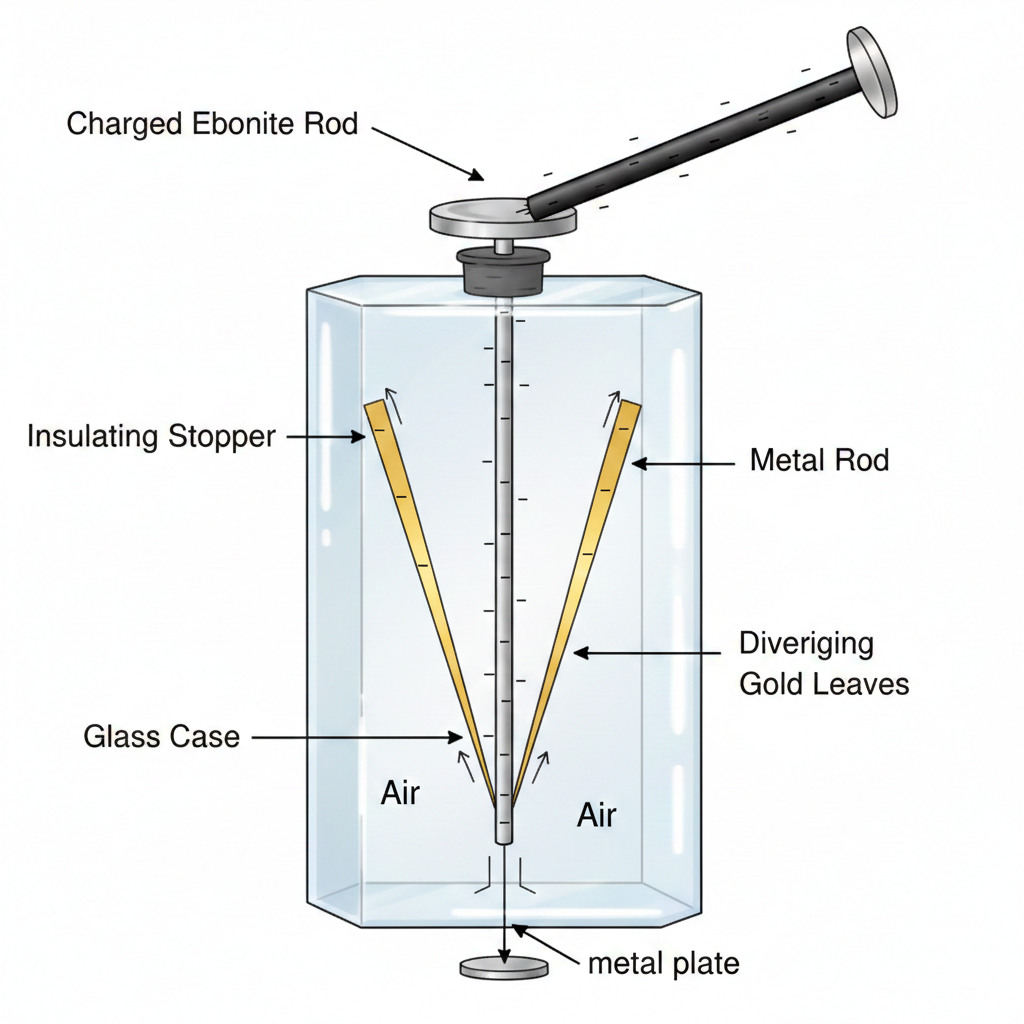
Materials behave differently with these charges. Conductors (like metals, the Earth, or even your body!) allow charges to flow easily. Insulators (like glass or plastic) act like a Bengaluru traffic jam—they offer high resistance and keep charges stuck in one place. To detect if an object is charged, we use a gold-leaf electroscope, where the divergence of thin gold leaves tells us there’s a charge present.
Figure below:
A clear diagram of a gold-leaf electroscope showing a vertical metal rod in a box with two thin gold leaves at the bottom diverging because a charged rod is touching the metal knob at the top.
NEET Checkpoint:
Which of the following is a conductor?
(a) Nylon
(b) Porcelain
(c) Human body
(d) Glass
✅ Answer: (c) Human body — We readily allow the passage of electricity! This is why you get a shock from a car door.
Charge has three "golden rules" (Basic Properties):
1. Additivity: Charges add up like real numbers. If you have $+2$ and $-5$ units, the total is $-3$.
2. Conservation: You can't create or destroy net charge in an isolated system; you just move it around.
3. Quantisation: Charge always comes in fixed packets. The total charge $q$ is always an integral multiple of the basic unit $e$.
Where $e = 1.602 \times 10^{-19} C$.
NEET Checkpoint:
Can a body have a charge of $0.8 \times 10^{-19} C$?
(a) Yes, because charge can have any fractional value
(b) Yes, because electrons can be partially transferred
(c) No, because charge is quantized and must be an integral multiple of ($1.6 \times 10^{-19} C$)
(d) No, because only positive charges are allowed
✅ Answer: (c) No — Charge is quantized and must be an integral multiple of $e$ ($1.6 \times 10^{-19} C$). You can't have half an electron.
Practice Questions:
- A polythene piece rubbed with wool acquires a negative charge of $3 \times 10^{-7} C$. The number of electrons transferred is approximately:
(a) $2 \times 10^{10}$
(b) $2 \times 10^{12}$
(c) $1.87 \times 10^{12}$
(d) $1.5 \times 10^{13}$
✅ Answer: (c) — Using $n = q/e$, we get $3 \times 10^{-7} / 1.6 \times 10^{-19} \approx 1.87 \times 10^{12}$.
2. When a conductor is charged, the excess charge resides:
(a) Entirely inside
(b) On the surface
(c) Only at the centre
(d) Evenly throughout the volume
✅ Answer: (b) — On a conductor, charge readily gets distributed over the entire surface.
Key Takeaway & Formula Summary
- Like charges repel; Unlike charges attract.
- Quantisation of Charge: $q = ne$ (where $n = \pm 1, \pm 2, \dots$ and $e = 1.6 \times 10^{-19} C$).
- Conservation: Total charge of an isolated system is constant.
- Conductors allow charge movement; Insulators do not.
2. Basic Properties of Electric Charge
Hey junior! Ready to master the fundamental fundas of charge? It’s not just random electricity; charge follows some very strict "sanskaars." Let's break them down before your next mock test!
First up is Additivity. Think of charge like your bill at a local dhabba—you just add everything up. Since charge is a scalar, we treat it like a real number. If a system has charges $+q_1, +q_2,$ and $-q_3$, the total charge is simply the algebraic sum. For example, if you have $+2$, $+4$, and $-5$ units, your total is $+1$ unit. Just don't forget the plus and minus signs, yaar!
NEET Checkpoint:
A system has charges $+5 C, +2 C,$ and $-10 C$. What is the total charge?
(a) +17C
(b) −3C
(c) +3C
(d) −17C
✅ Answer:(c) $-3 C$ — Simply add them algebraically: $5 + 2 - 10 = -3 C$. Signs are life!
Next is Conservation. Charge is like the total cash in a group of friends—one might get richer and another poorer, but the total stays the same. In an isolated system, charge is never created or destroyed; it’s only transferred. When you rub a glass rod with silk, electrons just jump from the rod to the silk. No new charge is born!
NEET Checkpoint:
In an isolated system, can the total charge change over time?
(a) Yes
(b) No
✅ Answer: (b) No — The total charge of an isolated system is always conserved.
Finally, we have Quantisation. Nature is "grainy," like buying packets of Maggi—you can't buy half a packet! Every free charge $q$ is an integral multiple of a basic unit $e$.
Here, $n$ is any integer, and $e \approx 1.6 \times 10^{-19} C$. At our big macroscopic level, $e$ is so tiny that charge looks continuous, like a smooth road that is actually made of tiny pebbles.
NEET Checkpoint:
Can a body have a charge of $1.5 e$?
(a) Yes
(b) No
✅ Answer: (b) No — Charge must be an integral multiple of $e$ ($q = ne$).
Practice Questions:
1. Which property of charge tells us that total charge remains constant in an isolated system?
(a) Additivity
(b) Quantisation
(c) Conservation
(d) Polarity
✅ Answer: (c) — Conservation ensures the total charge stays unchanged during any process.
2. How many electrons are approximately present in $-1 C$ of charge?
(a) $1.6 \times 10^{-19}$
(b) $6 \times 10^{18}$
(c) $9 \times 10^{9}$
(d) $1$
✅ Answer: (b) — Using $q = ne$, for $1 C$, $n = 1 / (1.6 \times 10^{-19}) \approx 6 \times 10^{18}$.
Key Takeaway & Formula Summary
- Additivity: $Q_{total} = q_1 + q_2 + ... + q_n$
- Quantisation: $q = ne$
- Basic Unit: $e = 1.602 \times 10^{-19} C$
3. Coulomb's Law and the Superposition Principle
If you have two point charges $q_{1}$ and $q_{2}$ at a distance $r$, Coulomb’s Law is the secret sauce that tells us how much they pull or push each other. The force $F$ is:
where $k = \frac{1}{4\pi\epsilon_{0}}$ is a constant. In vacuum, $k$ is roughly $9 \times 10^{9} \, \text{N m}^{2} \text{C}^{-2}$. This is an inverse square law, meaning if you double the distance, the force becomes one-fourth. Arre, don't forget—this force acts right along the line joining the two charges!.
NEET Checkpoint:
What is the SI unit of the permittivity of free space $\epsilon_{0}$?
(a) $\text{N m}^{2} \text{C}^{-2}$
(b) $\text{C}^{2} \text{N}^{-1} \text{m}^{-2}$
(c) $\text{C} \, \text{m}$
(d) $\text{N/C}$
✅ Answer: (b) $\text{C}^{2} \text{N}^{-1} \text{m}^{-2}$ — Just flip the units of $k$, simple funda!.
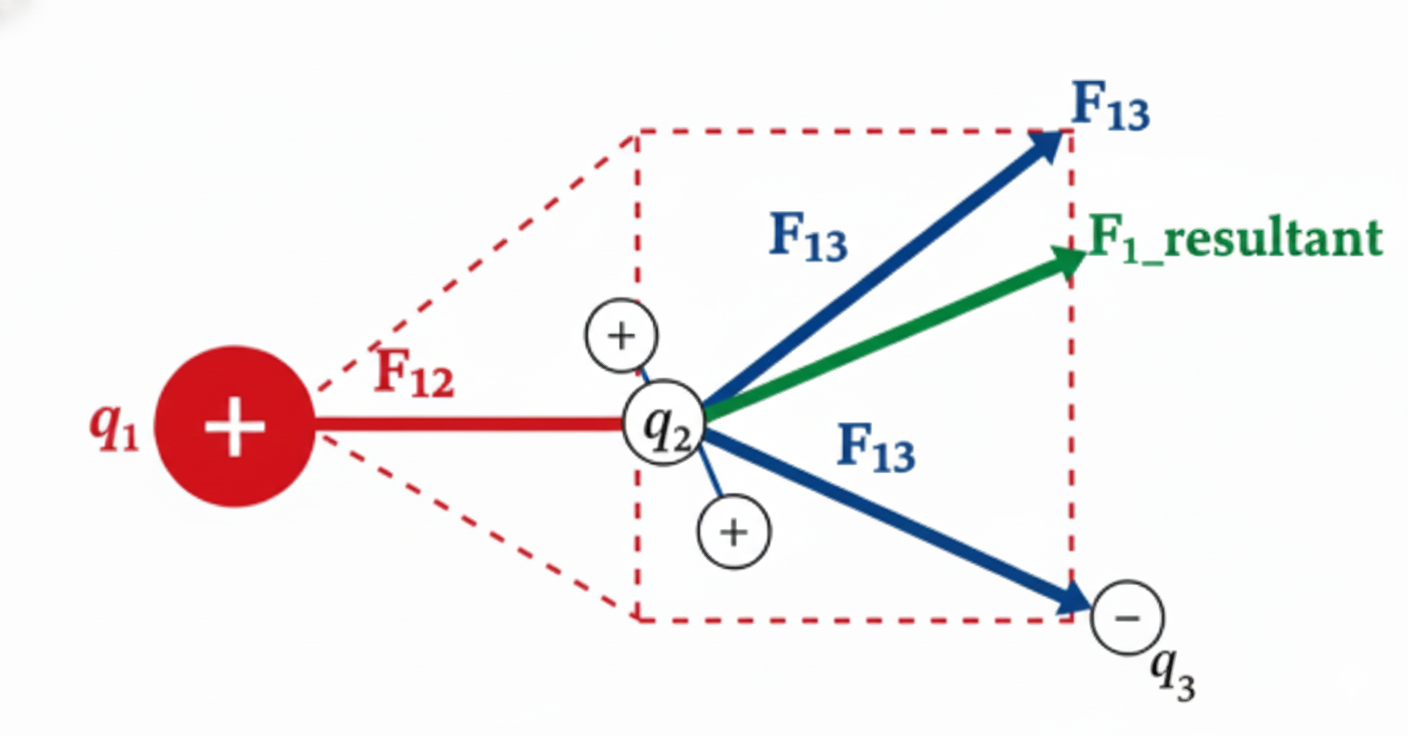
Now, imagine you're at a Pani Puri stall. The 'attraction' you feel toward the golgappa depends on how close you are. But what if there are five stalls? Your total 'craving' is the vector sum of all those pulls. This is the Superposition Principle. The force on one charge due to several others is just the vector sum of all individual forces, and here's the best part: each pair interaction remains totally unaffected by the presence of other charges.
NEET Checkpoint:
If a third charge $q_{3}$ is brought near two charges $q_{1}$ and $q_{2}$, the force between $q_{1}$ and $q_{2}$ will:
(a) Increase
(b) Decrease
(c) Remain unchanged
(d) Become zero
✅ Answer: (c) Remain unchanged — The mutual force between two charges doesn't care about a third wheeler!.
Figure below:
A clear diagram showing three point charges q1, q2, and q3 at different positions, with force vectors F12 and F13 originating from q1 and a resultant vector F1 showing their vector sum.
NEET Checkpoint:
For two like charges, the product $q_{1}q_{2}$ is:
(a) $< 0$
(b) $> 0$
(c) $= 0$
(d) Cannot be determined
✅ Answer: (b) $> 0$ — Like charges (both $+$ or both $-$) always give a positive product and repel each other.
Practice Question:
Two point charges are separated by distance $r$. If the distance is halved, the new force $F'$ becomes:
(a) $2F$
(b) $F/2$
(c) $4F$
(d) $F/4$
✅ Answer: (c) $4F$ — Since $F \propto 1/r^{2}$, halving $r$ means $(1/2)^{2}$ in the denominator, which flips to 4 in the numerator!.
Key Takeaway & Formula Summary
- Coulomb's Law: $F = \frac{1}{4\pi\epsilon_{0}} \frac{q_{1}q_{2}}{r^{2}}$
- Superposition: $\vec{F}{1} = \vec{F}{12} + \vec{F}{13} + \dots + \vec{F}{1n}$
4. Electric Field: The Invisible Force Field!
Listen yaar, have you ever wondered how one charge pushes another without even touching it? It’s not magic; it’s the Electric Field ($E$)!. Think of it as the "influence" a source charge $Q$ spreads everywhere in the surrounding space. When you bring a small test charge $q$ into this "area of influence," it feels an electrostatic force. Arre, it’s just like the aroma of a local pani puri stall; the smell is everywhere (the field), but you only feel the "hunger force" ($F$) when you walk into the street!
The electric field $E$ is a vector quantity, and for a point charge $Q$ at distance $r$, it is defined as:
Here, $\hat{r}$ is the unit vector from the origin to the point. If you know the field, finding the force on any test charge $q$ is a piece of cake:
NEET Checkpoint:
What is the SI unit of Electric Field?
(a) $C/N$
(b) $N/C$
(c) $J/C$
(d) $V/m^2$
✅ Answer: (b) $N/C$ — Simple funda: since $E = F/q$, the unit is Newtons per Coulomb!.
NEET Checkpoint:
Does the electric field $E$ due to a source charge $Q$ depend on the test charge $q$?
(a) Yes
(b) No
✅ Answer: (b) No — The field is a characteristic of the source charge $Q$ and is independent of the $q$ you use to measure it!.
Figure below:
A clear diagram showing a positive point charge with electric field vectors pointing radially outwards and a negative point charge with vectors pointing radially inwards.
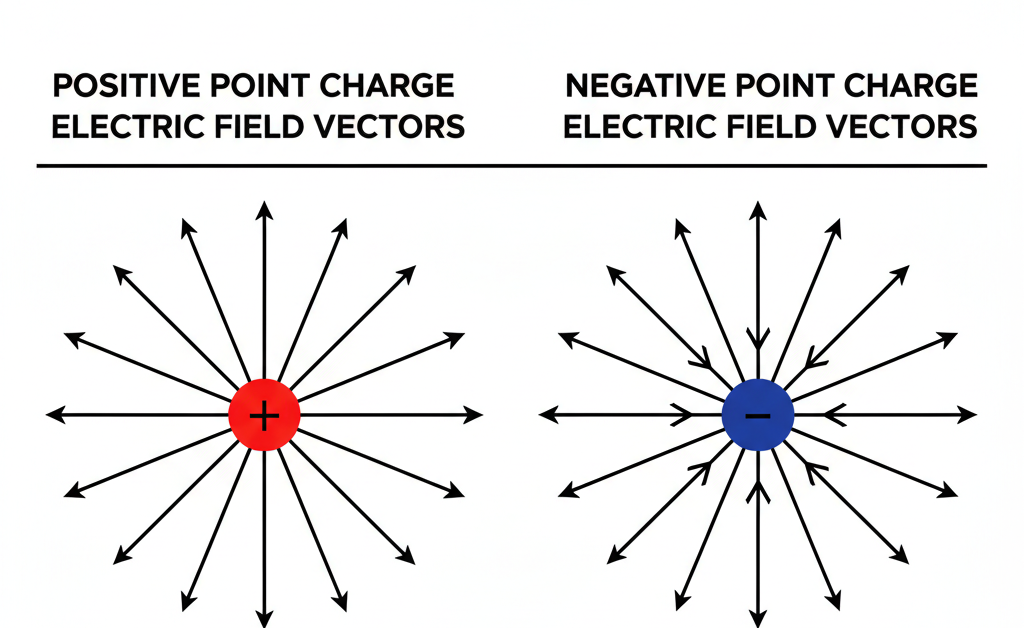
Direction matters, boss! For a positive source charge, the field points radially outwards (like "stay away!"), but for a negative charge, it points radially inwards ("come to me!"). Even the magnitude has spherical symmetry, meaning at the same distance $r$ from $Q$, the strength of $E$ is exactly the same.
NEET Checkpoint:
For a negative source charge, the electric field vector at any point is:
(a) Radially outwards
(b) Radially inwards
(c) Tangential
(d) Zero
✅ Answer: (b) Radially inwards — For $-Q$, the field lines are like a vacuum cleaner, pulling everything towards the centre!.
Practice Questions:
1. If the distance from a point charge is doubled, the electric field strength becomes:
(a) $2E$
(b) $4E$
(c) $E/2$
(d) $E/4$
Explanation: Since $E \propto 1/r^2$, doubling $r$ makes the field $(1/2)^2 = 1/4$ of the original!.
2. A force of $2\times 10^{-3} \text{ } N$ acts on a charge of $1 \mu C$. The electric field intensity is:
(a) $2 \times 10^3 \text{ } N/C$
(b) $2 \text{ } N/C$
(c) $0.5 \times 10^{-3} \text{ } N/C$
(d) $2 \times 10^{-9} \text{ } N/C$
Explanation: Using $E = F/q = (2 \times 10^{-3}) / (1 \times 10^{-6}) = 2 \times 10^3 \text{ } N/C$. Don't forget your powers of 10, yaar!.
Key Takeaway & Formula Summary
- Electric Field (Point Charge):
$$E = \frac{1}{4\pi\epsilon_0} \frac{Q}{r^2} \hat{r}$$- Force on Test Charge: $F = qE$
- Positive $Q$: Field is radially outwards.
- Negative $Q$: Field is radially inwards.
5. Electric Field Due to Systems of Charges and Field Lines
Hey there, junior! Ready to master the "force field" funda? When you have a whole gang of charges instead of just one, don't take tension. The net electric field $\vec{E}$ at any point is simply the vector sum of the fields produced by each individual charge. This is the Superposition Principle in action! Think of it like a cricket match: the total "cheer" at a stadium is the sum of every fan's individual shout.
Mathematically, for $n$ charges, the net field is:
.
Now, how do we "see" this invisible field? We use Electric Field Lines. Imagine them as a map where the tangent at any point shows the direction of the net field there. Also, the density of these lines tells you the strength. If they are crowded, the field is strong—like the rush at a pani puri stall in the evening! If they are spaced out, the field is weak.
NEET Checkpoint:
What does a tangent to an electric field line at any point represent?
(a) Magnitude of the electric field at that point
(b) Direction of the electric field at that point
(c) Path of a negative test charge
(d) Rate of change of electric field
✅ Answer: (b) The direction of the net electric field at that point — It's like the compass needle for charges!.
NEET Checkpoint:
Electric field lines can form closed loops.
(a) True
(b) False
✅ Answer: (b) False — They start at positive and end at negative charges; they don't do U-turns back to the start!.
Remember these golden rules: field lines are continuous curves without breaks, they never cross (because the field can't point in two directions at once!), and they always start from $q > 0$ and end at $q < 0$.
NEET Checkpoint:
If two field lines crossed, what would it imply?
(a) The electric field would have two different directions at the point of intersection
(b) The electric field would become zero at the point of intersection
(c) The magnitude of the electric field would increase suddenly
(d) Electric field lines can cross without any physical meaning
✅ Answer: (a) The field at the intersection would have two directions — Which is totally absurd in physics!.
Practice Question:
Which property of electric field lines is incorrect?
(a) They start at positive charges.
(b) They are continuous in charge-free regions.
(c) They can intersect if the charges are very strong.
(d) Their density indicates field strength.
✅ Answer: (c) — Even if the charges are "super-strong," field lines never cross, yaar!.
Key Takeaway: Field Line Fundas
- Superposition: $\vec{E}{net} = \vec{E}{1} + \vec{E}{2} + ... + \vec{E}{n}$.
- Direction: Given by the tangent to the field line.
- Strength: Indicated by the closeness of lines (crowding = strong).
- No Crossing: Lines never intersect or form closed loops.
6. Continuous Charge Distribution
Listen yaar, up until now, we’ve been dealing with discrete "point" charges. But in the real world—like on a charged metal plate or a long wire—counting every single electron is a total headache!. At the macroscopic level, the "grainy" nature of charge (quantisation) is lost, and it looks like a smooth, continuous distribution, much like a solid line looks continuous even if it’s made of tiny dots.
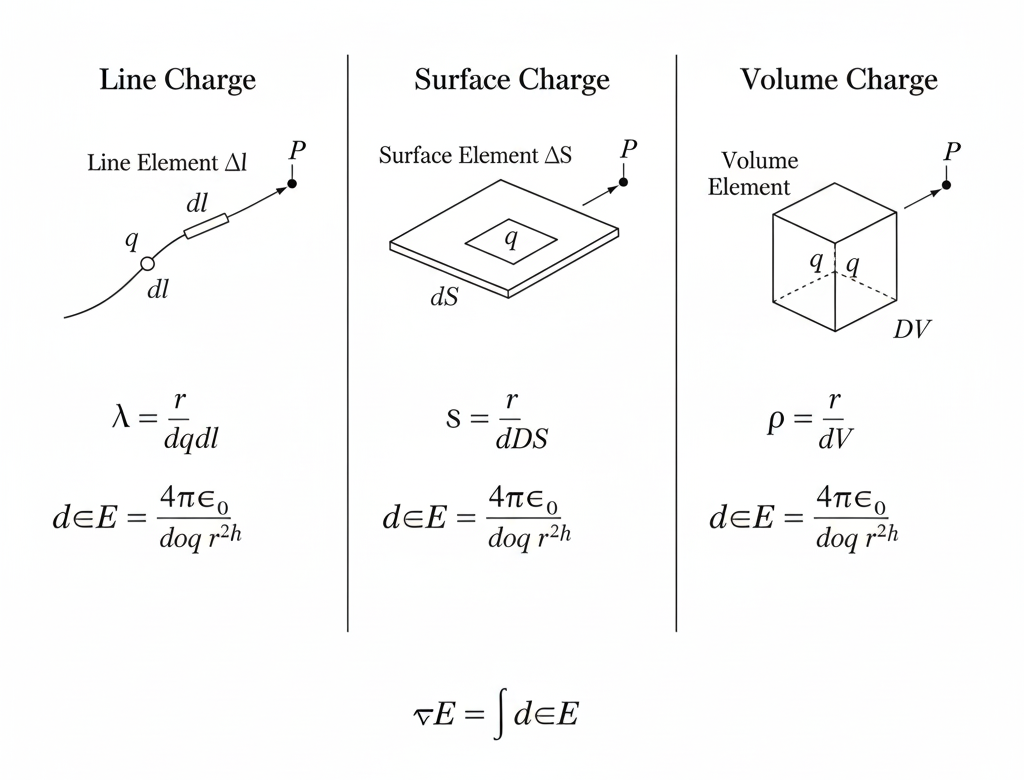
To handle this, we use three types of charge densities:
-
Linear Charge Density ($\lambda$): Used for wires. It’s charge per unit length.
$$\lambda = \frac{\Delta Q}{\Delta l}$$
Measured in $C/m$. Imagine a long, thin string of diwali lights—that’s your linear distribution! -
Surface Charge Density ($\sigma$): Used for sheets or conductor surfaces.
$$\sigma = \frac{\Delta Q}{\Delta S}$$
Measured in $C/m^2$. Think of spreading butter on a hot dosa—the more even the spread, the more "continuous" your $\sigma$ is. -
Volume Charge Density ($\rho$): Used for solid objects.
$$\rho = \frac{\Delta Q}{\Delta V}$$
Measured in $C/m^3$. This is like the stuffing inside a modak—it's everywhere inside the volume!
NEET Checkpoint:
What is the SI unit of surface charge density $\sigma$?
(a) $C/m$
(b) $C/m^2$
(c) $C/m^3$
(d) $C$
✅ Answer: (b) $C/m^2$ — Arre, it's charge per unit area! Just remember the "spread" funda.
To find the total electric field $E$, we divide the body into tiny elements (like a small volume $\Delta V$) and sum up (integrate) their contributions using the superposition principle:
NEET Checkpoint:
At the macroscopic level, quantisation of charge can be:
(a) Ignored
(b) Strictly followed
(c) Doubled
(d) Zero
✅ Answer: (a) Ignored — Because the charges are so enormous, it's like a continuous fluid.
NEET Checkpoint:
Which density is used for a thin charged copper wire?
(a) $\sigma$
(b) $\rho$
(c) $\lambda$
(d) $\epsilon_0$
✅ Answer: (c) $\lambda$ — Length means linear, simple as that!
Figure below:
A clear diagram showing a line element $\Delta l$, a surface element $\Delta S$, and a volume element $\Delta V$ with their respective charge density formulas, illustrating how they contribute to the electric field at a point $P$.
Practice Questions:
If a total charge $Q$ is distributed uniformly over a thin spherical shell of radius $R$, the surface charge density $\sigma$ is:
(a) $Q / (4\pi R^2)$
(b) $Q / (\frac{4}{3}\pi R^3)$
(c) $Q / (2\pi R)$
(d) $Q \cdot R^2$
✅ Answer: (a) — A shell only has surface area, and area of a sphere is $4\pi R^2$.
Key Takeaway & Formula Summary
- Linear ($\lambda$): $Q/L$ in $C/m$
- Surface ($\sigma$): $Q/A$ in $C/m^2$
- Volume ($\rho$): $Q/V$ in $C/m^3$
7. Electric Dipole and Dipole Fields
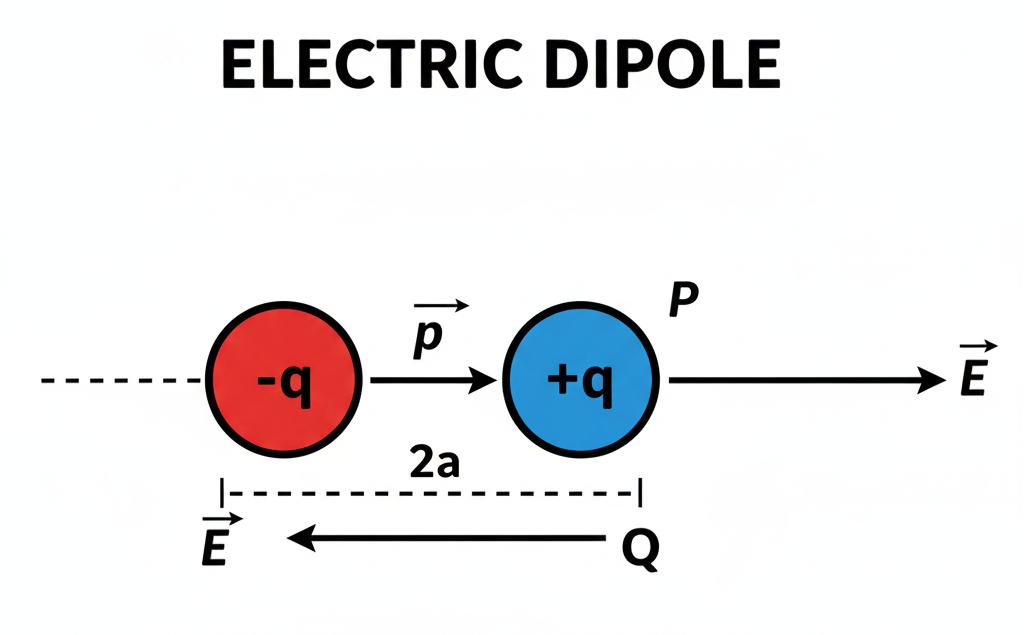
Hey junior! Let’s clear up this dipole funda. Imagine a pair of equal and opposite point charges, $+q$ and $-q$, sitting at a tiny distance $2a$ from each other. While the total charge is zero, don't think the field is zero too! Because the charges are separated, their fields don't perfectly cancel out, especially when you're close by.
We measure this setup using the dipole moment vector $\mathbf{p}$. Its magnitude is $p = q \times 2a$, and by convention, it always points from the negative charge to the positive charge.
Relatable Example: Think of a double-sided drum (dhol) at a wedding. Even if the net "beat" is balanced, the sound coming from each end is distinct because they are separated!
NEET Checkpoint:
What is the net charge of an electric dipole?
(a) +q
(b) −q
(c) Zero
(d) 2q
✅ Answer: (c) Zero — But remember, the resulting electric field is non-zero because the charges are separated.
At large distances ($r \gg a$), the field of a dipole is "shy" and disappears faster than a single charge. While a point charge field follows $1/r^2$, a dipole field falls off as $1/r^3$.
Here are the two "must-know" formulas for $r \gg a$:
1. On the Dipole Axis: The field is in the direction of $\mathbf{p}$:
2. On the Equatorial Plane: The field is opposite to $\mathbf{p}$:
NEET Checkpoint:
At the same large distance $r$, what is the ratio of the axial field to the equatorial field?
(a)1:2
(b)1:1
(c)2:1
(d)4:1
✅ Answer: (c) 2:1 — Just look at the factors in the formulas, yaar!
NEET Checkpoint:
What is the direction of the dipole moment vector?
(a) From negative charge to positive charge
(b) From positive charge to negative charge
(c) Perpendicular to the line joining the charges
(d) Along the equatorial line
✅ Answer: (a) From negative charge ($-q$) to positive charge ($+q$).
Figure below:
A clear diagram of an electric dipole with charges -q and +q separated by distance 2a. Label the dipole moment vector p pointing from -q to +q. Show a point P on the axis and a point Q on the equatorial plane, with arrows indicating the direction of the electric field E at each point.
Humour: A dipole is like that friend who says they have "zero" snacks but then pulls out two different chocolate bars from two different pockets—still a lot of "field" presence!
Practice Question:
How does the electric field of a short dipole vary with distance $r$?
(a) $E \propto 1/r$
(b) $E \propto 1/r^2$
(c) $E \propto 1/r^3$
(d) $E \propto 1/r^4$
✅ Answer: (c) — For a single charge it’s $1/r^2$, but for a dipole, it's $1/r^3$.
Key Takeaway
Formula Summary
* Dipole Moment: $p = 2aq$
* Axial Field ($r \gg a$): $E = \frac{2p}{4\pi\epsilon_0 r^3}$
* Equatorial Field ($r \gg a$): $E = \frac{p}{4\pi\epsilon_0 r^3}$
8. Dipole Torque in a Uniform Electric Field
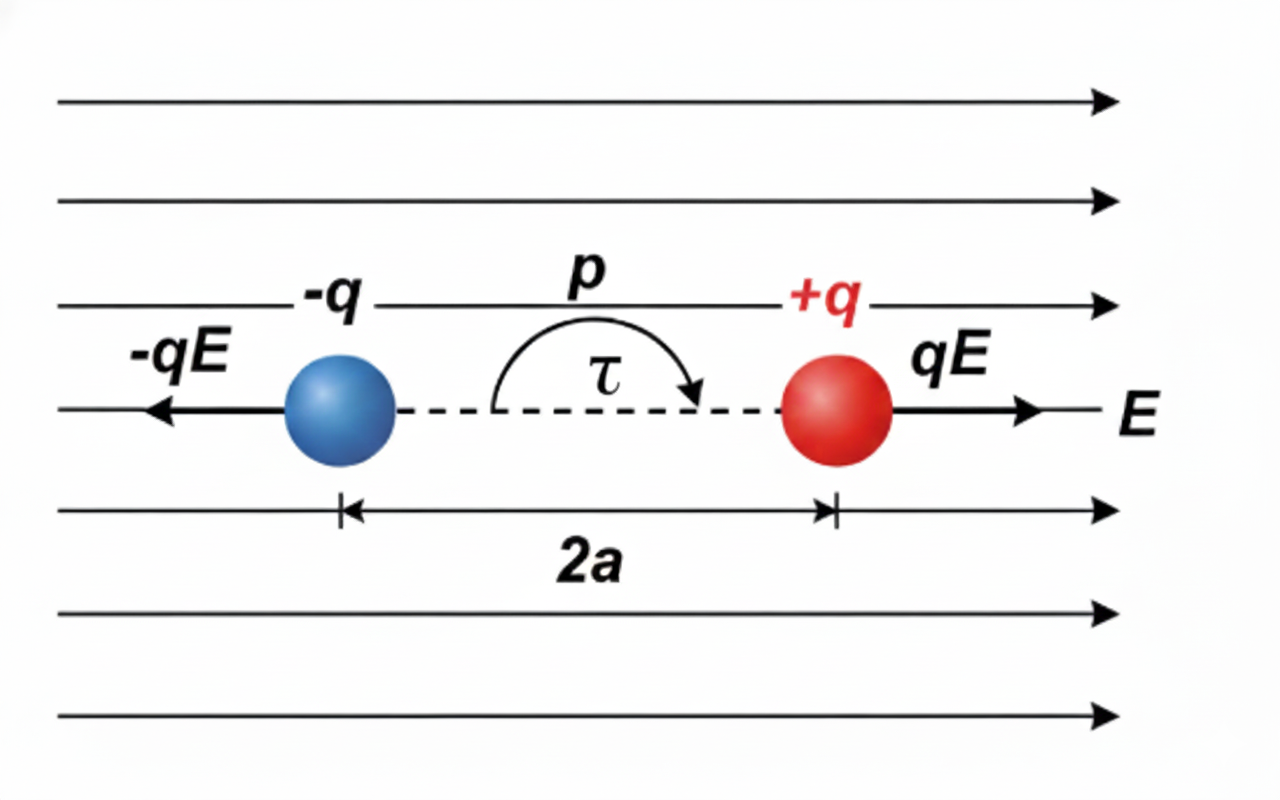
Listen up, junior! Let’s clear up this dipole funda once and for all. Imagine placing an electric dipole in a uniform external electric field $\vec{E}$. Since the field is uniform, the force on $+q$ is $q\vec{E}$ and the force on $-q$ is $-q\vec{E}$. Arre, look closely—the net force is zero because they perfectly cancel out ($F_{net} = 0$).
But don't chill yet! These forces act at different points, creating a "couple." This twisty effect is called torque ($\vec{\tau}$). It’s like trying to turn a cricket bat by pulling one end and pushing the other; the bat won't fly away, but it will definitely spin! The magnitude of this torque is:
Vectorially, we write it as the cross product:
. This torque always tries to align the dipole moment $\vec{p}$ with the field $\vec{E}$.
NEET Checkpoint:
What is the net force on a dipole in a uniform electric field?
(a) $pE$
(b) $2qE$
(c) $0$
(d) $qE \sin \theta$
✅ Answer: (c) 0 — Simple physics, yaar! The forces $+qE$ and $-qE$ are equal and opposite, so they cancel out.
NEET Checkpoint:
Torque on a dipole is maximum when the angle $\theta$ between $\vec{p}$ and $\vec{E}$ is?
(a) $0^\circ$
(b) $45^\circ$
(c) $90^\circ$
(d) $180^\circ$
✅ Answer: (c) $90^\circ$ — Because $\sin 90^\circ = 1$, which is the maximum value for the torque formula.
Relatable Example: Think of a pani puri stall owner twisting a tap. His fingers apply equal and opposite forces at two different points to rotate it. That’s exactly how the electric field treats our dipole!
Now, if the field is non-uniform, things get messy. The dipole will experience a net force in addition to the torque. If $\vec{p}$ is parallel to $\vec{E}$, the dipole is pulled toward the increasing field.
Figure below:
A clear diagram showing a dipole with charges +q and -q separated by distance 2a in a uniform electric field E. Show the force vectors qE and -qE acting at different points, with the angle theta between the dipole moment p and the field E, illustrating the torque.
NEET Checkpoint:
In a non-uniform field, if $\vec{p}$ is antiparallel to $\vec{E}$, the net force is in the direction of?
(a) Increasing field
(b) Decreasing field
(c) Perpendicular to field
(d) Zero
✅ Answer: (b) Decreasing field — When $\vec{p}$ is opposite to $\vec{E}$, it gets pushed toward the weaker side of the field.
Practice Questions:
1. A dipole is placed in a uniform field such that $\vec{p}$ is parallel to $\vec{E}$. The torque acting on it is:
(a) $pE$
(b) $p/E$
(c) $0$
(d) $2pE$
Explanation: Since $\theta = 0^\circ$, $\sin 0^\circ = 0$. So, torque is zero.
2. Which property of a dipole explains why a charged comb attracts neutral bits of paper?
(a) Net charge
(b) Induced dipole moment in non-uniform field
(c) Uniform torque
(d) Quantisation
Explanation: The comb's non-uniform field polarises the paper, and the resulting dipole feels a net force toward the comb.
Key Takeaway
Formula Summary
* Net Force (Uniform $\vec{E}$): $F_{net} = 0$
* Torque: $\vec{\tau} = \vec{p} \times \vec{E}$
* Magnitude: $\tau = pE \sin \theta$
* Non-uniform field: $F_{net} \neq 0$
9. Electric Flux and Gauss's Law
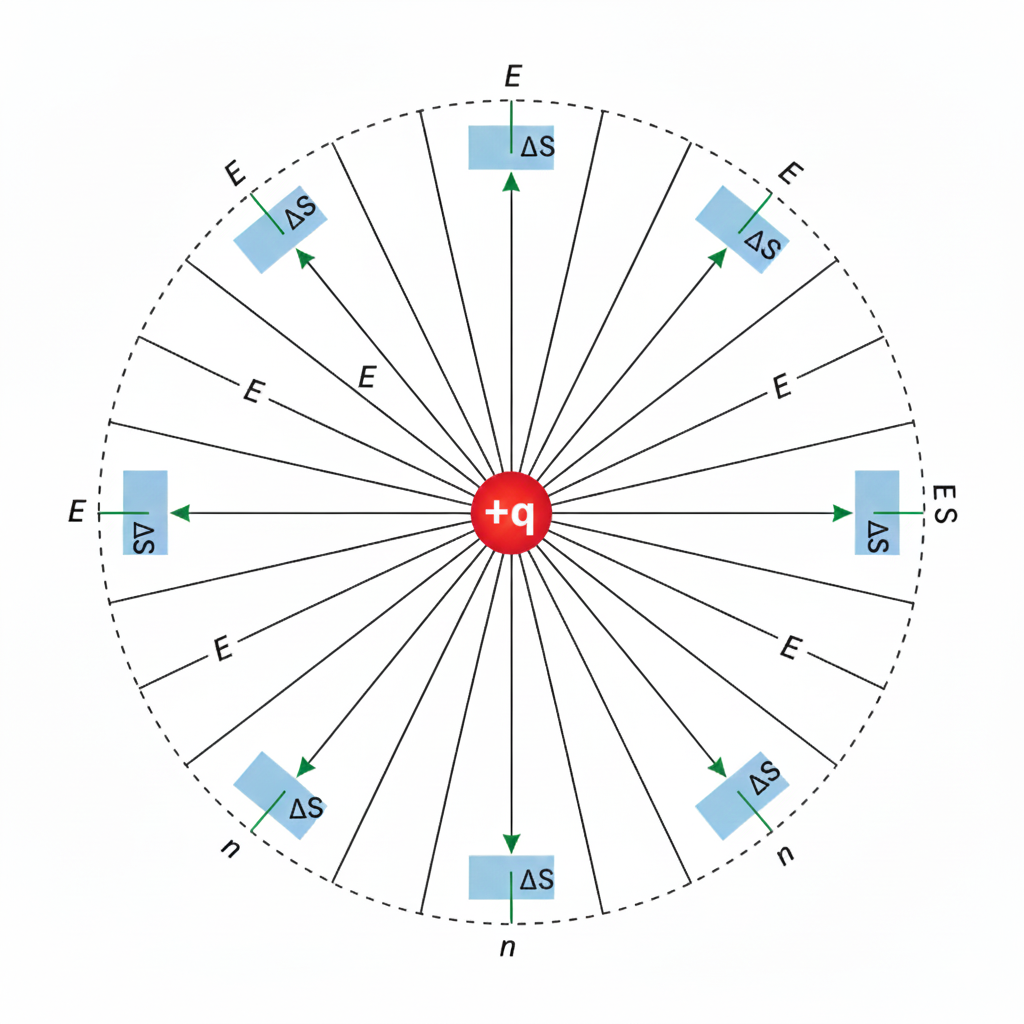
Listen up, junior! We’re about to crack the funda of how electric fields "flow" through space. Imagine you're holding a cricket bat in the rain; the amount of water hitting the flat side depends entirely on how you tilt it. In physics, we call this "flow" Electric Flux ($\Phi$), and it basically measures the number of electric field lines piercing a given area.
The flux $\Delta \phi$ through a tiny area element $\Delta S$ is defined as $\Delta \phi = \mathbf{E} \cdot \Delta \mathbf{S} = E \Delta S \cos \theta$, where $\theta$ is the angle between the field $\mathbf{E}$ and the area's outward normal vector. Now, why should you care? Because of Gauss’s Law—the ultimate shortcut for NEET aspirants!. It states that the total flux $\phi$ through any closed Gaussian surface is simply $\frac{1}{\epsilon_0}$ times the total charge $q$ trapped inside: $\phi = \frac{q}{\epsilon_0}$.
NEET Checkpoint:
If a closed surface encloses an electric dipole, what is the net flux?
(a) $\dfrac{q}{\varepsilon_0}$
(b) $\dfrac{q}{\varepsilon_0}$
(c) Zero
(d) Depends on the orientation of the dipole
✅ Answer: (c) Zero — A dipole has equal $+q$ and $-q$, so the net enclosed charge is $q + (-q) = 0$.
Think of a Pani Puri stall inside a circular tent. The "flux" of hungry students entering depends only on how many spicy plates (charges) are being served inside!. If there’s no plate, no one stays—net flux is zero.
Figure below:
A clear diagram showing a point charge q at the centre of a sphere, with radial electric field lines E passing through small area elements ΔS, where the normal vector n is parallel to the field lines.
NEET Checkpoint:
Flux is maximum when the angle $\theta$ between $E$ and the area normal is?
(a) $0^\circ$
(b) $45^\circ$
(c) $90^\circ$
(d) $180^\circ$
✅ Answer: (a) $0^\circ$ — Arre, because $\cos 0^\circ = 1$, making $\Delta \phi = E \Delta S$.
NEET Checkpoint:
Does the total flux change if you double the radius of the Gaussian sphere?
(a) Yes, it doubles
(b) Yes, it becomes four times
(c) Becomes zero
(d) No, it remains the same
✅ Answer: (d) No — Total flux depends only on the enclosed charge $q$, not the size of the surface.
Don't sweat the complex shapes; if the charge system has symmetry, Gauss's law makes calculating the field a piece of cake!.
Practice Question:
1. A charge $q$ is placed at the centre of a cube. The flux through one face of the cube is:
(a) $\frac{q}{\epsilon_0}$
(b) $\frac{q}{6\epsilon_0}$
(c) $\frac{6q}{\epsilon_0}$
(d) Zero
✅ Answer: (b) — Since the cube is a closed surface, total flux is $\frac{q}{\epsilon_0}$. Because of symmetry, the flux is distributed equally across all 6 faces, so one face gets $\frac{1}{6}$th of it.
Key Takeaway
Formula Summary
* Electric Flux: $\Delta \phi = \mathbf{E} \cdot \Delta \mathbf{S} = E \Delta S \cos \theta$
* Gauss’s Law: $\phi_{total} = \frac{q_{enclosed}}{\epsilon_0}$
* Unit: $\text{N C}^{-1} \text{m}^2$ or $\text{V m}$
10. Gauss's Law Application: Infinite Line and Plane Sheet
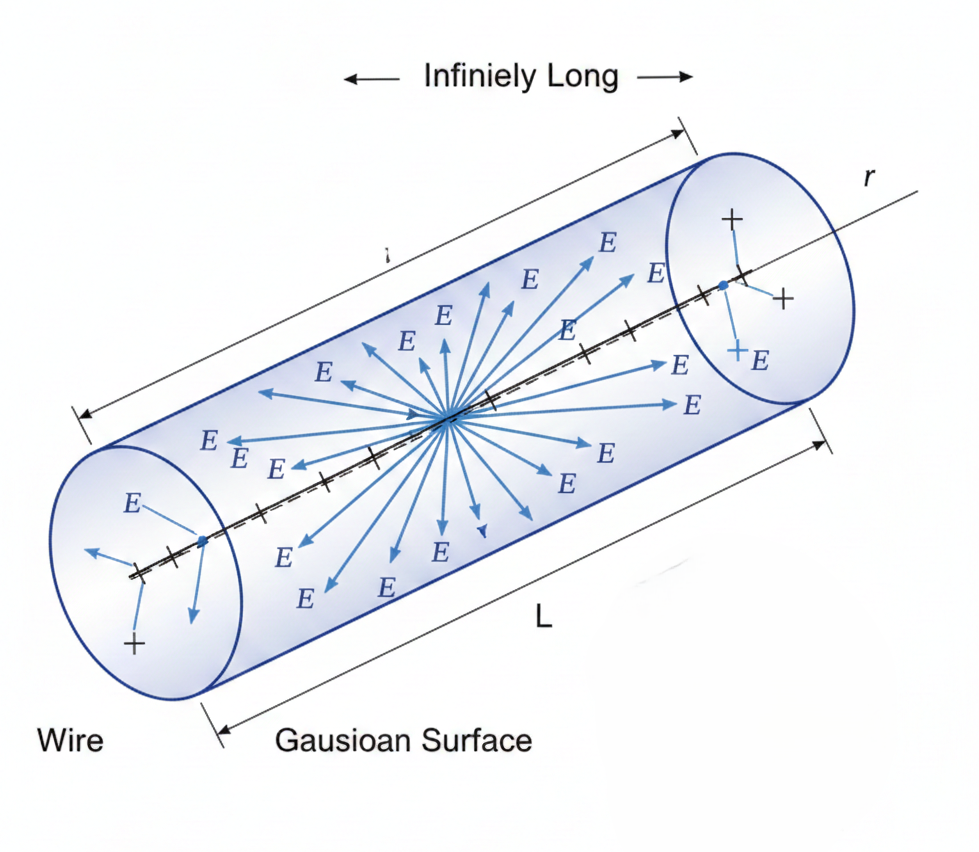
Listen up, future doctors! Let's clear up this Gauss's Law funda for symmetric distributions. First, imagine an infinitely long, straight wire with a uniform linear charge density $\lambda = \frac{\Delta Q}{\Delta l}$. Because the wire is like a never-ending seekh kebab skewer, the electric field $E$ must be radial—pointing directly out or in.
By choosing a cylindrical Gaussian surface of radius $r$ and length $l$, we find that the flux only escapes through the curved sides. Applying Gauss's law gives us the magic formula:
Notice that $E$ depends on $1/r$, so the further you are from the wire, the weaker the field.
NEET Checkpoint:
What is the direction of $E$ if $\lambda < 0$?
(a) Away from the line charge
(b) Towards the line charge
(c) Zero everywhere
(d) Tangential to the line charge
✅ Answer: (b) Radially inward — For negative charges, the field lines always point towards the source!
Now, imagine a giant, flat dosa on an infinite tawa. This is our uniformly charged infinite plane sheet with surface charge density $\sigma = \frac{\Delta Q}{\Delta S}$. Here's the trick: the electric field $E$ is uniform, normal to the plane, and—believe it or not—independent of distance $r$. Using a "pill box" (a rectangular parallelepiped) as our Gaussian surface, we get:
NEET Checkpoint:
Does $E$ change if you move $5\text{ cm}$ away from an infinite sheet?
(a) Yes, it increases
(b) Yes, it decreases
(c) Becomes zero
(d) No, it remains the same
✅ Answer: (d) No — It remains constant because the field is independent of $x$.
NEET Checkpoint:
What is the SI unit for $\sigma$?
(a) C
(b) C/m²
(c) C/m
(d) N/C
✅ Answer: (b) $C/m^2$ — It's just charge divided by area!
Figure below:
A diagram showing an infinitely long charged wire enclosed by a coaxial cylindrical Gaussian surface of radius $r$, with radial electric field vectors $E$ pointing outwards.
Practice Questions:
1. An infinite line charge produces a field of $9 \times 10^4\text{ N/C}$ at a distance of $2\text{ cm}$. What is $\lambda$?
(a) $10^{-7}\text{ C/m}$
(b) $10^{-8}\text{ C/m}$
(c) $10^{-6}\text{ C/m}$
(d) $0.5 \times 10^{-7}\text{ C/m}$
✅ Answer: (a) $10^{-7}\text{ C/m}$ — Use $\lambda = E(2\pi\epsilon_0 r)$. Here $E=9 \times 10^4$ and $r=0.02\text{ m}$.
2. The electric field due to a charged infinite planar sheet is $E$. If the surface charge density is doubled, the new field is:
(a) $E/2$
(b) $2E$
(c) $4E$
(d) $E$
✅ Answer: (b) $2E$ — Since $E = \sigma/2\epsilon_0$, $E$ is directly proportional to $\sigma$.
Key Takeaway
Formula Summary
* Infinite Wire: $E = \frac{\lambda}{2\pi\epsilon_0 r}$ (Field $\propto 1/r$)
* Infinite Sheet: $E = \frac{\sigma}{2\epsilon_0}$ (Field is constant)
11. Gauss's Law Application: Spherical Shell
Hey there, NEET commandos! Ready to clear up the funda of the thin spherical shell? Imagine a hollow plastic cricket ball that's been uniformly charged. This is a classic symmetry problem where Gauss's Law makes our life way easier than trying to sum up every tiny bit of charge, yaar!
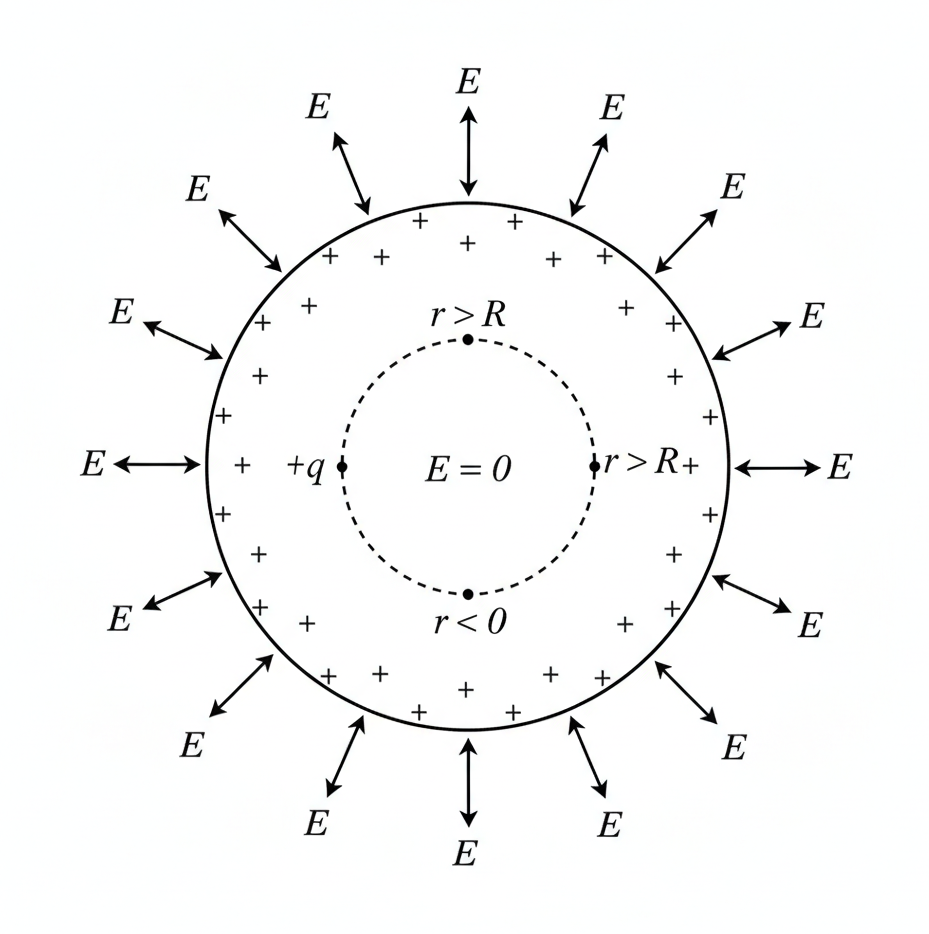
Case 1: Outside the Shell ($r \ge R$)
When you're standing outside, looking at a shell of radius $R$ with total charge $q$, the electric field treats you like you're looking at a single point charge sitting right at the centre. By picking a spherical Gaussian surface of radius $r$, the flux is $E \times 4\pi r^2$. Since all the charge $q$ is trapped inside your Gaussian bubble, the field is:
NEET Checkpoint:
If a shell has charge $q$, what is the field at a distance $r = 2R$?
(a) E = 0
(b) $ E = \dfrac{q}{4\pi\varepsilon_0 R^2}$
(c) $E = \dfrac{q}{8\pi\varepsilon_0 R^2}$
(d) $E = \dfrac{q}{16\pi\varepsilon_0 R^2}$
✅ Answer: (d) $E = \frac{q}{16\pi\epsilon_0 R^2}$ — Just plug $r = 2R$ into the inverse square formula!
Case 2: Inside the Shell ($r < R$)
Now, here’s the magic trick: if you go inside the shell, the electric field is exactly zero ($E = 0$). Why? Because if you draw a Gaussian sphere inside, it encloses zero net charge. No enclosed charge means no flux, which means no field. Even if the shell is pack-full of charge on its surface, the interior is an "electric-free" zone!
NEET Checkpoint:
Does the field change suddenly as you cross the shell surface?
(a) No, it remains continuous
(b) Changes gradually
(c) Becomes infinite
(d) Yes, it changes suddenly
✅ Answer: (d) Yes! It jumps from $0$ (inside) to its maximum value (at the surface).
Think of it like being inside a hollowed-out Laddu—all the sweetness (charge) is on the crust, but the hollow middle is totally empty.
NEET Checkpoint:
What is the direction of $E$ for a shell with $q < 0$?
(a) Away from the shell
(b) Tangential to the shell
(c) Zero everywhere
(d) Towards the shell
✅ Answer: (d) Radially inward — For negative charges, the field lines point toward the centre.
Figure below:
A clear diagram showing a thin spherical shell of radius R with charge +q on its surface. Draw two concentric dotted circles representing Gaussian surfaces: one with radius r > R and one with radius r < R. Use arrows to show the radial electric field pointing outwards for the outer surface and show E = 0 inside.
Practice Questions:
A thin spherical shell of radius $10$ cm has a charge of $5 \mu C$. What is the electric field at a point $5$ cm from the centre?
(a) $4.5 \times 10^6 N/C$
(b) $9 \times 10^6 N/C$
(c) Zero
(d) $2.25 \times 10^6 N/C$
✅ Answer: (c) Zero — $5$ cm is less than the radius ($10$ cm), so the point is inside the shell where the field is always zero!.
Key Takeaway
Formula Summary: The Shell Secret
* Inside ($r < R$): $E = 0$
* Outside ($r \ge R$): $E = \frac{q}{4\pi\epsilon_0 r^2}$
* Total Charge: $q = 4\pi R^2 \sigma$
12. Electric Potential, Difference, and Equipotential Surfaces
Listen up, juniors! Let’s clear up this electrostatic potential funda. Think of it as the work you’d do dragging a unit positive charge all the way from infinity to a specific point. If you're moving between two local points, say $R$ and $P$, that "work per unit charge" is your potential difference, denoted as $V_P - V_R$.
NEET Checkpoint:
If potential at infinity is zero, what is the work done to bring $1~C$ to a point where potential is $5~V$?
(a) $1~J$
(b) $5~J$
(c) $0~J$
(d) $10~J$
✅ Answer: (b) $5~J$ — Arre, it’s simple! $W = qV = 1 \times 5 = 5~J$.
For a point charge $Q$, the potential at distance $r$ is $V = \frac{1}{4\pi\epsilon_0} \frac{Q}{r}$. It decays slowly as $1/r$, but a dipole is much more aggressive, falling off as $1/r^2$ at large distances. Imagine a rickshaw fare: a point charge is a standard meter, but a dipole is like a "night charge" that drops the value much faster as you move away!
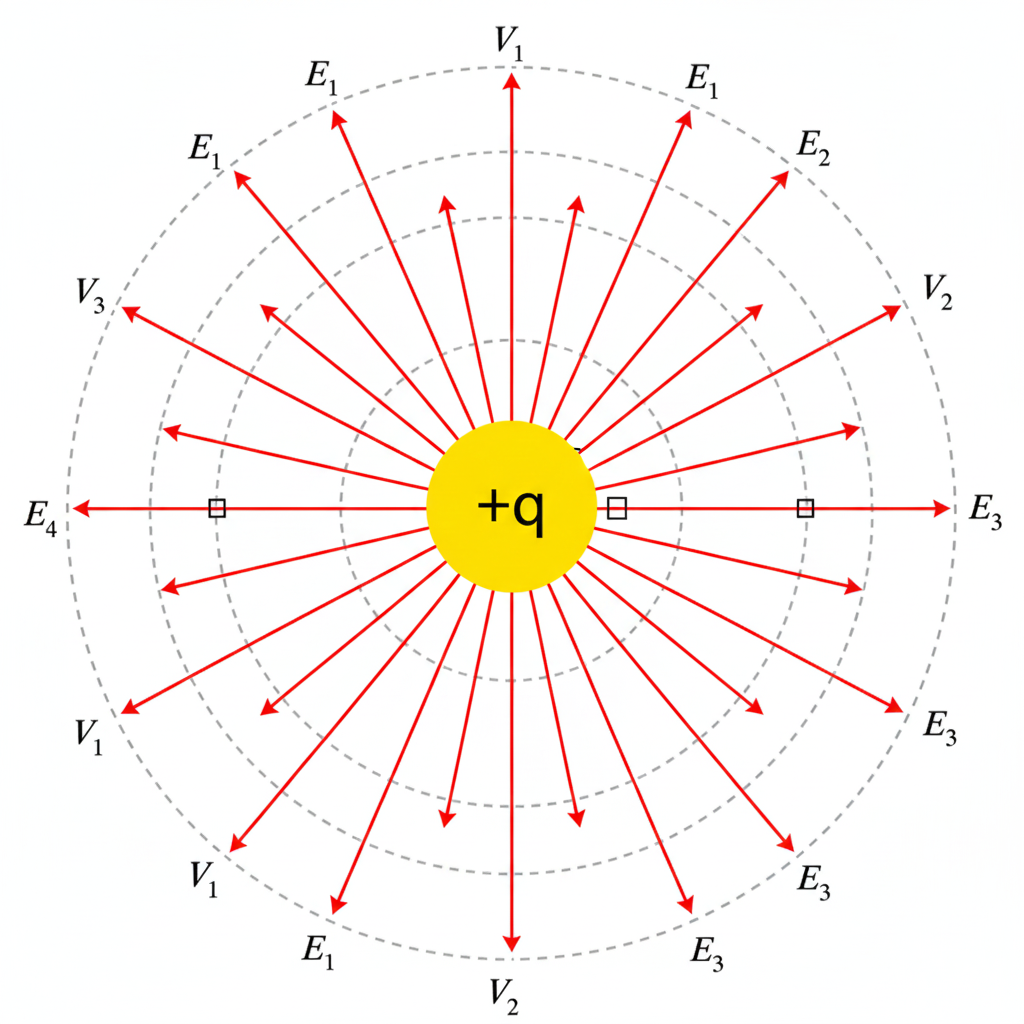
Equipotential surfaces are the "chill zones" where potential $V$ is constant everywhere. Moving a charge on these surfaces is like walking on a flat cricket pitch—no work is required because there's no potential difference. Crucially, the electric field $E$ is always a "normal" guy—it stays perpendicular to these surfaces and points exactly where the potential drops the fastest.
NEET Checkpoint:
What is the angle between the electric field and an equipotential surface?
(a) $0^{\circ}$
(b) $45^{\circ}$
(c) $90^{\circ}$
(d) $180^{\circ}$
✅ Answer: (c) $90^{\circ}$ — Always! If it weren't normal, you'd have to do work to move along the surface.
Figure below:
A clear diagram showing a point charge at the centre with concentric dashed circles representing equipotential surfaces and solid radial lines representing the electric field $E$ intersecting them at $90^{\circ}$ angles.
NEET Checkpoint:
How does the potential of an electric dipole vary with distance $r$ at large distances?
(a) $V \propto 1/r$
(b) $V \propto 1/r^2$
(c) $V \propto 1/r^3$
(d) $V \propto r^2$
✅ Answer: (b) $V \propto 1/r^2$ — Don't confuse this with the point charge's $1/r$!
Practice Questions:
1. The potential at a distance $r$ from a point charge is $10~V$. What is the potential at $2r$?
(a) $20~V$
(b) $5~V$
(c) $2.5~V$
(d) $10~V$
✅ Answer: (b) Since $V \propto 1/r$, doubling the distance halves the potential. So, $10/2 = 5~V$.
2. Work done in moving a $2~\mu C$ charge across an equipotential surface of $50~V$ for $5~cm$ is:
(a) $100~\mu J$
(b) $250~\mu J$
(c) Zero
(d) $10~mJ$
✅ Answer: (c) Don't get tricked by the numbers! On an equipotential surface, $\Delta V = 0$, so $W = q\Delta V = 0$.
Key Takeaway
Formula Summary
- Point Charge Potential:$$V = \frac{1}{4\pi\epsilon_0} \frac{Q}{r}$$
- Dipole Potential ($r \gg a$): $V = \frac{1}{4\pi\epsilon_0} \frac{p \cdot \hat{r}}{r^2}$
- Field-Potential Relation: $|E| = \frac{|\delta V|}{\delta l}$
- Units: $1~V = 1~J/C$ or $1~V~m^{-1} = 1~N/C$
13. Electrostatic Potential Energy (Systems and External Fields)
Listen up! Electrostatic potential energy ($U$) is essentially the total work you—the external agency—must do to bring charges from infinity and assemble them into a specific configuration. Since the Coulomb force is conservative, this work isn't lost but gets stored as potential energy. For a simple duo of charges $q_1$ and $q_2$ separated by a distance $r_{12}$, the energy of the system is given by:
If you have a whole squad of multiple charges, the total $U$ is simply the sum of the potential energies of every distinct pair you can form in the group.
NEET Checkpoint:
Does the work done to assemble a charge configuration depend on the path taken?
(a) Yes, it depends on the path
(b) Depends on the speed of assembly
(c) Depends on the medium
(d) No, it is independent of the path
✅ Answer: (d) No — Because the electrostatic field is conservative, work done depends only on the initial and final positions.
Now, imagine there's already an external field $E$ with a potential $V(r)$. Bringing a single charge $q$ into this "pre-heated" field costs you $qV(r)$ in work. Let's clear up this funda with a local example: imagine you are trying to park two scooters ($q_1$ and $q_2$) in a parking lot that is on a slope (the external field). You will do work against the slope for both scooters individually, plus the work needed to keep them at a distance $r_{12}$ from each other because they might repel!.
NEET Checkpoint:
What is the potential energy of a $2\mu C$ charge at a point where the external potential is $10 V$?
(a) $200 \mu J$
(b) $20 \mu J$
(c) $2 \mu J$
(d) $20 \ J$
✅ Answer: (b) $20 \mu J$ — Use the formula $U = qV(r)$, so $2 \times 10^{-6} \times 10 = 20 \times 10^{-6} J$.
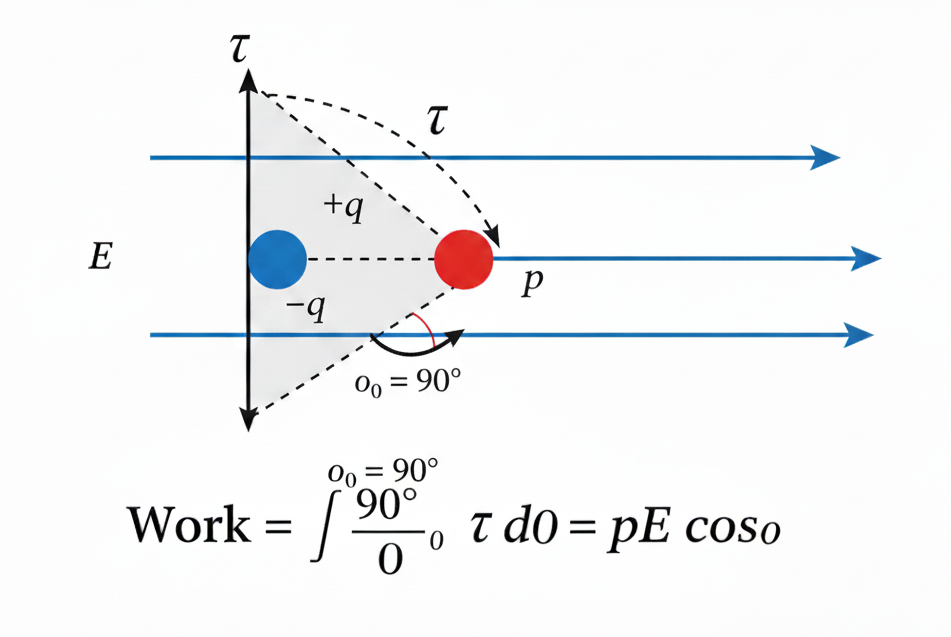
For a dipole $p$ sitting in a uniform field $E$, the potential energy depends on its orientation $\theta$:
NEET Checkpoint:
At what angle is a dipole in "stable equilibrium" with minimum energy?
(a) $\theta = 0^\circ$
(b) $\theta = 180^\circ$
(c) $\theta = 90^\circ$
(d) $\theta = 45^\circ$
✅ Answer: $\theta = 0^\circ$ — When $p$ is parallel to $E$, $U = -pE$, which is the lowest energy state.
Figure below:
A clear diagram showing an electric dipole with charges $+q$ and $-q$ at an angle $\theta$ to a uniform external electric field $E$, highlighting the work done to rotate it from $\theta_0 = 90^\circ$ to $\theta$.
Practice Questions:
A system of two charges $7\mu C$ and $-2\mu C$ are placed $18 cm$ apart with no external field. What is the potential energy?
(a) $0.7 J$
(b) $-0.7 J$
(c) $1.4 J$
(d) $-1.4 J$
✅ Answer: (b) $-0.7 J$ — Arre, don't forget the negative sign for unlike charges! $U = (9 \times 10^9 \times 7 \times 10^{-6} \times -2 \times 10^{-6}) / 0.18 = -0.7 J$.
Key Takeaway
Formula Summary
* Two Charges: $U = \frac{1}{4\pi\epsilon_0} \frac{q_1 q_2}{r}$.
* In External Field: $U = qV(r)$.
* Electric Dipole: $U = -p \cdot E = -pE \cos \theta$.
14. Electrostatics of Conductors, Dielectrics, and Polarisation
Hey junior! Let’s clear up this funda: why do we feel safe inside a car during lightning, but a tree is a big "no-no"? It’s all about how materials handle electric fields. Conductors are like social butterflies—their charges move freely until the internal electric field $E$ becomes zero. Any excess charge you give them simply rushes to the surface, like fans crowding the boundary of a cricket stadium. Inside, the electrostatic potential $V$ is constant, so moving a charge inside is as effortless as walking on a flat pitch.
NEET Checkpoint:
What is the electric field inside a cavity of a charged conductor?
(a) Zero
(b) Non-zero constant
(c) Varies with position
(d) Infinite
✅ Answer: (a) Zero — This is called electrostatic shielding; the interior is protected from any external electrical mess.
Just outside the conductor, the field is always normal to the surface. Its magnitude is given by:
where $\sigma$ is the surface charge density.
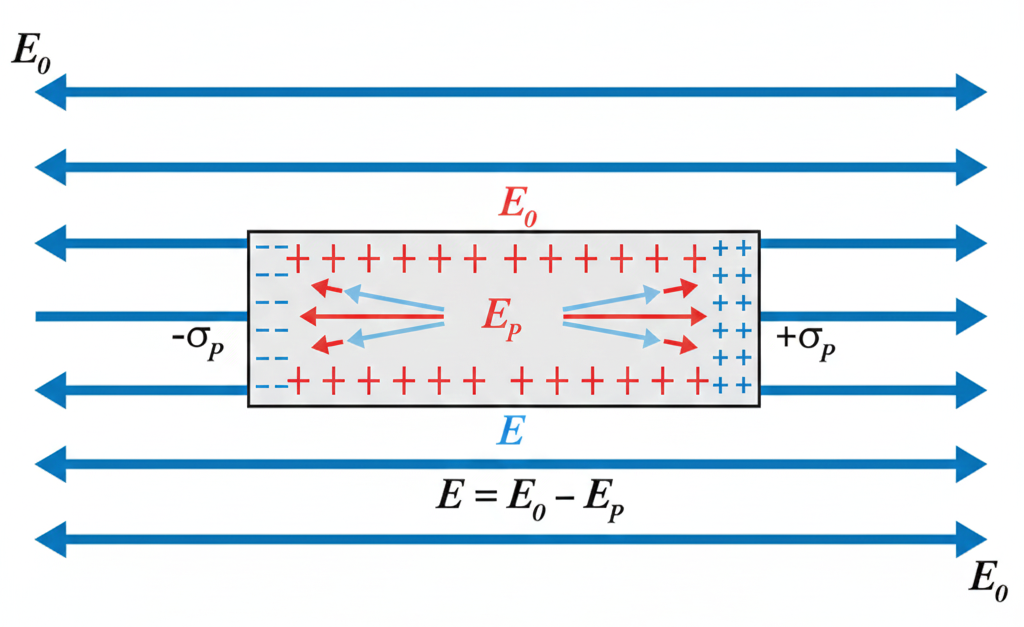
Now, meet the dielectrics. These are the "introverts" (non-conductors) with almost no free-moving charges. When you apply an external field $E_0$, they don't cancel it out completely. Instead, they polarise—the molecules either stretch (non-polar) or align (polar) to create a tiny internal field that opposes and reduces the net field.
Figure below:
A diagram showing a rectangular dielectric slab placed in a uniform external electric field E0. Inside the slab, molecular dipoles are aligned with the field, creating induced surface charges -σp and +σp on the left and right faces respectively, with a reduced net field E inside.
NEET Checkpoint:
Which molecules have a permanent dipole moment even without an external field?
(a) Non-polar molecules
(b) Symmetrical molecules
(c) Polar molecules
(d) Noble gas molecules
✅ Answer: (c) Polar molecules (e.g., $H_2O$, $HCl$) — Their centres of positive and negative charges don't coincide naturally.
NEET Checkpoint:
What is the relation for polarisation $P$ in linear isotropic dielectrics?
(a) ${P} = \varepsilon_0 \vec{E}$
(b) ${P} = \varepsilon_0 \chi_e \vec{E}$
(c) ${P} = \chi_e \vec{E}$
(d) ${P} = \dfrac{\vec{E}}{\varepsilon_0}$
✅ Answer: (b) $P = \epsilon_0 \chi_e E$ — where $\chi_e$ is the electric susceptibility.
Practice Questions:
1. A conductor is placed in an external electric field. In the static situation, the net charge density inside the conductor is:
(a) Positive
(b) Negative
(c) Zero
(d) Depends on the external field
✅ Answer: (c) Zero — Gauss’s law proves that all excess charge must reside only on the surface.
2. Unlike a conductor, when a dielectric is placed in an external field, the induced field:
(a) Exactly cancels the external field
(b) Is zero
(c) Only reduces the external field
(d) Increases the external field
✅ Answer: (c) Only reduces the external field — Charges in a dielectric aren't free to move far enough to cancel it completely.
Key Takeaway:
Conductor vs Dielectric
- Conductors: Internal $E = 0$, $V = \text{constant}$, charge stays on surface.
- Dielectrics: Net field is reduced due to Polarisation ($P$).
- Shielding: Cavities in conductors are field-free zones.
15. Capacitors, Combinations, and Energy Storage
Don't stress, yaar—this topic is a total scoring opportunity! Let’s clear up this funda: a capacitor is simply a system of two conductors separated by an insulator. We usually give them charges $Q$ and $-Q$, creating a potential difference $V$ between them. The "storage capacity" or capacitance $C$ is the ratio $C = \frac{Q}{V}$. Notice this: $C$ depends purely on the geometry (shape, size, separation) of the conductors, not on the charge itself.
NEET Checkpoint:
If you double the charge $Q$ on a capacitor, what happens to its capacitance $C$?
(a) Doubles
(b) Halves
(c) Becomes four times
(d) Remains unchanged
✅ Answer: (d) It remains unchanged — $C$ is a constant for a given geometry; $V$ simply doubles along with $Q$.
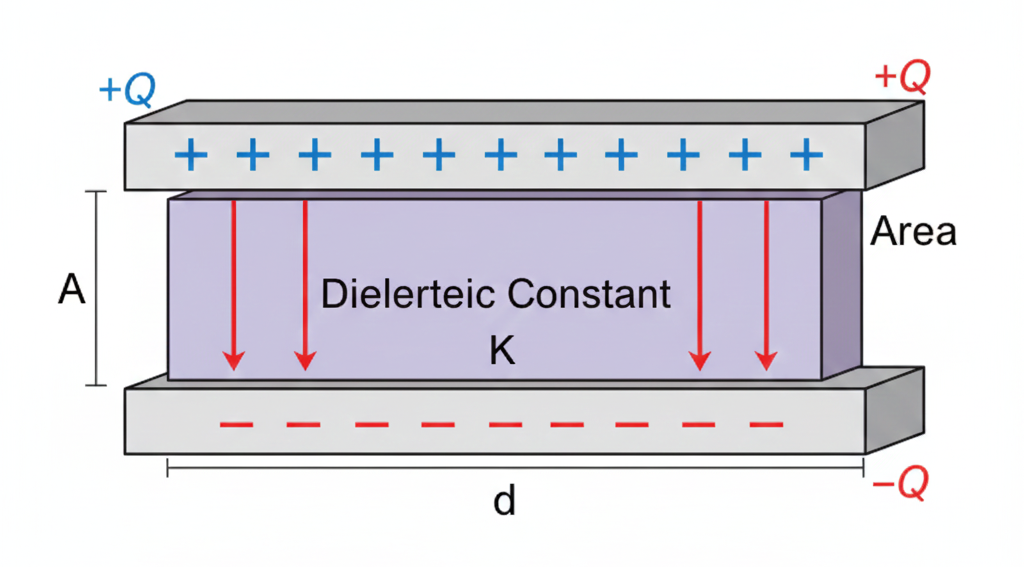
For a parallel plate capacitor in vacuum, the formula is a classic:
where $A$ is the area and $d$ is the separation. Imagine a Pani Puri stall where the plates are like two large, flat counters. If you slide a dielectric (insulator) with constant $K$ between them, the capacitance increases to $C = KC_0$. It’s like adding a high-speed server to a buffet; it suddenly holds way more charge at the same potential!
Figure below:
A clear diagram showing two parallel conducting plates with area $A$ and separation $d$, holding charges $+Q$ and $-Q$, with a dielectric slab of constant $K$ completely filling the space between them.
NEET Checkpoint:
Which property of a parallel plate capacitor decreases when a dielectric is inserted (with no battery connected)?
(a) Charge on the capacitor
(b) Capacitance
(c) Potential difference between the plates
(d) Electric flux linked with the plates
✅ Answer: (c) Potential difference ($V$) — because $V = \frac{V_0}{K}$ while $Q$ stays constant.
When it comes to combinations, keep the logic simple:
* Series: Like a single-lane road in Mumbai traffic, the charge $Q$ is the same on each capacitor, and the reciprocals add up:
* Parallel: Like multiple ticket counters at a cinema, the potential $V$ is the same, and you just sum them:
NEET Checkpoint:
You have two $10~\mu F$ capacitors. What is the max capacitance you can get?
(a) $5~\mu F$
(b) $10~\mu F$
(c) $15~\mu F$
(d) $20~\mu F$
✅ Answer: (d) $20~\mu F$ — by connecting them in parallel ($10 + 10 = 20$).
Finally, capacitors store energy $U$ in their electric field, given by $U = \frac{1}{2}CV^2$ or $\frac{Q^2}{2C}$. The energy density (energy per unit volume) is $u = \frac{1}{2}\epsilon_0 E^2$.
Practice Questions:
A $900~pF$ capacitor is charged by a $100~V$ battery. How much energy is stored?
(a) $4.5 \times 10^{-6}~J$
(b) $9 \times 10^{-6}~J$
(c) $2.25 \times 10^{-6}~J$
(d) $4.5~J$
✅ Answer: (a) — Using $U = \frac{1}{2}CV^2 = \frac{1}{2} \times 900 \times 10^{-12} \times 100^2 = 4.5 \times 10^{-6}~J$.
Now that you've got this, wait till you see how these fields behave in different materials!
Key Takeaway
Formula Summary
* Capacitance: $C = \frac{Q}{V}$
* Parallel Plate: $C = \frac{\epsilon_0 A}{d}$ (Vacuum), $C = \frac{K\epsilon_0 A}{d}$ (Dielectric)
* Series: $\frac{1}{C_{eq}} = \sum \frac{1}{C_i}$ | Parallel: $C_{eq} = \sum C_i$
* Energy: $U = \frac{1}{2}CV^2 = \frac{Q^2}{2C}$
* Energy Density: $u = \frac{1}{2}\epsilon_0 E^2$