
1. Introduction to Electromagnetic Waves
Hey there, future doctors! Ready to see how light is just a fancy mix of electricity and magnetism? Let’s clear up this funda. Back in the day, Maxwell noticed that Ampere's law had a little missing piece when charging a capacitor. He realised a changing electric field acts just like a current, which he dubbed the displacement current, $i_d = \epsilon_0 (d\Phi_E/dt)$. This was the "missing link" that unified electricity, magnetism, and light into one beautiful family.
NEET Checkpoint:
What is the source of a displacement current?
(a) A steady electric field
(b) A time-varying electric flux
(c) Stationary charges
(d) Uniformly moving charges
✅ Answer: (b) — Only a changing flux creates this "hidden" current.
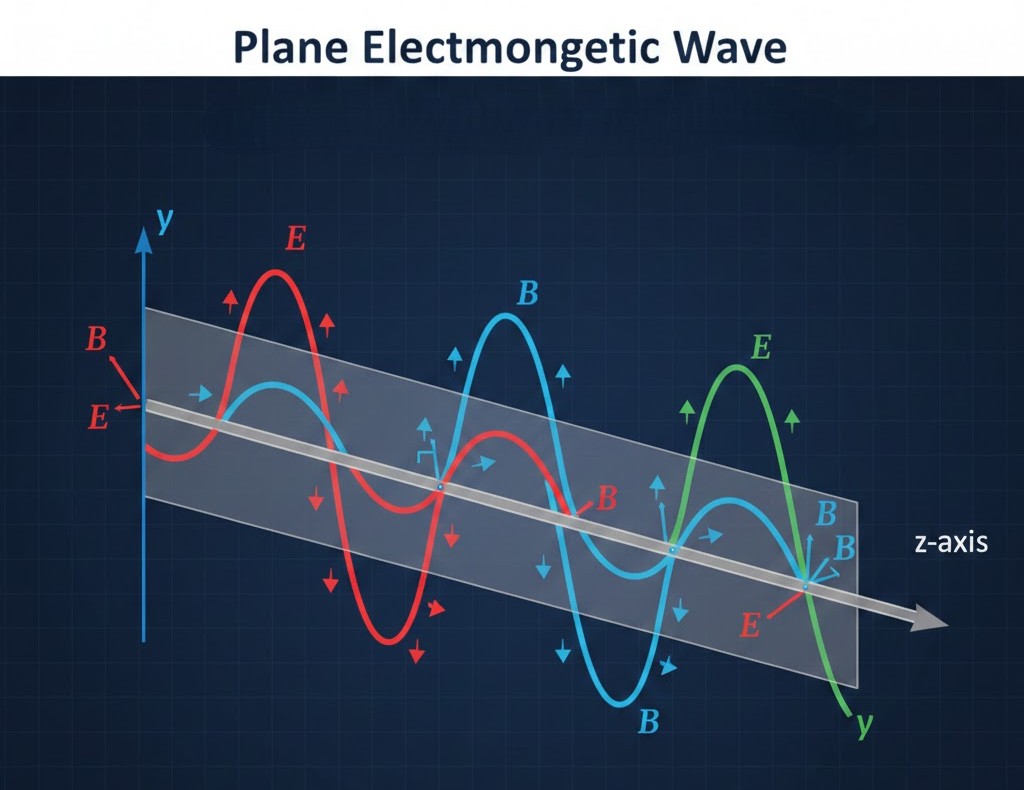
Now, how do we "make" these waves? You can't just have a charge sitting around like a student bunking class! Only accelerated charges (like an oscillating charge) can radiate electromagnetic waves. Imagine a rickshaw jerky-starting in Old Delhi traffic—that "acceleration" is what sends ripples through the fields. These waves are transverse, meaning the electric field $\mathbf{E}$ and magnetic field $\mathbf{B}$ oscillate perpendicular to each other and to the direction of travel.
NEET Checkpoint:
If an EM wave travels in the $z$-direction, what are the directions of $\mathbf{E}$ and $\mathbf{B}$?
(a) Both in $z$
(b) $x$ and $y$
(c) Both in $x$
(d) $y$ and $z$
✅ Answer: (b) — They must be perpendicular to the propagation direction ($z$) and each other!.
Figure below:
A 3D diagram showing a sinusoidal electric field wave oscillating along the x-axis and a sinusoidal magnetic field wave oscillating along the y-axis, both propagating together along the z-axis.
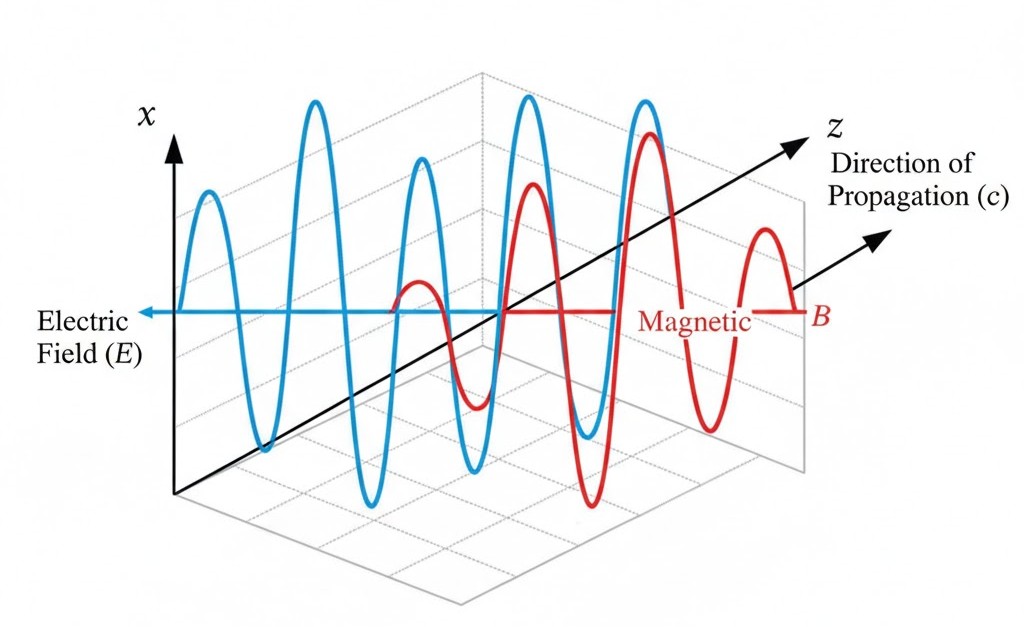
The speed of these waves in vacuum is a universal constant, $c = 1/\sqrt{\mu_0\epsilon_0}$, which is about $3 \times 10^8 \, m/s$. This matches the speed of light, proving light is an EM wave! In a medium like glass, the speed $v$ changes based on the medium's permittivity $\epsilon$ and permeability $\mu$ as $v = 1/\sqrt{\mu\epsilon}$.
NEET Checkpoint:
The ratio of the amplitudes of the electric and magnetic fields ($E_0/B_0$) in vacuum is:
(a) $c$
(b) $1/c$
(c) $c^2$
(d) $\sqrt{c}$
✅ Answer: (a) — Easy-peasy! $E_0/B_0 = c$ is the standard relation.
From the laboratory sparks of Hertz to the short-wave experiments of Jagdish Chandra Bose in Calcutta and Marconi’s long-distance radio, these waves now run our world. The EM spectrum covers everything from massive radio waves (used for your favourite FM channels) to tiny, high-energy $\gamma$-rays. It's like a vast Indian buffet—different "flavours" (frequencies) but all made of the same EM ingredients!
Practice Questions:
1. An oscillating charge with frequency $10^9 \, Hz$ produces an EM wave. What is the frequency of the wave?
(a) $2 \times 10^9 \, Hz$
(b) $10^9 \, Hz$
(c) $0.5 \times 10^9 \, Hz$
(d) $10^{18} \, Hz$
✅ Answer: (b) — The wave always inherits the frequency of its source.
2. Which scientist first experimentally demonstrated the existence of EM waves?
(a) Maxwell
(b) Marconi
(c) Hertz
(d) Bose
✅ Answer: (c) — Maxwell predicted them, but Hertz was the one who actually "caught" them in the lab in 1887.
Key Takeaway & Formula Summary
- Displacement Current: $i_d = \epsilon_0 \frac{d\Phi_E}{dt}$
- Source: Accelerated/oscillating charges
- Speed in Vacuum: $c = \frac{1}{\sqrt{\mu_0\epsilon_0}} \approx 3 \times 10^8 \, m/s$
- Speed in Medium: $v = \frac{1}{\sqrt{\mu\epsilon}}$
- Field Relation: $E_0/B_0 = c$
- Nature: Transverse; $\mathbf{E} \perp \mathbf{B} \perp$ direction of propagation.
2. The Need for Displacement Current
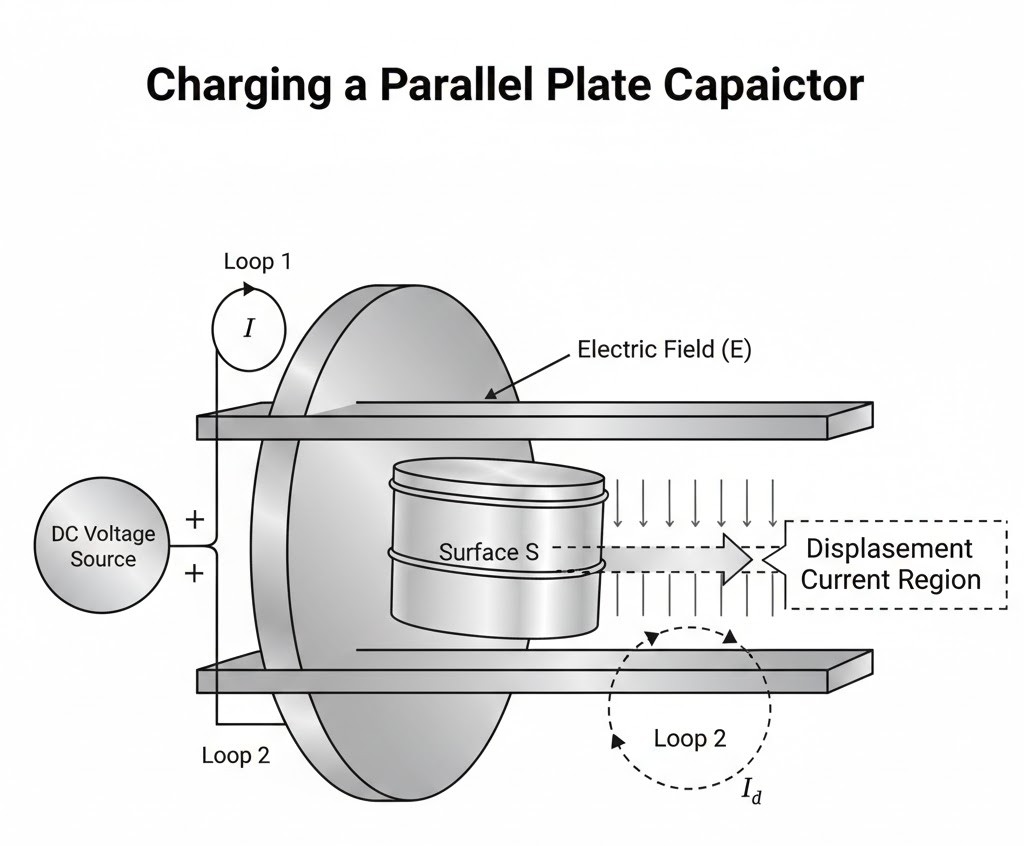
Hey junior! Let’s clear up a major funda today. You know Ampere's circuital law, right? Well, Maxwell realized it had a bit of a "glitch". Imagine you are charging a parallel plate capacitor. If you apply Ampere's law:
to a loop around the wire, you get a magnetic field $B$. But what if you use a "tiffin-box" shaped surface that passes between the plates where no wire exists?
NEET Checkpoint:
In a charging capacitor, what is the conduction current between the plates?
(a) Maximum at all times
(b) Zero
(c) Equal to the displacement current
(d) Equal to the sum of charging currents
✅ Answer: Zero — There is no actual flow of charges in the gap, just an electric field.
Suddenly, the right side of our equation becomes zero! This inconsistency meant the law was missing something. Maxwell looked between the plates and saw an electric field $E$ changing with time. He calculated the electric flux $\Phi_E$ as:
where $Q$ is the charge. Since the charge changes ($i = dQ/dt$), the flux also changes!
NEET Checkpoint:
Who suggested the existence of displacement current?
(a) Michael Faraday
(b) James Clerk Maxwell
(c) André-Marie Ampère
(d) Heinrich Hertz
✅ Answer: (b) James Clerk Maxwell — He was the genius who unified electricity and magnetism.
He defined a new "missing" term called Maxwell's displacement current ($i_d$):
Think of it like a Metro station gate. Outside, people (charges) are moving—that's conduction current ($i_c$). Inside the gate area, maybe no one is running, but the "flow" is maintained by the signal changing. Displacement current is that "signal" in the gap!
Figure below:
A clear diagram showing a parallel plate capacitor being charged, with a circular loop around the wire and a tiffin-box-shaped surface S between the plates. Show the electric field arrows between the plates and label the displacement current region.
NEET Checkpoint:
Does displacement current produce a magnetic field?
(a) Yes, just like conduction current
(b) No, it produces only electric field
(c) Only in vacuum
(d) Only inside a capacitor
✅ Answer: (a) Yes — It has exactly the same physical effects as conduction current.
Practice Questions:
1. The displacement current arises due to:
(a) Flow of electrons
(b) Stationary charges
(c) Time-varying electric field
(d) Constant magnetic flux
✅ Answer: (c) — It is specifically due to the rate of change of electric flux.
2. Outside the capacitor plates in a circuit, the value of displacement current $i_d$ is:
(a) Equal to $i_c$
(b) Zero
(c) Infinite
(d) $\mu_0 i_c$
✅ Answer: (b) — Outside the plates, we only have conduction current; $i_d$ is zero there.
Key Takeaway
Formula Summary
- Displacement Current: $i_{d}=\epsilon_{0}\frac{d\Phi_{E}}{dt}$
- Ampere-Maxwell Law: $\oint B\cdot dl=\mu_{0}i_{c}+\mu_{0}\epsilon_{0}\frac{d\Phi_{E}}{dt}$
3. Maxwell’s Generalisation and the Ampere-Maxwell Law
Hey there, future doctor! Let’s clear up a major funda: how Maxwell fixed a massive "oopsie" in Ampere’s original law. He realised that a magnetic field isn't just produced by charges moving in a wire, but also by a changing electric field.
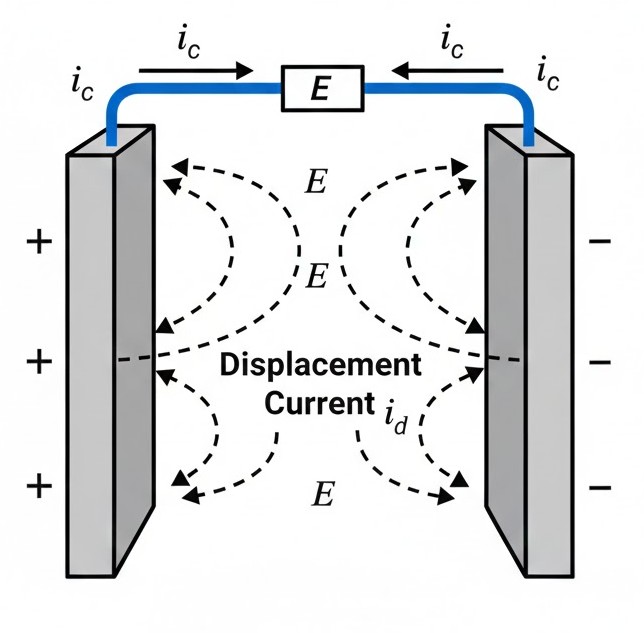
Maxwell proposed that the total current $i$ is actually the sum of two parts: the conduction current $i_c$ (from flowing charges) and the displacement current $i_d$. Outside a capacitor's plates, you only have $i_c$, but inside the gap where no charges flow, $i_d$ takes over to keep things continuous. Think of it like a relay race: $i_c$ is the runner on the track, and $i_d$ is the baton being thrown through the air to the next runner. Both are essential to finish the race!
NEET Checkpoint:
What is the source of displacement current?
(a) Flow of electrons in a wire
(b) Changing magnetic field
(c) Changing electric field
(d) Motion of ions in a conductor
✅ Answer: (c) Changing electric field — Maxwell argued that a changing electric field acts as a source of a magnetic field.
The explicit formula for the Ampere-Maxwell Law is:
Here, the term $\epsilon_0 (d\Phi_E/dt)$ is our displacement current $i_d$. This formula is a masterpiece of symmetry. Just as Faraday’s Law tells us a changing magnetic field creates an electric field, Maxwell showed that a changing electric field creates a magnetic field. It’s like the perfect Bollywood duo—one simply cannot exist without the other in an electromagnetic wave!
NEET Checkpoint:
Displacement current has the same physical effects as conduction current.
(a) True
(b) False
✅ Answer: (a) True — It acts as a source of a magnetic field just like $i_c$.
Figure below:
A diagram of a parallel plate capacitor being charged, showing conduction current $i_c$ in the wires and a changing electric field lines $E$ between the plates representing the displacement current $i_d$.
NEET Checkpoint:
In a region with no conduction current but a changing electric field, is there a magnetic field?
(a) Yes, because the displacement current produces a magnetic field
(b) No, magnetic field requires conduction current
(c) Only if the region contains charges
(d) Only if the electric field is uniform
✅ Answer: (a) Yes — The time-varying electric field produces a displacement current, which generates a magnetic field.
Practice Question:
Which of the following represents the total current $i$ in Maxwell’s generalisation?
(a) $i = i_c$
(b) $i = \epsilon_0 \frac{d\Phi_E}{dt}$
(c) $i = i_c + \epsilon_0 \frac{d\Phi_E}{dt}$
(d) $i = i_c - \epsilon_0 \frac{d\Phi_E}{dt}$
✅ Answer: (c) — Total current is the sum of conduction and displacement currents.
Key Takeaway
Formula Summary
- Total Current: $i = i_c + i_d$
- Displacement Current: $i_d = \epsilon_0 \frac{d\Phi_E}{dt}$
- Ampere-Maxwell Law: $\oint B \cdot dl = \mu_0 i_c + \mu_0 \epsilon_0 \frac{d\Phi_E}{dt}$
4. Foundations: Maxwell’s Equations in Vacuum
Arre juniors, listen up! If electromagnetism was a Bollywood blockbuster, James Clerk Maxwell would be the legendary director who brought all the stars together. He took four basic laws and turned them into a consistent set of equations that explain everything from your smartphone signals to the light from the sun.
NEET Checkpoint:
Which law implies that magnetic monopoles do not exist?
(a) Faraday's Law
(b) Gauss's Law for Magnetism
(c) Ampere-Maxwell Law
(d) Gauss's Law for Electricity
✅ Answer: (b) — Because $\oint B\cdot dA=0$, the net magnetic flux through any closed surface is always zero.
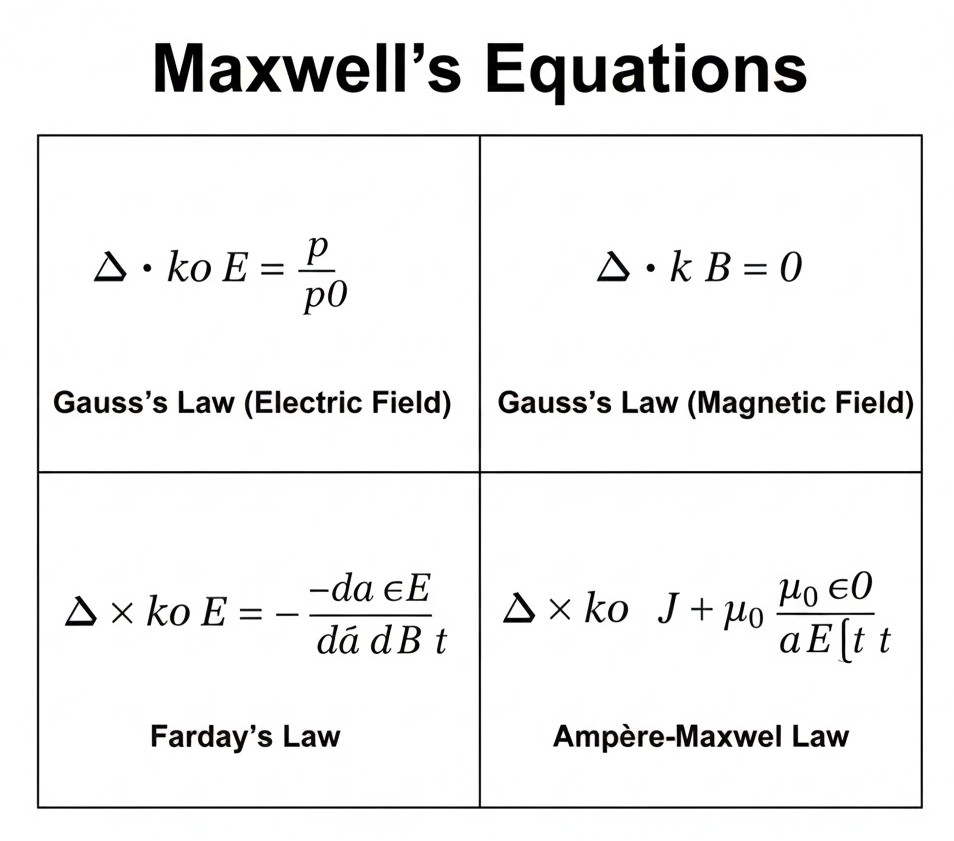
Here are the "Big Four" equations that govern vacuum:
- Gauss’s Law (Electricity): $\oint E\cdot dA = Q/\epsilon_{0}$ — Electric charge produces an electric field $E$.
- Gauss’s Law (Magnetism): $\oint B\cdot dA = 0$ — Magnetic fields $B$ always form closed loops.
- Faraday’s Law: $\oint E\cdot dl = -\frac{d\Phi_{B}}{dt}$ — A changing magnetic flux $\Phi_{B}$ creates an electric field.
- Ampere-Maxwell Law: $\oint B\cdot dl = \mu_{0}i_{c} + \mu_{0}\epsilon_{0}\frac{d\Phi_{E}}{dt}$ — Magnetic fields come from conduction current $i_{c}$ and changing electric flux $\Phi_{E}$.
Think of these like a well-coordinated cricket team. If the bowler (changing electric field) does their job, the fielder (magnetic field) has to react! This symmetry—where time-dependent fields give rise to each other—is the secret behind electromagnetic waves. Maxwell just added the missing "masala" (displacement current) to make the logic perfect.
NEET Checkpoint:
What is the displacement current $i_{d}$ equal to?
(a) i_d = ε₀ (dV/dt)
(b) $i_{d} = \epsilon_{0}\frac{d\Phi_{E}}{dt}$
(c) i_d = I_conduction
(d) i_d = B / μ₀
✅ Answer: (b)$i_{d} = \epsilon_{0}\frac{d\Phi_{E}}{dt}$ — It is the term Maxwell added to Ampere's law to remove inconsistency.
Figure below:
A clear, 2x2 grid chart showing Maxwell's four equations in LaTeX with their common names—Gauss (E), Gauss (B), Faraday, and Ampere-Maxwell—listed clearly next to each formula.
NEET Checkpoint:
Together with which formula do Maxwell's equations mathematically express all basic laws of electromagnetism?
(a) Coulomb’s law
(b) Lorentz force law
(c) Ohm’s law
(d) Biot–Savart law
✅ Answer: (b) The Lorentz force law - Maxwell’s equations describe how electric and magnetic fields are generated and interact. To describe the force on a charged particle in these fields, we use the Lorentz force law
Practice Question:
In a region with no conduction current ($i_{c} = 0$), can a magnetic field still exist?
(a) No
(b) Only if $E$ is constant
(c) Yes, if there's a time-varying electric field
(d) Never in vacuum.
✅ Answer: (c) — A changing electric flux creates a displacement current, which acts as a source for $B$.
Key Takeaway
Formula Summary
- Total Current: $i = i_{c} + i_{d}$ where $i_{d} = \epsilon_{0}\frac{d\Phi_{E}}{dt}$
- Speed of Light in Vacuum: $c = 1/\sqrt{\mu_{0}\epsilon_{0}}$
5. Sources of Electromagnetic Waves
Listen up, junior! Don't stress, yaar—the origin of electromagnetic (EM) waves is a total funda clear-out once you get the logic. You might think any old charge will do, but that’s not the case. Stationary charges only give us electrostatic fields, and charges in uniform motion (steady currents) only produce magnetic fields that don't change with time. Neither of these can create a wave!
The real secret sauce is the accelerated charge. It is an essential result of Maxwell’s theory that only accelerated charges radiate EM waves.
NEET Checkpoint:
Which of the following can act as a source of EM waves?
(a) A charge at rest
(b) A charge in uniform motion
(c) An oscillating charge
(d) A neutral atom.
✅ Answer: (c) — An oscillating charge is a prime example of an accelerated charge.
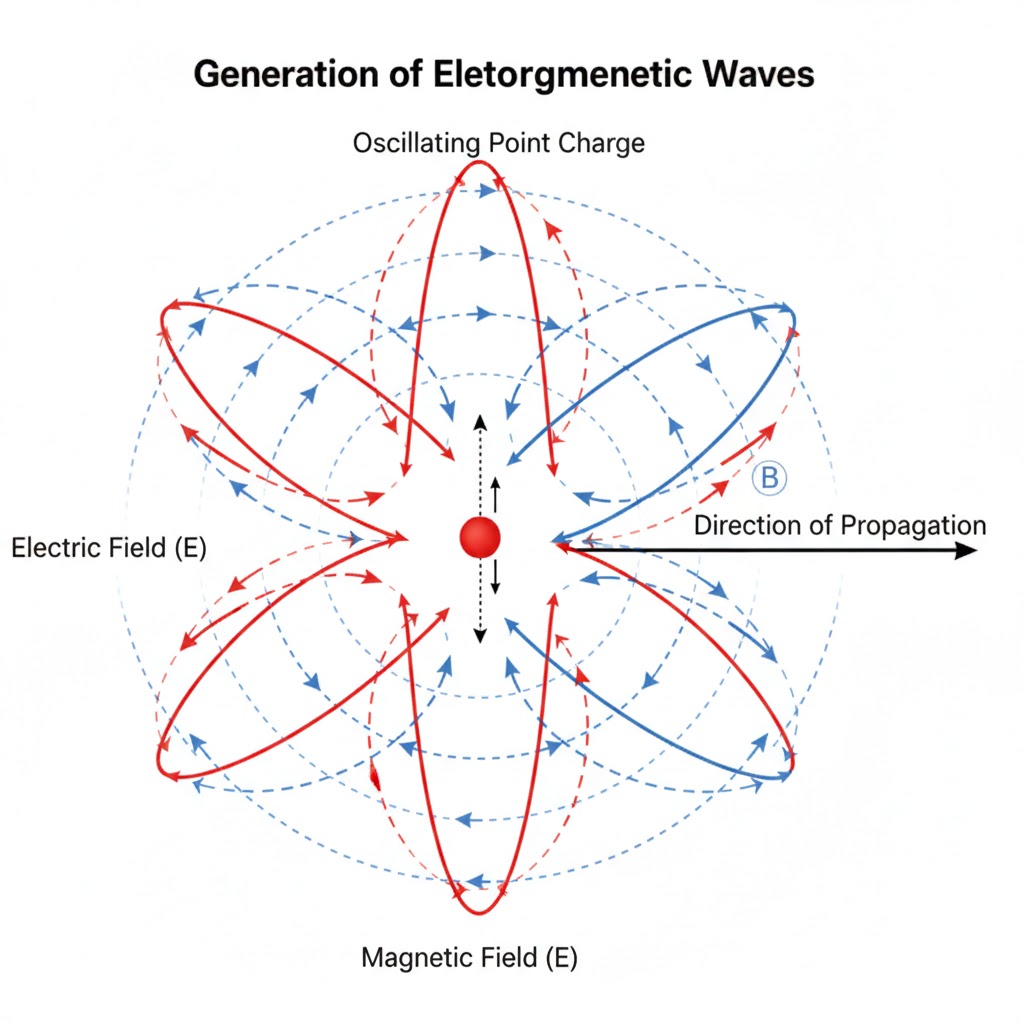
Here is how the magic happens: consider a charge oscillating with a specific frequency. This creates an oscillating electric field in space. This electric field then produces an oscillating magnetic field, which in turn regenerates an oscillating electric field, and so on. They keep regenerating each other as the wave travels through space!
NEET Checkpoint:
If a charge oscillates at a frequency of $10^{9}\text{ Hz}$, what is the frequency of the produced EM wave?
(a) 0.5 × 10⁹ Hz
(b) 10⁹ Hz
(c) 2 × 10⁹ Hz
(d) Depends on the amplitude
✅ Answer: (b) $10^{9}\text{ Hz}$ — The wave frequency always equals the frequency of oscillation of the source charge.
Relatable Example: Think of a pani puri wala shaking his hand rapidly to mix the palaak—the frequency of the "spice waves" reaching your nose is exactly the frequency of his hand's oscillation! Even physics needs a spicy break sometimes!
NEET Checkpoint:
From where does the propagating EM wave get its energy?
(a) From the charge producing it
(b) From the vacuum
(c) From the magnetic field only
(d) From the electric field only
✅ Answer: (a) At the expense of the energy of the source (the accelerated charge).
Figure below:
A clear diagram showing a point charge oscillating along an axis, with arrows indicating the generation of spreading, coupled sinusoidal electric and magnetic field loops.
Practice Question:
A steady current flows through a long straight wire. Does it radiate EM waves?
(a) Yes, definitely
(b) No, because the magnetic field is not time-varying
(c) Only if the wire is made of copper
(d) Yes, but only at high voltages.
✅ Answer: (b) — According to the sources, steady currents produce magnetic fields that do not vary with time and thus cannot be sources of EM waves.
Key Takeaway: Source of EM Waves
- Primary Source: Accelerated or oscillating charges.
- Mechanism: Oscillating $E$ and $B$ fields regenerate each other.
- Frequency Rule: $f_{wave} = f_{source}$.
6. The Nature of Electromagnetic Waves
Hey there, future doc! Ever wondered how light travels from the Sun to your balcony without any 'lift'? Unlike sound waves that need air to travel (like you need a stable Wi-Fi connection to stream lectures), EM waves are totally aatmanirbhar (self-reliant). They are self-sustaining oscillations of electric and magnetic fields that thrive in the emptiness of free space.
Think of it like a classic Bollywood duo on a scooty: the Electric Field ($E$) and the Magnetic Field ($B$). They are always perpendicular to each other and to the direction they are heading. When the oscillating electric field changes, it creates a magnetic field, which in turn acts as a source for a new electric field. They basically regenerate each other as they zoom along! This is what we call propagation as coupled fields.
NEET Checkpoint:
In an EM wave propagating along the $+z$ direction, if the electric field is along the $+x$ axis, where is the magnetic field?
(a) $+x$
(b) $+y$
(c) $-x$
(d) $-y$
✅ Answer: (b) $+y$ — Don't get confused, yaar! $E$, $B$, and the direction of propagation are all mutually perpendicular.
One of the coolest fundas is the absence of a requirement for a material medium. While waves on a string need a rope, EM waves are the ultimate rebels; they can travel through a vacuum at the speed of light, which is approximately $3 \times 10^8 m/s$.
NEET Checkpoint:
What is the formula for the speed of an EM wave in vacuum?
(a) $c = 1/\sqrt{\mu_0\epsilon_0}$
(b) c = μ₀ ε₀
(c) c = μ₀ / ε₀
(d) c = \sqrt{\mu_0\epsilon_0}
✅ Answer: (a) $c = 1/\sqrt{\mu_0\epsilon_0}$ — This fundamental constant depends on the permeability and permittivity of free space.
NEET Checkpoint:
Are the magnitudes of $E$ and $B$ fields related?
(a) No, they are independent
(b) Yes, E = c B
(c) Yes, E = B / c
(d) Only in vacuum
✅ Answer: (b) Yes! They follow the ratio $B_0 = E_0/c$, which means the electric field is much larger in magnitude than the magnetic field.
Figure below:
A 3D diagram showing a plane electromagnetic wave propagating along the z-axis. The electric field E oscillates sinusoidally along the x-axis, and the magnetic field B oscillates sinusoidally along the y-axis. Use different colours for E and B, and show they are mutually perpendicular.
Practice Question:
If an EM wave enters a glass slab from vacuum, its velocity $v$ will be:
(a) $1/\sqrt{\mu_0\epsilon_0}$
(b) $1/\sqrt{\mu\epsilon}$
(c) $c$
(d) Zero
✅ Answer: (b) — In a material medium, the velocity depends on the medium's permittivity ($\epsilon$) and permeability ($\mu$).
Key Takeaway: The Nature of EM Waves
- Transverse Nature: $E$ and $B$ are perpendicular to each other and the direction of propagation.
- No Medium: They travel through vacuum; no material required.
- Speed in Vacuum:
$$c = \frac{1}{\sqrt{\mu_0\epsilon_0}} \approx 3 \times 10^8 m/s$$- Field Relation:
$$B_0 = \frac{E_0}{c}$$
7. Transverse Nature of EM Waves
Listen up, junior! If you want to crack NEET, you need to understand the "personality" of an electromagnetic (EM) wave. Unlike sound waves that push and pull like a crowd at a Pani Puri stall, EM waves are transverse. This means the oscillating fields don't move in the direction of the wave; they "dance" perpendicular to it.
According to the sources, the electric field $\vec{E}$ and magnetic field $\vec{B}$ are perpendicular to each other and perpendicular to the direction of propagation. Imagine you are riding a scooter straight along the $z$-axis. Your $\vec{E}$ field would be jumping up and down (on the $x$-axis), while your $\vec{B}$ field would be swaying side-to-side (on the $y$-axis). This is what we call a linearly polarised wave.
NEET Checkpoint:
What is the angle between the electric field and the magnetic field in an EM wave?
(a) 0°
(b) 45°
(c) 90°
(d) 180°
✅ Answer: (c) $90^\circ$ — They are strictly orthogonal, yaar!
Mathematically, if the wave travels in the $z$-direction, we represent it as:
Notice this: both fields are in phase, meaning they hit their peaks and zeros at the same time. Also, keep this "funda" in mind: the ratio of their amplitudes is always the speed of light, $c$:
NEET Checkpoint:
If an EM wave propagates along the $x$-axis and $\vec{E}$ is along the $y$-axis, what is the direction of $\vec{B}$?
(a) x-axis
(b) y-axis
(c) z-axis
(d) Along E
✅ Answer: (c) The $z$-axis — Remember, $\vec{E}$, $\vec{B}$, and the propagation direction must all be mutually perpendicular.
NEET Checkpoint:
Does an EM wave need a medium like a rickshaw needs a road?
(a) Yes, always
(b) No, it can propagate through vacuum
(c) Only in air
(d) Only in solids
✅ Answer: (b) No! — EM waves are self-sustaining oscillations that can travel through vacuum.
Practice Question:
In a plane EM wave, the direction of propagation is given by the direction of:
(a) $\vec{E}$
(b) $\vec{B}$
(c) $\vec{E} \times \vec{B}$
(d) $\vec{B} \times \vec{E}$
✅ Answer: (c) $\vec{E} \times \vec{B}$ — This cross product gives the direction of wave travel. Just a bit of vector magic!
Key Takeaway
- Transverse Nature: $\vec{E} \perp \vec{B} \perp$ Direction of propagation.
- Field Ratio: $E_0/B_0 = c$.
- Wave Speed: $c = \frac{\omega}{k} = \frac{1}{\sqrt{\mu_0 \epsilon_0}}$.
8. Mathematical Description and Speed of Waves
Hey junior! Ready to see the funda behind how EM waves actually look on paper? It’s basically a sinusoidal dance between the electric field ($E$) and magnetic field ($B$). If our wave is zooming along the $z$-direction, the fields oscillate in the $x$ and $y$ planes like this:
.
Notice how they are "in phase"? When the electric field hits its peak, the magnetic field is right there at its peak too! They are always perpendicular to each other and the direction of travel.
NEET Checkpoint:
In an EM wave propagating along the $z$-axis, can the $E$-field oscillate along the $z$-axis?
(a) Yes, always
(b) No, E is always perpendicular to the direction of propagation
(c) Only in vacuum
(d) Only for low-frequency waves
✅ Answer: (b) No — EM waves are transverse; the oscillating fields must be perpendicular to the direction of propagation.
To nail those numericals, remember that the wave vector ($k$) is $2\pi/\lambda$ and the angular frequency ($\omega$) is $2\pi \nu$. The speed of this wave is $c = \omega/k$, which in vacuum is exactly:
In a material medium, it slows down to $v = 1/\sqrt{\mu \epsilon}$. Don't sweat the big numbers; just remember $c$ is a constant $3 \times 10^8 m/s$!
NEET Checkpoint:
What is the ratio of the electric field amplitude ($E_0$) to the magnetic field amplitude ($B_0$)?
(a) 1
(b) c
(c) c²
(d) 1 / c
✅ Answer: (b) $c$ — The amplitudes are related by $E_0 / B_0 = c$, meaning the electric part is numerically much larger.
Imagine a Mumbai local train speeding forward (propagation). The passengers swaying side-to-side are like the $E$-field, and the luggage on the top racks shaking up-and-down are the $B$-field. They all move together in a perfectly timed rhythm!
NEET Checkpoint:
Does the speed of an EM wave in vacuum change if you change its frequency?
(a) Yes, it increases with frequency
(b) Yes, it decreases with frequency
(c) No, it remains the same
(d) Only for light waves
✅ Answer: (c) No — Experiments show $c$ is a fundamental constant, independent of wavelength or frequency in vacuum.
Practice Quetion:
A plane EM wave has an $E$-field amplitude of $6.3 V/m$. What is the magnitude of its $B$-field?
(a) $2.1 \times 10^{-8} T$
(b) $18.9 \times 10^8 T$
(c) $6.3 T$
(d) $3 \times 10^8 T$
✅ Answer: (a) $2.1 \times 10^{-8} T$ — Arre! Just use $B_0 = E_0/c$. So, $6.3 / (3 \times 10^8) = 2.1 \times 10^{-8} T$.
Now that you’ve mastered the math, let’s see how these waves are spread across the massive electromagnetic spectrum!
Key Takeaway
Formula Summary
- Wave Equations: $E_x = E_0 \sin(kz - \omega t)$, $B_y = B_0 \sin(kz - \omega t)$
- Wave Relations: $k = 2\pi/\lambda$, $\omega = 2\pi \nu$, and $c = \nu \lambda$
- Speed in Vacuum: $c = \frac{\omega}{k} = \frac{1}{\sqrt{\mu_0 \epsilon_0}} \approx 3 \times 10^8 m/s$
- Amplitude Ratio: $\frac{E_0}{B_0} = c$
9. EM Waves in Material Media and Energy
Hey champion! Ready to dive into how light travels through your spectacles or how the Sun powers your day?. While we know EM waves zip through vacuum at $c$, things get a bit more "crowded" when they enter a material medium like glass or water. In these media, the speed of light isn't a constant $3 \times 10^{8} \text{ m/s}$ anymore.
The velocity $v$ of an EM wave in a material depends on its electrical and magnetic properties—specifically the permittivity $\epsilon$ and magnetic permeability $\mu$. These properties essentially describe how the medium reacts to the wave's fields. The "funda" is simple: the velocity in a medium is given by the formula:
NEET Checkpoint:
If a medium has both higher permittivity and permeability than vacuum, what happens to the velocity of light?
(a) Increases
(b) Decreases
(c) Remains $c$
(d) Becomes zero
✅ Answer: (b) Decreases — Since both $\mu$ and $\epsilon$ are in the denominator, increasing them makes $v$ smaller than $c$.
Now, why does this matter for your NEET prep? Because EM waves are the ultimate "delivery partners" of the universe!. They carry energy from one place to another.
Relatable Indian Example: Imagine a dabbawala in Mumbai delivering tiffins; he carries the energy (food) from the kitchen to the office. Similarly, radio and TV stations send EM waves carrying energy to your antenna so you can watch a cricket match.
NEET Checkpoint:
Which of the following is responsible for making life possible on Earth by transporting energy from the Sun?
(a) Sound waves
(b) EM waves
(c) Strings
(d) Static charges
✅ Answer: (b) EM waves — Light is an EM wave that carries life-sustaining energy from the Sun to Earth.
NEET Checkpoint:
Is the velocity of EM waves in vacuum dependent on their wavelength?
(a) Yes
(b) No
(c) Only for visible light
(d) Only for X-rays.
✅ Answer: (b) No — Experiments show that in vacuum, all EM waves travel at the same velocity $c$, regardless of wavelength.
Don't stress, yaar—just remember that these waves are carrying actual energy that can be captured, like in solar panels!.
Practice Question:
The velocity of light in a medium with permittivity $\epsilon$ and permeability $\mu$ is:
(a) $v = \sqrt{\mu\epsilon}$
(b) $v = \frac{1}{\sqrt{\mu\epsilon}}$
(c) $v = \frac{\mu}{\epsilon}$
(d) $v = \frac{1}{\mu\epsilon}$
✅ Answer: (b) — This is the standard relation derived from Maxwell’s equations for material media.
Key Takeaway
Formula Summary
* Velocity in vacuum: $c = \frac{1}{\sqrt{\mu_{0}\epsilon_{0}}} \approx 3 \times 10^{8} \text{ m/s}$
* Velocity in medium: $v = \frac{1}{\sqrt{\mu\epsilon}}$
* Energy Transfer: EM waves carry energy across space, enabling communication and solar power.
10. The Electromagnetic Spectrum Overview
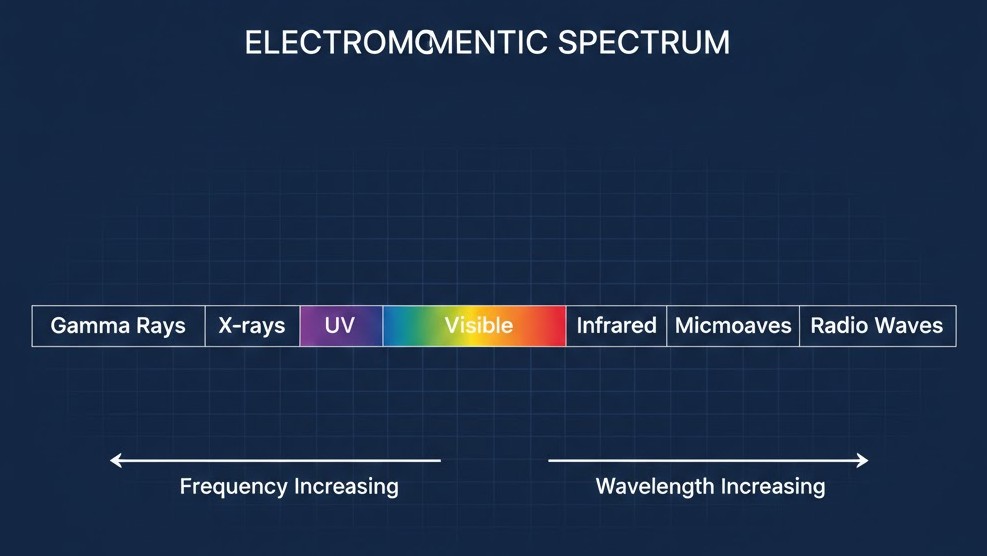
Hello, future doctors! Ready to meet the whole family of light? While Maxwell was busy unifying electricity and magnetism, he realised that visible light is just a tiny slice of a massive "Electromagnetic Spectrum". This spectrum stretches from tiny gamma rays ($\lambda \approx 10^{-12} \text{ m}$) all the way to massive long radio waves ($\lambda \approx 10^{6} \text{ m}$).
Here’s the main funda: all these waves are classified based on their frequency ($\nu$) or wavelength ($\lambda$). But don't expect strict "border security" here! There is no sharp division between one kind of wave and the next. It’s just like a local Indian bazaar—you can’t exactly tell where the Samosa stall ends and the Jalebi corner begins; they just blend into each other! The classification is roughly based on how these waves are produced or detected.
NEET Checkpoint:
What is the fundamental difference between various types of electromagnetic waves?
(a) Their speed in vacuum
(b) Their transverse nature
(c) Their wavelength or frequency
✅ Answer: (c) — All EM waves travel at the same speed $c$ in vacuum; only their $\lambda$ and $\nu$ differ.
Generally, radio waves are produced by accelerating electrons in aerials, while visible light comes from electrons jumping between energy levels in atoms. Even though they look different, they all follow the same golden rule in vacuum:
where $c \approx 3 \times 10^{8} \text{ m/s}$.
NEET Checkpoint:
Are there sharply defined boundaries between different regions of the EM spectrum?
(a) Yes, each type has a fixed frequency range
(b) No, the regions gradually merge into one another
(c) Only between radio and microwave
(d) Only in vacuum
✅ Answer: (b) No — The regions overlap, and classification is based mostly on production and detection mechanisms.
Figure below:
A clear horizontal bar chart showing the electromagnetic spectrum from Gamma rays to Radio waves. Label the frequency increasing to the left and wavelength increasing to the right. Highlight a small 'Visible' section in the middle with rainbow colours.
NEET Checkpoint:
Which mechanism is used to produce Microwaves?
(a) Radioactive decay
(b) Magnetron valve
(c) Inner shell electron transitions
✅ Answer: (b) — Microwaves are produced by special vacuum tubes like klystrons or magnetrons.
Practice Questions:
1. The classification of the electromagnetic spectrum is primarily based on:
(a) The intensity of the waves.
(b) The amplitude of the electric field.
(c) How the waves are produced and/or detected.
(d) The medium through which they travel.
✅ Answer: (c) As per the sources, the demarcation isn't sharp and is based on production/detection.
2. Which of the following has the longest wavelength in the EM spectrum?
(a) X-rays
(b) Radio waves
(c) Infrared waves
(d) Ultraviolet rays
✅ Answer: (b). Radio waves have wavelengths from $> 0.1 \text{ m}$ up to $10^{6} \text{ m}$, which is the longest in the listed spectrum.
Key Takeaway
- Spectrum Range: From $\gamma$-rays ($10^{-12} \text{ m}$) to Radio waves ($10^{6} \text{ m}$).
- Speed: All EM waves travel at $c = 3 \times 10^{8} \text{ m/s}$ in vacuum.
- No Hard Borders: Regions overlap; there are no sharp divisions.
11. Radio Waves and Microwaves
Arre junior, let's dive into the waves that make modern life possible—from catching a live cricket match on TV to heating up your late-night snacks!
Radio waves are the OGs of communication. They are produced by the accelerated motion of charges in conducting wires (those tall aerials you see on buildings). These waves cover a huge range, from $500\text{ kHz}$ to about $1000\text{ MHz}$.
Notice this: the AM (Amplitude Modulated) band we use for old-school radio is around $530\text{ kHz}$ to $1710\text{ kHz}$. But if you're a fan of high-quality FM (Frequency Modulated) music, you're tuning into $88\text{ MHz}$ to $108\text{ MHz}$. Even your cellular phones use the ultrahigh frequency (UHF) band to keep you connected!
NEET Checkpoint:
Which process produces radio waves?
(a) Stationary charges
(b) Uniform motion of charges
(c) Accelerated motion of charges
(d) Heating atoms
✅ Answer: (c) — Remember, only accelerated charges can radiate EM waves!
Now, let's talk Microwaves. Think of these as the shorter, punchier cousins of radio waves, sitting in the gigahertz ($GHz$) range. Instead of simple wires, they are produced by special vacuum tubes like klystrons, magnetrons, and Gunn diodes.
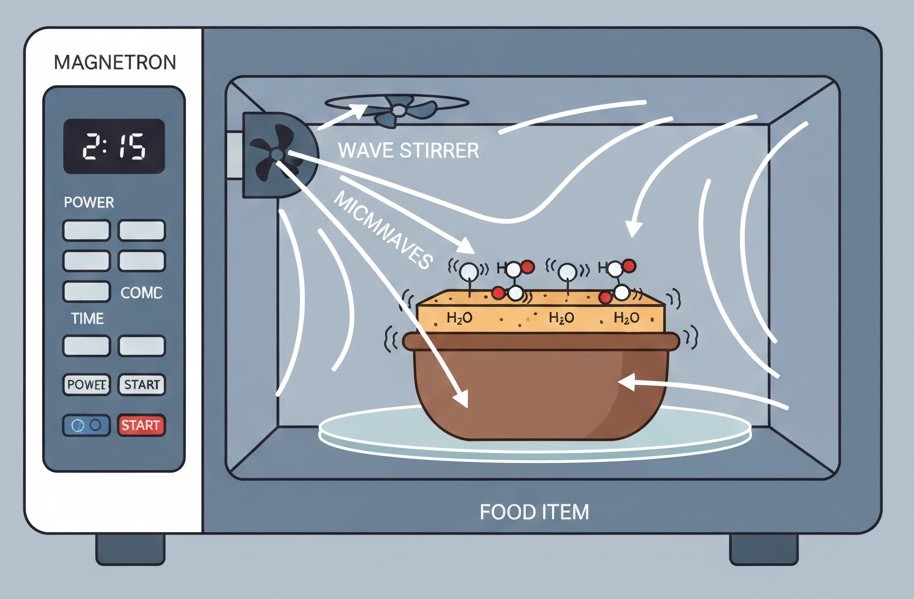
Because of their short wavelengths, they are perfect for radar systems used in aircraft navigation. Here’s a cool funda: the microwave oven in your kitchen works by matching the wave frequency to the resonant frequency of water molecules. This transfers energy directly to the water's kinetic energy, making your food piping hot!
NEET Checkpoint:
Which frequency range do microwaves typically belong to?
(a) Hz (Hertz) range
(b) kHz (Kilohertz) range
(c) MHz (Megahertz) range
(d) GHz (Gigahertz) range
✅ Answer: (d) $GHz$ (Gigahertz) range — These are short-wavelength radio waves.
NEET Checkpoint:
How do microwave ovens heat food?
(a) By conduction from hot air inside
(b) By absorption of microwave energy, causing water molecules to vibrate
(c) By infrared radiation from a heating coil
(d) By nuclear reactions in the food
✅ Answer: (b) By matching the resonant frequency of water molecules to transfer energy efficiently.
Figure below:
A simplified diagram of a microwave oven showing waves bouncing inside and vibrating water molecules within a food item.
Relatable Example: Imagine a traffic police officer using a speed gun to catch a speeding rickshaw—that gun is actually using microwaves to calculate the speed!
Practice Questions:
1. Which of the following is NOT a source for producing microwaves?
(a) Klystron
(b) Magnetron
(c) Gunn diode
(d) Simple conducting aerial
✅ Answer: (d) — Simple aerials are for radio waves; microwaves need special vacuum tubes like klystrons.
2. The FM radio band typically extends from:
(a) $530\text{ kHz} - 1710\text{ kHz}$
(b) $88\text{ MHz} - 108\text{ MHz}$
(c) $54\text{ MHz} - 890\text{ MHz}$
(d) Above $1000\text{ MHz}$
✅ Answer: (b) — Option (a) is for AM, and (c) is for TV.
Key Takeaway:
- Radio Waves: Produced by accelerated electrons in aerials; used for AM, FM, and TV.
- Microwaves: Produced by klystrons/magnetrons ($GHz$ range); used in Radar and ovens (resonant heating of water).
12. Infrared and Visible Light
Ready to heat things up, junior? Let’s talk about the part of the spectrum that keeps us warm and the part that lets us see the world!
Infrared: The "Heat Waves"
Infrared waves are produced by hot bodies and molecules. We call them "heat waves" because water molecules (and others like $CO_2$ and $NH_3$) in most materials readily absorb them. Once absorbed, their thermal motion increases—meaning they heat up!.
Think of a pani puri stall in the evening; that warmth you feel radiating from the hot kadhai even before you touch the plate? That’s Infrared hitting your skin, yaar!. It’s also the secret behind the greenhouse effect, where the Earth traps re-radiated infrared to keep us from freezing at night.
NEET Checkpoint:
Why are infrared waves called heat waves?
(a) They can be seen by the human eye
(b) They are absorbed by food to cook it
(c) They are readily absorbed by objects and produce heat
(d) They travel faster than visible light
✅ Answer: (c) Because they are absorbed by water molecules in most materials, increasing their thermal motion and temperature.
Visible Light: Our Window to the World
Next is Visible light, the most familiar part of the spectrum. It’s the only part our eyes can detect, ranging from a frequency of roughly $4 \times 10^{14}\text{ }Hz$ to $7 \times 10^{14}\text{ }Hz$. In terms of wavelength, that’s about $700\text{ }nm$ to $400\text{ }nm$.
Imagine watching a night match at the Eden Gardens—those massive floodlights are pumping out visible light so you can see the ball fly into the stands!. Interestingly, while we are limited to this range, snakes can actually detect infrared waves!.
NEET Checkpoint:
What is the approximate wavelength range of visible light?
(a) 1 nm – 10 nm
(b) 100 nm – 400 nm
(c) 400 nm – 700 nm
(d) 1 μm – 10 μm
✅ Answer: $400\text{ }nm$ to $700\text{ }nm$. All colors in between (blue, green, yellow, orange) fall within 400–700 nm.
NEET Checkpoint:
Which electronic device uses infrared for household systems?
(a) Microwave oven
(b) TV remote control
(c) Electric heater
(d) Smoke detector
✅ Answer: (b) Remote switches for TVs and hi-fi systems use infrared-emitting LEDs.
Practice Question:
The greenhouse effect maintains the Earth's average temperature because the atmosphere:
(a) Absorbs visible light and reflects it.
(b) Transmits infrared but traps visible light.
(c) Transmits visible light but traps re-radiated infrared.
(d) Reflects all incoming solar radiation.
✅ Answer: (c) — Incoming visible light passes through the atmosphere, is absorbed by the Earth, and is then re-radiated as longer-wavelength infrared, which is trapped by gases like $CO_2$.
Key Takeaway
- Infrared: $\lambda \approx 1\text{ }mm$ to $700\text{ }nm$; used in remote switches, physical therapy, and weather satellites.
- Visible: $\lambda \approx 700\text{ }nm$ to $400\text{ }nm$; the main source of visual information about the world.
13. Ultraviolet (UV) Rays
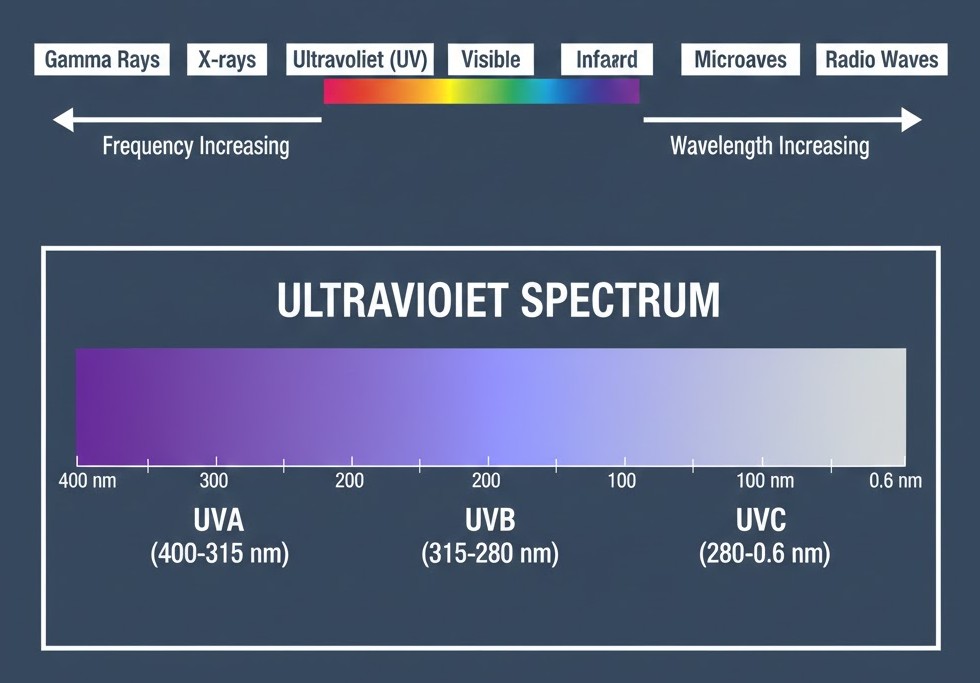
Let's talk about the rays that give you that beach tan (or a bad sunburn if you're not careful)—the Ultraviolet (UV) Rays! These waves sit right between visible light and X-rays, covering wavelengths from about $4 \times 10^{-7} \text{ m}$ ($400 \text{ nm}$) down to $6 \times 10^{-10} \text{ m}$ ($0.6 \text{ nm}$).
NEET Checkpoint:
Which of the following is the correct wavelength range for UV rays?
(a) $> 700 \text{ nm}$
(b) $400 \text{ nm}$ to $0.6 \text{ nm}$
(c) $< 10^{-3} \text{ nm}$
(d) $1 \text{ mm}$ to $700 \text{ nm}$
✅ Answer: (b) $400 \text{ nm}$ to $0.6 \text{ nm}$ — Don't confuse these with X-rays, yaar!
The Sun is our ultimate UV source, but we also produce them using special lamps and very hot bodies. Have you seen a welder on a Mumbai roadside wearing a heavy mask? That welding arc produces massive amounts of UV that can damage eyes, so they need those special glass goggles for protection. Interestingly, ordinary glass absorbs UV, so you can't get a tan while sitting inside a glass-windowed bus to Ooty!
NEET Checkpoint:
Why do welders wear special glass goggles?
(a) To look cool
(b) To block infrared
(c) To protect eyes from UV produced by welding arcs
(d) To see through metal
✅ Answer: (c) To protect eyes from UV — Safety first, especially with those high-energy waves!
Our planet has a natural bodyguard: the ozone layer in the atmosphere (at $40\text{--}50 \text{ km}$ altitude), which absorbs most of the Sun's harmful UV. We need to protect this layer from CFCs, or we're in trouble! Because UV has such short wavelengths, it can be focused into very narrow beams for high-precision LASIK eye surgery. Plus, those UV lamps in your home water purifiers are busy killing germs to keep your stomach happy.
NEET Checkpoint:
UV radiation is used in water purifiers to:
(a) Make water sweet
(b) Kill germs
(c) Filter sand
(d) Increase minerals
✅ Answer: (b) Kill germs — It's a microscopic germ-terminator!
Figure below:
A clear diagram showing the electromagnetic spectrum with a zoomed-in section for Ultraviolet rays between visible light and X-rays, highlighting the wavelength range from 400 nm to 0.6 nm.
Practice Questions:
1. UV rays are produced by:
(a) Radioactive decay
(b) Inner shell electrons moving between energy levels
(c) Klystron valves
(d) Vibration of atoms
Explanation: According to Table , UV and X-rays are produced by inner shell electron transitions.
2. The protective ozone layer is located at an altitude of approximately:
(a) $10\text{--}15 \text{ km}$
(b) $100\text{--}200 \text{ km}$
(c) $40\text{--}50 \text{ km}$
(d) $5\text{--}10 \text{ km}$
Explanation: The text specifically mentions the ozone layer is at an altitude of $40\text{--}50 \text{ km}$.
Key Takeaway
- Sources: Sun, special lamps, welding arcs.
- Detection: Photocells, photographic film.
- Applications: LASIK surgery, water purification, germicidal lamps.
- Absorbed by: Ozone layer ($40\text{--}50 \text{ km}$) and ordinary glass.
14. X-Rays and Gamma Rays
Hey junior! Ready to dive into the high-energy end of the spectrum? We are talking about X-rays and Gamma rays—the heavy hitters of the electromagnetic family. Don't stress, yaar, these are easier to understand than a tricky googly!
X-rays sit in the range of wavelengths from about $10^{-8}\text{ m}$ ($10\text{ nm}$) down to $10^{-13}\text{ m}$. You make them by bombarding a metal target with high-energy electrons. Think of it like a fast bowler's delivery hitting a sturdy wicket—that sudden "impact" releases the energy we call X-rays! We use them mostly for medical diagnostics to check for fractures (like that time you fell off your bicycle) and even to treat certain forms of cancer. But be careful, overexposure can damage living tissues.
NEET Checkpoint:
How are X-rays commonly produced?
(a) Radioactive decay
(b) Bombarding metal with high-energy electrons
(c) Heating a tiffin box
(d) Rapidly moving a magnet
✅ Answer: (b) — Straight from the NCERT! Smashing electrons into metal does the trick.
Then we have Gamma rays, the real bosses of frequency. They come from nuclear reactions and are emitted by radioactive nuclei. Their wavelengths are tiny—from $10^{-10}\text{ m}$ to less than $10^{-14}\text{ m}$. Because they are so powerful, doctors use them in medicine to destroy cancer cells.
NEET Checkpoint:
Which of these has the shortest wavelength?
(a) Infrared
(b) X-rays
(c) Gamma rays
(d) Microwaves
✅ Answer: (c) — Gamma rays are at the very top of the spectrum with the smallest wavelengths.
Figure below:
A clear diagram showing the high-frequency end of the electromagnetic spectrum, highlighting the overlapping regions of X-rays and Gamma rays.
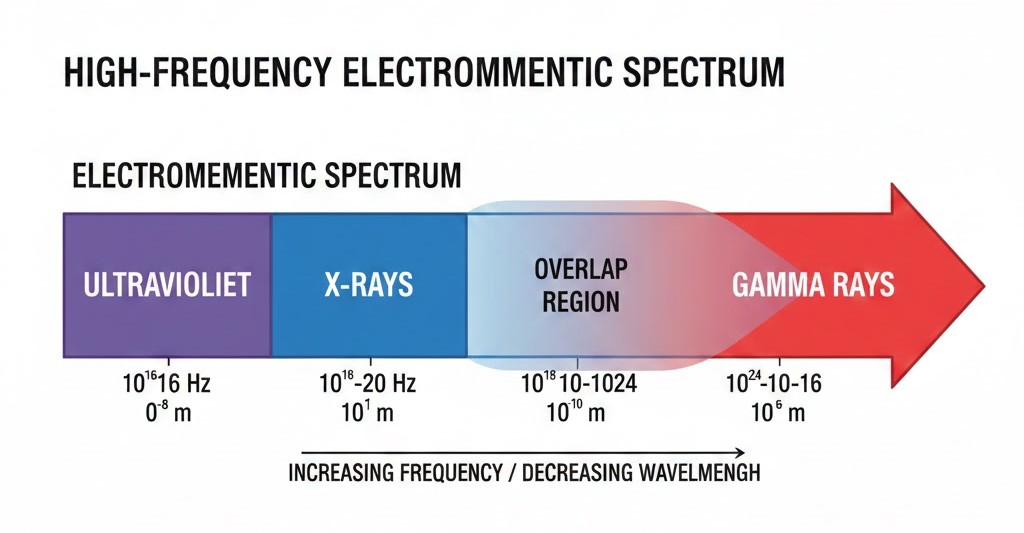
Notice this: there is no sharp boundary between these waves; the classification is just based on how they are produced.
NEET Checkpoint:
Gamma rays originate from where?
(a) Vibrations of molecules
(b) Accelerated charges in antennas
(c) Nuclear reactions and radioactive decay
(d) Thermal motion of atoms
✅ Answer: (c) Nuclear reactions and radioactive decay — Unlike X-rays which involve electrons, Gamma rays are a nuclear "funda".
Practice Questions:
1. Which wave is used to destroy cancer cells in medical treatment?
(a) Radio waves
(b) Gamma rays
(c) Microwaves
(d) Infrared.
✅ Answer: (b) — Sec 8.4.7 explicitly mentions their use in destroying cancer cells.
2. What is the approximate wavelength range for X-rays?
(a) $> 0.1\text{ m}$
(b) $1\text{ mm}$ to $700\text{ nm}$
(c) $10^{-8}\text{ m}$ to $10^{-13}\text{ m}$
(d) $400\text{ nm}$ to $1\text{ nm}$
Answer: (c) — Check the data in Sec 8.4.6!.
Key Takeaway
- X-Rays: Produced by electron impact on metal; used for diagnostics and cancer treatment.
- Gamma Rays: Produced in nuclear reactions/radioactive decay; used to destroy cancer cells.
- Wavelength: Gamma rays < X-rays.
15. Conclusion: Interaction with Matter
We’ve reached the final lap of this chapter. One big funda to remember is that while all EM waves are siblings travelling at the same speed $c \approx 3 \times 10^{8} \text{ m/s}$ in vacuum, they behave very differently when they hit matter. Whether they get absorbed or scattered depends entirely on their wavelength $\lambda$ and the nature of the atoms they encounter.
Think of it like driving through a busy Indian market. A small cycle (short wavelength) can weave through tiny gaps, while a big Tata truck (long wavelength) might get stuck or bounce off larger obstacles. Interaction is all about the "fit"!
NEET Checkpoint:
Which property of an EM wave remains constant as it travels through a vacuum?
(a) Wavelength
(b) Frequency
(c) Speed
(d) Interaction with matter
✅ Answer: (c) — Every EM wave, from radio to gamma, cruises at $c$ in vacuum.
Notice this: the wavelength is often correlated with the size of the system that radiates it. Tiny gamma rays ($\lambda \approx 10^{-14} \text{ m}$ to $10^{-15} \text{ m}$) originate from the tiny atomic nucleus, while radio waves are produced by electrons moving in large circuits. Even a transmitting antenna works most efficiently when its size is about the same as the $\lambda$ it’s sending out.
NEET Checkpoint:
Gamma radiation typically originates from:
(a) Heavy atoms
(b) Atomic nuclei
(c) Electronic circuits
(d) Molecular vibrations
✅ Answer: (b) — Their tiny wavelength matches the tiny size of the nucleus.
Finally, why do we see visible light and not X-rays? It’s because our eyes are "Team Sun"! Humans evolved with vision most sensitive to the strongest wavelengths the sun sends our way. The centre of our eye's sensitivity perfectly matches the peak of solar radiation. Evolution is smart, right? It made sure we could see the brightest light available!
NEET Checkpoint:
Human vision sensitivity is centered around the wavelength distribution of solar radiation due to:
(a) Speed of light
(b) Evolution
(c) Atmospheric pressure
(d) Nuclear reactions
✅ Answer: (b) — We evolved to make the most of the sun's strongest wavelengths!
Practice Question:
A transmitting antenna is being designed to radiate waves of a specific wavelength. For maximum efficiency, the antenna size should be:
(a) Much smaller than the wavelength
(b) About the same size as the wavelength
(c) Exactly double the wavelength
(d) Independent of the wavelength
✅ Answer: (b) According to the sources, an antenna radiates most efficiently when its size is correlated with (about the same as) the wavelength of the waves it emits.
Key Takeaway
All EM waves travel at $c$ in vacuum but interact differently based on $\lambda$. Radiation source size usually matches the emitted $\lambda$ (e.g., nuclei for gamma rays). Human vision is evolutionarily tuned to the sun’s peak radiation.