1. Introduction to the Dual Nature of Radiation and Matter
Hey there, future doctor! Ready to dive into the Dual Nature of Radiation and Matter? Think of light like a versatile Bollywood star—sometimes playing the romantic hero (a smooth wave), and sometimes the action lead (a hard-hitting particle)!. For a long time, Maxwell’s equations and Hertz’s 1887 experiments had everyone convinced that light was strictly a wave. But the end of the 19th century changed the game with milestones like Roentgen discovering X-rays (1895) and J.J. Thomson discovering the electron (1897).
NEET Checkpoint:
Who discovered the electron through electric discharge experiments in 1897?
(a) Maxwell
(b) Hertz
(c) J. J. Thomson
(d) Roentgen
✅ Answer: (c) J. J. Thomson — He confirmed that cathode rays are streams of fast-moving negatively charged particles!.
Thomson found that the specific charge ($e/m$) of these particles was $1.76 \times 10^{11} C/kg$, regardless of the gas or metal used. Later, Millikan’s famous oil-drop experiment (1913) proved that electric charge is quantised, meaning it only comes in fixed "packets" of $e = 1.602 \times 10^{-19} C$.
NEET Checkpoint:
What is the approximate speed of cathode ray particles compared to the speed of light ($c$)?
(a) $0.01$ to $0.02$ times $c$
(b) $0.1$ to $0.2$ times $c$
(c) Exactly $c$
(d) $2$ times $c$
✅ Answer: (b) $0.1$ to $0.2$ times $c$ — They are fast, but not as fast as light itself, yaar!.
Imagine a Pani Puri stall. You can’t buy $1.5$ puris; the bhaiya only gives them in whole numbers. That’s exactly how charge quantization works—it’s always an integral multiple of $e$. This "particle" logic eventually led to the realization that even light has a particle-like nature (photons), while matter can behave like a wave!.
NEET Checkpoint:
Which experiment established that electric charge is quantised?
(a) Hertz's spark experiment
(b) Millikan's oil-drop experiment
(c) Thomson's discharge tube
(d) Maxwell's equations
✅ Answer: (b) Millikan's oil-drop experiment — This was the pioneering work that measured the elementary charge precisely.
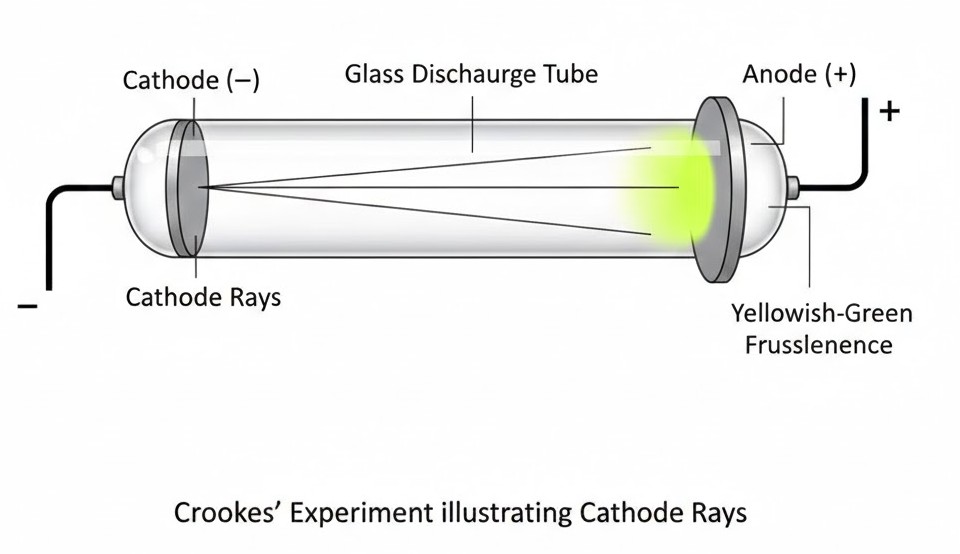
Figure below:
A clear, professional diagram of a glass discharge tube showing the cathode and anode, with a yellowish-green fluorescent glow on the glass opposite the cathode, illustrating the path of cathode rays as described by William Crookes.
Practice Question:
The specific charge of an electron is found to be independent of:
(a) The nature of the cathode material
(b) The gas in the discharge tube
(c) Both a and b
(d) Neither a nor b
✅ Answer: (c) — Thomson's observations suggested the universality of cathode ray particles.
Key Takeaway:
- Specific Charge ($e/m$): $1.76 \times 10^{11} C/kg$.
- Elementary Charge ($e$): $1.602 \times 10^{-19} C$.
- Dual Nature: Radiation and matter both exhibit wave and particle properties depending on the experiment.
2. Cathode Rays and the Discovery of the Electron
Let's dive into how scientists finally caught the electron!. Back in the late 19th century, folks were obsessed with sending electricity through gases at super low pressures—around $0.001 \text{ mm}$ of mercury. When they did this in a discharge tube, a cool yellowish-green fluorescent glow appeared on the glass opposite the cathode. These "cathode rays" were first spotted by William Crookes in 1870, who figured out they were actually streams of fast-moving negatively charged particles.
NEET Checkpoint:
What is the approximate pressure required for a discharge to take place in a tube?
(a) $760 \text{ mm Hg}$
(b) $10 \text{ mm Hg}$
(c) $0.001 \text{ mm Hg}$
(d) $1 \text{ atm}$
✅ Answer: (c) $0.001 \text{ mm Hg}$ — You need a very low pressure so the particles can actually travel without hitting too many gas molecules!.
Then came J.J. Thomson, the real "boss" who applied perpendicular electric and magnetic fields to calculate the specific charge or the charge-to-mass ratio ($e/m$). He found the speed of these particles to be about $0.1$ to $0.2$ times the speed of light ($c = 3 \times 10^{8} \text{ m/s}$).
NEET Checkpoint:
The value of $e/m$ for cathode rays depends on:
(a) Nature of gas
(b) Material of cathode
(c) Both (a) and (b)
(d) Neither
✅ Answer: (d) Neither — Thomson found $e/m$ is universal and independent of the gas or metal used!.
Think of it like a Pani Puri stall—no matter which city you are in, the basic "funda" of the snack remains the same! Similarly, the electron is a universal constituent of all matter. Later, Millikan used his famous oil-drop experiment in 1913 to prove that electric charge is quantised, meaning any charge $q$ is an integral multiple of $e = 1.602 \times 10^{-19} \text{ C}$. Even electrons need to be disciplined and follow the rules!
NEET Checkpoint:
Who established that electric charge is quantised?
(a) J.J. Thomson
(b) R.A. Millikan
(c) Wilhelm Roentgen
(d) Heinrich Hertz
✅ Answer: (b) R.A. Millikan — His oil-drop experiment showed charge only comes in fixed "packets.".
Practice Questions:
1. The presently accepted value of the specific charge ($e/m$) of an electron is:
(a) $1.76 \times 10^{11} \text{ C/kg}$
(b) $1.6 \times 10^{-19} \text{ C/kg}$
(c) $9.1 \times 10^{-31} \text{ C/kg}$
(d) $3 \times 10^{8} \text{ C/kg}$
✅ Answer: (a) — This value was determined by Thomson and is independent of the setup material.
2. If the specific charge is $e/m$ and the charge is $e$, the mass $m$ of the electron is:
(a) $e \times (e/m)$
(b) $(e/m) / e$
(c) $e / (e/m)$
(d) $1 / (e \times e/m)$
✅ Answer: (c) — Basic math, yaar! If you have the total charge and the ratio, you can easily find the mass.
Key Takeaway
Formula Summary
- Specific Charge ($e/m$): $1.76 \times 10^{11} \text{ C/kg}$.
- Elementary Charge ($e$): $1.602 \times 10^{-19} \text{ C}$.
- Quantisation of Charge: $q = ne$ (where $n$ is an integer).
3. Electron Emission and the Work Function
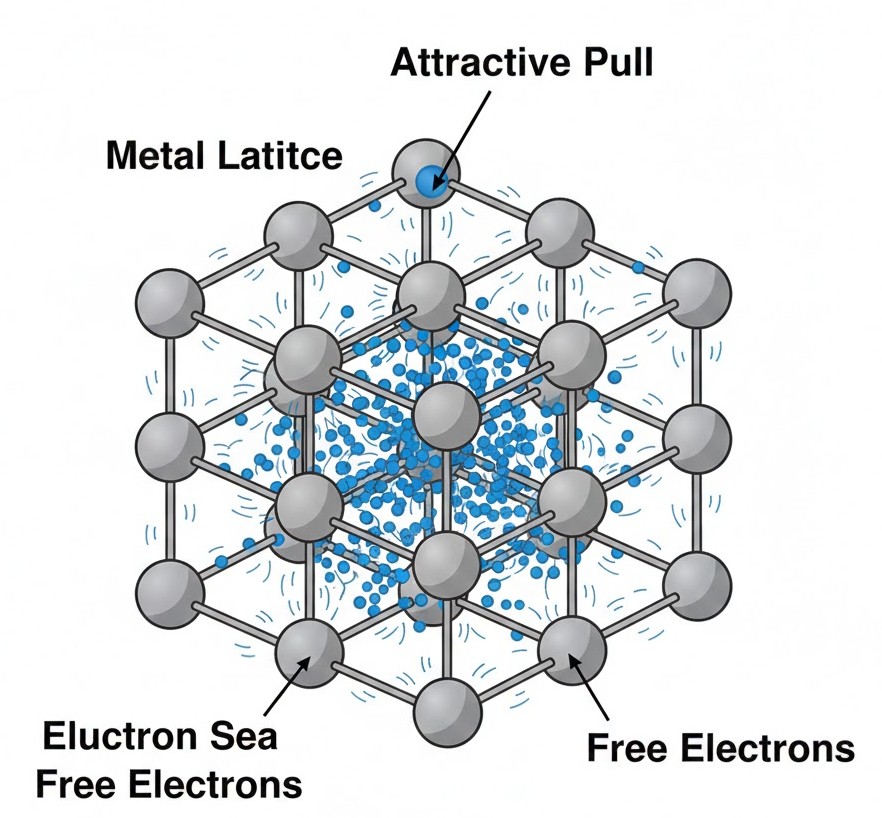
Arre, welcome back! Ever wondered why a copper wire doesn't just start spitting out electrons on its own? Let's clear up this fundamental "funda". Metals are packed with free electrons—negatively charged particles that zip around inside and give metals their conductivity. However, these electrons are like kids in a gated colony; they move freely inside but can't just hop over the wall. If an electron tries to leave, the metal surface gets a positive charge and pulls it right back.
NEET Checkpoint:
Why can't free electrons normally escape a metal surface?
(a) Gravitational force
(b) Attractive forces inside the metal
(c) Air pressure
(d) Magnetic force
✅ Answer: (b) Attractive forces — The positive ions in the metal pull the escaping negative electrons back.
To get an electron out, you must provide it with a "gate pass" of energy. This minimum energy required for an electron to escape the metal surface is called the Work Function ($\phi_0$). Think of it like the minimum entry fee at a Mumbai pani puri stall—you can't get even one puri unless you pay that base price! This value isn't fixed for everyone; it depends on the properties of the metal and the nature of its surface.
NEET Checkpoint:
What is the SI unit for the work function in atomic physics?
(a) Joule (J)
(b) Watt (W)
(c) Electron volt (eV)
(d) Coulomb (C)
✅ Answer: Electron volt ($eV$) — While Joules work, $eV$ is the standard "currency" here.
Since Joules are too massive for tiny electrons, we use the electron volt ($eV$). One $eV$ is the energy an electron gains when accelerated by a potential difference of $1\text{ volt}$.
The conversion is:
NEET Checkpoint:
If an electron is accelerated by $5\text{ V}$, how much energy in $eV$ does it gain?
(a)
(b)
(c)
(d)
✅ Answer: $5\text{ eV}$ — It's a 1-to-1 relationship with the voltage!
Figure below:
A clear diagram showing a metal lattice with positive ions, free electrons moving within, and one electron attempting to leave the surface but being pulled back by an arrow labeled "Attractive Pull".
Practice Question:
The work function of a metal is $2.14\text{ eV}$. What is this energy approximately in Joules?
(a) $2.14 \times 10^{-19}\text{ J}$
(b) $3.43 \times 10^{-19}\text{ J}$
(c) $1.60 \times 10^{-19}\text{ J}$
(d) $6.63 \times 10^{-34}\text{ J}$
✅ Answer: (b) — Calculation: $2.14 \times 1.602 \times 10^{-19}\text{ J} \approx 3.43 \times 10^{-19}\text{ J}$.
Key Takeaway
Formula Summary
- Work Function ($\phi_0$): Minimum energy for electron escape.
- Energy Conversion: $1\text{ eV} = 1.602 \times 10^{-19}\text{ J}$.
4. Physical Processes of Electron Emission
Listen up, junior! Even though metals are full of free electrons, these electrons can't just wander out of the metal surface whenever they feel like it. The moment an electron tries to leave, the metal surface gets a positive charge and pulls it right back in. To actually escape the "jail" of the metal's attractive forces, an electron needs a minimum "bribe" of energy called the work function ($\phi_{o}$).
We usually measure this energy in electron volts ($eV$), where $1 eV = 1.602 \times 10^{-19} J$. Think of it like the minimum entry fee for a concert—no ticket, no entry!
NEET Checkpoint:
What does the work function of a metal depend on?
(a) Intensity of incident radiation
(b) Frequency of incident radiation
(c) Nature of the metal
(d) Temperature of the metal
✅ Answer: (c) The properties of the metal and the nature of its surface.
There are three cool ways to give electrons the energy they need to break free:
- Thermionic Emission: We heat the metal, giving the electrons enough thermal energy to jump out. It’s like heating a pan of popcorn until the kernels start flying!
- Field Emission: We apply a massive electric field (around $10^8 V m^{-1}$) to literally pull the electrons out, similar to how a spark plug works.
- Photoelectric Emission: We shine light of a "suitable frequency" on the metal. The electrons absorb this light energy and escape. These specific escapees are called photoelectrons.
NEET Checkpoint:
In field emission, what is the required order of the electric field?
(a) $10^2 V m^{-1}$
(b) $10^4 V m^{-1}$
(c) $10^6 V m^{-1}$
(d) $10^8 V m^{-1}$
✅ Answer: (d) $10^8 V m^{-1}$ — That's a super strong field, yaar!
NEET Checkpoint:
Photoelectrons are fundamentally different from ordinary electrons.
(a) True
(b) False
✅ Answer: (b) False — They are identical; "photoelectron" just tells us light was the cause of emission.
Practice Question:
Which process involves the emission of electrons due to the absorption of radiant energy?
(a) Thermionic emission
(b) Field emission
(c) Photoelectric emission
(d) Cooling
✅ Answer: (c) — Because "photo" refers to light/radiation.
Key Takeaway
- Work Function ($\phi_{o}$): Minimum energy to escape the metal.
- Emission Methods: Heat (Thermionic), $10^8 V m^{-1}$ Field (Field), or Light (Photoelectric).
5. Hertz’s Observations of the Photoelectric Effect
Arre, junior! You think these big discoveries happen in fancy labs with perfectly planned meetings? Not always! In 1887, while Heinrich Hertz was busy proving Maxwell’s equations with his electromagnetic wave experiments, he stumbled upon a total game-changer.
He noticed something weird: the high voltage sparks jumping across his detector loop became much stronger and easier to produce when the emitter plate was hit by ultraviolet (UV) light from an arc lamp. It was like the light was giving the electricity a "VIP pass" to travel!
NEET Checkpoint:
Who discovered the phenomenon of photoelectric emission?
(a) Albert Einstein
(b) Heinrich Hertz
(c) Max Planck
(d) Niels Bohr
✅ Answer: (b) Heinrich Hertz in 1887 — He found it while working on EM waves, not even looking for electrons!
Relatable Example: Imagine you're trying to kick-start an old scooter at a tuition centre. Usually, it takes ten tries and a lot of sweat. But if a mechanic gives it a little spray of starter fluid, it roars to life instantly. That UV light was the "starter fluid" for Hertz’s sparks!
NEET Checkpoint:
Which type of radiation did Hertz use to enhance the sparks?
(a) Infrared rays
(b) Visible light
(c) Ultraviolet rays
(d) X-rays
✅ Answer: (c) Ultraviolet (UV) light — This specific radiation facilitated the discharge.
Hertz realized that light falling on the metal surface was somehow helping free, charged particles (which we now know as electrons) escape into the space around it. Even though he didn't have the full "funda" of the electron back then, he had just opened the door to the quantum world.
NEET Checkpoint:
What did the UV light actually facilitate in Hertz's experiment?
(a) Heating of the metal surface
(b) Emission of electrons from the metal surface
(c) Increase in resistance of the circuit
(d) Production of X-rays
✅ Answer: T(b) he escape of free, charged particles from the metal surface.
Practice Question:
During his 1887 experiments, Hertz observed that UV light:
(a) Stopped the spark
(b) Enhanced the spark discharge
(c) Changed the spark's colour
(d) Had no effect
✅ Answer: (b) — The UV light helped electrons escape, making the spark jump more easily.
Key Takeaway
- Discovery: Heinrich Hertz, 1887.
- Observation: UV light shining on an emitter plate facilitates/enhances the spark discharge across a detector loop.
- Inference: Light energy helps charged particles escape the metal surface.
6. Hallwachs’ and Lenard’s Experimental Contributions
Listen up, future doctors! After Hertz opened the door, Hallwachs and Lenard walked right in to show us how light actually kicks electrons out of metals. Think of it like a batsman hitting a cricket ball out of the stadium—the light is the bat, and the electron is the ball!
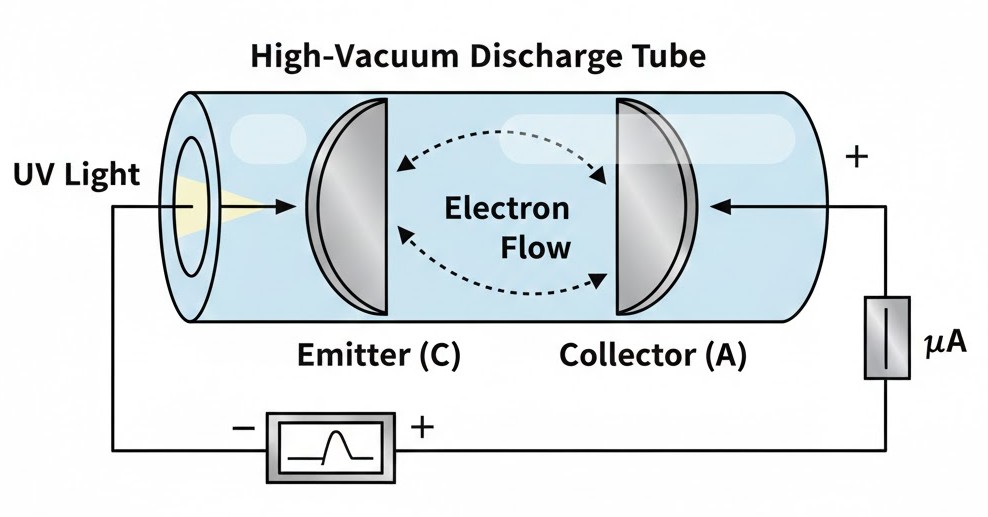
Lenard (1862-1947) used an evacuated glass tube with two electrodes. He noticed that when ultraviolet (UV) radiation hit the emitter plate, current suddenly started flowing in the circuit. The moment he stopped the light, the current vanished—poof! Just like how the crowd goes silent when a wicket falls. He concluded that light causes the emitter to eject electrons, which are then pulled toward the positive collector plate $A$ by an electric field.
NEET Checkpoint:
In Lenard's experiment, what causes the current to flow?
(a) Heating of cathode
(b) UV radiation falling on the emitter plate
(c) Application of magnetic field
(d) Ionization of residual gas
✅ Answer: (b) UV radiation falling on the emitter plate — This ejects electrons that complete the circuit.
Then came Hallwachs in 1888 with his famous zinc plate experiment. He connected a negatively charged zinc plate to an electroscope and found that UV light made the plate lose its negative charge. Even crazier? An uncharged plate became positively charged, and a positive plate became even more positive! It’s like a pani puri stall—the more people (light) come, the faster the puris (electrons) disappear, leaving the stall empty!
Figure below:
A clear diagram showing an evacuated glass tube with a quartz window, an emitter plate C receiving UV light, a collector plate A, and a circuit showing electron flow and a microammeter.
NEET Checkpoint:
If an uncharged zinc plate is irradiated with UV light, what happens?
(a) Nothing happens
(b) Plate gets positively charged
(c) Plate gets negatively charged
(d) Plate melts
✅ Answer: (b) Plate gets positively charged — This is due to the loss of negatively charged particles.
NEET Checkpoint:
What is the minimum frequency required for electron emission called?
(a) Threshold energy
(b) Threshold frequency
(c) Work function
(d) Critical frequency
✅ Answer: (b) Threshold frequency $v_0$ — Below this value, no electrons are emitted.
Practice Questions:
1. Hallwachs and Lenard concluded that the particles emitted under the action of light are:
(a) Positively charged
(b) Negatively charged
(c) Neutral
(d) Protons
✅ Answer: (b) Negatively charged — These were later identified as electrons.
2. According to Lenard's observations, the photoelectric current stops when:
(a) Intensity increases
(b) UV radiation is stopped
(c) The tube is filled with air
(d) High voltage is applied
✅ Answer: (b) UV radiation is stopped — The emission is dependent on the incident light.
Key Takeaway
- Lenard's Observation: UV light on a metal emitter in a vacuum causes current flow.
- Hallwachs' Discovery: Zinc plates lose negative charge or gain positive charge under UV light.
- Conclusion: Light causes the emission of negatively charged particles (electrons).
- Condition: Emission only occurs if the light frequency is above the threshold frequency $v_0$.
7. Definition and Characteristics of the Photoelectric Effect
Listen up, juniors! Let’s clear up this fundamental funda. When you shine light of a "suitable" frequency on a metal surface, it kicks out electrons. This cool phenomenon is formally known as the photoelectric effect, and those light-generated electrons are specifically called photoelectrons. Think of it like a bouncer at a cricket stadium gate: unless your ticket has a certain "minimum value," you aren't getting inside, no matter how many people are in line!
NEET Checkpoint:
What are the electrons emitted in the photoelectric effect called?
(a) Valence electrons
(b) Photoelectrons
(c) Free electrons
(d) Conduction electrons
✅ Answer: (b) Photoelectrons — Arre, it's in the name! "Photo" for light and "electrons" for the particles.
Now, not every metal is a "party animal" that reacts to just any light. Metals like zinc, cadmium, and magnesium are quite picky—they only respond to high-energy ultraviolet (UV) light. But then you have the alkali metals like lithium, sodium, and caesium. These guys are so sensitive that even ordinary visible light gets them excited enough to start emitting electrons.
NEET Checkpoint:
Which group of metals is sensitive even to visible light?
(a) Alkali metals
(b) Alkaline earth metals
(c) Transition metals
(d) Noble metals
✅ Answer: (a) Alkali metals (like $Li$, $Na$, $K$, $Cs$, $Rb$) — They don’t need the high-energy UV "kick" that Zinc requires.
Here’s the catch: emission only starts if the light frequency hits a minimum level called the threshold frequency ($\nu_0$). If your frequency $\nu < \nu_0$, then even if you shine a massive 1000W bulb for hours, nothing happens. This minimum frequency is a characteristic of the specific material used.
NEET Checkpoint:
Does threshold frequency depend on the intensity of light?
(a) Yes
(b) No
(c) Only at high intensity
(d) Only for UV light
✅ Answer: (b) No — It depends strictly on the nature of the material of the emitter plate.
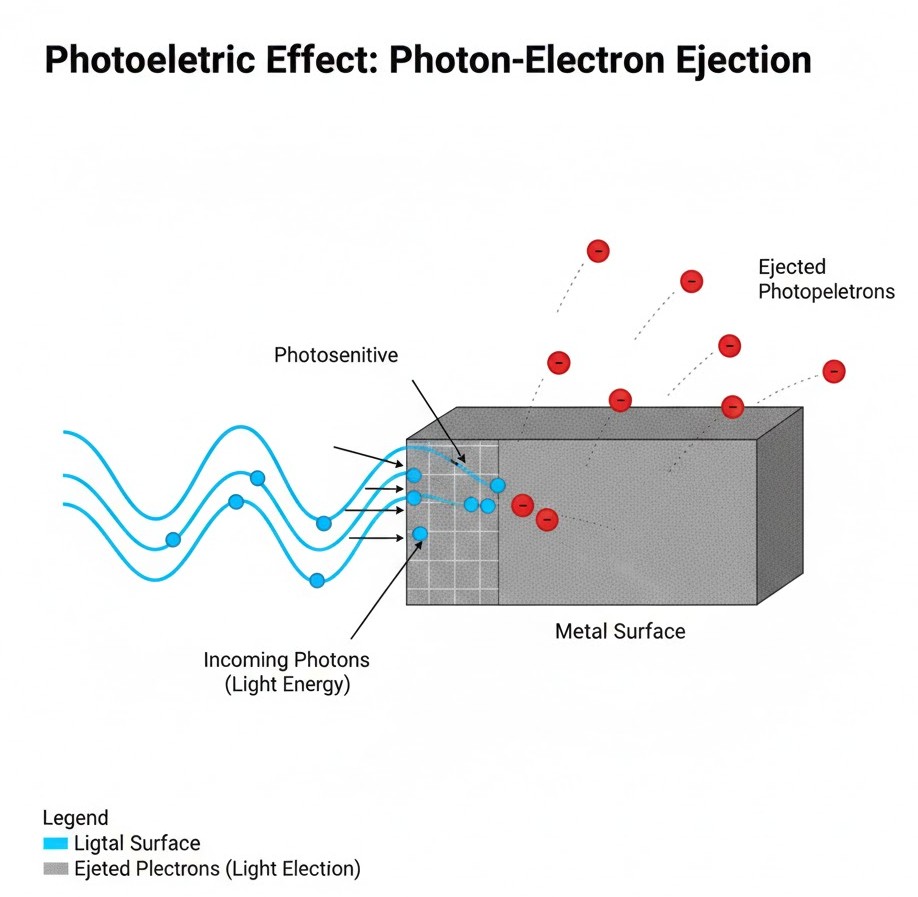
Figure below:
A clear diagram showing a photosensitive metal surface being hit by incoming light waves (photons) and negatively charged photoelectrons being ejected from the surface into the surrounding space.
Practice Question:
Photoelectric emission is possible only when the incident light frequency ($\nu$) is:
(a) $\nu < \nu_0$
(b) $\nu \ge \nu_0$
(c) Always occurs for visible light
(d) Depends only on intensity
✅ Answer: (b) — You need at least the threshold frequency ($\nu_0$) or more to overcome the metal's pull and kick those electrons out.
Key Takeaway
- Photoelectric Effect: Light energy $\rightarrow$ Electron emission.
- Threshold Frequency ($\nu_0$): The minimum frequency "cut-off" for emission.
- Sensitivity: Alkali metals respond to visible light; Zinc/Magnesium need UV.
8. Experimental Setup for Studying Photoelectric Effect
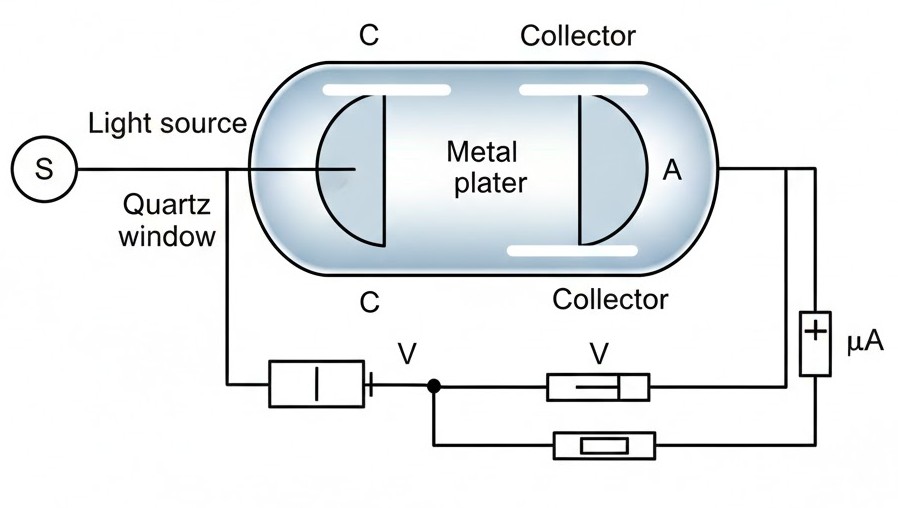
Ready to see the 'theatre' where the photoelectric effect performs? Don't stress, yaar—this funda is easier than it looks!. We use an evacuated glass or quartz tube so our tiny electrons don't keep bumping into air molecules like a crowded rickshaw in Delhi. Inside, we have two main stars: Plate C (the photosensitive emitter) and Plate A (the collector).
NEET Checkpoint:
Why is a quartz window used instead of ordinary glass in this setup?
(a) To block UV
(b) To permit UV
(c) To stop electrons
(d) To look stylish
✅ Answer: (b) To permit UV — Ordinary glass can block ultraviolet light, but quartz lets it pass through to irradiate the emitter.
Monochromatic light enters through the quartz window, hits Plate C, and—boom—electrons are ejected. To control these "photoelectrons," we connect the plates to a battery. The real "game-changer" here is the commutator, which allows us to vary the potential difference and even reverse the polarity of the plates. This means we can make Plate A positive to attract electrons or negative to repel them.
NEET Checkpoint:
Which instrument is used to measure the resulting photo current?
(a) microammeter
(b) Voltmeter
(c) Ammeter
(d) Electrometer
✅ Answer: A microammeter ($\mu A$) — Because the current is very small, we need a sensitive meter to catch it.
Think of Plate C as a pani puri vendor "emitting" puris (electrons) and Plate A as you, the collector. The commutator is like the vendor deciding whether to hand you the puri or pull it back!
NEET Checkpoint:
What is the specific function of the commutator?
(a) To increase current in a circuit
(b) To reverse the direction of current in the coil of a DC motor
(c) To convert AC into DC
(d) To reduce resistance
✅ Answer: (b) It reverses the polarity of plates A and C, allowing Plate A to be at a desired positive or negative potential.
Figure below:
A clear schematic diagram of the photoelectric experimental setup. Show an evacuated glass tube with a quartz window. Label a photosensitive emitter plate 'C' and a collector plate 'A'. Show light from a source 'S' hitting plate C. Include an external circuit with a voltmeter (V), microammeter (µA), a battery, and a commutator.
Practice Question:
In the experimental arrangement, the photoelectric current is measured by:
(a) Voltmeter
(b) Ammeter
(c) Galvanometer
(d) Potentiometer
✅ Answer: (c) Galvanometer— It measures the flow of photoelectrons in the circuit.
Key Takeaway
- Tube: Evacuated glass/quartz to allow free electron movement.
- Quartz Window: Essential for letting UV radiation through.
- Commutator: Key for reversing polarity and studying stopping potential.
- Current: Measured in microamperes ($\mu A$).
9. Effect of Light Intensity on Photocurrent
Arre, listen up! Imagine you’re at a busy pani puri stall. If the vendor serves one puri per second, you’re happy. But if he speeds up and throws five puris per second at you, that’s a "current" of snacks!. In our physics world, the photocurrent is simply the flow of photoelectrons emitted from the metal surface, and we measure this tiny flow using a microammeter ($\mu A$).
NEET Checkpoint:
Which instrument is used to measure the resulting photocurrent in the experimental setup?
(a) Voltmeter
(b) Ammeter
(c) Microammeter
(d) Galvanometer
✅ Answer: (c) Microammeter ($\mu A$) — Because photo-current is very small, we need that micro-scale sensitivity to catch every electron!.
Here’s the big funda: if you keep the frequency of light and the potential fixed, the photocurrent increases linearly with the intensity of incident light. It’s a perfect straight-line relationship! This tells us that the number of photoelectrons emitted per second is directly proportional to the intensity of the incident radiation.
NEET Checkpoint:
If you triple the intensity of incident light, what happens to the number of photoelectrons emitted per second?
(a) Remains the same
(b) Triples
(c) Doubles
(d) Decreases
✅ Answer: (b) It triples — The number of photoelectrons is directly proportional to the intensity.
Think of intensity as the "brightness" or the number of photons hitting the metal surface every second. More photons means more "hits," which results in more electrons being kicked out per second! But remember, intensity only changes the count of electrons, not their individual energy.
NEET Checkpoint:
Does changing the intensity of light affect the maximum kinetic energy of the photoelectrons?
(a) Yes
(b) No
(c) Only at high frequency
(d) Only at low intensity
✅ Answer: (b) No — The maximum kinetic energy is independent of intensity; intensity only controls the current.
Practice Question:
According to experimental observations, the photocurrent becomes zero when:
(a) Intensity is doubled
(b) Frequency is doubled
(c) The light source is turned off
(d) Intensity is very low
✅ Answer: (c) — Since photocurrent is directly proportional to intensity, if there is no light (zero intensity), there is no current.
Key Takeaway
Intensity $\propto$ Number of photoelectrons emitted per second $\propto$ Photocurrent.
10. Effect of Potential: Saturation and Stopping Potential
Alright, junior, let's look at how the potential on the collector plate $A$ actually controls our photoelectrons! Think of the collector plate as a magnet for electrons. When we make plate $A$ more positive (accelerating potential), it pulls those emitted electrons towards it with more "josh".
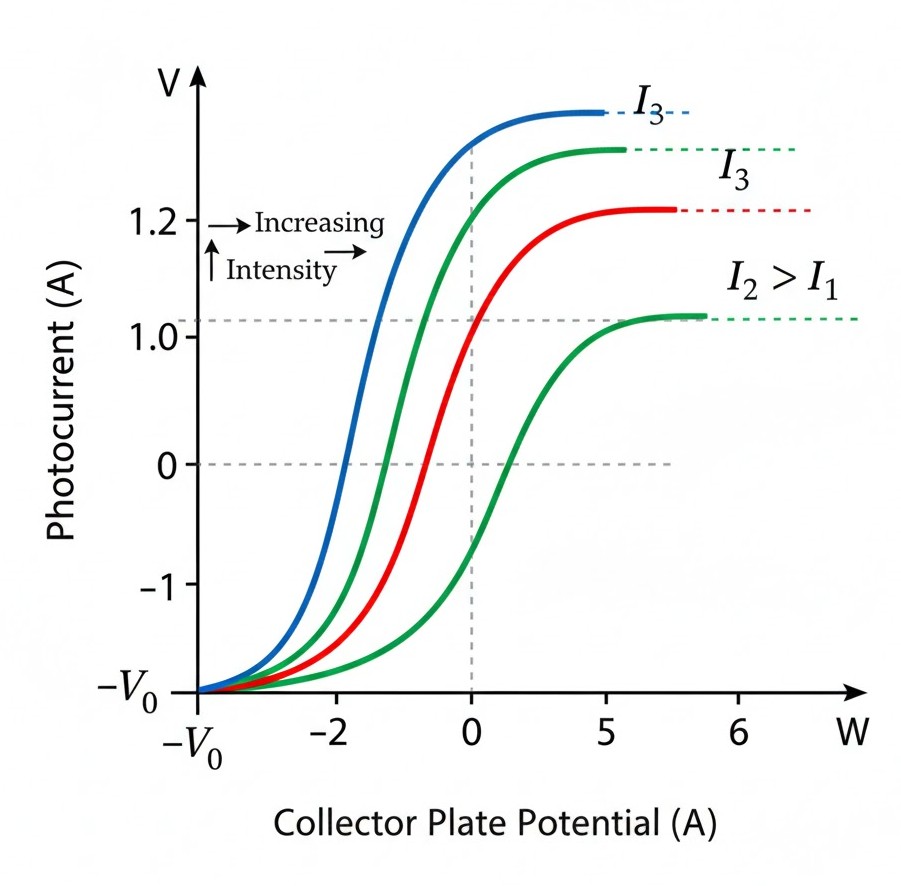
As you increase this positive potential, the photocurrent rises because more electrons are successfully making the trip. But wait! There’s a limit. Eventually, you reach a point where all the emitted electrons are being collected. This is called the saturation current. Increasing the voltage further won't do anything because you've already "cleared the crowd." It's like a Pani Puri stall—if the vendor is already serving all 10 people in line as fast as possible, doubling his speed won't help if there are no new customers!
NEET Checkpoint:
What happens to the photocurrent if you increase the accelerating potential beyond the saturation point?
(a) It increases indefinitely
(b) It decreases
(c) It remains constant
(d) It becomes zero
✅ Answer: (c) It remains constant — All available photoelectrons are already reaching the collector.
Now, let's get tricky. What if we reverse the battery? We apply a negative (retarding) potential to plate $A$. Now the plate is actually repelling the electrons. Only the most energetic ones—the "toppers" of the electron world—can reach the plate. If we keep making it more negative, eventually even the fastest electron with the maximum kinetic energy ($K_{max}$) gets pushed back, and the current hits zero. This specific voltage is our Stopping Potential ($V_0$).
NEET Checkpoint:
Does the stopping potential change if you make the incident light brighter (increase intensity)?
(a) Yes, it increases
(b) Yes, it decreases
(c) No, it remains the same
(d) It becomes zero
✅ Answer: (c) No, $V_0$ is independent of intensity for a given frequency.
Figure below:
A graph showing the variation of photocurrent on the y-axis and collector plate potential on the x-axis. It should show three curves for different intensities $I_1, I_2, I_3$ that all converge at the same negative stopping potential $-V_0$ on the x-axis but have different saturation levels on the positive side.
NEET Checkpoint:
What is the relationship between stopping potential and maximum kinetic energy?
(a) $K_{\max} = \dfrac{e}{V_0}$
(b) $K_{\max} = \dfrac{V_0}{e}$
(c) $K_{\max} = e^2 V_0$
(d) $K_{max} = e V_0$
✅ Answer: (d) $K_{max} = e V_0$ — The stopping potential is a direct measure of the energy of the fastest electrons.
Practice Questions:
1. For a fixed frequency of incident radiation, the stopping potential is:
(a) Directly proportional to intensity
(b) Inversely proportional to intensity
(c) Independent of intensity
(d) Proportional to the square of intensity
✅ Answer: (c) — Intensity only affects the number of electrons (current), not their maximum energy.
2. If the maximum kinetic energy of an emitted electron is $1.6 \times 10^{-19} J$, what is the stopping potential in Volts?
(a) $1.6 V$
(b) $1 V$
(c) $0.1 V$
(d) $10 V$
✅ Answer: (b) $1 V$. Use $K_{max} = e V_0$. Since $e = 1.6 \times 10^{-19} C$, $V_0 = K_{max}/e = 1 V$.
Key Takeaway
Formula Summary
- Saturation Current: Max current when all emitted electrons reach the collector.
- Stopping Potential ($V_0$): Retarding potential where current = 0.
- Energy-Voltage Relation:
$$K_{max} = e V_0$$
11. Frequency Dependence and Maximum Kinetic Energy
Hey there, future doctor! Let's clear up this frequency funda. While intensity is just about the "crowd" of electrons, frequency is what gives them their real "josh" or energy.
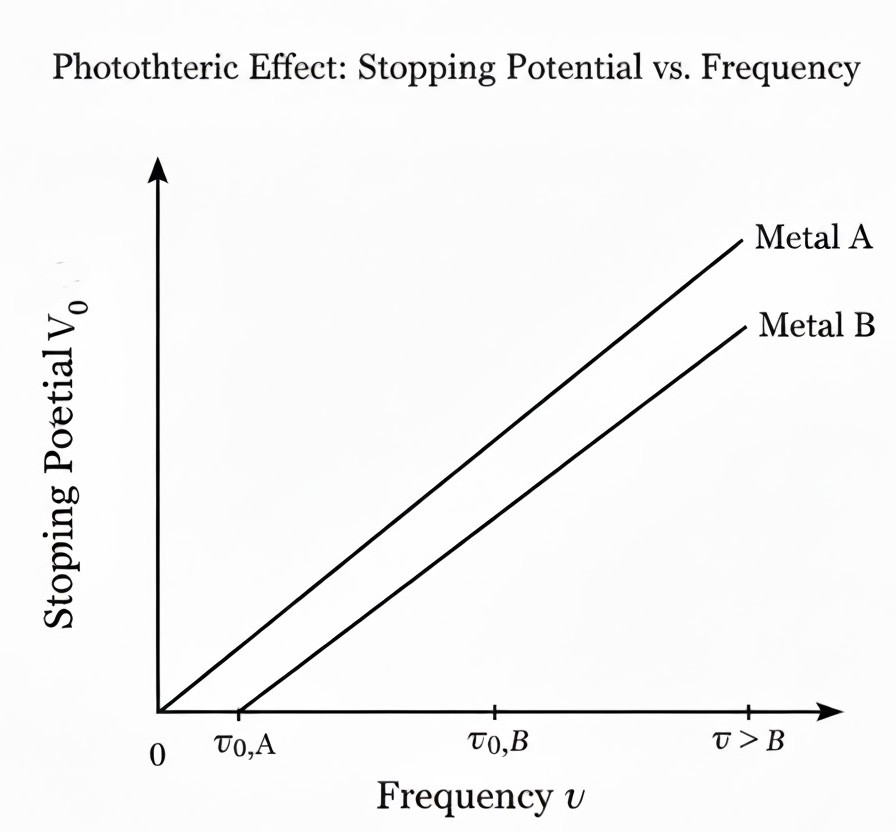
Here’s the deal: as you increase the frequency $\nu$ of the incident light, the stopping potential $V_{0}$ also increases. Why? Because higher frequency means the incident photons have more energy, which translates to a higher maximum kinetic energy $K_{max}$ for the emitted electrons. We measure this using the relationship:
NEET Checkpoint:
If the frequency of incident light is doubled (keeping $\nu > \nu_{0}$), what happens to the maximum kinetic energy?
(a) It doubles
(b) It halves
(c) It increases
(d) It remains the same
✅ Answer: (c) It increases — Higher frequency means more energetic photons, leading to faster photoelectrons.
Notice this: $K_{max}$ is totally independent of light intensity. Imagine a cricket bowling machine. If you increase the speed of the ball (frequency), the batsman has to hit harder to stop it ($V_{0}$). But if you just throw more balls at the same slow speed (intensity), the balls don't suddenly become faster.
NEET Checkpoint:
Does increasing the brightness (intensity) of a light beam change the stopping potential?
(a) Yes, it increases the stopping potential
(b) Yes, it decreases the stopping potential
(c) No, it does not change the stopping potential
(d) It becomes zero
✅ Answer: (c) No — Intensity only increases the number of electrons, not their individual energy.
Also, this process is instantaneous! There’s no "loading" time. Even if the light is super dim, emission starts in less than $10^{-9}$ s.
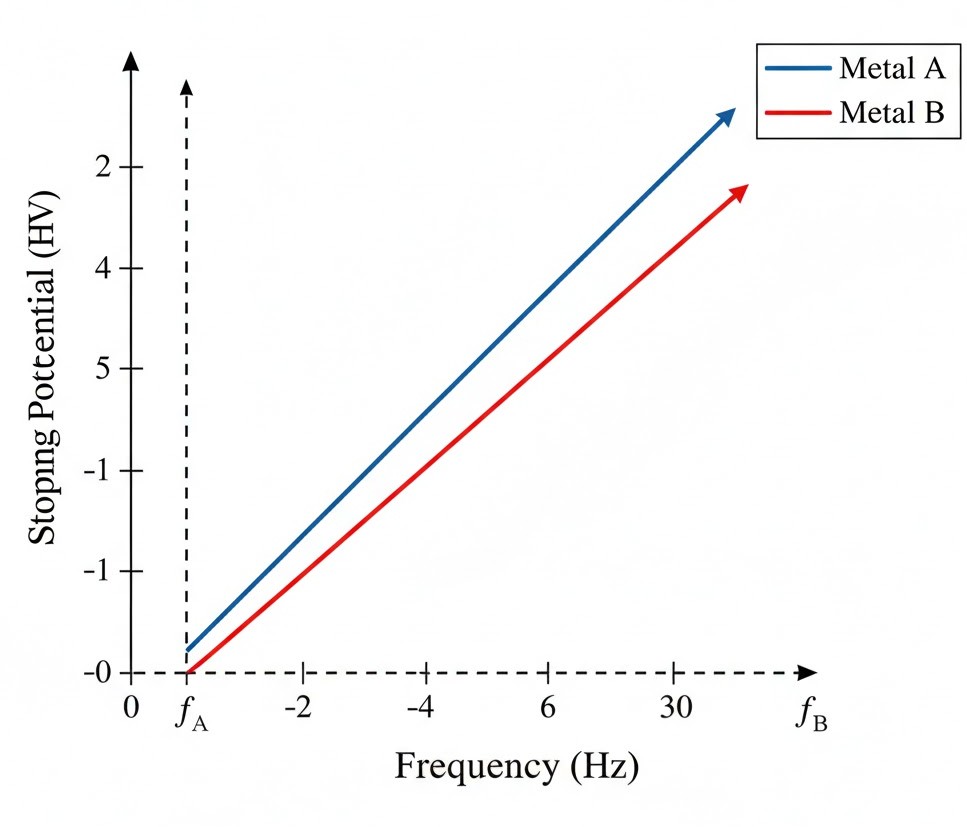
Figure below:
A line graph showing the linear relationship between stopping potential (y-axis) and frequency (x-axis) for two different metals, starting from their respective threshold frequencies on the x-axis.
NEET Checkpoint:
What is the approximate time lag in the photoelectric effect?
(a) $\sim 10^{-9}$
(b) $\sim 10^{-3}$
(c) $\sim 10^{-6}$
(d) $\sim 10^{-15}$
✅ Answer: (a) $\sim 10^{-9}$ s or less — It is an instantaneous process.
Practice Questions:
1. For a frequency $\nu < \nu_{0}$, what is the maximum kinetic energy?
(a) $h \nu$
(b) $e V_{0}$
(c) Zero
(d) Infinite
✅ Answer: (c) — Below threshold frequency $\nu_{0}$, no emission occurs regardless of intensity.
2. The slope of the $V_{0}$ vs $\nu$ graph is:
(a) $h$
(b) $h/e$
(c) $e/h$
(d) $\phi_{0}$
✅ Answer: (b) $h/e$ — This slope is a universal constant for all materials.
Key Takeaway
Formula Summary
* Max Kinetic Energy: $K_{max} = e V_{0}$
* Threshold Condition: Emission only if $\nu > \nu_{0}$
* Time Lag: $\sim 10^{-9}$ s (Instantaneous)
12. Failure of Wave Theory to Explain Photoelectric Effect
Listen up, junior! Before Einstein crashed the party, everyone thought light was just a continuous wave. While wave theory is great for explaining things like interference, it totally flopped when it came to the photoelectric effect. Let’s clear up this funda—why did the "Wave Boss" fail?
First, wave theory predicted that if you increase the intensity of light (the amplitude of the fields), the electrons should absorb more energy. This means the maximum kinetic energy $K_{max}$ should increase with intensity. But wait, experiments showed $K_{max}$ doesn't care about intensity at all!.
NEET Checkpoint:
According to wave theory, what should happen to $K_{max}$ if intensity increases?
(a) It should increase
(b) It should decrease
(c) It should remain the same
(d) It should become zero
✅ Answer: (a) It should increase — Arre, but remember, the actual experiments proved this wrong!.
Second, wave theory claimed that even low-frequency light should eventually knock out an electron if the intensity is high enough. It predicted that a threshold frequency $v_0$ shouldn't even exist. In reality, if your frequency $v$ is below $v_0$, nothing happens—no matter how bright the light is!.
Relatable Example: Imagine trying to hit a six in cricket. If you don't swing the bat with enough "frequency" (speed), you can't clear the boundary. Simply tapping the ball 100 times softly (high intensity) won't get you that six!
NEET Checkpoint:
Does wave theory support the existence of a threshold frequency?
(a) Yes, it predicts a threshold frequency
(b) No, it cannot explain the threshold frequency
(c) Yes, but only for metals
(d) It depends on intensity
✅ Answer: (b) No — It predicts any frequency should work given enough intensity or time.
Finally, the time lag issue. Wave theory says energy is spread across the wavefront, so an electron would need to wait for hours to soak up enough energy to escape. But in the lab? It’s instantaneous—happening in less than $10^{-9} s$!.
NEET Checkpoint:
What happens to the stopping potential if the intensity of incident light is increased (frequency constant)?
(a) Increases
(b) Decreases
(c) Remains unchanged
(d) Becomes zero
✅ Answer: (c) Remains unchanged - Stopping potential depends on frequency, not intensity.
Practice Questions:
1. Why does wave theory fail to explain the instantaneous nature of the photoelectric effect?
(a) Energy is concentrated in packets.
(b) Energy is distributed continuously over the wavefront.
(c) Electrons repel each other.
(d) Light has no energy.
✅ Answer: (b) — Wave theory says energy spreads out, so electrons should take a long time to gather enough to leave.
2. Wave theory expectations vs. Reality: Which of these is a direct contradiction?
(a) Intensity affects current.
(b) $K_{max}$ depends on frequency.
(c) $K_{max}$ should increase with intensity.
(d) All of the above.
✅ Answer: (c) — Wave theory thought more intensity = more energy, but reality said "No way, yaar!".
Key Takeaway
Wave theory failed because it predicted:
1. $K_{max}$ $\propto$ Intensity (Wrong!)
2. No Threshold Frequency (Wrong!)
3. Long Time Lag (Wrong!)
13. Einstein’s Photoelectric Equation and Energy Quanta
Arre beginners, listen up! In 1905, Albert Einstein flipped the script by proposing that light isn't just a continuous wave, but arrives in discrete packets of energy called quanta or photons. Each of these "energy bundles" has an energy of $E = h\nu$, where $h$ is Planck's constant and $\nu$ is the frequency. Think of it like a Vada Pav stall: if a plate costs ₹20 (that’s our work function $\phi_0$), and you hand over a ₹50 note ($h\nu$), you’ll have ₹30 left to speed away on your cycle ($K_{max}$).
Einstein’s legendary equation is:
This means an electron absorbs exactly one photon; it uses part of that energy to break free from the metal's pull and keeps the rest as kinetic energy.
NEET Checkpoint:
If you double the intensity of light, what happens to the maximum kinetic energy of the photoelectrons?
(a) It doubles
(b) It triples
(c) It remains the same
(d) It becomes half
✅ Answer: (c) It remains the same — Arre, intensity only increases the number of photons, not the energy of each individual photon!.
If the incident frequency $\nu$ is lower than a certain minimum, no electrons will pop out, no matter how bright the light is. This "entry-level" requirement is the threshold frequency $\nu_0$, defined as:
When we plot the stopping potential $V_0$ against frequency $\nu$, we get a beautiful straight line. The equation for this graph is $V_0 = (\frac{h}{e})\nu - \frac{\phi_0}{e}$, where the slope is always the constant $h/e$, regardless of the material used.
NEET Checkpoint:
What does the slope of the $V_0$ vs $\nu$ graph represent?
(a)
(b)
(c)
(d)
✅ Answer: $h/e$ — This is a universal constant and was used by Millikan to calculate Planck's constant $h$.
NEET Checkpoint:
In what year did Einstein win the Nobel Prize for his work on the photoelectric effect?
(a) 1905
(b) 1915
(c) 1921
(d) 1930
✅ Answer: (c) 1921 — Interestingly, it wasn't for his theory of relativity!.
Figure below:
A clear linear graph showing stopping potential $V_0$ on the vertical y-axis and frequency $\nu$ on the horizontal x-axis. Two parallel straight lines for 'Metal A' and 'Metal B' should be shown, each starting from a different point on the x-axis representing their respective threshold frequencies $\nu_0$ and $\nu_0'$.
Practice Questions:
1. According to Einstein, what determines the maximum kinetic energy of a photoelectron?
(a) Intensity of light
(b) Frequency of light
(c) Number of incident photons
(d) Exposure time
✅ Answer: (b) Frequency of light — More frequency means more energy per photon, yaar!.
2. If a metal has a work function of $2.14\text{ eV}$, what is the energy of a photon that could just barely knock an electron out?
(a) $1.0\text{ eV}$
(b) $2.14\text{ eV}$
(c) $4.28\text{ eV}$
(d) $0\text{ eV}$
✅ Answer: (b) $2.14\text{ eV}$ — To escape, the photon energy must at least equal the work function.
Key Takeaway
Formula Summary
- Photon Energy: $E = h\nu$
- Einstein’s Equation: $K_{max} = h\nu - \phi_0$
- Stopping Potential Form: $eV_0 = h\nu - \phi_0$
- Threshold Frequency: $\nu_0 = \frac{\phi_0}{h}$
14. The Particle Nature of Light: The Photon
Listen up, champ! We’ve seen light acting like waves, but when it’s time to hit matter, it shows its "particle" avatar. In these interactions, radiation behaves as if it is made of discrete packets of energy called photons.
Each photon carries a specific amount of energy, $E = hv$, and momentum, $p = hv/c$, where $v$ is the frequency and $c$ is the speed of light. Here is a major funda: all photons of a specific frequency have the exact same energy, regardless of how "bright" the light is. Increasing the intensity just means you're throwing more photons per second at a surface, not stronger ones.
NEET Checkpoint:
Does the energy of a photon change if you double the intensity of the light?
(a) Yes, it doubles
(b) Yes, it halves
(c) No, it remains the same
(d) It becomes zero
✅ Answer: (c) No — Photon energy $E = hv$ depends only on frequency, not intensity.
Think of a Pani Puri stall. The intensity is how many puris the bhaiyya serves per minute. But the energy is how much teekha (spice) is inside each individual puri. Serving more puris (higher intensity) doesn't make a single puri spicier! Each puri is like a photon, yaar.
Photons are also electrically neutral, so they don't care about electric or magnetic fields—they won't be deflected. In a photon-particle collision (like with an electron), the total energy and momentum are always conserved. However, the number of photons might change because they can be absorbed or new ones can be created.
NEET Checkpoint:
Are photons deflected by a strong magnetic field?
(a) Yes, always
(b) No, because photons have no charge
(c) Yes, if the magnetic field is very strong
(d) Only in vacuum
✅ Answer: (b) No — Photons are electrically neutral particles.
NEET Checkpoint:
What is the momentum of a photon with wavelength $\lambda$?
(a) p=hλ
(b) $p = \dfrac{h}{\lambda}$
(c) $p = \dfrac{hc}{\lambda}$
(d) $p = \dfrac{\lambda}{h}$
✅ Answer: (b) $p = h/\lambda$ — This is derived from $p = hv/c$ where $v/c = 1/\lambda$.
Practice Questions:
1. In a photon-electron collision, which of the following is NOT necessarily conserved?
(a) Total Energy
(b) Total Momentum
(c) Number of Photons
(d) Both (a) and (b)
✅ Answer: (c) — While energy and momentum are conserved, photons can be absorbed or created during the process.
2. Two light beams have the same intensity but different frequencies $v_1$ and $v_2$ ($v_1 > v_2$). Which beam has more photons per second?
(a) Beam 1
(b) Beam 2
(c) Both have the same
(d) Cannot be determined
✅ Answer: (b) — Since intensity is total energy per area per time, and Beam 2 has "cheaper" (lower energy) photons, it needs more of them to reach the same intensity.
Key Takeaway
Formula Summary
- Energy of a photon: $E = hv = \frac{hc}{\lambda}$
- Momentum of a photon: `$p = \frac{hv}{c} = \frac{h}{\lambda}$
- Speed: All photons travel at speed `$c = 3 \times 10^8 m/s$
15. Matter Waves and the de Broglie Relation
Listen up, junior! We’ve already seen how light—which we thought was just a wave—can behave like a bunch of particles called photons. In 1924, a French physicist named Louis Victor de Broglie (pronounced 'de-Broy') turned the tables. He pulled a "reverse uno" card and asked: if radiation can act like a particle, why can't particles like electrons act like waves?.
He reasoned that nature is symmetrical. Since the universe is made of matter and energy, they should both enjoy a dual nature. To link these worlds, he gave us the legendary de Broglie relation:
Here, $\lambda$ is the wave attribute, and $p$ (momentum) is the particle attribute, shaken and stirred together by Planck's constant $h$.
NEET Checkpoint:
Does the de Broglie wavelength of a particle depend on its internal structure or charge?
(a) Yes, it depends on both
(b) Yes, it depends only on charge
(c) Yes, it depends only on internal structure
(d) No, it depends only on momentum
✅ Answer: (d) No — It depends only on the particle's momentum ($p = mv$), regardless of its charge or nature.
Now, why don't you see your friend "waving" as they run to the pani puri stall? Let’s look at a cricket ball of mass $0.150$ kg moving at $30.0 m/s$. Its wavelength is a tiny $1.47 \times 10^{-34} m$. That is so small it’s basically invisible to any experiment. But for a tiny electron, the wavelength is significant—often comparable to X-ray wavelengths!
NEET Checkpoint:
If an electron and a proton are moving at the same speed, which one has a longer de Broglie wavelength?
(a) Electron
(b) Proton
(c) Both have the same wavelength
(d) Cannot be determined
✅ Answer: (a) Electron — Since $\lambda \propto 1/m$, the lighter particle (electron) has a much larger, more measurable wavelength.
NEET Checkpoint:
What happens to the wavelength if you double the momentum of a particle?
(a) It doubles
(b) It becomes half
(c) It remains the same
(d) It becomes four times
✅ Answer: (b) It becomes half — According to $\lambda = h/p$, wavelength is inversely proportional to momentum.
Practice Questions:
- A ball and an electron have the same momentum. Which one has a higher de Broglie wavelength?
(a) The ball
(b) The electron
(c) Both have the same wavelength
(d) Cannot be determined
✅ Answer: (c) — Arre, don't overthink! If $p$ is the same, $\lambda = h/p$ must be the same for both, no matter their size.
2. Why are wave properties not observed for a moving rickshaw?
(a) Its speed is too high
(b) Its mass is too large, making $\lambda$ negligible
(c) Rickshaws don't follow physics
(d) Its momentum is too small
✅ Answer: (b) — Massive objects have huge momentum, which makes the wavelength so small ($10^{-34} m$ range) that it’s beyond measurement.
Key Takeaway
Formula Summary
de Broglie Wavelength:$$\lambda = \frac{h}{p} = \frac{h}{mv}$$
where $h = 6.63 \times 10^{-34} Js$.
Key Funda: Large mass = Tiny $\lambda$ (Macroscopic); Tiny mass = Measurable $\lambda$ (Sub-atomic).