
1. Introduction and Definition of Electric Current
The moment these charges get moving, they constitute an electric current. Simple funda, right?
Imagine checking a clock driven by a cell or seeing water flowing smoothly in a river. This steady flow is our current, $I$! In physics, we define current by observing a small area held normal to the direction of charge flow.
If a net amount of charge ($q$) crosses this area in a given time interval ($t$), the steady current ($I$) is simply the quotient of charge over time:
Notice this: the net charge flowing forward is calculated as $q = q_{+} - q_{-}$, where $q_{+}$ is the net positive charge and $q_{-}$ is the net negative charge flowing in the forward direction. If your calculation gives you a negative current, it just implies that the net flow is actually happening in the backward direction.
NEET Checkpoint:
What is the prerequisite for the existence of an electric current?
(a) Charges must be bound
(b) Charges must be at rest
(c) Charges must be in motion
(d) Only lightning must occur
✅ Answer: (c) Charges must be in motion — Electric currents are constituted by charges in motion; static charges (charges at rest) were covered in Chapter 1.
For situations where the current is not steady (like the sudden, large flow during lightning), we need the instantaneous or differential definition. If a small net charge $\Delta Q$ flows across a cross-section during a tiny time interval $\Delta t$, the current at time $t$ is defined as the limit of the ratio as $\Delta t$ tends to zero:
And that’s cool, right? This definition ensures we can handle every flicker and flow!
The SI unit of current is the ampere (A). An ampere is typically the order of magnitude of currents you see in domestic appliances. In contrast, the current flow in your nervous system is minuscule, measured in microamperes.
Relatable Indian Example: Think of rush hour traffic in Mumbai. The steady current ($I$) is like the average rate at which cars (charge, $q$) pass through a toll booth over an hour ($t$). If a signal breaks and the flow becomes erratic, we need the differential definition, $I(t)$, to track the instantaneous flow!
NEET Checkpoint:
What is the SI unit of electric current?
(a) Coulomb (C)
(b) Volt (V)
(c) Joule (J)
(d) Ampere (A)
✅ Answer: (d) Ampere (A) — The unit of current in SI units is the ampere.
Practice Question:
For a steady current $I$ flowing through a conductor, if a net charge $q$ passes a cross-section in time $t$, which relation is correct?
(a) $q = I/t$
(b) $I = q + t$
(c) $I = q/t$
(d) $q = I t$
✅ Answer: (c) $I = q/t$ — This is the defining equation for steady current. While (d) is mathematically equivalent, (c) is the definition of current as the rate of charge flow.
NEET Checkpoint:
Currents in human nerves are typically in the order of:
(a) Tens of thousands of amperes
(b) Amperes
(c) Microamperes
(d) Megaamperes
✅ Answer: (c) Microamperes — Nerve currents are generally in the microampere range, significantly smaller than domestic appliance currents (amperes) or lightning currents (tens of thousands of amperes).
Now that we have cleared up the basic funda of current, let’s dive into how charges actually move inside a conductor—this is where the concept of drift velocity kicks in!
Key Takeaway
Electric current ($I$) arises from charges in motion. The general definition of current is $I(t) \equiv \lim_{\Delta t\rightarrow0}\frac{\Delta Q}{\Delta t}$. The fundamental SI unit for current is the Ampere ($A$).
2. Electric Currents in Conductors and Charge Carriers
In bulk matter, some materials have electrons that aren't clingy—they are practically free to move within the material! We call these conductors. In solid conductors, like the copper wires in your house, the atoms are tightly bound together. This means the current is carried by negatively charged electrons drifting against a background of fixed, stubborn positive ions.
NEET Checkpoint:
In a solid metallic conductor, the current is carried by:
(a) Fixed positive ions
(b) Free electrons
(c) Both
(d) Protons
✅ Answer: (b) — In solids, the positive ions are fixed; only the electrons are free to roam.
Now, why doesn't a piece of wire just "have" a current sitting on the table? Without an electric field $E$, it’s total chaos inside! Electrons are in constant thermal motion, colliding with fixed ions and bouncing off in completely random directions. On average, as many go left as go right, so the net current is zero. It's like a crowded Mumbai local station platform—everyone is moving, but the crowd isn't going anywhere until the train arrives!
NEET Checkpoint:
What is the net current in a conductor without an electric field?
(a) Zero
(b) Maximum
(c) Minimum
(d) Infinite
✅ Answer: (a) Zero — Because thermal motion is random and velocities average out.
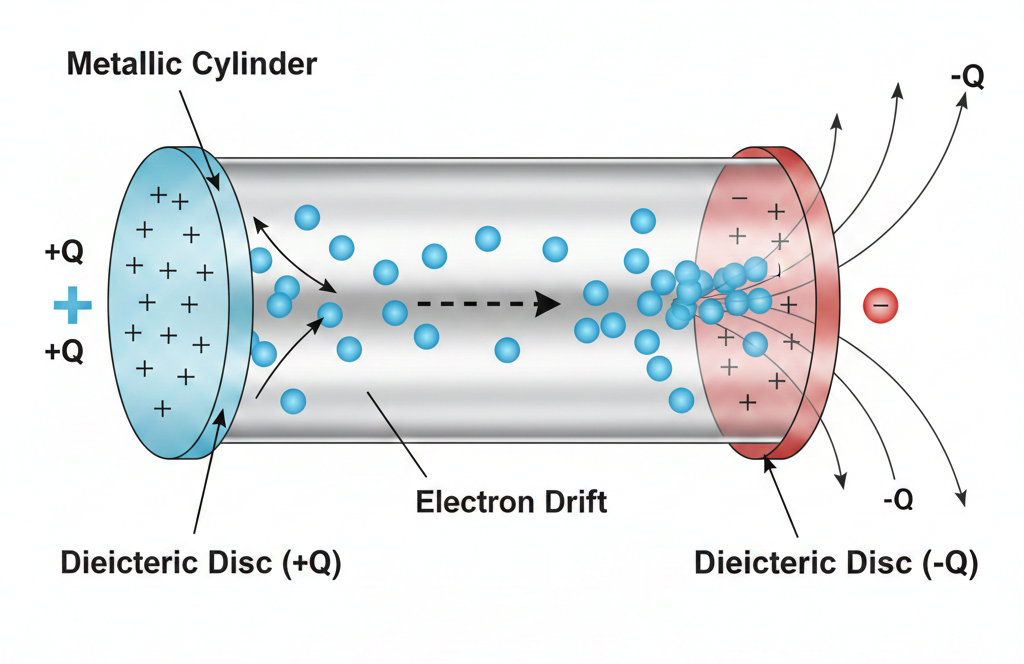
To get a steady flow, we apply an electric field $E$. But here's the catch: the electrons will quickly neutralise any charges at the ends, and the current will stop. To keep the "bijli" flowing, we need a cell or battery to act as a pump, continuously replenishing the charges and maintaining the field.
NEET Checkpoint:
Which device maintains a steady electric field in a conductor?
(a) Galvanometer
(b) Ammeter
(c) Electric cell / Battery
(d) Voltmeter
✅ Answer: (c) A cell or battery — It replenishes charges to ensure continuous current.
Figure below:
A clear diagram showing a metallic cylinder with two dielectric discs at the ends—one with +Q and one with -Q—showing internal electrons drifting towards the positive end.
Practice Questions:
When an electron collides with a fixed ion in a conductor, it:
(a) Gains speed
(b) Stops
(c) Emerges with a random direction
(d) Changes into a proton
✅ Answer: (c) — The speed stays the same, but the post-collision direction is totally random.
Key Takeaway
- Conductors: Free electrons + Fixed positive ions.
- No Field: Random thermal motion = $I = 0$.
- Steady Current: Requires a battery for charge replenishment.
3. Ohm's Law and the Definition of Resistance
Hey NEET aspirants! Let's clear up a super important funda in current electricity: Ohm's Law. Don't stress, yaar—it’s easier than it looks!
Back in 1828, G.S. Ohm discovered a basic law about current flow. He found that the potential difference ($V$) across a conductor is directly proportional to the current ($I$) flowing through it.
Notice this proportionality:
To convert this proportionality into a proper equation, we introduce a constant, $R$. This gives us the famous mathematical form of Ohm’s law:
Here, $R$ is the constant of proportionality known as the electrical resistance of the conductor. It basically measures how much the material "resists" the flow of charge.
NEET Checkpoint:
What is the SI unit of resistance?
(a) Ampere
(b) Volt
(c) Coulomb
(d) Ohm
✅ Answer: (d) Ohm ($\Omega$) — The SI unit of resistance is the Ohm ($\Omega$), which is equivalent to $1\,V\,A^{-1}$ (Volt per Ampere).
The value of resistance $R$ doesn't just depend on the material (like copper or glass), but also critically on the dimensions of the conductor. Imagine trying to squeeze into a crowded local train (high resistance) versus walking down a wide, empty street (low resistance)!
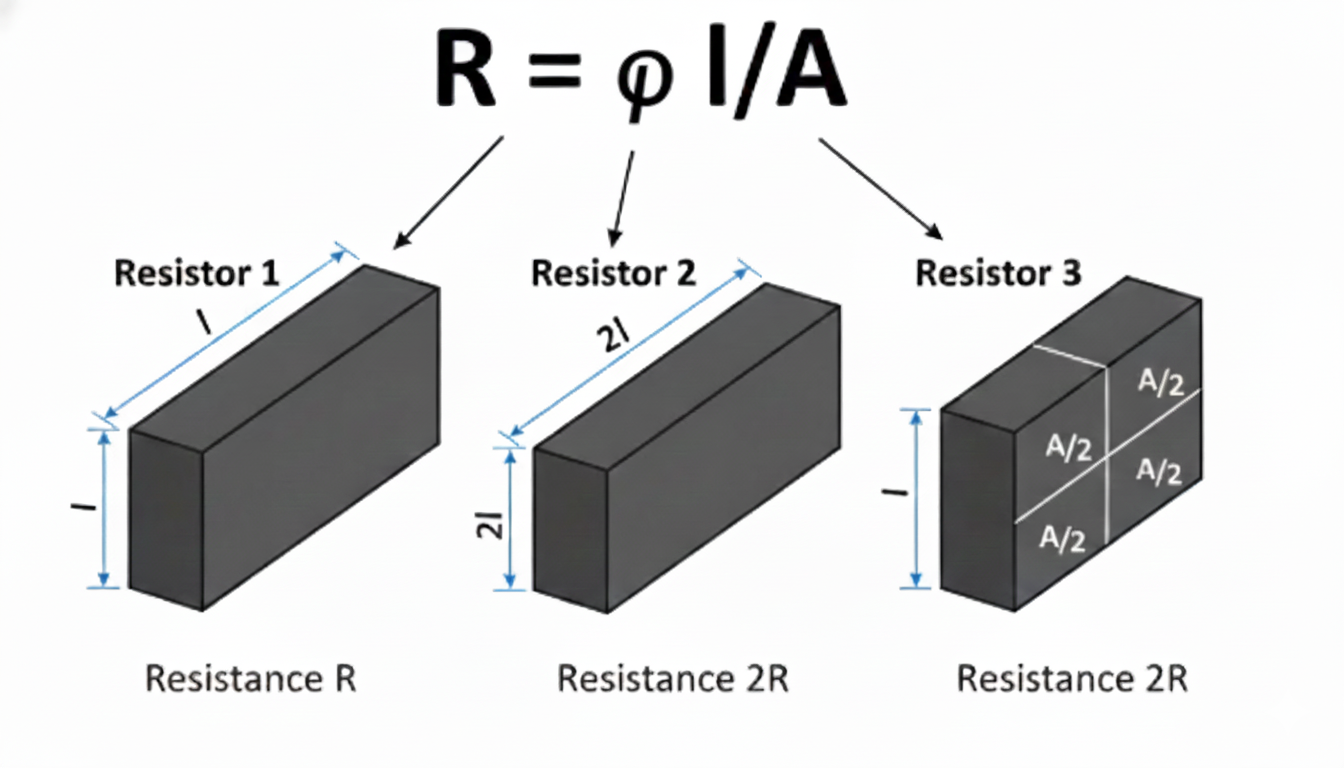
Specifically, resistance $R$ is directly proportional to the length ($l$) of the conductor, $R \propto l$, and inversely proportional to its cross-sectional area ($A$), $R \propto \frac{1}{A}$. Combining these gives us $R = \rho \frac{l}{A}$, where $\rho$ is resistivity. So, double the wire length, double the resistance. Halve the area, double the resistance.
NEET Checkpoint:
If a conductor's length is doubled without changing its material, how does its resistance change?
(a) Halves
(b) Doubles
(c) Stays the same
(d) Quadruples
✅ Answer: (b) Doubles — Resistance is proportional to length ($R \propto l$).
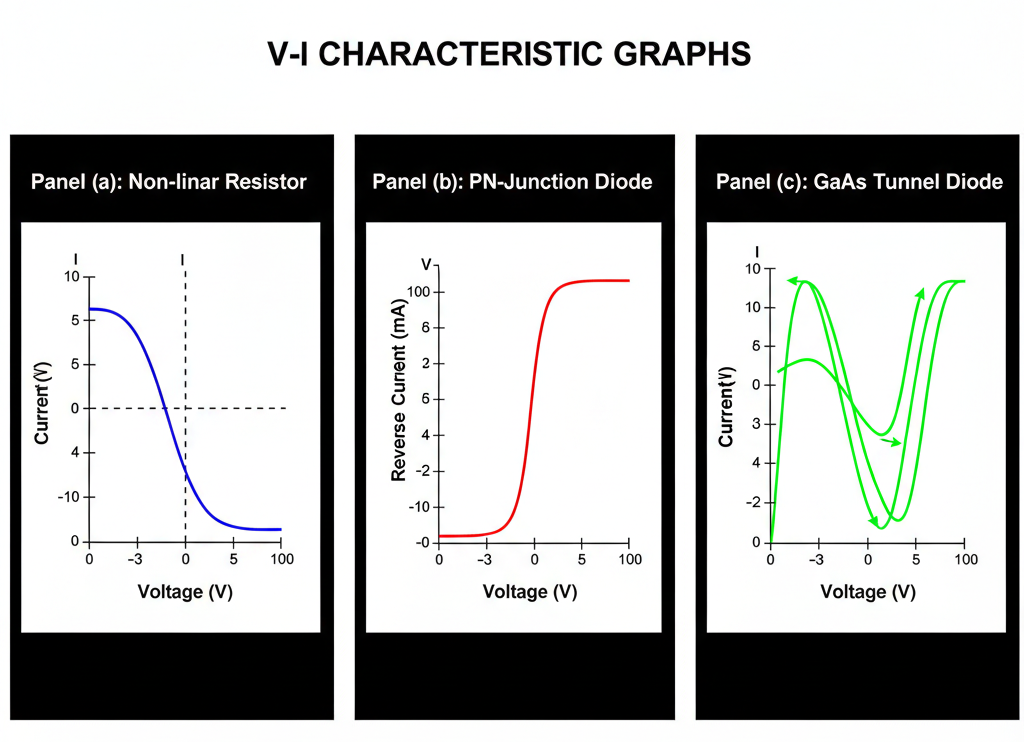
Now, here's the trick for the exam: $V=IR$ is technically just the definition of resistance, even for non-Ohmic materials. Ohm's Law specifically asserts that the plot of $I$ versus $V$ is linear, meaning $R$ is independent of $V$. Always remember the context! Materials like Gallium Arsenide ($GaAs$) or diodes don't obey the linear relationship.
NEET Checkpoint:
Which statement correctly describes Ohm's Law?
(a) $V=IR$ defines the resistance of any conductor.
(b) The resistance $R$ is independent of the conductor’s dimensions.
(c) The relationship between $V$ and $I$ must be linear.
(d) Ohm's Law is a fundamental law of nature.
✅ Answer: (c) The relationship between $V$ and $I$ must be linear — Ohm's law asserts that the plot of $I$ versus $V$ is linear, meaning $R$ is independent of $V$. It is not a fundamental law of nature.
Practice Questions:
- If the current $I$ flowing through a resistor is $1.5\,A$ when the potential difference $V$ is $12\,V$, what is the resistance $R$?
(a) $18\,\Omega$
(b) $8.0\,\Omega$
(c) $13.5\,\Omega$
(d) $10.5\,\Omega$
✅ Solution: (b) Using the formula $V=RI$, we rearrange to find $R = V/I$. $R = 12\,V / 1.5\,A = 8.0\,\Omega$.
2. Resistance $R$ depends on:
(a) Only the material.
(b) Only the dimensions.
(c) Both the material and the dimensions.
(d) The potential difference only.
✅ Solution: (c) Resistance $R$ depends on both the material of the conductor and its dimensions (length $l$ and cross-sectional area $A$).
Key Takeaway
Ohm's Law states $V \propto I$, leading to the formula
where $R$ is the resistance, measured in Ohm ($\Omega$). Remember that $R$ is governed by the material (resistivity $\rho$) and the geometry ($R \propto l/A$).
4. Electrical Resistance, Resistivity, and Conductivity
Hey junior! Let’s clear up this $R, \rho,$ and $\sigma$ funda once and for all. Think of resistance ($R$) as the "traffic jam" for electrons. According to the sources, if you double the length ($l$) of a wire, you double the resistance ($R \propto l$), just like a longer queue at a Pani Puri stall makes you wait longer. But, if you increase the cross-sectional area ($A$), resistance drops ($R \propto 1/A$) because those electrons finally have some "elbow room" to move!
We combine these to get the big boss formula:
Here, $\rho$ (rho) is the resistivity, a constant that only cares about the material and temperature, not how long or thick your wire is. Don't stress, yaar—it's easier than it looks!.
NEET Checkpoint:
If a copper wire is cut into two equal halves, what happens to its resistivity?
(a) It becomes half
(b) It becomes double
(c) It becomes four times
(d) It remains unchanged
✅ Answer: (d) It remains unchanged - Resistivity is a material property and depends only on the nature of the material and temperature, not on the length or size of the wire. Cutting the wire changes resistance, but not resistivity.
Now, meet the "good twin," conductivity ($\sigma$). It’s simply the reciprocal of resistivity:
Metals have tiny resistivity ($10^{-8} \Omega m$ to $10^{-6} \Omega m$), meaning they are legendary conductors. Insulators? They have resistivities $10^{18}$ times higher—total "roadblocks" for current!
NEET Checkpoint:
What is the SI unit of conductivity ($\sigma$)?
(a) ohm metre (Ω·m)
(b) siemens (S)
(c) siemens per metre (S m⁻¹)
(d) ampere per volt
✅ Answer: (c) $S$ (Siemens) or $\Omega^{-1} m^{-1}$ — It's the inverse of the resistivity unit.
NEET Checkpoint:
Which has higher resistivity: a semiconductor or a metal?
(a) Metal
(b) Semiconductor
(c) Both have same resistivity
(d) Cannot be compared
✅ Answer: (b) Semiconductor — Its resistivity lies in the middle range, between conductors and insulators.
Figure below:
A clear diagram showing a rectangular slab of length l and area A, another with 2l showing 2R, and one split into A/2 showing 2R to illustrate $R = \rho \frac{l}{A}$.
Practice Question:
A wire of resistance $R$ is stretched to triple its length. What is the new resistance?
(a) $3R$
(b) $R/3$
(c) $9R$
(d) $R/9$
✅ Answer: (c) $9R$ — Arre! If $l$ triples, $A$ must become $1/3$ to keep volume constant. So, $R' = \rho (3l) / (A/3) = 9R$.
Key Takeaway
Formula Summary:
- Resistance: $R = \rho \frac{l}{A}$ (Unit: $\Omega$)
- Resistivity: $\rho = \frac{m}{ne^2\tau}$ (Unit: $\Omega m$)
- Conductivity: $\sigma = \frac{1}{\rho}$ (Unit: $S$ or $\Omega^{-1} m^{-1}$)
5. Current Density, Drift Velocity, and Mobility
Hey there, future doctors! Let's clear up this funda of how electrons actually move. You might think they zoom through wires like a fast bowler's delivery, but it’s actually more of a slow, crowded shuffle!
First up is Current Density ($j$). Think of a crowded pani puri stall in a narrow lane; the "crowd" is the current ($I$), and the lane width is the area ($A$). Current density is simply the current per unit area, $j = I/A$, with SI units of $A/m^2$. We can also write Ohm’s Law in a stylish vector form as:
where $\sigma$ is conductivity.
NEET Checkpoint:
What are the SI units of current density?
(a) $A \cdot m$
(b) $A/m^2$
(c) $V/m$
(d) $\Omega \cdot m$
✅ Answer: (b) $A/m^2$ — Easy-peasy! It is current ($I$) divided by area ($A$).
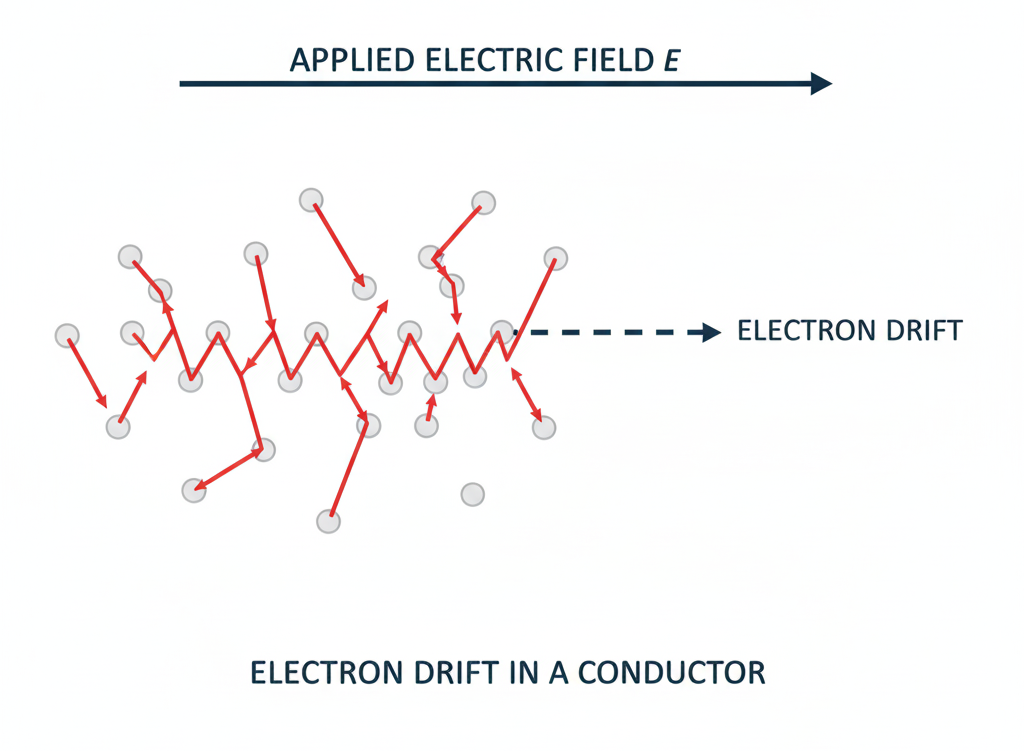
Now, why do electrons move so slowly? In a conductor, they constantly collide with heavy ions, losing their path like a rickshaw in a busy bazaar. However, an electric field ($E$) gives them a tiny push, making them "drift". This average velocity is the Drift Velocity ($v_d$):
where $\tau$ is the relaxation time (average time between collisions).
NEET Checkpoint:
If the relaxation time $\tau$ increases (fewer collisions), the drift velocity will:
(a) Decrease
(b) Increase
(c) Stay same
(d) Become zero
✅ Answer: (b) Increase — More time to accelerate between "accidents" means a higher drift speed!.
Figure below:
A clear diagram showing an electron's zigzag path through a conductor, with a dotted line showing the slight 'drift' opposite to the direction of the applied electric field E.
Finally, Mobility ($\mu$) tells us how "movable" a charge carrier is. It is the magnitude of drift velocity per unit electric field:
The SI unit is $m^2/Vs$, and it is always positive. Don't stress, yaar—it's easier than it looks!
NEET Checkpoint:
Which of the following is the correct relation for current?
(a) $I = n e A v_d$
(b) $I = n e / A v_d$
(c) $I = v_d / n e A$
(d) $I = n A v_d$
✅ Answer: (a) $I = n e A v_d$ — Here $n$ is the free electron density and $A$ is the area.
Practice Question:
A copper wire carries a steady current. If the diameter of the wire is doubled while keeping the current constant, the current density $j$ will:
(a) Double
(b) Halve
(c) Become one-fourth
(d) Quadruple
Explanation: Since $j = I/A$ and $A \propto d^2$, doubling the diameter $d$ increases the area four times, so $j$ becomes $j/4$.
Key Takeaway
Formula Summary
- Current Density: $j = \frac{I}{A}$
- Vector Ohm's Law: $\vec{j} = \sigma \vec{E}$
- Drift Velocity: $v_{d} = \frac{e E \tau}{m}$
- Mobility: $\mu = \frac{v_{d}}{E} = \frac{e \tau}{m}$
6. Microscopic Origin of Resistance and Drift
Don’t think electrons just zoom through a wire like a Ferrari on an empty highway! It’s more like trying to run through a crowded Mumbai local station during peak hours. You try to speed up, but dhishoom—you bump into someone and lose your direction.
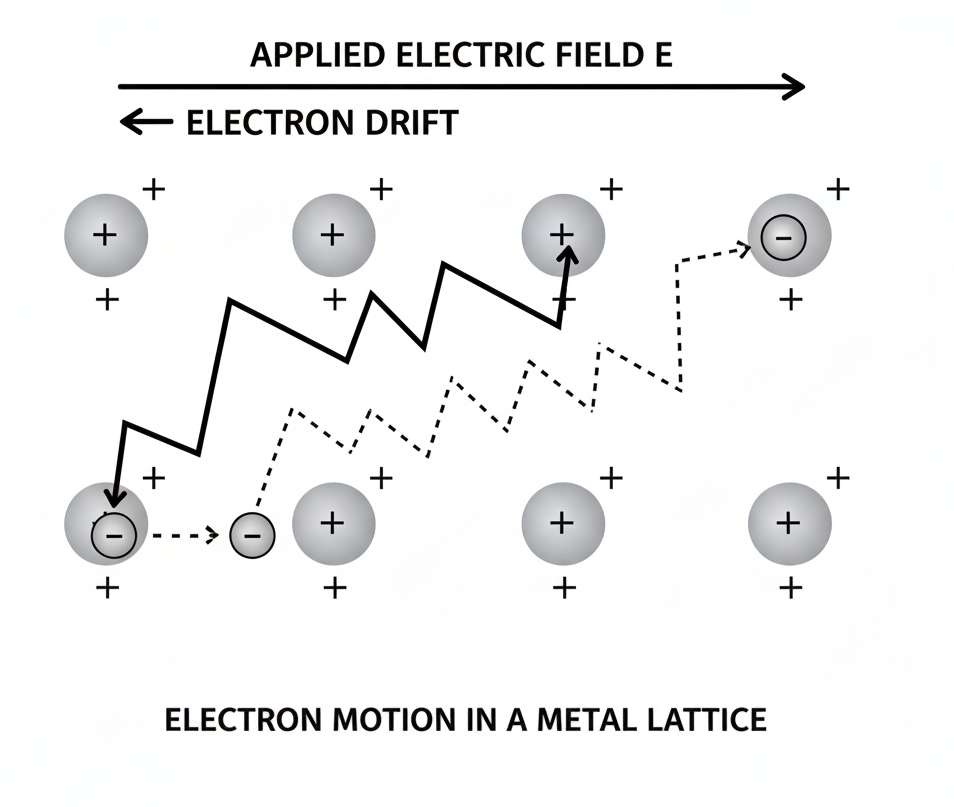
In a conductor, the electric field ($E$) exerts a force on electrons, giving them an acceleration $a = \frac{-eE}{m}$. However, they constantly collide with fixed ions in the metal. These collisions are like annoying uncles at a wedding who keep stopping you to talk—they completely randomise your velocity. Instead of accelerating forever, electrons acquire a steady, pathetic average speed called drift velocity ($v_d$).
NEET Checkpoint:
What is the average thermal velocity of electrons when $E = 0$?
(a) Zero
(b) Maximum
(c) Equal to drift velocity
(d) Infinite
✅ Answer: (a) Zero — Because their directions are completely random, they cancel out!.
The relationship between this drift and the field is given by:
Here, $\tau$ is the relaxation time, which is just the average time between two "collisions" with those fixed ions.
Now, why does your phone charge? Because of the current ($I$), which is directly tied to how fast these guys are drifting:
Where $n$ is the free electron density and $A$ is the cross-sectional area. Even though $v_d$ is tiny (only a few $mm/s$), the number of electrons ($n$) is massive—about $10^{29}$ per cubic metre—so you still get a huge current!.
Figure below:
A schematic diagram showing an electron's zig-zag path between fixed positive ions. Show a solid line for the path with no electric field and a dotted line showing a slight 'drift' in the opposite direction of an applied electric field E.
NEET Checkpoint:
Is the path of an electron between collisions a straight line when an electric field is present?
(a) Yes, always straight
(b) No, it is curved
(c) It is circular
(d) It is random
✅ Answer: (b) No, it is generally curved because of continuous acceleration.
NEET Checkpoint:
If you increase the temperature, what happens to the relaxation time $\tau$?
(a) Increases
(b) Decreases
(c) Remains constant
(d) Becomes zero
✅ Answer: (b) It decreases — Higher temperature means more frequent "bumping," so $\tau$ drops!.
Practice Question:
If the cross-sectional area $A$ of a wire is doubled while keeping the current $I$ constant, the drift velocity $v_d$ will:
(a) Double
(b) Halve
(c) Quadruple
(d) Remain same
✅ Answer: (b) Halve — From $I = n e A v_d$, if $A$ goes up, $v_d$ must go down to keep $I$ the same!.
Key Takeaway
Formula Summary
- Drift Velocity: $v_d = \frac{e E \tau}{m}$
- Current Relation: $I = n e A v_d$
- Resistivity: $\rho = \frac{m}{n e^2 \tau}$
7. Limitations of Ohm's Law ($V-I$ Characteristics)
Listen up, champ! While $V = IR$ feels like the ultimate truth, it isn't actually a fundamental law of nature. Think of it as a "rule of thumb" that many materials simply ignore. Notice this: the formula $V = IR$ is technically just the definition of resistance, but Ohm's Law specifically asserts that the plot of $I$ versus $V$ is linear, meaning $R$ stays constant regardless of the voltage applied.
NEET Checkpoint:
Is Ohm's Law a fundamental law of nature?
(a) Yes, it is a fundamental law
(b) No, it is an empirical law
(c) It applies to all materials under all conditions
(d) It is derived from Newton’s laws
✅ Answer: (b) No — It is an empirical relation valid for many, but not all, substances.
Here is where the "funda" gets tricky. Deviations happen in three main ways:
1. Non-proportionality: In many conductors, $V$ ceases to be proportional to $I$, especially at high currents.
2. Sign Dependence: In devices like the semiconductor diode, the current depends on the sign of $V$. Reversing the battery doesn't just reverse the current; it might stop it entirely!.
3. Non-unique Relationship: Materials like GaAs (Gallium Arsenide) are so "hatke" that for one single value of current $I$, you can have more than one possible value of voltage $V$.
NEET Checkpoint:
Which material exhibits a non-unique $V-I$ relationship?
(a) Copper
(b) Silver
(c) GaAs
(d) Nichrome
✅ Answer: (c) GaAs — It shows multiple voltages for the same current in certain regions.
Indian Example: Think of a local auto-rickshaw fare. For short trips, the fare is proportional to the distance. But during heavy rain or at midnight, the "law" breaks! The driver might demand a flat rate regardless of the meter. That’s exactly how non-ohmic materials behave—they don't follow the straight-line rules when things get "intense".
Figure below:
A three-panel set of V-I characteristic graphs. Panel (a) shows a solid line deviating from a dashed linear line at high current. Panel (b) shows the asymmetric curve of a diode where forward bias current is in mA and reverse bias is in µA. Panel (c) shows the non-unique V-I curve for GaAs featuring a negative resistance region.
NEET Checkpoint:
In a diode, reversing the direction of $V$ while keeping its magnitude fixed results in:
(a) Same current magnitude but opposite direction
(b) Zero current in both directions
(c) A very different current
(d) Current proportional to voltage in both directions
✅ Answer: (c) A current of a different magnitude — The relation between $V$ and $I$ depends on the sign of $V$.
Practice Question:
A material is found to have a region of "negative resistance" where the current decreases as voltage increases. This material is likely:
(a) A good metallic conductor
(b) A standard resistor
(c) Gallium Arsenide (GaAs)
(d) Copper at room temperature
✅ Answer: (c) GaAs — Fig 3.7 in the sources shows a non-linear region where the current-voltage relationship is non-unique and includes non-linear resistance.
Key Takeaway
Ohm’s Law fails if:
* $V$ is not proportional to $I$.
* The $V-I$ relation depends on the sign of $V$ (e.g., Diodes).
* The relationship is non-unique (e.g., GaAs).
8. Temperature Dependence of Resistance and Resistivity
Listen up, junior! Ever noticed how your phone gets warm during a long gaming session and starts to lag? In physics, temperature changes everything, especially how easily charges flow.
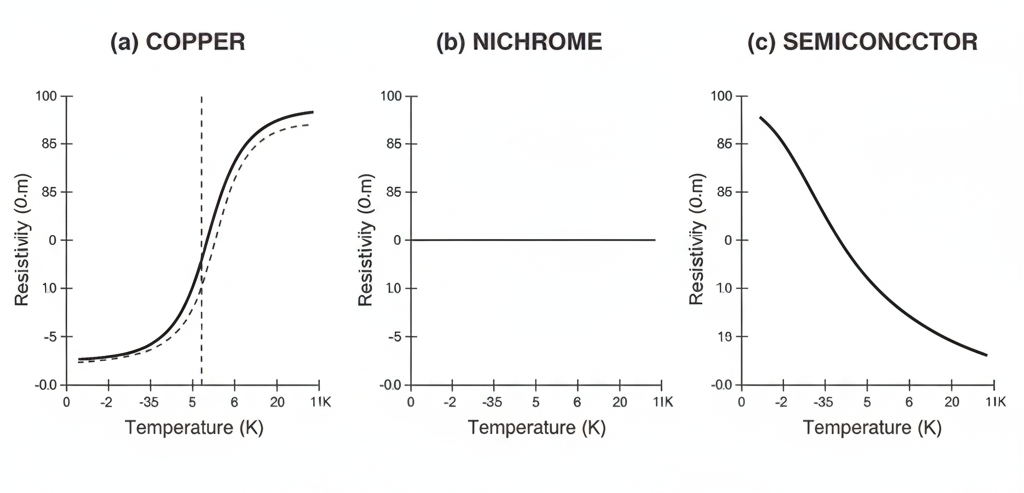
For most metals, resistivity $\rho$ increases as temperature $T$ rises. Within a limited range, we use this nifty linear approximation:
Here, $\alpha$ is the temperature coefficient of resistivity. For metals, $\alpha$ is positive, meaning they get more "stubborn" (resistant) when hot.
NEET Checkpoint:
If the temperature of a copper wire increases, its resistivity:
(a) Decreases
(b) Increases
(c) Stays the same
(d) Becomes zero
✅ Answer: (b) Increases — For metals, $\alpha$ is positive, so heat means more resistance!.
Why? Think of a crowded Mumbai local train. As the "heat" (temperature) rises, people (ions) vibrate more frantically. It becomes much harder for you (the electron) to sprint through without bumping into someone! This decrease in relaxation time $\tau$ increases resistivity $\rho = \frac{m}{ne^{2}\tau}$.
NEET Checkpoint:
For which of the following materials does resistivity decrease with temperature?
(a) Copper
(b) Nichrome
(c) Silicon
(d) Silver
✅ Answer: (c) Silicon — It's a semiconductor! Their $n$ increases so much with heat that it offsets the collision chaos.
Interestingly, alloys like Nichrome and Manganin have a very weak dependence on temperature. They are the "cool-headed" players of the circuit world, making them perfect for standard resistors.
NEET Checkpoint:
Why is Nichrome used in standard resistors?
(a) It has very low resistivity
(b) It has high resistivity and a small temperature coefficient
(c) It is a good conductor of electricity
(d) Its resistance decreases rapidly with temperature
✅ Answer: (b) It has high resistivity and a small temperature coefficient - Because its resistivity changes very little with temperature, keeping the resistance stable.
Figure below:
A clear set of three graphs showing Resistivity vs. Temperature: one for Copper showing a non-linear curve at low T, one for Nichrome showing a near-straight line with a small slope, and one for a Semiconductor showing a downward curve.
Practice Questions:
- A conductor has a positive temperature coefficient of resistivity. It is most likely a:
(a) Semiconductor
(b) Insulator
(c) Metal
(d) Electrolyte
✅ Answer: (c) is correct. Metals have a positive $\alpha$, meaning resistivity increases with temperature.
2. In semiconductors, the resistivity decreases with temperature because:
(a) $\tau$ increases
(b) $n$ increases
(c) $m$ decreases
(d) $\alpha$ is positive
✅ Answer: (b) is correct. In semiconductors, the increase in charge carrier density $n$ outweighs the decrease in relaxation time $\tau$.
Key Takeaway
Formula Summary
- Resistivity Formula:
$$\rho_{T} = \rho_{0}[1 + \alpha(T - T_{0})]$$- Resistance Formula:
$$R_{T} = R_{0}[1 + \alpha(T - T_{0})]$$- Metals: $\alpha > 0$ (Resistivity $\uparrow$ as $T \uparrow$)
- Semiconductors: $\rho$ decreases as $T$ increases
- Alloys: Very weak $T$ dependence
9. Electrical Energy and Power
Hey everyone! Ever wondered why your mobile phone gets warm after a long session of gaming or watching cricket? It's not just the heat of the match—it's Physics in action, yaar! Let's clear up this power funda once and for all.
When a current $I$ flows through a conductor with potential difference $V$, the potential energy of a charge $\Delta Q$ changes by $\Delta U = -\Delta Q V$. If charges moved freely, they’d just gain speed, but in a real conductor, electrons are like commuters in a crowded Mumbai local—they keep bumping into fixed ions! These collisions dissipate energy as heat, making the conductor warm.
NEET Checkpoint:
What happens to the energy gained by charges in a conductor?
(a) Stored as electrostatic energy
(b) Converted into kinetic energy permanently
(c) Dissipated as heat due to collisions
(d) Converted into magnetic energy
✅ Answer: (c) Dissipated as heat due to collisions - It is shared with atoms during collisions, causing them to vibrate more and heat up the conductor.
The energy dissipated per unit time is called Power ($P$). We calculate it as:
Using Ohm's law ($V = IR$), we can also write this "Ohmic loss" as:
NEET Checkpoint:
If you double the current through a fixed resistor, how much does the power loss change?
(a) Becomes double
(b) Becomes four times
(c) Becomes half
(d) Remains the same
✅ Answer: (b) Becomes four times - It increases 4 times ($P \propto I^2$). Don't let this simple logic bowl you out!
Now, why do those big transmission towers have "Danger High Voltage" signs? It’s because power wasted in cables ($P_c$) is:
Notice that $P_c \propto 1/V^2$. By using enormous voltages, we keep the current low and minimize energy waste during its long journey from the power station to your colony.
NEET Checkpoint:
Why is electrical power transmitted at very high voltages?
(a) To increase the current in transmission lines
(b) To minimize power loss, since loss is inversely proportional to $V^2$
(c) To increase the resistance of transmission wires
(d) To make electrical appliances operate safely
✅ Answer: To minimize power loss ($P_c$), since loss is inversely proportional to $V^2$.
Figure below:
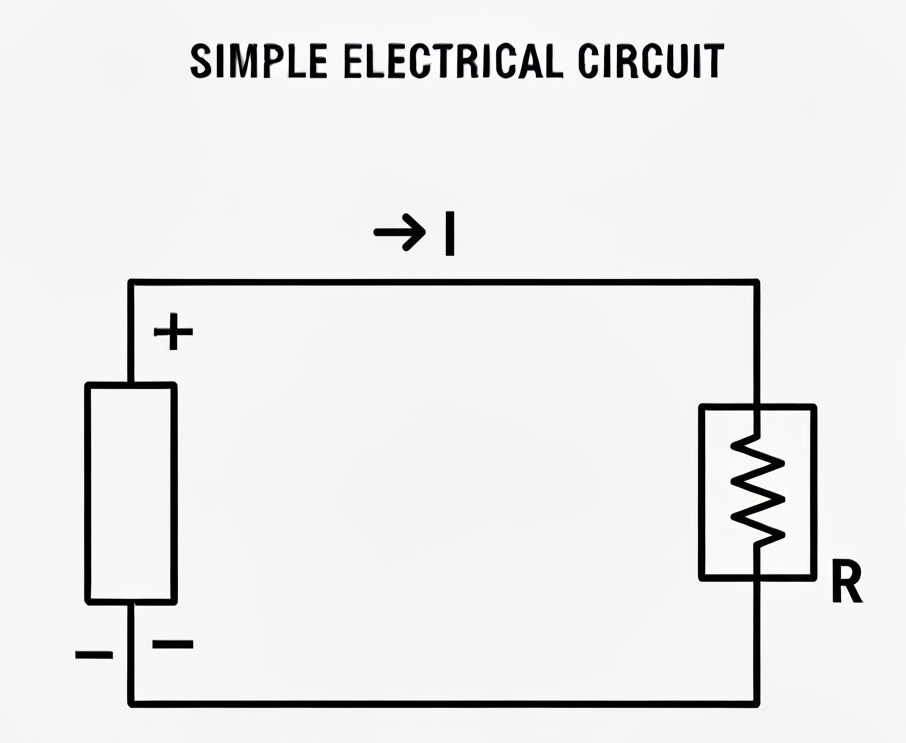
A clear diagram showing a simple circuit with a cell connected to a resistor R, with arrows indicating current I flowing from the positive to negative terminal.
Practice Questions:
- A device with power $P$ is delivered energy via cables of resistance $R_c$ at voltage $V$. The power wasted in the cables is:
(a) $V^2/R_c$
(b) $P^2 R_c / V^2$
(c) $I R_c$
(d) $P/V$
✅ Answer: (b) — High $V$ ensures low $P_c$ to save energy!
2. Which formula represents the power dissipated as heat in a resistor?
(a) $V/R$
(b) $I R^2$
(c) $I^2 R$
(d) $VI^2$
✅ Answer: (c) — This is the classic Ohmic loss formula.
Key Takeaway
Formula Summary
- Potential Energy Change: $\Delta U = -IV \Delta t$
- Power Dissipated: $P = IV$
- Ohmic Loss: $P = I^2 R = \frac{V^2}{R}$
- Transmission Loss: $P_c = \frac{P^2 R_c}{V^2}$
10. Cells: Electromotive Force ($\epsilon$) and Internal Resistance
Hey future doctors! Let's clear up the funda behind cells. A cell is a simple device—an electrolytic cell, technically—designed to keep a steady current flowing in a circuit. Think of it as the ultimate power bank for your circuit, using two electrodes, Positive ($P$) and Negative ($N$), immersed in an electrolyte.
Now, for the big term: Electromotive Force ($\epsilon$). Don't stress, yaar, it’s a huge misnomer! $\epsilon$ is not a force; it's a potential difference (voltage). It is the work done per unit charge by the source to move charge from lower potential to higher potential energy. $\epsilon$ is specifically the potential difference between the positive and negative electrodes when the circuit is open (meaning, $I=0$). We define it as $\epsilon = V_{+} + V_{-}$.
NEET Checkpoint :
EMF ($\epsilon$) is defined as:
(a) A mechanical force
(b) The current flowing
(c) The potential difference in an open circuit
(d) The power dissipated
✅ Answer: (c) The potential difference in an open circuit — Arre! Even though it has 'Force' in the name, it's just the voltage when no current ($I=0$) is drawn.
The electrolyte isn't a perfect conductor, though; it possesses a finite resistance ($r$), which we call the internal resistance of the cell. This little guy ($r$) is the reason your cell voltage drops when you use it!
When the cell is in a closed circuit carrying current $I$, the actual potential difference across the external resistance $R$ is called the terminal voltage ($V$). Since some voltage is dropped internally across $r$ (this drop is $I r$), $V$ is always less than $\epsilon$ (for $I>0$). This gives us the crucial relationship for the terminal voltage:
$V = \epsilon - I r$
NEET Checkpoint :
Which equation correctly relates the terminal voltage ($V$) to the EMF ($\epsilon$) when current $I$ flows?
(a) $V = \epsilon + I r$
(b) $V = I R$
(c) $V = \epsilon - I r$
(d) $V = \epsilon$
✅ Answer: (c) $V = \epsilon - I r$ — You subtract the voltage drop across the internal resistance ($Ir$) from the total EMF ($\epsilon$).
Since this terminal voltage $V$ is applied across the external resistance $R$, we also know from Ohm’s law that $V = I R$.
Imagine trying to drive your rickshaw (the current, $I$) up a slightly sandy road (internal resistance, $r$) to get onto the main road (external resistance, $R$). The full power your engine can supply ($\epsilon$) is reduced because the sand costs you some effort ($I r$), leaving only the effective terminal voltage ($V$) for the rest of the journey.
By setting the two expressions for $V$ equal ($I R = \epsilon - I r$), we can find the total current in the closed circuit:
$I = \frac{\epsilon}{R+r}$
Notice this: the total resistance in the circuit is the sum of external ($R$) and internal ($r$) resistance.
NEET Checkpoint :
The total current drawn from a cell in a closed circuit is $I = \epsilon / (R+r)$. Here, what does $R$ represent?
(a) Internal resistance
(b) Maximum resistance
(c) External resistance
(d) EMF
✅ Answer: (c) External resistance — $R$ is the external load resistance, while $r$ is the internal resistance of the cell.
Practice Question :
A cell with EMF $\epsilon$ and internal resistance $r$ is connected to an external resistor $R$. The voltage measured across $R$ is $V$. Which relationship is incorrect?
(a) $V = I R$
(b) $I = \frac{\epsilon}{R+r}$
(c) $\epsilon = V + I r$
(d) $V = \epsilon + I r$
✅ Answer: (d) $V = \epsilon + I r$ — This relationship is incorrect. The terminal voltage is always reduced by the internal voltage drop, so the correct relation is $V = \epsilon - I r$.
Key Takeaway (Formula Summary)
| Concept | Formula | Condition |
|---|---|---|
| EMF ($\epsilon$) | $\epsilon = V_{+} + V_{-}$ | Potential difference in an open circuit ($I=0$) |
| Terminal Voltage ($V$) | $V = \epsilon - I r$ | Potential difference in a closed circuit |
| Circuit Current ($I$) |
$$I = \frac{\epsilon}{R+r}$$
|
Current flowing through external resistance $R$ |
11. Combination of Cells in Series
Combinations are super important for NEET! Let's talk about connecting cells end-to-end like stacking batteries in a powerful flashlight or a fancy gadget's remote. That’s how we do a series combination!
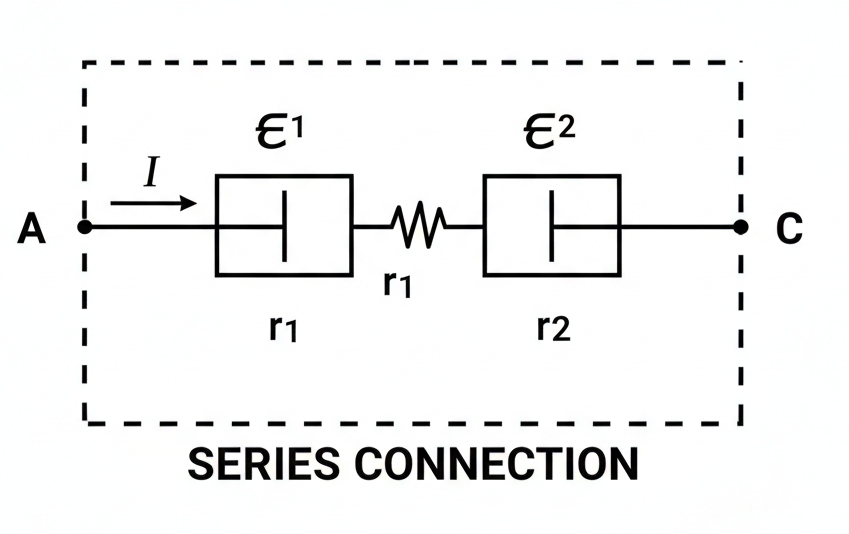
When you connect the negative electrode of one cell (say, emf $\epsilon_1$, internal resistance $r_1$) to the positive electrode of the next cell (emf $\epsilon_2$, internal resistance $r_2$), you get maximum boost. The equivalent emf ($\epsilon_{eq}$) is simply the sum of individual emfs.
The overall potential difference ($V_{AC}$) between the free terminals A and C is given by:
$V_{AC} = (\epsilon_1 + \epsilon_2) - I(r_1 + r_2)$
If we replace this pair with a single equivalent cell, we find that both the resultant emf and internal resistance just add up! Don't stress, yaar—it’s easier than it looks!
$\epsilon_{eq} = \epsilon_1 + \epsilon_2$
$r_{eq} = r_1 + r_2$
Notice this: the equivalent internal resistance is always the sum of individual internal resistances in series combination. The total resistance $r_{eq}$ is always additive, regardless of how you orient the cells.
Figure below:
A clear diagram (like Fig 3.13) showing two cells of emf $\epsilon_1$ and $\epsilon_2$ and internal resistances $r_1$ and $r_2$ connected in series (negative to positive) between points A and C, with current I flowing.
Now, here's the trick for the exam! What if your buddy accidentally reverses one cell? If a cell is connected such that the current leaves the negative electrode instead of the positive, its emf opposes the direction of flow.
The reversed cell's emf enters the sum with a negative sign. For two cells connected negative-to-negative (reversed polarity), the equivalent emf is the difference:
Imagine you have a rickshaw pulling forward ($5\text{ V}$) but then you tie a small scooter pulling backward ($3\text{ V}$). The net pull is only $2\text{ V}$! The rule extends to $n$ cells, using a negative sign for any cell that is flipped.
NEET Checkpoint:
If you have five identical cells, each $1\text{ V}$ and $1\ \Omega$, connected in series, and two cells are reversed, what is the total $r_{eq}$?
(a) $1\ \Omega$
(b) $3\ \Omega$
(c) $5\ \Omega$
(d) $7\ \Omega$
✅ Answer: $5\ \Omega$ — The equivalent internal resistance $r_{eq}$ is always the sum, irrespective of polarity ($1\Omega \times 5 = 5\ \Omega$).
NEET Checkpoint:
When a cell with emf $\epsilon$ is connected to opposing polarity in a series combination, what happens to the equivalent emf?
(a) It adds as +ϵ
(b) It enters the sum with a negative sign
(c) It has no effect on the equivalent emf
(d) It makes the equivalent emf zero
✅ Answer: (b) It enters the sum with a negative sign — The emf opposes the direction of the total current flow.
NEET Checkpoint:
What is the relation for the equivalent internal resistance of $n$ cells in series ($r_1, r_2, \dots r_n$)?
(a) $\dfrac{1}{r_1} + \dfrac{1}{r_2} + \cdots + \dfrac{1}{r_n}$
(b) $\dfrac{r_1 + r_2 + \cdots + r_n}{n}$
(c) $r_1 + r_2 + \cdots + r_n$
(d) $\dfrac{n}{r_1 + r_2 + \cdots + r_n}$
✅ Answer: (c) $r_{eq} = r_1 + r_2 + \dots + r_n$ — The internal resistances always add up.
Practice Question:
A cell ($\epsilon_1=6\text{ V}, r_1=0.5\ \Omega$) is connected in series with a cell ($\epsilon_2=2\text{ V}, r_2=0.5\ \Omega$), but $\epsilon_2$ is reversed. What is the equivalent emf $\epsilon_{eq}$?
(a) $8\text{ V}$
(b) $4\text{ V}$
(c) $1\text{ V}$
(d) $0\text{ V}$
✅ Explanation: (b) Since $\epsilon_2$ is reversed, the emfs subtract: $\epsilon_{eq} = 6\text{ V} - 2\text{ V} = 4\text{ V}$.
| Key Takeaway | Formula Summary |
|---|---|
| Equivalent EMF is the algebraic sum of individual emfs. Use a negative sign for reversed cells. |
$$\epsilon_{eq} = \sum_{i=1}^{n} \epsilon_i$$
|
| Equivalent Internal Resistance is always the simple sum of individual resistances. |
$$r_{eq} = \sum_{i=1}^{n} r_i$$
|
12. Combination of Cells in Parallel
Hey Future Doctors! Ready to parallel park your cells? This is where the funda gets interesting because, unlike series, in a parallel combination, we join the positive terminals together (say, at point $B_1$) and all the negative terminals together (at point $B_2$). It's like having two or more friends pooling their energy for the same task—they work on the same problem, but share the total current!
Notice this: When two cells ($\epsilon_1, r_1$ and $\epsilon_2, r_2$) are connected in parallel (Fig. 3.14), the terminal potential difference ($V$) across both cells must be the same. The total current ($I$) leaving the combination is the sum of the currents leaving each cell: $I = I_1 + I_2$. And that's cool, right?
Figure below:
A clear diagram showing two cells ($\epsilon_1, r_1$ and $\epsilon_2, r_2$) connected in parallel between points $B_1$ (positive terminals joined) and $B_2$ (negative terminals joined). The total current $I$ leaves the combination, splitting into $I_1$ and $I_2$ through the individual cells.
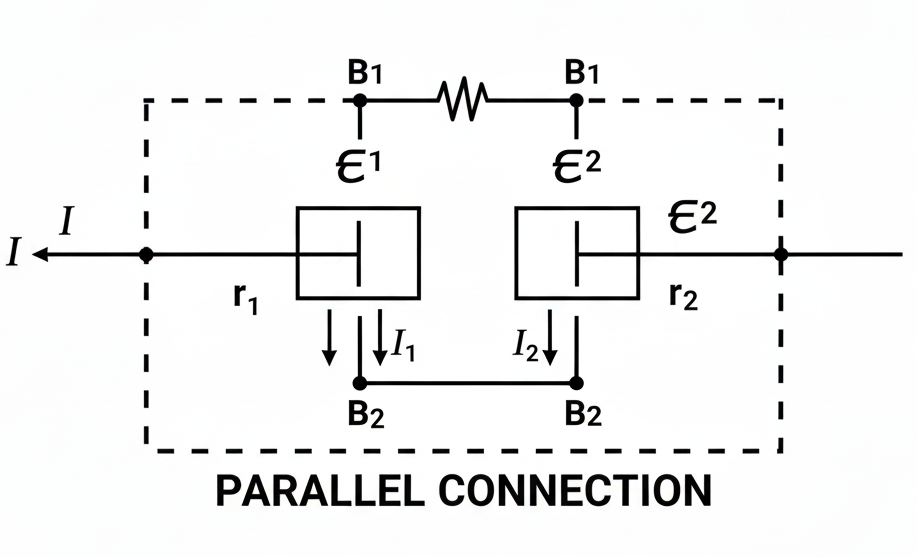
Here's the trick: We replace this whole setup with a single equivalent cell ($\epsilon_{eq}, r_{eq}$). When you derive the resulting equations, you find that the resistance follows the familiar parallel rule from resistors, but for the reciprocals of the internal resistances:
$\frac{1}{r_{eq}} = \frac{1}{r_{1}} + \frac{1}{r_{2}}$
For multiple cells, this extends to: $\frac{1}{r_{eq}}=\frac{1}{r_{1}}+...+\frac{1}{r_{n}}$. The equivalent EMF $\epsilon_{eq}$ is found using a weighted average rule:
$\frac{\epsilon_{eq}}{r_{eq}} = \frac{\epsilon_{1}}{r_{1}} + \frac{\epsilon_{2}}{r_{2}}$
This also generalizes easily for $n$ cells: $\frac{\epsilon_{eq}}{r_{eq}}=\frac{\epsilon_{1}}{r_{1}}+...+\frac{\epsilon_{n}}{r_{n}}$. Don't stress, yaar, this $\frac{\epsilon}{r}$ funda is the key to solving parallel combinations quickly!
Relatable Indian Example: Imagine two identical portable inverters in parallel powering your study lamp during a power cut. Since they are parallel, they both provide the same output voltage ($V$). But if one inverter's internal wiring (internal resistance $r$) gets old, the overall equivalent resistance ($r_{eq}$) improves slightly because of the other inverter sharing the load!
NEET Checkpoint:
For two identical cells ($\epsilon, r$) connected in parallel, what is the equivalent EMF ($\epsilon_{eq}$)?
(a) $2\epsilon$
(b) $\epsilon/2$
(c) $\epsilon$
(d) $2\epsilon/r$
✅ Answer: (c) $\epsilon$ — Since $\frac{\epsilon_{eq}}{r_{eq}} = \frac{\epsilon}{r} + \frac{\epsilon}{r} = \frac{2\epsilon}{r}$. And $\frac{1}{r_{eq}} = \frac{1}{r} + \frac{1}{r} = \frac{2}{r}$, so $r_{eq} = r/2$. Substitute $r_{eq}$ back: $\epsilon_{eq} = \frac{2\epsilon}{r} \times \frac{r}{2} = \epsilon$.
NEET Checkpoint:
What happens to the calculation if the negative terminal of Cell 2 is connected to the positive terminal of Cell 1 (i.e., reversed connection)?
(a) The resistance formula changes.
(b) $\epsilon_2$ is taken as negative in the EMF equation.
(c) The current equation becomes $I = I_1 - I_2$.
(d) The parallel combination fails.
✅ Answer: (b) $\epsilon_2$ is taken as negative in the EMF equation ($\epsilon_2 \rightarrow -\epsilon_2$). The general rules for $r_{eq}$ and $\epsilon_{eq}$ (Eqs. 3.56 and 3.57) still hold, but you substitute the appropriate negative value for the reversed EMF.
NEET Checkpoint:
The primary advantage of combining cells in parallel rather than in series is generally to achieve a higher:
(a) EMF
(b) Internal Resistance
(c) Current Capacity
(d) Terminal Voltage
✅ Answer: (c) Current Capacity — While the EMF usually stays the same (for identical cells), the internal resistance drops significantly ($\frac{1}{r_{eq}}$ increases), allowing a much higher maximum current ($I_{max} = \epsilon/r_{eq}$) to be drawn without damaging the cells.
Practice Questions:
1. Two cells with EMFs $\epsilon_1 = 10~\text{V}$ and $\epsilon_2 = 5~\text{V}$, and internal resistances $r_1 = 2~\Omega$ and $r_2 = 1~\Omega$, are connected in parallel (positive terminals together). What is the equivalent internal resistance $r_{eq}$?
(a) $3~\Omega$
(b) $1.5~\Omega$
(c) $2/3~\Omega$
(d) $1/3~\Omega$
✅ Answer: (c) $2/3~\Omega$ — We use the reciprocal rule for resistance: $\frac{1}{r_{eq}} = \frac{1}{r_{1}} + \frac{1}{r_{2}} = \frac{1}{2~\Omega} + \frac{1}{1~\Omega} = \frac{3}{2}~\Omega^{-1}$. Therefore, $r_{eq} = 2/3~\Omega$.
2. The equivalent EMF $\epsilon_{eq}$ for two cells in parallel is defined by which relationship?
(a) $\epsilon_{eq} = \epsilon_1 + \epsilon_2$
(b) $V = \epsilon_{eq} + I r_{eq}$
(c) $\frac{\epsilon_{eq}}{r_{eq}} = \frac{\epsilon_{1}}{r_{1}} + \frac{\epsilon_{2}}{r_{2}}$
(d) $\epsilon_{eq} = \frac{r_1 r_2}{\epsilon_1 r_2 + \epsilon_2 r_1}$
✅ Answer: (c) $\frac{\epsilon_{eq}}{r_{eq}} = \frac{\epsilon_{1}}{r_{1}} + \frac{\epsilon_{2}}{r_{2}}$ — This is the key defining relationship derived from equating the terminal voltage expressions.
Key Takeaway: Parallel Combination
When cells are connected in parallel, the reciprocal of the equivalent internal resistance is the sum of the reciprocals of individual internal resistances: $\frac{1}{r_{eq}} = \sum \frac{1}{r_{i}}$. The equivalent EMF is calculated via the weighted average: $\frac{\epsilon_{eq}}{r_{eq}} = \sum \frac{\epsilon_{i}}{r_{i}}$. Remember to use a negative value for $\epsilon$ if a cell's polarity is reversed.
Now that you've mastered both series and parallel combinations, we can move on to the real game-changers: Kirchhoff's Rules, which help solve any complex circuit, no matter how many cells and resistors it has!.
What a brilliant topic! Kirchhoff's Laws are like the secret codes you need to crack any monster circuit question in the NEET exam. Forget those simple series and parallel calculations—these laws let you tackle networks that are too complex to reduce otherwise. Chalo, let's clear up this funda!
13. Kirchhoff's Laws: The Circuit Gurus
What happens when your circuit diagram looks like a bowl of sev—super complex and impossible to simplify using just series or parallel formulas? Don't stress, yaar! That's when we bring in the circuit gurus: Kirchhoff's Rules. These two brilliant rules, established by Gustav Robert Kirchhoff, are crucial for analysing electric circuits that are too complex to reduce by simple combinations of resistors.
The Junction Rule (KCL)
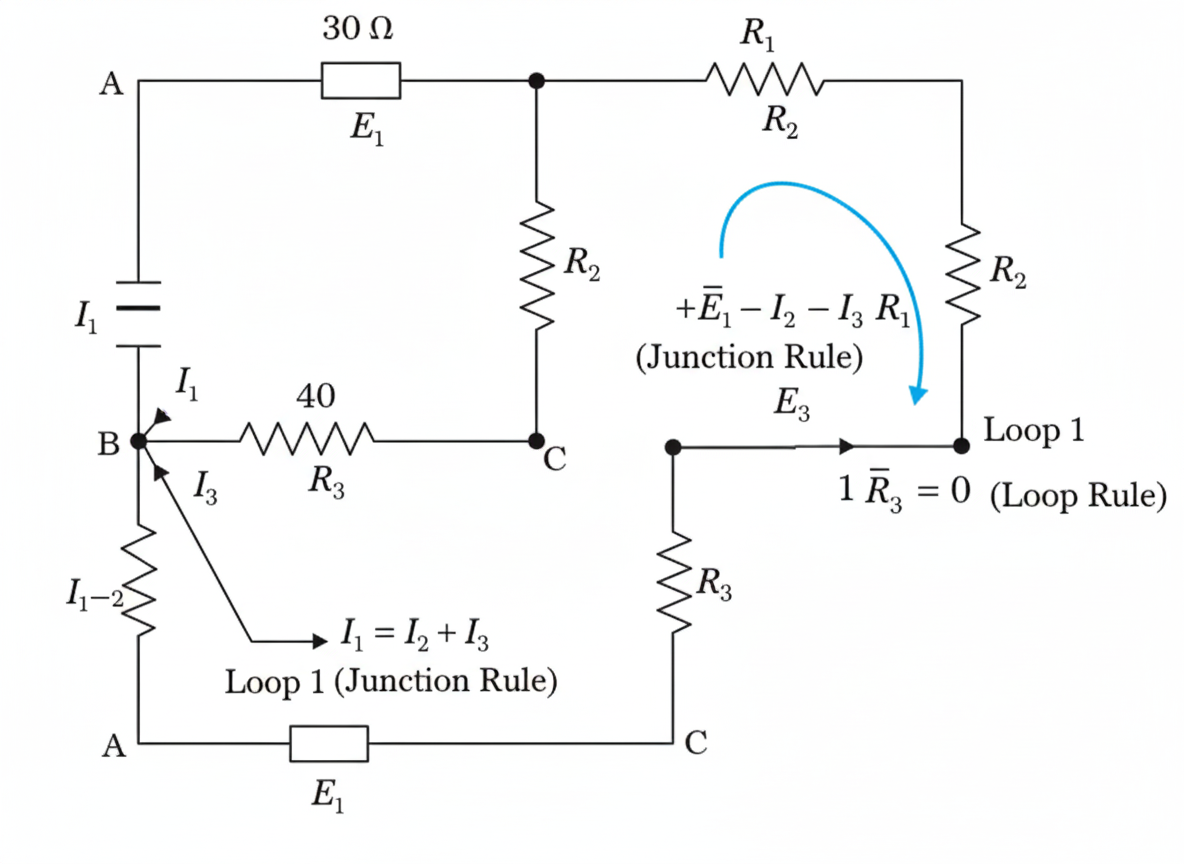
This is Kirchhoff's First Rule, often called the Junction Rule. It’s super simple: At any junction, the sum of the currents entering the junction is equal to the sum of currents leaving the junction.
Imagine a busy metro station junction (a central hub for trains!). If 50 people ($\sum I_{\text{in}}$) enter the platform per minute, exactly 50 people ($\sum I_{\text{out}}$) must leave it per minute, otherwise, the platform would flood! This rule is based on the fundamental principle that when currents are steady, there is no accumulation of charge at any point in the line or junction.
NEET Checkpoint:
The Junction Rule is based on the conservation of:
(a) Energy
(b) Momentum
(c) Charge
(d) Voltage
✅ Answer: (c) Charge — If charge accumulated, the current flowing in wouldn't equal the current flowing out. Steady current means zero net charge accumulation.
The Loop Rule (KVL)
This is Kirchhoff's Second Rule, or the Loop Rule. It states that the algebraic sum of changes in potential around any closed loop involving resistors and cells must be zero.
Notice this, junior: We start at a point in the circuit, move through various components, and end up back where we started. Since electric potential is dependent only on the location of the point, the total change in potential for that entire round trip must logically be zero. It’s like climbing a series of stairs and slopes—if you start and end at the ground level, your net change in potential energy is $0$.
We use these rules by first labeling currents and their directions. Remember the potential difference across a cell (with emf $\epsilon$ and internal resistance $r$) is given by $V = \epsilon - Ir$ (if the current $I$ leaves the positive electrode).
Figure below:
A clear diagram showing a circuit with multiple resistors, cells, and junctions labeled with currents $I_1$, $I_2$, etc., illustrating both a junction where currents meet/split, and a closed loop showing potential changes.
NEET Checkpoint:
The Loop Rule is derived from the principle that:
(a) Current density is constant
(b) Resistance is ohmic
(c) Electric potential is path-independent
(d) Power loss is zero
✅ Answer: (c) Electric potential is path-independent — If you return to the starting point, the total potential change must be zero.
Practice Questions:
-
According to the Junction Rule, if currents $I_1$, $I_2$ enter a junction and $I_3$ leaves it, which relation is correct?
(a) $I_1 + I_2 + I_3 = 0$
(b) $I_1 = I_2 + I_3$
(c) $I_1 + I_2 = I_3$
(d) $I_3 = I_1 - I_2$✅ Answer: (c) $I_1 + I_2 = I_3$ — The sum of entering currents equals the sum of leaving currents.
-
When applying the Loop Rule, the potential change when traversing a closed loop is zero because:
(a) Charge carriers accelerate only slightly.
(b) The electric potential is location-dependent.
(c) The circuit is always steady.
(d) Potential energy is conserved.
✅ Answer: (b) The electric potential is location-dependent — Returning to the start means the potential (which only depends on location) must return to its initial value, making the total change zero.
Key Takeaway
Junction Rule (First Rule): $\sum I_{\text{in}} = \sum I_{\text{out}}$ (Based on Conservation of Charge).
Loop Rule (Second Rule): $\sum \Delta V = 0$ (Based on Path-independence of Electric Potential).
14. Application of Kirchhoff's Laws: Wheatstone Bridge
Yo future doctors! Let's clear up this crucial funda: the Wheatstone Bridge. This circuit is a superstar application of Kirchhoff's rules, designed specifically to measure unknown resistances with high accuracy. Don't stress, yaar—it's easier than it looks!
What’s the setup? The Wheatstone bridge consists of four resistors ($R_1, R_2, R_3,$ and $R_4$) arranged in a closed loop. Across one pair of diagonally opposite points (the path AC), we connect the source (like a battery)—this is called the battery arm. Across the other pair of vertices (B and D), we connect a galvanometer ($G$)—this is the galvanometer arm. Remember, the galvanometer's job is just to detect current flow.
Figure below:
A clear diagram showing the Wheatstone bridge circuit with resistors $R_1, R_2, R_3, R_4$, a battery $\mathcal{E}$ connected across A and C (battery arm), and a galvanometer $G$ connected across B and D (galvanometer arm).
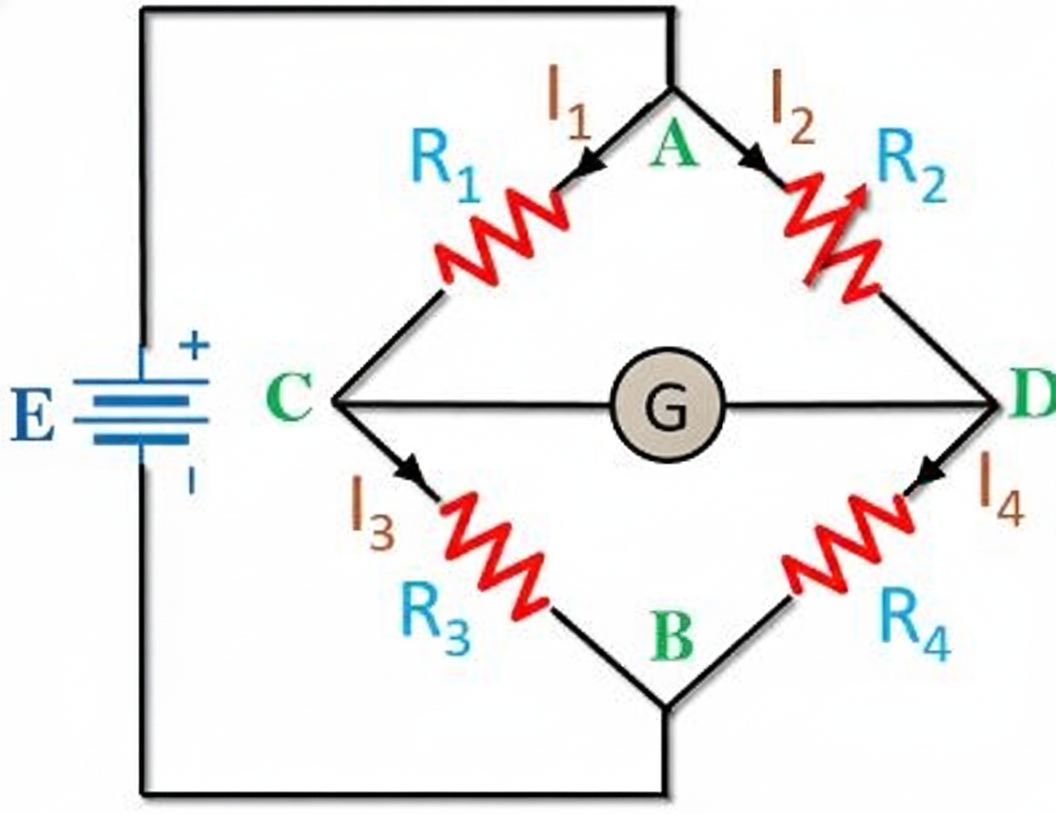
The Magic of Balance: We are interested in the case of a balanced bridge, which happens when the resistors are adjusted such that the current through the galvanometer ($I_g$) is zero. When $I_g = 0$, it means points B and D have the same potential!
NEET Checkpoint:
What must be true for the Wheatstone bridge to be considered "balanced"?
(a) The voltage across the battery arm is zero.
(b) The current through the battery is zero.
(c) The current through the galvanometer ($I_g$) is zero.
(d) $R_1 = R_4$.
✅ Answer: (c) The current through the galvanometer ($I_g$) is zero — This is the defining characteristic of the balanced condition.
When the bridge is balanced, applying Kirchhoff's Loop Rule to closed loops ADBA and CBDC gives us the required relationship. If $I_g=0$, then $I_1 = I_3$ and $I_2 = I_4$.
Loop ADBA yields:
$-I_{1}R_{1} + 0 + I_{2}R_{2}=0$
Which means $\frac{I_{1}}{I_{2}} = \frac{R_{2}}{R_{1}}$.
Loop CBDC yields:
$I_{2}R_{4} + 0 - I_{1}R_{3}=0$
Which means $\frac{I_{1}}{I_{2}} = \frac{R_{4}}{R_{3}}$.
Equating these ratios gives the fundamental Balance Condition:
$\frac{R_{2}}{R_{1}}=\frac{R_{4}}{R_{3}}$
This balance condition is sada-bahar (evergreen) because it allows us to determine an unknown resistance. If we place the unknown resistance in the fourth arm ($R_4$) and adjust $R_3$ (keeping $R_1$ and $R_2$ known) until the galvanometer shows a null deflection, we can find $R_4$:
$R_{4}=R_{3}\frac{R_{2}}{R_{1}}$
Relatable Example: Think of this as measuring the efficiency (resistance) of a small ceiling fan motor ($R_4$) in a tiny workshop. You use two standard resistors ($R_1, R_2$) and a variable resistor ($R_3$). You tweak $R_3$ until the meter (galvanometer) doesn't budge—bhai, no current means balance achieve ho gaya! This null method is accurate because you are aiming for zero current, minimizing measurement errors.
NEET Checkpoint:
If a Wheatstone bridge is used to find an unknown resistance $R_4$, which components must be known or adjustable?
(a) $R_1$ only
(b) $R_1$ and $R_2$ only
(c) $R_1, R_2,$ and $R_3$
(d) Only the voltage $\mathcal{E}$
✅ Answer: (c) $R_1, R_2,$ and $R_3$ — We need three known resistances ($R_1, R_2, R_3$) to calculate the unknown $R_4$ using the balance condition $R_{4}=R_{3}\frac{R_{2}}{R_{1}}$.
Practice Question:
If a bridge is balanced, and the ratio $\frac{R_{2}}{R_{1}} = 3$, and $R_3 = 12 \Omega$, what is the value of the unknown resistance $R_4$?
(a) $4 \Omega$
(b) $12 \Omega$
(c) $36 \Omega$
(d) $48 \Omega$
✅ Explanation: (c) The balance condition is $R_{4}=R_{3}\frac{R_{2}}{R_{1}}$. Since $\frac{R_{2}}{R_{1}} = 3$ and $R_3 = 12 \Omega$, we get $R_4 = 12 \times 3 = 36 \Omega$.
Key Takeaway:
Wheatstone Bridge Formula
The null-point balance condition ($I_g=0$) is:
$\frac{R_{2}}{R_{1}}=\frac{R_{4}}{R_{3}}$
or, as often seen:
$\frac{R_{1}}{R_{2}}=\frac{R_{3}}{R_{4}}$
15. Circuit Applications: Meter Bridge and Resistor Combinations
Hey future doctors, let's dive into some circuit applications! Circuit analysis can seem tricky, but the Wheatstone Bridge is your ultimate shortcut for finding an unknown resistance. Don't stress, yaar—the funda is super simple.
The Wheatstone Bridge Balance
The Wheatstone bridge is basically four resistors ($R_{1}, R_{2}, R_{3},$ and $R_{4}$) arranged in a diamond shape. We connect a voltage source (the battery arm) across one diagonal (A and C) and a galvanometer ($G$), which detects current, across the other diagonal (B and D). This is the galvanometer arm. The key concept here is the balance condition.
When the resistors are perfectly ratioed, no current flows through the galvanometer ($I_{g}=0$). Notice this: If $I_{g}=0$, then the current splits beautifully such that $I_{1}=I_{3}$ and $I_{2}=I_{4}$. Applying Kirchhoff's laws leads to the super useful balance equation:
$\frac{R_{2}}{R_{1}}=\frac{R_{4}}{R_{3}}$
NEET Checkpoint:
What is the current through the galvanometer when a Wheatstone bridge is balanced?
(a) Maximum
(b) Zero
(c) Depends on EMF
(d) Non-zero
✅ Answer: (b) Zero — The bridge is defined as balanced exactly when the current, $I_{g}$, is zero.
The Meter Bridge: Practical Jugaad
The Meter Bridge is the practical device that uses this exact Wheatstone principle to measure an unknown resistance ($R_{4}$). You set up three known resistances (or known resistance ratios) and vary the fourth arm until the galvanometer shows a null deflection (zero current). This is basically matching impedances! The unknown resistance $R_{4}$ is then calculated using the balance condition derived from the laws:
$R_{4}=R_{3}\frac{R_{2}}{R_{1}}$
Imagine you're trying to figure out the price of an unknown snack packet ($R_{4}$). You balance it perfectly on a scale (the galvanometer) against three known weights ($R_{1}, R_{2}, R_{3}$) until the scale is perfectly still ($I_{g}=0$). That stillness gives you the required ratio!
NEET Checkpoint:
In a balanced Wheatstone bridge, which currents are equal?
(a) $I_{1}$ and $I_{4}$
(b) $I_{1}$ and $I_{3}$
(c) $I_{2}$ and $I_{3}$
(d) $I_{g}$ and $I_{2}$
✅ Answer: (b) $I_{1}$ and $I_{3}$ — At balance, the current entering junction D ($I_{1}$) must equal the current leaving ($I_{3}$), and similarly $I_{2}=I_{4}$ at junction B.
Series and Parallel Combinations (The Basics)
We need to talk about combining resistors for general circuit analysis. Even though the source doesn't give us the standard general formulas ($R_{S}$ and $R_{P}$), we can deduce the basic concept of how resistance scales. For example, when you join two identical conductors end-to-end, you double the length ($l \rightarrow 2l$), and the total resistance doubles ($R_{C}=2R$). This is like resistors in series, where resistance is proportional to length ($R \propto l$).
On the flip side, if you divide a conductor lengthwise, you halve the cross-sectional area ($A \rightarrow A/2$), which also doubles the resistance ($R_{1}=2R$). This shows resistance is inversely proportional to area ($R \propto 1/A$). This is fundamentally how current chooses pathways in parallel arrangements—it prefers the path of least resistance.
NEET Checkpoint:
If you double the length of a conductor, keeping the cross-section constant, what happens to its resistance $R$?
(a) Halves
(b) Stays the same
(c) Doubles
(d) Increases four times
✅ Answer: (c) Doubles — Resistance is proportional to length ($R \propto l$), so doubling $l$ doubles $R$.
Practice Questions:
A Wheatstone bridge is balanced when $R_{1}=10~\Omega$, $R_{2}=20~\Omega$, and $R_{3}=15~\Omega$. What is the unknown resistance $R_{4}$?
(a) $7.5~\Omega$
(b) $30~\Omega$
(c) $15~\Omega$
(d) $40~\Omega$
✅ Answer: (b) $30~\Omega$ Use the balance condition $\frac{R_{2}}{R_{1}}=\frac{R_{4}}{R_{3}}$.
$R_{4} = R_{3} \times \frac{R_{2}}{R_{1}} = 15~\Omega \times \frac{20~\Omega}{10~\Omega} = 15 \times 2 = 30~\Omega$.
Key Takeaway
The Meter Bridge is a practical device using the Wheatstone Bridge principle. At balance ($I_{g}=0$), the ratio of resistances is fixed: $\frac{R_{2}}{R_{1}}=\frac{R_{4}}{R_{3}}$. Resistance $R$ is proportional to length $l$ and inversely proportional to area $A$.