
1. Introduction to Atomic Structure
Hey there, future doctor! Ready to clear up the atomic funda? Don't stress, yaar—understanding the atom is like unravelling the mystery of a Pani Puri.
Initially, J.J. Thomson imagined the atom as a "plum pudding" in 1898, where positive charge is spread out and electrons are stuck inside like seeds in a watermelon. Imagine a laddu with raisins—that was the vibe!.
NEET Checkpoint:
Who discovered that atoms of different elements contain identical negatively charged electrons?
(a) Ernest Rutherford
(b) J.J. Thomson
(c) Niels Bohr
(d) John Dalton
✅ Answer: (b) J.J. Thomson (1897) — He revealed these constituents through experiments on electric discharge through gases.
Then came Rutherford in 1911. His team bombarded gold foil with $\alpha$-particles and realized atoms are mostly empty space. He found the nucleus, a tiny central core holding $99.9\%$ of the mass. If an atom were a cricket stadium, the nucleus would be just a small cricket ball in the centre!.
NEET Checkpoint:
What is the approximate size of an atomic nucleus?
(a) $10^{-10}\ \text{m}$ to $10^{-9}\ \text{m}$
(b) $10^{-8}\ \text{m}$ to $10^{-7}\ \text{m}$
(c) $10^{-15}\ \text{m}$ to $10^{-14}\ \text{m}$
(d) $10^{-5}\ \text{m}$ to $10^{-4}\ \text{m}$
✅ Answer: (c) $10^{-15} \text{ m}$ to $10^{-14} \text{ m}$ — This is roughly $10,000$ to $100,000$ times smaller than the atom itself ($10^{-10} \text{ m}$).
Rutherford’s model failed because classical physics said revolving electrons should spiral into the nucleus. Niels Bohr fixed this by postulating stationary orbits where energy isn't radiated.
NEET Checkpoint:
What is the Bohr quantisation condition for angular momentum?
(a) $L = \dfrac{nh}{2\pi}$
(b) L = nh
(c) $L = \dfrac{h}{2\pi}$
(d) $L = \dfrac{n^2 h}{2\pi}$
✅ Answer: (c) $L = nh/2\pi$ — Electrons only revolve in orbits where angular momentum is an integral multiple of $h/2\pi$.
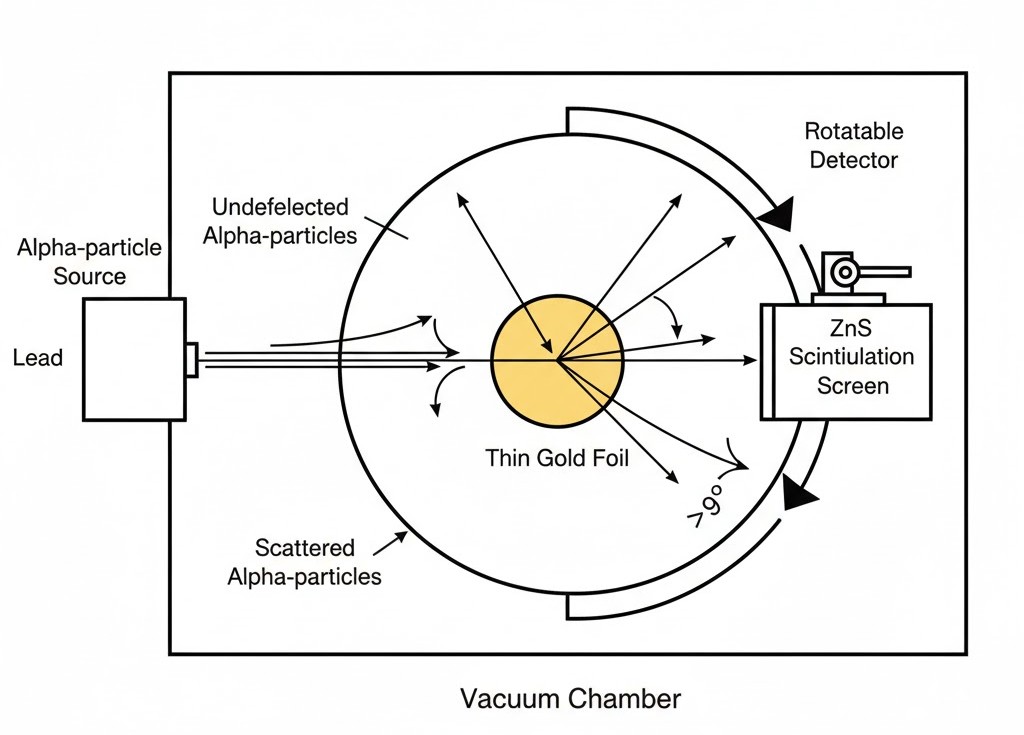
Figure below:
A clear schematic diagram of the Geiger-Marsden scattering experiment showing a source of alpha-particles, a thin gold foil, and a rotatable detector with a ZnS screen.
Practice Questions:
1. The mass defect $\Delta M$ of a nucleus is:
(a) Sum of constituent masses minus nuclear mass.
(b) Nuclear mass minus constituent masses.
✅ Answer: (a) — The experimental mass $M$ is always less than the sum of its individual protons and neutrons.
2. Nuclear fusion is the energy source of stars because:
(a) Heavy nuclei split.
(b) Light nuclei join to form more tightly bound heavier nuclei.
✅ Answer: (b) — Energy is released when lighter nuclei fuse because the final system is more tightly bound.
Key Takeaaway
Formula Summary
* Nuclear Radius: $R = R_0 A^{1/3}$ (where $R_0 = 1.2 \text{ fm}$)
* Mass-Energy Equivalence: $E = mc^2$
* Bohr’s Quantisation: $L = nh/2\pi$
* Binding Energy: $E_b = \Delta M c^2$
2. Alpha-Particle Scattering Experiment
Listen up, junior! Forget J.J. Thomson’s "watermelon" model; it’s time for some real action. In 1911, H. Geiger and E. Marsden (Rutherford’s rockstar students) conducted a classic experiment that changed physics forever. They fired a beam of $5.5\text{ MeV}$ $\alpha$-particles (emitted from a ${}^{214}_{83}\text{Bi}$ source) at a super thin gold foil, only $2.1 \times 10^{-7}\text{ m}$ thick.
Think of this foil like the ultra-thin silver "vark" on your Diwali sweets—it's that thin! To see where the particles went, they used a rotatable detector with a zinc sulphide (ZnS) screen and a microscope. When an $\alpha$-particle hit the screen, it produced a tiny flash of light called a scintillation.
NEET Checkpoint:
What was the energy of the $\alpha$-particles used in the Geiger-Marsden experiment?
(a) 1.5 MeV
(b) 3.0 MeV
(c) 5.5 MeV
(d) 10.0 MeV
✅ Answer: (c) $5.5\text{ MeV}$ — High energy is needed to get close to that gold nucleus!
Now, here is the shocker: most $\alpha$-particles passed straight through the foil like they were driving a scooty through an empty colony road. However, about $1$ in $8000$ particles deflected by more than $90^\circ$. Rutherford famously said it was as if you fired a shell at tissue paper and it came back to hit you!
NEET Checkpoint:
How many $\alpha$-particles typically deflect by more than $90^\circ$ in Rutherford’s gold foil experiment?
(a) About 1 in 10
(b) About 1 in 100
(c) About 1 in 1000
(d) About 1 in 8000
✅ Answer: (d) About 1 in 8000 — It’s a rare event, like finding no traffic at a Bangalore signal!
This led to a massive "funda" shift: the atom is mostly empty space. For a particle to bounce back, it must experience a powerful repulsive force from a very dense, positively charged centre called the nucleus.
NEET Checkpoint:
Which material was used to detect the scattered $\alpha$-particles?
(a) Gold foil
(b) Zinc sulfide ($\text{ZnS}$) screen
(c) Platinum foil
(d) Glass plate
✅ Answer: (b) Zinc Sulphide ($\text{ZnS}$) screen — It creates scintillations (light flashes) upon impact.
Practice Question:
Why do most $\alpha$-particles pass through the gold foil without deflection?
(a) They are attracted to electrons
(b) Gold atoms are very large
(c) Most of the atom is empty space
(d) $\alpha$-particles have no charge
✅ Answer: (c) — Since the nucleus is tiny, most particles never even come close to it.
Key Takeaway
- $\alpha$-source: ${}^{214}_{83}\text{Bi}$ ($5.5\text{ MeV}$)
- Observation: $1$ in $8000$ deflects by $> 90^\circ$
- Inference: Massive positive charge is concentrated in a tiny nucleus
3. Rutherford's Nuclear Model of the Atom
Listen up, yaar! Rutherford’s discovery was a total game-changer. By watching how $\alpha$-particles bounced (or didn't bounce!) off gold foil, he realized the old "Plum Pudding" idea was history. Instead, he gave us the Nuclear Model.
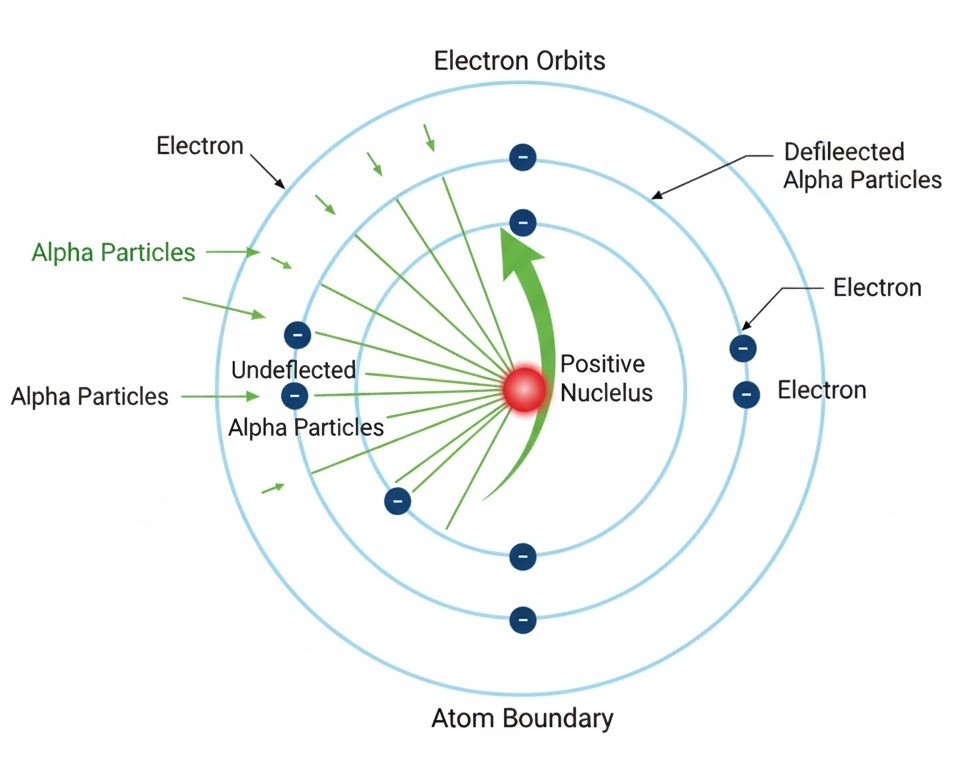
The big funda here is that the entire positive charge and almost all the mass of the atom are packed into a tiny, massive volume at the centre called the nucleus. How tiny? While an atom is about $10^{-10}$ m, the nucleus is a mere $10^{-15}$ m to $10^{-14}$ m.
Relatable Example: Imagine you are standing in the middle of the massive Narendra Modi Stadium. If the whole stadium is the atom, a small cricket ball on the pitch is the nucleus! The rest of the stadium is just empty space.
NEET Checkpoint:
What fraction of $\alpha$-particles scatter by more than $90^{\circ}$?
(a) About 1 in 100
(b) About 1 in 1000
(c) About 1 in 8000
(d) About 1 in 10000
✅ Answer: (c) About 1 in 8000 — Most pass through because the atom is mostly empty space!
Rutherford proposed a planetary model where electrons revolve around the nucleus in orbits, just like planets orbiting the Sun. Since the nucleus is so small compared to the atom ($10,000$ to $100,000$ times smaller!), it's easy to see why most $\alpha$-particles sailed through the gold foil undeviated.
NEET Checkpoint:
What is the typical size of an atom?
(a) $10^{-15} m$
(b) $10^{-12} m$
(c) $10^{-8} m$
(d) $10^{-10} m$
✅ Answer: (d) $10^{-10}$ m — This is known from kinetic theory.
NEET Checkpoint:
Which force keeps the electrons moving in their orbits?
(a) Gravitational force
(b) Magnetic force
(c) Electrostatic force
(d) Nuclear force
✅ Answer: (c) Electrostatic force — It provides the necessary centripetal force.
Figure below:
A clear diagram of Rutherford's atom showing a tiny central positive nucleus, large circular orbits with electrons, and several parallel alpha-particle trajectories where most pass straight through while one near the centre deflects sharply.
Practice Questions:
1. In Rutherford's nuclear model, the atom is:
(a) A solid sphere of positive charge
(b) Largely empty space
(c) Composed of static electrons
(d) Only made of a nucleus
✅ Answer: (b) — The large difference between atomic and nuclear size means it is mostly empty.
2. The ratio of the radius of an electron's orbit to the radius of the nucleus is approximately:
(a) $10^{2}$
(b) $10^{5}$
(c) $10^{8}$
(d) $10^{10}$
✅ Answer: (b) — The orbit is $10^{-10}$ m and the nucleus is $10^{-15}$ m, so the ratio is $10^5$.
Key Takeaway: Rutherford's Model
- Nucleus: Tiny, massive, $(+)$ charged centre ($10^{-15}$ m to $10^{-14}$ m).
- Atom: Mostly empty space ($10^{-10}$ m).
- Orbits: Electrons revolve like planets around the Sun.
4. Alpha-Particle Trajectory and Impact Parameter
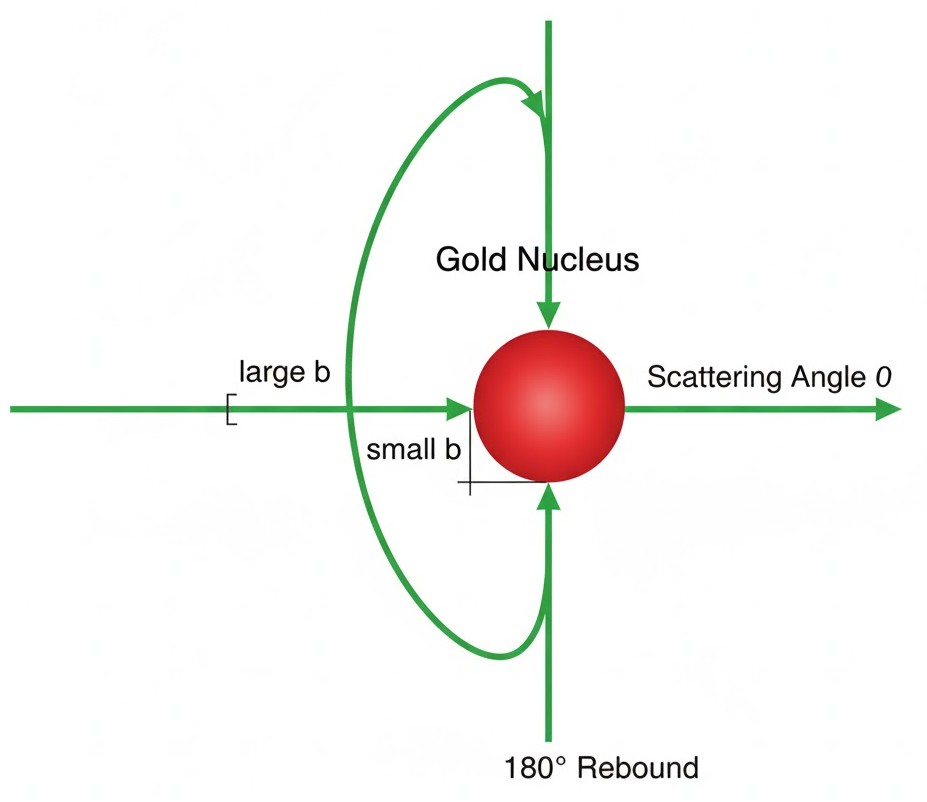
Listen up, junior! Ever tried to bowl a perfect yorker but the ball just drifts? In Rutherford’s experiment, the trajectory (path) of an $\alpha$-particle depends entirely on the impact parameter ($b$). This is defined as the perpendicular distance of the particle’s initial velocity vector from the centre of the nucleus. Think of it as how "off-centre" the particle is aiming.
NEET Checkpoint:
What happens to the scattering angle if the impact parameter $b$ decreases?
(a) Scattering angle decreases
(b) Scattering angle increases
(c) Scattering angle remains the same
(d) α-particles are not scattered
✅ Answer: (b) The scattering angle $\theta$ increases — The closer you get to the nucleus, the harder it pushes you away!
Think of it like trying to squeeze a rickshaw through a narrow gap near a crowded pani puri stall. If $b$ is small, you’re heading right for the stall (the nucleus), and you’ll have to take a sharp, large-angle turn to avoid a crash! A head-on collision ($b \approx 0$) means the particle does a full U-turn ($\theta \approx 180^{\circ}$). If $b$ is large, the particle just sails past like a VIP car with barely a nod ($\theta \approx 0$).
NEET Checkpoint:
In a head-on collision, what is the value of the scattering angle $\theta$?
(a) $180^\circ$
(b) $0^\circ$
(c) $90^\circ$
(d) Depends on energy
✅ Answer: $\theta \approx \pi$ (or $180^{\circ}$) — The particle literally says "not today" and rebounds.
To map these paths, we use Newton’s second law and Coulomb’s law for the repulsive force:
By calculating the distance of closest approach ($d$), where all kinetic energy ($K$) turns into potential energy, we can estimate the upper limit of the nuclear size.
NEET Checkpoint:
Which laws are used to compute the trajectory of an alpha-particle?
(a) Newton’s second law and Coulomb’s law
(b) Ohm’s law and Coulomb’s law
(c) Newton’s laws and Hooke’s law
(d) Faraday’s law and Coulomb’s law
✅ Answer: (a) Newton's second law and Coulomb's law — It’s a classic combo of force and motion, yaara!
Figure below:
A clear diagram showing a gold nucleus at the centre with several alpha-particle trajectories. Show one particle with large b passing straight, one with small b curving sharply, and one head-on particle rebounding at 180 degrees. Label b, the scattering angle theta, and the nucleus.
Practice Question:
An $\alpha$-particle has a very large impact parameter. Its scattering angle will be:
(a) $180^{\circ}$
(b) $90^{\circ}$
(c) Close to $0^{\circ}$
(d) $270^{\circ}$
✅ Answer: (c) Close to $0^{\circ}$ — At large distances, the nucleus barely exerts any force, so the particle goes nearly undeviated.
Key Takeaway
Formula Summary
* Impact Parameter ($b$): Perpendicular distance from nucleus centre.
* Small $b$: Large scattering angle $\theta$.
* Distance of Closest Approach ($d$):$$d = \frac{2Ze^{2}}{4\pi\epsilon_{0}K}$$
5. Atomic Spectra and the Hydrogen Spectrum
Arre junior! Ever noticed how a neon sign or a mercury lamp looks so different from a regular old light bulb? Well, atoms have their own way of "showing off" their identity! While solids and liquids give us a continuous spectrum where all colours bleed into each other like a messy Holi celebration, rarefied gases are much more sophisticated. When you excite these gases with electricity, they emit only discrete wavelengths, appearing as bright lines on a dark background.
NEET Checkpoint:
What kind of spectrum is produced by a heated solid?
(a) Line spectrum
(b) Continuous spectrum
(c) Emission spectrum
(d) Absorption spectrum
✅ Answer: (b) Continuous spectrum — Because atoms in solids are packed closely and interact heavily, they emit a whole range of wavelengths.
These emission line spectra are the "fingerprints" of elements. Just like your school ID card tells everyone who you are, these lines tell us exactly which gas we are looking at because no two elements have the same set of lines. On the flip side, if you pass white light through a rarefied gas, the gas "steals" those same specific wavelengths, leaving behind dark gaps in the rainbow—this is called an absorption spectrum.
Think of it like a Pani Puri stall menu. A continuous spectrum is the "unlimited" plate where you get everything. But a line spectrum? That’s like a picky customer who only wants the spicy teekha pani and refuses everything else—totally specific!
NEET Checkpoint:
Emission and absorption lines for the same gas occur at the same wavelengths.
(a) True
(b) False
✅ Answer: True — The dark lines in an absorption spectrum correspond precisely to the bright lines in the emission spectrum of the same gas.
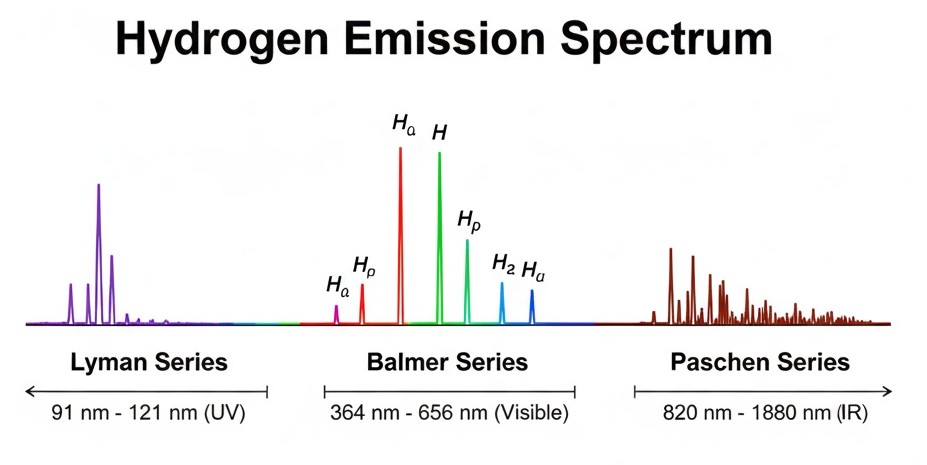
Johann Balmer found that atomic hydrogen, the simplest kid in the class, gives a beautiful set of lines called the Balmer series. We also have the Lyman and Paschen series, which make up the complex family of the hydrogen spectrum.
Figure below:
A clear diagram showing the emission lines of the hydrogen spectrum, highlighting the Lyman, Balmer, and Paschen series with their respective wavelength ranges.
NEET Checkpoint:
Which scientist provided the first simple empirical formula for hydrogen's spectral lines?
(a) Niels Bohr
(b) Johann Jakob Balmer
(c) J.J. Thomson
(d) Ernest Rutherford
✅ Answer: (b) Johann Jakob Balmer — In 1885, he cracked the code for the wavelengths of a group of lines in hydrogen.
Don't let these lines confuse you; they are just the atom's way of talking to us. Even physics needs a bit of "barcode" scanning sometimes!
Practice Questions:
- Which of the following serves as a "fingerprint" for element identification?
(a) Continuous spectrum
(b) Emission line spectrum
(c) Infrared radiation
(d) White light
✅ Answer: (b) — Each element is associated with a characteristic set of bright lines that are unique to it.
2. When white light passes through a rarefied gas, the resulting spectrum is called:
(a) Continuous
(b) Emission
(c) Absorption
(d) Magnetic
✅ Answer: (c) — The gas absorbs specific frequencies, leaving dark lines in the transmitted light.
Key Takeaway
- Continuous Spectrum: From solids/liquids; all wavelengths present.
- Emission Line Spectrum: Bright lines from excited rarefied gases; acts as a "fingerprint".
- Absorption Spectrum: Dark lines in a continuous spectrum after passing through gas.
- Hydrogen Series: Includes Lyman, Balmer (visible), and Paschen series.
6. Postulates of the Bohr Model
Niels Bohr basically took Rutherford’s planetary model and gave it some discipline using the "cool" new quantum concepts of that time. He combined classical mechanics with early quantum ideas to solve the stability crisis of the atom. Here is the real funda:
Postulate 1: The "No-Radiation" Chill Zone
Bohr’s first postulate says electrons revolve in certain stable orbits without radiating energy. These are called stationary states. Unlike a scooter that eventually runs out of petrol, an electron in these states doesn't lose energy or spiral into the nucleus.
NEET Checkpoint:
What are the non-radiating orbits in a Bohr atom called?
(a) Excited orbits
(b) Stationary orbits
(c) Forbidden orbits
(d) Radiating orbits
✅ Answer: (b) Stationary states — These are specific orbits where an electron exists with a definite total energy without emitting radiation.
Postulate 2: The Quantisation Rule
Only those orbits are allowed where the angular momentum ($L$) is an integral multiple of $h/2\pi$.
where $n = 1, 2, 3...$. Think of it like a Mumbai local train; it only stops at specific platforms. You can't just get off halfway between Dadar and Borivali!.
NEET Checkpoint:
What is the condition for the quantisation of angular momentum?
(a) L = nh
(b) $L = \dfrac{nh}{2\pi}$
(c) $L = \dfrac{h}{2\pi}$
(d) $mvr = n^2 h$
✅ Answer: (b) $L = nh/2\pi$ — The electron can only orbit in paths where its angular momentum is a multiple of this constant.
Postulate 3: The Photon Jump
An electron can jump from a higher energy orbit ($E_i$) to a lower one ($E_f$). When it does, it emits a photon with energy:
This energy difference determines the frequency ($\nu$) of the light we see in the spectrum.
NEET Checkpoint:
When is a photon emitted according to Bohr?
(a) During an electron moving in a stationary orbit
(b) During a transition of an electron from a higher to a lower energy orbit
(c) During a transition of an electron from a lower to a higher energy orbit
(d) When the nucleus emits radiation
✅ Answer: (b) A photon is released when an electron jumps from a higher energy state to a lower one.
Figure below:
A clear diagram of the Bohr model showing a central nucleus with circular orbits n=1, n=2, and n=3. Show an electron jumping from n=3 to n=2 with a squiggly arrow pointing outwards labeled 'Photon (hv)'.
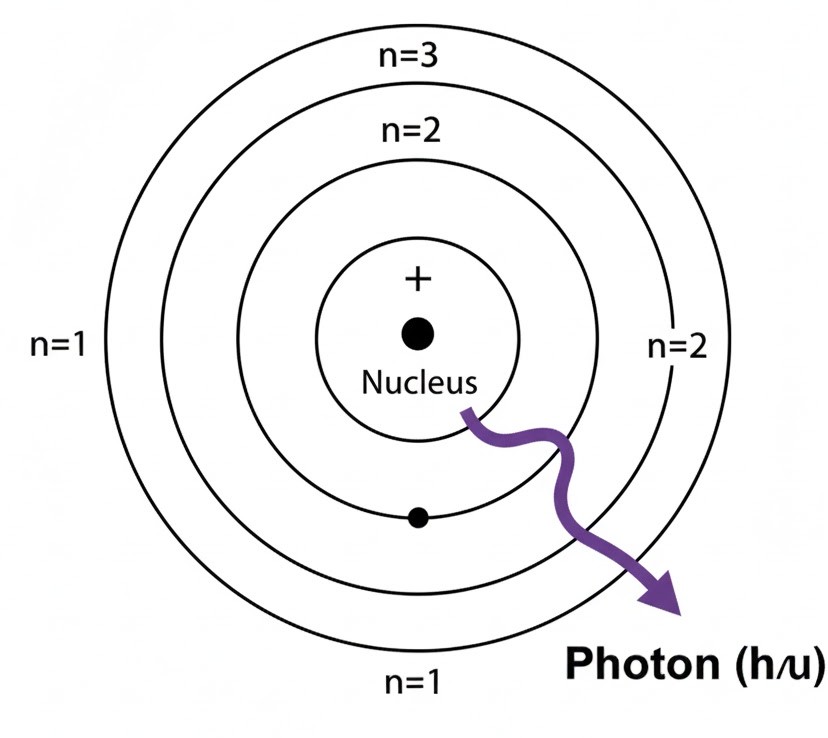
Practice Question:
According to Bohr's model, if an electron jumps from the $n=3$ state to the $n=2$ state, the energy of the emitted photon is:
(a) $E_2 - E_3$
(b) $E_3 - E_2$
(c) $E_3 + E_2$
(d) $E_3 / E_2$
✅ Answer: (b) $E_3 - E_2$ — Bohr’s third postulate states energy emitted is the difference between initial and final states.
Key Takeaway
Formula Summary
- Quantisation: $L = \frac{nh}{2\pi}$
- Energy Transition: $h\nu = E_i - E_f$
7. Energy Levels in the Hydrogen Atom
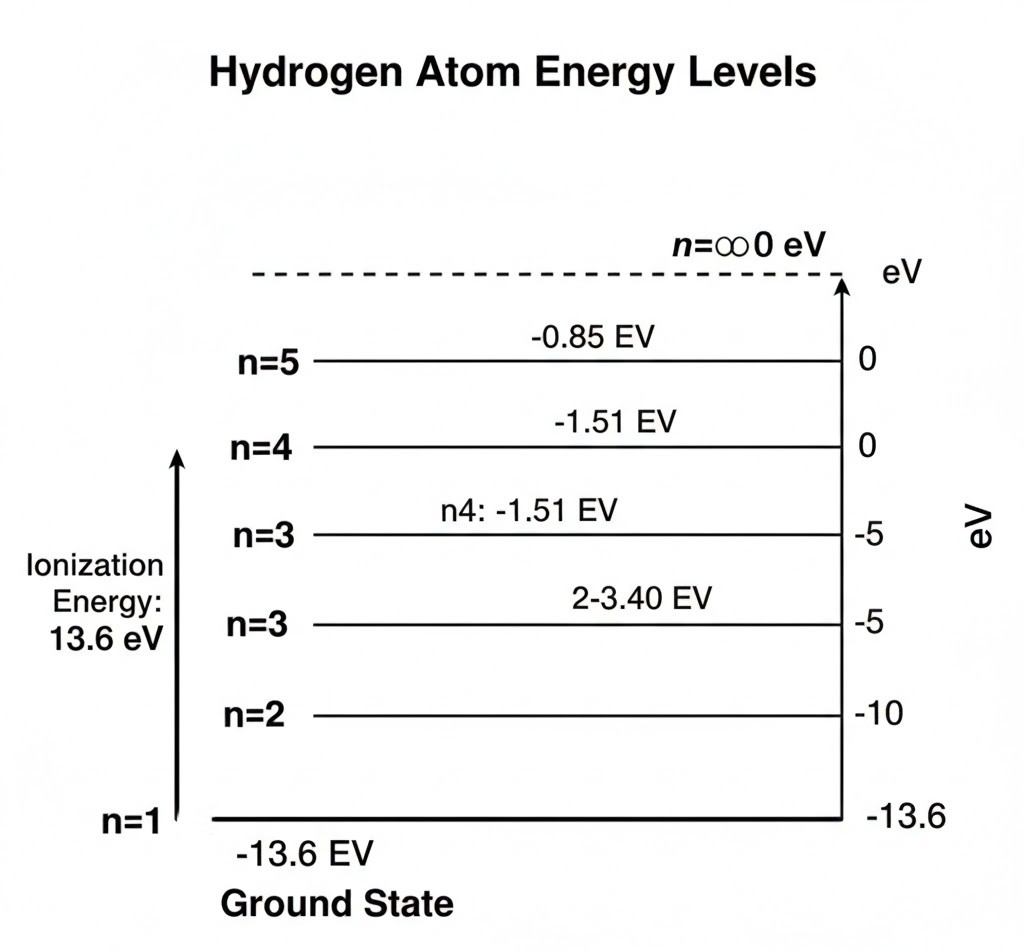
Hey juniors! Let’s talk about where electrons "hang out" inside an atom. They aren't just drifting aimlessly; they have specific VIP lounges called stationary states. The energy of these states is given by a simple funda:
NEET Checkpoint:
What is the energy of the hydrogen electron in its first excited state ($n=2$)?
(a) $-13.6 \text{ eV}$
(b) $-3.4 \text{ eV}$
(c) $-1.51 \text{ eV}$
(d) $0 \text{ eV}$
✅ Answer: (b) $-3.4 \text{ eV}$ — Arre, just plug $n=2$ into the formula: $-13.6 / 2^2 = -13.6 / 4 = -3.4 \text{ eV}$.
The state with the lowest energy ($n=1$) is the ground state. Here, the electron is most stable but also most "in debt" with $-13.6 \text{ eV}$. Any level above this ($n=2, 3, \dots$) is an excited state. Think of it like a Mumbai local train—the ground floor is crowded but stable, and everyone is trying to climb to the upper berths for a bit more "energy"!
To kick the electron out completely, you must provide the ionisation energy of $13.6 \text{ eV}$. It’s like paying the "exit tax" to finally become free from the nucleus.
NEET Checkpoint:
If an electron is at $n = \infty$, what is its energy?
(a) −13.6 eV
(b) −3.4 eV
(c) +13.6 eV
(d) 0 eV
✅ Answer: $0 \text{ eV}$ — At $n = \infty$, the electron is "unbound" and finally free from the nucleus's pull.
Notice how the levels behave as $n$ increases? The gaps between them get smaller and smaller, meaning the levels converge as they approach $0 \text{ eV}$. It’s like a pani puri stall queue—as the plates start moving, everyone at the front bunches up together!
Figure below:
A vertical energy level diagram for the Hydrogen atom. Show horizontal lines for $n=1$ at the bottom through $n=5$ and $n=\infty$ at the top. Label $n=1$ as -13.6 eV (Ground State) and show the energy levels getting progressively closer together as they approach 0 eV.
NEET Checkpoint:
How much energy is needed to excite an electron from $n=1$ to $n=2$?
(a) 3.4 eV
(b) 10.2 eV
(c) 13.6 eV
(d) 1.89 eV
✅ Answer: $10.2 \text{ eV}$ — It's the difference: $E_2 - E_1 = -3.4 - (-13.6) = 10.2 \text{ eV}$.
Practice Question:
As the principal quantum number $n$ increases, the energy of the stationary state:
(a) Decreases
(b) Increases
(c) Stays constant
(d) Becomes more negative
✅ Answer: (b) Increases — Don't get confused by the minus sign, yaar! Since the values are negative, $-3.4$ is actually "higher" energy than $-13.6$.
Key Takeaway
Formula Summary
- Energy of $n^{th}$ state: $E_n = -\frac{13.6}{n^2} \text{ eV}$.
- Ground State Energy ($n=1$): $-13.6 \text{ eV}$.
- Ionisation Energy: $13.6 \text{ eV}$.
8. De Broglie’s Explanation of Quantisation
Let’s clear up this Bohr-de Broglie funda! Bohr’s second postulate was a bit of a mystery—he just stated that angular momentum is quantised ($L_n = \frac{nh}{2\pi}$) without explaining why. In 1923, Louis de Broglie stepped in with his wave-particle duality to save the day.
NEET Checkpoint:
Who provided the theoretical explanation for Bohr's second postulate?
(a) Niels Bohr
(b) Louis de Broglie
(c) J.J. Thomson
(d) Ernest Rutherford
✅ Answer: (b) Louis de Broglie — He used the wave nature of electrons to explain why orbits are quantised.
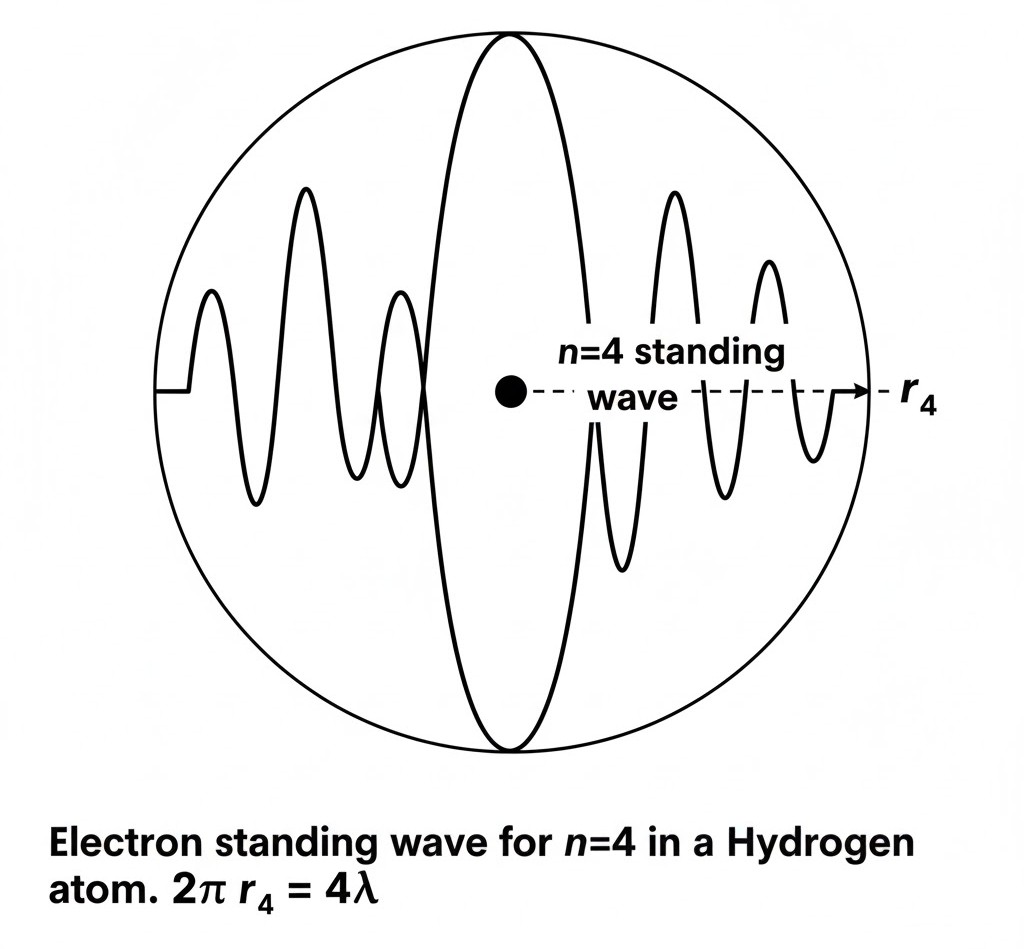
Imagine the electron circling the nucleus isn't just a tiny ball, but a particle wave. Think of a circular string; when you pluck it, only specific wavelengths survive to form standing waves. For the electron to be in a stable, non-radiating orbit, its wave must "close" perfectly on itself. This happens only if the circumference of the orbit is an integral multiple of the wavelength:
NEET Checkpoint:
What is the condition for a standing wave on a circular orbit of radius $r_n$?
(a) $ 2π r_n = n λ $
(b) $2π r_n = n λ/2$
(c) $ r_n = n λ $
(d) $r_n = n λ/2 $
✅ Answer: (a) $2\pi r_n = n\lambda$ — The circumference must fit a whole number of de Broglie wavelengths.
Now, use de Broglie’s hit formula $\lambda = \frac{h}{mv_n}$. Substituting this into the standing wave condition:
Rearranging the terms, we get $mv_n r_n = \frac{nh}{2\pi}$. This is exactly Bohr's quantisation of angular momentum! Only resonant standing waves can persist; others interfere with themselves and vanish.
NEET Checkpoint:
If an electron is in the $n=4$ orbit, how many de Broglie wavelengths fit the circumference?
(a) 1
(b) 2
(c) 4
(d) 8
✅ Answer: (c) 4 — Since $2\pi r_4 = 4\lambda$.
Indian Example: Think of a circular Pani Puri plate. If the plate doesn't fit the stand’s circumference perfectly, it will wobble and fall. Only specific "quantised" sizes stay stable!
Figure below:
A clear diagram showing a circular orbit around a nucleus with a standing wave undulating along the path, specifically illustrating $n=4$ wavelengths fitting into the circumference $2\pi r_n$.
Practice Question:
According to de Broglie, the quantised energy states in a hydrogen atom are a result of:
(a) Particle collisions
(b) Wave nature of electrons
(c) Nuclear fission
(d) Gravitational pull
✅ Answer: (b) — The wave nature leads to the formation of stable, resonant standing waves.
Key Takeaway
Formula Summary
- Standing Wave Condition: $2\pi r_n = n\lambda$
- De Broglie Wavelength: $\lambda = \frac{h}{mv}$
- Quantised Angular Momentum: $L_n = mv_n r_n = \frac{nh}{2\pi}$
9. Composition and Isotopes of the Nucleus
Hey juniors! Let’s clear up the funda of what’s actually sitting at the centre of an atom. Think of the nucleus as the high-security vault of a bank—it’s tiny, but it holds nearly all the mass (99.9%!).
The nucleus is packed with nucleons: positive protons and neutral neutrons. While protons were known, the neutron was a late entry. James Chadwick discovered it in 1932 by bombarding beryllium with alpha particles. He found this neutral radiation could knock protons out of light nuclei, proving it wasn't just photons but a new particle with a mass almost equal to a proton.
NEET Checkpoint:
Who discovered the neutron and in which year?
(a) J.J. Thomson, 1897
(b) Ernest Rutherford, 1911
(c) James Chadwick, 1932
(d) Niels Bohr, 1913
✅ Answer: (c) James Chadwick in 1932 — Arre, he even got a Nobel Prize for this in 1935!.
To keep track of these particles, we use three main numbers:
1. Atomic Number ($Z$): Number of protons.
2. Neutron Number ($N$): Number of neutrons.
3. Mass Number ($A$): Total nucleons ($A = Z + N$).
We write them as ${}{Z}^{A}X$. For example, Gold is ${}{79}^{197}Au${79}^{197}Au$, meaning it has 79 protons and $197 - 79 = 118$ neutrons.
Relatable Example: Imagine a cricket squad. Every player wears the same team India jersey (same $Z$), but some are heavy hitters and some are lean (different $N$). These are isotopes—same element, different mass.
NEET Checkpoint:
If a nucleus is represented as ${}_{1}^{3}H$, how many neutrons does it have?
(a) 1
(b) 2
(c) 3
(d) 4
✅ Answer: (b) 2 — Just subtract: $N = A - Z = 3 - 1 = 2$. This one is called Tritium!.
Now, notice these terms:
* Isotopes: Same $Z$, different $N$ (e.g., ${}{1}^{1}H$, ${}{1}^{2}H${1}^{2}H$, ${}{1}^{3}H$).
* Isobars: Same $A$, different $Z$ (e.g., ${}{1}^{3}H${1}^{3}H$ and ${}{2}^{3}He$).
* Isotones: Same $N$ (e.g., ${}{80}^{198}Hg${80}^{198}Hg$ and ${}_{79}^{197}Au$).
NEET Checkpoint:
What do we call nuclides with the same mass number $A$?
(a) Isotopes
(b) Isobars
(c) Isotones
(d) Isomers
✅ Answer: (b) Isobars — Remember "bar" as in weight; they have the same total "weight" of nucleons.
Practice Questions:
Chlorine exists as isotopes with masses $34.98\text{ u}$ and $36.98\text{ u}$. Why is the periodic table mass $35.47\text{ u}$?
(a) Experimental error
(b) Weighted average of abundance
(c) Extra protons
(d) Neutron decay
✅ Answer: (b) — Chemical atomic mass is the weighted average based on relative abundance.
Key Takeaway
Formula Summary
* Standard Notation: ${}_{Z}^{A}X$
* Nucleon Count: $A = Z + N$
* Neutron Mass ($m_n$): $\approx 1.00866\text{ u}$
10. Size and Density of the Nucleus
Listen up, junior! Ever wondered how much "stuff" is packed into that tiny nucleus? It's mind-blowing! Even though the nucleus is a tiny speck compared to the atom, it holds more than $99.9\%$ of the total mass.
We measure the nuclear radius $R$ using a simple funda: $R = R_0 A^{1/3}$, where $A$ is the mass number and $R_0 \approx 1.2 \text{ fm}$ (which is $1.2 \times 10^{-15} \text{ m}$). Notice the trick? Since volume $V$ is proportional to $R^3$, it is directly proportional to $A$. Because mass is also roughly proportional to $A$, the nuclear density (mass/volume) stays constant for all nuclei. It’s like a drop of liquid; no matter the size, the density remains the same!
NEET Checkpoint:
If the mass number $A$ of a nucleus increases, how does its density change?
(a) Increases with A
(b) Decreases with A
(c) Remains constant
(d) Becomes zero
✅ Answer: (c) It remains constant — Nuclear density is independent of $A$ for all nuclei.
This density is a staggering $2.3 \times 10^{17} \text{ kg m}^{-3}$. To put it in perspective, imagine a Mumbai local train packed so tight that it reached this density—it would weigh more than a mountain! This insane density is comparable to the matter found in neutron stars. In contrast, ordinary matter like water (at only $10^3 \text{ kg m}^{-3}$) is mostly empty space.
NEET Checkpoint:
Which projectiles are used to accurately measure the size of various nuclei?
(a) Neutrons
(b) α-particles
(c) Fast electrons
(d) Protons
✅ Answer: (c) Fast electrons — Scattering experiments with fast electrons give precise nuclear dimensions.
NEET Checkpoint:
How much smaller is the nucleus compared to the atom?
(a) About $10^2$
(b) About $10^3$
(c) About $10^6$
(d) About $10^4$
✅ Answer: (d) About $10^4$ times — If the atom were a classroom, the nucleus would be the size of a pinhead.
Practice Question:
A nucleus with $A = 27$ has a radius $R$. What is the radius of a nucleus with $A = 125$?
(a) $5/3 R$
(b) $3/5 R$
(c) $25/9 R$
(d) $R$
✅ Answer: (a) $5/3 R$. Since $R \propto A^{1/3}$, the ratio is $(125/27)^{1/3} = 5/3$. Arre, don't forget your cube roots, yaar!
Key Takeaway
Formula Summary
- Nuclear Radius: $R = R_0 A^{1/3}$ where $R_0 = 1.2 \times 10^{-15} \text{ m}$.
- Nuclear Density: $\approx 2.3 \times 10^{17} \text{ kg m}^{-3}$ (Constant for all $A$).
11. Atomic Masses and the Unified Mass Unit
Hey junior! Let’s clear up a major funda: measuring an atom in kilograms is like trying to weigh a single strand of hair using a truck scale—it's just not practical, yaar!. Instead, we use the unified atomic mass unit ($u$).
By definition, $1u$ is exactly $1/12^{th}$ of the mass of a single carbon-12 (${}^{12}C$) atom. In our standard units, $1u \approx 1.660539 \times 10^{-27} \text{ kg}$. Think of it as the "gold standard" for the microscopic world!
NEET Checkpoint:
What is $1u$ equal to in terms of carbon?
(a) Mass of one proton
(b) Mass of one neutron
(c) 1/16th of the mass of an ${}^{16}0$ atom
(d) 1/12th of the mass of a ${}^{12}C$ atom
✅ Answer: (d) $1/12^{th}$ of the mass of a ${}^{12}C$ atom — This is the base unit for all atomic measurements!.
To measure these tiny masses with super precision, scientists use a mass spectrometer. This cool device doesn't just give us weights; it reveals that most elements are actually mixtures of isotopes—atoms of the same element that have different masses.
Take Chlorine, for example. In any local pani puri stall, you might get some crispy ones and some slightly heavier ones. Similarly, Chlorine has two isotopes: one at $34.98u$ ($75.4\%$) and another at $36.98u$ ($24.6\%$). To find the average mass we see in the periodic table, we calculate a weighted average:
NEET Checkpoint:
Which instrument is used to discover isotopes?
(a) Cyclotron
(b) Cloud chamber
(c) Mass spectrograph
(d) Geiger–Müller counter
✅ Answer: (c) Mass Spectrometer — It separates atoms based on their precise mass!.
Now, here is the real magic: mass and energy are two sides of the same coin! Using Einstein’s relation, we find that the energy equivalent of $1u$ is a massive $931.5 \text{ MeV}$. Even a tiny bit of mass is basically "frozen" energy waiting to be released!
NEET Checkpoint:
What is the energy equivalent of $1u$?
(a) 931.5 MeV
(b) 1 MeV
(c) 12 MeV
(d) 1 GeV
✅ Answer: (a) $931.5 \text{ MeV}$ — This is a constant you must memorise for numericals!.
Practice Questions:
1. If an element has two isotopes with masses $10u$ and $12u$ in a $1:1$ ratio, what is its average atomic mass?
(a) $10u$
(b) $11u$
(c) $12u$
(d) $22u$
Answer: (b) $11u$ — Just take the simple average since the abundance is equal!.
2. The mass of a proton is approximately:
(a) $1.00727u$
(b) $0.00055u$
(c) $1.00866u$
(d) $12u$
Answer: (a) $1.00727u$ — Protons are slightly lighter than neutrons ($1.00866u$)!.
Key Takeaway
Formula Summary
- Atomic Mass Unit: $1u = \frac{\text{Mass of one } {}^{12}C \text{ atom}}{12}$.
- Average Mass: $\sum (\text{Isotope Mass} \times \text{Abundance } \%)$.
- Mass-Energy: $1u \approx 931.5 \text{ MeV}$.
12. Mass-Energy Relation and Mass Defect
Listen up, junior! Einstein’s famous equation
isn't just for cool T-shirts; it is the fundamental funda behind how the universe powers itself. Einstein proved that mass and energy are two sides of the same coin—mass is just a super-concentrated form of energy.
NEET Checkpoint:
What is the energy equivalent of $1 \text{ g}$ of matter?
(a) $3 \times 10^8 \text{ J}$
(b) $9 \times 10^{13} \text{ J}$
(c) $1 \text{ J}$
(d) $9 \times 10^{16} \text{ J}$
✅ Answer: (b) $9 \times 10^{13} \text{ J}$ — Use $E = mc^2$ where $m = 10^{-3} \text{ kg}$ and $c = 3 \times 10^8 \text{ m/s}$.
Now, here is the kicker: a nucleus is actually lighter than the sum of its parts!. If you add up the masses of individual protons and neutrons, the total is always more than the mass of the actual nucleus ($M$). This "missing mass" is called the mass defect ($\Delta M$):
This lost mass converts into Binding Energy ($E_b$), the "glue" that keeps nucleons packed in that tiny space. We calculate it as $E_b = \Delta M c^2$. In the atomic world, $1 \text{ u}$ of mass defect is equivalent to a massive $931.5 \text{ MeV}$.
NEET Checkpoint:
In a stable nucleus, the mass $M$ is:
(a) $M > \text{mass of constituents}$
(b) $M = \text{mass of constituents}$
(c) $M < \text{mass of constituents}$
(d) $M = 0$
✅ Answer: (c) — Nuclear mass is always less than the sum of its individual nucleons.
Relatable Indian Example: Imagine buying 10 laddoos for a tuition party. If you weigh them separately, they are heavy. But once they are packed tightly in a box, the box somehow feels slightly lighter because of the "binding energy" of the cardboard and tape! (Okay, physics doesn't work on laddoos, but you get the vibe, yaar!)
NEET Checkpoint:
Do chemical reactions also involve mass-energy interconversion?
(a) No
(b) Only in explosions
(c) Yes, but it is a million times smaller
(d) Only in batteries
✅ Answer: (c) — Strictly speaking, it happens in chemical reactions too, but the mass defect is so tiny we usually ignore it.
While chemical reactions deal with energies in the eV range, nuclear reactions are the heavyweights, releasing energy in MeV. Now that you've got this, wait till you see how this energy is unleashed in nuclear fission!
Practice Questions
If the mass defect of a nucleus is $0.1 \text{ u}$, what is its binding energy?
(a) 93 MeV
(b) 93.15 MeV
(c) 93.5 MeV
(d) 931 MeV
✅ Answer: (b) Approximately $93.15 \text{ MeV}$. Arre, just multiply the mass defect by $931.5$.
Key Takeaway
Formula Summary
- Mass-Energy Equivalence:
$$E = mc^2$$- Mass Defect:
$$\Delta M = [Z m_p + (A - Z) m_n] - M$$- Binding Energy:
$$E_b = \Delta M c^2$$- Energy of $1 \text{ u}$: $931.5 \text{ MeV}$
13. Binding Energy per Nucleon and Nuclear Stability
Let’s clear up a major funda today. Ever wondered why some nuclei are super "chill" and stable while others are ready to burst? It all comes down to the Binding Energy per Nucleon ($E_{bn}$), which is basically the "glue" per person in the nuclear family.
We define it simply as:
where $E_b$ is the total binding energy and $A$ is the mass number. Think of it as the average energy you’d need to kick a single nucleon out of its "home".
NEET Checkpoint:
What does a high $E_{bn}$ signify?
(a) Low stability
(b) High stability
(c) Radioactivity
(d) Zero mass defect
✅ Answer: (b) High stability — The more energy needed to remove a nucleon, the more tightly bound the nucleus is.
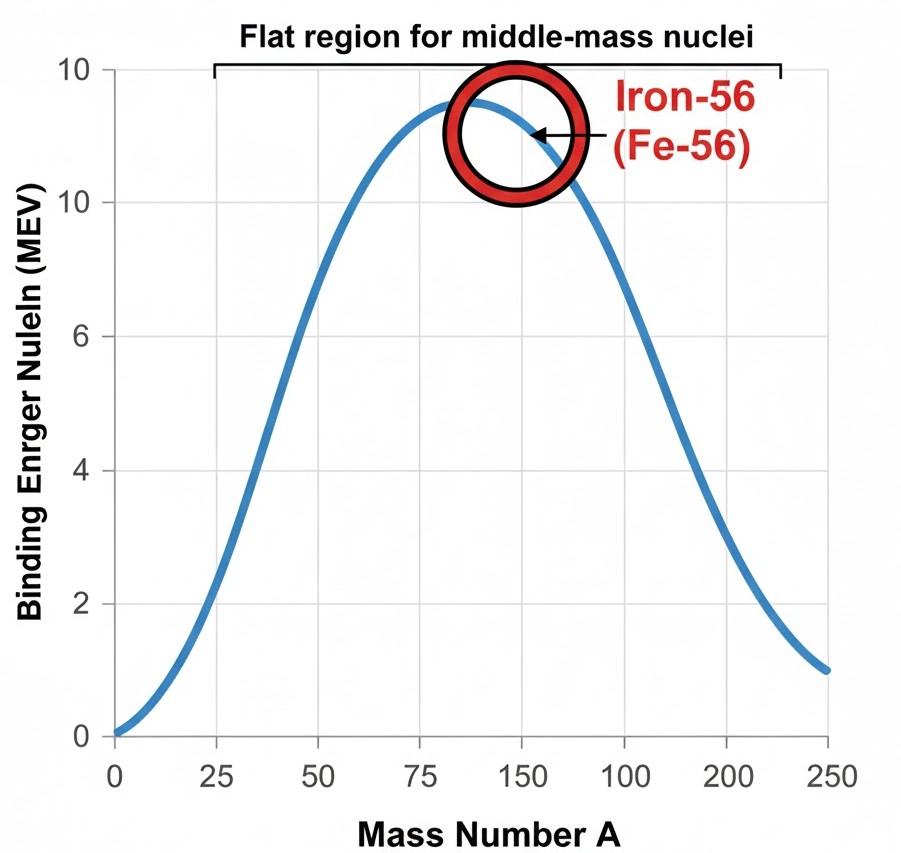
If you check the $E_{bn}$ curve, you’ll notice it peaks at Iron ($^{56}Fe$) with a value of about $8.75$ MeV. This makes Iron the "topper" of the stability charts! For middle-mass nuclei ($30 < A < 170$), $E_{bn}$ stays nearly constant at $8.0$ MeV. This happens because the nuclear force is short-ranged. A nucleon only interacts with its immediate neighbours—a property called saturation.
Relatable Example: It’s like a pani puri stall. If there are too few people (light nuclei), it’s not efficient. If there's a massive, chaotic crowd (heavy nuclei), the stall-keeper can't manage everyone. Iron is that perfect group size where everyone gets their puri comfortably!
Light nuclei ($A < 30$) and heavy nuclei ($A > 170$) have lower $E_{bn}$ and are less stable. This is why heavy ones undergo fission and light ones undergo fusion—they both just want to reach that stable middle ground!
NEET Checkpoint:
Why is $E_{bn}$ constant for $30 < A < 170$?
(a) Because nuclear force is repulsive
(b) Because nuclear force is long-range
(c) Because nuclear force is short-range and saturates
(d) Because Coulomb force dominates
✅ Answer: (b) Due to the short-range nature of nuclear forces; a nucleon only feels p-neighbours.
NEET Checkpoint:
What process do very light nuclei undergo to increase stability?
(a) Nuclear fission
(b) Nuclear fusion
(c) Radioactive decay
(d) Nuclear scattering
✅ Answer: (b) Nuclear Fusion — They join to form a heavier, more stable nucleus.
Figure below:
A graph showing Binding Energy per Nucleon (MeV) on the y-axis and Mass Number A on the x-axis, highlighting the peak at Iron-56 and the flat region for middle-mass nuclei.
Practice Questions:
1. Which of the following has the highest binding energy per nucleon?
(a) $^{238}U$
(b) $^{4}He$
(c) $^{56}Fe$
(d) $^{1}H$
✅ Answer: (c) $^{56}Fe$ — As per the curve, Iron is at the maximum of ~8.75 MeV.
2. The constancy of $E_{bn}$ for middle-mass nuclei is a consequence of:
(a) Long-range forces
(b) Coulomb repulsion
(c) Saturation of nuclear forces
(d) Gravitational pull
✅ Answer: (c) Saturation of nuclear forces — This is due to the short-range nature of the force.
Key Takeaway
Formula Summary
- Binding Energy per Nucleon: $E_{bn} = E_b / A$
- Max Stability: $A = 56$ ($E_{bn} \approx 8.75$ MeV)
- Stability Range: $30 < A < 170$ ($E_{bn} \approx 8.0$ MeV)
14. Nuclear Fission
Hey yaaro! Ever seen a giant ladoo so heavy it just can’t stay in one piece? That’s exactly what happens in Nuclear Fission. It is the process where a heavy nucleus breaks into intermediate-mass fragments.
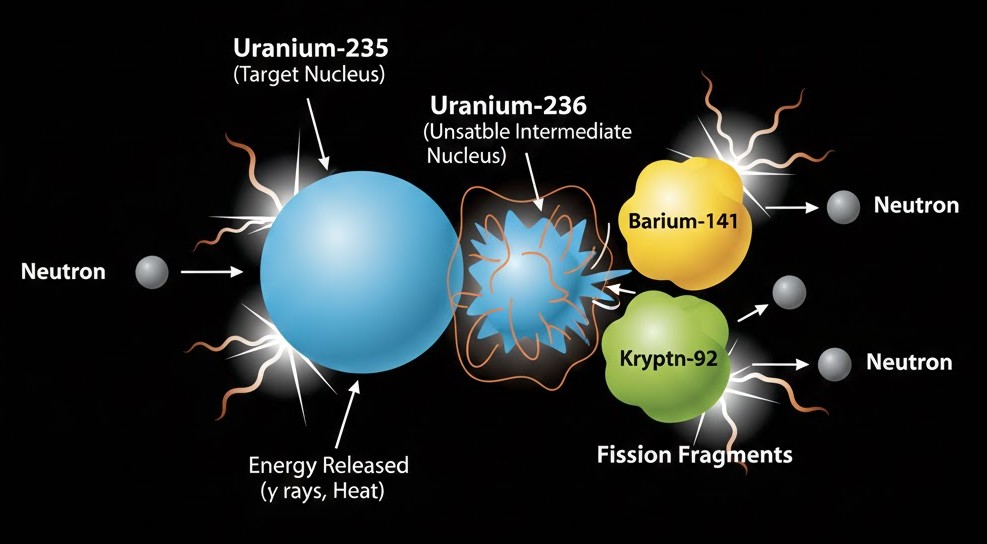
The classic hero of our story is ${}_{92}^{235}U$. When we bombard it with a neutron, it doesn't just sit there; it captures the neutron and then splits apart like a local rickshaw hitting a massive pothole. A typical reaction looks like this:
NEET Checkpoint:
What is the approximate energy released per fission of a ${}_{92}^{235}U$ nucleus?
(a) $20\text{ eV}$
(b) $200\text{ keV}$
(c) $200\text{ MeV}$
(d) $2\text{ GeV}$
✅ Answer: (c) $200\text{ MeV}$ — Nuclear reactions are roughly a million times more energetic than chemical ones!.
These "fragment products" aren't stable immediately. They are radioactive and undergo successive $\beta$-decay until they reach a stable end product. The energy released (about $200\text{ MeV}$ per nucleus) is what powers our nuclear reactors for electricity. But be careful—if this happens in an uncontrolled way, you get the massive explosion of an atom bomb.
NEET Checkpoint:
To achieve stability, fission fragments usually undergo which type of decay?
(a) Gamma decay
(b) Alpha decay
(c) Beta plus (β⁺) decay
(d) Beta minus (β⁻) decay
✅ Answer: (d) $\beta^-$decay — These unstable fragments need to transform to reach the "valley of stability".
NEET Checkpoint:
How much energy is released by the fission of $1\text{ kg}$ of uranium compared to burning $1\text{ kg}$ of coal?
(a) 10¹² J vs 10⁵ J
(b) 10¹³ J vs 10⁶
(c) 10¹⁴ J vs 10⁷ J
(d) 10¹⁵ J vs 10⁸ J
✅ Answer: $10^{14}\text{ J}$ vs $10^{7}\text{ J}$ — That's a huge difference, boss!.
Figure below:
A clear diagram showing a neutron hitting a Uranium-235 nucleus, leading to an unstable Uranium-236 intermediate, which then splits into Barium and Krypton fragments with three extra neutrons and energy bursts.
Practice Questions:
Which of the following is NOT a possible pair of fragments in ${}{92}^{235}U$ fission?
(a) ${}{56}^{144}Ba$ and ${}{36}^{89}Kr$
(b) ${}{51}^{133}Sb$ and ${}{41}^{99}Nb$
(c) ${}{54}^{140}Xe$ and ${}{38}^{94}Sr$
(d) ${}{2}^{4}He$ and ${}_{1}^{1}H$
✅ Answer: (d) — These are too light; fission produces intermediate mass fragments.
Key Takeaway
- Fission: Heavy nucleus $\rightarrow$ Intermediate fragments + Neutrons + Energy.
- Energy: $\approx 200\text{ MeV}$ per fission event.
- Stability: Achieved via successive $\beta$-decay of fragments.
15. Nuclear Fusion: The Ultimate Power Move
Arre junior, have you ever wondered where the Sun gets its non-stop energy? It’s not magic; it’s Nuclear Fusion! In this process, light nuclei decide to join forces and fuse into a heavier, more stable nucleus. This "joint family" setup releases a massive amount of energy because the final nucleus is more tightly bound than the original ones.
NEET Checkpoint:
In nuclear fusion, energy is released because:
(a) Mass is created
(b) The final nucleus is less stable
(c) The final nucleus has higher binding energy per nucleon
(d) Temperature decreases
✅ Answer: (c) Higher binding energy per nucleon — More stability means the nucleons are more tightly bound, releasing energy in the process,.
But here’s the tricky part: nuclei are positively charged. Like two rival cricket fans during an IPL match, they experience intense Coulomb repulsion when they get close. To overcome this barrier, they need massive kinetic energy, which we provide by cranking the temperature up to millions of degrees. This is why we call it thermonuclear fusion.
NEET Checkpoint:
What is the approximate temperature needed to overcome the Coulomb barrier for two protons?
(a) $10^3\text{ K}$
(b) $10^5\text{ K}$
(c) $10^7\text{ K}$
(d) $10^9\text{ K}$
✅ Answer: (d) $\sim 3 \times 10^9\text{ K}$ — While the Sun's core is "only" $1.5 \times 10^7\text{ K}$, fusion happens there because some lucky protons have much higher-than-average energy.
In our Sun, the energy comes from the proton-proton (p, p) cycle. The net result is:
Scientists are now trying to achieve controlled thermonuclear fusion on Earth to get unlimited power. The fuel exists as plasma—a hot soup of ions and electrons—at $10^8\text{ K}$. Confinement is a huge challenge because no tandoor or container can withstand that heat!
NEET Checkpoint:
Which element is the primary fuel for the proton-proton cycle in stars?
(a) Helium
(b) Hydrogen
(c) Carbon
(d) Uranium
✅ Answer: (b) Hydrogen — Specifically protons ($_{1}^{1}H$) that burn into helium.
Practice Question:
The energy released when four hydrogen atoms fuse to form one helium atom in the Sun is:
(a) $0.42\text{ MeV}$
(b) $200\text{ MeV}$
(c) $26.7\text{ MeV}$
(d) $7.6\text{ MeV}$
✅ Answer: (c) $26.7\text{ MeV}$ — This is the total energy payoff from the entire p-p cycle.
Key Takeaway
Nuclear Fusion involves light nuclei fusing into heavier ones.
Requirement: Extremely high temperatures to overcome Coulomb repulsion,.
Sun's Energy: Generated via the proton-proton cycle, releasing $26.7\text{ MeV}$ per helium nucleus formed.