
1. Introduction: The d- and f-Block Elements
Ready to dive into the coolest, most colourful, and complex part of the entire periodic table? We’re talking about the d- and f-block elements. These elements are the heavy lifters of modern chemistry, occupying the large middle section (d-block) and the separate panel at the bottom (f-block).
The d-block (Groups 3–12) elements are officially known as transition metals. They get this name because they are filling their inner $d$ orbitals progressively across the four long periods (3d, 4d, 5d, and 6d series). The primary funda (rule) for being a true transition metal, according to IUPAC, is having an incomplete $d$ subshell either in the neutral atom or in its ions.
NEET Checkpoint:
Elements of the d-block are generally placed between which blocks in the periodic table?
(a) s- and f-blocks
(b) s- and p-blocks
(c) p- and f-blocks
(d) s-block only.
✅ Answer: (b) s- and p-blocks — Notice this! The d-block occupies the large middle section flanked between the s- and p-blocks.
Now, here’s the trick: elements like Zinc ($Z=30$), Cadmium, and Mercury are in the d-block, but they are not counted as proper transition metals because they have a completely filled $d^{10}$ configuration in their ground state and common oxidation states. Don't stress, yaar, their chemistry is still studied right alongside the transition metals.
Next up, the f-block consists of the inner transition elements, separated into the Lanthanoids (4f series, Ce to Lu) and Actinoids (5f series, Th to Lr). These elements are super important; think of Iron, Copper, Silver, and Gold, which have played crucial roles in human civilisation, or Uranium, a key source of nuclear energy.
The magic that makes transition elements special is the presence of those partly filled $d$ or $f$ orbitals. This feature unlocks their characteristic properties! They display a variety of oxidation states, form coloured ions, exhibit magnetic properties (like paramagnetism), and are brilliant catalysts.
Think of the stainless steel utensils used to cook your favourite biryani (involving metals like Fe, Cr, and Ni, all d-block) or the catalytic converters in your dad's scooter that speed up reactions (using transition metal compounds). Even that vibrant blue colour in copper sulphate solution is due to these $d$ electrons!
NEET Checkpoint:
What is the configuration of the outer orbitals for the d-block elements in general?
(a) $(n)d^{1-10}(n-1)s^{1-2}$
(b) $(n-1)d^{1-10}ns^{1-2}$
(c) $nd^{1-10}ns^{1-2}$
(d) $(n-2)f^{1-14}ns^{1-2}$
✅ Answer: (b) $(n-1)d^{1-10}ns^{1-2}$ — That's the general formula! The $n-1$ stands for the inner $d$ orbitals.
NEET Checkpoint:
Iron, copper, silver, and gold belong to which class of elements?
(a) s-block elements
(b) Non-transition elements
(c) Transition elements
(d) Metalloids.
✅ Answer: (c) Transition elements — These are essential metals that have been crucial in human civilisation.
Practice Question:
Transition metals are defined as metals having an incomplete $d$ subshell:
(A) only in the neutral atom
(B) only in their ions
(C) either in the neutral atom or in their ions
(D) never in their compounds.
✅ Explanation: (C) According to IUPAC, metals must have an incomplete $d$ subshell in either the neutral state or in one of their common oxidation states to be classified as transition metals.
Key Takeaway
The d-block (Transition Elements, Groups 3-12) and f-block (Inner Transition Elements, Lanthanoids/Actinoids) are defined by the progressive filling of $d$ and $f$ orbitals, respectively. Their characteristic properties—like variable oxidation states, colour, and magnetic behaviour—arise due to the presence of partly filled inner orbitals.
2. Position and Definition of Transition Elements
Let's clear up the funda (fundamental concept) about where the transition elements sit on the periodic table and why they're so special. Don't stress, yaar—this positioning is a chill scene!
The d-block occupies the large middle section of the periodic table. Think of it as the VIP lounge spanning Groups 3 to 12. It is perfectly sandwiched, or flanked, between the $s$-block elements on the left and the $p$-block elements on the right. Just like a central batsman who has the responsibility between the openers ($s$-block) and the late hitters ($p$-block), the d-block handles the chemical transition! The electrons responsible for this character are filling the $d$ orbitals of the penultimate energy level of the atoms, giving rise to four distinct rows.
The Real Definition
Now, for the asli (real) definition, according to IUPAC, transition metals are strictly defined as metals that possess an incomplete $d$ subshell either in their neutral atom or in any of their ions. It's all about having those partly filled $d$ orbitals; that’s the unique feature that makes them different from non-transition elements.
NEET Checkpoint:
Where is the d-block located?
(a) Groups 1-2
(b) Groups 13-18
(c) Groups 3-12
(d) Below the main table
✅ Answer: (c) Groups 3-12 — The $d$-block occupies the middle section of the periodic table.
The Three Exceptions (Zn, Cd, Hg)
Here’s the plot twist! Elements like Zinc (Zn), Cadmium (Cd), and Mercury (Hg) (which are in Group 12) are technically not regarded as transition metals. Why? Because they have a full $d^{10}$ configuration in their ground state and in their common oxidation states. Imagine you reserved a seat at the cinema (Group 12), but it’s already completely full! They fit the position, but they don't fit the definition. However, because they are the end members of the transition series, we still study their chemistry along with the true transition metals. The general formula for their outer orbitals is $(n-1)d^{10}ns^{2}$.
The Four Transition Series
The transition metals are organised into four main series based on which $d$ orbital is being filled:
- 3d series: Spanning from Scandium (Sc) to Zinc (Zn).
- 4d series: Ranging from Yttrium (Y) to Cadmium (Cd).
- 5d series: Includes Lanthanum (La) and then elements from Hafnium (Hf) to Mercury (Hg).
- 6d series: Starting with Actinium (Ac) and covering elements from Rutherfordium (Rf) to Copernicium (Cn).
NEET Checkpoint:
Which element is a transition element, Scandium ($Z=21$) or Zinc ($Z=30$)?
(a) Zinc
(b) Scandium
(c) Both
(d) Neither
✅ Answer: (b) Scandium — Scandium has an incompletely filled $3d^{1}$ orbital in its ground state, while Zinc has a fully filled $3d^{10}$ orbital.
NEET Checkpoint:
Why are Cd and Hg not considered transition elements?
(a) They are radioactive.
(b) They are liquids.
(c) They have a full $d^{10}$ configuration.
(d) They belong to the $p$-block.
✅ Answer: (c) They have a full $d^{10}$ configuration — The definition requires an incomplete $d$ subshell in the atom or ion.
Practice Questions:
- Which of the following elements, despite being a $d$-block element, does not qualify as a transition metal according to the IUPAC definition?
(a) Copper ($Z=29$)
(b) Iron ($Z=26$)
(c) Cadmium ($Z=48$)
(d) Vanadium ($Z=23$)
✅ Answer: (c) Cadmium ($Z=48$). Cd has a completely filled $4d^{10}$ configuration in its ground state and common oxidation state, thus failing the "incomplete $d$ subshell" criterion.
2. The 5d transition series consists of which set of elements?
(a) Y to Cd
(b) La to Hg
(c) La and Hf to Hg
(d) Sc to Zn
✅ Answer: (c) La and Hf to Hg. The four main series are 3d (Sc to Zn), 4d (Y to Cd), 5d (La and Hf to Hg), and 6d (Ac and Rf to Cn).
Key Takeaway
| Concept | Detail |
|---|---|
| Position | $d$-block is the middle section (Groups 3–12) between $s$ and $p$ blocks. |
| Definition | Metals having an incomplete $d$ subshell in the neutral atom or their ions. |
| Exclusions | Zn, Cd, Hg are not true transition metals due to their stable $d^{10}$ configuration. |
| Series | 3d (Sc to Zn), 4d (Y to Cd), 5d (La and Hf to Hg), and 6d (Ac and Rf to Cn). |
3. Electronic Configuration of d-Block Elements
Let's clear up the funda (basic concept) of how those tricky transition metals manage their electrons. Electronic configurations are super important because they dictate almost all the chemical properties.
The general outer electronic configuration for the d-block is $\mathbf{(n-1)d^{1-10}ns^{1-2}}$. This means the inner $d$ orbitals are filling up (1 to 10 electrons) while the outermost $ns$ orbital usually holds 1 or 2 electrons. Now, for the biggest exception, keep $\text{Pd}$ (Palladium) close—it breaks the rule completely! Its configuration is $\mathbf{4d^{10}5s^{0}}$. Yes, $ns$ is completely empty!
Here's the trick: This generalization has exceptions because of the $\mathbf{small\ energy\ difference\ between}\ \mathbf{(n-1)d}\ \mathbf{and}\ \mathbf{ns}\ \mathbf{orbitals}$. Because the energy difference is so tiny, the electrons sometimes jump ship to achieve a super stable state.
NEET Checkpoint:
Why are $\text{Cr}$ and $\text{Cu}$ configurations unusual?
(a) Small atomic radii
(b) Presence of $f$ orbitals
(c) Extra stability of half-filled/completely filled orbitals
(d) High ionisation energy
✅ Answer: (c) Extra stability of half-filled/completely filled orbitals — The drive to achieve half-filled ($d^{5}$) or completely filled ($d^{10}$) orbitals overrides the normal filling order.
You see this extra stability reflected in the configurations of $\text{Cr}$ (Chromium) and $\text{Cu}$ (Copper). $\text{Cr}$ adopts $\mathbf{3d^{5}4s^{1}}$ instead of $3d^{4}4s^{2}$. Similarly, $\text{Cu}$ chooses $\mathbf{3d^{10}4s^{1}}$ over $3d^{9}4s^{2}$. Remember, $d^{5}$ (half-filled) and $d^{10}$ (completely filled) orbitals confer extra stability. Imagine trying to pack your school bag—it's most stable (and neatest!) when it's exactly half-full or totally full, not awkwardly almost-half.
NEET Checkpoint:
What is the electronic configuration of $\text{Cr}$ ($Z=24$)?
(a) $[Ar] 3d^4 4s^2$
(b) $[Ar] 3d^5 4s^1$
(c) $[Ar] 3d^3 4s^2$
(d) $[Ar] 3d^6 4s^0$
✅ Answer: (b) $[Ar] 3d^5 4s^1$ — This provides the highly stable half-filled $3d$ subshell.
Now, the final funda for forming ions: When d-block elements form ions (say, $M^{2+}$ or $M^{3+}$), they don't lose electrons based on the filling order. Instead, ions are formed by losing $\mathbf{ns}$ $\mathbf{electrons\ before}\ \mathbf{(n-1)d}\ \mathbf{electrons}$. This is super counter-intuitive, so mark it well! For example, $\text{Fe}$ is $[Ar] 3d^{6}4s^{2}$, but $\text{Fe}^{2+}$ is $[Ar] \mathbf{3d^{6}}$ (it loses the two $ $4s$ $electrons first).
NEET Checkpoint:
What is the configuration of $\text{Zn}^{2+}$ ($Z=30$)?
(a) $3d^{10}4s^{0}$
(b) $3d^{8}4s^{2}$
(c) $3d^{9}4s^{1}$
(d) $3d^{10}$
✅ Answer: (d) $3d^{10}$ — $\text{Zn}$ is $3d^{10}4s^{2}$, and it loses the two $ $4s$ $electrons first to form $\text{Zn}^{2+}$.
Practice Question:
The unusual stability of the $d^{10}$ configuration is observed in the electronic configuration of:
(a) $\text{Ni}$ ($3d^{8}4s^{2}$)
(b) $\text{Mn}$ ($3d^{5}4s^{2}$)
(c) $\text{V}$ ($3d^{3}4s^{2}$)
(d) $\text{Cu}$ ($3d^{10}4s^{1}$)
✅ Answer: (d) $\text{Cu}$ ($3d^{10}4s^{1}$) — Copper achieves a completely filled, stable $d^{10}$ orbital by promoting one electron from $4s$ to $3d$.
Key Takeaway
| Core Electronic Rules for d-Block |
|---|
| General Configuration: $(n-1)d^{1-10}ns^{1-2}$. |
| Key Exception (Pd): $4d^{10}5s^{0}$. |
| Stability Factors: Half-filled ($d^{5}$) and completely filled ($d^{10}$) orbitals are extra stable (e.g., $\text{Cr}$ and $\text{Cu}$). |
| Ion Formation Rule: Lose $ns$ electrons before $(n-1)d$ electrons. |
4. Physical Properties and Interatomic Bonding: The Strong Funda
If transition elements were superheroes, their superpower would be strength. Almost all transition elements show typical metallic properties—we are talking about high tensile strength, ductility, malleability, and excellent thermal and electrical conductivity. Basically, they are the backbone of industry, yaar!
Now, here's the funda you need to lock down: they are generally very hard and boast high melting and boiling points. They also have low volatility. Who are the usual suspects that break this rule? The exceptions are Zn, Cd, and Hg (Zinc, Cadmium, and Mercury). Remember this, it's a classic MCQ point!
NEET Checkpoint:
Which of the following is not generally classified as a transition metal due to its physical properties?
(a) Iron
(b) Copper
(c) Zinc
(d) Nickel.
✅ Answer: (c) Zinc — Along with Cd and Hg, Zn has a low melting point and completely filled $d$ orbitals, hence it's often not considered a typical transition element, even though its chemistry is studied with them.
Why are they so tough? The secret lies in their bonding! Their high melting points and high enthalpies of atomisation ($\Delta_{a}H^{\circ}$) are because a greater number of electrons are involved in the interatomic metallic bonding. It’s not just the $ns$ electrons; the crucial factor is the involvement of $(n-1)d$ electrons as well. More valence electrons mean stronger resultant bonding. This is why they exhibit such high $\Delta_{a}H^{\circ}$ values.
Imagine you're trying to break apart a massive, reinforced cement pillar. That pillar (the metal crystal) is strong because the cement (the $ns$ electrons) and the steel rods (the $(n-1)d$ electrons) are all tightly bonded!
NEET Checkpoint:
High enthalpies of atomisation in transition elements are primarily due to the involvement of:
(a) $p$ electrons
(b) $f$ electrons
(c) only $s$ electrons
(d) $ns$ and $(n-1)d$ electrons.
✅ Answer: (d) $ns$ and $(n-1)d$ electrons — Both sets of electrons participate in the metallic bonding, leading to stronger attraction.
If you look at the trend (Fig 4.2), the enthalpy of atomisation tends to rise to a maximum around the middle of each series. This peak usually happens at $d^{5}$ configurations, because having one unpaired electron per $d$ orbital is particularly favourable for strong interatomic interaction.
Figure below:
A clear diagram showing the trends in enthalpy of atomisation ($\Delta_{a}H^{\circ}/kJ~mol^{-1}$) versus Atomic number for the 1st, 2nd, and 3rd transition series, highlighting that the 2nd and 3rd series have generally greater $\Delta_{a}H^{\circ}$ and that the maximum occurs around the middle of each series.
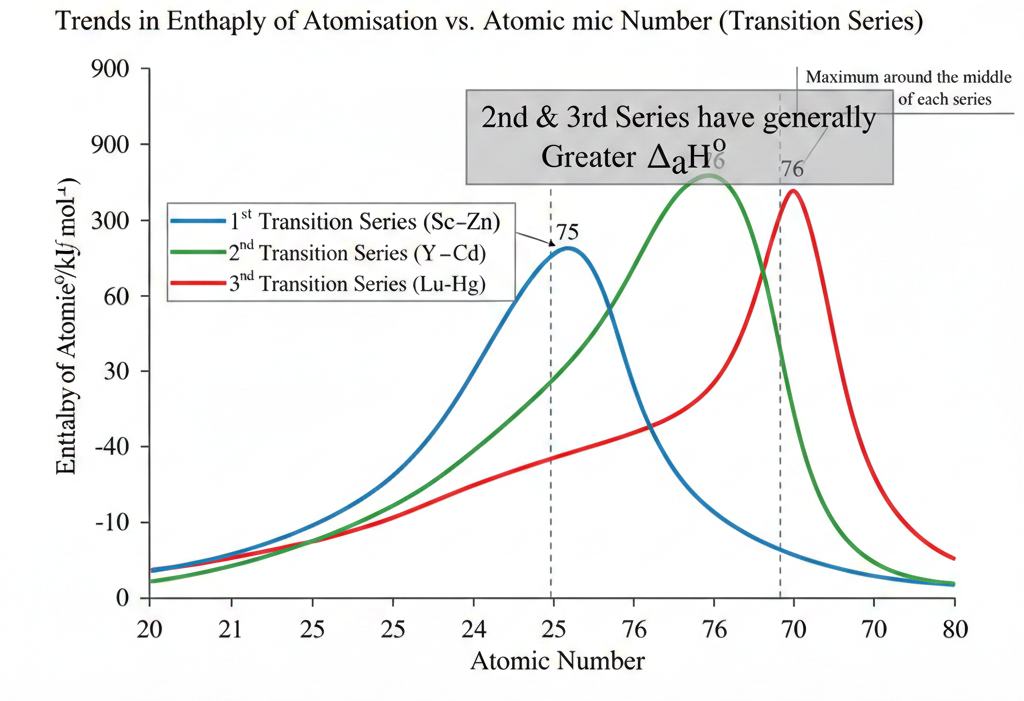
Remember, even the trend has exceptions: Mn and Tc (Manganese and Technetium) have anomalous, lower values despite being in the middle of their respective series.
Practice Question:
The maximum enthalpy of atomisation in the 3d series generally occurs at a $d$-electron configuration of:
(a) $d^{3}$
(b) $d^{5}$
(c) $d^{8}$
(d) $d^{10}$
✅ Answer: (b) $d^{5}$ — The maximum is near the middle of the series, indicating that one unpaired electron per $d$ orbital (like $d^{5}$) is especially good for strong interatomic bonding.
NEET Checkpoint:
Why is the enthalpy of atomisation of zinc ($Z=30$) significantly lower than iron ($Z=26$)?
(a) Zinc is radioactive
(b) Zinc has fewer unpaired $d$ electrons involved in bonding
(c) Zinc has a higher atomic mass
(d) Zinc is a gas.
✅ Answer: (b) Zinc has fewer unpaired $d$ electrons involved in bonding — Zinc has a completely filled $3d^{10}$ configuration, meaning fewer d-electrons are available for metallic bonding compared to elements like Fe or Cr.
Now that you've mastered the physical toughness of these elements, let's see how this strength affects their atomic sizes!
Key Takeaway
Transition elements are strong metals (high M.P., high $\Delta_{a}H^{\circ}$) because both $ns$ and $(n-1)d$ electrons contribute to the metallic bonding. This bonding strength often peaks around the $d^{5}$ configuration in the middle of the series. Exceptions like Zn, Cd, and Hg are less hard and have lower melting points.
5. Atomic and Ionic Sizes: Lanthanoid Contraction
Hey, NEET aspirants! Let’s talk about atomic size trends in transition elements—it’s full of surprises, but once you get the funda of Lanthanoid Contraction, you'll nail it!
Generally, when you move left to right across a given series (like $3d$), the atomic and ionic radii $\text{progressively decrease}$. Why, yaar? Because the nuclear charge increases by one unit each time, but the new electron enters an inner $d$ orbital. The $d$ electrons are terrible at shielding! This $\text{ineffective shielding}$ means the nucleus pulls the outermost electrons much harder, causing the size to shrink.
NEET Checkpoint:
What is the primary reason radii decrease horizontally in a $d$-block series?
(a) Electron pairing
(b) Increase in ionisation enthalpy
(c) Ineffective shielding by $d$-electrons
(d) Relativistic effects
✅ Answer: (c) Ineffective shielding by $d$-electrons — Since $d$ electrons don't block the nucleus effectively, the size decreases.
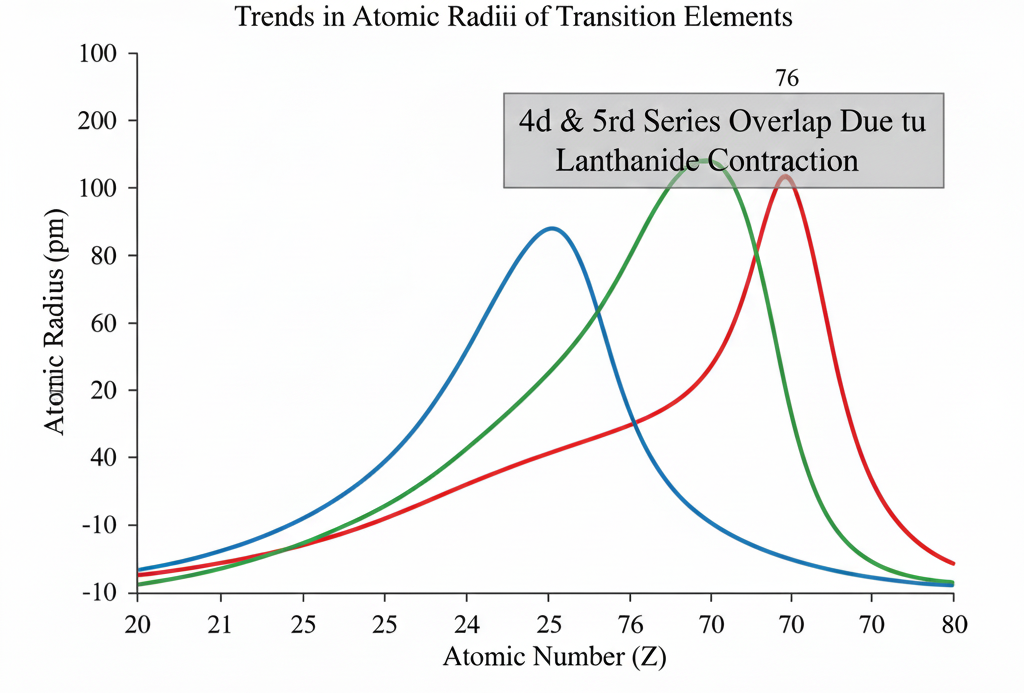
Now for the plot twist! When moving down a group, say from the $3d$ to the $4d$ series, the radii $\text{increase}$ as expected. But when you jump from the $4d$ series to the third ($5d$) series, the radii are $\text{virtually the same}$ as the corresponding $4d$ members! Seriously, check out Zirconium ($\text{Zr}$) at $160 \text{ pm}$ and Hafnium ($\text{Hf}$) at $159 \text{ pm}$. Almost identical!
This huge anomaly is the Lanthanoid Contraction. This phenomenon happens because of the $\text{intervention of the } 4f \text{ orbitals}$ which must be filled before the $5d$ series even begins.
Here's the trick: Lanthanoid contraction is the $\text{regular decrease in atomic radii}$ caused by the $\text{poor shielding of the intervening } 4f \text{ orbitals}$. Think of the nucleus as the strict teacher and the $4f$ electrons as lazy security guards. They don't block the teacher's stern gaze (nuclear charge) effectively, so the outer electrons feel the pull, and the atom shrinks regularly.
This contraction perfectly $\text{compensates for the expected increase in atomic size}$ you’d see going down a group.
NEET Checkpoint:
Which pair of elements exhibits nearly identical atomic radii due to the Lanthanoid Contraction?
(a) $\text{Sc}$ and $\text{Y}$
(b) $\text{Zr}$ and $\text{Hf}$
(c) $\text{Fe}$ and $\text{Co}$
(d) $\text{V}$ and $\text{Nb}$
✅ Answer: (b) $\text{Zr}$ and $\text{Hf}$ — Their radii ($160 \text{ pm}$ and $159 \text{ pm}$) are nearly the same because of LC.
The consequence of this contraction is huge: the $4d$ and $5d$ elements exhibit $\text{very similar physical and chemical properties}$. That's why separating elements like $\text{Zr}$ and $\text{Hf}$ is chemically difficult!
Figure below:
A clear diagram showing the trends in atomic radii of $3d$, $4d$, and $5d$ transition elements, highlighting how the $4d$ and $5d$ series overlap.
NEET Checkpoint:
The shielding effectiveness of $4f$ electrons compared to $d$ electrons is:
(a) Greater
(b) Less
(c) Equal
(d) Not comparable
✅ Answer: (b) Less — The shielding of one $4f$ electron by another is less effective than that of a $d$ electron.
Practice Questions:
- The Lanthanoid Contraction is defined as a regular decrease in radii due to the poor shielding effect of which orbitals?
(a) $5d$
(b) $4f$
(c) $3d$
(d) $6s$
✅ Answer: (b) $4f$ — The filling of $4f$ orbitals prior to the $5d$ series causes this contraction.
2. A major consequence of Lanthanoid Contraction is:
(a) $3d$ metals become more reactive than $4d$ metals.
(b) $5d$ metals become highly soluble in water.
(c) $4d$ and $5d$ elements show very similar chemical properties.
(d) $\text{La}$ exhibits a $\text{+4}$ oxidation state.
✅ Answer: (c) $4d$ and $5d$ elements show very similar chemical properties — The similar radii mean their properties are closely matched.
Key Takeaway
| CONCEPT | EXPLANATION |
|---|---|
| Horizontal Trend | Radii decrease because $d$-electron shielding is ineffective against increasing nuclear charge. |
| Vertical Trend (Group) | $\text{Size } (3d) < \text{Size } (4d) \approx \text{Size } (5d)$. |
| Lanthanoid Contraction | Regular decrease in size caused by the $\text{imperfect shielding of } 4f \text{ electrons}$, making $4d$ and $5d$ elements similar in size and properties (e.g., $\text{Zr}$ and $\text{Hf}$). |
6. Ionisation Enthalpies and Irregular Trends (The $d$-Block Drama!)
Let's clear up the funda behind Ionisation Enthalpies ($\Delta_i H^{\circ}$) in the transition metals. This topic has some classic NEET questions, so pay attention, yaar!
Generally speaking, as you move along a transition series from left to right, the ionisation enthalpy increases. This is due to the steadily increasing nuclear charge. However, notice this: the variation in I.E. across a transition series is much less compared to non-transition elements in the same period.
Now, why does this matter? Here’s the trick: as the atomic number increases, the new electrons enter the inner $3d$ orbitals. These $3d$ electrons do a decent job, but they only shield the outermost $4s$ electrons somewhat effectively from the nuclear charge. Because of this imperfect shielding, the atomic radii decrease less rapidly, and consequently, the ionization energies increase only slightly along the $3d$ series.
NEET Checkpoint:
Why is the I.E. trend less steep for $d$-block elements than $p$-block elements?
(a) Low atomic mass
(b) Effective shielding by $4s$ electrons
(c) Somewhat effective shielding by inner $3d$ electrons.
✅ Answer: (c) Somewhat effective shielding by inner $3d$ electrons — The inner $3d$ electrons partially screen the $4s$ electrons from the nucleus.
The main headache in this section comes from the irregular trends and breaks. These anomalies—especially impacting elements like $\text{Cr}$, $\text{Mn}$, $\text{Cu}$, and $\text{Zn}$—are fully accounted for by the extra stability provided by half-filled ($d^5$) and completely filled ($d^{10}$) electronic configurations.
Imagine stability is like finding a safe spot during a Mumbai monsoon downpour. Once you hit the $d^5$ or $d^{10}$ configuration, you're super stable! The factor responsible for this stabilisation is exchange energy. Exchange energy is approximately proportional to the total number of possible pairs of parallel spins in the degenerate orbitals. When stability increases, the ionisation becomes more difficult. For example, the sum of the first and second I.E. is unusually high for $\text{Cr}$ and $\text{Cu}$ because the $M^+$ ions ($\text{Cr}^+$ has $d^5$; $\text{Cu}^+$ has $d^{10}$) are extremely stable.
NEET Checkpoint:
Which two electronic configurations are responsible for the 'breaks' and stability trends in I.E. values of transition metals?
(a) $s^2$ and $p^6$
(b) $d^5$ and $d^{10}$
(c) $d^4$ and $d^9$.
✅ Answer: (b) $d^5$ and $d^{10}$ — Half-filled and completely filled subshells provide exceptional stability.
The third ionisation enthalpy ($\Delta_i H_3^{\circ}$) is also complicated by the stability of $\text{Mn}^{2+}$ ($d^5$) and $\text{Zn}^{2+}$ ($d^{10}$) ions, making it very difficult to remove that third electron, resulting in very high $\Delta_i H_3^{\circ}$ values for them.
NEET Checkpoint:
If an ion has a $d^5$ configuration, removing the next electron will be
(a) Easy
(b) Difficult
(c) Impossible.
✅ Answer: (b) Difficult — The loss of exchange energy increases stability, making further ionization harder.
Practice Questions:
- Which element shows an unusually low first ionisation enthalpy despite being a transition element, because its $M^+$ ion forms a stable $d^{10}$ configuration upon losing the $4s$ electron?
(a) $\text{Cr}$
(b) $\text{Mn}$
(c) $\text{Ni}$
(d) $\text{Zn}$
✅ Answer: (d) $\text{Zn}$ — Wait, no! The first I.E. for $\text{Zn}$ is high ($906$ $\text{kJ}$ $\text{mol}^{-1}$) compared to its neighbours. Let's rephrase based strictly on the text. The question should focus on the second or third I.E.
2. Why is the second ionisation enthalpy ($\Delta_i H_2^{\circ}$) of $\text{Cu}$ ($1958$ $\text{kJ}$ $\text{mol}^{-1}$) unusually high compared to $\text{Ni}$ ($1752$ $\text{kJ}$ $\text{mol}^{-1}$)?
(a) $\text{Cu}^+$ has a half-filled $d^5$ configuration
(b) $\text{Cu}^+$ has a completely filled $d^{10}$ configuration
(c) $\text{Cu}$ has a higher atomic radius
(d) $\text{Cu}$ has lower enthalpy of atomisation.
✅ Answer: (b) $\text{Cu}^+$ has a completely filled $d^{10}$ configuration — $\text{Cu}^+$ has the stable $d^{10}$ configuration, making the removal of the second electron very difficult.
3. The $\Delta_i H_3^{\circ}$ value is very high for $\text{Mn}$ because the electron must be removed from the highly stable configuration of $\text{Mn}^{2+}$. What is this configuration?
(a) $3d^4$
(b) $3d^6$
(c) $3d^5$
(d) $3d^{10}$
✅ Answer: (c) $3d^5$ — $\text{Mn}^{2+}$ has the highly stable $d^5$ half-filled configuration.
Key Takeaway
| Summary of Trends |
|---|
| Ionisation enthalpy generally increases due to rising nuclear charge. |
| The increase is small because inner $3d$ electrons somewhat effectively shield the $4s$ electrons. |
| Breaks occur due to the stability of $d^5$ (half-filled) and $d^{10}$ (completely filled) configurations. |
| Exchange energy contributes to stability, making ionization harder when stable configurations are involved. |
7. Oxidation States: Variability and Stability
If you're looking for the masters of chemical disguise, look no further than transition elements! One of their coolest fundas is the great variety of oxidation states they show in their compounds. Don't stress, this variability is actually easy to understand: it arises because of the incomplete filling of their $d$ orbitals.
Here’s the trick: they can lose electrons from both the outermost $ns$ orbital and the inner $(n-1)d$ orbitals, often resulting in oxidation states that differ from each other by unity. Think of vanadium, chilling happily as $V^{II}$, $V^{III}$, $V^{IV}$, and $V^{V}$. This is totally different from non-transition elements, whose oxidation states usually jump by two units.
NEET Checkpoint:
Transition elements show variable oxidation states because:
(a) They are magnetic
(b) Their d orbitals are incomplete
(c) They have high density
✅ Answer: (b) Their d orbitals are incomplete — Simple funda, right? Both $ns$ and $(n-1)d$ electrons participate in bonding.
Now, notice this trend: the elements that display the greatest number of oxidation states occur right near the middle of the series. The undisputed champ here is Manganese (Mn), which flaunts everything from $+2$ to $+7$. At the ends, elements like Scandium (too few electrons to lose) or Zinc (too many $d$ electrons, $d^{10}$) show limited states—Zn is strictly $+2$.
Let's imagine the transition series as a cricket team lineup. The initial batsmen (Sc, Ti) have limited shots (few oxidation states). The middle order (Mn) is super flexible, scoring $2$s, $3$s, $4$s, $5$s, $6$s, and $7$s (maximum variability).
The maximum stable oxidation state initially corresponds in value to the sum of the $s$ and $d$ electrons up to Manganese. For example, Titanium ($3d^2 4s^2$) shows $+4$ stability in $Ti^{IV}O_{2}$. However, after Manganese, there is a rather abrupt decrease in the stability of higher oxidation states, leading to typical species like $Fe^{II, III}$.
NEET Checkpoint:
Which element in the 3d series exhibits the largest number of oxidation states?
(a) Fe
(b) Cr
(c) Mn
(d) Cu
✅ Answer: (c) Mn — Manganese wins, showing $+2$ through $+7$.
So, how do we force elements to show their highest states? They need super strong oxidizers! The highest oxidation states are beautifully stabilized by oxygen (forming oxides or oxoanions) or fluorine (halides). But wait, oxygen is the superior stabilizer because of its ability to form multiple bonds to the metal.
This is why Manganese can only manage $MnF_{4}$ (just $+4$) with fluorine, but it hits the peak $Mn_{2}O_{7}$ (the $+7$ state!) with oxygen. Other high-state examples include $V^{V}O_{2}^{+}$ and $Cr^{VI}O_{4}^{2-}$.
NEET Checkpoint:
The highest oxidation states of transition metals are best stabilised by:
(a) Chlorine
(b) Sulphur
(c) Oxygen
(d) Iodine
✅ Answer: (c) Oxygen — Oxygen’s ability to form multiple bonds makes it the best friend for high oxidation states.
Practice Question:
Which transition metal ion's stability is often associated with the sum of its $s$ and $d$ electrons for maximum oxidation state, but is followed by an abrupt instability for the next element?
(a) $Ti^{IV}$
(b) $Mn^{VII}$
(c) $Zn^{II}$
(d) $Fe^{VI}$
✅ Answer: (b) $Mn^{VII}$ — The maximum stability for the highest oxidation states corresponds to the sum of $s$ and $d$ electrons up to Manganese. The stability of higher states then abruptly decreases after Mn, making $Fe^{VI}$ rare and highly unstable.
Key Takeaway
Transition metals exhibit variable oxidation states due to incomplete $d$ orbitals, differing usually by unity. Maximum variability is seen at Manganese ($+2$ to $+7$). Stability of high states drops after Mn and is enhanced by Oxygen (due to multiple bonding) and Fluorine.
8. Standard Electrode Potentials ($\text{E}^{\ominus}{\text{M}^{2+}/\text{M}}$ and $\text{E}^{\ominus}{\text{M}^{3+}/\text{M}^{2+}}$)
$\text{E}^{\ominus}$ values are the key to understanding a metal’s chemical reactivity—they tell us how easily the metal ion ($\text{M}^{2+}$) converts back to the metal ($\text{M}$), essentially indicating how easily the metal itself gets oxidised. As you scan across the first series, the general trend is for the standard electrode potential ($\text{E}^{\ominus}$) values to become less negative. Don't stress, this logical shift is tied to the general increase in the sum of the first and second ionisation enthalpies ($\Delta_{i} H^{\circ}{1} + \Delta{i} H^{\circ}_{2}$) across the period.
The Copper Conundrum
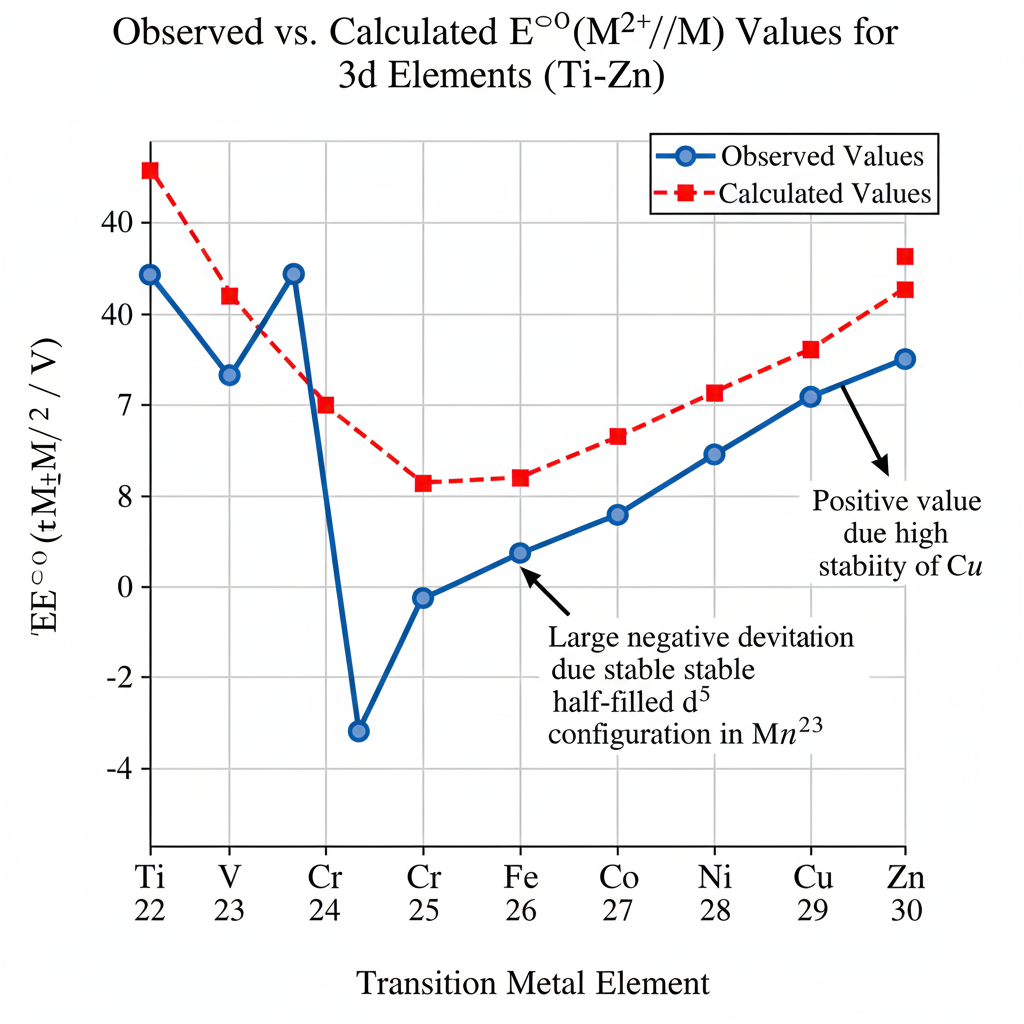
Now, here’s a major exception you must highlight for NEET: Copper ($\text{Cu}$) has a positive $\text{E}^{\ominus}$ value ($+0.34\text{V}$). This unique positive value means that $\text{Cu}$ cannot liberate $\text{H}2$ gas from non-oxidizing acids. Why, bhai? The high energy needed to transform solid $\text{Cu}$ into $\text{Cu}^{2+}$ ions in solution (high enthalpy of atomisation, $\Delta{a} H^{\circ}$) is not balanced by its hydration enthalpy ($\Delta_{hyd} H^{\circ}$).
Relatable Example: Think of Copper ($\text{Cu}$) as that super rich kid who is noble and won't react to street food (non-oxidizing acids). It takes too much money (energy) to make them move from their solid state, and even the hydration energy (the comfort of aqueous solution) isn't enough compensation!
NEET Checkpoint:
What thermochemical property is primarily responsible for $\text{Cu}$ having a positive $\text{E}^{\ominus}$ value?
(a) Low $\Delta_{i} H^{\circ}{1}$
(b) High $\Delta{a} H^{\circ}$ not balanced by $\Delta_{hyd} H^{\circ}$
(c) Stability of $\text{d}^{10}$ configuration
✅ Answer: (b) High $\Delta_{a} H^{\circ}$ not balanced by $\Delta_{hyd} H^{\circ}$ — The energy required to atomize and ionise $\text{Cu}$ is too high relative to the stabilizing hydration energy.
The Unexpected Negative Dip
It's interesting to note that the $\text{E}^{\ominus}$ values for Manganese ($\text{Mn}$), Nickel ($\text{Ni}$), and Zinc ($\text{Zn}$) are more negative than expected from the smooth trend. This drama is due to stability factors:
1. $\text{Mn}$ and $\text{Zn}$ are linked to the high stability of their $\text{M}^{2+}$ ions, which possess stable half-filled ($\text{d}^5$) and completely filled ($\text{d}^{10}$) configurations, respectively.
2. $\text{Ni}$’s higher negativity is related to its highest negative enthalpy of hydration ($\Delta_{hyd} H^{\circ}$) in the series.
Figure below:
A clear diagram showing the observed $\text{E}^{\ominus}(\text{M}^{2+}/\text{M})$ values for the elements $\text{Ti}$ to $\text{Zn}$ compared against their calculated values .
$\text{M}^{3+}/\text{M}^{2+}$ Potentials: The Oxidizing Agents
Switching gears to the $\text{M}^{3+}/\text{M}^{2+}$ redox couple, we identify the strongest oxidising agents. Based on their $\text{E}^{\ominus}$ values (Table 4.2), the ions $\text{Mn}^{3+}$ and $\text{Co}^{3+}$ are the strongest oxidising agents in aqueous solutions. This is because $\text{Mn}^{3+}$ readily accepts an electron to become $\text{Mn}^{2+}$, which has the extra stable $\text{d}^5$ configuration.
NEET Checkpoint:
The anomalously high negative $\text{E}^{\ominus}(\text{M}^{2+}/\text{M})$ value for $\text{Zn}$ is due to the stability of which ion configuration?
(a) $\text{Zn}^{+}$ ($\text{d}^{10}\text{s}^{1}$)
(b) $\text{Zn}^{2+}$ ($\text{d}^{10}$)
(c) $\text{Zn}^{3+}$ ($\text{d}^{9}$)
✅ Answer: (b) $\text{Zn}^{2+}$ ($\text{d}^{10}$) — The stability of the completely filled $\text{d}^{10}$ shell in $\text{Zn}^{2+}$ makes the $\text{M}^{2+}$ state highly favorable.
Practice Question:
Which ion is the strongest oxidising agent among $\text{Ti}^{3+}$, $\text{Cr}^{3+}$, $\text{Mn}^{3+}$, and $\text{Fe}^{3+}$ in aqueous solution?
(a) $\text{Ti}^{3+}$
(b) $\text{Cr}^{3+}$
(c) $\text{Mn}^{3+}$
(d) $\text{Fe}^{3+}$
✅ Answer: (c) $\text{Mn}^{3+}$ — $\text{Mn}^{3+}$ has the most positive $\text{E}^{\ominus}(\text{M}^{3+}/\text{M}^{2+})$ value among the common ions and reduces easily to the highly stable $\text{Mn}^{2+}(\text{d}^5)$ ion.
Key Takeaway
The less negative $\text{E}^{\ominus}{\text{M}^{2+}/\text{M}}$ trend follows the increase in $(\Delta{i} H^{\circ}{1} + \Delta{i} H^{\circ}_{2})$ ,$\text{Cu}$ ($+0.34\text{V}$) is exceptional because hydration enthalpy fails to balance its high energy of atomisation. $\text{Mn}^{3+}$ and $\text{Co}^{3+}$ are the strongest oxidising agents.
9. Chemical Reactivity and Stability in Solution
Hey NEET aspirants! Let's talk about the Chemical Reactivity of the first series transition metals—basically, who's a drama queen (reactive) and who’s super chill (noble)!
Notice this: $\text{Most metals of the first series}$, with the big exception of copper ($\text{Cu}$), are relatively reactive and will dissolve in mineral acids. Why is $\text{Cu}$ so special? Its standard electrode potential ($E^{\ominus}$) is positive, meaning it just doesn't feel like liberating hydrogen ($\text{H}_{2}$) from dilute acids. $\text{Cu}$ only reacts with strong oxidising acids like nitric acid, yaar!.
Now, let's look at some serious reducing agents. The sources tell us that ions like $\text{Ti}^{2+}$, $\text{V}^{2+}$, and $\text{Cr}^{2+}$ are strong reducing agents. They are so keen to lose electrons that they can even $\text{liberate hydrogen}$ gas from a dilute acid solution. Check out the classic reaction:
NEET Checkpoint:
Which ion among $\text{Ti}^{2+}$, $\text{V}^{2+}$, and $\text{Mn}^{2+}$ is not listed as a strong reducing agent that liberates $\text{H}_{2}$ from dilute acid?
(a) $\text{Ti}^{2+}$
(b) $\text{V}^{2+}$
(c) $\text{Mn}^{2+}$
(d) $\text{Cr}^{2+}$
✅ Answer: (c) $\text{Mn}^{2+}$ — Only $\text{Ti}^{2+}$, $\text{V}^{2+}$, and $\text{Cr}^{2+}$ are specifically named as strong reducing agents that liberate $\text{H}_{2}$.
The $d^{4}$ Stability Funda: $\text{Cr}^{2+}$ vs. $\text{Mn}^{3+}$
Here’s a crucial concept for stability. Both $\text{Cr}^{2+}$ and $\text{Mn}^{3+}$ have a $\text{d}^{4}$ electronic configuration, but they behave totally differently.
- $\text{Cr}^{2+}$ is a reducing agent (it gets oxidized). It changes from $\text{d}^{4}$ to the highly stable $\text{Cr}^{3+}$ ($\text{d}^{3}$ configuration). The $\text{d}^{3}$ configuration provides stability because it results in a half-filled $\text{t}_{2\text{g}}$ level.
- $\text{Mn}^{3+}$ is an oxidizing agent (it gets reduced). It changes from $\text{d}^{4}$ to the ultra-stable $\text{Mn}^{2+}$ ($\text{d}^{5}$ configuration), which has extra stability due to the half-filled d subshell.
Relatable Example: Think of this as two cricket players starting with a score of $4$ ($\text{d}^{4}$). Player $\text{Cr}^{2+}$ needs just one more run to hit the half-century mark in the $\text{t}_{2\text{g}}$ stadium ($\text{d}^{3}$ stability), so he is desperate to score (reduce others). Player $\text{Mn}^{3+}$ is already close to a bigger $d^{5}$ milestone, so he tries to reduce his score quickly to get the full $d^{5}$ benefit after retirement ($\text{Mn}^{2+}$ stability).
NEET Checkpoint:
The strong reducing nature of $\text{Cr}^{2+}$ is primarily due to the formation of which stable electronic configuration?
(a) $d^{5}$
(b) $d^{10}$
(c) $d^{3}$ ($\text{t}_{2\text{g}}$ half-filled)
(d) $d^{0}$
✅ Answer: (c) $d^{3}$ ($\text{t}{2\text{g}}$ half-filled) — The change from $\text{d}^{4}$ to $\text{d}^{3}$ is stabilised by the half-filled $\text{t}{2\text{g}}$ orbitals.
The Copper (I) Problem
Now, let's look at Copper(I) compounds ($\text{Cu}^{+}$). Many of them are $\text{unstable in aqueous solution}$. They undergo a reaction called disproportionation.
Disproportionation means a species reacts with itself to form products where it exists in both a higher and a lower oxidation state. For $\text{Cu}^{+}$, this is:
Here, $\text{Cu}^{+}$ is simultaneously oxidised to $\text{Cu}^{2+}$ and reduced to $\text{Cu}$ metal. This happens because the $\text{Cu}^{2+}(\text{aq})$ ion is highly stable due to its much more negative enthalpy of hydration ($\Delta_{\text{hyd}}H^{\circ}$), which outweighs the energy cost of removing the second electron (second ionisation enthalpy).
NEET Checkpoint:
The instability of $\text{Cu}^{+}$ in aqueous solution is an example of:
(a) Polymerisation
(b) Ligand exchange
(c) Disproportionation
(d) Neutralization
✅ Answer: (c) Disproportionation — It converts into $\text{Cu}^{2+}$ and $\text{Cu}$.
Practice Question:
Why does Copper ($\text{Cu}$) not readily liberate $\text{H}{2}$ from dilute non-oxidising acids, unlike most other first-series transition metals?
(a) Copper has an extremely high enthalpy of atomisation ($\Delta{a}H^{\circ}$).
(b) Copper forms a protective oxide layer that prevents reaction.
(c) Copper has a positive standard electrode potential $E^{\ominus}$ ($\text{Cu}^{2+}/\text{Cu}$).
(d) Copper has a completely filled $\text{d}^{10}$ configuration.
✅ Answer: (c) Copper has a positive standard electrode potential $E^{\ominus}$ ($\text{Cu}^{2+}/\text{Cu}$). — This positive value indicates its inability to reduce $\text{H}^{+}$ to $\text{H}_{2}$.
Key Takeaway
$\text{Most } \text{3d metals}$ (except $\text{Cu}$) are reactive enough to dissolve in mineral acids. $\text{Ti}^{2+}$, $\text{V}^{2+}$, and $\text{Cr}^{2+}$ are strong reducing agents. $\text{Cr}^{2+}$ is reducing ($\text{d}^{4}\rightarrow\text{d}^{3}$ half-filled $\text{t}_{2\text{g}}$) while $\text{Mn}^{3+}$ is oxidizing ($\text{d}^{4}\rightarrow\text{d}^{5}$ half-filled d). $\text{Cu}^{+}$ undergoes disproportionation in water: $\text{2Cu}^{+}\rightarrow \text{Cu}^{2+}+\text{Cu}$.
10. Magnetic Properties and Formation of Coloured Ions
Hey future doctor! Let's clear up the funda behind why transition metal ions are so colourful and why they love hanging out near magnets—it's all thanks to the $d$-orbitals.
The Magnetic Attraction (Magnetic Properties)
Many transition metal ions show paramagnetic behaviour. Paramagnetic substances are those that get attracted by an applied magnetic field. Don't stress, yaar—the reason is simple: the presence of unpaired electrons. Each unpaired electron acts like a tiny magnet due to its spin angular momentum.
If a substance has zero unpaired electrons (like $Sc^{3+}$ ($3d^0$) or $Zn^{2+}$ ($3d^{10}$)), it’s called diamagnetic and gets repelled. Ferromagnetism, like what you see in iron, is just an extreme version of paramagnetism.
To quantify this attraction, we use the ‘spin-only’ formula for the magnetic moment ($\mu$), measured in Bohr Magnetons ($BM$):
Here, $n$ is the number of unpaired electrons. For example, $Mn^{2+}$ has $3d^5$ configuration, so $n=5$, giving a calculated $\mu$ of $5.92 \text{ BM}$. Notice this: a single unpaired electron ($n=1$) already gives a respectable $\mu$ of $1.73 \text{ BM}$.
NEET Checkpoint:
Which species is predicted to have the highest spin-only magnetic moment?
(a) $Ti^{3+}$ ($d^1$)
(b) $V^{2+}$ ($d^3$)
(c) $Fe^{2+}$ ($d^6$)
(d) $Mn^{2+}$ ($d^5$)
✅ Answer: (d) $Mn^{2+}$ — It has the maximum number of unpaired electrons ($n=5$) in the series, leading to the highest $\mu$.
Why So Colourful? (Formation of Coloured Ions)
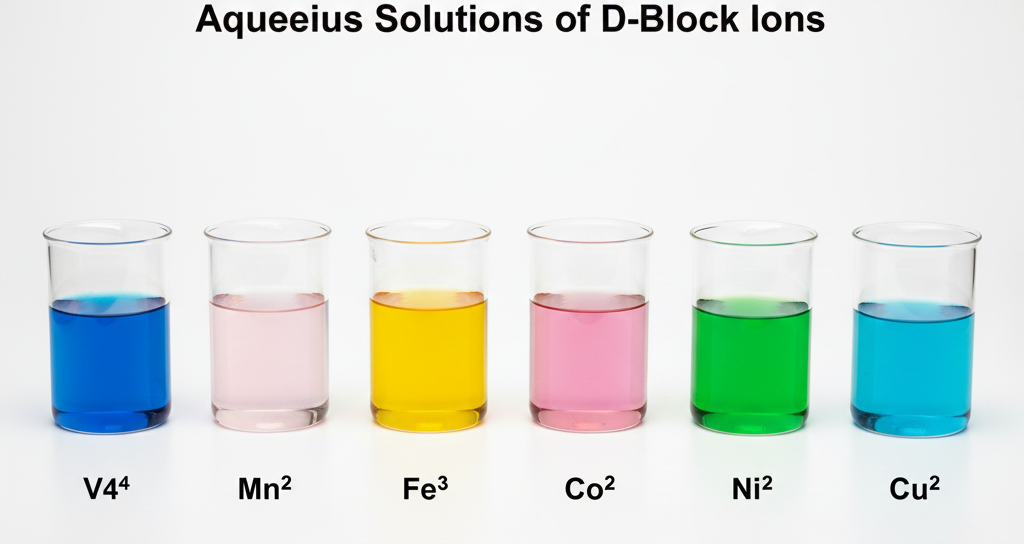
Transition metal ions are often super jhakas (vibrant) in solution (see Fig. 4.5) because they undergo d-d transitions.
Here's the trick: when light hits the ion, an electron in a lower energy $d$ orbital absorbs energy corresponding to a specific frequency (usually in the visible region) and jumps to a higher energy $d$ orbital.
Relatable Indian Example: Imagine you're at a pani puri stall, and the $d$-electrons are picky customers. They absorb one specific flavour (light frequency absorbed) to get the 'kick' to jump. The colour you see is the complementary colour—the light frequency that was not absorbed. The colour observed is also determined by the nature of the ligand surrounding the metal ion.
NEET Checkpoint:
Why are $Zn^{2+}$ ions colourless?
(a) They are strongly paramagnetic.
(b) They have a high ionic charge.
(c) They are too small.
(d) They have completely filled $d$ orbitals.
✅ Answer: (d) They have completely filled $d$ orbitals. — $Zn^{2+}$ is $3d^{10}$, meaning no vacant higher $d$ orbital is available for a $d-d$ transition.
Figure below:
A clear diagram showing aqueous solutions of d-block ions, highlighting $V^{4+}$ (blue), $Mn^{2+}$ (pink), $Fe^{3+}$ (yellow), $Co^{2+}$ (pink), $Ni^{2+}$ (green) and $Cu^{2+}$ (blue).
NEET Checkpoint:
The colour of the observed ion is:
(a) the frequency absorbed.
(b) the sum of all frequencies absorbed.
(c) complementary to the frequency absorbed.
(d) independent of the ligand.
✅ Answer: (c) complementary to the frequency absorbed. — The light that is transmitted or reflected (the complementary colour) is what we perceive.
Practice Questions:
- A divalent transition metal ion $M^{2+}$ has an atomic number of $27$. What is the calculated spin-only magnetic moment for this ion?
(a) $1.73 \text{ BM}$
(b) $2.84 \text{ BM}$
(c) $3.87 \text{ BM}$
(d) $4.90 \text{ BM}$
✅ Answer: (c) $3.87 \text{ BM}$ — Element $Z=27$ is Co. $Co$ is $[Ar]3d^74s^2$. $Co^{2+}$ is $3d^7$. A $d^7$ configuration has $3$ unpaired electrons ($n=3$). $\mu = \sqrt{3(3+2)} = \sqrt{15} \approx 3.87 \text{ BM}$.
2. If a complex absorbs green light, what colour will the observer most likely see?
(a) Red
(b) Blue
(c) Violet
(d) Yellow
✅ Answer: (a) Red — The observed colour is complementary to the colour absorbed.
Key Takeaway
Magnetic Moment Formula (Spin-Only): $\mu = \sqrt{n(n+2)} \text{ BM}$.
Colour Origin: Colour arises from $d-d$ transitions (electron jumping from lower to higher $d$ orbital) in the visible light region.
$d^0$ or $d^{10}$ ions are colourless as no $d-d$ transition is possible.
11. The Master of Complexes
Transition metals are the ultimate complex builders. They form a large number of complex compounds, with examples including $[Fe(CN){6}]^{3-}$ and $[Cu(NH{3})_{4}]^{2+}$. Now, why? Three powerful reasons, notice this:
1. They have comparatively smaller sizes of the metal ions.
2. They exhibit high ionic charges.
3. They have the availability of $d$ orbitals for bond formation.
The transition metal ion is like the $H^{+}$—small, highly charged, and has lots of 'slots' ($d$ orbitals) to hold different ingredients (ligands) and create that perfect, complex flavour!
NEET Checkpoint:
Transition metals primarily form complexes due to:
(a) Low ionic charge
(b) Large atomic size
(c) Availability of $d$ orbitals
✅ Answer: (c) Availability of $d$ orbitals — Plus their small size and high ionic charge! These three reasons are the core concept.
The Secret Agents: Catalysis
Transition metals and their compounds are famous for their catalytic activity. Why do they rock as catalysts? Because they can adopt multiple oxidation states and easily form complexes. This ability is like having a chemical Swiss Army knife! For example, Vanadium (V) oxide ($V_{2}O_{5}$) is used in the Contact Process, finely divided iron in Haber’s Process, and nickel in Catalytic Hydrogenation.
Here’s the trick: when acting as solid surface catalysts, transition metals use their $3d$ and $4s$ electrons to form temporary bonds with reactants. This action increases the concentration of reactants at the surface and weakens the bonds in the reacting molecules, lowering the activation energy. Since transition metal ions can change their oxidation states, they become effective catalysts. See how $Fe^{3+}$ catalyzes a reaction by cycling between $Fe^{3+}$ and $Fe^{2+}$:
Interstitial Compounds
Imagine trapping tiny atoms like H, C, or N inside the empty spaces (crystal lattices) of the metal. That’s an interstitial compound! Examples include $TiC$ and $Mn_{4}N$. And these compounds are total tough guys: they have high melting points (higher than the pure metals), are very hard (some borides approach diamond in hardness!), retain metallic conductivity, and are chemically inert.
NEET Checkpoint:
Which characteristic is retained by interstitial compounds compared to pure transition metals?
(a) Chemical reactivity
(b) Low melting points
(c) Metallic conductivity
✅ Answer: (c) Metallic conductivity — They retain metallic conductivity, but gain higher melting points, hardness, and chemical inertness.
Forming Power Alloys
Transition metals form alloys readily because they have similar metallic radii, generally within about $15\%$ of each other. This size similarity allows the atoms of one metal to distribute randomly among the atoms of the other, forming a homogeneous solid solution.
This is how we get industrially important materials. For example, Cr, V, W, Mo, and Mn are used to produce a variety of steels. Non-ferrous alloys like brass (copper-zinc) and bronze (copper-tin) are also vital. These alloys are typically hard and possess high melting points.
NEET Checkpoint:
What percentage range should the metallic radii be within for transition metals to readily form alloys?
(a) $15\%$
(b) $25\%$
(c) $5\%$
✅ Answer: (a) $15\%$ — Similar metallic radii within approximately $15\%$ is the key factor for easy alloy formation.
Practice Question:
The catalytic activity of transition metal compounds is mainly due to their ability to:
(a) Form interstitial compounds and exhibit diamagnetism.
(b) Adopt multiple oxidation states and form complexes.
(c) Possess full $d^{10}$ configurations in their common ions.
(d) Have very low enthalpies of atomisation.
✅ Answer: (b) Adopt multiple oxidation states and form complexes. — These two capabilities are directly ascribed to their high catalytic activity.
Key Takeaway
Transition metals are versatile: they form complexes (small size, high charge, $d$ orbitals), act as catalysts (multiple oxidation states), create tough interstitial compounds (trapped H, C, N leading to hardness/inertia), and form strong alloys (similar radii within $15\%$).
12. Preparation and Properties of Potassium Dichromate ($\text{K}{2}\text{Cr}{2}\text{O}_{7}$)
Hey future doctors! Let's clear up the funda behind Potassium Dichromate ($\text{K}{2}\text{Cr}{2}\text{O}_{7}$), a seriously important chemical used everywhere from leather centres to volumetric analysis. Don't stress, yaar—the preparation is just a three-step chemistry challenge!
The Preparation Panga
The journey starts with the chromite ore ($\text{FeCr}{2}\text{O}{4}$), which is fused with an alkali carbonate (like $\text{Na}{2}\text{CO}{3}$) in free access of air. This fusion forms yellow sodium chromate ($\text{Na}{2}\text{CrO}{4}$):
The resulting yellow solution of $\text{Na}{2}\text{CrO}{4}$ is then filtered and acidified (usually with sulphuric acid) to transform it into orange sodium dichromate ( $\text{Na}{2}\text{Cr}{2}\text{O}_{7}$).
NEET Checkpoint:
Which colour change indicates the formation of sodium dichromate during preparation?
(a) Green to Yellow
(b) Yellow to Orange
(c) Orange to Green
(d) White to Yellow
✅ Answer: (b) Yellow to Orange — The chromate ($\text{Na}{2}\text{CrO}{4}$) solution is yellow, and acidification converts it into the orange dichromate ( $\text{Na}{2}\text{Cr}{2}\text{O}_{7}$).
Since sodium dichromate is more soluble than potassium dichromate, we mix the solution with potassium chloride ($\text{KCl}$) to swap the sodium for potassium, crystallising out the final orange $\text{Na}{2}\text{Cr}{2}\text{O}_{7}$). crystals.
$\text{pH}$ Swap: Chromates vs. Dichromates
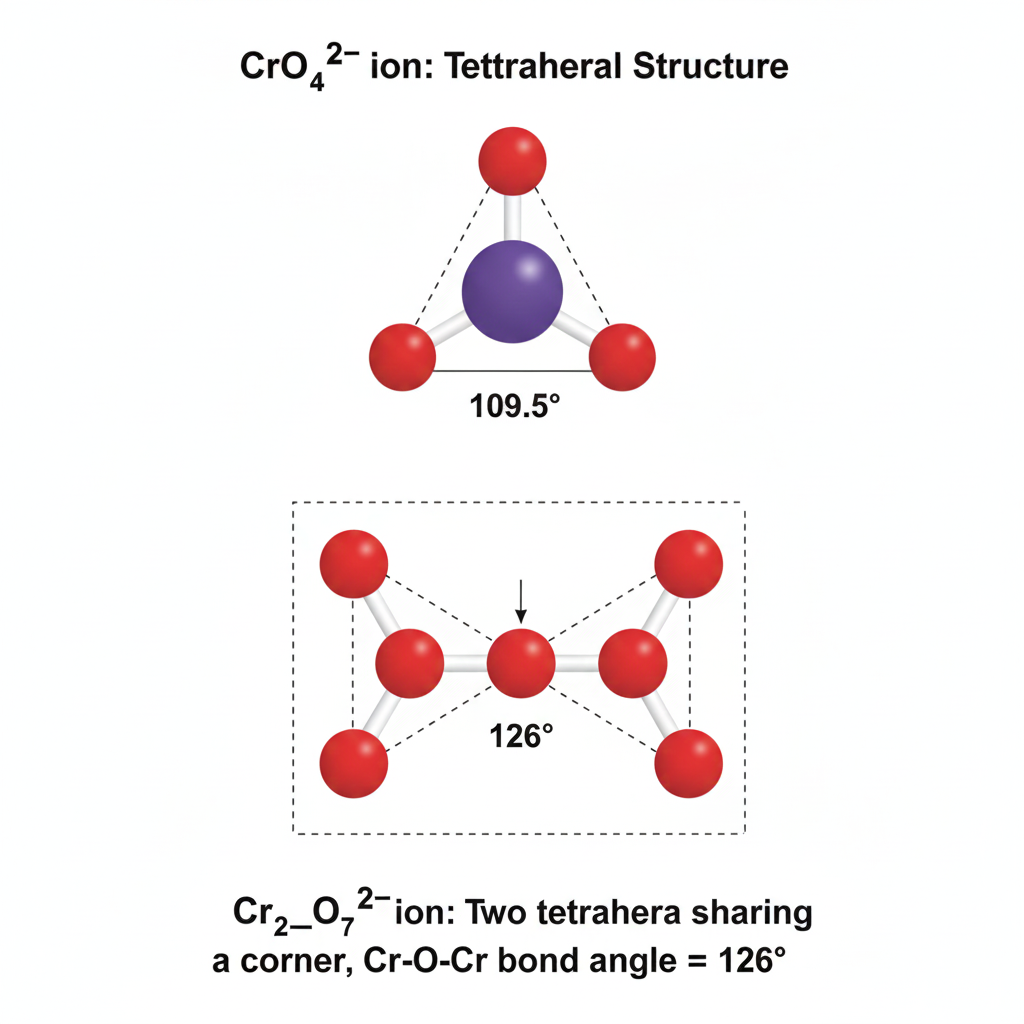
Here's the trick: Chromates ($\text{CrO}{4}^{2-}$) and Dichromates ($\text{Cr}{2}\text{O}_{7}^{2-}$ are best friends who switch teams based on the $\text{pH}$!
- In acidic media (high $\text{H}^{+}$), the yellow ($\text{CrO}{4}^{2-}$) forms the orange $\text{Cr}{2}\text{O}_{7}^{2-}$.
- In alkaline media (high $\text{OH}^{-}$), the orange $\text{Cr}{2}\text{O}{7}^{2-}$ converts back to the yellow $\text{CrO}_{4}^{2-}$.
Notice this, the oxidation state of Chromium is the same (+$6$) in both ions. Think of it like a cricket umpire changing his shirt colour depending on whether it's a day game (acidic) or a night game (alkaline)—same umpire, different look!
Figurte below:
A clear diagram showing the tetrahedral structure of the $\text{CrO}{4}^{2-}$ ion and the structure of the $\text{Cr}{2}\text{O}_{7}^{2-}$ ion which consists of two tetrahedra sharing one corner with a $\text{Cr-O-Cr}$ bond angle of $126^\circ$.
The Strong Oxidiser
$\text{K}{2}\text{Cr}{2}\text{O}_{7}$ is a strong oxidising agent, especially in acidic solution. Its power comes from the fact that in acid, the dichromate ion readily gets reduced to the stable green $\text{Cr}^{3+}$ ion, accepting $6$ electrons:
($E^\circ = 1.33 \text{ V}$)
This strong oxidizing action means it can easily oxidise things like iodides ($\text{I}^{-}$) to iodine ($\text{I}{2}$), sulfides ($\text{S}^{2-}$ or $\text{H}{2}\text{S}$) to sulphur ($\text{S}$), $\text{Sn}(\text{II})$ to $\text{Sn}(\text{IV})$, and crucial for titrations, $\text{Fe}(\text{II})$ salts ($\text{Fe}^{2+}$) to $\text{Fe}(\text{III})$ ($\text{Fe}^{3+}$).
Relatable Example: Imagine you are testing the quality of steel alloys in a factory. If you treat an iron sample ($\text{Fe}^{2+}$) with acidified dichromate, the colour shifts dramatically from the original orange dichromate solution to green ($\text{Cr}^{3+}$) as the iron gets oxidized ($\text{Fe}^{3+}$). That quick colour change is your signal that the reaction is on!
NEET Checkpoint:
The reduction of dichromate ion ($\text{Cr}{2}\text{O}{7}^{2-}$) in acidic solution produces which ion?
(a) $\text{Cr}^{6+}$
(b) $\text{Cr}^{4+}$
(c) $\text{Cr}^{3+}$
(d) $\text{Cr}^{2+}$
✅ Answer: (c) $\text{Cr}^{3+}$ — The dichromate is reduced, and the chromium oxidation state changes from $+6$ to $+3$.
Practice Questions:
- When potassium dichromate is used as an oxidising agent in acidic medium, how many electrons are gained per mole of the dichromate ion ( $\text{Cr}{2}\text{O}{7}^{2-}$)?
(a) $2$
(b) $3$
(c) $5$
(d) $6$
✅ Answer: (d) $6$ — The half-reaction shows that $6e^{-}$ are gained to produce $2\text{Cr}^{3+}$ ions.
2. What is the geometry of the chromate ion ($\text{CrO}_{4}^{2-}$)?
(a) Square planar
(b) Octahedral
(c) Trigonal bipyramidal
(d) Tetrahedral
✅ Answer: (d) Tetrahedral — The chromate ion ($\text{CrO}_{4}^{2-}$) has a tetrahedral structure.
NEET Checkpoint:
How is sodium dichromate converted into potassium dichromate?
(a) By heating with $\text{KOH}$
(b) By treating with $\text{KCl}$
(c) By acidifying with $\text{HNO}{3}$
(d) By reduction with $\text{H}{2}$
✅ Answer: (b) By treating with $\text{KCl}$ — Since $\text{Na}{2}\text{Cr}{2}\text{O}{7}$ is more soluble, $\text{KCl}$ is added to precipitate out the less soluble $\text{K}{2}\text{Cr}{2}\text{O}{7}$.
Key Takeaway
Preparation: $\text{FeCr}{2}\text{O}{4}$ (Chromite Ore) $\xrightarrow{\text{Fusion, Air}}$ $\text{Na}{2}\text{CrO}{4}$ (Yellow) $\xrightarrow{\text{Acidification}}$ $\text{Na}{2}\text{Cr}{2}\text{O}{7}$ (Orange) $\xrightarrow{\text{KCl}}$ $\text{K}{2}\text{Cr}{2}\text{O}{7}$.
Interconversion: $\text{CrO}_{4}^{2-}$ (Alkali, Yellow) $\leftrightarrow$ $\text{Cr}{2}\text{O}_{7}^{2-}$ (Acid, Orange).
Oxidation: In acid, $\text{Cr}{2}\text{O}_{7}^{2-}$ is reduced to $\text{Cr}^{3+}$.
13. Preparation and Properties of Potassium Permanganate ($KMnO_{4}$)
Hey future doctors, let's tackle one of the most colourful oxidising agents out there: Potassium Permanganate ($KMnO_{4}$). Don't stress, yaar—the funda is super simple!
To prep this powerful compound, you start with $\text{MnO}{2}$ (Manganese dioxide). First, you do an alkaline fusion. $\text{MnO}{2}${2}$ is fused with an alkali ($\text{KOH}$) and an oxidising agent (like $\text{KNO}_{3}$). Notice this forms a totally different beast first: Potassium Manganate ($K_{2}MnO_{4}$).
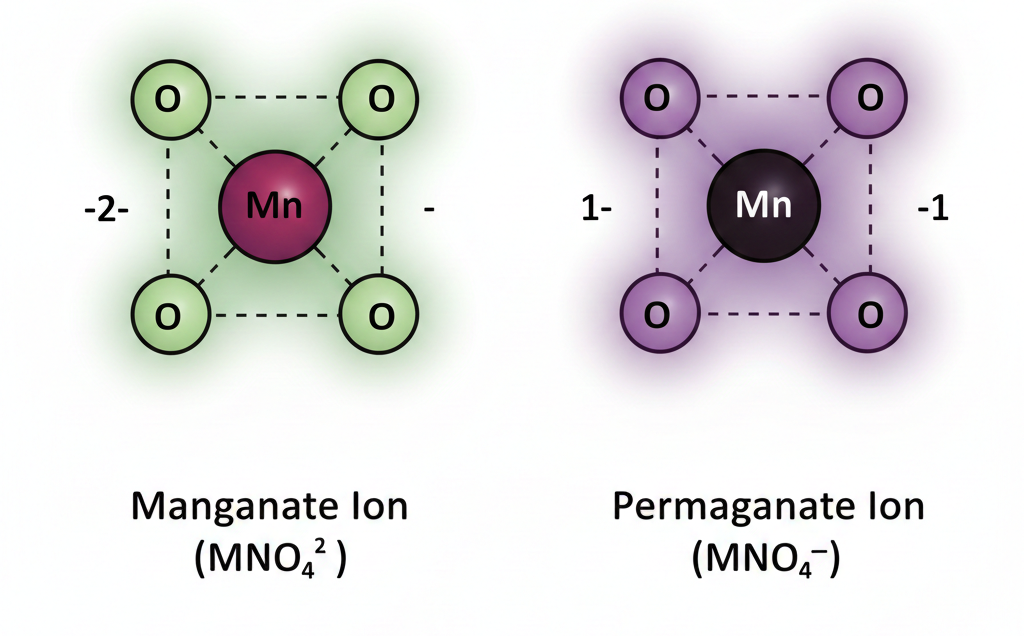
The $\text{MnO}_{4}^{2-}$ ion (Manganate ion) is dark green and interestingly, it is paramagnetic because it has one unpaired electron. Commercially, they complete the prep using electrolytic oxidation of this green manganate ion. Alternatively, the green manganate ion can undergo disproportionation in neutral or acidic solution to yield the required permanganate.
And that's cool, right? Now you have the $\text{MnO}_{4}^{-}$ ion (Permanganate ion), which forms those famous dark purple (almost black) crystals. Crucially, the purple permanganate ion is diamagnetic because it has no unpaired electrons. Both ions are tetrahedral.
Figure below:
A clear diagram showing the tetrahedral structure of the green manganate ion ($\text{MnO}{4}^{2-}$) and the purple permanganate ion ($\text{MnO}{4}^{-}$).
NEET Checkpoint:
Which species is paramagnetic: $\text{MnO}{4}^{-}$ or $\text{MnO}{4}^{2-}$?
(a) $\text{MnO}{4}^{-}$
(b) $\text{MnO}{4}^{2-}$
(c) Both $\text{MnO}{4}^{-}$ and $\text{MnO}{4}^{2-}$
(d) Neither $\text{MnO}{4}^{-}$ nor $\text{MnO}{4}^{2-}$
✅ Answer: (b) $\text{MnO}_{4}^{2-}$ — The manganate ion has one unpaired electron, making it green and paramagnetic, while the permanganate ion is diamagnetic.
Oxidising Action (The Real Funda)
$KMnO_{4}$ is a very strong oxidising agent. Think of it like a strict exam invigilator (acidified $\text{KMnO}_{4}$) that forces everyone to level up!
In acid solutions, the reduction potential is very high ($\text{E}^{\circ} = +1.52\text{ V}$ for $\text{MnO}_{4}^{-} \rightarrow \text{Mn}^{2+}$). It converts iron(II) ($\text{Fe}^{2+}$) to iron(III) ($\text{Fe}^{3+}$) (Green to Yellow). Similarly, it oxidises oxalates to carbon dioxide ($\text{CO}_{2}$) (often used when titrating in lab practicals at $333\text{ K}$).
NEET Checkpoint:
In acidic medium, $\text{KMnO}_{4}$ oxidises $\text{Fe}^{2+}$ ions to which product?
(a) $\text{Fe}^{0}$
(b) $\text{Fe}^{3+}$
(c) $\text{Fe}^{4+}$
(d) $\text{Mn}^{2+}$
✅ Answer: (b) $\text{Fe}^{3+}$ — The reaction is $5\text{Fe}^{2+} + \text{MnO}{4}^{-} + 8\text{H}^{+} \rightarrow \text{Mn}^{2+} + 4\text{H}{2}\text{O} + 5\text{Fe}^{3+}$.
In neutral or faintly alkaline solutions, its reduction product changes (usually to $\text{MnO}_{2}$). Here, it oxidises iodide ($\text{I}^{-}$) to iodate ($\text{IO}_{3}^{-}$) and converts manganous salts ($\text{Mn}^{2+}$) to $\text{MnO}_{2}$.
Relatable Example: Imagine $\text{KMnO}{4}$ as a traffic cop. When the street is acidic (high $\text{H}^{+}$), the cop is super effective and reduces down to a small, soluble $\text{Mn}^{2+}$ car. When the street is neutral/alkaline (low $\text{H}^{+}$), the cop only reduces slightly to the solid $\text{MnO}{2}$ barrier.
NEET Checkpoint:
What is the product when iodide is oxidised by $\text{MnO}_{4}^{-}$ in neutral solution?
(a) $\text{I}_2$
(b) $\text{IO}_3^{-}$
(c) $\text{I}^-$
(d) $\text{IO}_4^{-}$
✅ Answer: (b) Iodate ($\text{IO}_{3}^{-}$) — Note the oxidation state increases significantly here.
Finally, $KMnO_{4}$ is heavily used in analytical and preparative organic chemistry as a strong oxidant. Its strong oxidising power is also leveraged for bleaching wool, cotton, silk, and for decolourisation of oils.
Practice Questions:
1.Which of the following equations correctly represents the preparation of Manganate ion ($\text{MnO}{4}^{2-}$) from Pyrolusite ore ($\text{MnO}{2}$?
(a) $\text{2MnO}{4}^{-} + 3\text{Mn}^{2+} + 2\text{H}{2}\text{O} \rightarrow 5\text{MnO}{2} + 4\text{H}^{+}$
(b) $\text{3MnO}{4}^{2-} + 4\text{H}^{+} \rightarrow \text{2MnO}{4}^{-} + \text{MnO}{2} + 2\text{H}{2}\text{O}$
$(c)$${2} + 4\text{KOH} + \text{O}{2} \rightarrow 2\text{K}{2}\text{MnO}{4} + 2\text{H}{2}\text{O}$
(d) $\text{MnO}{4}^{-} + 8\text{H}^{+} + 5\text{e}^{-} \rightarrow \text{Mn}^{2+} + 4\text{H}{2}\text{O}$
✅ Answer: (c) $\text{2MnO}{2} + 4\text{KOH} + \text{O}{2} \rightarrow 2\text{K}{2}\text{MnO}{4} + 2\text{H}{2}\text{O}$ — This is the initial fusion step producing $\text{K}{2}\text{MnO}_{4}$. Option (b) shows disproportionation, and (d) shows acidic reduction.
Key Takeaway
Potassium Permanganate ($KMnO_{4}$) is prepared via fusion ($\text{MnO}{2} \rightarrow \text{MnO}{4}^{2-}$) followed by disproportionation or electrolytic oxidation ($\text{MnO}{4}^{2-} \rightarrow \text{MnO}{4}^{-}$). It is a strong oxidant: reducing to $\text{Mn}^{2+}$ in acid (oxidises $\text{Fe}^{2+}$ and $\text{C}{2}\text{O}{4}^{2-}$) and reducing to $\text{MnO}{2}$ in neutral/alkaline solutions (oxidises $\text{I}^{-}$ to $\text{IO}{3}^{-}$.
14. Lanthanoids: Configurations, Contraction, and Oxidation States
Ready to tackle the Lanthanoids? These fourteen elements, running from Cerium ($Ce$) to Lutetium ($Lu$), constitute the $4f$ inner transition series. They resemble each other much more closely than the members of ordinary transition series.
Configurations and Oxidation States
The main funda here is the filling of the inner $4f$ subshell. The atoms typically have an electronic configuration featuring $6s^2$ occupancy, alongside variable occupancy of the $4f$ level (see Table 4.9). When they form ions, the most stable state is the tripositive ion ($Ln^{3+}$). The electronic configuration for these stable $Ln^{3+}$ ions is straightforward: $4f^n$, where $n$ ranges from $1$ to $14$ as the atomic number increases.
The principal oxidation state for Lanthanoids is a reliable $+3$. But occasionally, $+2$ and $+4$ states pop up. These irregular states arise mainly from the extra stability gained by achieving an empty ($f^0$), half-filled ($f^7$), or filled ($f^{14}$) $f$ subshell. For example, Cerium ($Ce^{4+}$) is favored because it achieves the stable $f^0$ configuration, mimicking a noble gas structure. Similarly, Europium ($Eu^{2+}$) loves the $f^7$ half-filled stability, and Ytterbium ($Yb^{2+}$) benefits from the $f^{14}$ filled shell.
NEET Checkpoint:
The electronic configuration of the most stable ion of Lanthanoids is generally:
(a) $5d^1$
(b) $4f^n$
(c) $6s^2$
(d) $4f^{14}5d^1$
✅ Answer: (b) $4f^n$ — The tripositive ion ($Ln^{3+}$) configuration is typically $4f^n$, where $n=1$ to $14$.
Lanthanoid Contraction
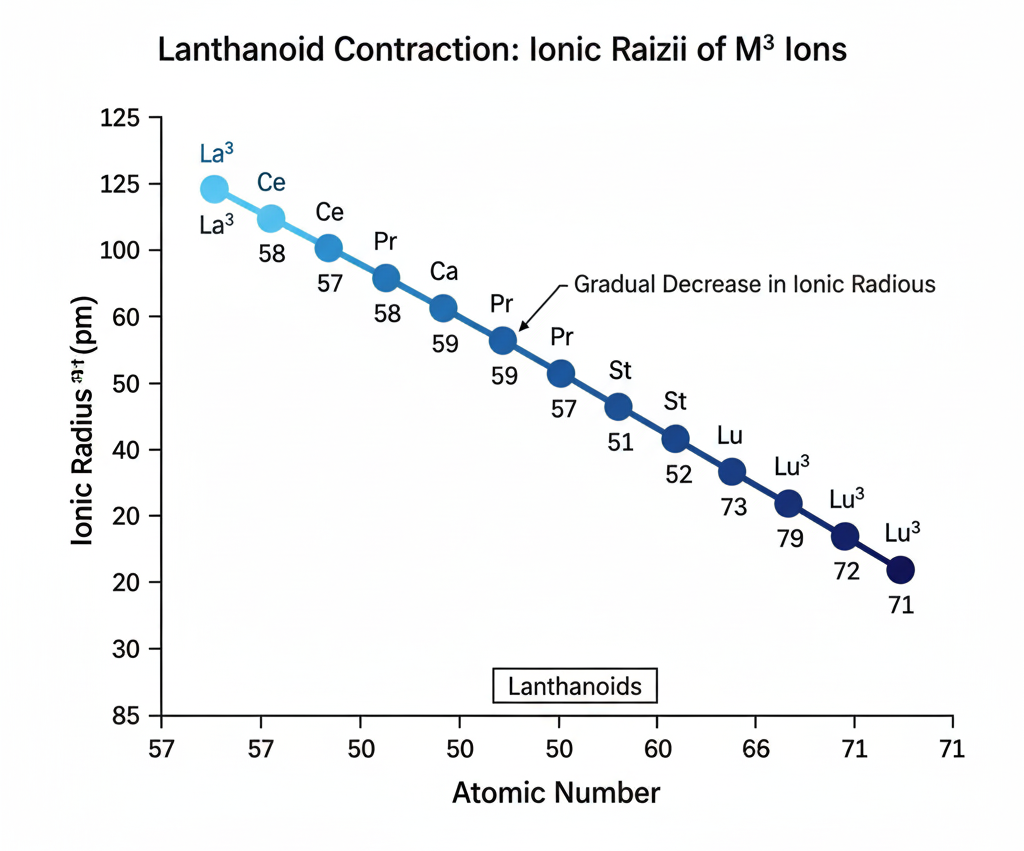
Now, for the big concept: Lanthanoid Contraction. This is the overall decrease in atomic and ionic radii (specifically $Ln^{3+}$) observed as you move from Lanthanum to Lutetium. Why does this happen? The $4f$ electrons provide imperfect shielding of the increasing nuclear charge along the series. The shielding of one $4f$ electron by another is less effective than that of a $d$ electron.
Invented Example: Imagine you are studying for NEET with a powerful headlight (the increasing nuclear charge). If you try to shield the light using flimsy paper ($4f$ electrons), the light still shines through, pulling your attention (shrinking the atomic radius)!
This cumulative shrinking effect has far-reaching consequences. The most significant result is that the radii of the third $d$-series elements become virtually the same as the corresponding elements in the second series, like Zirconium ($Zr$, $160\ pm$) and Hafnium ($Hf$, $159\ pm$). This similarity explains why they are so hard to separate.
NEET Checkpoint:
$Eu^{2+}$ is stable due to which configuration?
(a) $f^{0}$
(b) $f^{7}$
(c) $f^{14}$
(d) $f^{6}$
✅ Answer: (b) $f^{7}$ — $Eu^{2+}$ is favored by the extra stability of the half-filled $f^7$ subshell.
Figure below:
A clear diagram showing the gradual decrease in ionic radii ($M^{3+}$) from $La^{3+}$ to $Lu^{3+}$ against increasing atomic number, illustrating the Lanthanoid Contraction.
NEET Checkpoint:
Which pair of oxidation states is commonly exhibited only occasionally by Lanthanoids?
(a) +1 and +2
(b) +2 and +4
(c) +1 and +3
(d) +3 and +5
✅ Answer: (b) +2 and +4 — While +3 is predominant, +2 and +4 occur occasionally, generally stabilised by $f^0$, $f^7$, or $f^{14}$ configurations.
Practice Question:
Which of the following Lanthanoid ions is a strong reducing agent?
(a) $Ce^{4+}$
(b) $Tb^{4+}$
(c) $Lu^{3+}$
(d) $Eu^{2+}$
✅ Answer: (d) $Eu^{2+}$ — $Eu^{2+}$ has the stable $f^7$ configuration, but it acts as a strong reducing agent because it readily loses an electron to revert to the more common and principal $+3$ state ($Eu^{3+}$).
Key Takeaway
| Concept | Description | Stability Drivers |
|---|---|---|
| Series | $4f$ inner transition (Ce to Lu). | |
| Principal O.S. | $+3$. | |
| Lanthanoid Contraction | Overall decrease in atomic/ionic radii from La to Lu, due to imperfect shielding of $4f$ electrons. | |
| Occasional O.S. | $+2$ or $+4$. | $f^{0}$ (e.g., $Ce^{4+}$), $f^{7}$ (e.g., $Eu^{2+}$, $Tb^{IV}$), or $f^{14}$ (e.g., $Yb^{2+}$) stability. |
15. Actinoids: Configurations, Oxidation States, and Comparison
Let's clear up the funda of the Actinoids—the famous $5f$ inner transition series. These elements run from Thorium (Th) to Lawrencium (Lr), making up the second row placed separately at the bottom of the periodic table.
Configurations and Oxidation States: Why so dramatic?
All actinoids are radioactive, which makes studying them super tricky, especially since the later members have half-lives as short as three minutes for Lr ($Z=103$). They are believed to share a basic electronic configuration of $7s^{2}$, with variable filling of the $5f$ and $6d$ subshells.
Here's the trick: Actinoids show a much greater range of oxidation states compared to lanthanoids. Why? Because the energy levels of the $\mathbf{5f}$, $\mathbf{6d}$, and $\mathbf{7s}$ orbitals are comparable.
Imagine three auto-rickshaws lined up, all carrying the same luggage load (energy). Since all three ($5f$, $6d$, $7s$) are equally easy to push (remove electrons), you get varied chemical behavior! The most common oxidation state is +3. However, the early members really push the limits: Th shows $\mathbf{+4}$, Pa shows up to $\mathbf{+5}$, U up to $\mathbf{+6}$, and Np even reaches $\mathbf{+7}$ .
NEET Checkpoint:
Which set of orbitals accounts for the wide range of oxidation states in Actinoids?
(a) $4d, 5s, 5p$
(b) $5f, 6d, 7s$
(c) $4f, 5d, 6s$
(d) $3d, 4s$
✅ Answer: (b) $5f, 6d, 7s$ — Because these three energy levels are of comparable energies, all their electrons can participate in bonding.
Actinoid Contraction: Size Matters
Just like lanthanoids, actinoids experience a gradual decrease in size (atomic or $M^{3+}$ ions) across the series. This is called Actinoid Contraction.
Notice this: The actinoid contraction is greater from element to element than the lanthanoid contraction. This bigger drop in size is due to the poorer shielding ability of the $5f$ electrons. Since the $5f$ orbitals are not as "buried" as the $4f$ orbitals, they are more influenced by their surroundings and their electrons are less firmly held. Also, be warned, they are highly reactive metals, especially when finely divided.
NEET Checkpoint:
What is the primary cause of the Actinoid Contraction being greater than the Lanthanoid Contraction?
(a) Higher nuclear charge
(b) Better shielding by $5f$ electrons
(c) Poorer shielding by $5f$ electrons
(d) Absence of $6d$ electrons
✅ Answer: (c) Poorer shielding by $5f$ electrons — The $5f$ electrons are terrible at shielding the outermost electrons from the increasing nuclear charge, causing a greater size reduction.
Practice Questions:
- Which actinoid frequently exhibits the highest oxidation state of +7?
(a) Thorium (Th)
(b) Plutonium (Pu)
(c) Neptunium (Np)
(d) Uranium (U)
✅ Answer: (c) Neptunium (Np) — Np, along with Pa and U, exhibits high oxidation states, but Np specifically reaches +7 .
2. What is the most common and stable oxidation state found across the entire actinoid series?
(a) +2
(b) +3
(c) +4
(d) +5
✅ Answer: (b) +3 — In general, actinoids resemble lanthanoids by stabilizing the +3 oxidation state in their compounds.
NEET Checkpoint:
True or False: All actinoid elements have relatively long half-lives, making their study simpler.
(a) True
(b) False
✅ Answer: (b) False — The later members of the series have very short half-lives, sometimes down to 3 minutes, making their study complex.
Key Takeaway
Actinoids (Th to Lr) are the $\mathbf{5f}$ series. Their huge range of oxidation states (up to $\mathbf{+7}$) is due to the comparable energies of the $\mathbf{5f}$, $\mathbf{6d}$, and $\mathbf{7s}$ orbitals. They show a greater size decrease (Actinoid Contraction) because $\mathbf{5f}$ electrons provide $\mathbf{poor}$ shielding. All are radioactive.