
1. Introduction to Organic Chemistry: Scope and Fundamentals
Hey future NEET doctors! Welcome to the fundamental unit of Organic Chemistry. Don't stress, yaar, this is where we learn the basics that make all those complex molecules make sense! Organic compounds are essential for life, appearing everywhere from DNA to medicines.
First up: Carbon's Superpower. Carbon is tetravalent, forming four bonds explained by its electronic configuration and hybridisation. Remember the main shapes based on hybridisation: $sp^3$ hybridisation gives a tetrahedral shape (like methane, $CH_4$), $sp^2$ gives a trigonal planar shape (like ethene, $C_2H_4$), and $sp$ gives a linear shape (like ethyne, $C_2H_2$). Notice this: the greater the $s$ character in the hybrid orbital, the greater the electronegativity of that carbon atom.
We manage millions of these compounds using the systematic IUPAC nomenclature system, which correlates the name with the structure. But keep an eye out for trivial or common names too. Knowing the parent chain and the functional group (like the hydroxyl group, $-\text{OH}$, or aldehyde group, $-\text{CHO}$) is crucial for naming.
NEET Checkpoint:
What is the geometry of a carbon atom in $C_2H_4$?
(a) Linear
(b) Tetrahedral
(c) Trigonal planar
(d) Pyramidal
✅ Answer: (c) Trigonal planar — Bhai, $C_2H_4$ is ethene, which uses $sp^2$ hybridised carbons resulting in a trigonal planar shape.
Now, for reactions: these start with a substrate (the organic molecule) and an attacking reagent. The crucial step is bond fission, which can be: (i) Homolytic cleavage (forming neutral free radicals with an unpaired electron, shown by 'fish-hook' arrows) or (ii) Heterolytic cleavage (forming positively charged carbocations or negatively charged carbanions). The stability of these intermediates follows specific rules, like $\dot{C}H_{3} < \dot{C}H_{2}CH_{3} < (CH_{3}){2}\dot{C}H < (CH{3})_{3}\dot{C}$ for free radicals.
Electronic effects fundamentally drive reactivity. These include permanent effects like the Inductive effect (polarisation of $\sigma$-bonds due to electronegativity difference) and Resonance, as well as the temporary Electromeric effect (transfer of $\pi$-electrons on reagent demand). The major reaction types you'll recognise are Substitution, Addition, Elimination, and Rearrangement.
Relatable Indian Example: Understanding isomerism is like checking out similar-looking cricket players who have the same kit number (molecular formula) but play different positions on the field (different structure/properties). We have Structural Isomers (different atom linkage) and Stereoisomers (different spatial arrangement).
We must also purify and analyse compounds. Purification techniques, based on physical property differences, include Crystallisation (solubility) and Distillation (boiling points). Quantitative analysis methods, such as Dumas or Kjeldahl's for Nitrogen, determine the elemental percentage composition required for molecular formula calculation.
NEET Checkpoint:
Which type of bond cleavage forms free radicals?
(a) Heterolytic
(b) Ionic
(c) Homolytic
(d) Polar
✅ Answer: (c) Homolytic — Homolytic cleavage results in neutral species containing an unpaired electron, known as free radicals.
Practice Questions :
1. What are reagents that seek electron pairs called?
(a) Nucleophiles
(b) Electrophiles
(c) Carbanions
(d) Free radicals
✅ Answer: (b) Electrophiles — An electrophile ($\text{E}^+$) is an electron-seeking reagent that takes away an electron pair from a reactive site, often attacking an electron-rich centre.
2. Which structural isomerism arises due to different alkyl chains attached to either side of a functional group in a molecule?
(a) Chain isomerism
(b) Position isomerism
(c) Functional group isomerism
(d) Metamerism
✅ Answer: (d) Metamerism — Metamerism arises specifically because of different alkyl chains on either side of the functional group (e.g., in ethers or ketones).
Key Takeaway
Organic Chemistry fundamentals rely on carbon's $sp, sp^2, sp^3$ hybridisation determining shape, the systematic IUPAC rules for naming, and understanding bond fission (homolytic $\rightarrow$ free radicals; heterolytic $\rightarrow$ carbocations/carbanions) and electronic effects (Inductive, Resonance, Electromeric) to predict reactivity.
2. Tetravalency of Carbon and Hybridisation: Why Carbon is the King!
Hey future doctors! Let's clear up the funda behind the ultimate multi-tasker of chemistry: Carbon. Why is it so special? It’s all down to a unique superpower called catenation. Carbon loves forming covalent bonds with other carbon atoms. Even better, it plays well with others, forming strong covalent bonds with buddies like hydrogen ($H$), oxygen ($O$), nitrogen ($N$), sulphur ($S$), phosphorus ($P$), and halogens.
Now, for the big query: why is carbon tetravalent (forming four bonds)? This property is explained perfectly by carbon’s electronic configuration and the essential process of hybridisation of $s$ and $p$ orbitals.
Hybridisation is what dictates the shapes of our simplest organic compounds:
- Methane ($CH_{4}$) uses $sp^{3}$ hybrid orbitals, resulting in a stable tetrahedral shape.
- Ethene ($C_{2}H_{4}$) uses $sp^{2}$ hybrid orbitals, giving it a planar structure.
- Ethyne ($C_{2}H_{2}$) uses $sp$ hybrid orbitals, resulting in a linear molecule.
NEET Checkpoint:
The formation and shape of $C_{2}H_{4}$ are explained by which hybrid orbitals?
(a) $sp^{3}$
(b) $sp$
(c) $sp^{2}$
(d) $s$ and $p$ only
✅ Answer: (c) $sp^{2}$ — Ethene ($C_{2}H_{4}$) molecules utilize $sp^{2}$ hybrid orbitals.
Hybridisation also influences major properties like bond length and bond enthalpy (strength). Here’s the trick: it all depends on the $s$ character!
The greater the $s$ character in the hybrid orbital, the closer the bond is to the nucleus, making it shorter and stronger. A carbon atom with an $sp$ hybrid orbital has 50% $s$ character, making it form shorter and stronger bonds compared to $sp^{3}$. The $sp^{2}$ orbital is, naturally, intermediate in $s$ character, bond length, and enthalpy.
NEET Checkpoint
What is the trend for the electronegativity of carbon in its hybridised states?
(a) $sp^{3} > sp^{2} > sp$
(b) $sp > sp^{2} > sp^{3}$
(c) $sp^{3} = sp^{2} = sp$
✅ Answer: (b) $sp > sp^{2} > sp^{3}$ — Greater $s$ character means greater electronegativity, so $sp$ (50% s character) is the most electronegative.
Think of it like choosing a cricket bat grip! A tighter, shorter grip (high $s$ character like $sp$) gives you precise control and power (stronger bond). A looser, longer grip ($sp^{3}$) might be less strong and have a longer reach (longer bond length). The change in hybridisation directly affects the electronegativity of carbon.
NEET Checkpoint
The $sp^{3}$ hybrid orbital has how much $s$ character?
(a) 50%
(b) 33.3%
(c) 25%
(d) 75%
✅ Answer: (c) 25% — In $sp^{3}$ (one $s$ and three $p$), the $s$ orbital contributes one-fourth, or 25% (This is derived from the composition $1/(1+3)$ but is consistent with the discussion contrasting $sp$ and $sp^{3}$ character).
Practice Question:
Which of the following statements regarding hybridisation effects is correct?
(a) $sp^{2}$ bonds are stronger than $sp$ bonds.
(b) Hybridisation affects only the shape, not the bond length.
(c) $sp^{3}$ hybrid orbitals are less electronegative than $sp$ hybrid orbitals.
(d) Carbon in Methane is $sp^{2}$ hybridised.
✅ Explanation: The correct answer is (c). Hybridisation affects electronegativity, and the $sp^{3}$ orbital has the least $s$ character, making it less electronegative than $sp$. Options (a) and (b) contradict the fact that $sp$ forms stronger bonds and that hybridisation influences bond length. Option (d) is incorrect as Methane ($CH_{4}$) is $sp^{3}$ hybridised.
Key Takeaway
Carbon's tetravalency and the shapes of molecules ($CH_{4}$ tetrahedral, $C_{2}H_{4}$ planar, $C_{2}H_{2}$ linear) are determined by $sp^{3}$, $sp^{2}$, and $sp$ hybridisation, respectively. Greater $s$ character ($sp > sp^{2} > sp^{3}$) leads to shorter, stronger bonds and higher carbon electronegativity.
3. Understanding Sigma ($\sigma$) and Pi ($\pi$) Bonds
Hey future docs! Let's clear up the funda on sigma ($\sigma$) and pi ($\pi$) bonds. These two are the foundation of organic chemistry, so pay attention, yaar!
The sigma ($\sigma$) bond is your strong backbone. It's formed by the head-on overlap of orbitals. For example, a carbon-carbon $\sigma$ bond often results from the overlap of an $sp^{2}$ hybrid orbital from one carbon with an $sp^{2}$ hybrid orbital from an adjacent carbon. You can also get $\sigma$ bonds from the overlap of an $sp^{3}$ hybrid orbital with a $1s$ orbital (like in a $C-H$ bond).
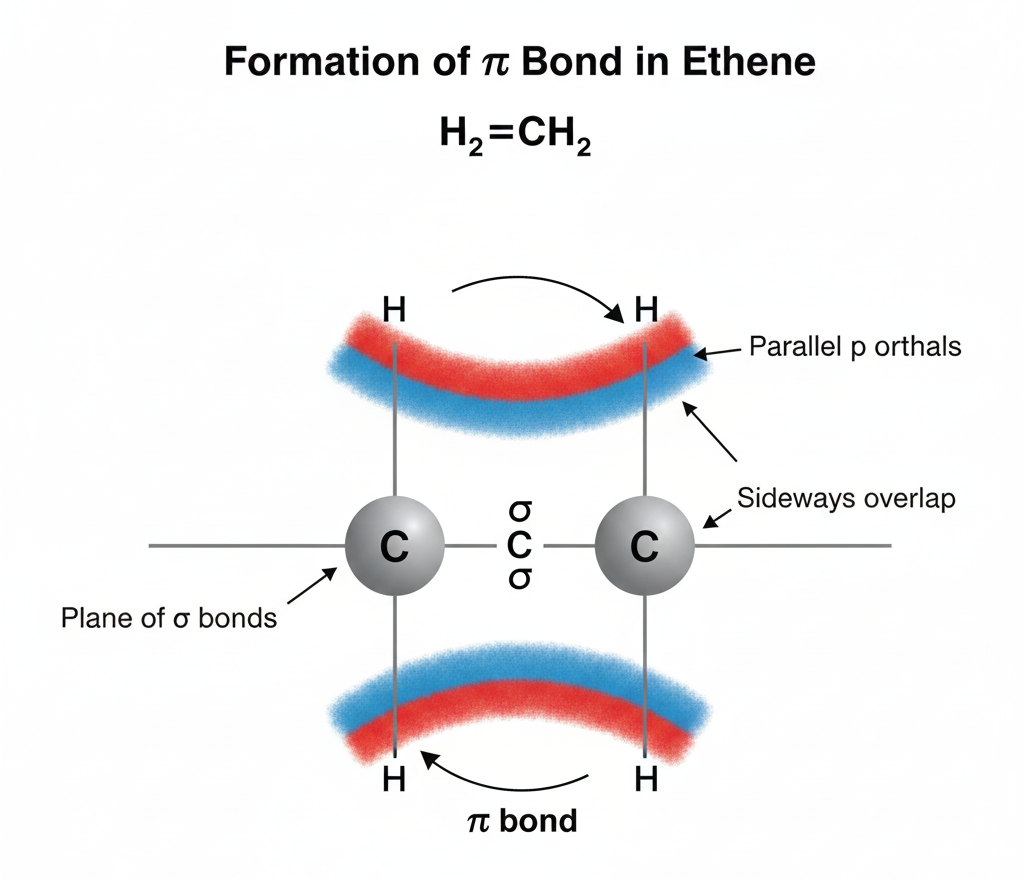
Now, the cooler, but more vulnerable, sibling: the pi ($\pi$) bond. For $\pi$ bonds, you need a parallel orientation of the two $p$ orbitals on adjacent atoms. These $p$ orbitals execute a sideways overlap to form the bond. Notice this: because of this requirement, in a molecule like ethene ($H_{2}C=CH_{2}$), all the atoms must lie in the same plane, and the $p$ orbitals stand perpendicular to that plane.
This geometric requirement is super important! The rotation about a carbon-carbon double bond ($C=C$) is restricted. Why? Because rotating one $CH_{2}$ fragment interferes with the maximum, parallel overlap of those $p$ orbitals. Imagine trying to open a door when it’s also nailed to the wall—that nail (the $\pi$ bond) restricts movement!
The electron charge cloud of the $\pi$ bond is located above and below the plane of the bonding atoms. And that's cool, right? This results in the electrons being easily available to attacking reagents. Hence, $\pi$ bonds provide the most reactive centres in molecules containing multiple bonds.
Figure below:
A clear diagram showing the formation of the $\pi$ bond in ethene ($H_{2}C=CH_{2}$), illustrating the parallel sideways overlap of two $p$ orbitals, located above and below the plane of the $\sigma$ bonds.
NEET Checkpoint:
Which type of orbital overlap results in $\pi$ bond formation?
(a) Head-on axial
(b) Sideways parallel
(c) $s-s$ overlap
(d) $sp^{3}-sp^{3}$ overlap.
✅ Answer: (b) Sideways parallel — Arre! $\pi$ bonds specifically require the parallel orientation of two $p$ orbitals for sideways overlap.
Relatable Indian Example: Think of a scooter going down a narrow street in Delhi. The main frame of the scooter (the $\sigma$ bond) is stable, but the luggage tied high on the carrier (the $\pi$ electron cloud, located "above and below") is easily bumped off (attacked by reagents) because it's exposed and readily available!
NEET Checkpoint:
Rotation around the $C=C$ bond is restricted because:
(a) $sp^2$ orbitals overlap poorly
(b) The overlap of $p$ orbitals is disturbed
(c) The $\sigma$ bond is too strong
(d) The atoms are too small.
✅ Answer: (b) The overlap of $p$ orbitals is disturbed — That rotation interferes with the maximum overlap required for the $\pi$ bond.
NEET Checkpoint:
In a molecule containing multiple bonds, where are the most reactive sites located?
(a) $C-H$ $\sigma$ bonds
(b) $C-C$ $\sigma$ bonds
(c) $\pi$ bonds
(d) $s$ orbitals.
✅ Answer: (c) $\pi$ bonds — Since the electron cloud is easily available to attacking reagents, $\pi$ bonds are the most reactive centres.
Practice Questions:
- Which factor restricts the rotation about the carbon-carbon double bond $(C=C)$?
(a) The electron density of the $\sigma$ bond.
(b) Interference with the maximum overlap of $p$ orbitals.
(c) The planar shape of the molecule.
(d) The polarity induced by hybridisation.
✅ Answer: (b) Interference with the maximum overlap of $p$ orbitals. — Rotation interferes with the required parallel arrangement for optimal $p$ orbital overlap.
2. The location of the $\pi$ bond's electron charge cloud makes it particularly susceptible to:
(a) Homolytic cleavage
(b) Nucleophilic attack
(c) Attacking reagents
(d) Inductive effects
✅ Answer: (c) Attacking reagents. — The electron cloud is exposed (above and below the plane), making electrons easily available to attacking reagents.
Key Takeaway
$\sigma$ bonds are strong (formed by head-on overlap of hybrid orbitals or $s$ orbitals), but $\pi$ bonds (formed by parallel $p$ orbital overlap) restrict rotation in $C=C$ and are the reactive centres because their electron cloud is easily accessible to attacking reagents.
4. Structural Representation of Organic Compounds
Listen up, junior! When we talk about organic chemistry, writing out huge, complex molecules can be a headache, right? That’s why chemists developed a few cool shortcuts, or structural representations, so we can draw molecules clearly and quickly. Mastering these different ways of drawing is the first step to acing organic chemistry, so let's clear up this funda!
We start with the Lewis structure or dot structure, but that’s pretty tedious. We usually simplify this into the complete structural formula (or dash structure). In this representation, every two-electron covalent bond is shown using a dash ($\text{-}$). A single dash is a single bond, a double dash ($\text{=}$) is a double bond, and a triple dash ($\equiv$) is a triple bond. Don't stress, yaar—it’s easier than drawing every single electron!
NEET Checkpoint:
In a complete structural formula, what does $\equiv$ signify?
(a) One electron bond
(b) Triple bond
(c) Ionic interaction
(d) Homolytic cleavage
✅ Answer: (b) Triple bond — It represents three pairs of shared electrons, or a triple two-electron covalent bond.
Condensed and Bond-line Formulas
Now, the complete formula is still too long for big molecules, so we move to the condensed structural formula. Here, we omit some or all of the dashes representing covalent bonds, and we use subscripts to indicate identical groups attached to an atom. For example, the long chain $CH_{3}CH_{2}CH_{2}CH_{2}CH_{2}CH_{2}CH_{2}CH_{3}$ can be neatly condensed to $CH_{3}(CH_{2}){6}CH{3}$.
For even faster notation, organic chemists use bond-line structural formulas. This is the ultimate shortcut! In these formulas, we omit carbon ($C$) and hydrogen ($H$) atoms entirely.
This system is just like looking at a metro map:
1. Lines are drawn in a zig-zag fashion.
2. Terminals (the ends of the lines) denote methyl ($\text{-}CH_{3}$) groups (unless a functional group is shown).
3. Junctions (where lines meet or bend) denote $C$ atoms.
4. We assume the appropriate number of $H$ atoms needed to satisfy the valency of the $C$ atom (which is usually four). The only atoms specifically written are heteroatoms like oxygen ($\text{O}$), nitrogen ($\text{N}$), or chlorine ($\text{Cl}$).
NEET Checkpoint:
If a junction point in a bond-line formula represents a carbon atom connected to two other carbon atoms, how many hydrogen atoms must be present?
(a) One
(b) Two
(c) Three
(d) Zero
✅ Answer: (b) Two — Since Carbon is tetravalent (4 bonds) and two bonds are already shown to other carbons, it must be bonded to $4 - 2 = 2$ hydrogens (a $\text{-CH}_2\text{-}$ group).
Three-Dimensional (3-D) Representation
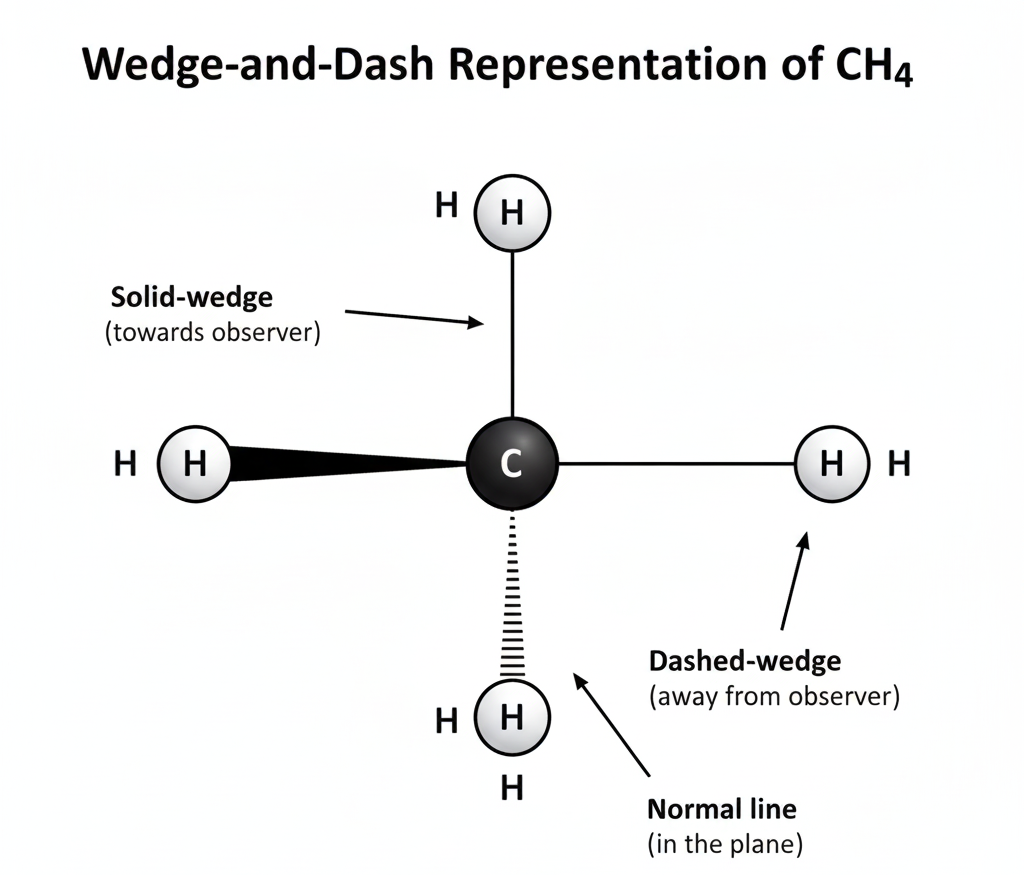
Since molecules aren't flat on paper, we need a way to show their 3-D structure. This is done using the solid ($\blacktriangledown$) and dashed ($\text{----}$) wedge formulas.
- A solid wedge indicates a bond projecting out of the plane of the paper, towards the observer.
- A dashed wedge depicts the bond projecting out of the plane of the paper and away from the observer.
- A normal line ($\text{—}$) shows bonds that are lying in the plane of the paper.
The broad end of the wedge is always facing the observer. This clever technique allows us to perceive the 3-D shape, like the tetrahedral structure of methane ($CH_{4}$).
Figure below:
A clear diagram showing the wedge-and-dash representation of $CH_{4}$, illustrating the solid wedge projecting towards the observer, the dashed wedge projecting away, and the normal lines lying in the plane of the paper.
NEET Checkpoint:
Which type of structural formula typically omits showing the $C$ and $H$ atoms?
(a) Complete structural
(b) Condensed structural
(c) Lewis structure
(d) Bond-line formula
✅ Answer: (d) Bond-line formula — This method uses zig-zag lines as a minimalist representation of the carbon skeleton.
Practice Questions:
- A compound is represented by the condensed formula $CH_{3}(CH_{2}){4}CH(CH{3})_{2}$. How many carbon atoms does the parent chain contain?
(a) 5
(b) 6
(c) 7
(d) 8
✅ Answer: (b) 6 — The longest continuous chain is $CH_{3} \text{-} (CH_{2}){4} \text{-} CH\dots$ which is $1 + 4 + 1 = 6$ carbons. The two $CH{3}${3}$ groups on the $CH$ atom are substituents, making the parent chain hexane (though the full IUPAC name would be 2-methylhexane, the parent chain length is six).
2. In the 3-D representation of an organic molecule, a bond represented by a dashed wedge ($\text{----}$) signifies that the bond:
(a) Is parallel to the plane of the paper.
(b) Is a double bond.
(c) Projects away from the observer.
(d) Projects towards the observer.
✅ Answer: (c) Projects away from the observer — This convention is used to depict the bond receding into the plane of the paper.
Key Takeaway
Complete Structure: Shows all atoms and bonds (single, double, triple dashes).
Condensed Structure: Omits dashes; uses subscripts for identical groups (e.g., $CH_{3}(CH_{2}){n}CH{3}$).
Bond-Line Formula: Omit $C$ and $H$ (zig-zag lines); terminals and junctions represent $C$ atoms.
3-D Formula: Uses solid ($\blacktriangledown$) wedges (towards observer) and dashed ($\text{----}$) wedges (away from observer).
5. Classification by Structural Type: Ring vs. Chain Funda
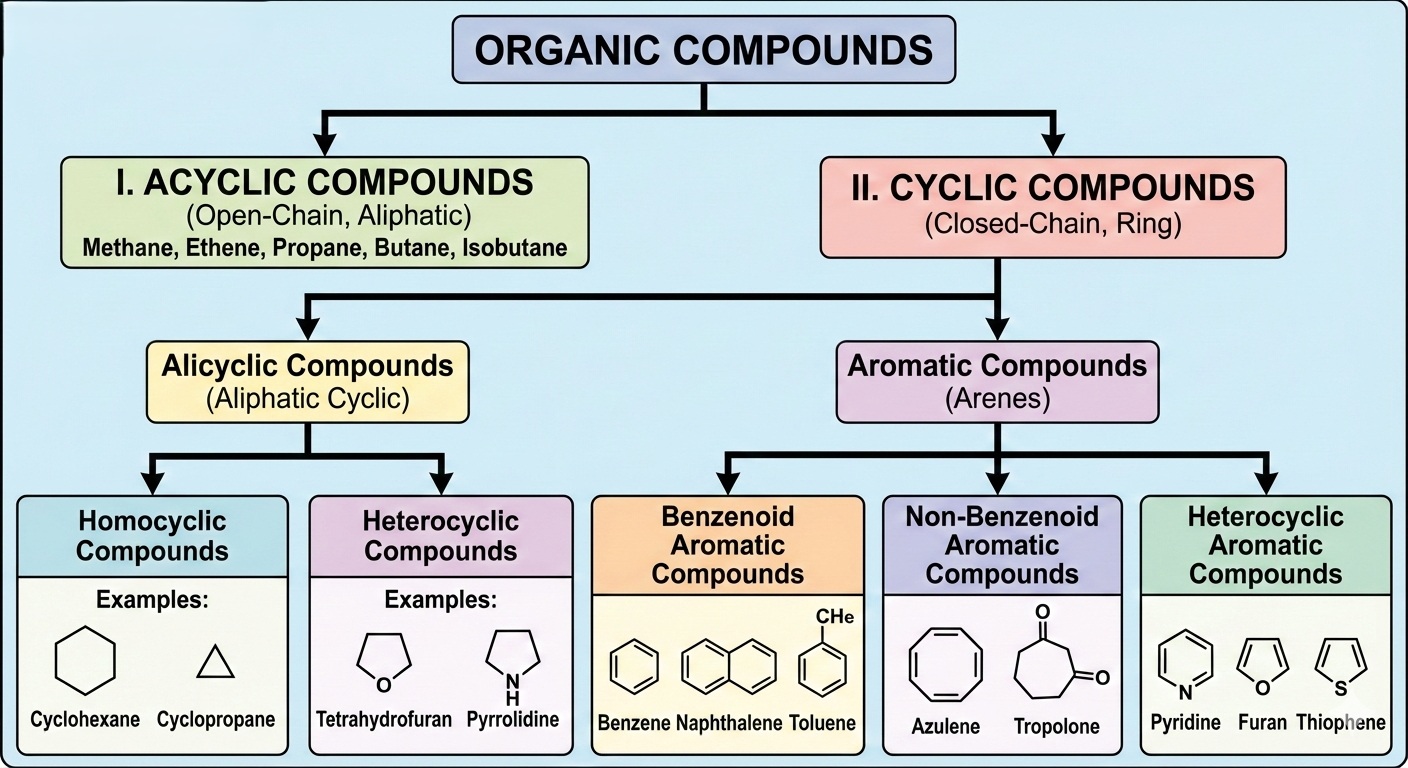
Organic compounds are broadly classified into two main families: Acyclic (Open chain or Aliphatic) compounds (I) and Cyclic (Closed chain or Ring) compounds (II).
The Open Road (Acyclic Compounds)
Acyclic compounds are also known as aliphatic compounds. Think of them as straight or branched roads, having carbon atoms connected in a continuous or spread-out fashion. If it’s a straight chain, like Ethane ($CH_{3}CH_{3}$), it’s simple. If it’s branched, like Isobutane ($CH_{3}$CH($CH_{3}$)$CH_{3}$), it looks like a traffic junction! Notice this: Acyclic compounds can also include functional groups, such as Acetaldehyde or Acetic acid.
Relatable Indian Example: Imagine an express highway from Delhi to Mumbai—that's a straight-chain acyclic compound. Now imagine that highway has service roads and exit ramps branching off everywhere—that’s a branched-chain acyclic compound!
The Roundabout (Cyclic Compounds)
Cyclic compounds, or ring compounds, are where the carbons join up to form a loop. These are further sub-classified, so pay attention, boss!
- Alicyclic Compounds: These are aliphatic cyclic compounds, meaning they contain carbon atoms joined in a ring. They show properties similar to the open-chain aliphatic compounds. Examples include Cyclopropane, Cyclohexane, and Cyclohexene,.
NEET Checkpoint:
Which type of cyclic compound exhibits properties similar to aliphatic compounds?
(a) Aromatic
(b) Heterocyclic Aromatic
(c) Alicyclic
(d) Benzenoid
✅ Answer: (c) Alicyclic — Alicyclic (aliphatic cyclic) compounds share properties with their open-chain aliphatic cousins.
2. Aromatic Compounds: These are special types of ring compounds, like Benzene, Aniline, and Naphthalene (called benzenoid aromatic compounds),. Some aromatic rings don't contain a benzene ring structure, like Tropone, and are called non-benzenoid compounds,.
The Ring Composition: Homocyclic vs. Heterocyclic
Cyclic compounds are also categorized based on what atoms are in the ring structure:
- Homocyclic (or Carbocyclic): The ring contains only carbon atoms. Cyclohexane is a classic example.
- Heterocyclic: If atoms other than carbon—known as heteroatoms (like oxygen, nitrogen, or sulphur)—are present in the ring, they are heterocyclic.
NEET Checkpoint:
Identify the heteroatom in Tetrahydrofuran.
(a) Carbon
(b) Nitrogen
(c) Oxygen
(d) Sulphur
✅ Answer: (c) Oxygen — The source specifies that Tetrahydrofuran is a heterocyclic compound containing an oxygen atom in the ring,.
Tetrahydrofuran, for instance, has oxygen,. Pyridine and Thiophene are examples of Heterocyclic Aromatic compounds containing nitrogen and sulphur, respectively,.
Figure below:
Re-create the comprehensive chart showing the classification hierarchy of Organic Compounds: broad classification into Acyclic (I) and Cyclic (II); Cyclic further dividing into Alicyclic (Homocyclic/Heterocyclic) and Aromatic (Benzenoid/Non-benzenoid/Heterocyclic Aromatic).
NEET Checkpoint:
Which compound is an example of a Homocyclic Alicyclic compound?
(a) Tetrahydrofuran
(b) Pyridine
(c) Cyclopropane
(d) Aniline
✅ Answer: (c) Cyclopropane — Cyclopropane is listed as an Alicyclic compound, and since its ring contains only carbon, it is homocyclic (carbocyclic),.
Practice Question:
Which pair represents an Acyclic compound and a Heterocyclic Aromatic compound, respectively?
(a) Ethane and Cyclohexene
(b) Isobutane and Furan
(c) Cyclopropane and Benzene
(d) Acetic acid and Cyclohexane
✅ Answer: (b) Isobutane and Furan — Isobutane is an acyclic (branched) compound. Furan is a heterocyclic aromatic compound containing oxygen.
Key Takeaway
| Type | Structure | Ring Atoms | Examples |
|---|---|---|---|
| Acyclic | Open Chain (Straight/Branched) | N/A | Ethane, Isobutane |
| Cyclic | Closed Ring | C only (Homocyclic) or C + Heteroatom (Heterocyclic) | Cyclopropane (Homocyclic), Tetrahydrofuran (Heterocyclic), |
6. Classification by Functional Group and Homologous Series
Hey, future doctor! Now that we’ve checked out how carbon chains are drawn (zig-zag style, woohoo!), let's figure out how organic chemistry organizes the millions of compounds out there. Don't stress, yaar—it’s easier than it looks, thanks to two cool concepts: Functional Groups and Homologous Series.
The Favour-Giving Functional Group Funda
Think of a carbon chain as a scooter, and the functional group as the engine. It's the engine that determines what the scooter does (its speed, power, etc.)! Similarly, the functional group is an atom or a group of atoms attached to the carbon chain that is responsible for the characteristic chemical properties of that compound. Even though the carbon chain might be long, the functional group is the site of chemical reactivity.
For example, whether you have a 2-carbon chain or a 10-carbon chain, if it has the hydroxyl group ($\text{-OH}$), it will behave like an alcohol. Other key examples you must remember are the aldehyde group ($\text{-CHO}$) and the carboxylic acid group ($\text{-COOH}$).
NEET Checkpoint:
Which structural element defines the unique chemical characteristics of an organic compound?
(a) The longest carbon chain
(b) The heteroatom
(c) The functional group
(d) The molecular mass
✅ Answer: (c) The functional group — Bhai, it’s the functional group that dictates the reactivity and properties of the compound, regardless of the carbon backbone length.
The Homologous Series Hype
When compounds share the same characteristic functional group, they form a homologous series. Members of this series are called homologues. Now, here is the critical part that NEET loves: successive members in a homologous series differ from each other in molecular formula by a $\text{-CH}_{2}$ unit.
Imagine a team of cricketers, all wearing the same team jersey (the functional group). As you move from the youngest player to the oldest, their weight increases step-by-step. That fixed "step" is like the $\text{-CH}_{2}$ unit difference! Examples of these important series include alkanes, alkenes, alkynes, alkanols, alkanals, alkanones, alkanoic acids, and amines.
NEET Checkpoint:
How do successive members of a homologous series typically differ in molecular formula?
(a) By one hydrogen atom
(b) By one carbon atom
(c) By a $\text{-CH}{2}$ unit
(d) By a $\text{-C}{2}$ unit
✅ Answer: (c) By a -$CH2$ unit — This $CH2$ difference is the core funda of homologues
NEET Checkpoint:
Alkanes, alkanols, and alkanals are all examples of what classification group?
(a) Functional Groups
(b) Homologous Series
(c) Carbocations
(d) Aliphatic compounds
✅ Answer: (b) Homologous Series — These are groups of compounds defined by a shared characteristic functional group (or bond type, like alkanes).
Practice Questions:
- Which one of the following groups is responsible for the characteristic chemical properties of an organic compound?
(a) Phenyl ($\text{C}{6}\text{H}{5}\text{-}$)
(b) Nitro ($\text{-NO}_{2}$)
(c) Alkyl ($\text{-R}$)
(d) Carboxy ($\text{-COOH}$)
✅ Answer: (d) Carboxy ($\text{-COOH}$) — While nitro groups ($\text{-NO}_{2}$) are also substituents, the query specifically lists $\text{-COOH}$ as an example of a functional group responsible for characteristic properties.
2. Which factor alone dictates that compounds belong to the same homologous series?
(a) They must have the same number of carbon atoms.
(b) They must be represented by a general molecular formula and contain a characteristic functional group.
(c) They must all be synthesised from inorganic sources.
(d) They must all contain carbon-carbon triple bonds.
✅ Answer: (b) They must be represented by a general molecular formula and contain a characteristic functional group — A homologous series is defined as a group of organic compounds containing a characteristic functional group and they can be represented by a general molecular formula.
Key Takeaway
Functional Group: The atom or group of atoms that decides the chemical behaviour (e.g., -OH, -CHO).
Homologous Series: A family of compounds with the same functional group where successive members differ by exactly one $CH2$ unit.
7. Nomenclature: Trivial vs. Systematic (IUPAC)
Listen up, future organic chemists! Organic chemistry is massive—we are talking about millions of compounds. Imagine trying to manage that chaos without a good system? That’s why the study of naming, or nomenclature, is crucial for NEET.
Before the brilliant minds at the IUPAC (International Union of Pure and Applied Chemistry) streamlined everything, we relied on trivial or common names. These names are super traditional and often rooted in the compound's origin or some specific property. For example, formic acid is called that because it was originally obtained from red ants, and the Latin word for ant is formica. Don't stress, yaar—some common names are still widely used and are considered indispensable, especially when the systematic names get ridiculously long and complicated, like for Buckminsterfullerene.
NEET Checkpoint:
Citric acid is named based on its source (citrus fruits). This is an example of which type of nomenclature?
(a) Systematic
(b) Trivial
(c) Homologous
(d) Aromatic.
✅ Answer: (b) Trivial — Trivial (Common) names are based on origin or properties.
The real superstar, though, is the IUPAC system. It’s a systematic method where the name of the compound correlates directly with its structure. This means if your friend gives you the IUPAC name, you can literally draw the exact molecule!
To construct a systematic IUPAC name, it’s a three-step process: First, you identify the parent hydrocarbon (the longest carbon chain). Second, you identify the functional group(s) attached to this chain. Third, you tweak the parent name using the appropriate prefixes and suffixes to locate everything perfectly.
Think of naming a molecule like addressing a massive apartment complex in a metro city. The parent hydrocarbon is the main building name. The functional groups are the specific apartment number (the site of chemical action). And the prefixes/suffixes? They are the directions (like 'behind the metro station' or '2nd floor, block B') that ensure zero confusion!
NEET Checkpoint:
A systematic IUPAC name is generally derived by identifying which three components?
(a) Boiling point, density, and mass
(b) Parent hydrocarbon, functional groups, and prefixes/suffixes
(c) Atomic number, mass number, and stability
(d) Alkane, alkene, and alkyne.
✅ Answer: (b) Parent hydrocarbon, functional groups, and prefixes/suffixes — These parts are combined to generate a systematic name that reflects the structure.
NEET Checkpoint: If an organic compound’s systematic name is very lengthy and complex, chemists might use what type of name instead?
(a) IUPAC name
(b) Molecular name
(c) Trivial (Common) name
(d) Structural name
✅ Answer: (c) Trivial or Common Name — They are indispensable in cases where the IUPAC name is too complicated.
Practice Questions:
- The IUPAC system of nomenclature was developed primarily to ensure that names:
(a) Are all based on the compound's origin.
(b) Correlate directly and systematically with the chemical structure.
(c) Sound familiar to traditional trivial names.
(d) Indicate the compound's physical state.
✅ Answer: (b) Correlate directly and systematically with the chemical structure.
2. What is the fundamental difference between the core principle of Trivial names and IUPAC names?
(a) Trivial names define chain length, IUPAC names define molecular weight.
(b) Trivial names are modern, IUPAC names are traditional.
(c) Trivial names are based on origin/property, IUPAC names are correlated directly to structure.
(d) Trivial names require prefixes, IUPAC names require suffixes.
✅ Answer: (c) Trivial names are based on origin/property, IUPAC names are correlated directly to structure.
Key Takeaway
Trivial Names are based on traditional factors like origin or properties (e.g., formic acid from formica). IUPAC Names are systematic and allow you to deduce the exact structure from the name by identifying the parent hydrocarbon, functional groups, and using prefixes/suffixes.
8. IUPAC Nomenclature of Alkanes and Alkyl Groups
Aight, NEET aspirants! Let’s tackle the funda of naming simple hydrocarbons, the alkanes. This is pure scoring material, so pay close attention!
Alkanes are the simplest members of the hydrocarbon family—they are saturated hydrocarbons, meaning they contain only carbon-carbon single bonds. Following the IUPAC system, we name this homologous series using the suffix '-ane'. For straight chain alkanes, we just slap on a prefix indicating the number of carbon atoms, like Pentane (5 carbons) or Hexane (6 carbons).
NEET Checkpoint:
What characteristic feature defines a saturated hydrocarbon?
(a) Presence of double bonds
(b) Only single C-C bonds
(c) Presence of functional groups
✅ Answer: (b) Only single C-C bonds — That's the basic requirement for alkanes, $C(sp^3)$ bonding, yaar!.
Now, how do we handle the little side chains? These small carbon chains are called alkyl groups. An alkyl group is conceptually derived from a saturated hydrocarbon by removing one hydrogen atom from a carbon. To name it, we simply substitute the '-ane' suffix of the parent alkane with '-yl'. For example, $CH_{4}$ (Methane) becomes the $-CH_{3}$ group (Methyl).
When we move to branched chain alkanes, things get slightly complex, but the rules are systematic. First, you MUST identify the longest continuous chain of carbon atoms; this becomes the parent or root chain. This is like finding the longest main road (parent chain) in a complex city map before naming the smaller connecting lanes (alkyl groups).
The next critical step is numbering the carbons of this parent chain. You number the chain in such a way that the substituted alkyl groups (the branches) get the lowest possible numbers. This is famously known as the lowest locant rule. For example, if numbering from the left gives substituents positions 2 and 6, and numbering from the right gives 4 and 8, you must choose 2 and 6.
NEET Checkpoint:
How is the name of an alkyl group derived from its corresponding alkane?
(a) Substituting '-yl' for '-ene'
(b) Substituting '-yl' for '-ane'
(c) Adding '-yl' as a prefix
✅ Answer: (b) Substituting '-yl' for '-ane' — Remember, if it's an alkane, it ends in $-ane$. Lose a $H$ and it becomes an alkyl group ending in $-yl$.
NEET Checkpoint:
If two possible numbering sequences for a parent chain give locant sets (2, 5, 6) and (3, 5, 7), which set is preferred?
(a) (3, 5, 7)
(b) (2, 5, 6)
✅ Answer: (b) (2, 5, 6) — We always choose the set that gives the lowest possible numbers to the substituents (the lowest locant rule).
Finally, the names of these alkyl groups, prefixed with their positional numbers, are put together with the parent alkane name, often in alphabetical order if different groups are present. Don't stress, once you find the longest chain and number it correctly, the rest is just arranging the names!
Practice Question:
Which of the following describes the first mandatory step in naming a branched chain alkane?
(a) Numbering the chain to give the functional group the lowest number.
(b) Identifying all alkyl groups attached to the chain.
(c) Identifying the longest continuous carbon chain (parent chain).
(d) Applying the alphabetical order rule.
✅ Answer: (c) Identifying the longest continuous carbon chain (parent chain). — You must select the longest chain first, or the entire name will be wrong!.
Key Takeaway
| Nomenclature Focussed | Rule |
|---|---|
| Alkanes | Saturated hydrocarbons; suffix is '-ane'. |
| Alkyl Groups | Derived from alkanes by removing $H$; suffix is '-yl'. |
| Branched Naming | Find longest chain (parent); number chain for lowest locants (lowest possible numbers). |
9. IUPAC Nomenclature: Cyclic Alkanes and Functional Groups – The Priority Game!
Let's nail the IUPAC nomenclature for cyclic compounds and functional groups. This funda is super important for NEET, and it’s all about following a strict order of priority, yaar! Think of it like deciding which movie star gets the biggest trailer—only one can be the principal lead!
Cyclic Alkanes: Just Add 'Cyclo'
For saturated monocyclic compounds, the naming is easy-peasy: you just slap the prefix 'cyclo-' onto the name of the corresponding straight chain alkane. So, a six-carbon ring is $\text{cyclohexane}$, just like that!
NEET Checkpoint:
How do you name a saturated four-carbon ring compound?
(a) Tetracarbonane
(b) Cyclobutane
(c) Cyclo-4-ane
(d) Butane-ring
✅ Answer: (b) $\text{Cyclobutane}$ — You use the prefix $\text{'cyclo-'}$ and the name for four carbons, $\text{'butane'}$.
If you have side chains on the ring, you apply the same rules as branched alkanes for numbering. The goal is to give the lowest possible number to the substituents. For example, the name $\text{3-Ethyl-1,1-dimethylcyclohexane}$ is correct because $1,1,3$ is a lower locant set than $1,3,3$ (which would happen if you numbered the methyl groups starting at $3$).
Functional Groups: Who's the Boss?
Now, when functional groups enter the picture, things get serious! The first rule: the longest carbon chain MUST contain the principal functional group. This chain is then numbered to ensure the principal group receives the lowest possible number.
But wait, what if your molecule is a polyfunctional compound (multiple functional groups)? This is where the priority list comes in! You select one group as the principal functional group based on a decreasing order of preference.
For instance, the priority order is: $-\text{COOH} > -\text{SO}_3\text{H} > -\text{COOR} > \dots > -\text{OH} > \dots$. If both a $\text{carboxylic acid}$ ($-\text{COOH}$) and an $\text{alcohol}$ ($-\text{OH}$) are present, the $\text{carboxylic acid}$ wins and determines the suffix of the name (e.g., $\text{-oic acid}$).
Relatable Indian Example: Imagine you have a $100$ $\text{m}$ race (the main chain). The finish line is where the principal functional group is! The runner (numbering) must start so that the principal group gets the best, lowest position number, no matter where the smaller side chains are!
Subordinate Groups and Prefixes
The groups that lose the priority contest (the subordinate functional groups) are named as simple substituents using prefixes.
For example, when the $\text{-OH}$ group is subordinate to a keto group ($>\text{C}=\text{O}$), you use the prefix 'hydroxy-' instead of the suffix $\text{'-ol'}$. Groups like halogens ($\text{F}, \text{Cl}, \text{Br}, \text{I}$), $\text{nitro}$ ($-\text{NO}_2$), and $\text{alkoxy}$ ($-\text{OR}$) are always named as prefix substituents, never suffixes.
A compound containing an alcohol and a keto group is named as a hydroxyalkanone because the keto group is preferred over the hydroxyl group. For example, $\text{HOCH}_2(\text{CH}_2)_3\text{CH}_2\text{COCH}_3$ is named $\text{7-hydroxyheptan-2-one}$.
NEET Checkpoint:
Which group is always treated as a prefix substituent in IUPAC naming?
(a) $-\text{COOH}$
(b) $-\text{OH}$
(c) $-\text{NO}_2$
(d) $>\text{C}=\text{O}$
✅ Answer: (c) $-\text{NO}_2$ — Nitro, halogens, and alkoxy groups are always prefix substituents, irrespective of other functional groups present.
NEET Checkpoint:
In the IUPAC name for $\text{BrCH}_2\text{CH}=\text{CH}_2$, the numbering starts such that the double bond gets the lowest number. What is the correct name?
(a) $\text{1-bromoprop-2-ene}$
(b) $\text{3-bromoprop-1-ene}$
(c) $\text{1-bromo-2-propene}$
✅ Answer: (b) $\text{3-bromoprop-1-ene}$ — The double bond ($\text{C}=\text{C}$) takes preference in numbering over the halogen. Therefore, we start numbering from the right end, making it prop-$\text{1-ene}$.
Practice Question:
Which IUPAC name is correct for the compound $\text{CH}_3\text{CH}_2\text{COCH}_2\text{CO}_2\text{H}$? (Priority: Carboxylic acid > Ketone)
(a) $\text{4-oxohexanoic acid}$
(b) $\text{3-oxohexanoic acid}$
(c) $\text{4-carboxy-2-butanone}$
✅ Answer: (a) $\text{4-oxohexanoic acid}$ — The longest chain must include the $\text{carboxylic acid}$ ($-\text{COOH}$), which is the principal functional group (suffix: $\text{-oic acid}$). The numbering starts at the $\text{COOH}$ carbon, making the keto group ($>\text{C}=\text{O}$) a subordinate 'oxo-' group at $\text{C}-4$.
Key Takeaway
Cyclic Compounds use the 'cyclo-' prefix. Functional Group Nomenclature prioritises the longest chain containing the principal functional group (highest preference). Groups lower in priority (like halogens, $\text{nitro}$ ($-\text{NO}_2$), $\text{alkoxy}$ ($-\text{OR}$)) are named as prefixes.
10. Nomenclature of Substituted Benzene Compounds: When the Ring is the King!
Welcome back! The benzene ring, $\text{C}_6\text{H}_6$, is a superstar in organic chemistry, and naming its derivatives is crucial for NEET. Don't stress, yaar, this funda is mostly about recognizing common names and following the lowest locant rules!
Monosubstitution: Simple Prefix Fun
When only one substituent is attached to the benzene ring (monosubstituted benzenes), we name it by simply placing the substituent as a prefix to the word 'benzene'. For instance, if a $\text{nitro}$ group is attached, it’s $\text{Nitrobenzene}$. If a $\text{bromine}$ atom is attached, it's $\text{Bromobenzene}$. Easy, right?
Here's the trick: Many monosubstituted benzenes have super important common names that are used universally, even in the IUPAC system. You absolutely must remember these! Examples include $\text{Methylbenzene}$ (known as $\text{Toluene}$), $\text{Aminobenzene}$ ($\text{Aniline}$), and $\text{Methoxybenzene}$ ($\text{Anisole}$).
NEET Checkpoint:
What is the IUPAC name for $\text{Toluene}$?
(a) $\text{Phenylmethane}$
(b) $\text{Methylbenzene}$
(c) $\text{Benzene-1-methyl}$
(d) $\text{Carbene}$
✅ Answer: (b) $\text{Methylbenzene}$ — $\text{Toluene}$ is the common name, and $\text{Methylbenzene}$ is its corresponding systematic name.
Disubstitution: Ortho, Meta, Para
When two groups are attached (disubstituted benzenes), we define their positions using numbers ($\text{1,2}$; $\text{1,3}$; $\text{1,4}$). However, the trivial system uses famous prefixes:
- $\text{1,2}$ position is ortho ($\text{o-}$)
- $\text{1,3}$ position is meta ($\text{m-}$)
- $\text{1,4}$ position is para ($\text{p-}$).
So, $\text{1,3-Dibromobenzene}$ is also known as $\text{m-dibromobenzene}$. The number set $(\text{1,3})$ is preferred over $(\text{1,5})$ because we must use the lowest possible numbers (lowest locant rule).
Relatable Indian Example: Think of disubstituted benzene like two friends sitting on a bus (the ring). If they sit side-by-side ($\text{1,2}$), they are ortho. If they have one empty seat between them ($\text{1,3}$), they are meta. If they are sitting exactly opposite ($\text{1,4}$), they are para!
NEET Checkpoint:
If a benzene derivative is named $\text{p-Dichlorobenzene}$, what are the locant numbers for the chlorine atoms?
(a) $\text{1,2}$
(b) $\text{1,3}$
(c) $\text{1,4}$
(d) $\text{1,6}$
✅ Answer: (c) $\text{1,4}$ — The $\text{p-}$ prefix (para) denotes the $\text{1,4}$ substitution pattern.
Tri- or Higher Substitution: The Locant Rule Reigns
For tri- or higher substituted benzenes, you must strictly follow the lowest locant rule.
- If you use a common name as the base (like $\text{Aniline}$ or $\text{Toluene}$), the carbon atom where that base substituent is attached automatically gets position $\text{1}$.
- The numbering direction must be chosen so that the subsequent substituents receive the lowest possible numbers.
- Substituents are then listed in alphabetical order in the final name.
For instance, in $\text{2-Chloro-1-methyl-4-nitrobenzene}$, the $\text{methyl}$ group at $\text{C}-1$ is the base, and the numbering gives the locants $\text{1, 2, 4}$.
When Benzene Becomes Phenyl
Sometimes, the benzene ring loses its 'parent' status and acts as a substituent itself! This happens when the ring is attached to an alkane chain that contains a principal functional group. In this case, the $\text{C}_6\text{H}_5-$ group is named the phenyl group (often abbreviated as $\text{Ph}$).
NEET Checkpoint:
In the compound $\text{2,3-Dibromo-1-phenylpentane}$, which functional group determines the parent chain?
(a) $\text{Benzene}$
(b) $\text{Bromine}$
(c) $\text{The pentane chain}$
✅ Answer: (c) $\text{The pentane chain}$ — The $\text{pentane}$ chain is the parent because the benzene ring is named as a $\text{phenyl}$ substituent, indicating the alkane chain contains the principal functional group.
Practice Question
Which is the correct naming procedure for $\text{1-Chloro-2,4-dinitrobenzene}$?
(a) $\text{The numbering set } (1,2,4) \text{ is correct because } \text{Cl}$ comes before $\text{NO}_2 \text{ alphabetically.}$
(b) $\text{The numbering set } (1,2,4) \text{ is chosen to give the substituents the lowest possible numbers.}$
(c) $\text{The name should be } \text{4-Chloro-1,3-dinitrobenzene}.$
✅ Answer: (b) $\text{The numbering set } (1,2,4) \text{ is chosen to give the substituents the lowest possible numbers.}$ — Even if the alphabetical order is followed for naming, the lowest locant rule is followed first for numbering. $\text{1-Chloro-2,4-dinitrobenzene}$ is preferred over $\text{4-chloro-1,3-dinitrobenzene}$.
Key Takeaway
Monosubstituted benzenes use $\text{prefix} + \text{benzene}$. Disubstituted benzenes use $\text{o-}$, $\text{m-}$, $\text{p-}$ for $\text{1,2}$, $\text{1,3}$, $\text{1,4}$ positions, respectively. For higher substitution, assign $\text{1}$ to the base group (if a common name like $\text{Aniline}$ is used), and always ensure the lowest locant rule is maintained. If the ring is a substituent to an alkane with a functional group, it is called phenyl.
11. Structural and Stereoisomerism: The Identity Crisis of Molecules!
Arre yaar, have you ever seen two friends who look exactly alike but behave totally differently? That’s the basic funda of Isomerism! It’s the phenomenon where compounds share the same molecular formula but have different properties. We classify these molecular doppelgängers into two major categories: Structural and Stereoisomerism.
First up, Structural Isomerism. This happens when compounds have the same formula but differ in the way their atoms are linked—meaning they have different structural arrangements. Imagine having the same set of Lego bricks but building completely different structures!
Structural isomers break down into four types:
- Chain Isomerism: Same formula, but a different carbon skeleton (a branched chain versus a straight chain). For example, $C_{5}H_{12}$ can be Pentane, Isopentane, or Neopentane.
- Position Isomerism: The carbon skeleton stays the same, but the position of a substituent or functional group changes. Notice this: $C_{3}H_{8}O$ can be Propan-1-ol or Propan-2-ol, depending on where the $-\text{OH}$ group sits.
- Functional Group Isomerism: Same formula, but the compounds have different functional groups altogether. Like $C_{3}H_{6}O$ forming Propanal (an aldehyde) or Propanone (a ketone).
- Metamerism: This is specific to compounds where the alkyl chains around a functional group are different. For instance, $C_{4}H_{10}O$ can be methoxypropane or ethoxyethane.
NEET Checkpoint:
Isomerism is defined by having the same molecular formula but differing:
(a) Atomic weights
(b) Physical/Chemical properties
(c) Hybridization
✅ Answer: (b) Physical/Chemical properties — The core difference that defines isomers is their distinct properties, despite sharing a formula.
Let's use a relatable analogy: Imagine two rival cricket teams, both having 11 players (same molecular formula). If Team A rearranges the order of batsmen dramatically compared to Team B, that's like Structural Isomerism—the connectivity (batting order) is fundamentally changed.
Now, shift your focus to Stereoisomerism. This is a special type where compounds have the same constitution (meaning atoms are linked in the exact same sequence) but they differ only in the relative positions of their atoms or groups in space. It's like looking at your left hand versus your right hand—same fingers connected in the same order, but they are mirror images and can’t be superimposed!
NEET Checkpoint:
Compounds with the same constitution but different spatial arrangement are called:
(a) Functional isomers
(b) Stereoisomers
(c) Metamers
✅ Answer: (b) Stereoisomers — Constitution refers to the sequence of covalent bonds; Stereoisomers differ only in 3D space.
Stereoisomerism is further classified into Geometrical and Optical isomerism. You'll see later that Geometrical isomerism often arises from restricted rotation, like around a carbon-carbon double bond ($C=C$).
NEET Checkpoint:
Methoxypropane ($CH_{3}OC_{3}H_{7}$) and ethoxyethane ($C_{2}H_{5}OC_{2}H_{5}$) exemplify which type of structural isomerism?
(a) Position
(b) Chain
(c) Metamerism
✅ Answer: (c) Metamerism — They differ in the nature of alkyl groups on either side of the functional oxygen bridge.
Practice Questions:
- Which of the following describes compounds that possess the same molecular formula but have different functional groups?
(a) Metamers
(b) Functional isomers
(c) Position isomers
(d) Geometrical isomers
✅ Explanation: The existence of compounds with the same molecular formula but distinct functional groups is specifically termed functional group isomerism.
2. If two compounds share the molecular formula $C_{5}H_{12}$ and one is a straight chain while the other is branched, they are related by:
(a) Metamerism
(b) Stereoisomerism
(c) Chain isomerism
(d) Position isomerism
✅ Explanation: Chain isomerism occurs when compounds have the same formula but differ in their carbon skeletons (straight vs. branched).
Key Takeaway
Isomerism is having the same molecular formula but different properties. If the difference is in the connectivity (structure), it's Structural Isomerism (Chain, Position, Functional Group, Metamerism). If the connectivity is identical but the arrangement in 3D space differs, it’s Stereoisomerism (Geometrical, Optical).
12. Covalent Bond Fission and Reactive Intermediates
Every organic reaction involves an organic molecule (the substrate) reacting with an attacking reagent to form one or more intermediates before finally yielding the stable product(s). Think of the intermediate as that awkward, highly energetic stage between batting defense and swinging for a six—it's fast, unstable, and dictates where the ball (reaction) goes next. These intermediates are born when a covalent bond breaks, a process called fission or cleavage.
There are two main ways a covalent bond can break, and this decision completely changes the reactive species formed:
1. Heterolytic Cleavage
this is when the sharing goes wrong! InTheterolytic cleavage, the bond breaks unevenly: the entire shared pair of electrons stays with just one of the fragments. This movement of an electron pair is shown using a standard curved arrow ($\curvearrowright$) notation.
The result is the formation of highly reactive, unstable ions.
- Carbocation: If carbon loses the electron pair, it ends up with a positive charge and only a sextet of electrons in its valence shell. For example, $H_3C\curvearrowright Br \rightarrow \tilde{C}H_3 + \overline{B}r$.
- Carbanion: If carbon gains the electron pair, it ends up with a negative charge and a complete valence octet.
NEET Checkpoint:
What is the electronic structure around the positively charged carbon in a carbocation?
(a) Octet
(b) Duet
(c) Sextet
(d) Decet
✅ Answer: (c) Sextet — Remember, it lost one pair of electrons, so it only has six electrons in its valence shell.
2. Homolytic Cleavage
This is the democratic way! In homolytic cleavage, the shared pair splits equally, with one electron going to each atom. The movement of this single electron is shown using a 'half-headed' curved arrow (fish hook: $\sim$).
This equal splitting results in neutral species called free radicals, which contain an unpaired electron. Just like their ionic cousins, free radicals are also highly reactive and unstable. Reactions involving this fission are often called free radical or nonpolar reactions.
Relatable Indian Example: Imagine splitting a ₹10 note you found on the road (the shared electron pair). If you fight, and one friend snatches the whole note (heterolysis), one becomes positive (richer, carbanion) and the other negative (poorer, carbocation). If you tear it exactly in half (homolysis), each friend gets a neutral, half-note free radical (unpaired electron/torn edge).
The relative stability of both carbocations and free radicals follows the same trend: the more alkyl groups attached to the reactive center, the more stable the intermediate is (Tertiary $>$ Secondary $>$ Primary). For example, the tert-butyl cation, $(\text{CH}_3)_3\dot{C}$, is the most stable carbocation listed.
NEET Checkpoint:
Which type of bond fission results in the formation of neutral species?
(a) Heterolytic cleavage
(b) Ionic cleavage
(c) Polar cleavage
(d) Homolytic cleavage
✅ Answer: (d) Homolytic cleavage — It yields neutral free radicals containing unpaired electrons.
NEET Checkpoint:
Arrange the following carbocations in increasing order of stability: (I) $\dot{C}H_3$ (II) $\text{CH}_3\dot{C}H_2$ (III) $(\text{CH}_3)_2\dot{C}H$
(a) I < II < III
(b) III < II < I
(c) II < I < III
(d) I < III < II
✅ Answer: (a) I < II < III — Methyl cation ($\dot{C}H_3$) is less stable than primary ethyl cation ($\text{CH}_3\dot{C}H_2$), which is less stable than secondary isopropyl cation ($(\text{CH}_3)_2\dot{C}H$).
Practice Questions:
- Homolytic cleavage of a covalent bond produces:
(a) Carbocations with sextet structure
(b) Carbanions with valence octet
(c) Free radicals with unpaired electrons
(d) Ions known as nucleophiles
✅ Answer: (c) Free radicals with unpaired electrons — Homolytic fission results in neutral free radicals.
2. A species having a carbon atom with a sextet of electrons and a positive charge is known as a:
(a) Free radical
(b) Carbanion
(c) Nucleophile
(d) Carbocation
✅ Answer: (d) Carbocation — This is the defining feature of a carbocation resulting from heterolysis.
Key Takeaway
Bond Fission Types: Heterolysis yields unstable ions (Carbocations/Carbanions) involving unequal electron distribution and is shown by curved arrows ($\curvearrowright$). Homolysis yields highly unstable neutral Free Radicals (unpaired electron) via equal splitting, shown by fish hook arrows ($\sim$).
13. Stability, Reagents (Electrophiles/Nucleophiles), and Inductive Effect
Hey champ! Organic chemistry reaction mechanisms are super important, so let’s clear up the funda behind reactive species and how electrons shift around. Don't stress, yaar—it’s easier than it looks!
Stability of Reactive Intermediates
When bonds break, we get unstable intermediates like carbocations ($\text{R}{3}\dot{\text{C}}$) and free radicals ($\text{R}{3}\dot{\text{C}}$). The key stability factor? Alkyl groups! Alkyl groups attached to the charged carbon stabilize these intermediates primarily due to the inductive and hyperconjugation effects.
This stabilization leads to a strict stability order we need to memorize: $\text{Tertiary (3}^{\circ}$) is the most stable, followed by $\text{Secondary (2}^{\circ}$), then $\text{Primary (1}^{\circ}$), and finally Methyl ($\dot{C}H_{3}$), which is the least stable. For carbocations, this order is specifically: $\dot{C}H_{3}{2}\dot{C}H<(CH{3}){3}\dot{C}$. Why is $\dot{C}H{3}$ so weak? Because it lacks hyperconjugative stability.
NEET Checkpoint:
Which effect is primary responsible for stabilizing $(CH_{3})_{3}\dot{C}$?
(a) Electromeric
(b) Resonance
(c) Hyperconjugation
(d) Dipole Moment
✅ Answer: (c) Hyperconjugation — This effect involves the delocalisation of $\sigma$ electrons from $\text{C}-\text{H}$ bonds into the adjacent empty $p$ orbital, significantly stabilizing the charge.
The Reagents: Givers and Takers
Reactions need partners! We classify attacking reagents into two types:
- Nucleophiles ($\text{Nu:}$): These are electron-rich (nucleus-seeking) reagents. They are the givers, donating an electron pair to an electrophilic (electron-deficient) centre. Examples include negatively charged ions like $\text{HO}^{-}$ and neutral molecules with lone pairs like $\text{H}_{2}\dot{\text{O}}$.
- Electrophiles ($\text{E}^{+}$): These are electron-deficient (electron-seeking) reagents. They are the takers, accepting an electron pair from a nucleophilic (electron-rich) centre. Carbocations ($\dot{C}H_{3}$) are classic examples, as they have an incomplete sextet of electrons.
NEET Checkpoint:
Which species acts as an electrophile?
(a) $\text{C}{2}\text{H}{5}\text{O}^{-}$
(b) (CH3)3N:
(c) $\text{BF}_{3}$
(d) $\text{HS}^{-}$
✅ Answer: (c) $\text{BF}_{3}$ — Boron has only six valence electrons, making it electron-deficient and ready to accept an electron pair.
The Inductive Effect ($I$ effect)
The Inductive Effect is a permanent polarization of a $\sigma$-bond caused by the polarization of an adjacent $\sigma$-bond. This happens because of differing electronegativities between bonded atoms (like in $\text{CH}{3}\text{CH}{2}\text{Cl}$).
Here's the trick: This effect is like passing a secret down a line of students—it diminishes rapidly, becoming almost zero after three bonds.
We classify groups based on this effect relative to hydrogen:
* Electron-withdrawing groups ($-\text{I}$ effect): They pull electrons away. Examples include halogens ($\text{X}$), nitro ($-\text{NO}{2}$), and cyano ($-\text{CN}$).
* Electron-donating groups ($+\text{I}$ effect): They push electrons toward the chain. Alkyl groups (like $-\text{CH}{3}$) are generally considered electron-donating.
Relatable Example: Imagine you have a ₹100 debt (the $-\text{Cl}$ atom creating $\delta^-$ charge) attached to Carbon 1 ($\text{C}1^{\delta+}$). $\text{C}1$ pulls electron density (money) from $\text{C}2$ ($\text{C}2^{\delta\delta+}$), which pulls less from $\text{C}3$. The debt pull drastically fades by $\text{C}3$, showing how the $I$ effect rapidly decreases!
NEET Checkpoint:
In the molecule $\text{CH}{3}\text{CH}{2}\text{CH}{2}\text{Br}$, where is the inductive effect expected to be the least?
(a) $\text{C}{1}-\text{Br}$ bond
(b) $\text{C}{1}-\text{C}{2}$ bond
(c) $\text{C}{2}-\text{C}{3}$ bond
(d) $\text{C}_{3}-\text{H}$ bonds
✅ Answer: (c) $\text{C}{2}-\text{C}{3}$ bond — The inductive effect imposed by $\text{Br}$ diminishes with the number of intervening bonds.
Practice Question:
Which of the following compounds has a carbon atom that acts as an electrophilic centre?
(a) $\text{H}{2}\dot{\text{O}}$
(b) $\text{CH}{3}\text{CH}{2}\text{O}^{-}$
(c) $\text{CH}{3}\text{I}$
(d) $(\text{CH}{3}){3}\text{N:}$
✅ Answer: (c) $\text{CH}_{3}\text{I}$ — In alkyl halides, the polarity of the $\text{C}-\text{X}$ bond generates a partial positive charge on the carbon atom, making it an electrophilic centre where a nucleophile can attack. Options (a), (b), and (d) are nucleophiles because they possess lone pairs or negative charge.
Key Takeaway:
Reactive intermediate stability follows the order $3^{\circ} > 2^{\circ} > 1^{\circ} > \text{Methyl}$, driven by hyperconjugation. Nucleophiles are electron-donors ($\text{Nu:}$), and Electrophiles are electron-acceptors ($\text{E}^{+}$). The Inductive Effect ($I$ effect) is a $\sigma$-bond polarization that quickly fades after about three bonds.
14. Resonance, Hyperconjugation, and Reaction Types
Let's conquer the electronic displacement effects that keep organic molecules buzzing and learn how they actually react. This funda is crucial because these tiny electron shifts decide stability and reactivity, which is basically the khela of organic chemistry.
The Resonance or Mesomeric (R/M) Effect
This is a permanent displacement effect, yaar. The Resonance Effect (R/M effect) is the polarity produced in the molecule by the interaction of two $\pi$-bonds or between a $\pi$-bond and lone pair of electrons present on an adjacent atom. This effect is then transmitted throughout the conjugated system (alternate single and double bonds).
We have two types:
- Positive Resonance Effect ($+R$): The transfer of electrons is away from the substituent group attached to the conjugated system. This jacks up electron density at certain positions (e.g., in aniline, $-NH_{2}$ group pushes electrons out).
- Negative Resonance Effect ($-R$): The transfer of electrons is towards the substituent group attached to the conjugated system. This pulls electron density away (e.g., in nitrobenzene, the $-NO_{2}$ group pulls electrons in).
NEET Checkpoint:
Which groups exhibit the $+R$ effect?
(a) $-\text{NO}{2}$ and $-\text{CHO}$
(b) $-\text{OH}$ and $-\text{NH}{2}$
(c) $-\text{COOH}$ and $-\text{CN}$
✅ Answer: (b) $-\text{OH}$ and $-\text{NH}_{2}$ — These groups donate electrons to the system, which is the definition of $+R$ effect.
Imagine a local food truck (the molecule) on a busy street. If the owner (substituent) starts pushing free plates of pani puri (+R effect) out, the crowd (electron density) shifts away from the truck! If he starts pulling cash aggressively (-R effect), the wealth (electron density) concentrates near him.
Electromeric Effect (E effect)
Hold up, this one is a temporary effect. It only happens when an attacking reagent is demanding electrons, like when a friend suddenly asks for a lift! The $\mathbf{E}$ effect is the complete transfer of a shared pair of $\pi$-electrons to one of the atoms joined by a multiple bond on the demand of an attacking reagent. As soon as the reagent is removed, the effect vanishes.
- Positive E Effect ($+E$): The $\pi$-electrons shift to the atom where the reagent gets attached.
- Negative E Effect ($-E$): The $\pi$-electrons shift to the atom where the reagent does not get attached.
Notice this: If the inductive effect and electromeric effect clash, the Electromeric effect wins and predominates.
NEET Checkpoint:
What kind of bonding is required for a molecule to show the Electromeric effect?
(a) Single bonds only
(b) Multiple bonds ($\sigma$ bonds)
(c) Multiple bonds ($\pi$ bonds)
✅ Answer: (c) Multiple bonds ($\pi$ bonds) — This effect involves the temporary, complete transfer of a $\pi$-electron pair.
Hyperconjugation (No Bond Resonance)
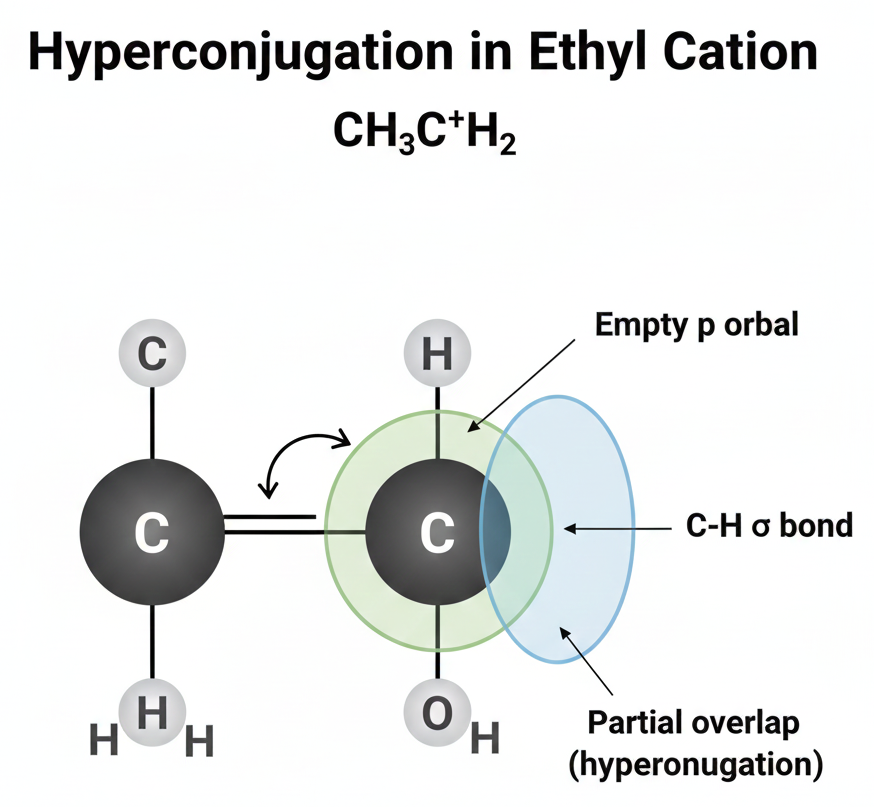
This is another permanent stabilising interaction. It involves the delocalisation of $\sigma$ electrons of the $\text{C-H}$ bond of an alkyl group into an attached unsaturated system or unshared $p$ orbital. Because of this delocalization, it's famously known as no bond resonance.
This effect is why higher-order carbocations are more stable! For instance, a tertiary carbocation ($\dot{C}(CH_{3}){3}$) is stabilized more than a primary one ($\dot{C}H{2}CH_{3}$ because the greater number of alkyl $\text{C-H}$ $\sigma$ bonds provide greater hyperconjugation interaction and charge dispersal.
Figure below:
A clear orbital diagram showing hyperconjugation in an ethyl cation ($CH_{3}\dot{C}H_{2}$), where the $\text{C-H}$ $\sigma$ bond overlaps partially with the adjacent empty $p$ orbital of the positively charged carbon.
Types of Organic Reactions
Finally, remember that the vast universe of organic chemistry usually boils down to just four main types of organic reactions:
- Substitution reactions: One group is swapped for another.
- Addition reactions: Across a multiple bond (like $C=C$), atoms or groups are added.
- Elimination reactions: Two atoms or groups are removed, often forming a multiple bond.
- Rearrangement reactions: Atoms or groups within the molecule shift to form an isomeric product.
NEET Checkpoint:
Which electronic effect is always temporary?
(a) Resonance Effect
(b) Inductive Effect
(c) Electromeric Effect
✅ Answer: (c) Electromeric Effect — The E effect requires the presence of an attacking reagent, making it temporary.
Practice Questions:
1. The primary criterion for an atom or group to exhibit the Positive Resonance ($+R$) effect is that the electron transfer must occur:
(a) Towards the substituent group.
(b) Away from the substituent group.
(c) Only upon demand of an attacking reagent.
(d) Only in saturated hydrocarbons.
✅ Answer: (b) Away from the substituent group. — In the $+R$ effect, electron transfer is away from the substituent, pushing electron density into the rest of the conjugated system.
2. The stability order of carbocations, such as $\dot{C}H_{3} < CH_{3}\dot{C}H_{2} < (CH_{3}){2}\dot{C}H < (CH{3})_{3}\dot{C},$ is primarily explained by which stabilizing electronic effect?
(a) Inductive effect
(b) Electromeric effect
(c) Resonance effect
(d) Hyperconjugation
✅ Answer: (d) Hyperconjugation — Alkyl groups stabilize carbocations via hyperconjugation, and stability increases with the number of $\text{C-H}$ $\sigma$ bonds adjacent to the positive charge (i.e., tertiary is most stable).
Key Takeaway
Permanent Effects: Resonance (R/M) and Hyperconjugation (No bond resonance, $\sigma$-electron delocalisation).
Temporary Effect: Electromeric (E effect, $\pi$-electron transfer on demand).
Reaction Types: Organic reactions fall into four major categories: Substitution, Addition, Elimination, and Rearrangement.
15. The Fission and Fusion of Organic Purity: Techniques for Separation and Estimation
First up, Purification. These methods leverage differences in physical properties. For solids, if your compound is a rockstar that goes straight from solid to vapour (like camphor), you use Sublimation to separate it from non-sublimable impurities. If you're dealing with different solubilities, Crystallisation is your friend; you dissolve the impure compound in a solvent where it’s sparingly soluble at room temperature but appreciably soluble when heated. Cool it down, and the pure compound crystallises out, leaving impurities in the mother liquor.
Distillation is key for liquids! It separates volatile liquids from nonvolatile impurities, or liquids with significantly different boiling points (B.P.). When the B.P. difference is huge (like Chloroform (b.p. $334 \text{ K}$) and Aniline (b.p. $457 \text{ K}$)), Simple Distillation works great. But if the B.P. difference is small, you need Fractional Distillation which uses a column to provide surfaces for successive condensation and re-vaporisation, making the vapour richer in the low boiling component as it ascends.
NEET Checkpoint:
Which distillation technique is used for liquids that decompose near their normal boiling point?
(a) Simple Distillation
(b) Fractional Distillation
(c) Distillation under Reduced Pressure
(d) Steam Distillation
✅ Answer: (c) Distillation under Reduced Pressure — This technique lowers the external pressure, allowing the liquid to boil at a temperature lower than its normal B.P., preventing decomposition.
For incredibly sensitive separations, we use Chromatography. This powerful technique separates mixtures based on their differential movement over a stationary phase, driven by a mobile phase. Adsorption chromatography (like Column and TLC) relies on differential adsorption onto adsorbents like silica gel. Partition chromatography (like Paper chromatography) relies on continuous differential partitioning between the stationary liquid (often water trapped in the paper) and the mobile solvent. Notice this: for TLC, we calculate the retardation factor: $R_f = \frac{\text{Distance moved by the substance from base line (x)}}{\text{Distance moved by the solvent from base line (y)}}$.
Let’s quickly talk analysis, the quantitative funda!
Qualitative Analysis kicks off with Lassaigne's Test. Why? Because we need to convert elements like Nitrogen ($\text{N}$), Sulphur ($\text{S}$), Halogens ($\text{X}$), and Phosphorus ($\text{P}$) from their covalent form in the organic compound into easily detectable ionic forms (like $\text{NaCN}$, $\text{Na}_2\text{S}$, $\text{NaX}$) by fusing them with sodium metal. If $\text{N}$ is present, we get the spectacular Prussian blue colour!
NEET Checkpoint:
What is the specific role of sodium fusion in Lassaigne's test?
(a) To oxidise the sample
(b) To convert covalent elements into ionic forms
(c) To precipitate the ions
(d) To increase the melting point
✅ Answer: (b) To convert covalent elements into ionic forms — This conversion (e.g., $\text{Na} + \text{C} + \text{N} \rightarrow \text{NaCN}$) is crucial for subsequent ionic detection reactions.
For Quantitative Analysis, we estimate the mass percent of elements. Carbon ($\text{C}$) and Hydrogen ($\text{H}$) are determined by combustion, collecting them as $\text{CO}_2$ and $\text{H}_2\text{O}$ respectively. Nitrogen is estimated via Dumas method (measuring the volume of free $\text{N}_2$ gas formed) or Kjeldahl’s method (measuring $\text{NH}_3$ absorbed after converting $\text{N}$ to ammonium sulphate, $(\text{NH}_4)_2\text{SO}_4$).
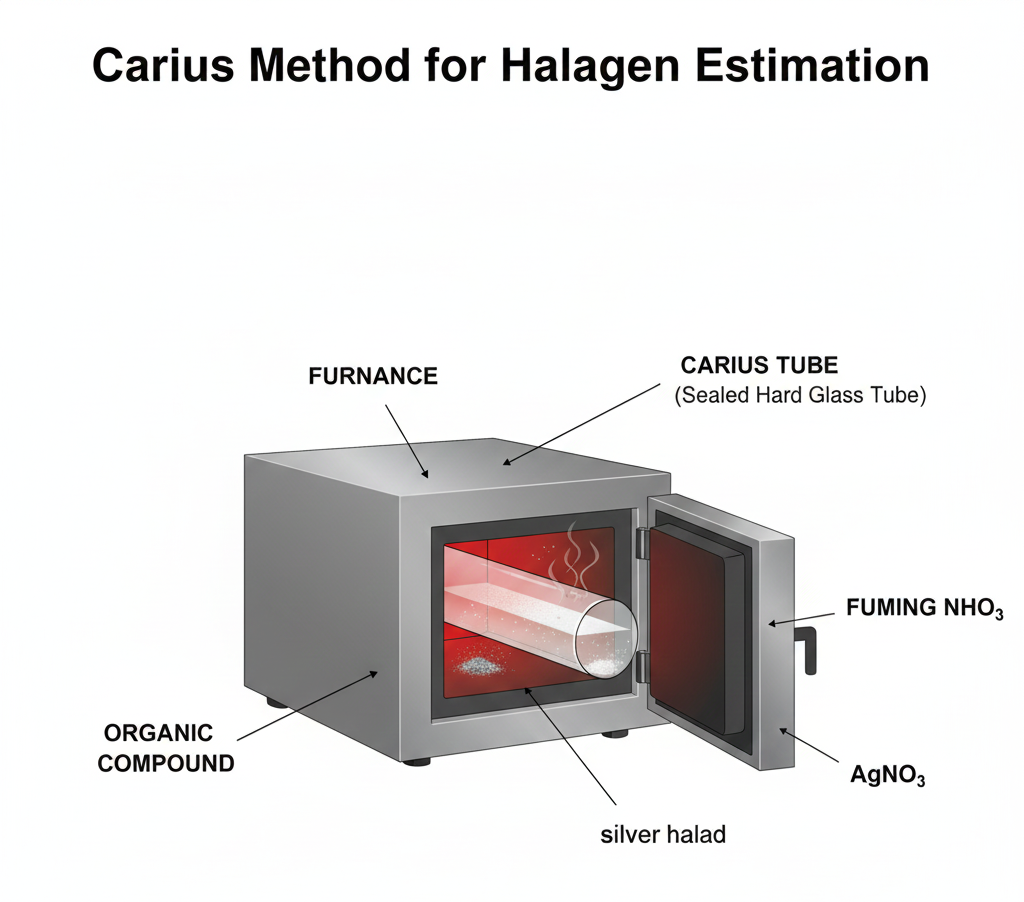
Halogens are estimated using the Carius method. In this technique, the compound is heated in a sealed tube (Carius tube) with fuming $\text{HNO}_3$ and $\text{AgNO}_3$, converting the halogen to the corresponding silver halide ($\text{AgX}$) precipitate, which is then weighed. Sulphur is also handled similarly, being oxidized to $\text{H}_2\text{SO}_4$ and precipitated as $\text{BaSO}_4$.
Figure below:
A clear diagram showing the Carius method apparatus, consisting of a sealed hard glass tube (Carius tube) containing the organic compound, fuming $\text{HNO}_3$, and $\text{AgNO}_3$ inside a furnace.
Relatable Indian Example: Imagine you are testing the purity of saffron (kesar) for a fancy sweet shop. You might use Crystallisation if the sugar content is the main impurity, or Chromatography to check if the colour components are genuine, separating them as they move up the paper like water soaking into a pani puri wrapper!
NEET Checkpoint:
If $m_1$ is the mass of $\text{AgX}$ formed from $m$ grams of organic compound containing halogen $\text{X}$, which calculation is used to find the mass of halogen $\text{X}$ present?
(a) $\frac{m_1}{Molar~mass~of~AgX} \text{ g}$
(b) $\frac{\text{Atomic mass of } \text{X} \times m_1}{\text{Molecular mass of AgX}} \text{ g}$ (c) $\frac{32 \times m_1}{233} \text{ g}$
(d) $\frac{12 \times m_1}{44 \times m} \text{ g}$
✅ Answer: (b) $\frac{\text{Atomic mass of } \text{X} \times m_1}{\text{Molecular mass of AgX}} \text{ g}$ — This ratio accounts for the proportion of the halogen in the total mass of the precipitated silver halide.
Practice Question:
Which purification method is ideal for separating Aniline from an Aniline-water mixture?
(a) Simple Distillation
(b) Fractional Distillation
(c) Sublimation
(d) Steam Distillation
✅ Answer: (d) Steam Distillation — Aniline is steam volatile and immiscible with water, making this method suitable, as the mixture boils below $373 \text{ K}$.
Key Takeaway
Purification methods leverage differences in volatility (Distillation variants), solubility (Crystallisation, Extraction), or differential movement (Chromatography). Quantitative analysis (like Dumas, Kjeldahl, Carius) determines mass percent by converting the element into a measurable product (gas, $\text{CO}_2/\text{H}_2\text{O}$, or weighed precipitate like $\text{AgX}$ or $\text{BaSO}_4$).