1. Introduction to Chemistry & Historical Development
Welcome to the world of atoms and molecules, yaar! Don't look at this as just another subject; chemistry is the science of molecules and their transformations. It's the study of how substances are prepared, their properties, and how they react to form something entirely new.
Long before modern labs, ancient India was the OG chemistry hub. Known as Rasayan Shastra or Rasvidya, our ancestors were masters of metallurgy, medicine, and even cosmetics. Acharya Kanda (600 BCE) conceptualised 'Paramānu' (indivisible atoms) over 2500 years before John Dalton! From the baked bricks of Mohenjodaro to the rust-resistant iron and vibrant dyes mentioned in the Rigveda, our chemical history is legendary.
Relatable Indian Example:
Think about your grandmother’s copper pujapatra or the "fresh" colours of the Ajanta cave paintings. That’s not magic; it’s high-level ancient Indian chemistry using metal oxides and plant extracts!
NEET Checkpoint:
Who was the first proponent of the atomic theory in ancient India?
(a) Charaka
(b) Nagarjuna
(c) Acharya Kanda
(d) Chakrapani
✅ Answer: (c) Acharya Kanda — He described atoms as eternal, indestructible, and in motion in the Vaiseshika Sutras.
NEET Checkpoint:
Which drug is synthesized by chemists to help AIDS patients?
(a) Cisplatin
(b) Taxol
(c) AZT
(d) CFCs
✅ Answer: (c) AZT — Azidothymidine is a vital contribution of chemistry to healthcare.
NEET Checkpoint:
What did Chakrapani use as ingredients for inventing soap in the $18^{th}$ century?
(a) Mustard oil and alkalies
(b) Glycerine
(c) Animal fat
(d) Petroleum
✅ Answer: (a) Mustard oil and alkalies — He is credited with the invention of soap in India.
Modern chemistry isn't just history; it's a life-saver! It provides drugs like cisplatin and taxol for cancer therapy and creates safer alternatives to CFCs ($chlorofluorocarbons$) to protect our ozone layer.
Practice Question:
Which of the following describes the 'Law of Definite Proportions' by volume?
(a) Dalton’s Law
(b) Gay Lussac’s Law
(c) Avogadro’s Law
(d) Lavoisier’s Law
✅ Answer: (b) Gay Lussac’s Law — It is essentially the law of definite proportions applied to volumes of gases.
Key Takeaway
Chemistry is the "Central Science" connecting everything from the functioning of your brain to life-saving medicines. India's contribution via 'Paramānu' and metallurgy laid the foundation centuries ago.
2. Nature and States of Matter
Listen up, junior! Before we dive into complex reactions, let's clear up a basic funda. Everything you see around you—from that heavy cricket bat to the chai in your cup and even the air you’re breathing—is matter. Simply put, matter is defined as anything that has mass and occupies space. If it’s taking up room and has weight, it's matter!
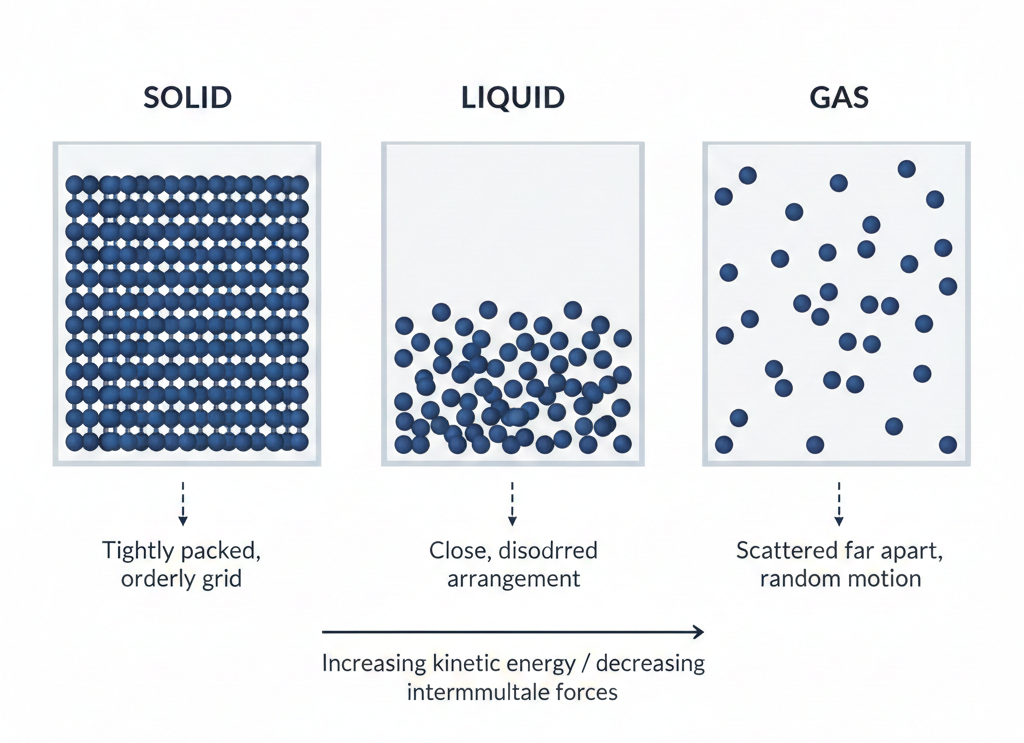
Matter usually hangs out in three physical states: solid, liquid, and gas. In solids, particles are like students in a disciplined morning assembly—held very close in an orderly fashion with hardly any freedom of movement. This is why solids have a definite volume and a definite shape. Liquids are more chilled out; particles stay close but can move around. They have a definite volume but no definite shape, taking the shape of whatever container you pour them into.
NEET Checkpoint:
Which state of matter has neither a definite volume nor a definite shape?
(a) Solid
(b) Liquid
(c) Gas
(d) Plasma
✅ Answer: (c) Gas — Particles are far apart and move easily/fast to occupy all available space.
Gases are the absolute rebels! Their particles are far apart and zooming everywhere, so they have neither a definite volume nor a definite shape.
Relatable Indian Example: Imagine a pani puri stall. The crispy puri is a solid (fixed shape), the teekha paani is a liquid (takes the shape of the bowl), and the tempting aroma wafting through the air is a gas (spreads everywhere).
NEET Checkpoint:
How can the three states of matter be interconverted?
(a) By changing only the shape of the substance
(b) By changing only the volume of the substance
(c) By changing temperature and pressure
(d) By adding a catalyst
✅ Answer: (c) By changing temperature and pressure — Heating a solid usually turns it into a liquid, and then a gas.
Figure below:
clear diagram showing the arrangement of particles in three boxes: one with particles tightly packed in an orderly grid (solid), one with particles close but disordered (liquid), and one with particles scattered far apart (gas).
NEET Checkpoint:
In liquids, particles have no freedom of movement.
(a) True
(b) False
✅ Answer: (b) False — Particles in a liquid are close but can move around.
Don't stress, yaar—it's easier than it looks! These states are interconvertible. On heating, a solid usually becomes a liquid, which then becomes a gas. Cooling does the reverse. Even molecules need a change of pace sometimes!
Practice Question:
Which of the following is true for the gaseous state?
(a) Particles are held in an orderly fashion.
(b) They have a definite shape.
(c) Movement of particles is easy and fast.
(d) They have a definite volume.
✅ Answer: (c) — In gases, particles are far apart and their movement is easy and fast.
Key Takeaway:
- Matter: Has mass and occupies space.
- Solids: Definite shape and volume.
- Liquids: Definite volume, no definite shape.
- Gases: No definite shape or volume.
- States are interconvertible by changing $Temperature$ and $Pressure$.
3. Classification of Matter: Mixtures vs. Pure Substances
Listen up, junior! At the macroscopic level, matter isn't just "stuff"—it's either a Mixture or a Pure Substance. Pure substances are the "perfectionists" with a fixed composition, like pure gold or water. Mixtures? They are more like your favourite street food—variable and chill!
NEET Checkpoint:
Which of the following has a variable composition?
(a) $H_{2}O$
(b) Sugar solution
(c) Glucose
(d) Copper
✅ Answer: (b) Sugar solution — Mixtures contain two or more pure substances in any ratio, unlike compounds.
In a homogeneous mixture, things are so well-mixed you can’t tell them apart—think of a clear glass of shikanji (sugar solution) or the air we breathe. But in a heterogeneous mixture, like a plate of Bhel Puri where you can see the peanuts and sev separately, the composition isn't uniform at all!
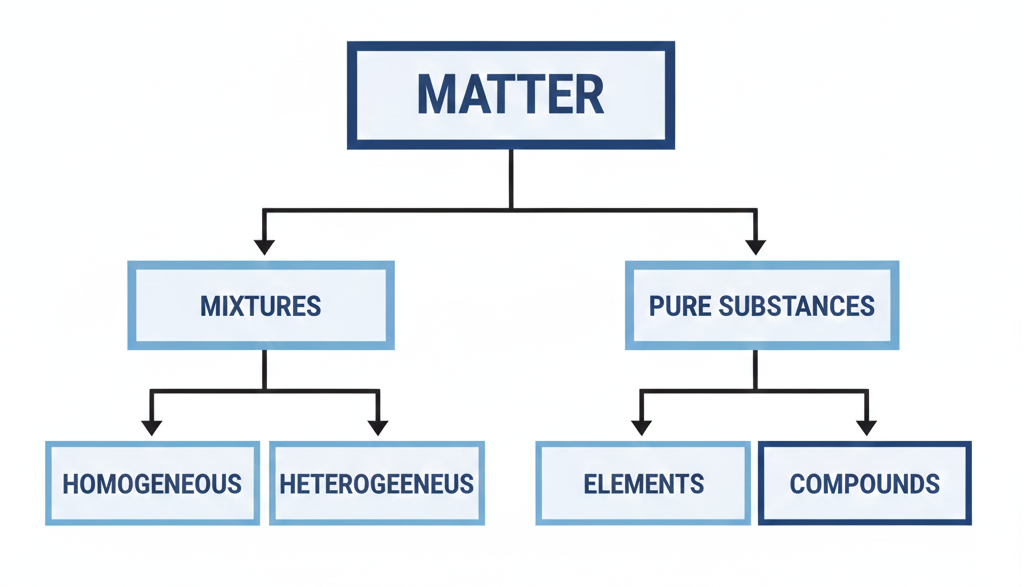
Figure below:
A flow chart based on Figure 1.2 showing Matter branching into Mixtures (Homogeneous and Heterogeneous) and Pure Substances (Elements and Compounds).
NEET Checkpoint:
Can you separate $CO_{2}$ into Carbon and Oxygen by filtration?
(a) Yes, because carbon is a solid
(b) Yes, because oxygen is a gas
(c) No, because $CO_{2}$ is a compound and its components cannot be separated by physical methods like filtration
(d) Yes, by using very fine filter paper
✅ Answer: (c) No! — Compounds are pure substances; their constituents cannot be separated by physical methods.
Pure substances are further split into Elements (only one type of atom, like $Cu$ or $O_{2}$) and Compounds (different atoms in a fixed ratio, like $H_{2}O$). You can separate mixtures using physical fundas like distillation or filtration, but for compounds, you’ll need chemical methods.
NEET Checkpoint:
Which is an element?
(a) $CO_{2}$
(b) $H_{2}O$
(c) $N_{2}$
(d) Sugar
✅ Answer: (c) $N_{2}$ — It consists of only nitrogen atoms, whereas others are compounds.
Practice Question:
1. A mixture of grains and pulses with dirt is:
(a) Homogeneous
(b) Pure Substance
(c) Heterogeneous
(d) Element
✅ Answer: (c) Heterogeneous — The components are visible and not uniformly distributed.
Key Takeaway
- Mixtures: Variable composition; separated physically (e.g., air, tea).
- Pure Substances: Fixed composition; Elements (one type of atom) or Compounds (different atoms in fixed ratio).
4. Elements, Compounds, and the Atomic Concept
Listen up, future doctors! Let’s clear up this fundamental funda about how matter is built. Think of elements as the purest form of a substance, consisting of only one type of atom. These atoms can hang out solo, like a lone batsman in the nets (e.g., $Na$ or $Cu$), or they can pair up into molecules, like a solid opening partnership (e.g., $H_2$ or $O_2$).
NEET Checkpoint: Does an element always consist of single, isolated atoms?
(a) Yes, all elements exist only as single atoms
(b) Yes, except metals
(c) No, some elements exist as molecules
(d) No, elements always exist as compounds
✅ Answer: (c) No — Elements can exist as individual atoms or as molecules (like $O_2$).
Now, when atoms of different elements decide to team up in a fixed and definite ratio, we get a compound. Here’s the kicker: the properties of a compound are totally different from its parent elements. Take $H_2O$, for example. Hydrogen burns with a pop and Oxygen supports fire, but put them together and you get water—a fire extinguisher!.
NEET Checkpoint:
Can you separate the Hydrogen from water by using a simple tea strainer?
(a) Yes, because hydrogen is lighter than water
(b) Yes, because hydrogen escapes as a gas
(c) No, because water is a compound and hydrogen cannot be separated by physical methods
(d) Yes, by heating the water
✅ Answer: No — Compounds cannot be separated by physical means; only chemical methods work.
Think of it like a Pani Puri stall. The individual puris and the spicy water are separate elements of the experience, but once you mix the masala perfectly in a fixed ratio, you get that specific "blast of flavour" that is a compound. You can't just "hand-pick" the salt back out once it's part of the magic!
NEET Checkpoint:
Is the ratio of elements in a compound variable or fixed?
(a) Variable
(b) Fixed
(c) Depends on temperature
(d) Depends on pressure
✅ Answer: (b) Fixed — Atoms of different elements are always present in a definite ratio.
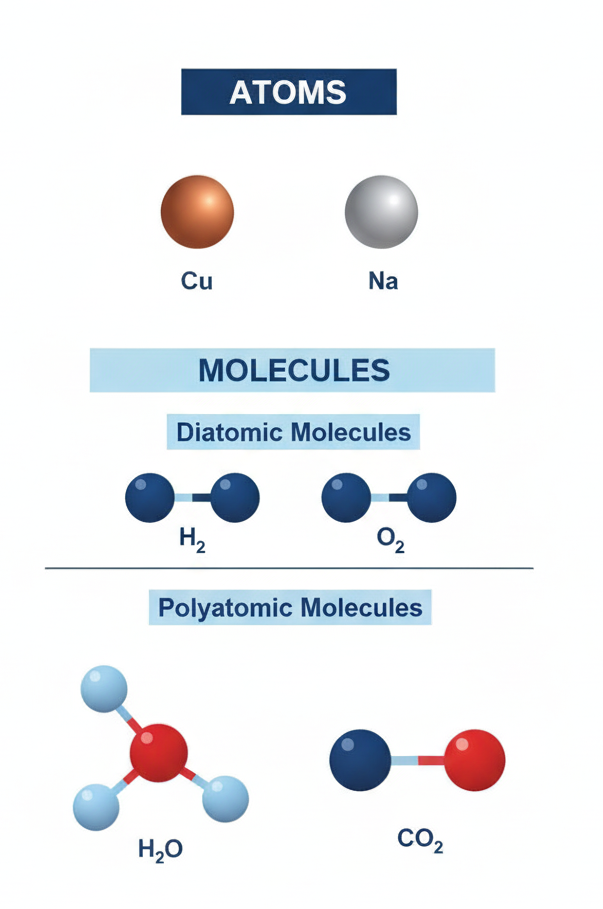
Figure below:
A clear diagram representing atoms and molecules, showing single atoms of Cu and Na, and diatomic molecules of H2 and O2, as well as the structures of H2O and CO2 as shown in Figures 1.3 and 1.4 of the sources.
Practice Questions:
- Which of the following is considered an element despite being a molecule?
(a) $H_2O$
(b) $CO_2$
(c) $O_2$
(d) $C_6H_{12}O_6$
✅ Answer: (c) $O_2$ — Because it contains only one type of atom (Oxygen).
2. A compound can be separated into its constituent elements by:
(a) Filtration
(b) Distillation
(c) Chemical methods
(d) Hand-picking
✅ Answer: (c) Chemical methods — Physical methods don't work for compounds.
Key Takeaway
- Elements: One type of atom (can be atoms or molecules).
- Compounds: Different elements in a fixed ratio with unique properties.
- Separation: Elements = cannot be simpler; Compounds = Chemical methods only.
5. Properties of Matter and SI Units
Hey junior! Ready to learn how to "size up" matter? It’s like judging a new cricket bat; you check its colour and weight (physical) before you see how it actually performs on the pitch (chemical)!.
Every substance has unique traits. Physical properties, like colour, odour, or density, are measured without changing the substance's identity. But to observe chemical properties, like combustibility or reactivity, a chemical change MUST occur. Think of a pani puri: the crunch is a physical property, but how it reacts with the spicy teekha pani in your stomach? That's chemical, yaaro!.
NEET Checkpoint:
Which of the following is a chemical property?
(a) Density
(b) Melting point
(c) Combustibility
(d) Colour
✅ Answer: (c) — Arre, the others are physical; you don't need a chemical reaction to see them!.
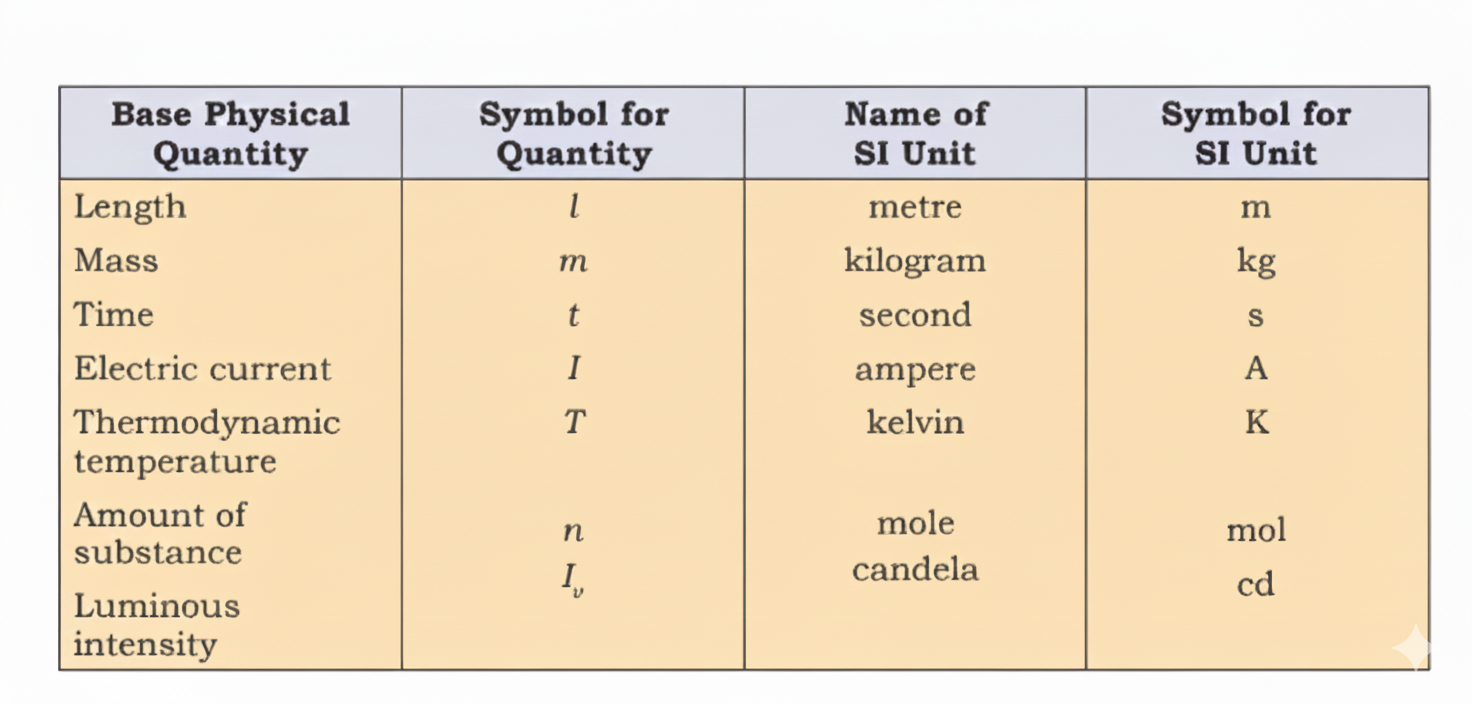
To keep measurements consistent worldwide, we use the International System of Units (SI). There are seven base units you must memorize for your NEET funda: mass is in $kg$, length in $m$, time in $s$, and the amount of substance in $mol$. For temperature, we use kelvin ($K$), and the relation is:
NEET Checkpoint:
What is the SI unit for the amount of a substance?
(a) Gram
(b) Mole
(c) Kilogram
(d) Litre
✅ Answer: (b) — The mole ($mol$) is our seventh base quantity!.
We also use SI prefixes to handle massive or tiny numbers. For example, 'micro' means $10^{-6}$ and 'kilo' means $10^{3}$. Even your mobile data uses these!
NEET Checkpoint:
Match the prefix 'nano' to its multiple.
(a) $10^{-6}$
(b) $10^{6}$
(c) $10^{-9}$
(d) $10^{9}$
✅ Answer: (c) — Nano stands for $10^{-9}$. Small but powerful!.
Figure below:
A clear table showing the seven SI base physical quantities, their symbols, and the names of their SI units.
Practice Question:
A substance has a mass of $4~g$ and occupies $10~cm^{3}$. Its density in $g~cm^{-3}$ is:
(a) $40$
(b) $0.4$
(c) $2.5$
(d) $4.0$
✅ Answer: (b) — Use the formula $Density = \frac{Mass}{Volume} = \frac{4~g}{10~cm^{3}} = 0.4~g~cm^{-3}$.
Key Takeaway: SI Base Units
- Mass: $kg$
- Length: $m$
- Temperature: $K$
- Amount of substance: $mol$
- Density: $\frac{kg}{m^{3}}$ (SI) or $g~cm^{-3}$ (Lab).
6. Measurement of Mass, Volume, and Density
Listen up, junior! In chemistry, being "approx" doesn't work—it’s all about precision. First, let's clear up a major confusion: mass vs. weight. Mass is the actual amount of matter in your substance and stays constant everywhere. Weight, however, is just the force exerted by gravity; it can change if you go to the moon, but your mass won't!. In the lab, we measure mass accurately using an analytical balance.
NEET Checkpoint:
If a sample is taken from Earth to a high-altitude mountain, which property remains unchanged?
(a) Weight
(b) Mass
(c) Both
(d) Density
✅ Answer: (b) Mass — Because mass is the amount of matter present and is independent of gravity.
Next is Volume, the space an object occupies. While the SI unit is $m^3$, we chemists usually play with $cm^3$ or $dm^3$. Remember this trick: $1\ L = 1000\ mL = 1000\ cm^3 = 1\ dm^3$.
Figure below:
A clear diagram showing lab equipment for measuring volume, including a graduated cylinder, a burette with a stopcock, a pipette, and a volumetric flask with a calibration mark.

Now, why does Density matter? It’s mass per unit volume:
It tells us how tightly particles are packed. High density means particles are packed like commuters in a Mumbai local train during peak hours!. The SI unit is $kg\ m^{-3}$, but we often use $g\ cm^{-3}$.
NEET Checkpoint:
What is the relationship between $1\ cm^3$ and $1\ mL$?
(a) $1\ cm^3 = 10\ mL$
(b) $1\ cm^3 = 1\ mL$
(c) $1\ cm^3 = 0.1\ mL$
(d) $1\ cm^3 = 100\ mL$
✅ Answer: (b) $1\ cm^3 = 1\ mL$ — These are equivalent units for volume in the lab.
Finally, Temperature! We use Celsius (${}^\circ C$), Fahrenheit (${}^\circ F$), and Kelvin ($K$). Kelvin is the SI unit, and here’s the kicker: you can never have a negative temperature in Kelvin.
NEET Checkpoint:
At what temperature does the Celsius scale read $0^\circ C$ in Kelvin?
(a) $0\ K$
(b) $273.15\ K$
(c) $-273.15\ K$
(d) $100\ K$
✅ Answer: (b) $273.15\ K$ — Simply use the conversion formula $K = {}^\circ C + 273.15$.
Practice Question:
A substance has a mass of $20\ g$ and a volume of $5\ cm^3$. What is its density?
(a) $100\ g\ cm^{-3}$
(b) $4\ g\ cm^{-3}$
(c) $0.25\ g\ cm^{-3}$
(d) $25\ g\ cm^{-3}$
✅ Answer: (b) $4\ g\ cm^{-3}$ — Density is mass divided by volume ($20/5 = 4$).
Key Takeaway / Formula Summary
- Mass: Constant amount of matter.
- Weight: Force of gravity (variable).
- Density:
$$\text{Density} = \frac{\text{Mass}}{\text{Volume}}$$(Unit: $kg\ m^{-3}$ or $g\ cm^{-3}$).- Temperature: $K = {}^\circ C + 273.15$ and ${}^\circ F = \frac{9}{5}({}^\circ C) + 32$.
7. Uncertainty in Measurement & Scientific Notation
Listen up, juniors! In Chemistry, we deal with numbers so massive (like the atoms in $2~g$ of hydrogen) or so tiny (like the mass of a single H atom) that your head would spin if you tried writing all those zeros. To save ourselves from "zero-overload," we use Scientific Notation, represented as $N \times 10^n$. Here, $N$ is a digit term between $1.000...$ and $9.999...$, and $n$ is an exponent. Move the decimal left, $n$ is positive; move it right, $n$ is negative!
NEET Checkpoint:
How is $0.00016$ written in scientific notation?
(a) $1.6 \times 10^{-4}$
(b) $1.6 \times 10^{-3}$
(c) $16 \times 10^{-5}$
(d) $0.16 \times 10^{-3}$
✅ Answer: (b) $1.6 \times 10^{-4}$ — Remember, we moved the decimal 4 places to the right, so the exponent is negative!
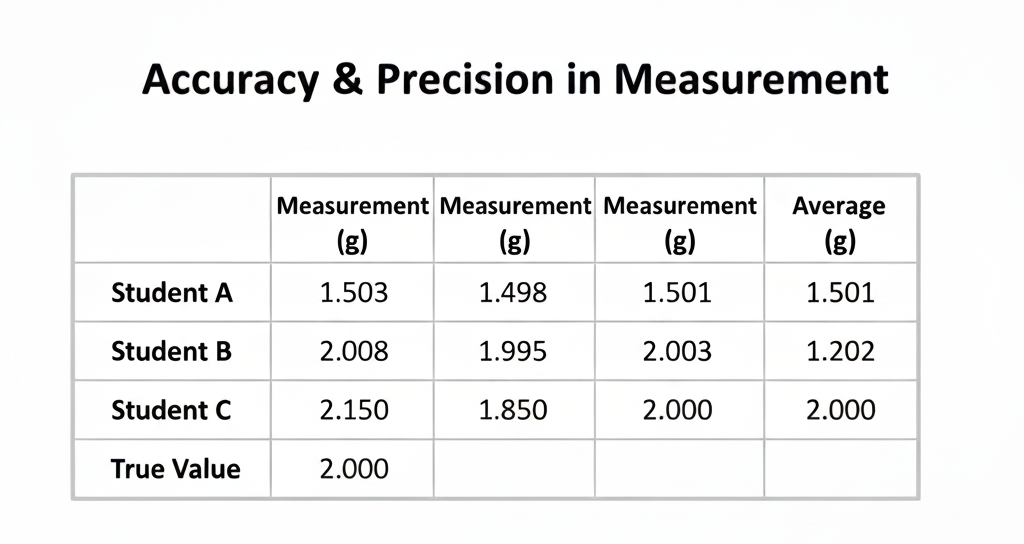
Now, let’s clear the Precision vs. Accuracy funda. Precision is how close your repeated measurements are to each other. Accuracy is how close your result is to the "true" value. Imagine you’re at a Pani Puri stall. If the bhaiya gives every customer exactly 5 puris, he is precise. But if the sign says "6 puris per plate" and he only gives 5, he isn't accurate, yaar!
NEET Checkpoint:
If the true mass is $2.00~g$ and a student gets $1.95~g$ and $1.93~g$, the results are?
(a) Accurate and precise
(b) Accurate but not precise
(c) Precise but not accurate
(d) Neither accurate nor precise
✅ Answer: (c) Precise but not accurate — The values are close to each other but far from $2.00~g$.
To handle uncertainty, we use Significant Figures—meaningful digits known with certainty plus one estimated digit.
* Rule 1: All non-zero digits are significant.
* Rule 2: Zeros at the start (e.g., $0.03$) are NOT significant.
* Rule 3: Zeros between non-zeros ARE significant.
NEET Checkpoint:
How many significant figures are in $2.005$?
(a) 2
(b) 3
(c) 5
(d) 4
✅ Answer: (d) 4 — Zeros between non-zero digits are always significant.
Figure below:
A clear table showing three students' measurement data (Student A, B, and C) to compare their average values against a true value of $2.000~g$, illustrating the concepts of precision and accuracy.
Practice Question:
Which of the following has only 2 significant figures?
(a) $2.005$
(b) $0.0052$
(c) $500.0$
(d) $285$
✅ Answer: (b) $0.0052$ — Zeros preceding the first non-zero digit are just placeholders and aren't significant.
Key Takeaway
- Scientific Notation:
$$N \times 10^n$$.- Precision: Closeness of multiple readings.
- Accuracy: Agreement with the true value.
- Sig Figs: All non-zeros are significant; leading zeros are not.
8. Dimensional Analysis
Don't stress—converting units is easier than it looks!. Often in Chemistry, we need to switch units from one system to another, like changing $inches$ to $cm$ or $days$ to $seconds$. This super-cool technique is called Dimensional Analysis, also known as the factor label method or unit factor method.
The secret funda here is the unit factor. Since $1 \text{ in} = 2.54 \text{ cm}$, we can write the ratio as:
Because these ratios equal 1, multiplying any number by them doesn't change its actual value, only its "look" (the units!).
NEET Checkpoint:
What is another name for Dimensional Analysis?
(a) Unit conversion method
(b) Factor-label method
(c) Vector method
(d) Graphical method
✅ Answer: (b) Factor label method or unit factor method — Just a fancy name for unit conversion, tension mat lo!
NEET Checkpoint:
Can units be cancelled out like numerical values?
(a) No, units can never be cancelled
(b) Yes, but only in physics problems
(c) Yes, units cancel algebraically just like numbers
(d) Only SI units can be cancelled
✅ Answer: (c) Yes — Units are treated like numbers and can be multiplied, divided, or cancelled.
NEET Checkpoint:
If $1 \text{ L} = 1000 \text{ cm}^3$, what is the unit factor to convert $L$ to $cm^3$?
(a) $\frac{1 \text{ L}}{1000 \text{ cm}^3}$
(b) $\frac{1000 \text{ cm}^3}{1 \text{ L}}$
(c) $\frac{1 \text{ cm}^3}{1000 \text{ L}}$
(d) $\frac{1000 \text{ L}}{1 \text{ cm}^3}$
✅ Answer: (b) $\frac{1000 \text{ cm}^3}{1 \text{ L}}$ — The numerator should always contain the unit you want in your final result.
Here’s a quick challenge for you: How many seconds are in 2 days?. We just multiply the unit factors in a series:
Even calculation needs a bit of rhythm sometimes!
Practice Question:
A piece of metal is $3 \text{ in}$ long. What is its length in $cm$?
(a) $2.54 \text{ cm}$
(b) $5.08 \text{ cm}$
(c) $7.62 \text{ cm}$
(d) $1.18 \text{ cm}$
✅ Answer: (c) $7.62 \text{ cm}$ — Simply multiply $3 \text{ in}$ by the unit factor $\frac{2.54 \text{ cm}}{1 \text{ in}}$ to get $3 \times 2.54 = 7.62 \text{ cm}$.
Key Takeaway: Unit Factor Method
- Unit Factor: A ratio of two equivalent quantities that equals 1.
- The Rule: Always place the desired unit in the numerator of the unit factor.
- Math with Units: Units can be cancelled, multiplied, or squared just like numbers.
9. Laws of Chemical Combination - I
Listen up, junior! Chemistry isn't just about random mixing; it follows strict rules that are the "Constitution of Chemistry". First up is the Law of Conservation of Mass, established by Antoine Lavoisier in $1789$. He performed careful experiments on combustion and concluded that matter is neither created nor destroyed during physical or chemical changes. Think of it like a Pani Puri stall: the total weight of the puris, potatoes, and teekha pani you consume is exactly what ends up in your stomach—nothing just vanishes into thin air!
NEET Checkpoint:
Who is credited with the Law of Conservation of Mass?
(a) Dalton
(b) Proust
(c) Lavoisier
(d) Avogadro
✅ Answer: (c) Lavoisier — He used exact measurements of reactants and products to prove this funda.
Next, let's clear up the Law of Definite Proportions, given by Joseph Proust. He stated that a given compound always contains exactly the same proportion of elements by weight. Whether you get cupric carbonate from a natural source or make it synthetically in a lab, the percentage of copper, carbon, and oxygen stays identical. It’s like your favorite cutting chai—no matter which tapri you go to, if it's the same recipe, the ratio of milk to water must be fixed!
NEET Checkpoint:
The Law of Definite Proportions is also known as?
(a) Law of Conservation of Mass
(b) Law of Constant Composition
(c) Law of Multiple Proportions
(d) Avogadro's Law
✅ Answer: (b) Law of Constant Composition — Because the elemental "recipe" is always constant.
NEET Checkpoint:
If $100~g$ of a reactant completely reacts to form two products, and one product weighs $60~g$, what is the mass of the other?
(a) 20 g
(b) 40 g
(c) 60 g
(d) 100 g
✅ Answer: (b) $40~g$ — Simple math, yaar! Total mass must remain conserved ($100 - 60 = 40$).
Practice Question:
Two samples of $H_{2}O$ are analyzed. Sample A (from a well) contains $88.89\%$ Oxygen, and Sample B (from a lake) also contains $88.89\%$ Oxygen. Which law does this support?
(a) Law of Conservation of Mass
(b) Law of Definite Proportions
(c) Law of Multiple Proportions
(d) Gay Lussac's Law
✅ Answer: (b) — Since the proportion by weight is identical regardless of the source.
Now that you've got this, wait till you see how elements can combine in different ratios in our next topic!
Key Takeaway
- Conservation of Mass: Total Mass of Reactants = Total Mass of Products.
- Definite Proportions: A compound's "recipe" (ratio by weight) never changes, regardless of its source.
10. Laws of Chemical Combination - II
Let's finish the laws of chemical combination! No tension, yaar—these fundas are as steady as a fixed-gear bicycle.
First up is the Law of Multiple Proportions, proposed by Dalton in $1803$. It says that if two elements combine to form more than one compound, the masses of one element that combine with a fixed mass of the other are in a ratio of small whole numbers.
Think of it like making different types of chai at a local stall: if you keep the milk amount fixed, the different amounts of sugar you add for "cutting" vs "full" chai will follow a simple ratio like $1:2$. For example, hydrogen and oxygen form water ($16~g$ oxygen) and hydrogen peroxide ($32~g$ oxygen). The ratio of oxygen masses is a simple $16:32$ or $1:2$.
NEET Checkpoint:
If carbon forms $CO$ and $CO_2$, which law is being followed?
(a) Law of Conservation of Mass
(b) Law of Definite Proportions
(c) Law of Multiple Proportions
(d) Avogadro's Law
✅ Answer: (c) Law of Multiple Proportions — Because the mass of oxygen combining with a fixed mass of carbon is in a $1:2$ ratio.
Next, we have Gay Lussac’s Law of Gaseous Volumes ($1808$). He observed that when gases react, they do so in a simple ratio by volume, provided $T$ and $P$ are constant. For instance, $100~mL$ of hydrogen reacts with $50~mL$ of oxygen to give $100~mL$ of water vapour—that's a neat $2:1$ ratio!
NEET Checkpoint:
Does Gay Lussac’s law apply to solids?
(a) Yes, for all solids
(b) Yes, but only for crystalline solids
(c) No, it applies to gases only
(d) No, it applies to liquids only
✅ Answer: (c) No — It specifically deals with the volumes of gases in a chemical reaction.
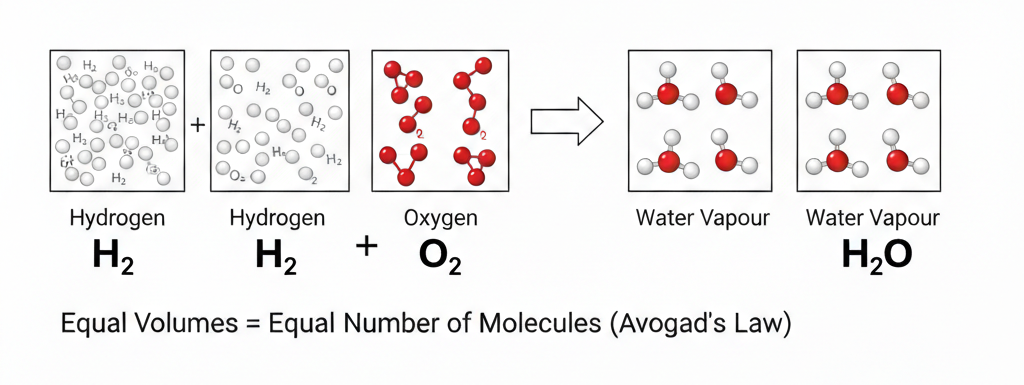
Finally, Avogadro’s Law ($1811$) states that equal volumes of all gases at the same temperature and pressure should contain an equal number of molecules. Even if the gases are different, if the volume is the same, the molecule count is the same!
Figure below:
A clear diagram showing three identical boxes; two boxes contain hydrogen molecules and one contains oxygen molecules. These combine to show two boxes of water vapour, illustrating that each box (volume) contains the same number of molecules.
NEET Checkpoint:
Who first distinguished between atoms and molecules?
(a) John Dalton
(b) Amedeo Avogadro
(c) Dmitri Mendeleev
(d) Joseph Louis Gay-Lussac
✅ Answer: (b) Avogadro — He explained gaseous volumes by suggesting molecules could be polyatomic.
Practice Questions:
- $100~mL$ of $CH_4$ burns in $O_2$ to produce $CO_2$ and $H_2O$ vapour. What is the volume ratio of $CH_4$ to $O_2$ if $200~mL$ of $O_2$ is consumed?
(a) $2:1$
(b) $1:2$
(c) $1:1$
(d) $3:2$
✅ Answer: (b) $1:2$ — According to Gay Lussac’s law, gases react in simple whole-number volume ratios.
2. According to Avogadro, equal volumes of $H_2$ and $O_2$ at same $T$ and $P$ have:**
(a) Same mass
(b) Same density
(c) Same number of molecules
(d) Different number of molecules
✅ Answer: (c) Same number of molecules — This is the literal definition of Avogadro's Law.
Chemistry is just nature’s way of following a strict budget—no random decimals allowed!
Key Takeaway
Formula Summary
- Law of Multiple Proportions: Ratio of masses = small whole numbers (e.g., $1:2, 2:3$).
- Gay Lussac’s Law: $V_{reactants} : V_{products} =$ simple ratio (for gases).
- Avogadro’s Law: $V \propto \text{number of molecules}$ (at constant $T, P$).
11 Dalton’s Atomic Theory
Hey junior! Let’s clear up the funda of the man who gave chemistry its first real structure: John Dalton. In $1808$, he published ‘A New System of Chemical Philosophy’, which turned philosophical guesses into scientific rules. Before him, even the ancient Greeks and our own Acharya Kanda had ideas about indivisible particles, but Dalton made it official for modern science.
NEET Checkpoint:
Who was the ancient Indian proponent of the 'atomic theory' long before Dalton?
(a) Nagarjuna
(b) Acharya Kanda
(c) Charaka
(d) Chakrapani
✅ Answer: (b) Acharya Kanda — He formulated the theory of ‘Paramānu’ around $2500$ years before Dalton!
Dalton’s theory rests on four major pillars:
1. Indivisible Atoms: Matter is made of tiny, indivisible bits called atoms.
2. Identical Twins: All atoms of a specific element are exactly the same in mass and properties.
3. The Perfect Recipe: Compounds form when atoms of different elements join in fixed ratios. Imagine making a perfect plate of pani puri—you need a fixed ratio of spice to water for that signature taste!
4. Musical Chairs: Chemical reactions are just a reorganisation of atoms; they aren't created or destroyed.
NEET Checkpoint:
According to Dalton, what happens to atoms in a chemical reaction?
(a) They are destroyed
(b) They are created
(c) They are reorganised
(d) They change into new elements
✅ Answer: (c) They are reorganised — Atoms are neither created nor destroyed, just shuffled around!
Think of it like cricket balls. Every ball from the same box (element) has the same colour and mass, but a leather ball is totally different from a tennis ball (different element). However, Dalton couldn't explain everything—he was stumped by the laws of gaseous volumes!
NEET Checkpoint:
Which law could Dalton's theory NOT explain?
(a) Law of Conservation of Mass
(b) Gay Lussac’s Law
(c) Law of Definite Proportions
(d) Law of Multiple Proportions
✅ Answer: (b) Gay Lussac’s Law — Dalton’s theory explained mass-related laws but failed on gaseous volumes.
Practice Question:
Which of the following is a postulate of Dalton's Atomic Theory?
(a) Atoms are composed of subatomic particles.
(b) Atoms of different elements have identical mass.
(c) Chemical reactions involve the reorganisation of atoms.
(d) Matter is continuous and divisible.
✅ Answer: (c). Dalton stated that chemical reactions involve reorganisation and that atoms are indivisible.
Key Takeaway: Dalton's Postulates
- Matter = Indivisible Atoms.
- Same element = Identical mass/properties.
- Compounds = Fixed ratios of atoms.
- Reactions = Atom reorganisation (no creation/destruction).
12. Atomic and Molecular Masses
Listen up, junior! Ever tried weighing a single mustard seed on a kitchen scale? Impossible, right? Atoms are even smaller, so we weigh them relatively. Since 1961, the Carbon-12 ($^{12}C$) isotope is our global standard, assigned a mass of exactly $12~u$ (unified mass). Don't stress, yaar—it’s just like using a standard 'batta' (weight) at a local sabzi mandi to weigh your potatoes!
NEET Checkpoint:
Which isotope is the current standard for atomic mass?
(a) $^{1}H$
(b) $^{16}O$
(c) $^{12}C$
(d) $^{14}C$
✅ Answer: (c) $^{12}C$ — It’s the fixed 'funda' for all relative mass calculations today!
In nature, elements have isotopes (siblings with different masses). We calculate the Average Atomic Mass by looking at their natural abundance. Imagine a cricket team: the 'average' score accounts for everyone’s performance, not just the star player!
NEET Checkpoint:
What does $1~amu$ equal in grams?
(a) $1.66× 10^{-27} g $
(b) $1.66× 10^{-24} g $
(c) $9.1× 10^{-28} g $
(d) $6.02× 10^{-23} g $
✅ Answer: (b) $1.66 \times 10^{-24}~g$. It's roughly $1/12^{th}$ the mass of one $^{12}C$ atom.
For molecules, Molecular Mass is just the sum of atomic masses. For example, water ($H_{2}O$) is:
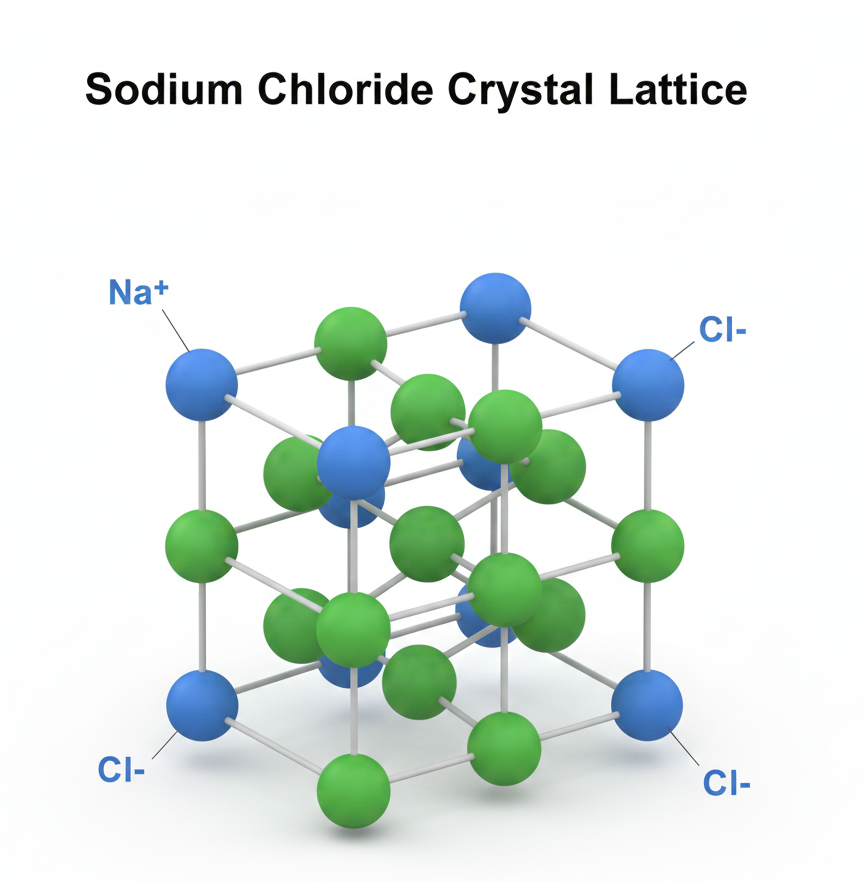
However, compounds like $NaCl$ don't have separate molecules; they form a giant 3D grid. We use Formula Mass for these. It’s like a crowded Mumbai local—everyone is packed together in a specific arrangement!
Figure below:
A clear diagram showing the 3D packing of Na+ and Cl- ions in a sodium chloride crystal lattice.
NEET Checkpoint:
Why use 'formula mass' for $NaCl$?
(a) NaCl has covalent bonds
(b) NaCl exists as discrete molecules
(c) NaCl exists as a lattice of ions
(d) NaCl has a low molar mass
✅ Answer: (c) NaCl exists as a lattice of ions - Because it exists as a 3D lattice, not as discrete molecules.
Practice Question:
Calculate the molecular mass of glucose ($C_{6}H_{12}O_{6}$).
(a) $180.162~u$
(b) $58.5~u$
(c) $16.04~u$
(d) $342.3~u$
✅ Answer: (a) $180.162~u$ — Just sum $6(12.011) + 12(1.008) + 6(16.00)$. Simple!
Key Takeaway
- Atomic Mass: Measured relative to $^{12}C = 12~u$.
- Average Atomic Mass: $\sum (\text{Isotopic Mass} \times \text{Abundance})$.
- Molecular Mass: Sum of atomic masses in a molecule.
- Formula Mass: Used for ionic solids (e.g., $NaCl = 58.5~u$).
13. Mole Concept and Molar Mass
Listen up junior! If you can handle a 'dozen' eggs or a 'gross' of pens, you can handle the Mole Concept. It’s just a fancy word for a specific count used because atoms are way too tiny to count one by one. In the SI system, the mole ($mol$) is our base unit for the amount of a substance.
One mole contains exactly $6.02214076 \times 10^{23}$ elementary entities. This mind-boggling number is the Avogadro constant ($N_A$). Arre, don't try to write all the zeros; your pen will run out of ink before you reach the end! Whether you have a mole of hydrogen atoms or a mole of spicy pani puris at a local stall, the number of items remains exactly the same.
NEET Checkpoint:
What is the SI unit for the amount of a substance?
(a) $kg$
(b) $mol$
(c) $cd$
(d) $A$
✅ Answer: (b) $mol$ — Simple funda, yaar! It is one of the seven base SI units.
Now, let's clear up the Molar Mass confusion. It is simply the mass of one mole of a substance in grams. Here’s the trick: the numerical value of molar mass in grams is identical to the atomic or molecular mass in unified units ($u$). For example, if the molecular mass of water ($H_2O$) is $18.02 \text{ u}$, then its molar mass is $18.02 \text{ g mol}^{-1}$.
NEET Checkpoint:
How many molecules are present in $1 \text{ mole}$ of water?
(a) $6.022 \times 10^{23}$
(b) $3.011 \times 10^{23}$
(c) $1.204 \times 10^{24}$
(d) 18
✅ Answer: (a) $6.022 \times 10^{23}$ — A mole of any substance always contains the same number of entities.
NEET Checkpoint:
If the atomic mass of Sodium is $23 \text{ u}$, what is its molar mass?
(a) 23 u
(b) 23 g
(c) 23 g mol⁻¹
(d) $6.02 \times 10^{23} g$
✅ Answer: (c) $23 \text{ g mol}^{-1}$ — Just swap the units, and you're good to go!
Practice Questions:
- The mass of one mole of a substance in grams is known as?
(a) Formula mass
(b) Molar mass
(c) Atomic mass
(d) Average mass
✅ Answer: (b) Molar mass — This is the standard definition for mass per mole.
2. Which constant is used to define the number of entities in $1 \text{ mol}$?
(a) Planck's constant
(b) Boltzmann constant
(c) Avogadro constant
(d) Speed of light
✅ Answer: (c) Avogadro constant — Denoted as $N_A$, it represents the fixed count of $6.022 \times 10^{23}$.
Key Takeaway: Mole & Molar Mass
- $1 \text{ mole} = 6.02214076 \times 10^{23}$ entities ($N_A$).
- Molar Mass: Mass of $1 \text{ mole}$ in $grams$.
- Conversion: Numerical value of mass in $u$ = Numerical value of molar mass in $g \text{ mol}^{-1}$.
14. Percentage Composition & Chemical Formulae
Arre junior, ever wondered what’s actually "inside" your chemicals? Just like checking the masala ratio in a plate of pav bhaji, Percentage Composition tells us the mass percent of each element in a compound. It’s the ultimate purity test for any sample!
To find it, use this simple funda:
NEET Checkpoint:
What does the empirical formula represent?
(a) Exact atoms
(b) Simplest whole-number ratio
(c) Molar mass
(d) Total weight
✅ Answer: (b) — It’s the most "minimalist" version of the formula!
Now, let’s talk formulas. The Empirical Formula is the simplest whole-number ratio of atoms, while the Molecular Formula shows the exact number of each atom type in a molecule. Think of it like a cricket team: the ratio of 1 Captain to 10 Players is the empirical version, but the specific names of all 11 players is the molecular version!
NEET Checkpoint:
If the empirical formula is $CH_{2}Cl$ and $n = 2$, what is the molecular formula?
(a) $CH_{2}Cl$
(b) $C_{2}H_{4}Cl_{2}$
(c) $C_{2}H_{2}Cl_{2}$
(d) $C_{2}H_{6}Cl$
✅ Answer: (b) — Just multiply every subscript by $n$!
To find the multiplier $n$, use:
NEET Checkpoint:
Can different compounds have the same empirical formula?
(a) Yes
(b) No
(c) Only for gases
(d) Only for solids
✅ Answer: (a) Yes — Many compounds share the same simplest ratio but have different actual counts.
Practice Question:
A compound contains $4.07\%$ hydrogen, $24.27\%$ carbon, and $71.65\%$ chlorine. If its molar mass is $98.96~g$, what is its molecular formula?
(a) $CH_{2}Cl$
(b) $C_{2}H_{4}Cl_{2}$
(c) $C_{2}H_{2}Cl_{2}$
(d) $CHCl_{3}$
✅ Answer: (b) — First find the empirical formula ($CH_{2}Cl$), then calculate $n = 98.96 / 49.48 = 2$, and multiply.
Key Takeaway:
Formula Summary
* Mass %: $\frac{\text{Mass of element}}{\text{Molar mass}} \times 100$
* Molecular Formula: $n \times (\text{Empirical Formula})$
* n Factor: $\frac{\text{Molar Mass}}{\text{Empirical Formula Mass}}$
15. Stoichiometry and Concentrations in Solution
Listen up, junior! Now we are entering the heart of chemical arithmetic—Stoichiometry. This fancy word actually comes from the Greek stoicheion (element) and metron (measure). Basically, it’s the art of calculating how much reactant you need to produce a certain amount of product in a balanced equation.
Think of a balanced equation like a perfect recipe for masala chai. If you have enough milk for ten cups but only enough tea leaves for two, your tea leaves are the Limiting Reagent. In chemistry, the reactant that is consumed first limits the amount of product formed—it’s the one that stops the party!.
NEET Checkpoint:
If $16~g$ of $CH_{4}$ reacts with $64~g$ of $O_{2}$ to form $CO_{2}$ and $H_{2}O$, which is the limiting reagent?
(a) $CH_{4}$
(b) $O_{2}$
(c) Both
(d) None
✅ Answer: (d) None — As per the balanced equation, $1~mol$ ($16~g$) of $CH_{4}$ reacts exactly with $2~mol$ ($64~g$) of $O_{2}$.
Now, when we deal with reactions in the lab, we usually work with solutions. Here’s the trick: we use different ways to express how "strong" a solution is:
- Mass percent: $\frac{\text{Mass of solute}}{\text{Mass of solution}} \times 100$.
- Mole fraction: The ratio of moles of one component to the total moles.
- Molarity ($M$): Moles of solute per litre of solution.
- Molality ($m$): Moles of solute per kilogram of solvent.
NEET Checkpoint:
Which concentration unit changes if the lab temperature rises from $25^{\circ}C$ to $40^{\circ}C$?
(a) Mass percent
(b) Mole fraction
(c) Molarity
(d) Molality
✅ Answer: (c) Molarity — Notice this: $M$ depends on volume, and volume changes with temperature, whereas mass-based units like molality stay constant!.
Imagine you're making nimbu paani at a cricket match. Whether it's a scorching afternoon or a cool evening, the amount of sugar (mass) doesn't change, but the liquid might slightly expand. So, Molality is your loyal friend that never changes with the weather.
NEET Checkpoint:
Calculate the Molarity of $NaOH$ if $4~g$ is dissolved in $250~mL$ of solution.
(a) $0.1~M$
(b) $0.2~M$
(c) $0.4~M$
(d) $0.8~M$
✅ Answer: (c) $0.4~M$ — Moles = $4~g / 40~g~mol^{-1} = 0.1~mol$. $M = 0.1~mol / 0.250~L = 0.4~M$.
Practice Questions:
- A solution is prepared by adding $2~g$ of substance A to $18~g$ of water. The mass per cent of the solute is:
(a) $2\%$
(b) $10\%$
(c) $11.1\%$
(d) $20\%$
✅ Answer: (b) $10\%$ - Total mass of solution = $2~g + 18~g = 20~g$. Mass $\% = (2/20) \times 100 = 10\%$.
2. What is the unit of Molality?
(a) $mol~L^{-1}$
(b) $g~L^{-1}$
(c) $mol~kg^{-1}$
(d) $kg~mol^{-1}$
✅ Answer: (c) $mol~kg^{-1}$ - Molality is defined as moles of solute per kg of solvent.
Key Takeaway:
Formula Summary
- Molarity ($M$): $M = \frac{\text{moles of solute}}{\text{Volume of solution in litres}}$
- Molality ($m$): $m = \frac{\text{moles of solute}}{\text{Mass of solvent in kg}}$
- Dilution Formula: $M_{1}V_{1} = M_{2}V_{2}$