
1. Introduction to Solutions
Hey there, future toppers! Ready to dive into the world of Solutions? Don't stress, yaar—it's easier than it looks! In our daily lives, we rarely deal with pure substances; almost everything is a mixture. Think of a solution as a homogeneous mixture of two or more components where the composition and properties are uniform throughout the entire mass.
Notice this: the property of the mixture depends entirely on its composition. For example, brass (a mix of copper and zinc) behaves very differently from German silver (copper, zinc, and nickel). Even a tiny change in concentration matters—did you know that while $1~ppm$ (part per million) of fluoride in water prevents tooth decay, $1.5~ppm$ can turn your teeth mottled and even higher amounts are used in rat poison?.
NEET Checkpoint:
Which of the following determines the physical state of the solution?
(a) Solute
(b) Solvent
(c) Both
(d) Temperature
✅ Answer: (b) Solvent — The component present in the largest quantity is the solvent, and it decides if your solution is a solid, liquid, or gas.
Here’s the trick: we usually focus on binary solutions, which have just two components—the solvent (the "big boss" in largest quantity) and the solute.
Relatable Indian Example: Imagine a local Pani Puri stall. The teekha pani is a perfect solution! Whether you take the first sip or the last, the spice level is uniform because it's a homogeneous mixture. If the uncle adds too much salt (changing the composition), the whole funda of the taste changes, just like brass vs. bronze!
NEET Checkpoint:
A mixture of chloroform and nitrogen gas is an example of:
(a) Liquid solution
(b) Gaseous solution
(c) Solid solution
(d) None
✅ Answer: (b) Gaseous solution — In this case, the solvent is a gas (Nitrogen) and the solute is a liquid (Chloroform).
Throughout this unit, we’ll learn to master different concentration units, understand the "laws of the land" like Henry’s Law and Raoult’s Law, and figure out why some solutions are "ideal" while others show a bit of attitude (non-ideal behaviour). We’ll also explore colligative properties and the famous van't Hoff factor for those tricky abnormal molar masses.
NEET Checkpoint:
$1.5~ppm$ of fluoride ions in water causes:
(a) Prevention of tooth decay
(b) Poisonous effect
(c) Mottled teeth
(d) No effect
✅ Answer: (c) Mottled teeth — Arre! Pay attention to the numbers: $1~ppm$ is good, but $1.5~ppm$ starts the staining!.
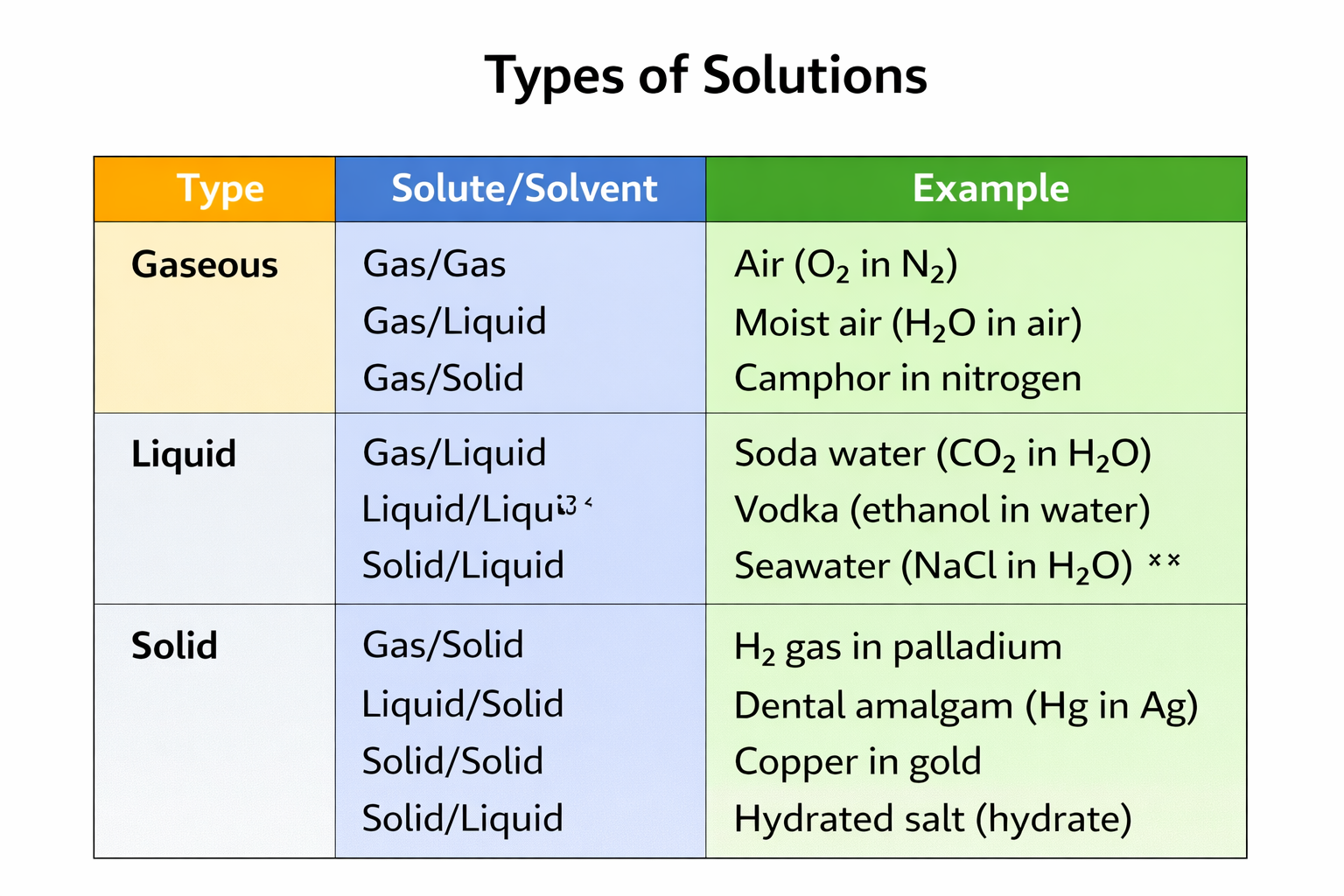
Figure below:
A clear, colourful table showing the 'Types of Solutions' with three columns: Type (Gaseous, Liquid, Solid), Solute/Solvent combinations, and common examples like 'Camphor in nitrogen' or 'Copper in gold'.
Practice Questions:
1. Which of the following is an example of a solid-in-solid solution?
(a) Amalgam of mercury with sodium
(b) Solution of hydrogen in palladium
(c) Copper dissolved in gold
(d) Glucose dissolved in water
✅ Answer: (c) is correct. Alloys like copper in gold are solid solutions where both solute and solvent are solids.
2. Intravenous injections are always dissolved in water containing salts to match the concentration of:
(a) Pure water
(b) Blood plasma
(c) Soda water
(d) Ethyl alcohol
✅ Answer:* (b) is correct. To be safe, the ionic concentration must match blood plasma.
Key Takeaway
- Solution: A homogeneous mixture.
- Solvent: Component in the largest quantity; determines the state.
- Binary Solution: Contains only two components.
- Composition Matters: $1~ppm$ $F^{-}$ = Healthy teeth; $1.5~ppm$ $F^{-}$ = Mottled teeth.
2. Types of Solutions
Hey junior! Let’s clear up this "funda" about what solutions actually are. In the real world, finding a pure substance is like finding a rickshaw in Mumbai that agrees to go exactly where you want without a fuss—nearly impossible!. Most things we encounter are mixtures, and their properties depend heavily on their composition.
A solution is basically a homogeneous mixture of two or more components, meaning its composition and properties are uniform throughout. The component present in the largest quantity is the solvent, and it’s the "big boss" because it determines the physical state of the solution. The other components are called solutes. If you are dealing with exactly two components, we call it a binary solution.
NEET Checkpoint:
What determines the physical state (solid, liquid, or gas) of a solution?
(a) Physical state of the solute
(b) Chemical nature of the solute
(c) Physical state of the solvent
(d) Amount of solute dissolved
✅ Answer: (c) The solvent — Since it's the component in the largest quantity, the solution takes its state.
We classify solutions based on the physical state of the solvent:
* Gaseous Solutions: Solvent is a gas. A cool example is camphor in nitrogen gas (solid solute in gas solvent).
* Liquid Solutions: Solvent is a liquid. Think of glucose dissolved in water.
* Solid Solutions: Solvent is a solid. A classic example is an amalgam of mercury with sodium (liquid solute in solid solvent).
Imagine you're at a local Pani Puri stall. The spicy pani is a solution where water is the solvent. If you're just mixing salt in water for a quick home remedy, that's your binary solution right there!.
NEET Checkpoint:
A mixture of chloroform vapour and nitrogen gas is classified as which type of solution?
(a) Gaseous solution
(b) Liquid solution
(c) Solid solution
(d) Colloidal solution
✅ Answer: (a) Gaseous solution — Nitrogen is the gaseous solvent.
NEET Checkpoint:
Which of these is a solid solution?
(a) Ethanol in water
(b) Solution of hydrogen in palladium
✅ Answer: (b) Solution of hydrogen in palladium — Palladium is a solid solvent.
Don't sweat the small stuff, yaar; even the brass in a trophy is just a solid solution of copper and zinc!.
Practice Questions:
- A binary solution must contain:
(a) At least three components
(b) Exactly two components
(c) Only liquid components
(d) One solvent and multiple solutes
✅ Answer: (b) — By definition, binary solutions consist of exactly two components.
2. Which of the following is an example of a liquid solute in a solid solvent?
(a) Copper dissolved in gold
(b) Amalgam of mercury with sodium
(c) Chloroform mixed with nitrogen
(d) Solution of hydrogen in palladium
✅ Answer: (b) — Mercury is liquid (solute) and sodium is solid (solvent).
Key Takeaway
- Solvent: Largest quantity; determines state.
- Solute: Component(s) other than the solvent.
- Binary Solution: Exactly two components.
- Crucial Examples: Camphor in $N_{2}$ (Solid-Gas), Amalgams (Liquid-Solid).
3. Concentration: Mass and Volume Percentages
Listen up, junior! In chemistry, we can't just say a solution is 'strong' or 'weak'—that's way too vague, yaar. We need the exact quantitative funda to describe how much solute is hiding in there.
First, we have Mass percentage ($w/w$). It’s simply the mass of a component divided by the total mass of the solution, multiplied by $100$. Think of a halwai making a huge batch of mithai. If the sugar syrup is $10\% (w/w)$ glucose, it means $10 g$ of glucose is mixed with $90 g$ of water to give you $100 g$ of solution.
NEET Checkpoint:
A commercial bleaching solution contains $3.62\%$ sodium hypochlorite by mass. What does this represent?
(a) $3.62 g$ in $100 mL$
(b) $3.62 mL$ in $100 mL$
(c) $3.62 g$ in $100 g$
(d) $3.62 g$ in $1 L$
✅ Answer: (c) $3.62 g$ in $100 g$ — Mass percentage ($w/w$) is mass of solute per $100 g$ of solution.
Next is Volume percentage ($v/v$), usually for liquid-in-liquid solutions.
Notice this cool application: a $35\% (v/v)$ solution of ethylene glycol is used as an antifreeze in car engines. It’s so effective that it lowers the freezing point of water to $255.4 K$ $(-17.6^\circ C)$—perfect for those winter trips to Shimla!
NEET Checkpoint:
Which unit is used for a $35\%$ ethylene glycol antifreeze solution?
(a) $w/w$
(b) $v/v$
(c) $w/V$
(d) ppm
✅ Answer: (b) $v/v$ — Liquid components are commonly expressed in volume percentage.
Then there's Mass by volume percentage ($w/V$). This is the mass of solute dissolved in $100 mL$ of the solution. Don't be a tube light—you’ll see this everywhere in medicine and pharmacy!
NEET Checkpoint:
If you find a medicine bottle labelled with $w/V$ units, what does it mean?
(a) Volume of solute in $100 mL$
(b) Mass of solute in $1 kg$
(c) Mass of solute in $100 mL$
(d) Moles per litre
✅ Answer: (c) Mass of solute in $100 mL$ — This is the standard definition for $w/V$ used in pharmacy.
Practice Question:
A solution is prepared by dissolving $10 mL$ of ethanol in water to make a total volume of $100 mL$. This is:
(a) $10\% (w/w)$
(b) $10\% (v/v)$
(c) $10\% (w/V)$
(d) $0.1\% (v/v)$
✅ Answer: (b) $10\% (v/v)$. Since both are liquids and it's volume per total volume, it's $v/v$.
Key Takeaway
Formula Summary
- Mass % ($w/w$): $\frac{Mass~of~component}{Total~mass~of~solution} \times 100$
- Volume % ($v/v$): $\frac{Volume~of~component}{Total~volume~of~solution} \times 100$
- Mass by Volume % ($w/V$): $\frac{Mass~of~solute~(g)}{100~mL~of~solution}$
4. Concentration: Mole Fraction and ppm
Hey junior! Ready to master the tiny details? Sometimes, the amount of solute is so small that using "molarity" feels like measuring a pinch of salt with a weighing bridge. Let's clear up the funda of ppm and Mole Fraction!
Parts Per Million (ppm)
When a solute is present in "trace" quantities—like a single drop of ink in a bucket of water—we use ppm. It’s defined as:
Think of it like this: if you’re at a massive cricket stadium with $1,000,000$ fans and only $5$ are wearing yellow jerseys, that's $5 \text{ ppm}$! It's commonly used to measure pollutants in the air or dissolved oxygen in sea water, which is a tiny $5.8 \text{ g}$ per $10^6 \text{ g}$ of sea water ($5.8 \text{ ppm}$).
NEET Checkpoint:
Which unit is most suitable for expressing the concentration of pollutants in the atmosphere?
(a) Molarity
(b) Mass percentage
(c) ppm
(d) Molality
✅ Answer: (c) ppm — Pollutants are usually present in trace quantities, making ppm the most convenient unit.
Mole Fraction ($x$)
This is the "fair share" of moles a component has in the total mixture. The symbol used is $x$. For a component $A$ in a mixture:
Here's the trick: The sum of all mole fractions in a solution is always unity (1).
If you know the mole fraction of one part of a binary solution is $0.3$, the other MUST be $0.7$. No heavy math needed, yaaar!
NEET Checkpoint:
In a mixture of $A, B,$ and $C$, if $x_A = 0.2$ and $x_B = 0.5$, what is $x_C$?
(a) $0.2$
(b) $0.3$
(c) $0.5$
(d) $0.7$
✅ Answer: (b) $0.3$ — Since the sum must be $1$ ($0.2 + 0.5 + 0.3 = 1$).
Why does this matter?
Mole fraction is super useful because it relates physical properties, like vapour pressure, to the concentration of the solution. Also, since it's a ratio of moles (which depend on mass), it is independent of temperature. Volume might change when it's hot in Delhi, but your mole fraction stays solid!.
NEET Checkpoint:
Why is mole fraction preferred over molarity for some scientific calculations?
(a) It depends on the volume of the solution
(b) It changes with temperature
(c) It is independent of temperature and pressure
(d) It is easier to calculate
✅ Answer: (c) It is independent of temperature because it does not involve volume terms.
Practice Questions:
A solution contains $20\%$ ethylene glycol by mass. What is the mole fraction of water?
(a) $0.068$
(b) $0.932$
(c) $0.500$
(d) $0.200$
✅ Answer: (b) $0.932$ — In $100 \text{ g}$ solution, we have $20 \text{ g}$ glycol and $80 \text{ g}$ water. Calculating moles ($n$) and then $x_{\text{water}} = n_{\text{water}} / (n_{\text{water}} + n_{\text{glycol}})$ gives $0.932$.
Key Takeaway
Formula Summary
* ppm $= \frac{\text{Parts of component}}{\text{Total parts}} \times 10^6$
* Mole Fraction ($x_i$) $= \frac{n_i}{\sum n_i}$
* Sum Rule: $\sum x_i = 1$
* Note: Both are temperature-independent!
5. Concentration: Molarity and Molality
Listen up, junior! Don't let these two "M" words scramble your brain right before the exam. Let’s clear up this funda once and for all. Molarity ($M$) is basically the "social butterfly" of concentrations—it’s the number of moles of solute dissolved in exactly one litre (or one cubic decimetre) of solution.
But here’s the catch: Molarity is a bit of a drama queen when it comes to heat. Since volume expands or contracts with temperature, Molarity changes as temperature changes.
Now, meet Molality ($m$). This one is the "steady student"—it's the number of moles of solute per kilogram ($kg$) of the solvent.
NEET Checkpoint:
Which unit is defined per kg of solvent?
(a) Molarity
(b) Molality
✅ Answer: (b) Molality — Arre, remember it’s per kg of solvent, not solution!.
Why is Molality so popular in labs? Because it’s independent of temperature! Since mass doesn’t care if it's hot or cold, mass-based units like Mass %, ppm, mole fraction, and molality stay constant.
NEET Checkpoint:
If the temperature of a solution increases, what happens to its Molarity?
(a) It increases
(b) It decreases
(c) It remains constant
(d) It becomes zero
✅ Answer: (b) It decreases — Volume increases with temperature, so $M$ (moles/volume) goes down.
Imagine you're at a pani puri stall. If the vendor measures his "theeka pani" by the litre bottle, that’s like Molarity—if the sun beats down and the liquid expands slightly, his concentration technically shifts. But if he weighed the water on a scale first, that would be like Molality—rock solid and reliable!
NEET Checkpoint:
Units of Molarity are:
(a) $mol~L^{-1}$
(b) $mol~kg^{-1}$
✅ Answer: (a) $mol~L^{-1}$ — Easy peasy, right?.
Practice Question:
A solution is prepared by dissolving $1~mol$ of $KCl$ in $1~kg$ of water. This solution is:
(a) $1~M$
(b) $1~m$
✅ Answer: (b) $1~m$ — Because it is per kg of solvent, it is molal ($m$), not molar ($M$).
Key Takeaway
Formula Summary
- Molarity ($M$): $\frac{\text{moles}}{\text{Volume (L)}}$ (Temp dependent!)
- Molality ($m$): $\frac{\text{moles}}{\text{Mass of solvent (kg)}}$ (Temp independent!)
- Stable units: Mass %, ppm, mole fraction, molality.
6. Solubility of Solids in Liquids
Let's clear up this solubility funda, yaar. Think of it like socialising at a cricket match—Dhoni fans love hanging out with other Dhoni fans, but they might not vibe as well with someone who doesn't even know what a Yorker is! This is exactly what we call "Like dissolves like". Polar solutes (like salt or sugar) dissolve easily in polar solvents like water, but non-polar naphthalene? No chance! It prefers non-polar benzene.
NEET Checkpoint:
Which substance will dissolve in benzene?
(a) $NaCl$
(b) Glucose
(c) Anthracene
(d) Water
✅ Answer: (c) Anthracene — Because non-polar solutes love non-polar solvents, bindaas!
When you stir sugar into your afternoon chai, two things happen: dissolution (sugar particles entering the liquid) and crystallisation (solute particles colliding and separating out). When the rates of both match, we hit dynamic equilibrium.
NEET Checkpoint:
At dynamic equilibrium, the rate of dissolution is...
(a) Greater than the rate of crystallisation
(b) Less than the rate of crystallisation
(c) Equal to the rate of crystallisation
(d) Zero
✅ Answer: (c) Equal to the rate of crystallisation — It's a perfectly balanced two-way street!
A saturated solution is like your stomach after a heavy Sunday Chhole Bhature feast—at that temperature, you simply cannot fit in another bite. If you can still manage a Gulab Jamun, you're unsaturated.
Now, the temperature trick! Following Le Chatelier’s Principle, if dissolving the solid is endothermic ($\Delta_{sol}H > 0$), heating things up increases solubility. But if it’s exothermic ($\Delta_{sol}H < 0$), heat is the enemy and solubility drops. Pressure? It’s basically irrelevant here because solids and liquids are way too stubborn (incompressible) to care about it.
NEET Checkpoint:
What is the effect of increasing pressure on the solubility of salt in water?
(a) Solubility increases greatly
(b) Solubility decreases
(c) No significant effect on solubility
(d) Salt becomes insoluble
✅ Answer:(c) No significant effect — Solids and liquids are practically incompressible, yaar!
Practice Question:
In a nearly saturated solution where the dissolution process is endothermic, what happens if the temperature is lowered?
(a) Solubility increases
(b) Solubility decreases
(c) No change
(d) Crystallisation stops
✅ Answer: (b) Solubility decreases — According to Le Chatelier’s Principle, for $\Delta_{sol}H > 0$, solubility follows temperature.
Key Takeaway:
- Rule: Polar dissolves polar; non-polar dissolves non-polar.
- Equilibrium: Rate of dissolution = Rate of crystallisation.
- Temp Effect: If $\Delta_{sol}H > 0$, $T \uparrow \text{ Solubility} \uparrow$; if $\Delta_{sol}H < 0$, $T \uparrow \text{ Solubility} \downarrow$.
7. Solubility of Gases: Henry’s Law
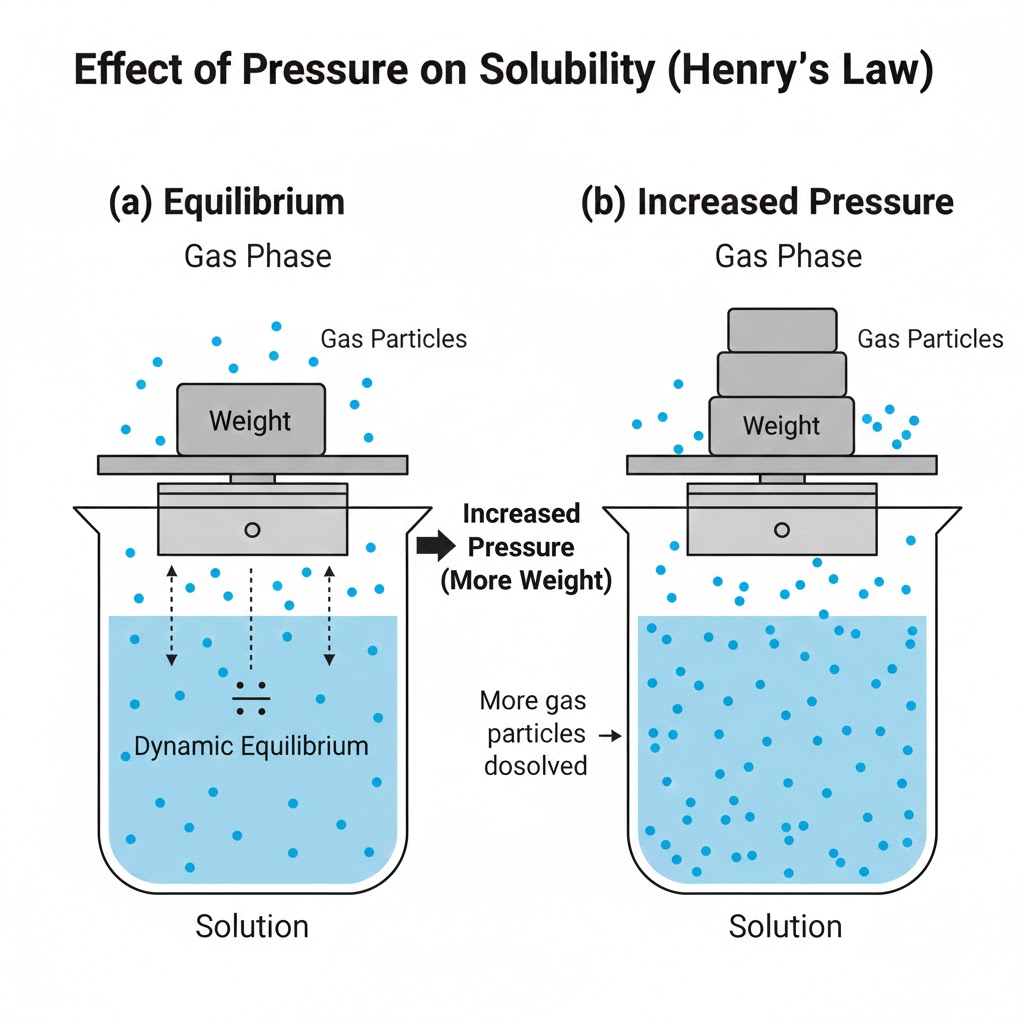
Listen up, junior! Ever wondered why a cold Pepsi tastes so much better than a warm, flat one? It’s all down to a neat little "funda" called Henry’s Law. Basically, at a constant temperature, the solubility of a gas in a liquid is directly proportional to its partial pressure ($p$) above the liquid.
Think of a crowded Mumbai local train. If the "pressure" from the crowd on the platform increases, more people are forced into the train compartment. Similarly, the more pressure you apply, the more gas molecules get "dissolved" into the liquid.
The most common way to write this is:
where $\chi$ is the mole fraction of the gas in the solution and $K_H$ is the Henry’s law constant.
NEET Checkpoint:
If pressure ($p$) is constant, what is the relationship between $K_H$ and solubility?
(a) Directly proportional
(b) Inversely proportional
(c) Exponentially proportional
(d) No relation
✅ Answer: (b) Inversely proportional - Higher $K_H$ means lower solubility at the same pressure.
Here’s the catch: $K_H$ isn't a fixed number. It depends on the nature of the gas and temperature. As temperature increases, $K_H$ also increases, which means the gas becomes less soluble. This is why fish prefer cold water—it has more dissolved oxygen than warm water!
NEET Checkpoint:
To increase the solubility of $CO_2$ in soda, how is the bottle sealed?
(a) At low pressure
(b) At atmospheric pressure
(c) At high pressure
(d) In vacuum
✅ Answer: (c) Under high pressure to force more gas into the liquid.
Life isn't always smooth for scuba divers, though. High pressure underwater forces more atmospheric gases into their blood. If they surface too fast, nitrogen forms bubbles, blocking capillaries—a painful and scary condition called bends. To avoid this, their tanks are diluted with Helium ($11.7\%$), $N_2$ ($56.2\%$), and $O_2$ ($32.1\%$). On the flip side, climbers at high altitudes face Anoxia, where low partial pressure of oxygen makes them weak and unable to think clearly.
Figure below:
A two-part diagram showing (a) a piston over a solution with gas particles in equilibrium and (b) the same piston pushed down (increased weight) causing more gas particles to dissolve into the solution.
NEET Checkpoint:
What causes "Anoxia" in climbers at high altitudes?
(a) Low oxygen availability in air
(b) Low atmospheric pressure
(c) Both low oxygen availability and low pressure
(d) High carbon dioxide concentration
✅ Answer: (c) Low partial pressure of oxygen in the air, leading to low oxygen concentrations in blood and tissues.
Practice Questions:
-
The Henry's law constant ($K_H$) for oxygen in water increases as the temperature rises. This implies:
(a) Solubility increases with temperature
(b) Solubility decreases with temperature
(c) Solubility remains constant
(d) Pressure increases linearly
✅ Answer: (b) — Higher $K_H$ at a given pressure always means lower solubility.
2. Scuba divers use air diluted with helium primarily to:
(a) Increase oxygen intake
(b) Prevent the toxic effects of high nitrogen concentration and avoid "bends"
(c) Help them float better
(d) Decrease the pressure of the tank
✅ Answer: (b) — Diluting with helium helps avoid the dangerous formation of nitrogen bubbles in the blood.
Key Takeaway
Formula Summary
- Henry's Law Equation:$$p = K_H \chi$$
- Units of $K_H$: Typically $kbar$, $Pa$, or $torr$.
- Key Rule: $\uparrow$ Temperature $\rightarrow$ $\uparrow K_H$ $\rightarrow$ $\downarrow$ Solubility.
8. Vapour Pressure and Raoult’s Law
Listen up, juniors! Ever wondered why your tea stays hot or why adding salt changes how things boil? Let's crack the Vapour Pressure funda. When you have volatile liquids in a closed container, they evaporate until an equilibrium is hit. Francois Marte Raoult figured out the secret sauce: for volatile liquids, the partial vapour pressure ($p_i$) of any component is directly proportional to its mole fraction ($x_i$).
Mathematically, it’s just:
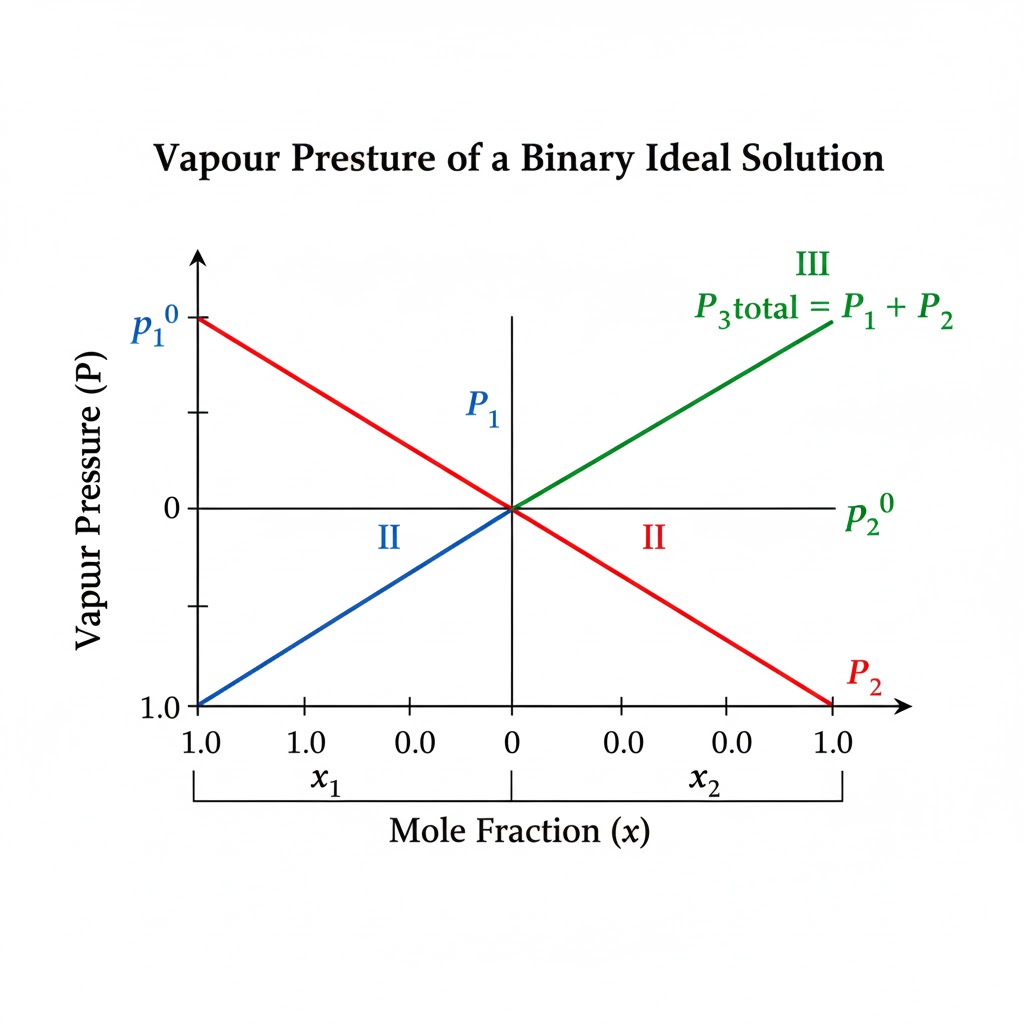
Here, $p_1^0$ is the vapour pressure of the pure component. Simple, right? If you mix two volatile liquids, the total vapour pressure ($p_{total}$) is a neat linear function of the mole fraction.
NEET Checkpoint:
Is the total vapour pressure over a solution a linear function of the mole fraction?
(a) Yes, for ideal solutions
(b) No, it is always non-linear
(c) Only for dilute solutions
(d) Independent of mole fraction
✅ Answer: (a) Yes — According to Raoult's Law, $p_{total}$ varies linearly with the mole fraction of the components.
Figure below:
A clear line graph showing Vapour Pressure on the y-axis and Mole Fraction ($x$) on the x-axis. Line I decreases from $p_1^0$ to 0 as $x_1$ goes from 1 to 0. Line II increases from 0 to $p_2^0$ as $x_2$ goes from 0 to 1. A solid Line III ($p_{total}$) connects $p_1^0$ and $p_2^0$.
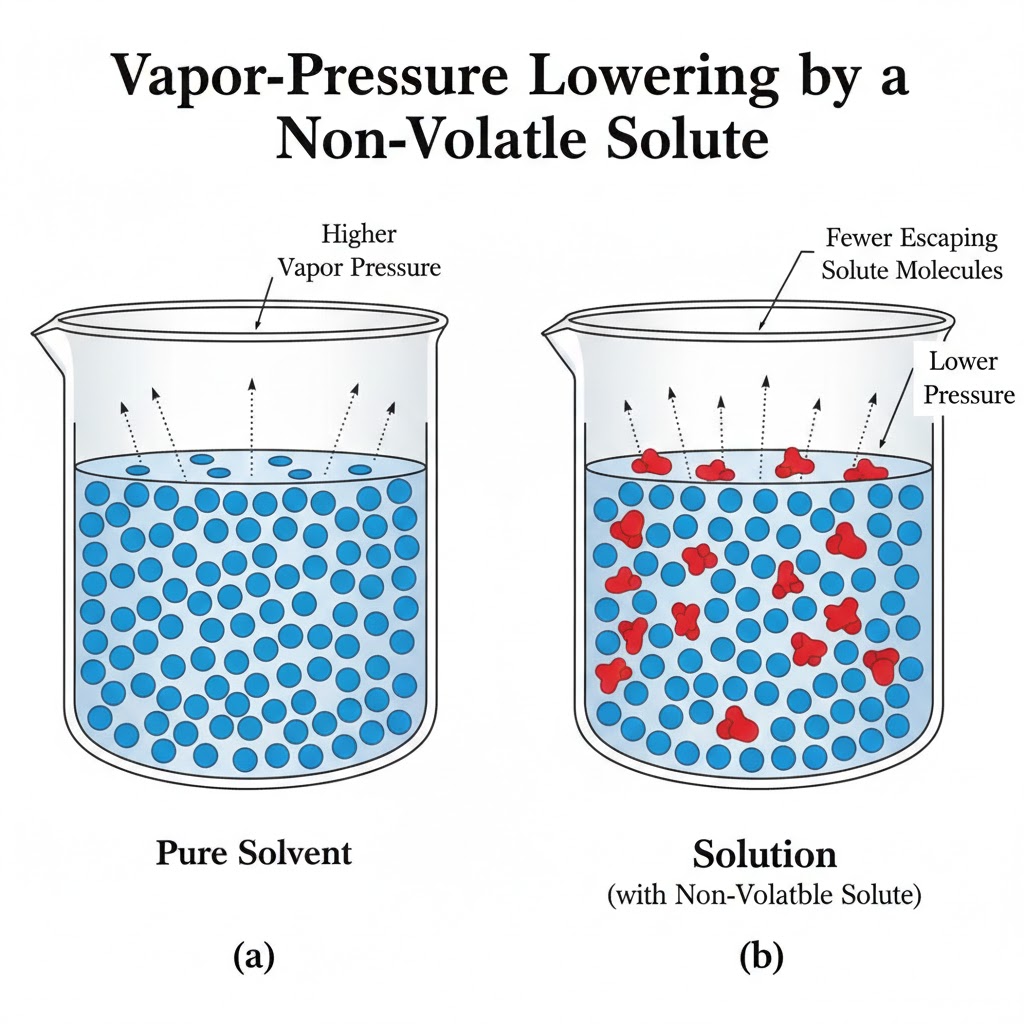
Now, imagine a crowded Pani Puri stall. If the counter is blocked by people who aren't even eating (our non-volatile solute), fewer actual customers (solvent molecules) can reach the front to get their puris (evaporate). This is why adding a non-volatile solute always lowers the vapour pressure of the solvent.
NEET Checkpoint:
Why does a non-volatile solute lower the vapour pressure?
(a) It increases the temperature of the solution
(b) It reacts with the solvent
(c) It occupies surface area
(d) It increases the volume of the solution
✅ Answer: (c) It occupies surface area — Fewer solvent molecules can escape from the surface into the vapour phase.
Interestingly, Raoult’s Law is just a special case of Henry’s Law! Both say $p \propto x$. The only twist? In Raoult’s, the proportionality constant is the pure component's pressure ($p_1^0$), while in Henry’s, it’s $K_H$.
NEET Checkpoint:
When does Raoult's Law identical to Henry's Law?
(a) When the solution shows positive deviation
(b) When the solution shows negative deviation
(c) When $K_H$ equals $p_1^0$
(d) When the solute is non-volatile
✅ Answer: (c) When $K_H$ equals $p_1^0$ — The mathematical form of both laws becomes identical.
Practice Question:
In a binary solution, if component 1 is less volatile than component 2 ($p_1^0 < p_2^0$), the minimum value of $p_{total}$ is:
(a) $p_2^0$
(b) $p_1^0$
(c) 0
(d) $p_1^0 + p_2^0$
✅ Answer: (b) $p_1^0$ — The total pressure ranges linearly between the vapour pressures of the two pure components.
Now that you've got this, wait till you see how this pressure drama leads us into the world of Ideal and Non-ideal solutions!
Key Takeaway
Formula Summary
- Raoult's Law (Volatile):$$p_1 = p_1^0 x_1$$
- Total Pressure:$$p_{total} = p_1^0 + (p_2^0 - p_1^0)x_2$$
- Relative Lowering of Vapour Pressure:$$\frac{p_1^0 - p_1}{p_1^0} = x_2$$
9. Ideal Solutions: The Perfect "Jodi"
Ever wondered if two liquids could just... get along perfectly? That’s exactly what an ideal solution is all about! According to the sources, these are solutions that obey Raoult’s Law over their entire concentration range. It’s like a perfect friendship where there’s no drama—just pure chemistry!
Notice this: for a solution to be ideal, it must satisfy two strict thermodynamic criteria. First, the enthalpy of mixing must be zero,
, meaning no heat is absorbed or evolved when you mix the components. Second, the volume of mixing must also be zero,
. This means if you mix $50~mL$ of A and $50~mL$ of B, you get exactly $100~mL$—not a drop more or less! Don't stress, yaar—it's simpler than it looks.
NEET Checkpoint:
For an ideal solution, what is the value of $\Delta_{mix}V$?
(a) $> 0$
(b) $< 0$
(c) $= 0$
(d) $\infty$
✅ Answer: (c) $= 0$ — Arre, it's a perfect mix! The total volume is just the sum of individual volumes.
Why does this happen? At the molecular level, the intermolecular attractive interactions between the different components ($A-B$) are nearly equal to those in the pure states ($A-A$ and $B-B$). Think of it like a cricket team where the school friends and tuition friends mix together; if everyone treats the newcomers exactly like their old buddies, the "team chemistry" remains perfectly ideal!
NEET Checkpoint:
Which interactions are nearly equal in an ideal solution?
(a) A−A only
(b) B−B only
(c) A−B only
(d) $A-A \approx B-B \approx A-B$
✅ Answer: (d) $A-A \approx B-B \approx A-B$ — This molecular balance is the "funda" behind ideal behaviour.
Common examples you'll see in your papers include n-hexane and n-heptane, or benzene and toluene. While perfectly ideal solutions are rare, these pairs are the closest real-world examples we have.
NEET Checkpoint:
Is a mixture of bromoethane and chloroethane ideal?
(a) Yes, it forms an ideal solution
(b) No, it forms a non-ideal solution
(c) Only at high temperature
(d) Only at low temperature
✅ Answer: (a) Yes — These molecules have similar sizes and polarities, making their interactions nearly equal.
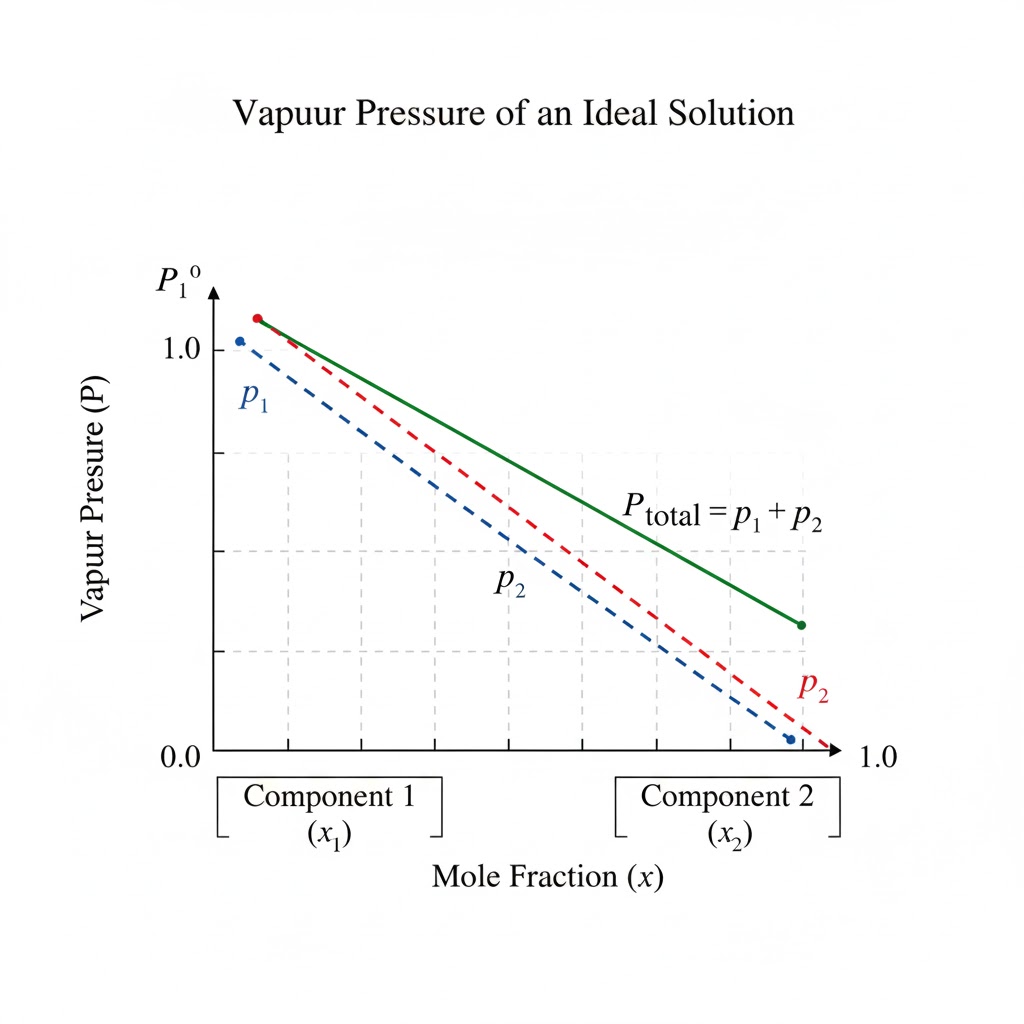
Figure below:
A clear linear graph showing vapour pressure on the y-axis and mole fraction on the x-axis for an ideal solution. Include two dashed lines for partial pressures $p_1$ and $p_2$ and a solid straight line on top for $p_{total}$.
Practice Questions:
Which of the following is a characteristic of an ideal solution?
(a) $\Delta_{mix}H > 0$
(b) Obeyance of Raoult's Law
(c) $\Delta_{mix}V < 0$
(d) Large change in temperature
✅ Answer: (b) — By definition, ideal solutions must obey Raoult's Law at all concentrations.
Key Takeaway
Formula Summary:
- Raoult's Law: $p_1 = x_1 p_1^0$ and $p_2 = x_2 p_2^0$
- Thermodynamic Criteria: $\Delta_{mix}H = 0$ and $\Delta_{mix}V = 0$
- Interactions: $A-A \approx B-B \approx A-B$
10. Non-Ideal Solutions: Deviations
Arre yaar, don't let the word "Non-Ideal" scare you! While ideal solutions are like those perfect students who follow every rule, most real-world solutions have a bit of "nakhras" (tantrums). When a solution doesn't obey Raoult's law over its entire concentration range, we call it non-ideal. The vapour pressure is either higher or lower than what the formula predicts. Let’s clear up this funda!
Positive Deviation: The "I Need Space" Vibe
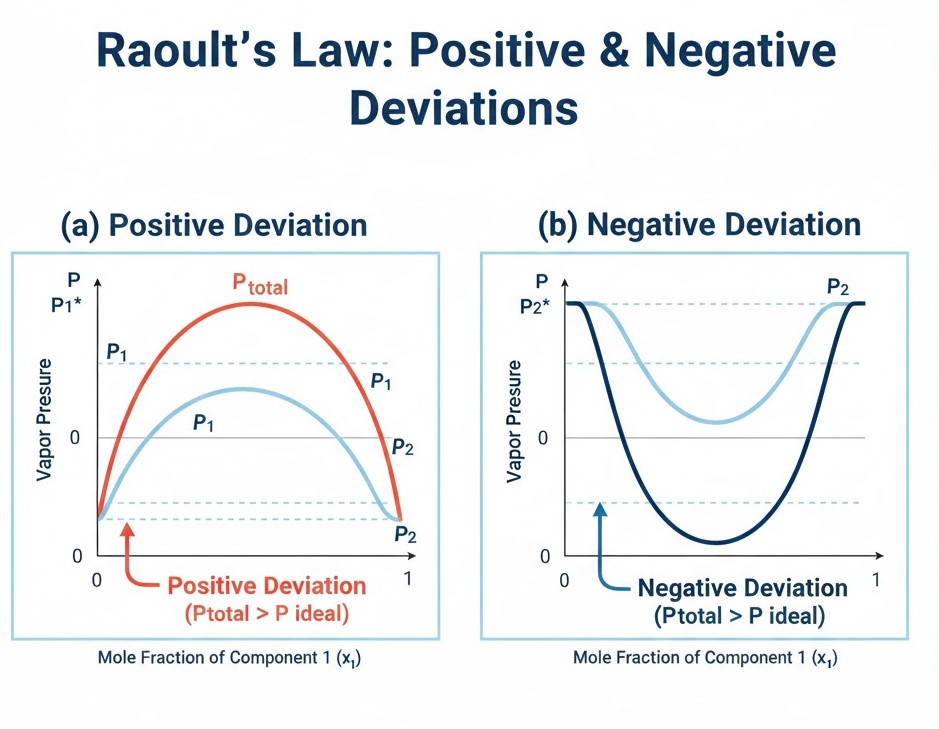
In positive deviation, the total vapour pressure is higher than expected. This happens because the new $A-B$ interactions are weaker than the original $A-A$ or $B-B$ interactions.
NEET Checkpoint:
In positive deviation, the intermolecular forces in the solution are:
(a) Stronger than pure components
(b) Weaker than pure components
✅ Answer: (b) — Because they don't "stick" well, molecules escape into vapour easily!
Think of two cricketers who don't get along; they’d rather be back in the pavilion than standing together on the pitch! Because they don't vibe (weak interactions), they "evaporate" from the field faster. A classic example is ethanol and acetone. In pure ethanol, molecules are held by strong hydrogen bonds. When you add acetone, it gets between the ethanol molecules and breaks some of those bonds, making it easier for them to escape.
Negative Deviation: The "Strong Connection" Vibe
Here, the vapour pressure is lower than predicted. This occurs when $A-B$ interactions are stronger than $A-A$ or $B-B$. It’s like a group of friends at a pani puri stall—they are so busy gossiping (strong interactions) that no one wants to leave!
NEET Checkpoint:
Which mixture shows negative deviation?
(a) Ethanol + Acetone
(b) Chloroform + Acetone
✅ Answer: (b) — Chloroform forms a new hydrogen bond with acetone, pinning the molecules down.
NEET Checkpoint:
What happens to the escaping tendency of molecules in negative deviation?
(a) Increases
(b) Decreases
(c) Remains the same as ideal solution
(d) Becomes zero
✅ Answer: (b) It decreases because the $A-B$ attractive forces are stronger than in pure states.
Figure below:
A dual-pane pressure-composition plot. Graph (a) shows three curves (total pressure, p1, and p2) all arching above the dashed linear Raoult's Law lines to represent positive deviation. Graph (b) shows the three curves dipping below the dashed linear lines to represent negative deviation.
Practice Questions:
1. Which of the following is true for a mixture showing positive deviation?
(a) $\Delta_{mix}V < 0$
(b) $A-B$ interactions < $A-A$ interactions
(c) It forms a maximum boiling azeotrope
(d) Vapour pressure decreases
✅ Answer: (b) — Weaker $A-B$ interactions are the root cause of the "positive" escape of molecules.
2. Chloroform and acetone show negative deviation because of:
(a) Dipolar interactions
(b) Van der Waals forces
(c) Hydrogen bonding
(d) London forces
✅ Answer: (c) — The phenolic proton or chloroform H forms a bond with the oxygen of acetone.
Key Takeaway
- Positive Deviation: $A-B < A-A/B-B \rightarrow$ Higher Vapour Pressure (e.g., Ethanol + Acetone).
- Negative Deviation: $A-B > A-A/B-B \rightarrow$ Lower Vapour Pressure (e.g., Chloroform + Acetone).
11. Azeotropes
Now we’re getting into the "best friends" of the chemistry world—Azeotropes. These are special binary mixtures that have the same composition in both the liquid and vapour phases. Because they behave like a single component, they boil at a constant temperature.
Think of it like a perfectly mixed plate of Pani Puri water—no matter how much you boil it, the "theeka" and "meetha" are so locked together that they evaporate in the exact same ratio! Because of this "bestie" bond, you cannot separate the components of an azeotrope using fractional distillation. Don't worry, it’s not magic, just chemistry!
NEET Checkpoint:
Azeotropes are mixtures of how many components?
(a) 1
(b) 2
(c) 3
(d) 4
✅ Answer: (b) 2 — The sources explicitly define them as binary mixtures.
There are two main types you need to memorize for the exam:
- Minimum Boiling Azeotropes: These are formed by solutions showing a large positive deviation from Raoult's law. A classic example is the ethanol-water mixture; at approximately $95\%$ ethanol by volume, it becomes an azeotrope.
- Maximum Boiling Azeotropes: These happen when there’s a large negative deviation. For example, a mixture of $68\%$ nitric acid and $32\%$ water by mass boils at a constant $393.5~K$.
NEET Checkpoint:
A solution showing large negative deviation forms which azeotrope?
(a) Ideal solution
(b) Minimum boiling
(c) Maximum boiling
(d) No azeotrope
✅ Answer: (c) Maximum boiling — Stronger interactions mean molecules find it harder to escape, raising the boiling point.
NEET Checkpoint:
Can we separate 95% ethanol by fractional distillation?
(a) Yes, easily
(b) No, because it forms an azeotrope
(c) Only at high pressure
(d) Only by adding water
✅ Answer: (b) No — At this specific composition, the liquid and vapour have the same composition.
Practice Question:
Which of the following is an example of a maximum boiling azeotrope?
(a) 95% Ethanol
(b) 68% Nitric acid
(c) n-hexane and n-heptane
(d) Benzene and toluene
✅ Answer: (b) — The sources specify 68% nitric acid and 32% water as a maximum boiling azeotrope.
Key Takeaway: Azeotropes
- Definition: Binary mixtures with identical liquid/vapour compositions.
- Minimum Boiling: Large positive deviation (e.g., $95\%$ ethanol).
- Maximum Boiling: Large negative deviation (e.g., $68\%$ nitric acid).
- Trick: They boil at a constant temperature like a pure liquid!
12. Colligative Properties: Lowering of Vapour Pressure
Hey junior! Ready to tackle the "team spirit" of solutions? Colligative properties are like a cricket team’s total score—it doesn't matter which player hits the boundary, only how many boundaries are hit in total. These properties depend solely on the number of solute particles, not their nature or identity.
NEET Checkpoint:
Colligative properties depend on:
(a) Nature of solute
(b) Number of solute particles
(c) Nature of solvent
(d) Chemical identity
✅ Answer: (b) Number of solute particles — Simple funda, yaar! It's all about the quantity, not the quality.
When you add a non-volatile solute (like salt in your nimbu paani), it sits on the surface like a slow rickshaw blocking a narrow lane. Because these solute particles occupy the surface area, fewer solvent molecules can escape into the vapour phase. Consequently, the vapour pressure of the solution is always lower than that of the pure solvent.
Raoult established that this Relative Lowering of Vapour Pressure (RLVP) is equal to the mole fraction of the solute, $x_2$. Notice this:
NEET Checkpoint:
If the pure solvent pressure $p_1^0$ is $100\text{ mm Hg}$ and solution pressure $p_1$ is $95\text{ mm Hg}$, the RLVP is:
(a) $5$
(b) $0.05$
(c) $0.95$
(d) $1.05$
✅ Answer: (b) $0.05$ — Calculate it as $(100 - 95) / 100 = 0.05$.
Figure below:
A diagram showing two containers: (a) Pure solvent with only solvent molecules at the surface escaping, and (b) A solution where the surface is shared by solvent and non-volatile solute particles, showing a reduced number of escaping solvent molecules.
For finding the molar mass ($M_2$) of a mystery solute, we use this formula for dilute solutions (where we ignore $n_2$ in the denominator):
NEET Checkpoint:
In the RLVP equation for dilute solutions, $n_2$ is neglected because:
(a) $n_2 > n_1$
(b) $n_2 \approx n_1$
(c) $n_2 \ll n_1$
(d) $n_1 = 0$
✅ Answer: (c) $n_2 \ll n_1$ — In a very dilute solution, the solute moles are negligible compared to the solvent.
Practice Question:
Adding $1.0\text{ mol}$ of sucrose to $1\text{ kg}$ of water lowers the vapour pressure nearly the same as adding $1.0\text{ mol}$ of urea to $1\text{ kg}$ of water. Why?
(a) Because sucrose and urea have the same molecular mass
(b) Because both are ionic compounds
(c) Because both provide the same number of particles
(d) Because both react with water
✅ Answer: (c) Because both provide the same number of particles. Colligative properties don't care if it's sugar or urea; they just count the heads!.
Key Takeaway
Formula Summary
- Relative Lowering of Vapour Pressure: $\frac{p_1^0 - p_1}{p_1^0} = x_2$
- Molar Mass Calculation ($M_2$): $M_2 = \frac{w_2 \times M_1 \times p_1^0}{w_1 \times (p_1^0 - p_1)}$
13. Elevation of Boiling Point
Hey there, future doctor! Ever noticed how a tea stall uncle adds sugar to the boiling water and suddenly the bubbling settles down for a second? That’s not magic; it’s pure chemistry! Let’s clear up this funda.
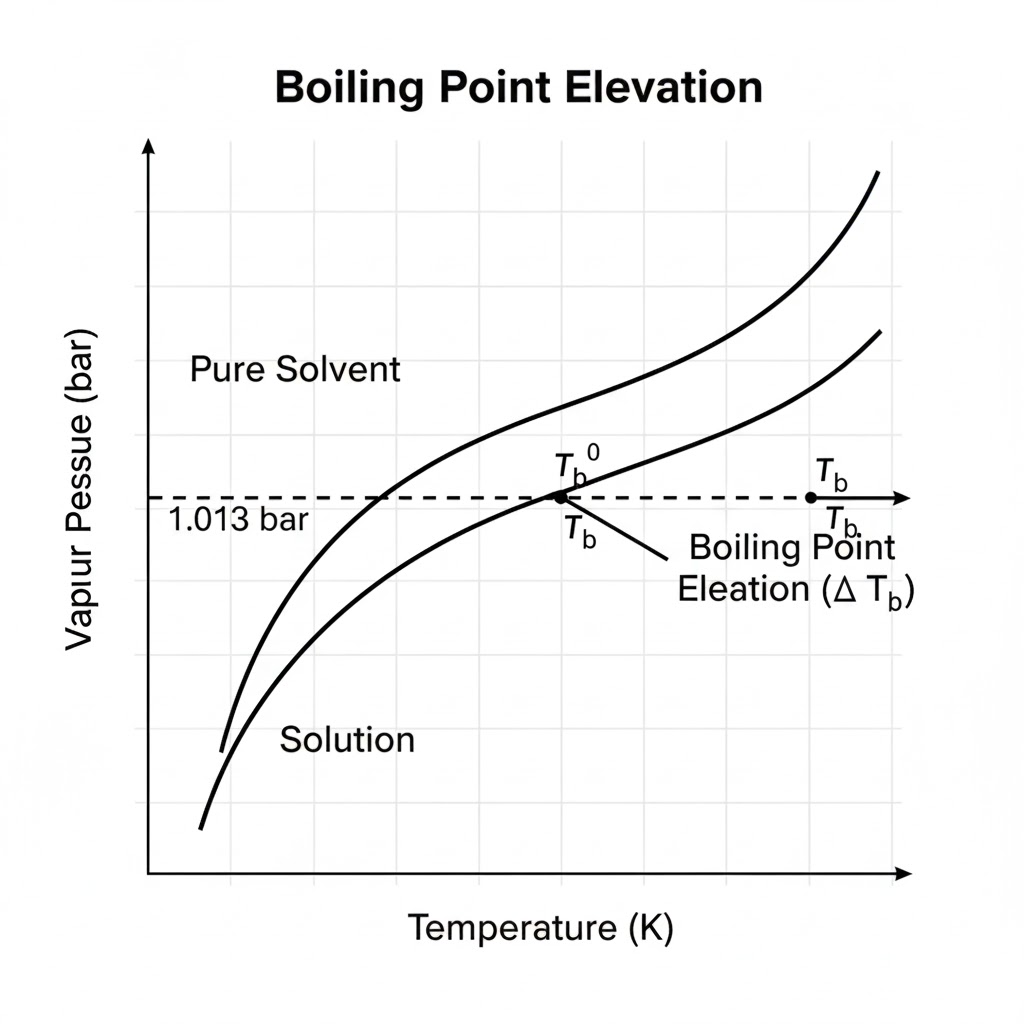
The boiling point of a liquid is simply the temperature where its vapour pressure equals the atmospheric pressure. For example, pure water boils at $373.15\ K$ because its vapour pressure hits $1.013\ bar$ at that point. But here’s the trick: when we add a non-volatile solute (like sugar or salt), the vapour pressure drops. To get it back up to atmospheric pressure, you need to heat it even more!. This "extra" temperature is what we call the Elevation of Boiling Point.
NEET Checkpoint:
At the boiling point, what is the relation between vapour pressure and atmospheric pressure?
(a) Vapour pressure < Atmospheric pressure
(b) Vapour pressure > Atmospheric pressure
(c) They are equal
(d) Vapour pressure is zero
✅ Answer: (c) They are equal — This is the basic definition you must remember for the exam!
Mathematically, if $T_b^0$ is the boiling point of pure solvent and $T_b$ is for the solution, the elevation is:
For dilute solutions, this elevation is directly proportional to molality ($m$):
Here, $K_b$ is the Ebullioscopic Constant (or Molal Elevation Constant). Its value depends on the nature of the solvent and its unit is $K\ kg\ mol^{-1}$.
NEET Checkpoint:
What is the unit of the Ebullioscopic Constant ($K_b$)?
(a)
(b)
(c)
(d)
✅ Answer: $K\ kg\ mol^{-1}$ — Don't get confused with $K/m$; it’s Kelvin-kilogram per mole!
Finding the Molar Mass
We can use this property to find the molar mass ($M_2$) of an unknown solute. If we dissolve $w_2\ g$ of solute in $w_1\ g$ of solvent, the formula is:
NEET Checkpoint:
Does the elevation of boiling point depend on the nature of the solute?
(a) Yes, it depends on the chemical nature
(b) No, it depends only on the number of solute particles
(c) Only for ionic solutes
(d) Only for molecular solutes
✅ Answer: (b) No — It is a colligative property, so it only depends on the number of solute particles.
Figure below:
A clear graph showing Vapour Pressure on the y-axis and Temperature/K on the x-axis. Two curves are shown: the upper curve for the "pure solvent" and the lower curve for the "solution". The boiling point elevation $\Delta T_b$ is marked as the horizontal distance between the two points where the curves intersect the 1.013 bar pressure line.
Example from the Dhaba: Imagine you're boiling water for Maggi. If you add the tastemaker (solute) before the water boils, it will actually take a slightly higher temperature to start bubbling than plain water would! Even chemistry needs a snack break sometimes!
Practice Questions:
1. A solution of $1\ mol$ of sucrose in $1000\ g$ of water boils at what temperature at $1\ atm$?
(a) $373.15\ K$
(b) $373.52\ K$
(c) $374.15\ K$
(d) $100\ K$
✅ Answer: (b) — According to the sources, this specific solution boils at $373.52\ K$.
2. The boiling point of a solution is always:
(a) Lower than the pure solvent
(b) Equal to the pure solvent
(c) Higher than the pure solvent
(d) Depends on the solute's colour
✅ Answer: (c) — Adding a non-volatile solute always raises the boiling point.
Key Takeaway
Formula Summary
- Boiling Point Elevation: $\Delta T_b = T_b - T_b^0$
- Molality Relation: $\Delta T_b = K_b m$
- Molar Mass Determination: $M_2 = \frac{1000 \times w_2 \times K_b}{\Delta T_b \times w_1}$
14. Freezing Point Depression and Osmosis
Hey there! Ready to chill? Literally. Let's clear up the funda of why we add salt to ice and how your RO filter actually works. It’s all about the pressure, yaar!
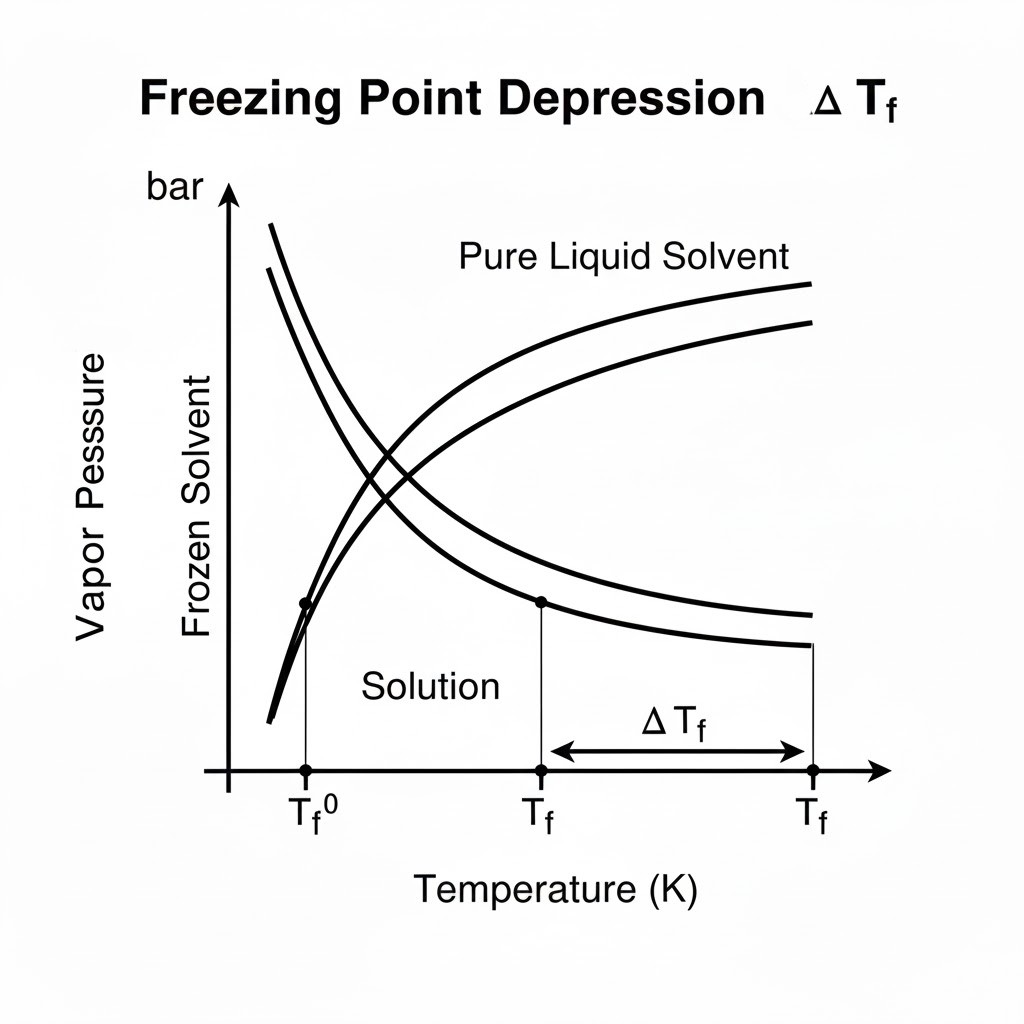
When you add a non-volatile solute to a solvent, the vapour pressure drops, and so does the freezing point. We call this Freezing Point Depression ($\Delta T_f$). The formula to remember is:
For dilute solutions, $\Delta T_f$ is directly proportional to molality ($m$):
Here, $K_f$ is the Cryoscopic Constant (or Molal Depression Constant). It depends solely on the nature of the solvent.
NEET Checkpoint:
What is the unit of the cryoscopic constant ($K_f$)?
(a) $K/m$
(b) $K~kg~mol^{-1}$
(c) $bar$
(d) $mol/L$
✅ Answer: (b) $K~kg~mol^{-1}$ — It’s simple! Just rearrange the formula to $K_f = \Delta T_f / m$.
Relatable Indian Example: Think of your local kulfi-wala! He adds salt to his ice-salt mixture in the hand-cart. This lowers the freezing point of the ice, keeping your kulfi frozen even in the sweltering heat!
Figure below:
A clear graph plotting vapour pressure against temperature, showing the curves for pure liquid solvent, frozen solvent, and the solution. Label the freezing point depression $\Delta T_f$ as the difference between the pure solvent freezing point $T_f^0$ and the solution freezing point $T_f$.
Next up: Osmosis! This is the flow of solvent through a Semipermeable Membrane (SPM) from pure solvent to solution. To stop this flow, we apply Osmotic Pressure ($\Pi$).
NEET Checkpoint:
Why is osmotic pressure preferred for finding the molar mass of proteins?
(a) It uses molality
(b) It's measured at high temps
(c) It has a large magnitude even for dilute solutions
(d) It's faster
✅ Answer: (c) — It’s a lifesaver for biomolecules that aren't stable at high temperatures!
Now, check your blood! Isotonic solutions have the same osmotic pressure. Our blood cells are isotonic with $0.9\%$ (mass/volume) NaCl. If you put them in a hypertonic solution (more than $0.9\%$ salt), they'll shrivel; in a hypotonic one, they'll swell!
NEET Checkpoint:
If a cell shrinks in a solution, the solution is:
(a) Isotonic
(b) Hypotonic
(c) Hypertonic
(d) Dilute
✅ Answer: (c) Hypertonic — Water flows out of the cell into the more concentrated solution.
Finally, Reverse Osmosis (RO) happens when we apply pressure greater than $\Pi$ on the solution side. This pushes pure water out through the SPM, which is how we get drinking water from sea water (desalination).
Practice Question:
Two solutions are isotonic if they have the same:
(a) Molality
(b) Molar mass
(c) Osmotic pressure
(d) Volume
✅ Answer: (c) Osmotic pressure — By definition, no osmosis occurs between them.
Key Takeaway
Formula Summary:
- Freezing Point Depression: $\Delta T_f = K_f m$
- Molar Mass from Freezing Point: $M_2 = \frac{K_f \times w_2 \times 1000}{\Delta T_f \times w_1}$
- Osmotic Pressure: $\Pi = CRT$
15. Abnormal Molar Masses and van’t Hoff Factor
Listen up, junior! Ever felt like your group of friends is a bit "abnormal"? Sometimes you all split up to find seats in a crowded DTC bus (dissociation), and other times you huddle together to share one plate of Pani Puri (association). In chemistry, solutes do the exact same thing, and it totally messes with our calculations!
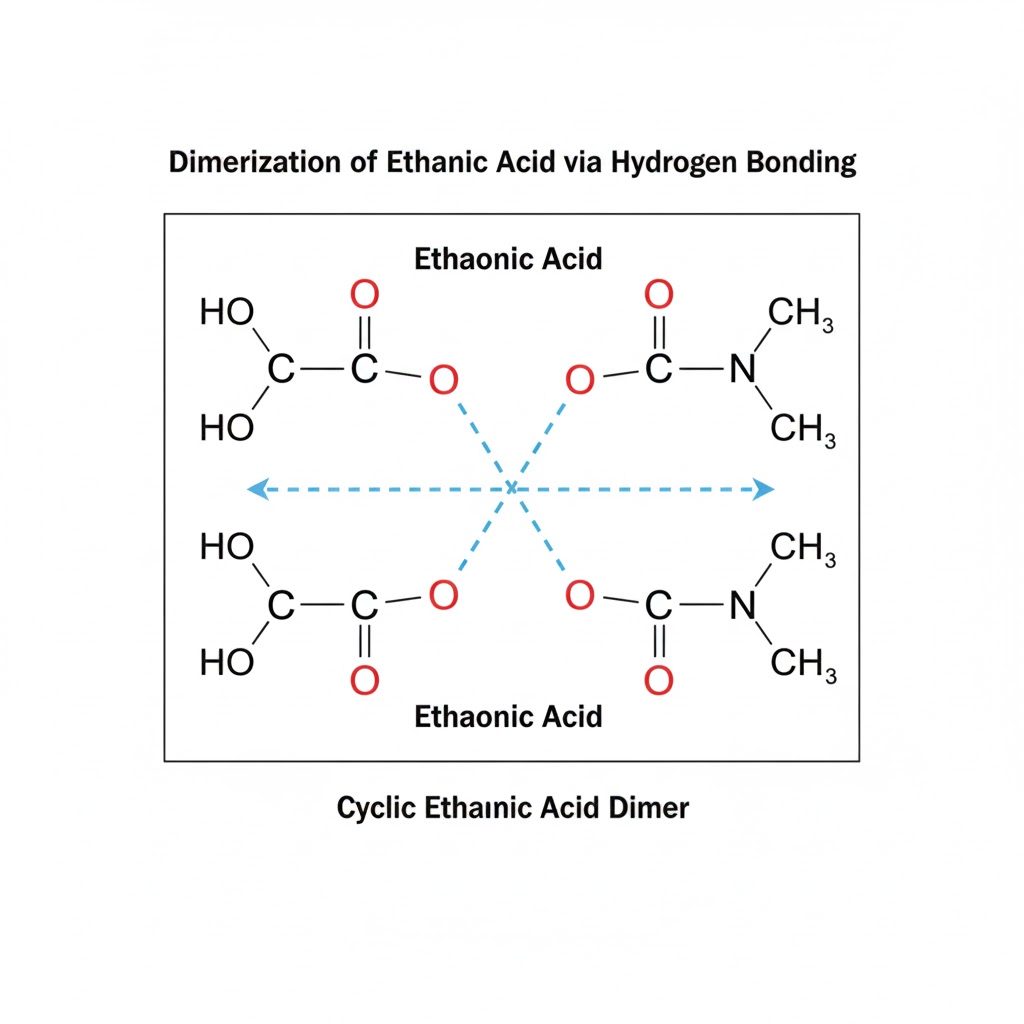
When a solute like $KCl$ dissociates into $K^+$ and $Cl^-$ ions, we get more particles than we expected. This makes the observed colligative property higher and the experimental molar mass lower than the "normal" value. Conversely, molecules like ethanoic acid ($CH_3COOH$) associate in benzene to form dimers, reducing the number of particles and making the molar mass look twice as big!
To fix this, we use the van’t Hoff factor ($i$):
NEET Checkpoint:
If $i < 1$, is the solute associating or dissociating?
(a) Dissociating
(b) Associating
(c) Neither
(d) Both
✅ Answer: (b) Associating — Fewer particles mean a smaller $i$ (like ethanoic acid in benzene where $i \approx 0.5$).
NEET Checkpoint:
What is the value of $i$ for $K_2SO_4$ in a very dilute solution?
(a) $1.00$
(b) $2.00$
(c) $3.00$
(d) $4.00$
✅ Answer: (c) $3.00$ — It dissociates into $2K^+$ and $1SO_4^{2-}$ ions.
NEET Checkpoint:
How does dissociation affect the boiling point compared to a non-electrolyte?
(a) It increases the boiling point
(b) It decreases the boiling point
(c) It has no effect on the boiling point
(d) It lowers the vapour pressure but not the boiling point
✅ Answer: (a) It increases the boiling point — More particles lead to a higher elevation of boiling point.
We must include $i$ in our main formulas to get the right answer:
* Boiling Point Elevation: $\Delta T_b = i K_b m$
* Freezing Point Depression: $\Delta T_f = i K_f m$
* Osmotic Pressure: $\Pi = i \frac{n_2 R T}{V}$
Figure below:
A clear diagram showing two ethanoic acid molecules forming a cyclic dimer through two dotted hydrogen bonds between the C=O and O-H groups.
Practice Questions:
1. A solute forms a trimer in solution. What is the value of $i$ assuming $100\%$ association?
(a) 3
(b) 1
(c) 0.33
(d) 0.5
✅ Answer: (c) $0.33$ — Three particles become one, so $i = 1/3$.
2. Which salt has an $i$ value closest to $2$ in dilute solution?
(a) $K_2SO_4$
(b) $NaCl$
(c) Glucose
(d) $AlCl_3$
✅ Answer: (b) $NaCl$ — It splits into two ions.
Key Takeaway
Formula Summary
- $i > 1$: Dissociation (e.g., $NaCl, KCl, MgSO_4$)
- $i < 1$: Association (e.g., Ethanoic acid in benzene)
- Modified Colligative Property: All properties are multiplied by $i$.