
1. Introduction to Redox: Classical Ideas
Chemistry is essentially a study of redox systems, affecting everything from burning fuels to corrosion. So, what exactly is redox? Well, before fancy electrons came along, chemists defined these reactions based purely on oxygen and hydrogen transfer.
The Classical Definition of Oxidation
Originally, oxidation was super simple: it was just the addition of oxygen to a substance. For instance, when magnesium $(\text{Mg})$ burns in air, it gets oxidised because oxygen $(\text{O}_2)$ is added to it to form magnesium oxide $(\text{MgO})$:
But scientists soon realised this definition was too limited. They broadened the scope of oxidation to include two key points:
1. Addition of an electronegative element to a substance (like adding $\text{F}_2$, $\text{Cl}_2$, or $\text{S}$ to $\text{Mg}$).
2. Removal of hydrogen or an electropositive element from a substance.
NEET Checkpoint:
Is the removal of potassium $(\text{K})$, an electropositive element, considered oxidation?
(a) No — because potassium is a reducing agent
(b) No — because oxidation only involves oxygen
(c) Yes — because removal of an electropositive element is oxidation
(d) Yes — but only in electrochemical reactions
✅ Answer: (c) Yes — Removing an electropositive element, like $\text{K}$, is a clear example of classical oxidation.
The Classical Definition of Reduction
Reduction is the opposite side of the coin, the anti-oxidation, if you will. Initially, it meant the removal of oxygen from a compound, like heating mercuric oxide $(\text{HgO})$ to get mercury $(\text{Hg})$.
Today, the definition of reduction is also broadened to include:
1. Removal of oxygen or an electronegative element from a substance (e.g., removing chlorine $(\text{Cl})$ from ferric chloride, $\text{FeCl}_3$).
2. Addition of hydrogen or an electropositive element to a substance.
NEET Checkpoint:
What two processes are essential for a reaction to be classified as 'redox'?
(a) Evaporation and condensation
(b) Neutralization and precipitation
(c) Oxidation and reduction
(d) Association and dissociation
✅ Answer: (c)Oxidation and Reduction — These two processes must always occur simultaneously; they are inseparable, hence the term "redox".
Redox Reactions
The most critical takeaway here is that oxidation and reduction always occur simultaneously. They are like two batsmen on a pitch—you can’t score a run without both moving! This simultaneous nature is why we use the single term Redox Reactions.
In the reaction where hydrogen sulphide $(\text{H}_2\text{S})$ reacts with chlorine $(\text{Cl}_2)$, the $\text{H}_2\text{S}$ is oxidised (hydrogen removed from $\text{S}$) and $\text{Cl}_2$ is reduced (hydrogen added to $\text{Cl}$).
NEET Checkpoint:
What process occurs when $\text{FeCl}_3$ changes to $\text{FeCl}_2$?
(a) Oxidation — due to addition of chlorine
(b) Reduction — due to removal of electronegative element (Cl)
(c) Neutralization — due to acid–base reaction
(d) Disproportionation — due to simultaneous oxidation and reduction
✅ Answer:(b) Reduction — This involves the removal of the electronegative element, chlorine $(\text{Cl})$, from ferric chloride.
Practice Questions:
- Which of the following is not consistent with the classical definition of oxidation?
(a) Addition of $O_{2}$ to a compound.
(b) Removal of $H_{2}$ from a compound.
(c) Addition of an electropositive element.
(d) Removal of an electropositive element.
✅ Answer: (c) Addition of an electropositive element. — The addition of an electropositive element is defined as reduction, not oxidation.
2. A reaction where oxygen is removed and an electronegative element is added simultaneously is classified as a:
(a) Combination reaction.
(b) Decomposition reaction.
(c) Oxidation-only reaction.
(d) Redox reaction.
✅ Answer: (d) Redox reaction. — Since both oxidation (addition of electronegative element) and reduction (removal of oxygen) occur, it is a simultaneous redox change.
Key Takeaway
Classical Oxidation: Addition of $\text{O}$ electronegative element OR Removal of $\text{H}$ electropositive element.
Classical Reduction: Removal of $\text{O}$ electronegative element OR Addition of $\text{H}$ electropositive element.
2. Redox in Terms of Electron Transfer and Half Reactions
Ready to tackle the electronic concept of Redox reactions? Don't stress, yaar—this funda is actually super logical, like balancing your monthly tuition fees! Instead of thinking about oxygen or hydrogen, we focus purely on electrons.
The electronic concept makes things crystal clear:
* Oxidation is simply the loss of electron(s) by any species. Think of it as leaving the exam hall early—you lose something (time/electrons) but gain a higher charge!
* Reduction is the gain of electron(s) by any species. You gain electrons, and your charge goes down (is reduced). Simple as that!
NEET Checkpoint:
A species that loses electrons during a chemical change is undergoing:
(a) Reduction
(b) Oxidation
(c) Disproportionation
(d) Neutralisation
✅ Answer: (b) Oxidation — Loss of electrons means oxidation. Remember LEO: Loss of Electrons is Oxidation!
Now, let's talk agents. An Oxidising agent (or oxidant) is the one that accepts the electron(s). It causes oxidation but itself gets reduced! It’s an electron acceptor. Conversely, a Reducing agent (or reductant) is the generous donor. It gives away electron(s) and gets oxidised in the process.
Imagine a pani puri stall. The person handing out the puri (electron) is the reducing agent (donor), getting 'oxidised' (empty handed), while you, the oxidising agent, accept the puri (electron acceptor) and get 'reduced' (satiated)!
We can split any redox process into two steps, called half reactions. One half involves electron loss (the oxidation half reaction), and the other involves electron gain (the reduction half reaction). The complete reaction is just the sum of these two half reactions. For example, when sodium reacts with chlorine:
\text{Oxidation Half:} \quad 2\text{Na}(s) \rightarrow 2\text{Na}^{+}(g) + 2e^{-}
$$
\text{Reduction Half:} \quad \text{Cl}_{2}(g) + 2e^{-} \rightarrow 2\text{Cl}^{-}(g)
$$
NEET Checkpoint:
In the half reaction $\text{Zn}(s) \rightarrow \text{Zn}^{2+}(\text{aq}) + 2e^{-}$, $\text{Zn}(s)$ is acting as a:
(a) Oxidant
(b) Reductant
(c) Spectator ion
(d) Proton donor
✅ Answer: (b) Reductant — Since $\text{Zn}(s)$ is losing electrons (getting oxidized), it is donating electrons and acting as a reducing agent.
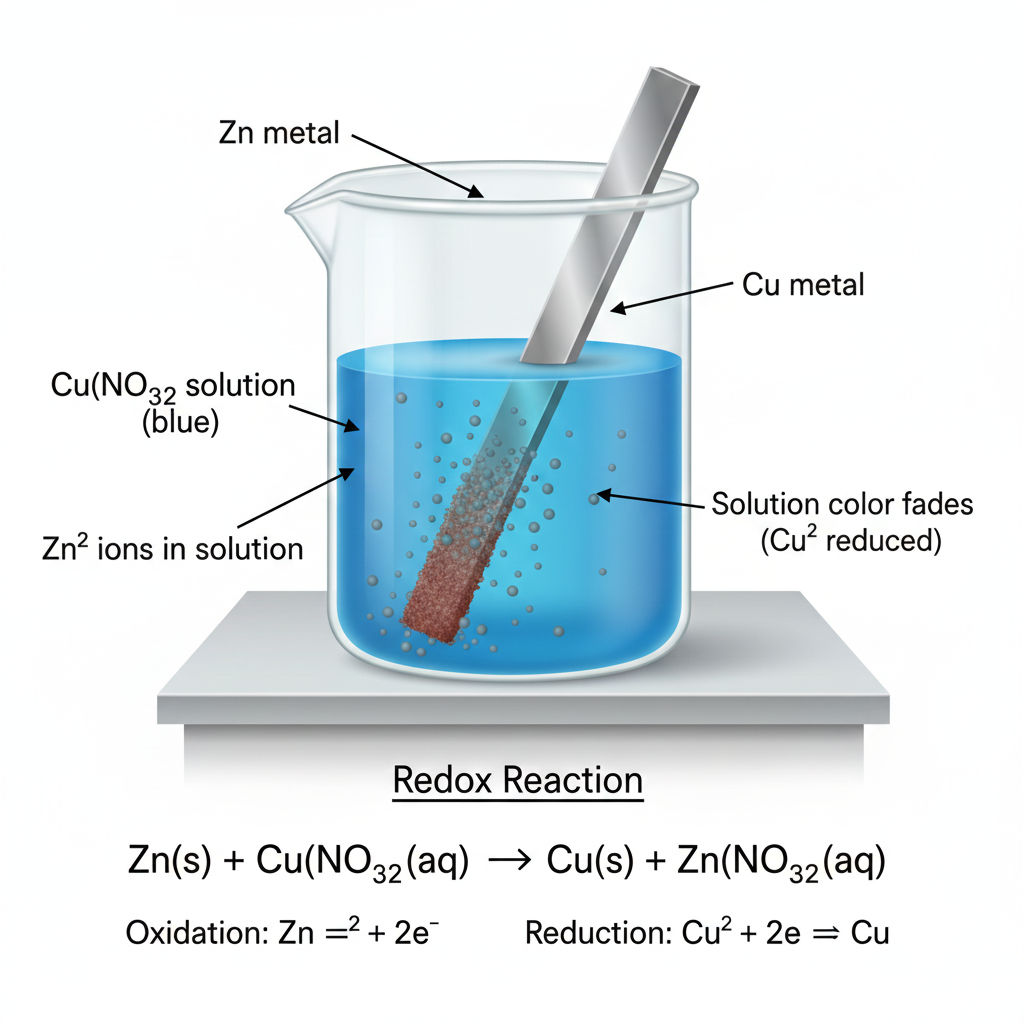
This whole concept of electrons competing for transfer is super useful! The competition for electrons between various metals (like $\text{Zn} > \text{Cu} > \text{Ag}$) is what helps us design Galvanic cells. In these cells, smart chemical reactions generate electrical energy—basically turning chemistry into bijli!.
Figure below:
A clear diagram showing the redox reaction between metallic zinc and aqueous copper nitrate solution occurring in a beaker, illustrating the deposition of copper on the zinc strip and the fading of the blue colour.
NEET Checkpoint:
Galvanic cells convert:
(a) Electrical energy to chemical energy
(b) Heat energy to electrical energy
(c) Chemical energy to electrical energy
(d) Kinetic energy to potential energy
✅ Answer: (c) Chemical energy to electrical energy — Galvanic cells harness the energy from spontaneous chemical (redox) reactions to produce electricity.
Practice Questions:
-
Which statement correctly defines a reducing agent according to the electronic concept?
(a) A species that gains electrons.
(b) A species whose oxidation state increases.
(c) A species that accepts electrons.
(d) A species that is reduced.
✅ Explanation: (b) A reducing agent is an electron donor, and donating electrons causes the species itself to be oxidized, meaning its oxidation state increases.
-
In the reaction $\text{Cu}(s) + 2\text{Ag}^{+}(\text{aq}) \rightarrow \text{Cu}^{2+}(\text{aq}) + 2\text{Ag}(s)$, which half reaction is the reduction step?
(a) $\text{Cu}(s) \rightarrow \text{Cu}^{2+}(\text{aq}) + 2e^{-}$
(b) $\text{Ag}^{+}(\text{aq}) + e^{-} \rightarrow \text{Ag}(s)$
(c) $\text{Cu}(s) + 2e^{-} \rightarrow \text{Cu}^{2+}(\text{aq})$
(d) $\text{Ag}(s) \rightarrow \text{Ag}^{+}(\text{aq}) + e^{-}$
✅ Explanation: (b) Reduction is the gain of electrons. The silver ion, $\text{Ag}^{+}$, gains an electron to form $\text{Ag}(s)$. The correct half reaction involves $\text{Ag}^{+}$ gaining electrons.
Key Takeaway
The funda is simple: Oxidation is Loss of electrons (LEO), and Reduction is Gain of electrons (GER). The species that causes oxidation is the Oxidant (it accepts $e^{-}$), and the species that causes reduction is the Reductant (it donates $e^{-}$). Redox reactions are just the sum of these two electron-transferring half reactions.
3. Oxidation Number Definition, Redox Change, and Key Rules (Part 1)
Hey NEET Aspirants! Ready to master the fundamental funda of Redox? Let's talk about the Oxidation Number (ON). Don't stress, yaar, this concept is essentially a fancy method for book-keeping purpose only in chemical reactions.
The oxidation number denotes the oxidation state of an element in a compound. We figure it out by pretending there is a complete transfer of electron from the less electronegative atom to the more electronegative atom. This assumption is just done for calculating the number.
This number is crucial because it defines the change itself: Oxidation is simply an increase in the oxidation number of the element in the given substance. Conversely, Reduction is a decrease in the oxidation number. Super easy math, right? Even friction needs a break sometimes!
The Essential ON Rules (Part 1)
Memorising these rules is your shortcut to success, junior:
Rule 1: The Zero Hero
In elements in the free or uncombined state, each atom bears an oxidation number of zero. Think of simple guys like $\text{O}_2$, $\text{Na}$, or $\text{Cl}_2$—they are all $0$. Notice this key detail: no matter how many atoms are bonded, if it is the element itself, the ON is $0$.
NEET Checkpoint 1:
What is the oxidation number of Phosphorus ($\text{P}$) in $\text{P}_4$?
(a) $+4$
(b) $-3$
(c) $0$
(d) $+5$
✅ Answer: (c) $0$ — According to Rule 1, $\text{P}_4$ is an element in its free state, so the ON is zero.
Rule 2: Monotonic VIPs
For monoatomic ions, the ON is equal to the actual charge on the ion (e.g., $\text{Cl}^{-}$ is $-1$). Here's the trick: remember these VIP metals in their compounds: Alkali metals (Group 1) always have an oxidation number of $+1$ in their compounds, and alkaline earth metals (Group 2) always have an ON of $+2$.
NEET Checkpoint 2:
In any compound, what is the mandatory ON of Potassium ($\text{K}$)?
(a) $0$
(b) $-1$
(c) $+2$
(d) $+1$
✅ Answer: (d) $+1$ — Potassium ($\text{K}$) is an alkali metal (Group 1), which always exhibits an ON of $+1$ in its compounds (Rule 2).
Rule 6: Balancing the Scoreboard
This rule is your balance sheet. In any neutral compound, the algebraic sum of the oxidation numbers of all atoms must be zero. And that's cool, right? For a polyatomic ion (like $\text{SO}_{4}^{2-}$), the algebraic sum of all ONs must equal the charge on the ion (e.g., the sum must be $-2$).
Imagine calculating the run rate for a Cricket match (neutral compound): all positive runs and negative run-outs must balance to make the final score zero!
Stock Notation Swag
To specify the ON of a metal, particularly those displaying several positive oxidation states, we use Stock notation. This involves putting a Roman numeral in parenthesis right after the metal's symbol. For instance, aurous chloride and auric chloride are written as $\text{Au}(\text{I})\text{Cl}$ and $\text{Au}(\text{III})\text{Cl}_3$. This clearly indicates the oxidation state, helping identify whether the species is in oxidised form or reduced form.
NEET Checkpoint 3:
If the algebraic sum of ONs for a substance is $+3$, that substance must be:
(a) A neutral compound
(b) A monoatomic metal
(c) A polyatomic ion with $+3$ charge
(d) An element in free state
✅ Answer: (c) A polyatomic ion with $+3$ charge — The sum of oxidation numbers must equal the charge on a polyatomic ion (Rule 6).
Practice Question:
If $\text{Fe}(\text{II})\text{O}$ reacts to form $\text{Fe}_2(\text{III})\text{O}_3$, the Iron atom has undergone:
(a) Reduction
(b) Displacement
(c) Oxidation
(d) Decomposition
✅ Answer: (c) Oxidation — The oxidation number of $\text{Fe}$ increased from $+2$ (in $\text{Fe}(\text{II})\text{O}$) to $+3$ (in $\text{Fe}_2(\text{III})\text{O}_3$), which is defined as oxidation.
Key Takeaway
The Oxidation Number (ON) is a theoretical charge for book-keeping, assuming complete electron transfer. Oxidation is an increase in ON, and Reduction is a decrease. Remember the three core rules: free elements are $0$ (Rule 1), Alkali metals are $+1$, and Alkaline Earth metals are $+2$ (Rule 2). The ON sum must equal the charge or $0$ (Rule 6).
4. Specific Rules for O, H, and Halogens (Part 2)
A lot of the confusion in calculating oxidation numbers boils down to a few special elements: Oxygen, Hydrogen, and the Halogens! Mastering their exceptions is key to acing those NEET questions, so let’s clear up this funda, yaar.
Rule 3: The Curious Case of Oxygen
Generally, Oxygen ($O$) is a stable element and takes an oxidation number of $-2$ in most compounds. But $O$ loves to throw curveballs!
- Peroxides: When $O$ forms an $O-O$ bond (like in $H_{2}O_{2}$ or $Na_{2}O_{2}$), each oxygen atom is assigned $-1$.
- Superoxides: These are even rarer, found in compounds like $KO_{2}$ or $RbO_{2}$. Here, the oxidation number of oxygen is a fraction: $-(\frac{1}{2})$.
- Bonded to Fluorine: This is the most special case! Since Fluorine ($F$) is the ultimate electron thief, when $O$ bonds to it (e.g., in $OF_{2}$), $O$ actually takes a positive oxidation number, like $+2$. Notice this: the number assigned to oxygen is now positive only.
NEET Checkpoint:
What is the oxidation state of oxygen in $OF_{2}$?
(a) $-2$
(b) $-1$
(c) $+2$
(d) $-(\frac{1}{2})$
✅ Answer: (c) $+2$ — Oxygen is forced to take a positive oxidation number only when bonded to the more electronegative fluorine.
Rule 4: Hydrogen's Dilemma
Hydrogen ($H$) usually behaves predictably, displaying an oxidation number of $+1$. Think of it as the most popular kid in the class, always positive!
The only major exception is when $H$ teams up with highly electropositive metals in binary compounds (metal hydrides), such as $NaH$, $LiH$, or $CaH_{2}$. In these compounds, $H$ acts as the electron receiver and is assigned $-1$. Don't stress, yaar—it’s easier than it looks!
Rule 5: Halogen Hierarchy
Fluorine ($F$) is the absolute boss in chemistry; it is the most electronegative element. Because of this raw pulling power, $F$ always has an oxidation number of $-1$ in all its compounds. No exceptions there!
Other halogens, $Cl$, $Br$, and $I$, follow the leader and usually have $-1$ when they act as halide ions. However, unlike $F$, they can exhibit positive oxidation numbers when they combine with oxygen (like in oxoacids or oxoanions).
The Paradox of Fractional Oxidation States
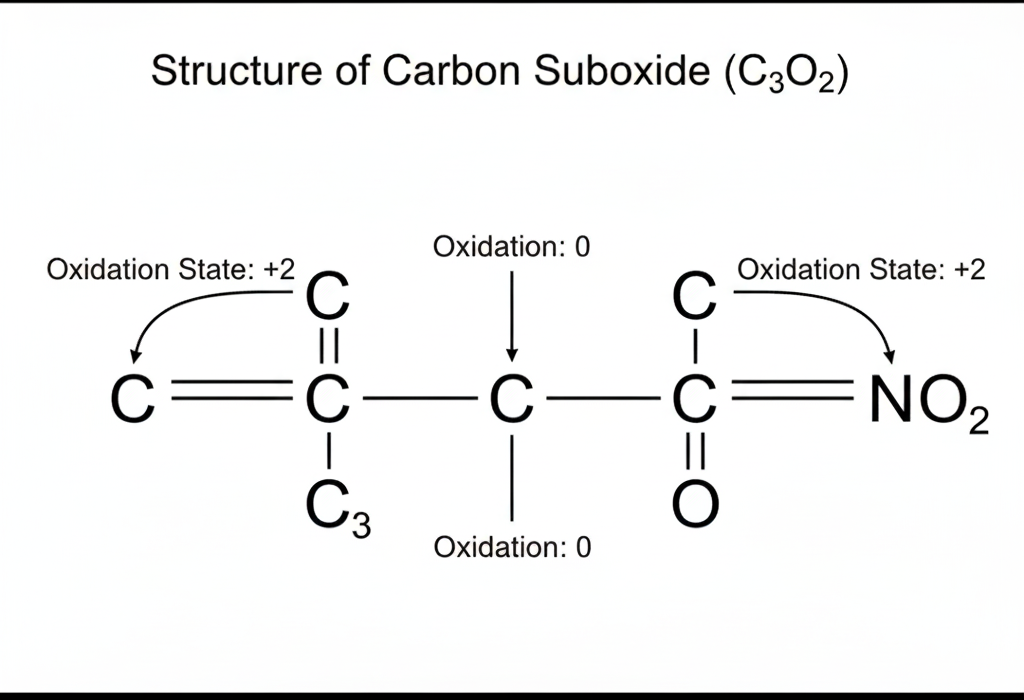
Sometimes, when calculating the oxidation number, you might get a weird fraction, like $4/3$ in $C_{3}O_{2}$ or $2.5$ in $Na_{2}S_{4}O_{6}$. This seems unconvincing because electrons are never shared or transferred in fractions.
Here’s the trick: this fractional number is only the average oxidation number for that element in the compound. In reality (which is revealed by studying the structure), the element exists in more than one whole number oxidation state.
For example, in $C_{3}O_{2}$ (carbon suboxide), the average for carbon is $4/3$. But structurally, two terminal carbon atoms are $+2$ and the middle carbon is $0$.
Figure below:
A clear diagram showing the structure of $C_{3}O_{2}$ (carbon suboxide) with the oxidation states of the terminal carbons as $+2$ and the central carbon as $0$.
NEET Checkpoint:
Does $ClO_{4}^{-}$ undergo disproportionation reaction?
(a) Yes
(b) No
✅ Answer: (b) No — Chlorine is already present in its highest oxidation state, $+7$, so it cannot be further oxidised.
Key Takeaway
| Element | Default ON | Common Exception | Example |
|---|---|---|---|
| O | $-2$ | Peroxides ($-1$), Superoxides ($-1/2$), $OF_{2}$ ($+2$) | $H_{2}O_{2}$, $KO_{2}$, $OF_{2}$ |
| H | $+1$ | Metal Hydrides ($-1$) | $NaH$ |
| F | $-1$ | None (always $-1$) | $HF$, $Na_{3}AlF_{6}$ |
5. Classification of Redox Reactions: The Four Pillars, Yaar!
Hey future doctors! Ready to tackle the funda of classifying redox reactions? It’s super straightforward, almost like sorting your clothes before laundry day! Redox reactions—where oxidation and reduction happen together—fall mainly into four types: combination, decomposition, displacement, and disproportionation. Let’s break down each one, focusing on what really matters for NEET prep.
1. Combination Reactions ($A+B \rightarrow C$)
For a combination reaction to be classified as redox, you must ensure that either $A$ or $B$, or both, are in their elemental form. Think of $C(s) + O_{2}(g) \rightarrow CO_{2}(g)$. Notice that Carbon ($C$) and Oxygen ($O_2$) start with an oxidation number (ON) of $0$. If no element starts in the elemental state, like in the reaction $CH_{4}(g)+2O_{2}(g)\rightarrow CO_{2}(g)+2H_{2}O(l)$, it’s still redox because the ONs change, but the core classification relies on that elemental reactant rule for the textbook examples.
NEET Checkpoint:
Which reactant must be elemental for a synthesis reaction ($A+B \rightarrow C$) to definitively be classified as redox based on the classification rule?
(a) Only C
(b) Either A or B, or both
(c) Only A
(d) None
✅ Answer: (b) Either A or B, or both — Mazza aa jaata hai when you spot that $ON = 0$ element!.
2. Decomposition Reactions
This is the opposite of combination: a compound breaks down into two or more components. Here’s the trick: at least one of the products must be in its elemental state. For example, the electrolysis of water: $2H_{2}O(l)\rightarrow2H_{2}(g)+O_{2}(g)$. Water breaks down, and both hydrogen and oxygen end up in the $0$ oxidation state, making it redox. Now, notice this, not all decomposition is redox; $CaCO_{3}$ decomposition, for instance, is not a redox reaction because no element changes into its elemental state.
3. Displacement Reactions ($X + YZ \rightarrow XZ + Y$)
In displacement, an ion or atom in a compound ($Y$ in $YZ$) is replaced by an ion or atom of another element ($X$). This is split into metal displacement (like zinc displacing copper from $CuSO_{4}$) and non-metal displacement (like metals displacing hydrogen from acids).
Let’s clear up this funda of halogens! Halogen displacement reactions are super important. The oxidizing power decreases as you move down the group from Fluorine ($F$) to Iodine ($I$). This means a stronger oxidant (higher up) can displace the ion of a weaker oxidant (lower down). For example, Chlorine ($Cl_2$) can kick out Bromide ($Br^{-}$) and Iodide ($I^{-}$) ions from a solution.
Relatable Example: Imagine two friends sitting on a rickshaw (YZ) and a third friend (X) comes along. If $X$ is stronger (a better reducing agent, like $Zn$ displacing $Cu$), $X$ displaces $Y$ from the seat ($YZ \rightarrow XZ + Y$).
NEET Checkpoint:
Which of the following halogens can displace $Br^{-}$ ions in an aqueous solution?
(a) $I_{2}$
(b) $F_{2}$
(c) $Br_{2}$
(d) $Cl^{-}$
✅ Answer: (b) $F_{2}$ — Both $F_2$ and $Cl_2$ are stronger oxidants than $Br_2$.
4. Disproportionation Reactions
This is the cool one! Here, a single element is simultaneously oxidized (ON increases) and reduced (ON decreases). That element must start in an intermediate oxidation state. A classic example is the decomposition of hydrogen peroxide, $H_{2}O_{2}$.
In $H_2O_2$, Oxygen is in the $-1$ state. It increases its ON to $0$ in $O_2$ (oxidation) and decreases its ON to $-2$ in $H_2O$ (reduction). This simultaneous change is disproportionation. Don't stress, yaar—it’s easier than it looks!
NEET Checkpoint:
For a species to undergo disproportionation, the element involved must be in what state?
(a) Its highest oxidation state
(b) Its lowest oxidation state
(c) An intermediate oxidation state
(d) Zero oxidation state
✅ Answer: (c) An intermediate oxidation state — It needs room to increase ON (oxidize) and decrease ON (reduce).
Practice Questions:
- Identify the type of redox reaction: $2NaH (s) \rightarrow 2Na (s) + H_{2}(g)$
(a) Combination
(b) Displacement
(c) Decomposition
(d) Disproportionation
✅ Answer: (c) Decomposition — The compound ($NaH$) breaks down, and at least one product ($Na$ and $H_2$) is in the elemental state (ON = $0$).
2. Which statement correctly describes the outcome of the reaction $Cl_{2}(g)+2I^{-}(aq)\rightarrow2Cl^{-}(aq)+I_{2}(s)$?
(a) $I_{2}$ displaces $Cl^{-}$ because Iodine is a stronger oxidant than Chlorine.
(b) $Cl_{2}$ displaces $I^{-}$ because Chlorine is a stronger oxidant than Iodine.
(c) The reaction is disproportionation of Iodine.
(d) This is a combination reaction.
✅ Answer: (b) $Cl_{2}$ displaces $I^{-}$ because Chlorine is a stronger oxidant than Iodine. — Oxidizing power decreases down the halogen group ($Cl > I$), so $Cl_2$ is the better oxidant and performs the displacement.
Key Takeaway
| Redox Reaction Type | Core Requirement/Definition (Key Word) |
|---|---|
| Combination | At least one reactant must be elemental. |
| Decomposition | Breakdown into components; at least one product must be elemental. |
| Displacement | An ion/atom is replaced by another element. |
| Disproportionation | A single element is simultaneously oxidized and reduced from an intermediate ON. |
6. Balancing Redox Equations: Methods and Steps
Time to tackle the biggest stress-point for many juniors: balancing these beastly redox equations! Don't stress, yaar—it's just like solving a complex puzzle where the atoms and charges must match on both sides. We have two main approaches to get that count equal: the Oxidation Number Method and the Half Reaction Method (also known as the Ion-Electron Method).
Oxidation Number Method: The Great Equalizer
This method relies heavily on tracking the change in oxidation states of the elements.
The most crucial step in this method is calculating the total increase in oxidation number and the total decrease in oxidation number, and then multiplying the involved species by suitable numbers so that the total increase equals the total decrease. If you don't do this, your equation will be unbalanced—a chemical disaster!
Here’s the trick: Once you’ve balanced the O.N. changes, you balance the ionic charges. If the reaction is taking place in an acidic medium, you balance charges by adding $\text{H}^+$ ions to the appropriate side. If you’re in a basic medium, you add $\text{OH}^-$ ions. Finally, you balance the $\text{H}$ atoms using $\text{H}_2\text{O}$ molecules.
Relatable Example: Think of this like balancing a big cricket score. The runs scored (+O.N.) by one team must be numerically matched exactly by the wickets lost (-O.N.) multiplied by a coefficient, ensuring the 'change count' is equal before you start adding neutral $\text{H}_2\text{O}$ spectators or charged $\text{H}^+/\text{OH}^-$ ions to the field!
NEET Checkpoint:
In the Oxidation Number method for a reaction in basic solution, what species is added to balance charge?
(a) $\text{H}^+$
(b) $\text{H}_2\text{O}$
(c) $\text{OH}^-$
(d) Electrons
✅ Answer: (c) $\text{OH}^-$ — Basic medium means excess base, so we balance charges using hydroxide ions.
Half Reaction Method (Ion-Electron Method)
This method explicitly shows the electrons transferred, which is why it is often the preferred funda.
- First, you split the unbalanced equation into the oxidation half-reaction and the reduction half-reaction.
- Next, you balance atoms other than $\text{O}$ and $\text{H}$.
- For reactions occurring in acidic medium, you balance $\text{O}$ atoms by adding $\text{H}_2\text{O}$ molecules. You then balance $\text{H}$ atoms by adding $\text{H}^+$ ions.
- Then, balance the charges in each half-reaction by adding electrons ($\text{e}^-$) to the appropriate side.
Just like balancing a big bank transaction, the electrons lost by the oxidation half must equal the electrons gained by the reduction half. You must multiply one or both half-reactions by a suitable integer so that the electron count is equalised before summing the halves. If you are working in a basic medium, after balancing atoms like in the acidic method, you add an equal number of $\text{OH}^-$ ions to both sides for every $\text{H}^+$ present, combining $\text{H}^+$ and $\text{OH}^-$ to form $\text{H}_2\text{O}$.
NEET Checkpoint:
In the Half Reaction method in acidic medium, how are oxygen atoms balanced?
(a) By adding $\text{OH}^-$
(b) By adding $\text{O}_2$
(c) By adding $\text{H}_2\text{O}$
(d) By adding $\text{H}^+$
✅ Answer: (c) By adding $\text{H}_2\text{O}$ — $\text{H}_2\text{O}$ molecules are added to the side deficient in oxygen atoms.
NEET Checkpoint:
What is the primary reason for multiplying half-reactions by suitable numbers in the Ion-Electron Method?
(a) To balance $\text{O}$ atoms
(b) To equalise the charge on the $\text{H}$ atoms
(c) To equalise the number of electrons lost and gained
(d) To balance mass.
✅ Answer: (c) To equalise the number of electrons lost and gained — This is essential for ensuring electrons ($\text{e}^-$) cancel out in the final net ionic equation.
Practice Questions:
1: The half-reaction $\text{Fe}^{2+}(\text{aq}) \rightarrow \text{Fe}^{3+}(\text{aq}) + \text{e}^-$ is a step in:
(a) Reduction
(b) Neutralisation
(c) Oxidation
(d) Disproportionation
✅ Answer: (c) Oxidation — Oxidation is defined as the loss of electron(s) by any species.
2: When balancing a redox reaction in acidic medium using the Half Reaction Method, $6\text{e}^-$ are added to the left side of the reduction half-reaction $\text{Cr}_2\text{O}_7^{2-}(\text{aq}) + 14\text{H}^+(\text{aq}) \rightarrow 2\text{Cr}^{3+}(\text{aq}) + 7\text{H}_2\text{O}(\text{l})$ to balance:
(a) Hydrogen atoms
(b) Oxygen atoms
(c) Charges
(d) Mass
✅ Answer: (c) Charges — The six electrons are added to the left side to balance the net positive charge of $+12$ ($\text{Cr}_2\text{O}_7^{2-}$ being $-2$ and $14\text{H}^+$ being $+14$) against the $+6$ charge on the right side ($2\text{Cr}^{3+}$).
That’s how you get your equation sorted! Now that you’ve mastered the balancing act, let's peek at how these redox reactions are used to determine solution strengths in titrations.
Key Takeaway
The two pillars of balancing redox reactions are the Oxidation Number Method (equalise total change in O.N. by multiplying, then balance charge using $\text{H}^+$ or $\text{OH}^-$) and the Half Reaction Method (split into oxidation and reduction halves, balance mass using $\text{H}_2\text{O}$ and $\text{H}^+$/$\text{OH}^-$, then balance charge by equalising electron ($\text{e}^-$) count).
7. Electrochemical Cells: Galvanic vs Electrolytic
Let’s clear up this core funda of electrochemistry. It's super important because it connects chemical reactions and electric current. Basically, Electrochemistry is the study of two things: how spontaneous chemical reactions can produce electricity, and how we can use electrical energy to force non-spontaneous reactions to happen. Don't stress, yaar—it’s easier than it looks!
The Power Pair: Galvanic vs. Electrolytic Cells
There are two main stars here. First, the Galvanic cell (or Voltaic cell), which is the battery type you love. It works because it takes the chemical energy liberated during a spontaneous redox reaction and converts it directly into electrical energy. The famous Daniell cell is a classic example of this, where zinc reacts with copper ions to generate a potential (like $1.1\text{ V}$ under standard conditions).
NEET Checkpoint:
Which type of cell converts Gibbs energy of a spontaneous reaction into electrical work?
(a) Fuel cell
(b) Electrolytic cell
(c) Galvanic cell
(d) Concentration cell
✅ Answer: (c) Galvanic cell — Arre! Galvanic cells are defined by converting spontaneous chemical energy into usable electrical energy.
Now, meet the opposite: the Electrolytic cell. This device uses external electrical energy to drive a non-spontaneous chemical transformation. Think of processes like producing pure metals (like Na, Mg, Al) or manufacturing caustic soda—they all need a power push.
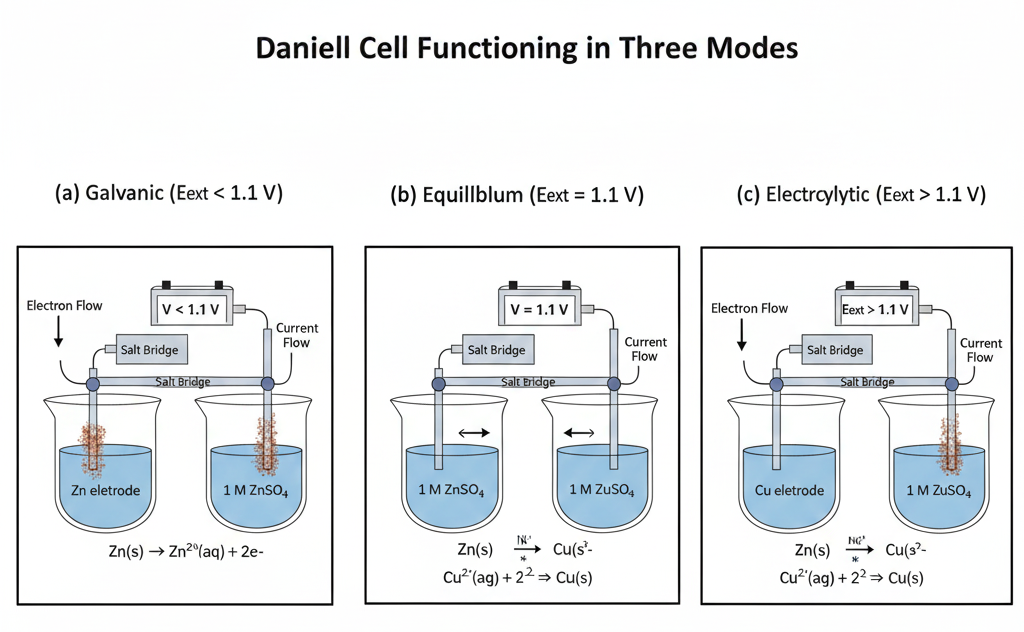
Here's the trick: A single Galvanic cell can be flipped to behave like an Electrolytic cell! This happens if you apply an external opposing potential ($E_{ext}$) that is greater than the cell's own potential ($E_{cell}$). If $E_{ext}$ is equal to $E_{cell}$ (like $1.1\text{ V}$ for the Daniell cell), the reaction stops completely and no current flows. But the moment $E_{ext}$ is cranked up past $E_{cell}$, the cell reaction reverses, and it starts consuming electrical energy to run the non-spontaneous reaction.
Notice this: When your scooter battery is powering your headlight, it's a Galvanic cell (spontaneous reaction producing current). But when you plug it into the charger at home, the charger applies a higher opposing potential, forcing the chemical reaction to reverse—it’s acting like an Electrolytic cell!
Figure below:
A clear diagram showing the Daniell cell functioning in three modes: (a) Galvanic ($E_{ext}<1.1\text{ V}$), (b) Equilibrium ($E_{ext}=1.1\text{ V}$), and (c) Electrolytic ($E_{ext}>1.1\text{ V}$), illustrating the reversal of electron and current flow.
NEET Checkpoint:
If an opposing potential of $1.5\text{ V}$ is applied to a standard Daniell cell ($E_{cell} = 1.1\text{ V}$), the cell will function as a:
(a) Galvanic cell
(b) Electrolytic cell
(c) Equilibrium cell
(d) Primary cell
✅ Answer: (b) Electrolytic cell — Since $E_{ext}$ ($1.5\text{ V}$) is greater than $E_{cell}$ ($1.1\text{ V}$), the cell reaction reverses, making it electrolytic.
NEET Checkpoint:
In an electrolytic cell, the chemical transformation is:
(a) Spontaneous
(b) Non-spontaneous
(c) Neutral
(d) Redox-neutral
✅ Answer: (b) Non-spontaneous — Electrolytic cells require external energy to drive a reaction that wouldn't happen on its own.
Practice Questions:
1. The essential difference in energy conversion between a Voltaic cell and an Electrolytic cell is:
(a) Voltaic converts electrical energy into chemical energy.
(b) Electrolytic converts spontaneous chemical energy into electrical energy.
(c) Voltaic converts chemical energy of a spontaneous reaction into electrical energy.
(d) Both convert heat energy into electrical energy.
✅ Answer: (c) Voltaic converts chemical energy of a spontaneous reaction into electrical energy. — This is the exact definition of a galvanic/voltaic cell.
2. Which relationship describes a standard Galvanic cell acting as an electrolytic device?
(a) $E_{ext} < E_{cell}$
(b) $E_{ext} = E_{cell}$
(c) $E_{ext} > E_{cell}$
(d) $E_{ext} = 0$
✅ Answer: (c) $E_{ext} > E_{cell}$ — For the spontaneous reaction to reverse (electrolytic function), the external potential must exceed the cell potential.
Key Takeaway
Galvanic cells are generators (spontaneous, Chemical $\rightarrow$ Electrical). Electrolytic cells are consumers (non-spontaneous, Electrical $\rightarrow$ Chemical). The flip occurs when the external opposing potential ($E_{ext}$) is higher than the cell potential ($E_{cell}$).
8. Electrode Processes and Potential
Let's talk about how we convert those cool redox reactions into actual, usable electricity. This funda is the heart of electrochemistry!
The basic building block is the redox couple. Think of a redox couple as a package deal, consisting of the oxidised form and the reduced form of a substance, both ready to participate in a half-reaction (either oxidation or reduction). We write them with the oxidised form first, separated by a slash or vertical line, like $Zn^{2+}/Zn$ or $Cu^{2+}/Cu$. These packages are what make up the two main half-cells of a galvanic cell.
NEET Checkpoint:
How is a redox couple conventionally represented?
(a) Reduced/Oxidised
(b) Oxidised/Reduced
(c) $Ox + Red$
(d) $Ox \rightarrow Red$
✅ Answer: (b) Oxidised/Reduced — Always remember the oxidised form comes before the reduced form, like in $Zn^{2+}/Zn$.
Now, why does voltage even happen? A potential difference (called the electrode potential) develops right at the electrode-electrolyte interface. This happens because the metal atoms want to shed electrons and go into the solution as ions, while the ions in the solution want to grab electrons and deposit on the metal. This separation of charges creates the potential.
In a galvanic cell, we have two specific roles:
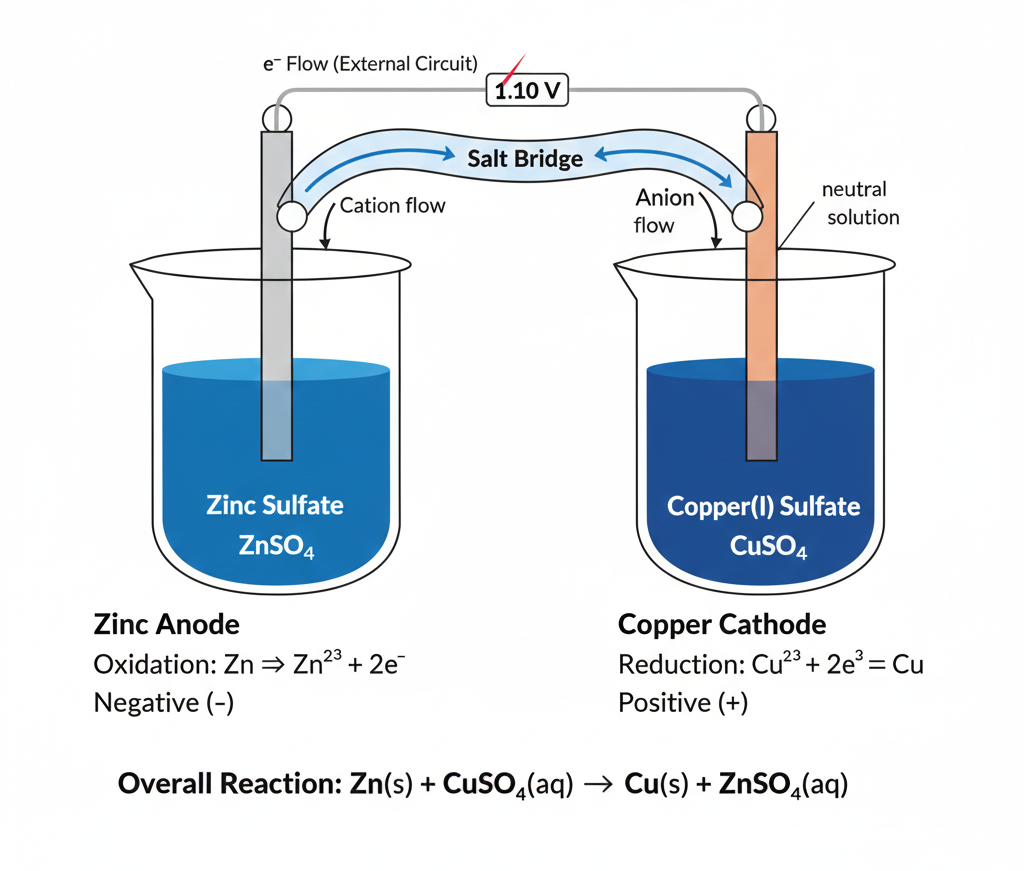
- Anode: This is where oxidation happens. Electrons are lost here, making the anode the electrode with the negative potential relative to the solution.
- Cathode: This is where reduction happens. Electrons are gained here, giving the cathode a positive potential relative to the solution. Electrons always flow from the negative anode to the positive cathode.
Imagine you are managing the accounts of a chaat stall. The Anode ($Zn$) is losing all its cash (electrons) to the bank (oxidation), making its balance negative. The Cathode ($Cu$) is where the payment is accepted (reduction), making its balance positive! The potential difference is how badly one part wants to lose electrons and the other wants to gain them.
Sometimes we use materials like Platinum ($Pt$) or Gold ($Au$). These are inert electrodes—they are total non-participants! They do not react or get consumed. Their job is simply to provide a stable surface for the crucial electron transfer reactions to happen and to conduct electrons.
Figure below:
A clear diagram showing the set-up of a Daniell cell, indicating the Zinc anode (oxidation, negative), Copper cathode (reduction, positive), electron flow through the external circuit, and the salt bridge completing the internal circuit.
NEET Checkpoint:
In a galvanic cell, which process occurs at the electrode with the negative potential?
(a) Reduction
(b) Hydrolysis
(c) Oxidation
(d) Neutralisation
✅ Answer: (c) Oxidation — The anode is negative and is where oxidation happens ("Anode $\rightarrow$ Oxidation").
Practice Question:
The role of a platinum electrode in a half-cell, according to the sources, is primarily:
(a) To participate directly in the chemical reaction.
(b) To dissolve and maintain ion concentration.
(c) To provide a surface for electron transfer and conduction.
(d) To act as a strong reducing agent.
✅ Answer: (c) To provide a surface for electron transfer and conduction — Inert electrodes like $Pt$ or $Au$ provide the surface but don't participate chemically.
NEET Checkpoint:
If an electrode has a negative standard electrode potential ($E^\circ$), it means it is a stronger reducing agent compared to which reference couple?
(a) $Cu^{2+}/Cu$ couple
(b) $Ag^{+}/Ag$ couple
(c) $H^{+}/H_{2}$ couple
(d) $Zn^{2+}/Zn$ couple
✅ Answer: (c) $H^{+}/H_{2}$ couple — A negative $E^\circ$ indicates the redox couple is a stronger reducing agent than the standard $H^{+}/H_{2}$ couple.
Now that you know how half-cells generate potential, let's look at how we measure and calculate these potentials!
Key Takeaway
| Component | Definition/Characteristics |
|---|---|
| Redox Couple | Oxidised and reduced forms of a substance in a half-reaction (e.g., $Zn^{2+}/Zn$). |
| Anode | Oxidation occurs, holds negative potential. |
| Cathode | Reduction occurs, holds positive potential. |
| Inert Electrodes ($Pt, Au$) | Provide surface for electron transfer/conduction; do not participate in reaction. |
9. Standard Electrode Potential and Measurement
Hey NEET aspirants! Let's decode one of the most fundamental concepts in Electrochemistry: Standard Electrode Potential, or $E^{\ominus}$. Don't stress, yaar—it's easier than it looks!.
When a metal electrode dips into its own electrolyte, a potential difference develops at the interface, which is the electrode potential. In a galvanic cell, the potential difference between the two electrodes is the cell potential. Here’s the trick: when no current is drawn through the cell, this potential difference is specifically called the cell electromotive force (emf).
We define the Standard Electrode Potential ($E^{\ominus}$) when specific standard conditions are met: the concentration of all species involved in the half-cell reaction must be unity (or $1~M$ for solutions and $1~bar$ pressure for gases) and the temperature is $298~K$. According to the IUPAC convention, standard reduction potentials are now called standard electrode potentials.
The accepted convention for representing a galvanic cell is to keep the anode (where oxidation happens) on the left and the cathode (where reduction happens) on the right. The cell emf ($E_{cell}$) is given by the potential of the right-hand electrode minus the left-hand electrode.
This is why we say $E_{cell}$ is Cathode potential minus Anode potential.
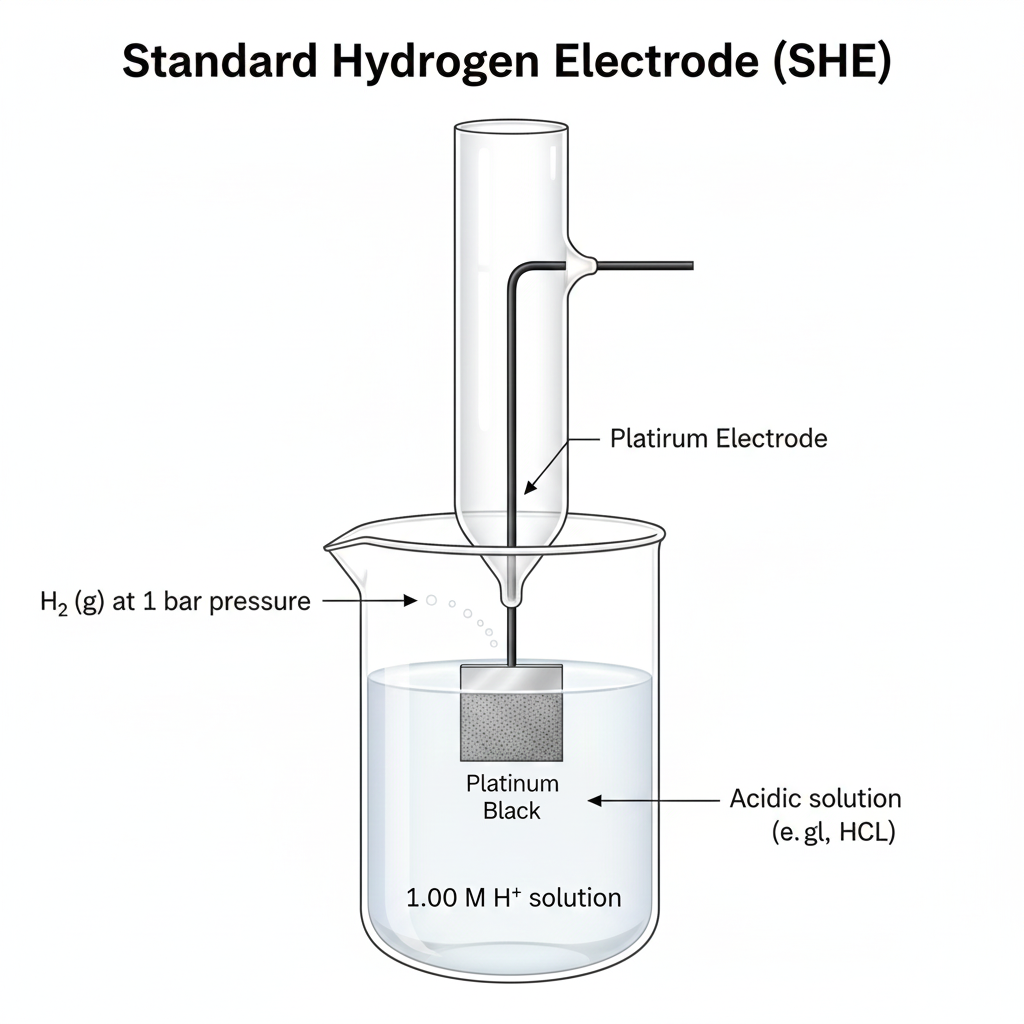
Since we can only measure the difference between two half-cell potentials, we need a common ground, or a reference point. Enter the Standard Hydrogen Electrode (SHE)!. By convention, the SHE is arbitrarily assigned a potential of $0.00~V$ at all temperatures. The SHE is represented as $Pt(s)|H_{2}(g)|H^{+}(aq)$. It’s a platinum electrode in a $1~M$ $H^{+}$ solution, with $H_{2}$ gas bubbled through at $1~bar$.
Figure below:
A clear diagram showing the Standard Hydrogen Electrode (SHE), featuring a platinum electrode coated with platinum black, dipped in $1.00~M$ $H^{+}$ solution, with $H_{2}(g)$ at $1~bar$ pressure bubbled through.
NEET Checkpoint:
What is the standard potential assigned to the Standard Hydrogen Electrode (SHE)?
(a) $+1.00~V$
(b) $0.00~V$
(c) $-0.76~V$
(d) $+0.34~V$
✅ Answer: (b) $0.00~V$ — This zero potential makes it the reference point for all other measurements.
Just like checking the height of a cricket stadium relative to the ground (zero), we measure the potential of any other half-cell by coupling it with the SHE as the anode. The measured emf of the resulting cell, $E^{\ominus}{cell}$, is then equal to the standard reduction potential of the unknown electrode, $E^{\ominus}{R}${R}$.
NEET Checkpoint:
A negative $E^{\ominus}$ value for a redox couple, like $Zn^{2+}/Zn$, implies that the couple is a:
(a) Weaker reducing agent than $H^{+}/H_{2}$
(b) Stronger oxidising agent than $H^{+}/H_{2}$
(c) Stronger reducing agent than $H^{+}/H_{2}$
(d) Weaker oxidising agent than $H^{+}/H_{2}$
✅ Answer: (c) Stronger reducing agent than $H^{+}/H_{2}$ — A negative $E^{\ominus}$ means it gives up electrons more easily than hydrogen.
A negative $E^{\ominus}$ means the species is a stronger reducing agent than $H^{+}/H_{2}$. For example, the $Zn^{2+}/Zn$ couple has an $E^{\ominus}$ of $-0.76~V$, meaning zinc metal can reduce $H^{+}$ ions. A positive $E^{\ominus}$ means it is a weaker reducing agent.
NEET Checkpoint:
What are the three essential standard conditions required to measure $E^{\ominus}$?
(a) $298~K$, $1~M$ concentration, $1~atm$ pressure
(b) $273~K$, $1~M$ concentration, $1~bar$ pressure
(c) $298~K$, $1~M$ concentration, $1~bar$ pressure
(d) $298~K$, $0.1~M$ concentration, $1~bar$ pressure
✅ Answer: (c) $298~K$, $1~M$ concentration, $1~bar$ pressure — Temperature must be $298~K$, and concentration/pressure must be unity.
Practice Question:
In a galvanic cell representation $X|X^{2+}||Y^{2+}|Y$, which potential is taken as $E_{left}$ in the calculation of the cell potential?
(a) $E_{(Y^{2+}/Y)}$
(b) $E_{(X^{2+}/X)}$
(c) $E_{(Y^{2+}/X)}$
(d) $E_{SHE}$
✅ Explanation: The convention is Anode on the left ($X|X^{2+}$) and Cathode on the right ($Y^{2+}|Y$). Thus, $E_{(X^{2+}/X)}$ is $E_{left}$.
Key Takeaway
| Term | Definition | Formula/Condition |
|---|---|---|
| Cell EMF | Cell potential when no current is drawn | $E_{cell} = E_{cathode} - E_{anode}$ |
| Standard Potential ($E^{\ominus}$) | Potential when all species are at unity concentration ($1~M$ or $1~bar$) and $T = 298~K$ | |
| SHE | Standard reference electrode | $E^{\ominus}_{SHE} = 0.00~V$ |
10. Nernst Equation and Equilibrium Constant: The Concentration Game, Boss!
Hey future doctor, ready to clear up one of the most important fundas in Electrochemistry? It's the Nernst Equation! Don't stress, this equation is basically your cheat sheet for calculating electrode potentials ($E$) when the concentrations are not standard, usually measured relative to the standard hydrogen electrode.
For a general electrode reaction like $M^{n+}(aq)+ne^{-}\rightarrow M(s)$, the Nernst equation tells you the potential at any point:
Notice this: The concentration of the solid metal, $[M]$, is always taken as unity. $E^{\circ}$ is your standard potential, $R$ is the gas constant, $F$ is the Faraday constant ($96487~C~mol^{-1}$), $T$ is temperature, and $n$ is the number of electrons involved. Easy peasy!
For a full cell reaction, the potential ($E_{(cell)}$) depends heavily on concentrations, just like whether your tuition class is fun depends on who is present! The Nernst Equation uses the reaction quotient, $Q$, to capture this dependence for a general reaction:
Where $Q$ is defined as $\frac{[C]^{c}[D]^{d}}{[A]^{a}[B]^{b}}$. Now, why does this matter? The cell potential ($E_{(cell)}$) decreases as the concentration of reactants decreases and products increase. Imagine a rickshaw trying to go uphill with too much samaan (products)—the potential decreases!
NEET Checkpoint:
For the reaction $aA+bB \rightleftharpoons cC+dD$, what does $Q$ become at equilibrium?
(a) $E^{\circ}_{(cell)}$
(b) $K_c$
(c) $nF$
(d) $RT$
✅ Answer: (b) $K_c$ — The reaction quotient ($Q$) becomes the equilibrium constant ($K_c$) at equilibrium.
Hitting Equilibrium: The $K_c$ Connection
Here's the trick, junior: When a galvanic cell reaches equilibrium, the transfer of charge stops, and the voltmeter reading hits zero. That means $E_{(cell)} = 0$!
Setting $E_{(cell)} = 0$ in the Nernst equation, and recognizing that $Q$ becomes $K_c$ at this point, we get the relationship between the standard potential and $K_c$:
If we calculate this at $T=298~K$ and substitute the constant values, the equation simplifies to the highly useful form (for $n$ electrons transferred):
And that's cool, right? This equation lets us calculate the equilibrium constant ($K_c$), which might otherwise be very difficult to measure, simply from the cell's standard potential ($E^{\circ}$).
NEET Checkpoint:
If a cell potential calculation yields a negative $E_{(cell)}$, what must be true about the ratio $\frac{[Products]}{[Reactants]}$ compared to unity?
(a) Equal
(b) Greater than unity
(c) Less than unity
(d) Cannot be determined
✅ Answer: (b) Greater than unity — A negative $E_{(cell)}$ means $\ln Q$ must be positive (since $E^{\circ}$ is generally positive for spontaneous cells), indicating $Q>1$, meaning products are dominant.
Practice Questions:
- If the standard cell potential ($E^{\circ}_{(cell)}$) for a reaction involving $n=2$ electrons is $0.46~V$ at $298~K$, calculate the approximate value of $K_c$:
(a) $3.92 \times 10^{10}$
(b) $3.92 \times 10^{15}$
(c) $2.0 \times 10^{37}$
(d) $1.5 \times 10^{5}$
✅ Explanation: (b) We use $log~K_{c}=\frac{E_{(cell)}^{o}\times n}{0.059~V}$. $log~K_{c}=\frac{0.46~V\times2}{0.059~V} \approx 15.6$. Taking antilog gives $K_{c}=3.92\times10^{15}$.
2. What is the reading of a voltmeter connected to a Daniell cell when the concentrations of $Zn^{2+}$ and $Cu^{2+}$ ions are no longer changing?
(a) $1.10~V$
(b) $0.76~V$
(c) $0.34~V$
(d) Zero
✅ Explanation: (d) When concentrations stop changing, the system has reached equilibrium, and the cell potential ($E_{(cell)}$) must be zero.
NEET Checkpoint:
Which thermodynamic constant can be calculated if we know $E^{\circ}_{(cell)}$ and the number of electrons ($n$)?
(a) $\Delta_rG$
(b) $R$
(c) $K_c$
(d) $F$
✅ Answer: (c) $K_c$ — The standard potential is directly related to the equilibrium constant $K_c$.
Now that you've got this Nernst funda down, wait till you see how it connects directly to the Gibbs Energy of the reaction!
Key Takeaway
Formula Summary: Nernst and Equilibrium
Nernst Equation (Cell):
$$E_{(cell)}=E_{(cell)}^{o}-\frac{RT}{nF}ln~Q$$
Equilibrium Condition: $E_{(cell)}=0$
$E^{\circ}$ to $K_c$ Relation (General):
$$E_{(cell)}^{o}=\frac{2.303RT}{nF}log~K_{C}$$
11. Relationship between Cell Potential and Gibbs Energy
Hey, future doctors! Let's decode the funda linking cell potential ($E_{\text{cell}}$) and Gibbs energy ($\Delta_r G$)—it's super crucial for electrochemistry, yaar! This relationship helps us quantify the maximum electrical work we can squeeze out of a galvanic cell.
The core concept is this: the maximum electrical work obtainable from a galvanic cell is always equal to the decrease in its Gibbs energy ($\Delta_r G$). Since the electrical work done is calculated by multiplying the charge passed ($nF$) by the cell potential ($E_{\text{cell}}$), we get the fundamental equation:
Notice this: $\Delta_r G$ is the Gibbs energy of the reaction, $n$ is the number of moles of electrons transferred during the reaction, and $F$ is the Faraday constant ($96487~C~mol^{-1}$). The negative sign is important because a spontaneous reaction (which drives a galvanic cell, $E_{\text{cell}} > 0$) must have a negative $\Delta_r G$ (work output).
NEET Checkpoint:
Which thermodynamic quantity determines the maximum electrical work obtainable from a galvanic cell?
(a) Enthalpy
(b) Entropy
(c) Decrease in Gibbs energy
(d) Cell potential
✅ Answer: (c) Decrease in Gibbs energy — Maximum reversible work done by the cell equals the decrease in $\Delta_r G$.
Now, here’s the trick: $E_{\text{cell}}$ is an intensive parameter (it doesn't depend on the amount), but $\Delta_r G$ is an extensive thermodynamic property. Its value depends directly on $n$ (the stoichiometry).
Think of it like booking a scooter (the cell potential, $E_{\text{cell}}$). The rate per kilometre is fixed ($E_{\text{cell}}$), but the total bill ($\Delta_r G$) depends entirely on how many trips ($n$) you book! If you double the entire reaction (doubling $n$), you double the total Gibbs energy change.
When all the reacting species are at unity concentration (standard conditions), we use the standard cell potential ($E_{\text{cell}}^{\circ}$) and the equation simplifies to relate the standard Gibbs energy ($\Delta_r G^{\circ}$) to $E_{\text{cell}}^{\circ}$:
This powerful relationship allows us to calculate $\Delta_r G^{\circ}$ from measured $E_{\text{cell}}^{\circ}$ values. Even better, once we have $\Delta_r G^{\circ}$, we can calculate the equilibrium constant ($K$) using $\Delta_r G^{\circ}=-RT\ln K$.
NEET Checkpoint:
If the standard cell potential ($E_{\text{cell}}^{\circ}$) for a reaction is $1.1~V$ and $n=2$, calculate the standard Gibbs energy ($\Delta_r G^{\circ}$).
(a) $-2.12 \times 10^5~J~mol^{-1}$
(b) $2.12 \times 10^5~J~mol^{-1}$
(c) $-96487~J~mol^{-1}$
(d) $1.1~J~mol^{-1}$
✅ Answer: (a) $-2.12 \times 10^5~J~mol^{-1}$ — Use $\Delta_r G^{\circ} = -nF E_{\text{cell}}^{\circ}$. $\Delta_r G^{\circ} = -2 \times 96487~C~mol^{-1} \times 1.1~V = -212271~J~mol^{-1}$, or $-212.27~kJ~mol^{-1}$.
NEET Checkpoint:
Which of the following is an intensive thermodynamic parameter in the equation $\Delta_r G = -nF E_{\text{cell}}$?
(a) $\Delta_r G$
(b) $n$
(c) $F$
(d) $E_{\text{cell}}$
✅ Answer: (d) $E_{\text{cell}}$ — Cell potential is an intensive parameter, while $\Delta_r G$ is extensive.
Practice Questions:
- For the reaction $2Zn(s)+2Cu^{2+}(aq)\longrightarrow 2Zn^{2+}(aq)+2Cu(s)$, the number of moles of electrons ($n$) transferred is:
(a) 1
(b) 2
(c) 4
(d) 6
✅ Answer: (c) 4 — In this reaction, $n=4$ electrons are transferred, as implied by the stoichiometry $2Zn$ to $2Zn^{2+}$.
2. The relationship $\Delta_r G^{\circ} = -nF E_{\text{cell}}^{\circ}$ allows the calculation of:
(a) Standard Gibbs energy from standard cell potential.
(b) Standard Gibbs energy from equilibrium constant.
(c) Faraday constant from cell potential.
(d) Charge of a single electron.
✅ Answer: (a) Standard Gibbs energy from standard cell potential — The relationship shows how $\Delta_r G^{\circ}$ can be obtained from measuring $E_{\text{cell}}^{\circ}$.
Key Takeaway
The heart of galvanic cell thermodynamics lies here: the decrease in Gibbs energy is the available electrical work.
Formula Summary:$$\Delta_r G = -nF E_{\text{cell}}$$
$$\Delta_r G^{\circ} = -nF E_{\text{cell}}^{\circ}$$
12. Electronic and Electrolytic Conduction: The Flow Funda!
Hey future doctors! Let's clear up the funda behind how different materials conduct electricity. It's super important for electrochemistry, so pay close attention, yaar!
We primarily deal with two types of conduction. Metallic (Electronic) Conductance is all about the flow of electrons. Think of the copper wires running current in your house. The cool (and counter-intuitive) trick here is that metallic conductance decreases when the temperature increases. It's like road traffic: when it gets too hot (high temperature), the electron path gets congested, slowing down the flow (decreasing conductivity)!
NEET Checkpoint:
How does increasing temperature affect metallic conductance?
(a) Increases
(b) Decreases
(c) Stays Constant
✅ Answer: (b) Decreases — Higher temperature causes more vibrations, obstructing the electron flow.
On the flip side, we have Electrolytic (Ionic) Conductance, which is due to the movement of ions in a solution. This is how electricity flows through your favourite lemon soda! This conduction increases with the increase of temperature. Why? Because higher temperatures reduce the viscosity of the solvent and increase the kinetic energy of the ions, making them zip around faster.
Now, let's nail down the key terms using simple physics giri (principles):
- Resistance ($\mathbf{R}$): Measured in ohm ($\Omega$). The resistance of any object is directly proportional to its length ($l$) and inversely proportional to its area of cross-section ($A$).
- Resistivity ($\mathbf{\rho}$): The resistance of a substance that is one metre long and has an area of cross-section of one $m^2$. The relationship is given by the formula: $R = \rho\frac{l}{A}$. The SI unit for resistivity is $\Omega~m$.
- Conductance ($\mathbf{G}$): Simply the inverse of resistance ($G = \frac{1}{R}$). It is measured in Siemens ($S$), which is equal to $\Omega^{-1}$ (also called mho).
- Conductivity ($\mathbf{\kappa}$): The inverse of resistivity ($\kappa = \frac{1}{\rho}$). It is measured in $S~m^{-1}$ or $S~cm^{-1}$.
NEET Checkpoint:
What is the unit of Conductance ($G$)?
(a) Ohm-metre
(b) Siemens
(c) Ampere
✅ Answer: (b) Siemens — Conductance is the inverse of resistance (ohm), and the SI unit is $S$.
Measuring Conductivity: The AC Trick
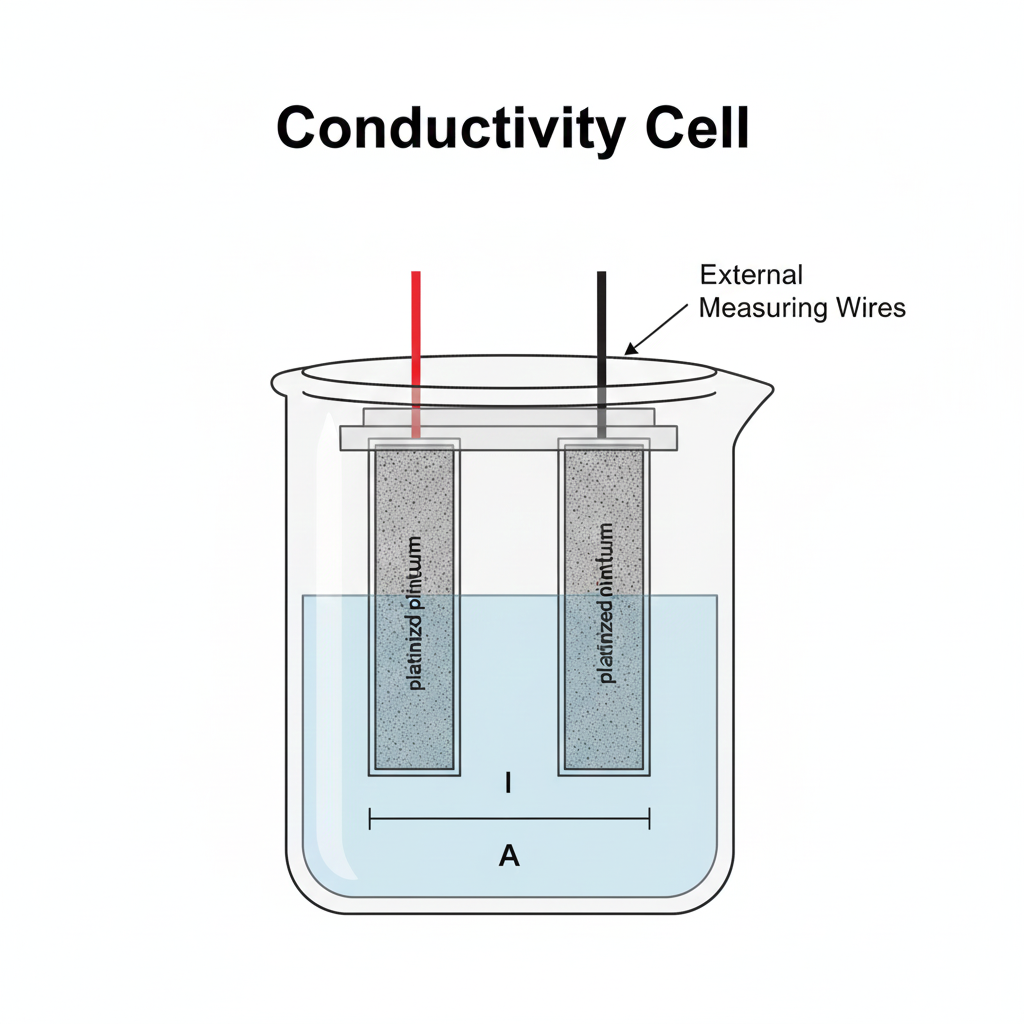
Measuring the conductivity ($\kappa$) of ionic solutions is tricky, boss! If you use direct current (DC), the solution composition changes due to electrochemical reactions. To prevent this change, we use an alternating current (AC) source. We also need a specially designed vessel called a conductivity cell. This cell uses two platinized platinum electrodes with area '$A$' and separated by distance '$l$'. The quantity $\frac{l}{A}$ is known as the cell constant ($G^*$).
Figure below:
A clear diagram showing a conductivity cell with two platinized platinum electrodes (area 'A' and distance 'l') connected to external measuring wires.
NEET Checkpoint:
Why is an AC source used to measure the conductivity of ionic solutions?
(a) To increase ion speed
(b) To prevent changes in solution composition
(c) To measure resistance directly
✅ Answer: (b) To prevent changes in solution composition — DC causes prolonged passage of current which leads to electrochemical reactions.
Practice Questions:
1. Which statement correctly describes the nature of conduction in copper wires and salt solutions?
(a) Copper conduction is due to ions, and salt solution conduction decreases with temperature.
(b) Copper conduction decreases with temperature, and salt solution conduction is due to electrons.
(c) Copper conduction is due to electrons, and salt solution conduction is due to ions.
(d) Both types of conduction are due to the movement of electrons.
✅ Answer: (c) Copper conduction (metallic/electronic) is due to the movement of electrons, and salt solution conduction (electrolytic/ionic) is due to the movement of ions.
2. The resistance of a substance that is one metre long and has an area of cross-section of one $m^2$ is defined as:
(a) Conductance ($G$)
(b) Cell Constant ($G^*$)
(c) Conductivity ($\kappa$)
(d) Resistivity ($\rho$)
✅ Answer: (d) Resistivity ($\rho$) — This is the physical definition provided for resistivity.
Key Takeaway: Conduction Types and Core Formulas
| Parameter | Electronic (Metallic) | Electrolytic (Ionic) |
|---|---|---|
| Charge Carrier | Electrons | Ions |
| Temp Effect | Decreases as $T$ increases | Increases as $T$ increases |
Resistance: $R = \rho \frac{l}{A} \quad (\text{Unit: } \Omega)$
Conductance: $G = \frac{1}{R} \quad (\text{Unit: } S \text{ or } \Omega^{-1})$
Conductivity: $\kappa = \frac{1}{\rho} \quad (\text{Unit: } S~m^{-1} \text{ or } S~cm^{-1})$
13. Molar Conductivity, Dilution, and Kohlrausch’s Law
Hey aspirants! Let's clear up a crucial electrochemistry funda that NEET loves: how the movement of ions changes when you dilute a solution. Don't stress, yaar—it’s easier than it looks if you remember one key difference between two terms!
First, the definition: Molar conductivity ($\Lambda_m$) is linked to conductivity ($\kappa$) by concentration ($c$ )using the equation:
Now, why does conductivity change upon dilution? Conductivity ($\kappa$)—which is the conductance of one unit volume of the solution—always decreases with dilution for both weak and strong electrolytes. Think of it like this: when you add water (dilution), the number of ions per unit volume drops, so less current can be carried in that unit volume.
But notice this: molar conductivity ($\Lambda_m$) increases with decrease in concentration (dilution)! How is that possible? $\Lambda_m$ represents the conductance of the total volume ($V$) containing one mole of the electrolyte. When you dilute, this volume ($V$) increases so significantly that it more than compensates for the small drop in $\kappa$.
Relatable Example: Imagine you’re a bike courier (the ion) tasked with delivering one mole of packages across the city (the solution). When the entire city map (volume, $V$) doubles in size due to dilution, your overall delivery capacity ($\Lambda_m$) increases drastically, even if the density of packages per street ($\kappa$) slightly decreases!
NEET Checkpoint:
Which property relates to conductivity at infinite dilution?
(a) Specific resistance
(b) $\Lambda_m$
(c) $\Lambda_m^{\circ}$
(d) Cell constant
✅ Answer: (c) $\Lambda_m^{\circ}$ — This symbol represents limiting molar conductivity, or molar conductivity at zero concentration.
Strong Electrolytes and $\Lambda_{m}^{\circ}$
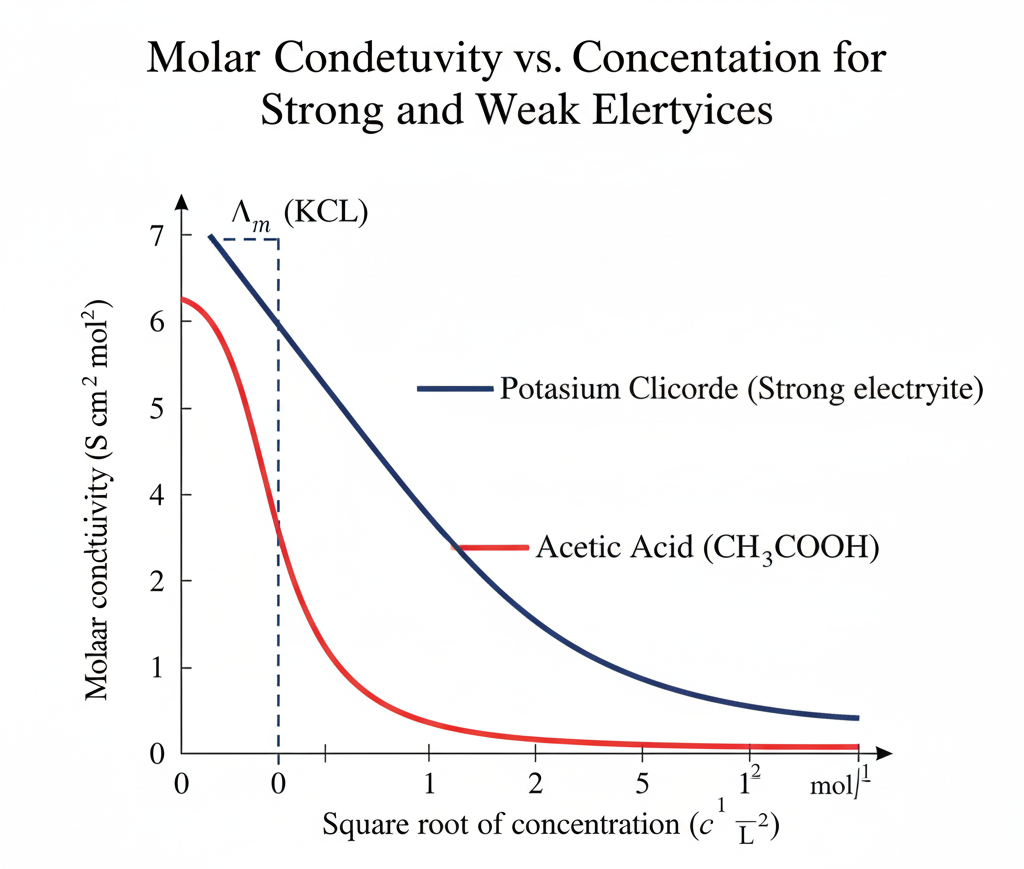
For strong electrolytes (like $\text{KCl}$), $\Lambda_m$ increases slowly with dilution. We use the relationship:
Here, $\Lambda_{m}^{\circ}$ is the limiting molar conductivity (molar conductivity at infinite dilution, i.e., zero concentration). For strong electrolytes, you can determine $\Lambda_{m}^{\circ}$ easily by plotting $\Lambda_m$ against $c^{1/2}$ and extrapolating the straight line back to $c^{1/2} = 0$.
Figure below:
A clear diagram showing Molar conductivity ($\Lambda_m$) versus the square root of concentration ($c^{1/2}$) for Potassium Chloride (strong electrolyte, showing linear decrease) and Acetic Acid (weak electrolyte, showing steep increase at low concentration).
NEET Checkpoint:
How is $\Lambda_{m}^{\circ}$ for a strong electrolyte found experimentally?
(a) Using Nernst equation
(b) Extrapolation of $\Lambda_m$ vs $c^{1/2}$ plot
(c) By measuring $\kappa$ at 1 M
(d) By simple calculation
✅ Answer: (b) Extrapolation of $\Lambda_m$ vs $c^{1/2}$ plot — For strong electrolytes, plotting $\Lambda_m$ vs $c^{1/2}$ yields a straight line suitable for extrapolation.
Kohlrausch’s Law of Independent Migration of Ions
This is the big boss funda! Kohlrausch observed that $\Lambda_{m}^{\circ}$ is the sum of the individual contributions of the limiting molar conductivities of the cation ($\lambda_{+}^{\circ}$) and the anion ($\lambda_{-}^{\circ}$).
The law states that the limiting molar conductivity ($\Lambda_{m}^{\circ}$) of an electrolyte can be represented as the sum of the individual contributions of its ions. It means each ion acts independently at infinite dilution.
If an electrolyte dissociates to give $v_{+}$ cations and $v_{-}$ anions, the general formula is:
NEET Checkpoint:
What is the specific value of $v_{+}$ for $\text{CaCl}_2$ in the Kohlrausch equation?
(a) 1
(b) 2
(c) 3
(d) 0
✅ Answer: (a) 1 — $\text{CaCl}2$ dissociates into one $\text{Ca}^{2+}$ ion ($v{+}=1$and two $\text{Cl}^{-}$ ions ($v_{-}=2$).
Practice Questions:
- The major reason why conductivity ($\kappa$) decreases with dilution is:
(a) Increased ionic mobility.
(b) Decreased number of ions per unit volume.
(c) Increased viscosity of the solvent.
(d) Complete dissociation of the electrolyte.
✅ Answer: (b) Decreased number of ions per unit volume. The number of current-carrying ions in a unit volume decreases as water is added.
2. $\Lambda_{m}^{\circ}$ for $\text{NaCl}$ is $126.4 \text{ S cm}^2 \text{ mol}^{-1}$ and $\Lambda_{m}^{\circ}$ for $\text{HCl}$ is $425.9 \text{ S cm}^2 \text{ mol}^{-1}$, which ion contributes more significantly to limiting molar conductivity?
(a) $\text{Na}^{+}$
(b) $\text{Cl}^{-}$
(c) $\text{H}^{+}$
(d) Cannot be determined
✅ Answer: (c) $\text{H}^{+}$. Since the difference between $\text{HCl}$ and $\text{NaCl}$ values (assuming $\lambda_{\text{Cl}^{-}}^{\circ}$ is constant) is large, $\text{H}^{+}$ must have a significantly higher $\lambda^{\circ}$ value (it’s $349.6 \text{ S cm}^2 \text{ mol}^{-1}$ in the table, the highest!).
Key Formula Summary
Molar Conductivity ($\Lambda_m$): $\Lambda_{m} = \kappa/c$
Strong Electrolytes: $\Lambda_{m} = \Lambda_{m}^{\circ} - A c^{\frac{1}{2}}$
Kohlrausch’s Law: $\Lambda_{m}^{\circ} = v_{+}\lambda_{+}^{\circ} + v_{-}\lambda_{-}^{\circ}$
14. Primary and Secondary Batteries: The Power Play!
Hey future doctors! Let’s clear up the funda (fundamental concept) about batteries—they are super important electrochemical cells. Think of them as the energy pack for everything from your wall clock to your dad's car. We divide them into two categories based on their recharging capability: Primary and Secondary.
Primary Batteries: Use and Throw!
These batteries are non-rechargeable. The chemical reaction inside occurs only once, and once the reactants are used up, the battery is dead. It’s like buying a single ticket to a cricket match—you only get one entry!
- Dry Cell (Leclanche Cell): This is the common cell in your TV remote or transistor. The anode is a $\text{zinc}$ container. The cathode is a $\text{carbon}$ ($\text{graphite}$) rod surrounded by powdered $\text{manganese dioxide}$ ($\text{MnO}_2$) and $\text{carbon}$. The cell potential is typically around $1.5\text{ V}$.
NEET Checkpoint:
In a dry cell, what substance is reduced at the cathode?
(a) $\text{Zn}$
(b) $\text{NH}_4^+$
(c) $\text{Zn}^{2+}$
(d) $\text{NH}_3$
✅ Answer: (b) $\text{NH}_4^+$ — It reacts with $\text{MnO}_2$ to form $\text{MnO}(\text{OH})$ and $\text{NH}_3$.
2. Mercury Cell: Used in low-current devices like watches or hearing aids. The overall reaction is super clean: $\text{Zn}(\text{Hg}) + \text{HgO}(s) \longrightarrow \text{ZnO}(s) + \text{Hg}(l)$. The cool part? Its potential, about $1.35\text{ V}$, remains constant throughout its life because the overall reaction doesn't involve any ion in solution whose concentration changes.
Secondary Batteries: Rechargeable Rockstars!
These are the heroes! After use, you can pass current through them in the opposite direction to reverse the chemical reaction and recharge them.
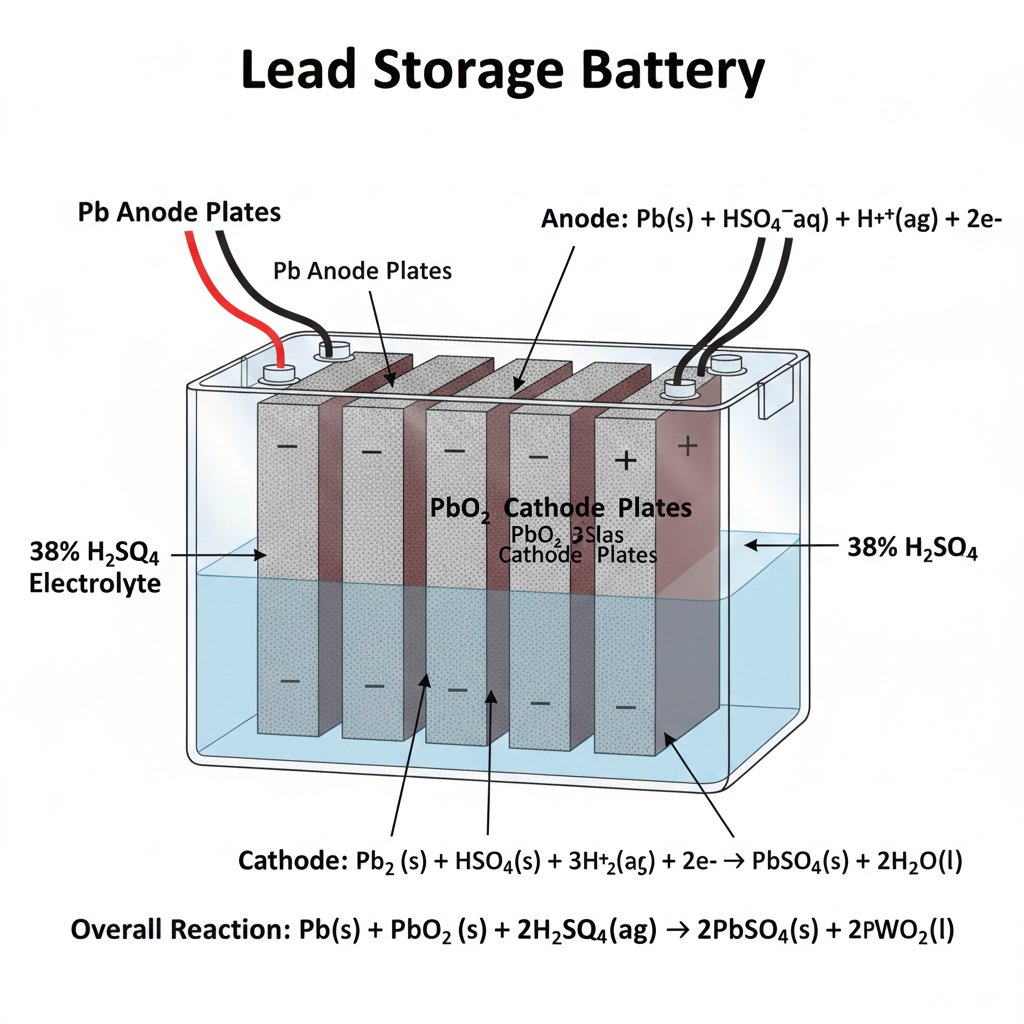
- Lead Storage Battery: The big daddy used in cars and invertors. The anode is $\text{lead}$ ($\text{Pb}$), and the cathode is a grid of $\text{lead}$ packed with $\text{lead dioxide}$ ($\text{PbO}_2$). The electrolyte is a $\mathbf{38\%}$ solution of $\text{sulphuric acid}$ ($\text{H}_2\text{SO}_4$). Notice this, yaar: during discharge, both electrodes are converted to $\mathbf{\text{PbSO}_4(s)}$! Charging reverses this entire process.
NEET Checkpoint:
What is the electrolyte concentration generally used in a lead storage battery?
(a) $38\%$ $\text{HCl}$
(b) $38\%$ $\text{H}_2\text{SO}_4$
(c) $1.1\text{ M}$ $\text{PbO}_2$
(d) $2\text{ V}$
✅ Answer: (b) $38\%$ $\text{H}_2\text{SO}_4$ — This specific concentration is crucial for the cell's operation.
Figure below:
A clear diagram showing the components of a Lead storage battery, including the $\text{Pb}$ anode plates, the $\text{PbO}_2$ packed cathode plates, and the $38\%$ $\text{H}_2\text{SO}_4$ electrolyte.
2. Nickel-Cadmium Cell (Ni-Cd): Another secondary option known for its longer life compared to the lead storage cell, though it's pricier to manufacture. The overall discharge reaction is $\text{Cd}(s) + 2\text{Ni}(\text{OH})_3(s) \longrightarrow \text{CdO}(s) + 2\text{Ni}(\text{OH})_2(s) + \text{H}_2\text{O}(l)$.
Relatable Example: Think of a primary cell (like a dry cell) as a paper boat—fun for one trip down the drain, then done. A secondary cell (like your laptop's battery) is a sturdy fibre boat—you can use it, bring it back, repair it, and send it out again, over and over!
NEET Checkpoint:
During the discharging of a lead storage battery, what compound is formed at both the anode and the cathode?
(a) $\text{PbO}$
(b) $\text{Pb}$
(c) $\text{PbO}_2$
(d) $\text{PbSO}_4$
✅ Answer: (d) $\text{PbSO}_4$ — Both $\text{Pb}$ (anode) and $\text{PbO}_2$ (cathode) are converted to $\text{PbSO}_4(s)$ during use.
Practice Questions:
-
Which cell uses $\text{zinc mercury amalgam}$ ($\text{Zn}(\text{Hg})$) as the anode?
(a) Dry Cell
(b) Lead Storage Battery
(c) Nickel-Cadmium Cell
(d) Mercury Cell
✅ Answer: (d) Mercury Cell — $\text{Zn}(\text{Hg})$ and a paste of $\text{HgO}$ and carbon form the electrodes, with $\text{KOH}$ and $\text{ZnO}$ as electrolyte.
2. The reversal of the chemical reaction in a cell is the defining characteristic of:
(a) A Primary Battery
(b) An Electrolytic Cell used for metal extraction
(c) A Secondary Battery
(d) A Fuel Cell
✅ Answer: (c) A Secondary Battery — Secondary cells are rechargeable because the reaction can be reversed by passing current in the opposite direction.
Key Takeaway
Primary cells die after a single use (e.g., Dry Cell, Mercury Cell). Secondary cells are rechargeable (e.g., Lead Storage, Ni-Cd) by converting the $\text{PbSO}_4$ back to $\text{Pb}$ and $\text{PbO}_2$.
15. Fuel Cells, Electrolysis, and Electrochemical Corrosion
Hey future Doctors! Let's wrap up this electrochemistry session with three super important fundas that connect chemistry to the real world: Fuel Cells, Electrolysis, and the constant battle against Corrosion. Don't stress, yaar—it's easier than it looks!
Fuel Cells: Powering the Future
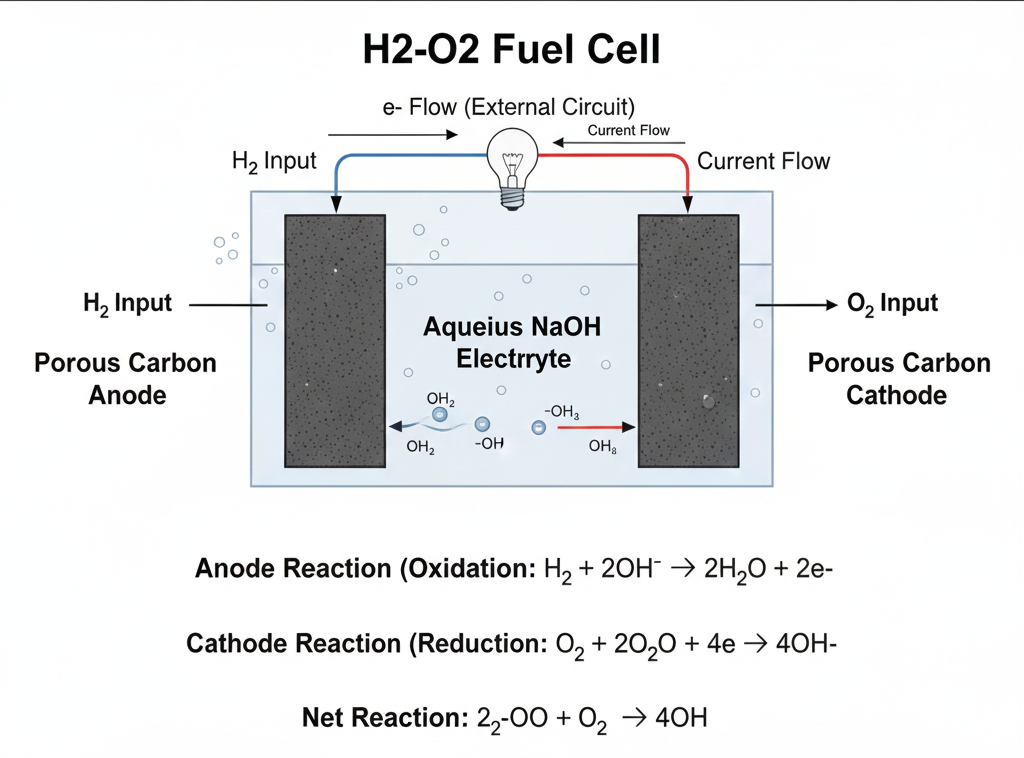
Fuel Cells are essentially galvanic cells that are specially designed to convert the energy released from the combustion of fuels (like hydrogen, methane, or methanol) directly into electrical energy continuously. Think of them as the high-mileage scooters of the electrical world! For example, the $\mathrm{H}{2}-\mathrm{O}{2}$ fuel cell was a superstar in the Apollo space programme, providing electrical power, and get this, the water vapour product was condensed for the astronauts' drinking water. Fuel cells are highly efficient, boasting about $70\%$ efficiency compared to thermal plants which manage only about $40\%$. Plus, they are pollution-free, producing only water when using hydrogen.
The reactions involve reactants being fed continuously into porous carbon electrodes containing catalysts like platinum $(\mathrm{Pt})$ or palladium $(\mathrm{Pd})$.
NEET Checkpoint:
Which type of cell converts the chemical energy of fuel combustion directly into electrical energy?
(a) Electrolytic cell
(b) Galvanic cell
(c) Concentration cell
(d) Leclanche cell
✅ Answer: (b) Galvanic cell — Fuel cells are designed as galvanic cells, converting spontaneous redox energy into electricity.
Figure below:
A clear diagram showing an $H_{2}-O_{2}$ fuel cell setup, illustrating $H_{2}$ and $O_{2}$ inputs, porous carbon electrodes, aqueous electrolyte (NaOH), and the flow of electrons/current.
Electrolysis: Forcing the Reaction
Now, let's flip the script! Electrolysis is the process carried out in an electrolytic cell, where electrical energy is intentionally used to bring about non-spontaneous chemical reactions. This is how industry extracts metals like $\mathrm{Na}$, $\mathrm{Mg}$, and $\mathrm{Al}$. This concept is quantified by Faraday's Laws of Electrolysis.
Faraday’s First Law states that the amount of substance produced at any electrode is proportional to the quantity of electricity passed ($Q$). Remember, $Q$ is given by:
Where $I$ is current in amperes and $t$ is time in seconds, yielding $Q$ in coulombs. The charge required to reduce one mole of monovalent ions is called the Faraday constant ($F$), which is approximately $96487\ \mathrm{C}\ \mathrm{mol}^{-1}$.
NEET Checkpoint:
What is the approximate value of the Faraday constant in $\mathrm{C}\ \mathrm{mol}^{-1}$? (a) $9650\ \mathrm{C}\ \mathrm{mol}^{-1}$
(b) $96487\ \mathrm{C}\ \mathrm{mol}^{-1}$
(c) $1.6\times10^{-19}\ \mathrm{C}\ \mathrm{mol}^{-1}$
(d) $1000\ \mathrm{C}\ \mathrm{mol}^{-1}$
✅ Answer: (b) $96487\ \mathrm{C}\ \mathrm{mol}^{-1}$ — This is the accurately known charge on one mole of electrons.
Corrosion: The Silent Destroyer
Finally, meet the ultimate chemical villain: Corrosion! Rusting of iron, tarnishing of silver—it’s all essentially an electrochemical phenomenon. Imagine a tiny galvanic cell setting up secretly on your iron railing when water and air are present.
At one spot, the metal undergoes oxidation (acts as the anode): $\mathrm{Fe}(s)\rightarrow \mathrm{Fe}^{2+}(aq)+2e^{-}$. The electrons travel through the metal to a cathodic spot where reduction of oxygen takes place in the presence of $\mathrm{H}^{+}$ ions.
The $\mathrm{Fe}^{2+}$ ions generated are then further oxidised by atmospheric oxygen to form rust, which is hydrated ferric oxide $(\mathrm{Fe}{2}\mathrm{O}{3}.x\mathrm{H}_{2}\mathrm{O})$.
Relatable Example: If your bicycle lock rusts solid after the monsoon, that’s corrosion converting your strong $\mathrm{Fe}(s)$ (metal) into useless, crumbly $\mathrm{Fe}{2}\mathrm{O}{3}.x\mathrm{H}_{2}\mathrm{O}$ (rust). Even friction needs a break sometimes!
NEET Checkpoint:
Rusting of iron involves the oxidation of iron occurring at which site?
(a) Cathodic spot
(b) Anodic spot
(c) Electrolyte
(d) Inert electrode
✅ Answer: (b) Anodic spot — Oxidation ($\mathrm{Fe}\rightarrow \mathrm{Fe}^{2+}+2e^{-}$) always occurs at the anodic spot during corrosion.
Practice Questions:
- If $2\ \mathrm{F}$ of electricity is passed through molten $\mathrm{Mg}^{2+}$, how many moles of $\mathrm{Mg}(s)$ will be deposited?
(a) $1\ \mathrm{mol}$
(b) $2\ \mathrm{mol}$
(c) $3\ \mathrm{mol}$
(d) $4\ \mathrm{mol}$
✅ Answer: (a) $1\ \mathrm{mol}$ — The reaction is $\mathrm{Mg}^{2+}(l)+2e^{-}\rightarrow \mathrm{Mg}(s)$. Since $2\ \mathrm{F}$ ($2$ moles of electrons) are required to deposit $1\ \mathrm{mol}$ of $\mathrm{Mg}$, passing $2\ \mathrm{F}$ deposits $1\ \mathrm{mol}$.
2. What is the chemical composition of rust formed during the corrosion of iron?
(a) Ferric chloride
(b) Ferrous oxide
(c) Hydrated ferric oxide
(d) Ferrous sulphate
✅ Answer: (c) Hydrated ferric oxide — Rust is the product of the further oxidation of $\mathrm{Fe}^{2+}$ by atmospheric oxygen, denoted as $\mathrm{Fe}{2}\mathrm{O}{3}.x\mathrm{H}_{2}\mathrm{O}$.
Key Takeaway
| Concept | Nature | Primary Output |
|---|---|---|
| Fuel Cell | Galvanic Cell (Spontaneous) | Electrical Energy + Water |
| Electrolysis | Electrolytic Cell (Non-Spontaneous) | Chemical Products |
| Corrosion | Electrochemical Phenomenon | Hydrated Ferric Oxide (Rust) |