
1. General Introduction & Fundamentals
Listen up, juniors! Organic chemistry is the study of life itself—think DNA, proteins, and even your favorite pair of jeans. Around 1780, chemists like Berzelius thought organic compounds needed a mysterious "vital force" to exist. But in 1828, F. Wöhler pulled a total "boss move" and synthesised urea from inorganic ammonium cyanate in the lab.
NEET Checkpoint:
Who first synthesised an organic compound from an inorganic source?
(a) Berzilius
(b) Kolbe
(c) Wöhler
(d) Berthelot
✅ Answer: (c) Wöhler — Arre, he’s the one who proved "vital force" was just a myth!.
The secret to Carbon's versatility? Tetravalence and its unique property of catenation. Carbon uses hybridisation ($sp^3, sp^2, sp$) to create specific shapes: Methane is tetrahedral ($sp^3$), Ethene is planar ($sp^2$), and Ethyne is linear ($sp$).
NEET Checkpoint:
Which hybrid orbital has the highest electronegativity?
(a) $sp$
(b) $sp^2$
(c) $sp^3$
(d) $p$
✅ Answer: (a) $sp$ — More $s$ character means the electrons are held closer to the nucleus!.
Think of it like a local pani puri stall—everyone thought only "special hands" could make the perfect theeka paani (Vital Force), until someone figured out the exact chemical recipe in a kitchen (the lab)!
NEET Checkpoint:
What was synthesised by Kolbe in 1845?
(a) Methane
(b) Urea
(c) Acetic Acid
(d) Benzene
✅ Answer: (c) Acetic Acid — Kolbe followed Wöhler's lead to further crush the vital force theory.
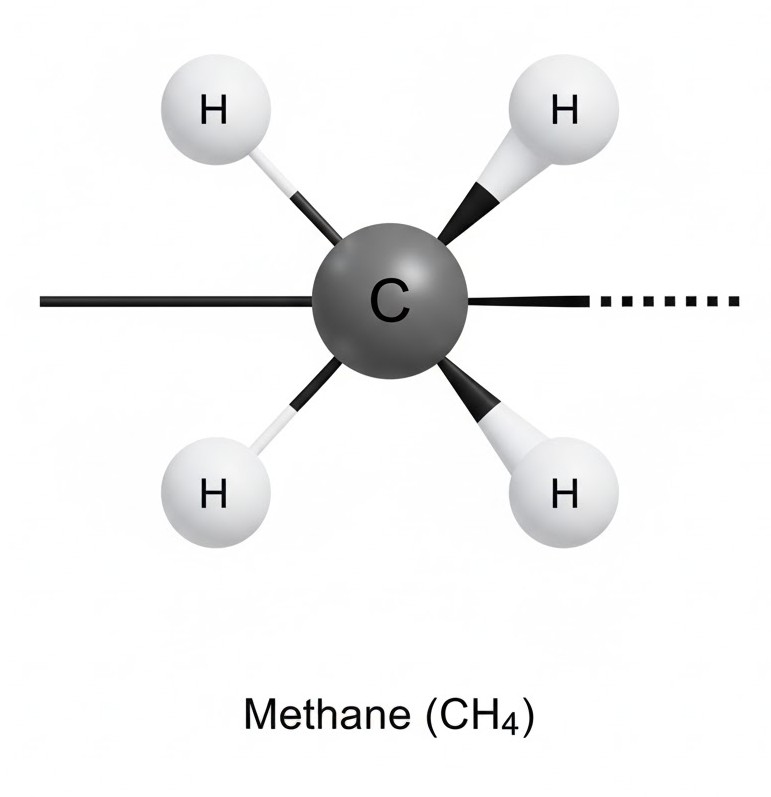
Figure below:
A clear 3D wedge-and-dash representation of a methane molecule ($CH_4$) showing a central carbon atom with two bonds in the plane of the paper, one solid wedge towards the observer, and one dashed wedge away.
Practice Question:
The transition from "Vital Force" theory to modern organic synthesis began with:
(a) Synthesis of methane
(b) Discovery of DNA
(c) Synthesis of urea
(d) IUPAC rules
✅ Answer: (c) Wöhler's synthesis of urea in 1828 was the historical turning point.
Key Takeaway
Organic chemistry shifted from "nature-only" to "lab-made" thanks to Wöhler. Carbon's $sp^3, sp^2,$ and $sp$ hybridisation dictates the 3D geometry and reactivity of every molecule you'll study.
2. Tetravalence and Shapes of Carbon
Hey junior! Let’s clear up this funda about why carbon is the ultimate architect of the molecular world. Carbon uses hybridisation of its $s$ and $p$ orbitals to decide its shape. Whether it's the tetrahedral vibe of methane ($CH_{4}$) using $sp^{3}$, the flat, planar look of ethene ($C_{2}H_{4}$) with $sp^{2}$, or the straight-up linear style of ethyne ($C_{2}H_{2}$) using $sp$ hybridisation, carbon always keeps it interesting.
NEET Checkpoint:
Which hybrid orbital has the maximum $s$-character?
(a) $sp^{3}$
(b) $sp^{2}$
(c) $sp$
(d) $dsp^{2}$
✅ Answer: (c) $sp$ — It’s a $50/50$ split, giving it $50\%$ $s$-character!
Here’s the trick: hybridisation dictates the "strength" of the bond. An $sp$ hybrid orbital has more $s$-character, meaning it stays closer to the nucleus, making its bonds shorter and stronger (higher bond enthalpy) than $sp^{3}$. This also makes the carbon more electronegative; so an $sp$ carbon is much hungrier for electrons than its $sp^{2}$ or $sp^{3}$ cousins.
Relatable Indian Example: Imagine three aunties squeezed into the back of an auto-rickshaw. To fit, they all have to sit in one flat row—that’s exactly like the trigonal planar shape of $sp^{2}$ hybridisation!
NEET Checkpoint:
How does increasing $s$-character affect bond length?
(a) It increases
(b) It decreases
(c) It remains the same
(d) Cannot be determined
✅ Answer: (b) It decreases it — More $s$-character means the bond is closer to the nucleus and shorter.
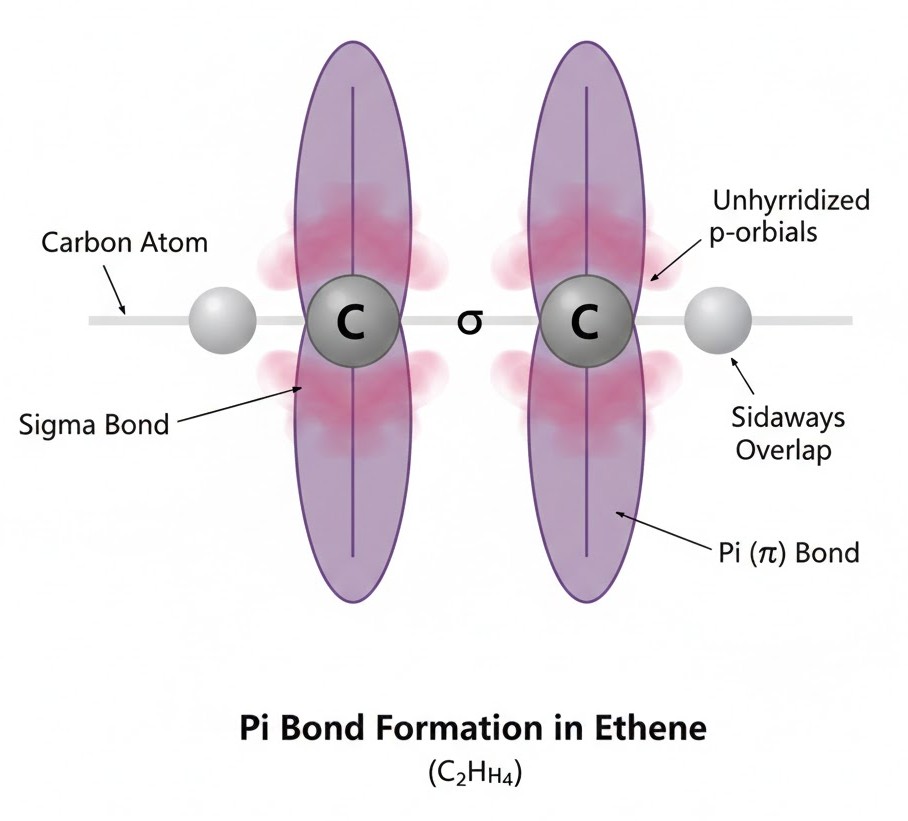
Now, notice this: $\pi$ bonds are special because they need parallel $p$-orbitals on adjacent atoms to overlap sideways. This specific orientation means the molecule must stay flat, and you can't just rotate the $C=C$ bond like a spinner—that’s restricted rotation for you! Because these $\pi$ electrons sit above and below the plane, they are the most reactive centres, ready for an "attack" by reagents.
Figure below:
A clear diagram showing the parallel orientation of two unhybridised p-orbitals on adjacent carbon atoms in ethene, illustrating the sideways overlap that forms a pi bond above and below the molecular plane.
NEET Checkpoint:
Why is rotation restricted around a $C=C$ bond?
(a) Presence of π-bond
(b) Presence of σ-bond
(c) High electronegativity of carbon
(d) Steric hindrance only
✅ Answer: (a) Rotation would interfere with the maximum overlap of the parallel $p$-orbitals.
Practice Question:
A carbon atom with $50\%$ $s$-character is:
(a) Less electronegative than $sp^{2}$
(b) More electronegative than $sp^{3}$
(c) Tetrahedral in shape
(d) Forming the longest bonds
✅ Answer: (b) — Greater $s$-character equals greater electronegativity.
Key Takeaway
- $sp^{3}$: Tetrahedral | $sp^{2}$: Planar | $sp$: Linear
- Electronegativity/Strength: $sp > sp^{2} > sp^{3}$ (due to $s$-character)
- $\pi$ Bonds: Parallel $p$-orbitals + Restricted rotation = High reactivity
3. Structural Representations: The Molecule's Wardrobe
Hey junior! Let’s clear up this structural representation funda. Think of these as different ways to draw a map of a molecule. Carbon is a bit of a minimalist, so we have levels of detail, from "full-on HD" to "quick sketch".
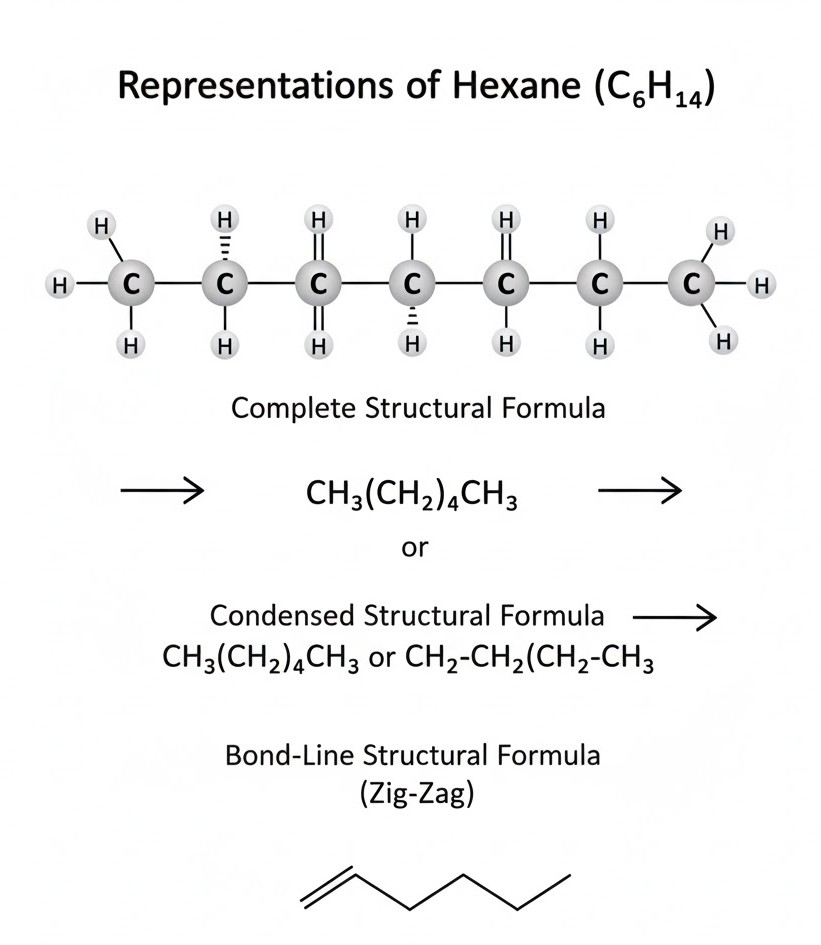
First up, Complete Structural Formulas use Lewis dots or dashes ($-$) to show every single covalent bond. A single dash represents a two-electron bond. It’s like drawing every single station on a Mumbai local map. But that gets crowded, so we use Condensed Structural Formulas. Here, we omit some dashes and use subscripts to show identical groups, like writing $CH_3(CH_2)_6CH_3$.
NEET Checkpoint:
In a complete structural formula, what does a single dash represent?
(a) 1 electron
(b) 2 electrons
(c) 4 electrons
(d) A lone pair
✅ Answer: (b) 2 electrons — Simple funda: one bond = one shared pair!
The coolest version is the Bond-line representation. We use zig-zag lines where carbon and hydrogen are "invisible". The terminals (ends) are methyl ($-CH_3$) groups, and every junction is a carbon atom bonded to enough hydrogens to satisfy its tetravalence. If you see a line for a simple propane, it looks like a mountain peak ($/\backslash$).
Figure below:
A clear diagram showing the step-by-step conversion of hexane ($C_6H_{14}$) from a dash-heavy complete formula to a condensed formula, and finally to a 5-segment zig-zag bond-line.
NEET Checkpoint:
In bond-line notation, what do the line junctions represent?
(a) Hydrogen atoms
(b) Carbon atoms
(c) Methyl groups
(d) Oxygen atoms
✅ Answer: (b) Carbon atoms — Each "corner" or junction is a carbon atom.
NEET Checkpoint:
How are heteroatoms like Oxygen or Nitrogen shown in bond-line formulas?
(a) They are invisible
(b) As zig-zag lines
(c) Specifically written out
(d) As dots
✅ Answer: (c) Specifically written out — Only C and H (attached to C) are hidden!
Imagine your mom's grocery list. Writing "10 units of $1kg$ sugar packets" is complete representation. Writing "10kg sugar" is condensed. Drawing a simple icon of a sugar cube is the bond-line version!
Practice Question:
Which of the following is the expanded form of a 3-carbon zig-zag line?
(a) $CH_3CH_2CH_3$
(b) $CH_3CH_3$
(c) $CH_4$
(d) $C_2H_6$
✅ Answer: (a) $CH_3CH_2CH_3$ — A 3-carbon chain has two terminals and one junction.
Key Takeaway
- Complete: Every bond is a dash ($-$).
- Condensed: Simplified using subscripts like $(CH_2)_n$.
- Bond-line: Minimalist zig-zag; terminals = methyl; junctions = Carbon.
- Expansion: Add hydrogens until every Carbon has 4 bonds.
4. 3D Representation & Molecular Models
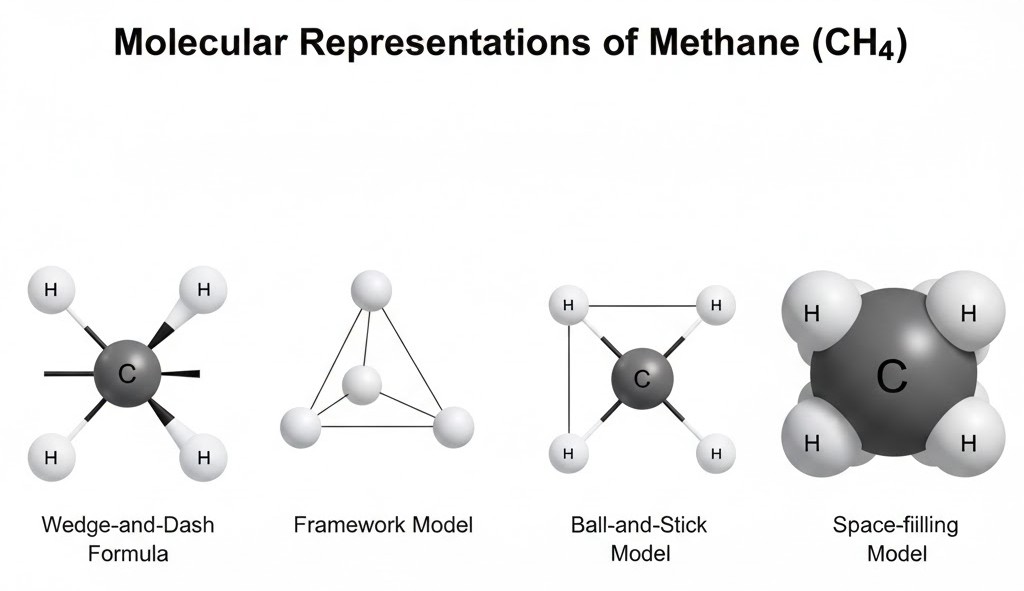
Hey there, future doctor! Ever wondered how we draw 3D molecules on a 2D notebook? It is like trying to show a cricket ball's swing on a flat TV screen!. To solve this, organic chemists use Wedge-and-Dash conventions. A solid wedge means the bond is popping out of the paper towards you—imagine a batsman’s bat coming right at the camera! A dashed wedge depicts the bond projecting away from you, hiding behind the paper. Normal lines? Arre, they are just chilling in the plane of the paper.
NEET Checkpoint:
In a 3D representation, which convention indicates a bond projecting towards the observer?
(a) Solid wedge
(b) Dashed wedge
(c) Straight line
(d) Curved arrow
✅ Answer: (a) Solid wedge — It is the molecule's way of saying "Hi" up close!.
When we want to get really hands-on, we use physical molecular models. The Framework model focuses only on bond patterns and ignores the size of the atoms—think of it as the molecule's skeleton. The Ball-and-stick model shows both atoms (balls) and bonds (sticks), though we use springs for double bonds like in ethene. Finally, Space-filling models show the 'bulk' of the molecule based on van der Waals radii, conveying the actual volume occupied.
NEET Checkpoint:
Which molecular model does not show the bonds but emphasizes the relative size of each atom?
(a) Ball-and-stick model
(b) Space-filling (CPK) model
(c) Lewis structure
(d) Skeletal formula
✅ Answer: (b) Space-filling model — It is all about that volume, based on van der Waals radii.
Example: Think of a packed Mumbai local train. The space-filling model is like the crowded compartment where you only see the total volume of people, not their individual 'bonds' (arms)!
Figure below:
A 3D wedge-and-dash representation of methane ($CH_{4}$) and the three types of molecular models: Framework, Ball-and-stick, and Space-filling.
NEET Checkpoint:
What is used instead of sticks to represent double bonds in ball-and-stick models?
(a) Springs
(b) Dotted lines
(c) Solid wedges
(d) Curved arrows
✅ Answer: (a) Springs — This helps us perceive the restricted rotation and bond patterns better.
Practice Question:
Which model focuses strictly on bond patterns while ignoring the size of the atoms?
(a) Ball-and-stick model
(b) Space-filling model
(c) Framework model
(d) Ball-and-spring model
✅ Answer: (c) Framework model — It is the minimal 'skeletal' view of a molecule.
Key Takeaway:
- Solid Wedge: Towards observer; Dashed Wedge: Away from observer.
- Framework: Bonds only; Ball-and-Stick: Atoms + Bonds.
- Space-filling: Based on van der Waals radii to show volume.
5. Classification of Organic Compounds
Don’t let the millions of organic compounds make your head spin, yaar! Sorting them is as simple as organising your cricket kit. Let's clear up this funda.
Acyclic or Open Chain (Aliphatic) Compounds
These consist of straight or branched chains, like a long queue at a pani puri stall. Examples include $CH_{3}CH_{3}$ (Ethane) and $CH_{3}CH(CH_{3})CH_{3}$ (Isobutane). Notice how the ends don't meet? That's why we call them open-chain!
NEET Checkpoint:
Are aliphatic compounds only straight chains?
(a) Yes, only straight chains
(b) No, they can be straight, branched, or cyclic
(c) Only branched chains
(d) Only cyclic chains
✅ Answer: (b) No — they can be straight or branched, like isobutane.
Cyclic or Closed Chain Compounds
Think of a circular racing track. These are classified into:
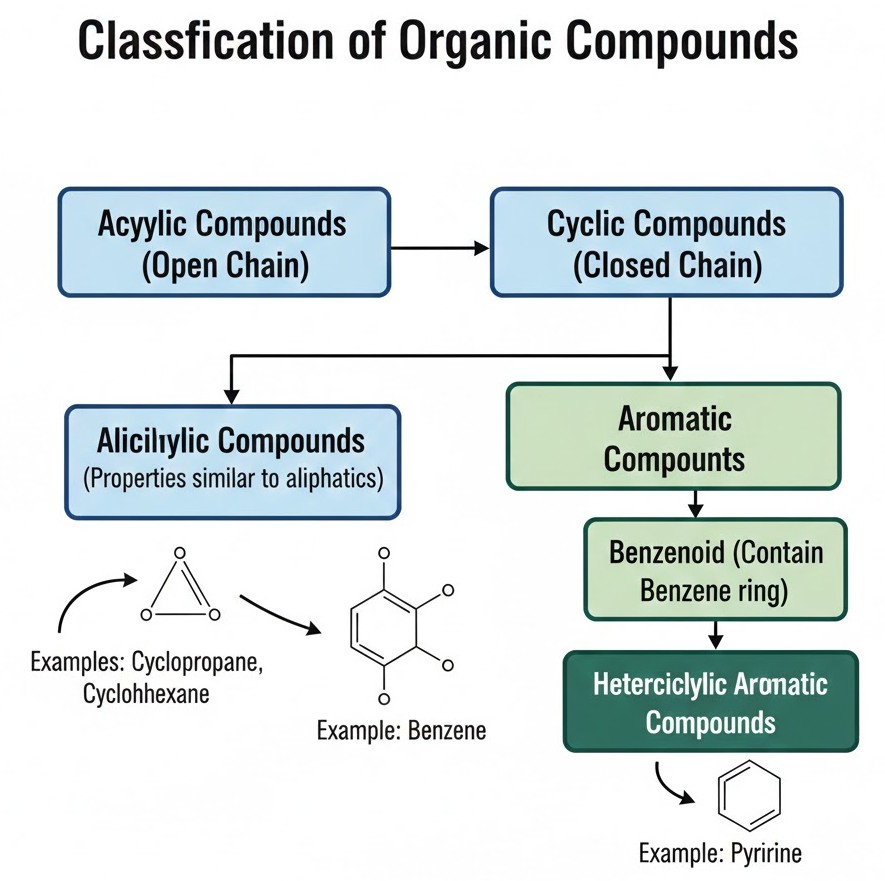
1. Alicyclic: These are "aliphatic cyclic" rings, like Cyclopropane or Cyclohexane. They act a lot like their open-chain cousins.
2. Aromatic: These are special "scented" rings.
* Benzenoid: They contain at least one benzene ring, like Aniline or Naphthalene.
* Non-benzenoid: They are aromatic but don't have a benzene ring. Tropone is the classic example here.
Heterocyclic Compounds
Sometimes, "uninvited guests" like Nitrogen ($N$), Oxygen ($O$), or Sulphur ($S$) join the carbon ring. If it’s a simple ring, we have Tetrahydrofuran. If it’s aromatic, we see Furan, Thiophene, or Pyridine.
Figure below:
A flow chart showing the classification of organic compounds into Acyclic and Cyclic, with Cyclic branching into Alicyclic and Aromatic (Benzenoid/Non-benzenoid), including heterocyclic examples like Pyridine.
NEET Checkpoint:
Which heteroatom is present in Thiophene?
(a) Oxygen (O)
(b) Nitrogen (N)
(c) Sulfur (S)
(d) Phosphorus (P)
✅ Answer: (c) Sulphur ($S$) — Remember, 'Thio' usually refers to sulphur!
NEET Checkpoint:
Is Tropone benzenoid?
(a) Yes
(b) No
(c) Sometimes
(d) Cannot be determined
✅ Answer: (b) No — it is a non-benzenoid aromatic compound.
Practice Questions:
1. Which of the following is a heterocyclic aromatic compound?
(a) Cyclohexane
(b) Benzene
(c) Tropone
(d) Pyridine
✅ Answer: (d) — Pyridine contains a Nitrogen atom in its aromatic ring.
2. Acyclic compounds are also known as:
(a) Aliphatic
(b) Aromatic
(c) Benzenoid
(d) Heterocyclic
✅ Answer: (a) — Open-chain compounds are called aliphatic compounds.
Key Takeaway
- Acyclic/Aliphatic: Open chains (Straight/Branched).
- Alicyclic: Closed carbon rings (Non-aromatic).
- Aromatic: Benzenoid (Benzene-based) vs. Non-benzenoid (e.g., Tropone).
- Heterocyclic: Rings containing $N$, $O$, or $S$.
6. Functional Groups & Homologous Series
Hey yaara! Ready to crack the "DNA" of organic molecules? Let’s clear the funda of why different compounds behave so differently. It’s all about who’s in charge of the molecule!
The "Action Center": Functional Groups
Think of a functional group as the "Captain" of a cricket team—it is the specific atom or group of atoms that is responsible for the characteristic chemical properties and is the actual site of chemical reactivity. For example, the hydroxyl group ($-OH$), aldehyde group ($-CHO$), and carboxylic acid group ($-COOH$) are the reasons why alcohols and acids show their unique "personality" in reactions.
NEET Checkpoint:
Which part of an organic molecule is primarily responsible for its chemical properties?
(a) Carbon backbone
(b) Functional group
(c) Hydrogen atoms
(d) Molecular mass
✅ Answer: (b) Functional group — It’s the "reactive hotspot" that dictates how a molecule reacts.
The Family Tree: Homologous Series
A homologous series is like a big family where everyone shares the same "last name" (functional group). Whether it’s Alkanes, Alkenes, or Alkanols, all members can be represented by a general molecular formula. The magic trick? Any two successive members differ from each other by exactly one $-CH_{2}$ unit in their molecular formula.
NEET Checkpoint:
Successive members of a homologous series differ by which molecular unit?
(a) –OH
(b) –CH₃
(c) –CH₂–
(d) –COOH
✅ Answer: (c) $-CH_{2}$ — Just add one carbon and two hydrogens to move to the next "sibling" in the family.
Local Train Analogy: It’s like adding an extra coach to a Mumbai local train. The train gets longer, but it still runs on the same track and belongs to the same line!
Sometimes, molecules like to multi-task and carry two or more identical or different groups—we call these polyfunctional compounds.
NEET Checkpoint:
What do you call a compound containing multiple functional groups?
(a) Homologous compound
(b) Heterocyclic compound
(c) Polyfunctional compound
(d) Aromatic compound
✅ Answer: (c) Polyfunctional compound — These are the "multi-taskers" of the organic world.
Practice Questions:
1. Which of the following is a functional group specifically mentioned in the sources?
(a) $-CH_{4}$
(b) $-COOH$
(c) $-CH_{3}$
(d) $-H$
✅ Answer: (b) $-COOH$ — This is the carboxylic acid functional group responsible for acidity.
2. Members of a homologous series have the same:
(a) Molecular mass
(b) Number of carbon atoms
(c) Functional group
(d) Physical properties
✅ Answer: (c) Functional group — This is what defines the series and its chemical behavior.
Key Takeaway
- Functional Group: The site of chemical reactivity ($-OH$, $-CHO$, etc.).
- Homologous Series: A family of compounds represented by a general formula, where members differ by a $-CH_{2}$ unit.
- Polyfunctional: Compounds with more than one functional group.
7. IUPAC Nomenclature: Alkanes
Naming millions of organic compounds might sound like a nightmare, but the IUPAC system is the ultimate "Aadhar Card" for molecules. It ensures that every structure has a unique, systematic name that anyone can decode. Let's clear the funda of naming the simplest family: the Alkanes!
Straight-Chain Alkanes: The Basics
For these "simple" guys, naming is a breeze. Just identify the number of carbons to choose the prefix (Meth-, Eth-, Prop-, etc.) and add the suffix '-ane'. For example, a single carbon is Methane ($CH_{4}$), and four carbons make Butane ($C_{4}H_{10}$).
NEET Checkpoint:
What is the IUPAC name for a straight-chain alkane with 8 carbon atoms?
(a) Heptane
(b) Octane
(c) Nonane
(d) Decane
✅ Answer: (b) Octane — Prefix 'Oct-' plus suffix '-ane'.
The "Rules of the Road" for Branched Alkanes
When branches (alkyl groups) show up, follow these steps to avoid getting clean bowled:
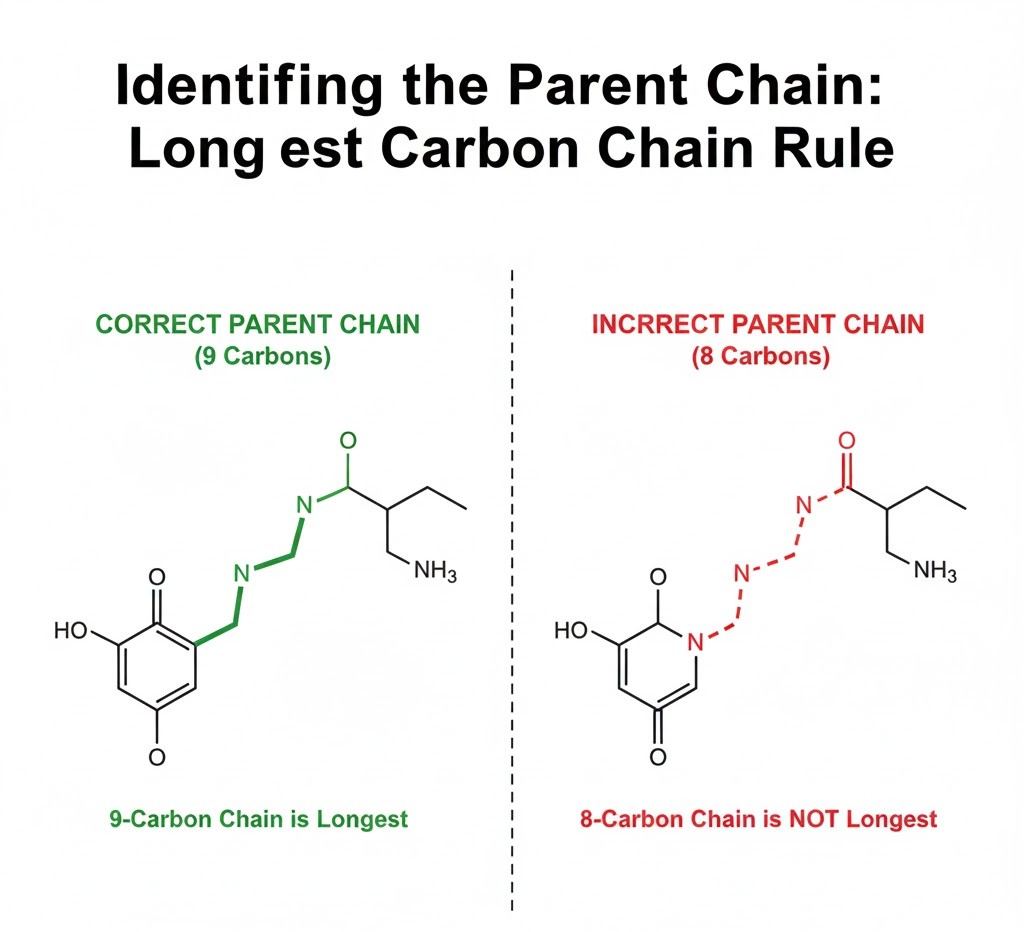
- Identify the Parent: Find the longest continuous carbon chain. This "Main Road" determines the parent name.
- The Lowest Locant Rule: Number the carbons of the parent chain starting from the end that gives the branches the lowest possible numbers.
- Alphabetical Swag: If different alkyl groups like Ethyl and Methyl are present, list them in alphabetical order in the final name, regardless of their position numbers.
Cricket Logic: Imagine a batting lineup. The longest partnership is your parent chain. If a star player (substituent) enters at "position 2" from one end but "position 6" from the other, we always count from the end that gives them the smaller number—because who doesn't want to be in the top order?
Figure below:
A clear diagram showing the correct selection of a nine-carbon parent chain versus an incorrect eight-carbon chain.
NEET Checkpoint:
If a chain has a Methyl at C-2 and an Ethyl at C-5, which group is written first in the name?
(a) Methyl
(b) Ethyl
(c) Both together as "Ethylmethyl"
(d) Depends on alphabetical order
✅ Answer: (b) Ethyl — Alphabetical order (E before M) is the priority in naming.
NEET Checkpoint:
How are multiple identical groups (like two methyls) indicated?
(a) By writing the group name twice
(b) By using prefixes like di-, tri-, tetra-
(c) By underlining the group name
(d) By using numbers only
✅ Answer: (b) By Using prefixes like 'di', 'tri', etc., with positions separated by commas.
Practice Questions:
1. What is the correct name for a 5-carbon chain with two methyl groups on the second carbon?
(a) 2-Dimethylpentane
(b) 2,2-Dimethylpentane
(c) 2,2-Methylpentane
(d) Isoheptane
✅ Answer: (b) 2,2-Dimethylpentane — Numbers must be repeated for each group and separated by a comma.
2. While naming, which prefix is not considered for alphabetical order?
(a) Iso
(b) Neo
(c) Sec
(d) Ethyl
✅ Answer: (c) Sec — Common prefixes like sec- and tert- are ignored for alphabetising, but iso- and neo- are included.
Key Takeaway
- Parent Chain: Longest continuous carbon chain.
- Numbering: Start from the end closer to the first branch (Lowest Locant).
- Punctuation: Commas between numbers (2,2); Hyphens between numbers and words (2-methyl).
- Alphabetical Order: Ethyl comes before Methyl, ignoring 'di' or 'tri' prefixes.
8. Nomenclature: Functional Groups
Arre wah! Ready to tackle the real bosses of organic chemistry? When a molecule has more than one functional group, it’s like a big Indian wedding—everyone is important, but there’s a strict hierarchy of who gets the most "izzat" (respect)!
In polyfunctional compounds, we pick one principal functional group based on a specific priority order. The ultimate "Mummy-Papa" of the group is the carboxylic acid ($-COOH$), followed by others like $-SO_3H$, $-COOR$, $-CN$, $-CHO$, $>C=O$, $-OH$, and $-NH_2$. The principal group gets the suffix (like -oic acid, -al, or -ol), while the "junior" groups are treated as mere prefixes (like hydroxy- for $-OH$ or oxo- for $>C=O$).
NEET Checkpoint:
If a compound has both an alcohol ($-OH$) and a ketone ($>C=O$), which one gets the suffix?
(a) Alcohol (–OH)
(b) Ketone (>C=O)
(c) Both get suffixes
(d) Neither
✅ Answer: (b) Ketone ($>C=O$) is higher in priority than alcohol ($-OH$), so the suffix will be -one and $-OH$ becomes a hydroxy- prefix.
When numbering your carbon chain, always give the principal functional group the lowest possible number. For unsaturated systems, we use -ene for double bonds ($C=C$) and -yne for triple bonds ($C \equiv C$). If both are present, we name it as an -en-yne!
Relatable Funda: Think of it like a cricket team. The Captain (Principal Group) always decides the team’s name (the suffix), while the other players (Subordinate Groups) just get a mention in the credits (the prefixes).
NEET Checkpoint:
What is the IUPAC name of $BrCH_2CH=CH_2$?
(a) 1-Bromopropane
(b) 3-Bromopropene
(c) 3-Bromoprop-1-ene
(d) 1-Bromoprop-2-ene
✅ Answer: (c) 3-Bromoprop-1-ene — We start numbering from the double bond side because it has priority over the halogen prefix!
NEET Checkpoint:
How do we name $CH_2(OH)CH_2(OH)$?
(a) Ethylene glycol
(b) Ethane-1,2-diol
(c) 1,2-Dihydroxyethane
(d) Both (a) and (b)
✅ Answer: (b) Ethane-1,2-diol — When multiple identical groups exist, we use "di", "tri", etc., and keep the full parent name.
Practice Question:
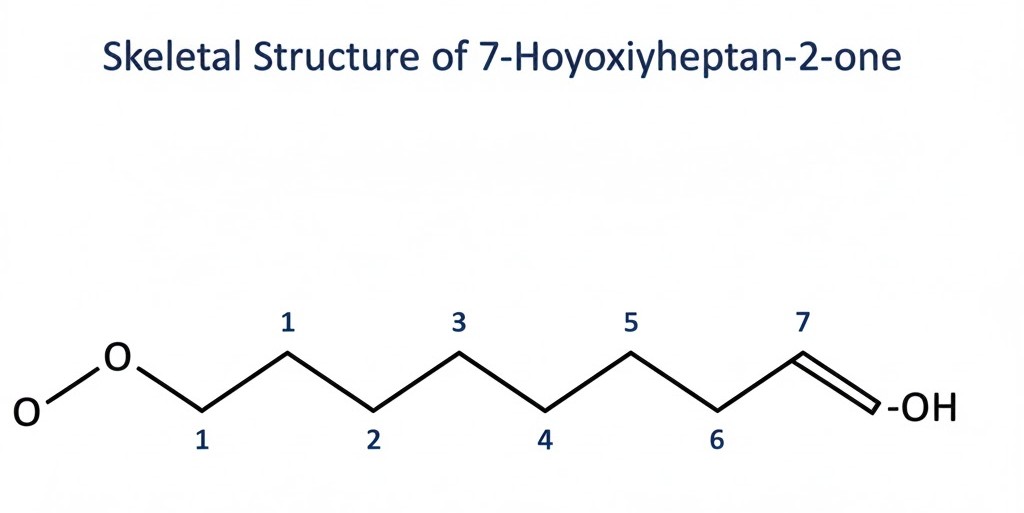
What is the IUPAC name for $HOCH_2(CH_2)_3CH_2COCH_3$?
(a) 2-Oxoheptan-7-ol
(b) 7-Hydroxyheptan-2-one
(c) 1-Hydroxyheptan-6-one
(d) Heptan-2-one-7-ol
✅ Answer: (b) 7-Hydroxyheptan-2-one. Because the keto group ($>C=O$) is the principal group, it gets the lower number (2) and the suffix -one, while $-OH$ becomes the 7-hydroxy prefix.
Figure below:
A clear skeletal structure of 7-hydroxyheptan-2-one, showing seven carbons in a chain with a carbonyl oxygen at position 2 and a hydroxyl group at position 7, with all positions numbered 1 to 7 starting from the carbonyl end.
Key Takeaway
- Priority: $-COOH > -CN > -CHO > >C=O > -OH > -NH_2 > C=C > C \equiv C$.
- Principal Group: Gets the Suffix.
- Subordinate Groups: Get Prefixes.
- Numbering: Lowest number to the principal group!
9. Nomenclature: Benzene Derivatives
Listen up, junior! Naming benzene and its cousins is a major funda you need to clear for NEET. It’s like assigning seats in a crowded shared rickshaw—everyone has a specific spot and a specific name.
Mono-substituted Benzenes
For these, we simply place the substituent name as a prefix to the word benzene. For example, methylbenzene (famously known as Toluene) or nitrobenzene. Some common names are so popular that IUPAC lets them slide, like Anisole for methoxybenzene and Aniline for aminobenzene.
NEET Checkpoint:
What is the IUPAC name for Aniline?
(a) Nitrobenzene
(b) Aminobenzene
(c) Methoxybenzene
(d) Methylbenzene
✅ Answer: (b) Aminobenzene — Aniline is just the "cool" name we use in the lab, but systematically, it's aminobenzene!
Disubstituted Rings: The $o, m, p$ Game
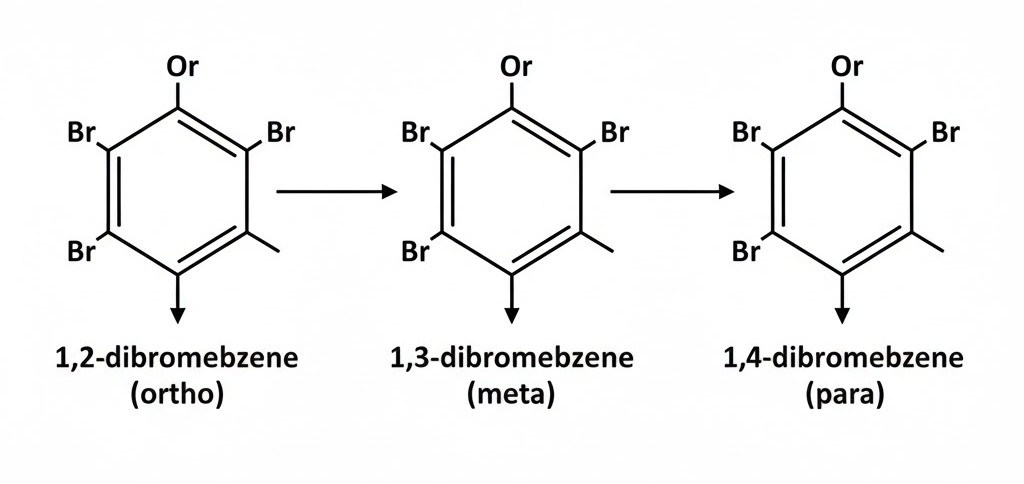
When two groups join the party, we number the ring $1$ to $6$ to give them the lowest possible numbers. In the trivial system, we use these prefixes:
* ortho ($o$-): 1,2-position (Next-door neighbours).
* meta ($m$-): 1,3-position (One empty seat in between).
* para ($p$-): 1,4-position (Sitting directly opposite).
Figure below:
A clear diagram showing three benzene rings representing 1,2-dibromobenzene (ortho), 1,3-dibromobenzene (meta), and 1,4-dibromobenzene (para).
Tri- or Higher Substituted Benzenes
For these, forget $o, m, p$! We must use the lowest locant rule. The base compound's substituent gets number $1$, then we go in the direction that gives the next substituent the lowest number. Also, remember to list them in alphabetical order in the final name.
NEET Checkpoint:
Why is a compound named 1-Chloro-2,4-dinitrobenzene and not 4-chloro-1,3-dinitrobenzene?
(a) Alphabetical priority
(b) Lowest locant rule
(c) Boiling point
(d) Carbon count
✅ Answer: (b) Lowest locant rule — We compare $(1, 2, 4)$ vs $(1, 3, 4)$. Since $2$ is smaller than $3$, the first set wins!
Benzene as a Substituent
Sometimes, the benzene ring isn't the boss. If it’s attached to an alkane that has a functional group, the ring becomes a substituent called a phenyl group ($C_6H_5-$, abbreviated as Ph).
NEET Checkpoint:
What do we call a benzene ring when it is a substituent?
(a) Benzyl
(b) Phenyl
(c) Benzine
(d) Phenol
✅ Answer: (b) Phenyl — Don't get confused between benzyl and phenyl; for now, remember $C_6H_5-$ is Phenyl!
Practice Questions:
1. What is the correct name for 1,3-dibromobenzene in the trivial system?
(a) $o$-dibromobenzene
(b) $p$-dibromobenzene
(c) $m$-dibromobenzene
(d) $sec$-dibromobenzene
✅ Answer: (c) $m$-dibromobenzene — The 1,3-position is always the meta position.
2. In the compound 2-Chloro-4-methylanisole, which group is at the number $1$ position?
(a) Chloro
(b) Methyl
(c) Methoxy
(d) Nitro
✅ Answer: (c) Methoxy — In anisole, the methoxy group is part of the base compound name, so it gets position $1$.
Key Takeaway
- Mono-substituted: Prefix + Benzene.
- Disubstituted: $1,2$ ($o$), $1,3$ ($m$), $1,4$ ($p$).
- Poly-substituted: Follow lowest locants and alphabetical order.
- As Substituent: Called a phenyl ($Ph$) group.
10. Isomerism: Structural and Stereo
Arre students, welcome to the "Twin World" of Organic Chemistry! Isomerism is a super cool phenomenon where two or more compounds have the same molecular formula but show different properties. Think of it like a set of ingredients: with the same flour and sugar, you can make a biscuit or a cake. Same "formula," totally different "vibe," yaar!
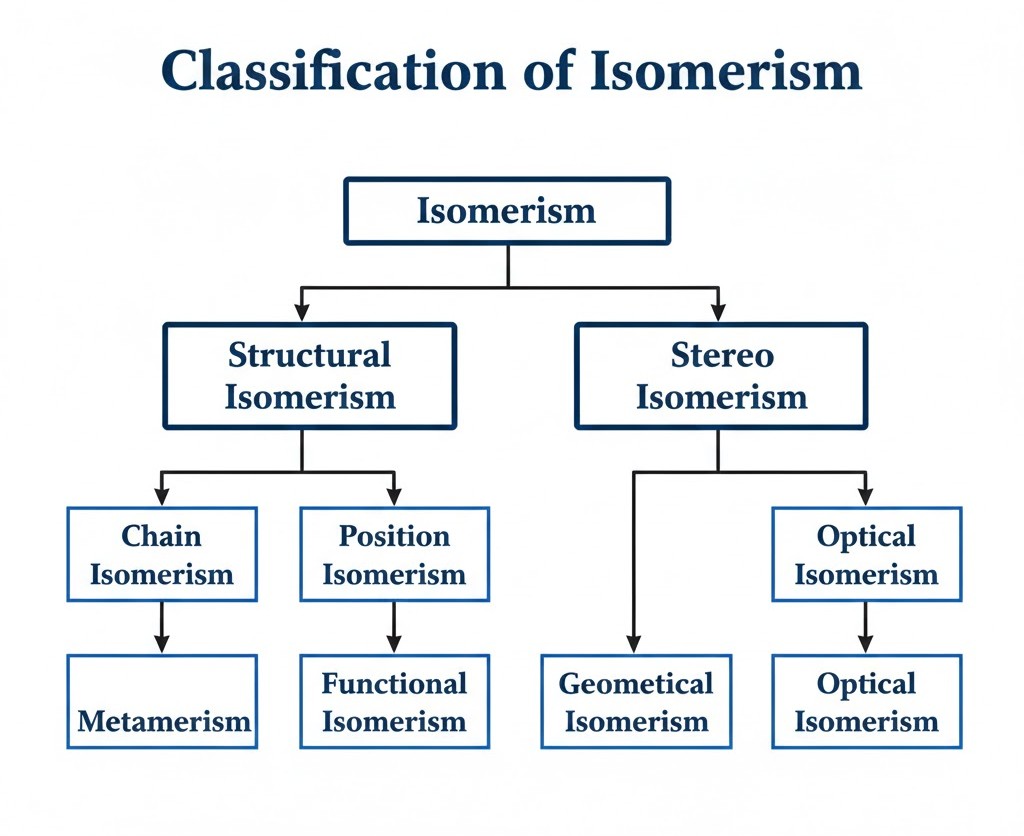
1. Structural Isomerism
This happens when the atoms are linked in different ways.
- Chain Isomerism: Here, the carbon skeletons are different. For example, $C_{5}H_{12}$ can be a straight line (pentane) or branched (neopentane). It’s like a cricket team—same players, but different batting orders change the "skeleton" of the game!
- Position Isomerism: The functional group or substituent just changes its "seat" on the same carbon chain.
NEET Checkpoint:
Propan-1-ol and Propan-2-ol are which type of isomers?
(a) Chain isomers
(b) Position isomers
(c) Functional isomers
(d) Metamers
✅ Answer: (b) Position isomers — The $-OH$ group moves from the first carbon to the second!.
- Functional Group Isomerism: Same formula, but a total identity crisis! One could be an aldehyde while the other is a ketone, like propanal and propanone ($C_{3}H_{6}O$).
- Metamerism: This arises due to different alkyl chains on either side of a functional group. Imagine shifting passengers between the left and right sides of a shared auto-rickshaw; the "functional group" (the driver) stays the same, but the "chains" (passengers) move! Example: $CH_{3}OC_{3}H_{7}$ and $C_{2}H_{5}OC_{2}H_{5}$.
2. Stereoisomerism
These isomers have the same bond sequence but differ in how their atoms are arranged in 3D space. It’s a bit like your left and right hands—they look similar but aren't identical in space! We classify these into Geometrical and Optical isomerism.
NEET Checkpoint:
Does metamerism involve different functional groups?
(a) Yes
(b) No
(c) Sometimes
(d) Only in alcohols
✅ Answer: (b) No — It involves different alkyl chains around the same functional group.
NEET Checkpoint:
What is the main difference in stereoisomers?
(a) Their molecular formula
(b) Their connectivity of atoms
(c) Their relative positions of atoms in space
(d) Their functional groups
✅ Answer: (c) Their relative positions of atoms in space — They have the same constitution but different 3D arrangements.
Figure below:
A clear flow chart showing the classification of isomerism into Structural (Chain, Position, Functional, Metamerism) and Stereo (Geometrical, Optical).
Practice Question:
Which of the following is an example of functional isomerism?
(a) Pentane and Isopentane
(b) Propan-1-ol and Propan-2-ol
(c) Methoxypropane and Ethoxyethane
(d) Propanal and Propanone
✅ Answer: (d) Propanal and Propanone — They have the same formula $C_{3}H_{6}O$ but different functional groups (aldehyde vs. ketone).
Key Takeaway: Isomerism Summary
- Structural: Different connectivity (Chain, Position, Functional, Metamerism).
- Stereo: Different spatial arrangement (Geometrical, Optical).
- Same Formula: $Molecular\ Formula\ (Isomer\ A) = Molecular\ Formula\ (Isomer\ B)$.
11. Reaction Mechanisms & Reagents
Listen up, junior! In organic chemistry, reactions are all about how bonds break and make—think of it as molecular drama. First, let’s clear the funda of bond fission. A covalent bond can break in two ways: Heterolytic or Homolytic cleavage.
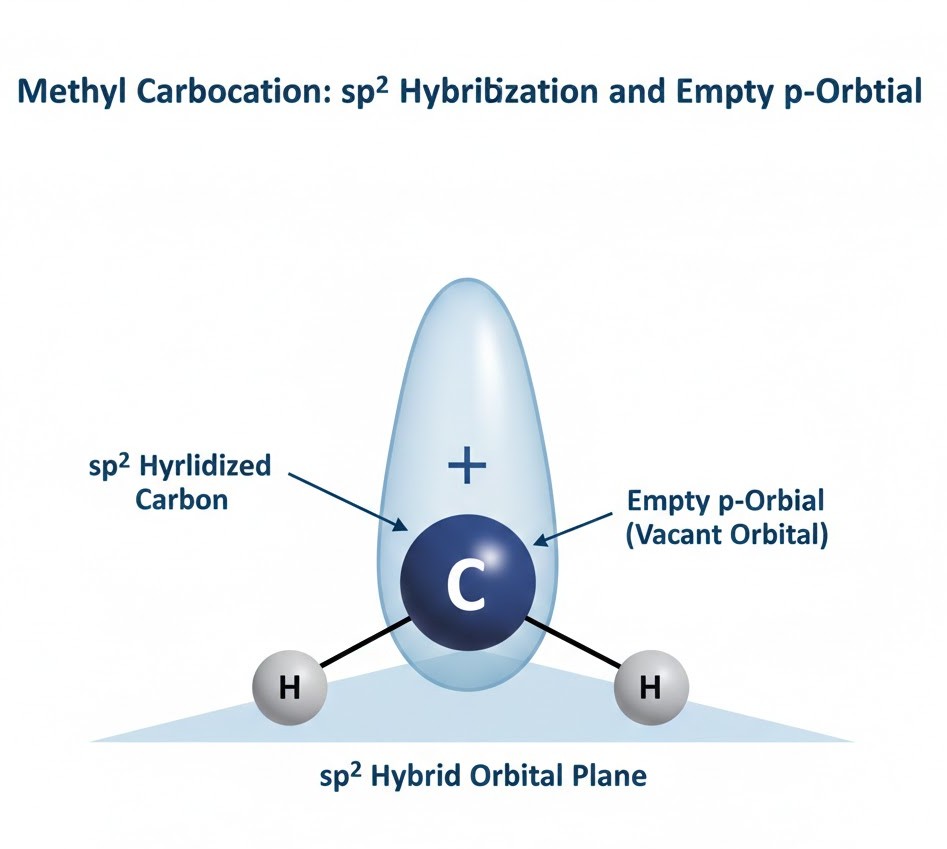
In heterolytic cleavage, the shared electron pair stays with just one fragment. This creates a carbocation (carbon with a positive charge and a sextet of electrons) or a carbanion (carbon with a negative charge and an octet). It's like a messy rickshaw fare split where one person ends up paying the whole amount!
NEET Checkpoint:
What is the hybridisation of the carbon atom in a methyl carbocation?
(a) $sp$
(b) $sp^2$
(c) $sp^3$
(d) $dsp^2$
✅ Answer: (b) $sp^2$ — Carbocations are trigonal planar with an empty p-orbital.
Then we have homolytic cleavage, where each atom takes one electron from the bond, forming free radicals. This is shown using 'half-headed' fish-hook arrows ($\sim$). Think of it like two friends splitting a plate of samosas equally—fair and square!
Figure below:
A clear diagram showing the trigonal planar shape of a methyl carbocation with $sp^2$ hybridised carbon and an empty p-orbital perpendicular to the plane.
NEET Checkpoint:
Arrange in increasing stability: $(CH_3)_3\dot{C}$, $\dot{C}H_3$, $(CH_3)_2\dot{C}H$.
(a) $\dot{C}H_3 < (CH_3)_2\dot{C}H < (CH_3)_3\dot{C}$
(b) (CH3)3C• < (CH3)2C•H < CH3•
(c) (CH3)2C•H < CH3• < (CH3)3C•
(d) CH3• < (CH3)3C• < (CH3)2C•H
✅ Answer: (a) $\dot{C}H_3 < (CH_3)_2\dot{C}H < (CH_3)_3\dot{C}$ — Tertiary free radicals are the most stable due to hyperconjugation!
Now, let's talk about the attackers: Nucleophiles and Electrophiles. Nucleophiles ($Nu:$) are electron-rich "givers" (like a langar serving food), while Electrophiles ($E^+$) are electron-deficient "takers" seeking a pair of electrons.
NEET Checkpoint:
Which of the following is an electrophile?
(a) $H_2O$
(b) $NH_3$
(c) $BF_3$
(d) $OH^-$
✅ Answer: (c) $BF_3$ — It has an incomplete octet and is hungry for electrons!
Practice Questions:
1. Which of the following carbocations is the most stable?
(a) Methyl
(b) Primary
(c) Secondary
(d) Tertiary
✅ Answer: (d) Tertiary — Alkyl groups stabilise the positive charge through inductive and hyperconjugation effects.
2. Reagents that bring an electron pair to the reactive site are called:
(a) Electrophiles
(b) Nucleophiles
(c) Free Radicals
(d) Carbenes
✅ Answer: (b) Nucleophiles — These are 'nucleus seeking' because they are already electron-rich.
Key Takeaway
- Stability Order: Tertiary ($3^\circ$) > Secondary ($2^\circ$) > Primary ($1^\circ$) for both carbocations and free radicals.
- Reagents: Nucleophiles = Electron rich; Electrophiles = Electron deficient.
12. Electron Displacement Effects
Listen up, junior! Chemistry isn't just about memorising reactions; it's about understanding how electrons move when nobody's watching—or when a reagent crashes the party! These electron displacement effects determine the structure and reactivity of every organic molecule you'll meet.
First, we have the Inductive Effect. This is a permanent polarisation of $\sigma$-bonds due to electronegativity differences. If you have a polar $C-Cl$ bond, the chlorine pulls electron density, creating a $\delta^+$ on carbon. Notice this: the effect is like a "tug-of-war" that fades away; it becomes vanishingly small after three bonds.
NEET Checkpoint:
Is the Inductive effect temporary or permanent?
(a) Temporary
(b) Permanent
(c) Both
(d) Neither
✅ Answer: (b) Permanent — It exists in the ground state of the molecule.
Next is the Resonance Effect, where polarity is produced by the interaction of two $\pi$-bonds or a $\pi$-bond and a lone pair. In the $+R$ effect, electrons move away from the group (like in aniline), making the ring electron-rich. In $-R$, they move towards the group (like nitrobenzene).
Relatable Example: Think of a Mumbai local train. If one coach is super crowded (high electron density), people naturally shift to the next connected coach to balance things out. That’s your resonance!
NEET Checkpoint:
Which of these is a $-R$ group?
(a) $-OH$
(b) $-NH_2$
(c) $-NO_2$
(d) $-Cl$
✅ Answer: (c) $-NO_2$ — It withdraws electrons from the conjugated system.
Then there's the Electromeric Effect. This one is a "guest-only" service—it’s a temporary transfer of $\pi$-electrons that only happens when an attacking reagent is present. If the reagent leaves, the molecule goes back to its original state! Arre, even electrons need a reason to move!
NEET Checkpoint:
In the $+E$ effect, where do the $\pi$-electrons move?
(a) To the atom where the reagent attaches
(b) Towards the substituent
(c) Along σ-bonds only
(d) Randomly
✅ Answer: (a) To the atom where the reagent attaches — It’s a direct delivery!
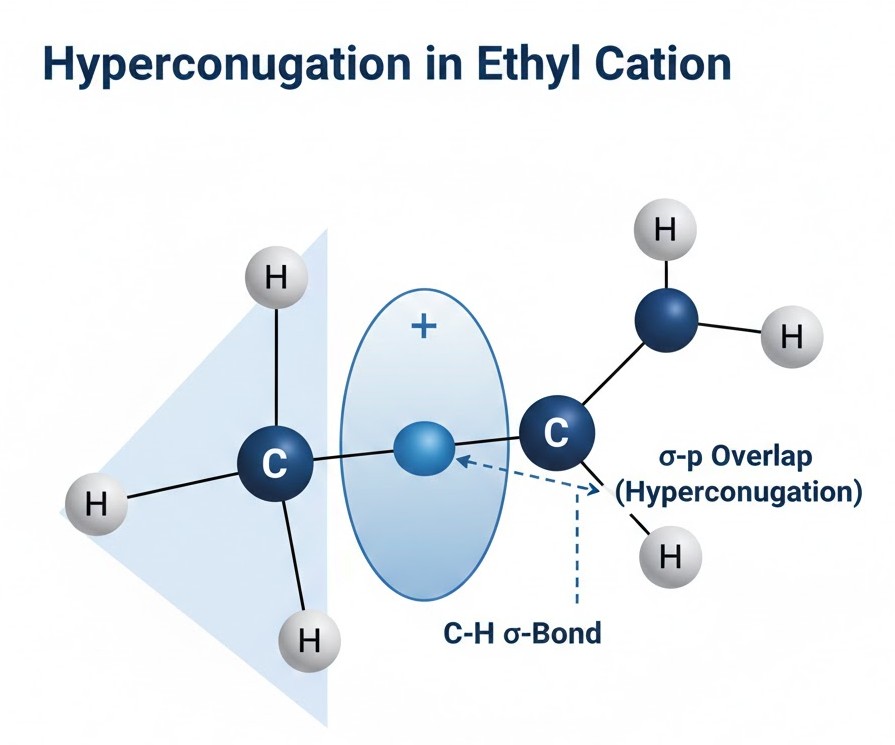
Finally, Hyperconjugation is the "secret backup" system. It involves the delocalisation of $\sigma$-electrons from $C-H$ bonds of an alkyl group into an adjacent unsaturated system or empty p-orbital. It’s why a tertiary carbocation like $(CH_3)_3\overset{+}{C}$ is more stable than a primary one—more $C-H$ bonds mean more stabilising "handshakes".
Figure below:
A clear diagram showing the $\sigma$-orbital of a $C-H$ bond overlapping with the empty 2p orbital of an adjacent positively charged carbon atom to illustrate hyperconjugation in an ethyl cation.
Practice Questions:
1. Which effect explains the stability order of carbocations as $3^\circ > 2^\circ > 1^\circ$?
(a) Inductive only
(b) Electromeric
(c) Hyperconjugation and Inductive
(d) Resonance only
✅ Answer: (c) — Both $+I$ and hyperconjugation disperse the positive charge.
2. The $-I$ effect is shown by which of the following?
(a) $-CH_3$
(b) $-C_2H_5$
(c) $-COOH$
(d) $-CH(CH_3)_2$
✅ Answer: (c) — Carboxy groups are electron-withdrawing.
Key Takeaway
- Inductive: Permanent $\sigma$-bond shift due to $\Delta EN$.
- Resonance ($R$): Permanent $\pi$/lone pair delocalisation.
- Electromeric ($E$): Temporary $\pi$ shift for a reagent.
- Hyperconjugation: Permanent $\sigma$-$\pi$ or $\sigma$-p conjugation.
13. Purification: Sublimation to Distillation
Listen up, yaar! Once you’ve synthesised a compound, you can't just leave it "ganda"—you have to purify it!. Sublimation is our first trick; it is perfect for solids that prefer "vaping" over melting, separating sublimable compounds from non-sublimable impurities. Then there's Crystallisation, the most common method for solids, which is all about the "solubility ka khel". We dissolve the impure stuff in a hot solvent where it’s super soluble and let pure crystals crash out as it cools.
NEET Checkpoint:
Which substance is used to remove colour during crystallisation?
(a) Silica gel
(b) Activated charcoal
(c) Iodine
(d) Copper oxide
✅ Answer: (b) Activated charcoal — It adsorbs those annoying coloured impurities like a sponge!.
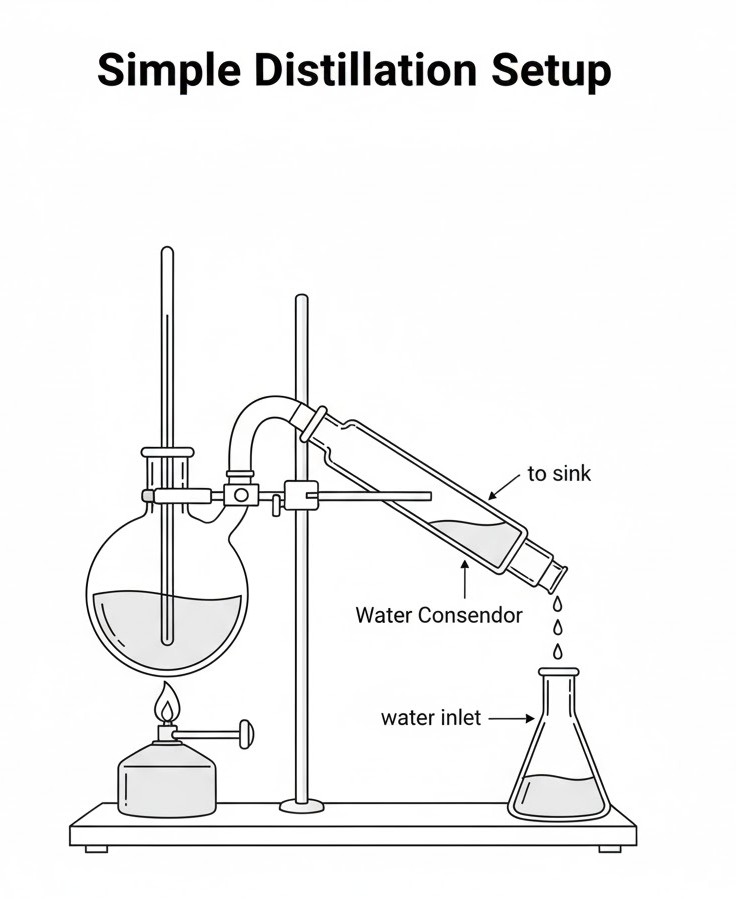
Now, let’s talk Distillation. Simple Distillation works if your liquids have a massive boiling point (B.P.) gap, like Chloroform ($334~K$) and Aniline ($457~K$). But if they are close cousins, you need Fractional Distillation. It uses a fractionating column to provide "theoretical plates" for repeated evaporation and condensation. Think of a Mumbai local train: Simple distillation is a separate ladies' coach, but fractional is like the general coach where people filter out at different stations based on how close they are to the door!.
NEET Checkpoint:
Which method is used to separate different fractions of crude oil?
(a) Steam distillation
(b) Fractional distillation
(c) Sublimation
(d) Crystallisation
✅ Answer: (b) Fractional distillation — This is the backbone of the petroleum industry!.
Figure below:
A clear diagram showing a simple distillation setup, including a round bottom flask, a thermometer, a water condenser with 'water inlet' and 'to sink' labels, and a conical flask collecting the distilled liquid.
For high-maintenance liquids that decompose at high temperatures, we use Distillation under reduced pressure (like for Glycerol). Finally, Steam Distillation is for steam-volatile liquids that don't like water. Here, the mixture boils when:
where $p$ is atmospheric pressure, $p_1$ is the organic liquid's vapour pressure, and $p_2$ is water's vapour pressure.
NEET Checkpoint:
In steam distillation, the liquid boils at a temperature:
(a) Higher than its B.P.
(b) Equal to 373 K
(c) Lower than its B.P.
(d) At 273 K
✅ Answer: (c) Lower than its B.P. — Since $p_1 < p$, it boils early!.
Key Takeaway
- Sublimation: Solid $\rightarrow$ Vapour.
- Crystallisation: Solubility difference.
- Fractional Distillation: For close B.P. liquids.
- Reduced Pressure: For Glycerol.
- Steam Distillation: For Aniline.
14. Extraction and Chromatography
Arre junior, let’s clear this funda! When an organic compound is stuck in an aqueous medium, we use differential extraction. We shake it with an immiscible organic solvent in a separatory funnel. The compound prefers the organic layer and moves there—simple, right?. It’s like trying to pick out the best paneer pieces from a watery "mutter paneer" gravy; you need the right technique to get the good stuff out!.
NEET Checkpoint:
What is the essential condition for the two solvents in differential extraction?
(a) Both must be miscible
(b) Both must be immiscible
(c) Both must be polar
(d) Both must be non-polar
✅ Answer: (b) Both must be immiscible — Otherwise, they’ll just mix together instead of forming layers!
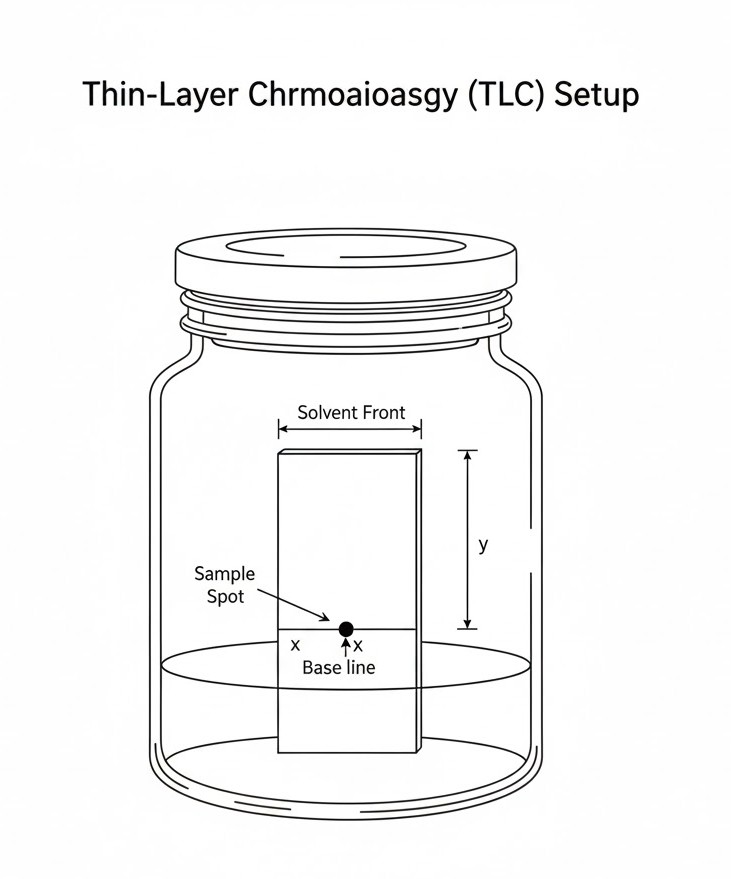
Next up is Chromatography, the ultimate separation trick. Adsorption chromatography (like Column and TLC) depends on how much a compound 'sticks' to an adsorbent like silica gel or alumina. In Thin Layer Chromatography (TLC), we identify components using the Retardation Factor ($R_f$):
Figure below:
A clear diagram of a TLC plate inside a closed jar with a solvent, showing the base line, a sample spot at distance 'x', and the solvent front at distance 'y'.
NEET Checkpoint:
In TLC, if the solvent front is at $10\text{ cm}$ and the spot is at $4\text{ cm}$, what is the $R_f$ value?
(a) 0.2
(b) 0.4
(c) 0.6
(d) 0.8
✅ Answer: (b) $0.4$ — Just divide $x$ by $y$ ($4/10$); it’s basically the compound's progress report!
Finally, Partition Chromatography (like Paper chromatography) uses water trapped in the paper as the stationary phase. The mobile phase flows over it, and components separate based on their partition between the two phases. Even molecules need a good workout to separate from the crowd!.
NEET Checkpoint:
In paper chromatography, what actually acts as the stationary phase?
(a) Cellulose paper
(b) Water molecules adsorbed on the paper
(c) Organic solvent used as mobile phase
(d) Air trapped in paper pores
✅ Answer: (b) Water trapped in the chromatography paper — Don't be fooled, it’s not the cellulose itself!
Practice Question:
Which technique is used if an organic compound is less soluble in the organic solvent during extraction?
(a) Simple distillation
(b) Continuous extraction
(c) Sublimation
(d) Crystallisation
✅ Answer: (b) Continuous extraction — This uses the same solvent repeatedly to ensure we extract every bit possible.
Key Takeaway & Formula Summary
- Differential Extraction: Uses solubility differences in immiscible solvents via a separatory funnel.
- Adsorption Chromatography: Based on differential adsorption on silica gel or alumina.
- $R_f$ Formula: $R_f = \frac{x}{y}$ (Always $\le 1$).
- Paper Chromatography: A type of partition chromatography where water in the paper is the stationary phase.
15. Qualitative & Quantitative Analysis: The Chemistry Detective Work!
Hey there, junior! Ready to play Sherlock Holmes in the lab? To figure out what's hidden in an organic molecule, we use Qualitative Analysis to spot the elements and Quantitative Analysis to measure them.
Qualitative: The "Who is it?" Phase
First, we catch Carbon and Hydrogen by heating with $CuO$, turning them into $CO_{2}$ and $H_{2}O$. But for the tricky ones like Nitrogen, Sulphur, and Halogens, we need the Lassaigne’s Test. We fuse the compound with Sodium metal to turn covalent bonds into ionic ones—like turning a messy group chat into a clear list of names.
NEET Checkpoint:
What confirms Nitrogen in Lassaigne’s test?
(a) Formation of white precipitate
(b) Formation of Prussian blue colour
(c) Evolution of ammonia gas
(d) Formation of yellow precipitate
✅ Answer: (b) Formation of Prussian blue colour — It's due to the formation of $Fe_{4}[Fe(CN){6}]{3}.xH_{2}O$.
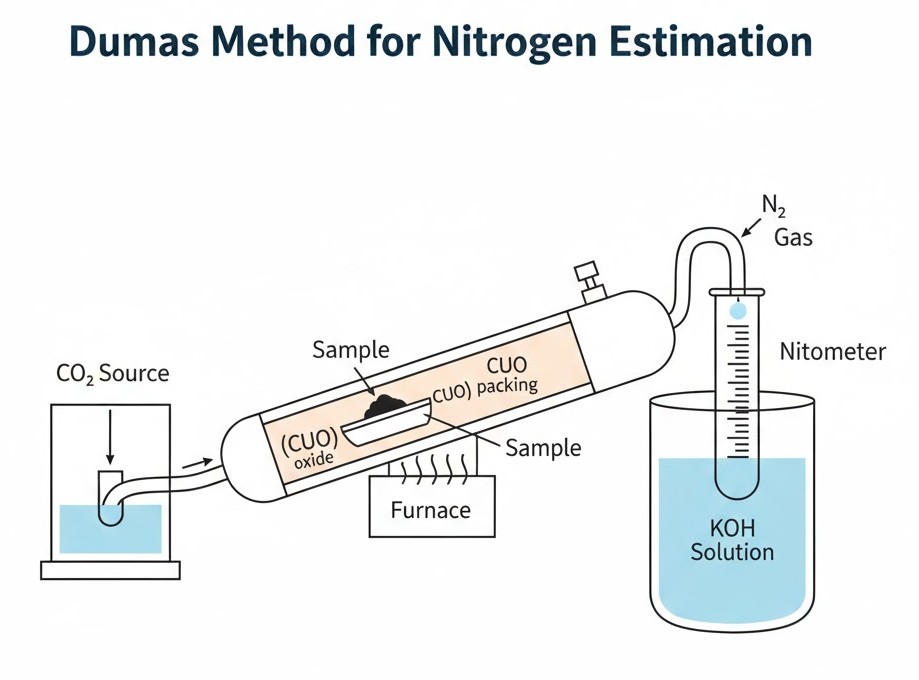
Figure below:
A clear diagram of the Dumas method setup showing the combustion tube, $CO_{2}$ source, and the nitrometer filled with $KOH$ solution.
Quantitative: The "How much?" Phase
Now, let's talk numbers, yaar!
* Carbon & Hydrogen: We burn the sample; $CO_{2}$ is trapped in a $KOH$ tube, and $H_{2}O$ in anhydrous $CaCl_{2}$.
* Nitrogen: We use Dumas Method (collecting $N_{2}$ gas) or Kjeldahl’s Method (converting $N$ to $NH_{3}$).
* Halogens & Sulphur: The Carius Method uses fuming $HNO_{3}$ to precipitate them as $AgX$ or $BaSO_{4}$.
NEET Checkpoint:
Can Kjeldahl's method estimate nitrogen in Nitrobenzene?
(a) Yes
(b) No
(c) Only partially
(d) Only after reduction
✅ Answer: (b) No — Kjeldahl doesn't work for nitro, azo groups, or nitrogen in the ring.
Relatable Example: Think of Kjeldahl’s Method like a pressure cooker at a roadside dhaba. You boil the organic "food" with acid until the nitrogen turns into "steam" ($NH_{3}$), which you then trap and measure.
NEET Checkpoint:
Which reagent absorbs $CO_{2}$ in combustion analysis?
(a) Concentrated H₂SO₄
(b) CaCl₂
(c) KOH solution
(d) Anhydrous CuSO₄
✅ Answer: (c) $KOH$ solution — It’s used to find the mass increase for carbon calculation.
Practice Question:
In a Carius estimation, $0.15$ $g$ of an organic compound gave $0.12$ $g$ of $AgBr$. What is the % of Bromine?
(a) 20.5%
(b) 34.04%
(c) 42.1%
(d) 56%
✅ Answer: (b) 34.04% — Using the formula:
Key Formula Summary
- % Carbon: $\frac{12 \times m_{2} \times 100}{44 \times m}$
- % Hydrogen: $\frac{2 \times m_{1} \times 100}{18 \times m}$
- % Nitrogen (Dumas): $\frac{28 \times V \times 100}{22400 \times m}$
- % Halogen (Carius): $\frac{\text{at. mass of } X \times m_{1} \times 100}{\text{mol. mass of } AgX \times m}$