
1. Introduction to P-Block Elements: General Characteristics
The p-block is the big family spanning Groups 13 to 18 of the periodic table. It’s super diverse, having everyone from the highly reactive non-metals to the shiny metals, and even the tricky metalloids in between.
The main identity card for this block is its electronic configuration. All members, except for the tiny exception Helium ($1s^2$), have their last electron entering the outermost $p$ orbital.
The valence shell electronic configuration is:
This range ($1$ to $6$ electrons in the $p$ orbitals) is exactly why there are six groups here.
NEET Checkpoint:
Excluding Helium, what is the maximum number of electrons that can be accommodated in the p-orbitals of the valence shell?
(a) Two
(b) Three
(c) Six
(d) Eight
✅ Answer: (c) Six — Since there are three $p$ orbitals, they can hold a maximum of six electrons total.
Notice this: The variation in properties as you go down a group is heavily influenced by differences in the inner electronic core. Specifically, the presence of $d$ and $f$ electrons in the heavier elements (starting from the third period onwards) significantly changes how they behave physically and chemically.
It’s like comparing a light, speedy local rickshaw (the first, lighter non-metal element) to a heavy, multi-axle truck (the heavier, metallic elements). The truck has extra gears (like $d$ and $f$ orbitals) in its core which totally alters its stability and speed!
The most common oxidation state is the group oxidation state, equal to the total number of valence electrons (sum of $s$ and $p$ electrons). However, the elements also show oxidation states two units less than the group state.
NEET Checkpoint:
Which type of element exists only within the p-block of the periodic table?
(a) Metals
(b) Metalloids
(c) Alkali metals
(d) All halogens
✅ Answer: (b) Metalloids — Non-metals and metalloids exist exclusively in the p-block.
This lower oxidation state becomes progressively more stable for the heavier members due to the 'inert pair effect'. This is key to understanding the trend! For instance, the heaviest element in a p-block group is generally the most metallic in nature. Also, non-metal oxides are acidic or neutral, while metal oxides are basic.
NEET Checkpoint:
The element Bismuth (Group 15) prefers the +3 oxidation state over +5. This is primarily an example of:
(a) $p\pi-p\pi$ bonding
(b) Inert pair effect
(c) High ionization enthalpy
(d) Amphoteric nature
✅ Answer: (b) Inert pair effect — The lower oxidation state (+3) becomes more stable for heavier elements like Bismuth.
Finally, remember the anomalous behaviour of the first element (like Boron or Nitrogen) in each group! They are restricted to a maximum covalence of four because they lack $d$ orbitals, a limitation which the heavier members overcome.
Practice Questions:
- Why is the first element of a p-block group (e.g., Nitrogen) restricted to a maximum covalence of 4?
(a) Its small size causes steric hindrance.
(b) It lacks $d$ orbitals in its valence shell.
(c) It has high electron gain enthalpy.
(d) It cannot form $\pi$-bonds with heavier elements.
✅ Answer: (b) It lacks $d$ orbitals in its valence shell. — Since the first element only has $s$ and $p$ orbitals (four total), its octet cannot be expanded beyond a covalence of four.
2. As you move down a p-block group from top to bottom, the chemical nature of the oxides generally changes from:
(a) Basic to acidic
(b) Neutral to amphoteric
(c) Acidic to basic
(d) Neutral to basic
✅ Answer: (c) Acidic to basic — The non-metallic character decreases down the group, meaning the heaviest elements are the most metallic. Non-metal oxides are acidic, while metal oxides are basic.
Key Takeaway
| Funda | Detail |
|---|---|
| P-Block Span | Groups 13 to 18. |
| Configuration | $ns^{2}np^{1-6}$ (except He). |
| Oxidation State Trend | Group oxidation state is stable for lighter elements, but state two units less becomes stable for heavier elements (Inert Pair Effect). |
| Anomalous Element | First element lacks $d$ orbitals, limiting maximum covalence to four. |
2. General Trends: Oxidation States & Bonding
First up, Oxidation States. The maximum oxidation state an element in the $p$-block can show is simply equal to the total number of valence electrons it holds (that’s the sum of $s$- and $p$-electrons, known as the group oxidation state). For Group 15 ($ns^2np^3$), this is $+5$, for instance. However, here's the trick: $p$-block elements frequently display other oxidation states, most commonly those that are two units less than the group oxidation state.
Now, why does this matter? Because of the infamous 'inert pair effect'. This term explains why the oxidation state two units less than the group oxidation state becomes progressively more stable for the heavier elements as you go down the group. For Group 13 elements like Thallium ($Tl$), the $+1$ state is predominant, while the $+3$ state is highly oxidising. Similarly, in Group 14, the stability of the $+2$ state increases significantly for Lead ($Pb$) ($Ge < Sn < Pb$) due to the inability of the $ns^2$ electrons to participate fully in bonding.
NEET Checkpoint:
Which feature stabilizes the $+1$ oxidation state for Thallium ($Tl$)?
(a) High hydration enthalpy
(b) Small atomic size
(c) Inert pair effect
(d) $d\pi-p\pi$ bonding
✅ Answer: (c) Inert pair effect — This effect causes the $ns^2$ electrons to resist participation in bonding for heavier elements.
Speaking of elements, let’s talk character. The non-metallic character decreases down the group. What does that mean? It means the elements at the bottom, like Bismuth ($Bi$) or Thallium ($Tl$), are the most metallic in nature. Boron, at the top of Group 13, is a typical non-metal, but its heavier counterpart, Gallium ($Ga$), is metallic.
Here’s a relatable example: Imagine ordering a three-layer wedding cake (representing a $p$-block group). The soft, airy icing on top (the non-metal) gives way to the dense, metallic base layer (the heaviest element).
Finally, let's talk Bonding. The lighter elements (the ones in the second period, like Carbon ($C$) and Nitrogen ($N$)) have a unique ability to form $p\pi - p\pi$ multiple bonds. They form bonds with themselves, like $C=C$ or $N\equiv N$, and with other small second-row elements, such as $C=O$. The heavier elements struggle with this because their atomic orbitals are too large and diffuse for effective overlap. They mostly rely on single bonds or weaker $\pi$ bonds involving $d$-orbitals.
NEET Checkpoint:
Carbon forms multiple bonds ($C=C$) easily because it:
(a) Has available $d$ orbitals
(b) Is the first element in its group
(c) Exhibits high metallic character
(d) Undergoes $d\pi - d\pi$ bonding
✅ Answer: (b) Is the first element in its group — The first member of the $p$-block has the strong ability to form $p\pi - p\pi$ multiple bonds.
NEET Checkpoint:
Which element pair shows the greatest difference in non-metallic character?
(a) $C$ and $Si$
(b) $P$ and $As$
(c) $N$ and $Bi$
(d) $Cl$ and $Br$
✅ Answer: (c) $N$ and $Bi$ — Non-metallic character decreases sharply down the group; Nitrogen is a non-metal, while Bismuth is a typical metal.
Practice Questions:
- Lead in its $+4$ oxidation state tends to act as a strong oxidising agent. This is primarily because:
(a) The stability of the $Pb^{4+}$ ion is high.
(b) $Pb$ tends to regain its group oxidation state of $+4$.
(c) $Pb$ prefers the more stable $+2$ oxidation state due to the inert pair effect.
(d) $Pb$ has a low ionisation enthalpy.
✅ Explanation: Lead compounds in the $+2$ state are stable, whereas in the $+4$ state they are strong oxidising agents, showing a high tendency to shift to the more stable $+2$ state due to the inert pair effect.
2. The triple bond in dinitrogen ($N_{2}$) is formed primarily through:
(a) $d\pi - d\pi$ interactions.
(b) Strong $p\pi - p\pi$ overlap.
(c) Ionic bonding.
(d) Low bond enthalpy.
✅ Explanation: Nitrogen exists as a diatomic molecule with a triple bond (one $\sigma$ and two $\pi$ bonds) formed by $p\pi-p\pi$ overlap, giving it a very high bond enthalpy.
Key Takeaway
Oxidation State Stability in $p$-block elements shifts towards the lower state (two units less than the group state) for heavier elements due to the Inert Pair Effect. Bonding ability shifts too: Lighter elements ace $p\pi - p\pi$ multiple bonds ($C=C$), while heavier elements struggle due to large atomic size.
3. Anomalous Behaviour & Maximum Covalence
Let’s clear up this tricky funda about why the first member of every p-block group is such a unique rockstar. The primary reason for the anomalous behaviour of the first element (like Boron, Carbon, Nitrogen, Oxygen, Fluorine) is their small size and the crucial non-availability of $d$ orbitals in their valence shell.
The Covalence Cap: Four is the Max!
Since the second period p-block elements—like Boron (B), Carbon (C), Nitrogen (N)—only have $2s$ and $2p$ orbitals available for bonding, they are strictly limited to a maximum covalence of four. They can only accommodate four pairs of electrons around the central atom. Nitrogen, for example, is restricted to a maximum covalency of $4$ and thus cannot form a pentahalide like $NCl_{5}$ because it has no $d$ orbitals to expand its octet.
NEET Checkpoint:
Which p-block element cannot expand its covalence beyond $4$?
(a) Phosphorus
(b) Silicon
(c) Nitrogen
(d) Sulphur
✅ Answer: (c) Nitrogen — Arre! It lacks vacant $d$ orbitals in its valence shell (like $2d$, which doesn't exist!), limiting it to four bonds or covalence.
The $d$ Orbital Expansion Pack
Now, look at the third period and heavier elements (starting from Silicon, Aluminium, Phosphorus). They are the seniors with the cheat code! Elements like Silicon (Si) and Phosphorus (P) have vacant $3d$ orbitals available between the $3p$ and $4s$ levels of energy. Using these vacant $d$ orbitals, these heavier elements can happily expand their covalence beyond four.
Notice this comparison, yaar: While Boron (B) forms only the tetrafluoroborate ion, $[BF_{4}]^{-}$, Aluminium (Al), the next member, can form the hexafluoroaluminate ion, $[AlF_{6}]^{3-}$, where its covalence is six. Similarly, Phosphorus can form the stable hexafluorophosphate anion, $PF_{6}^{-}$.
Relatable Indian Example: Imagine the second-period elements are like carrying groceries on a scooter—you can only hold four bags max! The third-period elements are like driving a family car (with vacant $d$ orbitals)—you can fit six or even seven bags easily, expanding your carrying capacity!
$\pi$ Bonding Funda: The Quality of Overlap
The type of $\pi$ bonding also changes down the group. Lighter elements rely on $p\pi-p\pi$ multiple bonding (like $C=C$, $N\equiv N$, $C=O$) to themselves or to other small, electronegative elements.
Here’s the trick: This type of $p\pi-p\pi$ bonding is not particularly strong for heavier p-block elements because their atomic orbitals are too large and diffuse for effective overlap. Instead, the heavier elements form $\pi$ bonds that involve $d$ orbitals, specifically $d\pi-p\pi$ or $d\pi-d\pi$ bonding.
This availability of $d$ orbitals influences both stability and coordination number. For instance, Nitrogen forms $NO_{3}^{-}$ (three-coordination with $p\pi$ bond), while Phosphorus forms $PO_{4}^{3-}$ (four-coordination involving $s$, $p$, and $d$ orbitals contributing to the $\pi$ bond).
NEET Checkpoint:
What electron configuration feature allows Silicon to form $[SiF_{6}]^{2-}$ but prevents Carbon from forming $[CCl_{6}]^{2-}$?
(a) Higher electronegativity
(b) Inert pair effect
(c) Presence of vacant $3d$ orbitals
(d) Smaller size of Carbon
✅ Answer: (c) Presence of vacant $3d$ orbitals — Silicon can use its vacant $d$ orbitals to expand its octet; Carbon cannot.
NEET Checkpoint:
In which compound does the central atom definitely utilize $d$ orbitals for bonding?
(a) $CCl_{4}$
(b) $BF_{3}$
(c) $AlF_{6}^{3-}$
(d) $NH_{3}$
✅ Answer: (c) $AlF_{6}^{3-}$ — Aluminium, a third-period element, expands its covalence beyond four (to six) by utilizing vacant $d$ orbitals.
Practice Question:
Which of the following statements about $p\pi-p\pi$ bonding is correct?
(a) It is strong for heavier p-block elements like Phosphorus.
(b) It involves the overlap of $d$ orbitals with $p$ orbitals.
(c) It is characteristic of second-period elements like Carbon and Nitrogen.
(d) It leads to the expansion of covalence beyond four.
✅ Answer: (c) It is characteristic of second-period elements like Carbon and Nitrogen.
Explanation: $p\pi-p\pi$ bonding is unique to light elements due to effective overlap of small orbitals. For heavier elements, this bonding is weak.
Key Takeaway
| Element Type | Covalence Limit | Reason | $\pi$-Bonding Type |
|---|---|---|---|
| Second Period | Maximum 4 | Absence of $d$ orbitals | Strong $p\pi-p\pi$ |
| Third Period/Heavier | Can exceed 4 | Vacant $d$ orbitals available | $d\pi-p\pi$ or $d\pi-d\pi$ |
4. Group 13 Elements: Electronic Structure and Physical Properties
Let's dive into Group 13, lovingly nicknamed the Boron Family. Don't stress, yaar—this group is famous for throwing chemistry curveballs, especially regarding their physical properties, but understanding the root cause (the electron core!) makes it simple.
Electronic Structure Fundamentals
The most basic funda (fundamental) for Group 13 elements (B, Al, Ga, In, Tl) is their outer electronic configuration: it's always $ns^{2}np^{1}$. Simple, right? However, the actual electronic structures become complex as you move down the group due to the inner core. While Boron and Aluminium have a noble gas core, Gallium (Ga) and Indium (In) feature a noble gas plus 10 $d$-electrons core. Thallium (Tl) is the most complex, having a noble gas core plus 14 $f$-electrons plus 10 $d$-electron cores.
Notice this: The presence of these $d$ and $f$ electron cores in heavier elements (Ga, In, Tl) greatly influences their physical and chemical properties.
Atomic Radii Deviation: Ga is Smaller than Al!
Normally, atomic size is expected to increase down the group as new shells are added. However, here is the first major surprise: the atomic radius of Gallium ($135 \text{ pm}$) is actually less than that of Aluminium ($143 \text{ pm}$).
Why the size drop? This is a classic question for NEET! It's due to the poor screening effect offered by those additional 10 $d$-electrons present in Gallium's inner core. Since $d$-electrons are terrible at shielding (screening) the outer electrons from the increased nuclear charge, the nucleus pulls the valence shell much tighter, resulting in a smaller size for Ga.
NEET Checkpoint:
Why is the atomic radius of Gallium smaller than Aluminium?
(a) Stronger $\pi$-bonding in Ga
(b) Inert pair effect
(c) Poor screening by $d$-electrons
(d) Higher electronegativity of Ga.
✅ Answer: (c) Poor screening by $d$-electrons — The $10 \ d$-electrons in Ga are inefficient at shielding the valence shell from the increased nuclear charge.
Ionisation Enthalpy and Electronegativity Trends
The first ionisation enthalpy ($\Delta_{i}H_{1}$) also refuses to decrease smoothly down the group. While it decreases from B to Al, a significant discontinuity (an increase) is observed from Al to Ga and again from In to Tl. This increase happens because the low screening ability of the intervening $d$- and $f$-electrons cannot sufficiently compensate for the increasing nuclear charge.
Relatable Indian Example: Imagine you are trying to squeeze through a crowded Mumbai local train (valence electron trying to move away). The crowd (d and f electrons) is so spread out (poor screening) that the train doors (nuclear charge) still press heavily on you, making it extremely hard to escape (high Ionisation Enthalpy).
The electronegativity profile is also unusual: it first decreases from B ($2.0$) to Al ($1.5$), but then increases marginally towards Tl ($1.8$). This marginal increase is directly related to the discrepancies observed in the atomic size of the heavier elements.
NEET Checkpoint:
What explains the discontinuity (increase) in ionisation enthalpy observed from In to Tl? (a) Absence of $d$ orbitals
(b) Availability of $d$ orbitals
(c) Poor shielding by $f$ electrons
(d) High metallic character.
✅ Answer: (c) Poor shielding by $f$ electrons — Thallium's core includes $f$-electrons, whose poor screening effect results in higher effective nuclear charge and thus, higher ionisation enthalpy.
Practice Questions:
- Which element in Group 13 has a core electronic configuration featuring both $d$- and $f$-electrons?
(a) Indium
(b) Gallium
(c) Boron
(d) Thallium
✅ Answer: (d) Thallium — Tl has noble gas plus 14 $f$-electrons plus 10 $d$-electron cores.
2. What is the typical trend of electronegativity in Group 13?
(a) Decreases continuously from B to Tl.
(b) Decreases from B to Al, then increases marginally toward Tl.
(c) Increases continuously from B to Tl.
(d) Remains constant throughout the group.
✅ Answer: (b) Decreases from B to Al, then increases marginally toward Tl. — This is due to the size discrepancies down the group.
NEET Checkpoint:
The general outer electronic configuration of the Group 13 elements is:
(a) $ns^{2}np^{2}$
(b) $ns^{2}np^{1}$
(c) $ns^{1}np^{2}$
(d) $ns^{2}np^{3}$.
✅ Answer: (b) $ns^{2}np^{1}$ — Group 13 elements are the Boron family, having one electron in the outermost $p$ orbital.
Key Takeaway
Group 13 elements follow the outer configuration $ns^{2}np^{1}$. The anomaly of $r_{Ga} < r_{Al}$ and the discontinuities in Ionisation Enthalpy ($\Delta_{i}H$) (Al $\rightarrow$ Ga and In $\rightarrow$ Tl) are both attributed to the poor screening ability of inner $d$ and $f$ electron cores.
5. Group 13: Chemical Reactivity, Oxidation States & Inert Pair Effect
Let’s dive into the core reactivity of Group 13, where the 'inert pair effect' creates some seriously interesting chemistry. Don't stress, yaar—it’s easier than it looks once you get the underlying funda.
First up is Boron ($\mathrm{B}$). Since its size is tiny, the sheer energy required to pull off three electrons (the sum of its first three ionization enthalpies, $\Delta_{i}H_{1}+\Delta_{i}H_{2}+\Delta_{i}H_{3}$) is extremely high. Think of this huge energy barrier like trying to lift three massive textbooks simultaneously! This massive energy cost prevents $\mathrm{B}$ from forming $+3$ ions and forces it to stick to making only covalent compounds.
Now, let's talk about the infamous Inert Pair Effect. As we move down the group, especially for heavier elements like $\mathrm{Ga}$, $\mathrm{In}$, and $\mathrm{Tl}$, the internal $d$ and $f$ electrons provide poor shielding. This increases the effective nuclear charge, which holds the valence $ns^{2}$ electrons so tightly that they become ‘inert’ and often refuse to participate in bonding.
Notice this carefully: this inertness leads to the growing stability of the oxidation state that is two units less than the group state, i.e., the $+1$ state. The relative stability of the $\mathrm{+1}$ oxidation state progressively increases in the order: $\mathrm{Al} < \mathrm{Ga} < \mathrm{In} < \mathrm{Tl}$.
Relatable Indian Example: Imagine you are making a cup of chai. The water ($\mathrm{Tl}^{+}$) is stable and easy to manage (predominant oxidation state), but if you heat it too much and it boils over ($\mathrm{Tl}^{3+}$), it becomes unstable, reactive, and messes up everything (acting as a powerful oxidising agent)!
For Thallium ($\mathrm{Tl}$), the $\mathrm{+1}$ state ($\mathrm{Tl}^{+}$) is predominant and far more stable in solution than the $\mathrm{+3}$ state ($\mathrm{Tl}^{3+}$). Standard electrode potentials confirm that $\mathrm{Tl}^{3+}$ is unstable and acts as a powerful oxidising agent in solution.
NEET Checkpoint:
What phenomenon is primarily responsible for the stability trend $\mathrm{In}^{+} > \mathrm{In}^{3+}$?
(a) Diagonal relationship
(b) Low ionisation enthalpy
(c) Inert pair effect
(d) High hydration energy.
✅ Answer: (c) Inert pair effect — The tight holding of $ns^{2}$ electrons increases the stability of the lower oxidation state in heavier elements.
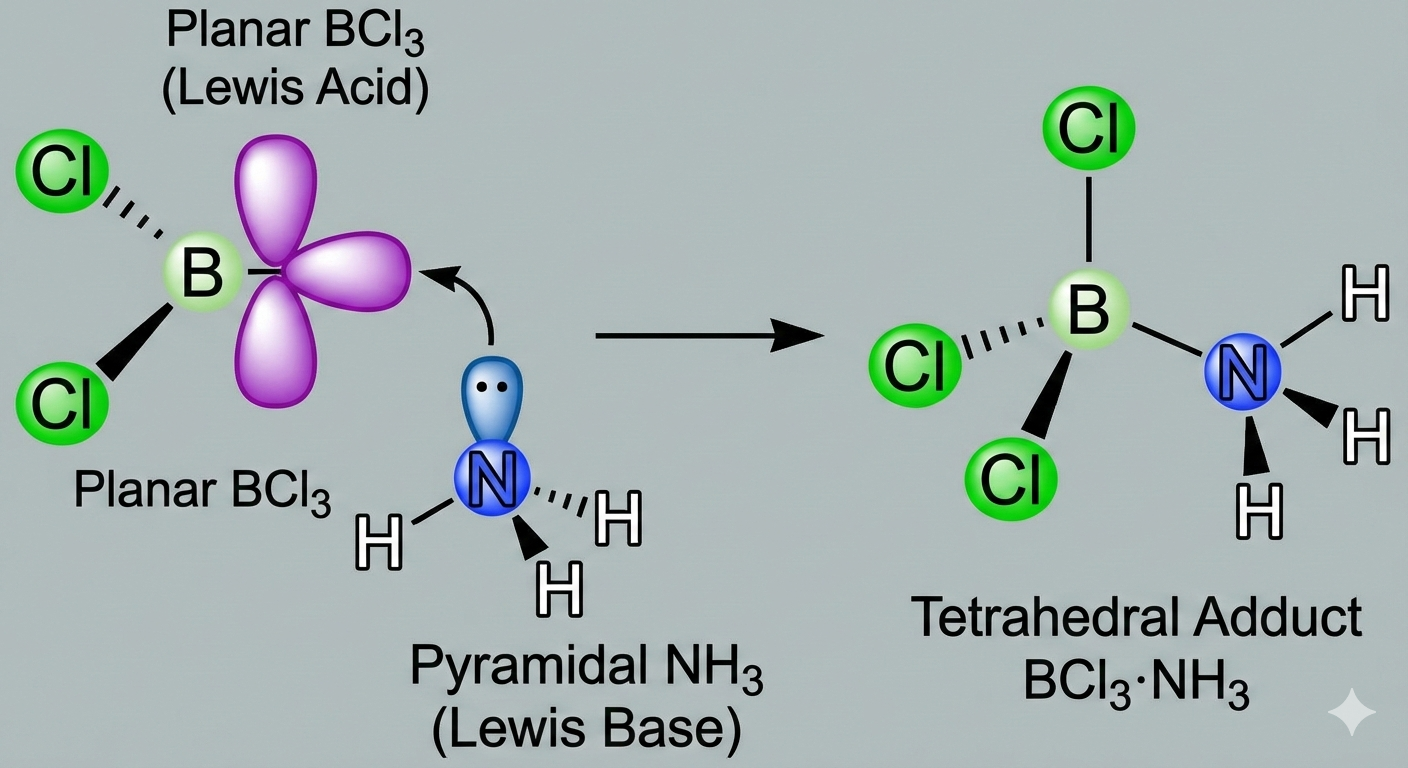
Finally, let’s check out the bonding nature. When Group 13 elements form trivalent compounds (like $\mathrm{BF}_{3}$), the central atom ends up with only six electrons around it. Since they are electron deficient molecules, they exhibit a strong tendency to accept a pair of electrons to complete their octet, making them excellent Lewis acids.
This Lewis acid character, though, is strongest for B and decreases down the group as the increasing size of the atom reduces its ability to attract incoming electrons. This is why $\mathrm{BCl}{3}$ readily accepts a lone pair from $\mathrm{NH}{3}$ to achieve stability.
You can literally see this Lewis acid action in $\mathrm{BCl}{3}$ combining with $\mathrm{NH}{3}$. The shape goes from a neat planar geometry to a crowded tetrahedral arrangement.
Figure below:
A clear diagram showing the planar structure of $\mathrm{BCl}{3}$ reacting with $\mathrm{NH}{3}$ to form the tetrahedral adduct $\mathrm{BCl}{3}\cdot \mathrm{NH}{3}$.
NEET Checkpoint:
Why does Boron exclusively form covalent compounds?
(a) Low electronegativity.
(b) High sum of first three $\Delta_{i}H$ values.
(c) Non-availability of $s$ orbitals.
(d) Strong $\pi$-bonding capability.
✅ Answer: (b) High sum of first three $\Delta_{i}H$ values — The high total energy needed to remove three electrons prevents ionic compound formation.
Practice Questions:
1. The decrease in Lewis acidic character down Group 13 is best explained by:
(a) Decreasing metallic character.
(b) Increasing difference in $\Delta_{i}H_{1}$ and $\Delta_{i}H_{3}$.
(c) Increasing atomic size of the central atom.
(d) Expansion of the octet in heavier elements.
✅ Answer: (c) Increasing atomic size of the central atom — As size increases down the group, the tendency to attract and accept an electron pair (Lewis acid character) decreases.
Key Takeaway
The Group 13 stability order is split: Boron favours covalency (due to the high sum of $\Delta_{i}H$ values), while heavy elements favour the $+1$ state ($\mathrm{Al} < \mathrm{Ga} < \mathrm{In} < \mathrm{Tl}$) due to the inert pair effect. All trivalent compounds are electron deficient Lewis acids.
6. Group 13: Reactions with Air, Acids, Alkalies, and Halogens
1. Reactivity towards Air (Oxides and Nitrides)
When it comes to reacting with air, crystalline boron is usually chill, but amorphous boron and aluminium are quite reactive when heated. On heating in air, they primarily form their respective oxides and, crucially, they also form nitrides when reacting with dinitrogen ($N_{2}$) at high temperatures.
The general reaction schemes are simple, but you must know them:
(Where $E$ represents the element).
Here's the trick: The nature of these oxides changes dramatically as you move down Group 13. Boron trioxide ($B_{2}O_{3}$) is purely acidic. Aluminium ($Al_{2}O_{3}$) and Gallium oxides are amphoteric (they react with both acids and bases). In contrast, Indium and Thallium oxides are predominantly basic. Notice how the basic character increases down the group!
NEET Checkpoint:
Which compound is formed when amorphous boron reacts with $N_{2}$?
(a) $B_{2}O_{3}$
(b) $BN$
(c) $BCl_{3}$
(d) $H_{3}BO_{3}$
✅ Answer: (b) $BN$ — Reaction with dinitrogen forms the nitride, $EN(s)$.
2. Reactions with Acids and Alkalies
Boron itself is pretty stubborn and doesn't react with acids or alkalies at moderate temperatures. But Aluminium is a true amphoteric star! It dissolves in mineral acids and aqueous alkalies, making it highly reactive.
When Aluminium reacts with dilute mineral acids like $HCl$, it liberates dihydrogen gas:
Even in aqueous alkali solutions, such as $NaOH$, Aluminium still dissolves and liberates dihydrogen gas, forming a soluble complex:
That Aluminium is a smart cookie—it knows how to handle both the acidic Chemistry sir and the basic Maths ma'am in your tuition centre!
NEET Checkpoint:
The final product, $Na^{+}[Al(OH)_{4}]^{-}$, formed when aluminium reacts with aqueous $NaOH$ is called:
(a) Sodium aluminate
(b) Aluminium hydroxide
(c) Sodium tetrahydroxoaluminate(III)
(d) Aluminium oxide
✅ Answer: (c) Sodium tetrahydroxoaluminate(III) — This is the complex salt formed during the amphoteric reaction with alkali.
3. Reactivity towards Halogens
These elements easily react with halogens ($X_{2}$) to form trihalides, $EX_{3}(s)$. (A cool side note: Thallium triiodide, $TlI_{3}$, is the exception and does not form).
The reaction is: $2E(s)+3X_{2}(g)\rightarrow2EX_{3}(s)$ ($X=F, Cl, Br, I$).
These trihalides are generally covalent in nature and are readily hydrolysed in water. For instance, trichlorides usually hydrolyse to form tetrahedral $[M(OH)_{4}]^{-}$ species.
NEET Checkpoint:
The trihalides of Group 13 elements are easily hydrolysed in water because they are generally:
(a) Ionic
(b) Electron precise
(c) Covalent
(d) Lewis bases
✅ Answer: (c) Covalent — Covalent trihalides like $BCl_{3}$ and $AlCl_{3}$ are hydrolysed in water, often forming tetrahedral species.
Practice Question:
Which of the following compounds is amphoteric in nature?
(a) $B_{2}O_{3}$
(b) $Ga_{2}O_{3}$
(c) $Tl_{2}O_{3}$
(d) $HCl$
✅ Explanation: Boron trioxide is acidic, and Thallium trioxide is basic. Gallium oxide ($Ga_{2}O_{3}$), along with Aluminium oxide ($Al_{2}O_{3}$), is amphoteric. The correct option is (b).
Key Takeaway
| Reaction Type | Key Reactants/Products | Nature/Formula |
|---|---|---|
| Air/N₂ | $E_{2}O_{3}$ (Oxide) & $EN$ (Nitride) | $B_{2}O_{3}$ is acidic; $Al_{2}O_{3}, Ga_{2}O_{3}$ are amphoteric. |
| Acids/Alkalies | Aluminium is amphoteric, liberating $H_{2}$ gas | E.g., $Al + NaOH \rightarrow Na^{+}[Al(OH){4}]^{-} + H{2}$ |
| Halogens | Trihalides ($EX_{3}$) | Generally covalent and hydrolysed in water. |
7. Key Compounds of Boron: Borax, Orthoboric Acid, and Diborane
Borax: The Glass Bead Magician
Borax is super important, being the most prominent compound of boron. It's a white crystalline solid with the formula $\text{Na}_2\text{B}_4\text{O}_7\cdot10\text{H}_2\text{O}$, though its correct formula actually involves tetranuclear units: $\text{Na}_2[\text{B}_4\text{O}_5(\text{OH})_4]\cdot8\text{H}_2\text{O}$. Notice this: Borax dissolves in water to give an alkaline solution.
The chemistry magic happens when you heat it! Borax first loses water and swells up. Upon further strong heating, it turns into a transparent liquid that solidifies into a glass-like material known as the borax bead. This bead is a mixture of Sodium metaborate ($\text{NaBO}_2$) and Boric anhydride ($\text{B}_2\text{O}_3$).
Relatable Example: The borax bead test is like a characteristic 'colour badge' for transition metals! Just like a $\text{Co}^{2+}$ ion gives a characteristic blue coloured bead, this test uses the formation of coloured metal metaborates to identify the metal.
NEET Checkpoint:
The reason an aqueous solution of borax is alkaline is the formation of:
(a) Orthoboric acid
(b) Sodium hydroxide
(c) Boric anhydride
(d) Sodium borate.
✅ Answer: (b) Sodium hydroxide — Borax hydrolyses in water to form $\text{NaOH}$ (a strong base) and $\text{H}_3\text{BO}_3$ (a weak acid), making the solution alkaline.
Orthoboric Acid: The Lewis Acid Champ
Orthoboric acid ($\text{H}_3\text{BO}_3$) is a white crystalline solid that feels soapy. Although it contains three $\text{H}$ atoms, it is key to remember it is not a protonic acid. In fact, it's categorized as a weak monobasic acid.
Now, why is it acidic? It acts as a Lewis acid by accepting a hydroxyl ion ($\text{OH}^-$) from water. It pulls the $\text{OH}^-$ to complete its octet, forcing the water to release $\text{H}^+$ into the solution.
NEET Checkpoint:
$\text{H}_3\text{BO}_3$ acts as a Lewis acid because:
(a) It releases $\text{H}^+$
(b) It is electron deficient and accepts $\text{OH}^-$ from water
(c) It is a proton donor
(d) It forms metaboric acid upon heating.
✅ Answer: (b) It is electron deficient and accepts $\text{OH}^-$ from water — Boron completes its octet by accepting electrons from the hydroxyl ion.
Diborane: The Banana Bond Structure
Diborane ($\text{B}_2\text{H}_6$) is the simplest boron hydride. This highly toxic, colourless gas spontaneously catches fire upon exposure to air.
We can prepare it by treating $\text{BF}_3$ with reducing agents like $\text{LiAlH}_4$ in diethyl ether.
Alternatively, a convenient laboratory preparation method involves the oxidation of sodium borohydride ($\text{NaBH}_4$) with iodine ($\text{I}_2$):
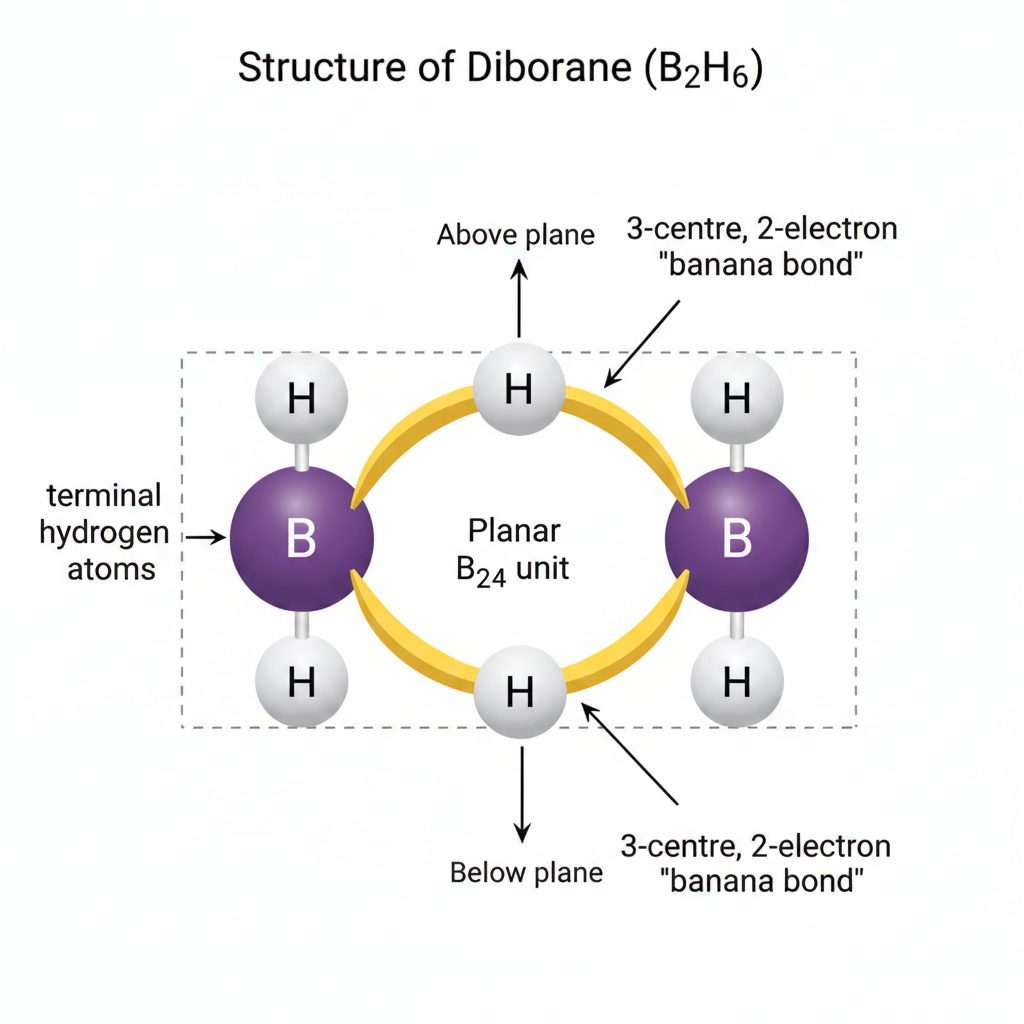
The structure is vital: The four terminal $\text{B}-\text{H}$ bonds and the two boron atoms all lie in one plane. These are normal two centre-two electron (2c-2e) bonds. Above and below this plane are two bridging hydrogen atoms forming the famous bridge bonds ($\text{B}-\text{H}-\text{B}$). These bridge bonds are unique three centre-two electron (3c-2e) bonds and are commonly referred to as banana bonds.
Figure below:
A clear diagram showing the structure of diborane ($\text{B}_2\text{H}_6$), depicting the planar arrangement of the two boron atoms and four terminal hydrogen atoms, and the two bridging hydrogen atoms located above and below this plane, indicating the 3-centre, 2-electron 'banana bonds'.
NEET Checkpoint:
How many electrons are involved in the two bridging bonds ($\text{B}-\text{H}-\text{B}$) of diborane?
(a) $4$
(b) $3$
(c) $2$
(d) $6$.
✅ Answer: (c) $2$ — Each bridge bond is a 3-centre, 2-electron bond, meaning only 4 electrons total are used for both bridges.
Key Takeaway
Borax dissolves in water to give an alkaline solution. Orthoboric Acid ($\text{H}_3\text{BO}_3$) is a Lewis acid, accepting $\text{OH}^-$. Diborane ($\text{B}_2\text{H}_6$) is prepared by reducing $\text{BF}_3$ or oxidizing $\text{NaBH}_4$ and features four 2c-2e terminal bonds and two 3c-2e banana bonds in the bridge.
8. Group 14 Elements: Overview, Trends, and Unique Bonding
Let's dive into the Carbon Family, Group 14, starting with Carbon ($\text{C}$), Silicon ($\text{Si}$), Germanium ($\text{Ge}$), Tin ($\text{Sn}$), and Lead ($\text{Pb}$). Their general valence shell configuration is $ns^{2}np^{2}$. This means they have four valence electrons to play with.
When looking at Covalent Radius, notice this: there is a considerable increase from $\text{C}$ to $\text{Si}$. But, the size increase from $\text{Si}$ down to $\text{Pb}$ is only a small increase in radius. Why is the growth sluggish later on? It’s due to the poor screening effect caused by the presence of completely filled $d$ and $f$ orbitals in the heavier members, like $\text{Ge}$ and $\text{Pb}$.
For Ionisation Enthalpy ($\Delta_{i}H$), the first thing to note is that Group 14 members have higher $\Delta_{i}H$ values than the corresponding members of Group 13. Generally, $\Delta_{i}H$ decreases down the group, as expected. Here's the trick for NEET: you observe a slight increase in $\Delta_{i}H$ from $\text{Sn}$ to $\text{Pb}$. This anomaly is a consequence of the poor shielding effect of intervening $d$ and $f$ orbitals.
Imagine planning a bike trip from Delhi to Leh, where the distance is the atomic size. Moving from Carbon to Silicon is like riding on a smooth highway (large radius increase). But from Silicon to Lead, the path gets messy with poor visibility (poor $d$ and $f$ shielding), meaning even though you expect a big jump (large size increase), the final distance (size) is only slightly more!
NEET Checkpoint:
The slight increase in ionization enthalpy from $\text{Sn}$ to $\text{Pb}$ is primarily due to:
(a) Inert pair effect only
(b) Poor $d/f$ shielding
(c) Absence of $d$ orbitals
(d) High stability of $\text{Pb}^{4+}$.
✅ Answer: (b) Poor $d/f$ shielding — This poor shielding effect holds the $ns^{2}$ electrons tightly, requiring slightly more energy to remove them from $\text{Pb}$ than $\text{Sn}$.
Elements of this group are slightly more electronegative than Group 13 elements, mainly due to their small size.
Now for the superstar feature: Bonding. Carbon has a unique ability to form $p\pi-p\pi$ multiple bonds. It forms multiple bonds with itself ($\text{C}=\text{C}$ and $\text{C}\equiv\text{C}$) and with other small, highly electronegative atoms (e.g., $\text{C}=\text{O}$, $\text{C}\equiv\text{N}$, $\text{C}=\text{S}$). This $p\pi-p\pi$ bonding is unique to the lighter elements; heavier elements cannot form effective $p\pi-p\pi$ bonds because their atomic orbitals are too large and diffuse.
NEET Checkpoint:
Which examples illustrate Carbon forming $p\pi-p\pi$ multiple bonds with itself and with other highly electronegative atoms, respectively?
(a) $\text{C}-\text{C}$ and $\text{C}-\text{H}$
(b) $\text{C}=\text{C}$ and $\text{C}=\text{O}$
(c) $\text{Si}-\text{Si}$ and $\text{Si}-\text{O}$
(d) $\text{C}\equiv\text{N}$ and $\text{C}\equiv\text{C}$.
✅ Answer: (b) $\text{C}=\text{C}$ and $\text{C}=\text{O}$ — $\text{C}=\text{C}$ shows bonding with itself, and $\text{C}=\text{O}$ shows bonding with a small, electronegative atom.
Practice Question:
For the elements $\text{Si}$ to $\text{Pb}$ in Group 14, what characterizes the electronegativity trend?
(a) Continuously decreases
(b) Continuously increases
(c) Remains almost the same
(d) Increases from $\text{Sn}$ to $\text{Pb}$.
✅ Answer: (c) Remains almost the same — The electronegativity values for elements from $\text{Si}$ to $\text{Pb}$ are almost the same.
NEET Checkpoint:
Which common oxidation state increases in stability for heavier Group 14 elements like Lead? (a) +4
(b) +2
(c) +6
(d) -4.
✅ Answer: (b) +2 — The stability of the $+2$ oxidation state increases down the group ($\text{Ge}<\text{Sn}<\text{Pb}$) due to the inert pair effect.
Key Takeaway
The Carbon family configuration is $ns^{2}np^{2}$. The most crucial deviations are the slight size and $\Delta_{i}H$ increase from $\text{Sn}$ to $\text{Pb}$ due to poor $d/f$ orbital shielding, and Carbon's unique $p\pi-p\pi$ multiple bonding ability, which is vital for organic chemistry.
9. Group 14: Oxidation States, Catenation, and Halide Funda
Hey future doctor, let’s tackle the tricky chemistry of Group 14 elements (Carbon family)! Don't stress, yaar—this funda is essential for understanding their chemical stability and reactivity.
Oxidation States Drama
The members of Group 14 typically show two common oxidation states: $+4$ and $+2$. Since the sum of the first four ionization enthalpies is very high, compounds in the $+4$ oxidation state are generally covalent in nature. Notice this—carbon ($\text{C}$) and silicon ($\text{Si}$) mostly rock the $+4$ state.
Now, why the shift? As we move down the group, the stability of the $+2$ oxidation state increases in the order $\text{Ge} < \text{Sn} < \text{Pb}$. This is due to the inert pair effect. The increase in effective nuclear charge, coupled with the poor shielding effect of intervening $\text{d}$ and $\text{f}$ orbitals, holds the $ns^{2}$ electrons tightly, restricting their participation in bonding. This makes $\text{Pb}$ in the $+2$ state stable, while $\text{Pb}$ in the $+4$ state is a strong oxidising agent.
NEET Checkpoint:
Which compound is a strong oxidizing agent?
(a) $\text{SnCl}{2}$
(b) $\text{PbCl}{4}$
(c) $\text{SiCl}{4}$
(d) $\text{GeCl}{2}$
✅ Answer: (b) $\text{PbCl}_{4}$ — Lead in the $+4$ state ($\text{Pb}^{4+}$) is highly unstable compared to $\text{Pb}^{2+}$, making it eager to gain electrons and act as a strong oxidizing agent.
The Catenation Chain
Catenation is the awesome ability of atoms to link together, forming chains or rings via covalent bonds. Carbon is the OG of catenation because the $\text{C}-\text{C}$ bonds are very strong ($348$ $\text{kJ mol}^{-1}$). However, this ability decreases dramatically down the group. Why? The bond enthalpy of the $\text{E}-\text{E}$ bond drops quickly (e.g., $\text{Sn}-\text{Sn}$ is only $240$ $\text{kJ mol}^{-1}$). The order is $\text{C} >> \text{Si} > \text{Ge} \simeq \text{Sn}$, and $\text{Pb}$ (Lead) does not show catenation at all.
Relatable Example: Think of catenation like forming a human chain during the morning assembly at school. Carbon atoms hold hands really tightly, but by the time you reach Lead ($\text{Pb}$), they just don't have the bond enthalpy to link up, leading to a break in the chain.
NEET Checkpoint:
Lead ($\text{Pb}$) does not show catenation because:
(a) It is radioactive
(b) It has low bond enthalpy
(c) It has high ionization enthalpy
(d) It is amphoteric
✅ Answer: (b) It has low bond enthalpy — Catenation decreases down the group due to decreasing $\text{E}-\text{E}$ bond enthalpy, and $\text{Pb}$ does not show this property.
Halides and Hydrolysis Funda
The tetrahalides ($\text{MX}{4}$) of Group 14 elements are generally covalent. The central atom undergoes sp3 hybridisation, giving the molecule a tetrahedral shape. (Note: $\text{SnF}{4}$ and PbF4 are exceptions, being ionic in nature).
Now, why does hydrolysis happen? Except for $\text{CCl}{4}$ (Carbon Tetrachloride), all other tetrachlorides, like $SiCl_4$are easily hydrolysed by water. Here’s the trick: carbon cannot exceed its covalence more than four because it lacks vacant $\text{d}$ orbitals. But other elements ($\text{Si}$, $\text{Ge}$, $\text{Sn}$, $\text{Pb}$) have vacant $\text{d}$ orbitals. This availability allows the central atom to accommodate the lone pair of electrons from the water molecule, leading to hydrolysis and the eventual formation of species like $\text{Si}(\text{OH})_{4}$ (silicic acid).
NEET Checkpoint:
$\text{SiCl}{4}$ undergoes hydrolysis easily, but $CCl _4 $ does not because:
(a) $\text{Si}$ is larger
(b) $\text{Si}$ has vacant $\text{d}$ orbitals
(c) $\text{C}-\text{Cl}$ bond is stronger
(d) $\text{Si}$ has lower electronegativity
✅ Answer: (b) $\text{Si}$ has vacant $\text{d}$ orbitals — The vacant $\text{d}$ orbitals are necessary for the central atom to accept the lone pair of electrons from water, initiating the hydrolysis reaction.
Practice Questions:
1: Which statement concerning the stability of oxidation states in Group 14 is correct?
(a) $\text{Sn}^{4+}$ is generally more stable than $\text{Sn}^{2+}$ and acts as a reducing agent.
(b) $\text{Pb}^{4+}$ is generally more stable than $\text{Pb}^{2+}$ due to $\text{d}$ orbital contraction.
(c) The stability of the $+2$ state increases down the group primarily due to the inert pair effect.
(d) $\text{C}$ and $\text{Si}$ commonly exhibit both $+2$ and $+4$ states equally.
✅ Answer: (c) The stability of the $+2$ state increases down the group primarily due to the inert pair effect. — The sequence $\text{Ge} < \text{Sn} < \text{Pb}$ shows increasing stability of the $+2$ state due to the inert pair effect.
2: In the hydrolysis of $\text{SiCl}_{4}$ by water, the silicon atom initially undergoes a change because:
(a) It forms $\pi$ bonds with oxygen.
(b) It utilizes $sp^{3}d^{2}$ hybrid orbitals to form octahedral complexes.
(c) It accepts a lone pair of electrons from the water molecule into its vacant $\text{d}$ orbital.
(d) It donates its $\text{s}$ electron pair to the water molecule.
✅ Answer: (c) It accepts a lone pair of electrons from the water molecule into its vacant $\text{d}$ orbital. — The availability of $\text{d}$ orbitals allows the central atom to accommodate the lone pair from $\text{H}_{2}\text{O}$, initiating the hydrolysis.
Key Takeaway |
|
| Oxidation States | The +2 stability increases down the group due to the inert pair effect ( $\text{Ge} < \text{Sn} < \text{Pb}$). $\text{Pb}$ in the +4 state is a strong oxidising agent. |
| Catenation | Decreases significantly down the group $\text{C} >> \text{Si} > \text{Ge} \simeq \text{Sn}$, driven by decreasing E−E bond enthalpy. Pb does not show catenation. |
| Hydrolysis | $\text{MX}{4}$ compounds (except $\text{CCl}{4}$) undergo hydrolysis because the central atom (Si, Ge, Sn, Pb) has vacant d orbitals to accept lone pairs from $\text{H}_{2}\text{O}$. |
10. Allotropes of Carbon: Diamond, Graphite, and Fullerenes
Carbon is a superstar, yaar, exhibiting many allotropic forms, which are broadly classified as crystalline (Diamond, Graphite, Fullerenes) and amorphous. When preparing for NEET, we need to focus on this cool crystalline trio! Don't stress, let's clear up this funda using their structures, as they dictate their crazy properties.
Diamond (The Hard Boss): Diamond is a rigid three-dimensional network solid. Every carbon atom undergoes $sp^{3}$ hybridisation and connects tetrahedrally to four others. This continuous 3D network of strong directional covalent bonds makes it the hardest substance on earth. The C-C bond length is $154~pm$.
NEET Checkpoint :
Which bonding characteristic gives diamond its extreme hardness?
(a) Layered structure
(b) Delocalised electrons
(c) Rigid three-dimensional covalent network
(d) $sp^{2}$ hybridisation.
✅ Answer: (c) Rigid three-dimensional covalent network — Breaking these extended C-C covalent bonds is extremely difficult.
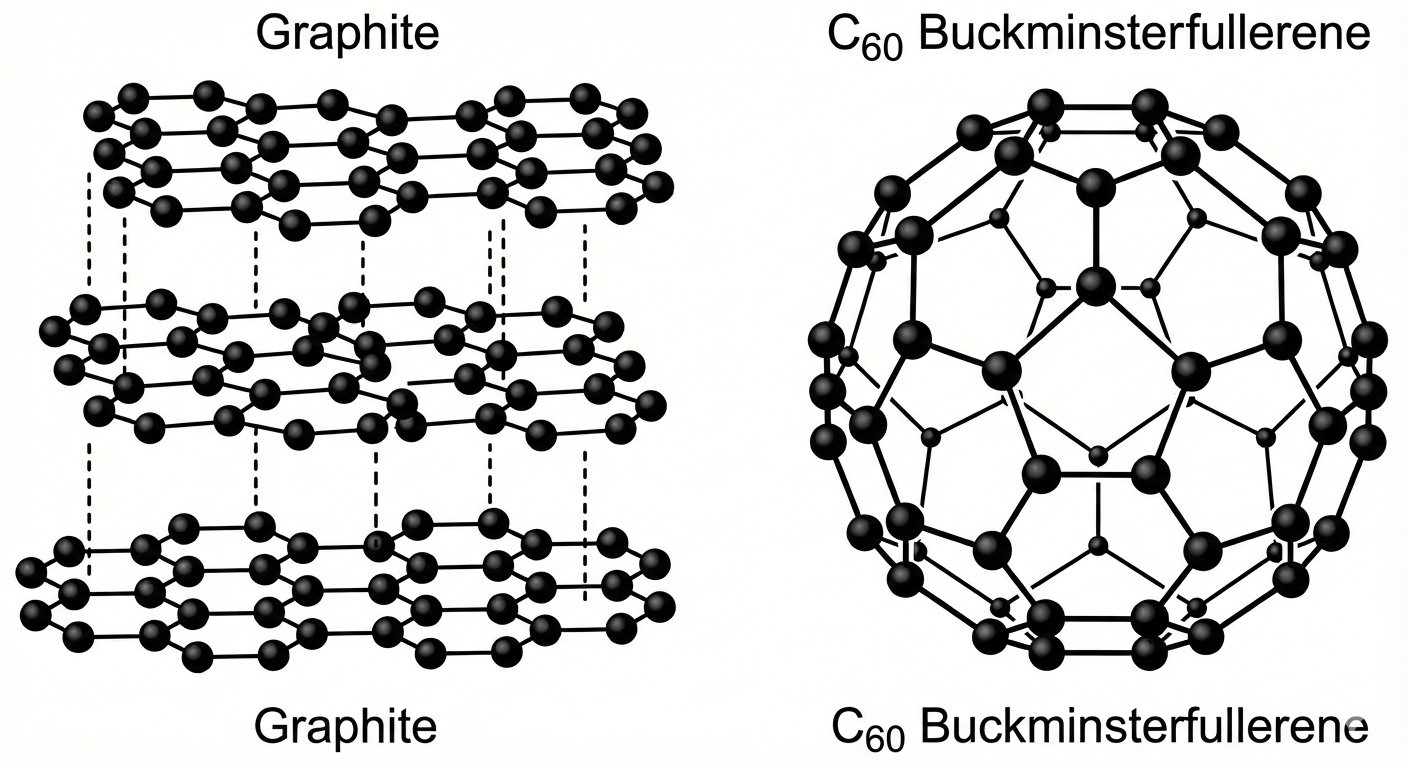
Graphite (The Smooth Conductor): Graphite has a layered structure. Each layer consists of planar hexagonal rings, where every carbon atom is $sp^{2}$hybridised. This hybridisation leaves one electron free to form a π bond, resulting in delocalised electrons over the sheet. And that’s cool, right? This mobility allows graphite to conduct electricity along the sheet. The C-C bond length within the layer is $141.5~pm$. The layers are held together only by weak van der Waals forces (distance $340~pm$), making graphite soft and slippery—ideal as a dry lubricant.
Relatable Indian Example: Think of diamond as a tough metal cutter used in industrial work, while graphite is the fine, slippery powder you sometimes apply to a sticky door hinge to make it move smoothly!
Fullerenes $C_{60}$ (The Bucky Ball): These are cage-like molecules, often referred to as "Bucky balls" because $C_{60}$ resembles a soccer ball. This specific molecule contains twenty six-membered rings and twelve five-membered rings. Notice this: like graphite, all carbon atoms in fullerenes are $sp^{2}$ hybridised. They are pure forms of carbon with delocalized aromatic character. The C-C distances vary between $143.5~pm$ (single) and $138.3~pm$ (double).
Figure below:
A clear diagram showing the layered structure of Graphite and the soccer ball structure of C60 Buckminsterfullerene .
NEET Checkpoint :
How many five-membered rings are present in a C60 fullerene molecule?
(a) 6
(b) 12
(c) 20
(d) 32.
✅ Answer: (b) 12 — The $C_{60}$ structure has twenty six-membered rings and twelve five-membered rings
NEET Checkpoint :
Why is graphite used as a lubricant?
(a) Because it has a high melting point
(b) Because it contains free electrons
(c) Because its layers are held together by weak van der Waals forces and slide easily
(d) Because it is a good conductor of heat
✅ Answer: (c) Graphite is soft and slippery because its layers are held by weak van der Waals forces and cleave easily.
Practice Questions:
1. Which allotrope of carbon possesses $sp^{3}$ hybridisation and a C-C bond length of $154~pm$?
(a) Graphite
(b) Fullerenes
(c) Diamond
(d) Coke
✅ Answer: (c) Diamond. Diamond is $sp^{3}$ hybridised, giving it the characteristic $154~pm$ single bond lengt
2. What property of graphite results from the presence of delocalized electrons?
(a) Extreme hardness
(b) Ability to act as an abrasive
(c) Conductance of electricity along the sheet
(d) Thermodynamically unstable nature
✅ Answer: (c) Conductance of electricity along the sheet. The free$
Key Takeaway
Hybridisation is Key: Diamond is $sp^{3}$ (3D network, hard). Graphite and Fullerenes are $sp^{2}$ (layers/cage, conductor/soft). Graphite is thermodynamically the most stable allotrope of carbon (ΔfH⊖=0).
11. Key Compounds of Carbon and Silicon: Oxides, Silicones & Silicates
Starting with Carbon Monoxide (CO): This is a neutral oxide that’s a beast of a powerful reducing agent. Notice this crucial point: pure CO is made in the lab by the dehydration of formic acid (HCOOH) using concentrated H2SO4 at 373 K. But be super careful, yaar! It’s highly poisonous because it forms a complex with haemoglobin that’s about 300 times more stable than the oxygen-haemoglobin complex
Now for its big sibling, Carbon Dioxide (CO2)! This is an acidic oxide. In the CO2 molecule, the carbon atom uses sp hybridisation, giving it a linear shape with no overall dipole moment. Increased atmospheric CO2 concentration is the main culprit behind the greenhouse effect.
NEET Checkpoint:
Which carbon oxide is neutral in nature?
(a) CO2
(b) CO
(c) C3O2
(d) C2O3
✅ Answer: (b) CO — Remember, CO is the odd one out; it’s the only common neutral oxide of carbon
Moving over to Silicon's compounds. Silicon Dioxide (SiO2), commonly known as silica, forms a covalent, three-dimensional network solid. In this giant molecule, each Si atom is tetrahedrally bonded to four O atoms. It’s almost non-reactive because the Si-O bond enthalpy is very high. This makes it resist most halogens, H2, and most acids, but it does react with HF and NaOH. This network structure is like a massive security grid—tough to break!
Figure below:
A clear diagram showing the three-dimensional structure of SiO2 where each silicon atom is tetrahedrally bonded to four oxygen atoms.
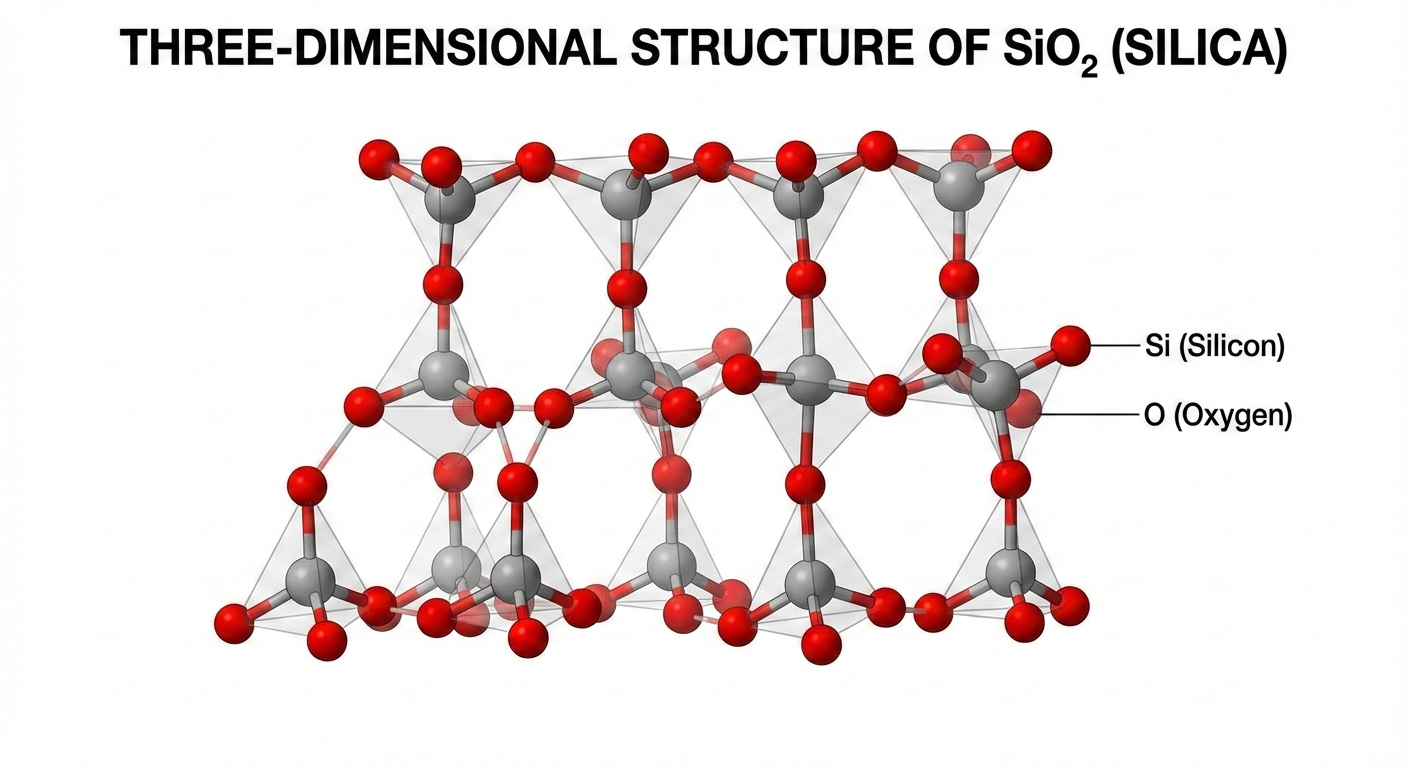
The core structural unit of Silicates is the tetrahedral SiO44− anion. These units link up by sharing O atoms to form amazing chain, ring, sheet, or 3D structures. Finally, Silicones are organosilicon polymers with repeating {R2SiO} units. They are surrounded by non-polar alkyl groups, making them water repelling (hydrophobic). That’s why they are used as sealants, greases, and for water proofing fabrics. Imagine silicone greases making your scooter chain completely safe from the monsoon rain—that’s the hydrophobic magic!
NEET Checkpoint:
SiO2 reacts with which of the following compounds?
(a) HCl
(b) H2SO4
(c) HF
(d) I2
✅ Answer: (c) HF — Silica is almost non-reactive but is attacked by HF and NaOH
NEET Checkpoint:
What is the repeating structural unit in Silicones?
(a) SiO44−
(b) {R2SiO}
(c) SiO2
(d) RSiCl3
✅ Answer: (b) {R2SiO} — Silicones are polymers defined by the repeating unit {R2SiO}
Practice Questions
1.The highly poisonous nature of CO gas is primarily due to:
(a) Its acidic nature in the lungs.
(b) Its ability to be reduced easily.
(c) The formation of a very stable complex with haemoglobin.
(d) Its low solubility in water.
✅ Answer: (c) The formation of a very stable complex with haemoglobin — The complex formed with haemoglobin is approximately 300 times more stable than the oxygen-haemoglobin complex.
2. What is the fundamental structural unit of silicates?
(a) SiCl4 molecule
(b) SiO2 network solid
(c) Tetrahedral SiO44− anion
(d) Polymeric {R2SiO} unit
✅ Answer: (c) Tetrahedral SiO44− anion — The basic structural unit of silicates is the SiO44− tetrahedron.
Key Takeaway
| Compound | Nature/Structure | Key Chemical/Physical Property |
| CO | Neutral oxide, :C≡O: | Highly poisonous due to stable complex formation with haemoglobin. |
| $CO_2$ | Acidic oxide, Linear (sp) | Increased atmospheric concentration causes the greenhouse effect. |
| $SiO_ 2 $ | Covalent, 3D network solid | Almost non-reactive due to high Si-O bond enthalpy. |
| Silicates | $\text{SiO}_{4}^{4-}$based structures | Forms chain, ring, sheet, or 3D structures |
| Silicones | Organosilicon polymers ${R _2 SiO}$ | Hydrophobic (water repelling) nature; used for waterproofing. |
12. Group 15 (N Family): General Trends and Nitrogen Reactivity
Group 15 (The Nitrogen Family) looks complex, but the trends are super predictable! This group starts with N and ends at Bi. As we cruise down the group, there’s a major shift: the elements transition from purely non-metallic (N and P) to metallic (Bi), with As and Sb acting as metalloids in between.
The secret sauce for this family is their valence shell configuration: ns2np3. Since the s orbital is completely filled and the p orbitals are perfectly half-filled, this configuration is considered extra stable. This stability means that removing an electron is difficult, so the Ionisation Enthalpy (ΔiH) of Group 15 elements is much greater than the corresponding Group 14 elements.
NEET Checkpoint:
Which elements in Group 15 are classified as metalloids?
(a) N, P
(b) As, Sb
(c) Sb, Bi
(d) P, As
✅ Answer: (b) As, Sb — The elements As (Arsenic) and Sb (Antimony) display metalloid character during the non-metal to metal transition
Anomalous Behaviour of Nitrogen
Nitrogen is the enfant terrible (the quirky first member!). Because it lacks d orbitals, Nitrogen is restricted to a maximum covalence of 4 (using one s and three p orbitals for bonding). However, its small size allows it to form super strong pπ−pπ triple bonds with itself, like the mighty N≡N in dinitrogen.
Now, why is N2 so chill? Because breaking that triple bond requires a massive bond enthalpy of 941.4 kJ mol−1. This high energy requirement is why Dinitrogen (N2) is highly inert at room temperature.
Here's the twist, though: the single N−N bond is actually weaker than the single P−P bond. Think of it like a crowded autorickshaw (Nitrogen): the passengers (non-bonding electrons) are so close that they repel each other strongly due to tiny bond length, leading to weak stability. This interelectronic repulsion results in weak catenation for nitrogen.
NEET Checkpoint:
What limits the maximum covalency of Nitrogen to four?
(a) High electronegativity
(b) Small atomic size
(c) Non-availability of d orbitals
(d) High bond enthalpy
✅ Answer: (c) Non-availability of d orbitals — Only the 2s and 2p orbitals are available for bonding in N.
Hydride Funda $ (EH_3 )$
All Group 15 elements form hydrides of type EH3. Down the group, the stability decreases (from NH3 being strongest to BiH3 being weakest), which is observed from their bond dissociation enthalpy. Consequently, the reducing character increases down the group, making BiH3 the strongest reducing agent.
Also, the Basicity decreases in the order $NH_3>PH_3>AsH_3>SbH_3≥BiH_3$.
NEET Checkpoint:
Arrange the hydrides NH3,PH3,AsH3 in order of decreasing basicity.
(a) $PH_3>AsH_3>NH_3$
(b) $NH_3>PH_3>AsH_3$
(c) $AsH_3>PH_3>NH_3$
✅ Answer: (b) $NH_3>PH_3>AsH_3$— Basicity decreases down the group
Practice Questions:
1.Why is the catenation tendency weak in nitrogen compared to phosphorus?
(a) Nitrogen forms strong pπ−pπ bonds.
(b) The N−N single bond is weaker than the P−P bond.
(c) Nitrogen is restricted to maximum covalence of four.
(d) Nitrogen has higher electronegativity.
✅ Answer: (b) The N–N single bond is weaker than the P–P bond.
Nitrogen atoms are very small, so electron repulsion weakens the N–N bond and reduces catenation.
2. Which statement correctly describes the stability and reducing character of BiH3?
(a) Low stability, weak reducing agent.
(b) High stability, strong reducing agent.
(c) Low stability, strong reducing agent.
(d) High stability, weak reducing agent.
✅ Answer: (c) Low stability, strong reducing agent.
Down the group, hydrides become less stable and more powerful reducing agents. Since bismuth is at the bottom, BiH₃ is very unstable and a strong reducing agent.
Key Takeaway
| Property | Trend in Group 15 (N to Bi) | Key Reason |
| Metallic Character | Increases | Decreasing ΔiH and increasing size |
| $Δ_iH $ | High overall value | Extra stable ns2np3 configuration |
| Hydride Stability $(EH_3)$ | Decreases $ (NH_3 to BiH_3)$ | Decreasing E−H bond enthalpy |
| Dinitrogen Inertness | Very High | High N≡N bond enthalpy (941.4 kJ mol−1) |
13. Ammonia, Nitric Acid, and Phosphorus Halides: The Group 15 Power Trio!
let's dive into the chemistry heavyweights of Group 15. This section covers three crucial compounds: the foundation (Ammonia), the acid powerhouse (Nitric Acid), and the structural mystery (Phosphorus Halides). Don't stress, the concepts are solid gold for NEET!
Ammonia (NH3): The Lewis Base Champ
Ammonia is manufactured on a massive scale by the famous Haber's process. It’s all about finding that optimum balance, like setting up a perfect cricket pitch—not too hot, not too cold.
The reaction, which is exothermic, demands high pressure to maximize yield (Le Chatelier's principle, remember that funda?):
The optimum conditions are around $200 \times 10^{5}~\text{Pa}$ (or about $200~\text{atm}$), a temperature of $\sim 700~\text{K}$, and a catalyst, typically iron oxide with small amounts of $K_{2}O$ and $Al_{2}O_{3}$.
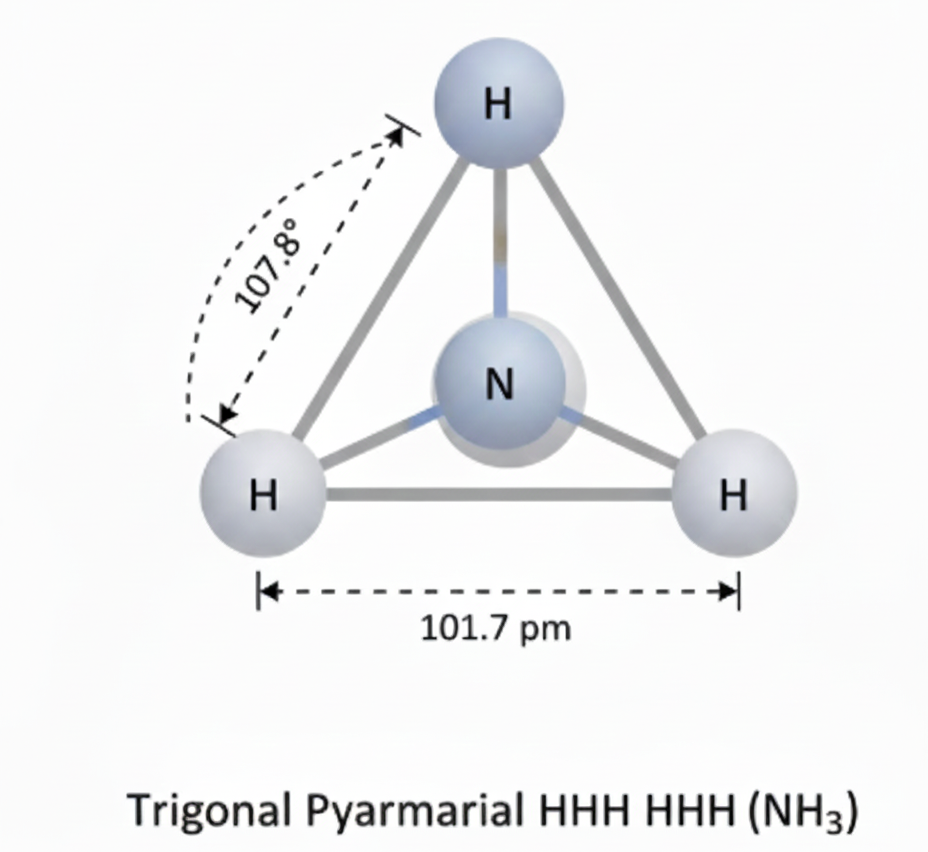
The structure of the $NH_{3}$ molecule is trigonal pyramidal, with the Nitrogen atom sitting right at the apex. Notice this: Nitrogen has one lone pair of electrons. Because of this lone pair, $NH_{3}$ is ready to donate electrons, making it a classic Lewis base.
Figure below:
A clear diagram showing the trigonal pyramidal structure of Ammonia ($NH_{3}$) with the Nitrogen atom at the apex, displaying the bond angle of $107.8^{\circ}$ and the N-H distance of $101.7~\text{pm}$.
NEET Checkpoint:
What is the primary reason Ammonia acts as a Lewis base?
(a) Its trigonal pyramidal shape
(b) Its high solubility in water
(c) The presence of a lone pair on the N atom
(d) Its high boiling point
✅ Answer: (c) The presence of a lone pair on the N atom — A Lewis base is an electron pair donor, a role perfectly filled by the lone pair on Nitrogen.
Nitric Acid ($HNO_{3}$): The Oxidising King
The manufacture of $HNO_{3}$ happens via Ostwald's process, starting with the catalytic oxidation of $NH_{3}$. $HNO_{3}$ is a strong monobasic acid and a powerful oxidising agent.
It reacts strongly with both metals and non-metals. For example, when reacting with non-metals, it oxidises Carbon ($C$) to carbon dioxide ($CO_{2}$), Sulphur ($S$) to sulphuric acid ($H_{2}SO_{4}$), and Phosphorus ($P$) to phosphoric acid ($H_{3}PO_{4}$).
Phosphorus Halides ($PX_{3}$ and $PX_{5}$)
Phosphorus is fancy; it forms both trihalides ($PX_{3}$) and pentahalides ($PX_{5}$), while Nitrogen cannot form pentahalides like $NF_{5}$ because it doesn't have those sweet, sweet $d$ orbitals to expand its covalency beyond four.
- Phosphorus Trichloride ($PCl_{3}$): This trihalide has a pyramidal shape (sound familiar? just like $NH_{3}$!) where Phosphorus is $sp^{3}$ hybridised. Crucially, it hydrolyses easily in the presence of moisture, giving rise to phosphonous acid ($H_{3}PO_{3}$) and $HCl$ gas, leading to white fumes:
$$PCl_{3}+3H_{2}O\rightarrow H_{3}PO_{3}+3HCl$$
NEET Checkpoint:
Why is $PCl_{3}$ fumes observed around the compound in moist air?
(a) $PCl_{3}$ is volatile
(b) $PCl_{3}$ reacts with water forming $H_{3}PO_{3}$ and $HCl$ gas
(c) It undergoes disproportionation
(d) It forms hydrogen bonds
✅ Answer: (b) $PCl_{3}$ reacts with water forming $H_{3}PO_{3}$ and $HCl$ gas — The release of $HCl$ gas produces the white fumes observed.
2. Phosphorus Pentachloride ($PCl_{5}$): In the gaseous and liquid phases, $PCl_{5}$ takes on a trigonal bipyramidal structure. Here's the most important structural detail, pay attention: the three equatorial $P-Cl$ bonds are equivalent, but the two axial bonds are longer! This is because the axial bond pairs experience more repulsion compared to the equatorial ones.
Figure below:
A clear diagram showing the trigonal bipyramidal structure of $PCl_{5}$ (Fig. 7.9) distinguishing between the three shorter equatorial bonds and the two longer axial bonds.
NEET Checkpoint:
In the trigonal bipyramidal structure of $PCl_{5}$, which bonds are non-equivalent and why?
(a) All five P–Cl bonds are equal due to symmetric geometry.
(b) Equatorial bonds are longer than axial bonds due to less repulsion.
(c) The two axial bonds are longer than the three equatorial bonds because axial bond pairs experience greater repulsion.
(d) Axial bonds are shorter due to stronger overlap than equatorial bonds.
✅ Answer: (c) The two axial bonds are longer than the three equatorial bonds because the axial bond pairs suffer more repulsion.
Practice Questions:
- Which non-metal product is formed when concentrated $HNO_{3}$ reacts with Sulphur ($S_{8}$)?
(a) $SO_{2}$
(b) $H_{2}SO_{3}$
(c) $H_{2}SO_{4}$
(d) $SO_{3}$
✅ Answer: (c) $H_{2}SO_{4}$ — Concentrated nitric acid is a strong oxidising agent, converting Sulphur to sulphuric acid.
2. What is the stability trend for oxidation states in the Group 15 elements, Phosphorus and Bismuth?
(a) P prefers $+5$, Bi prefers $+5$
(b) P prefers $+3$, Bi prefers $+5$
(c) P prefers $+5$, Bi prefers $+3$
(d) Both prefer $+3$
✅ Answer: (c) P prefers $+5$, Bi prefers $+3$ — The stability of the $+5$ oxidation state decreases down the group, and the stability of the $+3$ state increases (inert pair effect).
Key Takeaway
| Compound | Manufacture | Structure/Key Feature |
|---|---|---|
| Ammonia ($NH_{3}$) | Haber's Process ($700~\text{K}$, $200~\text{atm}$) | Trigonal Pyramidal, Lewis Base |
| Nitric Acid ($HNO_{3}$) | Ostwald's Process | Strong Oxidising Agent |
| $PCl_{3}$ | Pyramidal, Hydrolyses to $H_{3}PO_{3}$ | |
| $PCl_{5}$ | Trigonal Bipyramidal, Axial bonds are longer |
14. Group 16 & 17 Elements: Trends and Anomalies – The P-Block Powerhouses!
Let's start with Group 16, the Chalcogens (meaning 'ore forming'). Their general valence shell configuration is $ns^{2}np^{4}$. Notice this: the size of the oxygen atom is exceptionally small. Now, when we look at oxidation states, the stability of the $+6$ oxidation state decreases down the group, while the $+4$ oxidation state increases. Why this switcheroo? It's that infamous inert pair effect kicking in for the heavier elements.
Here's the trick: Water, $H_{2}O$, is a liquid, but hydrogen sulphide, $H_{2}S$, is a gas. Why? Because of strong hydrogen bonding in $H_{2}O$ which is absent in $H_{2}S$. It’s like $H_{2}O$ molecules holding hands tightly (hydrogen bonding) while $H_{2}S$ molecules are just floating around solo!
NEET Checkpoint:
Which hydride of Group $16$ is a liquid due to association through hydrogen bonding?
(a) $H_{2}S$
(b) $H_{2}Te$
(c) $H_{2}O$
(d) $H_{2}Po$
✅ Answer: (c) $H_{2}O$ — Due to oxygen's small size and high electronegativity, $H_{2}O$ forms strong hydrogen bonds, keeping it associated in the liquid state.
Moving to Sulphur Allotropes, remember two main crystalline forms: Rhombic ($\alpha$-sulphur) and Monoclinic ($\beta$-sulphur). Rhombic sulphur is the stable form at room temperature. If you heat it above $369\ K$ (that’s the transition temperature!), it transforms into Monoclinic sulphur, which is stable above this point. Don't forget their structure funda: Both forms contain puckered, crown-shaped $S_{8}$ rings.
Next up, Group 17, the Halogens (salt producers). Their valence shell is $ns^{2}np^{5}$. They have the smallest atomic radii in their respective periods due to the maximum effective nuclear charge. Since they are just one electron short of a noble gas configuration, they have the maximum negative electron gain enthalpy in their periods, making them ready electron acceptors, which translates to them being strong oxidising agents.
The Fluorine Anomaly
Fluorine (F), the first member, is super naughty and shows anomalous behaviour. It has the highest electronegativity of all elements (a perfect $4.0$ on the Pauling scale). But watch out: it has a surprisingly low $F-F$ bond dissociation enthalpy. This weakness, coupled with its high hydration enthalpy, makes it the strongest oxidising agent. Since it's the most electronegative and lacks $d$ orbitals, it forms only the $-1$ oxidation state.
NEET Checkpoint:
Why does $F$ exhibit only the $-1$ oxidation state?
(a) High ionic radius
(b) Low electronegativity
(c) Absence of $d$ orbitals
(d) High $F-F$ bond enthalpy
✅ Answer: (c) Absence of $d$ orbitals — Fluorine cannot expand its octet like other halogens and, being the most electronegative element, it only gains one electron to achieve the $-1$ state.
Let's imagine a pani puri stall (Group $16$ elements). Oxygen is that tiny, super-fast guy who handles all the orders quickly (small size, high reactivity), while Sulphur, who exists as $S_{8}$ rings, is like the large, slow-moving cart (polyatomic solid) that is stable but takes time to heat up!
NEET Checkpoint:
The $S_{8}$ ring in rhombic sulphur is described as having which shape?
(a) Tetrahedral
(b) Linear
(c) Planar hexagonal
(d) Puckered crown
✅ Answer: (d) Puckered crown — Both rhombic and monoclinic sulphur contain puckered, crown-shaped $S_{8}$ rings.
Practice Question:
Which statement regarding the Halogens (Group $17$) is INCORRECT?
(a) They have the smallest atomic radii in their periods.
(b) Fluorine has the lowest bond dissociation enthalpy among $X_{2}$ molecules.
(c) They are typically weak oxidising agents.
(d) They show maximum negative electron gain enthalpy in their periods.
✅ Explanation: (c). Halogens are strong oxidising agents because they readily accept one electron to achieve a noble gas configuration.
Now that you've mastered these two groups, you’re well set for the whole P-block journey. Wait till you see how Group $18$ behaves!
Key Takeaway
Group 16: Valence shell $ns^{2}np^{4}$. $H_{2}O$ is liquid due to H-bonding. Stability: $+4 > +6$ down the group (inert pair effect). $\alpha$-Sulphur (Rhombic) is stable below $369\ K$ and contains crown-shaped $S_{8}$ rings.
Group 17: Valence shell $ns^{2}np^{5}$. Smallest radii and maximum negative $\Delta_{eg}H$. F shows $-1$ state only, has highest electronegativity, and low $F-F$ bond enthalpy.
15. Group 18, Oxoacids, and Interhalogen Compounds
Let's wrap up the p-block with the 'noble' but slightly rebellious elements of Group 18 and the tricky compounds of the halogens! Don't stress, yaar, this funda is mostly about recognizing the exceptional stability and the shapes of $\text{Xe}$ compounds.
Group 18 elements are the ultimate non-reactive heroes because they have completely filled valence shell configurations, usually $ns^2np^6$ (except for $\text{He}$, which is $1s^2$). This closed shell structure results in a very high ionisation enthalpy and a tendency toward a positive electron gain enthalpy, making them chemically inert. They exist as monoatomic gases. Since the only interatomic interaction present is weak dispersion forces, they have super low boiling points; $\text{He}$ has the lowest known boiling point at $4.2\text{ K}$.
NEET Checkpoint:
What is the fundamental force responsible for the low boiling points of noble gases?
(a) Hydrogen bonding
(b) Dipole–dipole attraction
(c) Weak dispersion (van der Waals) forces
(d) Ionic forces
✅ Answer: (c) Weak dispersion forces — Since they are monoatomic and non-polar, this is the only force present.
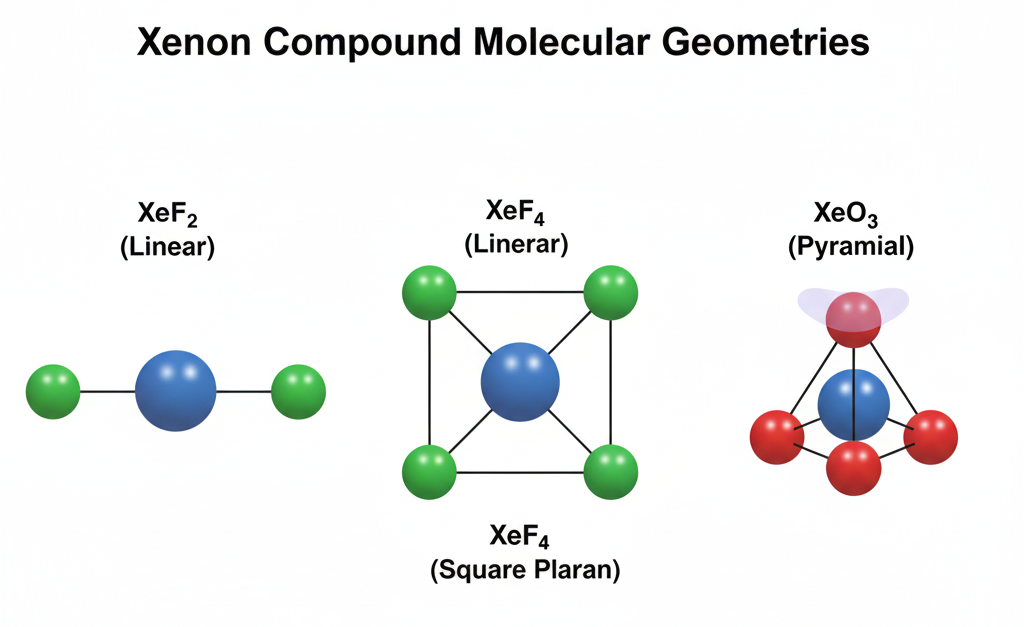
Now, meet the group rebel: Xenon ($\text{Xe}$). It reacts directly with fluorine under appropriate conditions. Remember these structures for your exam:
The hydrolysis of $\text{XeF}_6$ yields $\text{XeO}_3$, which has a pyramidal molecular structure.
Figure below:
A clear diagram showing the molecular structures of $\text{XeF}_2$ (linear), $\text{XeF}_4$ (square planar), and $\text{XeO}_3$ (pyramidal).
Think of this like a cricket match: The boundary ropes (high ionisation enthalpy) usually keep the noble gases inside (inert). But $\text{Xe}$ is like the power hitter who sometimes smashes a six (forms compounds) when highly electronegative fielders like $\text{F}_2$ are around!
Moving over to the Halogens (Group 17), they form multiple Oxoacids. Halogens (except $\text{F}$) form a series of these, like $\text{HOCl}$, $\text{HClO}_2$, $\text{HClO}_3$, and $\text{HClO}_4$. They are typically stable only when they are in aqueous solutions or as salts.
NEET Checkpoint:
Why does fluorine only form one oxoacid ($\text{HOF}$)?
(a) Because fluorine has a large atomic size and low electronegativity.
(b) Because fluorine can expand its octet easily using d-orbitals.
(c) Because fluorine prefers only negative oxidation states in all compounds.
(d) Due to its small size, very high electronegativity, and no d-orbitals for octet expansion, fluorine is restricted to the +1 oxidation state in oxoacids.
✅ Answer: (d) Due to its small size and high electronegativity, combined with the non-availability of $\text{d}$ orbitals to expand its octet, $\text{F}$ is restricted to the $+1$ oxidation state in oxoacids.
Finally, we have Interhalogen Compounds ($\text{XX}'_n$), formed when two different halogens link up. These compounds, such as $\text{ICl}$ or $\text{BrF}_3$, are generally more reactive than the constituent halogens (except $\text{F}_2$). This enhanced reactivity is key because the bond between the different halogens ($\text{X-X}'$) is typically weaker than the bond in the parent halogen molecule ($\text{X-X}$).
NEET Checkpoint:
Which of the following noble gas compounds is characterized by a distorted octahedral geometry?
(a) $\text{XeF}_2$
(b) $\text{XeF}_6$
(c) $\text{XeF}_4$
(d) $\text{KrF}_2$
✅ Answer: (b) $\text{XeF}_6$ — The $\text{Xe}$ atom has seven electron pairs (six bond pairs and one lone pair), resulting in the distorted octahedral shape.
Practice Questions:
- Which compound is formed upon complete hydrolysis of $\text{XeF}_6$?
(a) $\text{XeOF}_4$
(b) $\text{Xe}$
(c) $\text{XeO}_3$
(d) $\text{XeF}_4$
✅ Answer: (c) $\text{XeO}_3$ — Complete hydrolysis of $\text{XeF}_6$ yields $\text{XeO}_3$ and $\text{HF}$.
2. Interhalogen compounds ($\text{XX}'_n$) are more reactive than most halogens primarily because:
(a) They are highly ionic.
(b) The $\text{X-X}'$ bond is typically stronger than the $\text{X-X}$ bond.
(c) The $\text{X-X}'$ bond is typically weaker than the $\text{X-X}$ bond.
(d) They are gases at room temperature.
✅ Answer: (c) The $\text{X-X}'$ bond is typically weaker than the $\text{X-X}$ bond — This weaker bond increases their general reactivity compared to individual halogens (excluding $\text{F}_2$).
Key Takeaway
Noble Gases are inert due to high $\Delta_i H$ and $ns^2np^6$ configuration. $\text{XeF}_2$, $\text{XeF}_4$, and $\text{XeF}_6$ structures are linear, square planar, and distorted octahedral, respectively. Interhalogens ($\text{XX}'_n$) are highly reactive because the $\text{X-X}'$ bond is weak.