1. Introduction and Overview of Oxygen-Containing Compounds
Hello, future doctors! Ready to tackle the massive funda of oxygen-containing organic compounds? Don't stress, yaar—this unit is crucial, covering everything from the common spirit used for polishing ($\text{C}_2\text{H}_5\text{OH}$) to powerful flavouring agents like vanillin,. We’re dealing with compounds where oxygen links up with carbon, primarily through single bonds (Alcohols, Phenols, Ethers) or the famous carbonyl group ($>C=O$) found in Aldehydes, Ketones, and Carboxylic Acids,.
The classification is simple enough: Alcohols and phenols are grouped based on the number of hydroxyl ($-\text{OH}$) groups attached (mono-, di-, tri-, or polyhydric). When it comes to nomenclature, we swap the ‘e’ of the corresponding alkane for ‘ol’ in alcohols (IUPAC), or for ‘al’ in aldehydes and ‘one’ in ketones. Ethers are classified as simple (symmetrical) or mixed (unsymmetrical) depending on the attached alkyl/aryl groups.
NEET Checkpoint:
Which compound is used commercially to prepare formaldehyde?
(a) Ethanol
(b) Methanol
(c) Acetone
(d) Phenol
✅ Answer: (b) Methanol — Methanol ($\text{CH}_3\text{OH}$) is chiefly used for making formaldehyde.
Now, why do these compounds matter? They’re super reactive! Aldehydes and ketones feature an electrophilic carbonyl carbon due to the higher electronegativity of oxygen, making them prone to nucleophilic addition reactions,. Notice this: Aldehydes are generally more reactive than ketones due to smaller steric hindrance and better electrophilicity. Preparation methods are vital, ranging from the acid-catalyzed hydration of alkenes to the expensive use of $LiAlH_4$ for carboxylic acid reduction,.
Relatable Indian Example: Imagine comparing the solubility of ethanol ($\text{C}_2\text{H}_5\text{OH}$) and dimethylether ($\text{CH}_3\text{OCH}_3$), both having a comparable molecular mass ($46$). The ethanol bottle opens easily (it dissolves well in water) while the ether bottle is hesitant. Why? Because the strong intermolecular hydrogen bonding in alcohol is the reason for its significantly higher boiling point and better solubility in water, a property lacking in ethers,.
Acidity is a huge funda here. Carboxylic acids are stronger acids than phenols, which, in turn, are much stronger than alcohols. Remember the $pK_a$ values, yaar: Phenol ($pK_a \sim 10.0$) is million times more acidic than ethanol ($pK_a \sim 15.9$). The key named reactions are blockbuster topics for NEET. Aldehydes/ketones with $\alpha$-hydrogen atoms perform the Aldol condensation, while those without undergo Cannizzaro reaction,. Phenols are involved in Kolbe's reaction (forming salicylic acid) and Reimer-Tiemann reaction (forming salicylaldehyde),. And don't forget the complete reduction to hydrocarbons using Clemmensen or Wolff-Kishner reduction!
NEET Checkpoint:
Why are ketones generally less reactive than aldehydes toward nucleophilic addition?
(a) Higher molecular mass
(b) Greater steric hindrance and reduced electrophilicity
(c) Resonance stabilization
(d) Absence of an $\alpha$-hydrogen
✅ Answer: (b) Greater steric hindrance and reduced electrophilicity — The two relatively large alkyl groups in ketones hinder the nucleophile's approach and reduce the electrophilicity of the carbonyl carbon.
NEET Checkpoint:
Which type of alcohol is generally the easiest to dehydrate?
(a) Primary
(b) Secondary
(c) Tertiary
(d) Allylic
✅ Answer: (c) Tertiary — Tertiary alcohols dehydrate most easily because they form the most stable tertiary carbocations during the reaction mechanism.
Practice Question:
Which of the following transformations represents the Wolff-Kishner reduction?
(a) $\text{RCOOH} \rightarrow \text{RCH}_2\text{OH}$
(b) $\text{RCHO} \rightarrow \text{RCH}_2\text{OH}$
(c) $\text{R}_2\text{C=O} \rightarrow \text{R}_2\text{CH}_2$
(d) Phenol $\rightarrow$ Benzene
✅ Answer: (c) $\text{R}_2\text{C=O} \rightarrow \text{R}_2\text{CH}_2$ — Wolff-Kishner reduction specifically converts the carbonyl group ($>C=O$) of aldehydes or ketones into a methylene group ($\text{CH}_2$) using hydrazine followed by $\text{KOH}$/ethylene glycol.
Key Takeaway
These oxygen compounds are defined by their functional groups: $-\text{OH}$ (Alcohols/Phenols), $-\text{OR}$ (Ethers), and the $>\text{C}=\text{O}$ group (Aldehydes, Ketones, Carboxylic Acids). Acidity increases from alcohol to phenol to carboxylic acid, while nucleophilic reactivity decreases from aldehyde to ketone. Mastering these differences and the key named reactions (Aldol, Cannizzaro, Kolbe, Reimer-Tiemann, Clemmensen/Wolff-Kishner) is key to scoring big! Now that you’ve got this overview, let’s dive deeper into the preparation methods for each class.
2. Classification and Nomenclature of Alcohols and Phenols
Let's dive deep into alcohols and phenols. This funda is super important for cracking those basic structure questions in NEET. Don't stress, yaar—it’s just organised common sense!
Classification: Counting the $\text{-OH}$ Groups
We classify alcohols and phenols systematically, first by how many hydroxyl ($\text{-OH}$) groups they contain.
- Monohydric: Just one $\text{-OH}$ group (e.g., $C_2H_5OH$).
- Dihydric: Two $\text{-OH}$ groups (e.g., ethane-1,2-diol).
- Trihydric: Three $\text{-OH}$ groups (e.g., propane-1,2,3-triol).
- Polyhydric: Many $\text{-OH}$ groups.
NEET Checkpoint:
What term is used for alcohols containing three $\text{-OH}$ groups?
(a) Dihydric
(b) Polyhydric
(c) Trihydric
(d) Tetric
✅ Answer: (c) Trihydric — Easy peasy, right? It means three $\text{-OH}$ groups are present in the structure.
Classification: Where is the $\text{-OH}$ Attached?
For monohydric alcohols, classification gets more detailed based on the hybridisation of the carbon atom to which the $\text{-OH}$ group is bonded.
1. Compounds Containing $C_{sp^3}$-OH Bond
Here, the $\text{-OH}$ is attached to an $sp^3$ hybridised carbon. These are the most common types and include:
-
Primary ($1^\circ$), Secondary ($2^\circ$), and Tertiary ($3^\circ$): This depends entirely on whether the $sp^3$ carbon holding the $\text{-OH}$ group is attached to one, two, or three other carbon atoms, respectively.
- Relatable Indian Example: Think of a crowded rickshaw. If you (the $\text{-OH}$ group) are sitting next to a carbon that only has one friend (other carbon) nearby, you are $1^\circ$. If you’re squeezed between two friends, you’re $2^\circ$. If you’re surrounded by three big, bulky friends, you’re $3^\circ$—and the space gets super crowded, affecting its reactions!
-
Allylic Alcohols: The $\text{-OH}$ group is attached to an $sp^3$ carbon atom that is next to a carbon-carbon double bond ($\text{C=C}$). Notice this: Allylic alcohols can be $1^\circ, 2^\circ$, or $3^\circ$ themselves.
-
Benzylic Alcohols: Similar to allylic, but the $sp^3$ carbon bearing the $\text{-OH}$ group is positioned next to an aromatic ring. They too can be $1^\circ, 2^\circ$, or $3^\circ$.
2. Compounds Containing $C_{sp^2}$-OH Bond
In this scenario, the $\text{-OH}$ group is bonded directly to an $sp^2$ hybridised carbon atom, such as a vinylic carbon. These are known as Vinylic alcohols (e.g., $CH_2=CH-OH$).
NEET Checkpoint:
Which type of alcohol has the $\text{-OH}$ group attached to an $sp^3$ carbon adjacent to an aromatic ring?
(a) Allylic
(b) Vinylic
(c) Benzylic
(d) Phenolic
✅ Answer: (c) Benzylic — Remember, 'benzyl' relates to the $CH_2$ group next to the aromatic ring.
IUPAC Nomenclature Rules
The naming system is straightforward and crucial for NEET MCQs!
-
For Alcohols: We take the name of the corresponding alkane and replace the final 'e' with the suffix '-ol'.
- We number the longest carbon chain starting from the end nearest to the $\text{-OH}$ group.
- The position of the $\text{-OH}$ group is indicated by an appropriate numeral or 'locant'.
-
For Polyhydric Alcohols: We retain the 'e' of the alkane name. We then add a prefix like 'di', 'tri', etc., before the suffix '-ol' to indicate the number of $\text{-OH}$ groups present, using locants for their positions (e.g., Ethane-1,2-diol).
-
For Phenols: The simplest hydroxy derivative of benzene is called Phenol, which is an accepted IUPAC name. Substituted phenols are named either using the common ortho, meta, para prefixes or by numerical locants (e.g., 2-Methylphenol).
NEET Checkpoint:
How is the IUPAC name for $CH_3CH_2CH_2OH$ derived?
(a) Ethane + -ol
(b) Propane, dropping 'e', adding 'ol'
(c) Propyl alcohol
(d) Propen-1-ol
✅ Answer: (b) Propane, dropping 'e', adding 'ol' — $CH_3CH_2CH_2OH$ is derived from Propane by replacing 'e' with '-ol', giving Propan-1-ol.
Practice Questions:
- Identify the correct IUPAC name for glycerol (Propane 1, 2, 3-triol):
(a) Propanetriol
(b) Propane-1,2,3-triol
(c) Propanol
(d) Propyltriol
✅ Answer: (b) Propane-1,2,3-triol. Since it is a polyhydric alcohol, the 'e' of the alkane name ('Propane') is retained, and the locants are added before 'triol'.
2.What is the hybridization of the carbon atom directly bonded to the $\text{-OH}$ group in vinylic alcohol?
(a) $sp^3$
(b) $sp$
(c) $sp^2$
(d) $dsp^2$
✅ Answer: (c) $sp^2$. Vinylic alcohols are defined as containing the $\text{-OH}$ group bonded directly to an $sp^2$ hybridised carbon.
Key Takeaway
Classification of alcohols and phenols relies first on the number of $\text{-OH}$ groups (mono-, di-, polyhydric). Monohydric alcohols are further grouped by carbon hybridisation ($C_{sp^3}$ vs. $C_{sp^2}$). IUPAC naming for alcohols is based on the alkane name with the suffix '-ol'.
3. Classification & Structure Funda
Ethers are mainly classified based on the groups attached to the oxygen atom. If the alkyl or aryl groups are the same, they are simple (symmetrical). Think of $C_2H_5OC_2H_5$ (diethyl ether)—a perfect match, like two identical cricket bats!. If the groups are different, like $C_2H_5OCH_3$ and $C_2H_5OC_6H_5$, they are mixed or unsymmetrical. This confirms the second point: Ethers are classified as simple (symmetrical) or mixed (unsymmetrical) depending on whether the alkyl or aryl groups attached to the oxygen atom are the same or different. No stress, yaar, the classification is quite logical.
Now, for the structure: the oxygen atom in ethers is $sp^3$ hybridised. The four electron pairs (two bond pairs and two lone pairs) on oxygen are arranged approximately in a tetrahedral geometry. However, the bond angle is slightly greater than the ideal tetrahedral angle ($109.5^{\circ}$), and this is because of the repulsive interaction between the two bulky alkyl or aryl ($\text{-R}$) groups attached to the oxygen. For example, in methoxymethane ($CH_3OCH_3$), the bond angle is $111.7^{\circ}$. This bulky group repulsion is like two gundas sitting next to each other on a small scooter—they need more elbow room!. This covers the structure point: The oxygen atom in ethers is $sp^3$ hybridised, leading to a bond angle slightly greater than the tetrahedral angle (e.g., $111.7^{\circ}$ in methoxymethane) due to bulky group repulsion.
NEET Checkpoint:
What is the hybridisation state of the oxygen atom in ethers?
(a) $sp$
(b) $sp^2$
(c) $sp^3$
(d) $dsp^2$
✅ Answer: (c) $sp^3$ — The oxygen atom has four electron pairs (two bond, two lone) arranged tetrahedrally, indicating $sp^3$ hybridisation.
Figure below:
A clear diagram showing the structure of Methoxymethane, including the bond lengths ($\text{141 pm}$) and the $C-O-C$ bond angle ($111.7^{\circ}$).


Naming Ethers (Nomenclature)
For the IUPAC system, ethers are named as alkoxy ($\text{-OR}$) or aryloxy ($\text{-OAr}$) derivatives of the parent hydrocarbon. Here’s the trick: the larger alkyl ($\text{R}$) group is chosen as the parent hydrocarbon. This confirms the nomenclature point: According to IUPAC, ethers are named as alkoxy or aryloxy derivatives of the larger parent hydrocarbon. For example, $CH_3OCH_2CH_2CH_3$ (Methyl n-propyl ether) is named 1-Methoxypropane.
NEET Checkpoint:
In IUPAC nomenclature for $C_6H_5OCH_3$, why is the parent chain Benzene?
(a) The $\text{-OCH}_3$ group is larger.
(b) Benzene is aromatic.
(c) Benzene is the larger hydrocarbon component.
(d) The ether is symmetrical.
✅ Answer: (c) Benzene is the larger hydrocarbon component — $C_6H_5$ (Phenyl, 6 carbons) is larger than $CH_3$ (Methyl, 1 carbon), so the name is Methoxybenzene.
Let's check out $C_6H_5O(CH_2)6CH_3$ (Heptyl phenyl ether). Since the heptyl group ($\text{C}_7\text{H}{15}${15}$) is larger than the phenyl group ($\text{C}_6\text{H}_5$), the IUPAC name is 1-Phenoxyheptane.
NEET Checkpoint:
What is the approximate $\text{C-O}$ bond length in methoxymethane?
(a) $\text{136 pm}$
(b) $\text{141 pm}$
(c) $\text{142 pm}$
(d) $\text{109.5 pm}$
✅ Answer: (b) $\text{141 pm}$ — The $\text{C-O}$ bond length in methoxymethane is $\text{141 pm}$.
Practice Questions:
- Which structure represents a simple (symmetrical) ether?
(a) $CH_3OCH(CH_3)_2$
(b) $C_6H_5OCH_3$
(c) $C_2H_5OC_2H_5$
(d) $CH_3CH_2OCH_3$
✅ Answer: (c) $C_2H_5OC_2H_5$ — Symmetrical (simple) ethers have identical groups attached to the oxygen atom.
2. The C-O bond length ($\text{141 pm}$) in ethers is almost the same as that in:
(a) Phenols
(b) Carboxylic Acids
(c) Alcohols
(d) Alkyl Halides
✅ Answer: (c) Alcohols — The $\text{C-O}$ bond length ($\text{141 pm}$) in ethers is almost the same as in alcohols.
Key Takeaway
Ethers are either simple (symmetrical) or mixed (unsymmetrical). The oxygen atom is $sp^3$ hybridised, and the larger hydrocarbon chain determines the parent name in IUPAC nomenclature. The $C-O-C$ angle is typically slightly larger than the tetrahedral angle (e.g., $111.7^{\circ}$) due to bulky group repulsion.
4. Preparation Methods for Alcohols and Phenols
Hey future NEET aspirants! Let's decode the funda of preparing alcohols and phenols. This topic is super scoring, so pay attention, yaar—it’s easier than it looks!
For Alcohols, we have several reliable pathways. If you start with alkenes, you essentially have two routes: Route one is the acid-catalysed hydration, which is a classic addition following Markovnikov's rule. This mechanism involves the formation of a carbocation intermediate. The second, slightly more advanced route is hydroboration-oxidation, which uses diborane $(BH_{3})_{2}$ followed by oxidation. Notice this: the result looks like the addition of water in a way opposite to the Markovnikov's rule (anti-Markovnikov's manner), yielding the alcohol in excellent yield.
We can also get alcohols by reducing carbonyl compounds. Aldehydes ($RCHO$) are reduced to primary alcohols ($RCH_{2}OH$), while ketones ($RCOR'$) yield secondary alcohols ($RCH(OH)R'$). We use reducing agents like $\text{NaBH}_4$ (sodium borohydride) or the stronger, but expensive, $\text{LiAlH}_4$ (lithium aluminium hydride).
NEET Checkpoint:
Reduction of which compound commercially yields primary alcohols via catalytic hydrogenation?
(a) Aldehydes
(b) Ketones
(c) Esters
✅ Answer: (c) Esters — Carboxylic acids are often converted to esters ($RCOOR'$) and then reduced using hydrogen in the presence of a catalyst (catalytic hydrogenation) to yield primary alcohols ($RCH_{2}OH$) commercially.
Carboxylic acids ($RCOOH$) themselves are reduced to primary alcohols using $LiAlH_{4}$. The $RMgX$ (Grignard reagent) is another superstar nucleophile. Reacting it with methanal ($HCHO$) yields primary alcohols. If you use other aldehydes ($RCHO$), you get secondary alcohols; and if you use ketones ($RCOR$), you get tertiary alcohols upon hydrolysis.
Now, for Phenols! The single most important path is the commercial manufacture from cumene (isopropylbenzene). Cumene is oxidized using air to cumene hydroperoxide, and then cleaved by dilute acid, cleverly producing both phenol and acetone ($CH_{3}COCH_{3}$) as a major by-product. Think of this method as hitting a six and getting two runs—double benefit!
NEET Checkpoint:
What crucial intermediate is formed when phenol is prepared commercially from cumene?
(a) Benzene sulphonic acid
(b) Cumene hydroperoxide
(c) Sodium phenoxide
✅ Answer: (b) Cumene hydroperoxide — Cumene (isopropylbenzene) is oxidized in the presence of air to cumene hydroperoxide, which is then converted to phenol.
Other methods include starting from haloarenes, where chlorobenzene requires fusion with $NaOH$ at harsh conditions ($623~K$, $300~atm$). You can also heat benzenesulphonic acid with molten $\text{NaOH}$, or easily hydrolyse diazonium salts ($\text{ArN}_2^{+}\text{Cl}^{-}$) by simply warming them with water.
NEET Checkpoint:
Which starting material requires the mildest thermal conditions for converting to phenol? (a) Chlorobenzene
(b) Benzenesulphonic acid
(c) Benzene diazonium chloride
✅ Answer: (c) Benzene diazonium chloride — Diazonium salts are hydrolysed by just warming with water, which is much milder than fusing chlorobenzene or heating molten $\text{NaOH}$ with sulphonic acid.
Practice Questions:
1. If butanone reacts with ethylmagnesium iodide ($C_2H_5MgI$), followed by hydrolysis, what is the resulting alcohol?
(a) Primary alcohol
(b) Secondary alcohol
(c) Tertiary alcohol
(d) Aldehyde
✅ Answer: (c) Tertiary alcohol — Since butanone is a ketone, its reaction with a Grignard reagent, followed by hydrolysis, produces a tertiary alcohol.
2. The hydroboration-oxidation reaction primarily involves addition that seems opposite to Markovnikov's rule. This means the hydroxyl group is ultimately attached to the carbon atom with:
(a) Fewer hydrogen atoms
(b) Greater number of hydrogen atoms
(c) The $sp^3$ hybridised carbon
(d) Only methyl groups attached
✅ Answer: (b) Greater number of hydrogen atoms — The boron atom attaches to the $sp^2$ carbon carrying a greater number of hydrogen atoms, resulting in the alcohol being formed opposite to Markovnikov's rule.
Key Takeaway
Alcohols are obtained from alkenes (Markovnikov/anti-Markovnikov), reduction of carbonyl compounds using $LiAlH_{4}$ or $\text{NaBH}_4$, or via Grignard reactions which dictate the alcohol type (primary, secondary, or tertiary). Phenols are commercially made from cumene, yielding acetone as a bonus, or synthesized from haloarenes (harsh conditions) or diazonium salts (mild conditions).
5. Physical Properties and Structure of Hydroxyl Group
The physical properties of alcohols and phenols are mostly determined by the hydroxyl ($-\text{OH}$) group, but the alkyl/aryl group just modifies them slightly. Let's clear up this funda!
Alcohols and phenols are the high-scorers when it comes to boiling points compared to comparable hydrocarbons and ethers. Why? It’s all down to intermolecular hydrogen bonding. This strong association is lacking in compounds like ethers and hydrocarbons, forcing alcohols (like ethanol, b.p. $351~K$) to boil much higher than methoxymethane (b.p. $248~K$), even though their molecular masses are similar. Now, why does branching matter? If you increase branching in the carbon chain, the boiling point decreases. This happens because increased branching reduces the surface area, leading to weaker Van der Waals forces.
NEET Checkpoint :
If you compare Butan-1-ol, n-Butane, and Ethoxyethane, which has the highest boiling point? (a) n-Butane
(b) Ethoxyethane
(c) Butan-1-ol
(d) All are equal.
✅ Answer: (c) Butan-1-ol — Alcohols have the highest boiling points due to intermolecular hydrogen bonding.
The Structural Scoop
Let's look at the structure! In alcohols, the oxygen atom uses $sp^{3}$ hybridised orbitals. You might expect a perfect tetrahedral angle, but hold up! The $\text{C}-\text{O}-\text{H}$ bond angle is slightly less than the ideal tetrahedral angle of $109^{\circ} 28^{\prime}$ (for example, methanol’s angle is $108.9^{\circ}$). This small squeeze is caused by the repulsion between the unshared electron pairs (lone pairs) on the oxygen atom.
But wait, notice this contrast: The $\text{C}-\text{O}$ bond length in phenol ($136~pm$) is surprisingly shorter than in methanol ($142~pm$). Why the short cut? Phenol is clever, yaar! The oxygen's lone pair is conjugated with the aromatic ring, giving the $\text{C}-\text{O}$ bond a partial double bond character via resonance. Plus, the carbon atom in the ring attached to the $-\text{OH}$ group is in an $sp^{2}$ hybridised state, which also contributes to the shorter length.
NEET Checkpoint :
The $\text{C}-\text{O}-\text{H}$ bond angle in alcohols is slightly reduced from the ideal tetrahedral angle due to:
(a) Inductive effect
(b) $sp^{2}$ hybridisation of carbon
(c) Resonance
(d) Lone pair-lone pair repulsion on oxygen.
✅ Answer: (d) Lone pair-lone pair repulsion on oxygen — The two unshared electron pairs on oxygen exert a strong repulsion, reducing the bond angle.
Solubility and the Hydrophobic Friend
Solubility in water is simple: it relies on the ability of alcohols and phenols to form hydrogen bonds with water molecules. Think of your friend’s scooter (the $-\text{OH}$ group) that loves going out, and your friend’s big, bulky cricket kit bag (the alkyl/aryl group). As the size of the alkyl/aryl (hydrophobic) group increases, the kit bag gets too heavy for the water molecule to lift, and the solubility decreases. Lower molecular mass alcohols are so small that they are miscible in water in all proportions, which is cool, right?.
NEET Checkpoint :
What factor causes the solubility of alcohols in water to decrease as the carbon chain lengthens?
(a) Increase in Van der Waals forces
(b) Decrease in hydrogen bonding capacity
(c) Increase in the size of the hydrophobic group
(d) Decreased polarity.
✅ Answer: (c) Increase in the size of the hydrophobic group — The large non-polar alkyl/aryl group makes the molecule resist dissolution in water.
Practice Questions:
1 . The C–O bond length is shorter in phenol than in methanol because:
(a) Phenol forms stronger intermolecular H-bonds.
(b) The carbon attached to oxygen in phenol is $sp^{2}$ hybridised.
(c) The bond angle is larger in phenol.
✅ Answer: (b) The carbon attached to oxygen in phenol is $sp^{2}$ hybridised — This, along with partial double bond character from resonance, causes the shortening of the bond.
2 . Which of the following compounds of comparable molecular mass will have the lowest boiling point?
(a) Propan-1-ol
(b) Butan-2-ol
(c) Butan-1-ol
✅ Answer: (b) Butan-2-ol — Increased branching in the carbon chain leads to decreased surface area and weaker Van der Waals forces, thereby lowering the boiling point.
Key Takeaway:
The high boiling points are due to intermolecular H-bonding. Solubility decreases as the hydrophobic alkyl/aryl group gets bigger. The $\text{C}-\text{O}$ bond in phenol is shorter due to resonance and $\mathbf{sp^{2}}$ hybridisation.
6. Chemical Reactions of Alcohols: Cleavage of O-H Bond (Acidity and Esterification)
Hey NEET aspirants! Let's talk about the cool dual personality of alcohols. Remember how they are super versatile? They can act both as a nucleophile or an electrophile, depending on which bond breaks. When the $\text{O}-\text{H}$ bond breaks, alcohols are acting like nucleophiles. But wait, if they get protonated first, the $\text{C}-\text{O}$ bond can break, making them act like electrophiles. This is a critical funda to grasp!
Acidity of Alcohols and Phenols
The cleavage of the $\text{O}-\text{H}$ bond is the fundamental reaction that shows the acidic character of alcohols and phenols. They are considered Brönsted acids because they can donate a proton ($\text{H}^+$) to a stronger base.
You can easily prove this acidic nature by making alcohols and phenols react with active metals such as sodium ($\text{Na}$), potassium ($\text{K}$), or aluminium ($\text{Al}$). When this happens, they yield corresponding alkoxides (or phenoxides) and release hydrogen gas ($\text{H}_2$).
For example, yaar, if you react an alcohol ($R\text{-OH}$) with sodium, you get:
Why are they acidic? It's all about the polar nature of the $\text{O}-\text{H}$ bond. However, electron-releasing groups (like alkyl groups, e.g., $\text{-CH}_3$ or $\text{-C}_2\text{H}_5$) increase electron density on oxygen, which decreases the polarity of the $\text{O}-\text{H}$ bond. Notice this: the more electron-releasing groups present, the weaker the acid strength becomes!
NEET Checkpoint:
Which alcohol is the strongest acid among $1^\circ, 2^\circ$, and $3^\circ$?
(a) Tertiary
(b) Secondary
(c) Primary
(d) All are equal.
✅ Answer: (c) Primary — Electron-releasing alkyl groups decrease acid strength. Since the Primary alcohol ($1^\circ$) has the fewest alkyl groups attached to the carbon holding the hydroxyl group, it is the strongest acid.
The acid strength of alcohols follows this crucial order: Primary ($1^\circ$) > Secondary ($2^\circ$) > Tertiary ($3^\circ$).
Here's the trick: Alcohols are actually weaker acids than water. This means water is a better proton donor than alcohol.
Imagine acid strength is like having to quickly release the proton (like a ball). Tertiary alcohols have bulky alkyl groups attached—these groups are like sticky anchors holding onto the oxygen (the release point), making it harder to cleave the $\text{O}-\text{H}$ bond!
Esterification
Now let's switch gears to another key reaction showing $\text{O}-\text{H}$ bond cleavage: Esterification. This is how you make those lovely, fragrant esters! Alcohols or phenols react with three main types of compounds to form esters:
1. Carboxylic acids
2. Acid chlorides
3. Acid anhydrides
The reaction with carboxylic acids is carried out in the presence of a small amount of concentrated sulphuric acid ($\text{H}_2\text{SO}_4$). The reaction with acid chlorides, on the other hand, requires a base like pyridine to neutralize the hydrogen chloride ($\text{HCl}$) formed, which helps shift the equilibrium towards the product. The introduction of the acetyl ($\text{CH}_3\text{CO}$) group in alcohols or phenols is called acetylation.
NEET Checkpoint:
When performing esterification with an acid chloride, what is the role of pyridine?
(a) Catalyst
(b) Oxidising agent
(c) Neutralising agent for $\text{HCl}$
(d) Solvent only.
✅ Answer: (c) Neutralising agent for $\text{HCl}$ — Pyridine is a base used to neutralize the $\text{HCl}$ formed during the reaction, which drives the equilibrium to the right.
NEET Checkpoint:
Aspirin is produced by the acetylation of which starting material?
(a) Phenol
(b) Glycerol
(c) Salicylic acid
(d) Benzoic acid.
✅ Answer: (c) Salicylic acid — Acetylation of salicylic acid produces aspirin (acetylsalicylic acid).
Practice Question:
The decreasing order of acidic strength of methanol ($\text{CH}_3\text{OH}$), ethanol ($\text{CH}_3\text{CH}_2\text{OH}$), and propan-2-ol ($\text{CH}_3\text{CH(OH)}\text{CH}_3$) is best represented by:
(a) Methanol > Ethanol > Propan-2-ol
(b) Propan-2-ol > Ethanol > Methanol
(c) Ethanol > Methanol > Propan-2-ol
(d) Methanol > Propan-2-ol > Ethanol
✅ Answer: (a) is correct based on the principle of electron-releasing groups decreasing acid strength. The acidic character decreases as the number and size of electron-releasing alkyl groups increase, following the order $1^\circ > 2^\circ > 3^\circ$. Methanol is $1^\circ$ (with the smallest alkyl group), ethanol is $1^\circ$, and propan-2-ol is $2^\circ$. Since $\text{C}_2\text{H}_5$ is a larger electron-releasing group than $\text{CH}_3$, methanol is slightly stronger than ethanol, and both are stronger than the $2^\circ$ propan-2-ol.
Key Takeaway:
Alcohols show acidic nature via $\text{O}-\text{H}$ cleavage, reacting with active metals ($\text{Na}, \text{K}, \text{Al}$) to release $\text{H}_2$ gas. Their acidity decreases in the order Primary > Secondary > Tertiary, and they are weaker acids than water. The $\text{O}-\text{H}$ bond also breaks during Esterification, yielding esters when reacting with carboxylic acids, acid chlorides, or acid anhydrides.
7. Chemical Reactions of Alcohols: Cleavage of C-O Bond and Oxidation
Hey future doctor! When we look at alcohols, they are total rockstars—they can react both as nucleophiles (breaking the $\text{O}-\text{H}$ bond) and as electrophiles (breaking the $\text{C}-\text{O}$ bond). For this section, we are focusing on the reactions where the $\text{C}-\text{O}$ bond breaks and the crucial oxidation reactions.
C-O Bond Cleavage: The Lucas Test Funda
Reactions involving $\text{C}-\text{O}$ cleavage happen mainly in alcohols (phenols only show this with zinc!). The biggest example here is the reaction of alcohols ($\text{ROH}$) with hydrogen halides ($\text{HX}$) to form alkyl halides ($\text{R-X}$).
Here’s the trick for NEET: The difference in reactivity between primary, secondary, and tertiary alcohols with concentrated $\text{HCl}$ and anhydrous $\text{ZnCl}_2$ (this combo is called the Lucas reagent) is used to distinguish them—that’s the Lucas test. Alcohols are soluble in the reagent, but the resulting alkyl halides are immiscible, causing turbidity.
- Tertiary alcohols ($3^{\circ}$) ** are super speedy and produce turbidity immediately**.
- Primary alcohols ($1^{\circ}$) are lazy and do not produce turbidity at room temperature.
Also, don't forget that $\text{PBr}_3$ (Phosphorus tribromide) is used to convert alcohols into alkyl bromides.
NEET Checkpoint:
If an alcohol shows immediate turbidity upon addition of the Lucas reagent, what is its class?
(a) Primary
(b) Secondary
(c) Tertiary
(d) Allylic
✅ Answer: (c) Tertiary — Tertiary alcohols react fastest due to the stable carbocation intermediate, causing immediate turbidity.
Dehydration: When Water Leaves the Party
Dehydration is exactly what it sounds like: removing a molecule of water ($\text{H}_2\text{O}$) from an alcohol. This usually happens when alcohols are heated with protic acids (like concentrated $\text{H}_2\text{SO}_4$ or $\text{H}_3\text{PO}_4$) to form alkenes.
The ease of dehydration is crucial: $3^{\circ} > 2^{\circ} > 1^{\circ}$. This sequence follows the stability order of the carbocations formed during the reaction. The more stable the carbocation, the easier the alcohol dehydrates.
The mechanism of dehydration (e.g., of ethanol to ethene) involves three steps:
1. Step 1: Protonation of the alcohol (Fast).
2. Step 2: Formation of a carbocation ($\text{H}_2\text{O}$ is eliminated). This is the slowest step and, hence, the rate-determining step.
3. Step 3: Elimination of a proton ($\text{H}^{+}$) to form the final alkene.
Relatable Indian Example: Imagine a car breaking down on a busy flyover. How fast the reaction proceeds depends entirely on how quickly the $\text{H}_2\text{O}$ molecule (the leaving group) pehle leaves the carbocation, which is the slow step (Step 2). If the resulting carbocation ($3^{\circ}$) is stable, the breakdown (dehydration) happens super fast!
NEET Checkpoint:
What is the order of ease of dehydration of alcohols?
(a) $1^{\circ} > 2^{\circ} > 3^{\circ}$
(b) $3^{\circ} > 2^{\circ} > 1^{\circ}$
(c) $2^{\circ} > 1^{\circ} > 3^{\circ}$
(d) $1^{\circ} \approx 2^{\circ} \approx 3^{\circ}$
✅ Answer: (b) $3^{\circ} > 2^{\circ} > 1^{\circ}$ — This is directly related to the stability of the intermediate carbocations.
Oxidation: Making Carbonyl Compounds
Oxidation of alcohols involves the cleavage of both an $\text{O}-\text{H}$ and a $\text{C}-\text{H}$ bond to form a $\text{C}=\text{O}$ bond, so it’s also called dehydrogenation.
| Alcohol Type | Goal Product | Reagent Examples | Funda/Result |
|---|---|---|---|
| Primary ($1^{\circ}$) | Aldehyde ($\text{RCHO}$) | $\text{PCC}$ or $\text{CrO}_3$ in anhydrous medium | These are mild agents; they stop oxidation at the aldehyde stage. |
| Primary ($1^{\circ}$) | Carboxylic Acid ($\text{RCOOH}$) | Alkaline $\text{KMnO}_4$ (or other strong agents) | Strong agents oxidize the alcohol straight to the acid. |
| Secondary ($2^{\circ}$) | Ketone ($\text{RCOR}'$) | $\text{CrO}_3$ (Chromic anhydride) | Oxidises cleanly to the ketone. |
| Tertiary ($3^{\circ}$) | $-$ | $-$ | Resist oxidation under normal conditions. They lack the necessary $\text{C}-\text{H}$ bond. |
NEET Checkpoint:
What product is formed when a primary alcohol is oxidized using $\text{PCC}$?
(a) Ketone
(b) Alkene
(c) Carboxylic acid
(d) Aldehyde
✅ Answer: (d) Aldehyde — $\text{PCC}$ is a mild oxidising agent used specifically to stop the reaction at the aldehyde stage.
Practice Questions:
- The use of $\text{CrO}_3$ in anhydrous media for the oxidation of a primary alcohol aims to achieve:
(a) Carboxylic acid formation.
(b) Cleavage of $\text{C-C}$ bonds.
(c) Formation of aldehyde in good yield.
(d) Dehydration to alkene.
✅ Answer: (c) Formation of aldehyde in good yield — $\text{CrO}_3$ in anhydrous media is a milder agent used for the isolation of aldehydes from primary alcohols.
2. Which statement regarding the mechanism of alcohol dehydration is correct?
(a) Protonation is the slowest step.
(b) The $\text{C}-\text{O}$ bond cleavage to form a carbocation is rate-determining.
(c) The $\text{1}^{\circ}$ carbocation is most stable.
(d) Elimination of $\text{H}^+$ is reversible and slow.
✅ Answer: (b) The $\text{C}-\text{O}$ bond cleavage to form a carbocation is rate-determining — This step (Step 2) is explicitly defined as the slowest step in the mechanism.
Key Takeaway
Dehydration Ease: $\text{Tertiary} > \text{Secondary} > \text{Primary}$ because $\text{3}^{\circ}$ carbocations are most stable.
$1^{\circ}$ Oxidation: Use $\text{PCC}$ for aldehyde; use alkaline $\text{KMnO}_4$ for carboxylic acid.
Lucas Test: Distinguishes alcohols ($\text{3}^{\circ}$ reacts instantly) using $\text{HCl} / \text{ZnCl}_2$.
8. Chemical Reactions of Phenols: Acidity and Electrophilic Substitution
Hey future doctors! Time to talk about phenols, the ultimate dramaqueens of organic chemistry. They have two main agendas: showing off their acidity and dominating electrophilic substitution reactions. Don't stress, yaar, the core funda is all about resonance!
The Acidity Advantage
Phenols are stronger acids than alcohols and even water. Why this high-profile status? When phenol loses a proton, it forms the phenoxide ion, which is super stable. This is because the phenoxide ion is resonance-stabilised, distributing that negative charge across the ring.
Think of it like this: your family’s inheritance (the negative charge) is safely divided and managed by the entire clan (the benzene ring). In comparison, while phenol itself also shows resonance, those structures involve charge separation, which makes the neutral phenol molecule less stable than the resulting phenoxide ion. This stability difference makes releasing the proton easier.
NEET Checkpoint:
Which species is more stable: Phenoxide ion or Phenol molecule?
(a) Phenol
(b) Phenoxide ion
(c) Both equal
(d) Depends on solvent.
✅ Answer: (b) Phenoxide ion — The phenoxide ion has full charge delocalisation without needing charge separation, making it highly stable and favouring its formation.
If you slap an electron-withdrawing group (EWG), like $\text{-NO}_2$, onto the ring (especially at ortho or para positions), it pulls the electron density even further, enhancing stability and increasing acidity. But if you attach an electron-releasing group (ERG), like an alkyl group (in cresols), it destabilises the phenoxide ion, decreasing acidity. Cresols are less acidic than phenol itself.
Electrophilic Substitution: Ortho-Para Power
The $\text{-OH}$ group is a superstar activator! It activates the aromatic ring towards electrophilic substitution. Due to its strong resonance effect, it directs any incoming groups to the ortho and para positions because these positions become electron-rich.
Nitration and Separation
When phenol reacts with dilute $\text{HNO}_3$ at $298 \text{K}$, you get a mix of ortho and para nitrophenols. Now for the cool part: separating them!
- o-Nitrophenol is steam volatile because of intramolecular hydrogen bonding (H-bonding happening within one molecule, making it less associated).
- p-Nitrophenol is less volatile due to intermolecular hydrogen bonding (H-bonding happening between multiple molecules, causing association).
[nanobanana prompt: A clear diagram showing o-Nitrophenol with internal (intramolecular) H-bonding forming a six-membered ring, and p-Nitrophenol showing external (intermolecular) H-bonding linking multiple molecules together.]
NEET Checkpoint:
Steam distillation separates o- and p-nitrophenols. Which one is non-volatile?
(a) $p$-Nitrophenol
(b) $o$-Nitrophenol
(c) Both
(d) Neither
✅ Answer: (a) $p$-Nitrophenol — It is less volatile because of strong intermolecular H-bonds associating molecules together.
Halogenation Fun
Halogenation depends heavily on the solvent:
- Low Polarity Solvents (like $\text{CHCl}_3$ or $\text{CS}_2$) at low temperatures: You get monobromophenols (minor ortho, major para). The $\text{-OH}$ group is so activating that it polarises the bromine molecule even without a Lewis acid catalyst like $\text{FeBr}_3$.
- Aqueous Bromine Water: This is highly polar, leading to rapid substitution at all available ortho and para sites, yielding 2,4,6-tribromophenol as a white precipitate.
NEET Checkpoint:
What is the main product when phenol is treated with bromine water?
(a) p-Bromophenol
(b) m-Bromophenol
(c) 2,4-Dibromophenol
(d) 2,4,6-Tribromophenol
✅ Answer: (d) 2,4,6-Tribromophenol — The highly activating $\text{-OH}$ group causes substitution at all available positions in the polar bromine water solvent.
Practice Question:
The increasing order of acidic strength for Ethanol ($\text{p}K_a \approx 15.9$), Phenol ($\text{p}K_a \approx 10.0$), and $p$-Nitrophenol ($\text{p}K_a \approx 7.1$) is:
(a) $p$-Nitrophenol $<$ Phenol $<$ Ethanol
(b) Ethanol $<$ Phenol $<$ $p$-Nitrophenol
(c) Phenol $<$ $p$-Nitrophenol $<$ Ethanol
(d) Ethanol $<$ $p$-Nitrophenol $<$ Phenol
✅ Answer: (b) Ethanol $<$ Phenol $<$ $p$-Nitrophenol — Acidity increases as $\text{p}K_a$ decreases. The EWG ($\text{-NO}_2$) in $p$-nitrophenol increases acidity significantly.
Key Takeaway
Phenols are stronger acids than alcohols/water because the phenoxide ion is resonance stabilized. EWGs boost acidity, ERGs reduce it. The $\text{-OH}$ group is a strong ortho/para director and activator. Use dilute $\text{HNO}_3$ for mono-nitration and low-polarity solvents for mono-halogenation; use bromine water for $2,4,6$-tribromophenol.
9. Named Reactions of Phenols (Reimer-Tiemann & Kolbe's) and Uses
Hey, champ! Let's clear up the funda behind two crucial named reactions for phenols. These reactions, Kolbe's and Reimer-Tiemann, are total NEET favourites, so pay close attention to the products and reagents, alright? Don't stress, yaar—it's easier than it looks!
First up, the Kolbe's Reaction. When you treat phenol with sodium hydroxide ($\text{NaOH}$), you generate the phenoxide ion. Now, why do we do this? Because the phenoxide ion is even more reactive than phenol itself towards electrophilic substitution. This high reactivity allows it to undergo substitution even with carbon dioxide ($\text{CO}_2$), which acts as a weak electrophile. The main reaction product is the ortho hydroxybenzoic acid. We call this awesome product Salicylic acid.
This is how we get a carboxyl group ($-\text{COOH}$) at the ortho position!
NEET Checkpoint:
The key intermediate that undergoes electrophilic substitution in Kolbe's reaction is the:
(a) Phenol molecule
(b) Phenoxide ion
(c) Benzene cation
(d) Salicylaldehyde
✅ Answer: (b) Phenoxide ion — The phenoxide ion is much more activated towards electrophilic attack than phenol is.
Now let’s jump to the Reimer-Tiemann Reaction. This is how you introduce an aldehyde group ($-\text{CHO}$) into the aromatic ring of phenol, specifically at the ortho position. You treat the phenol with chloroform ($\text{CHCl}_3$) in aqueous $\text{NaOH}$. The intermediate is then hydrolysed in the presence of alkali to produce the final compound: salicylaldehyde. The reaction introduces the $-\text{CHO}$ group at the ortho position, forming salicylaldehyde.
Imagine you are scoring runs for your team (Phenol). In Kolbe’s, you use the ‘power play’ (activating $\text{NaOH}$) to hit a slow ball ($\text{CO}_2$) for a six (Salicylic acid). In Reimer-Tiemann, you use a special $\text{CHCl}_3$ reagent to place the ball (the $-\text{CHO}$ group) perfectly into the ortho boundary for a four (Salicylaldehyde)!
But wait, phenols have other neat tricks! If you heat phenol with zinc dust ($\text{Zn}$), it undergoes reduction to produce benzene. Also, oxidizing phenol using chromic acid ($\text{Na}_2\text{Cr}_2\text{O}_7$ in $\text{H}_2\text{SO}_4$) gives you a conjugated diketone known as benzoquinone.
NEET Checkpoint:
Phenol heated with $\text{Zn}$ dust gives which product?
(a) Benzoquinone
(b) Salicylaldehyde
(c) Benzene
(d) Picric acid
✅ Answer: (c) Benzene — Phenol is reduced to benzene upon heating with $\text{Zn}$ dust.
Finally, let's quickly recap commercial uses. Methanol ($\text{CH}_3\text{OH}$) is produced by the catalytic hydrogenation of carbon monoxide ($\text{CO}$). Be super careful, though: methanol is highly poisonous; ingesting even small quantities can cause blindness or death. On the flip side, Ethanol ($\text{C}_2\text{H}_5\text{OH}$) is made commercially by the fermentation of sugars. Here’s a cool fact: the enzyme responsible for fermentation, zymase, gets inhibited once the alcohol percentage in the mixture exceeds 14 percent.
NEET Checkpoint:
Why is the maximum ethanol concentration obtained by fermentation limited to about $14\%$? (a) Reaction reversal
(b) Enzyme inhibition
(c) Lack of $\text{CO}_2$
(d) High temperature
✅ Answer: (b) Enzyme inhibition — The action of the zymase enzyme is inhibited once the percentage of alcohol exceeds $14\%$.
Practice Question:
Which reaction yields Salicylaldehyde from Phenol?
(a) Kolbe's Reaction
(b) Friedel-Crafts Reaction
(c) Reimer-Tiemann Reaction
(d) Oxidation with chromic acid
✅ Answer: (c) Reimer-Tiemann Reaction. Treating phenol with $\text{CHCl}_3$ in aqueous $\text{NaOH}$ introduces the $-\text{CHO}$ group at the ortho position, resulting in salicylaldehyde.
Key Takeaway
| Reaction Name | Reagents & Conditions | Product Formed | Functional Group Added/Change |
|---|---|---|---|
| Kolbe's | $\text{NaOH}, \text{CO}_2, \text{H}^+$ | Salicylic acid | $-\text{COOH}$ (Carboxyl) at ortho position |
| Reimer-Tiemann | $\text{CHCl}_3, \text{aq} \text{NaOH}, \text{H}^+$ | Salicylaldehyde | $-\text{CHO}$ (Aldehyde) at ortho position |
| Reduction | $\text{Zn}$ dust, heat | Benzene | $-\text{OH}$ removed (reduction) |
10. Ethers: Preparation and Cleavage Funda
Hey NEET aspirant! Let's clear up the funda behind ethers. They might look simple, but their preparation and reactions are super tricky, especially when you have to decide between substitution and elimination. Don't stress, yaar, we’ll nail the key differences!
We have two main ways to prepare ethers. First, the Dehydration of Alcohols. This is done using protic acids (like $\text{H}_2\text{SO}_4$). The crucial part here is the temperature! If you use ethanol at $\text{443 K}$, you get alkene (ethene). But if you drop the temperature to $\text{413 K}$, substitution wins and you get the symmetrical ether (ethoxyethane, in this case). Notice this: This method is really only reliable for ethers involving primary alkyl groups.
NEET Checkpoint:
Which conditions favour ether formation over alkene formation from primary alcohols?
(a) $443 \text{ K}$ with $\text{H}_2\text{SO}_4$
(b) $413 \text{ K}$ with $\text{H}_2\text{SO}_4$
(c) $573 \text{ K}$ with $\text{Cu}$
✅ Answer: (b) $413 \text{ K}$ with $\text{H}2\text{SO}_4$ — Lower temperature and $\text{S}{\text{N}}2${\text{N}}2$ pathway favour substitution (ether),.
The second, and more versatile method, is the Williamson Synthesis. This is an important lab technique for preparing both symmetrical and unsymmetrical ethers by reacting an alkyl halide ($\text{R-X}$) with a sodium alkoxide ($\text{R}'-\text{O}^{-}\text{Na}^{+}$). The reaction involves an $\text{S}_{\text{N}}2$ attack by the alkoxide nucleophile on the alkyl halide.
Here’s the trick, or the limitation: for the synthesis to succeed, the alkyl halide ($\text{R-X}$) MUST be primary for best results. Why? Because alkoxides are strong bases as well as nucleophiles. If you use a tertiary alkyl halide (like $t$-butyl bromide), elimination reaction predominates over substitution. It's like trying to navigate a scooter through a narrow market street (the $\text{S}_{\text{N}}2$ path)—if the scooter (the bulky group) is too big, you just bounce off the road and hit elimination instead,!
Next, let’s talk Cleavage of $\text{C-O}$ Bond. Ethers are generally stable, but they react under drastic conditions with excess hydrogen halides ($\text{HX}$), typically $\text{HI}$ or $\text{HBr}$ (Reactivity: $\text{HI} > \text{HBr} > \text{HCl}$),.
NEET Checkpoint:
What products are formed when diethyl ether is cleaved with excess $\text{HI}$ at high temperature?
(a) Ethanol and Ethyl iodide
(b) Only Ethyl iodide
(c) Only Ethanol
✅ Answer: (b) Only Ethyl iodide — When $\text{HX}$ is in excess and temperature is high, the initial alcohol product ($\text{R-OH}$) reacts further to give the alkyl halide ($\text{R-X}$), yielding two molecules of alkyl halide in total,.
The mechanism for cleavage is key. After the ether is protonated, the good nucleophile, iodide ion ($\text{I}^{-}$), usually attacks the least substituted carbon via the $\text{S}_{\text{N}}2$ pathway. This means if you have methyl ethyl ether ($\text{CH}_3\text{OCH}_2\text{CH}_3$), the iodide attacks the methyl carbon to form $\text{CH}_3\text{I}$ and ethyl alcohol ($\text{C}_2\text{H}_5\text{OH}$).
However, if one of the alkyl groups is tertiary, the mechanism flips! It shifts to the $\text{S}_{\text{N}}1$ pathway (carbocation formation). Since the tertiary carbocation is the most stable, the halide attacks the tertiary carbon, forming the tertiary alkyl halide. For example, $t$-butyl methyl ether yields $t$-butyl iodide and methanol.
NEET Checkpoint:
When $t$-butyl ethyl ether reacts with $\text{HI}$, which species is predominantly formed and why?
(a) $t$-Butyl alcohol, $\text{S}{\text{N}}2$ attack
(b) $t$-Butyl iodide, stable tertiary carbocation
(c) Ethyl iodide, $\text{S}{\text{N}}2$ attack
✅ Answer: (b) $t$-Butyl iodide, stable tertiary carbocation — The tertiary alkyl group shifts the cleavage mechanism to $\text{S}_{\text{N}}1$ because the $t$-butyl carbocation is stable.
Practice Question :
The reaction of $\text{CH}_3\text{O}^{-}\text{Na}^{+}$ with $(\text{CH}_3)_3\text{C}-\text{Br}$ yields mainly:
(a) $\text{CH}_3\text{OC}(\text{CH}_3)_3$
(b) $\text{CH}_3\text{OH}$ and $\text{NaBr}$
(c) 2-Methylpropene
(d) 2-Methylpropan-2-ol
✅ Answer: (c) 2-Methylpropene — Since alkoxide ($\text{CH}_3\text{O}^{-}\text{Na}^{+}$) is a strong base, using a tertiary alkyl halide results exclusively in elimination, forming the alkene 2-methylpropene,.
Now that you know the rules for Williamson synthesis ($\text{S}{\text{N}}2$ requires primary $\text{R-X}$) and ether cleavage ($\text{S}{\text{N}}1$ kicks in for tertiary groups), you’re ready for the next topic!
Key Takeaway
Ethers can be prepared by Dehydration of primary alcohols at $\text{413 K}$ or via Williamson Synthesis ($\text{R-O}^{-}\text{Na}^{+} + \text{R}'-\text{X}$),. The key limitation is that using a tertiary alkyl halide in Williamson synthesis leads to elimination (alkene) because alkoxides are strong bases. Cleavage occurs with concentrated $\text{HI/HBr}$: generally via $\text{S}{\text{N}}2$ on the least substituted carbon, but if a tertiary group is present, $\text{S}{\text{N}}1$dominates, forming the tertiary alkyl halide,.
11. Ethers: Electrophilic Substitution and Introduction to Carbonyl Compounds
Ethers! Specifically, aryl alkyl ethers like Anisole ($\text{C}_6\text{H}_5\text{OCH}_3$). Yaar, these guys are super co-operative! The alkoxy group ($\text{-OR}$) attached to the benzene ring is an ortho and para directing champion. Not only that, but it massively activates the aromatic ring towards electrophilic substitution. Think of it like a star batsman who also boosts the run rate of the whole team—the $\text{-OR}$ group pushes electron density into the ring.
Notice this cool funda: because the methoxy group ($\text{OCH}_3$) is so activating, Anisole can undergo bromination even if you skip the usual Lewis acid catalyst like $\text{FeBr}_3$. Just bromine ($\text{Br}_2$) in ethanoic acid does the trick. The reaction yields the para isomer as the major product (obtained in about $90\%$ yield, wow!).
NEET Checkpoint:
Anisole is treated with $\text{Br}_2$ in $\text{CS}_2$ at $273 \text{K}$. What is the major product?
(a) $m\text{-Bromoanisole}$
(b) $p\text{-Bromoanisole}$
(c) $2,4,6\text{-Tribromoanisole}$
✅ Answer: (b) $p\text{-Bromoanisole}$ — The alkoxy group is $o, p\text{-}$ directing, and under monobromination conditions, the para isomer is usually the major product.
In Friedel-Crafts reactions, whether you're alkylating or acylating, the alkyl and acyl groups are introduced at the ortho and para positions of Anisole. You still need a Lewis acid catalyst, like anhydrous $\text{AlCl}_3$, along with the alkyl or acyl halide.
Okay, switching gears! Let's clear up the funda of Carbonyl Compounds. These champs are defined by the carbonyl group, $>C=O$. This group is the heart of both aldehydes and ketones. Here's the trick, junior: In an aldehyde, the carbonyl carbon is bonded to one Carbon (or group) and one Hydrogen ($\text{H}$). But in a ketone, the carbonyl carbon is strictly bonded to two other Carbon ($\text{C}$) atoms.
The structure is vital! The carbonyl carbon is $\text{sp}^2$-hybridised, giving it a trigonal planar geometry. All bond angles are approximately $120^\circ$.
NEET Checkpoint:
Which compound features a carbonyl carbon bonded directly to two other carbon atoms?
(a) Propanal
(b) Ethanal
(c) Acetone
✅ Answer: (c) Acetone — Ketones (like Acetone) have the carbonyl carbon bonded to two carbon atoms. Aldehydes are bonded to one $\text{C}$ and one $\text{H}$.
And that's cool, right? But the real magic is the polarity. Oxygen is way more electronegative than carbon, so the $\text{C=O}$ bond is strongly polarised. This means the carbonyl carbon becomes electrophilic (electron-deficient) and the carbonyl oxygen becomes nucleophilic (electron-rich).
Practice Question:
The carbonyl carbon is generally considered an electrophilic centre. This polarity is primarily driven by:
(a) The $\text{sp}^2$ hybridisation of the carbon
(b) The presence of a $\text{C=O}$ double bond
(c) The higher electronegativity of oxygen
✅ Answer: (c) The higher electronegativity of oxygen. — Oxygen's high electronegativity polarises the $\text{C=O}$ bond, making the carbon atom electron-deficient and electrophilic.
Now that you've got this, wait till you see how the electrophilic nature of the carbonyl carbon drives the next set of reactions.
Key Takeaway
Aryl alkyl ethers are $o, p\text{-}$ directing and highly activating. The core of aldehydes and ketones is the carbonyl group ($\text{C=O}$). The carbon atom is $\text{sp}^2$-hybridised (trigonal planar, $\approx 120^\circ$) and electrophilic due to the high electronegativity of oxygen.
12. Nucleophilic Addition Reactions: Mechanism and Reactivity
Hey future doctors! Let's talk about the core funda of why aldehydes and ketones are so obsessed with nucleophilic addition reactions. Don't stress, yaar—it's easier than it looks!. Remember the $\mathbf{>C=O}$ carbonyl group? It's highly polar because oxygen is significantly more electronegative than carbon. This uneven sharing of electrons means the carbonyl carbon atom is $\mathbf{\delta^{+}}$ (electrophilic), just waiting for a nucleophile ($\text{Nu}^{-}$) to attack.
The attack mechanism is super important for NEET. A nucleophile attacks the electrophilic carbon atom from a direction approximately perpendicular to the plane of the $sp^{2}$ hybridised orbitals. Notice this: the hybridisation of the carbon instantly changes from $\mathbf{sp^{2}}$ to $\mathbf{sp^{3}}$! This forms a tetrahedral alkoxide intermediate. This intermediate then quickly (fast step 2) captures a proton ($H^{+}$) from the reaction medium to give the final neutral product. The net result is the addition of $\text{Nu}^{-}$ and $H^{+}$ across the carbon-oxygen double bond.
Figure below:
A clear diagram showing the two steps of nucleophilic addition to a carbonyl group, illustrating the attack of a nucleophile ($\text{Nu}^{-}$) on the $sp^{2}$ carbonyl carbon, forming the $sp^{3}$ tetrahedral intermediate, and subsequent protonation (Step 2) to form the addition product.

Reactivity Factors: Why Aldehydes Win
Now, why are aldehydes generally more reactive than ketones in these addition reactions?.
NEET Checkpoint:
During nucleophilic addition to the carbonyl group, the hybridisation of the carbon atom changes from:
(a) $sp^{3}$ to $sp^{2}$
(b) $sp^{2}$ to $sp^{3}$
(c) $sp$ to $sp^{2}$
(d) $sp^{2}$ to $sp$
✅ Answer: (b) $sp^{2}$ to $sp^{3}$ — This is the key change when the nucleophile forms the tetrahedral intermediate.
Two primary factors are responsible:
- Steric Factors: Ketones have two relatively large substituents, which seriously hinder the approach of the nucleophile to the reaction centre. Aldehydes, having only one large substituent (the other being an $H$), face less steric hindrance. Think of it like a crowded pani puri stall—fewer people waiting means faster service!.
- Electronic Factors: The two alkyl groups in ketones are electron-releasing, which reduces the electrophilicity ($\delta^{+}$ character) of the carbonyl carbon more effectively than the single alkyl group found in aldehydes.
NEET Checkpoint:
Why is Propanal more reactive towards $\text{HCN}$ addition than Propanone?
(a) Propanal has a higher dipole moment.
(b) Propanone experiences greater steric hindrance and reduced electrophilicity.
(c) Propanone is less polar.
(d) Propanal can form hydrogen bonds.
✅ Answer: (b) Propanone experiences greater steric hindrance and reduced electrophilicity — Both factors (steric and electronic) decrease reactivity in ketones.
What about aromatic versus aliphatic carbonyls? Benzaldehyde is less reactive in nucleophilic addition than aliphatic aldehydes like Propanal. Here’s the trick: the polarity of the carbonyl group in Benzaldehyde is reduced due to resonance stabilisation involving the aromatic ring.
Practice Question:
Arrange the following compounds in increasing order of their reactivity in nucleophilic addition reactions: Ethanal, Propanal, Propanone, Butanone.
(a) Ethanal < Propanal < Propanone < Butanone
(b) Butanone < Propanone < Propanal < Ethanal
(c) Propanone < Butanone < Propanal < Ethanal
(d) Propanal < Ethanal < Propanone < Butanone
✅ Answer: (b) Butanone < Propanone < Propanal < Ethanal — Reactivity decreases as steric hindrance increases (Ketones $\lt$ Aldehydes; larger groups $\lt$ smaller groups).
Key Takeaway
The relative reactivity in nucleophilic addition is decided by two key factors: Steric Hindrance (less bulk around the carbonyl carbon is better) and Electronic Effect (more electrophilic carbon is better). Aromatic aldehydes like Benzaldehyde are less reactive than aliphatic ones because of resonance stabilization.
13. Specific Carbonyl Reactions: Addition, Reduction, and Tests
Hey future docs! Let's dive deep into the specific chemical masti (fun) that aldehydes and ketones get up to. The carbonyl group ($>\text{C=O}$) is an electrophilic centre, making it super prone to Nucleophilic Addition Reactions. When a nucleophile attacks, the carbon hybridisation shifts dramatically from $sp^{2}$ (planar) to $sp^{3}$ (tetrahedral).
Notice this: Aldehydes are generally more reactive than ketones in this process, mainly because ketones have two larger alkyl substituents that hinder the nucleophile's approach (steric reasons).
Key Addition Fundas
First up, Addition of $\text{HCN}$. It's base-catalyzed because the resulting cyanide ion ($\text{CN}^-$) is a stronger nucleophile that readily adds, leading to useful synthetic intermediates called cyanohydrins. Next, the purification hack: Sodium Hydrogensulphite ($\text{NaHSO}_3$). This adds to form a water-soluble, crystalline bisulphite addition compound. Here's the trick: you can easily convert it back to the original carbonyl compound using dilute acid or alkali, which makes it excellent for separation and purification of aldehydes. Think of it like a temporary VIP pass to separate one compound from a chaotic mixture!
NEET Checkpoint:
The main reason $\text{NaHSO}_3$ is effective for purification is:
(a) It forms a coloured complex
(b) It is easily oxidised
(c) It forms a reversible, crystalline, water-soluble adduct
(d) It selectively reacts only with ketones.
✅ Answer: (c) It forms a reversible, crystalline, water-soluble adduct — Easy to separate, easy to reverse! That’s the funda, yaar.
We also covered Grignard reagents ($R\text{MgX}$) in the previous unit—they undergo nucleophilic addition to the carbonyl group, followed by hydrolysis, to form primary alcohols (with methanal), secondary alcohols (with other aldehydes), and tertiary alcohols (with ketones).
Addition-Elimination & Reduction
When carbonyl compounds meet ammonia derivatives ($\text{H}_2\text{N-Z}$), we get Addition-Elimination. The initial addition product rapidly loses water (dehydrates) to form $>\text{C}=\text{N-Z}$ derivatives like oximes ($\text{Z}=\text{OH}$), hydrazones ($\text{Z}=\text{NH}_2$), or semicarbazones ($\text{Z}=\text{NHCONH}_2$). And that's cool, right? These are yellow, orange, or red solids, super helpful for characterising aldehydes and ketones.
To reduce the $>\text{C=O}$ group entirely to a $\text{CH}_2$ group, we have two big players in Reduction to Hydrocarbons:
1. Clemmensen reduction: Using $\text{Zn-Hg}$ and concentrated $\text{HCl}$.
2. Wolff-Kishner reduction: Using Hydrazine ($\text{NH}_2\text{NH}_2$) followed by heating with $\text{KOH}$/ethylene glycol.
Oxidation and Chemical Tests
Aldehydes are seriously easy to oxidize to carboxylic acids, even by mild agents. This reactivity difference is key for chemical tests to distinguish them from ketones.
- Tollens' Test (The Silver Mirror): Warming an aldehyde with freshly prepared ammoniacal silver nitrate solution (Tollens' reagent) yields a bright silver mirror.
$$R\text{CHO} + 2[\text{Ag}(\text{NH}_3)_2]^{+} + 3\text{OH}^- \longrightarrow R\text{CO}\overline{\text{O}} + 2\text{Ag} + 2\text{H}_2\text{O} + 4\text{NH}_3$$ - Fehling's Test (The Red-Brown Precipitate): Heating an aldehyde with Fehling's reagent (aqueous $\text{CuSO}_4$ plus Rochelle salt) gives a reddish brown precipitate ($\text{Cu}_2\text{O}$). Note: Aromatic aldehydes won't respond to this test!.
NEET Checkpoint:
Which reagent is used to reduce a carbonyl group ($>\text{C=O}$) directly to a methylene group ($\text{CH}_2$)?
(a) $\text{NaBH}_4$
(b) $\text{KMnO}_4$
(c) $\text{Zn-Hg/HCl}$
(d) $\text{PCC}$
✅ Answer: (c) $\text{Zn-Hg/HCl}$ — That's the Clemmensen reduction, reducing the carbonyl to an alkane!.
Finally, the Haloform Reaction is used for detection. Methyl ketones (compounds having at least one $\text{CH}_3\text{CO}$ group) are oxidised by sodium hypohalite ($\text{NaOX}$) to yield a carboxylic acid salt (one less carbon atom) and a haloform ($\text{CHX}_3$). The iodoform test (using $\text{NaOI}$) giving a characteristic yellow precipitate is a common application.
NEET Checkpoint:
Acetone will respond positively to which of the following tests?
(a) Fehling's test
(b) Tollens' test
(c) Iodoform test
(d) Gatterman-Koch reaction
✅ Answer: (c) Iodoform test — Acetone ($\text{CH}_3\text{COCH}_3$) is a methyl ketone and will give a positive result.
Key Takeaway
| Reaction Type | Reagent/Funda | Application/Product |
|---|---|---|
| Nucleophilic Addition | $\text{HCN}$ or $\text{RMgX}$ | Cyanohydrins, Alcohols |
| Purification | $\text{NaHSO}_3$ | Separation of aldehydes |
| Reduction | Clemmensen/Wolff-Kishner | $>\text{C=O} \rightarrow \text{CH}_2$ |
| Oxidation Test | Tollens'/Fehling's | Distinguish Aldehydes (positive) from Ketones (negative) |
| Detection Test | Haloform ($\text{NaOI}$) | Detects $\text{CH}_3\text{CO}$ group |
14. Acidity of $\alpha$-Hydrogen, Condensation Reactions, and Uses
Hey future doc, let's nail one of the most mechanism-heavy topics: reactions involving the tricky $\alpha$-hydrogen! This is prime material for NEET, so pay attention to the funda behind the acidity.
The $\alpha$-hydrogens (the ones attached to the carbon adjacent to the carbonyl group $>\text{C}=\text{O}$) in aldehydes and ketones are surprisingly acidic. Why? Because the strongly electron-withdrawing nature of the carbonyl group pulls electron density away. But the real magic happens next: when an $\alpha$-hydrogen is removed, the resulting conjugate base (called the enolate ion) is stabilized through resonance. This delocalization of the negative charge makes that $\text{H}$ much easier to yank off. Notice this stabilization:
\text{C}-\text{C}=\text{O} \longleftrightarrow -\text{C}=\text{C}-\text{O}^{-}
$$
Figure below:
A clear diagram showing the resonance stabilization of the conjugate base (enolate ion) formed by the removal of $\alpha$-hydrogen from a carbonyl compound, illustrating the charge delocalization over the carbon and oxygen atoms.

The Big Condensations
This simple acidity leads to huge reactions!
- Aldol Condensation: If an aldehyde or ketone has at least one $\alpha$-H, treating it with dilute alkali leads to the Aldol reaction. It forms a $\beta$-hydroxy aldehyde (an aldol) or a $\beta$-hydroxy ketone (a ketol). Often, this product then loses water $(\text{H}_{2}\text{O})$ upon heating to form a stable $\alpha, \beta$-unsaturated carbonyl compound. Don't stress, yaar—if it has an $\alpha$-H, it usually does Aldol!
NEET Checkpoint:
What is the primary reason for the acidity of $\alpha$-hydrogens in $\text{CH}_{3}\text{CHO}$?
(a) Inductive effect of the alkyl group
(b) Resonance stabilisation of the enolate ion
(c) High electronegativity of hydrogen
(d) Strong reducing power of the compound
✅ Answer: (b) Resonance stabilisation of the enolate ion — The enolate ion delocalises the negative charge, making the $\alpha$-H easy to remove.
2. Cross Aldol Condensation: Mixing two different aldehydes and/or ketones is a cross-aldol. Here's the trick: if both reactants have $\alpha$-H, you can form a mixture of up to four different products (two self-aldol products and two cross-aldol products). Talk about chemical chaos!
The $\alpha$-H-Less Reaction
What if the aldehyde has zero $\alpha$-H? Like a cricket team with no opening batsmen, they adapt!
- Cannizzaro Reaction: Aldehydes lacking an $\alpha$-H (examples: formaldehyde or benzaldehyde) undergo self-oxidation and reduction (disproportionation) when heated with concentrated alkali. One molecule is reduced to an alcohol, and the other is oxidised to a carboxylic acid salt.
NEET Checkpoint:
Which reagent is necessary for a Cannizzaro reaction?
(a) Dilute $\text{NaOH}$
(b) Concentrated $\text{KOH}$
(c) $\text{LiAlH}_{4}$
(d) $\text{PCC}$
✅ Answer: (b) Concentrated $\text{KOH}$ — Cannizzaro requires concentrated alkali, unlike Aldol, which uses dilute alkali.
Commercial Uses
These compounds aren't just for tests; they are vital in industry! Aldehydes and ketones are used as solvents (like acetone) and as starting materials for huge products. For instance, formaldehyde is used to prepare polymers like bakelite, and its $40\%$ solution (formalin) is used to preserve biological specimens. Many, like vanillin, also add fragrance and flavour to perfumes.
NEET Checkpoint:
Formaldehyde is crucial in manufacturing which synthetic polymer?
(a) Nylon-6, 6
(b) Polythene
(c) Bakelite
(d) PVC
✅ Answer: (c) Bakelite — Formaldehyde is a starting material for bakelite (a phenol-formaldehyde resin).
Practice Questions:
- Which aldehyde, when treated with dilute $\text{NaOH}$, will form an $\beta$-hydroxy aldehyde?
(a) Benzaldehyde
(b) Formaldehyde
(c) Ethanal
(d) 2,2-Dimethylpropanal
✅ Answer: (c) Ethanal. Only Ethananal ($\text{CH}_{3}\text{CHO}$) possesses the required $\alpha$-hydrogen for Aldol condensation.
2. When benzaldehyde is heated with concentrated $\text{NaOH}$, the products include an alcohol and a sodium salt of a carboxylic acid. This reaction is classified as:
(a) Aldol condensation
(b) Hydroboration-oxidation
(c) Clemmensen reduction
(d) Cannizzaro reaction
✅ Answer: (d) Cannizzaro reaction. Benzaldehyde lacks $\alpha$-H and undergoes disproportionation with concentrated alkali.
Key Takeaway
| Reaction Type | $\alpha$-H Required? | Reagent | Result |
|---|---|---|---|
| Aldol | Yes ($\geq 1$) | Dilute alkali | $\beta$-hydroxy carbonyl compound |
| Cannizzaro | No (0) | Concentrated alkali | Alcohol + Carboxylate salt (Disproportionation) |
15. Carboxylic Acids: Preparation and Acidic Strength
Hey future doctors, let's nail the carboxylic acids funda! These essential organic compounds feature the carboxyl functional group, written as
$-COOH$. Remember this simple IUPAC trick: you just dump the '$-e$' from the parent alkane name and add '$-oic \text{ acid}$'. For example, a two-carbon alkane derivative is ethanoic acid. You always number the carboxyl carbon as position one.
Preparation Fundas
There are four main entry routes, yaar, that you absolutely need to remember for NEET!
- Oxidation: If you have primary alcohols ($\text{RCH}_2\text{OH}$) or aldehydes ($\text{RCHO}$), you use strong oxidising agents. These include alkaline $\text{KMnO}_4$ followed by acidification, or $\text{CrO}_3$ in acidic medium, famously known as Jones reagent.
- Alkylbenzenes: For aromatic carboxylic acids, vigorous oxidation (like heating with $\text{KMnO}_4/\text{KOH}$) clears the entire alkyl side chain, oxidizing it to the carboxyl group, irrespective of the chain length.
- Hydrolysis: Nitriles ($\text{RCN}$) and amides ($\text{RCONH}_2$) can be hydrolysed using acid ($H^+$) or base ($\overline{O}H$) catalysts to form carboxylic acids.
- Grignard Reagents: Here's the trick: react a Grignard reagent ($\text{RMgX}$) with dry ice ($\text{CO}_2$) to form an intermediate salt, followed by acidification ($\text{H}_3\text{O}^+$) to yield the carboxylic acid. Notice this: Preparation methods 3 and 4 are super useful because they help you 'ascend the series'—converting an alkyl halide into an acid having one more carbon atom.
NEET Checkpoint :
Which reagent set allows conversion of an alkyl halide to a carboxylic acid containing an extra carbon atom?
(a) $\text{KMnO}_4$
(b) $\text{NaH}$
(c) $Mg/\text{dry ether}$ followed by $\text{CO}_2 / H_3O^+$ (d) $\text{LiAlH}_4$
✅ Answer: (c) $Mg/\text{dry ether}$ followed by $\text{CO}_2 / H_3O^+$ — This uses the Grignard reagent reaction with carbon dioxide (dry ice), increasing the carbon chain length.
Acidic Strength: Why Carboxylic Acids are the Boss
Carboxylic acids are significantly stronger acids than alcohols and many simple phenols. Their $\text{pK}_a$ values are typically between 1 and 5 (moderately strong acids), much lower than ethanol ($\text{pK}_a \sim 16$) or phenol ($\text{pK}_a \sim 10$).
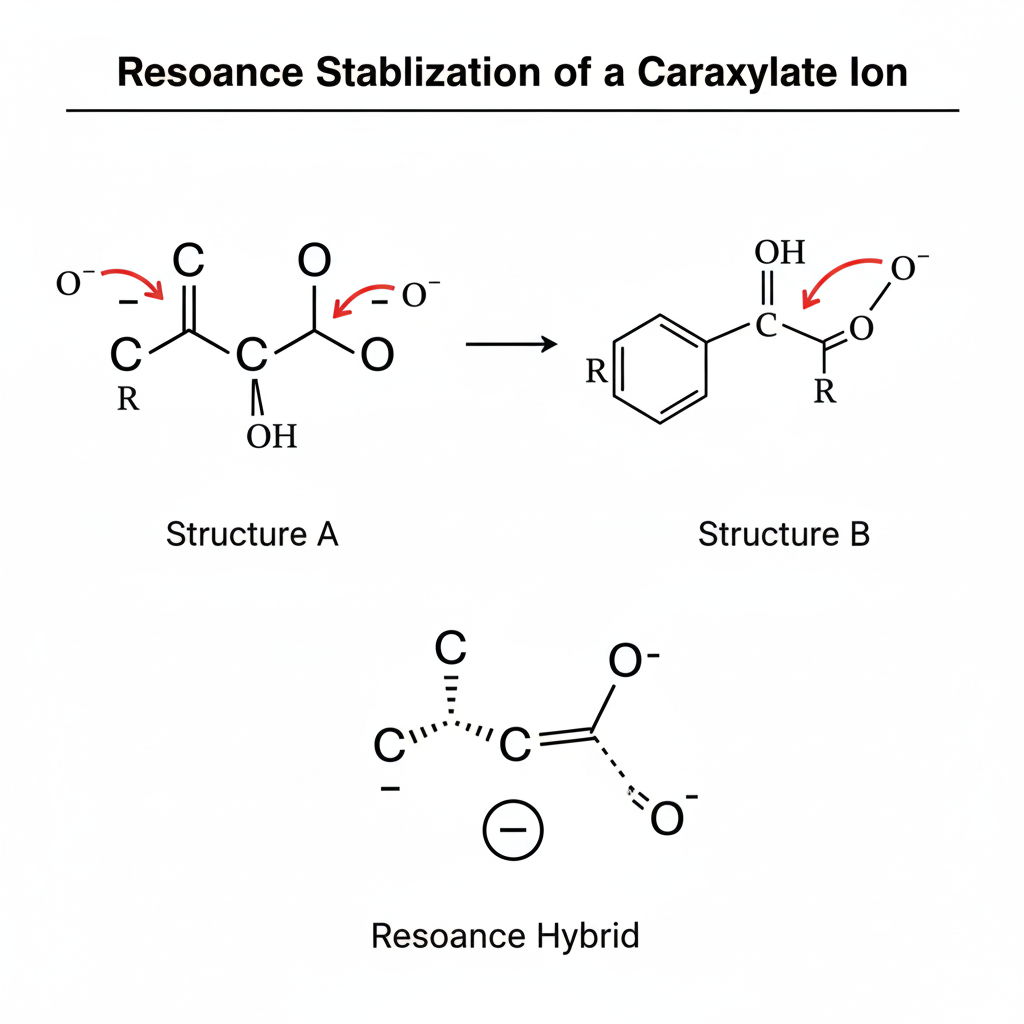
The main reason is the phenomenal stability of the conjugate base, the carboxylate ion ($\text{RCOO}^-$). When the acid loses a proton, the resulting anion is stabilized by two equivalent resonance structures. The negative charge is efficiently delocalised over the two highly electronegative oxygen atoms. Phenoxide ions are less stable because their resonance structures are non-equivalent and involve charge delocalisation onto less electronegative carbon atoms.
Figure below:
A clear diagram showing the two equivalent resonance structures of the carboxylate ion, where the negative charge is delocalised efficiently and equally between the two oxygen atoms, demonstrating stability.
NEET Checkpoint :
Compared to phenoxide ion, the carboxylate ion is highly stable because:
(a) It is non-polar
(b) The negative charge is localized on carbon
(c) It has two equivalent resonance structures
(d) It forms strong hydrogen bonds.
✅ Answer: (c) It has two equivalent resonance structures — The stability conferred by equivalent resonance structures is the key reason for high acidity.
Effect of Substituents
Substituents attached to the carboxylic acid affect the stability of the conjugate base.
- Electron-withdrawing groups (EWG), like halogens ($F$, $Cl$, $Br$), cyano ($\text{CN}$), or nitro ($\text{NO}_2$), stabilize the carboxylate anion by pulling electron density away. This increases acidity. Think of EWGs as weights stabilizing an empty, wobbly rickshaw.
- Electron-donating groups (EDG), like alkyl groups ($\text{CH}_3$), destabilize the conjugate base and thus decrease the acidity.
The increasing acidity order for various groups shows the power of EWGs: $\text{Ph} < I < \text{Br} < \text{Cl} < \text{F} < \text{CN} < \text{NO}_2 < \text{CF}_3$.
NEET Checkpoint :
Which acid is the weakest: $\text{CH}_3\text{COOH}$, $\text{ClCH}_2\text{COOH}$, or $\text{CH}_3\text{CH}_2\text{COOH}$?
(a) $\text{CH}_3\text{COOH}$
(b) $\text{ClCH}_2\text{COOH}$
(c) $\text{CH}_3\text{CH}_2\text{COOH}$
✅ Answer: (c) $\text{CH}_3\text{CH}_2\text{COOH}$ — The ethyl group ($\text{CH}_3\text{CH}_2$) is an EDG, decreasing the acidity most effectively, making it the weakest acid compared to the acetic acid and chloroacetic acid.
Practice Question :
Considering the effect of electron withdrawal, which acid is stronger: $\text{C}{6}\text{H}{5}\text{COOH}$ (Benzoic acid) or $\text{NO}{2}\text{C}{6}\text{H}_{4}\text{COOH}$ (4-Nitrobenzoic acid)?
(a) Benzoic acid
(b) 4-Nitrobenzoic acid
(c) Both are equally strong
✅ Explanation: (b) The nitro group ($\text{NO}_2$) is a strong electron-withdrawing group (EWG). When present at the para position, it effectively stabilizes the carboxylate anion, thereby increasing the acid strength significantly compared to unsubstituted benzoic acid.
That was solid! Next up, we’ll dive into how these acids react by checking out the cleavage of the $\text{O}-\text{H}$ bond.
Key Takeaway
Preparation: Key routes include strong oxidation ($\text{RCH}_2\text{OH} \to \text{RCOOH}$), Hydrolysis ($\text{RCN}$), and Grignard reaction with $\text{CO}_2$ (to ascend series).
Acidity: Carboxylic acids are stronger than phenols/alcohols because the $\text{RCOO}^-$ ion is highly stabilized by two equivalent resonance structures. EWG increases acidity; EDG decreases it.