1. Introduction to Nitrogen Compounds
Namaste, future doctors! Ready to clear the funda of Amines? Think of them as ammonia’s stylish derivatives where one or more $H$ atoms are replaced by alkyl or aryl groups. In nature, they are everywhere—from the proteins and vitamins in your diet to the hormones like adrenaline keeping you focused during exams.
Amines have a pyramidal geometry with $sp^{3}$ hybridised nitrogen. That unshared lone pair is the secret sauce; it makes them Lewis bases. Imagine a crowded Rickshaw; when an alkyl group joins ($+I$ effect), it "pushes" electron density toward nitrogen, making it a stronger base than ammonia. However, in aniline, the lone pair is busy "dancing" (resonating) with the benzene ring, making it a much weaker base.
NEET Checkpoint:
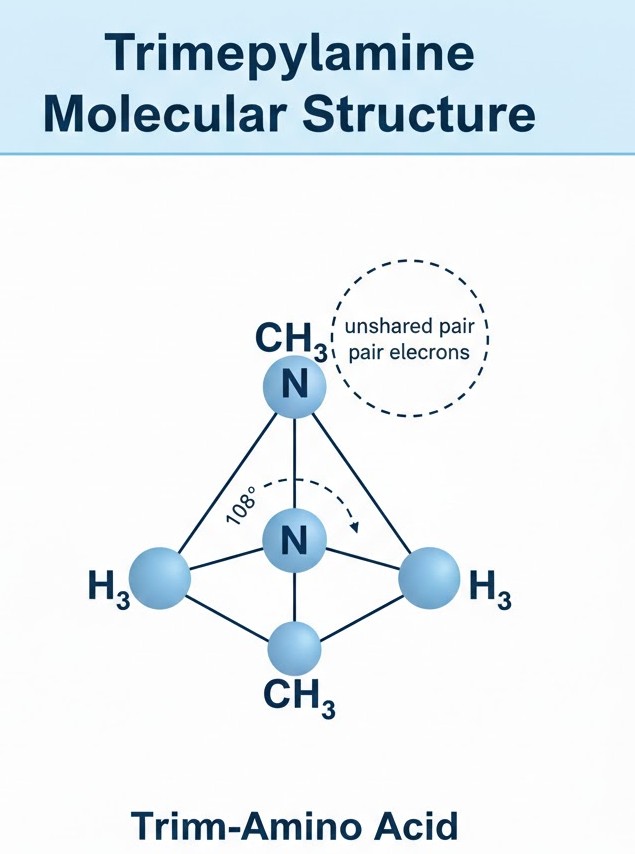
Why is the $C-N-E$ angle in trimethylamine $108^{\circ}$ instead of $109.5^{\circ}$?
(a) Due to presence of a lone pair on nitrogen
(b) Due to double bond character in C–N bond
(c) Due to steric repulsion between methyl groups
(d) Due to hydrogen bonding
✅ Answer: (a) The unshared electron pair exerts more repulsion, squeezing the bond angle.
We classify them based on $H$ replacement: Primary ($1^{\circ}$), Secondary ($2^{\circ}$), and Tertiary ($3^{\circ}$). For naming, the common system uses "alkylamine," while IUPAC uses "alkanamine" (dropping the ‘e’ from alkane). To tell them apart in the lab, we use the Hinsberg reagent ($C_{6}H_{5}SO_{2}Cl$), which reacts differently with each class.
figure below:
A clear diagram showing the pyramidal shape of trimethylamine, highlighting the $108^{\circ}$ bond angle and the unshared pair of electrons on the nitrogen atom.
NEET Checkpoint:
Which synthetic amino compound is a famous dental anaesthetic?
(a) Novocaine
(b) Aniline
(c) Urea
(d) Glycine
✅ Answer: (a) Novocain - Procaine, commonly known as Novocaine, is a synthetic amino compound widely used as a local dental anaesthetic.
NEET Checkpoint:
What is the IUPAC name for $CH_{3}NH_{2}$?
(a) Methylamine
(b) Methanamine
(c) Aminomethane
(d) Dimethylamine
✅ Answer: (b) Methanamine - According to IUPAC nomenclature, amines are named by replacing –e of the parent alkane with –amine. So, methane → methanamine.
Practice Question:
Diazonium salts are synthetically important because:
(a) They are very stable at room temperature.
(b) They help introduce groups like $-F$, $-Cl$, and $-CN$ into aromatic rings.
(c) They are only found in proteins.
(d) They are weaker bases than aniline.
✅ Answer: (b) — They are excellent intermediates for preparing substituted aromatic compounds that can't be made by direct substitution.
Now that you've got this, wait till you see how we actually prepare these molecules!
Key Takeaway
- Structure: $sp^{3}$ hybridised, Pyramidal.
- Basicity: Aliphatic amines > $NH_{3}$ > Aromatic amines.
- Identification: Hinsberg’s reagent distinguishes $1^{\circ}$, $2^{\circ}$, and $3^{\circ}$ classes.
2. Classification of Amines
Classifying amines is as simple as counting who’s sitting in a shared rickshaw. Think of Ammonia ($NH_3$) as your starting point. We classify amines based on how many of those three Hydrogen atoms are replaced by alkyl ($R$) or aryl ($Ar$) groups.
- Primary (1°) Amines: Only one H is replaced. You get $RNH_2$ or $ArNH_2$.
- Secondary (2°) Amines: Two H atoms are replaced, like $R-NH-R'$.
- Tertiary (3°) Amines: All three H atoms are gone! You’re left with $R_3N$.
NEET Checkpoint:
Is aniline ($C_6H_5NH_2$) a primary or secondary amine?
(a) Primary amine
(b) Secondary amine
(c) Tertiary amine
(d) Quaternary ammonium salt
✅ Answer: (a) Primary amine — Only one hydrogen of ammonia is replaced by the phenyl group.
Here’s the trick: when we have 2° or 3° amines, we look at the "guests" (the $R$ groups). If all the alkyl or aryl groups are identical, we call them 'simple' amines (e.g., $(C_2H_5)_2NH$). But if the groups are different—like having a methyl and an ethyl group together—they are 'mixed' amines.
NEET Checkpoint:
Categorise $(CH_3)_2NH$ based on its groups.
(a) Simple amine
(b) Mixed amine
(c) Aromatic amine
(d) Quaternary ammonium salt
✅ Answer: (a) Simple amine — Both alkyl groups are identical methyl groups.
NEET Checkpoint:
What do we call an amine with different $R$ groups?
(a) Simple amine
(b) Mixed amine
(c) Primary amine
(d) Aromatic amine
✅ Answer: (b) Mixed amine — For example, $CH_3-NH-C_2H_5$.
Imagine a tuition bench that fits three students. If one student replaces a bag, it's 1°. If two bags are placed, it's 2°. If all bags are the same brand, it's a 'simple' bench; if they are different, it's 'mixed'! Easy, right?
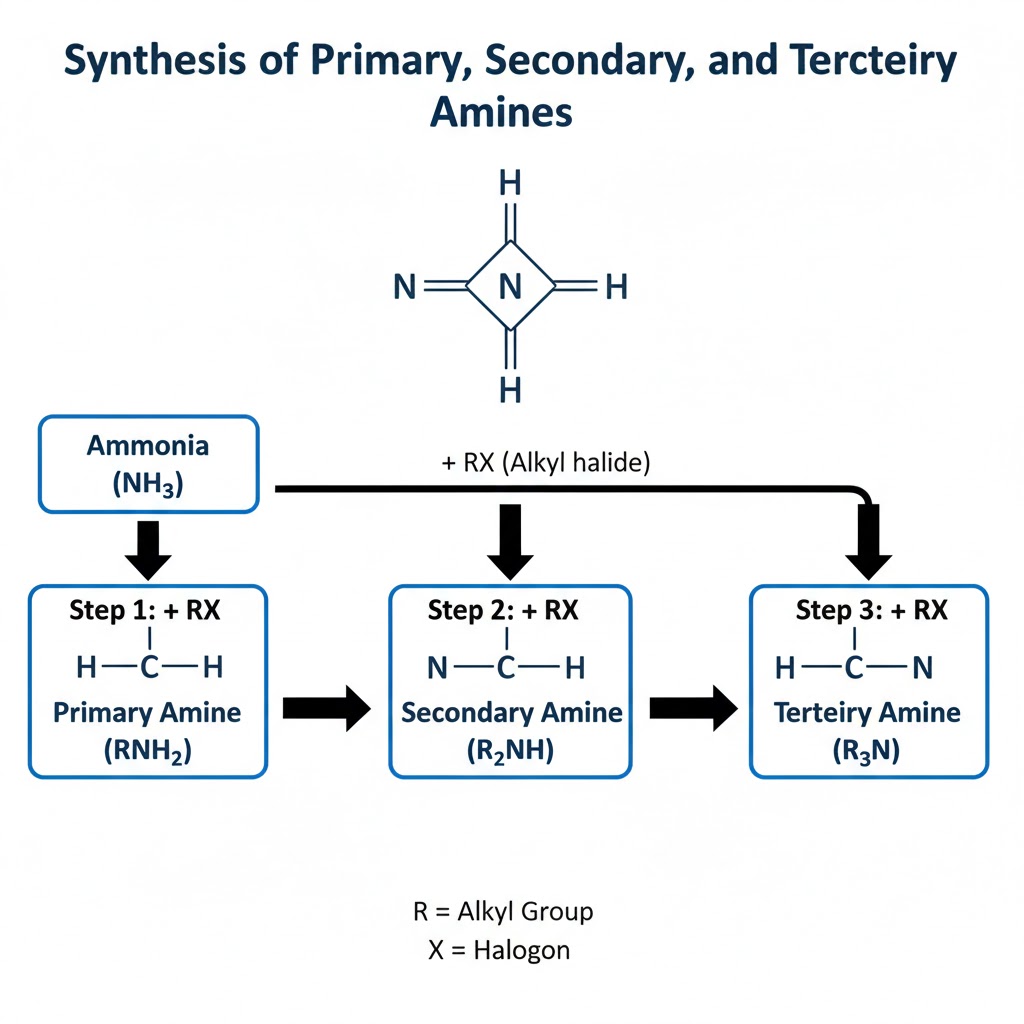
figure below:
A flow diagram showing the step-by-step replacement of hydrogen atoms in ammonia (NH3) by alkyl groups (R) to form primary (RNH2), secondary (R2NH), and tertiary (R3N) amines.
Practice Questions:
- Which of the following is a tertiary amine?
(a) $(CH_3)_2CHNH_2$
(b) $(C_2H_5)_2NH$
(c) $(CH_3)_3N$
(d) $C_6H_5NHCH_3$
✅ Answer: (c) — In $(CH_3)_3N$, all three hydrogens of ammonia are replaced by methyl groups.
2. An amine represented by $CH_3-NH-C_2H_5$ is:
(a) Primary and Simple
(b) Secondary and Mixed
(c) Secondary and Simple
(d) Tertiary and Mixed
✅ Answer: (b) — It is secondary because two H atoms are replaced, and mixed because the groups (methyl and ethyl) are different.
Key Takeaway
- 1° Amine: One H replaced ($RNH_2$).
- 2° Amine: Two H replaced ($R_2NH$).
- 3° Amine: Three H replaced ($R_3N$).
- Simple: Identical $R$ groups.
- Mixed: Different $R$ groups.
3. Structure of Amines
Hey junior! Let’s clear up the funda behind how an amine molecule is actually built. Think of the Nitrogen atom as the "boss" of the molecule. Just like in ammonia, the Nitrogen atom in amines is trivalent—meaning it makes three bonds—and carries one unshared pair of electrons.
The Nitrogen orbitals are $sp^{3}$ hybridised, giving the molecule a pyramidal geometry. Now, you might wonder why it isn't tetrahedral if it’s $sp^{3}$. Well, the fourth orbital is occupied by that "VIP" lone pair which doesn't bond but takes up a lot of room!
Relatable Indian Example:
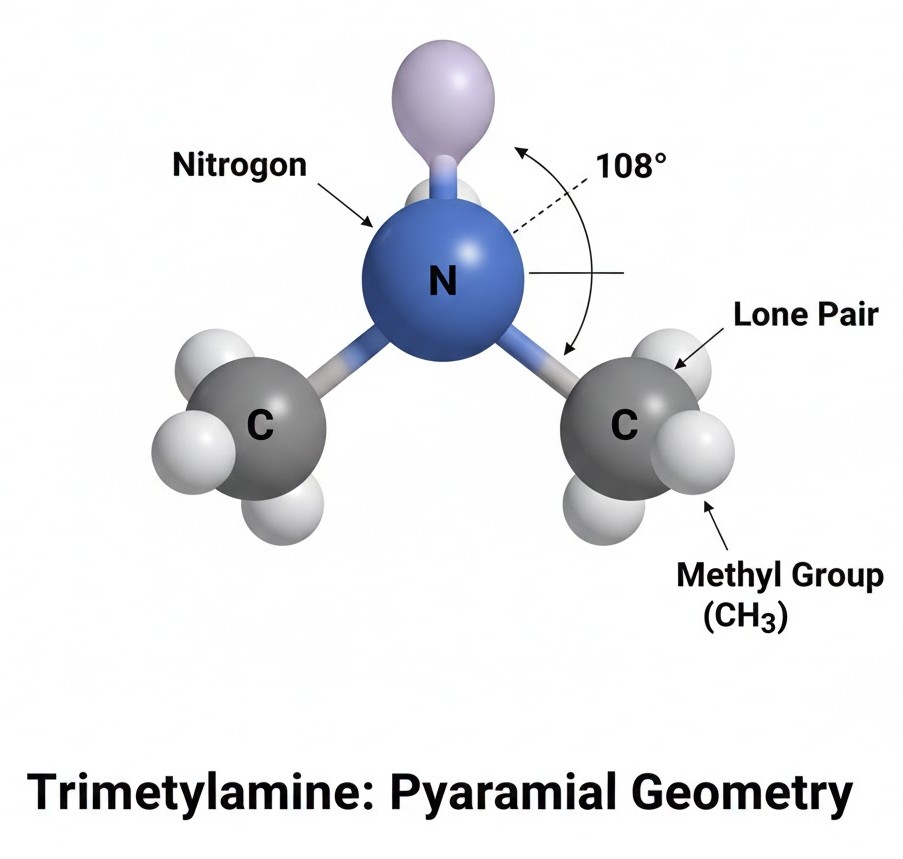
Imagine three friends sitting on the back seat of a shared auto-rickshaw. Suddenly, a very "healthy" uncle (our lone pair) sits in the corner and spreads out. To make room, the three friends have to squeeze closer together. This is exactly why the $C-N-E$ bond angle (where $E$ is $H$ or $C$) is less than the ideal tetrahedral angle of $109.5^{\circ}$. In trimethylamine, for instance, the angle shrinks to exactly $108^{\circ}$. Even molecules need their personal space, yaar!
Figure below:
A clear diagram showing the pyramidal shape of trimethylamine. The central nitrogen atom has one lone pair of electrons in an upward-pointing orbital, and three methyl (CH3) groups pointing downwards to form a tripod base. The C-N-C bond angle is clearly labelled as 108°.
NEET Checkpoint:
What is the hybridisation of Nitrogen in amines?
(a) sp
(b) $sp^{2}$
(c) $sp^{3}$
(d) $dsp^{3}$
✅ Answer: (c) $sp^{3}$ — Nitrogen uses four $sp^{3}$ hybrid orbitals, one of which holds the lone pair.
NEET Checkpoint:
Why is the bond angle in trimethylamine ($108^{\circ}$) less than $109.5^{\circ}$?
(a) Due to lone pair–bond pair repulsion on nitrogen
(b) Due to resonance in the molecule
(c) Due to double bond character in C–N bond
(d) Due to hydrogen bonding
✅ Answer: (a) Due to the presence of an unshared pair of electrons which exerts repulsion on the bonding pairs.
NEET Checkpoint:
What is the geometry of an amine molecule?
(a) Linear
(b) planar
(c) pyramidal
(d) Tetrahedral
✅ Answer: (c) Pyramidal — The three bond pairs form the base and the lone pair sits at the apex.
Practice Question:
Which statement is correct regarding the structure of amines?
(a) Nitrogen is $sp^{2}$ hybridised.
(b) The geometry is perfectly tetrahedral.
(c) The fourth $sp^{3}$ orbital contains a lone pair.
(d) The $C-N-C$ angle is always $109.5^{\circ}$.
✅ Answer: (c) — In amines, three $sp^{3}$ orbitals overlap with other atoms while the fourth contains the lone pair, creating a pyramidal shape.
Key Takeaway
Structure: Trivalent Nitrogen + 1 Lone Pair.
Hybridisation: $sp^{3}$.
Geometry: Pyramidal.
Bond Angle: $< 109.5^{\circ}$ (e.g., $108^{\circ}$ in trimethylamine).
4. Nomenclature: Aliphatic Amines
In the Common system, we prefix the alkyl group name to "amine" as one word, like methylamine. For IUPAC, it’s a bit different: we take the parent alkane name, drop the 'e', and add "amine" to get alkanamines. For instance, $CH_{3}NH_{2}$ is methanamine.
NEET Checkpoint:
What is the IUPAC name of $CH_{3}-CH_{2}-CH_{2}-NH_{2}$?
(a) Propylamine
(b) Propan-1-amine
(c) Propanamine
(d) Ethanamine
✅ Answer: (b) Propan-1-amine — We number the parent chain to give the carbon with the $-NH_{2}$ group the lowest number.
Here’s the real funda: for secondary and tertiary amines, we use the locant 'N' to show which groups are on the nitrogen. Think of Nitrogen as the middle seat in a shared auto-rickshaw; if a methyl group is sitting there while the main chain is ethane, it’s N-methylethanamine. If two ethyl groups are on the Nitrogen, it's N,N-diethylethanamine.
NEET Checkpoint:
Which locant designates substituents on the Nitrogen atom?
(a) 1, 2
(b) N-
(c) Alpha-
(d) Amine
✅ Answer: (b) N- — This locant identifies groups attached directly to the nitrogen atom.
For diamines, don't drop the 'e'! We keep it and say ethane-1,2-diamine. It's like carrying an extra suitcase on a rickshaw; you need the full name to stay stable!
NEET Checkpoint:
IUPAC name for $NH_{2}-(CH_{2}){6}-NH{2}$ is:
(a) Hexanamine
(b) Hexamethylenediamine
(c) Hexane-1,6-diamine
(d) Hexan-1,6-amine
✅ Answer: (c) Hexane-1,6-diamine — We keep the 'e' in 'hexane' when followed by the suffix 'diamine'.
Practice Question:
The IUPAC name for $(CH_{3})_{3}N$ is:
(a) Trimethylamine
(b) N,N-Dimethylmethanamine
(c) N-Methylmethanamine
(d) Propanamine
✅ Answer: (b) N,N-Dimethylmethanamine — One methyl is the parent chain; two are substituents on the Nitrogen.
Key Takeaway:
- Primary: Alkane - 'e' + amine = Alkanamine.
- Sec/Tert: Use 'N' for substituents attached to Nitrogen.
- Diamines: Keep 'e' in the hydrocarbon name (e.g., ethane-1,2-diamine).
5. Nomenclature: Arylamines
Listen up, junior! When the $-NH_{2}$ group decides to park itself directly on a benzene ring, we get Arylamines. The absolute legend of this family is $C_{6}H_{5}NH_{2}$, popularly known as Aniline. While the strict IUPAC system prefers the name Benzenamine, everyone—including the IUPAC bosses—is totally chill with using Aniline as an accepted name. Arre, nomenclature is basically just giving nicknames to molecules so we don't get confused during the exam!
NEET Checkpoint:
What is the accepted IUPAC name for the simplest arylamine?
(a) Benzene
(b) Benzenamine
(c) Aniline
(d) Both (b) and (c)
✅ Answer: (d) — While Benzenamine is the systematic name, Aniline is widely accepted by IUPAC.
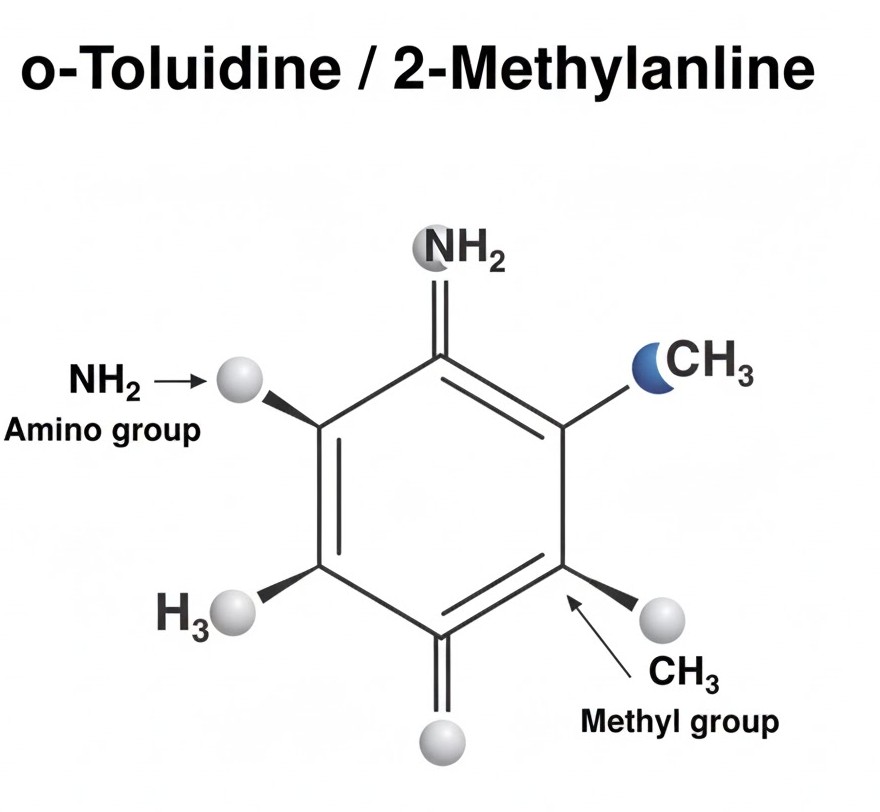
Think of the benzene ring like a round dining table at a Desi wedding. If the $-NH_{2}$ group is the 'Groom' sitting at position 1, then his 'Best Man' sitting right next to him at position 2 is at the ortho ($o$) position. Someone two seats away at position 3 is at meta ($m$), and the person sitting directly opposite at position 4 is at the para ($p$) position. Here’s the trick: for common names like o-Toluidine, we use these letters, but for IUPAC, we stick to numbers like 2-Methylaniline.
NEET Checkpoint:
In the common naming system, what does '$p$' stand for?
(a) Primary
(b) Para
(c) Polar
(d) Proton
✅ Answer: (b) Para — It represents the 1,4-positioning on the benzene ring.
Notice this: when numbering, we start from the carbon attached to the amino group. If you have $p$-Bromoaniline, the IUPAC name becomes 4-Bromobenzenamine or simply 4-Bromoaniline.
Figure below:
A clear diagram showing a benzene ring with an $NH_{2}$ group at the top (carbon 1) and a $CH_{3}$ group at the adjacent carbon 2, labelled as both o-Toluidine and 2-Methylaniline.
NEET Checkpoint:
What is the IUPAC name for $N,N$-Dimethylaniline?
(a) N,N-Dimethylbenzenamine
(b) N-Methylbenzenamine
(c) Aniline
(d) N,N-Dimethylphenylamine
✅ Answer: (a) $N,N$-Dimethylbenzenamine — The two methyl groups are attached to the nitrogen, not the ring.
Practice Questions:
Which of the following is the correct IUPAC name for $p$-Bromoaniline?
(a) 1-Bromobenzenamine
(b) 4-Bromobenzenamine
(c) 2-Bromobenzenamine
(d) 3-Bromobenzenamine
✅ Answer: (b) — The para position corresponds to the 4th carbon in the ring numbering.
Key Takeaway
For Arylamines, $C_{6}H_{5}NH_{2}$ is Aniline (accepted IUPAC) or Benzenamine. Use $o, m, p$ for common names and numbers ($1, 2, 3, \dots$) for IUPAC naming, starting from the amino-attached carbon.
6. Preparation: Reduction of Nitro Compounds
Hey junior! Ready to learn how to give molecules a total makeover? We are turning "explosive" nitro compounds into useful amines. Think of it as converting a high-pressure exam situation into a chill post-exam celebration. Let's clear this funda!.
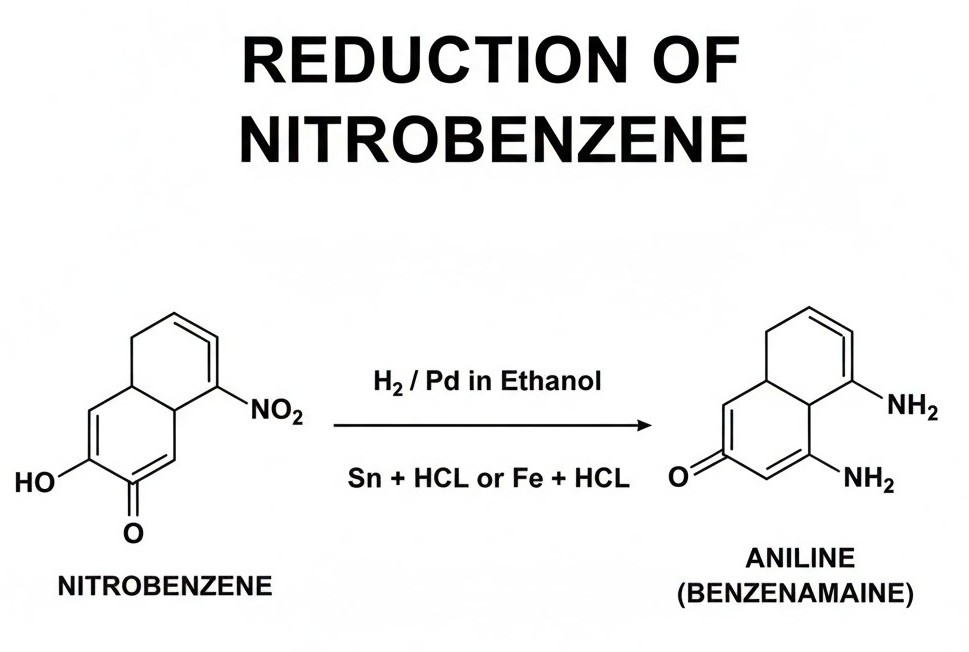
Nitro compounds are reduced to amines using two main methods. First, the "VIP treatment": passing hydrogen gas over finely divided catalysts like $Ni$, $Pd$, or $Pt$ in ethanol. Second, the "hard-work" way: using metals in an acidic medium like $Sn$ + $HCl$ or $Fe$ + $HCl$.
NEET Checkpoint:
Which of these is NOT mentioned as a catalyst for $H_{2}$ gas reduction?
(a) $Ni$
(b) $Pd$
(c) $Pt$
(d) $Zn$
✅ Answer: (d) $Zn$ — The sources specifically highlight finely divided $Ni$, $Pd$, and $Pt$ for this catalytic reduction.
Now, listen to this topper's secret: reduction with iron scrap ($Fe$) and $HCl$ is preferred. Why? Because the $FeCl_{2}$ produced gets hydrolysed to release $HCl$ back into the reaction. It’s like a local Pani Puri stall where the bhaiya gives you free extra sukha puri—you only need a tiny bit of $HCl$ to initiate the process, and the reaction takes care of the rest!.
NEET Checkpoint:
Why is $Fe/HCl$ the "favourite" over $Sn/HCl$?
(a) Iron is cheaper and more eco-friendly
(b) Tin gives lower yield
(c) Iron does not form complexes
(d) Tin is less reactive than iron
✅ Answer: (a) Because $FeCl_{2}$ hydrolyses to release $HCl$, meaning you only need a small amount of acid to start the reaction. Very pocket-friendly!.
Don't forget, nitroalkanes can also be "similarly reduced" to their corresponding alkanamines using these methods. Even molecules need to stay consistent, yaar!
NEET Checkpoint:
What is the product when nitroalkanes are reduced?
(a) Alkanamines
(b) Nitroalkenes
(c) Amides
(d) Nitriles
✅ Answer: (a) Alkanamines — The process is similar to the reduction of aryl nitro compounds.
Figure below:
A clear reaction scheme showing Nitrobenzene on the left with two arrows: one labeled 'H2/Pd in Ethanol' and the other labeled 'Sn+HCl or Fe+HCl', both pointing to Aniline (Benzenamine) on the right.
Practice Question:
Which reagent is most economical for the commercial reduction of nitro compounds?
(a) $H_{2}/Pd$
(b) $Sn/HCl$
(c) $Fe/HCl$
(d) $LiAlH_{4}$
✅ Answer: (c) $Fe/HCl$ — As per the sources, it is preferred because it requires only a small amount of $HCl$ to initiate the reaction.
Key Takeaway
- Catalytic: $H_{2}$ + $Ni/Pd/Pt$.
- Metal/Acid: $Sn/HCl$ or $Fe/HCl$.
- Top Choice: $Fe/HCl$ (due to $FeCl_{2}$ hydrolysis).
7. Preparation: Ammonolysis of Alkyl Halides
Listen up, junior! You know how in a crowded Mumbai local train, one person enters and someone else gets pushed out? That’s exactly what Ammonolysis is like!. We take an alkyl or benzyl halide and hit it with an ethanolic solution of ammonia ($NH_3$) in a sealed tube at $373\ K$. The ammonia acts as a nucleophile, cleaving that $C-X$ bond and replacing the halogen with an amino group ($-NH_2$).
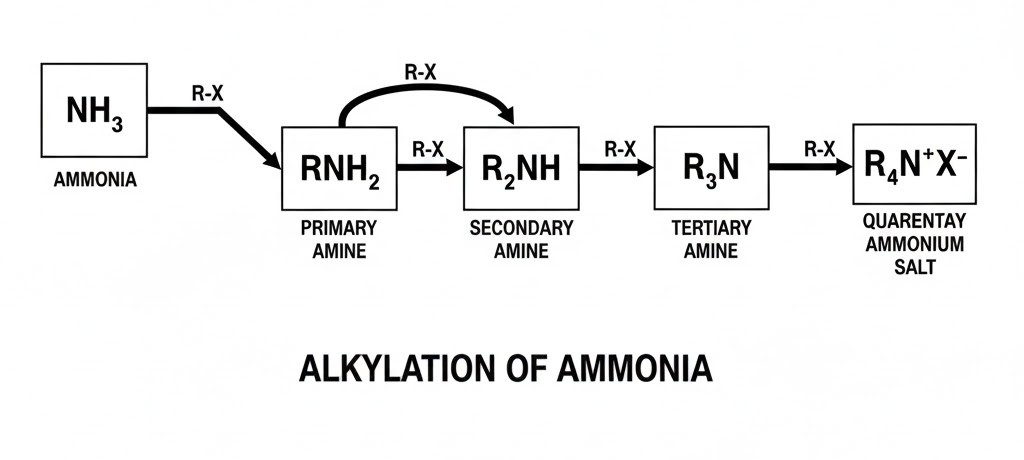
Here’s the catch: the reaction is a bit of a "party animal"—it doesn't know when to stop!. The primary amine formed acts as a nucleophile again, attacking more alkyl halide to form secondary and tertiary amines, finally ending in a quaternary ammonium salt ($R_4N^+X^-$).
NEET Checkpoint:
What is the order of reactivity of halides in ammonolysis?
(a) R–F > R–Cl > R–Br > R–I
(b) R–Cl > R–Br > R–I > R–F
(c) R–I > R–Br > R–Cl > R–F
(d) R–Br > R–I > R–Cl > R–F
✅ Answer: (c) R–I > R–Br > R–Cl > R–F — Iodine is the "best leaver" because the bond is weakest!.
To get your free amine back from the ammonium salt, just treat it with a strong base like $NaOH$.
NEET Checkpoint:
How can you make a $1^\circ$ amine the major product?
(a) Use excess ammonia
(b) Use excess alkyl halide
(c) Use strong base
(d) Use a catalyst
✅ Answer: (a) Use excess of ammonia ($NH_3$) — This ensures the $NH_3$ hits the halide first before the newly formed amine can!.
Relatable Example: Imagine a Pani Puri stall. If you have only one plate (excess $NH_3$), only you eat. But if there are many plates and only one seller (excess alkyl halide), you'll end up sharing and making a big group (quaternary salt)!
Figure below:
A flow diagram showing $NH_3$ reacting with $R-X$ to form $RNH_2$, which then reacts sequentially with $R-X$ to form $R_2NH$, $R_3N$, and finally $R_4N^+X^-$.
NEET Checkpoint:
At what temperature is this reaction carried out in a sealed tube?
(a) 298 K
(b) 350 K
(c) 373 K
(d) 400 K
✅ Answer: (c) $373\ K$ — Don't forget the heat, or the $C-X$ bond won't budge!.
Practice Questions:
Ammonolysis of benzyl chloride followed by reaction with two moles of $CH_3Cl$ yields:
(a) Benzylamine
(b) N-Methylbenzylamine
(c) N,N-Dimethylphenylmethanamine
(d) Quaternary salt
✅ Answer: (c) — Two moles of $CH_3Cl$ replace the two hydrogens on the nitrogen of benzylamine.
Key Takeaway
Ammonolysis involves the cleavage of a $C-X$ bond by $NH_3$.
* Reactivity: $RI > RBr > RCl$.
* Products: Mixture of $1^\circ, 2^\circ, 3^\circ$ amines and $R_4N^+X^-$.
* Regeneration: $R-NH_3^+X^- + NaOH \rightarrow R-NH_2$.
8. Preparation: Reduction of Nitriles and Amides
Listen up, future doctors! If you want to grow your carbon chain or just turn an amide into something more useful, this is your go-to funda. We are looking at how nitriles and amides get a "makeover" into primary amines.
The "Ascent of Series" with Nitriles
Nitriles ($R-C \equiv N$) are like that one friend who always brings an extra snack to the study session. When we reduce them using catalytic hydrogenation ($H_2/Ni$) or Lithium Aluminium Hydride ($LiAlH_4$), we get a primary amine ($R-CH_2-NH_2$). Notice the magic: the amine now has one more carbon atom than the starting alkyl halide you might have used to make the nitrile. This is called the "ascent of amine series".
NEET Checkpoint:
Which reagent can be used to reduce nitriles to primary amines?
(a) $Sn + HCl$
(b) $Na(Hg) / C_2H_5OH$
(c) $Fe + HCl$
(d) $Br_2 / NaOH$
✅ Answer: (b) $Na(Hg) / C_2H_5OH$ — Arre, don't forget this classic reagent mentioned alongside $LiAlH_4$ and $H_2/Ni$ for nitriles!
Relatable Example: Think of it like a Mumbai local train. If you have a 3-coach train (alkyl group) and you attach a special engine (the nitrile group), after the reduction "station," you suddenly have a 4-coach train (primary amine). That's your "ascent" right there!
Reducing Amides: Keeping it Simple
Amides ($R-CO-NH_2$) are a bit more chill. When they react with $LiAlH_4$ followed by water ($H_2O$), they turn into amines with the same number of carbon atoms. No extra coaches here, just a change in functional group.
NEET Checkpoint:
What is the product when Benzamide ($C_6H_5CONH_2$) is reduced with $LiAlH_4$?
(a) Aniline
(b) Benzylamine
(c) Nitrobenzene
(d) Benzonitrile
✅ Answer: (b) Benzylamine — Simple logic, yaar! The carbon count stays same, so $C_6H_5CONH_2$ becomes $C_6H_5CH_2NH_2$.
NEET Checkpoint:
If you want to prepare an amine with $n+1$ carbons from an $n$ carbon halide, which route is best?
(a) Reduction of Nitro compounds
(b) Ammonolysis
(c) Reduction of Nitriles
(d) Reduction of Amides
✅ Answer: (c) Reduction of Nitriles — This is the classic "ascent of series" trick to lengthen the chain.
Practice Question:
A compound $X$ ($C_2H_5CN$) is reduced using $H_2/Ni$. The IUPAC name of the product is:
(a) Ethanamine
(b) Propan-1-amine
(c) N-Methylethanamine
(d) Methanamine
✅ Answer: (b) Propan-1-amine — The nitrile has 3 carbons total (2 in ethyl + 1 in $CN$). So, the amine must have 3 carbons.
Key Takeaway: Reduction Summary
- Nitriles ($R-CN$): Use $H_2/Ni$ or $LiAlH_4 \rightarrow$ Primary Amine ($R-CH_2-NH_2$). Carbon count increases by 1.
- Amides ($R-CONH_2$): Use (i) $LiAlH_4$, (ii) $H_2O \rightarrow$ Amine ($R-CH_2-NH_2$). Carbon count remains the same.
9. Special Methods: Gabriel and Hoffmann Syntheses
Listen up, junior! If you want to master Amines for NEET, you can't skip these two legendary reactions. Think of them as the "VIP methods"—one is a specialist for pure primary amines, and the other is a "carbon-cutting" expert. Let's clear the funda!
1. Gabriel Phthalimide Synthesis
This method is the "gold standard" for preparing pure primary aliphatic amines. We start with phthalimide and treat it with ethanolic $KOH$ to get a potassium salt, which then reacts with an alkyl halide ($R-X$) followed by alkaline hydrolysis to give us our $1^\circ$ amine.
NEET Checkpoint:
Can we make Aniline using Gabriel synthesis?
(a) Yes
(b) No
✅ Answer: (b) No — Aryl halides are too stubborn! They don't undergo nucleophilic substitution with the phthalimide anion.
2. Hoffmann Bromamide Degradation
This is the famous "weight loss" reaction for molecules! When you treat an amide with $Br_2$ and aqueous/ethanolic $NaOH$, the alkyl or aryl group jumps from the carbonyl carbon to the nitrogen. The result? An amine with one less carbon than the starting amide. This is known as the "descent of series".
NEET Checkpoint:
If you start with Butanamide in Hoffmann degradation, what do you get?
(a) Butanamine
(b) Propanamine
✅ Answer: (b) Propanamine — Remember the "carbon thief" rule; you lose one carbon atom.
Indian Example: Imagine ordering a "Plate of 6 Pani Puris" but the vendor accidentally eats one—that's Hoffmann for you! You start with a 4-carbon amide and end up with a 3-carbon amine. "Descent of plate," yaar!
NEET Checkpoint:
Which halide reacts fastest in the preparation of amines by ammonolysis?
(a) R–F
(b) R–Cl
(c) R–Br
(d) R–I
✅ Answer: (d) R–I - In ammonolysis, the rate of reaction depends on the leaving group.
Figure below:
A clear chemical reaction flow chart showing Phthalimide reacting with KOH, then R-X, and finally NaOH to produce a primary amine and phthalate salt.

Practice Questions:
1. Which reagent is used in Hoffmann Bromamide reaction?
(a) $LiAlH_4$
(b) $Br_2 + NaOH$
(c) $H_2/Pd$
(d) $Sn + HCl$
✅ Answer: (b) $Br_2 + NaOH$ is the specific combo for this degradation.
2. Gabriel synthesis is preferred because it gives:
(a) $3^\circ$ amines
(b) Pure $1^\circ$ aliphatic amines
(c) Aromatic amines
(d) Quaternary salts
✅ Answer: (b) It avoids the mixture of amines seen in ammonolysis.
Key Takeaway
- Gabriel: Use for Primary Aliphatic Amines only. No aromatic amines allowed!
- Hoffmann: Amide $\rightarrow$ Amine (with $Carbon - 1$).
- Formula: $R-CONH_2 \xrightarrow{Br_2/NaOH} R-NH_2$
10. Physical Properties of Amines
Listen up, junior! Let's talk about how these amines actually behave in the real world. First off, the lower aliphatic amines are basically gases, but they come with a distinct fishy odour. Imagine walking past a local fish market—that’s exactly the vibe! As the carbon chain grows, they transition into liquids and eventually solids. Also, keep an eye on aniline; it’s usually colourless but turns dark on your shelf because it loves getting "tanned" via atmospheric oxidation.
NEET Checkpoint:
Why do arylamines like aniline often appear coloured in the lab?
(a) Atmospheric oxidation
(b) Presence of nitrogen atom
(c) High boiling point
(d) Hydrogen bonding
✅ Answer: (a) Atmospheric oxidation — They are naturally colourless but react with air over time.
Now, let's clear the funda on solubility. Lower amines are quite friendly with water because they form intermolecular hydrogen bonds with water molecules. However, as the hydrophobic alkyl part gets bigger, the solubility drops—much like your excitement for a 6:00 AM tuition class!
NEET Checkpoint:
Which is more soluble in water: butan-1-ol or butan-1-amine?
(a) Butan-1-ol
(b) Butan-1-amine
(c) Both are equally soluble
(d) Neither is soluble
✅ Answer: (a) Butan-1-ol — Oxygen is more electronegative ($3.5$) than Nitrogen ($3.0$), making alcohol H-bonds stronger.
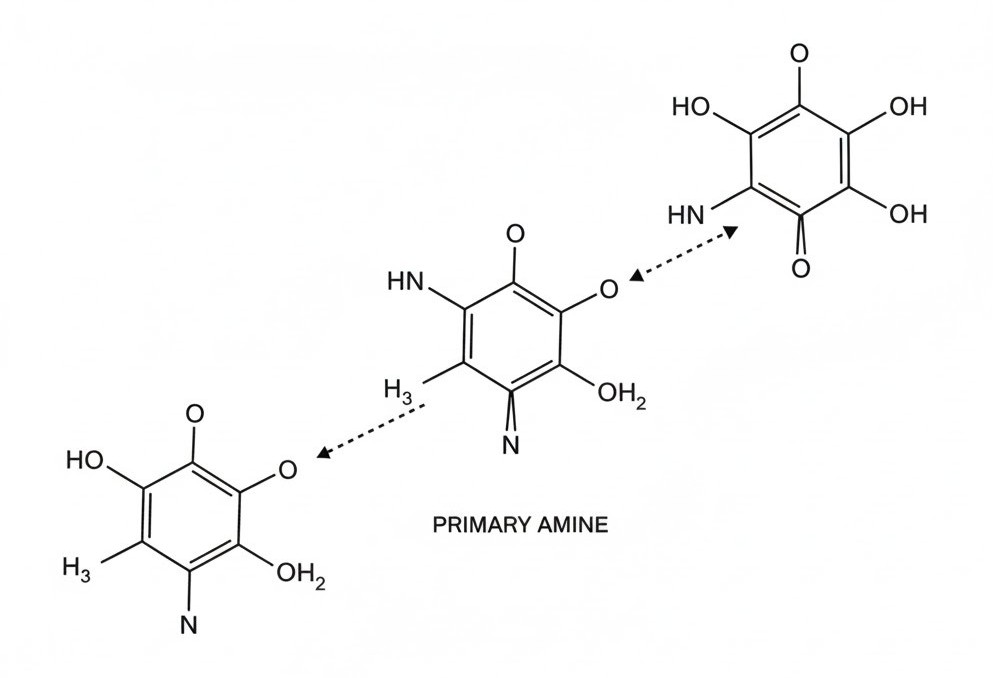
When it comes to boiling points, remember this trend: Primary ($1^{\circ}$) > Secondary ($2^{\circ}$) > Tertiary ($3^{\circ}$). Primary amines have two hydrogens to form H-bonds, secondary have one, and tertiary amines have none, making them the "loners" of the group with no intermolecular association.
Figure below:
A clear diagram showing intermolecular hydrogen bonding in primary amines, where the nitrogen atom of one molecule is attracted to the hydrogen atom of another, specifically replicating the arrangement.
Think of it like a crowded Mumbai local train. Primary amines are passengers holding on with both hands—very hard to separate! Tertiary amines aren't holding on at all, so they "evaporate" from the train easily.
NEET Checkpoint:
Arrange $n-C_{4}H_{9}NH_{2}$, $(C_{2}H_{5}){2}NH$, and $C{2}H_{5}N(CH_{3})_{2}$ in decreasing order of boiling point.
(a) n-C₄H₉NH₂ > (C₂H₅)₂NH > C₂H₅N(CH₃)₂
(b) (C₂H₅)₂NH > n-C₄H₉NH₂ > C₂H₅N(CH₃)₂
(c) C₂H₅N(CH₃)₂ > (C₂H₅)₂NH > n-C₄H₉NH₂
(d) n-C₄H₉NH₂ > C₂H₅N(CH₃)₂ > (C₂H₅)₂NH
✅ Answer:(a) $n-C_{4}H_{9}NH_{2} > (C_{2}H_{5}){2}NH > C{2}H_{5}N(CH_{3})_{2}$ — This follows the $1^{\circ} > 2^{\circ} > 3^{\circ}$ boiling point trend.
Practice Question:
Which of the following has the highest boiling point?
(a) $n-C_{4}H_{10}$
(b) $n-C_{4}H_{9}NH_{2}$
(c) $n-C_{4}H_{9}OH$
(d) $(C_{2}H_{5})_{2}NH$
✅ Answer: (c) — Alcohols have stronger H-bonds than amines and alkanes of similar molar mass.
Key Takeaway
- Odour: Fishy for lower members.
- Solubility: $1^{\circ} > 2^{\circ} > 3^{\circ}$; decreases with molar mass.
- Boiling Point: Alcohols > Amines > Alkanes (for similar mass).
- Amine BP Trend: Primary > Secondary > Tertiary.
11. Basic Character: Aliphatic Amines
Ready to crack the basicity funda, yaara? Amines are like that generous senior who’s always ready to share their notes—or in this case, a lone pair of electrons. We measure this "generosity" using $K_b$ or $pK_b$ values. Just remember this golden rule: Smaller the $pK_b$, the stronger the base.
NEET Checkpoint:
If Amine A has $pK_b = 3.0$ and Amine B has $pK_b = 4.0$, which is stronger?
(a) Amine A
(b) Amine B
(c) Both have equal strength
(d) Cannot be determined
✅ Answer: (a) Amine A — Smaller $pK_b$ means it's a "Don" of basicity!
Why are aliphatic amines stronger than ammonia? It’s all about the +I effect. Alkyl groups are like enthusiastic friends pushing electron density toward Nitrogen, making that lone pair super available for a proton. In the gaseous phase, life is simple: the order is $3^\circ > 2^\circ > 1^\circ > NH_3$.
But in water (aqueous phase), it’s like a crowded Mumbai local train! Solvation (H-bonding with water) and Steric Hindrance (crowding) join the party. While the +I effect wants $3^\circ$ to be strongest, water molecules prefer $1^\circ$ because the smaller cation is easier to "hydrate" or stabilise.
Figure below:
A clear diagram showing an ethylammonium cation forming multiple H-bonds with surrounding water molecules (solvation), contrasted with a bulky triethylammonium cation struggling to fit water molecules around it due to steric hindrance.
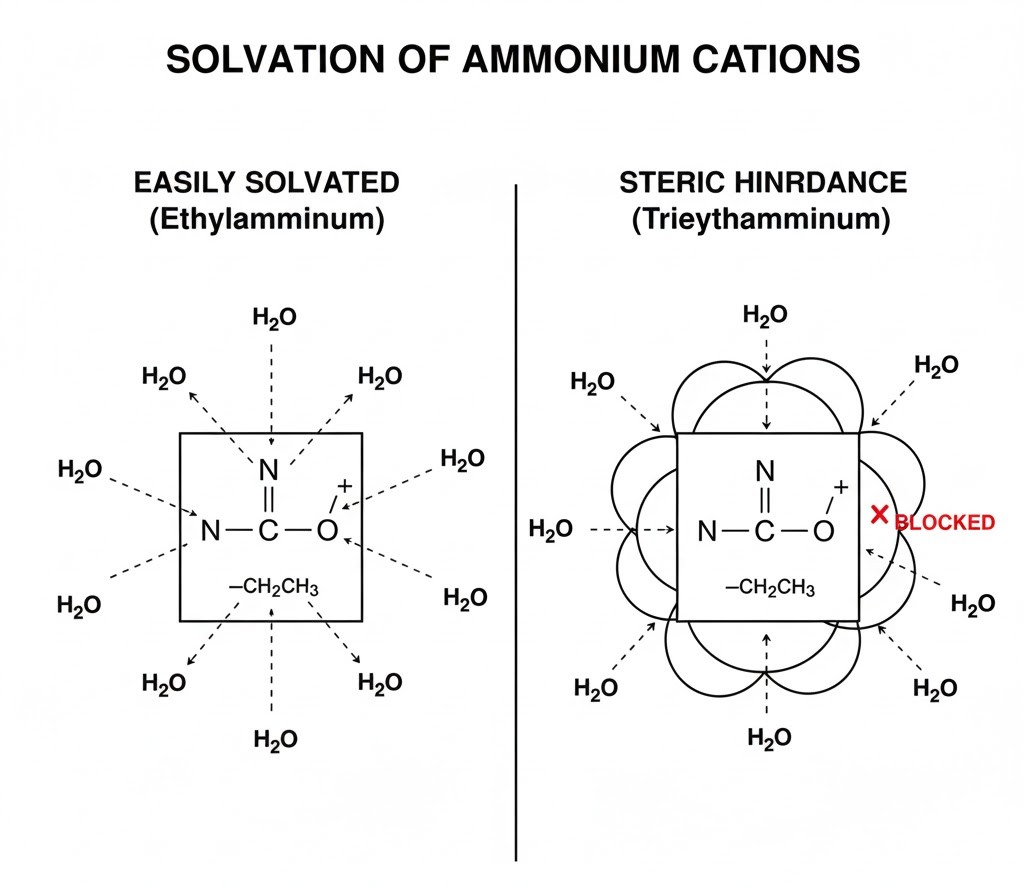
Think of a Pani Puri stall: If you have too many bulky friends (alkyl groups) crowding the counter, the server (Nitrogen) can't easily hand out the puris (electrons) to the customer (proton). This is why the Secondary amine (2°) usually wins—it’s the perfect balance of "push" (+I) and "space" (low hindrance).
NEET Checkpoint:
What is the basicity order for methyl-substituted amines in water?
(a) (CH₃)₃N > (CH₃)₂NH > CH₃NH₂ > NH₃
(b) (CH₃)₂NH > CH₃NH₂ > (CH₃)₃N > NH₃
(c) CH₃NH₂ > (CH₃)₂NH > (CH₃)₃N > NH₃
(d) NH₃ > CH₃NH₂ > (CH₃)₂NH > (CH₃)₃N
✅ Answer: (b) $(CH_3)_2NH > CH_3NH_2 > (CH_3)_3N > NH_3$ — Just remember the code "213"!
NEET Checkpoint:
Which effect stabilises the $R-NH_3^+$ ion in water?
(a) +I effect
(b) −I effect
(c) Solvation effect
(d) Resonance effect
✅ Answer: (c) Solvation effect — H-bonding with water keeps the cation "cool" and stable.
Practice Question:
Arrange the following in increasing order of basic strength in aqueous solution: $(C_2H_5)_3N, (C_2H_5)_2NH, C_2H_5NH_2$
(a) $1^\circ < 2^\circ < 3^\circ$
(b) $3^\circ < 1^\circ < 2^\circ$
(c) $1^\circ < 3^\circ < 2^\circ$
(d) $2^\circ < 3^\circ < 1^\circ$
✅ Answer: (c) — For ethyl, the order is "231" because the bigger alkyl groups change the steric-solvation balance!
Key Takeaway & Formula Summary
- Basicity: Inverse to $pK_b$ (Smaller $pK_b$ = Stronger Base).
- Gas Phase: $3^\circ > 2^\circ > 1^\circ > NH_3$.
- Aqueous (Methyl): $2^\circ > 1^\circ > 3^\circ > NH_3$.
- Aqueous (Ethyl): $2^\circ > 3^\circ > 1^\circ > NH_3$.
12. Basic Character: Arylamines vs. Ammonia
Arre junior, listen up! Let’s clear this basicity funda once and for all. You already know amines are Lewis bases because of that unshared pair of electrons on the nitrogen atom. But why is aniline ($C_{6}H_{5}NH_{2}$) so much weaker than our simple friend ammonia ($NH_{3}$)?
The real culprit is resonance. In aniline, the lone pair isn't just sitting there; it's busy "mingling" (conjugation) with the benzene ring. This makes it less available for any proton ($H^{+}$) that comes looking for a snack.
NEET Checkpoint:
Why is aniline a weaker base than ammonia?
(a) $+I$ effect
(b) Lone pair delocalisation
(c) Steric hindrance
(d) High $K_{b}$
✅ Answer: (b) — The lone pair is in conjugation with the benzene ring, making it less available for protonation.
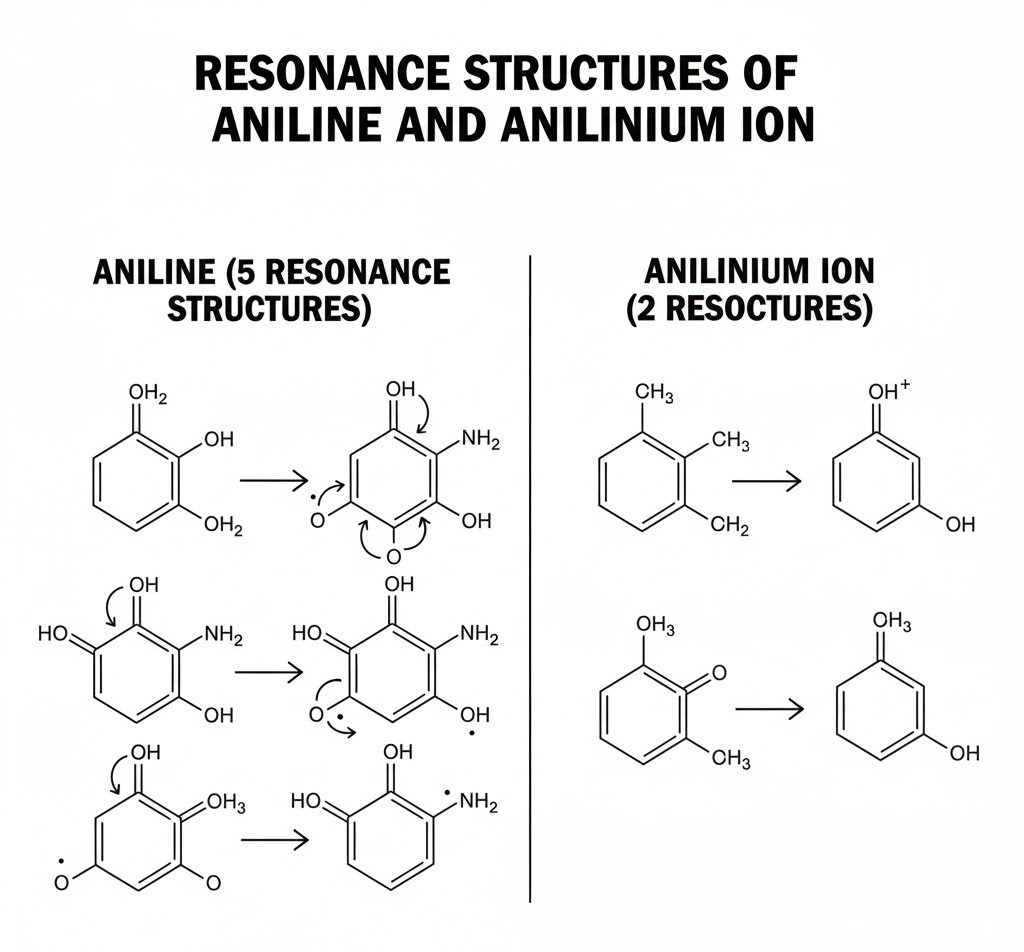
Think of it like this: Ammonia is like a local pani puri stall where the vendor is always ready to serve you. Aniline is like a vendor who is too busy chatting with five different friends (the 5 resonating structures) to notice you standing there!
Speaking of structures, aniline is way more stable than the anilinium ion. While aniline enjoys those 5 resonating forms, the anilinium ion only has 2.
NEET Checkpoint:
How many resonating structures does the anilinium ion have?
(a) 5
(b) 3
(c) 2
(d) 4
✅ Answer: (c) — It only has 2 Kekule structures because the lone pair is already gone.
Figure below:
A clear diagram showing the 5 resonance structures of aniline, highlighting the negative charge moving to ortho and para positions, contrasted with the 2 resonance structures of the anilinium ion.
Now, what if we add "guests" to the ring? Electron-releasing groups (ERGs) like $-OCH_{3}$ or $-CH_{3}$ are like cheerleaders; they push electrons toward the nitrogen and increase basicity. But electron-withdrawing groups (EWGs) like $-NO_{2}$ or $-COOH$ are like grumpy coaches who suck the energy out, decreasing basicity.
NEET Checkpoint:
Which substituent will make aniline a stronger base?
(a) $-NO_{2}$
(b) $-CH_{3}$
(c) $-SO_{3}H$
(d) $-Cl$
✅ Answer: (b) — ERGs increase the electron density on the nitrogen atom.
Finally, don't try to force Friedel-Crafts reactions on aniline—it’s a total flop! Aniline reacts with the $AlCl_{3}$ catalyst (a Lewis acid) to form a salt. This gives the nitrogen a positive charge, making it a "ring-killer" (strong deactivating group) that stops the reaction in its tracks.
Practice Questions:
1. Arrange in increasing order of basic strength: Aniline, $NH_{3}$, and Ethanamine.
(a) Aniline < NH₃ < Ethanamine
(b) NH₃ < Aniline < Ethanamine
(c) Aniline < Ethanamine < NH₃
(d) NH₃ < Ethanamine < Aniline
✅ Answer: (a) $Aniline < NH_{3} < Ethanamine$. Alkyl groups increase basicity via $+I$ effect, while aryl groups decrease it via resonance.
2. Why does aniline not undergo Friedel-Crafts alkylation?
(a) Due to steric hindrance
(b) Due to formation of anilinium salt with Lewis acid
(c) Due to −I effect of –NH₂ group
(d) Due to low reactivity of benzene ring
✅ Answer: (b) It forms a salt with the $AlCl_{3}$ catalyst, which puts a positive charge on Nitrogen, deactivating the benzene ring.
Key Takeaway
- Basicity Order: Aliphatic amines > $NH_{3}$ > Arylamines.
- Substituents: ERG $\uparrow$ Basicity; EWG $\downarrow$ Basicity.
- Stability: Aniline (5 resonance structures) > Anilinium ion (2 resonance structures).
13. Reactions: Acylation and Carbylamine
Ready to see how amines handle some "funda" chemistry? Let’s talk about how they dress up in Acylation and cause a stink in the Carbylamine reaction. Don’t stress, yaar—it’s easier than it looks!
Acylation: The Makeover
Think of acylation as an amine getting a "style upgrade" by adding an acyl group. Both aliphatic and aromatic primary ($1^\circ$) and secondary ($2^\circ$) amines react with acid chlorides, anhydrides, or esters. This is a nucleophilic substitution where the H atom is replaced by an acyl group to form amides. We use a base like pyridine to soak up the $HCl$ byproduct and keep the equilibrium moving right.
NEET Checkpoint:
Why is pyridine used in the acylation of amines?
(a) It acts as a solvent only
(b) It acts as a catalyst
(c) To remove $HCl$ formed during the reaction
(d) It increases nucleophilicity of acyl chloride
✅ Answer: (c) To remove $HCl$ formed during the reaction and shift the equilibrium to the product side.
When we use benzoyl chloride ($C_6H_5COCl$), the reaction is specifically called Benzoylation.
It’s like adding a fancy brand label to a plain t-shirt—you've changed the look, but the core is still there!
Carbylamine Reaction: The Stink Test
Now, here’s the real drama. The Carbylamine reaction (or isocyanide test) is a VIP club—only primary ($1^\circ$) amines are invited! When you heat a $1^\circ$ amine with chloroform ($CHCl_3$) and ethanolic $KOH$, you get isocyanides (carbylamines).
NEET Checkpoint:
Can secondary amines give a positive Carbylamine test?
(a) Yes
(b) No
(c) Only aromatic secondary amines
(d) Only aliphatic secondary amines
✅ Answer: (b) No — only primary (aliphatic or aromatic) amines show this reaction.
Warning: These isocyanides are foul-smelling substances. Imagine opening a tiffin box that's been sitting in a hot school bus for three days—that's the "aroma" we're talking about! Because $2^\circ$ and $3^\circ$ amines don't react this way, it's a perfect diagnostic test.
NEET Checkpoint:
What is the functional group formed in the Carbylamine reaction?
(a) Amide (–CONH₂)
(b) Nitrile (–C≡N)
(c) Isocyanide (–NC)
(d) Nitro group (–NO₂)
✅ Answer: (c) Isocyanide ($–NC$) — specifically, an alkyl/aryl isocyanide.
Practice Questions:
1. Which of the following will produce a foul smell when heated with $CHCl_3$ and $KOH$?
(a) $(CH_3)_2NH$
(b) $C_6H_5NH_2$
(c) $(CH_3)_3N$
(d) $CH_3NHCH_2CH_3$
✅ Answer: (b) $C_6H_5NH_2$ — Only primary amines like aniline give this test.
2. The reaction of $CH_3NH_2$ with $CH_3COCl$ in the presence of pyridine yields:
(a) $CH_3NC$
(b) $CH_3NHCOCH_3$
(c) $CH_3NH_2 \cdot HCl$
(d) $(CH_3)_2NH$
✅ Answer: (b) $CH_3NHCOCH_3$ — This is an acylation reaction forming an amide.
Key Takeaway
- Acylation: $1^\circ$ & $2^\circ$ amines + Acid Chloride/Anhydride $\rightarrow$ Amides.
- Carbylamine: $1^\circ$ Amines + $CHCl_3$ + $KOH$ + $\Delta \rightarrow$ Foul-smelling Isocyanide ($R-NC$).
14. Identification: Distinction Between Amines
Listen up, chote! Distinguishing between $1^{\circ}$, $2^{\circ}$, and $3^{\circ}$ amines is a classic NEET funda that you can't afford to skip. It’s like sorting players at a cricket trial based on their performance—each one reacts differently under pressure!
1. Nitrous Acid ($HNO_{2}$) Reaction
Primary aliphatic amines are quite dramatic; they react with $HNO_{2}$ (prepared in situ) to form unstable aliphatic diazonium salts, which immediately release $N_{2}$ gas and turn into alcohols.
Aromatic $1^{\circ}$ amines, like aniline, are cooler—literally! At $273\text{-}278\ K$, they form relatively stable arenediazonium salts.
NEET Checkpoint:
Which gas is quantitatively evolved when primary aliphatic amines react with $HNO_{2}$?
(a) $Cl_{2}$
(b) $N_{2}$
(c) $H_{2}$
(d) $NH_{3}$
✅ Answer: (b) $N_{2}$ — This quantitative evolution is actually used to estimate proteins and amino acids. Amazing, right?
2. Hinsberg’s Test
This uses benzenesulphonyl chloride ($C_{6}H_{5}SO_{2}Cl$), also known as Hinsberg’s reagent. Think of it as the ultimate filter:
* Primary Amines ($1^{\circ}$): They react to form $N$-ethylbenzenesulphonyl amide. This product has an acidic hydrogen attached to nitrogen (thanks to the strong electron-withdrawing sulphonyl group), making it soluble in alkali.
* Secondary Amines ($2^{\circ}$): They form $N,N$-diethylbenzenesulphonamide, but since there’s no acidic hydrogen left on the nitrogen, it is insoluble in alkali.
* Tertiary Amines ($3^{\circ}$): These guys are chill—they do not react with benzenesulphonyl chloride at all!
NEET Checkpoint:
A compound reacts with Hinsberg's reagent to give a product insoluble in $KOH$. The compound is:
(a) $1^{\circ}$ amine
(b) $2^{\circ}$ amine
(c) $3^{\circ}$ amine
(d) Quaternary salt
✅ Answer: (b) $2^{\circ}$ amine — Since it lacks an acidic hydrogen on the nitrogen of the resulting sulphonamide, it won't dissolve in alkali.
Relatable Example: Imagine sorting guests at a wedding. $1^{\circ}$ amines are like guests who eat and dance (reactive and soluble), $2^{\circ}$ amines only eat (reactive but insoluble), and $3^{\circ}$ amines are the ones who didn't even show up to the party (no reaction)!
NEET Checkpoint:
What is the modern replacement for benzenesulphonyl chloride in this test?
(a) Methanesulphonyl chloride
(b) p-Toluenesulphonyl chloride
(c) Benzenoyl chloride
(d) Acetyl chloride
✅ Answer: (b) $p$-toluenesulphonyl chloride is now often used instead.
Practice Question:
Which of the following will not react with benzenesulphonyl chloride?
(a) Ethanamine
(b) $N$-Methylethanamine
(c) $N,N$-Dimethylmethanamine
(d) Aniline
✅ Answer: (c) $N,N$-Dimethylmethanamine — As a tertiary amine, it has no replaceable hydrogen on the nitrogen atom to initiate the reaction.
Key Takeaway: Hinsberg Summary
- $1^{\circ}$ Amine: Reacts $\rightarrow$ Product soluble in alkali.
- $2^{\circ}$ Amine: Reacts $\rightarrow$ Product insoluble in alkali.
- $3^{\circ}$ Amine: No reaction.
15. Diazonium Salts: The Ultimate Organic Middlemen
Hey junior! Ready to master the "junction station" of organic chemistry? Diazonium salts ($ArN_2^+X^-$) are like that one versatile friend who can introduce you to anyone. They are the perfect intermediates for making aromatic compounds that direct substitution just can't handle.
1. The Chill Process: Diazotisation
To get these salts, we treat a primary aromatic amine (like aniline) with nitrous acid at a very specific, chilly temperature of $273-278\text{ K}$. Since nitrous acid is unstable, we make it in situ using $NaNO_2$ and $HCl$. Keep it on ice, yaar! If the temperature rises, the salt decomposes.
NEET Checkpoint:
Why is the temperature for diazotisation kept between $273-278\text{ K}$?
(a) To maintain stability of the diazonium salt
(b) To increase the reaction rate
(c) To prevent oxidation of the amine
(d) To enhance solubility of reactants
✅ Answer: (b) To maintain stability — Arenediazonium salts are unstable and decompose if the temperature rises.
2. Swapping Groups: Sandmeyer & Gattermann
Once you have the diazo group, you can swap it for halides or cyanides.
- Sandmeyer Reaction: Use $Cu(I)$ salts (like $Cu_2Cl_2$ or $CuCN$).
- Gattermann Reaction: Use copper powder and the corresponding halogen acid ($HCl/HBr$).
Relatable Example: Think of Sandmeyer as the seasoned pani puri pro who gives you the perfect spicy hit (higher yield), while Gattermann is the new trainee—he gets the job done, but the yield isn't as "paisa vasool" as the pro!
NEET Checkpoint:
Which reaction generally gives a better yield for aryl halides?
(a) Gattermann
(b) Sandmeyer
✅ Answer: (b) Sandmeyer — The sources state the yield is better than the Gattermann reaction.
3. Adding Colour: Coupling Reactions
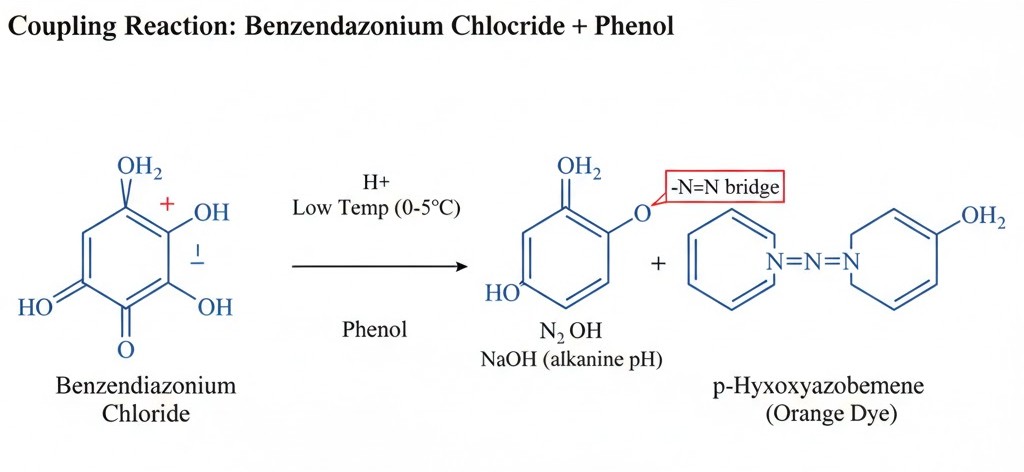
When diazonium salts meet phenols or anilines, they join hands (via the $-N=N-$ bond) to form bright azo dyes.
- With phenol, you get p-hydroxyazobenzene (orange dye).
- With aniline, you get p-aminoazobenzene (yellow dye).
Figure below:
A clear diagram showing the coupling reaction between benzenediazonium chloride and phenol to form p-hydroxyazobenzene, highlighting the -N=N- bridge.
4. Why They Matter
Some groups, like $-F$, $-I$, or $-CN$, are hard to put directly on a benzene ring. Diazonium salts make this a piece of cake. For example, you can't just "direct-substitute" a cyano group into chlorobenzene, but with a diazonium salt? Easy-peasy!
NEET Checkpoint:
Which reagent is used to replace the diazo group with Iodine?
(a) KI
(b) NaI
(c) I₂
(d) HI
✅ Answer: (a) $KI$ — Simply warming the diazonium salt solution with potassium iodide yields iodobenzene.
Practice Questions:
1. Identify the product when benzenediazonium chloride reacts with $H_3PO_2$:
(a) Benzene
(b) Phenol
(c) Iodobenzene
(d) Aniline
✅ Answer: (a) Hypophosphorous acid reduces the salt to benzene.
2. Primary aliphatic amines form stable diazonium salts.
(a) True
(b) False
✅ Answer: (b) False. They form highly unstable alkyldiazonium salts that liberate nitrogen gas immediately.
Key Takeaway
- Diazotisation: $ArNH_2 \xrightarrow{NaNO_2/HCl, 273-278\text{ K}} ArN_2^+Cl^-$.
- Sandmeyer: Uses $Cu(I)$ salts; Gattermann: Uses $Cu$ powder.
- Coupling: Forms coloured azo dyes (orange with phenol, yellow with aniline).