1. Introduction to Haloalkanes and Haloarenes
Hello, junior! Ready to tackle organic chemistry? Don't stress, yaar—it's easier than it looks! Let's clear up this funda: haloalkanes and haloarenes are basically hydrocarbons where one or more hydrogen atoms have been swapped for halogens ($X = F, Cl, Br, I$).
In haloalkanes, the halogen is attached to an $sp^3$ hybridised carbon of an alkyl group. Think of it like swapping a regular potato in a samosa for a spicy paneer cube—the base is the same, but the "flavour" (reactivity) changes! In haloarenes, the halogen is directly linked to an $sp^2$ hybridised carbon of an aromatic ring, like a rickshaw driver fixing a new headlight directly onto the frame.
NEET Checkpoint:
In haloarenes, the halogen atom is attached to which hybridised carbon?
(a) $sp$
(b) $sp^2$
(c) $sp^3$
(d) $dsp^2$
✅ Answer: (b) $sp^2$ — Haloarenes are aromatic, so that carbon is part of a double-bond system!
These compounds aren't just for textbooks; they are life-savers! For instance, chloramphenicol treats typhoid, and chloroquine is our weapon against malaria. Even our body produces thyroxine (an iodine compound) to prevent goiter.
Learning Outcomes for this Unit:
* Master IUPAC nomenclature to name these beauties.
* Learn how to prepare alkyl and aryl halides in the lab.
* See how molecular structure dictates chemical reactivity.
* Use stereochemistry to peek into reaction mechanisms.
* Understand the environmental impact of polyhalogen compounds.
NEET Checkpoint:
Which halogen-containing hormone deficiency causes goiter?
(a) Adrenaline
(b) Insulin
(c) Thyroxine
(d) Estrogen
✅ Answer: (c) Thyroxine — It's an iodine-containing hormone produced by our body!
NEET Checkpoint:
Which antibiotic is used to treat typhoid fever?
(a) Penicillin
(b) Streptomycin
(c) Chloramphenicol
(d) Tetracycline
✅ Answer: (c) Chloramphenicol — It's produced by microorganisms and contains chlorine.
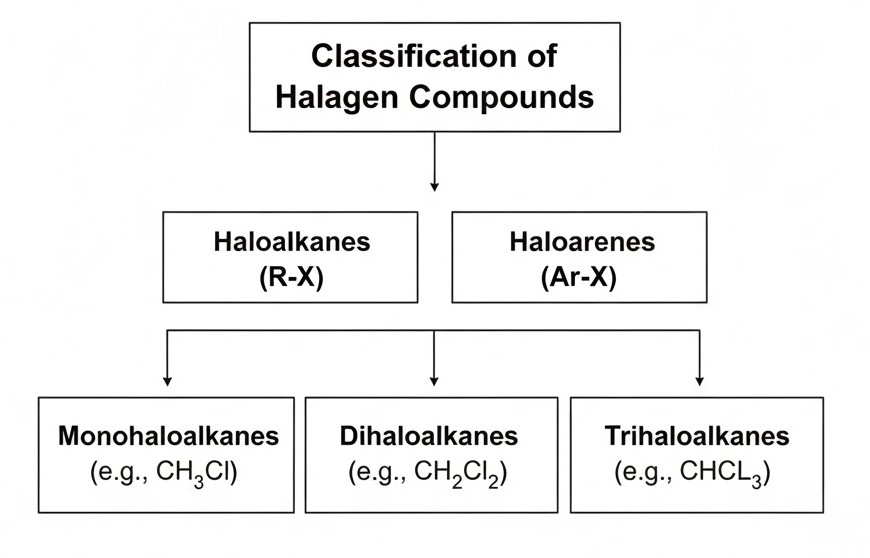
Figure below:
A clear diagram showing the classification of halogen compounds into mono, di, and trihaloalkanes and haloarenes.
Practice Questions:
1. Which of the following is used as an anaesthetic during surgery?
(a) Chloroquine
(b) Halothane
(c) Chloramphenicol
(d) Thyroxine
✅ Answer: (b) Halothane — It's a synthetic halogen compound used in hospitals!
2. Haloalkanes persist in the environment because:
(a) They are very volatile
(b) They resist breakdown by soil bacteria
(c) They are non-polar
(d) They are always liquid
✅ Answer: (b) They resist breakdown by soil bacteria — This is why they are environmental concerns!
Key Takeaway
- Haloalkanes: Halogen + $sp^3$ Carbon (Alkyl group).
- Haloarenes: Halogen + $sp^2$ Carbon (Aryl group).
- Crucial Compounds: Chloramphenicol (Typhoid), Chloroquine (Malaria), Thyroxine (Goiter), Halothane (Anaesthetic).
2. Classification of Halogenated Compounds
Hey junior! Let’s clear up the funda of how we label these halogen buddies. It’s like sorting players in a gully cricket match—everyone has a specific position and role based on where they stand!
First, just count the halogens. One halogen atom makes it monohalo, two make it dihalo, and three or more make it polyhalo. Think of it like ordering pani puri—you can have one, two, or a whole plate!
Now, look at the carbon's "vibe" (hybridisation). If the halogen is on an $sp^3$ carbon, it might be an alkyl halide ($R-X$). We sub-classify these by looking at their carbon neighbours:
* Primary ($1^\circ$): Carbon is bonded to one other carbon.
* Secondary ($2^\circ$): Carbon is bonded to two others.
* Tertiary ($3^\circ$): Carbon is bonded to three others.
NEET Checkpoint:
In $(CH_3)_3C-Cl$, what is the degree of the halide?
(a) $1^\circ$
(b) $2^\circ$
(c) $3^\circ$
(d) $4^\circ$
✅ Answer: (c) $3^\circ$ — The carbon holding the $Cl$ is bonded to three methyl groups. Total crowd!
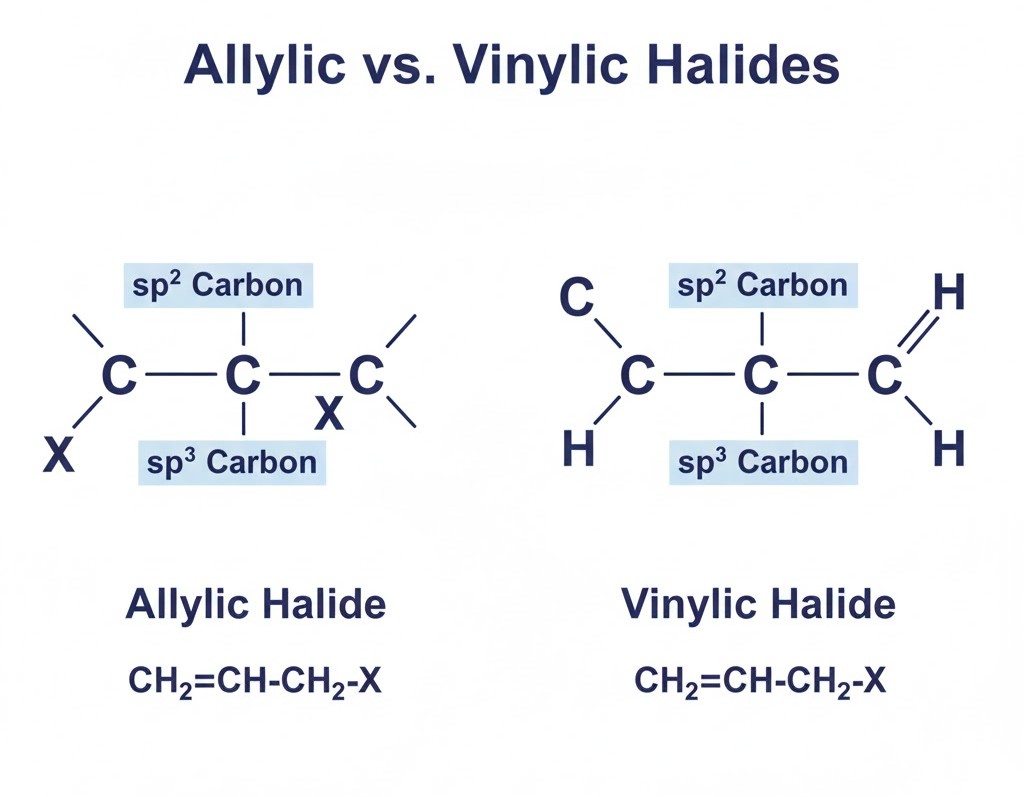
Don't get confused between Allylic and Vinylic, yaar! In Allylic halides, the halogen sits on an $sp^3$ carbon next to a $C=C$ double bond. In Vinylic halides, the halogen is directly on the $sp^2$ double-bonded carbon. It's like a rickshaw—vinylic is the driver on the main seat ($C=C$), while allylic is the passenger sitting one step behind!
NEET Checkpoint:
Is a Benzylic halide $sp^2$ or $sp^3$ bonded?
(a) sp²
(b) sp³
(c) Both sp² and sp³
(d) Neither
✅ Answer: (b) $sp^3$ — The halogen is on a carbon attached to the ring, not directly on the ring.
Aryl halides are when the halogen is a direct member of the aromatic ring family, bonded to an $sp^2$ carbon.
Figure below:
A clear comparison diagram showing an allylic halide ($CH_2=CH-CH_2-X$) and a vinylic halide ($CH_2=CH-X$), with $sp^3$ and $sp^2$ carbons clearly labelled.
NEET Checkpoint:
Identify the vinylic halide:
(a) Benzyl chloride
(b) Vinyl chloride
(c) Ethyl chloride
✅ Answer: (b) Vinyl chloride — The halogen is on the double-bonded carbon.
Practice Question:
Which of the following is an allylic halide?
(a) $CH_2=CHCl$
(b) $CH_2=CHCH_2Br$
(c) $C_6H_5Cl$
(d) $CH_3Cl$
✅ Answer: (b) — The $Br$ is on an $sp^3$ carbon adjacent to the double bond.
Key Takeaway
- $sp^3$ C-X: Alkyl ($1^\circ, 2^\circ, 3^\circ$), Allylic (next to $C=C$), and Benzylic (next to ring).
- $sp^2$ C-X: Vinylic (on $C=C$) and Aryl (on ring).
3. Nomenclature Systems
Naming haloalkanes is like choosing a name for your WhatsApp group—it’s either super formal or totally 'desi'! In the common system, we simply name the alkyl group and add the halide name (e.g., n-propyl bromide). But for IUPAC, we treat them as halosubstituted hydrocarbons, like 1-bromopropane.
NEET Checkpoint:
What is the IUPAC name for isopropyl chloride?
(a) 1-chloropropane
(b) 2-chloropropane
(c) Chloro-isopropane
(d) 2-chlorobutane
✅ Answer: (b) 2-chloropropane — Arre, the chlorine is on the second carbon, so it's 2-chloro!
Now, for dihalobenzenes, the common system uses ortho ($o-$), meta ($m-$), and para ($p-$). But IUPAC is all about numbers: $1,2$; $1,3$; and $1,4$. Think of it like a three-seater auto-rickshaw: if you and your friend sit on seats 1 and 2, you're ortho; seats 1 and 3 is meta; and sitting on opposite ends ($1$ and $4$) is para!
NEET Checkpoint:
$1,4$-dibromobenzene is also known as:
(a) $o$-dibromobenzene
(b) $m$-dibromobenzene
(c) $p$-dibromobenzene
(d) $sym$-tribromobenzene
✅ Answer: (c) $p$-dibromobenzene — $1,4$ is the "para" position, simple funda!
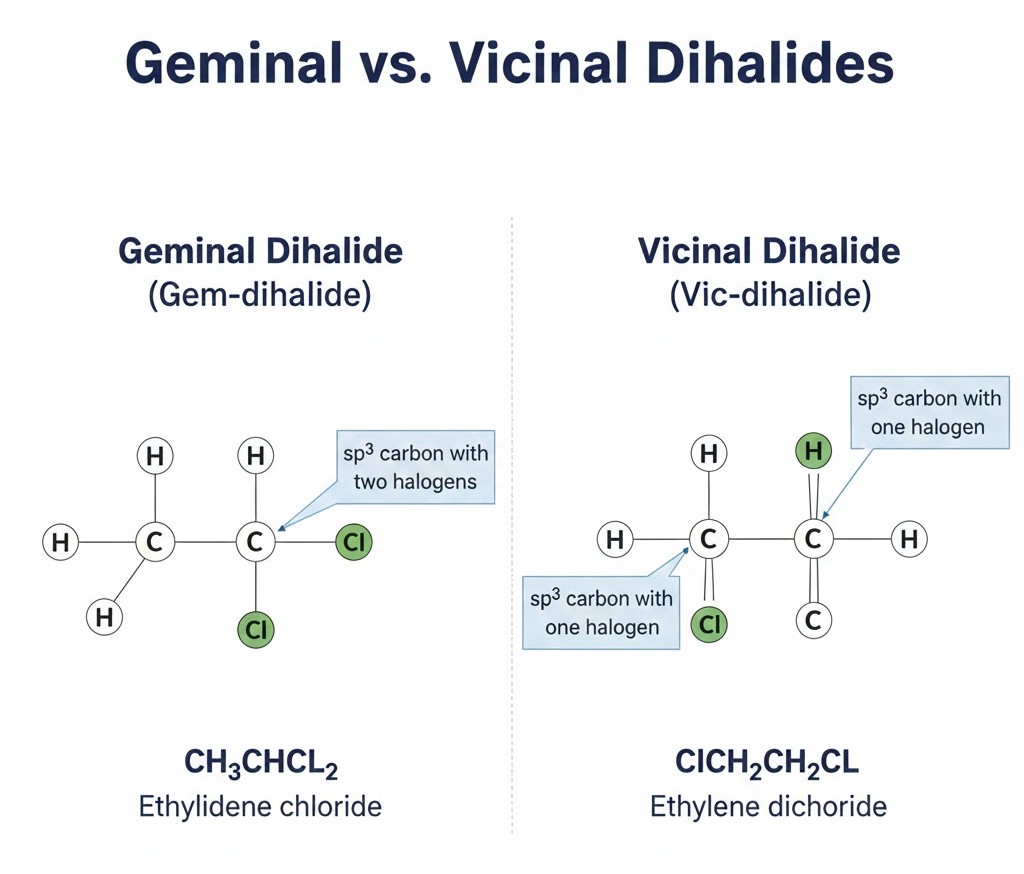
Wait, there’s a twist! If you have two halogens on the same carbon, they are geminal (gem-dihalides), also called alkylidene halides. If they are on adjacent carbons, they are vicinal (vic-dihalides) or alkylene dihalides. It’s like two friends sharing one pani puri plate (Geminal) vs. sharing adjacent stools at the stall (Vicinal)!
Figure below:
A clear structural diagram showing ethylidene chloride ($CH_3CHCl_2$) as a gem-dihalide and ethylene dichloride ($ClCH_2CH_2Cl$) as a vic-dihalide.
NEET Checkpoint:
$H_3C-CHCl_2$ is a:
(a) Vic-dihalide
(b) Gem-dihalide
(c) Allylic halide
(d) Vinylic halide
✅ Answer: (b) Gem-dihalide — Both $Cl$ atoms are on the same carbon, so it’s ethylidene chloride.
Practice Question:
Which of the following is an alkylene dihalide?
(a) Ethylidene chloride
(b) Ethylene dichloride
(c) Isopropyl chloride
(d) Benzyl chloride
✅ Answer: (b) Ethylene dichloride — This is a vicinal dihalide with halogens on adjacent carbons ($ClCH_2-CH_2Cl$), which are named as alkylene dihalides in the common system.
Key Takeaway
- Common Name: Alkyl group + Halide (e.g., n-propyl bromide).
- IUPAC Name: Halo + Alkane (e.g., 1-bromopropane).
- Geminal: 2 halogens on 1 carbon (Alkylidene halide).
- Vicinal: 2 halogens on adjacent carbons (Alkylene dihalide).
4. Nature of the C-X Bond
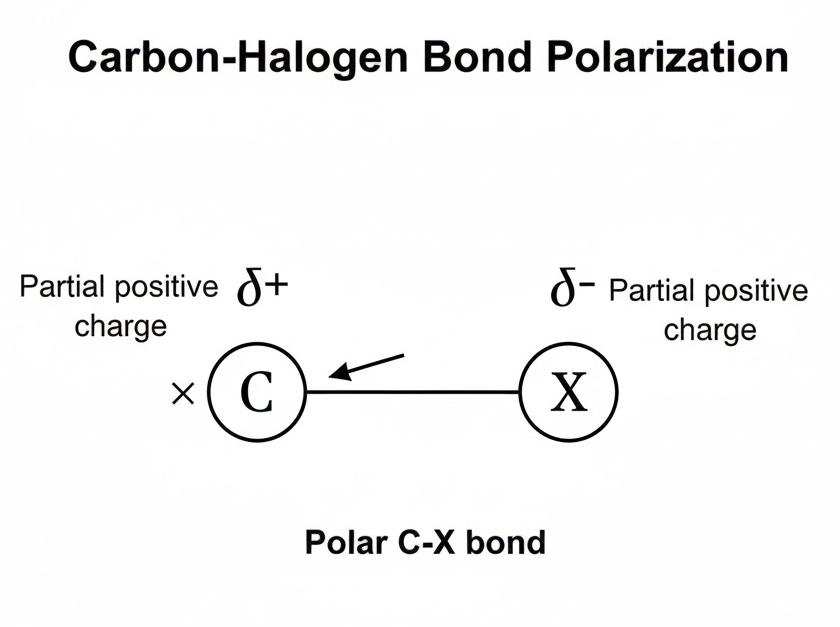
Halo, juniors! Let’s decode the Nature of the C-X Bond. Think of this bond as a tug-of-war where one side is way stronger. Since halogen atoms are more electronegative than carbon, the shared electron pair spends more time near the halogen. This makes the carbon atom bear a partial positive charge ($\delta+$) and the halogen a partial negative charge ($\delta-$). It’s basically a permanent polar drama—no neutrality here, yaar!
NEET Checkpoint:
Why is the $C-X$ bond in alkyl halides considered polar?
(a) Equal sharing of electrons
(b) Electronegativity difference
(c) High temperature
(d) Presence of a catalyst
✅ Answer: (b) — Halogens are electron-hungry, creating $\delta+$ and $\delta-$ charges.
As we move down the group in the periodic table, the halogen atoms get bigger—Fluorine is the "chota recharge" and Iodine is the "heavyweight". Consequently, the bond length increases from $C-F$ to $C-I$. Because the bonds are getting longer, they also get weaker. So, the bond enthalpy (energy needed to break the bond) decreases as you go down.
NEET Checkpoint:
Arrange the following in increasing order of bond length: $CH_3-F$, $CH_3-I$, $CH_3-Br$, $CH_3-Cl$.
(a) CH3–I < CH3–Br < CH3–Cl < CH3–F
(b) CH3–F < CH3–Cl < CH3–Br < CH3–I
(c) CH3–Cl < CH3–F < CH3–Br < CH3–I
(d) CH3–F < CH3–Br < CH3–Cl < CH3–I
✅ Answer: (b) $CH_3-F < CH_3-Cl < CH_3-Br < CH_3-I$ — Size matters! Bigger halogens mean longer bonds.
Here’s a fun funda: Even though Fluorine is more electronegative, the dipole moment of $CH_3-Cl$ ($1.860 D$) is actually higher than $CH_3-F$ ($1.847 D$). It’s a classic NEET trap!
Relatable Indian Example:
Imagine sharing a plate of pani puri with a friend who always grabs the last piece. That friend is like the Halogen, pulling the "electron-puris" closer to themselves, leaving you (the Carbon) with a partial "empty-stomach" charge!
Figure below:
A clear diagram showing a carbon atom bonded to a halogen X, with delta positive and delta negative symbols indicating bond polarisation
NEET Checkpoint:
Which bond has the highest bond enthalpy?
(a) $CH_3-F$
(b) $CH_3-Cl$
(c) $CH_3-Br$
(d) $CH_3-I$
✅ Answer: (a) $CH_3-F$ — Short bonds are strong bonds! It requires $452 kJ mol^{-1}$ to break.
Practice Questions:
Identify the correct trend for C-X bond strength.
(a) $CH_3-F > CH_3-Cl > CH_3-Br > CH_3-I$
(b) $CH_3-I > CH_3-Br > CH_3-Cl > CH_3-F$
(c) $CH_3-Cl > CH_3-F > CH_3-Br > CH_3-I$
(d) All have same strength.
✅ Answer: (a) Bond enthalpy decreases as the halogen size increases down the group.
Key Takeaway: The C-X Bond
- Polarity: $C^{\delta+} - X^{\delta-}$ due to electronegativity.
- Bond Length: $C-F (139 pm) < C-Cl (178 pm) < C-Br (193 pm) < C-I (214 pm)$.
- Bond Enthalpy: Decreases as size increases ($C-F$ is strongest).
- Dipole Moment: $CH_3-Cl > CH_3-F > CH_3-Br > CH_3-I$.
5. Preparation from Alcohols
Listen up, junior! Alcohols are like the VIP lounge for making alkyl halides—they are easily accessible and ready to react. The main funda here is to kick out the hydroxyl group ($-OH$) and replace it with a halogen atom ($X$).
You can do this using halogen acids ($HX$), phosphorus trihalides ($PX_3$), phosphorus pentachloride ($PCl_5$), or thionyl chloride ($SOCl_2$).
NEET Checkpoint:
Which reagent is preferred for preparing pure alkyl halides?
(a) $PCl_5$
(b) $HCl$
(c) $SOCl_2$
(d) $PX_3$
✅ Answer: (c) $SOCl_2$ — Because the gaseous by-products escape, leaving the product pure!.
Why is $SOCl_2$ the "GOAT" (Greatest of All Time) reagent here? It’s because the by-products, $SO_2$ and $HCl$, are escapable gases. This gives you pure alkyl halides without extra effort. It’s like a guest who cleans up their own mess before leaving—totally chill!
Now, notice the reactivity order: $3^\circ > 2^\circ > 1^\circ$. Tertiary alcohols are the fast bowlers; they react with conc. $HCl$ by just shaking at room temperature. Primary and secondary ones are a bit lazy and need a catalyst like $ZnCl_2$ to get moving.
Relatable Indian Example: Imagine you're at a busy Pani Puri stall. Replacing the $-OH$ group is like swapping the spicy teekha paani for sweet meetha sonth—the 'Puri' (alkyl group) stays the same, but the 'flavour' (functional group) changes completely!
NEET Checkpoint:
What catalyst is needed for primary alcohols to react with $HCl$?
(a) AlCl₃
(b) Anhydrous ZnCl₂
(c) FeCl₃
(d) CuCl₂
✅ Answer: (b) $Anhydrous$ $ZnCl_2$ — Without this coach, primary alcohols just won't play!.
NEET Checkpoint:
How is $PBr_3$ or $PI_3$ usually generated in the reaction?
(a) By reacting phosphorus with halogen in situ
(b) By heating phosphorus with water
(c) By reacting phosphorus with alcohol
(d) By electrolysis of halogen acids
✅ Answer: (a) By reacting Red Phosphorus with halogen in situ. They are generated by reacting red phosphorus with Br₂ or I₂ directly in the reaction mixture.
Practice Question:
Which of the following reacts fastest with $HCl$ at room temperature?
(a) $CH_3CH_2OH$
(b) $(CH_3)_2CHOH$
(c) $(CH_3)_3COH$
(d) All react at the same rate
✅ Answer: (c) — Tertiary alcohols ($3^\circ$) have the highest reactivity order: $3^\circ > 2^\circ > 1^\circ$.
Key Takeaway
Formula Summary
- Reagents: $HX$, $PX_3$, $PCl_5$, $SOCl_2$.
- Reactivity: $3^\circ > 2^\circ > 1^\circ$.
- Best Reagent: $SOCl_2$ (for purity).
6. Preparation from Hydrocarbons
Ready to cook some haloalkanes? We’re starting with raw hydrocarbons—Alkanes and Alkenes.
First up, Free Radical Halogenation. Treat an alkane with $Cl_{2}$ or $Br_{2}$ under UV light or heat. It’s a bit of a mess, yaar! You get a complex mixture of mono- and polyhaloalkanes that are super hard to separate, so the yield of a single compound is usually low.
NEET Checkpoint:
Why is free radical halogenation not the best for pure alkyl halides?
(a) Reaction is too slow
(b) Reaction gives low yield
(c) Reaction is highly selective
(d) Reaction gives a mixture of products
✅ Answer: (d) It produces a complex mixture of isomers that are difficult to separate.
Next, Addition of Hydrogen Halides ($HX$) to Alkenes. For unsymmetrical alkenes like propene, we follow Markovnikov’s Rule. The halogen lands on the carbon that makes the product predominate. Think of it like a popular pani puri stall—the "halide" customer always goes where the action is (the more substituted carbon)!
NEET Checkpoint:
Which product is "major" when $HI$ adds to propene?
(a) 1-Iodopropane
(b) 2-Iodopropane
(c) Propyl iodide (mixture)
(d) No reaction
✅ Answer: (b) 2-Iodopropane, because Markovnikov’s rule says so!
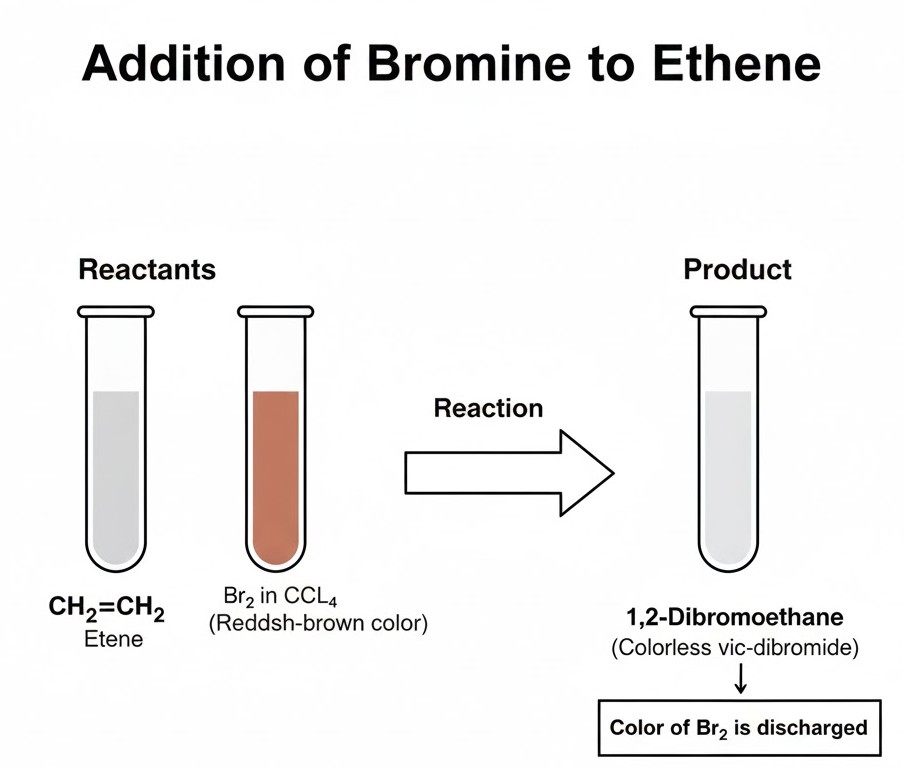
Finally, Addition of Halogens. Shake an alkene with $Br_{2}$ in $CCl_{4}$. The reddish-brown colour of bromine vanishes as it forms vic-dibromides (halogens on adjacent carbons). This is our "magic trick" to detect double bonds in the lab.
Figure below:
A clear diagram showing the addition of Br2 in CCl4 to ethene, resulting in the formation of a colourless vic-dibromide molecule, highlighting the discharge of the reddish-brown bromine colour.
NEET Checkpoint:
What do you observe when $Br_{2}/CCl_{4}$ is added to an alkene?
(a) Formation of white precipitate
(b) Reddish-brown colour persists
(c) Reddish-brown colour disappears
(d) Evolution of gas
✅ Answer: (c) Discharge of the reddish-brown colour of bromine. Alkenes undergo addition reaction with bromine, forming dibromoalkanes.
Practice Question:
Addition of $Br_{2}$ to an alkene in $CCl_{4}$ results in:
(a) Gem-dihalide
(b) Vic-dihalide
(c) Alkane
(d) Alcohol
✅ Answer: (b) — Two bromine atoms add to adjacent carbons to form a vic-dibromide.
Key Takeaway
- Alkanes + $Cl_{2}/UV$: Messy mixture of isomers.
- Alkenes + $HX$: Follows Markovnikov’s rule.
- Alkenes + $Br_{2}/CCl_{4}$: Forms vic-dihalides; used to test for double bonds.
7. Halogen Exchange & Aryl Halide Synthesis
Listen up, junior! Sometimes you can't just force a halogen onto a molecule; you have to play a "swap game." This is where Halogen Exchange comes in. If you want an alkyl iodide, the Finkelstein reaction is your best bet: just treat an alkyl chloride or bromide with $NaI$ in dry acetone.
Notice this: the $NaCl$ or $NaBr$ precipitates in dry acetone, which, according to Le Chatelier's Principle, pushes the reaction forward. For fluorides, we use the Swarts reaction by heating alkyl halides with metallic fluorides like $AgF$ or $CoF_2$.
NEET Checkpoint:
Why is dry acetone used in the Finkelstein reaction?
(a) To dissolve NaCl and NaBr
(b) To precipitate NaX (NaCl/NaBr)
(c) To act as a catalyst
(d) To supply iodide ions
✅ Answer: (b) To precipitate $NaX$ — This facilitates the forward reaction via Le Chatelier's Principle.
Now, for the big leagues: Aryl Halides. You can make them via electrophilic substitution of arenes using a Lewis acid catalyst like $Fe$ or $FeCl_3$ in the dark.
Relatable Example: Think of this like swapping seats in a crowded Mumbai local train. You’re already on the "benzene" train, but you swap your "hydrogen" seat for a "halogen" one because the catalyst (the Ticket Collector) is watching!
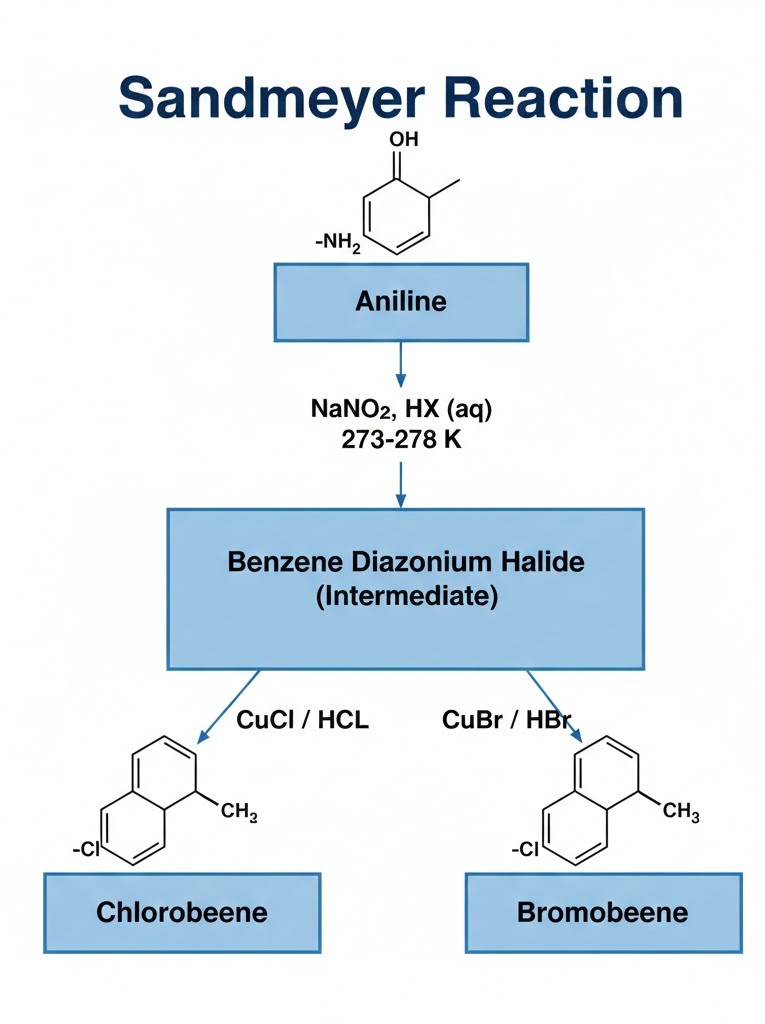
Another legendary method is Sandmeyer’s reaction. You start with a primary aromatic amine, turn it into a diazonium salt using $NaNO_2$ and $HX$ at $273-278\text{ K}$, then replace that group with $Cu_2Cl_2$ or $Cu_2Br_2$ to get your aryl halide.
NEET Checkpoint:
Which reagent is used to replace the diazonium group with iodine?
(a) KI
(b) NaI
(c) HI
(d) I₂
✅ Answer: (a) $KI$ — Unlike chloro or bromo groups, iodine only needs a simple shake with potassium iodide.
NEET Checkpoint:
What catalyst is needed for the electrophilic bromination of benzene?
(a) Lewis acid
(b) Br2
(c) H2SO4
(d) Water
✅ Answer: (a) Lewis acid (e.g., $Fe$ or $FeCl_3$) — It helps generate the electrophile required for substitution.
Figure below:
A clear flowchart showing the Sandmeyer reaction starting from aniline, forming a benzene diazonium halide intermediate, and branching into chlorobenzene and bromobenzene using cuprous salts.
Practice Questions:
- Which of the following metallic fluorides is NOT typically used in a Swarts reaction?
(a) $AgF$
(b) $Hg_2F_2$
(c) $SbF_3$
(d) $NaF$
✅ Answer: (d) — The sources specifically list $AgF$, $Hg_2F_2$, $CoF_2$, and $SbF_3$ as suitable metallic fluorides.
2. In the synthesis of iodobenzene from diazonium salts, cuprous halide is:
(a) Mandatory
(b) Not required
(c) Replaced by $Fe$
(d) Used as a solvent
✅ Answer: (b) — Iodine replacement happens simply by shaking with $KI$.
Key Takeaway: Synthesis Summary
- Finkelstein: $NaI$ + dry acetone $\rightarrow$ Alkyl Iodide.
- Swarts: Metallic fluorides ($AgF, CoF_2$, etc.) $\rightarrow$ Alkyl Fluoride.
- Sandmeyer’s: Diazonium salt + $Cu_2X_2$ $\rightarrow$ Aryl Halide ($N_2$ gas released).
8. Physical Properties: Trends and Solubility
Let's look at the physical "vibes" of these molecules! First up is the Boiling Point ($B.P.$). Because haloalkanes are polar and heavier than their parent hydrocarbons, they have stronger intermolecular forces like dipole-dipole and van der Waals attractions. For the same alkyl group, the trend is: $RI > RBr > RCl > RF$. Why? As the halogen gets bigger and heavier, those van der Waals forces become super strong!
NEET Checkpoint:
Which has a higher $B.P.$, $CH_{3}Br$ or $CH_{3}I$?
(a) CH3Br
(b) CH3I
(c) Both are same
(d) Cannot be determined
✅ Answer: (b) $CH_{3}I$ — Bigger size and mass of Iodine means stronger van der Waals forces.
Now, here is a cool funda: branching lowers the $B.P.$. Think of a crowded Mumbai local train. If everyone stands in a long line (linear chain), they take up more space and have more surface area for "attraction." If they huddle into a tight ball (branching), the surface area decreases, and the $B.P.$ drops. For example, $n$-butyl bromide boils at $375 K$, but tert-butyl bromide boils at just $346 K$.
NEET Checkpoint:
Arrange the isomers of $C_{4}H_{9}Br$ in decreasing order of $B.P.$
(a) Primary > Secondary > Tertiary
(b) Tertiary > Secondary > Primary
(c) Secondary > Primary > Tertiary
(d) All have same B.P.
✅ Answer: (a) Primary > Secondary > Tertiary — More branching equals lower $B.P.$.
When it comes to Density, bromo, iodo, and polychloro derivatives are the "heavyweights"—they are heavier than water. Density increases as you add more Carbon atoms or heavier Halogens. Regarding Solubility, haloalkanes are like that shy student—they are only slightly soluble in water. They can't break water’s strong hydrogen bonds, so they prefer "partying" in organic solvents instead!
NEET Checkpoint:
Why are haloalkanes poorly soluble in water?
(a) They are highly polar
(b) They form strong hydrogen bonds with water
(c) They are non-polar or weakly polar and cannot hydrogen bond
(d) They react with water
✅ Answer: (c) They cannot form strong enough attractions to break the existing $H$-bonds between water molecules.
Practice Question:
Which of the following will be the densest?
(a) $n-C_{3}H_{7}Cl$
(b) $n-C_{3}H_{7}Br$
(c) $n-C_{3}H_{7}I$
(d) $CH_{3}Cl$
✅ Answer: (c) $n-C_{3}H_{7}I$. Density increases with the atomic mass of the halogen ($I > Br > Cl$) and the number of carbon atoms.
Key Takeaway
- $B.P.$ Trend: $RI > RBr > RCl > RF$.
- Branching Effect: More branches = Lower $B.P.$.
- Solubility: Low in $H_{2}O$, High in organic solvents.
- Density: Increases with halogen mass and count.
9. Nucleophilic Substitution: The $S_N2$ Mechanism
Hey junior! Ready to clear the $S_N2$ funda? This stands for Substitution Nucleophilic Bimolecular. Think of it as a "one-shot" action movie—no intervals, just straight to the climax!,
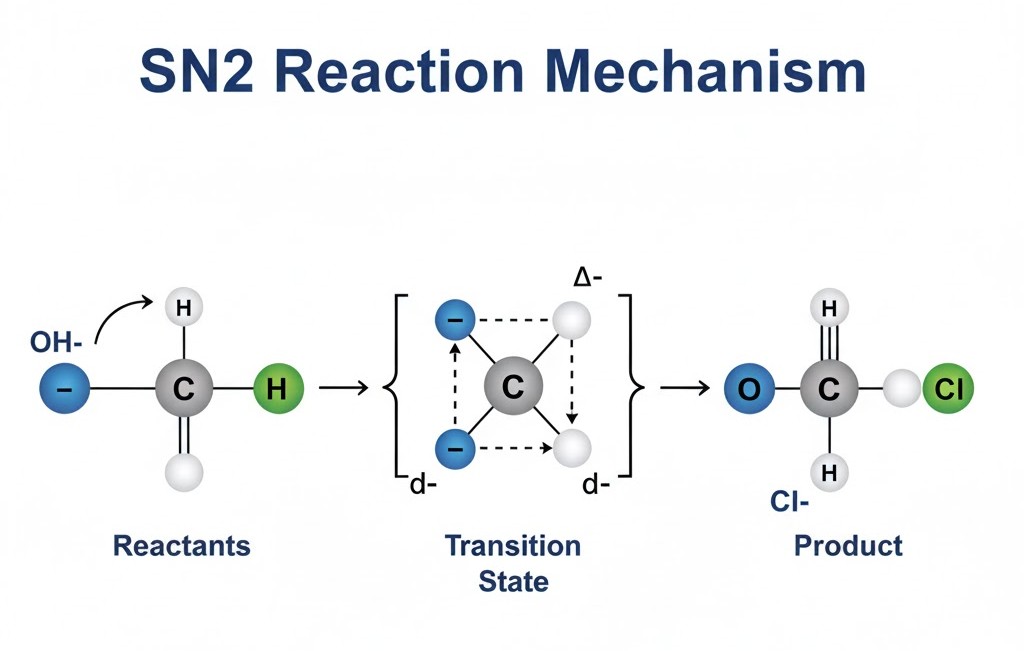
In an $S_N2$ reaction, the incoming nucleophile attacks the carbon atom from the back side, exactly opposite to where the leaving group (the halogen) is sitting. Everything happens in a single step: as the new bond forms, the old one breaks simultaneously. This creates a crowded, unstable transition state where the carbon is momentarily bonded to five atoms!
NEET Checkpoint:
What is the order of kinetics for an $S_N2$ reaction?
(a) First order
(b) Second order
(c) Zero order
(d) Third order
✅ Answer: (b) Second-order — The rate depends on the concentration of both the alkyl halide and the nucleophile.
Here’s the trick: because the attack is from the back, the molecule's configuration flips like an umbrella turning inside out in a heavy Mumbai monsoon wind. This is called inversion of configuration,.
Relatable Example: Imagine a crowded Mumbai local train. If you (the nucleophile) want a seat, you have to push someone out (the leaving group) the moment you sit down. If the seat is occupied by three heavy uncles (tertiary halide), you’ll find it impossible to get in! But if there are just small kids (methyl halide), you can easily slide in. This is why the reactivity order is:
This happens because bulky groups cause steric hindrance, blocking the nucleophile's path,.
NEET Checkpoint:
Why are tertiary halides the least reactive in $S_N2$?
(a) Poor leaving group
(b) Steric hindrance
(c) Weak nucleophile
(d) Electronic effects
✅ Answer: (b) Steric hindrance — Large, bulky groups prevent the nucleophile from approaching the carbon atom.
Figure below:
A clear diagram showing the SN2 mechanism of OH- attacking CH3Cl. It should show the nucleophile approaching from the back, the pentacoordinate transition state with dotted lines for partial bonds, and the final product with an inverted configuration.
NEET Checkpoint:
In the $S_N2$ transition state, how many atoms is the carbon simultaneously bonded to?
(a) 3
(b) 4
(c) 5
(d) 6
✅ Answer: (c) 5 — Carbon is temporarily bonded to three hydrogens, the incoming nucleophile, and the outgoing halogen.
Practice Questions:
1. Which of the following will react fastest in an $S_N2$ reaction?
(a) $CH_{3}CH_{2}Br$
(b) $(CH_{3}){2}CHBr$
(c) $(CH{3}){3}CBr${3}){3}CBr$
(d) $CH{3}Br${3}Br$
✅ Answer: (d) $CH_{3}Br$ — It has the least steric hindrance with only three small hydrogen atoms,.
2. $S_N2$ reactions are generally carried out in:
(a) Non-polar solvents
(b) Polar protic solvents
(c) Polar aprotic solvents
(d) None
✅ Answer: (c) Polar aprotic solvents — (Note: While the source mentions $S_N1$ uses polar protic, $S_N2$ efficiency is generally boosted by aprotic ones, though the source focuses on the kinetic dependency on both reactants for $S_N2$).
Key Takeaway: $S_N2$ Summary
- Kinetics: Second-order; $Rate = k[R-X][Nu^{-}]$.
- Mechanism: Single-step via a Transition State.
- Stereochemistry: 100% Inversion of configuration,.
- Reactivity: $CH_{3}X > 1^{\circ} > 2^{\circ} > 3^{\circ}$.
10. Nucleophilic Substitution: The $S_N1$ Mechanism
Listen, junior! Ready to master the $S_N1$ funda? It stands for Substitution Nucleophilic Unimolecular. Think of it like waiting for a seat in a crowded Delhi Metro coach. You can’t just push someone out; you have to wait for a passenger to exit before you can grab the seat!
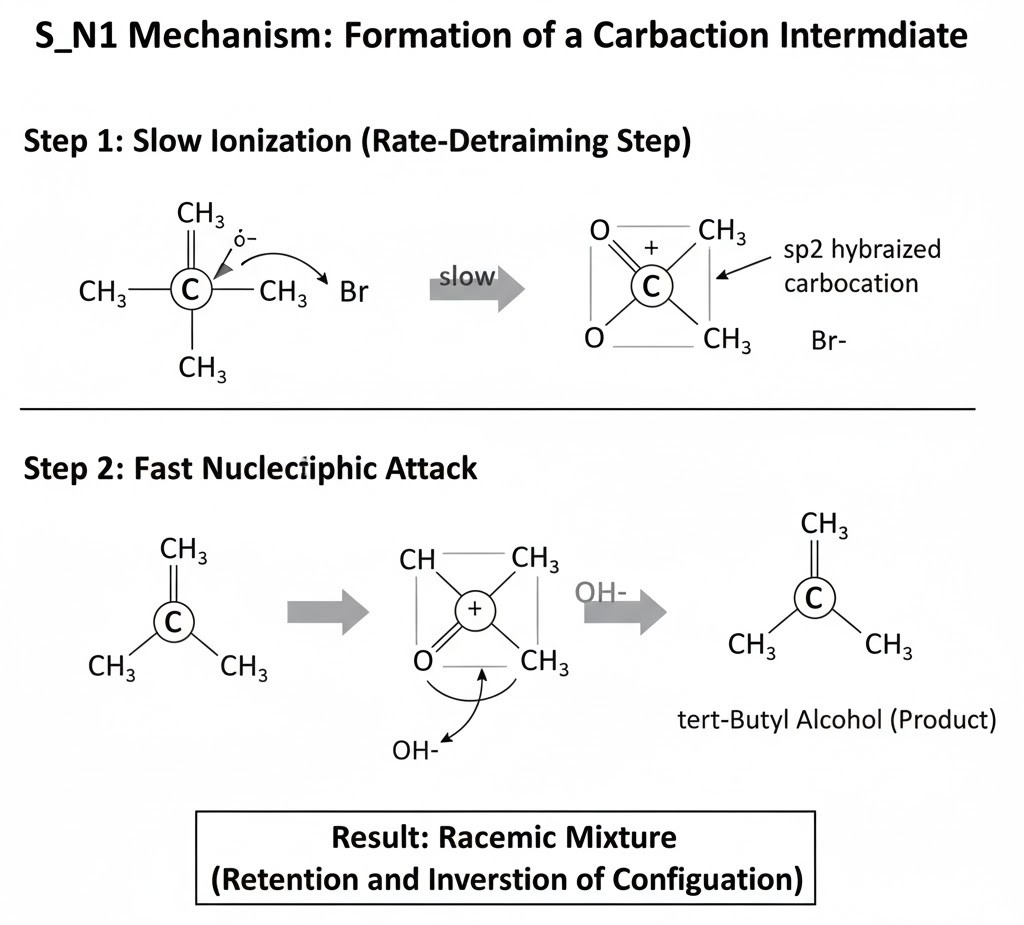
This is a two-step process. In Step I, the polarised $C-X$ bond undergoes a slow cleavage to form a carbocation and a halide ion. This is the "waiting" step and the slowest part of the whole journey.
NEET Checkpoint:
What is the rate-determining step in an $S_N1$ reaction?
(a) Step I (Leaving group departs)
(b) Step II (Nucleophile attacks)
(c) Step III (Proton transfer)
(d) Step IV (Carbocation rearrangement)
✅ Answer: (a) Step I (Leaving group departs) — The slow formation of the carbocation intermediate determines the overall rate.
Because the rate depends only on the concentration of the alkyl halide, we say it follows first-order kinetics.
Polar protic solvents (like water, alcohol, or acetic acid) are the best buddies for this reaction because they help stabilise the ions. The reactivity order is all about carbocation stability:
Tertiary halides are the kings here because $3^\circ$ carbocations are super stable. Notice this: allylic and benzylic halides also show high reactivity because their carbocations are resonance-stabilised.
Figure below:
A clear two-step reaction mechanism diagram showing a tertiary alkyl halide (like tert-butyl bromide) slowly breaking its C-Br bond to form a planar sp2 hybridised carbocation intermediate in Step 1, followed by a fast Step 2 where a hydroxide nucleophile attacks the carbocation.
NEET Checkpoint:
Which solvent would best facilitate an $S_N1$ mechanism?
(a) Benzene
(b) Ethanol
(c) Hexane
(d) $CCl_4$
✅ Answer: (b) Ethanol — It is a polar protic solvent that helps in the ionisation of the alkyl halide.
NEET Checkpoint:
What is the hybridisation of the carbon in the $S_N1$ intermediate?
(a) sp
(b) sp²
(c) sp³
(d) sp³d
✅ Answer: (b) $sp^2$ — The carbocation intermediate is planar.
Practice Questions:
1. Arrange the following in increasing order of $S_N1$ reactivity: $CH_3CH_2Br$, $(CH_3)_2CHBr$, $(CH_3)_3CBr$.
(a) $CH_3CH_2Br < (CH_3)_2CHBr < (CH_3)_3CBr$
(b) $(CH3)_3CBr < (CH3)_2CHBr < CH_3CH_2Br$
(c) $CH_3CH_2Br < (CH3)_3CBr < (CH3)_2CHBr$
(d) $(CH3)_2CHBr < CH_3CH_2Br < (CH3)_3CBr$
✅ Answer: (a) $CH_3CH_2Br < (CH_3)_2CHBr < (CH_3)_3CBr$. Reactivity increases with carbocation stability ($1^\circ < 2^\circ < 3^\circ$).
2. Why does $S_N1$ typically lead to racemisation?
(a) Nucleophile attacks from one side only
(b) Carbocation intermediate is planar
(c) Reaction is too slow
(d) Leaving group does not depart completely
✅ Answer: (b) Because the intermediate carbocation is planar, the nucleophile can attack from either side with equal ease.
Key Takeaway
- Kinetics: First-order ($Rate = k[RX]$).
- Mechanism: Two steps via a carbocation.
- Reactivity: $3^\circ > 2^\circ > 1^\circ$ (due to stability).
- Solvent: Polar protic.
11. Stereochemical Aspects of Nucleophilic Substitution
Listen up, junior! Stereochemistry might seem like a headache, but it’s just the 3D version of organic chemistry. Let's clear this funda once and for all!
A molecule is optically active if it can rotate plane-polarised light. If it rotates it clockwise, it’s dextrorotatory (+); if anticlockwise, it’s laevorotatory (-). The real "hero" here is chirality. If a molecule and its mirror image are non-superimposable—like your left and right hands—it’s chiral. These non-superimposable twins are called enantiomers.
NEET Checkpoint:
What is a 50:50 mixture of two enantiomers called?
(a) Racemic mixture
(b) Diastereomeric mixture
(c) Optically active mixture
(d) Meso compound
✅ Answer: (a) Racemic mixture — It has zero optical rotation because the rotations of the two isomers cancel each other out.
Think of a pair of Kolhapuri chappals. You can’t wear the left one on the right foot—that’s chirality in action! In the same way, chiral molecules have a stereocentre (an asymmetric carbon bonded to four different groups).
Now, notice how the mechanism changes the "look" of the molecule:
1. $S_N2$ Reaction: This leads to a complete inversion of configuration. It’s like an umbrella turning inside out in a heavy Mumbai rainstorm!
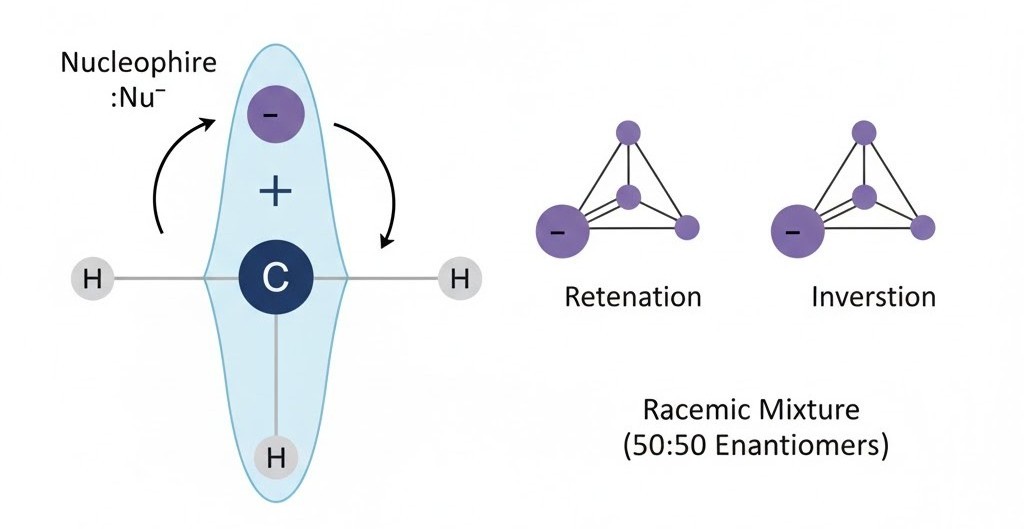
2. $S_N1$ Reaction: This leads to racemisation. Why? Because the intermediate is a planar carbocation ($sp^2$ hybridised). The nucleophile can attack from either the top or the bottom face with equal ease, giving you a 50:50 mix.
NEET Checkpoint:
Which intermediate is responsible for racemisation in $S_N1$?
(a) Planar Carbocation
(b) Carbanion
(c) Free radical
(d) Transition state
✅ Answer: (a) Planar carbocation — Being flat and achiral, it allows the nucleophile to attack from both sides.
NEET Checkpoint:
In $S_N2$, where does the nucleophile attach?
(a) Same side as the halogen
(b) Opposite side of the halogen
(c) Randomly
(d) Only at sp² carbons
✅ Answer: (b) Opposite side of the halogen — This "backside attack" is what causes the configuration to flip.
Figure below:
A clear diagram showing a planar sp2 hybridised carbocation intermediate being attacked by a nucleophile from both the top and bottom faces to illustrate racemisation.
Practice Question:
Which of the following will have identical physical properties like boiling point?
(a) Diastereomers
(b) Enantiomers
(c) A mixture of $CH_4$ and $Cl_2$
(d) Constitutional isomers
✅ Answer: (b) — Enantiomers have identical physical properties and only differ in how they rotate light.
Key Takeaway
- $S_N2$ = Inversion (Umbrella flip).
- $S_N1$ = Racemisation (Planar carbocation).
- Chiral = Non-superimposable mirror images.
12. Elimination Reactions & Zaitsev Rule
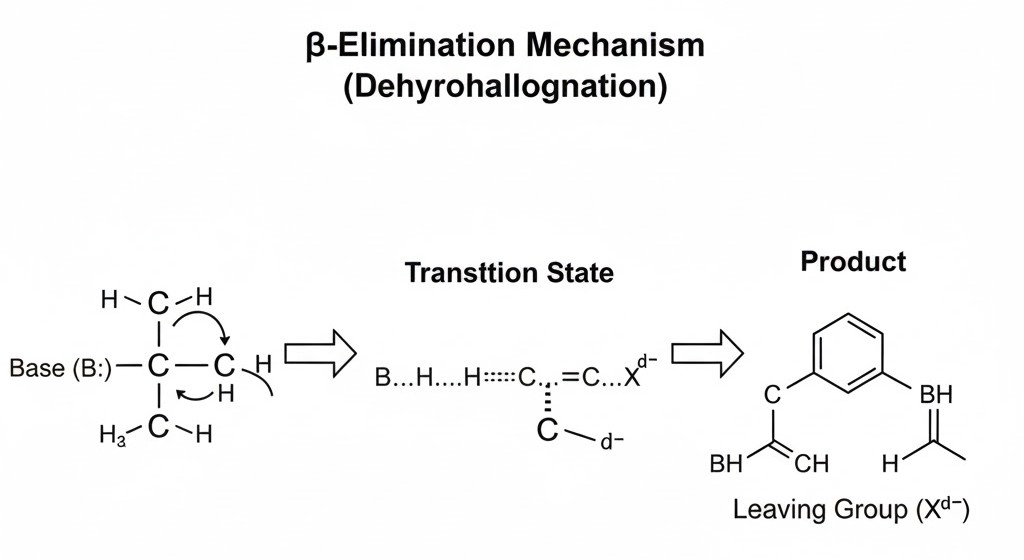
Listen up, junior! Ever seen a friend try to lose weight by cutting out both carbs and sugar? In organic chemistry, haloalkanes do something similar called $\beta$-elimination. When you heat a haloalkane with alcoholic potassium hydroxide ($KOH$), it loses a halogen from the $\alpha$-carbon and a hydrogen from the $\beta$-carbon to form a flashy new double bond (an alkene).
NEET Checkpoint:
Which reagent is used to trigger $\beta$-elimination in haloalkanes?
(a) Aqueous $KOH$
(b) Alcoholic $KOH$
(c) $H_2O$
(d) Dry ether
✅ Answer: (b) Alcoholic $KOH$ — Remember, "Alcoholic" leads to "Elimination", while "Aqueous" leads to "Substitution". Don't mix up this funda!
But what if there are multiple $\beta$-carbons? That's where the Zaitsev (Saytzeff) Rule steps in. Think of it like a cricket captain picking the most experienced (substituted) players. The rule states: in dehydrohalogenation, the preferred product is the alkene with the greater number of alkyl groups attached to the doubly bonded carbon atoms.
For example, 2-bromopentane can form pent-1-ene or pent-2-ene. According to Zaitsev, pent-2-ene is the "Man of the Match" (81% yield) because it’s more substituted than pent-1-ene (19% yield).
NEET Checkpoint:
According to Zaitsev Rule, which alkene is preferred?
(a) The less substituted alkene
(b) The more highly substituted alkene
(c) Both are formed equally
(d) Only terminal alkenes
✅ Answer: (b) The more highly substituted alkene — More alkyl groups on the double bond mean more stability!
Figure below:
A clear chemical reaction diagram showing $\beta$-elimination where a base ($B:$) abstracts a proton from the $\beta$-carbon, the electrons move to form a $C=C$ bond, and the halogen ($X$) leaves the $\alpha$-carbon.
NEET Checkpoint:
Why is it called $\beta$-elimination?
(a) Because the leaving group leaves from the α-carbon
(b) Because the hydrogen atom is removed from the $\beta$-carbon atom.
(c) Because elimination occurs in two steps
(d) Because the reaction requires a base
✅ Answer: (b) Because the hydrogen atom is removed from the $\beta$-carbon atom. In β-elimination, a hydrogen atom (proton) is removed from the β-carbon (the carbon next to the carbon attached to the leaving group, called the α-carbon).
Finally, remember that substitution and elimination are always in a race. A bulky nucleophile is like a wide truck in a narrow Indian lane; it can’t reach the central carbon easily, so it just grabs a proton from the side and chooses elimination instead!
Practice Question:
Which of the following would most likely undergo elimination over substitution when reacting with a strong, bulky base?
(a) Primary alkyl halide
(b) Tertiary alkyl halide
(c) Methyl chloride
(d) Methanol
✅ Answer: (b) Tertiary alkyl halide — Bulkier halides and bases favour elimination due to stability of the resulting alkene and steric reasons.
Key Takeaway:
- $\beta$-Elimination: $Alkane + Alc. KOH \rightarrow Alkene + HX$.
- Zaitsev Rule: More substituted alkene = Major product.
- Competition: Bulky bases and tertiary halides love elimination.
13. Reaction with Metals
Hey junior! Ready to see how organic halides make friends with metals? It’s like a Bollywood crossover—when these two meet, the results are explosive (literally, if you aren't careful!). Let's clear up this funda.
The Legend of Grignard Reagents
First up is the MVP, Victor Grignard. He discovered that haloalkanes react with magnesium metal in dry ether to form alkyl magnesium halides, or Grignard Reagents ($RMgX$).
NEET Checkpoint:
Why is the Grignard reaction carried out in dry ether?
(a) To dissolve the Grignard reagent
(b) To prevent reaction with water
(c) To act as a catalyst
(d) To supply halide ions
✅ Answer: (b) To avoid even traces of moisture, as $RMgX$ reacts instantly with proton sources.
In these reagents, the $C-Mg$ bond is covalent but highly polar, while the $Mg-X$ bond is essentially ionic. Because the carbon pulls electrons from the electropositive magnesium, it becomes a powerhouse of reactivity! If it finds any proton source—water, alcohols, or even amines—it snaps it up to become a hydrocarbon.
Relatable Example: Think of a Grignard reagent as a hungry student at a Pani Puri stall. If there's any "water" (proton source) nearby, they’ll react immediately to satisfy that hunger and turn into a stable hydrocarbon!
The "Double-Up" Reactions
Now, let’s talk about the Wurtz Reaction. When you treat alkyl halides with sodium in dry ether, you get an alkane with double the number of carbon atoms.
Relatable Example: It’s like a local Rickshaw driver who refuses to go alone and insists on a "double seat" fare—two alkyl groups join hands to become one big alkane.
NEET Checkpoint:
What is the product of $2CH_{3}Br + 2Na$ in dry ether?
(a) Ethane (CH3–CH3)
(b) Methanol (CH3OH)
(c) Methyl iodide (CH3I)
(d) No reaction
✅ Answer: (a) Ethane ($C_{2}H_{6}$) — The Wurtz reaction doubles the carbon count.
For our aryl halide friends, we have the Wurtz-Fittig and Fittig reactions:
1. Wurtz-Fittig: A mix of alkyl and aryl halides gives an alkylarene.
2. Fittig: Two aryl groups join to form diphenyl.
NEET Checkpoint:
Which reaction produces diphenyl?
(a) Wurtz reaction
(b) Fittig reaction
(c) Friedel–Crafts alkylation
(d) Sandmeyer reaction
✅ Answer: (b) Fittig reaction — Two aryl halides react with sodium in dry ether.
Practice Question:
Which of the following is an organo-metallic compound?
(a) $CH_{3}Cl$
(b) $CH_{3}MgBr$
(c) $CHCl_{3}$
(d) $C_{2}H_{5}OH$
✅ Answer: (b) $CH_{3}MgBr$ — It contains a direct carbon-metal bond.
Key Takeaway
Formula Summary
- Grignard Formation: $R-X + Mg \xrightarrow{\text{dry ether}} R-MgX$
- Wurtz Reaction: $2R-X + 2Na \xrightarrow{\text{dry ether}} R-R + 2NaX$
- Fittig Reaction: $Ar-X + 2Na \xrightarrow{\text{dry ether}} Ar-Ar + 2NaX$
14. Reactivity and Substitution in Haloarenes
Haloarenes are the 'strong-headed' members of the halogen family—they don't like swapping their halogens easily!. This low reactivity toward nucleophilic substitution happens because the lone pairs on the halogen atom are in conjugation with the $\pi$-electrons of the ring, giving the $C-X$ bond a partial double bond character. It's like a strong friendship bond; it's much harder to break than a single bond! Also, the carbon is $sp^2$ hybridised, making it more electronegative and the bond shorter ($169\text{ pm}$) compared to haloalkanes ($177\text{ pm}$).
NEET Checkpoint:
Why is $S_N1$ ruled out for haloarenes?
(a) Aryl carbocations are unstable
(b) Nucleophiles cannot attack aromatic rings
(c) Haloarenes do not have leaving groups
(d) Haloarenes react too fast
✅ Answer: (a) The phenyl cation formed by self-ionisation is unstable and not stabilised by resonance.
To force a replacement of the halogen with an $-OH$ group (forming Phenol), you need 'extreme' conditions: heating with $NaOH$ at $623\text{ K}$ and $300\text{ atm}$. However, if you add electron-withdrawing nitro groups ($-NO_2$) at the ortho or para positions, the ring becomes way more reactive!. It's like adding a bit of spice to a boring curry; it definitely speeds things up!
NEET Checkpoint:
Which position of the nitro group has NO effect on haloarene reactivity?
(a) Ortho
(b) Meta
(c) Para
(d) All positions affect reactivity
✅ Answer: (b) Meta - Meta-position—the negative charge in the intermediate carbanion never reaches the carbon bearing the nitro group.
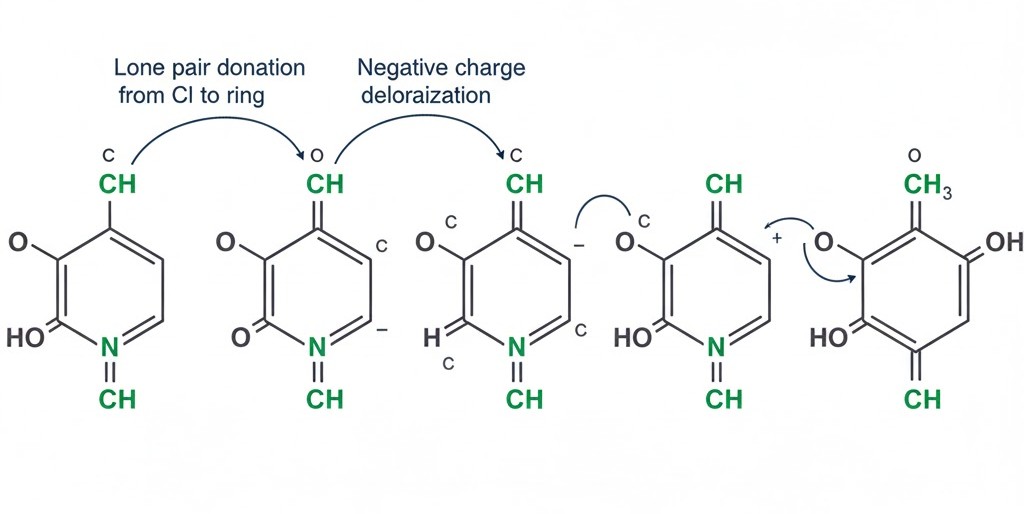
In electrophilic substitution, halogens are $o, p$-directing. Even though they withdraw electrons via the $-I$ effect, resonance increases electron density at the ortho and para positions. In reactions like Halogenation, Nitration, Sulphonation, and Friedel-Crafts, the para isomer is usually the major product because it's more symmetrical and less crowded.
Figure below:
A set of five resonating structures of chlorobenzene showing the lone pair on chlorine shifting into the ring, creating negative charges at the ortho and para positions.
Practice Question:
In Friedel-Crafts acylation of chlorobenzene with $CH_3COCl$ and anhydrous $AlCl_3$, which is the major product?
(a) 2-Chloroacetophenone
(b) 3-Chloroacetophenone
(c) 4-Chloroacetophenone
(d) Benzoyl chloride
✅ Answer: (c) 4-Chloroacetophenone—The para isomer is the major product due to less steric hindrance.
Key Takeaway
- Reactivity: Haloarenes < Haloalkanes (due to resonance and $sp^2$ hybridisation).
- Dow’s Process: $NaOH$, $623\text{ K}$, $300\text{ atm}$.
- Orientation: Halogens are $o, p$-directing but deactivating.
15. Polyhalogen Compounds & Environmental Impact
Hey future doc! Ready to see how some chemicals are both life-savers and a total headache for Mother Earth? Let's clear up this funda on polyhalogen compounds.
First up is Dichloromethane ($CH_{2}Cl_{2}$), a pro at stripping paint from an old rickshaw, but bad news for your brain; it can cause dizziness and even burn your cornea! Then there’s Chloroform ($CHCl_{3}$), the old-school anaesthetic from movies. It’s tricky because, in light, it oxidises into Phosgene ($COCl_{2}$), a gas so poisonous it’s definitely not invited to any party:
NEET Checkpoint:
Why is chloroform stored in dark, full bottles?
(a) To prevent evaporation
(b) To prevent reaction with oxygen forming phosgene
(c) To maintain purity
(d) To avoid freezing
✅ Answer: (b) To prevent oxidation into poisonous Phosgene ($COCl_{2}$) by cutting off light and air.
Iodoform ($CHI_{3}$) was our go-to antiseptic, though its "hospital smell" is quite intense. Fun fact: the healing power actually comes from the liberation of free iodine, not the molecule itself. For our cooling needs, Freons (like Freon 12, $CCl_{2}F_{2}$) were the kings of ACs and fridges, but they sneak into the stratosphere and wreck the ozone layer.
NEET Checkpoint:
What causes the antiseptic action of $CHI_{3}$?
(a) Liberation of free iodine
(b) Release of free radicals
(c) Formation of CHI3 crystals
(d) Reaction with proteins
✅ Answer: (a) The liberation of free iodine. Iodine acts as a powerful antiseptic, killing bacteria and preventing infection.
Finally, Carbon Tetrachloride ($CCl_{4}$) and DDT are the environmental villains. $CCl_{4}$ depletes ozone and can cause liver cancer, while DDT—the famous insecticide—refuses to leave! It's fat-soluble and bioaccumulates in animals, leading to long-term toxicity.
NEET Checkpoint:
Which property of DDT makes it an environmental hazard?
(a) High solubility in water
(b) High stability and persistence
(c) High reactivity
(d) Volatility
✅ Answer: (b) It is fat-soluble and not metabolised rapidly, leading to bioaccumulation in fatty tissues.
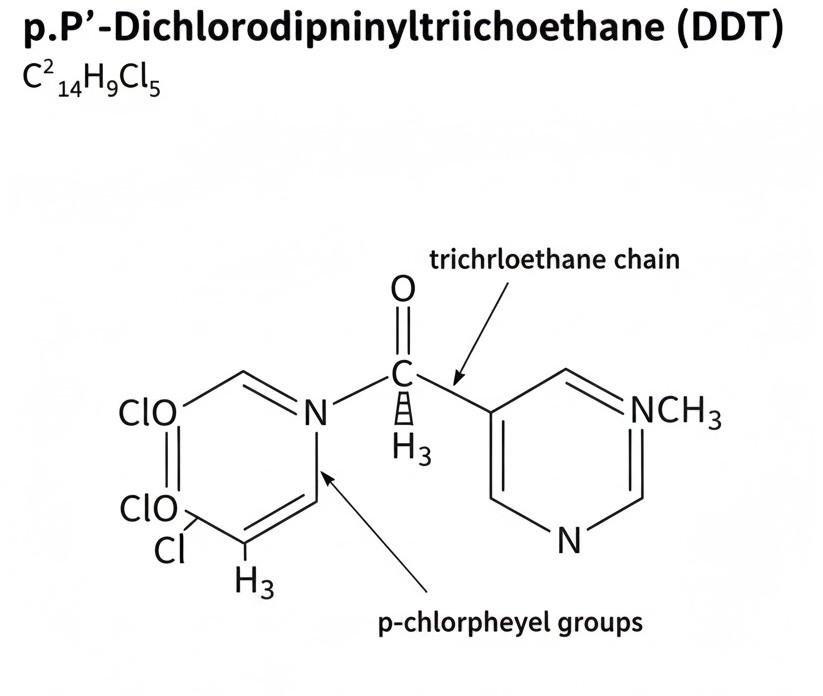
Figure below:
A clear chemical structure of p,p'-Dichlorodiphenyltrichloroethane (DDT) showing two chlorophenyl groups attached to a trichloroethane chain.
Practice Questions:
1. Which compound is primarily used to manufacture Freon refrigerant R-22?
(a) $CH_{2}Cl_{2}$
(b) $CHCl_{3}$
(c) $CHI_{3}$
(d) $CCl_{4}$
✅ Answer: (b) $CHCl_{3}$ — Chloroform is the major feedstock for R-22 production.
2. Freon 12 ($CCl_{2}F_{2}$) is industrially manufactured from $CCl_{4}$ using which reaction?
(a) Finkelstein
(b) Wurtz
(c) Swarts
(d) Sandmeyer
✅ Answer: (c) Swarts reaction — This is the standard method for synthesizing freons from $CCl_{4}$.
Key Takeaway
- $CHCl_{3}$: Replaced anaesthetic; forms poisonous $COCl_{2}$.
- $CHI_{3}$: Antiseptic due to free $I_{2}$.
- Freons & $CCl_{4}$: Major ozone depleters.
- DDT: Persistent insecticide; bioaccumulates in fat.