1. Introduction to Hydrocarbons & Classification
Hey there, future doctor! Let’s kick off this chapter with something you see every day. Hydrocarbons are simply compounds made of only carbon and hydrogen—nothing else, yaar!. Think of them as the "fuel of life." From the LPG (Liquefied Petroleum Gas) cylinder in your kitchen to the CNG (Compressed Natural Gas) running those green rickshaws in Delhi, hydrocarbons are everywhere. They even provide the raw materials for your favourite polymers like polythene and polystyrene.
NEET Checkpoint:
What is the full form of LNG mentioned in the sources?
(a) Liquid Natural Gas
(b) Liquefied Natural Gas
(c) Low Natural Gas
(d) Lite Natural Gas
✅ Answer: (b) Liquefied Natural Gas — Remember, "Liquefied" is the keyword here for both LPG and LNG!
Now, let’s clear this classification funda. We group them based on their carbon-carbon bonds:
1. Saturated: These contain only single bonds. Think of them as the "chill" ones, like alkanes (open chain) or cycloalkanes (rings).
2. Unsaturated: These contain double or triple bonds (or both!). They are like a crowded Mumbai local train—plenty of "room" to add more atoms.
3. Aromatic: These are special cyclic compounds, with benzene being the most famous member.
NEET Checkpoint:
Which of these is a saturated open-chain hydrocarbon?
(a) Alkene
(b) Alkyne
(c) Alkane
(d) Benzene
✅ Answer: (c) Alkane — Open chain + single bonds = Alkane. Simple, right?
Indian Example: Imagine a Pani Puri stall. The stove is burning LPG to keep the spicy aloo mix ready. That LPG is a mixture of hydrocarbons providing energy. Even the plastic bag the vendor uses is likely a polymer made from these same building blocks!
NEET Checkpoint:
Coal gas is obtained by which process?
(a) Fractional distillation
(b) Compression
(c) Destructive distillation
(d) Liquefaction
✅ Answer: (c) Destructive distillation — Don't confuse it with petrol or diesel, which come from the fractional distillation of petroleum!
Practice Questions:
1. Higher hydrocarbons are commonly used as solvents for which of the following?
(a) Drinking water
(b) Paints
(c) Concentrated acids
(d) Fruit juices
✅ Answer: (b) Paints — The sources mention they are excellent solvents for paints.
2. Which of the following is NOT a source of hydrocarbons mentioned in the text?
(a) Petroleum
(b) Coal
(c) Natural Gas
(d) Common Salt
✅ Answer: (d) Common Salt — Hydrocarbons come from fossil fuels like petroleum, coal, and gas.
Key Takeaway
Hydrocarbons = Carbon $+$ Hydrogen only.
Classification:
* Saturated: Alkanes (Single bonds).
* Unsaturated: Alkenes/Alkynes (Multiple bonds).
* Aromatic: Special rings (e.g., Benzene).
2. Alkanes: Nomenclature and Isomerism
Listen up, champ! Alkanes are the "paraffins" of the organic world—meaning they have "little affinity" and are pretty chill/inert under normal conditions. Their basic funda is simple: they are saturated open-chain hydrocarbons with the general formula
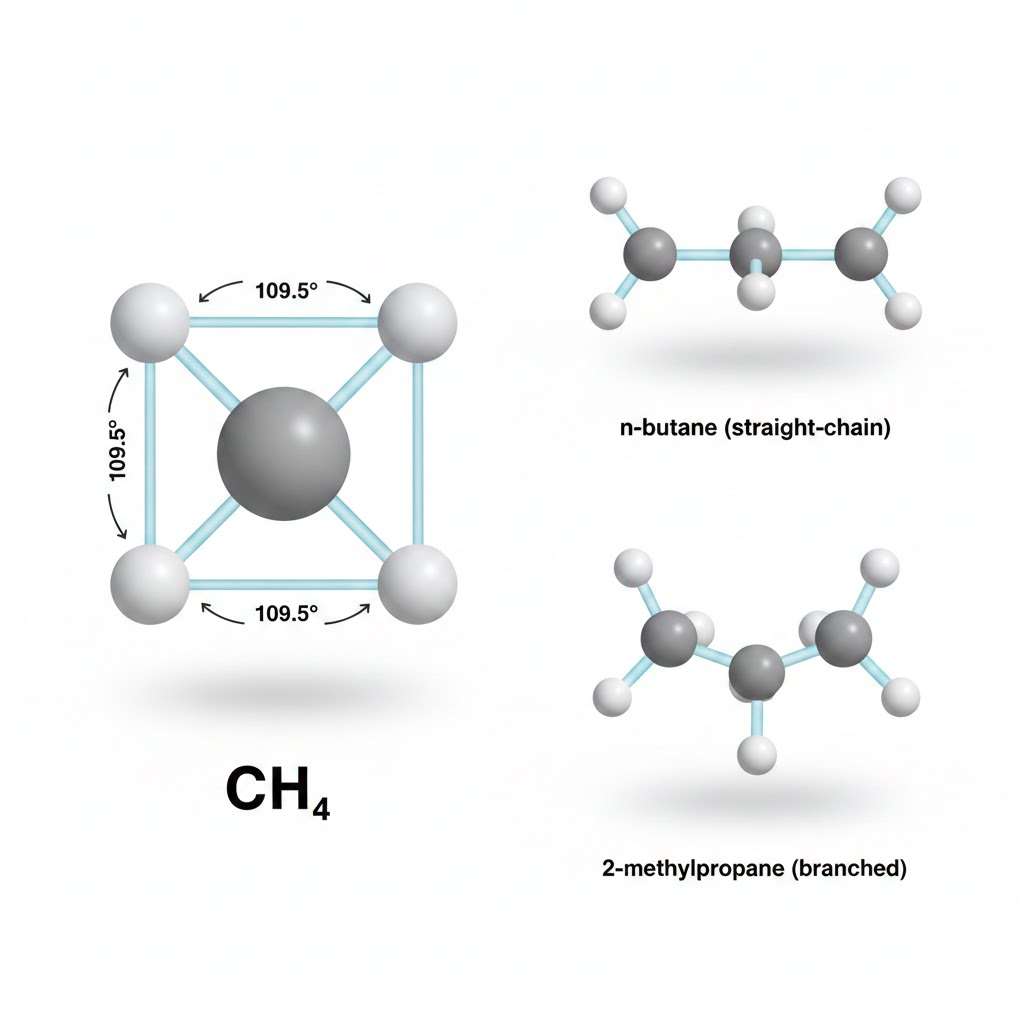
. In methane ($CH_{4}$), the carbon sits like a boss at the centre of a tetrahedron, keeping all hydrogens at a bond angle of $109.5^{\circ}$. It’s a perfect $sp^{3}$ hybridisation setup where the $C-C$ bond length is $154\text{ pm}$ and $C-H$ is $112\text{ pm}$.
NEET Checkpoint:
What is the general formula for an alkyl substituent?
(a) CnH2nC_nH_{2n}CnH2n $C_nH_{2n}$
(b) CnH2n+2C_nH_{2n+2}CnH2n+2 $C_nH_{2n+2}$
(c) CnH2n+1C_nH_{2n+1}CnH2n+1 $C_nH_{2n+1}$
(d) CnH2n−1C_nH_{2n-1}CnH2n−1 $C_nH_{2n-1}$
✅ Answer: (b) $C_{n}H_{2n+1}$ — Arre, it’s just an alkane minus one hydrogen atom!
When it comes to naming, IUPAC is the law. You must find the longest continuous carbon chain—think of it like finding the longest route for a Delhi rickshaw to overcharge you!. If you have branches, number the chain so the substituents get the lowest possible numbers.
Now, let's talk about Isomerism. Alkanes like Butane ($C_{4}H_{10}$) and Pentane ($C_{5}H_{12}$) can rearrange their carbon "skeletons" to form chain isomers. While Butane has only two isomers, Pentane has three: n-pentane, isopentane, and neopentane. As the chain gets longer, the family drama increases—$C_{10}H_{22}$ actually has 75 possible isomers!
NEET Checkpoint:
How many chain isomers are possible for $C_{6}H_{14}$?
(a) 2
(b) 3
(c) 4
(d) 5
✅ Answer: (d) 5 — Check out Problem 9.1 in your NCERT for the full list, yaar!
Don't forget to identify your carbons! A primary ($1^{\circ}$) carbon is attached to only one other carbon (the "loner"), while a quaternary ($4^{\circ}$) carbon is the "social butterfly" attached to four others.
NEET Checkpoint:
In neopentane, how many $1^{\circ}$ carbons are present?
(a) 1
(b) 2
(c) 3
(d) 4
✅ Answer: (d) 4 — The central carbon is $4^{\circ}$, and all four terminal methyl carbons are $1^{\circ}$.
Figure below:
A clear 3D diagram showing the tetrahedral structure of methane ($CH_{4}$) with bond angles of 109.5 degrees and a separate diagram comparing the straight-chain structure of n-butane with the branched structure of 2-methylpropane.
Practice Questions:
1. Which of the following alkanes has the highest number of chain isomers?
(a) $C_{4}H_{10}$
(b) $C_{5}H_{12}$
(c) $C_{6}H_{14}$
(d) $C_{3}H_{8}$
✅ Answer: (c) $C_{6}H_{14}$ — It has 5 isomers, while $C_{3}H_{8}$ has only one possible structure.
2. What is the IUPAC name for isobutane?
(a) 2-Methylpropane
(b) 2,2-Dimethylpropane
(c) n-Butane
(d) 2-Methylbutane
✅ Answer: (a) 2-Methylpropane — It’s a three-carbon chain with a methyl group on the second carbon.
Key Takeaway
- General Formula: $C_{n}H_{2n+2}$.
- Structure: Tetrahedral, $109.5^{\circ}$ bond angles, $sp^{3}$ hybridised.
- Isomerism: Chain isomerism starts from Butane ($n=4$).
- Carbon Types: $1^{\circ}$ (terminal), $2^{\circ}$ (middle), $3^{\circ}$ (tertiary), $4^{\circ}$ (quaternary/neo).
3. Preparation of Alkanes
Hey juniors! Ready to learn how to "cook" some alkanes? It’s not exactly MasterChef, but getting these fundas right will definitely help you ace NEET. Alkanes might be "paraffins" (little affinity), but their preparation methods are super important.
1. From Unsaturated Hydrocarbons
Think of this as adding extra players to your cricket team. We take alkenes or alkynes and add dihydrogen gas ($H_2$) using catalysts like Platinum ($Pt$), Palladium ($Pd$), or Nickel ($Ni$).
- The Trick: $Pt$ and $Pd$ work at room temperature, but $Ni$ is a bit stubborn and needs higher temperature and pressure.
NEET Checkpoint:
Which catalyst requires higher temperature for hydrogenation?
(a) Platinum (Pt)
(b) Palladium (Pd)
(c) Nickel (Ni)
(d) Raney nickel
✅ Answer: (c) Nickel (Ni) — While $Pt$ and $Pd$ work at room temperature, $Ni$ needs that extra "garmi" (heat) to get going.
2. From Alkyl Halides
We can reduce alkyl halides (except fluorides) using Zinc and dilute Hydrochloric acid. It’s like a simple player substitution in a gully cricket match—swapping a halogen for a hydrogen.
Wurtz Reaction: This is the famous "doubling" reaction. If you treat alkyl halides with Sodium in dry ether, you get higher alkanes with an even number of carbons. Think of it like ordering two plates of vada pav—you always end up with an even number of vadas!
NEET Checkpoint:
Can we prepare Methane ($CH_4$) using the Wurtz reaction?
(a) Yes, by using methyl halide
(b) Yes, by using ethyl halide
(c) No, because Wurtz reaction gives higher alkanes
(d) No, because methane has only one carbon
✅ Answer: (c) No — Since the reaction couples two alkyl groups ($R-R$), the smallest product has at least 2 carbons.
3. From Carboxylic Acids
Decarboxylation: Heat a sodium salt of a carboxylic acid with soda lime (a mix of $NaOH$ and $CaO$). You’ll lose one carbon atom as $Na_2CO_3$, leaving you with an alkane that has one carbon less than the original salt.
Kolbe’s Electrolytic Method: Electrolysing an aqueous solution of sodium/potassium salts gives alkanes at the anode.
NEET Checkpoint:
In Kolbe’s electrolysis, where is the alkane formed?
(a) At the cathode
(b) At the anode
(c) In the solution
(d) At both electrodes
✅ Answer: (b) At the Anode — The methyl free radicals couple up right there at the positive electrode.
Even friction needs a break sometimes, so take a breather after these reactions!
Practice Question:
Which of the following is used for the decarboxylation of sodium salts of carboxylic acids?
(a) $Zn / HCl$
(b) $Pt / Pd$
(c) $NaOH + CaO$
(d) $Na / \text{dry ether}$
✅ Answer: (c) — This mixture is known as soda lime and helps remove $CO_2$.
Key Takeaway: Preparation Summary
- Hydrogenation: Alkenes/Alkynes + $H_2$ + ($Pt/Pd/Ni$) $\rightarrow$ Alkane
- Wurtz Reaction: $2RX + 2Na \xrightarrow{\text{dry ether}} R-R$ (Even carbons only)
- Decarboxylation: $RCOONa + \text{Soda Lime} \xrightarrow{\Delta} R-H$ (One carbon less)
- Kolbe’s: Electrolysis of $RCOONa \rightarrow$ Alkane at Anode
4. Properties of Alkanes & Halogenation Mechanism
Hey, future docs! Ready to crack the funda of Alkanes? These guys are called paraffins (Latin: parum = little; affinis = affinity) because they are super chill and don't react with acids or bases under normal conditions.
Physical Properties: The Non-Polar Squad
Alkanes are almost non-polar because the electronegativity difference between $C$ and $H$ is tiny. They only have weak van der Waals forces to hold them together.
Here’s the B.P. (Boiling Point) logic:
1. Size Matters: As molecular mass increases, B.P. increases because surface area and van der Waals forces grow.
2. Branching is a Party Pooper: Branching makes a molecule spherical (like a cricket ball). This reduces surface area and contact, so branching decreases B.P..
Indian Example: Imagine $n$-pentane as a long line of people waiting for a Mumbai local train, and neopentane as a tight huddle around a Pani Puri stall. The huddle (branched) is more compact and easier to "break apart" than the long line.
NEET Checkpoint:
Arrange in increasing B.P.: $n$-butane, $i$-butane.
(a) $n$-butane < $i$-butane
(b) $i$-butane < $n$-butane
(c) $i$-butane = $n$-butane
(d) Cannot be compared
✅ Answer: (b) $i$-butane < $n$-butane — Because branching reduces surface area, decreasing the boiling point.
The Halogenation Drama (Free Radical Mechanism)
Halogenation isn't a simple handshake; it’s a three-act play:
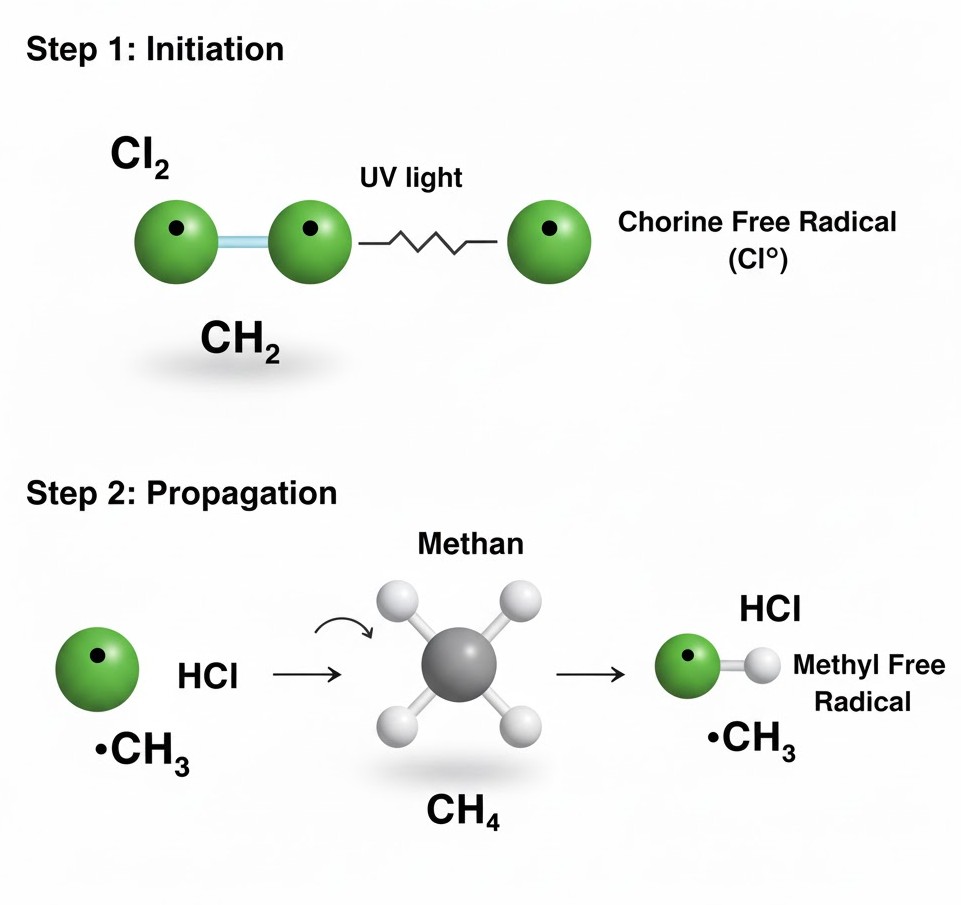
1. Initiation: UV light or heat causes homolysis of $Cl-Cl$ to create chlorine free radicals ($Cl^{\bullet}$).
2. Propagation: These radicals attack the alkane, creating methyl radicals and $HCl$, which then keep the chain going.
3. Termination: The party ends when any two radicals collide and form a stable molecule.
NEET Checkpoint:
Which step in halogenation forms the principal products?
(a) Initiation step
(b) Propagation step
(c) Termination step
(d) Induction step
✅ Answer: (b) Propagation — Steps directly yield the halogenated products.
Combustion, Oxidation, and Aromatisation
Alkanes are the "fuel of India" (CNG/LPG) because combustion releases massive heat:
Controlled Oxidation is like using a remote control. Use $Cu$ at $523\text{ K}$ and you get Methanol; use $Mo_2O_3$ and you get Methanal.
Aromatisation is the ultimate glow-up! $n$-Hexane, when heated to $773\text{ K}$ with oxides of $V, Cr,$ or $Mo$, turns into Benzene.
NEET Checkpoint:
Which catalyst converts methane to methanol?
(a) Nickel
(b) Copper
(c) Molybdenum oxide
(d) Platinum
✅ Answer: (b) Copper ($Cu$) at $523\text{ K}$ and $100\text{ atm}$.
Figure below:
A clear diagram showing the homolysis of a chlorine molecule into two chlorine free radicals under UV light, and the subsequent attack on a methane molecule as seen in Section 9.2.3.
Practice Question:
What is the major product when $n$-Hexane is heated with $Cr_2O_3/Al_2O_3$ at $773\text{ K}$?
(a) Hexene
(b) Benzene
(c) Cyclohexane
(d) Ethane
✅ Answer: (b) Benzene — This is the process of aromatisation or reforming for alkanes with $C_6$ or more.
Key Takeaway
- B.P. Trend: Mass $\uparrow$, B.P. $\uparrow$; Branching $\uparrow$, B.P. $\downarrow$.
- Halogenation: Free radical chain mechanism (Initiation $\rightarrow$ Propagation $\rightarrow$ Termination).
- Aromatisation: $C_6+$ alkanes + $V_2O_5/Cr_2O_3$ + $773\text{ K} \rightarrow$ Benzene.
5. Conformations of Ethane
Listen, yaar, ethane molecules aren't just stiff sticks! Because of the symmetry of the sigma ($\sigma$) bond, the carbon atoms can actually rotate around each other almost freely. This twisting creates different spatial arrangements called conformations, conformers, or rotamers. Think of it like a pani puri stall: if you stack two plates perfectly so the edges line up, they are "eclipsed," but if you rotate one slightly to see the spicy water underneath, they are "staggered!".
NEET Checkpoint:
What do we call the spatial arrangements formed by rotation around a $C-C$ bond?
(a) Structural isomers
(b) Geometrical isomers
(c) Conformations or rotamers
(d) Tautomers
✅ Answer: (c) Conformations or rotamers — It’s just the molecule doing a little twist!.
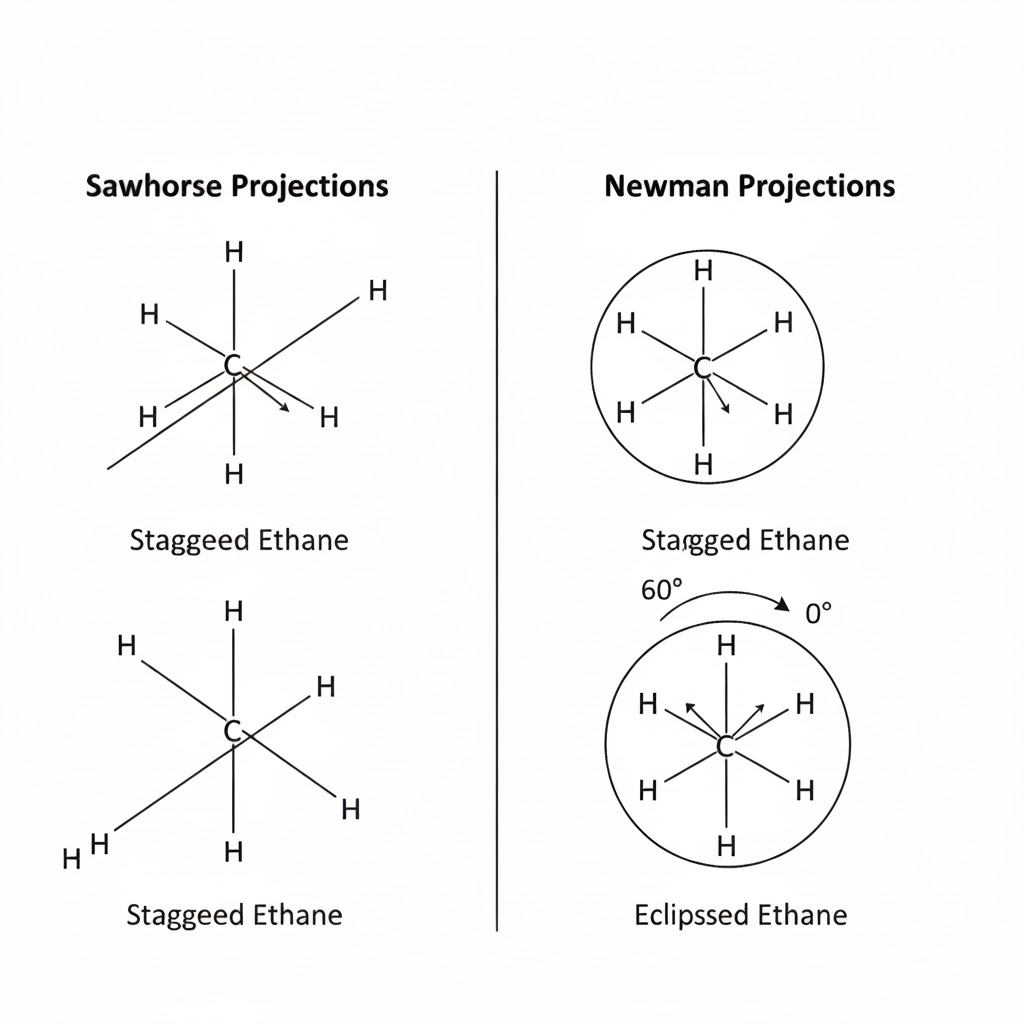
To visualise this, we use two main tricks. In Sawhorse Projections, we draw the $C-C$ bond as a long line and tilt it slightly; the front carbon is at the bottom and the rear at the top, with hydrogen lines at $120^{\circ}$. Newman Projections are even cooler—you look at the bond head-on! The front carbon is a tiny point and the rear carbon is a circle.
NEET Checkpoint:
In which projection is the rear carbon represented by a circle?
(a) Fischer projection
(b) Sawhorse projection
(c) Newman projection
(d) Wedge–dash projection
✅ Answer: (c) Newman Projection — It's like looking through a telescope at the bond!.
Now, for the real funda: stability. In the staggered form, hydrogens are as far apart as possible, meaning minimum repulsion and maximum "chill". The eclipsed form is high-energy and unstable because of torsional strain—the repulsive interaction between electron clouds. The energy difference is just $12.5~kJ~mol^{-1}$, so ethane keeps rotating easily at room temperature.
Figure below:
A clear diagram illustrating Sawhorse and Newman projections of ethane. For Sawhorse, show the $C-C$ bond as a long tilted line with $H$ atoms at $120^{\circ}$. For Newman, show the front carbon as a dot and the rear as a circle, clearly depicting the staggered ($60^{\circ}$ dihedral angle) and eclipsed ($0^{\circ}$ dihedral angle) positions.
NEET Checkpoint:
Which conformation of ethane has the least torsional strain?
(a) Eclipsed
(b) Partially eclipsed
(c) Staggered conformation
(d) Gauche
✅ Answer: (c) staggered conformation — Maximum distance equals minimum drama!.
Practice Questions:
1. The energy barrier for rotation about the $C-C$ bond in ethane is:
(a) $100~kJ~mol^{-1}$
(b) $12.5~kJ~mol^{-1}$
(c) $5~kJ~mol^{-1}$
(d) $0~kJ~mol^{-1}$
✅ Answer: (b) $12.5~kJ~mol^{-1}$ — This small barrier is easily crossed via collisions.
2. The dihedral angle in the eclipsed conformation of ethane is:
(a) $60^{\circ}$
(b) $120^{\circ}$
(c) $0^{\circ}$
(d) $180^{\circ}$
✅ Answer: (c) $0^{\circ}$ — Because the $H$ atoms are hidden directly behind each other!.
Now that you've mastered the twisty dance of alkanes, let’s see why alkenes are much more "rigid" with their double bonds!
Key Takeaway
Stability Order: Staggered > Skew > Eclipsed.
Torsional Strain: The repulsion between adjacent bond electron clouds that makes the eclipsed form less stable.
Energy Barrier: $12.5~kJ~mol^{-1}$.
6. Alkenes: Structure and Nomenclature
Ready to dive into the world of "olefins", yaar? Alkenes are the energetic cousins of alkanes, featuring at least one $C=C$ double bond. Think of them like a popular Pani Puri stall—they attract everyone (electrophiles) because of those loosely held $\pi$ electrons.
The Fundamental Funda
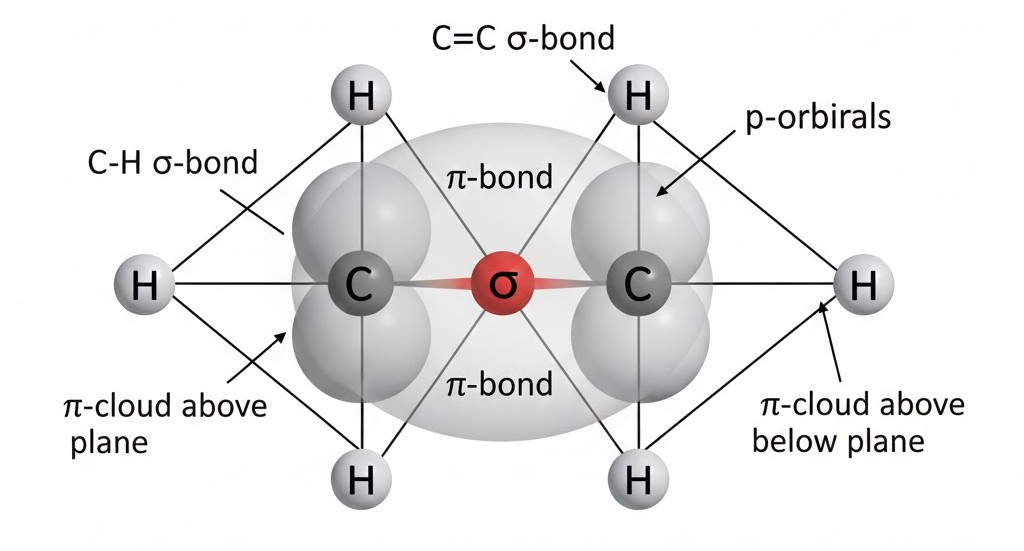
The general formula for alkenes is $C_nH_{2n}$. In a $C=C$ double bond, the carbon atoms are $sp^2$ hybridised. This double bond is a mix: one strong $\sigma$ (sigma) bond formed by head-on overlapping of $sp^2$ orbitals, and one weak $\pi$ (pi) bond created by lateral or sideways overlapping of $2p$ orbitals. Don't forget, the $\pi$ bond is the weak link here, making alkenes quite reactive!
NEET Checkpoint:
Why are alkenes called "olefins"?
(a) They are oily liquids
(b) They form oils on oxidation
(c) They form oily products with halogens
(d) They are obtained from oils
✅ Answer: (c) Because the first member, ethene, reacts with chlorine to form an oily liquid.
Naming the Game
To name these, pick the longest chain containing the double bond and number it from the end closer to that double bond. Just swap the 'ane' from alkanes with the suffix '-ene'. It’s like changing your surname after joining a cooler club!
Figure below:
A clear diagram of the orbital picture of ethene showing the planar $sp^2$ hybridised framework, the $\sigma$ bond between carbons, and the overlapping $2p$ orbitals forming a $\pi$-cloud above and below the molecular plane.
Isomerism Magic
While ethene and propene are straightforward, $C_4H_8$ and higher alkenes show structural isomerism. You’ll encounter chain isomerism (different carbon skeletons) and position isomerism (where the double bond shifts, like moving your seat to the front in a shared rickshaw).
NEET Checkpoint:
What is the IUPAC name for $CH_3-CH_2-CH=CH_2$?
(a) Butene
(b) 2-Butene
(c) 1-Butene
(d) But-1-ene
✅ Answer: (d) But-1-ene — We number from the right to give the double bond the lowest number, which is 1!
NEET Checkpoint:
Which bond is shorter: $C-C$ or $C=C$?
(a) C−C single bond
(b) C=C double bond
(c) Both are equal
(d) Cannot be determined
✅ Answer: (b) $C=C$ ($134\text{ pm}$) is shorter than $C-C$ ($154\text{ pm}$).
Practice Question:
How many structural isomers (chain and position) are possible for the molecular formula $C_4H_8$?
(a) 1
(b) 2
(c) 3
(d) 4
✅ Answer: (c) 3 — You get But-1-ene, But-2-ene (position isomers), and 2-Methylprop-1-ene (chain isomer).
Key Takeaway
Formula Summary
- General Formula: $C_nH_{2n}$
- Hybridisation: $sp^2$ (Planar geometry)
- Bonding: 1 $\sigma$ (strong) + 1 $\pi$ (weak)
- Nomenclature: Suffix '-ene'; lower number to the double bond.
7. Geometrical Isomerism in Alkenes
Let’s clear this funda! In alkanes, carbon atoms can spin like a fidget spinner, but alkenes have a double bond that acts like two nails hammered into cardboard—rotation is restricted! This gives rise to Geometrical Isomerism. When the two identical atoms or groups lie on the same side of the $C=C$ double bond, it is the Cis isomer. If they lie on opposite sides, it’s the Trans isomer.
Think of a local rickshaw—if two friends sit together on the back seat, that’s Cis. If one sits with the driver and the other stays in the back, facing away, that’s Trans! Even molecules need their personal space sometimes, right?
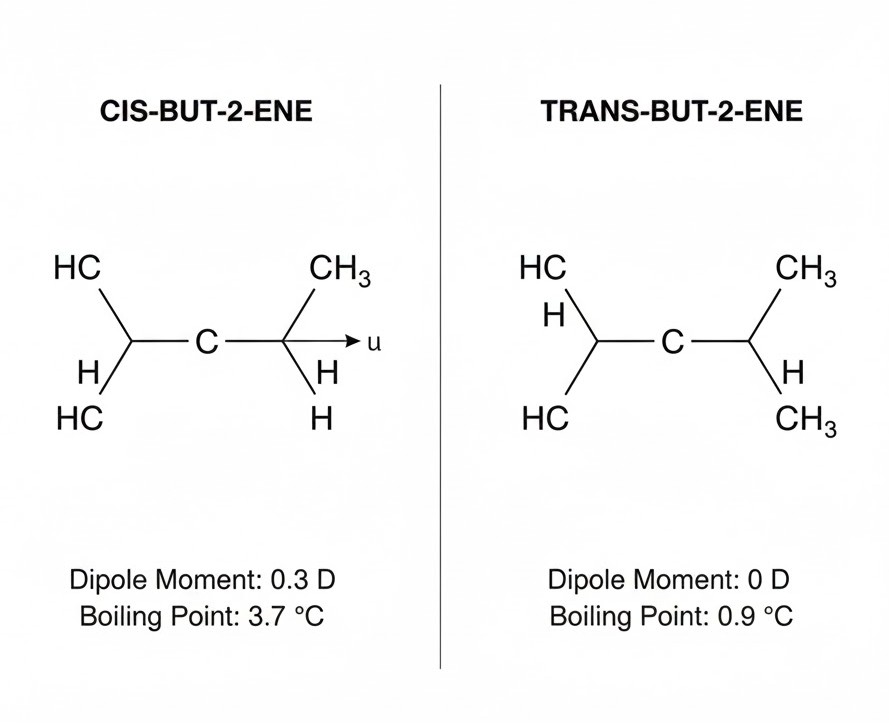
Now, why does this matter for NEET? Because properties change! Cis forms are typically more polar. For instance, cis-but-2-ene has a dipole moment of $\mu = 0.33 D$, but trans-but-2-ene is non-polar ($\mu = 0$) because the $C-CH_3$ bond moments cancel each other out. This polarity difference means the Cis form has a higher boiling point ($277 K$) than the Trans form ($274 K$). However, in solids, the Trans isomer generally has a higher melting point because its symmetry allows it to pack better in the crystal lattice.
NEET Checkpoint:
What is the primary cause of geometrical isomerism in alkenes?
(a) Free rotation
(b) Restricted rotation around $C=C$
(c) Chain branching
(d) Electronegativity
✅ Answer: (b) Restricted rotation around $C=C$ — It's the "two-nail" rule, yaar!
NEET Checkpoint:
Which isomer of but-2-ene has a dipole moment of zero?
(a) Cis
(b) Trans
(c) Both
(d) Neither
✅ Answer: (b) Trans — The methyl groups pull in opposite directions, so $\mu$ cancels out perfectly.
NEET Checkpoint:
In the solid state, which isomer typically shows a higher melting point?
(a) Cis
(b) Trans
(c) Both are identical
(d) But-1-ene
✅ Answer: (b) Trans — Better symmetry means it packs tightly like a well-organised tiffin box!
Figure below:
A side-by-side comparison diagram of cis-but-2-ene and trans-but-2-ene, showing the methyl groups on the same side versus opposite sides of the double bond, with labels for dipole moment and boiling point.
Practice Question:
Which of the following will show geometrical isomerism?
(a) Propene
(b) $CH_2=CBr_2$
(c) $CHCl=CHCl$
(d) Ethene
✅ Answer: (c) $CHCl=CHCl$. To show this isomerism, each carbon of the double bond must be attached to two different groups.
Key Takeaway
Geometrical Isomerism: Occurs due to restricted rotation.
Cis Isomer: Identical groups on the same side; higher $\mu$ and boiling point.
Trans Isomer: Identical groups on opposite sides; higher melting point.
8. Preparation of Alkenes
Hey junior! Ready to manufacture some alkenes? Think of it like making the perfect batura—you need the right ingredients and a bit of heat to get that double-bond fluffiness!
1. From Alkynes (Partial Reduction):
If you start with an alkyne, you can choose your "side." Use Lindlar’s catalyst (palladised charcoal partially deactivated with sulphur or quinoline) to get a cis-alkene. But if you want the trans-alkene, use sodium in liquid ammonia. It's like choosing between a window seat or an aisle seat on a bus—same destination, different geometry!
NEET Checkpoint:
What do we call palladised charcoal partially deactivated with poisons?
(a) Baeyer's Reagent
(b) Lindlar's Catalyst
(c) Soda lime
(d) Zeigler-Natta
✅ Answer: (b) Lindlar's Catalyst — Arre, remember it’s "poisoned" so it doesn't reduce the alkyne all the way to an alkane!
2. From Alkyl Halides ($\beta$-Elimination):
Heating alkyl halides with alcoholic potash (KOH) eliminates a halogen acid ($HX$) to form alkenes. This is a $\beta$-elimination because the $H$ atom is removed from the $\beta$-carbon (the one next to the carbon holding the halogen).
3. From Vicinal Dihalides & Alcohols:
Got two halogens on adjacent carbons (vicinal dihalides)? Treat them with Zinc metal to lose $ZnX_2$ (dehalogenation). Or, take an alcohol and heat it with conc. $H_2SO_4$ to squeeze out a water molecule (acidic dehydration). Think of it like a pani puri vendor squeezing out the extra water—we want the crisp double bond!
NEET Checkpoint:
Which halogen shows the fastest rate in dehydrohalogenation?
(a) $Cl$
(b) $F$
(c) $I$
(d) $Br$
✅ Answer: (c) $I$ — Iodine is the best leaving group because the $C-I$ bond is weak. Fast like a boundary hit!
Practice Question:
Acidic dehydration of ethanol using concentrated $H_2SO_4$ produces:
(a) Ethane
(b) Ethene
(c) Ethyne
(d) Methane
✅ Answer: (b) Ethene — Dehydration removes $H_2O$ to create the unsaturation. Simple funda!
Key Takeaway
Formula Summary
- Lindlar’s: Alkyne $\rightarrow$ cis-alkene
- Na/liq. $NH_3$: Alkyne $\rightarrow$ trans-alkene
- Alc. KOH: Alkyl Halide $\rightarrow$ Alkene ($\beta$-elimination)
- Zn metal: Vicinal dihalide $\rightarrow$ Alkene
- Conc. $H_2SO_4$ / $\Delta$: Alcohol $\rightarrow$ Alkene
9. Electrophilic Addition Reactions of Alkenes
Listen up, juniors! Alkenes are like the popular kids in school—everyone wants to "add" them because they have those loosely held $\pi$ electrons just waiting for an electrophile to come knocking. Since these electrons are mobile, alkenes act as great sources for reagents looking for an electron-fix.
NEET Checkpoint:
Why are alkenes easily attacked by electrophiles?
(a) Because of the weak C−H bond
(b) Because of the high bond angle
(c) Because of the electron-rich double bond (π-bond)
(d) Because of their low molecular weight
✅ Answer: (c) Due to the presence of loosely held mobile $\pi$ electrons.
First, let's talk about the Test for Unsaturation. If you add reddish-orange bromine in $CCl_{4}$ to an alkene, the colour disappears faster than free samosas at a tuition break!. This decolourisation proves there's a double bond because it forms a vicinal dihalide.
Markovnikov’s Rule is the real boss for unsymmetrical alkenes. It states the negative part of the reagent (like $Br^{-}$ in $HBr$) attaches to the carbon with fewer hydrogen atoms. Think of it like a crowded Mumbai local: the "negative" passenger squeezes in where there are already fewer "H-friends" to make space!
The Mechanism Funda:
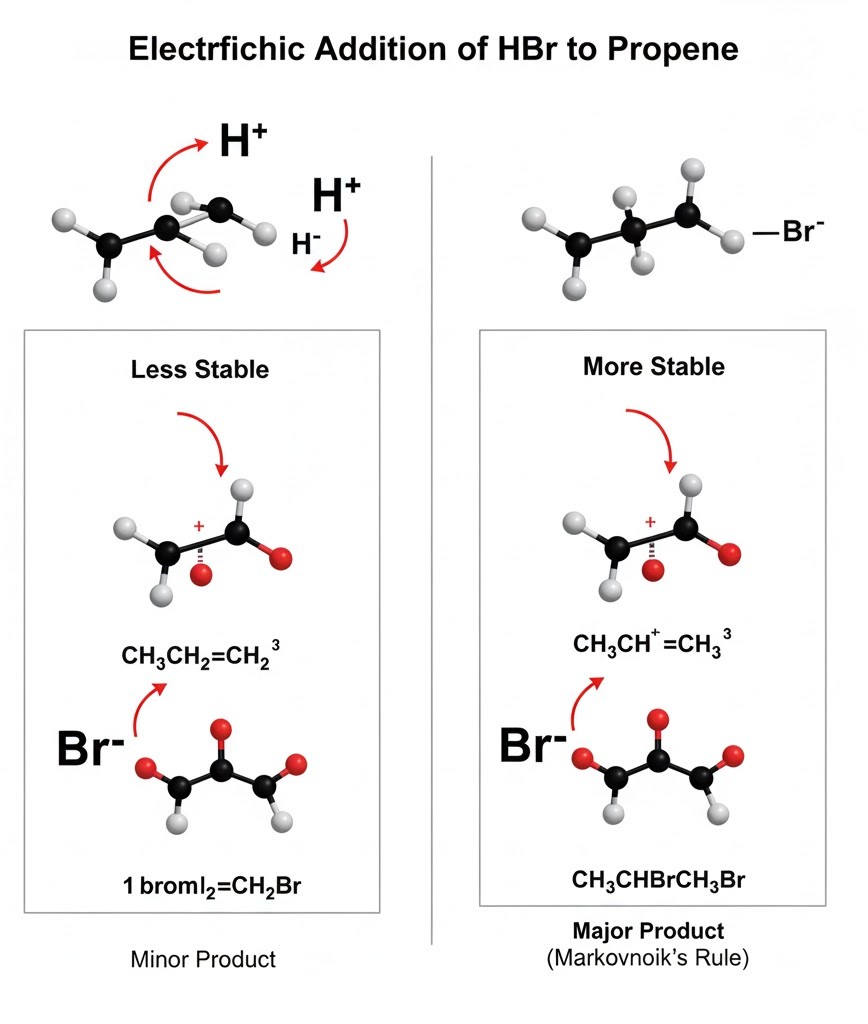
When adding $HBr$ to propene, we form carbocation intermediates. The $2^{\circ}$ carbocation is more stable than the $1^{\circ}$ one, so it forms faster and leads to the major product.
NEET Checkpoint:
Which carbocation is more stable during $HBr$ addition to propene?
(a) Primary carbocation
(b) Secondary carbocation
(c) Tertiary carbocation
(d) All are equally stable
✅ Answer: (b) Secondary ($2^{\circ}$) carbocation—Stability order is $3^{\circ} > 2^{\circ} > 1^{\circ}$.
For Addition of Water (Hydration), just use a few drops of sulphuric acid as a catalyst. It follows Markovnikov's rule to give you an alcohol.
NEET Checkpoint:
What is the product of ethene + $H_{2}$ in the presence of $Pt$?
(a) Ethyne
(b) Ethane
(c) Ethanol
(d) Acetaldehyde
✅ Answer: (b) Ethane—This is the addition of dihydrogen (hydrogenation).
Figure below:
A clear reaction mechanism diagram showing Propene reacting with $H^{+}$, branching into two paths: one showing a primary carbocation (labelled 'Less Stable') and another showing a secondary carbocation (labelled 'More Stable'), leading to 2-bromopropane.
Practice Question:
Which of the following will decolourise bromine water?
(a) Methane
(b) Propene
(c) Ethane
(d) Benzene
✅ Answer: (b) Propene — Alkenes undergo electrophilic addition with $Br_{2}$ to discharge the reddish-orange colour.
Key Takeaway: Electrophilic Addition
- Test: $Br_{2}/CCl_{4}$ colour discharge = Unsaturation.
- Markovnikov: Negative part $\rightarrow$ C with fewer H atoms.
- Stability: Major product comes from the more stable carbocation ($2^{\circ} > 1^{\circ}$).
10. Peroxide Effect and Ozonolysis
Most of the time, alkenes follow the rules, but today we are looking at the rebels of the chemical world. First up is the Peroxide Effect (also called the Kharash Effect), discovered by M.S. Kharash and F.R. Mayo. While the Markovnikov rule usually tells the negative part of a reagent to go to the carbon with fewer hydrogens, adding a little peroxide changes the whole game for $HBr$. It forces an Anti-Markovnikov addition via a free radical mechanism.
NEET Checkpoint:
The peroxide effect is observed with which of these?
(a) $HCl$
(b) $HI$
(c) $HBr$
(d) All of these.
✅ Answer: (c) $HBr$ only — Arre, don't get confused! The $H-Cl$ bond is too strong for radicals to break, and $I$ radicals prefer joining each other to form $I_{2}$ instead of attacking the alkene.
Think of it like a local bus during rush hour. Usually, everyone crowds the first door they see (Markovnikov). But if a "Peroxide" (a helpful conductor) points to the empty back door, everyone rushes there instead (Anti-Markovnikov)!
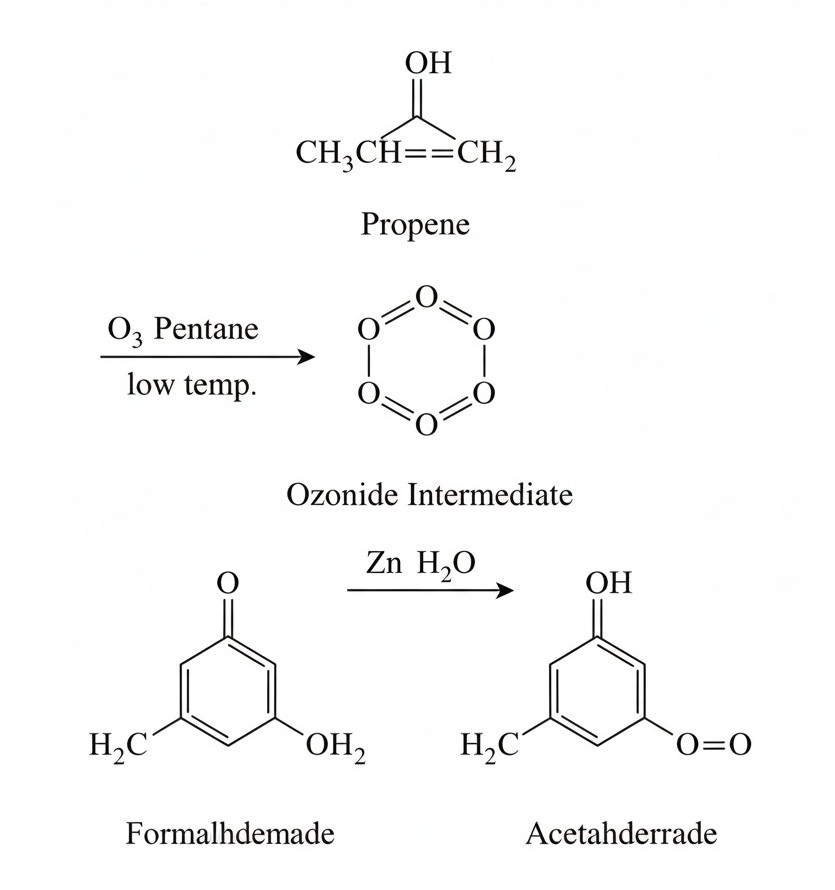
Next, we have Ozonolysis. We add ozone ($O_{3}$) to an alkene to form an ozonide, then slice it up using $Zn$ and $H_{2}O$. This is the ultimate "detective" reaction because it tells us exactly where the double bond was hiding. If your alkene was propene, you’d end up with ethanal ($CH_{3}CHO$) and methanal ($HCHO$).
Figure below:
A clear diagram showing the addition of $O_{3}$ to propene to form a ring-like ozonide intermediate, followed by its cleavage with $Zn/H_{2}O$ into two smaller carbonyl compounds.
NEET Checkpoint:
What is the product of reacting an alkene with Baeyer’s reagent?
(a) Alcohol
(b) vicinal glycols
(c) Ketone
(d) Carboxylic acid
✅ Answer: (b) Vicinal glycols — Cold, dilute $KMnO_{4}$ (Baeyer's reagent) adds two $-OH$ groups across the double bond, turning the purple solution colourless.
NEET Checkpoint:
Ozonolysis is used to:
(a) Prepare alkanes
(b) Find double bond positions
(c) Reduce alcohols
(d) Test for acidity
✅ Answer: (b) — It breaks the molecule at the double bond so we can see the fragments and reconstruct the original structure.
Practice Questions:
An alkene on ozonolysis gives two moles of an aldehyde with molar mass $44~u$. What is the alkene?
(a) But-1-ene
(b) But-2-ene
(c) Butadiene
(d) 2-Methylpropene
✅ Answer: (b) But-2-ene — A mass of $44~u$ corresponds to ethanal ($CH_{3}CHO$), and joining two of these at the $C=O$ site gives but-2-ene.
Key Takeaway: Reaction Summary
- Peroxide Effect: $HBr + \text{Peroxide} \rightarrow \text{Anti-Markovnikov product (Free Radical Mechanism)}$.
- Ozonolysis: $1. O_{3}, 2. Zn/H_{2}O \rightarrow \text{Cleaves } C=C \text{ into carbonyls}$.
- Oxidation: $\text{Cold dil. } KMnO_{4} \rightarrow \text{Glycols (Test for unsaturation)}$.
11. Polymerisation of Alkenes and Alkynes
Listen up, juniors! Ever wondered how a tiny molecule like ethene ends up as the plastic bag you carry your groceries in? That’s the magic of polymerisation, where many small units called monomers join hands to form a giant polymer.
NEET Checkpoint:
What do we call the simple compounds from which polymers are made?
(a) Isomers
(b) Monomers
(c) Polymers
(d) Dimers
✅ Answer: (b) Monomers — Easy-peasy! Monomers are the building blocks.
For alkenes like ethene and propene, this happens at high temperature and pressure with a catalyst. Think of it like a Mumbai local train; each bogie is a monomer, and when they all couple together, you get one long, unstoppable polymer train!
Polythene is used for toys and pipes, while polypropene is the "tough guy" used for milk crates and buckets.
NEET Checkpoint:
Which polymer is used specifically for making milk crates?
(a) Polythene
(b) Polystyrene
(c) Polypropene
(d) Polyacetylene
✅ Answer: (c) Polypropene — It's the go-to for moulded articles like crates.
Now, don't forget the alkynes! Ethyne undergoes linear polymerisation to produce polyacetylene (or polyethyne). This contains repeating $-(CH=CH-CH=CH)-$ units. Here’s the "funda": under special conditions, this thin film conducts electricity! It’s used as a cheap, light electrode in batteries.
NEET Checkpoint:
Polyacetylene is a high molecular weight polyene that can:
(a) Only exist as a gas
(b) Conduct electricity
(c) Form benzene at 273 K
(d) Only be used for welding
✅ Answer: (b) Conduct electricity — That’s why it’s used in battery electrodes, yaarr!.
Practice Questions:
1. The polymer used in the manufacture of refrigerator dishes and TV cabinets is:
(a) Polypropene
(b) Polythene
(c) Polyacetylene
(d) Methane
✅ Answer: (b) Polythene — The sources list these as common applications.
2. Linear polymerisation of ethyne produces:
(a) Benzene
(b) Polypropene
(c) Polyacetylene
(d) Ethane
✅ Answer: (c) Polyacetylene — Linear polymerisation leads to polyacetylene, while cyclic leads to benzene.
Key Takeaway
- Polythene: From ethene; used for bags, toys, and pipes.
- Polypropene: From propene; used for milk crates and buckets.
- Polyacetylene: From ethyne; conducts electricity and is used in battery electrodes.
12. Alkynes: Structure, Nomenclature & Acidity
Welcome back, future doctors! Ready to master the "triple-threat" of hydrocarbons? Alkynes are unsaturated beauties with the general formula $C_nH_{2n-2}$. Think of them like a stiff cricket bat—perfectly linear and incredibly strong!
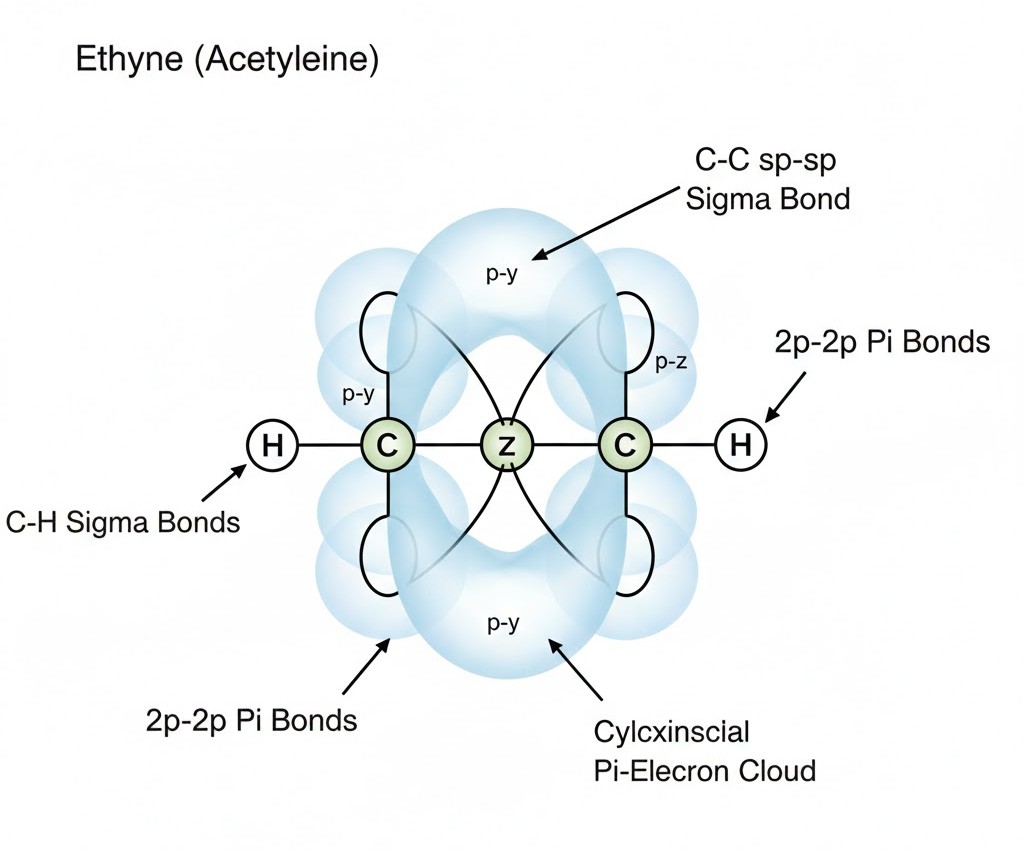
In alkynes, each triply bonded carbon is $sp$ hybridised. This means they have two $sp$ orbitals and two unhybridised $p$ orbitals. One $sp$ orbital overlaps head-on to form a sigma ($\sigma$) bond, while the $p$ orbitals overlap sideways to form two pi ($\pi$) bonds. This results in a linear geometry with a bond angle of $180^\circ$.
NEET Checkpoint:
What is the hybridisation of carbon atoms in ethyne?
(a) $sp^3$
(b) $sp^2$
(c) sp
(d) s
✅ Answer: $sp$ — It involves one $s$ and one $p$ orbital, leading to a linear shape.
Now, let's clear up this acidity funda. Terminal alkynes (where the triple bond is at the end) are surprisingly acidic! Why? Because the $sp$ hybridised carbon has 50% $s$-character, making it highly electronegative. It pulls the shared electrons of the $C-H$ bond toward itself, letting the hydrogen leave as a proton. They react with strong bases like sodium or sodamide ($NaNH_2$) to form acetylides.
NEET Checkpoint:
Which is more acidic:
(a) Ethane
(b) Ethene
(c) Ethyne
(d) Methane
✅ Answer: (c) Ethyne — It has two acidic hydrogens, while propyne has only one.
Imagine the acidity order like a queue at a Pani Puri stall: Ethyne is at the front, followed by Ethene, and Ethane is way at the back.
Order of Acidity: $CH \equiv CH > CH_2 = CH_2 > CH_3 - CH_3$.
NEET Checkpoint:
What is the bond length of a $C \equiv C$ bond?
(a) 154 pm
(b) 134 pm
(c) 120 pm
(d) 109 pm
✅ Answer: (c) $120$ pm — It is shorter and stronger than single ($154$ pm) or double ($133$ pm) bonds.
Figure below:
A clear diagram showing the orbital structure of ethyne (acetylene), illustrating the two $sp-sp$ sigma bond, the $C-H$ sigma bonds, and the two mutually perpendicular pi-electron clouds forming a cylindrical shape around the internuclear axis.
Practice Questions:
1. Which of the following will react with sodamide ($NaNH_2$)?
(a) But-2-ene
(b) But-2-yne
(c) But-1-yne
(d) Butane
✅ Answer: (c) — Only terminal alkynes like But-1-yne have acidic hydrogens.
2. The $C \equiv C$ bond enthalpy is $823$ kJ/mol. This is higher than $C=C$ because:
(a) More s-character
(b) Three bonds are stronger than two
(c) Linear geometry
(d) It's non-polar
✅ Answer: (b) — A triple bond consists of one $\sigma$ and two $\pi$ bonds, making it much stronger.
Key Takeaway: Alkyne Essentials
- General Formula: $C_nH_{2n-2}$
- Structure: $sp$ hybridised, Linear, $180^\circ$
- Bonding: $1\sigma$ and $2\pi$ bonds
- Acidity: Ethyne > Ethene > Ethane
13. Preparation and Reactions of Alkynes
Hey juniors! Ready to master the triple bond? Alkynes are the hardcore members of the hydrocarbon family, and their "triple bond funda" makes them super reactive. Let's clear up how we make them and what they do before your next mock test!
Making Alkynes: The Two Main Routes
First up, Preparation. On an industrial scale, we use Calcium Carbide ($CaC_2$). Just add water to it, and you get Ethyne ($C_2H_2$). It's as simple as adding water to a pani puri concentrate!
Another way is from vicinal dihalides (where halogens are on adjacent carbons). We use a two-step "dehydrohalogenation" process: first with alcoholic $KOH$, then with a stronger base like sodamide ($NaNH_2$) to get that final triple bond.
NEET Checkpoint:
Which reagent is used to convert an alkenyl halide to an alkyne?
(a) $ H_2$
(b) $NaNH_2$
(c) $Br_2$
(d) $KMnO_4$
✅ Answer: (b) $NaNH_2$ — Alcoholic $KOH$ starts the job, but you need the stronger "sodamide" to finish it!.
Reaction Action: Addition & Polymerisation
Alkynes love adding stuff across their bonds. Hydrogenation with $Pt$, $Pd$, or $Ni$ takes them all the way to alkanes. When adding Halogens like $Br_2$, the reddish-orange colour disappears—this is your classic "test for unsaturation," yaar!
For Hydrogen Halides ($HX$), we follow Markovnikov’s rule: the negative part goes to the carbon with fewer hydrogens.
Hydration is the real NEET favourite. Using $Hg^{2+}/H^+$ at $333\ K$, Ethyne turns into Ethanal, while Propyne gives us Propanone. Think of it like a local train changing tracks; the reagents decide the final station (aldehyde or ketone)!
NEET Checkpoint:
What is the product of propyne hydration?
(a) Propanol
(b) Propanone
(c) Propanoic acid
(d) Propene
✅ Answer: (b) Propanone — Higher alkynes always yield ketones, not aldehydes, during hydration.
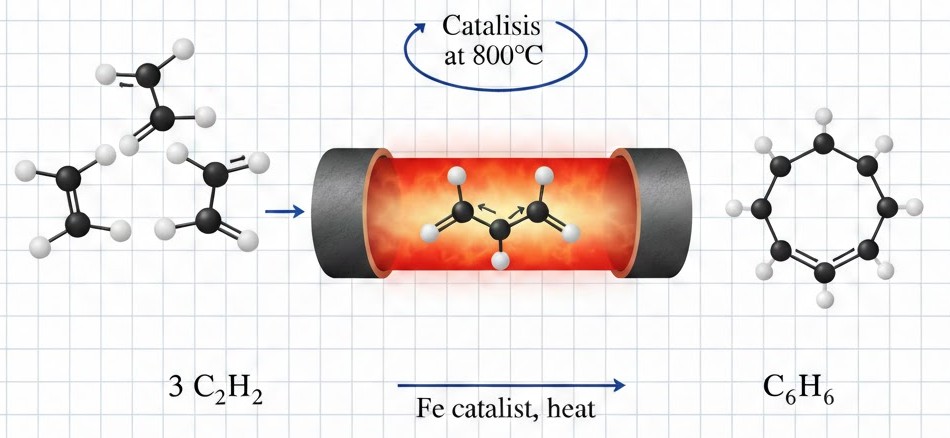
Finally, there’s Cyclic Polymerisation. Pass Ethyne through a red-hot iron tube at $873\ K$, and three molecules join up to form Benzene ($C_6H_6$).
Figure below:
A clear diagram showing three Ethyne ($C_2H_2$) molecules passing through a glowing red-hot iron tube and emerging as a single hexagonal Benzene ring.
NEET Checkpoint:
At what temperature does ethyne polymerise to benzene in an iron tube?
(a) 673 K
(b) 873 K
(c) 773 K
(d) 973 K
✅ Answer: (b) $873\ K$ — Don't forget this specific temperature; it's a common fact-based question!.
Practice Question:
Which of the following is formed when ethyne reacts with water in the presence of $HgSO_4$ and $H_2SO_4$?
(a) Methanal
(b) Ethanal
(c) Propanone
(d) Ethanol
✅ Answer: (b) Ethanal — Ethyne is the only alkyne that gives an aldehyde on hydration; others give ketones.
Key Takeaway: Alkyne Summary
- Prep: $CaC_2 + H_2O$ or Vicinal Dihalide + alc. $KOH/NaNH_2$.
- Hydration: $Hg^{2+}/H^+$ at $333\ K$ $\rightarrow$ Carbonyl compounds.
- Benzene Prep: $3 \times C_2H_2 \xrightarrow{\text{Red hot Fe, } 873\ K} C_6H_6$.
14. Aromatic Hydrocarbons: Structure and Aromaticity
Arre! Let's decode the superstar of Organic Chemistry—Benzene ($C_6H_6$). Back in the day, Friedrich August Kekulé had a dream about a snake biting its tail, leading him to suggest a cyclic ring with oscillating double bonds. Today, we use the resonance hybrid model, where a circle inside the hexagon represents six electrons delocalised across all six carbon atoms.
NEET Checkpoint:
What is the C-C bond length in benzene?
(a) 154 pm
(b) 134 pm
(c) 139 pm
(d) 120 pm
✅ Answer: (c) $139~pm$ — This is a classic "funda"! It's intermediate between a C-C single bond ($154~pm$) and a double bond ($133~pm$).
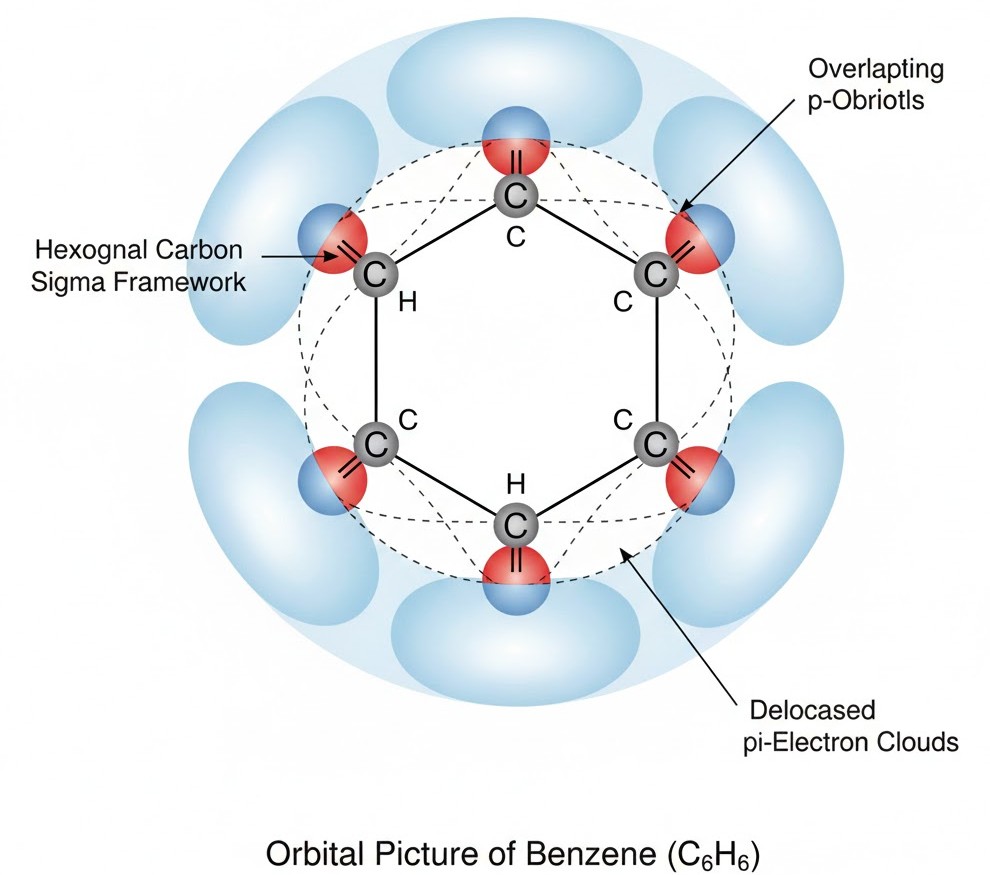
In the orbital picture, every carbon is $sp^2$ hybridised. These carbons form a flat hexagonal ring via $\sigma$ bonds, leaving one unhybridised p-orbital on each atom. These p-orbitals overlap sideways to form two "doughnut-shaped" delocalised pi-clouds, one above and one below the plane of the ring. Think of it like a circular crowd at an IPL match doing 'the wave'—the energy is spread out everywhere!
NEET Checkpoint:
Which hybridisation is found in benzene's carbon atoms?
(a) sp
(b) $sp^2$
(c) $sp^3$
(d) $sp^3d$
✅ Answer: (b) $sp^2$ — Each carbon uses three $sp^2$ orbitals for $\sigma$ bonding, leaving one p-orbital for $\pi$ delocalisation.
To be "Aromatic," a molecule must follow the Hückel Rule:
1. It must be planar.
2. There must be complete delocalisation of $\pi$ electrons in the ring.
3. It must have $(4n + 2) \pi$ electrons, where $n$ is an integer ($n = 0, 1, 2...$).
NEET Checkpoint:
Is a flat ring with $8 \pi$ electrons aromatic?
(a) Yes, because it is cyclic and planar
(b) No, because it does not satisfy Hückel’s rule
(c) Yes, because it has conjugation
(d) No, because it is non-cyclic
✅ Answer: (b) No — $8$ does not fit the $(4n + 2)$ rule ($n=1$ gives $6$, $n=2$ gives $10$). It must be $2, 6, 10,$ or $14 \pi$ electrons.
Figure below:
A clear diagram of the orbital picture of benzene, showing the hexagonal ring of carbon atoms with p-orbitals overlapping to form two doughnut-shaped delocalised pi-electron clouds above and below the planar ring.
Practice Question:
Which of the following is the correct number of $\pi$ electrons for naphthalene ($n=2$) to be aromatic?
(a) $6$
(b) $8$
(c) $10$
(d) $14$
✅ Answer: (c) $10$ — Using Hückel's Rule: $(4 \times 2) + 2 = 10 \pi$ electrons.
Key Takeaway
- Bond Length: All C-C bonds are equal at $139~pm$.
- Hybridisation: $sp^2$ with a planar hexagonal shape.
- Hückel Rule: $(4n+2) \pi$ electrons are mandatory for aromaticity.
15. Electrophilic Substitution & Directive Influence
Listen up, junior! Benzene might look stable, but it has a real weakness for electrophiles ($E^+$). While it hates addition reactions because it doesn't want to lose its aromaticity, it’s always down for Electrophilic Substitution Reactions (ESR).
The Big Five Reactions
Here’s the line-up you need to memorize for NEET:
1. Nitration: Benzene meets conc. $HNO_3$ + conc. $H_2SO_4$ to form Nitrobenzene. The hero here is the nitronium ion, $NO_2^+$.
2. Halogenation: Using $Cl_2$ or $Br_2$ with a Lewis acid like anhyd. $AlCl_3$ gives you haloarenes.
3. Sulphonation: Heating with fuming sulphuric acid (oleum) adds a $-SO_3H$ group.
4. Friedel-Crafts Alkylation: Adding an alkyl group using $R-X$ and anhyd. $AlCl_3$.
5. Friedel-Crafts Acylation: Adding an acyl group (like $-COCH_3$) using acyl halide.
NEET Checkpoint:
What is the electrophile in nitration?
(a) $NO_2$
(b) $NO_2^-$
(c) $NO_2^+$
(d) $NO_3^-$
✅ Answer: (c) $NO_2^+$ — Arre, the nitrating mixture produces this cation to attack the ring!
The Three-Step Mechanism
Every ESR follows this "funda":
* Step 1: Generation of the electrophile (using Lewis acids like $AlCl_3$).
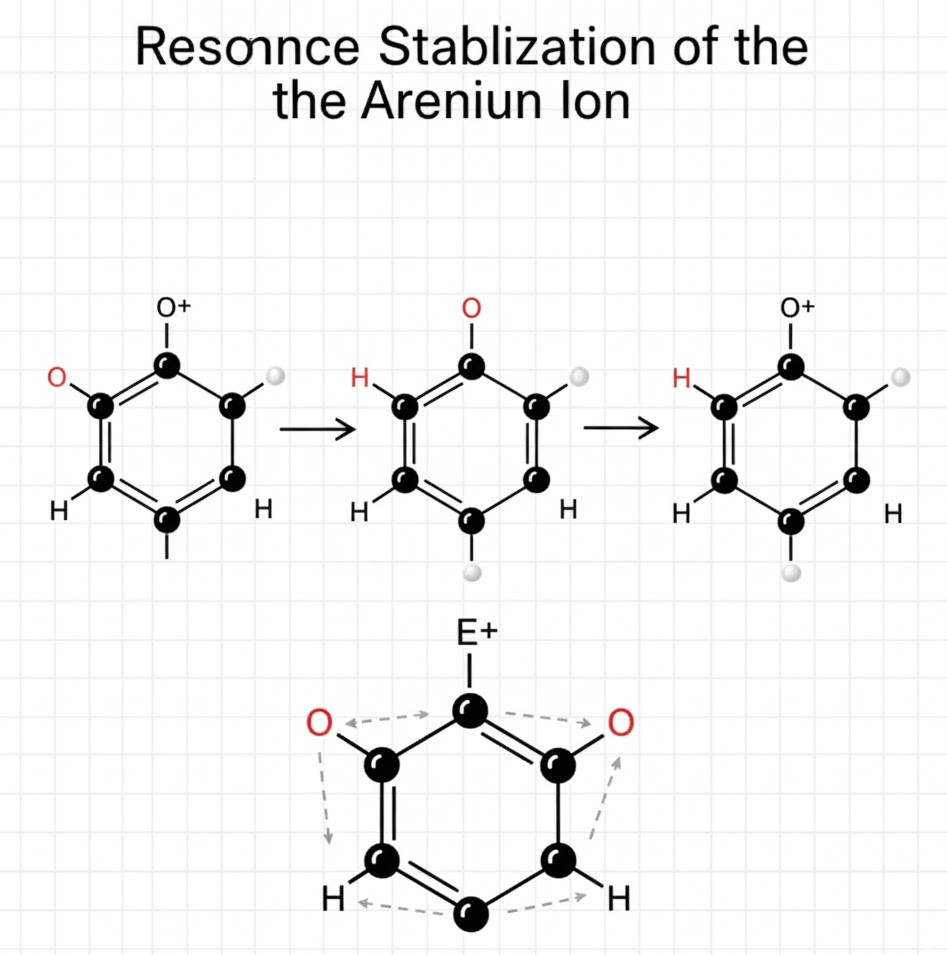
* Step 2: Formation of the arenium ion (or sigma complex). The ring temporarily loses its aromaticity here—very high energy!
* Step 3: Removal of a proton ($H^+$) to restore that precious aromatic character.
Figure below:
A clear diagram showing the resonance-stabilised arenium ion (sigma complex) with the positive charge delocalised over the ortho and para positions.
Directive Influence: The Traffic Police
Once a group is already on the ring, it acts like a traffic cop for the next guest:
* Ortho/Para Directing: Groups like $-OH$, $-NH_2$, and $-CH_3$ are activating. they push electrons into the ring, making it "rich" at $o$ and $p$ spots.
* Meta Directing: Groups like $-NO_2$, $-CHO$, and $-COOH$ are deactivating. They pull electrons away, leaving the $m$ position as the only viable spot for attack.
Relatable Example: Imagine a crowded Mumbai local train. If a friendly passenger (activating group) is sitting by the window, he’ll make space for you at the nearby seats (ortho/para). But if a grumpy uncle (deactivating group) is there, he’ll glare at you until you sit far away in the corner (meta)!
NEET Checkpoint:
Which of these is a meta-directing group?
(a) $-CH_3$
(b) $-OH$
(c) $-CHO$
(d) $-NH_2$
✅ Answer: (c) $-CHO$ — It's an electron-withdrawing group that makes the ring less reactive.
Toxicity: The Dark Side
Watch out! Polynuclear hydrocarbons like 1,2-Benzpyrene (formed from incomplete combustion of tobacco or coal) are highly toxic and carcinogenic. They enter the body and damage our DNA, leading to cancer. Stay away from that smoke, yaar!
NEET Checkpoint:
How are carcinogenic polynuclear hydrocarbons typically formed?
(a) By polymerization of alkenes
(b) By oxidation of alcohols
(c) By incomplete combustion of organic matter
(d) By halogenation of alkanes
✅ Answer: (c) Incomplete combustion of organic materials like tobacco and coal.
Practice Question:
Benzene reacts with $CH_3Cl$ in the presence of anhydrous $AlCl_3$ to form:
(a) Chlorobenzene
(b) Toluene
(c) Benzene hexachloride
(d) Acetophenone
✅ Answer: (b) Toluene — This is the classic Friedel-Crafts Alkylation!
Key Takeaway
- ESR Mechanism: Electrophile → Sigma Complex → Proton Loss.
- Activating (o/p): $-OH, -CH_3, -NH_2$.
- Deactivating (m): $-NO_2, -CHO, -COOH$.
- Carcinogens: Fused benzene rings from soot/smoke.