
1. Introduction to Equilibrium: Dynamic Nature and Characteristics
Hey future doctors! Let's dive into the core concept of Equilibrium. Don't stress, yaar—this funda is super logical once you get past the initial confusion!
Equilibrium: The Dynamic Flow
Many students think equilibrium means the reaction has stopped. Arre, that's static equilibrium, but chemistry usually deals with dynamic equilibrium. Dynamic equilibrium is established when the rate of the forward process is precisely balanced by the rate of the reverse process.
Imagine water evaporating in a closed bottle, represented by the phase change: $H_2O(l)\rightleftharpoons H_2O$ (vap). Equilibrium is reached when the rate at which molecules leave the liquid (evaporation rate) equals the rate at which they return from the vapour phase (condensation rate).
Notice this: Even though the amount of liquid water and the resulting vapour pressure stay constant (these are stable, macroscopic properties), the molecules are still buzzing with activity at the boundary. This constant, balanced, high-activity state is exactly what makes the condition dynamic.
NEET Checkpoint:
For a system to be at physical equilibrium, is the net rate of change zero?
(a) Yes
(b) No
(c) Only if the system is open
✅ Answer: (a) Yes — While molecular movement continues (dynamic), the net change in measurable properties is zero because opposing rates are equal.
The Characteristics Fanda
Equilibrium applies to both physical processes (like solid-liquid, liquid-gas, or solid dissolving) and chemical reactions. Several characteristics are common to systems at equilibrium:
- Closed System is Key: Equilibrium is possible only in a closed system where no exchange of matter occurs, and the temperature is constant. Open systems, like water evaporating into the atmosphere, cannot reach equilibrium.
- Opposing Rates are Equal: Both the forward and reverse processes occur simultaneously at the same rate.
- Constant Properties: All measurable properties of the system, such as concentration or pressure, remain constant because the two rates balance out.
Relatable Example: Think of a hugely popular pani puri stall. The rate at which the vendor gives out full puris (forward reaction) is exactly equal to the rate at which customers immediately hand back empty bowls for another one (reverse reaction). The total concentration (or amount) of ingredients seems constant, but the transactions are non-stop—that’s dynamic balance!
In chemical processes, this dynamic state means that the concentrations of reactants and products remain constant over time. Chemical systems can be classified into three groups based on the extent of reaction at equilibrium: those that proceed nearly to completion, those that form only small amounts of products, or those where reactants and products are present in comparable concentrations. This dynamic nature can be confirmed using tracer molecules, such as using deuterium ($D_2$) in the synthesis of ammonia, showing that the forward and reverse reactions continue even after constancy is achieved.
NEET Checkpoint:
Is chemical equilibrium reached when product concentration stops changing?
(a) Yes
(b) No, it must stop completely
(c) Only if $K_c$ is large
✅ Answer: (a) Yes — When concentrations stop changing, the rates of forward and reverse reactions have become equal, marking dynamic equilibrium.
Practice Question:
Which of the following is a general characteristic of physical equilibrium?
(a) The process must occur rapidly.
(b) The equilibrium constant changes with concentration.
(c) The system must be closed at a given temperature.
(d) Only the forward process occurs.
✅ Answer: (c) The system must be closed at a given temperature. — Physical equilibrium, like solid-liquid or liquid-vapour, is only possible in a closed system to maintain constant measurable properties.
NEET Checkpoint:
If a reaction has proceeded nearly to completion, what can be inferred about the reactants remaining at equilibrium?
(a) Their concentrations are comparable to products
(b) Only negligible concentrations are left
(c) No reactants are left
✅ Answer: (b) Only negligible concentrations are left — This classification applies to reactions that proceed nearly to completion.
Key Takeaway:
Equilibrium is a dynamic state where the rate of the forward reaction is exactly balanced by the rate of the reverse reaction, keeping all observable (macroscopic) properties constant.
2. Physical Equilibria: Phases and Dissolution Processes
Let's zoom in on how dynamic equilibrium shows up in everyday physical processes! These aren't reactions where bonds break, but rather phase changes (like melting or boiling) or dissolution (like sugar dissolving). Remember, the fundamental rule is the same: the rate of the opposing processes must be equal.
Phase Transformations: The Balanced Act
- Solid-Liquid Equilibrium (The Ice Funda): Imagine ice and water in a perfectly insulated flask at atmospheric pressure ($1~atm$) and $273~K$. Equilibrium is maintained because molecules leaving the ice surface to become liquid are balanced by liquid molecules adhering to the ice. The measurable properties, like the mass of ice and water, remain constant, but the molecular transfer is non-stop. The temperature at which this happens for a pure substance at $1~atm$ is the normal melting point.
Relatable Example: If you keep a frozen kulfi (Indian ice cream) in a super-insulated thermos, it seems static, but at the boundary, water molecules are constantly freezing and melting, just keeping the overall ratio balanced.
NEET Checkpoint:
For the $H_2O(s) \rightleftharpoons H_2O(l)$ equilibrium, the melting point is fixed only if which condition is constant?
(a) Volume
(b) Pressure
(c) Heat of fusion
✅ Answer: (b) Pressure — Melting point is fixed at constant pressure.
2. Liquid-Vapour Equilibrium (The Boiling Point Trick): If you seal a liquid in a container at a constant temperature, molecules escape into the vapour phase (evaporation). Eventually, molecules return to the liquid phase (condensation). Equilibrium is reached when the rate of evaporation equals the rate of condensation. At this point, the pressure exerted by the vapour is the equilibrium vapour pressure and remains constant at that specific temperature. The normal boiling point is the temperature where the liquid and vapour are in equilibrium at $1.013~bar$ pressure.
3. Solid-Vapour Equilibrium (Sublimation Swag): This is when a solid bypasses the liquid phase entirely to form a gas, like when solid Iodine ($I_{2}$) or Camphor sublimates. The equilibrium, such as $I_2$ (solid) $\rightleftharpoons I_2$ (vapour), is achieved when the intensity of the violet colour (vapour) becomes constant, indicating that the rate of sublimation equals the rate of condensation.
Dissolution Equilibria: Saturated Solutions
-
Solids in Liquids: When you dissolve sugar, a saturated solution is achieved when no more solute can dissolve at that temperature. Here, the rate of dissolution (sugar going into solution) balances the rate of crystallisation (sugar coming out of solution). This dynamic state means the concentration of the solute in the solution is constant at a given temperature.
-
Gases in Liquids (Henry's Law): Ever opened a chilled soda bottle and heard that satisfying fizz? That rapid fizzing is the gas escaping because the pressure dropped! Henry's law governs this equilibrium: the mass (or concentration) of a gas dissolved in a solvent is proportional to the pressure of the gas above the solvent. When the bottle is sealed, $CO_2$ is highly soluble due to high pressure; opening it causes the solubility to decrease quickly.
NEET Checkpoint:
If you seal a soft drink bottle under extremely high $CO_2$ pressure, how is the gas concentration in the liquid affected?
(a) Decreases
(b) Increases
(c) Remains constant
✅ Answer: (b) Increases — Henry's Law states concentration is proportional to pressure.
General Characteristics (Must-Knows for NEET)
For all these physical equilibria, some general characteristics hold true:
1. They require a closed system at a given temperature. An open system cannot reach equilibrium (like water evaporating completely into the atmosphere).
2. Opposing processes (forward and reverse) occur simultaneously at the same rate.
3. All measurable properties (pressure, concentration) remain constant.
Practice Question:
Which statement about the boiling point of a pure liquid is correct at $1.013~bar$ pressure?
(a) The rate of condensation is higher than the rate of evaporation.
(b) The vapour pressure is zero.
(c) The liquid and vapour phases coexist dynamically.
(d) The temperature varies depending on the amount of liquid.
✅ Answer: (c) The liquid and vapour phases coexist dynamically — The normal boiling point is the fixed temperature at which the liquid and vapour are in equilibrium (coexisting) at $1.013~bar$.
NEET Checkpoint:
If sugar crystals are added to a saturated sugar solution labelled with a radioactive tracer, what is observed after some time?
(a) No change in radioactivity in the solution.
(b) Radioactivity only in the solid crystals.
(c) Radioactivity in both solid and solution.
✅ Answer: (c) Radioactivity in both solid and solution — This confirms the dynamic nature of equilibrium, where continuous exchange (dissolution and crystallization) occurs.
Key Takeaway:
Physical equilibria, spanning solid-liquid, liquid-vapour, solid-vapour, and dissolution processes, are all dynamic. They are characterized by constant measurable parameters (like solubility or vapour pressure) only when maintained in a closed system.
3. Chemical Equilibrium: Concepts and Dynamic Nature
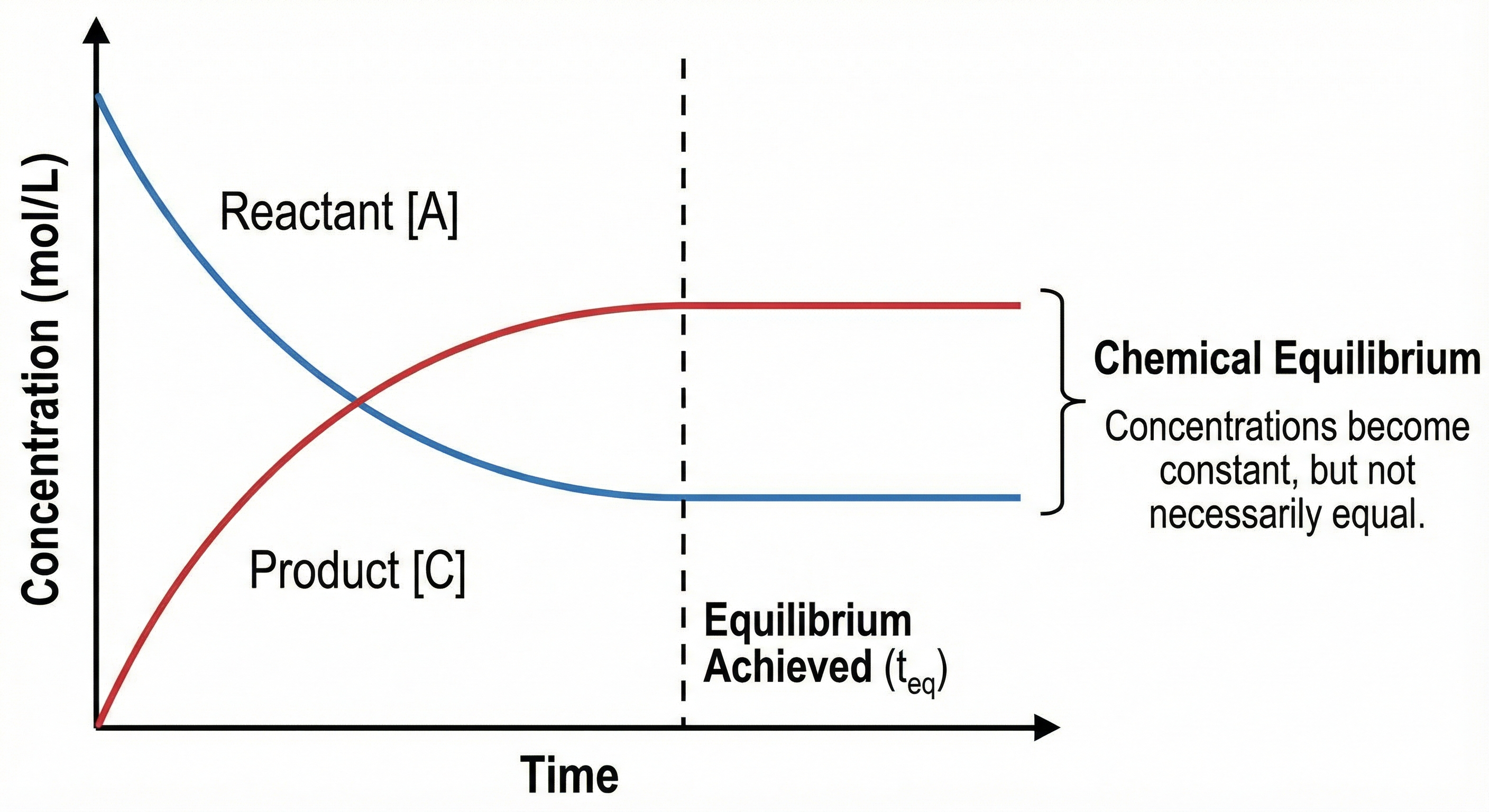
Let's talk about chemical equilibrium! Notice this: just like ice and water reach a dynamic balance (a physical equilibrium) where freezing and melting rates match, chemical reactions also achieve an analogous state. This is when the rate of the forward reaction becomes exactly equal to the rate of the reverse reaction. When this magical stage hits, the concentrations of reactants and products become constant and show no further net change. Don't stress, yaar, this doesn't mean the reaction stops! The process is still going on, which is why we call it dynamic equilibrium.
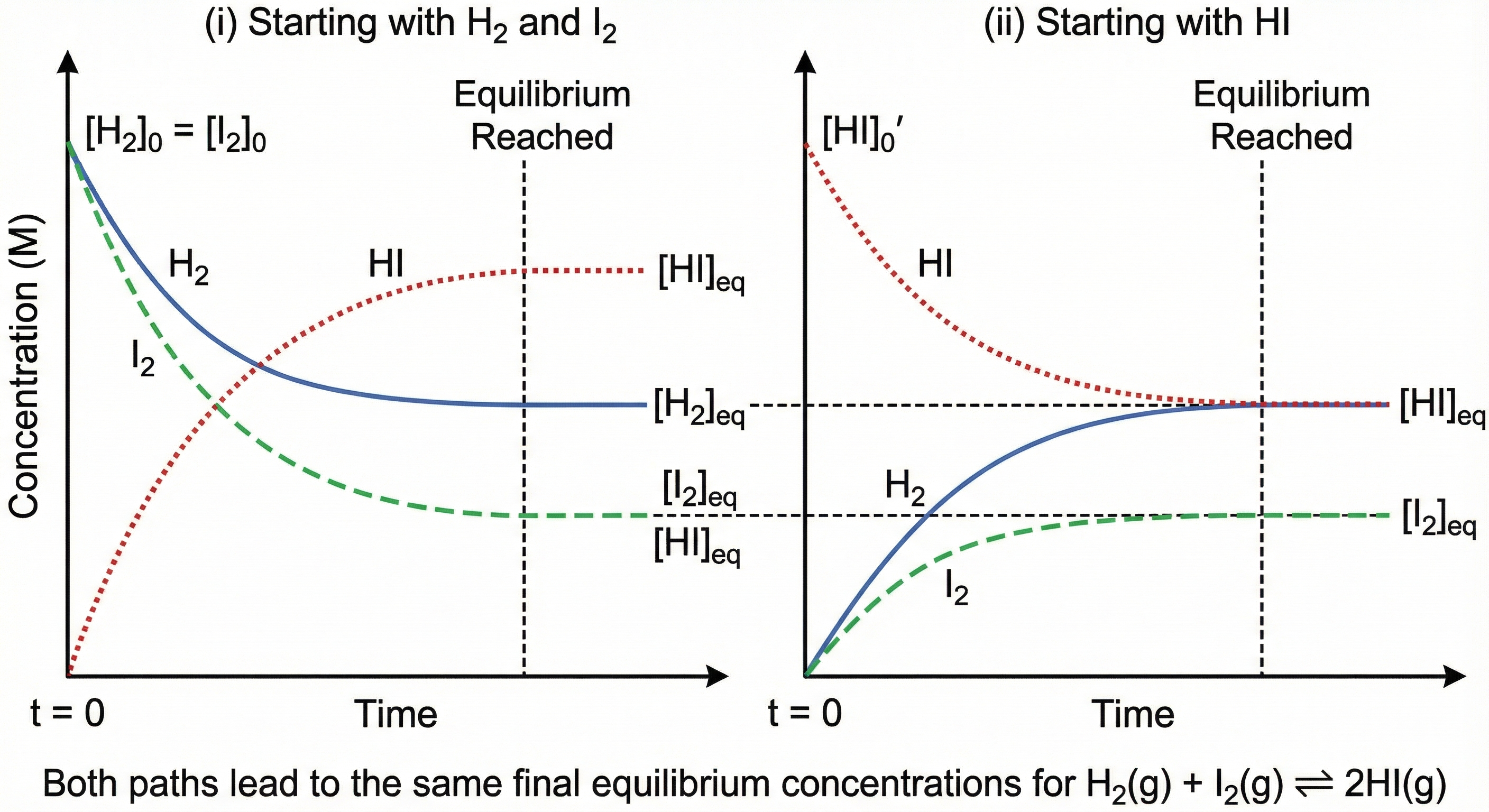
Here's the trick: A general reversible reaction like $\text{A}+\text{B} \rightleftharpoons \text{C}+\text{D}$ reaches equilibrium even if you start with only the reactants ($\text{A}$ and $\text{B}$) or only the products ($\text{C}$ and $\text{D}$). This constancy in composition indicates equilibrium attainment. Imagine you are balancing your time between studying and sleeping. Even if you start totally fresh (only studying) or totally exhausted (only sleeping), you'll eventually settle into the same balanced routine!
NEET Checkpoint:
Which statement is true for the attainment of chemical equilibrium?
(a) Reactant concentration must be zero.
(b) The reaction must start with only products.
(c) It can be attained from either direction.
(d) The rate of the forward reaction is zero.
✅ Answer: (c) It can be attained from either direction. — Whether starting with $\text{H}_2$ and $\text{I}_2$ or just $\text{HI}$, the same equilibrium mixture is reached.
The most convincing proof of this dynamic nature comes from isotope experiments. For instance, in the famous Haber process, $\text{N}_2(g)+3\text{H}_2(g)\rightleftharpoons2\text{NH}_3(g)$, they used heavy hydrogen ($\text{D}_2$) instead of normal $\text{H}_2$. When equilibrium mixtures containing $\text{H}_2$ and $\text{D}_2$ were mixed and analyzed later, species like $\text{NHD}_2$ and $\text{NH}_2\text{D}$ were found. This scrambling shows the forward and reverse reactions are continuously occurring; if the reaction had just stopped, no mixing of isotopes would have happened. And that's cool, right? This concept is crucial for your NEET preparation!
Figure below:
A clear diagram showing reactant concentrations ($\text{A}$ or $\text{B}$) dropping and product concentrations ($\text{C}$ or $\text{D}$) rising until both become constant, indicating the attainment of chemical equilibrium.
Finally, we quantify this balance using the Law of Chemical Equilibrium (or Equilibrium Law). This law mathematically relates the concentrations of reactants and products at equilibrium to yield a constant value, $K_c$.
NEET Checkpoint:
The Law of Chemical Equilibrium relates:
(a) The rates of reaction over time.
(b) The activation energy of the reaction.
(c) The concentrations of reactants and products at equilibrium.
(d) The effect of a catalyst.
✅ Answer: (c) The concentrations of reactants and products at equilibrium. — The Law specifically provides an equilibrium equation relating these concentrations.
Figure below:
A diagram showing concentration profiles for the reaction $H_2(g) + I_2(g) \rightleftharpoons 2HI(g)$ starting (i) with only reactants ($\text{H}_2$ and $\text{I}_2$) and (ii) with only product ($\text{HI}$), demonstrating both paths lead to the same final equilibrium concentrations.
Practice Question:
If a reaction mixture is at dynamic equilibrium, which of the following remains constant?
(a) The rate of the forward reaction only.
(b) The mass of the catalyst used.
(c) All measurable properties of the system.
(d) The total volume of the container.
✅ Explanation: At equilibrium, all measurable properties of the system, such as concentrations and pressure, remain constant.
NEET Checkpoint:
In the general reversible reaction $\text{A}+\text{B} \rightleftharpoons \text{C}+\text{D}$, if concentrations of $\text{A}$, $\text{B}$, $\text{C}$, and $\text{D}$ are constant, the system is in:
(a) Static equilibrium.
(b) Chemical equilibrium.
(c) Physical equilibrium.
(d) Completion.
✅ Answer: (b) Chemical equilibrium. — Constant concentrations signify the dynamic balance achieved in chemical processes.
Key Takeaway
Chemical equilibrium is a dynamic state where the rate of the $\text{forward}$ reaction equals the rate of the $\text{reverse}$ reaction.
The system can reach this constant composition state starting from either $\text{reactants}$ or $\text{products}$.
The Equilibrium Law (or Law of Chemical Equilibrium) provides a concentration relationship that defines the equilibrium constant, $K_c$.
4. Law of Chemical Equilibrium and Concentration Constant ($K_c$)
Hey NEET aspirants! Ready to decode the funda behind the Concentration Equilibrium Constant ($K_c$)? This is super important, so pay attention, yaar!
The fundamental relationship governing equilibrium concentrations is the Law of Chemical Equilibrium, which is also historically known as the Law of Mass Action. This law was proposed way back in 1864 by two brilliant Norwegian chemists, Cato Maximillian Guldberg and Peter Waage. What’s the core idea? For any reversible reaction at a given temperature, a specific ratio of concentrations—products over reactants—will always remain a constant value. That constant is your equilibrium constant ($K_c$).
For a generic reversible reaction where species are in molar concentrations ($mol~L^{-1}$):
The concentration equilibrium constant ($K_c$) expression is defined as:
Notice this: the powers in the expression are the stoichiometric coefficients ($a, b, c, d$), and the concentrations used, indicated by the brackets, must always be the equilibrium values. The subscript '$c$' indicates that $K_c$ is expressed in concentrations of $mol~L^{-1}$.
NEET Checkpoint:
The Law of Mass Action provides the mathematical basis for calculating the numerical value of $K_c$.
(a) True
(b) False
✅ Answer: (a) True — The expression for $K_c$ is derived directly from the Law of Mass Action proposed by Guldberg and Waage.
Here’s the trick (and where $K_c$ gets dynamic!): $K_c$ is fiercely loyal to the exact form of the balanced chemical equation.
-
Reversing the Reaction: If you reverse the chemical equation (products become reactants), the new equilibrium constant ($K_{c}^{\prime}$) is simply the inverse of the original one. Think of it like a mathematical reciprocal:
$$K_{c}^{\prime}=1/K_{c}$$ -
Changing Stoichiometry: If you multiply the stoichiometric coefficients throughout by a factor '$n$' (say, doubling or halving the reaction), the new constant ($K_{c}^{\prime\prime}$) must be raised to that power '$n$':
$$K_{c}^{\prime\prime}=(K_{c}^{n})$$
Relatable Example: Imagine you are making pani puri! If the base recipe for $1~plate~puri$ has $K_c = 50$, and you multiply the recipe by $n=2$ to make $2~plates~puri$, the new equilibrium constant will be $K_c^2$.
Because the numerical value of $K_c$ changes if the equation is reversed or multiplied, it is absolutely essential to specify the form of the balanced chemical equation when quoting the value of an equilibrium constant.
NEET Checkpoint:
If the equilibrium constant for $A \rightleftharpoons B$ is $K_c$, the constant for $3A \rightleftharpoons 3B$ is:
(a) $3K_c$
(b) $K_c$
(c) $K_c^3$
(d) $K_c^{1/3}$
✅ Answer: (c) $K_c^3$ — Since the coefficients are multiplied by $n=3$, the constant is raised to the power of 3.
NEET Checkpoint:
Why is it crucial to specify the balanced equation when reporting $K_c$?
(a) To ensure all reactants are gas phase.
(b) Because $K_c$ changes numerically with the form of the equation.
(c) Because $K_c$ depends only on temperature.
(d) To define the reaction rate.
✅ Answer: (b) Because $K_c$ changes numerically with the form of the equation — If the equation is multiplied or reversed, the numerical value of the constant changes.
Practice Question:
For the reaction $4NH_{3}(g)+5O_{2}(g)\rightleftharpoons4NO(g)+6H_{2}O(g)$, the equilibrium constant is $K_{c}$. If this reaction is halved, what is the new equilibrium constant, $K_{c}^{\prime\prime}$?
(a) $K_{c}^{2}$
(b) $K_{c}^{-1}$
(c) $K_{c}^{1/2}$
(d) $\frac{1}{2}K_{c}$
✅ Answer: (c) $K_{c}^{1/2}$ — Halving the reaction means multiplying the coefficients by $n=\frac{1}{2}$, so the new constant is $K_{c}$ raised to the power of $\frac{1}{2}$.
Now that you've got this, wait till you see how the concentration constant ($K_c$) connects with the pressure constant ($K_p$)!
Key Takeaway
The Law of Chemical Equilibrium defines $K_c$ based on reaction stoichiometry. For $aA + bB \rightleftharpoons cC + dD$
$$K_{c}=\frac{[C]^{c}[D]^{d}}{[A]^{a}[B]^{b}}$$Reversing the reaction gives $1/K_c$, and multiplying coefficients by '$n$' gives $K_c^n$. Always specify the balanced equation form!
5. Equilibrium Constants in Gaseous Systems ($K_p$ and $K_c$ Relation)
Hey NEET aspirants! When dealing with reactions where all the species are in the same phase, we call it Homogeneous Equilibria. Think of it like all your friends sitting together in the same canteen section—it's one phase! For systems involving gases, we often find it more convenient to express the equilibrium constant using partial pressures instead of molar concentrations. We denote this equilibrium constant as $K_p$.
Now, for the serious funda! How do we connect the pressure ($p$) of a gas to its concentration ($c$)? We use our old buddy, the Ideal Gas Equation:
If you rearrange this, you get $p = \frac{n}{V}RT$. Since $n/V$ is molar concentration ($c$), the partial pressure ($p$) of any gas is related to its molar concentration $([gas])$ by:
Notice this: at a constant temperature, the pressure of the gas ($p$) is directly proportional to its concentration ($[gas]$).
The $K_p$ and $K_c$ Link (The Ultimate Formula!)
For a general reversible reaction where all components are gases:
$K_p$ is expressed using the partial pressures of the species raised to their stoichiometric coefficients. By substituting the relationship $p = [gas]RT$ for every gaseous species into the $K_p$ expression, we arrive at a crucial relationship that bridges the gap between the two constants:
Here's the trick, yaar: $\Delta n$ represents the difference between the number of moles of gaseous products and the number of moles of gaseous reactants. Mathematically:
(Where $a, b, c, d$ are the stoichiometric coefficients of the gaseous species). Don't stress, just remember to count only the gaseous moles!
NEET Checkpoint:
For the reaction $H_2(g) + I_2(g) \rightleftharpoons 2HI(g)$, what is $\Delta n$?
(a) 1
(b) 2
(c) 0
(d) -1
✅ Answer: (c) 0 — It's $(2) - (1 + 1) = 0$. In this special case, $K_p = K_c(RT)^0$, so $K_p = K_c$.
The Pressure Standard Funda
When you calculate the numerical value of $K_p$, you must ensure the pressure is expressed in bar. Why? Because the standard state for pressure in chemistry is officially 1 bar. If you use atmospheres or pascals, your resulting numerical value of $K_p$ will be different, so stick to the standard bar unit!.
Relatable Indian Example: Imagine you are making chai (tea). The amount of tea leaves you put in (molar concentration, $K_c$) determines the final strength of the tea. But the pressure inside your cooker or bharti (partial pressure, $K_p$) changes how quickly the flavor extracts. Both concentration and pressure affect the outcome, but they are intrinsically linked by temperature ($RT$) and how much volume the gas takes up ($\Delta n$) during the process!
NEET Checkpoint:
For calculating $K_p$, the pressure must be expressed in which unit?
(a) Pascal
(b) atmosphere
(c) bar
(d) $N m^{-2}$
✅ Answer: (c) bar — 1 bar is the standard state for pressure.
NEET Checkpoint:
If $\Delta n$ is negative, how does $K_p$ compare to $K_c$?
(a) $K_p > K_c$
(b) $K_p < K_c$ (c) $K_p = K_c$
(d) Cannot determine.
✅ Answer: (b) $K_p < K_c$ — If $\Delta n$ is negative (e.g., $-2$), then $K_p = K_c(RT)^{-2} = K_c / (RT)^2$. Since $RT$ is positive, $K_p$ must be smaller than $K_c$.
Practice Question:
For the synthesis of ammonia, $N_{2}(g)+3H_{2}(g)\rightleftharpoons2NH_{3}(g)$, what is the relationship between $K_p$ and $K_c$?
(a) $K_p = K_c(RT)^{-2}$
(b) $K_p = K_c(RT)^{2}$
(c) $K_p = K_c(RT)^{4}$
(d) $K_p = K_c(RT)^{-4}$
✅ Answer: (a) $K_p = K_c(RT)^{-2}$
The moles of gaseous products is 2 ($2NH_3$) and the moles of gaseous reactants is 4 ($1N_2 + 3H_2$). Thus, $\Delta n = 2 - 4 = -2$. Substituting this into the general formula gives $K_p = K_c(RT)^{-2}$.
Key Takeaway:
For reactions involving only gases, the equilibrium constants based on concentration ($K_c$) and partial pressure ($K_p$) are related by:
$$K_p = K_c(RT)^{\Delta n}$$Where $\Delta n = (\text{moles of gaseous products}) - (\text{moles of gaseous reactants})$. Remember to use $R = 0.0831 \text{ bar L mol}^{-1} \text{K}^{-1}$ and express pressure in bar.
6. Heterogeneous Equilibria and Units
Hey Juniors! Let's dive into chemical systems that aren't ek hi jaat ke (of the same kind)—the Heterogeneous Equilibria! This happens when your reactants and products exist in more than one phase, like a solid and a gas, or a solid in an aqueous solution. Don't stress, yaar—it's easier than it looks!
The biggest funda here is simplification. When you write the equilibrium expression ($K_{c}$ or $K_{p}$), you must ignore pure solids and pure liquids. Why? Because the molar concentration of a pure solid or pure liquid is constant (independent of the amount present). This constant value gets neatly absorbed into the overall equilibrium constant.
Notice this: For the thermal dissociation of calcium carbonate:
We exclude the pure solids, $CaCO_{3}(s)$ and $CaO(s)$, leaving the modified constant to simplify drastically to just $K_{c}^{\prime}=[CO_{2}(g)]$ or $K_{p}=p_{CO_{2}}$.
Relatable Example: Think of a busy pani puri stall. The big tub of solid ice (pure solid) used to chill the water is always there; you only worry about the masala water's concentration ($[CO_{2}(g)]$) or the pressure of the gas being bottled (if it were a closed system)! The constant solid concentration doesn't define the reaction's equilibrium position!
NEET Checkpoint:
In the equilibrium $H_{2}O(l)\rightleftharpoons H_{2}O(g)$, which species’ molar concentration is constant?
(a) $H_{2}O(g)$
(b) $H_{2}O(l)$
(c) Both
(d) Neither
✅ Answer: (b) $H_{2}O(l)$ — The molar concentration of a pure liquid is constant, independent of the amount present.
The units of $K_{c}$ ($\text{mol/L}$) or $K_{p}$ ($\text{bar}$, $\text{Pa}$, etc.) depend entirely on whether the exponents of the concentration terms in the numerator and denominator of the equilibrium expression are equal. If they are unequal (like in the $CaCO_{3}$ example), $K_{c}$ or $K_{p}$ will carry units.
Here's the trick: We can make $K_{p}$ and $K_{c}$ dimensionless quantities if we specify standard states. The standard state for a pure gas is $1~\text{bar}$, and for a solute, it is $1~\text{M}$ solution. So, we divide the actual concentration by the standard state concentration, resulting in a dimensionless number.
NEET Checkpoint:
If the exponents in the numerator and denominator of the equilibrium expression are the same, what are the units of $K_{c}$?
(a) $\text{mol/L}$
(b) $\text{bar}$
(c) Dimensionless
(d) $\text{M}^{-1}$.
✅ Answer: (c) Dimensionless — If the exponents are equal, the units cancel out, making $K_{c}$ or $K_{p}$ unitless.
NEET Checkpoint:
To express $K_{c}$ for a solute reaction as a dimensionless quantity, what standard state ($c_{0}$) must be specified?
(a) $1~\text{bar}$
(b) $1~\text{M}$
(c) $1~\text{kg}$
(d) $1~\text{Pa}$.
✅ Answer: (b) $1~\text{M}$ — The standard state ($c_{0}$) for a solute is specified as $1~\text{M}$.
Practice Questions:
1. For the reaction used in nickel purification, $Ni(s)+4~CO(g)\rightleftharpoons Ni(CO){4}(g)$, what is the equilibrium constant $K{c}$ expression?
(a) $K_{c}=\frac{[Ni(CO){4}]}{[Ni][CO]^{4}}$
(b) $K{c}=\frac{[Ni(CO){4}]}{[CO]^{4}}$
(c) ${c}=\frac{[CO]^{4}}{[Ni(CO){4}]}$
(d) $K{c}=[Ni(CO)_{4}][CO]^{4}${
✅ Answer: (b) $K_{c}=\frac{[Ni(CO)_{4}]}{[CO]^{4}}$ — We exclude the pure solid $Ni(s)$ from the expression, retaining only the concentrations of the gaseous species.
2. If $K_{p}$ for a reaction is calculated using pressures measured in bar, and the value is $4.0\times10^{-2}$, how can this value be written if standard states are specified?
(a) $4.0\times10^{-2}~\text{bar}$
(b) $4.0\times10^{-2}~\text{M}$
(c) $4.0\times10^{-2}$ (dimensionless)
(d) $4.0\times10^{3}~\text{Pa}$
✅ Answer: (c) $4.0\times10^{-2}$ (dimensionless) — When standard states (like $1~\text{bar}$) are specified, the resulting equilibrium constant is expressed as a dimensionless quantity.
Key Takeaway
Heterogeneous Equilibria involve multiple phases (solid, liquid, gas, aqueous).
Pure Solids and Pure Liquids are omitted from $K_{c}$ or $K_{p}$ expressions because their molar concentrations are constant.
$K_{c}$ ($\text{mol/L}$) and $K_{p}$ ($\text{bar}/\text{Pa}$) are dimensionless only when exponents cancel out or when standard states ($1~\text{M}$ for solute, $1~\text{bar}$ for gas) are specified.
7. Applications of Equilibrium Constants: Predicting Extent and Direction
Let's talk about the power of the Equilibrium Constant ($K_c$ or $K_p$). Remember, $K$ is like the final scorecard for a reaction—it tells you how far the reaction will go (extent) and which way it's heading (direction), but it gives zero information about the actual rate at which equilibrium is achieved. Don't confuse thermodynamics (where $K$ comes from) with kinetics!
Predicting Extent: Is the Reaction a Hit or a Flop?
The magnitude of $K$ is directly proportional to the concentrations of products (numerator) and inversely proportional to the concentrations of reactants (denominator). This funda helps us predict the extent of reaction:
- High $K_c$ ($>10^3$): Products predominate. The reaction proceeds nearly to completion. Think blockbuster hit, yaar! For example, the reaction of $H_2$ with $O_2$ at $500\text{ K}$ has a massive $K_c = 2.4 \times 10^{47}$.
NEET Checkpoint:
If $K_c = 5.0 \times 10^{-1}$, what is the likely composition at equilibrium?
(a) Reactants only
(b) Mostly products
(c) Appreciable concentrations of both
✅ Answer: (c) Appreciable concentrations of both — Since $K_c$ is between $10^{-3}$ and $10^{3}$, both reactants and products are present.
2. Very Small $K_c$ ($<10^{-3}$): Reactants predominate. The reaction barely proceeds. Total flop, buddy. The decomposition of $H_2O$ at $500\text{ K}$ has $K_c = 4.1 \times 10^{-48}$.
3. Moderate $K_c$ ($10^{-3}$ to $10^3$): Appreciable concentrations of both reactants and products are present.
Predicting Direction: The Reaction Quotient $Q$
To know if a system not currently at equilibrium needs to shift left or right, we use the Reaction Quotient, $Q_c$. It's calculated exactly like $K_c$, but you use concentrations measured at some arbitrary time $t$, not necessarily at equilibrium.
Now, compare $Q_c$ with the actual $K_c$ value:
- If $Q_c < K_c$: The ratio of products to reactants is currently too small. The reaction must proceed forward (left to right, towards products) to increase $Q_c$ until it equals $K_c$.
- If $Q_c > K_c$: The ratio of products to reactants is too large. The reaction must proceed backward (right to left, towards reactants) to decrease $Q_c$ until it equals $K_c$.
- If $Q_c = K_c$: Congrats! The system is already at equilibrium.
Example for the Direction Funda: Imagine a traffic signal (Equilibrium, $K_c$). If your rickshaw driver (the reaction) is far behind the line ($Q_c < K_c$), he speeds forward to reach the light. If he's already way past the stop line ($Q_c > K_c$), he has to reverse backward to fix the position!
NEET Checkpoint:
If $K_c = 50$ and the instantaneous calculated $Q_c = 10$, which direction does the net reaction move?
(a) Left
(b) Right
(c) Stops
✅ Answer: (b) Right — Since $Q_c < K_c$ ($10 < 50$), the reaction needs to make more products (right) to reach the equilibrium ratio.
Calculating Equilibrium Concentrations
When solving quantitative problems, we often know the initial concentrations but need to find the equilibrium concentrations. This usually involves a standardized, multi-step process:
- Write the balanced equation.
- Set up a table (often called an ICE table) listing Initial concentrations, the Change in concentration (defined using '$x$'), and the Equilibrium concentrations (in terms of '$x$').
- Substitute the equilibrium concentrations into the $K$ equation and solve the resultant algebraic equation for $x$ (sometimes a quadratic equation, remember to choose the chemically sensible root!).
- Calculate the final equilibrium concentrations using the value of $x$.
NEET Checkpoint:
What concentration is defined by '$\alpha$' in the context of weak acid ionization calculations?
(a) Initial concentration
(b) Equilibrium concentration of product
(c) Extent or degree of ionization
✅ Answer: (c) Extent or degree of ionization — In weak acid/base problems, '$\alpha$' is typically used to represent the degree of ionization.
Key Takeaway
| Concept | What It Predicts | Key Rules |
|---|---|---|
| Equilibrium Constant ($K$) | Extent of Reaction | $K > 10^3$: Products win (near completion). |
| Reaction Quotient ($Q$) | Direction of Reaction | $Q < K$: Moves Forward (L $\rightarrow$ R). $Q > K$: Moves Backward (R $\rightarrow$ L). |
8. Relationship between Equilibrium Constant ($K$), Reaction Quotient ($Q$), and Gibbs Energy ($\Delta G$)
Hey future doctors! Let's clear up this super important funda that connects chemical equilibrium directly to thermodynamics—the whole Gibbs energy story. Don't stress, yaar, this relationship tells us why a reaction goes forward and how far it will go!
The change in Gibbs energy, $\Delta G$, is the ultimate dictator of spontaneity. It relates to the standard Gibbs energy change, $\Delta G^{\ominus}$ (which is measured under standard conditions), and the reaction quotient, $Q$, via this powerful equation:
Here, $R$ is the gas constant and $T$ is the temperature in Kelvin. Notice this: $\Delta G$ tells you the spontaneity right now, while $\Delta G^{\ominus}$ tells you the inherent tendency under standard conditions.
NEET Checkpoint:
The term $RT~ln~Q$ accounts for which aspect of the reaction?
(a) Activation energy
(b) Non-standard concentrations
(c) Temperature independence
(d) Standard state
✅ Answer: (b) Non-standard concentrations — $Q$ uses concentrations that are not necessarily equilibrium values, making $\Delta G$ applicable at any point in time.
When a reaction finally hits the sweet spot—the equilibrium state—two crucial things happen simultaneously: the net reaction stops, meaning $\Delta G$ becomes zero (no more free energy left to drive it). And guess what? At this precise moment, the Reaction Quotient, $Q$, becomes equal to the Equilibrium Constant, $K$ (or $K_c$).
So, the fundamental equation simplifies beautifully to link the standard energy change ($\Delta G^{\ominus}$) directly to $K$:
This formula is basically your roadmap to predicting the reaction extent. Think of the reaction as a big, competitive pani puri eating contest. $\Delta G^{\ominus}$ is the baseline hunger level of the crowd, determining whether they want more puri (products) or are already stuffed (reactants).
- If $\Delta G^{\ominus}$ is negative ($<0$): This means the reaction is inherently spontaneous in the forward direction. Therefore, $K$ must be greater than 1 ($K>1$). Products predominate! The crowd is super hungry for pani puri (products are favored).
- If $\Delta G^{\ominus}$ is positive ($>0$): This means the forward reaction is non-spontaneous. Consequently, $K$ is less than 1 ($K<1$). Reactants predominate! The crowd is already full (only a minute quantity of product is formed).
NEET Checkpoint:
If $K=10^{5}$, what is the likely sign of $\Delta G^{\ominus}$ for the reaction?
(a) Positive
(b) Negative
(c) Zero
(d) Cannot be determined
✅ Answer: (b) Negative — Since $K$ is very large ($>1$), the reaction proceeds nearly to completion, implying a spontaneous process where $\Delta G^{\ominus}$ must be negative.
NEET Checkpoint:
What is the value of $\Delta G$ when a chemical system achieves dynamic equilibrium?
(a) $RT~ln~Q$
(b) $\Delta G^{\ominus}$
(c) $0$
(d) $K_c$
✅ Answer: (c) $0$ — At equilibrium, there is no net change, meaning there is no free energy left to drive the reaction, so $\Delta G=0$.
Practice Questions:
- A reaction has a large positive value for $\Delta G^{\ominus}$ at $298~K$. Which statement is true regarding the equilibrium constant $K$?
(a) $K$ is very large ($>10^3$).
(b) $K=1$.
(c) $K$ is very small ($<1$).
(d) $K$ is equal to $\Delta G^{\ominus}$.
✅ Answer: (c) $K$ is very small ($<1$). A positive $\Delta G^{\ominus}$ indicates a non-spontaneous reaction, which correlates directly with $K<1$ (reactants are favored).
2. For a given reaction, if $\Delta G$ is negative, which direction will the reaction proceed?
(a) Towards reactants (reverse)
(b) Towards products (forward)
(c) It is already at equilibrium
(d) Cannot be predicted
✅ Answer: (b) Towards products (forward). If $\Delta G$ is negative, the reaction is spontaneous and proceeds in the forward direction until $\Delta G$ reaches zero.
Key Takeaway
| Gibbs Energy and Equilibrium | |
|---|---|
| The relationship is defined by $\Delta G=\Delta G^{\ominus}+RT~ln~Q$. | |
| At Equilibrium: $\Delta G=0$ and $Q=K$, giving the standard relationship:$\Delta G^{\ominus}=-RT~ln~K$ | |
| Spontaneity Link: If $\Delta G^{\ominus} < 0$, then $K>1$ (products favored, spontaneous forward reaction). If $\Delta G^{\ominus} > 0$, then $K<1$ (reactants favored, non-spontaneous forward reaction). |
9. Factors Affecting Equilibrium (I): Le Chatelier’s Principle and Concentration/Pressure Changes
This is the master funda of equilibrium shifts: Le Chatelier's Principle. Don't stress, the principle is super intuitive! It states that if a system already at equilibrium is subjected to a change in conditions (like concentration, pressure, or temperature), the system will change its position in a way that reduces or counteracts the effect of that change. It’s like the universe trying to maintain status quo in the reaction mixture. This principle is applicable to all physical and chemical equilibria.
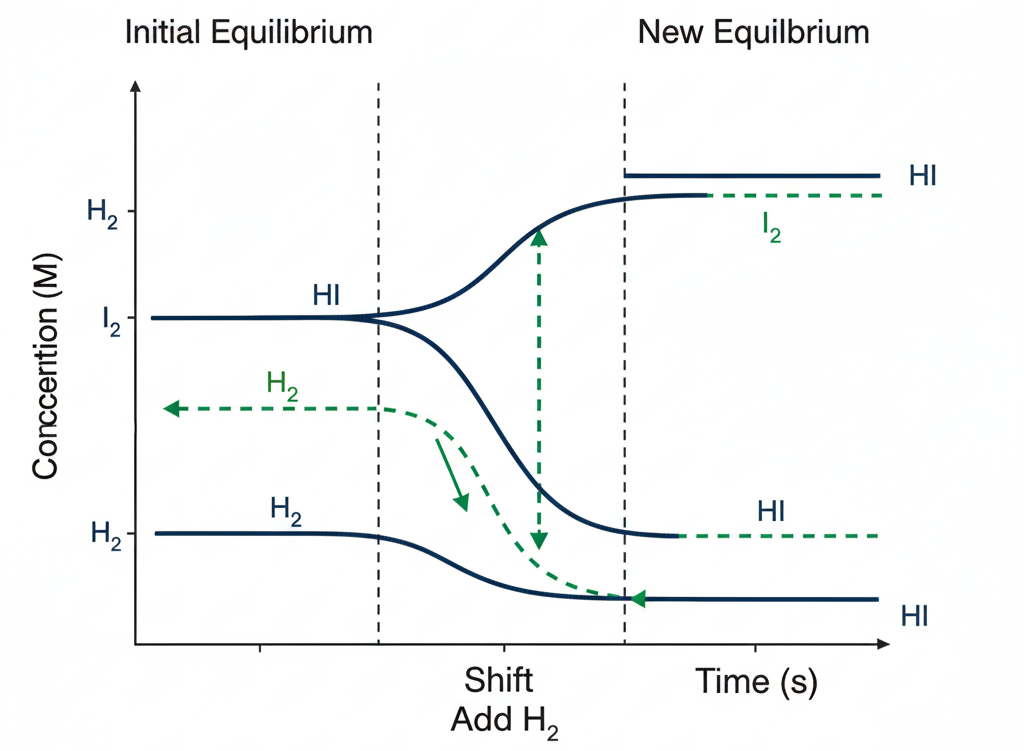
Let's look at Effect of Concentration Change (the simplest one). If you add a reactant (which creates concentration stress), the system panics and shifts forward to consume the added substance. Conversely, if you remove a product, the equilibrium shifts in the forward direction to replenish the removed substance. For example, adding $\text{H}2$ to the equilibrium $\text{H}{2}(g)+\text{I}_{2}(g)\rightleftharpoons2\text{HI}(g)$shifts the system right to consume the added $\text{H}_2$ and form more $\text{HI}$.
Figure below:
A clear diagram showing the concentrations of $\text{H}_2$, $\text{I}_2$, and $\text{HI}$ over time. The graph should show equilibrium, then an abrupt increase in $[\text{H}_2]$ when $\text{H}_2$ is added, followed by the re-establishment of a new equilibrium where $[\text{H}_2]$ and $[\text{I}_2]$ decrease, and $[\text{HI}]$ increases, but the final $[\text{H}_2]$ is still higher than the original equilibrium value.
This concept has huge commercial value! Notice this: in industrial production, like making ammonia ($\text{NH}3$) , we constantly liquify and remove the $\text{NH}_3$ product. Removing the product maintains the reaction quotient $Q{c}$at a value less than $K_{c}$, driving the reaction continuously in the forward direction and boosting the yield. Similarly, the continuous removal of gaseous $\text{CO}_2$ from the kiln drives the decomposition of $\text{CaCO}_3$ to completion.
NEET Checkpoint:
In the decomposition of $\text{CaCO}_3$ to $\text{CaO}$ and $\text{CO}_2$, removing $\text{CO}_2$ drives the reaction:
(a) To completion
(b) To the left
(c) Towards reactants
✅ Answer: (a) To completion — Continuous removal of the product ($\text{CO}_2$) maintains the stress, shifting equilibrium forward to replenish $\text{CO}_2$.
Now for Effect of Pressure Change. This factor is only important for gaseous reactions where the total number of moles of gaseous reactants and products are different. If you increase the pressure (by decreasing volume, according to $pV=\text{constant}$), the equilibrium shifts towards the side that has fewer moles of gas. This is the system’s way of reducing the pressure stress.
For example, in $CO(g) + 3H_{2}(g) \rightleftharpoons CH_{4}(g) + H_{2}O(g)$ (where $4$ moles of gas become $2$ moles of gas), increasing pressure pushes the reaction forward. Conversely, in the reaction $\text{C}(s) + \text{CO}_{2}(g) \rightleftharpoons 2\text{CO}(g)$, increasing pressure shifts the reaction reverse because the product side has more moles of gas (2 moles) than the reactant side (1 mole of $\text{CO}_2$). Remember, the effect of pressure on solids and liquids is generally ignored.
Relatable Example (Cricket Field): Imagine an outdoor cricket match (equilibrium) where suddenly, due to heavy crowds, the volume of the seating area decreases (pressure increases). To relieve the stress, the crowd (moles of gas) shifts towards the smallest area available. The reaction shifts toward the side with fewer moles of gas!
NEET Checkpoint:
If pressure is increased on the reaction $N_{2}O_{4}(g) \rightleftharpoons 2NO_{2}(g)$, the shift occurs:
(a) Towards $\text{NO}_2$
(b) Towards $\text{N}_2\text{O}_4$
(c) No change
✅ Answer: (b) Towards $\text{N}_2\text{O}_4$ — The reactant side has $1$ mole and the product side has $2$ moles. Increasing pressure favours the side with fewer moles.
Finally, let's talk about the Effect of Inert Gas Addition. If the volume is kept constant and an inert gas (one that doesn't react) is added, the equilibrium remains undisturbed. This is because the addition of an inert gas at constant volume does not alter the partial pressures or molar concentrations of the reactants and products involved in the reaction.
Practice Question:
If the volume of the container containing $2\text{HI}(g)\rightleftharpoons \text{H}{2}(g)+\text{I}{2}(g)$ is halved, what happens to the equilibrium composition?
(a) Shifts left, increasing $[\text{HI}]$.
(b) Shifts right, increasing $[\text{H}_2]$ and $[\text{I}_2]$.
(c) Shifts in a direction that consumes the added gas.
(d) Remains unchanged.
✅ Answer: (d) Remains unchanged. Halving the volume increases the pressure. Since there are $2$ moles of gas on both the reactant and product sides ($\Delta n=0$), the pressure change has no effect on the equilibrium composition.
NEET Checkpoint:
Why does adding an inert gas at constant volume have no effect on equilibrium?
(a) The total pressure remains constant.
(b) The partial pressures of reactants/products remain constant.
(c) The reaction quotient $Q_{c}$ changes to equal $K_{c}$.
✅ Answer: (b) The partial pressures of reactants/products remain constant — Since volume is constant, adding an inert gas does not change the concentrations or partial pressures of the reacting substances, so equilibrium is not disturbed.
Key Takeaway
Le Chatelier’s Principle helps predict equilibrium shifts to counteract applied stress. Add reactants or remove products $\rightarrow$ shift forward. Increase pressure (decrease volume) $\rightarrow$ shift to side with fewer gaseous moles. Adding an inert gas at constant volume has no effect.
10. Factors Affecting Equilibrium (II): Temperature and Catalyst Effects
Hey champs! Last time we saw how concentration and pressure changes mess with the equilibrium position (Le Chatelier’s Principle). But listen up, there’s one VIP guest that doesn't just shift the reaction left or right—it actually changes the numerical value of the equilibrium constant ($K_c$ or $K_p$) itself! That VIP is Temperature.
Effect of Temperature Change
Temperature is the only factor that alters the numerical value of the equilibrium constant ($K_c$ or $K_p$). We need to know the sign of the enthalpy change ($\Delta H$) to predict the outcome.
- Exothermic Reactions ($\Delta H$ is negative): Increasing the temperature is like adding a product (heat). According to Le Chatelier’s Principle, the system tries to consume that added heat, shifting the equilibrium to the left (towards reactants). This causes the equilibrium constant ($K$) to decrease. For example, ammonia synthesis is exothermic ($\Delta H=-92.38~kJ~mol^{-1}$), so low temperature favors high yield.
- Endothermic Reactions ($\Delta H$ is positive): Increasing the temperature is like adding a reactant (heat). The system shifts the equilibrium to the right (towards products), and the equilibrium constant ($K$) increases.
NEET Checkpoint:
For the reaction $2NO_{2}(g)\rightleftharpoons N_{2}O_{4}(g)$ ($\Delta H$ negative), what happens to the intensity of the brown $NO_{2}$ gas colour when the system is cooled?
(a) Increases
(b) Decreases
(c) Stays the same.
✅ Answer: (b) Decreases — Since the reaction is exothermic, cooling shifts the equilibrium to the right (forward direction), favoring the colourless $N_{2}O_{4}(g)$ and decreasing the brown colour of $NO_{2}(g)$.
Effect of a Catalyst
Now let’s talk about our speedy friend, the Catalyst. Does it affect equilibrium? Nope! A catalyst is like the efficient scooter-wallah who finds the shortest route by lowering the activation energy. It speeds up the rate of the forward and reverse reactions equally. Since both sides accelerate by the exact same amount, the equilibrium composition is not affected. It only speeds up the attainment of equilibrium, helping you reach the final position much faster. Don't stress, yaar—this is a favourite concept for examiners!
NEET Checkpoint:
Why doesn't a catalyst affect the equilibrium composition?
(a) It only speeds up the forward reaction.
(b) It changes $K_c$ only slightly.
(c) It increases the rates of both forward and reverse reactions equally.
✅ Answer: (c) It increases the rates of both forward and reverse reactions equally — Because the catalyst lowers the activation energy equally for both sides, the ratio of rates (which determines equilibrium) remains the same.
Think of it like being stuck in classroom traffic trying to exit: the equilibrium is the number of students inside vs. outside. Hiring a hall monitor (catalyst) speeds up the rate of entry and exit equally. The percentage of students inside/outside remains stable, but the final, stable state is achieved much quicker!. Crucially, the catalyst does not appear in the balanced chemical equation or the equilibrium constant expression.
NEET Checkpoint:
Which statement about catalysts in equilibrium is false?
(a) They lower activation energy.
(b) They are absent from the $K_{p}$ expression.
(c) They alter the concentration of reactants at equilibrium.
✅ Answer: (c) They alter the concentration of reactants at equilibrium — This is false. A catalyst does not affect the final equilibrium composition.
Practice Questions:
-
For an endothermic reaction, if the temperature is increased, what occurs?
(a) $K_c$ decreases and equilibrium shifts left.
(b) $K_c$ increases and equilibrium shifts right.
(c) $K_c$ remains constant, but the rate increases.
(d) $K_c$ decreases and equilibrium shifts right.✅ Answer: (b) $K_c$ increases and equilibrium shifts right. — For an endothermic reaction ($\Delta H$ positive), heat is required, so increasing temperature favors the product side, increasing $K_c$.
-
A catalyst is added to an equilibrium system. Which change is observed?
(a) $\Delta G^{\ominus}$ becomes more negative.
(b) The value of the equilibrium constant changes.
(c) The time taken to reach equilibrium is reduced.
(d) The equilibrium concentration of products increases.✅ Answer: (c) The time taken to reach equilibrium is reduced. — A catalyst speeds up the reaction rates equally, helping the system attain equilibrium faster, without changing the constant $K_c$ or the composition.
Key Takeaway
Factor Effect on Equilibrium Position Effect on Equilibrium Constant ($K$) Temperature Shifts according to $\Delta H$ (Exo $\rightarrow$ Left; Endo $\rightarrow$ Right) Changes (It is the only factor that does this) Catalyst No effect (Speeds up both rates equally) No effect
11. Introduction to Ionic Equilibrium: Electrolytes, Acids, Bases, and Salts
Hey future medico! Ready to tackle the funda of ionic equilibrium? Don't stress, yaar—it’s easier than it looks! This whole chapter kicks off by answering a simple question: Why do some water solutions conduct electricity while others don't?
The secret lies in the presence of ions. Substances like common salt (sodium chloride) conduct electricity in aqueous solutions and are therefore called electrolytes. Substances like sugar, whose solutions do not conduct electricity, are called non-electrolytes.
Electrolytes include our three main players: acids, bases, and salts. But not all electrolytes are equally strong, okay? Michael Faraday sorted them out: Strong electrolytes (like $NaCl$) are almost completely ionized when dissolved in water. On the flip side, weak electrolytes (like acetic acid) are only partially dissociated.
NEET Checkpoint:
What state must be reached by a weak electrolyte in an aqueous solution?
(a) Static equilibrium
(b) $100\%$ dissociation
(c) Equilibrium between ions and unionized molecules
(d) $K_{c}=1$
✅ Answer: (c) Equilibrium between ions and unionized molecules — Weak electrolytes are only partially dissociated, establishing an equilibrium between their ions and their unionized form.
For these weak buddies, a special kind of balance sets up: the ionic equilibrium. This is simply the specific type of equilibrium involving ions in an aqueous solution.
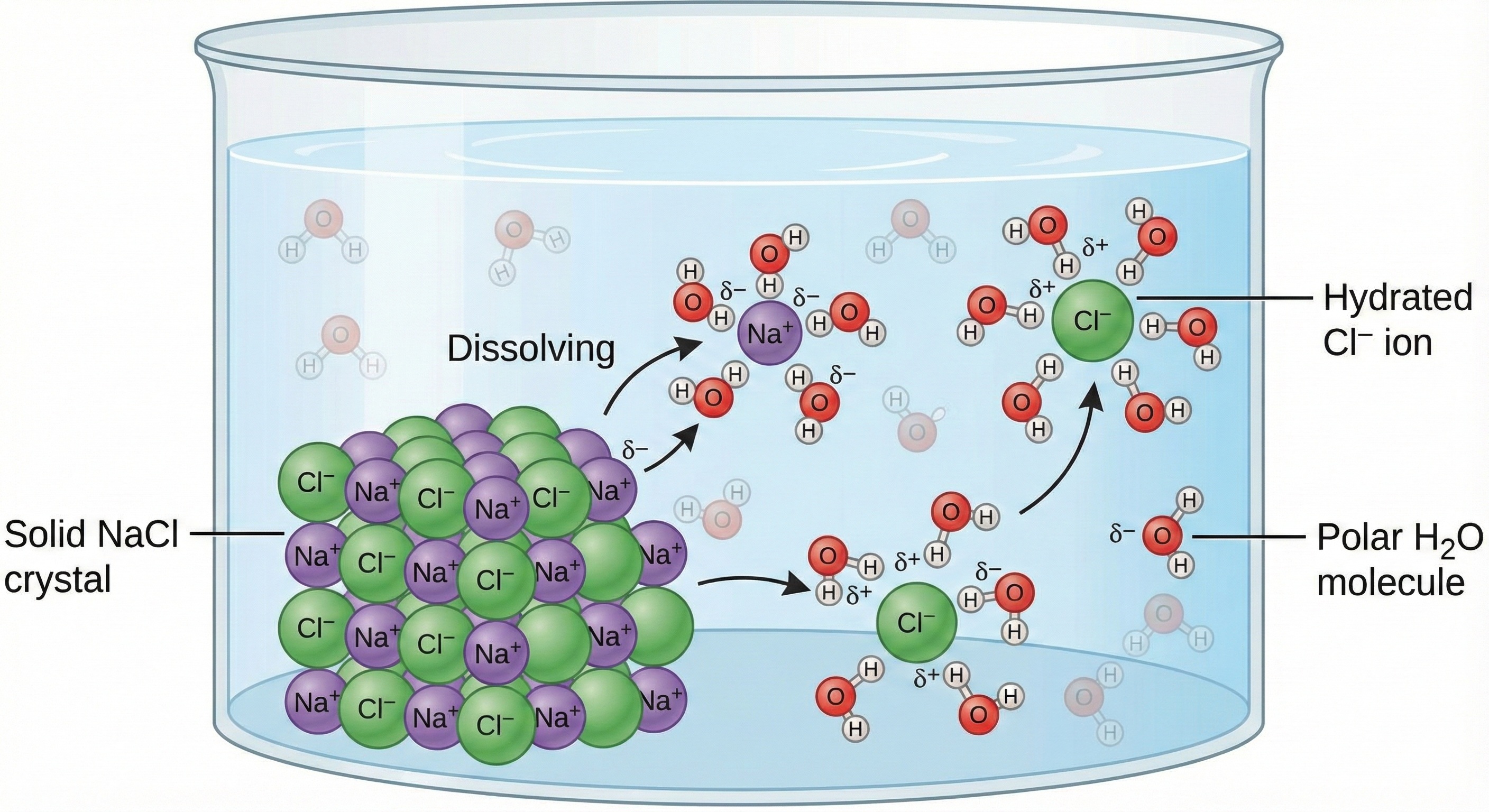
Now, why does water even let the ions run free? Imagine $NaCl$, a salt formed when an acid ($HCl$) reacts with a base ($NaOH$). In its solid state, it’s a cluster of positively charged $Na^{+}$ ions and negatively charged $Cl^{-}$ ions held together tightly by electrostatic interactions. Water, our universal solvent, is highly polar and has a massive dielectric constant of $80$. This high polarity significantly reduces those electrostatic interactions (by a factor of $80$), allowing the ions to move freely and get stabilized by hydration.
Figure below:
A clear diagram showing solid $NaCl$ dissolving, where polar $H_{2}O$ molecules surround the $Na^{+}$ (oxygen side facing) and $Cl^{-}$ (hydrogen side facing) ions, illustrating hydration.
NEET Checkpoint:
How does a high dielectric constant of water aid the dissolution of ionic salts?
(a) Increases the temperature
(b) Increases the volume of the solution
(c) Reduces the electrostatic interactions between ions
(d) Increases the $pH$
✅ Answer: (c) Reduces the electrostatic interactions between ions — Water's high dielectric constant ($\approx 80$) reduces the attractive forces holding the ions together, helping them separate.
Relatable Indian Example: Think of two auto rickshaws speeding down a crowded Delhi street. If the road is full of potholes (low dielectric constant, strong attraction), they stick close together (low dissolution). But if the road is wide open (high dielectric constant, water!), the attractive force between them vanishes, and they zoom off freely (high dissolution). That open road is water's high dielectric constant freeing the ions!
Just a final terminology clarification: Historically, dissociation meant the separation of existing ions (like $NaCl$ in solid state), while ionization meant a neutral molecule splitting into ions (like acetic acid). But thankfully, the sources confirm these two terms are used interchangeably in this context, so don't let it trip you up.
NEET Checkpoint:
Which category do acids, bases, and salts belong to?
(a) Non-electrolytes
(b) Lewis acids
(c) Electrolytes
(d) Non-polar compounds
✅ Answer: (c) Electrolytes — Acids, bases, and salts are categorized as electrolytes because they conduct electricity in aqueous solutions.
Key Takeaway
Electrolytes conduct electricity via ions. Strong electrolytes are almost fully ionized, while weak ones establish ionic equilibrium between ions and unionized molecules. Water’s high dielectric constant makes it an excellent solvent by dramatically reducing the electrostatic forces between ions.
12. Arrhenius Concept: The Aqueous Angle
This is the OG definition, the most basic level. According to Svante Arrhenius, an acid is any substance that dissociates in water to crank out hydrogen ions ($\text{H}^+ (\text{aq})$). Remember, a bare proton ($\text{H}^+$) can't exist alone, so it snuggles up to a water molecule to form the hydronium ion ($\text{H}_3\text{O}^+$). A base is simply a substance that produces hydroxyl ions ($\text{OH}^-(\text{aq})$) in water.
NEET Checkpoint:
What is the primary limitation of the Arrhenius concept?
(a) Only applies to non-aqueous solvents
(b) Only explains strong acids
(c) Only applies to aqueous solutions and fails to explain basicity of substances like $\text{NH}_3$
(d) Cannot define salts.
✅ Answer: (c) Only applies to aqueous solutions and fails to explain basicity of substances like $\text{NH}_3$ — This is the big limitation, because substances like ammonia ($\text{NH}_3$) don't have $\text{OH}^-$ but are still basic.
Brönsted-Lowry (B-L) Concept: Proton Transfer Power (Sec 6.10.2)
Johannes Brönsted and Thomas Lowry gave us a more flexible definition. Think of it as a proton exchange system, like a chemistry game of 'hot potato'! Here's the trick: A Brönsted acid is a proton donor ($\text{H}^+$ donor), and a Brönsted base is a proton acceptor.
When an acid ($\text{HCl}$) transfers its proton to a base ($\text{H}_2\text{O}$), they form conjugate acid-base pairs. For example, in the reaction $\text{HCl}(\text{aq}) + \text{H}_2\text{O}(\text{l}) \rightleftharpoons \text{H}_3\text{O}^+(\text{aq}) + \text{Cl}^-(\text{aq})$, the $\text{Cl}^-$ ion is the conjugate base of the acid $\text{HCl}$. Notice this: A stronger acid always has a weaker conjugate base, and vice-versa. This concept beautifully explains why water ($\text{H}_2\text{O}$) can be dual-natured (amphoteric), acting as a base with $\text{HCl}$ and as an acid with $\text{NH}_3$.
Relatable Indian Example: Imagine a cricket match where the B-L Acid is the bowler donating the ball (proton, $\text{H}^+$), and the B-L Base is the batter accepting the ball. The products formed after the transfer become the conjugate pair—a classic exchange!
Lewis Concept: The Electron Embrace (Sec 6.10.3)
Finally, G.N. Lewis broadened the scope even further by focusing on electron pairs, not just protons. A Lewis acid is an electron pair acceptor (or electrophile). A Lewis base is an electron pair donor (or nucleophile). Lewis bases are similar to B-L bases since both involve providing a lone pair.
The cool part? Lewis acids don't need $\text{H}^+$! This definition includes electron-deficient species like $\text{BF}_3$ or metal ions like $\text{Mg}^{2+}$ and $\text{AlCl}_3$. For example, $\text{BF}_3$ (electron deficient, acid) accepts the lone pair from $\text{NH}_3$ (base).
NEET Checkpoint:
Which species must act as a Lewis acid?
(a) $\text{OH}^-$
(b) $\text{F}^-$
(c) $\text{H}^+$
(d) $\text{H}_2\text{O}$.
✅ Answer: (c) $\text{H}^+$ — A proton ($\text{H}^+$) is a Lewis acid because it can accept a lone pair of electrons from bases like hydroxyl ion ($\text{OH}^-$) or fluoride ion ($\text{F}^-$).
NEET Checkpoint:
If $\text{H}_2\text{SO}_4$ is a strong acid, its conjugate base ($\text{HSO}_4^-$) is considered a:
(a) Strong acid
(b) Strong base
(c) Weak base.
✅ Answer: (c) Weak base — Strong acids always yield very weak conjugate bases.
Practice Question:
Which one of the following compounds is capable of acting only as a Lewis acid and not as a Brönsted-Lowry acid?
(a) $\text{H}_2\text{O}$
(b) $\text{HSO}_4^-$
(c) $\text{NH}_3$
(d) $\text{AlCl}_3$
✅ Answer: (d) $\text{AlCl}_3$ — Lewis acids like $\text{AlCl}_3$ are electron-deficient species capable of accepting an electron pair. They do not possess a removable proton ($\text{H}^+$) and thus cannot be Brönsted acids.
Key Takeaway
Arrhenius: $\text{H}^+$ (acid) and $\text{OH}^-$ (base) in water. Limited to aqueous solution.
Brönsted-Lowry: Proton ($\text{H}^+$) donor (acid) and proton acceptor (base). Forms conjugate pairs; strength is inverse ($\text{Strong Acid} \Leftrightarrow \text{Weak Conjugate Base}$).
Lewis: Electron pair acceptor (acid) and electron pair donor (base). Includes proton-less species like $\text{BF}_3$.
13. Acid and Base Ionization Constants ($\mathbf{K}_{\mathbf{a}}$and $\text{K}{\text{b}}$)
For a weak acid ($\text{HX}$), which partially ionizes, we use the Acid Ionization Constant ($\mathbf{K}_{\mathbf{a}}$) to measure its strength:
Notice this: A larger value of $\mathbf{K}_{\mathbf{a}}$ indicates a stronger acid. Similarly, we can express this using the negative logarithm: $\text{pK}{\text{a}} = -\text{log}(\text{K}{\text{a}})$ . Remember, the smaller the $\text{pK}{\text{a}}$, the stronger the acid.
For a weak base ($\text{MOH}$), where partial ionization occurs, we define the Base Ionization Constant ($\mathbf{K}_{\mathbf{b}}$):
NEET Checkpoint:
Hydrocyanic Acid ($\text{HCN}$) has $\text{K}{\text{a}} = 4.9 \times 10^{-10}$, while Hydrofluoric Acid ($\text{HF}$) has $\text{K}{\text{a}} = 3.5 \times 10^{-4}$. Which acid is weaker?
(a) HF
(b) HCN
(c) Equal
✅ Answer: (b) HCN — The smaller the $\text{K}_{\text{a}}$, the weaker the acid.
Degree of Ionization ($\alpha$)
The Degree of Ionization ($\alpha$) represents the extent of ionization. It is related to the initial concentration ($c$) and the constant by the expression (for acids, but similar for bases):
Sometimes, Percent dissociation is a useful measure of acid strength, calculated as $\frac{[\text{HA}]{\text{dissociated}}}{[\text{HA}]_{\text{initial}}}\times 100\%$. It’s super helpful for gauging acid strength.
Relatable Indian Example: Imagine you are making chai ($c$) and waiting for the sugar to dissolve ($\alpha$). If you start with a high concentration of sugar, only a fraction ($\alpha$) will dissolve immediately. The equilibrium constant ($\text{K}{\text{a}}$ or $\text{K}{\text{b}}$) tells you how effective that dissolution process is!
NEET Checkpoint:
If the degree of ionization $\alpha$ is very small compared to 1, the $\text{K}_{\text{a}}$ expression simplifies to:
(a) $c/(1-\alpha)$
(b) $c\alpha^{2}$
(c) $c\alpha$
✅ Answer: (b) $c\alpha^{2}$ — If $\alpha \ll 1$, then $(1-\alpha) \approx 1$, simplifying the equation $\text{K}{\text{a}} = c\alpha^{2}/(1-\alpha)$ to $\text{K}{\text{a}} \approx c\alpha^{2}$.
The Conjugate Pair Relationship
Here's a crucial relationship for any conjugate acid-base pair (like $\text{NH}{4}^{+}$ and $\text{NH}{3}$): their strengths are linked via the ionic product of water ($\text{K}_{\text{w}}$).
Taking the negative logarithm gives the key $\text{pK}$ relationship (at $298\text{K}$):
Remember: A strong acid must have a very weak conjugate base, and vice-versa. Even friction needs a break sometimes!
NEET Checkpoint:
If a base has a $\text{pK}{\text{b}}$ of 4.75, what is the $\text{pK}{\text{a}}$of its conjugate acid at $298\text{K}$?
(a) 14.0
(b) 9.25
(c) 4.75
✅ Answer: (b) 9.25 — Since $\text{pK}{\text{a}} + \text{pK}{\text{b}} = 14$, then $\text{pK}_{\text{a}} = 14 - 4.75 = 9.25$.
Polybasic/Polyprotic Acids
Don't sweat the acids with multiple ionizable protons, called Polybasic or Polyprotic Acids (e.g., r $\text{H}{2}\text{SO}{4}$ or $\text{H}{3}\text{PO}{4}$). Ionization happens in stages, each having a successive constant ( $\text{K}{\text{a}{1}}, \text{K}{\text{a}{2}}$, etc.).
The successive constants become progressively smaller, meaning $\mathbf{K}{\mathbf{a}{1}} > \mathbf{K}{\mathbf{a}{2}} > \mathbf{K}{\mathbf{a}{3}}$. This happens because it is more difficult to remove a positively charged proton from a negatively charged ion due to increasing electrostatic forces. It’s harder to pull a proton from $\text{HCO}{3}^{-}$ than from uncharged $\text{H}{2}\text{CO}_{3}$.
Practice Question :
The ionization constant of ammonia ($\text{NH}{3}$) is $\text{K}{\text{b}} = 1.77 \times 10^{-5}$. In a $0.05\text{M}$ ammonia solution, calculate the degree of ionization $\alpha$ (assuming $\alpha$ is small).
(a) $0.05$
(b) $0.0018$
(c) $0.018$
(d) $1.77 \times 10^{-5}$
Solution: Since $\alpha$ is small, $\text{K}{\text{b}} \approx c\alpha^{2}$. $\alpha = \sqrt{\frac{\text{K}{\text{b}}}{c}} = \sqrt{\frac{1.77 \times 10^{-5}}{0.05}} \approx 0.018$.
✅ Answer: (c) $0.018$
Key Takeaway
| Concept | Formula | Notes |
|---|---|---|
| Acid Ionization ($\text{K}_{\text{a}}$) |
$$\text{K}_{\text{a}} = \frac{[\text{H}^{+}][\text{X}^{-}]}{[\text{HX}]}$$
|
Larger $\text{K}_{\text{a}}$ means stronger acid. |
| Base Ionization ($\text{K}_{\text{b}}$) |
$$\text{K}_{\mathbf{b}} = \frac{[\text{M}^{+}][\text{OH}^{-}]}{[\text{MOH}]}$$
|
$$\text{pK}{\text{b}} = -\text{log}(\text{K}{\text{b}})$$
. |
| Conjugate Pair Relation |
$\mathbf{K}{\mathbf{a}} \times \mathbf{K}{\mathbf{b}} = \mathbf{K}_{\mathbf{w}}$
|
Or $\text{pK}{\text{a}} + \text{pK}{\text{b}} = 14$ (at $298\text{K}$). |
| Polyprotic Trend |
$\text{K}{\mathbf{a}{1}} > \text{K}{\mathbf{a}{2}} > \dots$
|
Successive removal of protons gets harder. |
14. Aqueous Solutions: Ionic Product of Water ($K_w$), pH Scale, Common Ion Effect, and Salt Hydrolysis
Hey, future docs! Let's dive deep into aqueous solutions—a super important funda for cracking NEET chemistry, especially the concentration part. Don't stress, yaar! Understanding how water itself behaves is the key to unlocking the secrets of $pH$.
Ionic Product of Water ($K_w$)
Did you know water auto-ionizes? It’s true! Two $H_2O$ molecules interact, with one acting as a Brønsted acid and the other as a Brønsted base.
The equilibrium looks like this:
We define the Ionic Product of Water, $\mathbf{K_{w}}$, by multiplying the equilibrium concentrations of these ions.
Notice this: Since the dissociation of pure water produces equal numbers of $H^+$ and $OH^-$ ions, $\mathbf{[H^+] = [OH^-] = 1.0 \times 10^{-7}~M}$ at $298~K$. Plugging this in gives us the value for $K_w$, which is $\mathbf{1\times10^{-14}M^{2}}$ at $298~K$. This $K_w$ value is crucial because it remains constant at a fixed temperature.
NEET Checkpoint:
What is the value of $K_{w}$ at $298~K$?
(a) $10^{-7}$
(b) $10^{-14}M^{2}$
(c) $10^{14}$
(d) $10^{-1}$
✅ Answer: (b) $10^{-14}M^{2}$ — This is the constant product of $\mathbf{[H^+]}$ and $\mathbf{[OH^-]}$ concentrations at $298~K$.
The $pH$ Scale
Handling those small concentrations like $10^{-7}~M$ is clumsy, so Sørensen introduced the $pH$ scale. $pH$ is simply a convenient logarithmic scale.
It is Defined as: $\mathbf{pH=-log~a_{H^{+}}}$ (For dilute solutions, activity $a_{H^+}$ is equal to molarity $[H^+]$).
At $298~K$, if $\mathbf{pH<7}$ the solution is acidic; if $\mathbf{pH>7}$ the solution is basic; and if $\mathbf{pH=7}$ the solution is neutral. Remember, the scale is logarithmic, so a change of one $pH$ unit means a tenfold change in $[H^+]$.
The relationship $\mathbf{pK_{w}=pH+pOH=14}$ is derived from $\mathbf{K_{w}=[H_{3}O^{+}][OH^{-}]=10^{-14}}$ by taking the negative logarithm of both sides.
Common Ion Effect
Here's the trick: when you add an ion that is already present in a weak electrolyte's equilibrium, the equilibrium shifts to counteract that addition, as per Le Chatelier’s principle.
Common Ion Effect: A shift in equilibrium caused by adding a substance that contains an ion already present in the dissociation equilibrium of a weak acid or base. This effect reduces the degree of ionization of the weak electrolyte.
Imagine you are studying $CH_3COOH$ dissociation. If you add $CH_3COONa$ (which supplies $CH_3COO^-$ ions), the equilibrium shifts backward, reducing the original $CH_3COOH$'s ionization and decreasing the $[H^+]$ concentration. It's like having too many spectators on one side of the cricket pitch—the game shifts the action away from them to balance things out!
NEET Checkpoint:
Adding acetate ions to an acetic acid solution causes the $[H^+]$ concentration to:
(a) Increase
(b) Decrease
(c) Remain constant
(d) $K_a$ increases.
✅ Answer: (b) Decrease — The common ion effect shifts the equilibrium towards the undissociated acid, consuming $H^+$ ions.
Hydrolysis of Salts
Hydrolysis of Salts: Interaction between water and the ions of a salt to reform the corresponding acid or base, affecting the solution's $pH$.
Salts derived from strong acids and strong bases (e.g., $NaCl$) simply hydrate their ions but do not hydrolyse, resulting in a neutral solution ($\mathbf{pH=7}$).
Salts of weak acid/strong base (e.g., $\mathbf{CH_{3}COONa}$) are basic ($\mathbf{pH>7}$) because the anion ($CH_3COO^-$) hydrolyses to produce $\mathbf{OH^-}$ ions.
Salts of strong acid/weak base (e.g., $\mathbf{NH_{4}Cl}$) are acidic ($\mathbf{pH<7}$) because the cation ($NH_4^+$) hydrolyses to produce $\mathbf{H^+}$ ions.
The $pH$ of a salt of weak acid and weak base (e.g., $\mathbf{CH_{3}COONH_{4}}$) is determined by $\mathbf{pH=7+\frac{1}{2}(pK_{a}-pK_{b})}$.
NEET Checkpoint:
A salt of a weak acid and a strong base will result in a solution with a $pH$:
(a) Equal to 7
(b) Less than 7
(c) Greater than 7
(d) Equal to $pK_a$.
✅ Answer: (c) Greater than 7 — The anion of the weak acid hydrolyses, producing $OH^-$ ions, making the solution alkaline (basic).
Practice Questions:
- Which of the following conditions is characteristic of an acidic aqueous solution at $298~K$?
(a) $pH=7$
(b) $[OH^-] > [H_3O^+]$
(c) $pH > 7$
(d) $[H_3O^+] > 10^{-7}~M$
✅ Answer: (d) $[H_3O^+] > 10^{-7}~M$ — An acidic solution has $[H^+]$ concentration greater than that of neutral water ($10^{-7}~M$).
2. When sodium acetate ($\mathrm{CH_3COONa}$) is dissolved in water, the acetate ion undergoes hydrolysis, resulting in a basic solution. This hydrolysis reaction is best represented as:
(a) $CH_3COO^- + H^+ \rightleftharpoons CH_3COOH$
(b) $CH_3COO^- + H_2O \rightleftharpoons CH_3COOH + OH^-$
(c) $CH_3COO^- + H_2O \rightleftharpoons CH_3COOOH + H^-$
(d) $CH_3COONa \rightleftharpoons Na^+ + CH_3COO^-$
✅ Answer: (b) $CH_3COO^- + H_2O \rightleftharpoons CH_3COOH + OH^-$ — Hydrolysis is the interaction with water that forms the weak acid ($CH_3COOH$) and releases $OH^-$ ions, making it basic.
Key Takeaway / Formula Summary
| Concept | Formula / Rule (at $298~K$) |
|---|---|
| Ionic Product of Water |
$$K_{w}=[H^{+}][OH^{-}] = 1\times10^{-14}M^{2}$$
|
| $pH$ Definition |
$$pH=-log[H^{+}]$$
|
| $pH/pOH$ Relation |
$$pK_{w}=pH+pOH=14$$
|
| Salt Hydrolysis (WA/SB) | Results in $\mathbf{pH>7}$ (Basic solution) |
| Salt Hydrolysis (SA/WB) | Results in $\mathbf{pH<7}$ (Acidic solution) |
| Salt Hydrolysis (WA/WB) |
$$pH=7+\frac{1}{2}(pK_{a}-pK_{b})$$
|
15. Special Ionic Equilibria: Buffer Solutions and Solubility Products
Hey future doctor! Let's conquer the final frontier of ionic equilibrium: Buffer Solutions and Solubility Products. This funda is super important, especially in biochemistry, so pay attention!
A Buffer Solution is basically a superhero solution; it's designed to resist changes in $\text{pH}$ when you dilute it or add small amounts of strong acid or alkali. Just like a good cricket umpire maintains neutrality no matter how much the crowd (acid/alkali) screams, buffers keep the $\text{pH}$ constant. We make Acidic Buffers using a weak acid and its salt (like acetic acid and sodium acetate, buffering around $\text{pH}$ 4.75) or Basic Buffers using a weak base and its salt (like ammonia and ammonium chloride, buffering around $\text{pH}$ 9.25).
To design an acidic buffer, we use the legendary Henderson-Hasselbalch Equation:
Since the conjugate base concentration $[\text{A}^-]$ usually comes from the salt, this is often written as $\text{pH} = \text{pK}_a + \text{log} \frac{[\text{Salt}]}{[\text{Acid}]}$. Here’s the trick: If you take equal molar concentrations of the acid and the salt, then the $\text{log}$ term vanishes (since $\text{log } 1 = 0$), and $\text{pH}$ becomes equal to $\text{pK}_a$.
NEET Checkpoint:
What kind of components form an Acidic Buffer?
(a) Strong Acid + Salt
(b) Weak Acid + Strong Base
(c) Weak Acid + Salt of Strong Base
✅ Answer: (c) Weak Acid + Salt of Strong Base — Yaar, a weak acid combined with its conjugate base (usually supplied by a strong base salt) does the job!
Now, let's talk about the super tiny amounts that dissolve: Solubility Equilibria. We focus on sparingly soluble salts (those with solubility less than $0.01 \text{ M}$). When a salt like $\text{BaSO}_4$ is in its saturated solution, the solid is in dynamic equilibrium with its ions:
The equilibrium constant here is the Solubility Product Constant, $K_{sp}$:
For a general salt $\text{M}x\text{X}_y$ with molar solubility $S$, the relationship is:
This $K_{sp}$ value helps in Predicting Precipitation. We calculate the Ionic Product ($Q_{sp}$) using instantaneous concentrations. If $Q_{sp} > K_{sp}$, the solution is supersaturated, and precipitation occurs. If $Q_{sp} < K_{sp}$, more solid can dissolve.
NEET Checkpoint:
If $Q_{sp} = 1.0\times10^{-8}$ and $K_{sp} = 1.0\times10^{-10}$, will precipitation occur? (a) Yes
(b) No
(c) Already at equilibrium
✅ Answer: (a) Yes — Since $Q_{sp} > K_{sp}$, the concentration product is too high, forcing the equilibrium back toward the solid, hence precipitation.
The final concept is the Common Ion Effect on Solubility. If you add an ion that is already part of the sparingly soluble salt (the "common ion"), Le Chatelier's principle kicks in: the equilibrium shifts back toward the solid, causing precipitation until $K_{sp} = Q_{sp}$ is restored. This effectively decreases the solubility of the sparingly soluble salt. This is used commercially, like precipitating $\text{NaCl}$ by passing $\text{HCl}$ gas to get rid of impurities. Think of a crowded pani puri stall: if you add more people selling the same item (the common ion), the market gets saturated quicker, and the effective "solubility" (selling capacity) of the original stall owner goes down!
NEET Checkpoint:
Adding $\text{AgNO}_3$ to a saturated solution of $\text{AgCl}$ causes the solubility of $\text{AgCl}$ to
(a) Increase
(b) Decrease
(c) Remain same
✅ Answer: (b) Decrease — Adding $\text{Ag}^+$ is the Common Ion Effect, pushing the equilibrium toward the formation of solid $\text{AgCl}$.
Practice Questions:
- Which relationship is correct for a buffer solution where the acid concentration is equal to the conjugate base concentration?
(a) $\text{pH} = \text{log} (K_{a})$
(b) $\text{pH} = \text{pK}{a}$
(c) $\text{pH} = \text{pK}{a} + \text{pK}_{b}$
(d) $\text{pH} = 7$
✅ Answer: (b) $\text{pH} = \text{pK}_{a}$ — When $[\text{A}^-] = [\text{HA}]$, the $\text{log}$ term in the Henderson-Hasselbalch equation ($\text{log } 1$) is zero, so $\text{pH} = \text{pK}_a$.
2. If the sparingly soluble salt $\text{A}2\text{B}_3$ has a molar solubility $S$, the expression for its solubility product constant $K{sp}$ is:
(a) $5S^5$
(b) $6S^5$
(c) $108S^5$
(d) $12S^5$
✅ Answer: (c) $108S^5$ — For $\text{A}2\text{B}_3$ , $x=2$ and $y=3$. $K{sp} = x^x.y^y.S^{(x+y)} = (2^2)(3^3)S^{(2+3)} = 4 \times 27 \times S^5 = 108S^5$
Key Takeaway
Buffer solutions keep $\text{pH}$ stable, related by $\text{pH} = \text{pK}a + \text{log} \frac{[\text{Salt}]}{[\text{Acid}]}$. For sparingly soluble salts, equilibrium is defined by $K{sp}$. Precipitation occurs when the calculated ionic product $Q_{sp}$ exceeds $K_{sp}$. The Common Ion Effect decreases solubility.