
1. Introduction to Coordination Compounds and Overview
Welcome to one of the most exciting units in inorganic chemistry: Co-ordination Compounds! Don’t stress, yaar—this funda is the absolute backbone of modern inorganic and bio-inorganic chemistry.
Coordination compounds are essentially complex compounds where a central metal atom or ion is bound to several anions or neutral molecules by sharing electrons. These complexes are crucial; they are used in everything from analytical reagents and textile dyeing to vital metallurgical processes.
Here’s the cool part: your body literally runs on these complexes! Chlorophyll (photosynthesis pigment) is a coordination compound of Magnesium ($\text{Mg}$). Haemoglobin (oxygen carrier in blood) coordinates Iron ($\text{Fe}$). And don't forget Vitamin $\text{B}_{12}$ (anti-pernicious anaemia factor), which features Cobalt ($\text{Co}$). That's bio-inorganic chemistry for you!
The first systematic attempt to understand these structures came from Alfred Werner. You must appreciate his postulates! Werner proposed two valences for the metal: Primary valence (ionisable, satisfied by negative ions) and Secondary valence (non-ionisable, equal to the coordination number).
We'll learn the rules recommended by IUPAC to write formulas and systematic names of mononuclear coordination compounds. We will also define and differentiate various types of isomerism (like geometrical, linkage, and ionisation isomerism) that arise from different atomic arrangements, even with the same formula.
NEET Checkpoint:
Haemoglobin is a coordination compound of which metal?
(a) Mg
(b) Co
(c) Fe
(d) Ni
✅ Answer: (c) Fe — Haemoglobin uses Iron ($\text{Fe}$) to carry oxygen.
The complex behaviours, especially their dazzling colour and magnetic properties, are explained using advanced theories like Valence Bond Theory (VBT) and Crystal Field Theory (CFT). VBT helps predict geometry and magnetism, while CFT, an electrostatic model, explains d-orbital splitting, which determines the complex's colour through d-d transitions.
Imagine the central metal ion as the opening batsman in a cricket match. The number of non-batting fielders (ligands) directly surrounding him who are permanently bonded for that session is his coordination number (secondary valence). The spectators (counter ions) are outside the boundary (coordination sphere).
NEET Checkpoint:
Werner's secondary valence corresponds to the:
(a) Oxidation number
(b) Coordination number
(c) Valency of ligands
(d) Charge on the complex ion
✅ Answer: (b) Coordination number — The secondary valence is non-ionisable and fixed for a metal, equal to the coordination number.
NEET Checkpoint:
Which of the following ligands would lead to linkage isomerism?
(a) $\text{Cl}^{-}$
(b) $\text{H}{2}\text{O}$
(c) $\text{NO}{2}^{-}$
(d)$\text{C}{2}\text{O}{4}^{2-}$
✅ Answer: (c) $\text{NO}{2}^{-}$ — $\text{NO}{2}^{-}$is an ambidentate ligand, meaning it can bind through N or O, leading to linkage isomerism.
Practice Questions:
- Which complex formulation, based on Werner’s observations of $1$ mol $\text{CoCl}{3}\cdot5\text{NH}{3}$ giving $2$ mol $\text{AgCl}$, is correct?
(a) $[\text{Co}(\text{NH}{3}){5}]\text{Cl}{3}$
(b) $[\text{CoCl}(\text{NH}{3}){5}]\text{Cl}{2}$
(c) $[\text{CoCl}{2}(\text{NH}{3}){4}]\text{Cl}$
(d) $[\text{Co}(\text{NH}{3}){6}]\text{Cl}{3}$
✅ Answer: (b) $[\text{CoCl}(\text{NH}{3}){5}]\text{Cl}_{2}$ — Since only $2$ moles of $\text{AgCl}$ are precipitated, only two chloride ions are outside the coordination sphere (ionisable primary valence).
2. The two main types of isomerism in coordination compounds are:
(a) Optical and Geometrical isomerism
(b) Linkage and Solvate isomerism
(c) Stereoisomerism and Structural isomerism
(d) Ionisation and Coordination isomerism
✅ Answer: (c) Stereoisomerism and Structural isomerism — These are the two principal categories of isomerism, which are further subdivided.
Key Takeaway
Coordination compounds are essential in biology and industry, defined by Werner’s primary (ionisable) and secondary (coordination number) valences. Their properties like colour and magnetism are understood through theories like VBT and CFT. Now that we’ve got this overview, let’s dive deeper into Werner's original experiments!
2. Alfred Werner's Theory and Postulates: The OG Coordination Guru
Let’s start with the legend who first cracked the code on complex structures: Alfred Werner (1866–1919). This Swiss chemist was the absolute pioneer—the OG—who first cooked up ideas about the structure of coordination compounds. He studied a bunch of complexes and proposed a revolutionary concept involving two types of bonding linkages, or valences, for a metal ion. Don't stress, yaar, the funda is simple:
Werner’s Key Postulates
- Primary Valence (The Ionisable One): This valence is normally ionisable. It is satisfied only by negative ions. Think of it as the metal's modern oxidation state. For $CoCl_{2}$, the primary valence is $2$.
- Secondary Valence (The Non-ionisable One): This valence is non-ionisable. It can be satisfied by neutral molecules or negative ions. This is super important: the secondary valence is equal to the coordination number and is fixed for a metal. The groups bound this way stay tightly attached within the coordination entity.
- The ions/groups held by secondary linkages have characteristic spatial arrangements (like octahedral or square planar).
NEET Checkpoint:
Which type of valence is satisfied exclusively by negative ions and is normally ionisable?
(a) Secondary valence
(b) Primary valence
(c) Coordination number
(d) Ligand valence
✅ Answer: (b) Primary valence — Only the primary valence must be satisfied by negative ions and represents the ionisable portion of the complex.
Experimental Evidence: The AgCl Precipitation Test
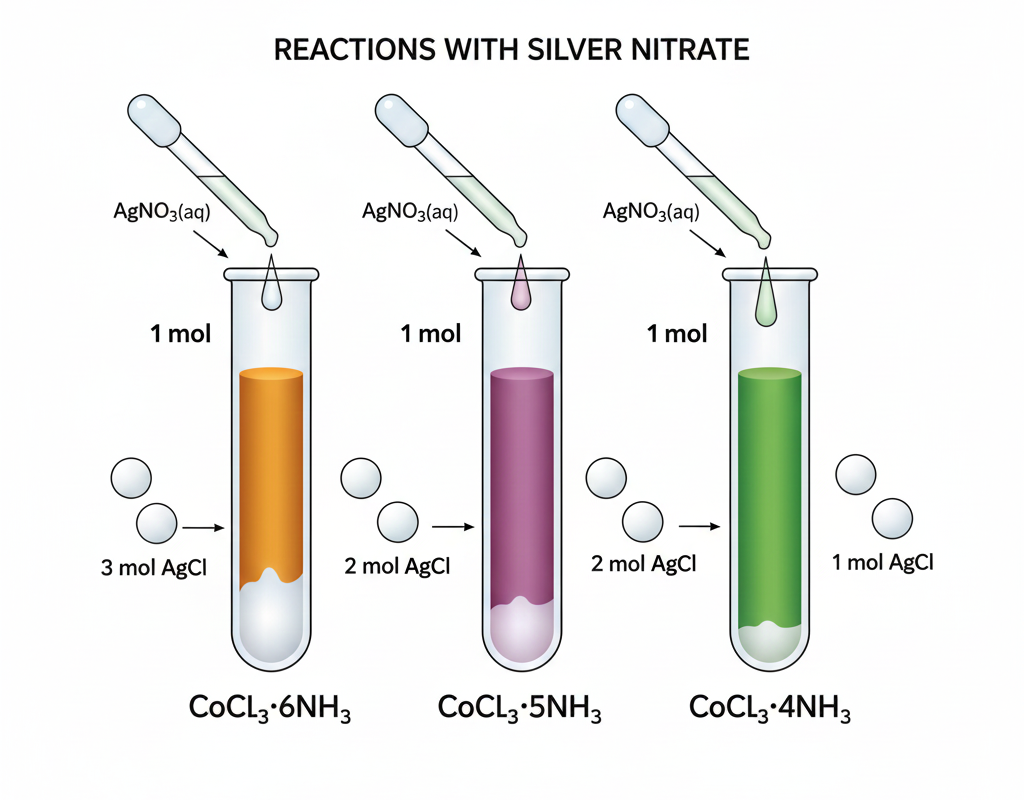
Werner used simple experimental techniques to prove this, chiefly the AgCl precipitation test and conductivity measurements. He studied a series of compounds formed between $CoCl_{3}$ and $NH_{3}$.
Imagine you’re calculating how many runs (ions) are free. When Werner added excess silver nitrate ($AgNO_{3}$), only the chloride ions corresponding to the primary valence would precipitate as $AgCl$.
- For $1$ mol of $CoCl_{3}.6NH_{3}$ (Yellow), he obtained $3$ mol of $AgCl$. This complex is formulated as $[Co(NH_{3})_{6}]^{3+}3Cl^{-}$, meaning all three chlorides were ionisable, acting as counter ions. Its solution conductivity corresponds to a $1:3$ electrolyte.
- For $1$ mol of $CoCl_{3}.5NH_{3}$ (Purple), he obtained $2$ mol of $AgCl$. This means one chloride ion was non-ionisable (bound by secondary valence). The formulation is $[CoCl(NH_{3})_{5}]^{2+}2Cl^{-}$.
- In all these examples, the groups bound directly to the cobalt ion totaled six, so the secondary valence is six.
NEET Checkpoint:
If $1$ mole of $PdCl_{2}.4NH_{3}$ precipitates $2$ moles of $AgCl$, what is the secondary valence of $Pd$?
(a) $2$
(b) $3$
(c) $4$
(d) $6$
✅ Answer: (c) $4$ — Since $2$ moles of $Cl^{-}$ are outside (ionisable), the $4$ $NH_{3}$ molecules must be directly bound to $Pd$. Secondary valence (coordination number) is $4$.
NEET Checkpoint:
Compounds like $[CoCl_{2}(NH_{3}){4}]^{+}Cl^{-}$ and $[CoCl{2}(NH_{3})_{4}]^{+}Cl^{-}$ (Green/Violet forms) are examples of:
(a) Coordination isomers
(b) Linkage isomers
(c) Geometrical isomers
(d) Ionisation isomers
✅ Answer: (c) Geometrical isomers — They have the same empirical formula ($CoCl_{3}.4NH_{3}$) but distinct properties, indicating different spatial arrangements (isomers).
Figure below:
A diagram illustrating three test tubes containing $1$ mol each of $CoCl_{3}.6NH_{3}$, $CoCl_{3}.5NH_{3}$, and $CoCl_{3}.4NH_{3}$. Show the addition of $AgNO_{3}$ and depict $3$, $2$, and $1$ mole of $AgCl$ precipitate respectively.
Practice Questions:
1. Which statement correctly describes the nature of the secondary valence in coordination chemistry, according to Werner’s postulates?
(a) It is ionisable and satisfied by negative ions.
(b) It is equal to the oxidation state of the metal.
(c) It is non-ionisable and fixed for a given metal.
(d) It is variable and always satisfied by neutral molecules.
✅ Explanation: The secondary valence is defined as non-ionisable, fixed for a metal, and equal to the coordination number.
2. The complex $[CoCl_{2}(NH_{3})_{4}]Cl$ is expected to yield how many ions in aqueous solution?
(a) $4$
(b) $3$
(c) $2$
(d) $1$
✅ Explanation: The coordination entity $[CoCl_{2}(NH_{3})_{4}]^{+}$ remains intact, and the counter ion $Cl^{-}$ dissociates. Total ions: one complex cation plus one chloride anion, totaling $2$ ions (a $1:1$ electrolyte).
Now that you've got this historical funda cleared up, wait till you see how these linkages connect with modern theories like Valence Bond Theory (VBT) and Crystal Field Theory (CFT)!
Key Takeaway
Primary Valence $\implies$ Ionisable $\implies$ Oxidation State.
Secondary Valence $\implies$ Non-ionisable $\implies$ Coordination Number.
Werner used $AgCl$ precipitation to determine the number of ionisable groups (primary valence) outside the coordination sphere.
3. Fundamental Terminology: Coordination Entity and Central Atom
Coordination Entity (The Special Tiffin Box)
A coordination entity (or complex) is the heart of the compound. It constitutes a central metal atom or ion bonded to a fixed number of ions or molecules. Think of this entire arrangement—the metal and its direct attachments—as being protected by square brackets, like $[CoCl_{3}(NH_{3}){3}]$ or $[Fe(CN){6}]^{4-}$. This bracketed species is the unit that maintains its identity, even in solution.
NEET Checkpoint:
Which feature is characteristic of a coordination entity?
(a) It dissociates completely into simple ions in water.
(b) It involves a central atom bonded to a fixed number of ions or molecules.
(c) It must be satisfied by primary valences only.
✅ Answer: (b) It involves a central atom bonded to a fixed number of ions or molecules — Yeh definition hai! The whole thing stays together, boss.
Central Atom/Ion (The Captain)
Within the coordination entity, the central atom/ion is the main element. This is the atom/ion to which a fixed number of ions/groups are bound in a definite geometrical arrangement around it. For example, in $[NiCl_{2}(H_{2}O){4}]$, the central ion is $Ni^{2+}$, and in $[Fe(CN){6}]^{3-}${6}]^{3-}$, it's $Fe^{3+}$.
Now, why does this matter? Because the central atom/ion accepts electron pairs from the surrounding groups (ligands, which we'll discuss next) to form coordinate bonds. Hence, these central atoms/ions are also famously referred to as Lewis acids! Keep this in mind, it’s a quick memory point!
Coordination Sphere (The Inner Circle)
The coordination sphere is simply the central atom/ion and all the ligands attached to it, all enclosed within the square bracket. Imagine the square bracket is the boundary line of a cricket pitch: everything inside is the coordination sphere, and it’s non-ionisable.
The ionisable groups, which are written outside the bracket, are called counter ions. They are basically there to balance the charge of the coordination entity. For example, if you look at the complex $K_{4}[Fe(CN){6}],$ the coordination sphere is $[Fe(CN){6}]^{4-}$ (which is the complex ion) and the counter ion is $K^{+}$.
Analogy time! Think of the coordination entity like a $Kachori$ stall setup at a busy metro station. The Coordination Sphere ($[Fe(CN)_{6}]^{4-}$) is the Kachori itself—the core ingredients (metal and ligands) that stick together and give the entity its flavour. The Counter Ions ($K^{+}$) are the change you hand over—they are separate and just there to balance the transaction (charge)!
NEET Checkpoint:
In the compound $K_{2}[Zn(OH)_{4}]$, which part represents the counter ion?
(a) $Zn^{2+}$
(b) $OH^{-}$
(c) $K^{+}$
✅ Answer: (c) $K^{+}$ — The ionisable group written outside the square bracket is the counter ion.
NEET Checkpoint:
What term is used for the central atom/ion due to its electron pair accepting nature?
(a) Lewis Base
(b) Lewis Acid
(c) Neutral entity
✅ Answer: (b) Lewis Acid — They accept electron pairs from ligands.
Practice Questions:
- Identify the central metal ion acting as a Lewis acid in $[Co(NH_{3}){6}]^{3+}$:
(a) $N$
(b) $H$
(c) $Co^{3+}$
(d) $NH{3}$
✅ Answer: (c) $Co^{3+}$ — Cobalt is the atom to which the groups ($NH_{3}$) are bound, making it the central atom/ion.
2. A coordination compound has the formula $X[M L_{5}]Y_{2}$. The Coordination Sphere is best represented by:
(a) $M L_{5}$
(b) $X$
(c) $[M L_{5}]$
(d) $Y_{2}$
✅ Answer: (c) $[M L_{5}]$ — The central atom ($M$) and attached ligands ($L$) are enclosed in square brackets, defining the coordination sphere.
Key Takeaway
Coordination Entity is the overall complex, like $[Co(NH_{3}){6}]^{3+}$.
Central Atom/Ion is the Lewis acid inside, e.g., $Co^{3+}$.
Coordination Sphere is the central atom plus ligands, inside the bracket, e.g., $[Fe(CN){6}]^{4-}$ in $K_{4}[Fe(CN)_{6}]$.
4. Ligands, Denticity, and Chelation
A ligand is essentially the ion or molecule that is bound to the central atom/ion within the coordination entity. These guys are electron donors (Lewis bases, remember?) and they can range dramatically in size. They can be super simple ions like $\text{Cl}^{-}$ or small molecules like $\text{H}_2\text{O}$ or $\text{NH}_3$. But wait, they can also be huge macromolecules, such as proteins. Imagine one of those giant stadium floodlights (the central atom) surrounded by tiny fireflies and huge lamps (the ligands)—it’s quite the range!
The Denticity Dynamo
Ligands are classified based on how many donor atoms they use to bind to the metal:
- Unidentate: Uses a single donor atom, like $\text{Cl}^{-}$, $\text{H}_2\text{O}$, or $\text{NH}_3$.
- Didentate: Binds through two donor atoms simultaneously. Examples include ethane-1,2-diamine ($\text{H}_2\text{NCH}_2\text{CH}_2\text{NH}_2$, often abbreviated as $en$) and the oxalate ion ($\text{C}_2\text{O}_4^{2-}$).
- Polydentate: Has several donor atoms present in a single ligand. The best (and most important) example is the Ethylenediaminetetraacetate ion ($\text{EDTA}^{4-}$), which is a hexadentate ligand. It coordinates through six atoms: two nitrogens and four oxygens.
Denticity is the number of ligating groups used by a di- or polydentate ligand to bind to the central atom.
NEET Checkpoint:
Which type of ligand binds via two donor atoms?
(a) Polydentate
(b) Unidentate
(c) Didentate
(d) Ambidentate
✅ Answer: (c) Didentate — Simple logic, di- means two donor atoms are used.
Chelation: The Stable Ring Funda
When a didentate or polydentate ligand uses two or more donor atoms simultaneously to grab a single metal ion, it forms a ring-like structure. This process is called chelation, and the ligand is a chelate ligand.
Here's the trick: These chelate complexes are generally much more stable than similar complexes formed with just unidentate ligands. It’s like carrying your school bag with both hands versus just balancing it on one finger—two hands (chelation) offer way more stability!
Relatable Example: Think of holding a rickshaw driver (the central metal ion) with both your hands (didentate $en$). That simultaneous two-handed grip is chelation, ensuring he can’t leave, making the complex (your ride) highly stable!
Ambidentate Ligands: Choosing a Donor Atom
Now, notice this special category: ambidentate ligands. These are ligands that possess two different donor atoms, but only one atom links to the central metal ion in a specific complex. They get to choose!
Classic examples are the nitrite ion ($\text{NO}_2^{-}$) and the thiocyanate ion ($\text{SCN}^{-}$).
- The $\text{NO}_2^{-}$ ion can coordinate through nitrogen ($\text{M}-\text{NO}_2$, nitrito-N) or through oxygen ($\text{M}-\text{ONO}$, nitrito-O).
- The $\text{SCN}^{-}$ ion can coordinate through sulphur ($\text{M}-\text{SCN}$, thiocyanato-S) or through nitrogen ($\text{M}-\text{NCS}$, thiocyanato-N).
NEET Checkpoint:
$\text{SCN}^{-}$ is an example of an ambidentate ligand because it can coordinate through:
(a) Sulphur only
(b) Nitrogen only
(c) Sulphur or Nitrogen
(d) Carbon
✅ Answer: (c) Sulphur or Nitrogen — It has two different ligating groups available.
Practice Questions:
- Identify the denticity of the $\text{EDTA}^{4-}$ ion as described in the sources:
(a) Tetradentate
(b) Pentadentate
(c) Hexadentate
(d) Didentate
✅ Explanation: $\text{EDTA}^{4-}$ is explicitly mentioned as an important hexadentate ligand, binding through two nitrogen and four oxygen atoms (six total donor atoms).
2. Which characteristic makes a chelate complex more stable than a non-chelate complex?
(a) Lower oxidation state of the metal
(b) Binding through a single donor atom
(c) Simultaneous binding of multiple donor atoms from a single ligand
(d) Presence of ionic bonds
✅ Explanation: Chelation is defined as the simultaneous binding of two or more donor atoms from a single ligand, and the sources state that such complexes tend to be more stable.
NEET Checkpoint:
Macromolecules, such as proteins, can act as ligands. True or False?
(a) True
(b) False
✅ Answer: (a) True — Ligands can range from simple ions to macromolecules like proteins.
Key Takeaway
Ligands supply electron pairs. Their Denticity classifies them based on donor atoms (e.g., Unidentate $\text{Cl}^{-}$, Didentate $\text{C}_2\text{O}_4^{2-}$). Chelation occurs when a single ligand uses two or more donor atoms simultaneously, forming highly stable ring structures. Ambidentate ligands ($\text{NO}_2^{-}$, $\text{SCN}^{-}$) have a choice of two different donor atoms.
5. Coordination Number and Polyhedra: The Geometry Funda
Coordination compounds look complex, but their geometry funda is quite straightforward if you remember two key definitions: Coordination Number (CN) and the Coordination Polyhedron.
Coordination Number (CN)
The Coordination Number (CN) of a metal ion in a complex is simply defined as the number of ligand donor atoms to which the central metal is directly bonded.
Notice this crucial trick: CN is determined only by the number of sigma bonds formed between the ligand and the central atom/ion. Pi bonds, if they form, are not counted for CN. For example, in the complex ion $[PtCl_{6}]^{2-}$, the CN of $Pt$ is $6$, and in $[Ni(NH_{3})_{4}]^{2+}$, the CN of $Ni$ is $4$.
Here's the trick: When a didentate ligand (like $en$ or $C_{2}O_{4}^{2-}$) binds, it uses two donor atoms simultaneously to attach to the metal. So, in $[Co(en)_{3}]^{3+}$, even though there are only three $en$ molecules, since each $en$ binds through two donor atoms, the total CN for $Co$ is $3 \times 2 = 6$.
Relatable Indian Example: Imagine counting passengers on a scooter. CN counts the number of hands holding the central person (the metal). If a friend holds on using just one hand (unidentate), that's CN 1. But if your bachpan friend hugs you tight using both arms (didentate), that counts as two donor points (CN 2) from just one person!
NEET Checkpoint:
The Coordination Number of the central metal in $[Fe(C_{2}O_{4})_{3}]^{3-}$ is:
(a) 3
(b) 6
(c) 9
(d) 4
✅ Answer: (b) 6 — Because the oxalate ion $(C_{2}O_{4}^{2-})$ is a didentate ligand, meaning it contributes two donor atoms each. So, $3 \times 2 = 6$ donor atoms.
Coordination Polyhedra and Shapes
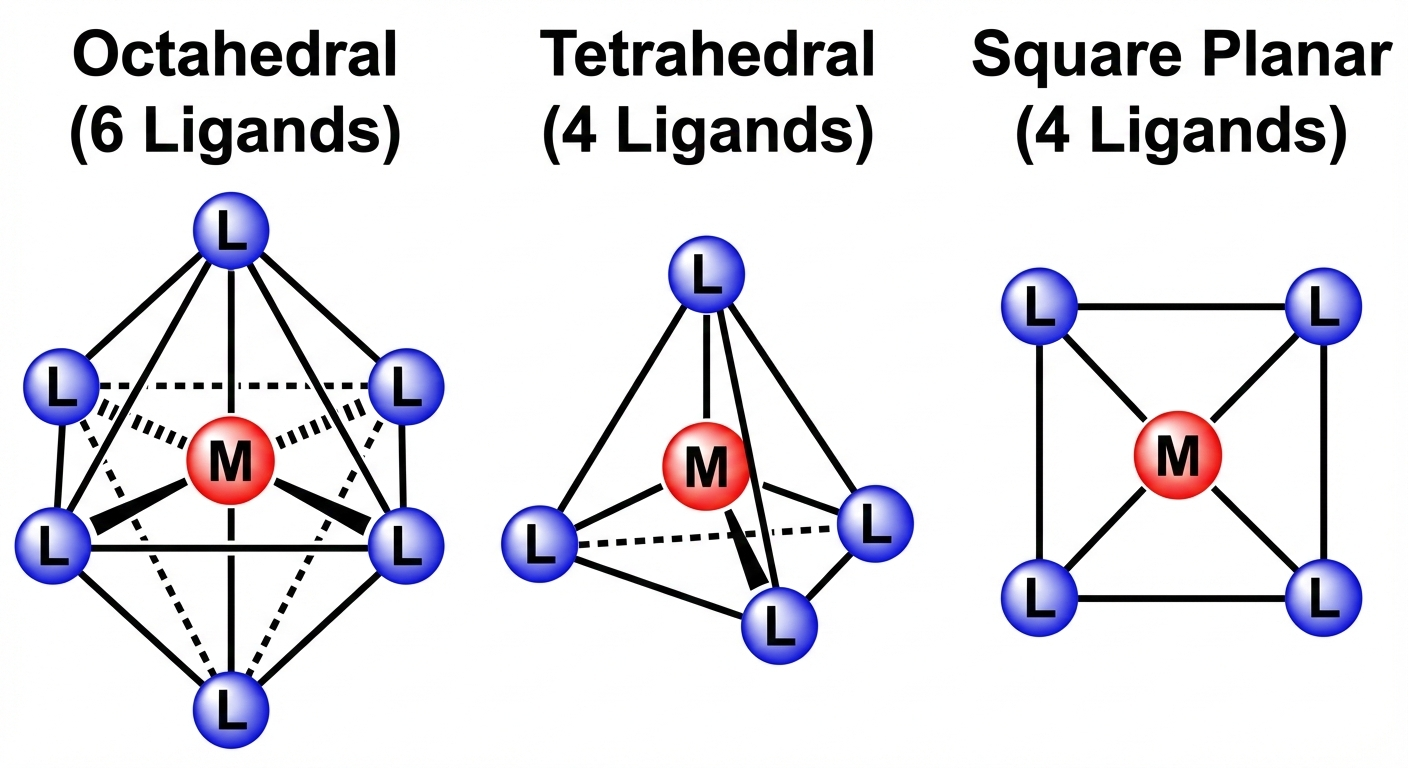
The coordination polyhedron is the characteristic spatial arrangement of the ligand atoms which are directly attached to the central atom/ion. Essentially, it's the shape of the complex.
The most common polyhedra shapes are:
- Octahedral: Coordination Number 6. Example: $[Co(NH_{3})_{6}]^{3+}$.
- Tetrahedral: Coordination Number 4. Example: $[Ni(CO)_{4}]$.
- Square Planar: Coordination Number 4. Example: $[PtCl_{4}]^{2-}$.
We can't draw the geometry here, but you must recognize these shapes for NEET!
Figure below:
A clear diagram showing the three most common coordination polyhedra shapes: Octahedral (with 6 ligands L), Tetrahedral (with 4 ligands L), and Square Planar (with 4 ligands L).
NEET Checkpoint:
Which coordination number can result in two different common polyhedral shapes?
(a) 6
(b) 3
(c) 4
(d) 5
✅ Answer: (c) 4 — CN 4 can be either tetrahedral or square planar.
Homoleptic and Heteroleptic Complexes
Based on the type of ligands they hold, complexes are classified into two types:
-
Homoleptic Complexes: Complexes in which the metal is bound to only one kind of donor groups.
- Example: $[Co(NH_{3}){6}]^{3+}$ (only $NH{3}$ donor groups).
-
Heteroleptic Complexes: Complexes in which the metal is bound to more than one kind of donor groups.
- Example: $[Co(NH_{3}){4}Cl{2}]^{+}$ (bound to both $NH_{3}$ and $Cl^{-}$ donor groups).
NEET Checkpoint:
A complex that contains $\text{aqua}$ ($\text{H}_2\text{O}$) and $\text{ammine}$ ($\text{NH}_3$) ligands simultaneously is classified as:
(a) Homoleptic
(b) Homodentate
(c) Heteroleptic
(d) Ambidentate
✅ Answer: (c) Heteroleptic — Since the metal is bound to two different types of donor groups ($\text{H}_2\text{O}$ and $\text{NH}_3$), it’s heteroleptic.
Practice Questions:
- Which complex below is classified as homoleptic?
(a) $[Co(NH_{3}){6}]^{3+}$.
(b) $[Ni(CO){4}]$
(c) $[Pt(NH_{3})Cl_{3}]^{-}$
(d) $[Cr(H_{2}O)_{5}Cl]^{2+}$
✅ Answer: (b) $[Ni(CO){4}]$, It contains only one type of ligand ($CO$), making it homoleptic. The others contain multiple ligand types ($Cl^{-}$ and $en$; $NH{3}$ and $Cl^{-}$; $H_{2}O$ and $Cl^{-}$).
2. The CN of $Pt$ in the square planar entity $[PtCl_{4}]^{2-}$ and the geometry of $[Co(NH_{3})_{6}]^{3+}$ are:
(a) CN 6, Tetrahedral
(b) CN 4, Square Planar
(c) CN 4, Octahedral
(d) CN 6, Octahedral
✅ Answer: (c) CN 4, Octahedral. For $[PtCl_{4}]^{2-}$, CN is 4, and its geometry is square planar. For $[Co(NH_{3})_{6}]^{3+}$, the CN is 6, and its geometry is octahedral.
Key Takeaway
Coordination Number (CN) is the number of ligand donor atoms directly bonded by sigma bonds. CN 4 yields Tetrahedral or Square Planar shapes, while CN 6 yields Octahedral shapes. Homoleptic complexes have one kind of ligand donor group, and Heteroleptic complexes have more than one.
6. Oxidation Number and Formula Writing (IUPAC)
First, let's talk about the Oxidation Number. This is super essential for naming complexes. It’s defined as the hypothetical charge the central atom would carry if all ligands are removed along with the electron pairs they shared. When we talk about naming a complex, we indicate this oxidation number using a Roman numeral in parenthesis following the name of the coordination entity. For instance, if copper has a $+1$ charge, we represent it as $Cu(I)$.
NEET Checkpoint:
The oxidation state of the central atom is indicated by a Roman numeral in parenthesis in the name. This charge is defined as the hypothetical charge if:
(a) The counter ions are removed.
(b) All ligands are removed along with shared electron pairs.
(c) Only neutral ligands are removed.
✅ Answer: (b) All ligands are removed along with shared electron pairs — This is the official definition of the oxidation number of the central atom.
Now, let's look at the rules for writing the Formulas of Mononuclear Coordination Entities (Sec 5.3.1). Think of this like setting up a cricket team roster: there's a fixed order!
- Central Atom First: The central atom is listed first. It's the captain, yaar!
- Alphabetical Ligands: The ligands are listed next, and this is where it gets tricky: they are listed in alphabetical order. Here’s the trick: the placement of a ligand does not depend on its charge. So, ammine ($NH_{3}$) comes before chloro ($Cl$) because 'a' comes before 'c'.
- Square Brackets Rule: The formula for the entire coordination entity (charged or not) is enclosed in square brackets. If ligands themselves are polyatomic (like $H_{2}O$), wrap them in parentheses. Remember, there should be no space between the ligands and the metal inside the coordination sphere.
- Charge Indication: If you are writing the formula for a charged coordination entity (a complex ion) without its counter ion, the charge is indicated outside the square brackets as a right superscript, with the number always coming before the sign. For example, $[Co(CN)_{6}]^{3-}$.
NEET Checkpoint:
When writing the formula for a complex, which ligand property determines its placement?
(a) The magnitude of its charge
(b) The alphabetical order of its name/formula
(c) Whether it is neutral or anionic
✅ Answer: (b) The alphabetical order of its name/formula — The placement depends on alphabetical order and explicitly does not depend on the charge.
Relatable Example: Imagine you are making a tiffin box (the coordination entity, $[...]$) for your friend. The main item (the central metal, $M$) goes in first. Then, the side dishes (the ligands) must be packed alphabetically based on their names. If your tiffin box is charged (a complex ion), the charge tag (superscript) sticks outside the box.
NEET Checkpoint:
In the formula $K_{3}[Al(C_{2}O_{4})_{3}]$, the square brackets enclose:
(a) The cation and anion.
(b) The central atom and the ligands.
(c) Only the ligands.
✅ Answer: (b) The central atom and the ligands — The species within the square bracket forms the coordination entity.
Practice Questions:
- In writing the formula for a charged coordination entity, the charge is shown:
(a) As a left superscript inside the brackets
(b) As a right superscript outside the brackets
(c) As a subscript outside the brackets
(d) Only if the charge is negative
✅ Answer: (b) As a right superscript outside the brackets — The charge is written outside the brackets as a right superscript, number before the sign (e.g., $[Co(H_{2}O)_{6}]^{3+}$).
2. Which component is always listed first when writing the formula of a coordination entity?
(a) The ligand with the lowest charge
(b) The ligand that appears first alphabetically
(c) The central atom
(d) The counter ion
✅ Answer: (c) The central atom — The rule is clear: The central atom is listed first.
Key Takeaway
| Component | Rule Summary |
|---|---|
| Oxidation Number (in name) | Charge if ligands removed; written as Roman numeral in parenthesis. |
| Formula Rule (1) | Central atom listed first. |
| Formula Rule (2) | Ligands listed alphabetically, charge is irrelevant for placement. |
| Formula Rule (3) | Entire entity enclosed in square brackets. |
| Formula Rule (4) | Charge on entity is right superscript (number before sign) outside brackets. |
7. Naming Mononuclear Coordination Compounds (IUPAC)
IUPAC nomenclature for coordination compounds is just a set of systematic rules, like memorising the periodic table trends. Once you get the flow, it's easier than it looks! We use the recommendations from the International Union of Pure and Applied Chemistry (IUPAC) to describe these complex entities unambiguously.
Here's the trick to naming them:
-
Cation First, Always: This is the most important rule. The cation is named first, regardless of whether the cation is a simple counter ion (like $K^{+}$) or the complex coordination entity (inside the square brackets). It’s like naming the state before the capital city. For example, in $K_{3}[Fe(CN)_{6}]$, the potassium ($K$) is named first, even though the complex is the anion.
-
Ligands Lead the Way (Alphabetically!): The ligands always get named before the central metal atom. And get this—they are listed in alphabetical order. Their charge doesn't matter for the ordering, only their name.
-
Anionic Ligands end in -o: If a ligand is an anion, its name must end with the suffix -o. Simple chloride ($Cl^{-}$) becomes chloro (or sometimes chlorido). Neutral ligands usually keep their common names, but remember these must-know exceptions: $H_{2}O$ is aqua, $NH_{3}$ is ammine, $CO$ is carbonyl, and $NO$ is nitrosyl.
NEET Checkpoint:
Which of the following ligands is named ammine?
(a) $H_{2}O$
(b) $CO$
(c) $NH_{3}$
(d) $Cl^{-}$
✅ Answer: (c) $NH_{3}$ $—$ $NH_{3}$ is one of the mandatory neutral ligand exceptions you must know.
4. Prefixes: Di/Tri vs. Bis/Tris: How do you show the number of ligands?
-
- For simple ligands (like aqua or chloro), use di, tri, tetra, etc..
- Here's the funda that catches students: If the ligand's name already contains a numerical prefix (like ethane-1,2-diamine), using 'di' again sounds confusing! In this case, use bis (for two), tris (for three), or tetrakis (for four). When using these, place the ligand name in parentheses. For instance, $ [NiCl_{2}(PPh_{3})_{2}] $ is dichloridobis(triphenylphosphine)nickel(II).
NEET Checkpoint:
The prefix tetrakis is used when naming:
(a) four simple ligands
(b) four ligands whose name contains a numerical prefix
(c) five anionic ligands
✅ Answer: (b) four ligands whose name contains a numerical prefix — We use bis, tris, or tetrakis when the ligand name itself already includes a number.
5. Oxidation State and Suffix -ate: Right after the metal name, you must indicate the oxidation state of the metal using Roman numerals in parenthesis. But wait, the metal's name itself changes based on charge!
-
- If the complex ion is a cation (or neutral), you use the standard element name (e.g., cobalt, platinum).
- If the complex ion is an anion, you apply the suffix -ate. Cobalt becomes cobaltate, and iron ($Fe$) uses its Latin root to become ferrate.
NEET Checkpoint:
In the name tetraamminediaquacobalt(III) chloride, why is the metal called cobalt and not cobaltate?
(a) The oxidation state is +3.
(b) It is a neutral complex.
(c) The complex ion is a cation.
(d) The ligands are neutral.
✅ Answer: (c) The complex ion is a cation. — We use the element name (cobalt) when the coordination entity is a cation.
Practice Question:
What is the correct IUPAC name for $K_{3}[Fe(C_{2}O_{4})_{3}]$
(a) Potassium trioxalatocobaltate(III)
(b) Tripotassium trioxalatoferrate(III)
(c) Potassium trioxalatoiron(III)
(d) Potassium trioxalatoferrate(III)
✅ Answer: (d) Potassium trioxalatoferrate(III) — Cation Potassium is named first. Anionic ligand $C_{2}O_{4}^{2-}$ is oxalato (three means trioxalato). Since the complex is an anion, iron becomes ferrate. The oxidation state is (III).
Key Takeaway
Nomenclature Order: Cation → Ligands (alphabetical) → Metal (with Roman numeral) → Anion. Use suffix -ate only if the complex entity is an anion. Use bis/tris/tetrakis for ligands that already have numerical prefixes.
8. Overview of Isomerism in Coordination Compounds
Alright, NEET aspirants, let's clear up the funda of isomerism in coordination compounds. Don't stress, yaar—it’s easier than it looks! Isomerism is basically about compounds that are chemical twins: they share the same chemical formula but have a completely different arrangement of atoms. Because their internal assembly is different, they end up having distinct physical or chemical properties.
We primarily classify isomers into two major, super-important families:
- Stereoisomerism: Think of this as having the same eleven players on the cricket field, but just rearranging their positions (spatial arrangement). Stereoisomers have the same chemical formula and chemical bonds, but their ligands are arranged differently in 3D space.
- Structural Isomerism: This is when the fundamental 'rules' change. Structural isomers are those that have different bonds altogether.
Here’s the breakdown of the major subtypes you need to master for your exam:
Subtypes Breakdown
Stereoisomerism has two main variations:
- Geometrical isomerism
- Optical isomerism
Structural Isomerism, where the linkages are fundamentally different, involves four subtypes:
- Linkage isomerism
- Coordination isomerism
- Ionisation isomerism
- Solvate isomerism (which is also known as hydrate isomerism if the solvent involved is water).
NEET Checkpoint :
Compounds that have the same chemical formula but different bonds are called:
(a) Stereoisomers
(b) Homoleptic complexes
(c) Structural isomers
(d) Solvate isomers
✅ Answer: (c) Structural isomers — The key giveaway is "different bonds".
Relatable Example: Imagine you have the exact same set of materials (metal, ligands, and counter ions). If you build a 2×2 matrix arrangement, and then switch to a 4×1 linear arrangement, that’s Structural Isomerism (different bonds). But if you have the same octahedral structure (same bonds), and you just change a chlorine atom from the X-axis to the Y-axis, that's Stereoisomerism (just changing the spatial arrangement).
NEET Checkpoint :
Which pair of subtypes belongs to Stereoisomerism?
(a) Linkage and Solvate
(b) Geometrical and Optical
(c) Coordination and Ionisation
(d) Optical and Linkage
✅ Answer: (b) Geometrical and Optical — These two rely on the spatial positioning of the ligands, not different fundamental bonds.
NEET Checkpoint :
What is the condition required for an isomer to be classified as a Solvate isomer?
(a) The complex must contain CN− ligands
(b) A solvent molecule is present, either bonded or free
(c) The metal ions must interchange ligands
(d) The complex must be square planar
✅ Answer: (b) A solvent molecule is present, either bonded or free — Solvate isomers differ by whether a solvent molecule (like $H_2O$) is bonded to the metal ion or just present in the crystal lattice.
Practice Question:
Which of the following isomerism arises due to the interchange of ligands between the cationic and anionic entities of a complex?
(a) Ionisation isomerism
(b) Coordination isomerism
(c) Linkage isomerism
(d) Solvate isomerism
✅ Explanation: Coordination isomerism involves the interchange of ligands between the complex cation and the complex anion, as seen in examples like$
$[\text{Co}(\text{NH}_3)_6][\text{Cr}(\text{CN})_6]$ and its isomer $[\text{Cr}(\text{NH}_3)_6][\text{Co}(\text{CN})_6].$
Key Takeaway
Isomers share the same formula but have different atom arrangements. The two main types are Stereoisomerism (same bonds, different spatial orientation) and Structural Isomerism (different bonds).
9. Geometrical Isomerism (cis/ trans and fac/ mer)
This type of isomerism happens in heteroleptic complexes—meaning complexes where the central metal atom is bound to more than one kind of ligand. It arises simply because the ligands can be arranged in different possible geometric arrangements in space. These isomers have the same chemical formula and chemical bonds, but their spatial setup is different.
Notice this: This isomerism is common in coordination numbers 4 (specifically square planar) and 6 (specifically octahedral).
Here's the trick: Geometrical isomerism is generally not possible in tetrahedral complexes. Why? Because in a tetrahedral arrangement, the relative positions of the unidentate ligands attached to the central metal atom are always the same with respect to each other. Imagine four friends clustered on a small scooter (tetrahedral geometry)—no matter how they shuffle, everyone is adjacent to everyone else!
NEET Checkpoint:
Why don't tetrahedral complexes exhibit geometrical isomerism?
(a) They have high coordination numbers
(b) The relative positions of ligands are always the same
(c) They only form homoleptic complexes
(d) They require didentate ligands.
✅ Answer: (b) The relative positions of ligands are always the same — Arre, remember the scooter analogy! All corners of the tetrahedron are equidistant and adjacent, so cis or trans separation is impossible.
cis and trans Forms
The two primary forms you need to know are cis and trans.
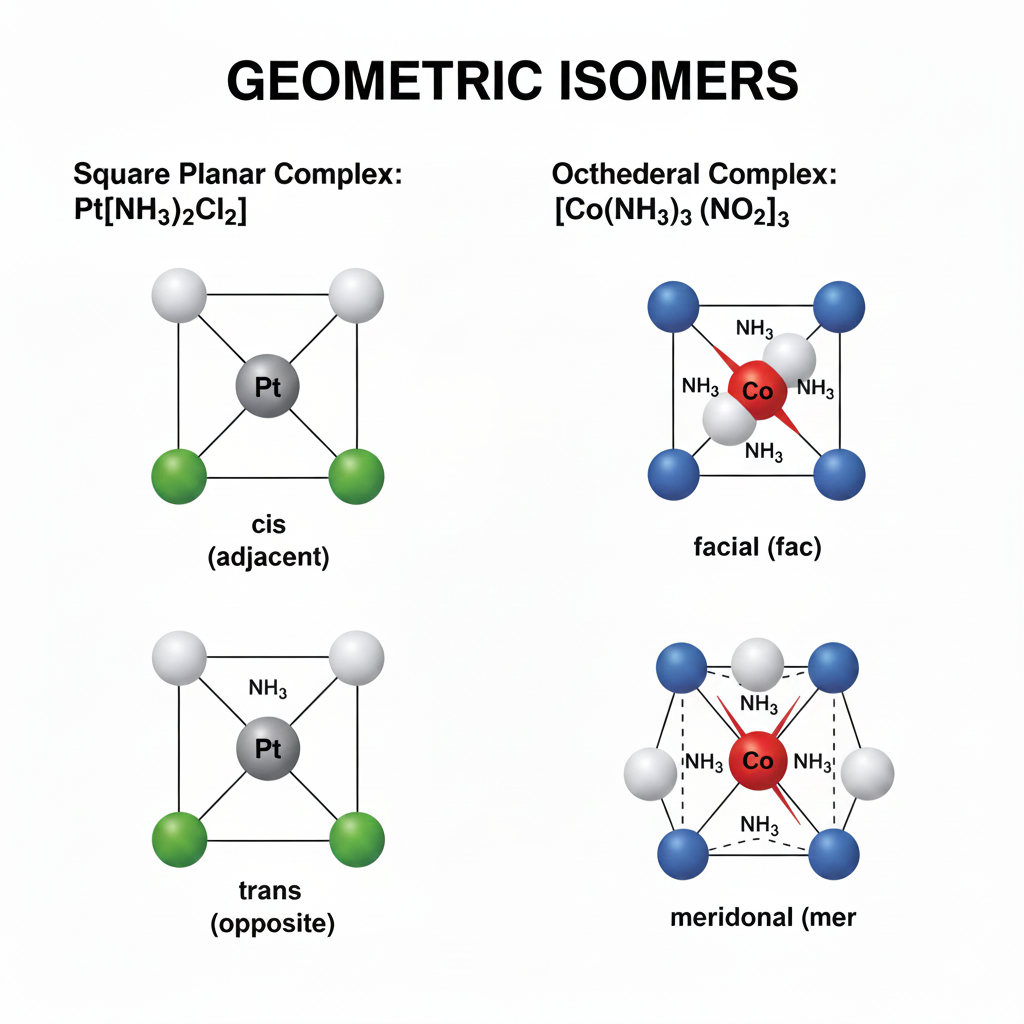
- Square Planar Complexes $([MX_{2}L_{2}])$: In complexes like $[Pt(NH_{3}){2}Cl{2}]$, if the two identical ligands (X) are arranged adjacent to each other, you have the cis isomer. If they are arranged opposite to each other, it's the trans isomer. Think of a pani puri stall counter (square planar). If the chutney bowls are side-by-side, that's cis. If they are diagonal, that's trans. Square planar complexes of the type MABXL (where A,B,X,L are unidentates) show three isomers—two cis and one trans.
- Octahedral Complexes $([MX_{2}L_{4}] 𝑜 𝑟 [MX_{2}(L-L)_{2}])$: Octahedral geometry shows similar behaviour. In $[MX_{2}L_{4}]$ the two identical ligands X can be oriented cis (adjacent) or trans (opposite). This distinction is also seen in complexes where didentate ligands (L−L), like ethane-1,2-diamine (en), are present, such as $[MX_{2}(L-L)_{2}])$.
NEET Checkpoint:
The geometrical isomer where two identical unidentate ligands (X) are placed opposite each other in a square planar $[MX_{2}L_{2}]$ complex is called the:
(a) fac isomer
(b) mer isomer
(c) cis isomer
(d) trans isomer.
✅ Answer: (d) trans isomer — Opposite positions mean trans, simple funda.
fac and mer Forms (Octahedral Only)
This special case of geometrical isomerism occurs only in octahedral coordination entities of the formula $[Ma_{3}b_{3}]$, like $[Co(NH_{3}){3}(NO{2})_{3}]$.
1. Facial (fac) Isomer: If the three donor atoms of the same ligand (e.g., a) occupy adjacent positions at the corners of one of the octahedron's faces, you get the facial (fac) isomer.
2. Meridional (mer) Isomer: When these three identical ligands occupy positions around the meridian of the octahedron, we get the meridional (mer) isomer.
And that's cool, right? We use geometric structures to explain why compounds with the same formula can behave completely differently
Figure below:
A clear diagram showing the cis (adjacent) and trans (opposite) geometrical isomers of a square planar complex, $Pt[(NH_{3}){2}Cl{2}]$, and the facial (fac) and meridional (mer) isomers of an octahedral complex, $[Co(NH_{3}){3}(NO{2})_{3}]$ , illustrating the spatial arrangement of ligands.
NEET Checkpoint:
Which complex type is expected to exhibit $fac/mer$ isomerism?
(a) $[MX_{4}L_{2}]$
(b) $[Ma_{3}b_{3}]$
(c) $[ML_{6}]$
(d) $[MX_{2}L_{2}]$
✅ Answer: (b) $[Ma_{3}b_{3}]$ — This is the specific formula needed for the facial and meridional arrangement in octahedral complexes.
Practice Questions:
- Geometrical isomerism is caused by different spatial arrangements of ligands in which class of compounds?
(a) Homoleptic complexes
(b) Heteroleptic complexes
(c) Double salts
(d) All complexes
✅ Explanation: The differing geometric arrangements that lead to isomerism require more than one kind of donor group, defining them as heteroleptic complexes.
2. A coordination entity of the type $[CoCl_{2}(en)_{2}]$ (where $en$ is ethane-1,2-diamine) exhibits which primary form of isomerism?
(a) Linkage and Ionisation
(b) Optical and Coordination
(c) Geometrical ($cis$/$trans$) and Optical
(d) Solvate and Linkage
✅ Explanation: Complexes of the type $[MX_{2}(L-L)_{2}]$ like this one show both geometrical isomerism ($cis$/$trans$ forms) and optical isomerism (the *cis* form is chiral).
Key Takeaway
Geometrical Isomerism requires heteroleptic complexes. It’s common in square planar $[MX_{2}L_{2}]$ : cis/ trans) and octahedral complexes $[MX_{2}L_{4}]$: cis/ trans). The unique octahedral type is $[Ma_{3}b_{3}]$ yielding facial (fac) (adjacent corners) and meridional (mer) (meridian positions) isomers. Tetrahedral complexes rarely show this funda.
10. Optical Isomerism (Chirality) – The Mirror Magic
If structural and geometrical isomerism felt like basic blueprint rearrangements, Optical Isomerism is where we deal with non-superimposable, magical mirror images! This whole concept revolves around chirality.
Listen up: Optical isomers are mirror images that simply cannot be superimposed on one another. These twins are formally called enantiomers. Think of riding a scooter! Your left hand is the mirror image of your right hand, but try to wear your right glove on your left hand—it won’t fit perfectly. That non-superimposable property is what we call chiral. A molecule or ion is chiral if it cannot be superimposed on its mirror image.
NEET Checkpoint:
A molecule that cannot be perfectly overlaid on its mirror image is defined as:
(a) Mesomeric
(b) Achiral
(c) Chiral
(d) Geometric
✅ Answer: (c) Chiral — The property of non-superimposability defines a molecule as chiral.
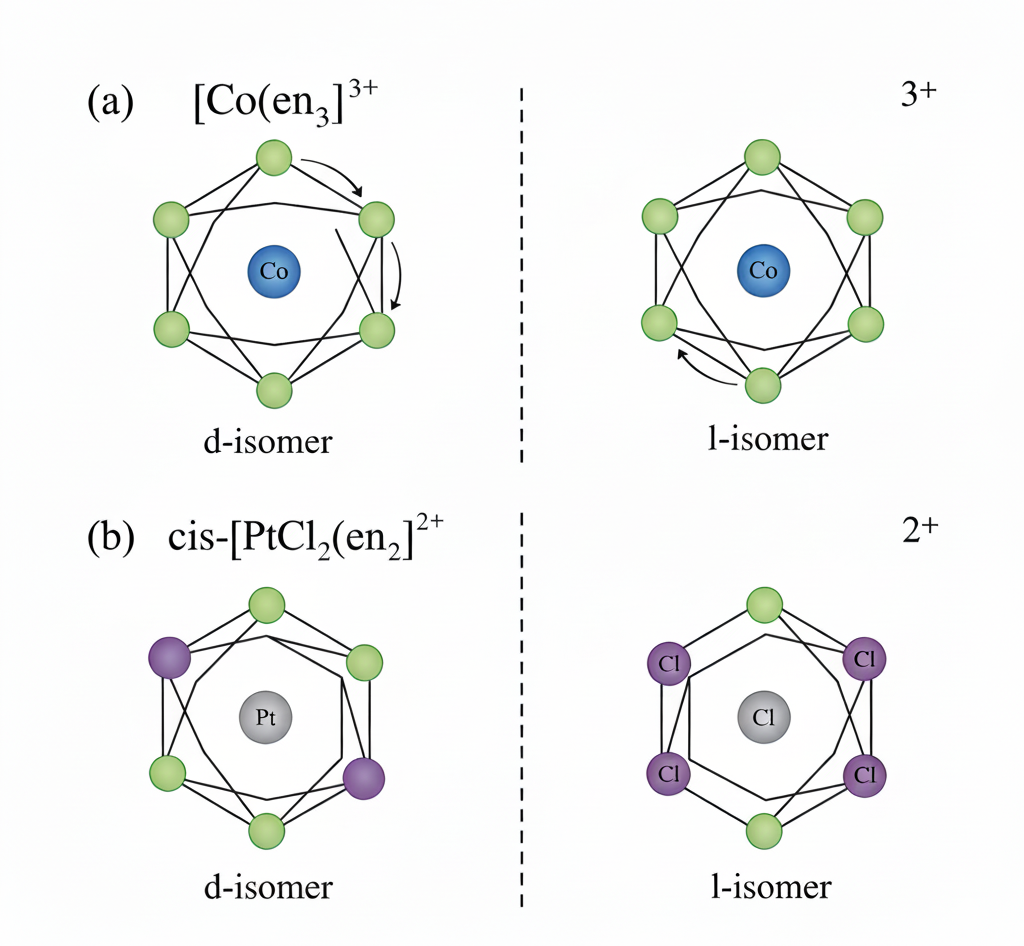
These chiral complexes are fascinating because they interact differently with light. The two forms are named dextro ($d$) and laevo ($l$). Their differentiation depends entirely on the direction they rotate plane-polarised light in a polarimeter. If the complex is dextro ($d$), it rotates the light to the right, and if it is laevo ($l$), it rotates the light to the left.
This type of isomerism is especially common in octahedral complexes involving didentate ligands. A classic example given in the sources is $[Co(en)_{3}]^{3+}$, where 'en' stands for ethane-1,2-diamine.
NEET Checkpoint:
If an optical isomer rotates plane-polarised light to the left, it is known as the:
(a) Dextro form
(b) Racemic mixture
(c) Laevo form
(d) Meso form
✅ Answer: (c) Laevo form — Laevo ($l$) rotates light to the left
Now, here's a crucial funda to clear up for the exam: For complexes of the type $[PtCl_{2}(en)_{2}]^{2+}$, only one geometrical isomer shows this optical activity. You must remember that only the cis-isomer shows optical activity . The trans-isomer, due to its symmetry, generally is not chiral. Don't stress, yaar—just look for didentate ligands in octahedral complexes and check the geometry!
Practice Questions:
In the complex $[PtCl_{2}(en)_{2}]^{2+}$, why is the cis-isomer optically active while the trans-isomer is not?
(a) The trans-isomer has higher oxidation number.
(b) Only the cis-isomer can form chelates.
(c) The cis-isomer is chiral (non-superimposable mirror images).
(d) The trans-isomer involves sp3 hybridisation.
✅ Explanation: The optical activity arises because the cis-isomer forms non-superimposable mirror images and is therefore chiral
Figure below:
A clear diagram showing the d and l non-superimposable mirror images of an octahedral complex like $[Co(en){3}]^{3+}$ (Fig. 5.6) and the optical isomers (d and l) of the cis-form of $[PtCl{2}(en)_{2}]^{2+}$.
Key Takeaway
A chiral molecule/ion cannot be superimposed on its mirror image. This pair is called enantiomers. Optical isomerism is common in octahedral complexes with didentate ligands, but remember the rule: for complexes like $[MX_{2}(L-L)_{2}]^{n+}$ generally only the cis-isomer is optically active .
11. Structural Isomerism Types
Let’s clear up the funda on Structural Isomerism. Remember, while stereoisomers just change their orientation in space, structural isomers are way more serious—they actually have different chemical bonds!. These are four classic ways coordination compounds trick us while having the same chemical formula. Don't stress, yaar, it's easier than it looks!.
Linkage Isomerism: The Ambidentate Trick
This isomerism arises when a compound contains an ambidentate ligand. An ambidentate ligand is super cool because it has two different atoms it can use to donate electrons and bind to the metal.
-
Example Focus: Check out the complex $[\text{Co}(\text{NH}_3)_5(\text{NO}_2)]\text{Cl}_2$ It can be the yellow form by binding through nitrogen ( $\text{NO}_2$) or the red form by binding through oxygen (−ONO).
-
Relatable Example: Imagine a famous batsman who can score equally well right-handed or left-handed. That versatility is ambidentate, and the resulting score card (the complex) looks identical, but the actual bond (the grip) is different!
NEET Checkpoint:
Which type of isomerism is shown by $\text{M-SCN} 𝑣 𝑒 𝑟 𝑠 𝑢 𝑠 \text{M-NCS}$ ?
(a) Ionisation
(b) Linkage
(c) Solvate
(d) Geometrical
✅ Answer: (b) Linkage — It arises due to the ambidentate nature of the thiocyanate ligand, binding through S or N
Coordination Isomerism: The Great Swap
This one is purely about the interchange of ligands between the cationic entity and the anionic entity of complexes containing different metal ions.
- Example Focus: Consider $[\text{Co}(\text{NH}_3)_6][\text{Cr}(\text{CN})_6]$. Here, $\text{NH}_3 $ is on $\text{Co}^{3+}$ and $\text{CN}^-$ is on $\text{Cr}^{3+}$ . The isomer is $[\text{Cr}(\text{NH}_3)_6][\text{Co}(\text{CN})_6]$ where the ligands have literally swapped places between the two metal centres .
Ionisation Isomerism: The Counter-Ion Exchange
In this case, the isomerism arises when the counter ion (the ion outside the square bracket) is a potential ligand itself and manages to displace a ligand inside the coordination sphere. The ligand that got kicked out becomes the new counter ion.
- Example Focus: The pair $[\text{Co}(\text{NH}_3)_5(\text{SO}_4)]\text{Br}$ and $[\text{Co}(\text{NH}_3)_5\text{Br}]\text{SO}_4$ are ionisation isomers. Notice how $\text{Br}^-$ and $\text{SO}_4^{2-}$ swap roles, leading them to yield different ions when dissolved in water.
NEET Checkpoint:
What dictates the difference between ionisation isomers?
(a) Different metal oxidation states
(b) Different spatial arrangements of ligands
(c) Which ion is released as a counter ion in solution
✅ Answer: (c) Which ion is released as a counter ion in solution — This is because the counter ion and an inner ligand swap positions.
Solvate (Hydrate) Isomerism: In or Out?
This isomerism, similar to ionisation isomerism, focuses on the role of the solvent molecule. When the solvent is water, it's specifically called hydrate isomerism.
-
The Difference: Solvate isomers differ based on whether the solvent molecule is directly bonded to the metal ion (inside the coordination sphere) or if it's just free solvent molecules sitting in the crystal lattice.
-
Example Focus: Look at the violet complex $[\text{Cr}(\text{H}_2\text{O})_6]\text{Cl}_3$. Its grey- green isomer is $[\text{Cr}(\text{H}_2\text{O})_5\text{Cl}]\text{Cl}_2.\text{H}_2\text{O}$. In the second case, one $\text{H}_2\text{O}$ molecule is chilling outside the coordinaion sphere.
NEET Checkpoint:
In the complex $[\text{Cr}(\text{H}_2\text{O})_5\text{Cl}]\text{Cl}_2.\text{H}_2\text{O}$, how many $\text{H}_2\text{O}$ molecules are directly bonded to Chromium?
(a) Six
(b) Five
(c) One
✅ Answer: (b) Five — The five molecules inside the square brackets, $[\text{Cr}(\text{H}_2\text{O})_5\text{Cl}]$, are bonded; the one outside, $\text{.}\text{H}_2\text{O}$, is lattice water.
Practice Question:
Which type of isomerism is demonstrated by the difference between $[\text{Cr}(\text{H}_2\text{O})_6]\text{Cl}_3$ (violet) and $[\text{Cr}(\text{H}_2\text{O})_5\text{Cl}]\text{Cl}_2.\text{H}_2\text{O}$ (grey-green)?
(a) Linkage Isomerism
(b) Coordination Isomerism
(c) Hydrate Isomerism
(d) Geometrical Isomerism
✅ Answer: (c) Hydrate Isomerism — Since water ($\text{H}_2\text{O}$) is the solvent that is either bonded or free in the lattice, it is a form of solvate isomerism called hydrate isomerism.
Key Takeaway
| Isomer Type | Key Change | Example Bond Difference |
| Linkage | Ambidentate ligand uses different donor atoms. | $\text{M-NO}_2$ vs $\text{M-ONO}$. |
| Coordination | Ligands interchange between the cationic and anionic coordination entities. | $[\text{Co}(\text{NH}_3)_6]/\text{CN}_6$ vs $[\text{Cr}(\text{NH}_3)_6]/\text{CN}_6$. |
| Ionisation | Inner ligand swaps place with the external counter ion. | $[\text{Co}...(\text{SO}_4)]\text{Br}$ vs $[\text{Co}...\text{Br}]\text{SO}_4$. |
| Solvate/Hydrate | Solvent molecules are either coordinated or free in the lattice. | $[\text{Cr}(\text{H}_2\text{O})_6]\text{Cl}_3$ vs $[\text{Cr}(\text{H}_2\text{O})_5\text{Cl}]\text{Cl}_2.\text{H}_2\text{O}$. |
12. Bonding: Valence Bond Theory (VBT)
Hey future doctors! Ready to tackle the classic way we understand bonding in coordination compounds? Don't stress, yaar—Valence Bond Theory (VBT) is our first approach to explaining how these complex structures work. VBT manages to explain the formation, magnetic behaviour, and geometrical shapes of coordination compounds with reasonable success.
The main funda here is hybridisation. VBT assumes that the central metal ion, under the influence of the ligands, uses its $(n-1)d$, $ns$, $np$ or $ns$, $np$, $nd$ orbitals for hybridisation. This mixing yields a set of equivalent orbitals with a specific geometry. These hybridised orbitals then overlap with ligand orbitals that donate electron pairs for bonding.
NEET Checkpoint:
Which orbitals are *not* included in the inner orbital complex hybridisation scheme if $n=4$?
(a) $3d$
(b) $4s$
(c) $4p$
(d) $4d$
✅Answer: (d) $4d$ — Inner orbital complexes specifically use the $(n-1)d$ (e.g., $3d$) orbitals, not the outer $nd$ (e.g., $4d$) ones.
Here’s the geometry cheat sheet based on Coordination Number (CN) 4 and 6:
| CN | Hybridisation | Geometry |
|---|---|---|
| 4 | $sp^{3}$ | Tetrahedral |
| 4 | $sp^{2}$ | Square planar |
| 6 | $sp^{3}d^{2}$ | Octahedral |
| 6 | $d^{2}sp^{3}$ | Octahedral |
Notice this: If a complex needs two $d$ orbitals for hybridisation (CN 6), it can grab them either from the inner shell (like $3d$) or the outer shell (like $4d$).
If the complex uses the inner $d$ orbitals (like $3d$), for example in $d^{2}sp^{3}$ hybridisation, it's called an inner orbital complex. These are also known as low spin or spin paired complexes. Think of a tightly packed rickshaw full of people—it’s low spin! An example is $[Co(NH_{3})_{6}]^{3+}$.
If the complex uses the outer $d$ orbitals (like $4d$), for example in $sp^{3}d^{2}$ hybridisation, it’s an outer orbital complex. These are also called high spin or spin free complexes. This is like having enough space in a cricket stadium to spread out—it’s high spin! An example is ${[CoF_{6}]}^{3-}$.
NEET Checkpoint:
The hybridisation $d^{2}sp^{3}$ corresponds to which type of complex?
(a) High spin
(b) Outer orbital
(c) Low spin
(d) Square planar
✅ Answer: (c) Low spin — $d^{2}sp^{3}$ uses inner $d$ orbitals, defining it as an inner orbital or low spin complex.
VBT: The Limitations Yaar!
While VBT is a good starting point, it has some major shortcomings that keep it from being a complete theory:
- It relies on a number of assumptions.
- It fails to give a quantitative interpretation of magnetic data.
- It does not explain the colour exhibited by coordination compounds. (For example, why is your college lab copper sulphate solution blue, but anhydrous $\text{CuSO}_{4}$ is white? VBT can’t tell us.)
- Crucially for NEET, it does not distinguish between weak and strong ligands.
NEET Checkpoint:
Which limitation highlights VBT's inability to explain why a complex is coloured?
(a) Lack of quantitative stability data.
(b) Failure to distinguish ligand strength.
(c) Lack of quantitative interpretation of optical properties.
(d) Reliance on assumptions.
✅ Answer: (c) Lack of quantitative interpretation of optical properties. Although the source explicitly mentions VBT does not explain colour, the summary refers to its failure concerning optical properties, which relates directly to colour.
Practice Questions:
1. A complex has the hybridisation $dsp^{2}$. What is its predicted geometry?
(a) Tetrahedral
(b) Octahedral
(c) Trigonal bipyramidal
(d) Square planar
✅ Answer: (d) The hybridisation $dsp^{2}$ is listed specifically for a Coordination Number of 4 leading to a **Square planar** geometry.
2. Which statement is a major shortcoming of the Valence Bond Theory (VBT)?
(a) It fails to predict the octahedral geometry.
(b) It involves no assumptions.
(c) It cannot differentiate between strong field and weak field ligands.
(d) It successfully explains the colours of complexes quantitatively.
✅ Answer: (c) VBT's limitations include the fact that it does not distinguish between weak and strong ligands.
Key Takeaway
VBT uses hybridisation ($sp^{3}$, $dsp^{2}$, $d^{2}sp^{3}$, $sp^{3}d^{2}$) to predict the geometry (Tetrahedral, Square Planar, Octahedral) and magnetic behaviour of coordination compounds. Complexes are either inner orbital (low spin, $d^{2}sp^{3}$, uses $(n-1)d$) or outer orbital (high spin, $sp^{3}d^{2}$, uses $nd$). Its biggest flaws are reliance on assumptions and failure to explain colour or distinguish between ligand strengths.
13. Bonding: Crystal Field Theory (CFT)
Hey, NEET aspirants! Ready to tackle the funda behind $d$-orbital splitting? Don't stress, yaar! Crystal Field Theory (CFT) is super important, and once you grasp the basics, it totally unlocks the secrets of complex *colour* and magnetic properties.
The Crystal Field Theory (CFT) is an electrostatic model. It keeps things simple by assuming the bond between the metal ion and the ligand is purely ionic, arising only from electrostatic interactions. The ligands themselves are treated either as point charges (if they are anions) or point dipoles (if they are neutral molecules like $NH_3$ or $H_2O$).
Initially, the five $d$ orbitals in an isolated gaseous metal atom or ion are degenerate (they have the same energy). This degeneracy is maintained if the ligands surround the metal symmetrically, but when they approach in a specific geometry (like octahedral), the negative field becomes asymmetrical, and the degeneracy is lifted. This lifting results in the famous $d$-orbital splitting.
Octahedral Splitting
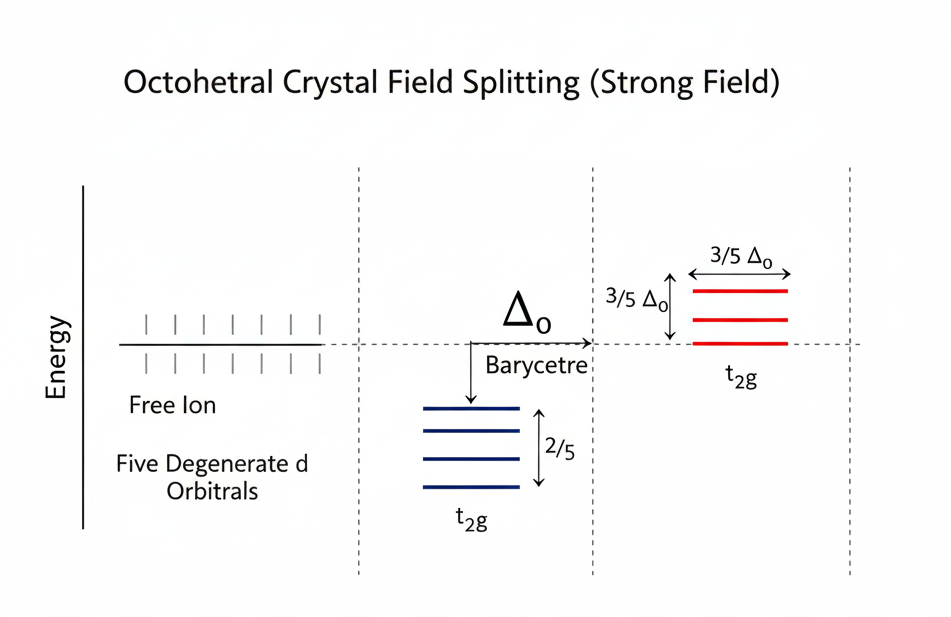
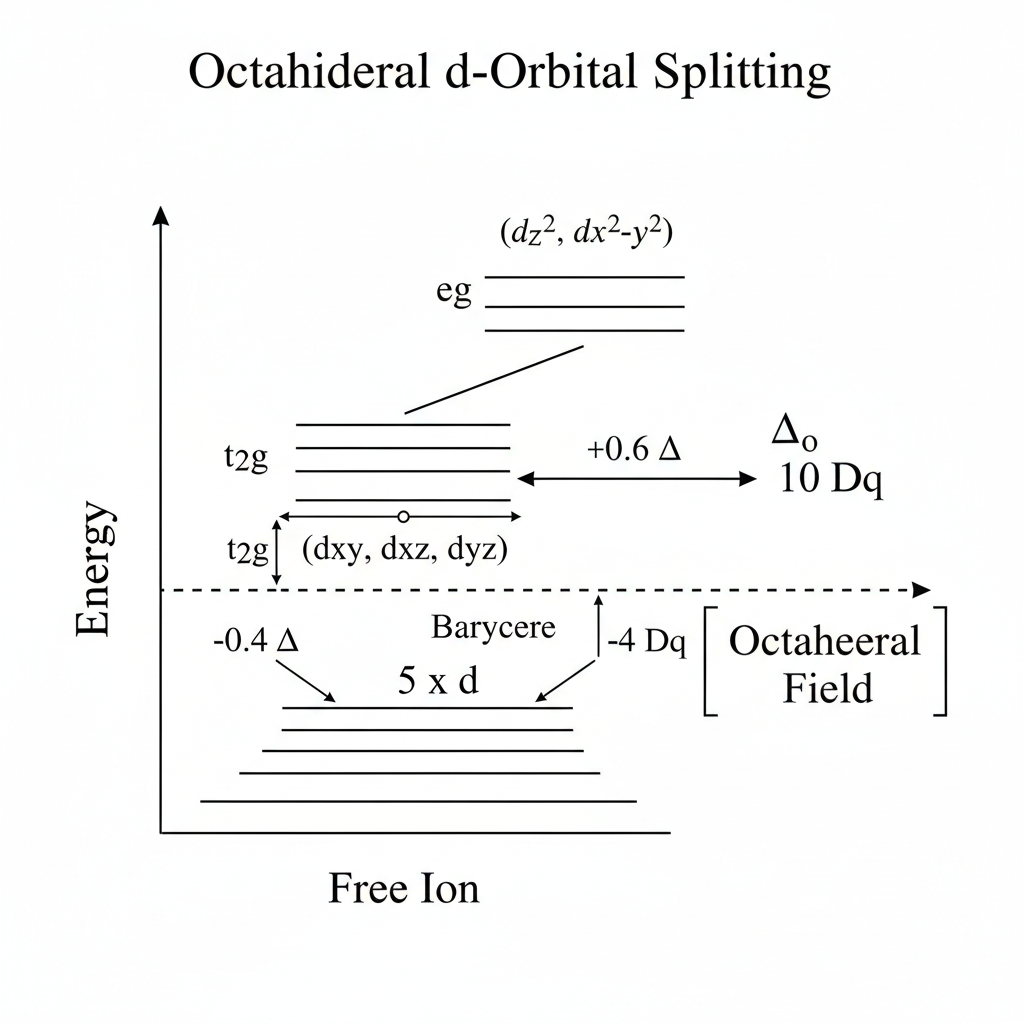
Imagine six ligands coming in along the $x, y, z$ axes. The $d$ orbitals that point directly along these axes, namely the $e_g$ set ($d_{x^2-y^2}$ and $d_{z^2}$), feel the maximum repulsion from the approaching ligands. Consequently, they are raised in energy. The other three orbitals, the $t_{2g}$ set ($d_{xy}$, $d_{yz}$, and $d_{xz}$), are directed between the axes, so they experience less repulsion and are lowered in energy relative to the average energy (called the barycentre).
This energy separation is called the crystal field splitting energy for octahedral complexes, denoted as $\Delta_o$. The two $e_g$ orbitals are raised by $3/5 \Delta_o$ while the three $t_{2g}$ orbitals are lowered by $2/5 \Delta_o$. The magnitude of $\Delta_o$ decides whether electrons pair up (low spin) or move to the higher $e_g$ level (high spin).
Figure below:
A clear diagram showing the splitting of the five degenerate $d$ orbitals into a lower energy $t_{2g}$ set (three orbitals) and a higher energy $e_g$ set (two orbitals), separated by $\Delta_o$. Include the barycentre line, with the energy difference marked as $2/5 \Delta_o$ and $3/5 \Delta_o$ respectively.
NEET Checkpoint:
In an octahedral complex, which $d$ orbitals point directly towards the ligands?
(a) $t_{2g}$
(b) $d_{xy}$
(c) $e_g$
(d) $d_{xz}$
✅ Answer: (c) $e_g$ — These orbitals ($d_{x^2-y^2}$ and $d_{z^2}$) are directed along the axes, experiencing maximum repulsion.
Tetrahedral Splitting
In tetrahedral coordination entities, the splitting pattern is inverted compared to the octahedral field splitting. Here, the $e$ set (two orbitals, corresponding to the octahedral $e_g$ orbitals) is lowered in energy, and the $t_2$ set (three orbitals, corresponding to the octahedral $t_{2g}$ orbitals) is raised in energy. Notice that we don't use the 'g' subscript because tetrahedral complexes lack a centre of symmetry.
And here's the trick funda: tetrahedral splitting is always smaller than octahedral splitting for the same metal and ligands. The relationship is given by the formula:
. Because $\Delta_t$ is so small, it's usually not enough energy to force electrons to pair up, which is why **low spin configurations are rarely observed** in tetrahedral complexes.**Relatable Example:** Think of this splitting like studying for NEET. When you have six massive textbooks (octahedral ligands), you get highly stressed, and the energy difference between solving easy questions ($t_{2g}$) and tough questions ($e_g$) is huge ($\Delta_o$ is large). When you only have four small notes (tetrahedral ligands), the overall stress (splitting) is much smaller ($\Delta_t$), and you rarely bother to skip a question (forcing pairing) because the energy barrier is low!
NEET Checkpoint:
Why is the '$g$' subscript omitted in tetrahedral splitting diagrams (like $e$ and $t_2$)?
(a) Because they have only four ligands.
(b) They lack a centre of symmetry.
(c) The splitting is inverted.
(d) They are always high spin.
✅ Answer: (b) They lack a centre of symmetry. — The '$g$' subscript is reserved for complexes (like octahedral) that possess a centre of symmetry.
NEET Checkpoint:
If $\Delta_o = 90 \text{ kJ/mol}$, what is the approximate value of $\Delta_t$?
(a) $90 \text{ kJ/mol}$
(b) $40 \text{ kJ/mol}$
(c) $20 \text{ kJ/mol}$
(d) $60 \text{ kJ/mol}$
✅ Answer: (b) $40 \text{ kJ/mol}$ — We use the formula $\Delta_t = (4/9)\Delta_o$. $4/9 \times 90 = 40 \text{ kJ/mol}$.
Practice Questions:
1. In the octahedral crystal field, the $t_{2g}$ set of orbitals consists of:
(a) $d_{x^2-y^2}$ and $d_{z^2}$
(b) $d_{xy}$, $d_{yz}$, and $d_{xz}$
(c) $d_{x^2-y^2}$ only
(d) $d_{x^2-y^2}$, $d_{z^2}$, and $d_{xy}$
✅ Answer: (b) The $t_{2g}$ set comprises the three orbitals that lie between the axes: $d_{xy}$, $d_{yz}$, and $d_{xz}$.
2. Which statement correctly describes the nature of bonding in CFT?
(a) Covalent bonding.
(b) Ionic bonding derived from point charges/dipoles.
(c) Hybridisation of $d$-orbitals.
(d) $\sigma$ and $\pi$ synergic bonding.
✅ Answer: CFT treats the metal-ligand bond as purely **ionic, treating ligands as point charges (anions) or point dipoles (neutral molecules).
Key Takeaway
CFT is an electrostatic model defining the metal-ligand bond as purely ionic. In **octahedral** complexes, the $e_g$ orbitals are raised by $3/5 \Delta_o$ and $t_{2g}$ orbitals are lowered by $2/5 \Delta_o$. In tetrahedral complexes, the pattern is inverted, and the splitting ($\Delta_t$) is much smaller:$$\Delta_t = (4/9)\Delta_o$$.
14. CFT, Colour, and Magnetic Properties: The Real Fun Begins!
Let's dive into the core funda of Crystal Field Theory (CFT) and see why coordination compounds are so colourful and magnetic! CFT treats the metal-ligand bond as purely ionic, viewing ligands as simple point charges or point dipoles.
The Spectrochemical Series: Ligand Power Ranking
This is your ligand power ranking, experimentally determined based on how much light complexes absorb! The spectrochemical series is simply the arrangement of ligands in order of increasing field strength (their ability to cause splitting).
Notice this, yaar: weak field ligands cause small splitting, while strong field ligands cause large splitting of the $d$ orbitals.
Here's the trick for recalling parts of the series: $I^{-}$<$Br^{-}$<$SCN^{-}$<$CI^{-}$<$S^{2-}$<$F^{-}$<$OH^{-}$<$C_{2}{O_{4}}^{2-}$<$H_{2}O$<$NCS^{-}$<$edta^{4-}$<$NH_{3}$<$en$<$CN^{-}$<$CO$.
NEET Checkpoint:
Which ligand is typically the strongest field ligand in the spectrochemical series?
(a) $H_{2}O$
(b) $F^{-}$
(c) $CO$
(d) $Cl^{-}$
✅ Answer: (c) $CO$ — Carbonyl ($CO$) is generally placed right at the end of the series, indicating maximum field strength.
High Spin vs. Low Spin: The $\Delta_o$ vs. $P$ Dilemma
For $d^{4}$ to $d^{7}$ ions in octahedral complexes, electrons face a choice: pair up in the lower $t_{2g}$ orbitals, or jump to the higher $e_{g}$ orbitals. This choice depends on two energy values: the crystal field splitting energy ($\Delta_{o}$ for octahedral complexes) and the pairing energy ($P$). $P$ is the energy required to force two electrons into the same orbital.
1. Weak Field Ligands (WFLs) $\rightarrow$ High Spin Complexes: If the energy required to jump (the splitting, $\Delta_{o}$) is less than the energy required to pair ($P$), the electron avoids pairing up and jumps to $e_{g}$.
This configuration maximises unpaired electrons (e.g., $t_{2g}^{3}e_{g}^{1}$ for a $d^{4}$ ion).
2. Strong Field Ligands (SFLs) $\rightarrow$ Low Spin Complexes: If the energy required to jump ($\Delta_{o}$) is *greater* than the energy required to pair ($P$), the electron will pair up in the $t_{2g}$ level to save energy.
This configuration minimizes unpaired electrons (e.g., $t_{2g}^{4}e_{g}^{0}$ for a $d^{4}$ ion).
Relatable Example: Imagine preparing for NEET. If the fee for an excellent coaching center ($P$, pairing energy) is very high, you'd rather study alone at home and use that money for books ($\Delta_o < P$, high spin/unpaired electrons). If the coaching is affordable ($P$) compared to the effort of self-study ($\Delta_o$), you pay the fee and pair up in the classroom ($\Delta_o > P$, low spin/paired electrons). Don't stress, this funda is straightforward!
Figure below:
A clear diagram showing the octahedral splitting of d orbitals, labelling $t_{2g}$ and $e_{g}$ sets, and showing the energy separation $\Delta_{o}$ and the barycentre.
NEET Checkpoint:
A complex has the configuration $t_{2g}^{6}e_{g}^{0}$. This implies:
(a) $\Delta_{o} < P$
(b) $\Delta_{o} = 0$
(c) $\Delta_{o} > P$
(d) It is tetrahedral
✅ Answer: (c) $\Delta_{o} > P$ — Since all six $d$ electrons are paired up in the lower $t_{2g}$ orbitals, it must be a low spin case, meaning the splitting energy was larger than the pairing energy.
Colour in Complexes: The d-d Transition Vibe
Transition metal complexes are typically brightly coloured. This colour is explained by the existence of empty $d$ orbitals following splitting.
When white light passes through a complex, the complex absorbs certain wavelengths (colours) corresponding exactly to the energy gap ($\Delta_{o}$ or $\Delta_{t}$). This absorbed energy causes an electron to be excited from a lower energy $t_{2g}$ orbital to a higher energy $e_{g}$ orbital. This is called a d-d transition (e.g., $t_{2g}^{1}e_{g}^{0}\rightarrow t_{2g}^{0}e_{g}^{1}$ for $[Ti(H_{2}O)_{6}]^{3+}$).
The colour we see is the complementary colour—the colour generated from the wavelengths that were *not* absorbed. For instance, $[Ti(H_{2}O)_{6}]^{3+}$ absorbs blue-green light, so it appears violet. If there are no ligands (no splitting), there is no $d-d$ transition, and the compound is colourless (e.g., anhydrous $CuSO_{4}$ is white).
NEET Checkpoint:
The colour of coordination compounds is primarily due to:
(a) Charge transfer
(b) Ion-ion interaction
(c) $\pi-\pi$ transitions
(d) d-d transitions
✅ Answer: (d) d-d transitions — Excitation of electrons from $t_{2g}$ to $e_{g}$ levels upon absorbing visible light causes the colour.
Flaws in the CFT Model (The Shortcomings)
While CFT is great for explaining colour and magnetism, it has two major weaknesses:
1. It ignores covalent character: CFT is based purely on the electrostatic (ionic) interaction model. It fails to account for the actual partial covalent character of the metal-ligand bond.
2. It gets ligand strength wrong: Because ligands are treated as negative point charges/dipoles, CFT predicts that anionic ligands should produce the greatest crystal field splitting effect. However, experimentally, anionic ligands (like $Cl^{-}$, $Br^{-}$, $I^{-}$) are found at the low end of the spectrochemical series, showing they are usually weak field ligands.
Practice Question:
Which of the following statements about Crystal Field Theory (CFT) is INCORRECT?
(a) It attributes colour to $d-d$ electronic transitions.
(b) It successfully explains why anionic ligands are usually weak field ligands.
(c) It considers the metal-ligand bond to be purely ionic.
(d) It explains the differentiation between high spin and low spin complexes.
✅ Answer: (b) It successfully explains why anionic ligands are usually weak field ligands. — CFT actually predicts the opposite (that anionic ligands should be strong field) but the experimental results show they are often weak field. This failure is a major shortcoming of CFT.
Key Takeaway
| Concept | Summary |
|---|---|
| Spectrochemical Series | Ligands ordered by increasing field strength (experimental $\Delta_{o}$). |
| High/Low Spin | Determined by comparing splitting energy ($\Delta_{o}$) and pairing energy ($P$). If $\Delta_{o} > P$, it’s low spin; if $\Delta_{o} < P$, it’s high spin. |
| Colour | Due to d-d transitions ($t_{2g} \rightarrow e_{g}$) where the observed colour is complementary to the light absorbed. |
| CFT Flaws | Fails to account for covalency and incorrectly ranks anionic ligands as strong field. |
15. Importance and Applications of Coordination Compounds
Hey, NEET aspirants! Don't stress, yaar—coordination compounds aren't just fancy formulas; they are the real workhorses found everywhere, from your blood to industrial reactors. Understanding their applications is a guaranteed quick score in the exam!
Applications Across the Spectrum
Coordination compounds play crucial roles in biological systems, industry, and medicine.
First up, biological systems! They are absolutely vital. Chlorophyll, the pigment that drives photosynthesis in plants, is a coordination compound of magnesium ($\text{Mg}$). Likewise, Haemoglobin, the red pigment in blood that acts as an oxygen carrier, is a coordination compound of iron ($\text{Fe}$). Even Vitamin $\text{B}_{12}$ (cyanocobalamine), which combats pernicious anaemia, is a complex of cobalt ($\text{Co}$). Plus, enzymes like carbonic anhydrase and carboxypeptidase $\text{A}$ are coordination compounds that act as biological catalysts.
Next, in analytical chemistry, they are indispensable for qualitative and quantitative analysis. Chelating agents are key here: for instance, $\text{EDTA}$ (Ethylenediaminetetraacetate) is used in simple titration methods to estimate the hardness of water by forming stable complexes with $\text{Ca}^{2+}$ and $\text{Mg}^{2+}$ ions. Another chelating agent used for detection and estimation is $\text{DMG}$ (dimethylglyoxime).
NEET Checkpoint:
Haemoglobin is a coordination compound of which metal ion?
(a) $\text{Mg}$
(b) $\text{Fe}$
(c) $\text{Co}$
(d) $\text{Pt}$
✅ Answer: (b) $\text{Fe}$ — Gotta remember the blood funda! Chlorophyll is $\text{Mg}$ and $\text{Vitamin B}_{12}$ is $\text{Co}$.
Industrial and Medical Uses
These complexes rock the metallurgy world too! Extraction of silver and gold involves complex formation, where gold, for example, combines with cyanide ions to form the complex entity $[\text{Au}(\text{CN})_{2}]^{-}$ in aqueous solution. This gold can then be separated by adding zinc. Similarly, impure nickel can be purified by converting it to the volatile coordination compound $[Ni(\text{CO})_{4}]$, which is subsequently decomposed to yield pure nickel.
In catalysis, coordination compounds are used widely for industrial processes. A famous example is the Wilkinson catalyst, which is a rhodium complex with the formula $[(\text{Ph}{3}\text{P}){3}\text{RhCl}]$, used specifically for the hydrogenation of alkenes.
And get this—they make things look shiny! Electroplating silver and gold results in much smoother and more even finishes when done from solutions of complex ions like $[\text{Ag}(\text{CN})_{2}]^{-}$ and $[\text{Au}(\text{CN})_{2}]^{-}$, rather than simple metal ion solutions.
NEET Checkpoint:
Which compound is used in medicinal chemistry to treat lead poisoning via chelation?
(a) $\text{cis}$-platin
(b) $\text{DMG}$
(c) $\text{EDTA}$
(d) Wilkinson catalyst
✅ Answer: (c) $\text{EDTA}$ — $\text{EDTA}$ is the hero for removing toxic lead, a classic example of chelate therapy.
In medicinal chemistry (chelate therapy), $\text{EDTA}$ is employed to treat lead poisoning by removing the toxic metal from the body. Even more remarkably, some platinum coordination compounds like $\text{cis}$-platin and related molecules are effective anti-tumour drugs that inhibit the growth of malignant cells.
The Synergic Bond Funda in Metal Carbonyls
Let's quickly clear up the funda behind the stability of metal carbonyls, like $[Ni(\text{CO})_{4}]$. The metal-carbon bond here has a unique synergic bonding interaction, possessing both $\sigma$ and $\pi$ character.
- M-C $\sigma$ bond (Ligand $\rightarrow$ Metal): This is formed by the donation of a lone pair of electrons from the carbonyl carbon atom into a vacant orbital of the metal.
- M-C $\pi$ bond (Metal $\rightarrow$ Ligand): This is the $\pi$ back-donation! It forms when a pair of electrons from a filled metal $\text{d}$ orbital is donated into the vacant antibonding $\pi^{*}$ orbital of the carbon monoxide molecule.
This dual bonding mechanism creates a synergic effect that mutually strengthens the bond between the $\text{CO}$ ligand and the metal, making the complex stable. It's like having a helpful junior who brings snacks ( $\sigma$ donation) and also helps clear up complex concepts before the exam ( $\pi$ back-donation)!
$M-C$ $\sigma$ bond (Ligand to Metal): $\text{C} \rightarrow \text{M}$
$M-C$ $\pi$ bond (Metal to Ligand): $\text{M} \rightarrow \pi^{*}$ orbital of $\text{CO}$
[nanobanana prompt: A clear diagram showing synergic bonding interactions in a metal carbonyl complex, illustrating M-C $\sigma$ bond formation (lone pair donation from $\text{CO}$ to metal vacant orbital) and M-C $\pi$ back-donation (filled metal $\text{d}$ orbital to vacant antibonding $\pi^{*}$ orbital of $\text{CO}$). ]
NEET Checkpoint:
In synergic bonding in metal carbonyls, the $\pi$ bond is formed by electron donation from:
(a) Ligand lone pair to metal vacant orbital.
(b) Metal vacant $\text{d}$ orbital to ligand $\pi^{}$ orbital.
(c) Filled metal $\text{d}$ orbital to ligand $\pi^{}$ orbital.
(d) Filled metal $\text{d}$ orbital to ligand $\sigma$ orbital.
✅ Answer: (c) Filled metal $\text{d}$ orbital to ligand $\pi^{*}$ orbital — This is the $\pi$ back-donation part that gives the synergic strength.
Practice Questions:
- Which coordination compound is used as a catalyst for the hydrogenation of alkenes?
(a) $\text{cis}$-platin
(b) $\text{Haemoglobin}$
(c) $\text{Chlorophyll}$
(d) $\text{Wilkinson catalyst}$
✅ Answer: (d) Wilkinson catalyst. This rhodium complex, $[(\text{Ph}{3}\text{P}){3}\text{RhCl}]$, is a major industrial catalyst.
2. The ability of $\text{EDTA}$ to selectively estimate $\text{Ca}^{2+}$ and $\text{Mg}^{2+}$ in hard water is due to:
(a) The difference in their oxidation states.
(b) The difference in the stability constants of their complexes.
(c) The d-d electronic transition.
(d) $\text{EDTA}$ is a strong field ligand.
✅ Answer: (b) The difference in the stability constants of their complexes. This difference allows for their selective estimation through titration.
Key Takeaway
Coordination compounds are versatile chemical agents necessary for life (e.g., Chlorophyll-$\text{Mg}$, Haemoglobin-$\text{Fe}$), essential in analysis ($\text{EDTA}$), purification (Ni carbonyl), and medicine ($\text{cis}$-platin). The stability of metal carbonyls is enhanced by synergic bonding, which involves both $\sigma$ donation (ligand $\rightarrow$ metal) and $\pi$ back-donation (metal $\rightarrow$ ligand $\pi^{*}$ orbital).