1. Introduction to Chemical Thermodynamics
Hey NEET aspirants! Ready to dive into Thermodynamics? Don't stress, yaar, this unit gives us the foundational funda for understanding why chemical reactions happen and how much energy is involved. Even Albert Einstein was convinced this theory would never be overthrown!
The first step is defining our playground. The System is the part of the universe where we make observations, and everything else is the Surroundings. Together they form the Universe. A crucial concept is classifying systems: Open Systems exchange both matter and energy, Closed Systems exchange only energy, and Isolated Systems (like a perfect thermos flask) exchange neither.
NEET Checkpoint 1:
Which type of system allows heat exchange but prevents matter exchange with the surroundings?
(a) Isolated
(b) Open
(c) Closed
(d) Adiabatic
✅ Answer: (c) Closed — Notice this! A closed system, typically a sealed vessel made of conducting material, allows energy (heat/work) transfer but keeps the matter contained.
We describe the system using State Functions (or state variables) like Internal Energy ($U$), Pressure ($p$), Volume ($V$), and Temperature ($T$). The cool part is that the value of a state function depends only on the current state, not the path taken to reach it.
Now for the engine room: the First Law of Thermodynamics. This is simply the law of conservation of energy. It relates the change in internal energy ($\Delta U$) to heat ($q$) and work ($w$):
Remember the sign convention: $q$ is positive when heat is added to the system, and $w$ is positive when work is done on the system.
Extensive vs. Intensive Properties and Enthalpy
Hold up, let's talk about size! Extensive Properties depend on the quantity of matter present—think mass, volume ($V$), and internal energy ($U$). In contrast, Intensive Properties are independent of quantity, like temperature ($T$), density, or pressure ($p$).
Relatable Example: Imagine splitting your jumbo pack of pani puri mix. The total volume is halved (extensive), but the temperature of the remaining mix stays exactly the same (intensive).
Since many chemical reactions happen at constant pressure (like in open flasks), we define the helpful state function Enthalpy ($H$) as $H = U + pV$. The change in enthalpy ($\Delta H$) is equal to the heat absorbed at constant pressure, $\Delta H = q_{p}$. Using Hess's law, we can calculate various enthalpy changes ($\Delta_{r}H^{\ominus}$) by summing the standard enthalpies of intermediate reactions. We can also predict $\Delta_{r}H^{\ominus}$ using bond enthalpies ($\Delta_{bond}H^{\ominus}$) for gaseous reactions.
NEET Checkpoint 2:
Which of the following is an intensive property?
(a) Mass
(b) Enthalpy
(c) Heat Capacity
(d) Temperature
✅ Answer: (d) Temperature — Temperature ($T$) does not depend on the size or quantity of the substance present.
The Drive for Spontaneity: Entropy and Gibbs Energy
The First Law tells us where the energy goes, but the Second Law tells us why a reaction proceeds in a certain direction. Spontaneous processes tend toward higher Entropy ($S$), which is a measure of randomness or disorder. For an isolated system, a spontaneous change occurs only if the total entropy change ($\Delta S_{total}$) is positive ($>0$).
The most important concept for spontaneity in the system is Gibbs Energy ($G$). This function combines enthalpy and entropy into one powerful criterion:
A reaction is spontaneous if the Gibbs energy change ($\Delta G$) is negative ($<0$). When the system reaches equilibrium, $\Delta G = 0$.
NEET Checkpoint 3:
For a process to be spontaneous at constant temperature and pressure, which condition must be met?
(a) $\Delta U = 0$
(b) $\Delta G > 0$
(c) $\Delta G < 0$
(d) $\Delta S_{sys} < 0$
✅ Answer: (c) $\Delta G < 0$ — A negative Gibbs energy change is the criterion for spontaneity.
Practice Questions :
1. If a process occurs at constant volume ($\Delta V = 0$), the heat absorbed ($q_{v}$) is equal to:
(a) $\Delta H$
(b) $\Delta G$
(c) $\Delta U$
(d) $-p_{ex}\Delta V$
✅ Answer: (c) $\Delta U$ — At constant volume, $w=0$, so the First Law ($\Delta U = q + w$) simplifies to $\Delta U = q_{v}$.
2. Which state function is related to the equilibrium constant ($K$)?
(a) $\Delta H^{\ominus}$
(b) $\Delta U^{\ominus}$
(c) $\Delta S^{\ominus}$
(d) $\Delta G^{\ominus}$
✅ Answer: (d) $\Delta G^{\ominus}$ — The standard Gibbs energy change relates directly to $K$ via $\Delta_{r}G^{\ominus} = -RT \ln K$.
Key Takeaway: Core Thermodynamic Concepts
First Law: $\Delta U = q + w$. Energy is conserved.
Enthalpy ($\mathbf{H}$): Heat transfer at constant pressure ($\Delta H = q_{p}$).
Spontaneity: Predicted by Gibbs Energy ($\Delta G$), where $\Delta G < 0$ means spontaneous.
Relationship to Equilibrium: $\Delta_{r}G^{\ominus}=-RT \ln K$.
2. Fundamental Thermodynamic Terms: System and Surroundings
Welcome back, future doc! When we talk about Chemical Thermodynamics, the first funda we need to clear up is who's who in this universal drama. Don't stress, yaar, it’s easier than it looks!
In thermodynamics, we focus our observation on a specific part of the universe, and we call that our system. Everything else in the universe that is not the system constitutes the surroundings. Simple, right? Notice this key relation:
However, the entire universe usually doesn't care about what happens in your test tube. So, for all practical purposes, the surroundings are just the portion of the remaining universe that can actually interact with your system. This interaction usually happens in the immediate neighbourhood.
What keeps these two apart? A boundary. This boundary is the wall (which can be real or imaginary) that separates the system from the surroundings. It is designed specifically so we can control and keep track of all the movements of matter and energy entering or leaving the system.
NEET Checkpoint:
For practical calculations in thermodynamics, which part of the universe is considered the surroundings?
(a) The nearest star
(b) The region that can interact with the system
(c) Only the air in the room.
✅ Answer: (b) The region that can interact with the system — Arre, remember, the surrounding is just the portion of the remaining universe that interacts with the system.
The Three Types of Systems
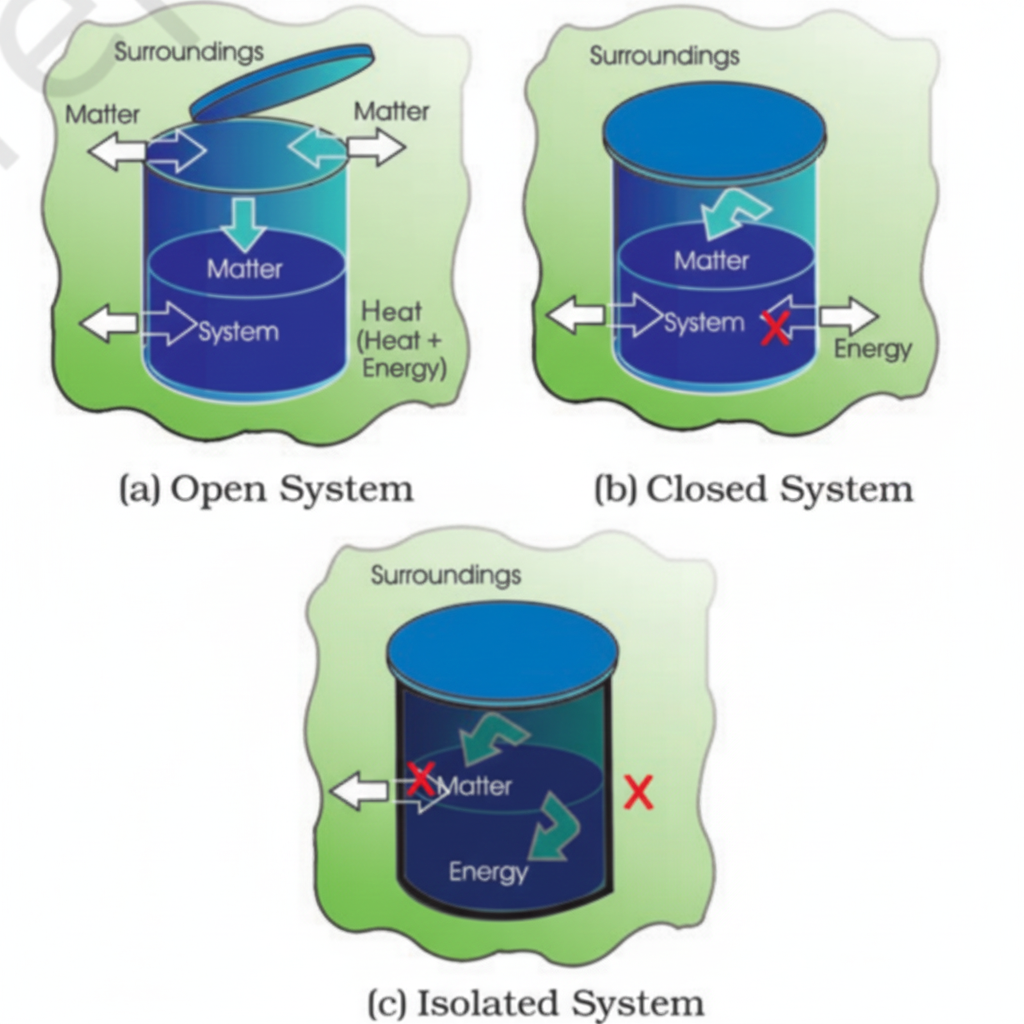
This is where the NEET guys love to test your conceptual clarity! We classify systems based on whether they exchange matter or energy with the surroundings. Let's imagine you’re making some classic street-style chai (tea).
- Open System: This system is like chai boiling in an open tapeli. There is exchange of both energy and matter (steam/vapour) between the system and surroundings. Reactants in an open beaker are a classic example.
- Closed System: This system is tighter, like chai in a steel kettle with a sealed lid but sitting on a cold stone floor. There is no exchange of matter, but exchange of energy is still possible. Reactants in a closed vessel made of a conducting material (like copper or steel) fall into this category.
- Isolated System: The ultimate fortress! This is your high-end thermos flask chai. There is no exchange of energy or matter between the system and the surroundings. Reactants in a closed, insulated vessel (like a thermos flask) exemplify an isolated system.
Figure below:
A clear diagram showing three boxes labeled (a) Open System, (b) Closed System, and (c) Isolated System. In (a), double arrows indicate the exchange of both Matter and Energy between System and Surroundings. In (b), only a double arrow for Energy exchange is shown, with Matter blocked. In (c), both Matter and Energy exchanges are blocked.
NEET Checkpoint:
Which type of system permits the exchange of energy but restricts the exchange of matter?
(a) Open
(b) Closed
(c) Isolated.
✅ Answer: (b) Closed — Only energy exchange is possible; matter is locked in.
NEET Checkpoint:
Reactants kept in a perfect thermos flask represent what kind of system?
(a) Open
(b) Closed
(c) Isolated.
✅ Answer: (c) Isolated — A thermos flask is designed to block both matter and energy exchange.
Practice Question:
A process is carried out in a vessel that has conducting walls and a tightly fitted piston. If the piston remains stationary during the process, what type of system is being studied?
(a) Open
(b) Isolated
(c) Closed
(d) Adiabatic
✅ Answer: (c) Closed. The piston ensures no matter (gas/liquid) can escape, fulfilling the "no matter exchange" criterion. Conducting walls allow energy exchange via heat transfer, which defines a closed system.
Key Takeaway
System Classification is based on Exchange: Open systems exchange both matter and energy. Closed systems exchange only energy. Isolated systems exchange neither matter nor energy. The boundary (real or imaginary) dictates this exchange.
3. State of the System and Thermodynamic Properties
Hey Future Doctor! When we dive into thermodynamics, the first and most crucial funda is defining exactly what we are studying—that’s the state of the system. It’s like taking a snapshot of the reaction mixture!
Defining the State and State Functions
To make any useful calculations, we must describe the state of a thermodynamic system using its macroscopic (bulk) properties. You have to specify these properties quantitatively, like the pressure ($\mathbf{p}$), volume ($\mathbf{V}$), and temperature ($\mathbf{T}$), along with the composition of the system. These are the measurable qualities we deal with in bulk systems, not the motion of individual tiny particles.
Now, here’s the neat trick: many of these measurable properties, like $p$, $V$, and $T$, are known as state functions (or state variables). What makes them special? Their values depend only on the state of the system—the final condition—and not on how that state was reached (the path taken).
Think of it this way: if you go from your home (State A) to your coaching centre (State B), the change in your elevation (a state function) is the same whether you take the straight main road or the winding galli route! Quantities like Internal Energy ($\mathbf{U}$) and Enthalpy ($\mathbf{H}$) are classic examples of state functions in thermodynamics.
NEET Checkpoint:
If a process goes from State 1 to State 2, is the work done ($w$) independent of the path?
(a) Yes, always
(b) No, only state functions are path independent
(c) Only if it's reversible
(d) Only if $p=0$
✅ Answer: (b) No, only state functions are path independent — $w$ and $q$ depend on the path, but $\Delta U$ and $\Delta H$ do not.
Extensive vs. Intensive Properties
Once you've fixed the state, we need to classify the properties based on size. This distinction is super important for your NEET prep, so pay attention!
-
Extensive Properties: These are properties whose value depends on the quantity or size of matter present in the system. More matter, bigger value, simple! Examples include mass, volume ($\mathbf{V}$), internal energy ($\mathbf{U}$), enthalpy ($\mathbf{H}$), and heat capacity ($\mathbf{C}$).
-
Intensive Properties: These are properties that do not depend on the quantity or size of matter present. They remain the same even if you cut the system in half. Examples include temperature ($\mathbf{T}$), density, and pressure ($\mathbf{p}$).
Relatable Indian Example: Imagine a giant cauldron of sambar in a wedding kitchen. The volume (an extensive property) is huge. If you take a tiny cup of sambar out, the volume changes drastically. But, the temperature (an intensive property) and the density of the sambar remain the exact same in both the cauldron and your cup!
A clever way to make an extensive property intensive is by defining it per mole of substance. For instance, molar heat capacity ($\mathbf{C_{m}}$) is an intensive property because it's defined per unit amount.
NEET Checkpoint:
Which of these properties is intensive?
(a) Internal Energy
(b) Mass
(c) Density
(d) Heat Capacity
✅ Answer: (c) Density — Density depends on the ratio of mass (extensive) and volume (extensive), making it independent of the total size.
NEET Checkpoint:
If you have $10~L$ of water at $300~K$, and you pour half of it out, what happens to the internal energy ($U$) and the temperature ($T$)?
(a) Both $U$ and $T$ are halved
(b) $U$ is halved, $T$ remains same
(c) $U$ remains same, $T$ is halved
(d) Both remain same
✅ Answer: (b) $U$ is halved, $T$ remains same — Internal energy ($U$) is extensive (depends on amount) while temperature ($T$) is intensive (independent of amount).
Practice Question:
Which pair contains one state function and one intensive property?
(a) p is intensive/state function; V is extensive/state function.
(b) q is path function; U is state function.
(c) Enthalpy ($\Delta H$) is state function; Temperature ($T$) is intensive
(d) Mass is extensive; Density is intensive .
✅ Solution: (c) Enthalpy ($\Delta H$) is a state function and Temperature ($T$) is an intensive property.
Key Takeaway
State: Defined by macroscopic properties like $p$, $V$, $T$.
State Function: Path independent (e.g., $U, H, T, p, V$).
Extensive: Depends on quantity (e.g., Mass, $V, U, H$, Heat Capacity).
Intensive: Independent of quantity (e.g., $T$, Density, $p$, Molar Heat Capacity).
4. Internal Energy ($U$), Work, and Heat: The Funda of Energy Transfer
Hello, future doctor! Don't stress, yaar—Thermodynamics is just about tracking energy changes. Think of it like keeping track of your pocket money and your hostel's total budget!
Internal Energy ($U$)
The Internal Energy ($U$) of a system is simply the sum of all types of energy present within it, which could be chemical, electrical, mechanical, or any other type. It represents the system's total energy budget.
And here is the trick: $U$ is a state function. This means its value depends only on the current state of the system (like its temperature ,$p$, or $v$) and not on how that state was reached. Whether you went straight from State A to State B, or took a crazy detour, the change in internal energy,
remains the same.
This crucial state function, $U$, can change mainly in three ways:
- Via heat transfer ($q$).
- Via work done ($w$).
- Via matter entering or leaving the system.
Work ($w$) and Heat ($q$) Conventions
Let's clear up the sign conventions for work and heat—this is a big deal for NEET!
Work ($w$):
Work is energy transferred by mechanical or electrical means. By IUPAC convention, work ($w$) is positive when work is done on the system (compression, mixing, stirring). This action increases the internal energy of the system. Conversely, if the system does work (like an expanding gas), $w$ is negative.
Relatable Indian Example: Imagine riding your bicycle up a steep Ghat (hill). The work done on the system (you, the cyclist) by your legs is positive, and your internal energy (stored chemical energy, potential energy) increases.
Heat ($q$):
Heat ($q$) is the energy exchange resulting specifically from a temperature difference between the system and surroundings. Heat is positive when it is transferred to the system from the surroundings (heating the system), causing an increase in $U$. If heat is lost from the system (exothermic process), $q$ is negative.
NEET Checkpoint:
If $50 \text{ J}$ of heat is released by the system, what is the sign and value of $q$?
(a) q=+50J
(b) q=−50J
(c)q=0
(d) q=+100J
✅ Answer:(b) $q = -50 \text{ J}$ — Heat transferred from the system is negative according to convention.
Adiabatic Processes
A special type of process, the adiabatic process, occurs when the system is perfectly insulated, meaning no heat transfer occurs between the system and surroundings.
For this process, we set $q=0$.
The change in internal energy is then given solely by the work done:
This concept connects directly to the First Law of Thermodynamics, which states that for any general change involving both heat and work:
NEET Checkpoint:
For an adiabatic change, what is the relationship between $\Delta U$ and $q$?
(a) 𝑞≠0 and ΔU=q+w
(b) q=0 and ΔU=w
(c) q=w and ΔU=0
(d) q=ΔU andw=0
✅ Answer:(b) $q=0$ and $\Delta U = w$ — Adiabatic means the boundary prevents heat exchange.
Practice Question:
A closed system absorbs $200 \text{ J}$ of heat from the surroundings and $150 \text{ J}$ of work is done on the system. What is the change in internal energy ($\Delta U$)?
(a) $+50 \text{ J}$
(b) $-350 \text{ J}$
(c) $+350 \text{ J}$
(d) $-50 \text{ J}$
✅ Answer: (c) $+350 \text{ J}$ — Both heat absorbed ($q = +200 \text{ J}$) and work done on the system ($w = +150 \text{ J}$) are positive, so
$\Delta U = q + w = 200 \text{ J} + 150 \text{ J} = 350 \text{ J}$
NEET Checkpoint:
Which thermodynamic term is a state function: $q$, $w$, or $U$?
(a) q only
(b) w only
(c) U only
(d) All q,w, and U
✅ Answer: (c) $U$ — Internal energy depends only on the state, while $q$ and $w$ depend on the path taken.
Key Takeaway
Internal Energy ($\Delta U$): Sum of all energy; a state function.
First Law: $\Delta U = q + w$
Work Convention ($w$): Positive when done on the system.
Heat Convention ($q$): Positive when transferred to the system.
Adiabatic Process: No heat transfer ($q=0$), so$\Delta U = w_{ad}$
5. The First Law of Thermodynamics and Pressure-Volume Work
The First Law is super important—it’s just a mathematical way of saying, "Energy can neither be created nor be destroyed". For a general process where a change of state occurs by both doing work ($w$) and transferring heat ($q$), the change in the system’s internal energy ($U$) is given by:
Notice this: $\Delta U$ is a state function, meaning it depends only on the initial and final states, regardless of the path taken. And that's cool, right? This equation is the mathematical statement of the First Law of Thermodynamics.
If your system is an isolated system (like reactants sealed perfectly in a high-quality thermos flask), there is no transfer of energy as heat ($q=0$) or as work ($w=0$). Consequently, the change in internal energy is zero ($\Delta U=0$), confirming that the energy of an isolated system is constant.
NEET Checkpoint:
If heat absorbed ($q$) and work done ($w$) are both zero for a system, what can you conclude about it?
(a) It is adiabatic
(b) It is an isolated system
(c) It is a closed system
(d) It is isothermal
✅ Answer: (b) It is an isolated system — An isolated system permits no exchange of energy (heat or work) or matter.
Now, let's look at work. In chemistry, we often focus on mechanical work, specifically pressure-volume work. Imagine compressing a gas inside a cylinder against a constant external pressure ($p_{ex}$) in a single step. When work is done on the system (compression), the final volume ($V_{f}$) is smaller than the initial volume ($V_{i}$), so $\Delta V$ is negative. To ensure the resulting work ($w$) is positive (since energy increases when work is done on the system), we use the formula:
This is typically used for irreversible processes where the external pressure is constant.
What if the compression or expansion is extremely slow and reversible? A reversible process proceeds infinitely slowly by balancing the internal pressure ($p_{in}$) with the external pressure ($p_{ex}$) at every moment. In this case, we relate work to the internal pressure of the system by using integration:
Relatable Indian Example: Think of inflating a tyre tube using a manual hand pump. Pushing the piston down quickly is like compression against a constant external pressure (simple $w = -p_{ex}\Delta V$). If the pump had sensors that adjusted your pressing force infinitesimally slowly to exactly match the increasing pressure inside the tube at every single point—that would be the reversible work, $W_{rev}=-\int p_{in}dV$. Too much effort for a puncture, right?
Here’s the trick for constant volume processes: If you carry out a change at constant volume ($\Delta V=0$), then no pressure-volume work is done ($w=0$). In this essential case, the First Law simplifies beautifully:
The subscript $v$ denotes that the heat exchange is carried out at constant volume. This heat, $q_v$, directly measures the change in internal energy.
NEET Checkpoint:
For an ideal gas undergoing free expansion into a vacuum, what is the value of work done ($w$)?
(a) $w = -p_{ex}\Delta V$
(b) $w$ is positive
(c) $w = 0$
(d) $w = q$
✅ Answer: (c) $w = 0$ — Free expansion occurs into a vacuum, where the external pressure ($p_{ex}$) is zero, so $w = -p_{ex}\Delta V = 0$.
Practice Question:
When a process is carried out such that $\Delta V = 0$, the change in internal energy ($\Delta U$) is equal to:
(a) $q$
(b) $-w$
(c) $q_{p}$
(d) $q_{v}$
✅ Answer: (d) $q_{v}$ — Since $\Delta V=0$, PV work is zero, so the First Law ($\Delta U = q+w$) simplifies to $\Delta U = q_{v}$.
Key Takeaway
| Concept | Formula Summary | Focus Point |
|---|---|---|
| First Law (General) |
$$\Delta U = q + w$$
|
Energy is conserved. |
| Work (Constant $p_{ex}$) |
$$w = -p_{ex}\Delta V$$
|
Used for irreversible changes. |
| Work (Reversible) |
$$W_{rev}=-\int_{V_{i}}^{V_{f}}p_{in}dV$$
|
Relates work to internal system pressure. |
| Constant Volume Heat |
$$\Delta U = q_{v}$$
|
Heat measured at constant volume equals $\Delta U$. |
6. Reversible, Irreversible, and Adiabatic Processes: The Speed of Change
Don't stress, yaar—the funda of thermodynamic processes is actually pretty cool and logical. It all depends on how fast the change happens and whether the system talks to the surroundings!
Defining Reversible and Irreversible Processes
A process is called reversible if the change is brought about so slowly that it could be reversed at any moment by an infinitesimal change. Imagine driving your scooter up a hill so slowly that if you release the accelerator just a tiny bit, you stop immediately and can reverse without effort. A reversible process proceeds infinitely slowly through a series of equilibrium states where the system and surroundings are always in near equilibrium.
Now, every other process in the world? They are called irreversible processes. Almost every actual process we observe—like a ball dropping or a gas expanding quickly—is irreversible! They don't pass through a series of equilibrium states.
Work Done in Isothermal Reversible Expansion
For NEET prep, understanding the work done during the isothermal reversible expansion of an ideal gas is super important. 'Isothermal' means the temperature ($T$) is constant. Since the process is reversible, the external pressure ($p_{ex}$) is always infinitesimally close to the internal pressure ($p_{in}$).
NEET Checkpoint:
What condition defines a reversible process?
(a) $\Delta T = 0$
(b) Sudden large change
(c) Proceeding through infinite equilibrium steps
(d) $w = 0$
✅ Answer: (c) Proceeding through infinite equilibrium steps — The system and surroundings must always be in near equilibrium for a reversible change.
Using the ideal gas equation ($p=\frac{nRT}{V}$) and integrating the work equation ($W_{rev}=-\int_{V_{i}}^{V_{f}}p_{in}dV$), we get the key formula:
or, using $\log_{10}$:
Notice this: the work done is maximum in a reversible process because you are opposing the change with the maximum possible external pressure at every step!
Free Expansion and Adiabatic Funda
Another interesting case is free expansion, which is when a gas expands into a vacuum ($p_{ex}=0$). Since work done ($w$) depends on external pressure ($w=-p_{ex}\Delta V$), if $p_{ex}=0$, then no work is done ($w=0$). For an ideal gas undergoing free expansion (whether reversible or irreversible), Joule determined experimentally that $q=0$. Since $\Delta U = q+w$, for free expansion of an ideal gas, $\Delta U=0$. This is a frequent MCQ star!
If a process occurs through an adiabatic wall (a wall that prevents heat transfer), the process is adiabatic. In an adiabatic process, heat transfer ($q$) is zero ($q=0$). Therefore, the First Law simplifies to: $\Delta U = w_{ad}$.
NEET Checkpoint:
If an ideal gas expands into a vacuum at constant temperature, what is the value of $\Delta U$?
(a) $\Delta U > 0$
(b) $\Delta U < 0$
(c) $\Delta U = 0$
(d) Cannot be determined
✅ Answer: (c) $\Delta U = 0$ — In free expansion (vacuum), $w=0$ and for an ideal gas, $q=0$. Thus, $\Delta U=q+w=0$.
Summary of Key Thermodynamic Equations ($\Delta U = q+w$)
Here’s the summary of how the First Law looks for different key processes:
| Process Type | $\Delta U$ Equation | Work ($w$) / Heat ($q$) |
|---|---|---|
| Isothermal Irreversible Change | $\Delta U=0$ | $q=-w=p_{ex}(V_{f}-V_{i})$ |
| Isothermal Reversible Change | $\Delta U=0$ | $q=-w=nRT~ln\frac{V_{f}}{V_{i}}$ |
| Adiabatic Change | $\Delta U=w_{ad}$ | $q=0$ |
NEET Checkpoint:
What is the sign convention for work done by the system (expansion) in chemical thermodynamics (IUPAC convention)?
(a) Positive
(b) Negative
(c) Zero
(d) Dependent on $p_{ex}$
✅ Answer: (b) Negative — If work is done by the system, internal energy decreases, so $w$ is negative.
Practice Questions:
1. A process is carried out in a vessel with adiabatic walls. Which of the following must be true for this process?
(a) $\Delta U = 0$
(b) $q = 0$
(c) $w = 0$
(d) $\Delta H = 0$
✅ Answer: (b) $q = 0$ — An adiabatic process is defined by the absence of heat transfer between the system and surroundings.
2. The equation for calculating work done during isothermal reversible expansion relates work to the ratio of final volume ($V_{f}$) to initial volume ($V_{i}$) using:
(a) $p_{ex}$
(b) $R\Delta T$
(c) $-nRT~ln(V_{f}/V_{i})$
(d) $-p_{ex}\Delta V$
✅ Answer: (c) $-nRT~ln(V_{f}/V_{i})$ — This is the specific formula derived for $W_{rev}$ under isothermal conditions for an ideal gas.
Key Takeaway
| Concept | Formula Summary |
| Reversible Work (Ideal Gas, Isothermal): | $W_{rev}=-2.303~nRT~log\frac{V_{f}}{V_{i}}$ |
| Free Expansion (Ideal Gas, into vacuum): | $p_{ex}=0, w=0, q=0, \Delta U=0$ |
| Adiabatic Process: | $\Delta U = w_{ad} \quad (since~q=0)$ |
7. Enthalpy ($\mathbf{H}$) and Its Relation to Internal Energy
Hey future doctors! We've seen that the change in Internal Energy ($\Delta U$) equals the heat absorbed only when the reaction happens at constant volume ($\Delta U = q_{v}$). But let's be real, most of your chemistry practicals happen in flasks open to the air, meaning they are at constant atmospheric pressure, yaar. We need a thermodynamic function that is suitable for these common constant pressure conditions.
Enter Enthalpy ($H$), our new state function hero!
Enthalpy comes from the Greek word enthalpien, meaning 'to warm' or heat content. It is fundamentally defined as:
Since $U$ (internal energy), $p$ (pressure), and $V$ (volume) are all state functions, $H$ is also a state function. This is super important because it means $\Delta H$ is independent of the path taken.
The Magic of Constant Pressure
Here's the cool funda: When a process is carried out at constant pressure, the heat absorbed by the system, $q_{p}$, is exactly equal to the change in Enthalpy ($\Delta H$).
So, measuring $\Delta H$ just means measuring the heat change under standard lab conditions!
NEET Checkpoint:
Enthalpy ($H$) is a state function because it depends on $U$, $p$, and $V$, all of which are:
(a) Path functions
(b) State functions
(c) Extensive properties.
✅ Answer: (b) State functions — The value of $H$ depends only on the current state of the system, not how that state was reached.
Exothermic vs. Endothermic
This function makes classifying reactions super simple. If a reaction evolves heat, it's exothermic, and $\Delta H$ will be negative. If a reaction absorbs heat from the surroundings (making things cooler, like putting ice in a drink), it's endothermic, and $\Delta H$ will be positive.
Imagine a pani puri stall. If the mixing of spices releases heat and makes the whole area feel warmer (exothermic), $\Delta H$ is negative. If the stall owner has to keep cooling the pani by absorbing heat from the surroundings (endothermic), $\Delta H$ is positive!
NEET Checkpoint:
For a reaction to be exothermic, the sign of $\Delta H$ must be:
(a) Positive
(b) Negative
(c) Zero.
✅ Answer: (b) Negative — Exothermic reactions evolve heat, meaning the system's enthalpy decreases ($\Delta H$ is negative).
Connecting $H$ and $U$
The relationship between Enthalpy change ($\Delta H$) and Internal Energy change ($\Delta U$) is found by expanding $H = U + pV$. At constant pressure, $\Delta H = \Delta U + p\Delta V$.
This difference only really matters if gases are involved. If your system only contains solids and liquids (like melting ice), $p\Delta V$ is almost zero, and $\Delta H$ is essentially the same as $\Delta U$.
However, if gases are involved, we use the Ideal Gas Law to substitute $p\Delta V$:
This gives us the critical equation for gases:
Here, $\Delta n_{g}$ refers to the change in the number of moles of gaseous substances (moles of gaseous products minus moles of gaseous reactants).
NEET Checkpoint:
What does $\Delta n_{g}$ in the $\Delta H/\Delta U$ relation represent?
(a) Change in moles of all reactants
(b) Change in volume
(c) Change in moles of gaseous substances.
✅ Answer: (c) Change in moles of gaseous substances — The term $\Delta n_{g}$ specifically tracks the mole change for gaseous components to account for volume work.
Practice Question
If $V_{A}$ is the total volume of gaseous reactants and $V_{B}$ is the total volume of gaseous products, the term $p(V_{B} - V_{A})$ is equal to:
(a) $\Delta U$
(b) $\Delta H$
(c) $\Delta n_{g}RT$
(d) $\Delta S$
Explanation: (c) When considering gaseous reactants and products under constant pressure and temperature, the change in $pV$ (i.e., $p\Delta V$) is derived from the ideal gas law as $p\Delta V = (n_{B} - n_{A})RT$, where $n_{A}$ and $n_{B}$ are moles of gaseous substances. This simplifies to $p\Delta V = \Delta n_{g}RT$.
Key Takeaway: Enthalpy Funda
Enthalpy ($H$) is defined as $H = U + pV$ (heat content).
At constant pressure, the heat absorbed is $\Delta H = q_{p}$.
Endothermic reactions have $\Delta H > 0$ (positive), and Exothermic reactions have $\Delta H < 0$ (negative).
The relationship is $\Delta H = \Delta U + \Delta n_{g}RT$, where $\Delta n_{g}$ is the difference in gaseous moles.
8. Heat Capacity and Calorimetry
Every substance needs energy to warm up, right? Heat capacity ($C$) is simply the coefficient that relates the heat transferred ($q$) to the resulting temperature change ($\Delta T$). We define it mathematically like this:
Notice this: if a substance has a large $C$ ,it needs a lot of heat to show even a small temperature rise. Water is a great example; it has a large heat capacity, meaning a lot of energy is needed to raise its temperature. This is like that one friend who takes ages to start studying for NEET—huge capacity, needs massive energy input!
Since $C$ is an extensive property (it depends on the amount of substance), we often use Molar Heat Capacity ($C_m$). This is the capacity for just one mole of the substance, defined as $C_{m} = C/n$. It’s the heat quantity needed to raise the temperature of one mole by one degree Celsius (or one Kelvin).
NEET Checkpoint:
Is heat capacity ($C$) an extensive or intensive property?
(a) Intensive — depends only on temperature
(b) Extensive — depends on the amount of substance
(c) Neither extensive nor intensive
(d) Both extensive and intensive
✅ Answer: (b) Extensive — Because its value depends directly on the quantity or size of matter present in the system.
Now, the big difference: heat capacity changes depending on how we measure the process.
The $C_p$ vs. $C_v$ War
We differentiate between heat capacity measured at constant volume ($C_v$) and at constant pressure ($C_p$).
-
Heat Capacity at Constant Volume ($C_v$): When the volume is fixed, all the heat supplied goes into changing the internal energy ($\Delta U$) of the system, since no $P-V$ work is done.
$$q_v = C_v \Delta T = \Delta U$$ -
Heat Capacity at Constant Pressure ($C_p$): When the pressure is fixed (like reactions in an open beaker exposed to the atmosphere), the heat supplied equals the change in enthalpy ($\Delta H$).
$$q_p = C_p \Delta T = \Delta H$$
And here’s the most important relationship for an ideal gas, which connects these two:
Substitute the heat capacities, and we get the golden formula:
This means that for an ideal gas, the heat capacity at constant pressure is always greater than at constant volume by the gas constant, $R$!
NEET Checkpoint:
Why is $C_p$ always larger than $C_v$ for an ideal gas?
(a) Because pressure is always greater than volume
(b) Because more heat is lost at constant volume
(c) Because at constant pressure, the gas does expansion work in addition to increasing internal energy
(d) Because temperature rises faster at constant pressure
✅ Answer: (c) At constant pressure, the system does expansion work ($P\Delta V$) against the surroundings in addition to increasing the internal energy, requiring more heat input than at constant volume.
Calorimetry: The Measurement Technique
Calorimetry is the experimental technique used to measure the energy changes associated with chemical or physical processes. The process happens inside a calorimeter, which is immersed in a liquid bath, allowing us to determine the heat evolved or absorbed by measuring temperature changes.
-
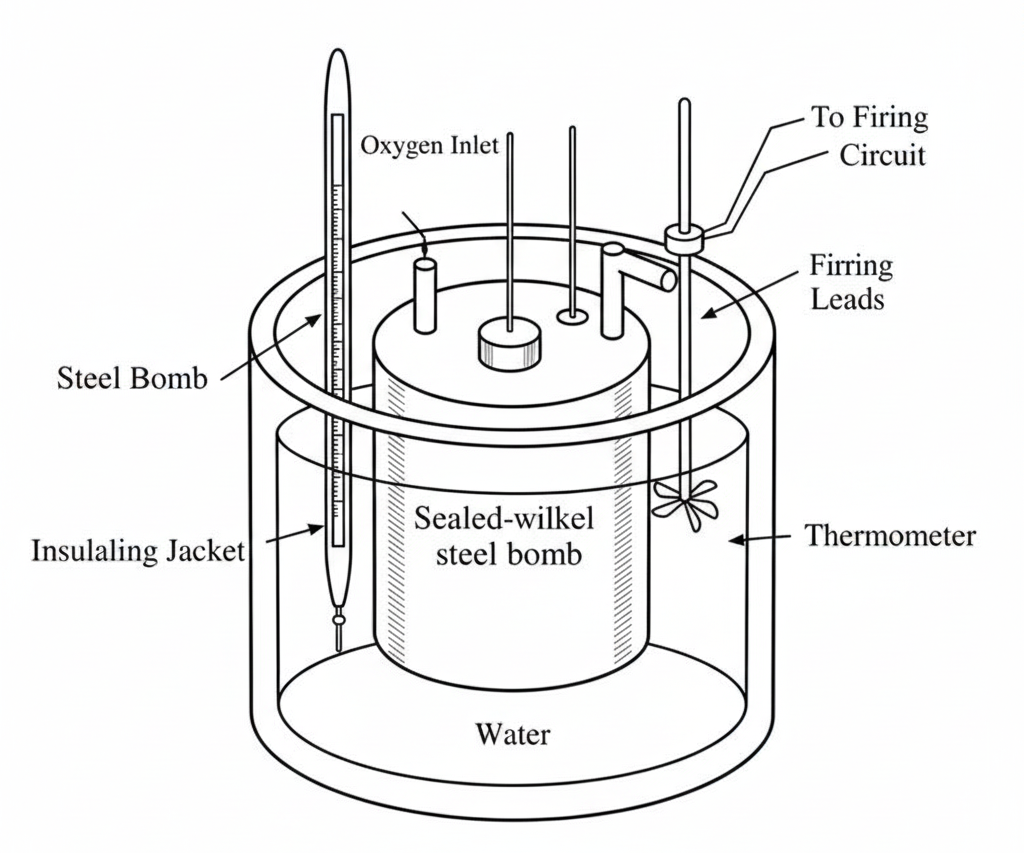
Measuring $\Delta U$ (Constant Volume): We use a Bomb Calorimeter. This is a sealed steel vessel (the 'bomb'). Since it is sealed, the volume does not change ($\Delta V=0$), meaning no work is done, and the energy change measured is $q_v$, which is equal to $\Delta U$.
Figure below:
A clear diagram showing a Bomb Calorimeter with a sealed steel bomb immersed in water, connected to a thermometer, stirrer, and firing leads/oxygen inlet.
-
Measuring $\Delta H$ (Constant Pressure): This uses a constant pressure calorimeter (often an insulated cup, like the foam polystyrene cup in Fig. 5.8). Since the process is carried out at constant atmospheric pressure, the heat change measured is $q_p$, which is equal to $\Delta H$.
NEET Checkpoint:
A scientist wants to measure the enthalpy of a combustion reaction. Which type of calorimeter must she use?
(a) Coffee-cup calorimeter
(b) Constant pressure calorimeter
(c) Bomb calorimeter (constant volume calorimeter)
(d) Ice calorimeter
✅ Answer: (c) A bomb calorimeter (or constant volume calorimeter) — Combustion reactions are typically carried out in a sealed bomb to ensure $\Delta V=0$, allowing calculation of $\Delta U$, which can then be converted to $\Delta H$.
Practice Question:
Which equation correctly defines the heat required to raise the temperature of a sample of mass $m$ by $\Delta T$ when $c$ is the specific heat capacity?
(a) $q = c\Delta T$
(b) $q = m\Delta T / c$
(c) $q = c \times m \times \Delta T$
(d) $q = C_m \times \Delta T$
✅ Answer: (c) $q = c \times m \times \Delta T$ — Specific heat ($c$) is multiplied by mass ($m$) and temperature change ($\Delta T$) to find the total heat ($q$).
Key Takeaway
| Funda | Definition/Formula |
|---|---|
| Heat Capacity ($C$) | $q = C\Delta T$ |
| Ideal Gas Relation | $C_p - C_v = R$ |
| Bomb Calorimeter | Measures $\Delta U$ (at constant volume) |
| Constant Pressure Cal. | Measures $\Delta H$ (at constant pressure) |
9. Reaction Enthalpy ($\Delta_{r}H$) and Standard Enthalpy of Formation ($\Delta_{f}H^{\ominus}$)
Welcome back, future doctor! Let's clear up the funda behind enthalpy changes, which are super important for predicting if a reaction needs heating or cooling. Don't stress, yaar—it's easier than it looks!
What is Reaction Enthalpy?
When a reaction happens (Reactants $\rightarrow$ Products), the enthalpy change accompanying a reaction is called the Reaction Enthalpy ($\Delta_{r}H$). This is essentially the heat absorbed or evolved when the reaction occurs at constant pressure ($q_{p}$).
The calculation is straightforward: you subtract the total enthalpy of the reactants from the total enthalpy of the products:
where $a_{i}$ and $b_{i}$ are the stoichiometric coefficients from the balanced equation.
NEET Checkpoint :
Which condition must be constant for the heat absorbed to equal $\Delta_{r}H$?
(a) Volume
(b) Pressure
(c) Temperature
(d) Mass
✅ Answer: (b) Pressure — Remember, $\Delta H = q_{p}$. Enthalpy is specifically defined as the heat transfer at constant pressure.
Standard Enthalpy of Reaction ($\Delta_{r}H^{\ominus}$)
Since enthalpy depends on conditions, we need a standard reference point. The Standard Enthalpy of Reaction ($\Delta_{r}H^{\ominus}$) is the enthalpy change when all participating substances are in their standard states.
So, what’s a standard state? It's simply the pure form of a substance at 1 bar pressure (and usually, we take data at $298 \text{ K}$). We use the superscript $\ominus$ to denote these standard conditions, like $\Delta H^{\ominus}$.
Standard Molar Enthalpy of Formation ($\Delta_{f}H^{\ominus}$)
This is perhaps the most useful tool for thermochemistry! The Standard Molar Enthalpy of Formation ($\Delta_{f}H^{\ominus}$) is the enthalpy change when one mole of a compound is formed from its elements in their most stable reference states.
For example, when making liquid water:
Notice this: For an element in its most stable reference state (like $\text{C(graphite)}$ or $\text{H}_{2}(\text{g})$ at $298 \text{ K}$ and $1 \text{ bar}$), the standard enthalpy of formation ($\Delta_{f}H^{\ominus}$) is taken as zero by convention. This makes sense because you aren't forming it from anything new!
Relatable Example: Imagine you are making chai. The standard state for water is liquid water, and the standard state for sugar is solid crystal. If you form 1 mole of water from liquid water, the $\Delta_{f}H^{\ominus}$ is zero, because liquid water is the stable element (or reference state) in that context. Similarly, the reference state of dihydrogen is $\text{H}_{2}$ gas.
NEET Checkpoint :
What is the standard enthalpy of formation for solid carbon in the form of diamond?
(a) $0~kJ~mol^{-1}$
(b) $+1.89~kJ~mol^{-1}$
(c) $-1.89~kJ~mol^{-1}$
(d) Cannot be determined
✅ Answer: (b) $+1.89~kJ~mol^{-1}$ — The reference state for carbon is graphite, not diamond. Therefore, $\text{C}(\text{graphite})$ has $\Delta_{f}H^{\ominus} = 0$, but $\text{C}(\text{diamond})$ has a small positive value of $+1.89~kJ~mol^{-1}$.
Calculating $\Delta_{r}H^{\ominus}$ using $\Delta_{f}H^{\ominus}$ values
This is the big formula you need to nail for the exam! Once you know the $\Delta_{f}H^{\ominus}$ for all reactants and products, calculating the reaction enthalpy is just subtraction (products minus reactants).
Here’s the trick: Always look up the $\Delta_{f}H^{\ominus}$ values of the products first, multiply them by their stoichiometric coefficients, sum them up, and then subtract the corresponding sum for the reactants.
NEET Checkpoint :
When calculating $\Delta_{r}H^{\ominus}$ using $\Delta_{f}H^{\ominus}$, why do pure elements in their reference state drop out of the calculation?
(a) Their mass is too small
(b) They are extensive properties
(c) Their standard enthalpy of formation is zero
(d) They are not involved in bond breaking
✅ Answer: (c) Their standard enthalpy of formation is zero — By convention, the most stable form of an element has $\Delta_{f}H^{\ominus}=0$, simplifying the calculation significantly.
Practice Questions:
1: The standard molar enthalpy of formation for $\text{O}{2}(\text{g})$ is:
(a) Positive
(b) Negative
(c) Zero
(d) Same as $\text{O}{3}(\text{g})$
✅ Answer: (c) Zero — Oxygen gas ($\text{O}_{2}(\text{g})$) is the most stable reference state for the element oxygen, so its standard enthalpy of formation is zero.
2: For the reaction $\text{A} + 2\text{B} \rightarrow 3\text{C}$, the correct expression for $\Delta_{r}H^{\ominus}$ in terms of standard enthalpies of formation is:
(a) $3\Delta_{f}H^{\ominus}(\text{C}) - \Delta_{f}H^{\ominus}(\text{A}) - 2\Delta_{f}H^{\ominus}(\text{B})$
(b) $\Delta_{f}H^{\ominus}(\text{A}) + 2\Delta_{f}H^{\ominus}(\text{B}) - 3\Delta_{f}H^{\ominus}(\text{C})$
(c) $\Delta_{r}H^{\ominus} = \sum \Delta_{f}H^{\ominus}(\text{reactants}) - \sum \Delta_{f}H^{\ominus}(\text{products})$
✅ Answer: (a) $3\Delta_{f}H^{\ominus}(\text{C}) - \Delta_{f}H^{\ominus}(\text{A}) - 2\Delta_{f}H^{\ominus}(\text{B})$ — Remember, it's always $\sum (\text{products}) - \sum (\text{reactants})$, with coefficients applied.
Key Takeaway
Reaction Enthalpy ($\Delta_{r}H$): Enthalpy change accompanying any reaction ($\Delta_{r}H = q_{p}$).
Standard State ($\ominus$): Pure substance at $1 \text{ bar}$ (usually $298 \text{ K}$).
Standard Molar Enthalpy of Formation ($\Delta_{f}H^{\ominus}$): $\Delta H$ for forming 1 mole of compound from elements in stable states. Elements in stable states have $\Delta_{f}H^{\ominus} = 0$.
Calculation Formula: $\Delta_{r}H^{\ominus} = \sum a_{i} \Delta_{f}H^{\ominus}(\text{products}) - \sum b_{i} \Delta_{f}H^{\ominus}(\text{reactants})$
10. Enthalpies of Phase Transition and Sublimation
When matter changes its roop (form)—like ice melting or water boiling—energy is always involved. Since these phase transitions usually happen at constant atmospheric pressure, we quantify this energy exchange using Enthalpy ($\Delta H$). We focus on three key types under standard conditions ($1~bar$).
Standard Enthalpy of Fusion ($\Delta_{fus}H^{\ominus}$)
This fancy term is simply the enthalpy change that accompanies melting of one mole of a solid substance in standard state. Think about ice melting into water: $H_{2}O(s)\rightarrow H_{2}O(l)$.
Notice this: Melting is an endothermic process, meaning the system absorbs heat. Therefore, all enthalpies of fusion are positive. Don't stress, yaar—the ice needs energy to break free!
NEET Checkpoint:
If ice melts, where does the heat go?
(a) It is released to the surroundings
(b) It is absorbed by the system
(c) $\Delta H = 0$
✅ Answer: (b) It is absorbed by the system — Melting is endothermic, so the system absorbs heat, making $\Delta_{fus}H^{\ominus}$ positive.
Standard Enthalpy of Vaporization ($\Delta_{vap}H^{\ominus}$)
Moving from liquid to gas! This is the amount of heat required to vaporize one mole of a liquid at constant temperature and under standard pressure ($1~bar$). For water, this process looks like $H_{2}O(l)\rightarrow H_{2}O(g)$, where $\Delta_{vap}H^{\ominus}$ is $+40.79~kJ~mol^{-1}$.
Here’s the trick: The magnitude of this enthalpy depends heavily on the strength of the intermolecular interactions. Imagine a chai stall where the water is boiling. Water has strong hydrogen bonds, holding molecules tightly, so it needs a large amount of heat to vaporise. Contrast this with acetone (nail polish remover); its weaker dipole-dipole interactions mean less heat is needed for vaporisation, which is why it evaporates chataak se!.
Standard Enthalpy of Sublimation ($\Delta_{sub}H^{\ominus}$)
This is the shortcut method! Standard enthalpy of sublimation, $\Delta_{sub}H^{\ominus}$, is the change in enthalpy when one mole of a solid substance sublimes directly to vapour. This process skips the liquid state completely. Dry ice (solid $CO_{2}$) is a classic example of sublimation.
NEET Checkpoint:
Sublimation always occurs from which state to which state?
(a) Liquid to Gas
(b) Solid to Liquid
(c) Solid to Vapour
✅ Answer: (c) Solid to Vapour — Sublimation is the direct conversion of a solid into its vapour.
NEET Checkpoint:
If acetone vaporises easily compared to water, its $\Delta_{vap}H^{\ominus}$ must be:
(a) Higher
(b) Lower
(c) Equal
✅ Answer: (b) Lower — Weaker intermolecular interactions (like dipole-dipole in acetone) mean less heat is required for vaporisation.
Practice Question:
Which of the following processes has an enthalpy change with a negative sign?
(a) Melting of $1~mol$ of ice at $273~K$
(b) Vaporisation of $1~mol$ of water at $373~K$
(c) Freezing of $1~mol$ of water at $273~K$
(d) Sublimation of $1~mol$ of dry ice at $195~K$
✅ Explanation: Melting, vaporisation, and sublimation all require heat input (endothermic, $\Delta H$ positive). Freezing is the reverse of melting. Since melting is endothermic, freezing must be exothermic (releasing heat), resulting in a negative $\Delta H$.
Key Takeaway
Fusion, Vaporisation, and Sublimation are endothermic ($\Delta H^{\ominus}>0$).
$\Delta_{fus}H^{\ominus}$: Solid $\rightarrow$ Liquid (Melting $1~mol$).
$\Delta_{vap}H^{\ominus}$: Liquid $\rightarrow$ Gas (Vaporising $1~mol$).
$\Delta_{sub}H^{\ominus}$: Solid $\rightarrow$ Vapour (Subliming $1~mol$).
11. Hess's Law and Enthalpy of Combustion
First up, let's nail Hess's Law of Constant Heat Summation. This is a biggie because it relies on the idea that enthalpy ($\Delta H$) is a state function.
Hess’s Law State Check:
If a chemical reaction happens in multiple stages, the standard reaction enthalpy ($\Delta_{r}H^{\ominus}$) of the overall reaction is simply the sum of the standard enthalpies of the intermediate reactions into which the overall reaction may be divided, provided they are all at the same temperature.
Imagine trying to calculate the total time your rickshaw driver took to get you to your coaching centre. You could calculate the time for the whole trip (A $\rightarrow$ B), or sum up the time he spent waiting at the pani puri stall (A $\rightarrow$ C) and then the time driving the rest of the way (C $\rightarrow$ B). The total time is the same, no matter the pit stops! Similarly, for chemical reactions:
NEET Checkpoint:
Hess's Law is valid because enthalpy ($\Delta H$) is:
(a) An extensive property
(b) A path function
(c) A state function
(d) Measured in $J$
✅ Answer: (c) A state function — Since $\Delta H$ only depends on the initial and final states, the path taken (single step or multiple steps) doesn't matter.
Standard Enthalpy of Combustion ($\Delta_c H^{\ominus}$)
Now, let's talk about burning things! The Standard Enthalpy of Combustion ($\Delta_{c}H^{\ominus}$) is defined as the enthalpy change per mole (or per unit amount) of a substance when it undergoes complete combustion, with all reactants and products being in their standard states at the specified temperature. Remember, combustion reactions are usually exothermic, meaning $\Delta_{c}H^{\ominus}$ is typically negative. For example, when 1 mole of butane burns (like in your cooking gas cylinder), 2658 kJ of heat is released.
NEET Checkpoint:
For the calculation of $\Delta_{c}H^{\ominus}$, the amount of substance undergoing combustion must be:
(a) 1 gram
(b) 1 molecule
(c) 1 mole
(d) Any specific mass
✅ Answer: (c) 1 mole — The standard enthalpy of combustion is defined per mole of the substance.
Application of Hess's Law
We use Hess's Law when we can't measure a reaction enthalpy directly. Let's calculate the enthalpy for forming carbon monoxide ($\text{CO}$) from graphite:
We know the following reactions:
1. $C(graphite,s) + O_{2}(g)\rightarrow CO_{2}(g); \Delta_{r}H^{\ominus}=-393.5~kJ~mol^{-1}$ (i)
2. $CO(g)+\frac{1}{2}O_{2}(g)\rightarrow CO_{2}(g); \Delta_{r}H^{\ominus}=-283.0~kJ~mol^{-1}$ (ii)
Here's the trick: we need $\text{CO}(g)$ as a product, so we reverse reaction (ii) and change the sign of its $\Delta_{r}H^{\ominus}$:
3. $CO_{2}(g)\rightarrow CO(g)+\frac{1}{2}O_{2}(g); \Delta_{r}H^{\ominus}=+283.0~kJ~mol^{-1}$ (iii)
Now, adding (i) and (iii) gives us the desired reaction, because the $\text{CO}2$ cancels out, and $O_2$ is balanced:
This is how we calculate the unknown $\Delta_{r}H^{\ominus}$ using Hess's Law!
NEET Checkpoint:
When a thermochemical equation is reversed, the sign of $\Delta_{r}H^{\ominus}$ must:
(a) Remain the same
(b) Be reversed
(c) Be multiplied by 2
(d) Become zero
✅ Answer: (b) Be reversed — Since the process changes direction (from exothermic to endothermic or vice-versa), the sign must flip.
Practice Question:
Which of the following processes requires heat to be supplied, given that $\Delta_{fus}H^{\ominus}=+6.01~kJ~mol^{-1}$ for water at $273.15~K$?
(a) $\text{C}{4}\text{H}{10}(g) + \frac{13}{2}\text{O}{2}(g) \rightarrow 4\text{CO}{2}(g) + 5\text{H}{2}\text{O}(l)$
(b) $H{2}O(l)\rightarrow H_{2}O(s)$
(c) $H_{2}O(s)\rightarrow H_{2}O(l)$
(d) $\text{Fe}{2}\text{O}{3}(s)$ formation from $\text{Fe}(s)$ and $\text{O}_{2}(g)$
✅ Answer: (c) $H_{2}O(s)\rightarrow H_{2}O(l)$ — Melting (fusion) is an endothermic process. Option (a) and (d) are typically exothermic combustion/formation reactions. Freezing (b) is the reverse of fusion and releases heat.
Key Takeaway
| Concept | Definition/Formula | Importance |
|---|---|---|
| Hess's Law | $\Delta_{r}H=\sum \Delta_{r}H_{steps}$ | Allows calculating $\Delta H$ for complex reactions based on simpler ones. |
| $\Delta_c H^{\ominus}$ | Enthalpy change for 1 mole of substance burned, all species in standard states. | Used to quantify heat released by fuels (exothermic). |
12. Bond, Atomization, and Lattice Enthalpies
We use the term Enthalpy of Atomization ($\Delta_{a}H^{\ominus}$) to define the enthalpy change that happens when one mole of bonds is completely broken down to get atoms, all in the gaseous phase. For example, turning one mole of dihydrogen gas into separate hydrogen atoms:
Notice this: for solid substances like sodium, the enthalpy of atomization ($\text{Na}(s) \rightarrow \text{Na}(g)$) is the exact same thing as its enthalpy of sublimation.
Then there is Bond Dissociation Enthalpy. This is the change in enthalpy when one mole of covalent bonds in a gaseous covalent compound is broken to form gaseous products. For diatomic molecules, like $\text{H}{2}$ or $\text{Cl}{2}$, the bond dissociation enthalpy is the same as the enthalpy of atomization.
NEET Checkpoint :
For $Cl_{2}(g) \rightarrow 2Cl(g)$, the enthalpy change is:
(a) $\Delta_{fus}H^{\ominus}$
(b) $\Delta_{c}H^{\ominus}$
(c) $\Delta_{a}H^{\ominus}$
(d) Both (a) and (b)
✅ Answer: (c) $\Delta_{a}H^{\ominus}$ — For a diatomic gas, the enthalpy of atomization ($\Delta_{a}H^{\ominus}$) and the bond dissociation enthalpy are identical.
The Mean Bond Enthalpy Trick
Here’s the thing: for polyatomic molecules, like methane ($\text{CH}_{4}$), the energy required to break the four identical $\text{C-H}$ bonds successively is different at each step! It's like how your first 50 runs in a cricket match might take less energy than scoring the last 10 runs when you're tired.
Since successive steps differ ($\Delta_{bond}H^{\ominus}$ values are $+427, +439, +452$, and $+347~kJ~mol^{-1}$ for $\text{CH}{4}$), we use the Mean Bond Enthalpy. We take the overall atomization enthalpy ({and divide it by the number of bonds (four $\text{C-H}$ bonds).
NEET Checkpoint :
Which statement is correct regarding bond energies in $\text{CH}_{4}$?
(a) All four C-H bonds require the same energy to break.
(b) Mean bond enthalpy is calculated because successive bond breaking steps differ in energy.
(c) The atomization enthalpy is always less than the mean bond enthalpy.
✅ Answer: (b) Mean bond enthalpy is calculated because successive bond breaking steps differ in energy — The energy required for each $\text{C-H}$ bond breaking step is different in polyatomic molecules.
Calculating Reaction Enthalpies
For gas phase reactions, we can estimate the standard enthalpy of reaction ($\Delta_{r}H^{\ominus}$) using bond enthalpies (a very useful, approximate relation!):
Remember this rule: Energy IN (Reactants) minus Energy OUT (Products).
Lattice Enthalpy
Now shift gears to ionic compounds! The Lattice Enthalpy ($\Delta_{lattice}H^{\ominus}$) is the enthalpy change when one mole of an ionic compound dissociates completely into its component ions, all in the gaseous state.
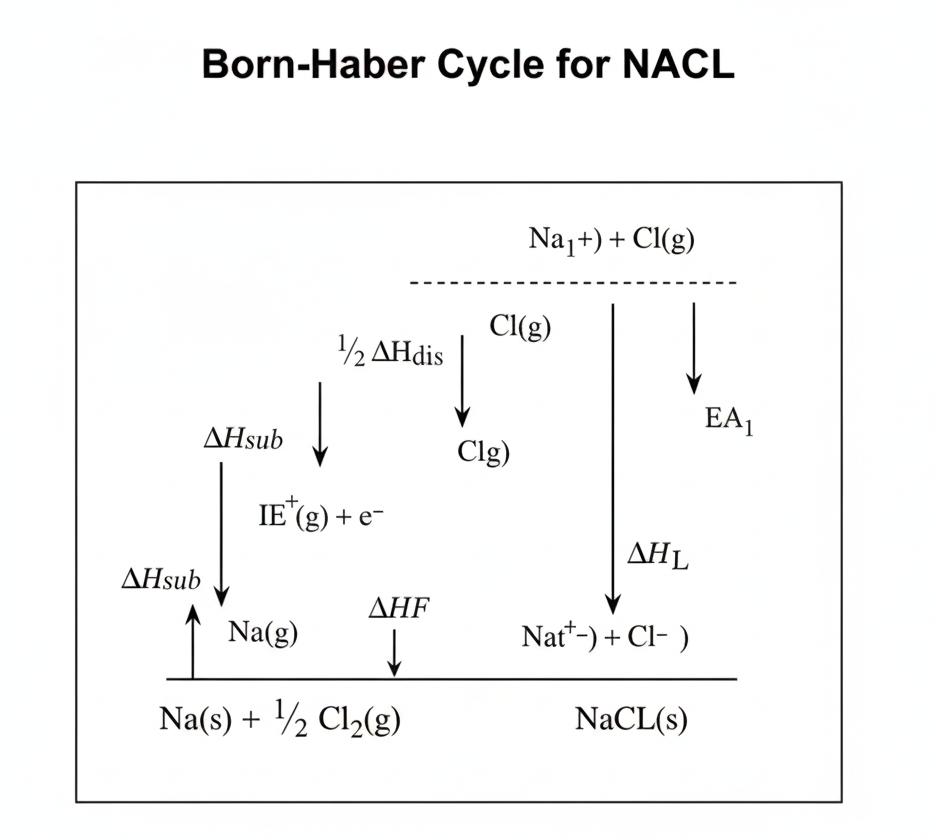
Since we can't measure this directly, we calculate it indirectly using Hess's Law via a famous thermodynamic cycle called the Born-Haber Cycle.
Figure below:
A clear diagram showing the Born-Haber cycle for $\text{NaCl}(s)$, illustrating the enthalpy changes for sublimation, ionization, dissociation, electron gain, formation, and lattice enthalpy
NEET Checkpoint :
The process $\text{Na}^{+}(g) + \text{Cl}^{-}(g) \rightarrow \text{Na}^{+}\text{Cl}^{-}(s)$ corresponds to:
(a) Ionization enthalpy
(b) Enthalpy of hydration
(c) Negative of Lattice Enthalpy
✅ Answer: (c) Negative of Lattice Enthalpy — Lattice enthalpy is defined for dissociation ($s \rightarrow g$), so formation ($g \rightarrow s$) is the negative of $\Delta_{lattice}H^{\ominus}$.
Practice Question:
If the atomization enthalpy of $\text{CH}{4}(g)$ is $1665~kJ~mol^{-1}$, what is the energy required to break one $\text{C-H}$ bond in the first step of dissociation, $\text{CH}{4}(g) \rightarrow \text{CH}_{3}(g)+\text{H}(g)${4}(g) \rightarrow \text{CH}_{3}(g)+\text{H}(g)$?
(a) $416~kJ~mol^{-1}$
(b) $1665~kJ~mol^{-1}$
(c) $427~kJ~mol^{-1}$
(d) $347~kJ~mol^{-1}$
✅ Answer: (c) $427~kJ~mol^{-1}$ — The first step of dissociation has an enthalpy change of $+427~kJ~mol^{-1}$. The value $416~kJ~mol^{-1}$ is the mean bond enthalpy, not the specific energy for the first step.
Key Takeaway
Atomization vs. Dissociation: For diatomic molecules, $\Delta_{a}H^{\ominus}$ is equal to $\Delta_{bond}H^{\ominus}$.
Polyatomic Molecules: Use the mean bond enthalpy when successive bond breaking steps differ in energy.
Reaction Enthalpy (Gas Phase): $\Delta_{r}H^{\ominus} = \Sigma \Delta H_{\text{Reactants}} - \Sigma \Delta H_{\text{Products}}$.
Lattice Enthalpy: Enthalpy required to dissociate $1$ mole of an ionic compound into gaseous ions.
13. Enthalpies of Hydration, Solution, and Dilution: The Dissolution Drama
Don't stress, yaar! Thermodynamics keeps giving us ways to figure out energies we can't measure directly, and this section is a perfect example of that useful funda.
The Secret of Lattice Energy: The Born-Haber Cycle (BHC)
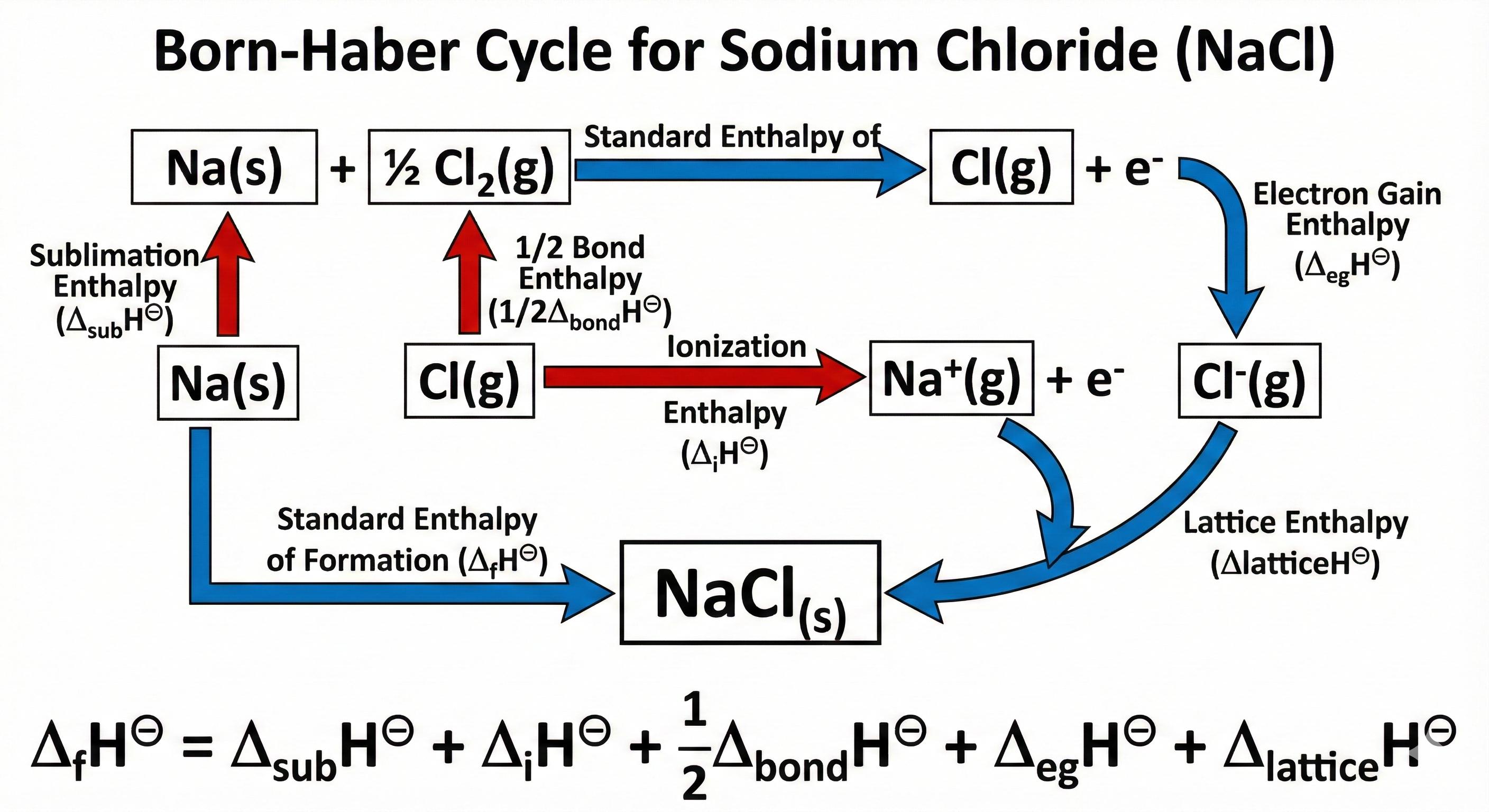
The Lattice Enthalpy ($\Delta_{lattice}H^{\ominus}$) is the energy change when one mole of an ionic compound dissociates into its ions in the gaseous state, like $Na^{+}Cl^{-}(s)\rightarrow Na^{+}(g)+Cl^{-}(g)$. Measuring this directly is impossible, so we use the Born-Haber Cycle, which is essentially a powerful application of Hess’s Law.
The BHC lets us calculate $\Delta_{lattice}H^{\ominus}$ indirectly by summing up a series of known, measurable steps that start and end with the same overall formation reaction:
- Sublimation ($\Delta_{sub}H^{\ominus}$): Turning the solid metal into gas, e.g., $Na(s)\rightarrow Na(g)$.
- Ionisation ($\Delta_{i}H^{\ominus}$): Converting the gaseous metal atom into a gaseous cation, $Na(g)\rightarrow Na^{+}(g)+e^{-1}(g)$.
- Dissociation: Breaking the halogen molecule into gaseous atoms, e.g., $\frac{1}{2}Cl_{2}(g)\rightarrow Cl(g)$ (half the bond dissociation enthalpy).
- Electron Gain ($\Delta_{eg}H^{\ominus}$): Converting the gaseous non-metal atom into a gaseous anion, $Cl(g)+e^{-1}(g)\rightarrow C\overline{l}(g)$.
- Lattice Formation: The final step (which is the reverse of lattice enthalpy) combines the gaseous ions to form the solid.
Applying Hess's Law means the enthalpy of formation ($\Delta_{f}H^{\ominus}$) of the ionic compound equals the sum of all these steps, allowing us to isolate and calculate $\Delta_{lattice}H^{\ominus}$.
Figure below:
A clear diagram showing the Born-Haber Cycle for $NaCl$, illustrating the standard enthalpy of formation ($\Delta_{f}H^{\ominus}$) as the sum of $\Delta_{sub}H^{\ominus}$, $\Delta_{i}H^{\ominus}$, $1/2\Delta_{bond}H^{\ominus}$, $\Delta_{eg}H^{\ominus}$, and $\Delta_{lattice}H^{\ominus}$.
NEET Checkpoint:
Which law is the conceptual basis for calculating lattice enthalpy using the Born-Haber Cycle?
(a) First Law of Thermodynamics
(b) Boyle's Law
(c) Hess's Law
(d) Second Law of Thermodynamics
✅ Answer: (c) Hess's Law — Hess’s law states that the total enthalpy change is independent of the path taken.
Solution and Hydration Enthalpies
When you dissolve a substance, we define the Enthalpy of Solution ($\Delta_{sol}H^{\ominus}$) as the enthalpy change when one mole of that substance dissolves in a specified amount of solvent.
Here’s the trick: Dissolution is a two-part process. First, we break apart the crystal lattice (this needs energy, $\Delta_{lattice}H^{\ominus}$). Second, the freed ions get surrounded by solvent molecules, a process called solvation (or hydration if the solvent is water), releasing energy ($\Delta_{hyd}H^{\ominus}$).
Notice this: The overall enthalpy of solution is simply the sum of these two processes:
If the hydration energy is much higher (more negative) than the lattice energy (positive), dissolution will be exothermic ($\Delta_{sol}H^{\ominus} < 0$). If the lattice energy dominates, the process is endothermic ($\Delta_{sol}H^{\ominus} > 0$), like for $NaCl$ ($\Delta_{sol}H^{\ominus}=+4~kJ~mol^{-1}$).
NEET Checkpoint:
If $\Delta_{lattice}H^{\ominus}$ is $1000~kJ~mol^{-1}$ and $\Delta_{hyd}H^{\ominus}$ is $-980~kJ~mol^{-1}$, what is the nature of the dissolution?
(a) Exothermic
(b) Endothermic
(c) Isothermal
(d) Spontaneous at all T
✅ Answer: (b) Endothermic — Since $\Delta_{sol}H^{\ominus} = 1000 + (-980) = +20~kJ~mol^{-1}$, heat is absorbed, making it endothermic.
The Enthalpy of Dilution
Now, picture this: You’ve dissolved your salt, and you decide to pour in more water to dilute it further. The heat change that occurs when you add additional solvent to an already existing solution is called the Enthalpy of Dilution. It’s defined as the heat withdrawn from the surroundings during this addition.
This value is not constant; it depends heavily on the original concentration of your solution and the amount of solvent you add. As you add more and more solvent, the enthalpy of solution approaches a limiting value (at infinite dilution).
Relatable Example (Dilution): Imagine you have strong orange squash concentrate. Adding the first glass of water causes a large release of heat (or perhaps a small absorption), but adding the 50th glass of water causes almost no change, because the solution is already very dilute. The enthalpy of dilution measures these successive small energy changes.
NEET Checkpoint:
The enthalpy of dilution of a solution depends on:
(a) Lattice enthalpy only
(b) Volume of the original solution only
(c) Original concentration and amount of solvent added
(d) Temperature of the surroundings only
✅ Answer: (c) Original concentration and amount of solvent added — The enthalpy of dilution is specific to the state of the solution before and after dilution.
Key Takeaway
Born-Haber Cycle uses Hess's law to calculate the indirectly measurable Lattice Enthalpy by summing steps like sublimation, ionisation, dissociation, and electron gain.
Enthalpy of Solution: $\Delta_{sol}H^{\ominus} = \Delta_{lattice}H^{\ominus} + \Delta_{hyd}H^{\ominus}$.
Enthalpy of Dilution is the heat withdrawn when additional solvent is added to an existing solution.
14. Spontaneity and the Second Law of Thermodynamics
Let's clear up the funda behind why reactions happen naturally. This is super important for chemical thermodynamics, yaar!
First up, what is a spontaneous process? Simple definition: it's a process that has the potential to proceed without the assistance of external agency. Don't stress, this doesn't mean it has to happen fast! Even if the reaction takes years, it's still spontaneous if it doesn't need an external push once started. Critically, a spontaneous process is always an irreversible process; you can only reverse it using some external agency.
NEET Checkpoint:
Does spontaneity indicate the rate of a reaction?
(a) Yes, faster reactions are more spontaneous.
(b) No, it only indicates the potential to proceed.
(c) Only for exothermic reactions.
✅ Answer: (b) No, it only indicates the potential to proceed — Spontaneity tells us if it can happen, not how quickly.
Why $\Delta H$ is Not Enough
For ages, scientists thought a decrease in enthalpy ($\Delta H$)—meaning exothermic reactions—was the driving force for spontaneity. It makes sense, right? Like a cricket ball falling from the stands (a spontaneous process), things tend to move towards lower energy. But hold up! We have endothermic reactions (where $\Delta H$ is positive, heat is absorbed) that are totally spontaneous, like the formation of $NO_{2}(g)$ from elements ($\Delta_{r}H^{\ominus} = +33.2~kJ~mol^{-1}$). So, decrease in $H$ is just a contributory factor, but not the sole criterion for spontaneity.
Enter Entropy ($S$): The King of Chaos
If energy decrease isn't the only driver, what is? Disorder! We introduce Entropy ($S$), which is a measure of the degree of randomness or disorder in the system. The greater the disorder in an isolated system, the higher the entropy. Think of your study table right before the NEET—pure chaos means high entropy! The gaseous state has the highest entropy, and crystalline solids have the lowest.
We can quantify the change in entropy ($\Delta S$) for a reversible process using the heat transferred ($q_{rev}$) and the temperature ($T$):
Since entropy is a state function, the entropy change is independent of the path taken.
NEET Checkpoint:
Which physical state has the highest entropy?
(a) Liquid
(b) Crystalline Solid
(c) Gaseous
(d) Plasma
✅ Answer: (c) Gaseous — Gases are the most disordered state.
The Second Law of Thermodynamics
The ultimate criterion for spontaneity involves the total entropy of the universe (or system + surroundings). A process is spontaneous if the total entropy increases.
Criterion for Spontaneity based on Entropy:
This leads us directly to the Second Law of Thermodynamics: The entropy of an isolated system increases in the natural direction of a spontaneous change. Notice this: for an isolated system, energy ($\Delta U$) stays constant, so entropy is the discriminator for spontaneity. This law explains why things like gas diffusion happen naturally—they increase the total disorder.
NEET Checkpoint:
For an isolated system, what must be true for a change to be spontaneous?
(a) $\Delta U < 0$
(b) $\Delta S < 0$
(c) $\Delta S > 0$
(d) $\Delta H = 0$
✅ Answer: (c) $\Delta S > 0$ — In an isolated system, the entropy must increase for a spontaneous change (Second Law).
Practice Questions:
- Which concept explains why heat flows spontaneously from a warmer body to a colder body?
(a) First Law of Thermodynamics
(b) Enthalpy of reaction
(c) Entropy of the system
(d) Second Law of Thermodynamics
✅ Answer: (d) Second Law of Thermodynamics — While the First Law deals with energy conservation, the Second Law dictates the direction of spontaneous processes like heat flow, requiring an overall increase in entropy.
2. When a liquid crystallizes into a solid, the entropy of the system:
(a) Increases
(b) Decreases
(c) Remains constant
(d) Cannot be determined
✅ Answer: (b) Decreases — Upon freezing, molecules take up an ordered state (crystal), meaning the randomness/disorder decreases.
Key Takeaway
For any spontaneous process, the total entropy of the system and surroundings must increase ($\Delta S_{total} > 0$). Entropy is the measure of disorder, and nature loves disorder! Now that you've got this $S$ funda cleared, wait till you see how it connects with Gibbs energy ($G$)!
15. Gibbs Energy ($G$) and Equilibrium Constant
Hey NEET prep champs! Ready to tackle the ultimate spontaneity funda? We've seen that sometimes a negative enthalpy ($\Delta H$) or a positive entropy ($\Delta S$) isn't enough to guarantee a reaction happens spontaneously. That's where Gibbs Energy ($G$) steps in to save the day!
Gibbs energy, often called the Gibbs function, is a state function and an extensive property. It combines both enthalpy and entropy, giving us a single, powerful tool. The definition is simple, yet crucial:
Notice this: When a process occurs at constant temperature, the change in Gibbs energy, $\Delta G$, is given by the famous Gibbs equation: $\Delta G = \Delta H - T\Delta S$. The units for $\Delta G$ are energy units (like Joules or kilojoules) because both $\Delta H$ and $T\Delta S$ are energy terms. This $\Delta G$ essentially measures the net energy available to do useful work, hence why it's also called "free energy".
NEET Checkpoint:
Which thermodynamic function provides a criterion for spontaneity at constant temperature and pressure?
(a) $\Delta H$
(b) $\Delta S$
(c) $\Delta U$
(d) $\Delta G$
✅ Answer: (d) $\Delta G$ — $\Delta G$ is the key indicator, bringing $\Delta H$ and $\Delta S$ together to determine if a reaction is feasible.
Here’s the trick: $\Delta G$ provides the clear criteria for spontaneity at constant pressure and temperature. Think of it like deciding whether to start studying early for NEET—if the "energy cost" ($\Delta G$) is negative, you're good to go!
| Criterion | Result |
|---|---|
| $\Delta G < 0$ | Spontaneous (The process is possible) |
| $\Delta G > 0$ | Non-spontaneous (External help is needed) |
| $\Delta G = 0$ | At Equilibrium (Minimum energy achieved) |
Imagine a pani puri stall. When the stall is running perfectly, with ingredients being prepped and sales happening at the same rate, the system is at equilibrium, and $\Delta G = 0$. The "stress" or potential for spontaneous change is zero!
Connecting Gibbs Energy to Equilibrium Constant ($K$)
Now, let's talk standard states. The standard Gibbs energy change ($\Delta_r G^\ominus$) is related to the equilibrium constant ($K$) of a reaction. This is super important for predicting how far a reaction will proceed.
The relationship is established as:
Since $\ln K = 2.303 \log K$, we can also write it as:
If $\Delta_r G^\ominus$ is large and negative, $K$ will be much larger than 1, meaning the reaction goes almost to completion. Conversely, if $\Delta_r G^\ominus$ is large and positive, $K$ will be much smaller than 1, meaning the reaction won't form much product.
NEET Checkpoint:
For a reversible chemical reaction that has reached a state where the system is in perfect equilibrium, what is the value of the Gibbs energy change ($\Delta G$)?
(a) Positive
(b) Negative
(c) Zero
(d) Maximum
✅ Answer: (c) Zero — At equilibrium, $\Delta G = 0$.
NEET Checkpoint:
If the standard Gibbs energy change ($\Delta_r G^\ominus$) is large and negative, what can you predict about the equilibrium constant ($K$)?
(a) $K$ is less than 1
(b) $K$ is equal to 1
(c) $K$ is much larger than 1
(d) $K$ is zero
✅ Answer: (c) $K$ is much larger than 1 — A large negative $\Delta_r G^\ominus$ implies that $K$ will be very large, meaning the products are highly favoured.
Practice Question:
If the value of $\Delta_r G^{\ominus}$ for a reaction is given as $-13.6 \text{ kJ mol}^{-1}$ at $298 \text{ K}$ (where $R = 8.314 \text{ J K}^{-1} \text{ mol}^{-1}$), the value of $\log K$ is approximately:
(a) $13.6$
(b) $2.38$
(c) $-2.38$
(d) $0.57$
✅ Explanation: (b) We use $\log K = \frac{-\Delta_r G^\ominus}{2.303 RT}$.
Substitute $\Delta_r G^\ominus = -13.6 \times 10^3 \text{ J mol}^{-1}$ (converting kJ to J).
$\log K = \frac{-(-13.6 \times 10^3)}{(2.303)(8.314)(298)}$. This calculation results in a value of $2.38$.
Key Takeaway:
Gibbs Energy ($G$) is defined as $G = H - TS$. It is the universal criterion for spontaneity at constant $T$ and $P$. Spontaneous change occurs if $\Delta G < 0$. The relationship between the standard change and equilibrium is $\Delta_r G^{\ominus} = -RT \ln K$.