
1. Introduction to Chemical Kinetics
Arre, welcome to the world of Chemical Kinetics, yaar! While thermodynamics tells us if a reaction can happen (if $\Delta G < 0$), kinetics tells us how fast it actually goes. Think of it like this: thermodynamics says a diamond "should" turn into graphite, but kinetics tells us the rate is so slow that you won't see it in your lifetime! That's why we say "diamond is forever".
In simple terms, kinetics (from Greek kinesis, meaning movement) deals with reaction rates, their mechanisms, and the conditions that change them.
NEET Checkpoint:
What does Thermodynamics predict that Kinetics cannot?
(a) Rate of reaction
(b) Feasibility of reaction
(c) Reaction mechanism
(d) Activation energy
✅ Answer: (b) — Thermodynamics only tells if a reaction is feasible; kinetics tells the speed.
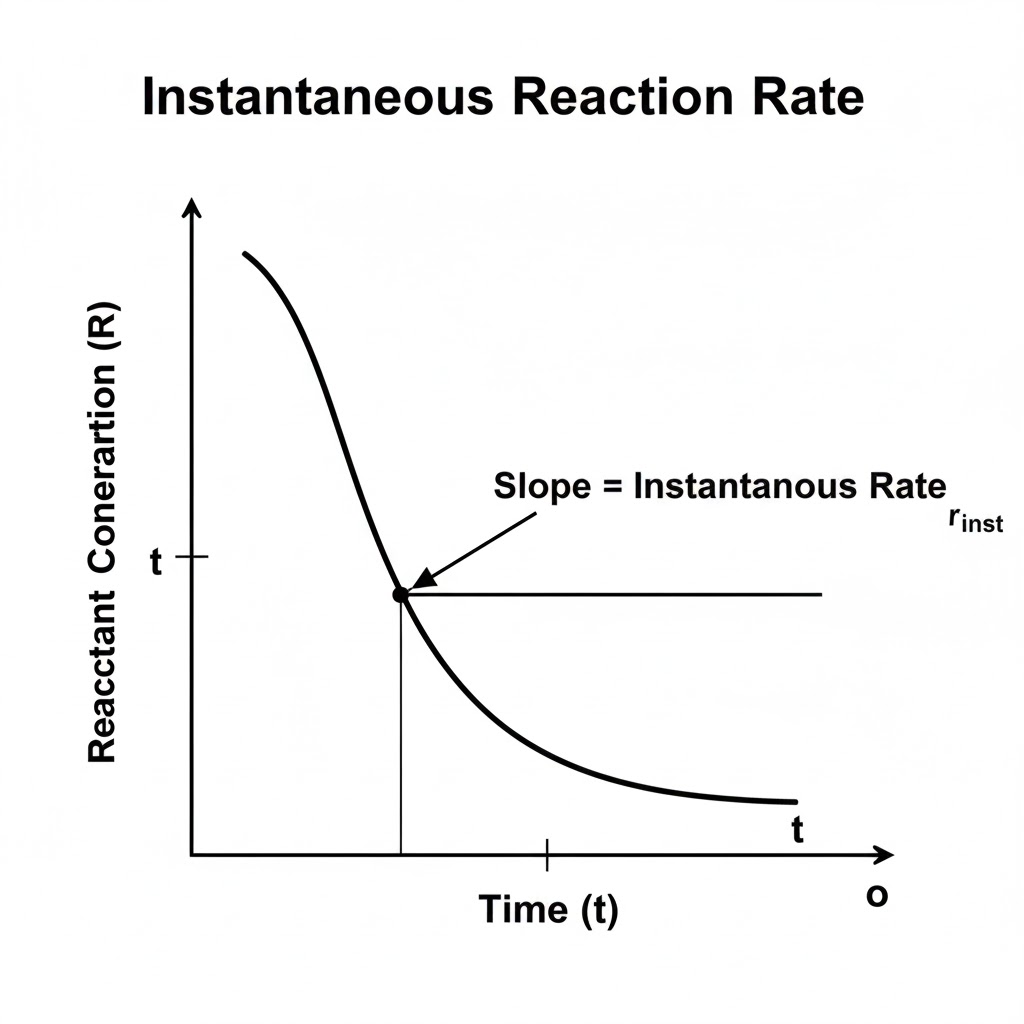
To measure this speed, we look at the Rate of Reaction. It’s the change in concentration of a reactant or product per unit time. Imagine you are tracking a scooty moving through Delhi traffic; its speed changes every second. Similarly, the average rate ($r_{av}$) is measured over a long time interval, while the instantaneous rate ($r_{inst}$) is the speed at one specific moment ($dt$).
The minus sign is just to keep the rate positive because reactant concentration decreases. Units are usually $mol L^{-1} s^{-1}$, or $atm s^{-1}$ for gases.
Figure below:
A graph showing a curve of Reactant concentration $[R]$ decreasing over time, with a tangent line drawn at a specific point $t$ to show the slope as the instantaneous rate $r_{inst}$.
NEET Checkpoint:
For the reaction $R \rightarrow P$, if $\Delta[R]$ is $-0.01 M$ in $20$ seconds, what is the rate?
(a) $5 \times 10^{-2} mol L^{-1} s^{-1}$
(b) $5 \times 10^{-3} mol L^{-1} s^{-1}$
(c) $ 2\times 10^{-4} mol L^{-1} s^{-1}$
(d) $5 \times 10^{-4} mol L^{-1} s^{-1}$
✅ Answer: (d) $5 \times 10^{-4} mol L^{-1} s^{-1}$. Just divide change in concentration by time.
NEET Checkpoint:
Which factor does NOT affect the rate of a reaction?
(a) Concentration
(b) Temperature
(c) Catalyst
(d) Enthalpy of reaction
✅ Answer: (d) — Concentration, temperature, and catalysts are the big bosses that alter rates.
Practice Question:
In the reaction $2HI \rightarrow H_{2} + I_{2}$, how is the rate of disappearance of $HI$ related to the appearance of $H_{2}$?
(a) $Rate = -\frac{\Delta[HI]}{\Delta t} = \frac{\Delta[H_{2}]}{\Delta t}$
(b) $Rate = -\frac{1}{2}\frac{\Delta[HI]}{\Delta t} = \frac{\Delta[H_{2}]}{\Delta t}$
(c) $Rate = -{2}\frac{\Delta[HI]}{\Delta t} = \frac{\Delta[H_{2}]}{\Delta t}$
(d) $Rate = \frac{\Delta[HI]}{\Delta t} = \frac{\Delta[H_{2}]}{\Delta t}$
✅ Answer: (b) $Rate = -\frac{1}{2}\frac{\Delta[HI]}{\Delta t} = \frac{\Delta[H_{2}]}{\Delta t}$. We divide by the stoichiometric coefficient to make them equal.
Key Takeaway
- Rate: Change in concentration per unit time ($mol L^{-1} s^{-1}$).
- Average Rate: $\frac{-\Delta[R]}{\Delta t}$ (over a time gap).
- Instantaneous Rate: $\frac{-d[R]}{dt}$ (at a specific moment, calculated via tangent slope).
2. Defining the Rate of Chemical Reaction
Hey there, future doctors! Ready to clear up the funda of how fast a reaction actually goes?. Just like you measure the speed of your scooty by checking the distance covered in a certain time, we measure the "speed" of a chemical reaction by looking at how much stuff changes over time.
NEET Checkpoint:
What is the unit of the rate of reaction for a solution-phase reaction?
(a) $mol\,L^{-1}$
(b) $s^{-1}$
(c) $mol\,L^{-1}s^{-1}$
(d) $mol$
✅ Answer: (c) $mol\,L^{-1}s^{-1}$ — Arre, remember it’s concentration ($mol\,L^{-1}$) divided by time ($s$)!.
In chemistry, the rate of reaction is simply the change in concentration of a reactant or a product in unit time. To be more specific, we can track it in two ways:
1. The rate of decrease in concentration of any one of the reactants.
2. The rate of increase in concentration of any one of the products.
NEET Checkpoint:
In the expression for the rate of disappearance of a reactant $R$, why do we use a negative sign ($-\Delta[R]/\Delta t$)?
(a) To make the rate negative
(b) To make the final rate a positive quantity
(c) Because concentration increases
(d) It’s a mathematical error.
✅ Answer: (b) To make the final rate a positive quantity — Since $\Delta[R]$ is negative (concentration is dropping), multiplying by $-1$ keeps the vibe positive!.
Think of a Cricket Match: The "Rate of Wicket Fall" is how many reactants (batsmen) leave the crease per over. Simultaneously, the "Run Rate" is how many products (runs) are being added to the scoreboard per over. Both tell you how fast the "game" is progressing!
We use square brackets $[ ]$ to denote molar concentration. If you’re dealing with a gaseous match where everything is in the air, we use partial pressures instead, so the units become $atm\,s^{-1}$.
NEET Checkpoint:
If the concentration of a gas is expressed in terms of partial pressure, the unit of the rate is:
(a) $mol\,L^{-1}s^{-1}$
(b) $atm\,L^{-1}$
(c) $atm\,s^{-1}$
(d) $Pa$
✅ Answer: (c) $atm\,s^{-1}$ — For gases, pressure takes the place of concentration. Simple, right?.
Figure below:
A clear graph showing the decrease in reactant concentration R and the increase in product concentration P over time, with tangents illustrating the difference between average and instantaneous rates.

Practice Question:
Which of the following is NOT a valid unit for reaction rate?
(a) $mol\,L^{-1}s^{-1}$
(b) $atm\,s^{-1}$
(c) $mol\,L^{-1}min^{-1}$
(d) $mol\,L^{-1}$
✅ Answer: (d) $mol\,L^{-1}$. This is just concentration, yaar! Time must be in the denominator.
Key Takeaway
Formula Summary
For a hypothetical reaction $R \rightarrow P$:
$$Rate = \text{Rate of disappearance of } R = -\frac{\Delta[R]}{\Delta t}$$
$$Rate = \text{Rate of appearance of } P = +\frac{\Delta[P]}{\Delta t}$$
Units: $mol\,L^{-1}s^{-1}$ or $atm\,s^{-1}$.
3. Average and Instantaneous Reaction Rates
Ever noticed how your school bus speed changes? Sometimes it’s flying on the flyover, and sometimes it’s stuck in "Dilli-level" traffic. That is exactly the funda behind reaction rates! In chemistry, the rate of reaction is simply the change in concentration of a reactant or product per unit time.
The Two Types of Speed
-
Average Rate ($r_{av}$): This is calculated over a measurable time interval. Think of it like your total journey time divided by distance.
$$r_{av} = \frac{-\Delta[R]}{\Delta t} = \frac{\Delta[P]}{\Delta t}$$
We add a minus sign for reactants because their concentration decreases, and we want our rate to be a positive quantity. -
Instantaneous Rate ($r_{inst}$): This is like looking at your speedometer at exactly 10:05 AM. It happens when the time interval $\Delta t$ approaches zero.
$$r_{inst} = \frac{-d[R]}{dt} = \frac{d[P]}{dt}$$
Here’s the trick: You find this graphically by drawing a tangent at time $t$ on the concentration-time curve—the slope of that tangent is your $r_{inst}$.
NEET Checkpoint:
What are the units for a reaction rate in the gas phase?
(a) mol L⁻¹
(b) atm s⁻¹
(c) mol L⁻¹ s⁻¹
(d) s⁻¹
✅ Answer: (b) $atm \, s^{-1}$ — For gases, concentration is often expressed as partial pressure.
Stoichiometry: The Balancer
When the coefficients aren't 1, don't panic! We divide the rate of change by the stoichiometric coefficient to keep things consistent. For $2HI \rightarrow H_2 + I_2$, the rate is:
Relatable Example: Imagine a Pani Puri competition. Your Average Rate is how many puris you finished in 10 minutes. Your Instantaneous Rate is how fast you were gulping that one specific spicy puri at the 5th minute! Even physics needs a snacks break sometimes!
NEET Checkpoint:
Why do we multiply the reactant concentration change by $-1$ in rate expressions?
(a) To increase the value of the rate
(b) To make the rate positive
(c) To decrease the value of the rate
(d) To match the units of rate
✅ Answer: (b) To make the rate a positive quantity, as $\Delta[R]$ is naturally negative.
NEET Checkpoint:
How is $r_{inst}$ determined graphically?
(a) By calculating the slope of the concentration vs time curve at a specific point
(b) By measuring the average change in concentration over time
(c) By calculating the area under the concentration-time curve
(d) By taking the final concentration and dividing by total time
✅ Answer: (a) By calculating the slope of a tangent on a concentration-time curve.
Practice Question:
For the reaction $5Br^- + BrO_3^- + 6H^+ \rightarrow 3Br_2 + 3H_2O$, how is the rate expressed in terms of $Br^-$?
(a) $-\Delta[Br^-]/\Delta t$
(b) $-\frac{1}{5} \frac{\Delta[Br^-]}{\Delta t}$
(c) $\frac{1}{3} \frac{\Delta[Br^-]}{\Delta t}$
(d) $-5 \frac{\Delta[Br^-]}{\Delta t}$
✅ Answer: (b) — You must divide the disappearance rate by its stoichiometric coefficient (5) to maintain consistency across all species.
Key Takeaway
Formula Summary
- Average Rate ($r_{av}$): $\frac{-\Delta[R]}{\Delta t}$
- Instantaneous Rate ($r_{inst}$): $\frac{-d[R]}{dt}$
- Units: $mol \, L^{-1}s^{-1}$ or $atm \, s^{-1}$
4. General Factors Influencing Reaction Rates
Listen up, juniors! Ever wondered why milk turns into curd faster in the sweltering heat of May than in chilly December?. It’s all about the speed of the reaction, and today we’re decoding what makes those molecules hustle!.
First up is concentration. Imagine a Pani Puri stall during peak evening hours—more hungry students (concentration) means the vendor has to hand out puris much faster to keep up with the 'rate' of demand!. In the lab, higher reactant concentration generally leads to a faster reaction rate. For our gaseous friends, the rate is proportional to the partial pressure of the species, as pressure is directly proportional to concentration at a constant temperature.
NEET Checkpoint:
For a gaseous reaction, what is the rate directly proportional to?
(a) Volume
(b) Partial pressure
(c) Mass
(d) Colour
✅ Answer: (b) Partial pressure — Arre! Since concentration $\propto$ partial pressure, increasing pressure is like packing more molecules into a smaller rickshaw, making them react faster.
Then there's temperature. Most reactions accelerate as the temperature rises. In fact, for most chemical reactions, a mere $10~K$ rise in temperature nearly doubles the rate constant $k$.
NEET Checkpoint:
By how much does the rate constant generally increase with a $10~^{\circ}C$ rise?
(a) Triple
(b) Half
(c) Nearly double
(d) No change
✅ Answer: (c) Nearly double — This is a classic NEET funda you must remember!.
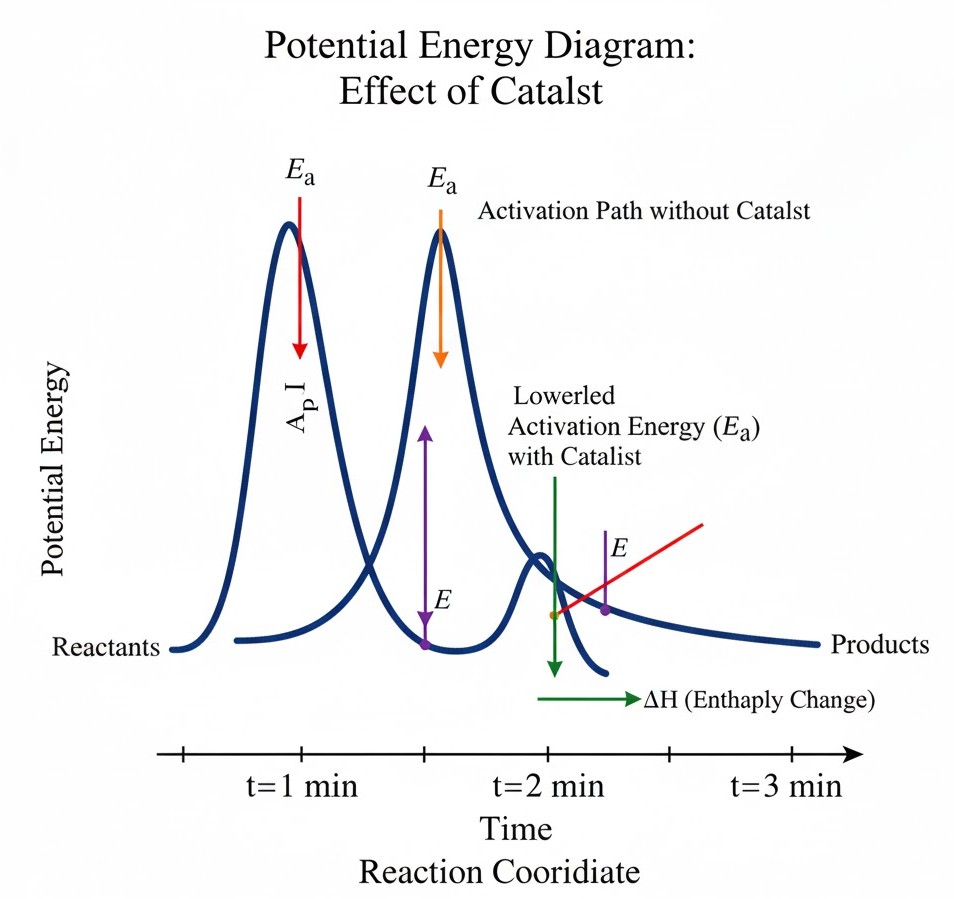
Finally, the catalyst. A catalyst is that witty senior who shows you a shortcut to the canteen, helping you get there faster without changing the canteen's menu!. It provides an alternate pathway with a lower activation energy ($E_a$), significantly increasing the rate. Note that it doesn't touch the Gibbs energy ($\Delta G$) or the equilibrium constant of a reaction.
Figure below:
A potential energy diagram showing a high peak for 'reaction path without catalyst' and a lower peak for 'reaction path with catalyst', with both starting at the same 'Reactants' level and ending at the same 'Products' level, clearly labelling the lowered activation energy Ea.
NEET Checkpoint:
Does a catalyst change the equilibrium constant of a reaction?
(a) Yes
(b) No
(c) Only at high pressure
(d) Only for endothermic reactions
✅ Answer: (b) No — It only helps in attaining the equilibrium faster by speeding up both forward and backward reactions equally.
Practice Question:
Which factor does NOT change the equilibrium constant but increases the reaction rate?
(a) Temperature
(b) Catalyst
(c) Concentration
(d) Pressure
✅ Answer: (b) Catalyst — While temperature can change equilibrium, a catalyst just helps you reach that state earlier.
Key Takeaway
- $\uparrow$ Concentration/Pressure: Increases rate.
- $\uparrow$ Temperature: Rates accelerate; $k$ nearly doubles for every $10~K$ rise.
- Catalyst: Increases rate by lowering activation energy ($E_a$).
5. The Rate Law and Differential Expressions
Listen up, junior! Let’s clear up this fundamental funda of Chemical Kinetics. While balanced equations look nice in your notebook, the real "boss" that dictates how fast a reaction actually goes is the Rate Law. It is the mathematical representation that relates the reaction rate to the molar concentration of reactants.
For a general reaction:
The rate expression is written as:
Here, $k$ is the proportionality constant called the rate constant. Now, here is the trick: the exponents $x$ and $y$ are determined experimentally. They might be the same as the stoichiometric coefficients $a$ and $b$, or they might be completely different. You can't just guess them by looking at the equation—you’ve got to do the lab work, yaar!.
NEET Checkpoint:
Can we predict the rate law of a reaction just by looking at a balanced chemical equation?
(a) Yes, always
(b) No, rate law must be determined experimentally
(c) Only for ionic reactions
(d) Only for gas-phase reactions
✅ Answer: (b) No — It must be determined experimentally; it cannot be predicted theoretically.
Think of a Pani Puri stall. The speed at which the bhaiya serves doesn't just depend on the number of bowls he has on the counter (the stoichiometry); it depends on how fast the customers are actually shouting and eating (the experimental rate law)!.
When we write this as a differential rate equation, we express the rate as the change in concentration over an infinitesimally small time $dt$:
This form is super useful because it shows the rate at any specific moment.
NEET Checkpoint:
What is the proportionality constant $k$ in the rate law called?
(a) Reaction order
(b) Rate of reaction
(c) Rate constant
(d) Activation energy
✅ Answer: (c) Rate constant - Its value depends on temperature and presence of a catalyst but not on concentrations.
NEET Checkpoint:
In the expression $Rate = k[A]^x [B]^y$, what does the sum $x + y$ represent?
(a) Rate constant
(b) Reaction order with respect to 𝐴
(c) Reaction order with respect to 𝐵
(d) Overall order of the reaction
✅ Answer: (d) The overall order of the reaction. Overall reaction order = x+y, which determines how the rate depends on total concentration of reactants.
Practice Question:
For a reaction $A + B \rightarrow C$, the rate law is $Rate = k[A]^{1/2}[B]^2$. If the concentration of $A$ is quadrupled, the rate will:
(a) Double
(b) Triple
(c) Quadruple
(d) Remain same
✅ Answer: (a) — Since $Rate \propto [A]^{1/2}$, if $[A]$ becomes $4[A]$, the rate becomes $\sqrt{4} = 2$ times. Don't let the fractions confuse you; even the best bowlers face a "half-century" sometimes!.
Key Takeaway
Formula Summary
- Rate Law: $Rate = k[A]^x [B]^y$
- Differential Rate Equation: $-\frac{d[R]}{dt} = k[A]^x [B]^y$
- Rate Constant ($k$): Proportionality constant specific to a reaction.
6. The Order of a Chemical Reaction
Let’s clear up this funda of reaction order. While a balanced chemical equation looks great on paper, it doesn't always tell the full story. The order of a reaction is defined as the sum of the powers of the concentration terms in the rate law expression. If our rate law is $Rate = k[A]^x[B]^y$, then the overall order is simply $x + y$.
NEET Checkpoint:
Can the order of a reaction be $1.5$?
(a) Yes
(b) No
(c) Only for gases
(d) Never
✅ Answer: (a) Yes — Unlike molecularity, order can be a fraction, zero, or an integer.
Think of it as the "sensitivity" setting. It tells you how much the rate will jump if you tweak the concentration. If it’s zero-order, the rate is independent of concentration—like a Pani Puri bhaiya who only serves at one speed regardless of how many hungry students are crowding his stall!
NEET Checkpoint:
If $Rate = k[A]^0$, what happens to the rate if $[A]$ is doubled?
(a) Doubles
(b) Quadruples
(c) Stays the same
(d) Triples
✅ Answer: (c) Stays the same — Zero-order means the rate is independent of concentration.
Here is the kicker: you cannot predict the order just by looking at a balanced equation; it must be determined experimentally.
NEET Checkpoint:
Order is a ______ quantity.
(a) Theoretical
(b) Experimental
(c) Hypothetical
(d) Imaginary
✅ Answer: (b) Experimental — You can't just guess it from the stoichiometry, yaara!
Practice Question:
Calculate the overall order for $Rate = k[A]^{3/2}[B]^{-1}$.
(a) $1$
(b) $1/2$
(c) $2$
(d) $2.5$
✅ Answer: (b) $1/2$. Arre, just add the powers: $3/2 + (-1) = 1/2$!
Key Takeaway:
- Order ($n$): Sum of exponents ($x+y$) in the rate law $Rate = k[A]^x[B]^y$.
- Values: Can be $0, 1, 2, 3$ or even a fraction.
- Zero-Order: $Rate = k$; rate is independent of reactant concentration.
7. Collision Frequency: The "Crowding" Factor
Now, let’s talk about the real "action" inside the reaction vessel, junior! To understand why some reactions are fast and others are slow, we use Collision Theory. The first big funda here is collision frequency, denoted by the symbol $Z$.
Collision frequency ($Z$) is defined as the number of collisions that occur per second per unit volume of the reaction mixture. Think of it like a Mumbai local train platform during rush hour. The "collision frequency" is how many times people bump into each other every second in that one crowded space. More people (higher concentration) means more bumping, and therefore, a higher $Z$!
NEET Checkpoint:
What does $Z$ represent in the rate equation $Rate = Z_{AB} e^{-E_a/RT}$?
(a) Activation energy
(b) Collision frequency of A and B
(c) Rate constant
(d) Temperature of the reaction
✅ Answer: (b) Collision frequency of reactants $A$ and $B$ — It is the total number of hits happening in a unit volume per second.
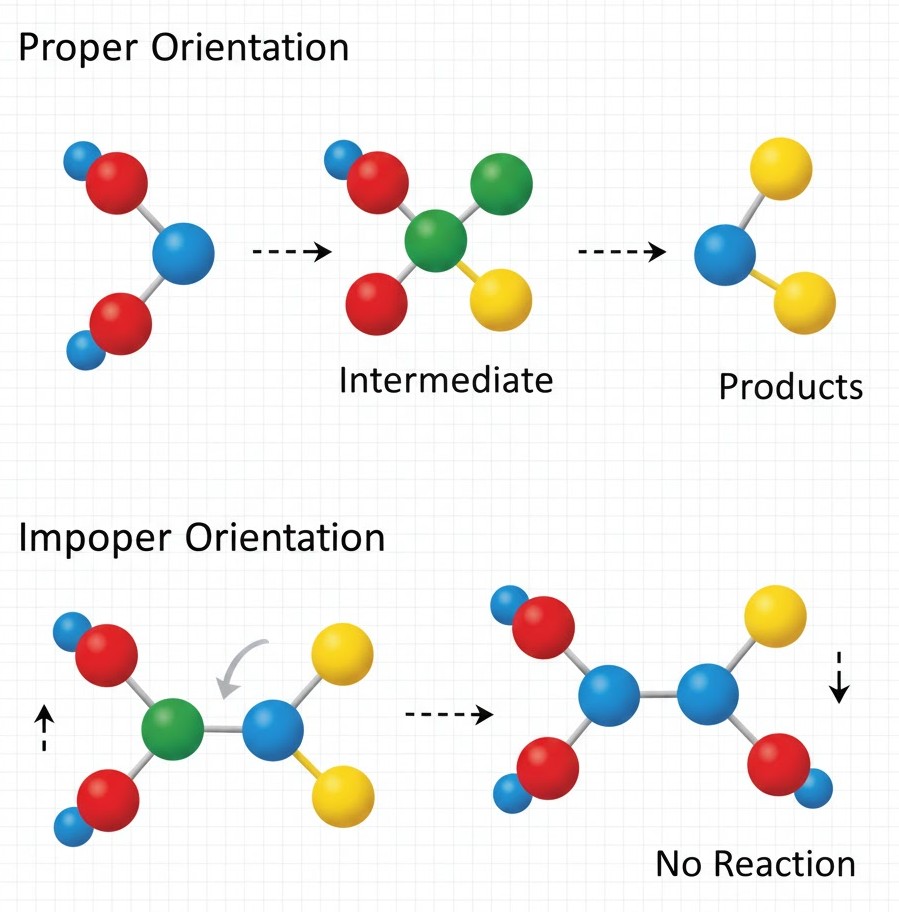
But here’s the catch: just like bumping into someone on a train doesn't mean you've made a new friend, not every molecular "hit" leads to a reaction. For a collision to be effective, the molecules need to have enough energy (threshold energy) and hit each other with the proper orientation. If they hit the wrong way, they just bounce back like a dropped catch in a gully cricket match!
Figure below:
A clear diagram showing two molecules colliding with 'Proper Orientation' leading to an intermediate and then products, and another set of molecules with 'Improper Orientation' simply bouncing apart without reacting.
NEET Checkpoint:
Does Collision Theory account for the complex shapes of molecules?
(a) Yes, completely
(b) No, it assumes molecules are hard spheres
(c) Only for diatomic molecules
(d) Only at high temperatures
✅ Answer: (b) No — It assumes reactant molecules are "hard spheres" and ignores their structural details.
Practice Question:
If the temperature of a reaction is increased, the collision frequency ($Z$):
(a) Decreases
(b) Increases
(c) Remains constant
(d) Becomes zero
✅ Answer: (b) — As molecules move faster with more heat, they hit each other more often, increasing $Z$.
NEET Checkpoint:
What is the "probability factor" used to account for proper orientation?
(a) Activation energy
(b) Steric factor (p)
(c) Collision frequency (Z)
(d) Rate constant (k)
✅ Answer: (b) Steric factor ($P$) — It's multiplied by $Z$ to show that only some hits are oriented correctly.
Key Takeaway
- Collision Frequency ($Z$): Number of collisions per second per unit volume.
- Effective Collisions: Hits that have both sufficient energy and correct orientation.
- Modified Rate Law: $Rate = P Z_{AB} e^{-E_a/RT}$.
8. Molecularity of Elementary Reactions
Listen up, junior! Let’s clear up a major funda in chemical kinetics. While the "order" of a reaction is an experimental mystery, molecularity is much more straightforward. It is simply the number of reacting species (atoms, ions, or molecules) that must collide simultaneously in an elementary step to make a reaction happen.
Think of it like this:
* Unimolecular: A single molecule decides to break apart on its own, like the decomposition of ammonium nitrite:
* Bimolecular: Two species crash into each other, like the dissociation of hydrogen iodide:
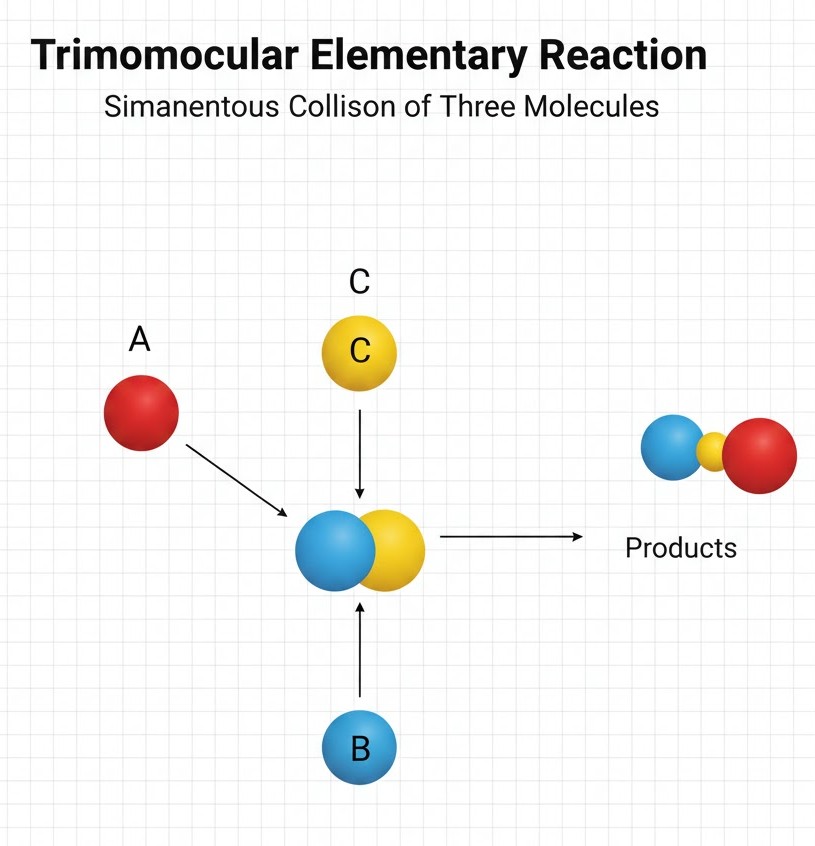
* Trimolecular: Three species collide at once, which is like a triple-car pileup—rare and slow! An example is:
NEET Checkpoint:
Can the molecularity of a reaction be $0$?
(a) Yes
(b) No
✅ Answer: (b) No — You need at least one molecule to have a collision; a reaction with zero molecules is just an empty flask, yaar!.
Here’s the catch: the probability of more than three molecules hitting each other at the exact same microsecond is super low. That’s why molecularity above three is extremely rare. If you see a reaction with ten molecules in the equation, it’s definitely a complex reaction happening in multiple steps, and molecularity for the whole thing has no meaning.
NEET Checkpoint:
What is the molecularity of a complex reaction?
(a) Sum of all coefficients
(b) Same as order
(c) It has no meaning
(d) Always 1
✅ Answer: (c) It has no meaning — Molecularity is only defined for elementary (single-step) reactions.
Relatable Indian Example:
Imagine a crowded Pani Puri stall in Mumbai. A unimolecular reaction is you eating a puri alone (simple!). A bimolecular reaction is you and your friend reaching for the last puri at the same time. But a deca-molecular reaction? That's ten people trying to grab one puri simultaneously without bumping into anyone else—impossible, right? Even molecules need personal space!
NEET Checkpoint:
Unlike reaction order, molecularity can be:
(a) A fraction
(b) Zero
(c) Only a whole number
(d) Negative
✅ Answer: (c) Only a whole number — You can't have half a molecule colliding!.
Figure below:
A clear diagram showing three spheres labeled A, B, and C colliding at a single central point to represent a trimolecular elementary reaction.
Practice Questions:
1. The reaction $2HI \rightarrow H_2 + I_2$ is an example of:
(a) Unimolecular
(b) Bimolecular
(c) Trimolecular
(d) Zero-molecular
✅ Answer: (b) Since two molecules of $HI$ are colliding.
2. Why is the molecularity of a reaction never a fraction?
(a) It’s an experimental value
(b) It depends on pressure
(c) Molecules react as whole units during collisions
(d) It’s always equal to order
✅ Answer: (c) Molecularity represents the number of actual species colliding in an elementary step, and you can't have a fraction of a molecule colliding.
Key Takeaway
- Molecularity: Number of species colliding in an elementary step.
- Values: Always a whole number ($1, 2,$ or $3$). Never zero or a fraction.
- Limitation: Molecularity $> 3$ is very rare due to low collision probability.
9. Kinetics of Complex Reactions
Listen up, junior! Most chemical reactions aren't simple one-shot deals. Elementary reactions are like hitting a straight six—they occur in just one single step. But most reactions are complex reactions, which are basically a full movie plot involving a sequence of elementary steps called a mechanism. Don't let the word "complex" give you tension; it's just a series of simple steps!
Imagine a busy Pani Puri stall during the evening rush. One person fries the puris, another cracks them open, and a third fills the spicy water. If the person cracking the puris is super slow, the whole line stops moving, right? In chemistry, the overall rate of a complex reaction is controlled by the slowest step, famously known as the rate-determining step.
NEET Checkpoint:
In a complex reaction, which step determines the speed?
(a) The fastest step
(b) Any step chosen at random
(c) The last step
(d) The slowest step
✅ Answer: (d) The slowest step — Just like a relay race depends on the slowest runner to reach the finish line.
During these steps, we meet intermediates. These are species formed in one step and consumed in another; they are the "behind-the-scenes" actors that don't appear in the final balanced equation. For example, in the decomposition of $2H_{2}O_{2}$ in an alkaline medium with $I^{-}$ catalyst, the species $IO^{-}$ is an intermediate.
NEET Checkpoint:
Is molecularity relevant for complex reactions?
(a) No, it applies only to elementary reactions
(b) Yes, for the overall reaction
(c) Only at high temperature
(d) Only for gaseous reactions
✅ Answer: (a) No — Molecularity is only for elementary steps; for complex reactions, it has no meaning.
NEET Checkpoint:
Can the order of a complex reaction be a fraction?
(a) No, it’s always a whole number
(b) Only at high temperature
(c) Yes, it can be a fraction or even zero
(d) Only for elementary reactions
✅ Answer: (c) Yes — Order is an experimental quantity and can be zero or a fraction, unlike molecularity.
Practice Question:
For a complex reaction, the order is always:
(a) Equal to molecularity
(b) Given by the slowest step
(c) Sum of all coefficients
(d) Zero
✅ Answer: (b) — The slowest step is the "bottleneck" that dictates the overall rate law.
Key Takeaway
- Elementary: One step only.
- Complex: Multiple steps (mechanism).
- RDS: The slowest step controls the rate.
- Intermediates: Formed and consumed during the reaction; absent in final equation.
10. Zero-Order Integrated Rate Laws: The "Constant Speed" Squad
Ever seen a reaction that just doesn't care how much "stuff" you give it?. That’s our Zero-Order reaction, where the rate is totally independent of the reactant's concentration. Whether you have a whole bucket of reactant or just a tiny spoonful, the rate stays exactly equal to the rate constant ($k$) because the concentration term is raised to the power of zero ($[R]^0 = 1$).
Let's clear this funda with a relatable scenario: Imagine a busy Pani Puri stall. No matter if there are 2 or 20 hungry students waiting, the bhaiya can only prepare puris at one constant speed. That’s zero-order for you—the "serving rate" is independent of the "concentration" of students!.
Mathematically, we write the differential rate equation as:
By integrating this, we get the integrated rate law, which is your best friend for numericals:
NEET Checkpoint:
For a zero-order reaction, what are the units of the rate constant $k$?
(a) $s^{-1}$
(b) $mol \ L^{-1} \ s^{-1}$
(c) $mol^{-1} \ L \ s^{-1}$
(d) $atm^{-1} \ s^{-1}$
✅ Answer: (b) $mol \ L^{-1} \ s^{-1}$ — Since $Rate = k$, the units of $k$ must be the same as the rate of reaction!.
If you plot the concentration $[R]$ against time $t$, you get a beautiful straight line. Notice this: the slope of this line is $-k$, and the y-intercept is the initial concentration $[R]_0$.
NEET Checkpoint:
Which of the following is a classic example of a zero-order reaction?
(a) Decomposition of hydrogen peroxide in the presence of a platinum catalyst
(b) Formation of NO₂ from N₂O₅
(c) Hydrolysis of sucrose
(d) Combustion of methane
✅ Answer: (a) Decomposition of gaseous ammonia ($NH_3$) on a hot platinum (Pt) surface at high pressure.
Figure below:
A clear line graph showing "Concentration of Reactant R" on the y-axis and "Time (t)" on the x-axis. A straight line slopes downwards, with the slope labeled as $-k$ and the y-intercept labeled as initial concentration $[R]_0$..

NEET Checkpoint:
How does the half-life ($t_{1/2}$) of a zero-order reaction relate to $[R]_0$?
(a) t₁/₂ is independent of [R]₀
(b) t₁/₂ ∝ 1/[R]₀
(c) t₁/₂ ∝ [R]₀
(d) t₁/₂ ∝ [R]₀²
✅ Answer: (c) t₁/₂ ∝ [R]₀ - or a zero-order reaction: ($t_{1/2} = \frac{[R]_0}{2k}$). The half-life is directly proportional to the initial concentration [R]₀
Practice Questions:
In the decomposition of $NH_3$ on a Pt surface, why does the reaction become zero-order at high pressure?
(a) The metal surface gets saturated with gas molecules.
(b) The temperature decreases.
(c) The activation energy increases.
(d) Ammonia becomes a liquid.
✅ Answer: (a) — At high pressure, the surface is fully covered, so adding more gas doesn't change the amount reacting on the catalyst.
Key Takeaway
Formula Summary
- Integrated Rate Law: $[R] = -kt + [R]_0$
- Rate Constant: $k = \frac{[R]_0 - [R]}{t}$
- Half-life: $t_{1/2} = \frac{[R]_0}{2k}$
11. First-Order Integrated Rate Laws
Hello there, junior! Ready to master First-Order Integrated Rate Laws? Don't stress, yaar—it’s easier than it looks! In these reactions, the rate depends on the first power of the reactant concentration. Imagine a local bus emptying out at the last stop; the fewer people left inside, the slower they exit. That’s the first-order vibe!
Mathematically, we write the rate as:
When we integrate this, we get a formula that lets us calculate concentrations at any time $t$:
Or, if you prefer the more "exam-friendly" common logarithm (base 10):
NEET Checkpoint:
What are the units for a first-order rate constant $k$?
(a) mol L⁻¹ s⁻¹
(b) mol² L⁻² s⁻¹
(c) L mol⁻¹ s⁻¹
(d) s⁻¹
✅ Answer: (d) $s^{-1}$ or $time^{-1}$ — Arre, remember the concentration terms cancel out in the rate law!
Here’s a cool trick: if you plot $\ln[R]$ against time $t$, you get a straight line with a slope of $-k$ and an intercept of $\ln[R]_0$. If you plot $\log \frac{[R]_0}{[R]}$ against $t$, the slope becomes $\frac{k}{2.303}$.
Relatable Example:
Think of your mobile data pack. If the speed at which you consumed data depended exactly on how many GBs you had left—fast at the start of the month and crawling by the end—that would be first-order kinetics!
Figure below:
A clear linear graph showing a straight line with a negative slope. The y-axis is labeled ln R and the x-axis is labeled Time (t). The y-intercept is marked as ln R₀ and the slope is indicated as -k.
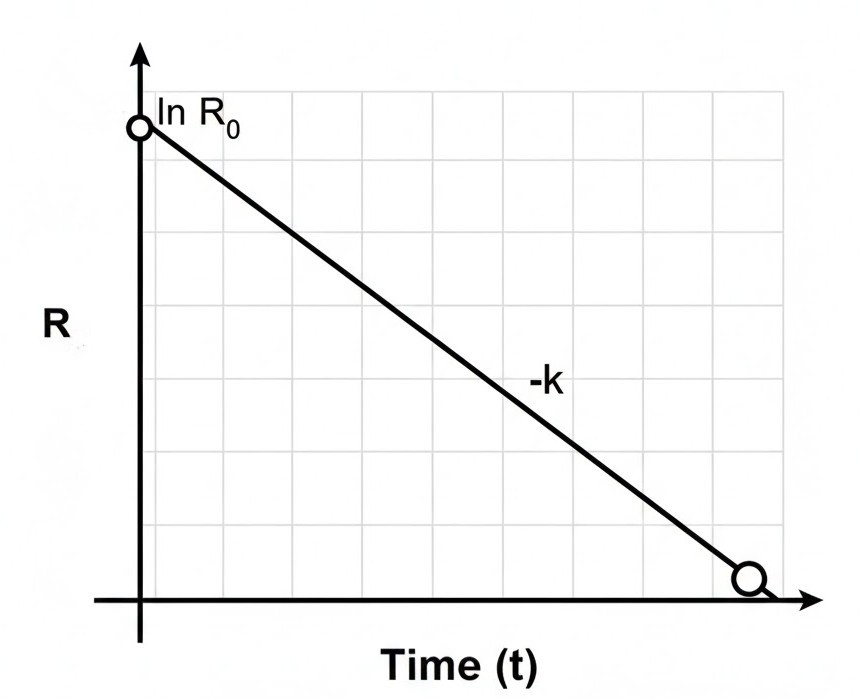
First-order reactions are everywhere! Examples include the hydrogenation of ethene, gas-phase decompositions like $N_2O_5$, and all natural radioactive decay (like Radium-226 decaying into Radon).
NEET Checkpoint:
Which of these is a first-order reaction?
(a) $2NH_3$ on Pt
(b) Hydrogenation of ethene
✅ Answer: (b) — Decomposition of ammonia on Pt is actually zero-order at high pressure!
For gas-phase reactions like $A(g) \rightarrow B(g) + C(g)$, we use partial pressures:
NEET Checkpoint:
The half-life ($t_{1/2}$) of a first-order reaction depends on the initial concentration.
(a) True
(b) False
✅ Answer: False — It's constant! $t_{1/2} = \frac{0.693}{k}$.
Practice Question:
In a first-order reaction, if the concentration of the reactant is reduced to half, the rate constant $k$ will:
(a) Double
(b) Halve
(c) Remain the same
(d) Triple
✅ Answer: (c) — Suno! The rate constant $k$ is specific to the reaction and temperature; it doesn't change with concentration!
Key Takeaway
Formula Summary
- Integrated Law: $k = \frac{2.303}{t} \log \frac{[R]_0}{[R]}$
- Exponential Form: $[R] = [R]_0 e^{-kt}$
- Graph Slope: $\ln[R]$ vs $t$ slope is $-k$.
12. Characteristics and Half-Lives
Listen up, future doctors! Half-life, denoted as $t_{1/2}$, is simply the time it takes for a reactant's concentration to drop to exactly half of its initial value. Think of it like a cricket match where you want to know how long it takes for half the wickets to fall. Every reaction order has its own unique "personality" when it comes to this timing!
For a zero-order reaction, the half-life is given by the formula:
Notice that $t{1/2}${1/2}$ is directly proportional to the initial concentration $[R]_0$. It’s like a pani puri stall where the owner serves at a constant speed regardless of the crowd; if the queue ($[R]_0$) is twice as long, it will take twice as much time to clear half of it!.
NEET Checkpoint:
Is the half-life of a zero-order reaction constant?
(a) Yes, always
(b) No, it depends on the initial concentration
(c) Only at high temperature
(d) Only for gaseous reactions
✅ Answer:(b) No — it depends on the initial concentration $[R]_0$.
Now, first-order reactions are the real VIPs of NEET. Their half-life formula is:
Here’s the trick: there is no $[R]_0$ in this equation!. This means the half-life is independent of how much you started with. Whether you have 100g or 1g of a radioactive substance, it will take the exact same time to reduce by half.
NEET Checkpoint:
If the rate constant $k$ of a first-order reaction is $5.5 \times 10^{-14} s^{-1}$, what is its $t_{1/2}$?
(a) 1.26 × 10¹³ s
(b) 1.26 × 10⁻¹³ s
(c) 1.26 × 10¹¹ s
(d) 1.26 × 10¹⁵ s
✅ Answer: (a) $1.26 \times 10^{13} s$ — Just use $t_{1/2} = 0.693 / k$.
Sometimes, a reaction "pretends" to be first-order. These are pseudo-first-order reactions. This happens when one reactant, like water in the hydrolysis of ethyl acetate, is in such a massive excess that its concentration hardly changes during the reaction. It’s like adding a teaspoon of water to the Indian Ocean—the ocean level stays the same, yaar!.
NEET Checkpoint:
Mention an example of a pseudo-first-order reaction.
(a) Decomposition of H₂O₂ on platinum
(b) Hydrolysis of an ester in excess water
(c) Combustion of methane
(d) Formation of NO₂ from N₂O₅
✅ Answer: (b) Inversion of cane sugar or hydrolysis of ethyl acetate.
Practice Questions:
1. For a first-order reaction, if the initial concentration is doubled, what happens to the half-life?
(a) Doubles
(b) Halves
(c) Remains unchanged
(d) Triples
✅ Answer: (c) — The $t_{1/2}$ of a first-order reaction is independent of initial concentration.
2. In the hydrolysis of ethyl acetate, the reaction behaves as first-order because:
(a) It is an elementary reaction
(b) Water is in large excess
(c) It is a zero-order reaction
(d) The catalyst is very strong
✅ Answer: (b) — Large excess of one reactant makes it pseudo-first-order.
Key Takeaway
Formula Summary
- Zero-Order Half-life: $t_{1/2} = \frac{[R]_0}{2k}$ (Depends on $[R]_0$)
- First-Order Half-life: $t_{1/2} = \frac{0.693}{k}$ (Independent of $[R]_0$)
- Pseudo-First-Order: Rate depends on only one reactant concentration as the other is in excess.
13. Temperature Dependence & Arrhenius Theory
Let's turn up the heat! Ever wondered why your chai brews faster or why food spoils so quickly in a hot Indian summer? Most chemical reactions get a massive boost when the temperature rises. In fact, for most reactions, the rate constant $k$ nearly doubles for every $10^{\circ}$ rise in temperature. Even your chemistry marks need some activation energy to jump, yaar!
The Swedish chemist Arrhenius gave us the ultimate formula to explain this:
Here, $A$ is the Arrhenius factor (or frequency factor), and $E_a$ is the activation energy—the "minimum energy ticket" molecules need to react. Think of it like a local train station; only those with the right energy ($E_a$) can push through the crowd to reach the platform (products)!
NEET Checkpoint:
If the temperature of a reaction increases from $298\text{ K}$ to $308\text{ K}$, what typically happens to the rate constant?
(a) It decreases
(b) It nearly doubles
(c) It remains the same
(d) It becomes zero
✅ Answer: (b) It nearly doubles — This is the standard observation for a $10^{\circ}$ rise.
When we take the natural log of the equation, it becomes a straight-line party:
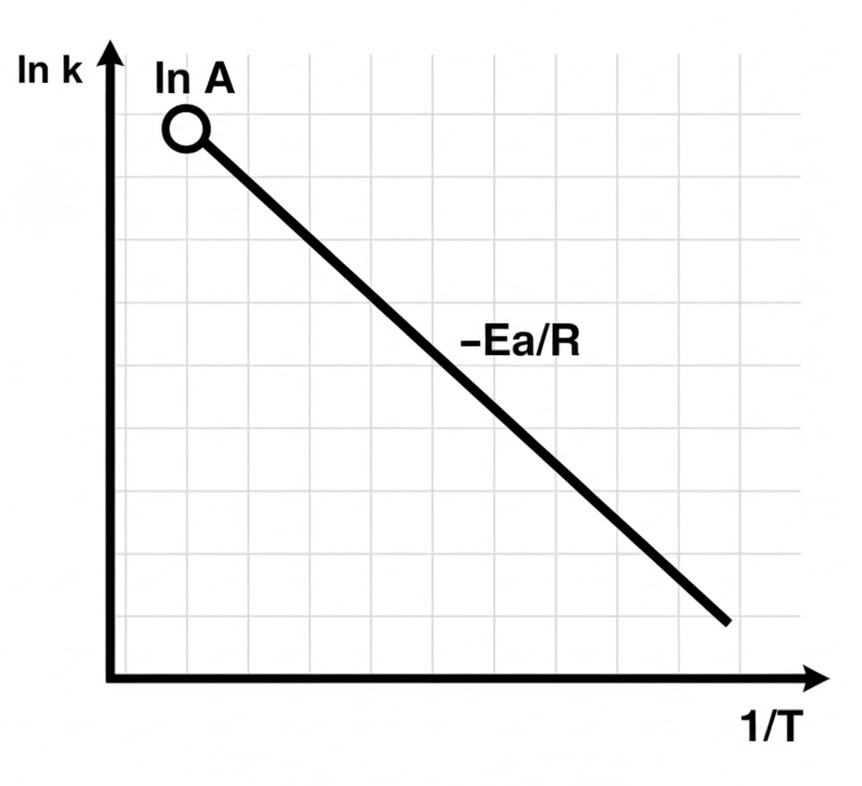
If you plot $\ln k$ against $1/T$, you get a straight line with a slope of $-E_a/R$ and an intercept of $\ln A$. This is a goldmine for NEET numericals!
NEET Checkpoint:
What does the factor $e^{-E_a/RT}$ represent in the Arrhenius equation?
(a) Collision frequency
(b) Rate constant
(c) Fraction of molecules with energy ≥ activation energy
(d) Activation energy itself
✅ Answer: (c) The fraction of molecules with kinetic energy equal to or greater than $E_a$.
Figure below:
A linear graph showing a plot of $\ln k$ on the y-axis against $1/T$ on the x-axis, with a negative slope labeled as $-E_a/R$ and a y-intercept labeled as $\ln A$.
Practice Questions:
1. In the Arrhenius plot of $\ln k$ vs $1/T$, what is the value of the slope?
(a) $E_a/R$
(b) $-E_a/R$
(c) $\ln A$
(d) $R/E_a$
✅ Answer: (b) — According to equation 3.19, the slope of the linear plot is $-E_a/R$.
2. For a reaction where $E_a$ is $209\text{ kJ/mol}$, if you use the formula $\log \frac{k_2}{k_1} = \frac{E_a}{2.303R} \left[ \frac{T_2 - T_1}{T_1 T_2} \right]$, what are you calculating?
(a) Rate of disappearance
(b) Temperature coefficient
(c) The ratio of rate constants at two temperatures
(d) Total pressure
✅ Answer: (c) — This integrated form allows us to find how $k$ changes between $T_1$ and $T_2$.
NEET Checkpoint:
Does increasing the temperature increase the activation energy?
(a) Yes, activation energy increases
(b) No, activation energy remains constant
(c) Yes, but only for endothermic reactions
(d) Activation energy decreases with temperature
✅ Answer: (b) No — Increasing temperature increases the fraction of molecules that possess enough energy to cross the $E_a$ barrier.
Key Takeaway
Formula Summary
- Arrhenius Equation: $k = A e^{-E_a/RT}$
- Linear Form: $\ln k = -\frac{E_a}{RT} + \ln A$
- Two-Temp Equation: $\log \frac{k_2}{k_1} = \frac{E_a}{2.303R} \left[ \frac{T_2 - T_1}{T_1 T_2} \right]$
- Slope of $\ln k$ vs $1/T$: $-E_a/R$
14. Activation Energy & Catalysis
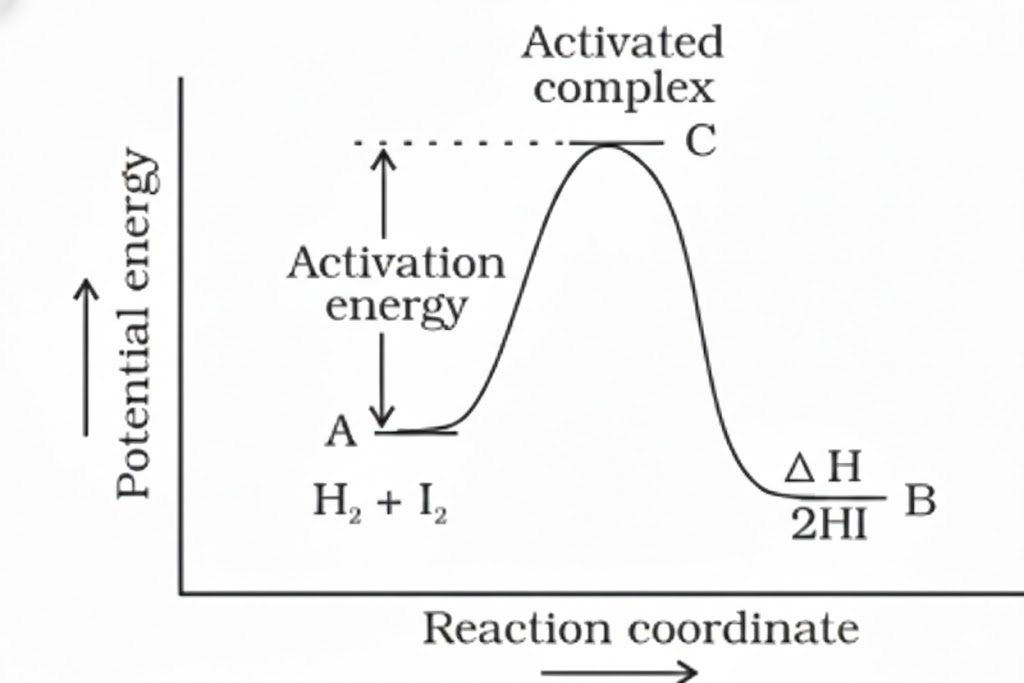
Ever wondered why some reactions are as slow as a rickshaw in a Bangalore traffic jam? It’s all about the energy barrier, yaaro! According to the Arrhenius theory, for a reaction to happen, molecules must collide to form an unstable intermediate called an activated complex. The "toll tax" they must pay to reach this state is the Activation Energy ($E_{a}$). Only those high-energy molecules with kinetic energy equal to or greater than $E_{a}$ can actually react.
NEET Checkpoint:
What is the unstable intermediate formed during a collision called?
(a) Reactant complex
(b) Activated complex
(c) Catalyst
(d) Product
✅ Answer: (b) Activated complex — It's that fleeting, high-energy "handshake" before products are born.
Think of it like hitting a six in cricket. If your swing doesn't have the minimum "oomph" (kinetic energy), the ball won't clear the boundary rope ($E_{a}$). Now, enter the Catalyst—the ultimate "life hack" for chemicals! A catalyst provides an alternate pathway by lowering the potential energy barrier. It’s like finding a secret gully that bypasses the main road traffic!
NEET Checkpoint:
Does a catalyst change the equilibrium constant ($K$)?
(a) Yes, it increases K
(b) Yes, it decreases K
(c) No, it does not change K
(d) Only at high temperature
✅ Answer: (c) No — It only helps you reach equilibrium faster, not change where it sits.
Crucially, a catalyst is a bit of a "professional." It speeds things up without being permanently changed itself. It does not alter the Gibbs energy ($\Delta G$) of the reaction. It simply increases the rate constant ($k$) by making it easier for more molecules to participate.
NEET Checkpoint:
Only molecules with energy $\geq$ what value can react?
(a) Rate constant (k)
(b) Activation energy ($E_{a}$)
(c) Collision frequency (Z)
(d) Thermal energy (RT)
✅ Answer: (b) Activation Energy ($E_{a}$) — No ticket, no entry to the product party!
Figure below:
A clear potential energy vs. reaction coordinate diagram showing two curves: one high peak for the "uncatalysed" path and a lower peak for the "catalysed" path, with the difference in peak heights clearly marked as the reduction in $E_{a}$.
Practice Question:
A catalyst increases the rate of a reaction by:
(a) Increasing $\Delta G$
(b) Decreasing $E_{a}$
(c) Changing the equilibrium constant
(d) Decreasing the temperature
✅ Answer: (b) — It lowers the energy hurdle so more molecules can jump over!
Key Takeaway
- Activation Energy ($E_{a}$): The minimum energy required to form the activated complex.
- Catalyst: Lowers $E_{a}$ via an alternate path but ignores $\Delta G$ and $K$.
- Arrhenius Equation:
$$k = A e^{-E_{a}/RT}$$.
15. Collision Theory of Bimolecular Gaseous Reactions
Hey there, future doctor! Ever wondered how molecules actually decide to react? It’s not just about meeting up; it’s about the vibe and the impact. According to Max Trautz and William Lewis, reactant molecules are like hard spheres. For a reaction to happen, they must collide. But here’s the catch: not every "hello" leads to a product!
The number of collisions happening per second per unit volume is the collision frequency, denoted by $Z$. If we look at a bimolecular reaction $A + B \rightarrow \text{Products}$, the initial rate equation is:
where $Z_{AB}$ is the collision frequency and $e^{-E_{a}/RT}$ is the fraction of molecules with energy $\ge E_{a}$.
NEET Checkpoint:
What is collision frequency ($Z$)?
(a) Fraction of molecules with energy ≥ ($E_{a}$)
(b) Rate constant of a reaction
(c) Number of collisions per unit time between reactant molecules
(d) Activation energy
✅ Answer: (c) The number of collisions per second per unit volume of the reaction mixture. Simple funda, don't forget it!
Now, why don't all collisions work? Because you need Effective Collisions. Think of it like Cricket: to hit a six, you don't just need to swing the bat hard (that's your threshold energy); you also need to middle the ball with the right face of the bat (that's proper orientation). If the orientation is wrong, the molecules just bounce back like a badly timed shot.
To fix this, we add the steric factor or probability factor, $P$.
NEET Checkpoint:
Which two criteria determine an effective collision?
(a) High concentration and low temperature
(b) Sufficient energy and proper orientation
(c) Large molecules and high pressure
(d) Rate constant and activation energy
✅ Answer: (b) Sufficient kinetic energy (threshold energy) and proper orientation.
Our final, modified rate equation becomes:
NEET Checkpoint:
What does the factor $P$ account for?
(a) Activation energy
(b) Collision frequency
(c) Proper orientation of molecules
(d) Rate constant
✅ Answer: (c) The orientation requirement of colliding molecules. Even molecules need to be in the right "position" to succeed!
Practice Questions:
1. According to collision theory, the rate of a reaction is determined by:
(a) Total number of collisions only
(b) Activation energy only
(c) Collision frequency, activation energy, and proper orientation
(d) Molecularity of the reaction
✅ Answer: (c) — Arre, remember the Cricket example! You need speed, energy, and the right angle.
2. The collision theory is based on which of the following?
(a) Thermodynamics
(b) Kinetic theory of gases
(c) Chemical equilibrium
(d) Total pressure only
✅ Answer: (b) — It assumes molecules are hard spheres moving around, which is straight from the kinetic theory of gases.
Key Takeaway
Formula Summary
* Collision Frequency ($Z$): Collisions / sec / volume.
* Effective Collision Criteria: Energy $\ge$ Threshold Energy + Proper Orientation.
* Modified Rate Equation:$$Rate = PZ_{AB}e^{-E_{a}/RT}$$