
1. Introduction and Foundations of Chemical Bonding
Hey future toppers! Let’s kick off the funda of Chemical Bonding with the biggest question: Why do atoms even bother sticking together? Simple: They’re trying to achieve stability, yaar! A chemical bond is defined as the attractive force that holds constituent atoms or ions together in a chemical species. Bonding always occurs because every system tends to be more stable by lowering its energy. If the energy doesn't go down, the bond doesn't happen—it’s that simple!
Think of it like two students cramming for NEET (high energy, unstable). When they decide to form a dedicated study partnership (a bond), they reduce their stress and anxiety (lower energy), making the system more stable.
To explain this basic behaviour, scientists put forward four major theories over time:
- Kössel-Lewis approach: The old-school rule focused on achieving a stable octet or duplet.
- Valence Shell Electron Pair Repulsion (VSEPR) Theory: The geometry expert that predicts shapes based on electron pair repulsion.
- Valence Bond (VB) Theory: Explains bond formation via the concept of orbital overlap and hybridisation.
- Molecular Orbital (MO) Theory: The advanced view that treats the whole molecule as having new orbitals.
We’ll learn how these theories explain everything from the formation of ionic bonds (by electron transfer) and covalent bonds (by electron sharing), right up to complex ideas like Resonance and Dipole Moment.
NEET Checkpoint:
What is the primary driving force for chemical bond formation?
(a) Maximizing repulsion
(b) Lowering the system's energy
(c) Increasing atomic size
✅ Answer: (b) Lowering the system's energy — Stability is attained by reducing energy.
We also need to master the quantifiable aspects of bonds, known as physical parameters: bond length, bond enthalpy, and bond order. For instance, a larger bond enthalpy means a stronger bond. We'll even look at special interactions, like the weak but mighty Hydrogen bonding.
NEET Checkpoint:
Which type of bond is formed due to the electrostatic attraction between positive and negative ions?
(a) Covalent bond
(b) Electrovalent (ionic) bond
(c) Metallic bond
✅ Answer: (b) Electrovalent (ionic) bond — Kössel's approach defined this bond type resulting from electrostatic attraction between ions.
NEET Checkpoint:
What principle dictates that atoms aim for eight electrons in their valence shell?
(a) Aufbau Principle
(b) Octet Rule
(c) Pauli Exclusion Principle
(d) Hund’s Rule
✅ Answer: (b) The Octet Rule — This forms the basis of the electronic theory of chemical bonding developed by Kössel and Lewis.
Practice Question:
The term used to describe the total number of shared electron pairs between two atoms in a Lewis structure is:
(a) Formal Charge
(b) Bond Angle
(c) Bond Order
(d) Covalent Radius
✅ Answer: (c) Bond Order — In the Lewis description, Bond Order is the number of bonds (shared electron pairs) between the atoms.
Key Takeaway
Chemical bonding is driven by the universal tendency of systems to achieve stability by lowering their energy. The fundamental theories—Kössel-Lewis, VSEPR, VB, and MO—help us understand bond types, molecular shapes, and key parameters like bond order and bond enthalpy.
2. Kössel-Lewis Approach and the Octet Rule
Hey future docs! Let's kick off Unit 4 with the fundamental idea that started it all: the Kössel-Lewis approach to chemical bonding. This breakthrough, developed independently in $1916$, gave us a logical explanation for valence based fundamentally on the inertness of noble gases. Think of it like this: every atom is desperately trying to be as chill and stable as Neon or Argon!
G.N. Lewis pictured the atom having a positively charged 'Kernel' (which is the nucleus plus all the inner, protected electrons). This Kernel is surrounded by an outer shell that can accommodate a maximum of eight electrons. Notice this simplicity: only the outer shell electrons, known as valence electrons, participate in chemical combination. Lewis introduced Lewis symbols—simple notations using dots to represent these crucial valence electrons. These symbols are super helpful because they instantly show you the number of valence electrons, which lets you calculate the group valence (either the number of dots or $8$ minus the number of dots).
NEET Checkpoint:
The Lewis concept pictures the atom in terms of a positively charged:
(a) Valence shell
(b) Electron cloud
(c) Kernel
(d) Octet
✅ Answer: (c) Kernel — Lewis defined the 'Kernel' as the nucleus plus the inner electrons.
Meanwhile, Kössel focused on the high-intensity drama of ionic bond formation. He drew attention to the fact that highly electropositive alkali metals and highly electronegative halogens achieve stability by readily losing or gaining electrons. The goal? To attain stable noble gas electronic configurations. This means achieving an octet of electrons (eight), or a duplet in the case of light elements like Helium. The resulting positive and negative ions are then held together by powerful electrostatic attraction.
Imagine you are calculating the run rate for a final over in cricket (the atom). You only care about the runs needed in that last over (valence electrons). The runs scored in the previous $49$ overs (Kernel electrons) are important for the total, but they are 'safe' and won't change during this final calculation—just like the Kernel is protected and generally not involved in bonding.
This drive for stability culminated in the Octet Rule. This rule states clearly that atoms combine either by transferring valence electrons (Kössel's ionic method) or sharing valence electrons (Lewis's covalent method) to ensure they achieve eight electrons in their valence shell.
NEET Checkpoint:
The Octet Rule is based on atoms combining to achieve eight electrons in their valence shell through:
(a) Hybridisation only
(b) Transferring or sharing valence electrons
(c) Resonance stabilization only
(d) Magnetic properties.
✅ Answer: (b) Transferring or sharing valence electrons — This is the core definition of the Octet Rule, covering both ionic and covalent routes to the stable eight-electron configuration.
Practice Question:
According to Kössel’s approach, what type of force stabilizes the resulting positive and negative ions?
(a) Dipole moment force
(b) Covalent force
(c) London dispersion force
(d) Electrostatic attraction
✅ Answer: (d) Electrostatic attraction — The stabilization of ionic species comes from the electrostatic force between the oppositely charged ions.
NEET Checkpoint:
Lewis symbols represent:
(a) The Kernel charge
(b) The total number of electrons
(c) The valence electrons
(d) The mass number.
✅ Answer: (c) The valence electrons — Lewis used dots specifically to represent the outer shell electrons involved in combination.
Key Takeaway
The Kössel-Lewis approach provided the foundational concept that chemical bonds form so that atoms can achieve the highly stable octet (or duplet) configuration, either by transferring electrons (Kössel, ionic) or sharing electrons (Lewis, covalent).
3. Ionic Bonding, Formation Factors, and Lattice Enthalpy Calculation
Yo, future doctors! Let's clear up the funda of how ions get cozy and form solids. Don't stress, yaar—it’s easier than it looks!
The Ionic Bond, also known as the Electrovalent Bond, forms due to the mighty electrostatic attraction between positive and negative ions created when electrons are completely transferred. For this bond formation to be easy-peasy, nature needs a specific combination of elements.
For the element that forms the cation (M): It should have a comparatively low Ionization Enthalpy ($\Delta_{i}H$). This is the energy required to remove an electron, and ionization is always endothermic. For the element that forms the anion (X): It needs a comparatively high negative value of Electron Gain Enthalpy ($\Delta_{eg}H$). This high negative value means the atom releases a lot of energy when it grabs an electron.
NEET Checkpoint:
For the spontaneous formation of $\text{M}^{+}(g)$ and $\text{X}^{-}(g)$ ions, the metal atom must have:
(a) High $\Delta_{i}H$
(b) Low $\Delta_{i}H$
(c) High positive $\Delta_{eg}H$
(d) Zero $\Delta_{eg}H$.
✅ Answer: (b) Low $\Delta_{i}H$ — A low Ionization Enthalpy means the cation ($\text{M}^{+}$) forms easily.
Relatable Example: Think of two cricket players. One is a lazy fielder (Low $\Delta_{i}H$): he throws the ball (electron) away instantly! The other is a super aggressive batsman (High negative $\Delta_{eg}H$): he catches that ball (electron) with maximum zeal! Together, they form a perfect ionic team.
Wait, here's the trick: sometimes, the energy required to form the ions ($\Delta_{i}H + \Delta_{eg}H$) might be positive! For $\text{NaCl}$, this sum is $+147.1 \text{ kJ mol}^{-1}$. So, how does $\text{NaCl}$ stabilize? The real magic happens when the ions arrange themselves into an orderly three-dimensional arrangement called the crystal lattice. The stability of the ionic solid is primarily provided by the huge amount of energy released during this lattice formation.
Lattice Enthalpy ($\Delta_{L}H$) is defined as the energy required to completely separate one mole of a solid ionic compound into its gaseous constituent ions. For instance, if you want to break $\text{NaCl}(s)$ into $1$ mole of $\text{Na}^{+}(g)$ and $1$ mole of $\text{Cl}^{-}(g)$, you need $788 \text{ kJ mol}^{-1}$ of energy.
NEET Checkpoint:
The stability of an ionic solid like $\text{NaCl}$ depends least on which factor?
(a) Ionization Enthalpy of $\text{Na}$
(b) Electron Gain Enthalpy of $\text{Cl}$
(c) Energy released in the formation of the crystal lattice
(d) The size of the nucleus.
✅ Answer: (c) Energy released in the formation of the crystal lattice. Wait, that's wrong! The stability is primarily provided by the energy released in the formation of the crystal lattice. Let's rephrase the question to test key concepts:
NEET Checkpoint:
Which process is defined by the energy required to separate $1$ mole of $\text{MX}(s)$ into $1$ mole of $\text{M}^{+}(g)$ and $1$ mole of $\text{X}^{-}(g)$?
(a) Electron Gain Enthalpy
(b) Ionization Enthalpy
(c) Lattice Enthalpy
(d) Bond Enthalpy.
✅ Answer: (c) Lattice Enthalpy ($\Delta_{L}H$).
Practice Question:
If the $\Delta_{i}H$ for $\text{Na}(g)$ is $495.8 \text{ kJ mol}^{-1}$ and $\Delta_{eg}H$ for $\text{Cl}(g)$ is $-348.7 \text{ kJ mol}^{-1}$, how is the $\text{NaCl}$ formation ($\text{Na}^{+}(g) + \text{Cl}^{-}(g) \rightarrow \text{NaCl}(s)$) stabilized?
(a) By the $\Delta_{i}H$ value.
(b) By the endothermic nature of lattice formation.
(c) By the highly exothermic $\Delta_{L}H$ ($-788 \text{ kJ mol}^{-1}$).
(d) By the overall positive energy required.
✅ Answer: (c) By the highly exothermic $\Delta_{L}H$ ($-788 \text{ kJ mol}^{-1}$). The energy released by the lattice formation compensates for the initial energy input.
Key Takeaway
| Concept | Favourable Condition | Definition |
|---|---|---|
| Ionic Bond | Low $\Delta_{i}H$ (Cation) and high negative $\Delta_{eg}H$ (Anion) | Electrostatic attraction between positive and negative ions |
| Lattice Enthalpy | Energy required to convert $1$ mole of solid to gaseous ions | Provides the primary stability to the ionic solid |
4. Covalent Bonding and Lewis Structure Representation
Hey future doctors! Let's tackle the funda of Covalent Bonding, where atoms choose collaboration over conflict, meaning they don't transfer electrons but prefer to share them, yaar. This concept, refined by Langmuir, focuses on atoms combining by sharing valence electrons in order to achieve the super-stable, nearest noble gas configuration (the famous octet) in their outermost shells. For example, Hydrogen, our tiny friend, aims for a duplet.
The basic rules are simple: A covalent bond is formed when atoms share an electron pair. Critically, each combining atom must contribute at least one electron to that shared pair.
Now, sharing comes in different flavours!
1. Single Bond: Atoms share just one electron pair. Think of the $Cl-Cl$ bond.
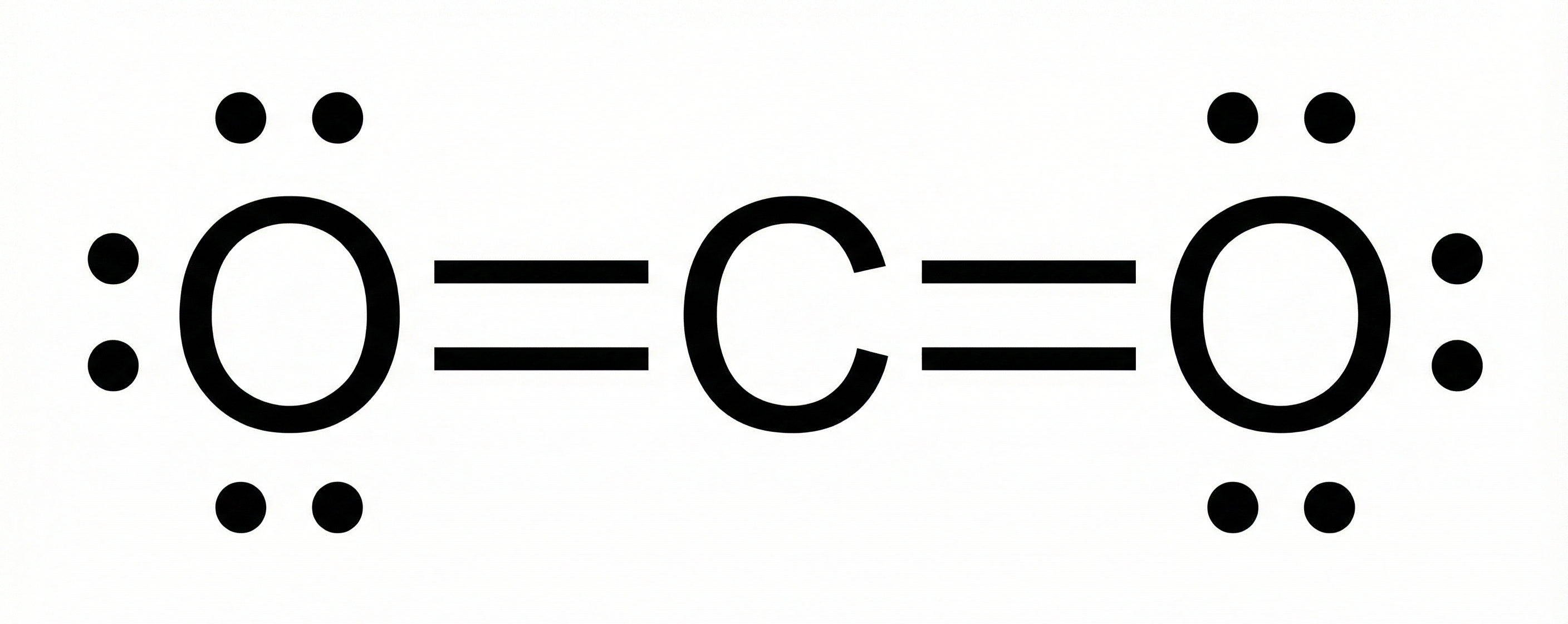
2. Double Bond: They share two pairs of electrons. Like in the $O=C=O$ molecule.
3. Triple Bond: When atoms go all out and share three pairs, you get a powerful triple bond, such as in the $N \equiv N$ molecule.
NEET Checkpoint:
A double bond involves sharing how many electrons in total between two atoms?
(a) 1
(b) 2
(c) 4
(d) 6
✅ Answer: (c) 4 — A double bond is defined as sharing two pairs of electrons, meaning four total electrons.
Drawing the Lewis Map
Lewis dot structures are your roadmap to visualize these bonds (shared pairs) and the unshared electrons (lone pairs) in molecules and ions.
Think of drawing a Lewis structure like balancing a cricket team's budget (total valence electrons). You must spend just enough to buy essential players (single bonds) first, and if you have extra cash (remaining electrons), you use it to hire consultants (lone pairs) or buy better equipment (multiple bonds) until the entire team is stable with an octet.
The Steps to Draw (The Funda to follow):
- Count the Electrons: Sum up the total valence electrons from all combining atoms. If you have an anion (negative charge, like $CO_3^{2-}$), add one electron for each negative charge. If it's a cation (positive charge, like $NH_4^{+}$), subtract one electron for each positive charge.
- Skeletal Structure: Place the least electronegative atom in the centre (like Carbon in $CO_3^{2-}$).
- Distribute and Octet Check: After forming single bonds, distribute the remaining electrons as lone pairs or use them to form multiple bonds to ensure every bonded atom achieves its noble gas configuration (usually 8e⁻).
NEET Checkpoint:
In the molecule $NF_3$, which atom generally occupies the central position?
(a) Fluorine
(b) Nitrogen
(c) Both can be central
(d) Cannot be determined
✅ Answer: (b) Nitrogen — The least electronegative atom generally occupies the central position in molecules/ions.
Figure below:
A clear diagram showing the Lewis dot structure of the $CO_2$ molecule with $O=C=O$, where each oxygen atom has two lone pairs (8e⁻ total) and the carbon atom has no lone pairs (8e⁻ total).
NEET Checkpoint:
Which species requires the subtraction of electrons when calculating the total valence electrons for its Lewis structure?
(a) $CO_3^{2-}$
(b) $H_2O$
(c) $NH_4^{+}$
(d) $Cl_2$
✅ Answer: (c) $NH_4^{+}$ — For cations (positive charge), you must subtract electrons from the total count of valence electrons.
Practice Question:
If an atom in a molecule shares three pairs of electrons, what is the bond order between those two atoms?
(a) 1
(b) 2
(c) 3
(d) 4
✅ Answer: (c) 3 — Sharing three electron pairs results in a triple bond, and the bond order is defined by the number of bonds, which is 3.
Key Takeaway
Covalent bonds rely on the sharing of electron pairs to ensure every combining atom attains a stable noble gas configuration (octet or duplet). The Lewis structure is vital for visualizing the distribution of these shared (bonding) and unshared (lone) electron pairs.
5. Formal Charge and Limitations of the Octet Rule
Hey future doctor! Let's tackle two vital concepts: Formal Charge (F.C.) and why the Octet Rule sometimes gives us the cold shoulder. This funda is super important for choosing the most stable Lewis structure, so pay close attention, yaar.
Formal Charge: Keeping Track of Electrons
Formal Charge doesn't represent the real charge separation in a molecule; think of it as a helpful bookkeeping tool to track valence electrons. It lets us figure out which possible Lewis structure for a given species has the lowest energy, because the structure with the smallest formal charges on the atoms is usually the most stable one.
The Formal Charge ($F.C.$) on any atom in a Lewis structure is calculated like this:
Notice this: The calculation assumes the atom "owns" all its lone pair electrons, but only half of the shared (bonding) electrons. For example, in the ozone molecule ($O_3$), the central $O$ atom (marked 1) has a formal charge of $+1$ ($6 - 2 - 1/2(6)$), while one end $O$ atom (marked 3) has $-1$ ($6 - 6 - 1/2(2)$).
NEET Checkpoint: Which structure typically represents the lowest energy state?
(a) The one with the highest overall charge.
(b) The one with the smallest formal charges on the atoms.
(c) The one with the most triple bonds.
✅ Answer: (b) The one with the smallest formal charges on the atoms — Smaller formal charges mean lower energy and higher stability for the molecule.
Why the Octet Rule Fails (The Limitations)
The Octet Rule is cool for many organic compounds and second-period elements, but it's far from universal. It has three main exceptions:
- Incomplete Octet: Sometimes, the central atom is happy with less than eight electrons. This typically happens with elements having fewer than four valence electrons, like in $LiCl$, $BeH_{2}$, $BCl_{3}$, $AlCl_{3}$, and $BF_{3}$.
- Odd-Electron Molecules: If a molecule has an odd total number of valence electrons, like Nitric Oxide ($NO$) or Nitrogen Dioxide ($NO_{2}$), it's mathematically impossible for all atoms to achieve an octet.
- Expanded Octet: Elements in or beyond the third period (hello, $3d$ orbitals!) can accommodate more than eight valence electrons. This is the expanded octet, seen in $PF_{5}$ (10 electrons around $P$), $SF_{6}$ (12 electrons around $S$), and $H_{2}SO_{4}$ (12 electrons around $S$).
Relatable Indian Example: Trying to balance your lunch budget (₹100) on a $pani$ $puri$ run is like Lewis structures. If you spend ₹120 (Expanded Octet), or if you only use ₹60 (Incomplete Octet), your financial "rule" is broken!
NEET Checkpoint:
$SF_{6}$ is an example of which type of octet exception?
(a) Incomplete Octet
(b) Odd-electron molecule
(c) Expanded Octet
✅ Answer: (c) Expanded Octet — Sulphur, being in the third period, uses its $d$-orbitals to hold 12 valence electrons.
The octet theory has other crucial drawbacks too:
* It fails to account for the actual shape of molecules.
* It doesn't explain the relative stability (energy) of molecules.
* It is contradicted by the existence of compounds formed by supposedly inert noble gases, like $XeF_{2}$ and $KrF_{2}$.
NEET Checkpoint:
Which feature of a molecule is not explained by the octet theory?
(a) Valence electron count
(b) Molecular shape
(c) The presence of single bonds
✅ Answer: (b) Molecular shape — The octet theory is silent on the geometry of molecules.
Practice Questions
- Identify the species below that exhibits an incomplete octet:
(a) $CO_{2}$
(b) $H_{2}O$
(c) $BF_{3}$
(d) $N_{2}$
✅ Explanation: The central Boron atom in $BF_{3}$ has only six electrons around it, making it an example of an incomplete octet.
2. The concept of formal charge is most useful for:
(a) Determining the exact bond length of a molecule.
(b) Selecting the most plausible Lewis structure from several possibilities.
(c) Predicting the existence of noble gas compounds like $XeF_{2}$.
✅ Explanation: Formal charges help us select the lowest energy structure from possible Lewis representations.
Key Takeaway
Formal Charge helps us choose the most stable structure (lowest F.C.s). The Octet Rule is helpful, but fails spectacularly for incomplete octets ($BCl_{3}$), odd-electron species ($NO_{2}$), and expanded octets ($SF_{6}$), plus it ignores shape and stability.
6. Bond Parameters: Length, Angle, Enthalpy, and Order
Hey future doctors! This section is about quantifying the chemical bond—it’s like giving dimensions and strength ratings to the invisible forces holding molecules together. Mastering these bond parameters is key to understanding molecular stability and reactivity. Don't stress, yaar—let's clear up this funda!
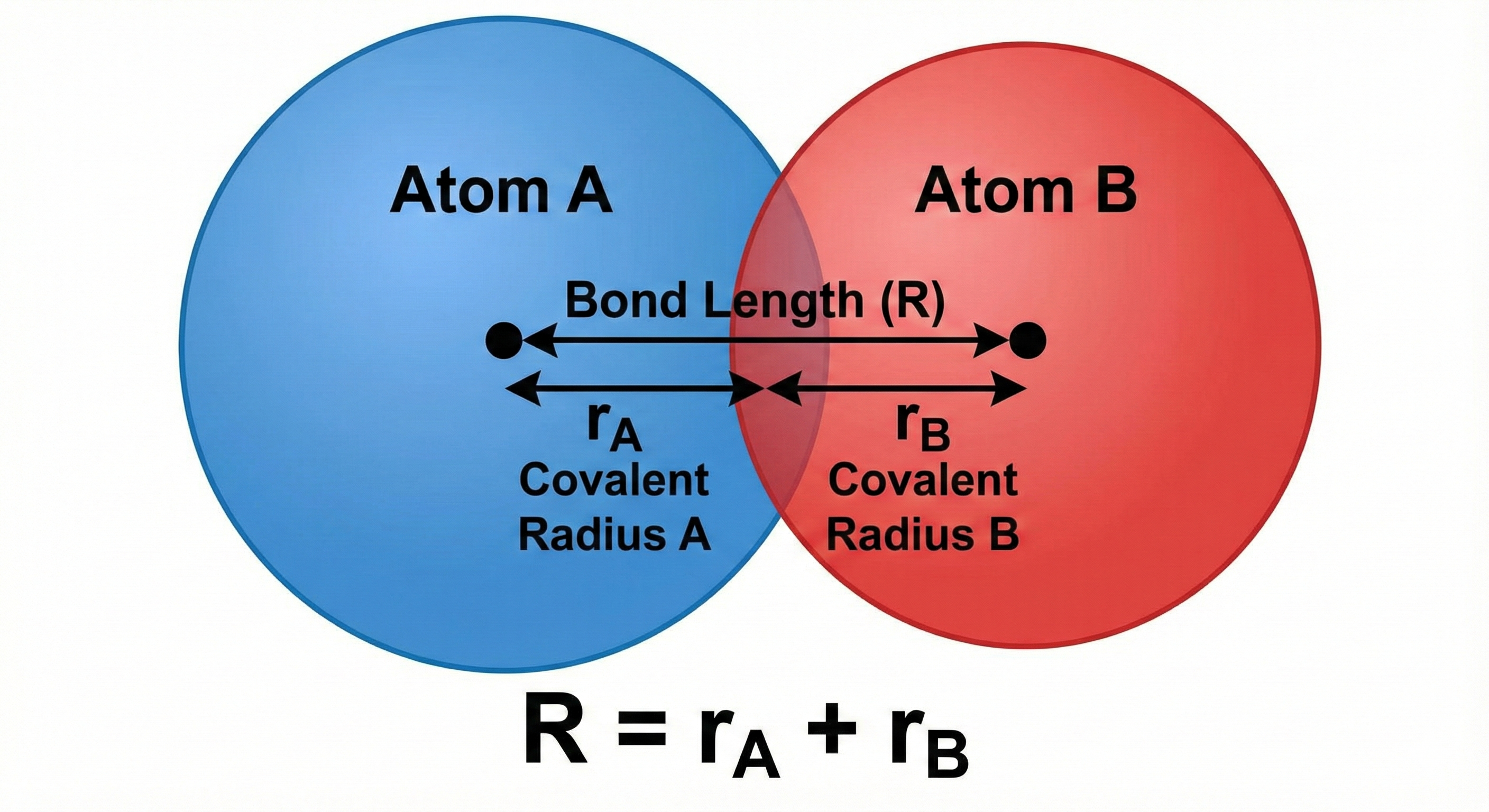
The Bond Length ($R$) is simply defined as the equilibrium distance between the nuclei of the two bonded atoms in a molecule. We measure these tiny distances using super precise methods like X-ray diffraction. A component of this length is the covalent radius ($r$), which is half the distance between two similar atoms joined by a covalent bond in the same molecule. Notice this: the total bond length is the sum of the covalent radii: $R = r_A + r_B$.
Figure below:
A clear diagram showing two bonded atoms (A and B) with their nuclei separated by the bond length (R), indicating their respective covalent radii ($r_A$ and $r_B$) so that $R = r_A + r_B$.
Bond Angle is the angle between the bonding orbitals around the central atom. This is expressed in degrees and it’s the primary factor that helps us determine the molecular shape. For instance, in the $H_2O$ molecule, the $H-O-H$ bond angle is $104.5^{\circ}$.
NEET Checkpoint:
What parameter around the central atom determines the molecular shape?
(a) Bond Length
(b) Dipole Moment
(c) Bond Angle
(d) Covalent Radius
✅ Answer: (c) Bond Angle — The angle between bonding orbitals dictates the spatial arrangement of atoms, defining the geometry.
Next, the strength: Bond Enthalpy ($\Delta_{a}H$) is the energy required to break one mole of a specific bond in the gaseous state, measured in $kJ~mol^{-1}$. Here’s the funda: the larger the bond dissociation enthalpy, the stronger the bond. If a molecule is polyatomic, like $H_2O$, we use the mean or average bond enthalpy because the energy required to break the second bond might differ due to the changed chemical environment.
Think of it like securing your scooter (the molecule) with multiple strong locks (the bonds). You need high energy (enthalpy) to break those locks, right? The nitrogen triple bond ($N\equiv N$) requires a massive $946.0~kJ~mol^{-1}$ to break—that’s why it’s so stable!
NEET Checkpoint:
Bond enthalpy is defined as the energy required to break the bond in which state?
(a) Liquid state
(b) Solid state
(c) Gaseous state
(d) Aqueous solution
✅ Answer: (c) Gaseous state — Bond enthalpy is the energy required to break one mole of bonds between two atoms in a gaseous state.
Finally, Bond Order (b.o.) in the Lewis description is just the number of shared electron pairs between two atoms. For $O_2$, the bond order is 2, and for $N_2$, it’s 3. Now, why does this matter? There is a key correlation useful for stability: With increase in bond order, bond enthalpy increases and bond length decreases. More bonds pull the atoms closer (shorter length) and make them harder to break (higher enthalpy)!
NEET Checkpoint:
If Bond Order increases, what happens to Bond Length and Bond Enthalpy, respectively?
(a) Decreases, Decreases
(b) Increases, Increases
(c) Increases, Decreases
(d) Decreases, Increases
✅ Answer: (d) Decreases, Increases — Increased bonding pulls atoms closer (decreased length) and makes the bond stronger (increased enthalpy).
Practice Question :
Which relationship is generally correct for the comparison between a double bond (Bond Order 2) and a triple bond (Bond Order 3)?
(a) Triple bond has lower enthalpy and longer length.
(b) Triple bond has higher enthalpy and shorter length.
(c) Double bond has higher enthalpy and shorter length.
(d) Triple bond has the same enthalpy but shorter length.
✅ Explanation: Based on the general correlation, increasing bond order (from 2 to 3) increases bond enthalpy and decreases bond length. Therefore, the triple bond is stronger and shorter (b).
Key Takeaway
Bond Order is the master control! A higher Bond Order means a stronger bond, leading to increased Bond Enthalpy (more energy needed to break it) and decreased Bond Length (atoms are held closer).
7. Resonance Structures
Hey future doctor! Let's tackle a super important concept for NEET: Resonance Structures. This funda is crucial because sometimes, a simple Lewis structure just isn't enough to capture the real picture of a molecule, especially when dealing with experimentally determined parameters.
Notice this... when we look at experimental data for molecules like ozone, $\text{O}_3$, things get tricky. A normal Lewis structure (Structure I or II) suggests one single $\text{O-O}$ bond (normal length $148 \text{ pm}$) and one double $\text{O=O}$ bond (normal length $121 \text{ pm}$). But wait! Experiments show both oxygen-oxygen bonds are actually identical, sitting somewhere in the middle at $128 \text{ pm}$. Thus, the oxygen-oxygen bonds in the $\text{O}_3$ molecule are intermediate between a double and a single bond. This single structure is clearly inadequate, yaar.
Resonance is the concept introduced to solve this headache. When a single Lewis structure cannot describe a molecule accurately, we represent the molecule as a hybrid of several fictional structures called canonical structures or resonance structures. These contributing structures must have similar energy, the same positions of nuclei, and the same count of bonding and non-bonding electron pairs.
NEET Checkpoint:
What features must canonical structures have in common?
(a) Same energy, different nuclear positions
(b) Similar energy, same nuclear positions
(c) Different electron counts, similar energy
✅ Answer: (b) Similar energy, same nuclear positions — Canonical forms are imaginary representations that must have similar energy and identical nuclear geometry.
The actual structure of the molecule is the single resonance hybrid (like Structure III in $\text{O}_3$), which is always more stable (has lower energy) than any individual canonical form. Resonance stabilizes the molecule because the energy of the hybrid is lower than the energy of any single canonical structure. Canonical forms have no real existence—they are just tools we use to understand the real, single hybrid structure. The molecule inherently possesses the single structure of the hybrid. We use a double-headed arrow ($\leftrightarrow$) to show resonance. The hybrid also averages the bond characteristics, which explains why the bond lengths in $\text{O}_3$ are equivalent.
Relatable Indian Example: Imagine you ordered a piping hot thali (meal platter). You might think of it as three distinct dishes (dal, roti, sabzi), but when you eat it, the overall satisfaction (the resonance hybrid) is more complete and stable than just focusing on any single component (canonical form). That single, satisfying thali experience is the stable structure, far better than its theoretical parts!
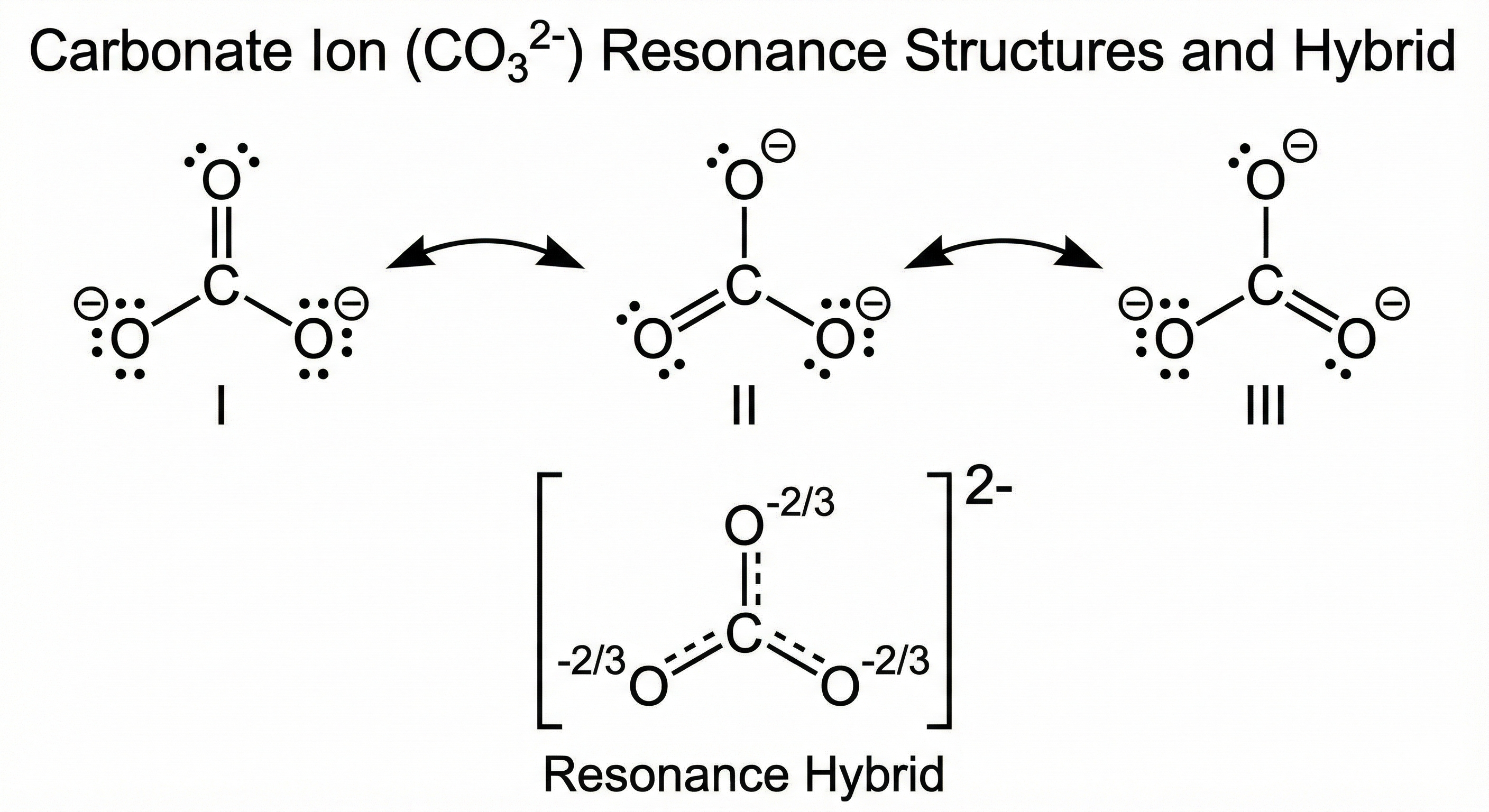
Let's look at another classic case: the carbonate ion, $\text{CO}_3^{2-}$. The experimental findings show all carbon-to-oxygen bonds are equivalent, even though a Lewis structure must show one double bond and two single bonds. It is best described as a hybrid of three equivalent canonical forms.
NEET Checkpoint:
Compared to any single canonical form, the resonance hybrid is:
(a) Higher in energy
(b) Lower in energy
(c) Equal in energy
✅ Answer: (b) Lower in energy — Resonance stabilizes the molecule, meaning the hybrid has the lowest energy.
Figure below:
A clear diagram showing the three canonical forms (I, II, and III) of the carbonate ion ($\text{CO}_3^{2-}$) linked by double-headed arrows, along with the resulting resonance hybrid structure.
NEET Checkpoint:
True or False: The molecule exists for a fraction of time in one canonical form and for other fractions of time in others.
(a) True
(b) False
✅ Answer: (b) False — This is a misconception; the molecule has a single structure, which is the resonance hybrid, and there is no equilibrium or shifting between forms.
Practice Questions
1: The $\text{C-O}$ bond lengths in carbon dioxide ($\text{CO}_2$), which is a resonance hybrid, are experimentally found to be $115 \text{ pm}$. The normal carbon-to-oxygen double bond ($\text{C=O}$) length is $121 \text{ pm}$, and the triple bond ($\text{C}\equiv\text{O}$) length is $110 \text{ pm}$. What does the $115 \text{ pm}$ value indicate?
(a) The $\text{CO}_2$ molecule undergoes rapid tautomerism between the canonical forms.
(b) The $\text{C-O}$ bonds are intermediate between double and triple bonds, confirming the resonance hybrid structure.
(c) The actual bond length is equal to the shortest canonical form's bond length.
✅ Answer: (b) The $\text{C-O}$ bonds are intermediate between double and triple bonds, confirming the resonance hybrid structure. — The bond length in the hybrid (Structure III in $\text{CO}_2$) is an average of the canonical forms, lying between the double and triple bond values.
2: Why does resonance occur?
(a) To account for the polarity in ionic compounds.
(b) Because a single Lewis structure is inadequate to represent the molecule accurately based on experimental data.
(c) Because the canonical forms exist in dynamic equilibrium with each other.
✅ Answer: (b) Because a single Lewis structure is inadequate to represent the molecule accurately based on experimental data. — Resonance is introduced when a single structure cannot conform with experimentally determined parameters, like intermediate bond lengths.
Key Takeaway
Resonance occurs when a single Lewis structure is inadequate. We draw fictional canonical forms (similar energy/nuclear positions) to represent the actual structure, which is the highly stable resonance hybrid. The hybrid structure lowers the system's energy and averages the bond characteristics.
8. Polarity, Electronegativity, and Dipole Moment: The Ultimate Tug-of-War
Hey future docs! When atoms hold hands to form a covalent bond, it’s rarely a $100\%$ fair sharing wala deal. Even in a $H_{2}$ molecule, where both atoms are identical, there is some degree of ionic character, though the bond is primarily covalent.
The deciding factor in this electron sharing game is electronegativity. If the bond is between two similar atoms (like in $Cl_{2}$), the electron pair is attracted equally, sitting exactly between the nuclei. We call this a nonpolar covalent bond. Simple funda, right?
NEET Checkpoint:
A bond formed between two identical atoms is called a:
(a) Polar covalent bond
(b) Ionic bond
(c) Nonpolar covalent bond
(d) Metallic bond.
✅ Answer: (c) Nonpolar covalent bond — The shared electron pair is equally attracted, sitting exactly between the two identical nuclei.
Now, notice this: In a heteronuclear molecule like HF, Fluorine is way more electronegative than Hydrogen, so it pulls the shared electron pair strongly towards itself. This displacement causes polarisation, resulting in a polar covalent bond.
The result of this polarisation is the Dipole Moment ($\mu$). It is defined as the product of the magnitude of the charge ($Q$) and the distance of separation ($r$). Remember this formula, bahut important hai:
Dipole moment is a vector quantity, and its units are usually given in Debye units ($D$). Just like a vector, its direction matters! The crossed arrow ($\rightarrow$) on a Lewis structure shows the direction of electron density shift, with the cross on the positive end.
For polyatomic molecules, the net dipole moment is the vector sum of all the individual bond dipoles. This means the spatial arrangement (geometry) of the molecule is hugely critical.
Imagine three friends trying to pull a pani puri stall using ropes, each pulling with equal force at $120^{\circ}$ angles (just like the bonds in $BF_{3}$). What happens? The forces cancel out due to that perfect symmetrical geometry, giving a net movement (or net dipole moment) of zero. Molecules like $BeF_{2}$ (linear) and $BF_{3}$ (trigonal planar) are non-polar because their bond dipoles cancel perfectly [60, 61, 62 (Table 4.5)].
Here's the trick: Compare $NH_{3}$ ($\mu = 1.47~D$) and $NF_{3}$ ($\mu = 0.23~D$). Both are pyramidal. Why is $NH_{3}$ so much higher? In $NH_{3}$, the orbital dipole due to the lone pair and the resultant bond dipoles are in the same direction, adding up. But in $NF_{3}$, the orbital dipole opposes the resultant $N-F$ bond moments, causing significant cancellation. Think of it like a cricket team’s total score: in $NF_{3}$, the lone pair and the bond pairs are running in opposite directions, partially canceling the effort, leading to a much lower net score.
NEET Checkpoint:
The dipole moment of $BeF_{2}$ is zero because:
(a) F is less electronegative than Be
(b) the structure is bent
(c) the two equal bond dipoles cancel each other
(d) Be is a metal.
✅ Answer: (c) the two equal bond dipoles cancel each other — $BeF_{2}$ is linear, and its two equal and opposite bond dipoles result in a zero net dipole moment.
NEET Checkpoint:
Why is the dipole moment of $NH_{3}$ greater than $NF_{3}$?
(a) Because fluorine is heavier than hydrogen
(b) Because nitrogen is more electronegative in $NH_{3}$
(c) Because in $NH_{3}$, the lone pair dipole and N–H bond dipoles act in the same direction, whereas in $NF_{3}$ they oppose each other
(d) Because $NF_{3}$ has stronger covalent bonds
✅ Answer: (c)In $NH_{3}$, the lone pair dipole and the resultant N-H bond dipoles are in the same direction, enhancing the net moment; in $NF_{3}$, they oppose each other, causing cancellation.
Practice Questions
- The net dipole moment in polyatomic molecules depends on:
(A) The magnitude of individual bond dipoles
(B) The spatial arrangement of the bonds
(C) Both A and B
(D) Only bond length
✅ Answer: (C) Both A and B — The net dipole moment is the vector sum of individual bond dipoles, which fundamentally depends on the spatial arrangement.
2. If the bond dipoles in a molecule cancel each other out due to symmetrical geometry, the molecule is classified as:
(A) Polar
(B) Ionic
(C) Non-polar
(D) Resonance hybrid
✅ Answer: (C) Non-polar — If the vector sum of the dipoles is zero (as in linear $CO_{2}$ or tetrahedral $CCl_{4}$), the molecule is non-polar [60, 62 (Table 4.5)].
Key Takeaway
Bond Polarity is determined by electronegativity difference, creating bond dipoles. For polyatomic molecules, the net Dipole Moment ($\mu$) is the vector sum of these bond dipoles and depends heavily on molecular geometry. Symmetrical shapes lead to cancellation ($\mu = 0$ for molecules like $BeF_{2}$ and $BF_{3}$).
9. Fajans’ Rules: Partial Covalent Character
Arey, listen up! We know the world isn't black and white, right? Just like how even a strong covalent bond (sharing electrons, yaar) has some partial ionic character, its totally opposite twin—the ionic bond—also possesses partial covalent character. This is a super important funda, and the degree of this "covalent sneakiness" in an ionic compound is governed by Fajans' Rules. Don't stress, these rules make predicting properties much easier!
So, what increases this covalent tendency? Fajans' Rules give us three key trends, based on maximizing the polarisation of the anion by the cation:
- Smaller size of the cation: A tiny cation has a higher charge density, making its pull stronger.
- Larger size of the anion: A massive, diffuse electron cloud (large anion) is easily distorted, or polarised.
- Greater charge on the cation (e.g., $Al^{3+}$ vs $Na^{+}$): More charge means more pulling power!.
Here's the trick: The cation acts like a strong magnet, polarising the anion. It pulls the anion's electron cloud towards itself. When this happens, the electron density starts building up between the two nuclei. And what is a covalent bond, essentially? A build-up of electron charge density between nuclei! Bole toh, the ionic bond starts looking like a shared bond.
NEET Checkpoint:
Which pair has the highest covalent character?
(a) $LiCl$
(b) $KCl$
(c) $NaCl$
(d) $RbCl$
✅ Answer: (a) $LiCl$ — Bhai, among alkali metals, $Li^{+}$ is the smallest cation, maximizing the polarisation and thus the covalent character.
Let’s use a simple analogy: Imagine two types of transport. An ionic bond is like having your own dedicated driver (Cation) and a giant luxury bus (Anion). Fajans’ rules say that if the driver is very small but very charged (small cation, high charge) and the bus is super huge and floppy (large anion, high polarisability), the driver effectively "squashes" the bus while pulling it. This squashing is the polarisation, which increases the per cent covalent character.
NEET Checkpoint:
Increasing the charge on the anion (e.g., $O^{2-}$ vs $F^{-}$) generally leads to:
(a) Decreased polarisability
(b) Increased covalent character
(c) Decreased ionic character
✅ Answer: (b) Increased covalent character — A higher negative charge makes the anion softer and easier to polarise (higher polarisability), increasing the covalent character.
Practice Question:
Which compound is expected to be the least ionic based on Fajans' Rules?
(a) $CaCl_{2}$
(b) $MgCl_{2}$
(c) $BaCl_{2}$
(d) $SrCl_{2}$
✅ Answer: (b) $MgCl_{2}$ — All have a $2+$ charge, but $Mg^{2+}$ has the smallest size compared to $Ca^{2+}$, $Sr^{2+}$, and $Ba^{2+}$ in the group, leading to maximum covalent character (least ionic character).
Key Takeaway
Fajans' Rules state that covalent character increases with: $\mathbf{1)~\text{Small Cation Size}}$, $\mathbf{2)~\text{Large Anion Size}}$, and $\mathbf{3)~\text{High Cation Charge}}$. Remember, the core mechanism is the polarisation of the anion by the cation. Now that we’ve sorted out the ionic-covalent hybrid nature, let's explore how these concepts define the shapes of molecules using VSEPR theory!
10. VSEPR Theory: Predicting Molecular Shapes
Feeling confused about why molecules have specific shapes? Don't stress, the Valence Shell Electron Pair Repulsion (VSEPR) Theory is here to save the day! While Lewis structures just show bonding, VSEPR helps us predict the actual geometrical shapes of covalent molecules. This awesome theory, initially proposed by Sidgwick and Powell and refined by Nyholm and Gillespie, is based on a simple funda: electron pairs hate each other.
The VSEPR Postulates
The entire concept hinges on minimizing these negative-charge repulsive interactions between the valence shell electron pairs (both bonded and nonbonded, i.e., lone pairs). These pairs position themselves in space to maximize the distance between them and minimize the repulsion.
Here’s the golden rule for repulsion, which is super important for NEET:
Lone pair–Lone pair (lp–lp) > Lone pair–Bond pair (lp–bp) > Bond pair–Bond pair (bp–bp).
This means lone pairs are the biggest bullies! Since lone pairs are localized only on the central atom, they take up more space than bonding pairs, leading to greater repulsion and distortions in ideal shapes.
NEET Checkpoint:
Which type of repulsion causes the greatest deviation from ideal molecular geometry?
(a) bp-bp
(b) lp-bp
(c) lp-lp
(d) None
✅ Answer: (c) lp-lp — Lone pairs are localized solely on the central atom, occupying more space and creating the maximum repulsive force.
Also, remember that a multiple bond (double or triple bond) is treated as if it were a single electron pair (often called a super pair) when determining the geometry.
Relatable Example: Imagine four grumpy neighbours (electron pairs) trying to sit on a circular park bench (the valence shell). They will automatically spread out to form a perfect square (or tetrahedron in 3D!) to achieve maximum separation and minimum friction (repulsion).
Ideal Geometries (When the Central Atom is Chill)
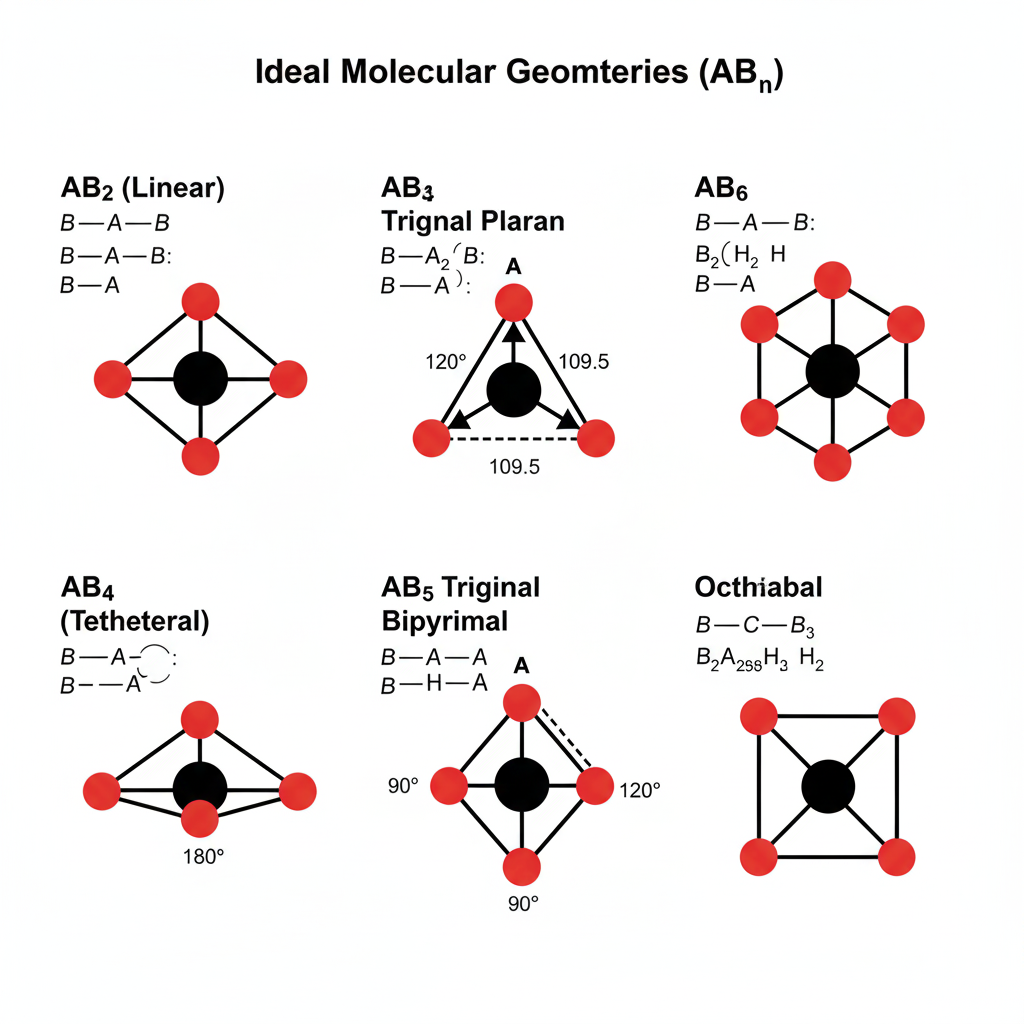
For molecules of the $AB_{x}$ type, where the central atom $A$ has no lone pairs (zero $lp$!), the arrangement of electron pairs is the same as the molecular geometry—meaning they exhibit ideal geometries. These shapes are determined purely by the number of electron pairs ($N$):
| N (Pairs) | Geometry | Example | Angle |
|---|---|---|---|
| 2 | Linear | $BeCl_{2}$ | $180^{\circ}$ |
| 3 | Trigonal Planar | $BF_{3}$ | $120^{\circ}$ |
| 4 | Tetrahedral | $CH_{4}$ | $109.5^{\circ}$ |
| 5 | Trigonal Bipyramidal | $PCl_{5}$ | $120^{\circ}$ and $90^{\circ}$ |
| 6 | Octahedral | $SF_{6}$ | $90^{\circ}$ |
Figure below:
A clear diagram showing the ideal geometries for $AB_{2}$ (linear), $AB_{3}$ (trigonal planar), $AB_{4}$ (tetrahedral), $AB_{5}$ (trigonal bipyramidal), and $AB_{6}$ (octahedral).
NEET Checkpoint 3:
What is the geometry of $PCl_{5}$ based on VSEPR theory, assuming no lone pairs?
(a) Tetrahedral
(b) Octahedral
(c) Trigonal bipyramidal
✅ Answer: (c) Trigonal bipyramidal — $PCl_{5}$ has five bonding pairs, leading to a trigonal bipyramidal arrangement.
Practice Question
If a molecule $AX_{4}$ has a central atom $A$ with four bond pairs and zero lone pairs, what is its expected geometry and bond angle?
(a) Square Planar, $90^{\circ}$
(b) Tetrahedral, $109.5^{\circ}$
(c) Trigonal Pyramidal, $107^{\circ}$
(d) Linear, $180^{\circ}$
✅ Explanation: The molecule is of the $AB_{4}$ type with four electron pairs. Since there are no lone pairs, it adopts the ideal Tetrahedral geometry with a bond angle of $109.5^{\circ}$.
Key Takeaway
VSEPR Postulates: Molecular shape is determined by electron pair repulsion, where $lp-lp > lp-bp > bp-bp$. A multiple bond is a single 'super pair'. Ideal geometries for $AB_{x}$ molecules (0 lone pairs) are Linear (2 pairs), Trigonal Planar (3 pairs), Tetrahedral (4 pairs), Trigonal Bipyramidal (5 pairs), and Octahedral (6 pairs).
11. VSEPR Theory: Predicting Shapes with Lone Pairs
Listen up: VSEPR (Valence Shell Electron Pair Repulsion) theory explains molecular shapes based on the repulsive interactions between electron pairs around the central atom. When a central atom has only bonding pairs ($\text{bp}$), the shape is usually ideal, like the perfect $109.5^\circ$ angle in tetrahedral $\text{CH}_4$. But what happens when a lone pair ($\text{lp}$) enters the chat?
Here's the trick: $\text{lp}$ are localized exclusively on the central atom, unlike $\text{bp}$ which are shared between two nuclei. Because of this, lone pair electrons occupy more space compared to bonding pairs. This extra space occupation causes significantly greater repulsion.
The repulsive interaction follows a strict hierarchy—like seniority in a school hostel! The repulsion decreases in this order:
.
This hierarchy is why molecules deviate from their ideal geometries. Imagine you’re on a crowded Mumbai local train ($\text{lp}$) versus sitting calmly in a shared cab ($\text{bp}$). The local train takes up way more dynamic space!
NEET Checkpoint:
The main force causing bond angle reduction in $\text{H}_2\text{O}$ from the ideal tetrahedral angle is:
(a) $\text{lp}-\text{bp}$ repulsion
(b) $\text{lp}-\text{lp}$ repulsion
(c) $\text{bp}-\text{bp}$ repulsion
✅ Answer: (b) $\text{lp}-\text{lp}$ repulsion — While both $\text{lp}-\text{bp}$ and $\text{lp}-\text{lp}$ exist, the $\text{lp}-\text{lp}$ repulsion is the strongest, causing the maximum deviation in molecules like $\text{H}_2\text{O}$.
Case 1: The Ammonia Molecule ($\text{NH}_3$)
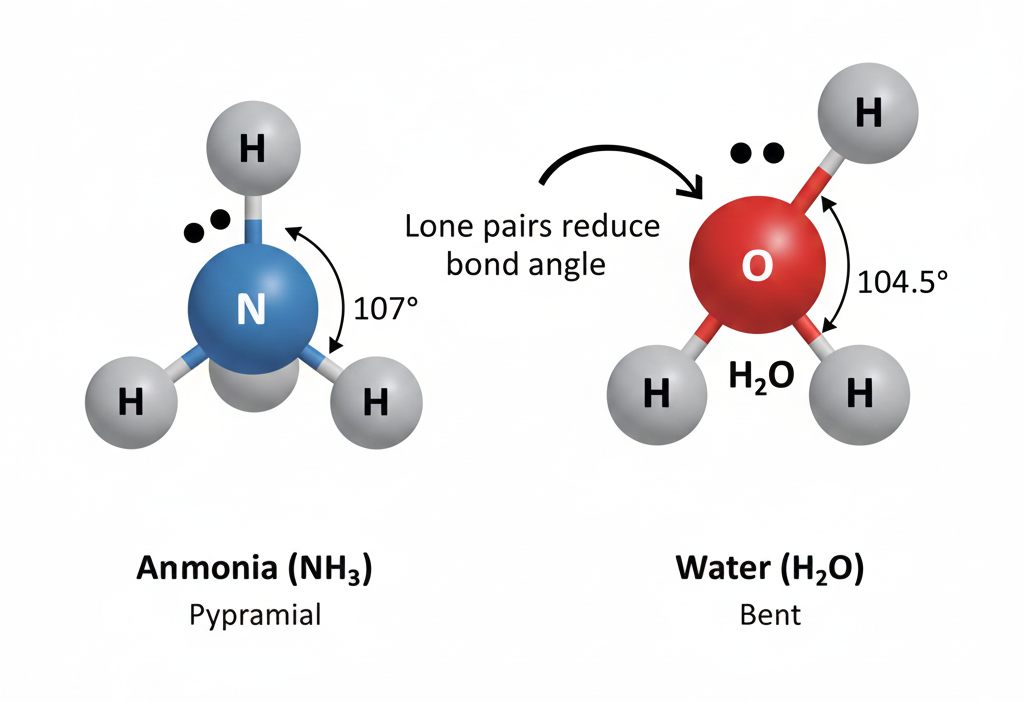
$\text{NH}_3$ is an example of an $\text{AB}_3\text{E}$ type molecule (3 $\text{bp}$, 1 $\text{lp}$). If it had only $\text{bp}$, its geometry would be tetrahedral ($109.5^\circ$). However, the single lone pair pushes the three $\text{N}-\text{H}$ bond pairs closer. Due to $\text{lp}-\text{bp}$ repulsion (which is stronger than $\text{bp}-\text{bp}$), the bond angle is reduced to only $107^\circ$, giving it a Trigonal Pyramidal shape.
Case 2: The Water Molecule ($\text{H}_2\text{O}$)
$\text{H}_2\text{O}$ is an $\text{AB}_2\text{E}_2$ type (2 $\text{bp}$, 2 $\text{lp}$). Here, two lone pairs are present, and we have the maximum repulsion: $\text{lp}-\text{lp}$. This intense repulsion squeezes the two $\text{O}-\text{H}$ bond pairs even more aggressively, resulting in a bond angle of $104.5^\circ$. The resulting shape is Bent (or V-shaped/Angular).
Notice this: Adding a second lone pair ($\text{H}_2\text{O}$) reduced the angle further ($104.5^\circ$) compared to just one lone pair ($\text{NH}_3$, $107^\circ$). This confirms that those lone pairs are high-repulsion zones!
NEET Checkpoint:
What is the geometry type ($\text{AB}_n\text{E}_m$) for $\text{H}_2\text{O}$?
(a) $\text{AB}_4$
(b) $\text{AB}_3\text{E}$
(c) $\text{AB}_2\text{E}_2$
✅ Answer: (c) $\text{AB}_2\text{E}_2$ — It has 2 bonding pairs ($\text{bp}$) and 2 lone pairs ($\text{lp}$) on the central oxygen atom.
VSEPR is a rockstar model, particularly successful in accurately predicting the geometry of a large number of molecules, especially compounds of p-block elements.
Figure below:
A clear diagram showing the $\text{NH}_3$ molecule with its pyramidal shape and $107^\circ$ bond angle, and the $\text{H}_2\text{O}$ molecule with its bent shape and $104.5^\circ$ bond angle, illustrating the lone pairs on the central N and O atoms causing the angular reduction.
NEET Checkpoint:
Which type of molecule often has its geometry successfully predicted by VSEPR theory?
(a) Noble gas compounds
(b) p-block compounds
(c) Coordination compounds
✅ Answer: (b) p-block compounds — The VSEPR Theory is highly successful in predicting the geometry of p-block element compounds.
Now that you've got this repulsion funda down, wait till you see how the next theory, Valence Bond Theory, offers a different angle on these shapes using orbital overlap and hybridisation.
Practice Question:
In the sequence of electron pair repulsion $\text{lp}-\text{lp} > \text{lp}-\text{bp} > \text{bp}-\text{bp}$, which repulsion is responsible for reducing the bond angle in $\text{NH}_3$ from the ideal $109.5^\circ$?
(a) $\text{lp}-\text{lp}$ repulsion
(b) $\text{lp}-\text{bp}$ repulsion
(c) $\text{bp}-\text{bp}$ repulsion
(d) The difference between $\text{lp}-\text{bp}$ and $\text{bp}-\text{bp}$ repulsion.
Explanation: In $\text{NH}_3$, there is one $\text{lp}$ and three $\text{bp}$. The primary force causing the deviation (reduction of angle from $109.5^\circ$ to $107^\circ$) is the stronger repulsion exerted by the lone pair on the bonding pairs, which is the $\text{lp}-\text{bp}$ repulsion.
Key Takeaway
The presence of lone pairs ($\text{lp}$) causes deviations from ideal molecular geometry because lone pairs occupy more space than bonding pairs ($\text{bp}$), leading to the repulsion order $\text{lp}-\text{lp} > \text{lp}-\text{bp} > \text{bp}-\text{bp}$. Examples include $\text{NH}_3$ (Trigonal pyramidal, angle $107^\circ$) and $\text{H}_2\text{O}$ (Bent/Angular, angle $104.5^\circ$). VSEPR is highly accurate for predicting the geometry of $\text{p-block}$ element compounds.
12. Valence Bond (VB) Theory and Covalent Bond Formation
Hey champs! Ready to ditch the limitations of VSEPR and dive into the solid funda of energy that actually drives chemical bonding? We are talking about the Valence Bond (VB) Theory! This quantum mechanical approach was introduced by Heitler and London (1927) and further developed by Pauling. It finally addresses the energetics of the covalent bond, which VSEPR failed to do.
The core feature of VB theory is super straightforward: a covalent bond is formed through the overlap of atomic orbitals. But wait, there’s a crucial rule here: this overlap results in the pairing of electrons present in the valence shell, and these electrons must have opposite spins. Think of two Hydrogen atoms, $\text{H}_A$ and $\text{H}_B$, approaching each other. New attractive forces arise (like $N_A - e_B$) and new repulsive forces also arise (like $e_A - e_B$).
NEET Checkpoint:
The fundamental requirement for forming a covalent bond via VB theory is the overlap of orbitals containing:
(a) Paired electrons
(b) Unpaired electrons with opposite spins
(c) Electrons with the same spin
✅ Answer: (b) Unpaired electrons with opposite spins — This overlap leads to the pairing of electrons and bond formation.
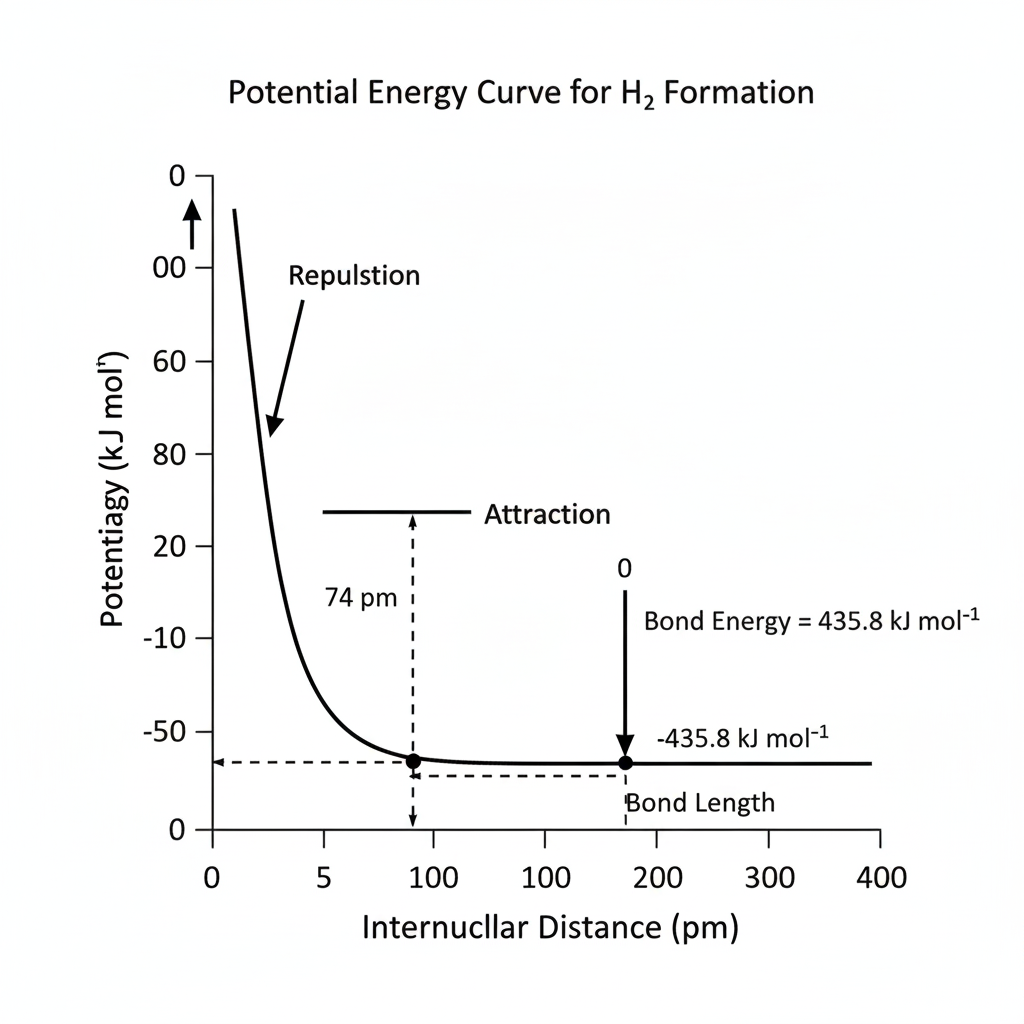
Notice this: the magnitude of the new attractive force is greater than the new repulsive forces. As the atoms approach, the potential energy decreases. Bond stability is achieved precisely when the potential energy reaches its minimum. This minimum energy state corresponds to the equilibrium bond distance. For the simplest molecule, $\text{H}_2$, this stable distance is $74\ \text{pm}$. The energy released at this minimum is the bond enthalpy, which is $435.8\ \text{kJ}\ \text{mol}^{-1}$ for $\text{H}_2$. If you try to push the nuclei any closer than $74\ \text{pm}$, repulsion spikes up, and the molecule destabilises.
Here’s the trick: The extent of overlap directly decides the strength of the bond. Greater the overlap of atomic orbitals, the stronger the covalent bond.
Let's clear up this funda with a relatable example: Imagine two rickshaws carrying heavy cargo trying to cross a narrow bridge. The stability of the bridge (the bond strength) depends on how much the support beams (atomic orbitals) overlap and merge when constructed. If the overlap is weak, the bridge (bond) is weak, and it breaks easily (low bond enthalpy). If the overlap is maximum, the bridge is solid and stable (high bond enthalpy).
Figure below:
A clear diagram showing the potential energy curve for $\text{H}_2$ formation as a function of internuclear distance, highlighting the minimum point corresponding to the bond length of $74\ \text{pm}$ and bond energy of $435.8\ \text{kJ}\ \text{mol}^{-1}$.
NEET Checkpoint:
For the $\text{H}_2$ molecule, the equilibrium bond distance is:
(a) $144\ \text{pm}$
(b) $74\ \text{pm}$
(c) $121\ \text{pm}$
✅ Answer: (b) $74\ \text{pm}$ — This is the internuclear distance where the system acquires minimum energy.
Practice Question:
Why was Valence Bond Theory required after the VSEPR model?
(a) VSEPR could not predict molecular geometry accurately.
(b) VB theory gives a mathematical definition for bond length.
(c) VB theory explains bond formation based on quantum mechanics and bond energetics.
(d) VSEPR was only applicable to diatomic molecules.
✅ Answer: (c) VB theory explains bond formation based on quantum mechanics and bond energetics — VB theory addresses the stability and energy of the bond, a key concept missed by the VSEPR theory.
Now that you understand how simple orbital overlap creates a bond, wait till you see how VB theory uses the concept of hybridisation to explain those complex molecular shapes, like the tetrahedral geometry of $\text{CH}_4$!.
Key Takeaway
VB Theory is a quantum mechanical approach that explains bond formation based on orbital overlap and energetics.
Covalent bonds form by the overlap of atomic orbitals containing unpaired electrons with opposite spins.
Bond strength is directly proportional to the extent of overlap.
Maximum stability is achieved at the minimum potential energy (equilibrium bond distance, e.g., $74\ \text{pm}$ for $\text{H}_2$).
13. Types of Overlapping: Sigma ($\sigma$) and Pi ($\pi$) Bonds
Let's dive into the core funda of covalent bonding: orbital overlap! Remember the Valence Bond Theory? It’s all about how atomic orbitals meet up to form bonds. This meeting is classified into two main types—the Sigma ($\sigma$) bond and the Pi ($\pi$) bond. This distinction is crucial for understanding molecular structure, so let's clear up this funda like a boss!
The Sigma ($\sigma$) bond is the big boss of overlaps. It's formed by the end-to-end (or axial) overlap of bonding orbitals right along the line connecting the two nuclei—that's the internuclear axis. Think of it like a direct, powerful, head-on collision. This strong axial overlap can happen between any combination of relevant orbitals: $s-s$ overlap, $s-p$ overlap, or $p-p$ overlap (along the axis). Because this overlap is extensive (a larger extent of overlapping), the $\sigma$ bond is inherently stronger than the $\pi$ bond.
NEET Checkpoint:
Which orbital overlap is also referred to as "head-on" overlap?
(a) $\pi$ bond
(b) $\delta$ bond
(c) $\sigma$ bond
(d) $p-p$ sidewise overlap
✅ Answer: (c) $\sigma$ bond — The $\sigma$ bond results from the direct, head-on or axial overlap along the internuclear axis.
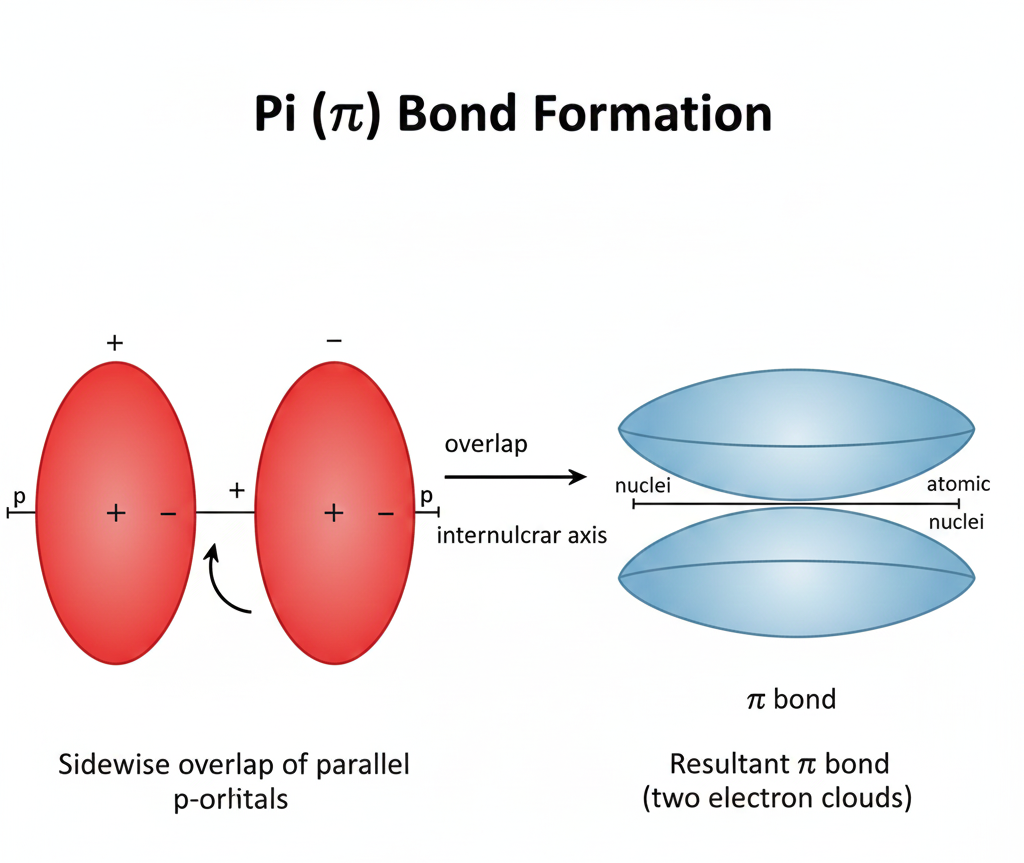
Now, for the Pi ($\pi$) bond, things get lateral. The $\pi$ bond results from the sidewise overlap of atomic orbitals (typically $p$-orbitals). These orbitals keep their axes parallel to each other and perpendicular to the internuclear axis. This overlapping forms a unique structure: two saucer-type charged clouds, one above and one below the plane of the atoms involved.
Imagine trying to push two scooters ($\sigma$ bond) versus trying to push them only by brushing their side mirrors ($\pi$ bond). The direct push ($\sigma$) is much stronger! Since the sidewise overlap in $\pi$ bonds is much smaller than the head-on overlap in $\sigma$ bonds, $\pi$ bonds are weaker.
Here's the trick: In any multiple bond (double or triple), you must have one $\sigma$ bond first, and then the $\pi$ bond(s) are formed in addition. So, a double bond has one $\sigma$ and one $\pi$ bond (like in $C_2H_4$), and a triple bond has one $\sigma$ and two $\pi$ bonds (like in $C_2H_2$).
Figure below:
Re-create the diagram showing pi ($\pi$) bond formation from the sidewise overlap of two parallel p-orbitals, illustrating the resultant two saucer-shaped charged clouds above and below the internuclear axis.
NEET Checkpoint:
Why are $\sigma$ bonds stronger than $\pi$ bonds?
(a) They are formed only by $s$ orbitals.
(b) The repulsive forces are lower.
(c) They involve a larger extent of overlapping.
(d) They have lower energy.
✅ Answer: (c) They involve a larger extent of overlapping — The strength of a bond depends primarily upon the extent of overlapping, which is greater for $\sigma$ bonds.
Practice Question:
The triple bond between two carbon atoms in ethyne ($C_2H_2$) consists of: (a) Three $\sigma$ bonds
(b) Two $\sigma$ and one $\pi$ bond
(c) One $\sigma$ and two $\pi$ bonds
(d) Three $\pi$ bonds
✅ Answer: (c) One $\sigma$ and two $\pi$ bonds — A triple bond is made up of one $\sigma$ bond and two $\pi$ bonds.
NEET Checkpoint:
If the internuclear axis is the $z$-axis, which overlap forms a $\pi$ bond?
(a) $s-s$ overlap
(b) $s-p_z$ overlap
(c) $p_y-p_y$ overlap
(d) $p_z-p_z$ overlap
✅ Answer: (c) $p_y-p_y$ overlap — Sidewise overlap of $p$ orbitals whose axes are perpendicular to the internuclear axis ($z$) forms $\pi$ bonds.
Key Takeaway
Sigma ($\sigma$) Bond: Head-on (Axial) overlap along the internuclear axis ($s-s$, $s-p$, or $p-p$). Strongest bond type due to large overlap.
Pi ($\pi$) Bond: Sidewise (Parallel) overlap perpendicular to the internuclear axis ($p-p$). Weaker due to smaller extent of overlap.
Multiple Bonds: All multiple bonds contain exactly one $\sigma$ bond plus one or two $\pi$ bonds.
14. Hybridization Involving $s$, $p$, and $d$ Orbitals
Hybridisation, yaar, is basically the chemistry hack where atomic orbitals of slightly different energies decide to intermix, or combine, to form a brand new set of equivalent orbitals known as hybrid orbitals. This process redistributes their energy, giving them all equivalent energies and shape. Now, why do they bother? Because these resulting hybrid orbitals are specifically directed in space to ensure the minimum repulsion between electron pairs, and this geometric arrangement is what ultimately dictates the geometry of the molecules. It's all about finding that stable arrangement!
NEET Checkpoint:
What is the fundamental purpose served by the spatial direction of hybrid orbitals?
(a) To maximise overlap
(b) To minimize bond energy
(c) To minimize electron pair repulsion
(d) To increase $s$-character
✅ Answer: (c) To minimize electron pair repulsion — The goal is always stability, which means making sure those negatively charged electron pairs are as far apart as possible.
Let’s quickly revise the main fundas:
- $sp$ Hybridisation: Mixing one $s$ and one $p$-orbital gives you two equivalent $sp$ hybrid orbitals. Since they point in opposite directions along the axis, the resulting geometry is linear, with a bond angle of $180^\circ$. Notice this, the $s$ and $p$ characters are 50% each. Example: $\text{BeCl}_2$.
- $sp^2$ Hybridisation: This involves one $s$ and two $p$-orbitals mixing to form three equivalent $sp^2$ hybrid orbitals. These three line up in a trigonal planar arrangement, making the bond angle $120^\circ$. Example: $\text{BCl}_3$.
- $sp^3$ Hybridisation: The most famous type! Here, one $s$ and three $p$-orbitals mix to yield four equivalent $sp^3$ hybrid orbitals. These four orbitals point towards the corners of a tetrahedron, resulting in the standard angle of $109.5^\circ$. Example: $\text{CH}_4$.
Imagine you are serving pani puri (relatable Indian example). You want to arrange the plates (hybrid orbitals) on the counter (central atom) so that each plate has maximum space and doesn't collide with others (minimum repulsion). If you have three plates, setting them up in a $120^\circ$ circle (trigonal planar) is the most efficient way to achieve this stability!
NEET Checkpoint:
A central atom undergoing $sp^2$ hybridization will exhibit which molecular geometry?
(a) Linear
(b) Tetrahedral
(c) Trigonal planar
(d) Pyramidal
✅ Answer: (c) Trigonal planar — One $s$ and two $p$ orbitals combining results in three hybrid orbitals arranged at $120^\circ$ in a plane.
Now, the d orbitals come into play! $d$ orbitals are available for bonding for elements starting from the third period of the periodic table, because the energy of the $3d$ orbitals becomes comparable to $3s$ and $3p$ orbitals. This allows for expanded octets and complex geometries. For instance, $\text{PCl}_5$ uses $sp^3d$ hybridisation, and $\text{SF}_6$ uses $sp^3d^2$ hybridisation.
NEET Checkpoint:
Which elements can utilize $d$ orbitals for hybridisation?
(a) Only second period elements
(b) Elements in and beyond the third period
(c) Only noble gases
(d) Only elements with $p$-orbitals
✅ Answer: (b) Elements in and beyond the third period — The presence of $d$ orbitals with comparable energy makes this possible from the third period onwards.
Let's test your understanding of geometry fundas:
Practice Questions :
1. What is the bond angle expected for a molecule whose central atom exhibits $sp^3$ hybridisation without any lone pairs?
(a) $180^\circ$
(b) $120^\circ$
(c) $109.5^\circ$
(d) $90^\circ$
✅ Explanation: The $sp^3$ hybrid orbitals are directed towards the corners of a tetrahedron, resulting in a bond angle of $109.5^\circ$.
2. $sp$ hybridisation is sometimes called diagonal hybridisation because:
(a) it involves $d$ orbitals
(b) it forms a tetrahedral structure
(c) the hybrids point in opposite, linear directions
(d) it uses only s orbitals
✅ Explanation: $sp$ hybridisation results in two hybrids oriented at $180^\circ$ along the axis, forming a linear or 'diagonal' structure.
Key Takeaway
| Hybridisation Type | Atomic Orbitals Mixed | Geometry | Bond Angle | Example |
|---|---|---|---|---|
| $sp$ | $s(1) + p(1)$ | Linear | $180^\circ$ | $\text{BeCl}_2$ |
| $sp^2$ | $s(1) + p(2)$ | Trigonal Planar | $120^\circ$ | $\text{BCl}_3$ |
| $sp^3$ | $s(1) + p(3)$ | Tetrahedral | $109.5^\circ$ | $\text{CH}_4$ |
15. Hybridization Involving $d$ Orbitals, Molecular Orbital Theory (MOT), and Hydrogen Bonding
D-Orbitals and Exotic Shapes: The $PCl_5$ Funda!
Hey juniors, let's level up our hybridization game by involving the $d$ orbitals! Elements in the third period and beyond have $d$ orbitals available that can participate in hybridization alongside $s$ and $p$ orbitals.
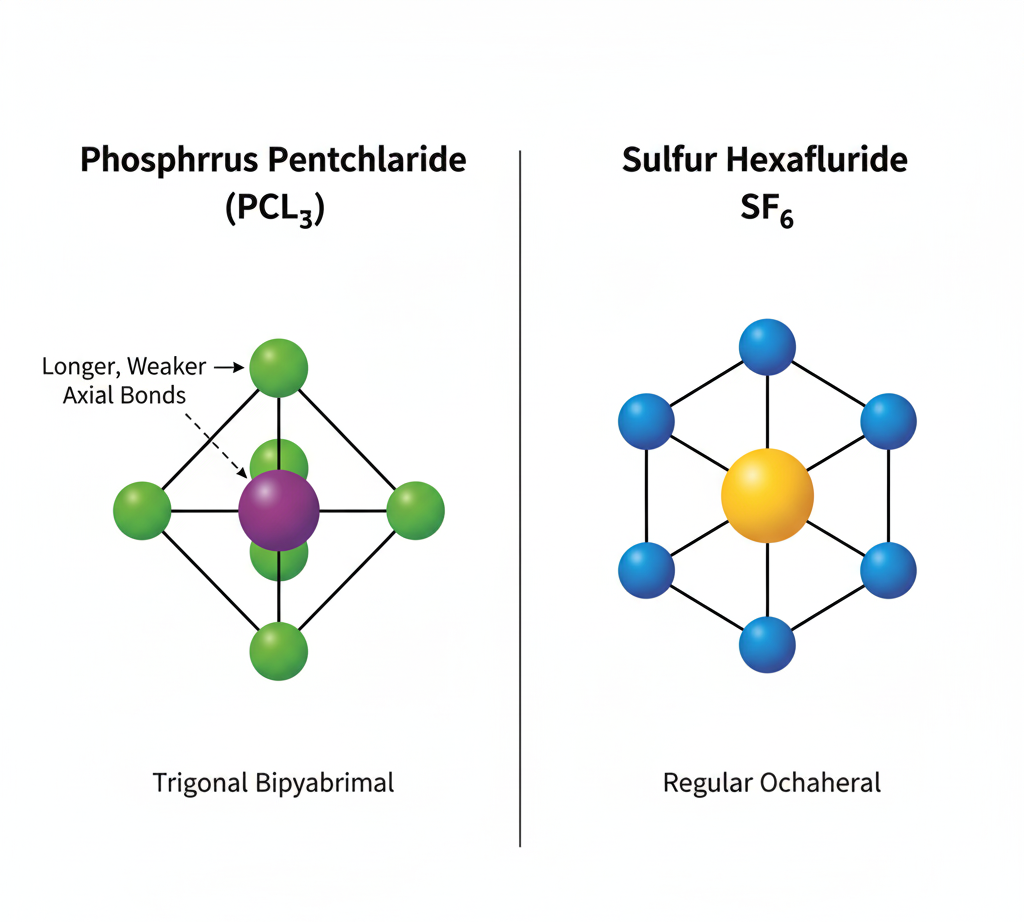
First up is $\mathbf{sp^{3}d}$ hybridization. This mixing involves one $s$, three $p$, and one $d$ orbital. The result is a set of five $sp^{3}d$ hybrid orbitals directed towards the corners of a trigonal bipyramidal structure, like in $PCl_5$. Notice this: Not all bonds are equal here! In $PCl_5$, the three equatorial bonds lie in one plane, but the two axial bonds have been found to be slightly longer and hence slightly weaker than the equatorial bonds. This weakness occurs because the axial bond pairs suffer more repulsive interaction from the equatorial bond pairs.
Next, if one $s$, three $p$, and two $d$ orbitals combine, we get $\mathbf{sp^{3}d^{2}}$ hybridization. This process yields six $sp^{3}d^{2}$ hybrid orbitals, which are projected towards the six corners of a regular octahedral structure, as seen in $SF_6$.
Figure below:
A clear diagram showing the trigonal bipyramidal geometry of $PCl_5$ (with the longer, weaker axial bonds marked) and the regular octahedral geometry of $SF_6$.
NEET Checkpoint 1:
In $PCl_5$, why are the axial bonds longer and weaker than the equatorial bonds?
(a) They form $\pi$ bonds.
(b) They are formed by $d$ orbitals only.
(c) They suffer more repulsive interaction from equatorial bond pairs.
(d) They have $sp^2$ character.
✅ Answer: (c) They suffer more repulsive interaction from equatorial bond pairs — This increased repulsive interaction causes the axial bonds to be slightly longer and weaker.
Molecular Orbital Magic (MOT)
Don't stress about Valence Bond Theory’s limitations, yaar, because Molecular Orbital Theory (MOT), developed by Hund and Mulliken, clears up the remaining funda. MOT states that atomic orbitals combine via the approximate method known as LCAO (Linear Combination of Atomic Orbitals). When two atomic orbitals combine, they form two molecular orbitals (MOs):
1. The bonding molecular orbital ($\sigma$ or $\pi$), formed by addition, has lower energy and greater stability.
2. The **antibonding molecular orbital** ($\sigma^*$ or $\pi^*$), formed by subtraction, has higher energy.
The stability of a molecule is determined by the Bond Order (b.o.), which is defined as half the difference between the number of electrons in the bonding ($N_b$) and antibonding ($N_a$) orbitals:
If the bond order is positive (i.e.,$N_b > N_a$, the molecule is stable. MOT successfully explains the famously difficult case of $O_2$: its electronic configuration, $KK(\sigma2s)^{2}(\sigma2p_{s})^{2}(\sigma2p_{z})^{2} (\pi2{p_{x}}^{2}=\pi2p_{y}^{2}),(\pi2{p^{1}}_{x}=\pi2p_{y}^{1})\rfloor$, clearly shows two unpaired electrons in the antibonding $\pi^{}2p_{x}$ and $\pi^{}2p_{y}$ orbitals, confirming $O_2$'s paramagnetism.
NEET Checkpoint 2:
Which statement about the $O_2$ molecule is correct according to MOT?
(a) It is diamagnetic.
(b) It has a bond order of 3.
(c) It has unpaired electrons in antibonding orbitals.
(d) It is formed by a sigma and two pi bonds.
✅ Answer: (c) It has unpaired electrons in antibonding orbitals — The presence of two unpaired electrons makes it paramagnetic, a key success of MOT.
Hydrogen Bonding: The Weak Link
Finally, let's look at the attractive force known as Hydrogen Bonding. This attractive force arises when a hydrogen atom, which is already bonded to a highly electronegative atom (like F, O, or N), forms a weak bond with another electronegative atom. This process requires the $\text{H}$ atom to become partially positive $(\delta^{+})$. Hydrogen bonds are represented by dotted lines and are generally weaker than covalent bonds.
We have two types of H-Bonds:
1. Intermolecular H-bond: Formed between two different molecules (e.g., between HF molecules).
2. Intramolecular H-bond: Formed within the same molecule (e.g., in $o$-nitrophenol). Imagine trying to hold two friends' hands inside one scooter—that’s intramolecular bonding!
NEET Checkpoint 3:
If $N_b$ (bonding electrons) $= 6$ and $N_a$ (antibonding electrons) $= 6$ for a molecule, what is its stability?
(a) Highly stable
(b) Stable
(c) Unstable
(d) Paramagnetic
✅ Answer: (c) Unstable — The bond order is zero, meaning the antibonding influence equals the bonding influence, leading to an unstable molecule that does not exist (like $He_2$).
Practice Questions:
1.Which orbitals participate in the formation of $SF_6$?
(a) $s, p_x, p_y, p_z, d_{z^2}$
(b) $s, p_x, p_y, p_z, d_{x^2-y^2}, d_{z^2}$
(c) $s, p_x, p_y, p_z, d_{xy}, d_{yz}$
(d) $s, p_x, p_y, p_z, d_{z^2}$
✅ Answer: (b) $SF_6$ uses $sp^3d^2$ hybridization, requiring one $s$, three $p$, and two $d$ orbitals.
2. The molecular orbital obtained by the subtraction of atomic wave functions ($\Psi_{A} - \Psi_{B}$) is:
(a) Bonding
(b) Non-bonding
(c) Sigma
(d) Antibonding
✅ Answer: (d) Subtraction leads to $\sigma^*$ or $\pi^*$, which are antibonding molecular orbitals.
Key Takeaway
Hybridization: $\mathbf{sp^{3}d}$ gives trigonal bipyramidal ($PCl_5$) with longer, weaker axial bonds. $\mathbf{sp^{3}d^{2}}$ gives octahedral ($SF_6$). MOT: Atomic orbitals combine via LCAO to form bonding ($\sigma/\pi$) and antibonding $\sigma^*/\pi^*$ MOs. Bond Order $= \frac{1}{2}(N_{b}-N_{a})$ determines stability. MOT explains $\text{O}_2$'s paramagnetism. H-Bonding: Attractive force involving $\text{H}$ bonded to $\text{F}$, $\text{O}$, or $\text{N}$, classified as Intermolecular (between molecules) or Intramolecular (within one molecule).