1. Introduction to Biomolecules
Hey there, future doctors! Ready to crack the "molecular logic of life"? Life isn't just about breathing; it's a high-stakes chemical dance. As the sources say, "It is the harmonious and synchronous progress of chemical reactions in the body which leads to life".
The biggest mind-bender here? Even though we are very much alive, we are composed of non-living atoms like $C$, $H$, $O$, and $N$. Biochemistry is simply the study of these chemical processes. Our bodies rely on complex biomolecules like carbohydrates (our fuel), proteins (the builders), and nucleic acids (the blueprint for heredity). Don't ignore the side-kicks—vitamins and mineral salts are essential for keeping our biological machinery running smoothly.
NEET Checkpoint:
Biochemistry is the study of:
(a) Physical growth
(b) Chemical processes in living systems
(c) Plant anatomy
(d) Only laboratory reactions
✅ Answer: (b) — Simple funda, yaar! It’s all about the chemistry happening inside you.
Think of your body like a Pani Puri stall. The puri is like a carbohydrate (the energy base), the aloo filling is the protein (the substance), and the teekha pani is like vitamins—you only need a little, but without it, the whole experience is a fail!
NEET Checkpoint:
Which of these are the "reserve of genetic information"?
(a) Proteins
(b) Lipids
(c) Nucleic acids
(d) Vitamins
✅ Answer: (c) — DNA is the boss that carries your family's traits over generations.
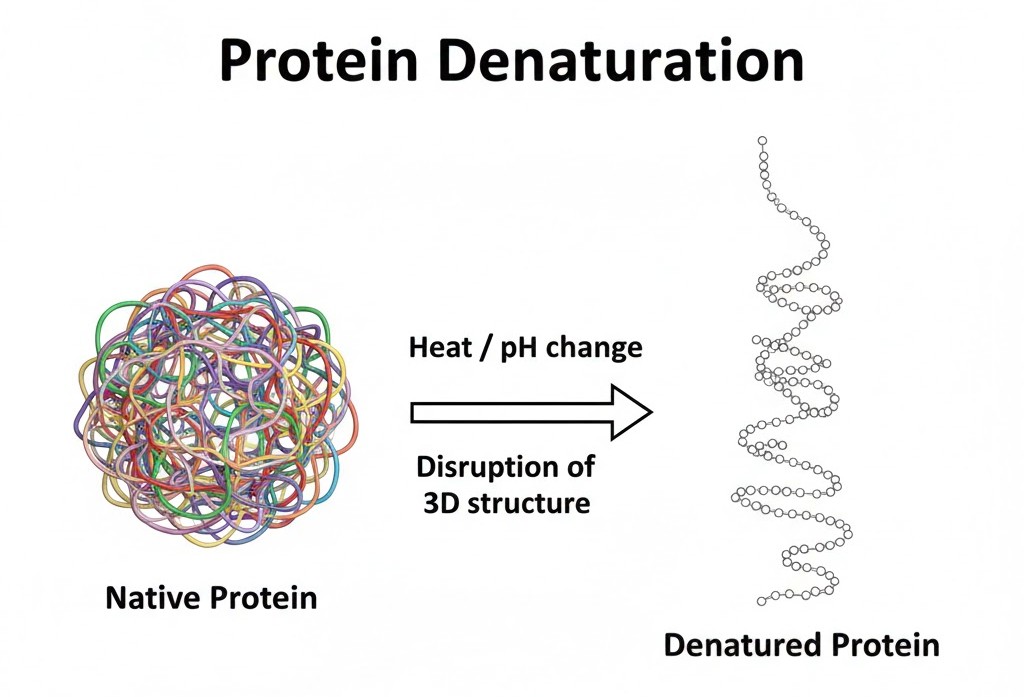
Sometimes, external factors like high temperature or a change in $pH$ can mess with a protein's 3D shape, making it lose its biological activity. This is called denaturation. It’s like when a batsman loses his form after a heavy rain delay—the structure is there, but the "action" is gone!
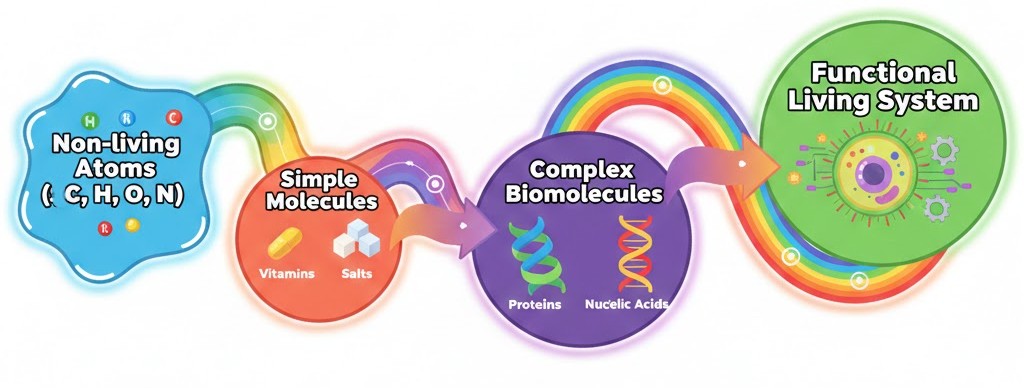
Figure below:
A colourful flowchart starting from Non-living Atoms ($C, H, O, N$) leading to simple molecules (Vitamins, Salts), then to complex Biomolecules (Proteins, Nucleic Acids), and finally to a functional Living System.
NEET Checkpoint:
Which of these is NOT a complex biomolecule?
(a) Proteins
(b) Carbohydrates
(c) Lipids
(d) Mineral salts
✅ Answer: (d) — While essential, mineral salts are classified as simple molecules in this context.
Practice Question:
Living systems grow, sustain, and reproduce themselves using:
(a) Only proteins
(b) Non-living atoms and molecules
(c) Only vitamins
(d) Non-chemical processes
✅ Answer: (b) — The most amazing thing is that living systems are built from non-living components.
Key Takeaway
Life is a complex interaction of biomolecules. While carbohydrates and proteins are food essentials, nucleic acids handle heredity, and vitamins maintain health.
2. Classification of Carbohydrates
Arre, welcome back! Ready to decode the "sweet" world of carbohydrates? Don't stress, yaar—it's easier than it looks!
Historically, scientists saw formulas like glucose, which is $C_{6}H_{12}O_{6}$ or $C_{6}(H_{2}O){6}$, and thought, "Arre, these are just hydrates of carbon!". This gave us the general formula${C_x}(H_{2}O){y}$. But chemistry is cheeky—acetic acid ($CH{3}COOH$) fits this but isn't a carb, while Rhamnose ($C_{6}H_{12}O_{5}$) is a carb but ignores the formula entirely. Modern science defines them as optically active polyhydroxy aldehydes or ketones.
Think of your local pani puri stall. A single puri is like a monosaccharide—it’s the simplest unit and can’t be hydrolysed further (e.g., Glucose, Fructose). A plate of 2–10 puris is like an oligosaccharide. A massive sack of flour used to make them? That’s your polysaccharide (many units), like starch or cellulose, which aren't even sweet—so we call them non-sugars.
NEET Checkpoint:
Is Rhamnose a carbohydrate?
(a) Yes, it is a carbohydrate
(b) It is a protein
(c) It is a lipid
(d) It is a nucleic acid
✅ Answer: (a)Yes — Even though it doesn't fit the old $C_{x}(H_{2}O)_{y}$ formula, it’s chemically a carb!
NEET Checkpoint:
Which type of carbohydrate is called a 'non-sugar'?
(a) Monosaccharides
(b) Oligosaccharides
(c) Polysaccharides
(d) Disaccharides
✅ Answer: (c) Polysaccharides — Unlike monosaccharides or oligosaccharides, they don't taste sweet!
NEET Checkpoint:
Why is sucrose a non-reducing sugar?
(a) Both aldehyde and ketone groups are involved in glycosidic bonding
(b) It contains only one monosaccharide unit
(c) It is insoluble in water
(d) It shows mutarotation
✅ Answer: (a) Its aldehydic or ketonic groups are "locked" in a bond and can't reduce Fehling's solution!
Carbs also have a "giving" nature. If they reduce Fehling's solution or Tollens' reagent, they are reducing sugars (all monosaccharides are in this club!). Sucrose is the famous non-reducing exception because its reducing groups are busy in a bond. Even molecules need their social life to be complicated sometimes!
Practice Questions:
A carbohydrate that yields three monosaccharide units on hydrolysis is:
(a) Monosaccharide
(b) Disaccharide
(c) Trisaccharide
(d) Polysaccharide
✅ Answer: (c) Trisaccharide — It falls under the oligosaccharide category (2–10 units).
Key Takeaway
- Formula: $C_{x}(H_{2}O)_{y}$ (with exceptions like Rhamnose).
- Definition: Optically active polyhydroxy aldehydes/ketones.
- Classification: Monosaccharides (1 unit), Oligosaccharides (2–10 units), Polysaccharides (many units).
- Reducing Sugars: Can reduce Fehling’s/Tollens' reagents.
3. Monosaccharides: Aldoses and Ketoses
Listen up, junior! Let’s talk about the simplest kids on the carbohydrate block: Monosaccharides. Think of them as the "building blocks" of the sugar world. By definition, a monosaccharide is a carbohydrate that cannot be hydrolysed further to give simpler units of polyhydroxy aldehyde or ketone. Basically, they are the end of the line—you can't break them down into smaller sugar units.
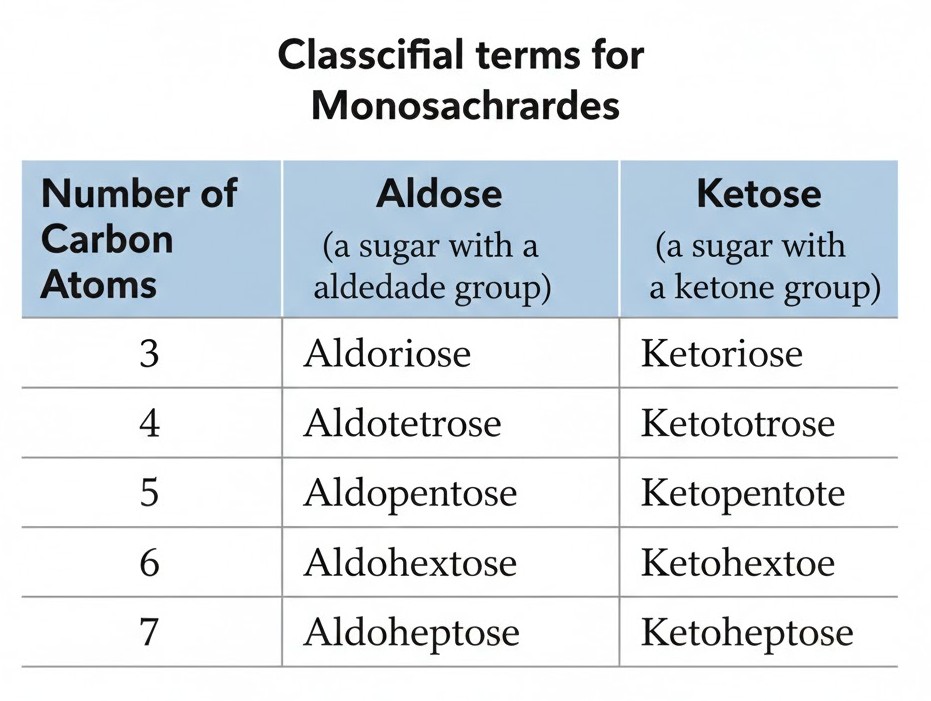
Now, how do we name these guys? It’s a mix-and-match game based on two things: the number of carbon atoms and the functional group present. If the sugar contains an aldehyde group, we call it an aldose. If it packs a keto group, it’s a ketose.
NEET Checkpoint:
A monosaccharide with $6$ carbon atoms and a ketone group is called?
(a) Aldohexose
(b) Ketohexose
(c) Aldopentose
(d) Ketopentose
✅ Answer: (b) Ketohexose — You just combine the prefix for the carbon count (hexose) with the functional group name.
We classify them by carbon count using terms like triose ($3$ carbons), tetrose ($4$ carbons), pentose ($5$ carbons), and hexose ($6$ carbons). It’s exactly like choosing a vehicle for a trip—a rickshaw for a short $3$-carbon distance (triose) or a big SUV for a $6$-carbon journey (hexose like Glucose)!
NEET Checkpoint:
All monosaccharides are reducing sugars.
(a) True
(b) False
✅ Answer: (a) True — Whether they are aldoses or ketoses, they all reduce Fehling's solution and Tollens' reagent.
Example: Imagine a single Pani Puri. You can’t split one puri into two smaller puris and still call it a snack—it’s the basic unit! Similarly, you can’t hydrolyse a monosaccharide like Glucose into simpler sugars.
NEET Checkpoint:
Which functional group is present in an aldose?
(a) Aldehyde group
(b) Ketone group
(c) Carboxylic acid group
(d) Alcohol group
✅ Answer: (a) Aldehyde group — Don't get confused between the 'a' in aldose and aldehyde, they go together!.
Figure below:
A clear classification table showing the general terms for monosaccharides with 3 to 7 carbon atoms, split into Aldose and Ketose columns.
Practice Question:
Which of the following is an example of an aldotetrose?
(a) A $3$-carbon sugar with an aldehyde group
(b) A $4$-carbon sugar with a keto group
(c) A $4$-carbon sugar with an aldehyde group
(d) A $5$-carbon sugar with an aldehyde group
✅ Answer: (c) — 'Aldo' signifies the aldehyde group and 'tetrose' signifies $4$ carbon atoms.
Key Takeaway
Monosaccharides are the simplest sugars that cannot be further hydrolysed. They are classified as Aldoses (aldehyde group) or Ketoses (keto group) and named based on carbon count (e.g., Aldohexose for Glucose).
4. Glucose: Structure and Preparation
Hey future doctors! Let's clear the funda on the most abundant organic compound on Earth: Glucose. You’ll find it naturally in honey and sweet fruits—ripe grapes are practically glucose bombs!. It occurs freely in nature and also in combined forms.
Preparation Hacks:
1. From Sucrose: Boil cane sugar with dilute $HCl$ or $H_{2}SO_{4}$ in an alcoholic solution to get equal amounts of glucose and fructose.
2. From Starch: Commercially, we boil starch with dilute $H_{2}SO_{4}$ at $393\text{ K}$ under $2-3\text{ atm}$ pressure to get glucose in bulk.
NEET Checkpoint:
Glucose is also popularly known as?
(a) Dextrose
(b) Maltose
(c) Lactose
(d) Sucrose
✅ Answer: (a) Dextrose — Don't forget this simple name!.
The Straight-Chain Mystery:
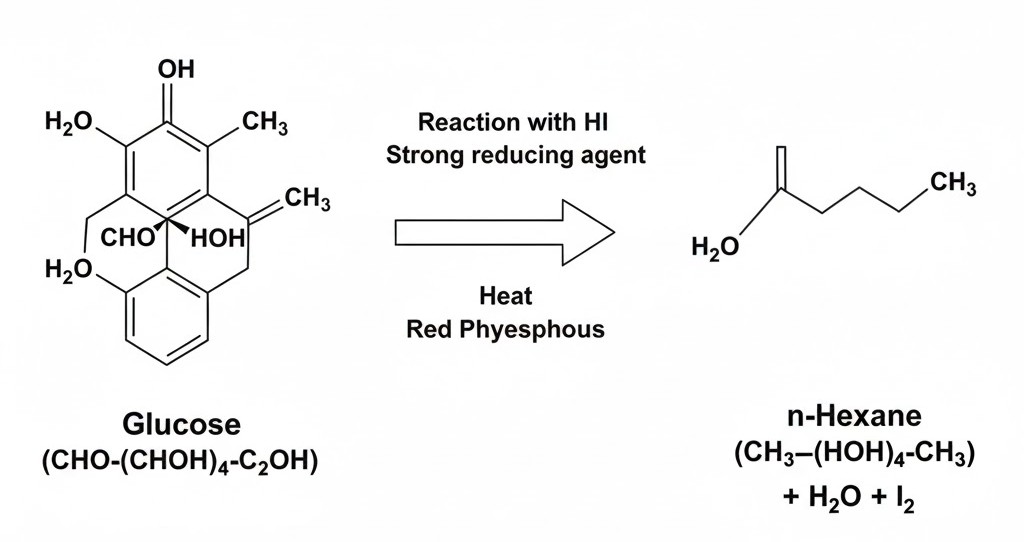
Glucose is an aldohexose with the molecular formula $C_{6}H_{12}O_{6}$. But how do we know its shape? When heated with $HI$ for a long time, it forms $n$-hexane. This proves all six carbons are sitting in a straight line, like students in a disciplined school assembly!.
Figure below:
A clear diagram showing the open-chain structure of glucose (CHO-(CHOH)4-CH2OH) and its reaction with HI to form n-hexane.
NEET Checkpoint:
Which product is formed when glucose is heated with $HI$?
(a) Hexanol
(b) n-Pentane
(c) Hexene
(d) n-hexane
✅ Answer: (d) $n$-hexane — This confirms the straight-chain structure.
Relatable Example: Think of sucrose hydrolysis like splitting a double-seat rickshaw—you start with one vehicle and end up with two separate passengers (glucose and fructose).
NEET Checkpoint:
Commercial glucose is prepared from which polysaccharide?
(a) Starch
(b) Cellulose
(c) Glycogen
(d) Inulin
✅ Answer: (a) Starch — By boiling it under high pressure and temperature.
Practice Question:
Which of the following is an aldohexose?
(a) Sucrose
(b) Starch
(c) Glucose
(d) Cellulose
✅ Answer: (c) Glucose — It has six carbons and an aldehyde group!.
Key Takeaway
Formula Summary:
- Glucose Formula: $C_{6}H_{12}O_{6}$
- Sucrose $\xrightarrow{H^+}$: Glucose + Fructose
- Starch $\xrightarrow{H^+}$: $n$ units of Glucose
- $HI$ Reaction: Glucose $\rightarrow$ $n$-hexane
5. Chemical Properties of Glucose: The "Lab Report" of Life
Hey champ! Ever wondered how scientists figured out what glucose actually looks like? They didn't have X-ray vision; they used some classic chemistry fundas to decode its structure piece by piece. Let's look at the evidence!
To see if glucose has a carbonyl group ($>C=O$), they reacted it with hydroxylamine ($NH_2OH$) to form an oxime, and with $HCN$ to get cyanohydrin. This proved the "heart" of the molecule was there.
NEET Checkpoint:
Which reagent confirms the presence of a carbonyl group in glucose?
(a) $HI$
(b) $NH_2OH$
(c) $Br_2$ water
(d) $HNO_3$
✅ Answer: (b) $NH_2OH$ — It reacts with the carbonyl group to form an oxime.
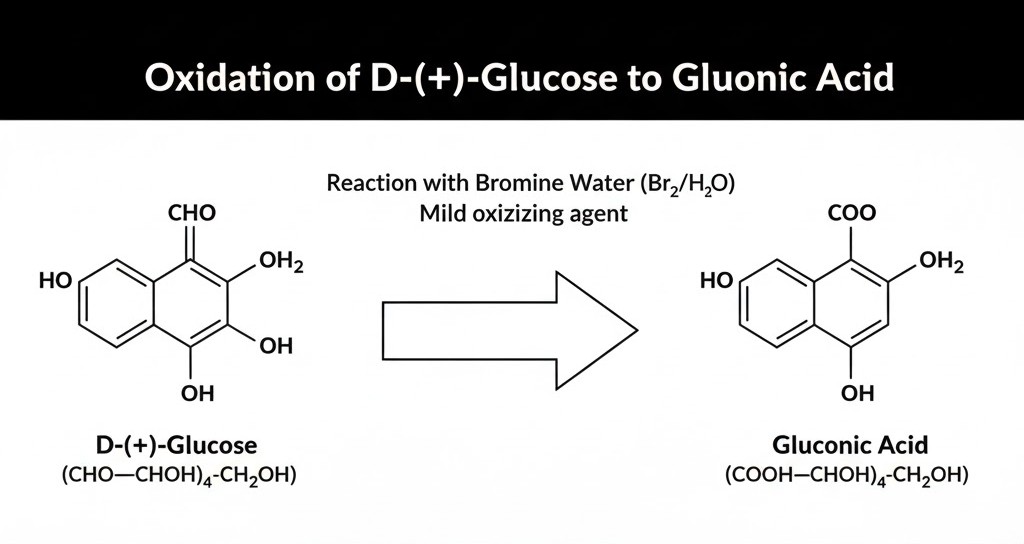
But is it an aldehyde or a ketone? By using mild bromine water, the $-CHO$ group was oxidised to a carboxyl group, forming gluconic acid. This confirmed the carbonyl is at the end of the chain as an aldehydic group.
Relatable Example: Think of bromine water like a "soft" umpire in cricket who only calls a wide if it's really obvious. It’s a mild oxidising agent that only reacts with the sensitive aldehyde, leaving the rest of the chain alone!
To find the five -OH groups, they used acetylation with acetic anhydride, resulting in glucose pentaacetate. Since it's stable, these five groups must be on different carbons.
NEET Checkpoint:
Acetylation of glucose confirms how many hydroxyl groups?
(a) 4
(b) 5
(c) 6
(d) 3
✅ Answer: (b) 5 — The formation of pentaacetate confirms five $-OH$ groups.
Finally, the D(+) configuration is assigned relative to (+) glyceraldehyde. In D-glucose, the $-OH$ on the lowest asymmetric carbon (C5) is on the right side. The '(+)' simply means it's dextrorotatory, spinning light to the right.
NEET Checkpoint:
In the D-configuration of glucose, the $-OH$ on the lowest asymmetric carbon is on the:
(a) Left
(b) Right
(c) Top
(d) Bottom
✅ Answer: (b) Right — This is the standard convention relative to D-(+)-glyceraldehyde.
Figure below:
A clear diagram showing the open-chain structure of D-(+)-glucose and its reaction with bromine water to form gluconic acid.
Practice Question:
Bromine water oxidation of glucose results in:
(a) Saccharic acid
(b) Gluconic acid
(c) n-Hexane
(d) Cyanohydrin
✅ Answer: (b) — Bromine water is a mild oxidising agent that specifically targets the aldehyde group to form a six-carbon carboxylic acid.
Key Takeaway:
- Carbonyl ($>C=O$): $NH_2OH$ (oxime) or $HCN$ (cyanohydrin).
- Aldehyde ($-CHO$): $Br_2$ water (gluconic acid).
- 5 -OH groups: Acetic anhydride (pentaacetate).
- D-Config: $-OH$ on C5 is on the right.
6. Cyclic Structure of Glucose
Arre, did you think the straight-chain structure was the whole story? Not quite, yaaro! While the open chain explains a lot, glucose likes to play hide-and-seek with its functional groups. For instance, despite having an aldehyde group, it fails the Schiff’s test and refuses to form an addition product with $NaHSO_{3}$. Even the pentaacetate of glucose acts shy and won't react with hydroxylamine, proving the $–CHO$ group isn't free to roam.
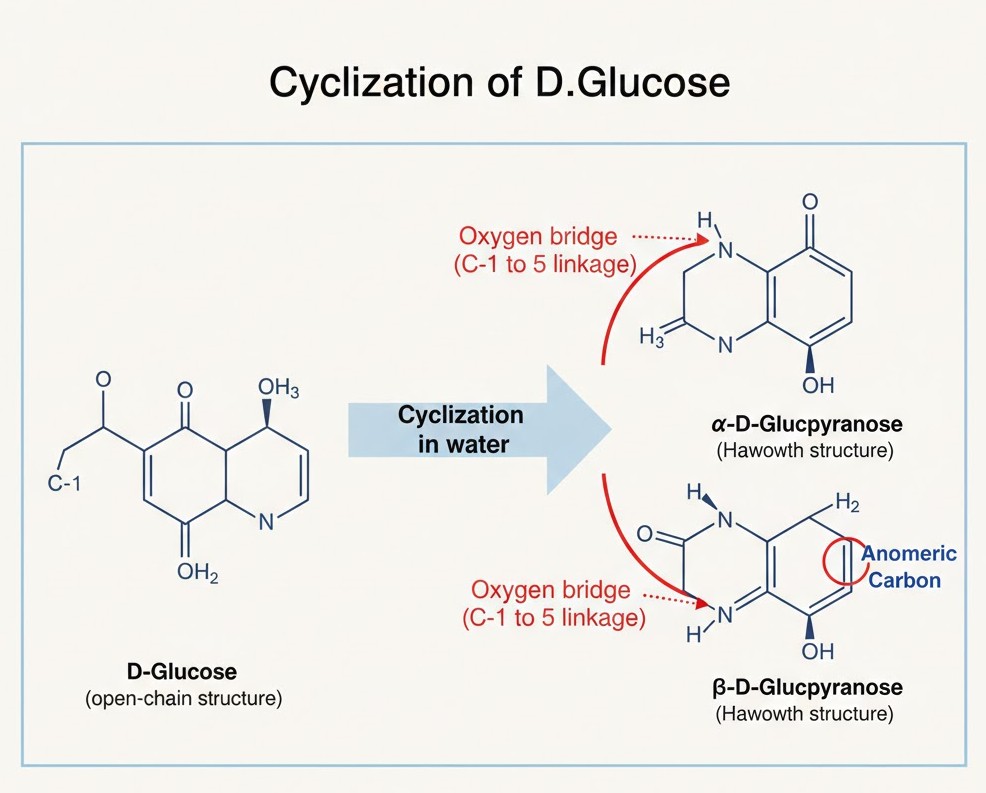
Here is the real funda: glucose actually forms a cyclic hemiacetal. The $-OH$ group at $C-5$ reaches out and bonds with the $C-1$ aldehyde carbon, creating a six-membered ring. This creates two new versions called anomers—the $\alpha$ and $\beta$ forms—which differ only at $C-1$, our famous anomeric carbon. Think of it like a folding chair; it’s the same chair, just in a different position!
NEET Checkpoint:
Why doesn't glucose pentaacetate react with hydroxylamine?
(a) High molecular mass
(b) Absence of free $–CHO$ group
(c) Presence of five $-OH$ groups
(d) It's a non-reducing sugar.
✅ Answer: (b) Absence of free $–CHO$ group — The aldehyde is locked in the cyclic structure!
We represent these using Haworth structures. Because the ring has five carbons and one oxygen, we call it a pyranose ring, named after the molecule 'pyran'. It’s like the frame of a local rickshaw—sturdy and specific!
NEET Checkpoint:
Which carbon atoms are involved in the cyclic hemiacetal ring of glucose?
(a) $C-1$ and $C-4$
(b) $C-1$ and $C-5$
(c) $C-2$ and $C-5$
(d) $C-1$ and $C-6$.
✅ Answer: (b) $C-1$ and $C-5$ — The $C-5$ hydroxyl group closes the ring at the $C-1$ aldehyde.
Figure below:
A high-quality educational diagram showing the cyclisation of D-glucose into $\alpha$-D-glucopyranose and $\beta$-D-glucopyranose Haworth structures, highlighting the oxygen bridge between C-1 and C-5 and labeling the anomeric carbon.
NEET Checkpoint:
What are $\alpha$-D-(+)-glucose and $\beta$-D-(+)-glucose collectively called?
(a) Epimers
(b) Enantiomers
(c) Anomers
(d) Isomers.
✅ Answer: (c) Anomers — They are cyclic hemiacetal forms differing only at $C-1$.
Practice Question:
The $\beta$-form of glucose is obtained by crystallisation from:
(a) Concentrated solution at $303\text{ K}$
(b) Hot and saturated aqueous solution at $371\text{ K}$
(c) Alcohol at room temperature
(d) Dilute $HCl$.
✅ Answer: (b) Hot and saturated aqueous solution at $371\text{ K}$ — The $\alpha$-form comes from $303\text{ K}$, don't mix them up!
Key Takeaway
- Limitations: Open chain fails Schiff's test and $NaHSO_{3}$ reaction.
- Structure: Six-membered pyranose ring formed by $C-1$ and $C-5$.
- Anomers: $\alpha$ and $\beta$ forms differ at the anomeric carbon ($C-1$).
7. Fructose: The Ketohexose
Let’s talk about Fructose, the "sweetest" member of the carbohydrate family! Found naturally in fruits, honey, and vegetables, it’s a total hit as a natural sweetener. While glucose is an aldohexose, fructose is a ketohexose with the same molecular formula: $C_{6}H_{12}O_{6}$.
NEET Checkpoint:
Fructose is a/an:
(a) Aldohexose
(b) Ketohexose
(c) Aldopentose
(d) Ketopentose.
✅ Answer: (b) Ketohexose — It has 6 carbons and a ketone group.
Think of it like this: if Glucose is your regular school bus, Fructose is the private AC coach—same capacity ($C_6H_{12}O_6$), but a different 'funda' (functional group)! It has a ketone group at $C-2$ and belongs to the D-series. But wait, don't get confused—it is actually laevorotatory, which is why we write it as $D-(-)$-fructose.
NEET Checkpoint:
Which carbon in fructose carries the ketonic group?
(a) First carbon (C-1)
(b) Second carbon (C-2)
(c) Third carbon (C-3)
(d) Sixth carbon (C-6)
✅ Answer: (b) Second carbon (C-2) — Unlike glucose ($C-1$ aldehyde), fructose keeps its ketone at the second carbon.
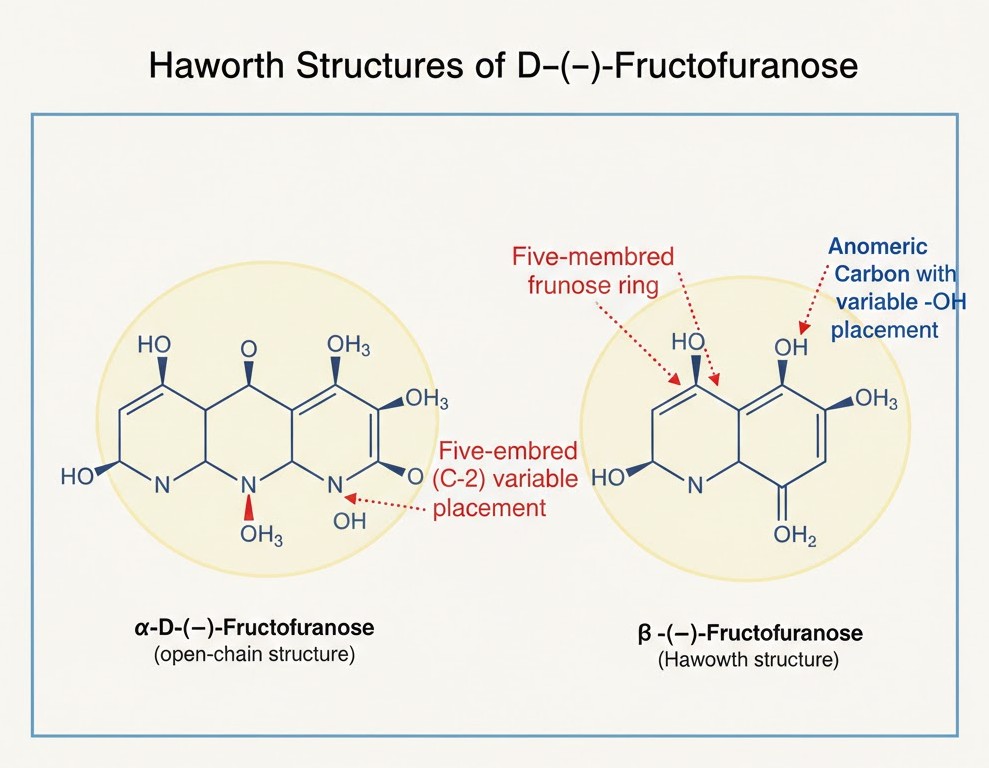
Unlike glucose’s 6-membered ring, fructose forms a five-membered ring called a furanose. This happens when the $-OH$ at $C-5$ joins the $(C=O)$ group at $C-2$. In the Haworth structures, you'll see $\alpha$ and $\beta$ anomers, which differ only at the $C-2$ anomeric carbon.
Figure below:
A clear diagram showing the Haworth structures of α-D-(-)-fructofuranose and β-D-(-)-fructofuranose side-by-side, highlighting the five-membered ring and the placement of OH groups at C-2.
NEET Checkpoint:
Fructose forms a five-membered ring called:
(a) Fructopyranose
(b) Fructofuranose
(c) Glucopyranose
(d) Glucofuranose
✅ Answer: (b) FructoFuranose — It is named so because it is analogous to the compound furan.
Practice Question:
Which of the following is true for $D-(-)$-fructose?
(a) It is a dextrorotatory compound.
(b) It contains an aldehyde group.
(c) It forms a 5-membered furanose ring.
(d) It is found only in milk.
✅ Answer: (c) — Fructose is a laevorotatory ketohexose that forms a furanose ring.
Key Takeaway
- Classification: Ketohexose with formula $C_{6}H_{12}O_{6}$.
- Functional Group: Ketone at $C-2$.
- Cyclic Form: 5-membered Furanose ring.
- Optical Nature: Laevorotatory ($D-(-)$ configuration).
8. Oligosaccharides: Sucrose, Maltose, and Lactose
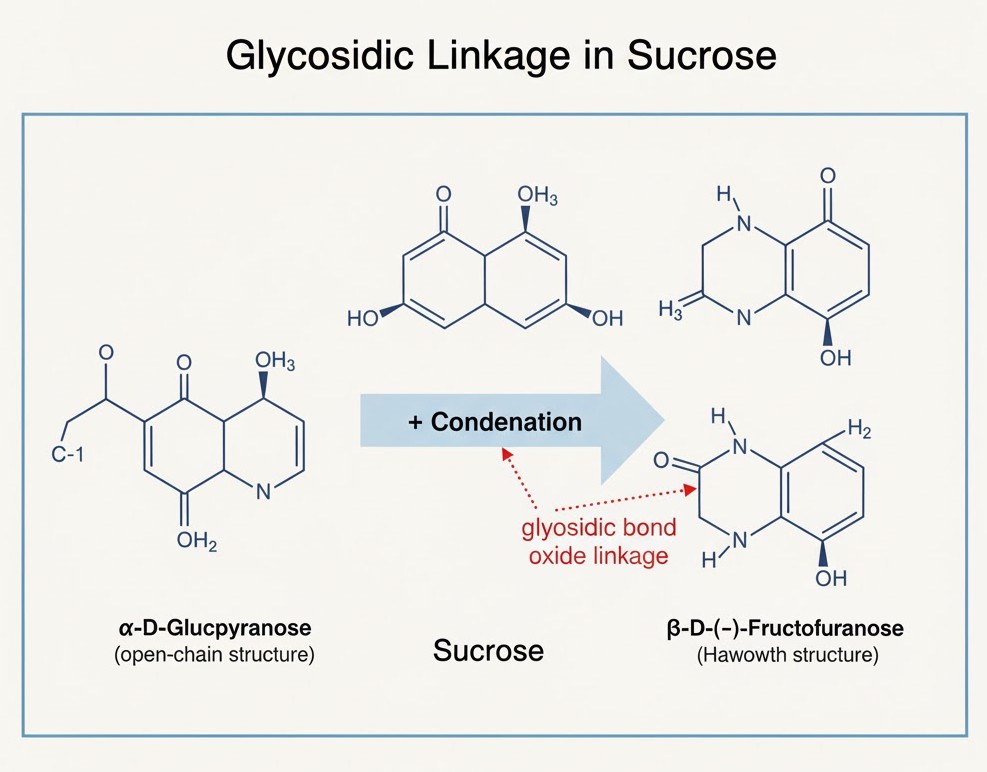
Hey there, future doctors! Ready to dive into the sweet world of oligosaccharides? These are carbohydrates that yield two to ten monosaccharide units upon hydrolysis. Think of them as a small team of sugars joined by a special "handshake" called a glycosidic linkage—an oxide bond formed by losing a water molecule.
Let’s start with Sucrose, our everyday table sugar. It’s a bit of a rebel! Unlike most small sugars, it is a non-reducing sugar because the reducing groups of its components—$C1$ of $\alpha$-D-glucose and $C2$ of $\beta$-D-fructose—are tied up in the linkage.
NEET Checkpoint:
Which of the following is a non-reducing sugar?
(a) Glucose
(b) Maltose
(c) Sucrose
(d) Lactose
✅ Answer: (c) Sucrose — Arre, remember! Its reducing groups are busy in the glycosidic bond.
When you hydrolyse sucrose, you get an equimolar mixture of glucose and fructose. Interestingly, while sucrose is dextrorotatory ($+$), the resulting mixture is laevorotatory ($-$) because fructose's laevorotation is much stronger than glucose's dextrorotation. This is why we call it invert sugar.
NEET Checkpoint:
Hydrolysis of sucrose is called inversion because:
(a) It forms a ring
(b) The sign of optical rotation changes
(c) It becomes a polysaccharide
(d) It loses water
✅ Answer: (b) The sign of optical rotation changes — Dextro becomes laevo because of that strong fructose "funda"!
Next is Maltose, the "malt sugar." It’s made of two $\alpha$-D-glucose units linked at $C1$ and $C4$. Since it has a free aldehyde group at the second glucose's $C1$, it is a reducing sugar.
Finally, we have Lactose, or "milk sugar." It’s composed of $\beta$-D-galactose and $\beta$-D-glucose linked via $C1$ and $C4$. It’s also a reducing sugar. Imagine putting your morning milk in a test tube; it would definitely reduce Fehling’s solution!
Figure blow:
A clear diagram showing the glycosidic linkage in sucrose between C1 of alpha-D-glucose and C2 of beta-D-fructose, highlighting the oxide bond.
Relatable Example: Think of sucrose like two best friends holding both hands during a game—they can’t catch a ball (reduce reagents) because their hands are occupied! Maltose and Lactose are like friends holding only one hand; they still have one hand free to catch the ball!
NEET Checkpoint:
Lactose is composed of:
(a) 2 Glucose units
(b) Glucose + Fructose
(c) Glucose + Galactose
(d) 2 Fructose units
✅ Answer: (c) Glucose + Galactose — This is the basic building block of milk sugar.
Practice Question:
Which linkage is found in Maltose?
(a) $C1-C2$
(b) $C1-C4$
(c) $C1-C6$
(d) $C2-C4$
✅ Answer: (b) $C1-C4$ — Specifically between two $\alpha$-D-glucose units.
Key Takeaway
- Oligosaccharides: Yield 2-10 monosaccharides.
- Glycosidic Linkage: Oxide bond between units.
- Sucrose: Non-reducing; $\alpha$-Glc ($C1$) + $\beta$-Fru ($C2$).
- Maltose: Reducing; $\alpha$-Glc ($C1$) + $\alpha$-Glc ($C4$).
- Lactose: Reducing; $\beta$-Gal ($C1$) + $\beta$-Glc ($C4$).
9. Proteins and $\alpha$-Amino Acids
Hey future doctors! Let's clear the funda of Proteins—the most abundant biomolecules in your system. Derived from the Greek word 'proteios', they are of 'prime importance' because they literally build and maintain your body.
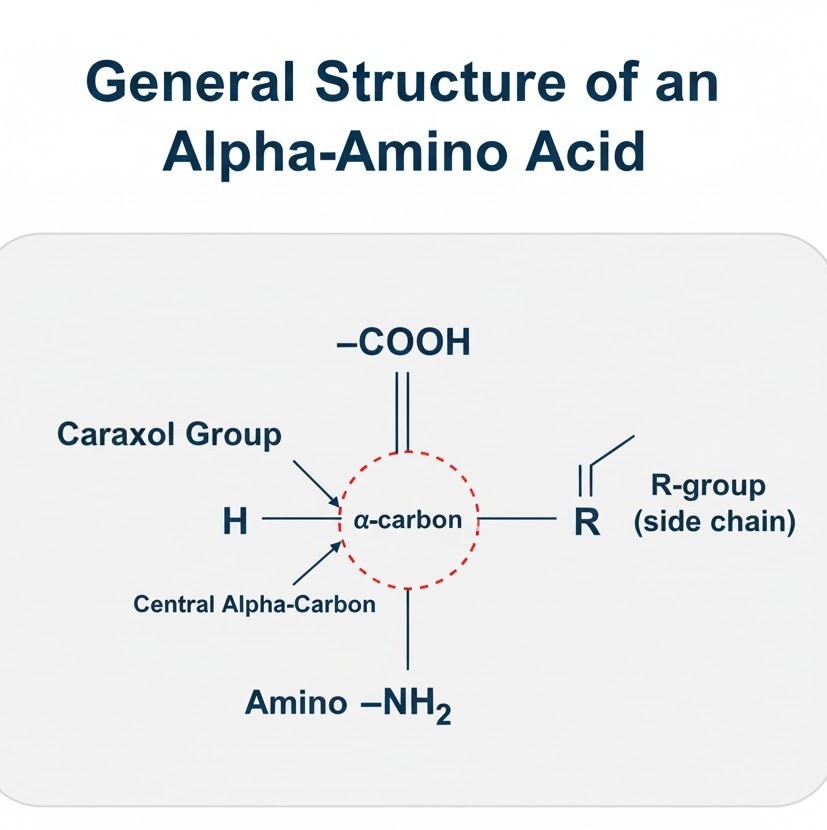
Proteins are actually long polymers made of $\alpha$-amino acids. Think of these acids as the 'Lego blocks' of life. Every $\alpha$-amino acid has a specific 'kit' containing both an amino ($-NH_{2}$) group and a carboxyl ($-COOH$) group.
The general structure looks like this:
Here, $R$ is a side chain that changes for every amino acid. It's like a local rickshaw—the basic structure (frame and wheels) stays the same, but the 'extra fittings' ($R$ group) make each one unique!
NEET Checkpoint:
Which functional groups are present in all amino acids?
(a) Carbonyl and Hydroxyl
(b) Amino and Carboxyl
(c) Nitro and Amino
(d) Carboxyl and Aldehyde
✅ Answer: (b) Amino and Carboxyl — Arre, these are the 'base' and 'acid' parts that give it the name!
Classification is simple math:
* Neutral: Equal number of $-NH_{2}$ and $-COOH$.
* Acidic: More $-COOH$ groups.
* Basic: More $-NH_{2}$ groups.
NEET Checkpoint:
If an amino acid has more carboxyl groups than amino groups, it is...?
(a) Basic
(b) Neutral
(c) Acidic
(d) Essential
✅ Answer: (c) Acidic — More acid ($-COOH$) means an acidic nature, simple logic, yaar!
Then we have the Essential vs. Non-essential split. Your body is quite a chef and can cook up 'non-essential' amino acids on its own. But the Essential ones? Your body can't make them, so you must get them from your diet.
NEET Checkpoint:
Which amino acids cannot be synthesised by the body?
(a) Non-essential
(b) Essential
(c) Neutral
(d) Acidic
✅ Answer: (b) Essential — Since they are essential for survival but not 'home-made', they must come from food!
Practice Question:
Based on the classification rules, which of the following is a basic amino acid?
(a) Glycine
(b) Alanine
(c) Lysine
(d) Valine
✅ Answer: (c) Lysine — Arre, check the side chain in Table 10.2; it has an extra amino group!
Figure below:
A clear diagram showing the general structure of an alpha-amino acid, with the alpha-carbon at the center bonded to an H atom, an R side chain, a carboxyl group, and an amino group.
Key Takeaway
- Proteins: Polymers of $\alpha$-amino acids used for growth.
- Structure: Contains both basic $-NH_{2}$ and acidic $-COOH$.
- Essential: Amino acids that must be obtained via diet.
10. Properties of Amino Acids and Zwitterions
Listen up, junior! Amino acids aren't just your average organic compounds; they are the high-achievers of the molecular world. Physically, they are colourless, crystalline, water-soluble solids. Unlike simple amines, they have high melting points and behave like salts. Why? Because they are basically "living a double life" as dipolar ions.
NEET Checkpoint:
Why do amino acids behave like salts rather than simple amines?
(a) Because they exist as zwitterions
(b) Because they are insoluble in water
(c) Because they have high molecular mass
(d) Because they contain only amino groups
✅ Answer:(a) Due to the presence of both acidic and basic groups in the same molecule, leading to Zwitterion formation.
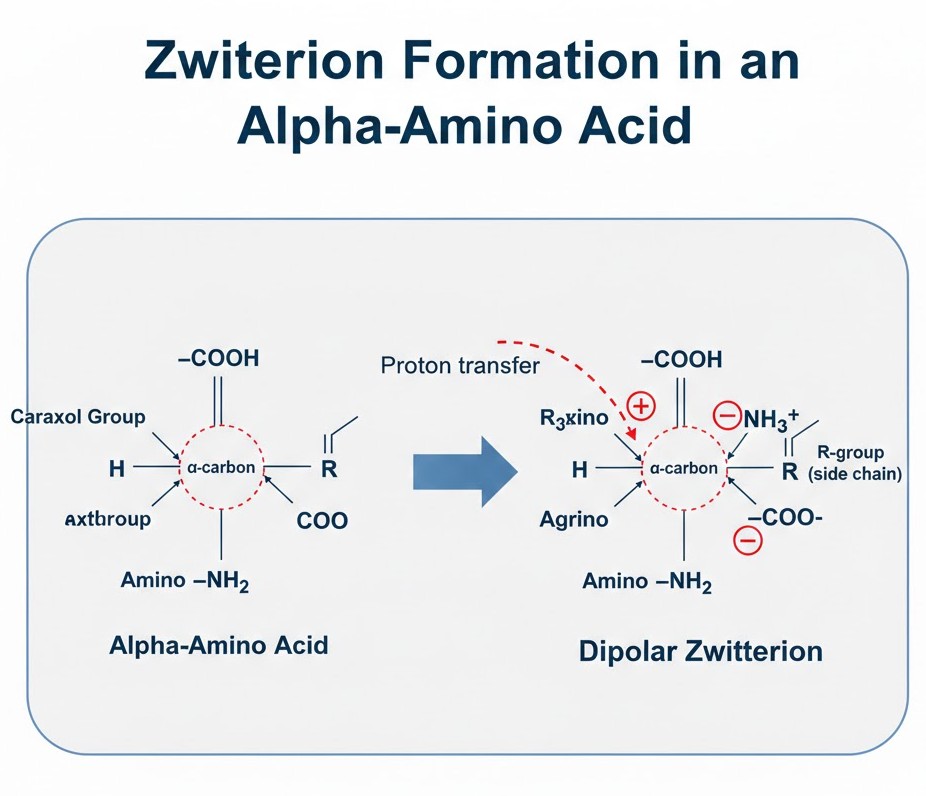
In aqueous solution, the $-COOH$ group loses a proton ($H^{+}$) and the $-NH_{2}$ group accepts it. This creates a dipolar ion called a Zwitterion. It is neutral but carries both $+ve$ and $-ve$ charges. Imagine a Pani Puri stall—it has to be both spicy and sweet to satisfy everyone; similarly, this duality makes amino acids amphoteric, meaning they react with both acids and bases.
Figure below:
A clear structural diagram showing an $\alpha$-amino acid transitioning into a dipolar Zwitterion by moving a proton from the carboxyl group to the amino group.
NEET Checkpoint:
Which amino acid is optically inactive?
(a) Glycine
(b) Alanine
(c) Valine
(d) Leucine
✅ Answer: (a) Glycine — It is the only natural $\alpha$-amino acid where the $\alpha$-carbon is not asymmetric.
Except for Glycine, all naturally occurring $\alpha$-amino acids are optically active because the $\alpha$-carbon is asymmetric. Most of them exist in the L-configuration, where the $-NH_{2}$ group is represented on the left side. Arre, just remember "L for Left," and you’ll never confuse it with the D-form!
NEET Checkpoint:
In L-amino acids, on which side is the amino group written?
(a) Left side
(b) Right side
(c) Top side
(d) Bottom side
✅ Answer: (a) Left side. In L-amino acids (Fischer projection), the amino group (–NH₂) is always written on the left.
Practice Question:
The Zwitterionic form of an amino acid is:
(a) Positively charged
(b) Negatively charged
(c) A dipolar, neutral ion
(d) Non-polar
✅ Answer: (c) — It contains both positive and negative charges, making it a dipolar but overall neutral ion.
Key Takeaway
- Physical State: Colourless, crystalline, water-soluble solids with salt-like behaviour.
- Zwitterion: A dipolar neutral ion formed by internal $H^{+}$ transfer.
- Nature: Amphoteric and primarily L-configuration (except Glycine).
11. Peptide Bonds and Protein Classification
Let’s understand how these amino acids actually 'shake hands' to form proteins! When the $-COOH$ group of one amino acid reacts with the $-NH_{2}$ group of another, a water molecule is kicked out—that’s water elimination, yaar—forming an amide linkage represented as $-CO-NH-$. This specific connection is what we call a peptide bond.
NEET Checkpoint:
A peptide bond is chemically which type of linkage?
(a) Glycosidic
(b) Ester
(c) Amide
(d) Ether
✅ Answer: (c) Amide — It’s the $-CO-NH-$ bond formed between two amino acid units.
Think of it like a long Mumbai Local train. One bogie (amino acid) hooks onto another. If you have two bogies, it’s a dipeptide. Three bogies make a tripeptide. When you have more than ten, it's a polypeptide. Generally, if a polypeptide has more than 100 amino acids and a molecular mass $> 10,000 u$, we call it a protein. But don't forget the VIP exception: Insulin has only 51 amino acids but is still a protein!
NEET Checkpoint:
A polypeptide is generally called a protein when it has more than:
(a) 10 amino acids
(b) 50 amino acids
(c) 100 amino acids
(d) 20 amino acids
✅ Answer: (c) 100 amino acids — Though some with fewer, like insulin, are also proteins.
We classify proteins into two shapes:
1. Fibrous Proteins: Chains run parallel like railway tracks, held by hydrogen and disulphide bonds. They are insoluble in water. Think of Keratin in your hair or myosin in muscles.
2. Globular Proteins: Chains coil around into a spherical "ball" shape. These are soluble in water. Examples include insulin and albumins.
NEET Checkpoint:
Which of the following is an example of a fibrous protein?
(a) Insulin
(b) Albumin
(c) Keratin
(d) Enzyme
✅ Answer: (c) Keratin — It forms a fibre-like structure and is insoluble in water.
Practice Question:
Which statement is true for globular proteins?
(a) They are insoluble in water.
(b) They have a spherical shape.
(c) Keratin is a primary example.
(d) They consist of parallel strands only.
✅ Answer: (b) — Globular proteins coil up into spheres and are typically water-soluble.
Key Takeaway:
- Peptide Link: Amide bond ($-CO-NH-$) from water loss.
- Fibrous: Parallel, Insoluble (e.g., Keratin, Myosin).
- Globular: Spherical, Soluble (e.g., Insulin, Albumin).
12. Hierarchy of Protein Structure
Oye junior! Don't let the "Hierarchy of Protein Structure" give you a headache. It’s just like how a simple thread becomes a fancy sherwani—it's all about the layers!.
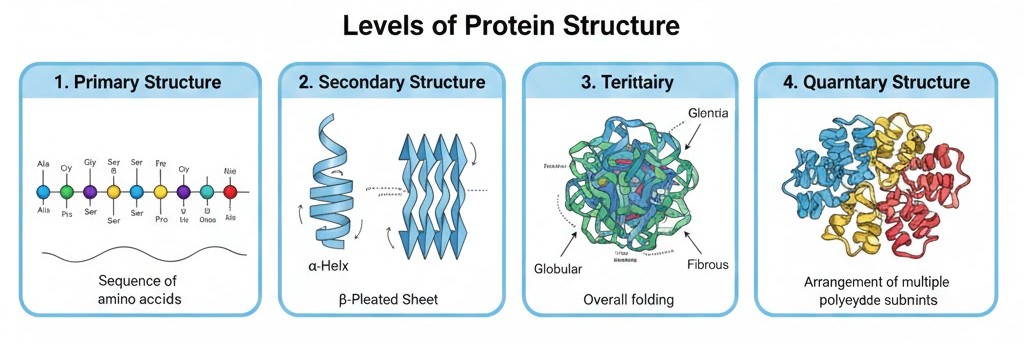
1. Primary Structure: This is just the specific sequence of amino acids in a polypeptide chain. Think of it like a Mumbai local train; if you change the order of the bogies, the whole "protein train" becomes something else entirely!.
2. Secondary Structure: Here, the chain starts folding into an $\alpha$-helix (like a spiral staircase or a right-handed screw) or a $\beta$-pleated sheet (resembling the pleated folds of a heavy saree or drapery). The "glue" here is hydrogen bonding between the $>C=O$ and $-NH-$ groups of the peptide bond.
NEET Checkpoint:
Which bond stabilizes secondary structures?
(a) Hydrogen bond
(b) Peptide bond
(c) Disulfide bond
(d) Ionic bond
✅ Answer: (a) Hydrogen bonds — It's the H-bond between peptide groups that keeps the helix intact!.
3. Tertiary Structure: This represents the overall folding of the polypeptide chains, giving us fibrous or globular shapes. This level is stabilized by H-bonds, disulphide linkages, van der Waals, and electrostatic forces.
4. Quaternary Structure: Some proteins are "extra" and are made of two or more polypeptide chains called sub-units. Their spatial arrangement with respect to each other is the quaternary structure.
Figure below:
A clear diagram showing the four levels of protein structure: Primary (sequence of amino acid beads), Secondary (alpha-helix and beta-pleated sheet), Tertiary (overall folding into globular/fibrous shapes), and Quaternary (arrangement of multiple polypeptide subunits).
NEET Checkpoint:
Which structure gives rise to globular or fibrous shapes?
(a) Primary structure
(b) Secondary structure
(c) Tertiary structure
(d) Quaternary structure
✅ Answer: (c) Tertiary structure — This level determines the overall 3D "funda" of the protein.
NEET Checkpoint:
What constitutes the primary structure?
(a) Sequence of amino acids
(b) Hydrogen bonding between –CO and –NH groups
(c) 3D folding of polypeptide chain
(d) Interaction between multiple polypeptide chains
✅ Answer: (a) Sequence of amino acids — Just like letters in a word, the order is everything!.
Practice Question:
If a protein consists of multiple polypeptide sub-units, which level of structure describes their spatial arrangement?
(a) Primary
(b) Secondary
(c) Tertiary
(d) Quaternary
✅ Answer: (d) Quaternary — Remember, this level is specifically about how different sub-units sit together.
Key Takeaway
- Primary: Amino acid sequence..
- Secondary: $\alpha$-helix/$\beta$-sheet (H-bonds)..
- Tertiary: 3D folding (Fibrous/Globular)..
- Quaternary: Sub-unit arrangement..
13. Denaturation and Enzymes
Listen up, junior! Ever wondered why a boiled egg doesn't turn back into a runny one, or how your body digests dinner so fast? Let’s clear up this biochemistry funda!
A native protein is a protein in its natural, active 3D shape, ready to do its job. But proteins are sensitive souls. If you change the temperature (like boiling an egg) or shift the pH (like adding lemon to milk), the hydrogen bonds get disturbed. The protein’s globules unfold and the helixes uncoil. This "unwrapping" is called denaturation.
NEET Checkpoint:
Which protein structure remains intact during denaturation?
(a) Secondary
(b) Tertiary
(c) Primary
(d) Quaternary
✅ Answer: (c) Primary — The sequence of amino acids is tough; it stays joined even when the 3D shape is wrecked!
Think of denaturation like a neatly folded paper plane getting crushed into a ball. It’s still paper (Primary structure), but it won't fly anymore!
Now, meet the Enzymes. These are globular proteins that act as high-speed biocatalysts. They are incredibly specific—like a key that only fits one lock. They work by lowering the activation energy ($E_a$).
Relatable Example: Imagine you're trying to push a heavy Royal Enfield up a steep hill. That hill is the "activation energy." An enzyme is like a secret tunnel through the hill—it makes the journey way easier and faster!
For example, hydrolysing sucrose with acid takes an $E_a$ of $6.22 \text{ kJ mol}^{-1}$, but with the enzyme sucrase, it drops to just $2.15 \text{ kJ mol}^{-1}$.
Figure below:
A diagram showing a 'Native Protein' as a complex coiled globule, followed by an arrow labeled 'Heat/pH change' pointing to a 'Denatured Protein' which appears as a long, uncoiled random string.
NEET Checkpoint:
Almost all enzymes are:
(a) Fibrous proteins
(b) Globular proteins
(c) Carbohydrates
(d) Lipids
✅ Answer: (b) Globular proteins — They are spherical and soluble, perfect for biological reactions!
NEET Checkpoint:
The enzyme that converts maltose into glucose is:
(a) Zymase
(b) Maltase
(c) Invertase
(d) Sucrase
✅ Answer: (b) Maltase — Easy trick: just add '-ase' to the substrate name!
Practice Question:
What happens to the biological activity of a protein after denaturation?
(a) It increases
(b) It stays the same
(c) It is lost
(d) It doubles
✅ Answer: (c) It is lost — Once the shape goes, the function goes with it!
Key Takeaway
- Native Protein: Functional 3D state.
- Denaturation: Loss of $2^{\circ}$ and $3^{\circ}$ structures due to Temp/pH; $1^{\circ}$ stays.
- Enzymes: Specific globular proteins that lower Activation Energy ($E_a$).
14. Vitamins: Classification and Functions
Hey there, future doctor! Let's talk about the "secret agents" of our body—Vitamins. These are organic compounds required in teeny-tiny amounts in our diet to keep our biological machinery running smoothly. Think of them like the "extra masala" in your favorite street-side pani puri; you only need a pinch, but without it, the whole system loses its balance!
NEET Checkpoint:
Why are vitamins called "essential food factors"?
(a) They give energy
(b) Most can't be synthesised by the body
(c) They are inorganic
(d) They are needed in large amounts
✅ Answer: (b) — Correct! Plants make them, but we must eat them to survive.
The Solubility Game
We classify vitamins based on whether they love oil or water. It's a simple funda:
- Fat-Soluble (A, D, E, and K): These are the "STAY-cation" vitamins. They dissolve in fats and are stored in your liver and adipose (fat) tissues.
- Water-Soluble (B-group and C): These are the "Tourists." They dissolve in water and are readily excreted in urine. Because your body can't store them (except for our rebel friend Vitamin $B_{12}$), you need to eat them regularly!
NEET Checkpoint:
Which water-soluble vitamin is the exception and can be stored in the body?
(a) $B_{1}$
(b) $C$
(c) $B_{12}$
(d) $B_{6}$
✅ Answer: (c) — Arre, don't forget this! $B_{12}$ is the only water-soluble one that sticks around.
Deficiency Drama
If these agents go missing, your body starts a protest. Check out these major deficiency diseases:
* Vitamin A: Leads to Xerophthalmia (hardening of the cornea) or night blindness.
* Vitamin $B_{1}$ (Thiamine): Causes Beri-beri, making you lose appetite and retarding growth.
* Vitamin C: Results in Scurvy (bleeding gums).
* Vitamin D: Causes Rickets in kids, leading to bone deformities. Imagine trying to play a heavy cricket shot with a "soft" bone—not happening, yaar!
NEET Checkpoint:
A patient has bleeding gums. Which vitamin is likely missing?
(a) Vit K
(b) Vit D
(c) Vit C
(d) Vit A
✅ Answer: (c) — Scurvy is the classic sign of Vitamin C deficiency.
Practice Questions
1. Which of the following is NOT a fat-soluble vitamin?
(a) Vitamin A
(b) Vitamin B
(c) Vitamin E
(d) Vitamin K
✅ Answer: (b) Vitamin B-group and C are water-soluble; A, D, E, and K are fat-soluble.
2. Where does the body store Vitamin A?**
(a) Kidneys
(b) Muscles
(c) Liver
(d) Pancreas
✅ Answer: (c) Fat-soluble vitamins like A are stored in the liver and adipose tissues.
Key Takeaway
- Fat-Soluble: $A, D, E, K$ (Stored in Liver/Fat).
- Water-Soluble: $B\text{-group}, C$ (Excreted in urine; need daily intake).
- $B_{12}$: The only water-soluble vitamin that can be stored.
15. Nucleic Acids: DNA and RNA
Arre junior, let’s decode the secret code of life—Nucleic Acids! Think of DNA and RNA as the "Master Manuals" stored in the cell's nucleus. Don't worry, it's not as complex as trying to find a parking spot for a rickshaw in Chandni Chowk!
First, the building blocks: A nucleotide is made of a pentose sugar, phosphoric acid, and a nitrogenous base. In DNA, the sugar is $\beta$-$D$-$2$-deoxyribose, while RNA uses $\beta$-$D$-ribose. The bases are split into Purines (Adenine $A$ and Guanine $G$) and Pyrimidines (Cytosine $C$, Thymine $T$, and Uracil $U$ in RNA).
NEET Checkpoint:
Which base is unique to DNA and not found in RNA?
(a) Adenine
(b) Thymine
(c) Guanine
(d) Cytosine
✅ Answer: (b) Thymine ($T$) — RNA swaps it for Uracil ($U$). Easy marks, don't miss this funda!
When a base joins the sugar at the $1'$ position, you get a nucleoside. Add a phosphate at the $5'$ position, and boom—you have a nucleotide! These link up via phosphodiester linkages between the $5'$ and $3'$ carbons. It’s like a legendary opening pair in cricket—Sachin and Saurav—they just fit perfectly together.
NEET Checkpoint:
A nucleoside is formed by the attachment of a base to which position of the sugar?
(a) 1′- position
(b) 2′- position
(c) 3′- position
(d) 5′- position
✅ Answer: (a) $1'$ - position — Just remember the base comes first!
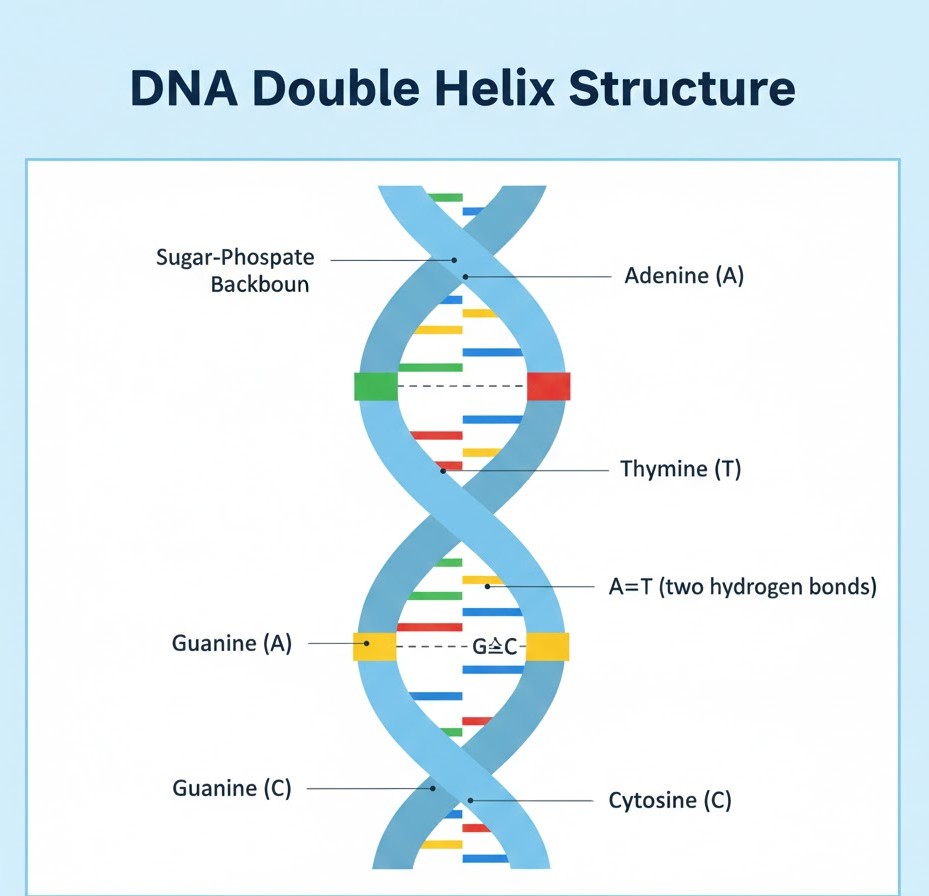
Watson and Crick discovered the famous double helix. The magic is in the complementary base pairing: $A$ always pairs with $T$ via two hydrogen bonds, and $G$ with $C$ via three.
Figure below:
A clear diagram of the DNA double helix showing the sugar-phosphate backbone and complementary base pairing between $A=T$ and $G\equiv C$ as described in Figure 10.7 of the sources.
NEET Checkpoint:
What type of linkage joins nucleotides in a chain?
(a) Glycosidic bond
(b) Phosphodiester bond
(c) Peptide bond
(d) Hydrogen bond
✅ Answer: (b) Phosphodiester linkage — Specifically between the $5'$ and $3'$ carbon atoms!
Why do these matter? DNA is the boss of heredity, maintaining species identity. It handles self-duplication and carries the recipe for protein synthesis, though RNA actually carries out the cooking!
Practice Question:
If a DNA strand has the sequence $A-T-G-C$, its complementary strand will be:
(a) $T-A-C-G$
(b) $U-A-C-G$
(c) $G-C-T-A$
(d) $A-T-G-C$
✅ Answer: (a) — Because $A$ pairs with $T$ and $G$ pairs with $C$. Basic logic, yaar!
Key Takeaway
- DNA Sugar: $2$-deoxyribose; RNA Sugar: Ribose.
- Bases: Purines ($A, G$), Pyrimidines ($C, T, U$).
- Structure: Double helix held by hydrogen bonds ($A=T, G\equiv C$).
- Functions: Heredity, self-duplication, and protein synthesis.