
1. Introduction to Atomic Structure & Subatomic Particles
Hey future doctors! Ready to crack the funda of the atom? Long ago, Dalton thought atoms were like hard gulab jamuns—indivisisible and final. But he couldn't explain why rubbing ebonite with fur creates a spark of electricity. Dalton's Atomic Theory basically crashed because it ignored the electrical nature of matter.
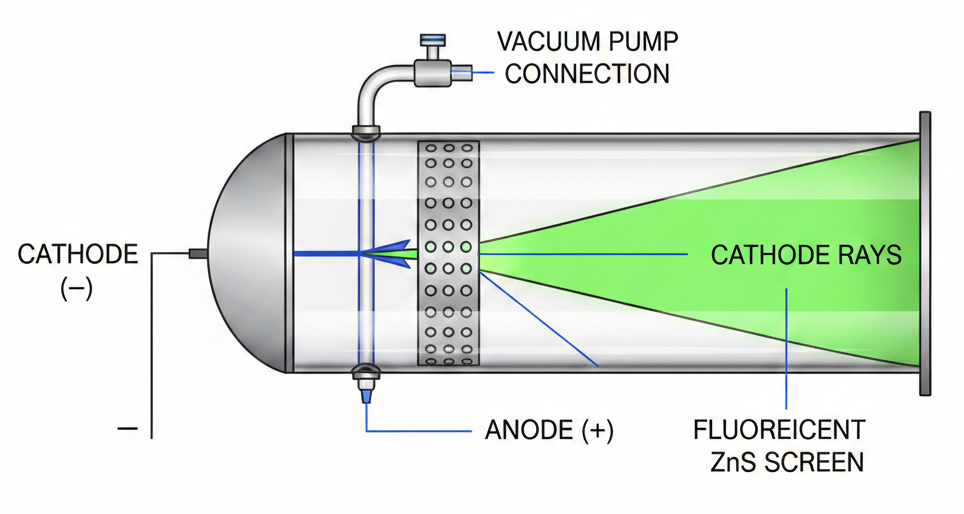
Scientists then used cathode ray discharge tubes (think of them like the old-school bulky TVs) to find the first subatomic particle: the electron. These rays travel in straight lines from the negative cathode to the positive anode.
NEET Checkpoint:
Do cathode ray properties change with the gas inside the tube?
(a) Yes
(b) No
✅ Answer: (b) No — Unlike canal rays, electrons are universal constituents of all matter.
J.J. Thomson measured the charge-to-mass ratio using the formula:
Then came Millikan’s famous Oil Drop Experiment, where he balanced tiny droplets to find the charge of an electron: $e = -1.602176 \times 10^{-19} \text{ C}$.
Relatable Example: Imagine a cricket match where the ball’s trajectory is changed by a sudden wind—Thomson did exactly that with electric and magnetic fields to study electrons!.
Protons were found via canal rays (positive ions), and their mass actually depends on the gas used. Finally, in 1932, Chadwick discovered the neutral neutron by hitting Beryllium with $\alpha$-particles.
NEET Checkpoint:
Who discovered the neutron?
(a) J. J. Thomson
(b) Ernest Rutherford
(c) James Chadwick
(d) Niels Bohr
✅ Answer: (c) James Chadwick in 1932.
NEET Checkpoint:
What is the absolute charge of a proton?
(a) $+1.6 \times 10^{-19} \text{ C}$
(b) $-1.6 \times 10^{-19} \text{ C}$
(c) 0 C
(d) $+9.1 \times 10^{-31} \text{ C}$
✅ Answer: (a) $+1.602176 \times 10^{-19} \text{ C}$ — Same magnitude as an electron, just positive!.
Figure below:
A detailed diagram of a cathode ray discharge tube showing the cathode, anode, vacuum pump connection, and the fluorescent ZnS coating glowing behind the perforated anode.
Practice Question:
If the $e/m_{e}$ ratio is $1.76 \times 10^{11} \text{ C/kg}$ and the charge is $1.6 \times 10^{-19} \text{ C}$, what is the mass of the electron?
(a) $9.1 \times 10^{-31} \text{ kg}$
(b) $1.67 \times 10^{-27} \text{ kg}$
✅ Answer: (a) — Just divide charge by the ratio! Arre, it's simple math, yaar.
Key Takeaway & Formula Summary
- Electron mass ($m_{e}$): $9.1094 \times 10^{-31} \text{ kg}$
- Proton mass ($m_{p}$): $1.6726 \times 10^{-27} \text{ kg}$
- Neutron mass ($m_{n}$): $1.6749 \times 10^{-27} \text{ kg}$
- Note: Electrons are universal; canal ray properties depend on the gas.
2. Early Atomic Models and Their Limitations
Let’s clear the funda of how we actually figured out what’s inside an atom! Before the high-tech quantum stuff, scientists were just trying to guess the "vibe" of an atom.
Thomson’s "Pudding" Party
In 1898, J.J. Thomson proposed that an atom is a sphere (radius $\approx 10^{-10}$ m) of uniform positive charge with electrons embedded in it. Think of it like a Gajar ka Halwa where the halwa is the positive charge and the dry fruits are electrons! This plum pudding or watermelon model explained why atoms are neutral, but it couldn't stand up to later experiments.
NEET Checkpoint:
What did Thomson assume about the mass of an atom?
(a) Concentrated only at the center
(b) Due only to electrons
(c) Uniformly distributed throughout the atom
(d) Negligible compared to its charge
✅ Answer: (c) He assumed it was uniformly distributed over the atom.
Rutherford’s "Sixer" Moment
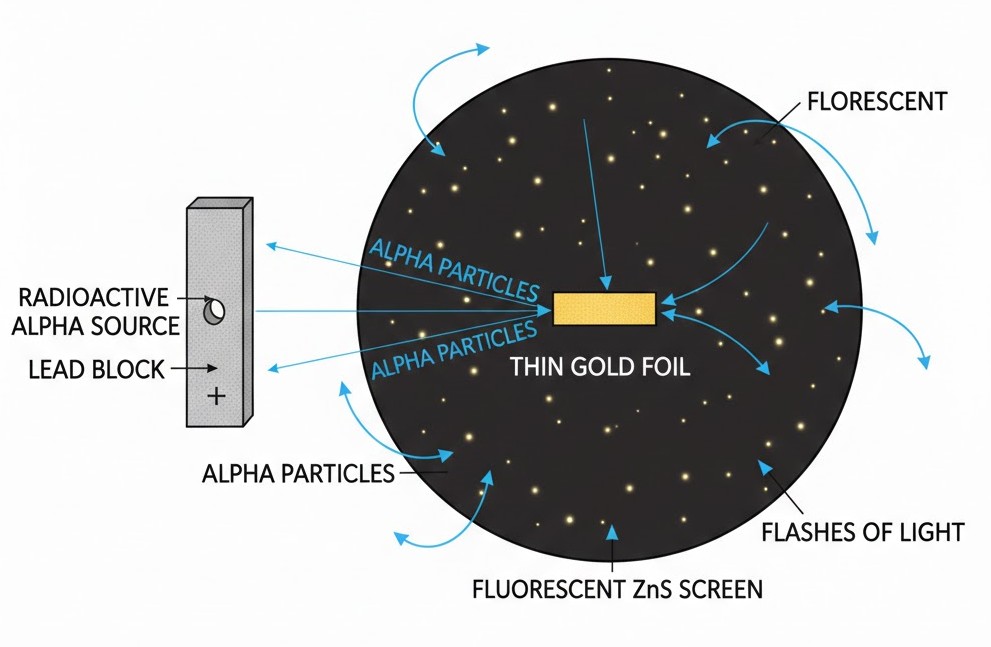
Rutherford and his students shot high-energy $\alpha$-particles at a gold foil only $\approx 100$ nm thick. Most particles zipped right through undeflected. But wait! A few bounced back at nearly $180^\circ$. Imagine hitting a plastic ball at a tissue paper and it bounces back at you—crazy, right?.
He concluded the atom is mostly empty space with a tiny, dense nucleus at the centre. If a cricket ball represents the nucleus, the atom's radius would be about $5$ km! In his Nuclear Model, electrons move in circular orbits like planets around the Sun, held by electrostatic forces.
Figure below:
A clear diagram showing Rutherford’s alpha-particle scattering experiment with a radioactive source of alpha particles, a thin gold foil, and a circular fluorescent zinc sulphide screen detecting flashes of light.
NEET Checkpoint:
What fraction of $\alpha$-particles bounced back in the scattering experiment?
(a) Almost all
(b) Very few
(c) About half
(d) None
✅ Answer: (b) Very few, about 1 in 20,000.
The Big Flop: Drawbacks
Rutherford’s model had a major glitch. According to Maxwell’s theory, an accelerated charged electron should constantly emit radiation. This means it would lose energy and spiral into the nucleus in just $10^{-8}$ s. Arre, if that happened, matter would be unstable and we wouldn't exist! Also, he couldn't explain how electrons are distributed or what their energies are.
NEET Checkpoint:
Why does an orbiting electron undergo acceleration?
(a) Its speed keeps increasing
(b) Its velocity changes direction continuously
(c) It loses energy continuously
(d) The nucleus repels the electron
✅ Answer: (b) Because it is constantly changing direction in its circular path.
Practice Questions:
1. The radius of the nucleus is approximately:
(a) $10^{-10}$ m
(b) $10^{-15}$ m
(c) $10^{-12}$ m
(d) $10^{-8}$ m
✅ Answer: (b) $10^{-15}$ m — It's tiny compared to the $10^{-10}$ m atom.
2. Rutherford's model was compared to which macroscopic system?
(a) A plum pudding
(b) A staircase
(c) The solar system
(d) A cricket match
✅ Answer: (c) The solar system — Nucleus is the Sun, electrons are planets.
Key Takeaway
- Thomson: Uniform positive sphere; radius $\approx 10^{-10}$ m.
- Rutherford: Discovery of nucleus; radius $\approx 10^{-15}$ m; planetary electrons.
- Failure: Cannot explain atomic stability or electron distribution.
3. Fundamental Atomic Properties
Let's decode the atom’s "ID card", shall we? Every element has a unique identity, just like your Aadhaar number or your roll number in tuition.
Atomic Number ($Z$) is simply the number of protons in the nucleus. For neutral atoms, it also equals the number of electrons. Notice this: $Z$ is what defines the element. If $Z$ changes, the element changes!
Mass Number ($A$) is the heavy stuff. It's the total number of protons and neutrons, which we collectively call nucleons.
NEET Checkpoint:
In a neutral atom, if $Z = 11$, how many electrons are there?
(a) 10
(b) 22
(c) 33
(d) 11
✅ Answer: (d) 11 — In a neutral species, number of protons always equals number of electrons.
The relationship is simple:
where $n$ is the number of neutrons. If you know the mass and the atomic number, finding $n$ is just basic subtraction, yaar!
Isotopes vs. Isobars:
Isotopes are like siblings. They have the same $Z$ but different $A$. Take Hydrogen’s family: Protium (${}{1}^{1}H$), Deuterium (${}{1}^{2}H${1}^{2}H$), and Tritium (${}_{1}^{3}H$). Because they have the same number of electrons, they show the same chemical behaviour.
Isobars, on the other hand, are like strangers who happen to weigh the same. They have the same $A$ but different $Z$, like ${}{6}^{14}C$ and ${}{7}^{14}N${7}^{14}N$.
NEET Checkpoint:
What is the number of neutrons in Tritium (${}_{1}^{3}T$)?
✅ Answer: 2 — $n = A - Z$. So, $3 - 1 = 2$.
Example: Imagine two different backpacks at a bus stand. One is filled with bricks and the other with heavy books. Both might weigh $10 kg$ (same $A$), but their "identity" is totally different. Those are your Isobars!
NEET Checkpoint:
Which property is identical for all isotopes of an element?
(a) Physical properties
(b) Atomic mass
(c) Number of neutrons
(d) Chemical properties
✅ Answer: (d) hemical properties — These are controlled by the number of electrons, which is determined by $Z$.
Practice Question:
Calculate the number of protons and neutrons in ${}_{35}^{80}Br$.
(a) 35 $p$, 80 $n$
(b) 45 $p$, 35 $n$
(c) 35 $p$, 45 $n$
(d) 80 $p$, 35 $n$
✅ Answer: (c) 35 $p$, 45 $n$ — $Z$ is 35 (protons), and $n = A - Z = 80 - 35 = 45$. Easy-peasy!
Key Takeaway
Formula Summary
- Atomic Number ($Z$): Number of protons = Number of electrons (in neutral atom).
- Mass Number ($A$): $Z + n$ (Number of nucleons).
- Isotopes: Same $Z$, different $A$.
- Isobars: Same $A$, different $Z$.
4. Wave Nature of Electromagnetic Radiation
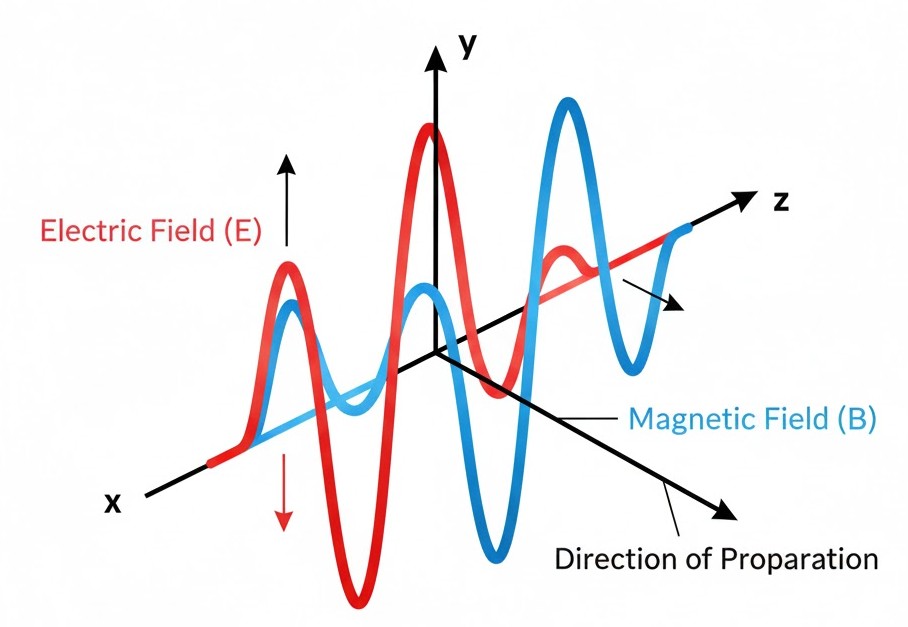
Arre, listen up, paltan! Before we dive into the deep stuff, let's clear the funda of how light actually travels. Back in 1870, James Maxwell told us that when electrically charged particles accelerate, they produce alternating electric and magnetic fields. These fields move together as waves, which is why we call them electromagnetic radiation.
The coolest part? These fields are mutually perpendicular to each other AND to the direction the wave is going. Unlike the sound waves you hear in a crowded canteen, these waves don't need any medium—they can travel through a vacuum with ease.
NEET Checkpoint:
Which property of EM waves allows them to travel in space?
(a) High frequency
(b) Requirement of medium
(c) Non-requirement of medium
(d) Longitudinal nature
✅ Answer: (c) — Unlike sound, EM waves are vacuum-friendly.
Every wave has a specific wavelength ($\lambda$) and frequency ($v$). In a vacuum, all EM radiations—from your local FM radio waves to those scary Gamma rays—travel at the same constant speed, the speed of light ($c$):
where $c \approx 3.0 \times 10^8 m s^{-1}$.
Relatable Example: Think of the Electromagnetic Spectrum like a local train map. The "Radio Wave" station is at one end (low frequency, long wavelength), and "Gamma Ray" is at the far end. Our eyes can only see the tiny "Visible Light" station between $400 nm$ (violet) and $750 nm$ (red).
NEET Checkpoint:
What is the relationship between frequency and wavelength?
(a) Frequency is directly proportional to wavelength
(b) Frequency is independent of wavelength
(c) Frequency is inversely proportional to wavelength
(d) Frequency is proportional to the square of wavelength
✅ Answer: (c) They are inversely proportional to wavelength. If one goes up, the other must come down, yaar!.
NEET Checkpoint:
Which has a higher frequency: Microwave or Ultraviolet?
(a) Microwave
(b) Ultraviolet
(c) Both have the same frequency
(d) Cannot be compared
✅ Answer: (b) Ultraviolet. It's further up the spectrum with more "energy" vibes.
Figure below:
A 3D diagram showing an electromagnetic wave with oscillating electric field (vertical) and magnetic field (horizontal) components, both perpendicular to the x-axis direction of propagation.
Practice Questions:
Calculate the frequency of yellow light with $\lambda = 580 nm$.
Explanation: Use $v = c/\lambda$. Converting $nm$ to $m$ ($580 \times 10^{-9} m$), we get $v \approx 5.17 \times 10^{14} s^{-1}$.
Key Takeaway
Formula Summary
* Speed of Light: $c = 3.0 \times 10^8 m s^{-1}$
* Main Relation: $c = v \lambda$
* Wavenumber: $\bar{v} = \frac{1}{\lambda}$ (measured in $m^{-1}$ or $cm^{-1}$)
5. Planck’s Quantum Theory
Listen up, junior! Before 1900, physicists thought energy was like a smooth slide, but Max Planck realized it’s actually more like a staircase. Let's clear up this funda.
First, let's talk about Black-body Radiation. Ever seen an iron rod being heated in a furnace? It first turns dull red, then bright red, and finally blue as it gets super hot. An ideal body that absorbs and emits all frequencies of radiation uniformly is called a black body. The intensity of this radiation depends on temperature—as $T$ increases, the peak intensity shifts toward a shorter wavelength.
NEET Checkpoint:
What happens to the wavelength of maximum intensity as temperature increases?
(a) It increases
(b) It remains constant
(c) It shifts to a shorter wavelength
(d) It shifts to a longer wavelength
✅ Answer: (c) It shifts to a shorter wavelength — More "blue" light is generated at higher temperatures.
Planck proposed that atoms don't just absorb or emit energy in any random amount. Instead, energy is exchanged in discrete "chunks" or packets called quanta.
NEET Checkpoint:
What is a 'Quantum'?
(a) A continuous packet of energy
(b) The smallest unit of matter
(c) The smallest discrete packet of energy
(d) A wave with infinite frequency
✅ Answer: (c) The smallest quantity of energy that can be emitted or absorbed as electromagnetic radiation.
Think of it like buying Pani Puri. The 'bhaiya' won't give you $1.5$ or $2.75$ puris; you get them in discrete counts of 1, 2, or 3. That’s quantization!
Planck’s famous equation is:
Where $E$ is the energy of a quantum, $\nu$ is the frequency, and $h$ is Planck’s constant, valued at $6.626 \times 10^{-34} \text{ J s}$.
NEET Checkpoint:
Which of these is a valid energy value according to Planck?
(a) $1.5 h\nu$
(b) $2.5 h\nu$
(c) $3 h\nu$
(d) $0.7 h\nu$
✅ Answer: (c) $3 h\nu$ — Energy must be an integral multiple of $h\nu$ ($E = nh\nu$).
Practice Questions:
1. A black body is:
(a) A perfect absorber only
(b) A perfect radiator only
(c) A perfect absorber and perfect radiator
(d) An object that reflects all light
✅ Answer: (c) — An ideal black body absorbs and emits all frequencies uniformly.
2. Calculate the energy of a photon if its frequency is $\nu$.
(a) $E = h/\nu$
(b) $E = h\nu$
(c) $E = \nu/h$
(d) $E = h\lambda$
✅ Answer: (b) — This is the core of Planck’s Equation.
Key Takeaway
Formula Summary
- Total Energy: $E = nh\nu \quad (\text{where } n = 1, 2, 3...)$
- Planck’s Equation: $E = h\nu$
- Planck’s Constant ($h$): $6.626 \times 10^{-34} \text{ J s}$
6. The Photoelectric Effect
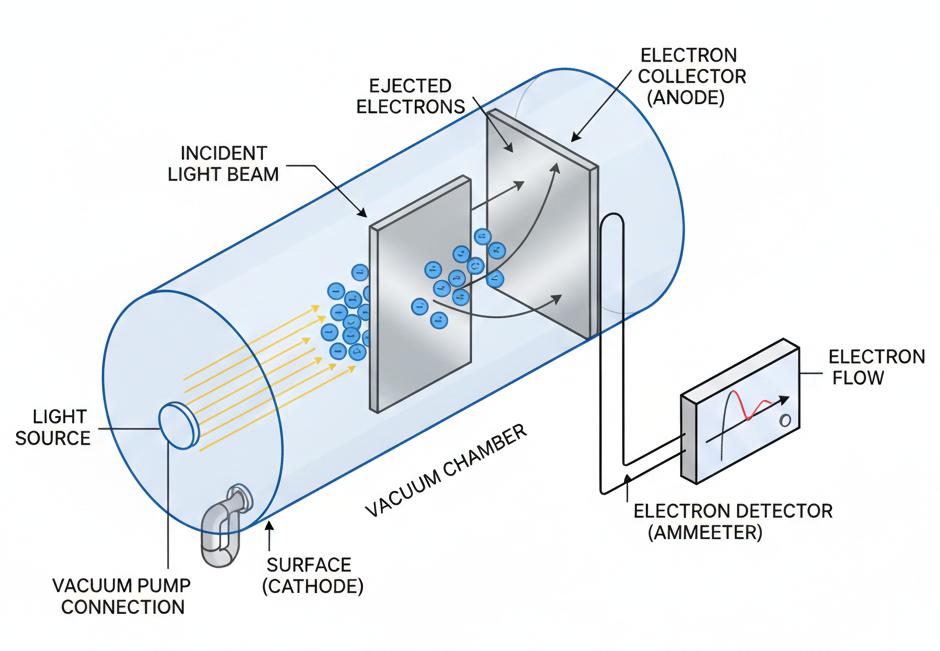
Listen up, yaar—the Photoelectric Effect is basically metal "throwing" electrons when light hits it. Hertz first saw this in 1887, noticing electrons jump out as soon as light strikes, with no time lag. But there's a catch: you need a minimum frequency, the threshold frequency ($\nu_{0}$), or else nothing happens.
Einstein later cleared the funda by explaining light as a stream of particles called photons. Think of it like a pani puri stall: if you don't pay the minimum price (threshold energy), the vendor won't give you a plate! Even if a thousand people stand there with only half the money (high intensity), he won't budge. But if you pay extra, that "change" you get back is the electron's kinetic energy to run away!
The math is simple: the energy of the incoming photon ($h\nu$) is used to overcome the metal's "grip" or work function ($h\nu_{0}$), and the rest is turned into the electron's speed.
Higher frequency light gives electrons more "kick" or kinetic energy.
NEET Checkpoint:
If you shine brighter light, do electrons move faster?
(a) Yes, electrons move faster
(b) No, brightness increases the number of electrons, not their speed
(c) Yes, only if wavelength is increased
(d) Electrons stop moving
✅ Answer: (b) No — Brighter light just means more photons hit, so more electrons are ejected, but their speed stays the same.
NEET Checkpoint:
What did Hertz observe regarding the timing of ejection?
(a) There is a measurable time lag
(b) Electrons are emitted after heating
(c) No time lag
(d) Emission occurs only at high intensity
✅ Answer: (c) No time lag — Electrons are ejected instantly when the beam hits the surface.
NEET Checkpoint:
Can red light eject electrons from Potassium?
(a) Yes, because red light has high intensity
(b) Yes, potassium has very low work function
(c) No, red light has frequency below the threshold frequency of potassium
(d) Only if exposure time is increased
✅ Answer: (c) No — Its frequency is below the threshold for Potassium, while yellow light can do it.
Figure below:
A clear diagram of a vacuum chamber containing a metal surface being struck by a beam of light, resulting in electrons being ejected and moving toward a detector.
Practice Question:
The kinetic energy of photoelectrons is directly proportional to the:
(a) Intensity of light
(b) Frequency of light
(c) Brightness of light
(d) Metal's surface area
✅ Answer: (b) — Frequency determines the energy of the individual photon, which directly increases the K.E. of the ejected electron.
Key Takeaway
Formula Summary
- Photon Energy: $E = h\nu$
- Einstein’s Equation: $h\nu = h\nu_{0} + \frac{1}{2}m_{e}v^{2}$
- Work Function: $W_{0} = h\nu_{0}$
7. Atomic Spectra and Hydrogen Line Spectrum
Hey there, future doctors! Ever wondered why atoms are so picky about the light they emit? They don't just glow randomly; they have a very specific "signature" style. Let's clear up this Atomic Spectra funda once and for all!
When white light passes through a prism, it spreads into a continuous spectrum where colours like red and violet merge into each other—just like the crowd in a local train. But atoms are different. When you give them energy, they get "excited" and emit radiation at specific wavelengths, creating a line spectrum with bright lines on a dark background. It's like a Pani Puri stall that only serves at specific spots on a street instead of everywhere!
NEET Checkpoint:
Which spectrum is known as the "fingerprint" of an element?
(a) Continuous spectrum
(b) Absorption spectrum
(c) Line emission spectrum
(d) Band spectrum
✅ Answer: (c) Line emission spectrum — Because every element has a unique set of lines used for identification.
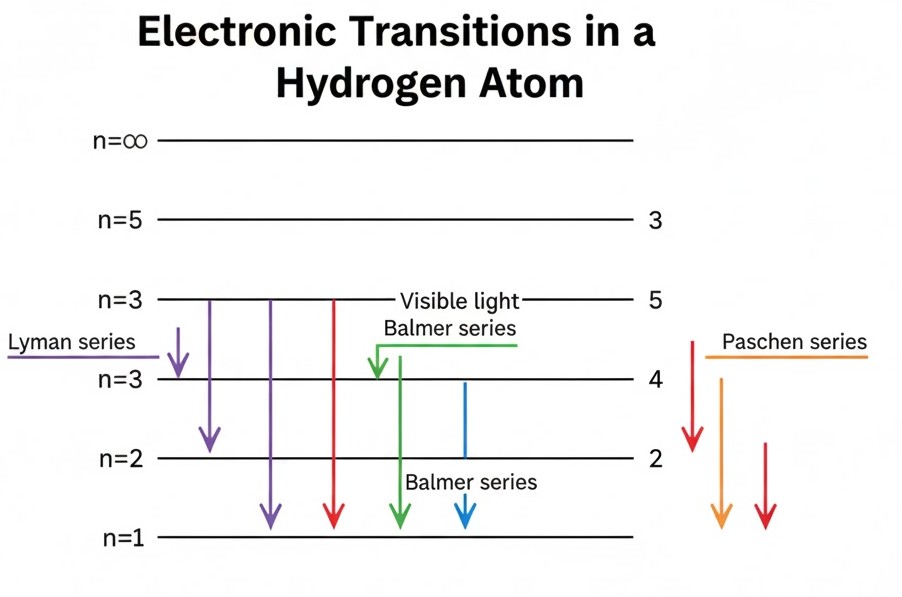
For Hydrogen, these lines fall into specific spectral series depending on where the "excited" electron lands:
1. Lyman Series: $n_1 = 1$ (Ultraviolet region).
2. Balmer Series: $n_1 = 2$ (The only one in the Visible region!).
3. Paschen, Brackett, and Pfund: Landing on $n_1 = 3, 4, \text{ and } 5$ respectively (all in the Infrared region).
NEET Checkpoint:
To which region does the Paschen series belong?
(a) Ultraviolet
(b) Visible
(c) Infrared
(d) X-ray
✅ Answer: (c) Infrared — Transitions ending at $n_1 = 3$ are always in the IR zone.
To calculate the wavenumber ($\overline{\nu}$), we use the Rydberg Formula:
Where $109,677 \text{ cm}^{-1}$ is the Rydberg constant ($R_H$).
Figure below:
A clear diagram showing electronic transitions in a hydrogen atom. Draw horizontal lines for energy levels $n=1, 2, 3, 4, 5, \infty$. Show arrows pointing down to $n=1$ for Lyman, to $n=2$ for Balmer, and to $n=3$ for Paschen series.
NEET Checkpoint:
What is the value of $n_1$ for the Balmer series?
(a) $n_1 = 1$
(b) $n_1 = 2$
(c) $n_1 = 3$
(d) $n_1 = 4$
✅ Answer: (b) $n_1 = 2$ — These are the only lines visible to the human eye.
Practice Question:
A transition from $n = 5$ to $n = 2$ in a hydrogen atom belongs to which series?
(a) Lyman
(b) Balmer
(c) Paschen
(d) Pfund
✅ Answer: (b) Balmer — Any transition ending at $n_1 = 2$ is part of the Balmer series.
Key Takeaway
Formula Summary
* Rydberg Formula: $\overline{\nu} = R_H \left( \frac{1}{n_1^2} - \frac{1}{n_2^2} \right) \text{ cm}^{-1}$
* Rydberg Constant ($R_H$): $109,677 \text{ cm}^{-1}$
* Visible Series: Only Balmer ($n_1 = 2$).
8. Bohr’s Model for Hydrogen Atom
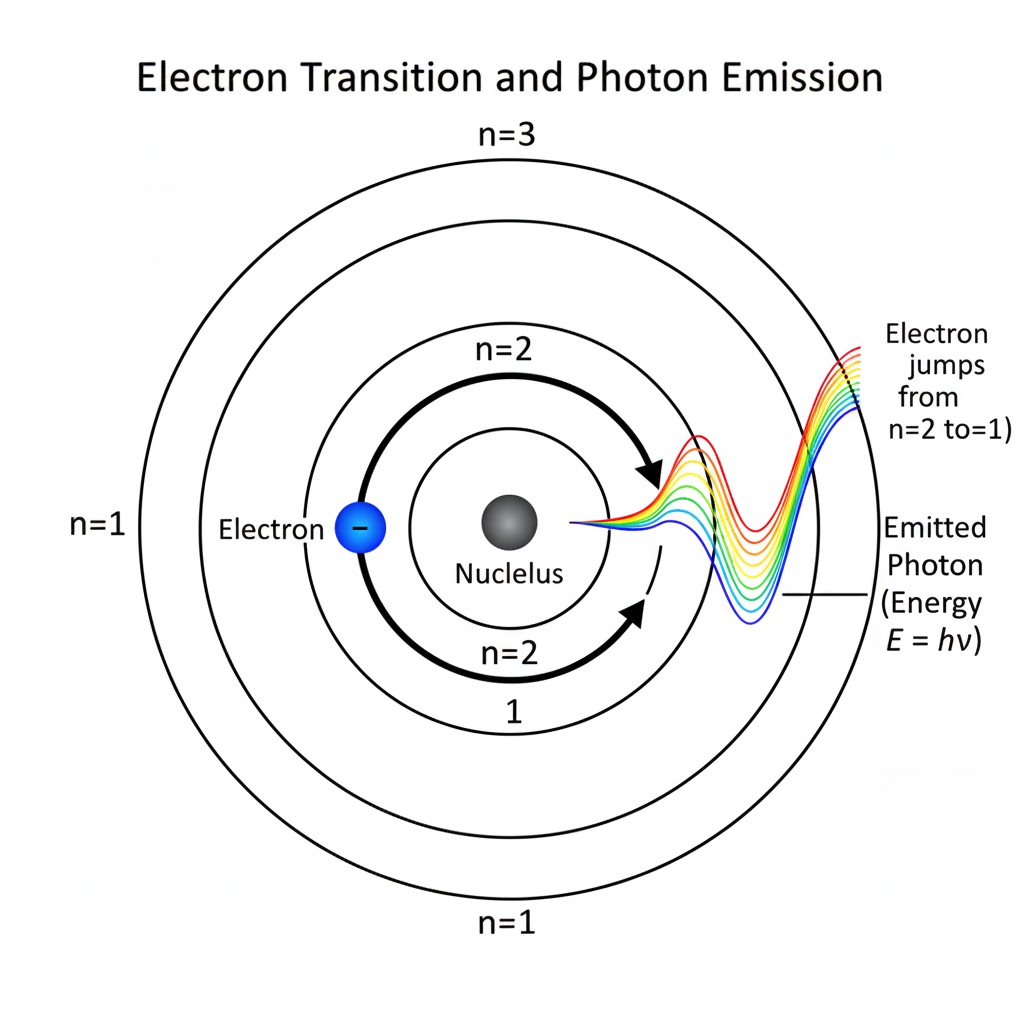
Listen up, junior! Neils Bohr basically fixed the mess Rutherford left behind by using Planck’s "funda" of quantisation. He proposed that electrons don't just wander around; they move in fixed circular orbits called stationary states. Think of it like a local Mumbai train—the electron stays on its specific track unless it gets enough energy to hop to another platform.
Bohr’s biggest rule was Angular Momentum Quantisation. An electron can only exist in orbits where its angular momentum is an integral multiple of $\frac{h}{2\pi}$.
NEET Checkpoint:
If an electron is in the 3rd orbit, what is its angular momentum?
(a) $\frac{h}{2\pi}$
(b) $\frac{3h}{2\pi}$
(c) $\frac{1.5h}{\pi}$
(d) Both (b) and (c)
✅ Answer: (d) — Because $\frac{3h}{2\pi}$ is mathematically the same as $1.5 \frac{h}{\pi}$.
For H-like species (ions like $He^+$ or $Li^{2+}$), the energy and radii change based on the atomic number $Z$. The radius is given by $r_n = \frac{52.9(n^2)}{Z} pm$, while the energy of the state is $E_n = -2.18 \times 10^{-18} \left(\frac{Z^2}{n^2}\right) J$.
NEET Checkpoint:
What happens to the radius as $Z$ increases?
(a) Increases
(b) Remains constant
(c) Decreases
(d) First increases, then decreases
✅ Answer: (c) Decreases - The radius becomes smaller because the nucleus pulls the electron tighter, like a strict tuition teacher!
Finally, we have the Frequency Rule. Energy isn't emitted continuously; it only happens when an electron jumps between states.
Figure below:
A diagram showing a central nucleus with concentric circular orbits labeled $n=1, 2, 3$. Show an electron jumping from $n=2$ down to $n=1$ with a wavy arrow pointing away, representing an emitted photon.
NEET Checkpoint:
Can an electron exist between two Bohr orbits?
(a) Yes, temporarily
(b) Yes, during emission
(c) No, it cannot
(d) Only in excited state
✅ Answer: (c) No! It is like a staircase; you can stand on the steps but not in the air between them.
Practice Question:
Calculate the energy of the 1st orbit of $He^+$.
(a) $-2.18 \times 10^{-18} J$
(b) $-4.36 \times 10^{-18} J$
(c) $-8.72 \times 10^{-18} J$
(d) $-1.09 \times 10^{-18} J$
✅ Answer: (c) — For $He^+$, $Z=2$ and $n=1$, so $E = -2.18 \times 10^{-18} \cdot (\frac{2^2}{1^2}) = -8.72 \times 10^{-18} J$.
Key Takeaway
Formula Summary
- Angular Momentum: $m_e vr = \frac{nh}{2\pi}$
- Radius: $r_n = \frac{52.9 n^2}{Z} pm$
- Energy: $E_n = -2.18 \times 10^{-18} \frac{Z^2}{n^2} J$
- Frequency Rule: $\nu = \frac{\Delta E}{h}$
9. Successes and Limitations of the Bohr Model
Listen up, juniors! Bohr’s model was like that one student who tops the class in a single subject but struggles during the boards. It was a massive hit for hydrogen, giving a quantitative explanation for its spectrum and stability. It even worked for "hydrogen-like" ions like $He^{+}$ and $Li^{2+}$. But, let's clear up this funda: it had some serious "limited edition" vibes.
NEET Checkpoint:
Which of these species is successfully explained by Bohr's model?
(a) $He$
(b) $Li^{2+}$
(c) $Be$
(d) $H_{2}$
✅ Answer: (b) $Li^{2+}$ — Arre, Bohr only loves species with exactly ONE electron!
The trouble started when things got fancy. Bohr couldn't explain the finer details like "doublets" (two super close lines) in the spectrum. Plus, if you put the atom in a magnetic field (Zeeman effect) or an electric field (Stark effect), the lines split further, and Bohr was left scratching his head.
Indian Example: Think of a simple Pani Puri stall. One person serving is easy to track (like one electron). But try managing a massive wedding buffet with hundreds of guests—it's total chaos! Bohr just couldn't handle the "crowd" of multi-electron atoms.
NEET Checkpoint:
What is the splitting of spectral lines in an electric field called?
(a) Zeeman effect
(b) Stark effect
(c) Photoelectric effect
(d) Compton effect
✅ Answer: (b) Stark effect — Remember, "Stark" sounds like a "Spark" of electricity!
Finally, Bohr didn't have a clue about how atoms join to form molecules. No bonding info, yaara!
NEET Checkpoint:
Does Bohr’s model account for $H_{2}$ molecule formation?
(a) Yes, fully
(b) No, it cannot
(c) Only partially
(d) Only for ions
✅ Answer: (b) No — It could not explain chemical bonding or molecular formation at all.
Practice Questions:
1. Bohr's model fails for:
(a) $H$
(b) $He^{+}$
(c) $Li^{2+}$
(d) $He$
✅ Answer: (d) is correct because $He$ has two electrons, and Bohr is strictly for one-electron systems.
2. Which effect refers to spectral line splitting in a magnetic field?
(a) Stark
(b) Zeeman
(c) Photoelectric
(d) Diffraction
✅ Answer: (b) Zeeman effect is specifically for magnetic fields.
Key Takeaway:
Bohr’s model is a hero for one-electron systems ($H$, $He^{+}$, etc.) but fails to explain multi-electron spectra, Zeeman/Stark effects, and chemical bonding.
10. Dual Nature of Matter: The de Broglie Funda
Hey future doctors! Ready to catch a wave? 🌊 In 1924, a French physicist named Louis de Broglie dropped a major truth-bomb by proposing that matter, just like radiation, has a dual nature. This means that every moving object—from a tiny electron to your favorite cricket ball—exhibits both particle and wave-like properties.
Here is the secret funda: he combined particle properties like momentum with wave properties like wavelength into one legendary relationship.
In this formula, $\lambda$ is the wavelength, $h$ is Planck’s constant ($6.626 \times 10^{-34} \text{ J s}$), $m$ is the mass, $v$ is the velocity, and $p$ is the momentum.
NEET Checkpoint:
Which phenomenon experimentally confirms the wave nature of electrons?
(a) Photoelectric effect
(b) Compton effect
(c) Zeeman effect
(d) Electron diffraction
✅ Answer: (d) Electron diffraction — Just like light waves, an electron beam undergoes diffraction when it hits a target.
Imagine Virat Kohli smashing a ball for a six. Does that ball have a wavelength? Technically, yes! However, because the ball’s mass ($m$) is so huge compared to an electron, its wavelength is so incredibly tiny that it cannot be detected. No "wave-ball" wickets here, yaar!
NEET Checkpoint:
Why don't we notice the wave nature of a moving scooter or a rickshaw?
(a) They move too slowly
(b) Because they have large mass
(c) They are too far away
(d) They do not emit light
✅ Answer: (b) Large mass — Since $\lambda \propto \frac{1}{m}$, a large macroscopic mass makes the wavelength negligibly small and undetectable.
But for tiny subatomic particles like electrons, this wave nature is a total game-changer. We actually use this property in electron microscopes, which can magnify images up to 15 million times by utilizing the wave character of electrons.
NEET Checkpoint:
What is the relationship between wavelength ($\lambda$) and momentum ($p$)?
(a) $\lambda = \frac{p}{h}$
(b) $\lambda = \frac{h}{p}$
(c) $p = h\lambda$
(d) $p = \frac{\lambda}{h}$
✅ Answer: (a) $\lambda = \frac{h}{p}$ — They are inversely proportional, meaning more momentum results in a shorter wavelength.
Practice Question:
What is the wavelength of a ball of mass $0.1 \text{ kg}$ moving with a velocity of $10 \text{ m s}^{-1}$?
(a) $6.626 \times 10^{-34} \text{ m}$
(b) $6.626 \times 10^{-32} \text{ m}$
(c) $10^{-34} \text{ m}$
(d) $6.626 \times 10^{-25} \text{ m}$
✅ Answer: (a) — Arre, don't overthink it; just use $\lambda = \frac{h}{mv}$. The math gives exactly $6.626 \times 10^{-34} \text{ m}$, which is why you can't see the ball "waving" at you!
Key Takeaway
Formula Summary
- de Broglie Equation:$$\lambda = \frac{h}{mv} = \frac{h}{p}$$
- Key Takeaway: Wave properties are only significant and detectable for microscopic particles like electrons due to their tiny mass.
11. Heisenberg Uncertainty Principle
Listen up, junior! Bohr thought he had electrons running on perfect circular tracks like a toy train set, but Werner Heisenberg (1927) dropped a total truth bomb. He realized that because matter has a dual nature, you can never be a perfectionist when measuring subatomic particles.
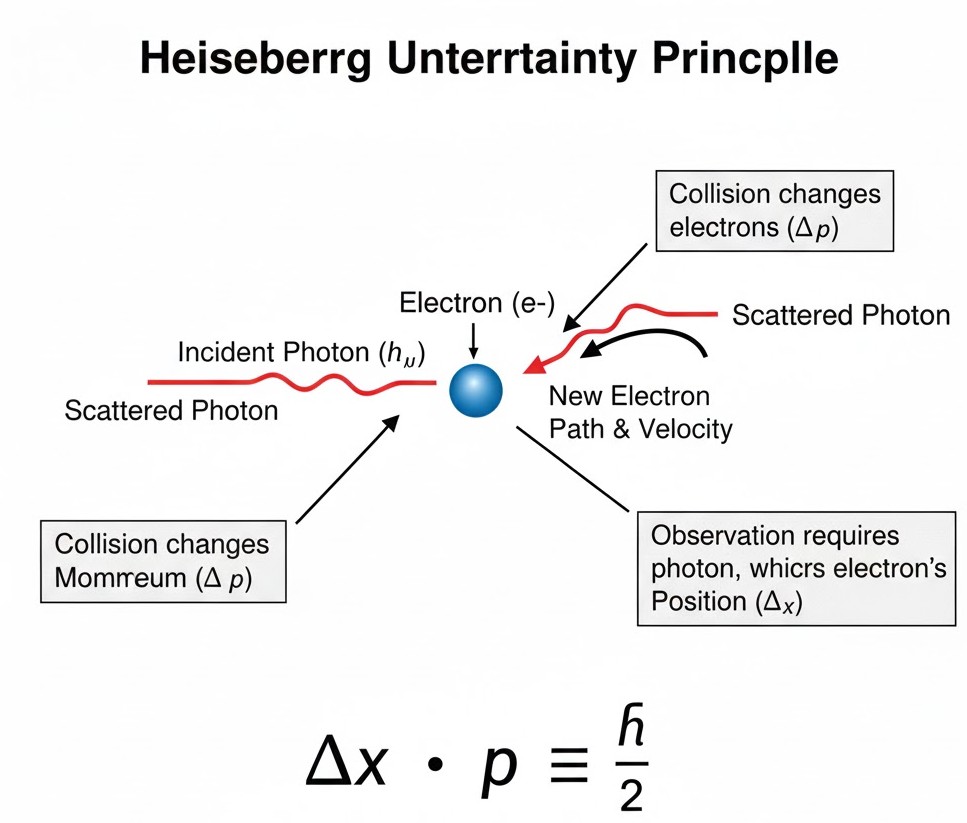
The Heisenberg Uncertainty Principle states that it is impossible to determine simultaneously the exact position and exact momentum (or velocity) of an electron. If you try to pin down where the electron is ($\Delta x$ is small), its velocity becomes a total blur ($\Delta v$ becomes large). Let’s clear up this funda with the math:
NEET Checkpoint:
Does this principle apply to a moving scooty?
(a) No, it applies only to electrons
(b) Yes, but wavelength is extremely small
(c) Yes, and wavelength is easily observable
(d) No, it applies only to light
✅ Answer: (b) Technically yes, but it’s negligible — For macroscopic objects, the uncertainty is so tiny ($\approx 10^{-28} \text{ m}^2 \text{s}^{-1}$) that it doesn't matter in our daily life.
Imagine trying to track a fast-moving cricket ball in a pitch-dark stadium using a super-powered laser. To "see" the electron, you’d need light with a wavelength smaller than the electron. But those high-energy photons would hit the electron like a heavy truck hitting a cycle, changing its speed instantly! You might know where it was, but you’ve ruined any chance of knowing where it’s going.
NEET Checkpoint:
What did this principle do to Bohr's "orbits"?
(a) Confirmed them
(b) Made them larger
(c) Ruled them out
(d) Made them circular
✅ Answer: (c) It ruled them out — Since we can't know position and velocity together, electrons don't follow definite trajectories.
NEET Checkpoint:
For which particles is this principle significant?
(a) Microscopic particles
(b) Large molecules like sugar
(c) Macroscopic objects like cars and rickshaws
(d) Only photons
✅ Answer: (a) Microscopic particles — Like electrons, where the small mass ($m$) makes the uncertainty huge.
Figure below:
A diagram showing a photon of light hitting an electron, causing the electron to change its path and velocity, illustrating the difficulty in measuring position and momentum simultaneously.
Practice Question:
If the uncertainty in the position of an electron is zero, what is the uncertainty in its momentum?
(a) Zero
(b) $\frac{h}{4\pi}$
(c) Infinity
(d) $1$
✅ Answer: (c) Infinity — Arre, look at the formula! If $\Delta x = 0$, then $\Delta p$ must be infinite to satisfy the inequality.
Now that you've grasped why we can't be sure about an electron's path, let's see how Schrödinger used this "fuzziness" to build a whole new model of the atom!
Key Takeaway
Formula Summary
Main Equation:
$$\Delta x \cdot \Delta v_{x} \ge \frac{h}{4\pi m}$$
Key Rule: Position and momentum are like two friends who can never be in the same room at the same time—the more you know about one, the less you know about the other!
12. Quantum Mechanical Model of the Atom
Arre junior, listen up! Since Bohr’s circular tracks were a bit too simple to handle the actual wave-nature of electrons, Erwin Schrödinger and Werner Heisenberg independently developed Quantum Mechanics in 1926. This branch of science treats microscopic objects as having both wave-like and particle-like properties.
The "Big Boss" of this model is the Schrödinger Wave Equation:
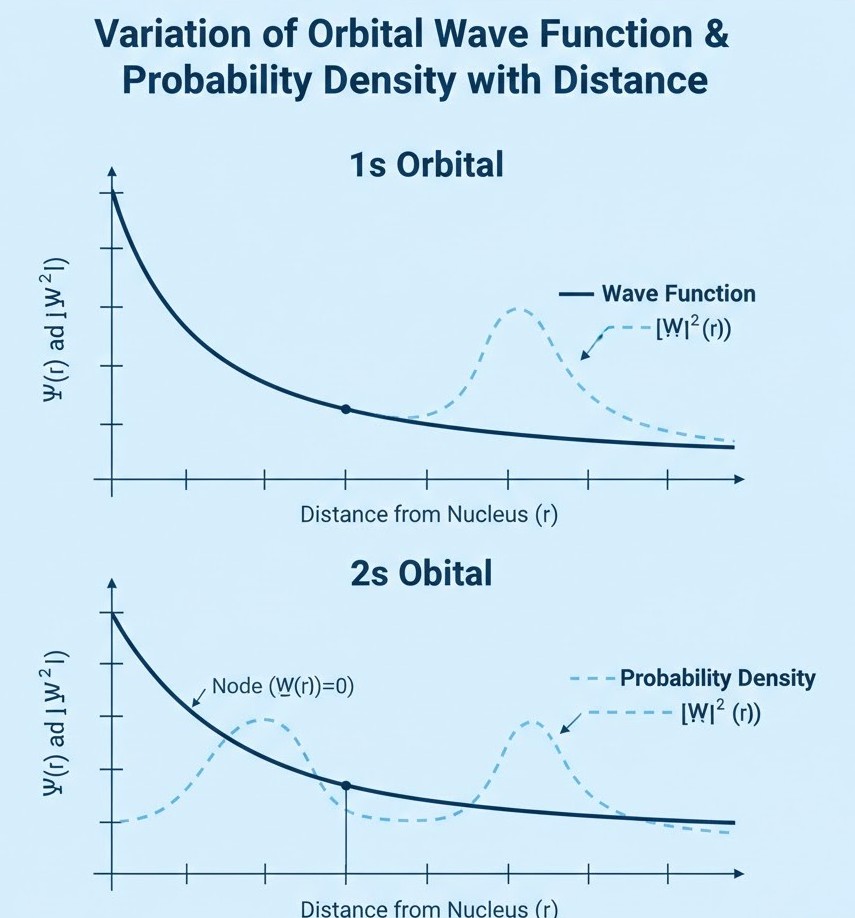
Here, $\hat{H}$ is a mathematical operator called the Hamiltonian, and $E$ is the total energy of the system. Notice this: solving this equation for the hydrogen atom gives us specific energy levels and the wave function, $\Psi$.
NEET Checkpoint:
What is the physical significance of the wave function $\Psi$?
(a) It gives the exact position of the particle
(b) It gives the momentum of the particle
(c) It has no direct physical meaning
(d) It gives the energy of the particle
✅ Answer: (c) It has no physical meaning — By itself, $\Psi$ is just a mathematical function of the electron's coordinates.
To find something real, we look at the Probability Density, $|\Psi|^2$. This value tells us the probability of finding an electron at a specific point in the atom.
NEET Checkpoint:
What is the sign of $|\Psi|^2$ at any point?
(a) Negative
(b) Zero
(c) Always positive
(d) Can be positive or negative
✅ Answer: (c) Always positive — Since it represents a probability per unit volume, it cannot be negative.
Think of it like a Cricket Stadium during an IPL match. You can't predict exactly where a specific fan will run, but you know the probability of finding them in the stands is 99%, while it’s nearly zero on the pitch! That high-probability region is what we call an atomic orbital. (Note: This stadium example is not from the sources and is for illustration only).
NEET Checkpoint:
Which quantum numbers arise naturally from the Schrödinger equation for Hydrogen?
(a) Principal quantum number n only
(b) n and azimuthal quantum number l
(c) n, l, and magnetic quantum number m
(d) n, l, m, and spin quantum number s
✅ Answer: (c) $n, l,$ and $m_l$ — These three quantum numbers are a natural consequence of the solution.
Figure below:
A clear plot showing the variation of the orbital wave function $\Psi(r)$ and probability density $|\Psi|^2(r)$ as a function of distance $r$ from the nucleus for 1s and 2s orbitals
Quick Recap:
$\Psi$ = Mathematical "address" (no physical meaning).
$|\Psi|^2$ = Probability of finding the electron (real physical meaning).
Practice Question:
The region in space around the nucleus where the probability of finding an electron is maximum is called:
(a) Orbit
(b) Orbital
(c) Nucleus
(d) Path
✅ Answer: (b) Orbital — Remember, Bohr had "orbits," but Schrödinger gave us "orbitals".
Key Takeaway
- Schrödinger Equation:
$$\hat{H}\Psi = E\Psi$$.- Wave Function ($\Psi$): No physical meaning; contains all info about an electron.
- Probability Density ($|\Psi|^2$): Square of $\Psi$; tells us the chance of finding an electron at a point.
- Orbital: The "one-electron wave function" representing the electron's space.
13. Quantum Numbers
Listen up, junior! If you want to find an electron in the chaotic "city" of an atom, you need its exact GPS coordinates. In chemistry, we call these Quantum Numbers. Don't stress, yaar—it’s just a four-part address that tells us everything about an electron's "home".
- Principal Quantum Number ($n$): This is the main "Sector" or shell ($K, L, M, N$). It determines the size and energy of the orbital. As $n$ increases, the electron moves further from the nucleus, like a student sitting on the last bench of a coaching class to avoid the teacher's gaze!
NEET Checkpoint:
How many orbitals are in the $n=3$ shell?
(a) 3
(b) 6
(c) 9
(d) 18
✅ Answer: (c) $n^2 = 3^2 = 9$. Simple maths, boss!
2. Azimuthal Quantum Number ($l$): This defines the three-dimensional shape and identifies the sub-shell ($s, p, d, f$). For any $n$, $l$ ranges from $0$ to $n-1$.
NEET Checkpoint:
If $n=2$, what are the possible values of $l$?
(a) 0
(b) 1
(c) 0 and 1
(d) 1 and 2
✅ Answer: (c) $0$ and $1$ (representing $2s$ and $2p$ sub-shells).
3. Magnetic Quantum Number ($m_l$): This gives the spatial orientation of the orbital. Think of it as which way the balcony of your flat faces! For a given $l$, there are $2l+1$ values of $m_l$.
4. Electron Spin ($m_s$): Electrons spin like a top! This accounts for those tricky doublet lines in spectra. An electron can only have two spin states: $+\frac{1}{2}$ (up) or $-\frac{1}{2}$ (down).
NEET Checkpoint:
What is the maximum number of electrons in a single orbital?
(a) 1
(b) 2
(c) 3
(d) 4
✅ Answer: (b) Two, and they must have opposite spins!
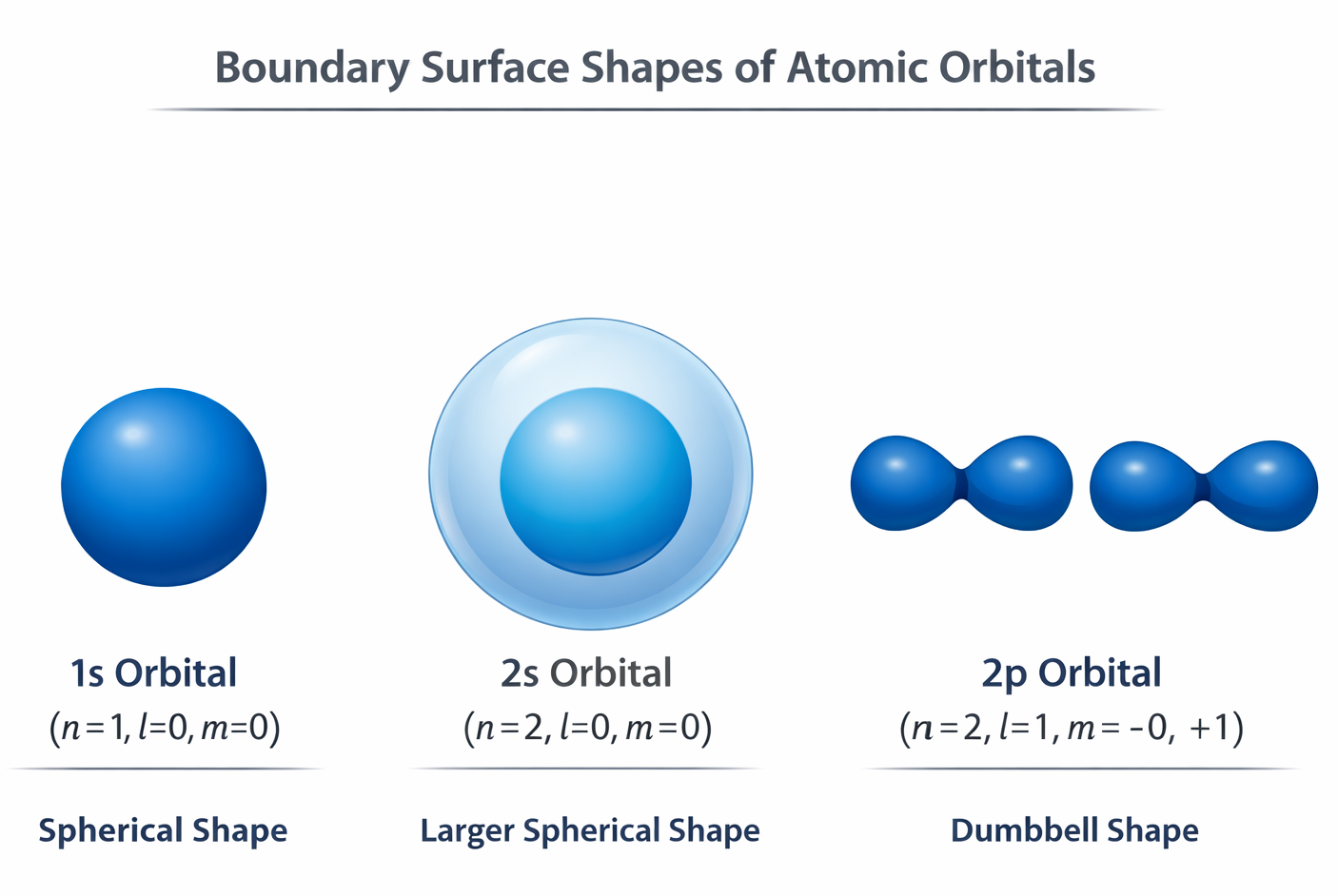
Figure below:
A clear diagram showing the boundary surface shapes of 1s, 2s (spheres) and 2p (dumbbells) orbitals based on quantum numbers.
Practice Questions:
Which set of quantum numbers is NOT possible?
(a) $n=3, l=2, m_l=0$
(b) $n=2, l=2, m_l=1$
✅ Answer: (b). Because $l$ must always be less than $n$. If $n=2$, the maximum $l$ can be is $1$.
Key Takeaway: The Quantum Address
- $n$: Shell / Size / Energy ($1, 2, 3...$)
- $l$: Sub-shell / Shape ($0$ to $n-1$)
- $m_l$: Orientation ($-l$ to $+l$)
- $m_s$: Spin ($+\frac{1}{2}, -\frac{1}{2}$)
14. Shapes of Atomic Orbitals & Probability
Let’s clear the funda of where electrons actually hang out! Think of orbitals as the "homes" or haunts of electrons. Instead of fixed paths, we talk about probability density ($|\psi|^{2}$), which is the chance of finding our electron in a specific spot.
s-Orbitals are the simplest—they are spherically symmetric, meaning the probability of finding the electron is the same in every direction from the nucleus. Imagine a perfectly round, sweet Laddu; that’s your $s$-orbital! As the principal quantum number $n$ increases, the orbital gets bigger, and we find radial nodes—regions where the probability of finding an electron drops to zero. For any $ns$-orbital, the number of radial nodes is exactly $n-1$.
NEET Checkpoint:
How many radial nodes are present in a $3s$ orbital?
(a) 1
(b) 2
(c) 3
(d) 0
✅ Answer: (b) 2 — Arre, just use the formula $n-1$. For $3s$, $n=3$, so $3-1 = 2$ nodes.
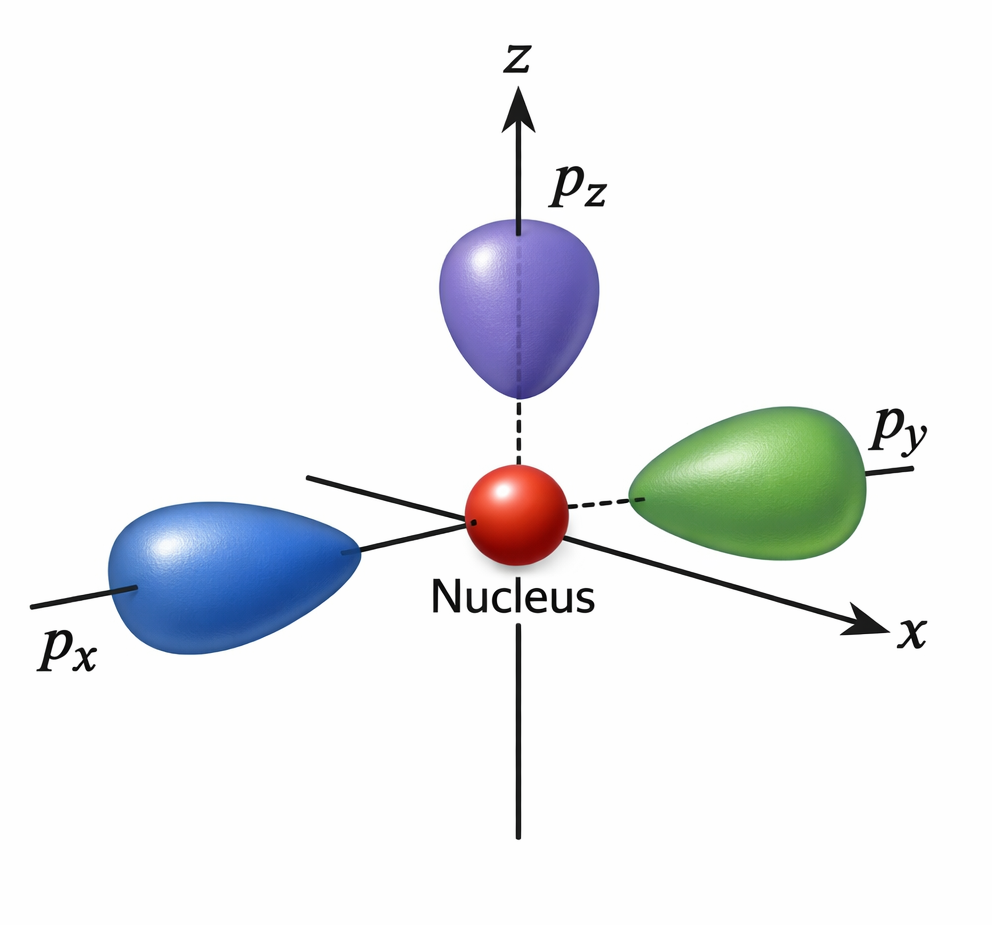
p-Orbitals ($l=1$) look like dumbbells with two lobes on either side of the nucleus. They have three orientations along the axes: $p_{x}$, $p_{y}$, and $p_{z}$.
d-Orbitals ($l=2$) are even more complex, with five orientations: $d_{xy}$, $d_{yz}$, $d_{xz}$, $d_{x^{2}-y^{2}}$, and the unique $d_{z^{2}}$.
Think of nodes like the boundary rope in a cricket stadium. The players (electrons) are either inside the boundary or outside in the stands, but nobody stands on the rope!
* Angular nodes are defined by the azimuthal quantum number $l$.
* Radial nodes are calculated as $n - l - 1$.
NEET Checkpoint:
Which orbital has orientations along the $x, y,$ and $z$ axes?
(a) $s$
(b) $p$
(c) $d$
(d) $f$
✅ Answer: (b) $p$ — These are the $p_{x}$, $p_{y}$, and $p_{z}$ orbitals.
Figure below:
A clear 3D diagram showing the three dumbbell-shaped p-orbitals ($p_{x}, p_{y}, p_{z}$) oriented along the Cartesian axes, with shaded lobes and the nucleus at the origin.
NEET Checkpoint:
Total number of nodes in a $4d$ orbital is?
(a) 1
(b) 2
(c) 3
(d) 4
✅ Answer: (c) 3 — Total nodes = $n-1$. For $4d$, $n=4$, so $4-1 = 3$.
Practice Question:
Calculate the number of radial and angular nodes for a $3p$ orbital.
Explanation: For $3p$, $n=3$ and $l=1$. Angular nodes = $l = 1$. Radial nodes = $n - l - 1 = 3 - 1 - 1 = 1$. Total nodes = 2.
Key Takeaway
- s-orbitals: Spheres; $n-1$ radial nodes.
- p-orbitals: Dumbbells ($p_{x}, p_{y}, p_{z}$).
- d-orbitals: 5 orientations ($d_{xy}, d_{yz}, d_{xz}, d_{x^{2}-y^{2}}, d_{z^{2}}$).
- Nodes Summary: Angular nodes = $l$; Radial nodes = $n - l - 1$; Total nodes = $n - 1$.
15. Filling Orbitals & Electronic Configuration
Don't stress, yaar—it's easier than it looks! Let's clear up this electronic seating arrangement funda. Think of the atom like a hostel with very strict rules for its residents (the electrons).
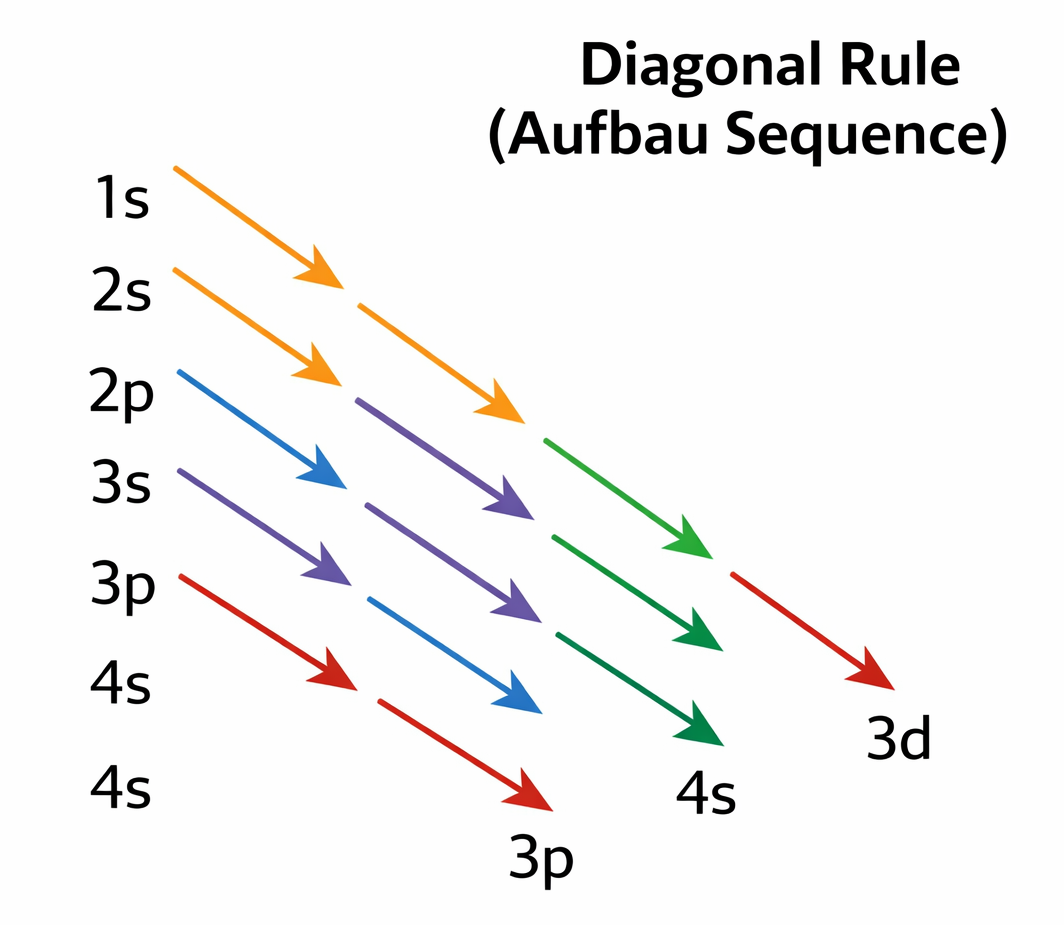
First up is the Aufbau Principle (German for 'building up'), which says electrons must occupy the lowest energy orbitals first. How do we decide who's "lower"? We use the $(n+l)$ rule: the orbital with the lower $(n+l)$ value fills first. If they tie, the one with the lower $n$ wins. It’s like boarding a Mumbai local train—you grab the first empty seat you see before standing!
NEET Checkpoint:
Which orbital fills first: $4s$ or $3d$?
(a) 3d
(b) 4s
(c) Both fill simultaneously
(d) Depends on the element
✅ Answer: (b) $4s$ — Because for $4s$, $(n+l) = 4+0=4$, and for $3d$, $(n+l) = 3+2=5$. Lower $(n+l)$ fills first!
Next, Pauli’s Exclusion Principle tells us that no two electrons can have the same four quantum numbers. Basically, an orbital can hold a maximum of two electrons, and they must have opposite spins ($m_s = +1/2$ and $-1/2$). Then we have Hund’s Rule of Maximum Multiplicity, which is the "no-sharing-yet" rule: pairing in $p, d,$ or $f$ orbitals doesn't happen until every orbital in that subshell has at least one electron. Think of a pani puri stall—the bhaiyya gives one puri to everyone in the circle before starting the second round!
NEET Checkpoint:
What is the maximum number of electrons in a $p$-subshell?
(a) $2$
(b) $4$
(c) $10$
(d) $6$
✅ Answer: (d) $6$ — There are three $p$-orbitals, each holding 2 electrons ($3 \times 2 = 6$).
Finally, why do $Cr$ ($Z=24$) and $Cu$ ($Z=29$) have weird configurations like $3d^5 4s^1$ and $3d^{10} 4s^1$? It's because half-filled ($d^5$) and fully filled ($d^{10}$) subshells enjoy Extra Stability. This happens due to their symmetrical distribution and higher exchange energy. Even electrons love a bit of symmetry!
Figure below:
A clear diagram showing the diagonal rule (Aufbau sequence) for filling orbitals, with arrows flowing from 1s to 2s, 2p, 3s, 3p, 4s, and 3d.
NEET Checkpoint:
Can two electrons in the same orbital have the same spin?
(a) Yes, always
(b) Yes, sometimes
(c) No, never
(d) Only in excited states
✅ Answer: (c) No — Pauli’s principle mandates opposite spins for electrons in the same orbital.
Practice Question:
The electronic configuration of Chromium ($Z=24$) is:
(a) $[Ar] 3d^4 4s^2$
(b) $[Ar] 3d^5 4s^1$
(c) $[Ar] 3d^6 4s^0$
(d) $[Ar] 4s^2 4p^4$
✅ Answer: (b) $[Ar] 3d^5 4s^1$ — This provides extra stability due to a half-filled $d$-subshell.
Key Takeaway
- Aufbau: Fill low energy $(n+l)$ first.
- Pauli: Max 2 electrons/orbital, opposite spins.
- Hund: Singly occupy degenerate orbitals before pairing.
- Stability: $d^5$ and $d^{10}$ are super stable!