1. Introduction to Biological Reproduction
Biology is basically the story of life on Earth. While individual players eventually "get out," the team (the species) stays in the game for millions of years because of reproduction. It's the vital process that ensures species survival.
Why do we prefer the sexual mode? Simple: it creates new variants. Think of it like a local street food market—while every stall sells Pani Puri, each has a slightly different teekha water. That variety is the "variant" that helps some stalls survive better when tastes change! Similarly, sexual reproduction enhances survival advantages by creating genetic diversity.
In the world of plants, flowers are not just for your Instagram posts, yaaar! To a biologist, they are morphological and embryological marvels and the specific sites of sexual reproduction. Humans, meanwhile, are viviparous and follow a beautifully complex sequence: gametogenesis $\rightarrow$ insemination $\rightarrow$ fertilisation $\rightarrow$ implantation $\rightarrow$ gestation $\rightarrow$ parturition.
NEET Checkpoint:
Why is sexual reproduction considered more advantageous than asexual reproduction?
(a) Faster process
(b) Creates clones
(c) Creates new variants
(d) Requires less energy
✅ Answer: (c) Creates new variants — This provides a survival advantage in changing environments!
NEET Checkpoint:
According to WHO, reproductive health means total well-being in which aspects?
(a) Only physical
(b) Physical and social
(c) Physical, emotional, behavioural, and social
(d) Only functional
✅ Answer: (c) Physical, emotional, behavioural, and social — It’s a broader perspective, boss!
NEET Checkpoint:
What is the required temperature for spermatogenesis relative to body temperature?
(a) $37^{\circ}C$
(b) $2-2.5^{\circ}C$ lower
(c) $2-2.5^{\circ}C$ higher
(d) $0^{\circ}C$
✅ Answer: (b) $2-2.5^{\circ}C$ lower — The scrotum acts like a natural cooler for the testes!
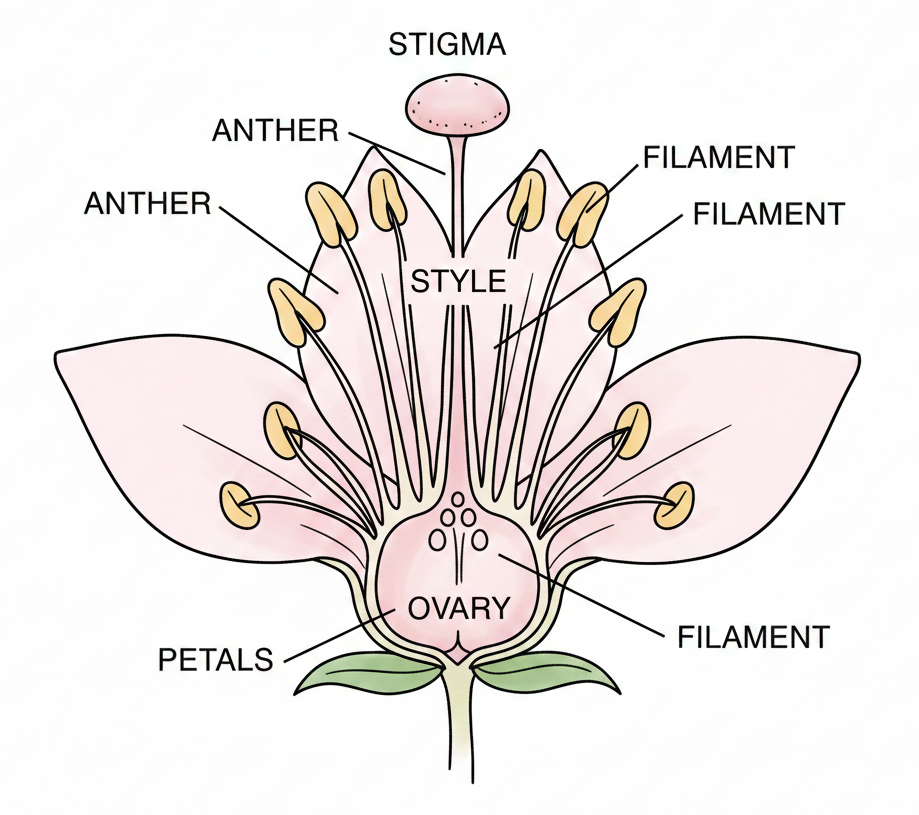
Figure below:
A clear, labelled diagram of the L.S. of a typical flower showing the stigma, style, ovary, anther, filament, and petals.
From the microscopic anatomy of a pollen grain measuring $25-50\ \mu m$ to the complex hormonal regulation of the human menstrual cycle, we are going to clear every funda. We’ll also evaluate how medical interventions like MTP and Assisted Reproductive Technologies (ART) help when nature needs a little backup.
Practice Questions:
1. Which of the following is a "terminal method" to prevent further pregnancies?
(a) IUDs
(b) Oral Pills
(c) Vasectomy
(d) Condoms
✅ Answer: (c) Vasectomy. It’s a surgical method that blocks gamete transport permanently.
2. In angiosperms, the end products of sexual reproduction are:
(a) Flowers and buds
(b) Fruits and seeds
(c) Roots and shoots
(d) Petals and sepals
✅ Answer: (b) Fruits and seeds. These are the "end products" plants work so hard for!
Key Takeaway
Reproduction is the survival funda for species. Sexual reproduction brings the "spice" of variation, while Reproductive Health ensures total physical, emotional, and social well-being.
2. Flower Structure and Male Gametophyte Development
Listen up, junior! To a biologist, flowers aren't just for decoration; they are "morphological and embryological marvels" and the actual sites of sexual reproduction. The male part, the androecium, is made of stamens. A typical stamen has a long stalk called the filament and a terminal bilobed anther.
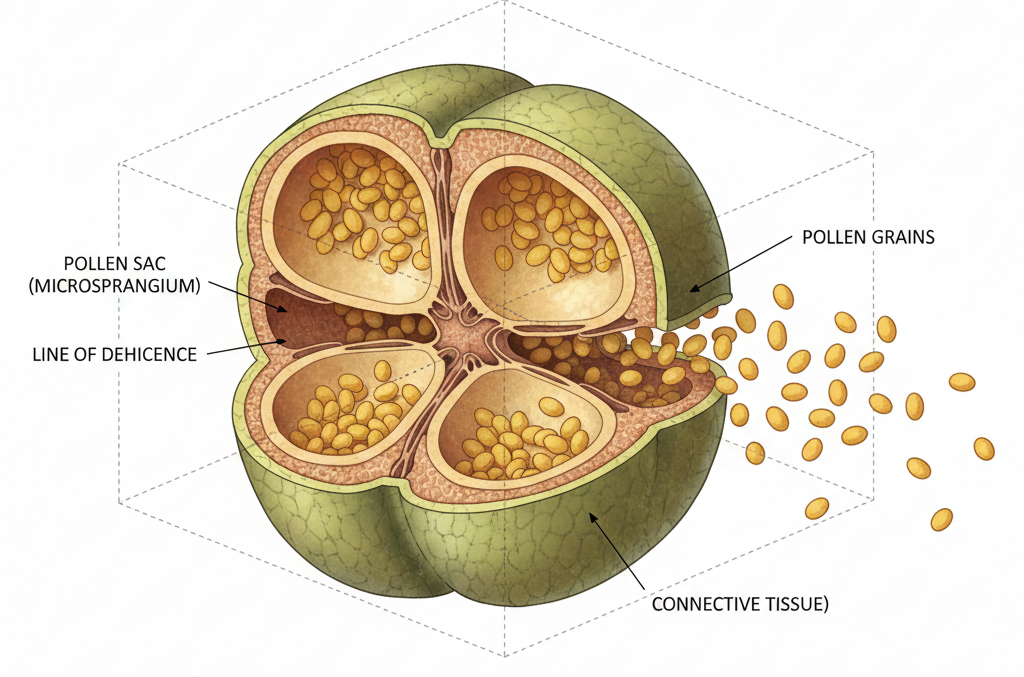
Think of the anther as a high-tech factory. It’s usually dithecous (two theca per lobe) and tetragonal, containing four microsporangia at the corners. Imagine a local Masala Dabba with four compartments—those are your microsporangia, which later develop into pollen sacs packed with pollen grains.
NEET Checkpoint:
Which layer of the microsporangium provides nutrition to developing pollen?
(a) Epidermis
(b) Endothecium
(c) Tapetum
(d) Middle layers
✅ Answer: (c) Tapetum — It has dense cytoplasm and is usually multi-nucleate to feed the growing pollen!
Inside, the sporogenous tissue undergoes meiotic divisions—this is microsporogenesis. This process turns a diploid Pollen Mother Cell (PMC) into a microspore tetrad (four haploid cells).
NEET Checkpoint:
What is the ploidy of cells in a microspore tetrad?
(a) $n$
(b) $2n$
(c) $3n$
(d) $4n$
✅ Answer: (a) $n$ — Meiosis always reduces the chromosome number by half!
Pollen grains are the male gametophytes, measuring about $25-50\ \mu m$ in diameter. They have a two-layered wall: the inner intine (cellulose and pectin) and the super-tough outer exine. The exine is made of sporopollenin, the "Hulk" of organic materials—it resists high temperatures, strong acids, and even enzymes!
NEET Checkpoint:
Why are pollen grains so well-preserved as fossils?
(a) Presence of Intine
(b) Presence of Sporopollenin
(c) High oil content
(d) Small size
✅ Answer: (b) Presence of Sporopollenin — It’s one of the most resistant organic materials known!
Figure below:
A three-dimensional cut section of a mature anther showing four pollen sacs, the line of dehiscence, and numerous pollen grains being released.
Inside a mature pollen grain, you'll find two cells: a large vegetative cell (the "foodie" with lots of reserves) and a small, spindle-shaped generative cell that floats in its cytoplasm. In $60\%$ of angiosperms, pollen is shed at this 2-celled stage.
Practice Questions:
1. The exine of a pollen grain has prominent apertures where sporopollenin is absent. These are called:
(a) Germ pores
(b) Micropyles
(c) Hilum
(d) Nucellus
✅ Answer: (a) Germ pores. This is where the pollen tube will eventually pop out!
2. In $40\%$ of flowering plants, the generative cell divides to form two male gametes. At what stage is this pollen shed?
(a) 1-celled
(b) 2-celled
(c) 3-celled
(d) 4-celled
✅ Answer: (c) 3-celled. The vegetative cell plus two male gametes makes three!
Key Takeaway
The anther is the site of microsporogenesis, producing haploid pollen. Sporopollenin in the exine makes pollen incredibly durable, while the generative cell is the "VIP" that produces the male gametes.
3.Megasporogenesis and the Female Gametophyte
Listen up, future doctors! The gynoecium is the "boss lady" of the flower, consisting of the stigma, style, and the basal ovary. Inside that ovary, you'll find the megasporangia, or as we normally call them, ovules.
A typical anatropous ovule is like a high-security apartment. It's attached by a funicle (the stalk), has a hilum (the junction point), and is wrapped in protective integuments. Inside, the nucellus stores the food—think of it as the pantry—and the embryo sac stays tucked away.
NEET Checkpoint:
What do we call the junction between the ovule and the funicle?
(a) Chalaza
(b) Hilum
(c) Micropyle
(d) Nucellus
✅ Answer: (b) Hilum — Arre, it's just the meeting point where the body of the ovule fuses with its stalk!
Now, let's talk about Megasporogenesis. A single Megaspore Mother Cell (MMC)—a large cell with dense cytoplasm—undergoes meiosis to produce four megaspores. In most plants, it’s a bit of a "survival of the fittest" situation: three megaspores degenerate, and only one functional megaspore remains to form the female gametophyte. This is called monosporic development.
NEET Checkpoint:
In a majority of flowering plants, how many megaspores actually survive?
(a) $1$
(b) $2$
(c) $3$
(d) $4$
✅ Answer: (a) $1$ — Only one functional megaspore develops; the other three just retire early, yaar!
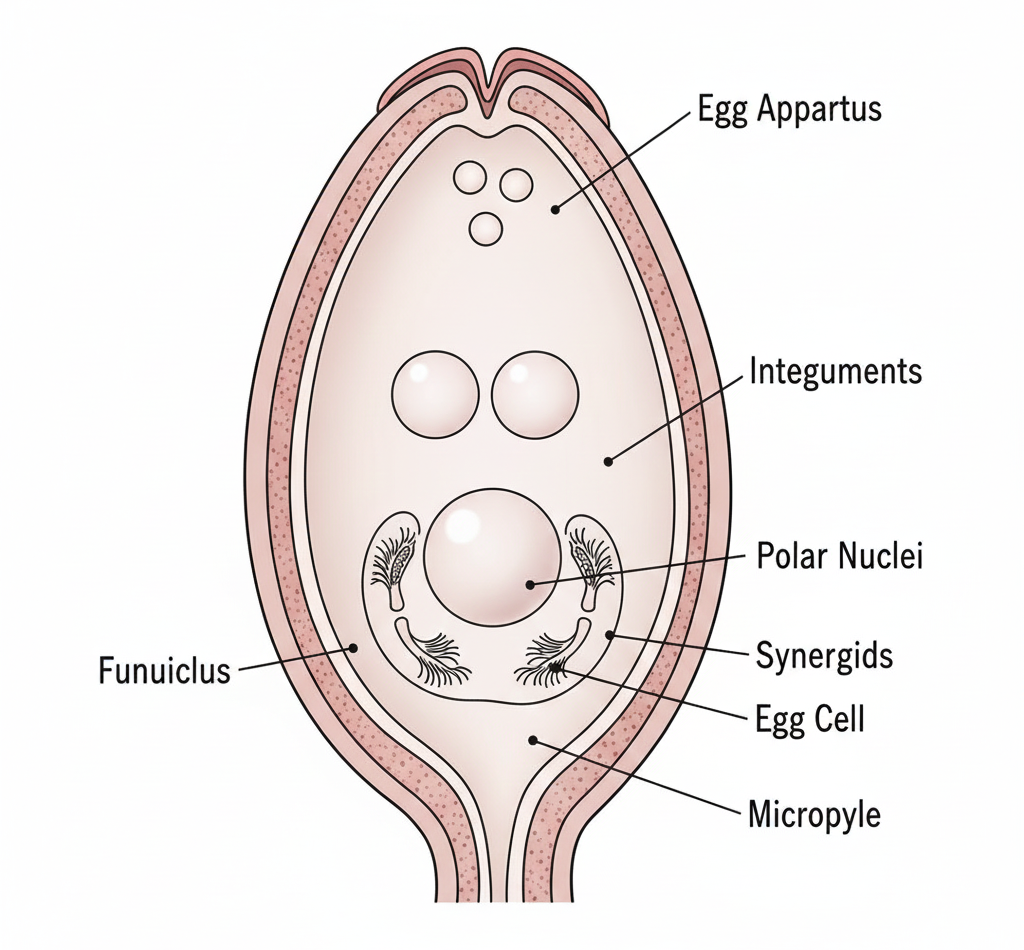
The functional megaspore's nucleus divides mitotically (free nuclear division!) to eventually create an $8$-nucleate, $7$-celled embryo sac. At the micropylar end, you have the egg apparatus ($2$ synergids + $1$ egg cell). The synergids have a cool filiform apparatus to guide the pollen tube. At the other end (chalazal end), we have $3$ antipodals, and in the middle sits a massive central cell with $2$ polar nuclei.
Think of it like a local bus: $3$ passengers (antipodals) at the back, $2$ conductors (synergids) and $1$ driver (egg) at the front door, and $2$ VIPs (polar nuclei) sitting in the middle aisle!
NEET Checkpoint:
Which structure guides the entry of the pollen tube into the synergid?
(a) Chalaza
(b) Integuments
(c) Filiform apparatus
(d) Antipodals
✅ Answer: (c) Filiform apparatus — It's like a GPS for the pollen tube!
Figure below:
A clear, diagrammatic representation of a mature 7-celled, 8-nucleate embryo sac, highlighting the egg apparatus, polar nuclei in the central cell, and antipodals at the chalazal end.
Practice Questions:
- The basal part of the ovule, opposite the micropyle, is the:
(a) Hilum
(b) Funicle
(c) Chalaza
(d) Nucellus
✅ Answer: (c) The chalaza represents the basal part of the ovule.
2. A mature angiosperm embryo sac is:
(a) $8$-nucleate, $8$-celled
(b) $7$-nucleate, $8$-celled
(c) $8$-nucleate, $7$-celled
(d) $7$-nucleate, $7$-celled
✅ Answer: (c) Even though there are $8$ nuclei, two stay in one large central cell, making it $7$-celled.
Key Takeaway
- Gynoecium: Stigma + Style + Ovary.
- Ovule Parts: Funicle, Hilum, Integuments, Nucellus, Micropyle, Chalaza.
- Process: $1$ MMC $\xrightarrow{Meiosis}$ $4$ Megaspores $\rightarrow$ $1$ Functional Megaspore $\xrightarrow{3 \text{ Mitosis}}$ $8$-nucleate embryo sac.
- Embryo Sac Setup: $3$ Antipodals (Chalaza) + $2$ Polar Nuclei (Central Cell) + $2$ Synergids & $1$ Egg (Micropyle).
4. Pollination: Types, Agencies, and Examples
Listen up, future doctors! Let’s clear this funda once and for all. Pollination is simply the mechanism to transfer pollen grains (shed from the anther) to the stigma of a pistil. Since both male and female gametes in flowering plants are non-motile, they need a "delivery service" to bring them together for fertilisation.
The Three "Rishtas" (Types of Pollination)
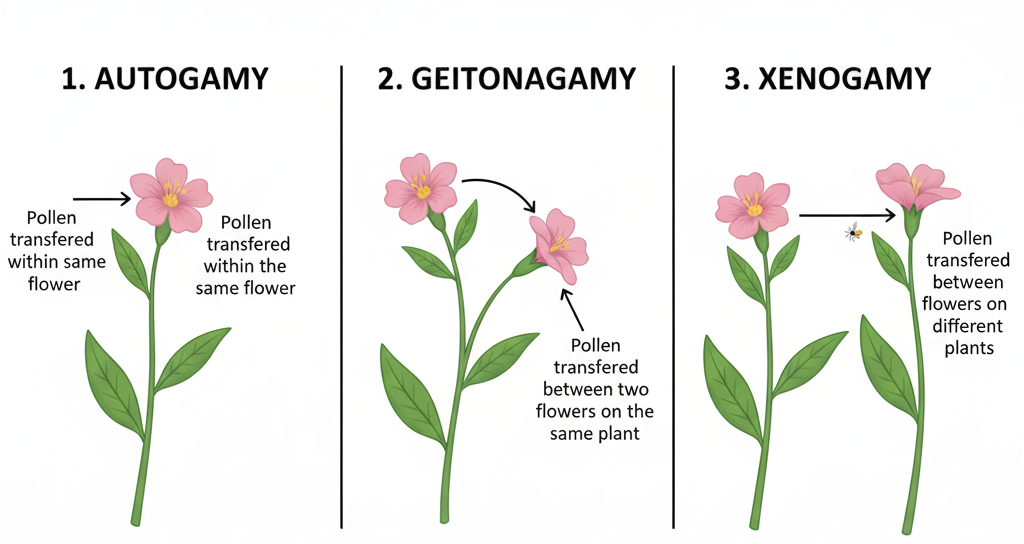
- Autogamy: The "self-service" mode. Pollen moves from the anther to the stigma of the same flower. Some plants like Viola and Commelina are so "introverted" they have cleistogamous flowers that never open at all, ensuring an assured seed-set even without pollinators!
- Geitonogamy: This is like sending a WhatsApp to your neighbour in the same apartment building—it's the transfer of pollen to another flower on the same plant. It's functionally cross-pollination but genetically it's still autogamy.
- Xenogamy: The real cross-pollination where pollen travels to a different plant. This is the only one that brings in new genetic variations.
NEET Checkpoint :
Which type of pollination is genetically similar to autogamy?
(a) Xenogamy
(b) Geitonogamy
(c) Cleistogamy
(d) Anemophily
✅ Answer: (b) Geitonogamy — Because the pollen comes from the same plant, the genetic makeup is identical.
Agencies: The Delivery Guys
Plants use two abiotic (wind and water) and one biotic (animals) agent.
* Wind (Anemophily): Common in grasses. Pollen must be light and non-sticky so they can fly in wind currents.
* Water (Hydrophily): Quite rare, limited to about 30 genera like Vallisneria and Zostera.
* Biotic: Most plants prefer animals, especially bees, which are the dominant pollinating agents. Flowers provide "salaries" or floral rewards like nectar and pollen to keep these visitors coming back.
NEET Checkpoint :
What is a common characteristic of wind-pollinated flowers?
(a) Brightly coloured petals and nectar
(b) Large, sticky pollen grains
(c) Well-exposed stamens and feathery stigmas
(d) Presence of scent to attract insects
✅ Answer: (c) Well-exposed stamens and feathery stigmas — This setup is perfect for dispersing and catching air-borne pollen.
NEET Checkpoint :
All aquatic plants use water for pollination.
(a) True
(b) False
✅ Answer: (b) False — Plants like water lily and water hyacinth emerge above water and use insects or wind.
Imagine a busy Mumbai Local train. The pollen grains are the passengers. In wind pollination, it's like the doors opening and the crowd just "flowing" out randomly. In animal pollination, it's like hiring a rickshaw (the bee) to take you exactly where you need to go in exchange for some Pani Puri (the nectar)!
Figure below:
A clear diagram showing the three types of pollination: Autogamy (within one flower), Geitonogamy (between two flowers on one plant), and Xenogamy (between flowers on two separate plants), with arrows indicating pollen flow.
Practice Questions:
1. Cleistogamous flowers are invariably:
(a) Cross-pollinated
(b) Autogamous
(c) Xenogamous
(d) Geitonogamous
✅ Answer: (b) Autogamous — Since they never open, there is no chance of cross-pollen landing on the stigma.
2. Floral rewards are generally provided to sustain visits from:
(a) Wind
(b) Water
(c) Animals
(d) Gravity
✅ Answer: (c) Animals — Nectar and pollen are the usual "bribes" given to animal visitors.
Key Takeaway
- Autogamy: Same flower; Geitonogamy: Same plant; Xenogamy: Different plant.
- Wind Pollen: Light/non-sticky; Water Pollen: Often has a mucilaginous covering.
- Biotic Rewards: Nectar and Pollen grains.
5. Outbreeding Devices and Pollen-Pistil Interaction
Listen up, yaar! If plants keep "marrying" within the same flower, they face inbreeding depression—basically, they lose their genetic "vibe" and strength. To keep things fresh, plants have evolved some clever outbreeding devices to discourage self-pollination.
NEET Checkpoint:
Which of these prevents both autogamy and geitonogamy?
(a) Castor
(b) Maize
(c) Papaya
(d) All of these
✅ Answer: (c) Papaya — Because it's dioecious (male and female flowers on different plants), it’s the ultimate "social distancing" champion!
Some plants play with timing (pollen release and stigma receptivity aren't synced), while others place anthers and stigmas at different heights so they can’t touch. But the most "boss" move is self-incompatibility, a genetic mechanism where the pistil literally blocks its own pollen from germinating.
Think of it like a Mumbai local train ticket: you can't enter the First Class compartment with a Second Class pass! The pistil is like the ticket checker, using a "chemical dialogue" to recognize if the pollen is compatible.
NEET Checkpoint:
The dynamic dialogue between pollen and pistil is mediated by:
(a) Electrical impulses
(b) Chemical components
(c) Air pressure
✅ Answer: (b) Chemical components — It’s all about the molecular chemistry, buddy!
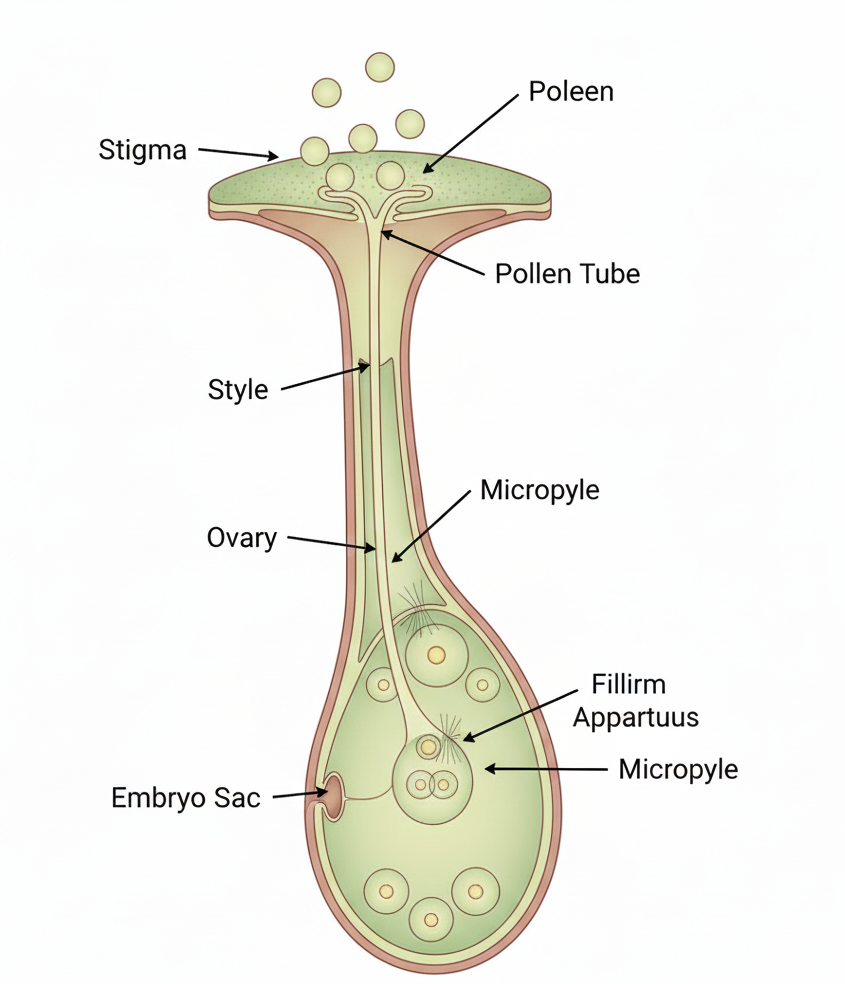
If the pollen is "right," it germinates and a pollen tube grows through the style, carrying male gametes to the ovary. This journey is guided by the filiform apparatus in the synergids. You can even see this yourself by dusting pollen in a $10\%$ sugar solution on a slide!
Figure below:
A clear diagram showing pollen grains germinating on a stigma with a long pollen tube growing down through the style, entering the ovule through the micropyle and being guided by the filiform apparatus of a synergid.
NEET Checkpoint:
Where does the pollen tube usually enter the ovule?
(a) Chalaza
(b) Integument
(c) Micropyle
✅ Answer: (c) Micropyle — It's the "VIP entrance" for the pollen tube!
Practice Questions:
1. Self-incompatibility prevents:
(a) Only autogamy
(b) Only geitonogamy
(c) Both autogamy and geitonogamy
(d) Formation of fruits
✅ Answer: (c) — It’s a genetic "no-entry" for any pollen from the same plant.
2. The filiform apparatus is found in:
(a) Antipodals
(b) Synergids
(c) Polar nuclei
(d) Secondary oocyte
✅ Answer: (b) — These are the "GPS navigators" for the pollen tube.
Key Takeaway
- Outbreeding Devices: Mechanisms like dioecy and self-incompatibility that prevent inbreeding depression.
- Pollen-Pistil Interaction: A chemical-mediated "yes/no" dialogue that determines fertilisation success.
6. Double Fertilisation and Post-Fertilisation Events
Hello there, future doctor! Ready to crack the most unique event in the plant kingdom? We’re talking about Double Fertilisation. It’s like a "Buy One, Get One Free" offer at a pani puri stall, but for nuclei!
Inside the embryo sac, one male gamete fuses with the egg cell (Syngamy) to form a diploid ($2n$) zygote. Meanwhile, the second male gamete fuses with two polar nuclei to create a triploid ($3n$) Primary Endosperm Nucleus (PEN). This "Triple Fusion" plus Syngamy equals Double Fertilisation—a total VIP event only for angiosperms.
NEET Checkpoint:
What is the ploidy of the PEN?
(a) $n$
(b) $2n$
(c) $3n$
(d) $4n$
✅ Answer: (c) $3n$ — It’s called triple fusion for a reason, yaar! One male gamete plus two polar nuclei.
After the big fusion, the Primary Endosperm Cell (PEC) develops into the endosperm. Here’s the trick: endosperm development always precedes embryo development. Think of it like a local train; the endosperm is the pantry car that must be ready before the passenger (the embryo) starts its journey to provide nutrition!
NEET Checkpoint:
Why does endosperm develop before the embryo?
(a) To form the seed coat
(b) To aid in pollination
(c) To provide nourishment to the developing embryo
(d) To protect the ovule from desiccation
✅ Answer: (c) To provide assured nutrition to the developing embryo.
The zygote then transforms into an embryo, passing through a specific sequence: proembryo $\rightarrow$ globular $\rightarrow$ heart-shaped $\rightarrow$ mature embryo. Don't stress, the "funda" is simple: it grows in shapes!
Figure below:
A diagram showing the stages of dicot embryo development from zygote to globular, heart-shaped, and mature stages.

NEET Checkpoint:
Which embryo stage follows the globular stage?
(a) Proembryo
(b) Heart-shaped
(c) Mature
✅ Answer: (b) Heart-shaped — It’s the sequence of development!
Practice Question:
Double fertilisation is unique to:
(a) Algae
(b) Gymnosperms
(c) Angiosperms
(d) Bryophytes
✅ Answer: (c) Angiosperms — This is their signature move!
Key Takeaway:
- Double Fertilisation = Syngamy ($2n$ Zygote) + Triple Fusion ($3n$ PEN).
- Sequence: Endosperm first, then Embryo.
- Embryo Stages: Globular $\rightarrow$ Heart-shaped $\rightarrow$ Mature.
7. Seed Formation, Fruit Development, and Special Modes
Listen up, junior! Once the "double date" of double fertilisation is over, the ovule matures into a seed and the ovary turns into a fruit. Seeds are nature’s ultimate survival kits, packed with a protective coat and food reserves in the cotyledons. Some seeds are albuminous (greedy ones that keep their endosperm, like wheat or maize) while others are non-albuminous (like the peas in your pulao that use it all up).
NEET Checkpoint:
Which of these is a non-albuminous seed?
(a) Castor
(b) Barley
(c) Groundnut
(d) Wheat
✅ Answer: (c) Groundnut — Arre, remember! Most legumes finish their endosperm "tiffin" during embryo development.
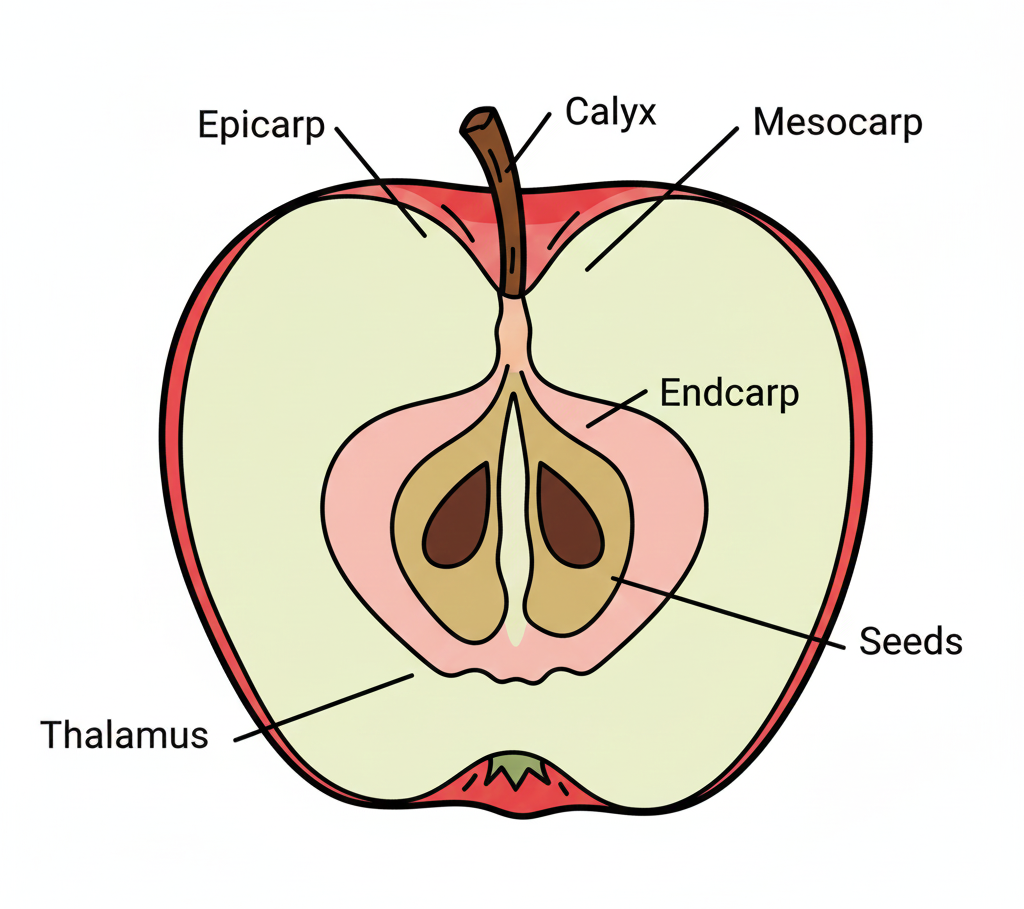
Did you know the thalamus sometimes tries to be the hero? In apples and strawberries, the thalamus contributes to fruit formation, making them false fruits.
Figure below:
A clear diagram showing the L.S. of an apple as a false fruit, highlighting the thalamus, endocarp, and seeds.
NEET Checkpoint:
What is the persistent nucellus found in black pepper called?
(a) Pericarp
(b) Perisperm
(c) Scutellum
(d) Tegmen
✅ Answer: (b) Perisperm — This is a classic NEET favourite funda!
Now for the "life hacks." Apomixis is when plants produce seeds without fertilisation—basically asexual reproduction mimicking the sexual style, seen in some grasses. Then there's Polyembryony, where you find a crowd of embryos in one seed, like in a juicy Nagpur orange.
Indian Example: Imagine buying a bunch of bananas from the local thela. Notice they don’t have seeds? That's Parthenocarpy—fruit development without any fertilisation.
NEET Checkpoint:
Which of these mimics sexual reproduction?
(a) Parthenocarpy
(b) Polyembryony
(c) Apomixis
(d) Emasculation
✅ Answer: (c) Apomixis — It’s asexual but looks like the real deal since it produces seeds.
Practice Questions:
1. Seeds of Lupinus arcticus germinated after how many years of dormancy?
(a) 2,000
(b) 5,000
(c) 10,000
(d) 1,000
✅ Answer: (c) 10,000 — That’s a serious nap! This was discovered in the Arctic Tundra.
2. As a seed matures, its moisture content is reduced to:
(a) $20-25\%$
(b) $5-8\%$
(c) $10-15\%$
(d) $50\%$
✅ Answer: (c) $10-15\%$ — This dryness helps the embryo enter a state of dormancy.
Key Takeaway
- Ovule $\rightarrow$ Seed; Ovary $\rightarrow$ Fruit.
- Perisperm: Persistent nucellus (Black pepper, beet).
- Apomixis: Seeds without fertilisation.
- Polyembryony: Multiple embryos (Citrus, Mango).
8. The Male Reproductive System and Microscopic Anatomy
Hey junior! Ready to decode the male reproductive system? It’s located in the pelvis and consists of the testes, accessory ducts, glands, and external genitalia. Think of it as a highly organised factory where the "product" (sperms) needs very specific conditions to be manufactured.
First, let's clear up a major funda: why are the testes kept in a pouch called the scrotum outside the body? Because sperm production, or spermatogenesis, is a "cool" job—literally! It requires a temperature $2-2.5^{\circ}C$ lower than our normal $37^{\circ}C$ body heat. Imagine it like a high-end server room that needs extra cooling so the hardware doesn't fry!
NEET Checkpoint:
The scrotum helps in maintaining a temperature:
(a) Higher than body temp
(b) Equal to body temp
(c) $2-2.5^{\circ}C$ lower than body temp
(d) $5^{\circ}C$ lower than body temp
✅ Answer: (c) — It’s essential for successful spermatogenesis.
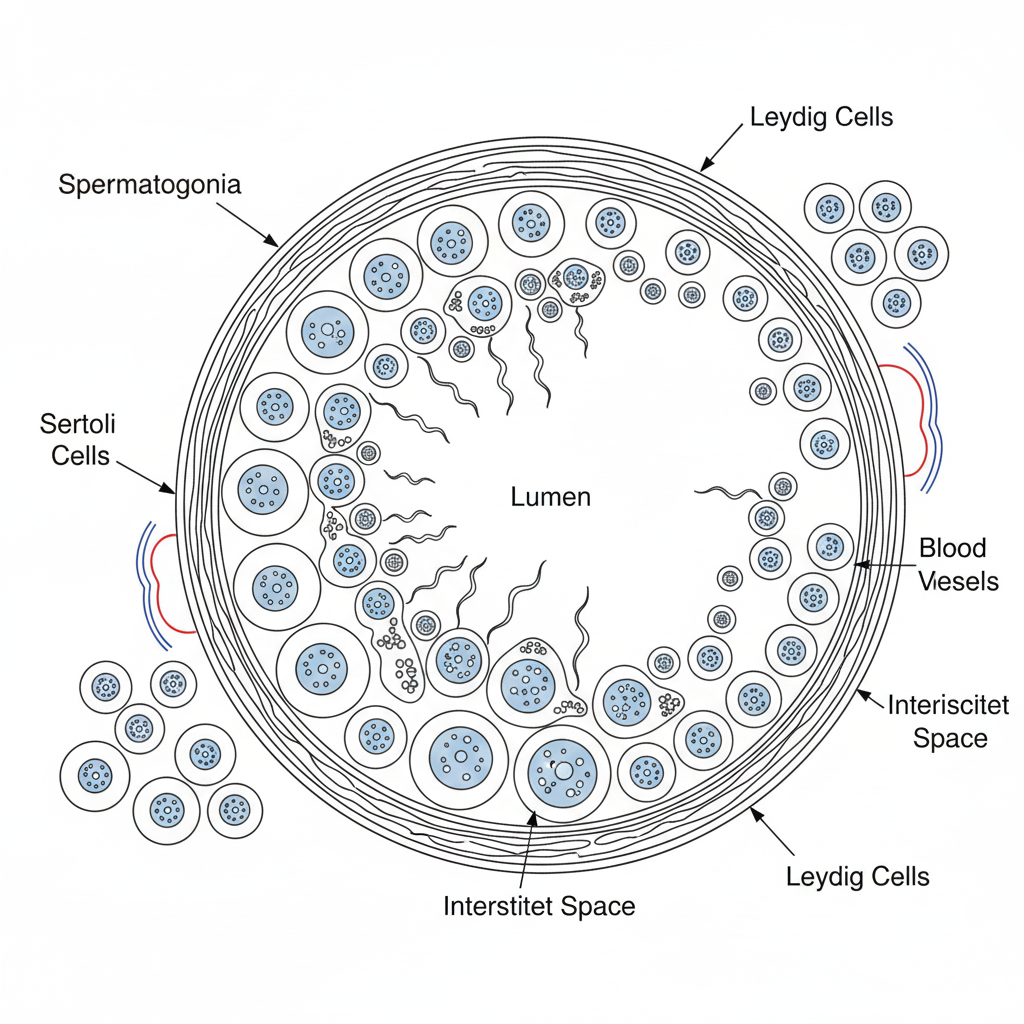
Each testis is about $4$ to $5$ $cm$ long and contains roughly $250$ compartments called testicular lobules. Inside these, you’ll find the seminiferous tubules. These tubules are lined with two types of cells: male germ cells (spermatogonia) that undergo meiosis to become sperms, and Sertoli cells, which act like the canteen managers providing nutrition to the germ cells.
NEET Checkpoint:
Which cells synthesise androgens?
(a) Sertoli cells
(b) Spermatogonia
(c) Leydig cells
(d) Epithelial cells
✅ Answer: (c) — Leydig cells (interstitial cells) are located in the spaces outside the tubules and secrete male hormones.
Outside the tubules, we have the Leydig cells secreting androgens. Finally, the accessory glands (seminal vesicles, prostate, and bulbourethral glands) produce seminal plasma. This "energy drink" for sperms is rich in fructose and calcium. Even the bulbourethral glands help out by providing lubrication for the penis.
NEET Checkpoint:
Seminal plasma is rich in:
(a) Glucose and Sodium
(b) Fructose and Calcium
(c) Ribose and Potassium
(d) Maltose and Iron
✅ Answer: (b) — Fructose provides the necessary fuel for sperm motility.
Figure below:
A clear diagram of a sectional view of a seminiferous tubule, showing spermatogonia and Sertoli cells inside the tubule, with Leydig cells and blood vessels in the interstitial spaces outside.
Practice Question:
Which of the following is NOT an accessory duct of the male reproductive system?
(a) Rete testis
(b) Epididymis
(c) Vas deferens
(d) Prostate gland
✅ Answer: (d) — The prostate is an accessory gland, not a duct. Don't let the examiner trip you up with this classic googly, yaar!
Key Takeaway:
- Scrotum: Keeps testes $2-2.5^{\circ}C$ cooler for spermatogenesis.
- Seminiferous Tubules: Contain Spermatogonia (germ cells) and Sertoli cells (nutrition).
- Leydig Cells: Secrete androgens.
- Glands: Produce seminal plasma (rich in fructose and calcium).
9. The Female Reproductive System and Microscopic Anatomy
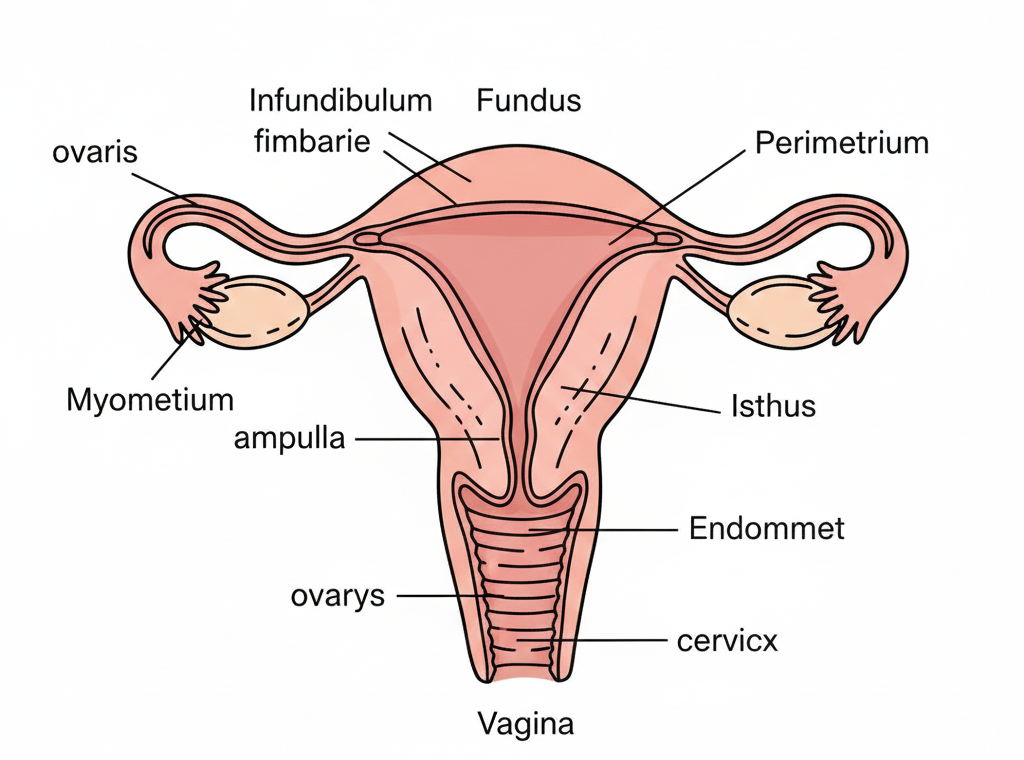
Listen up, junior! While the male system is all about production and delivery, the female reproductive system is a high-tech "incubation centre" integrated for ovulation, fertilisation, and child care. The core players are the ovaries, which produce the ovum and steroid hormones. Each ovary is about $2-4 \text{ cm}$ in length and is tucked away in the lower abdomen, held in place by ligaments.
Think of the fimbriae (those finger-like projections on the infundibulum) like a star fielder at a cricket match, perfectly positioned to "catch" the ovum the moment it’s released during ovulation. From there, the ovum travels through the ampulla and isthmus of the oviduct toward the uterus.
NEET Checkpoint:
Which layer of the uterus undergoes cyclical changes during the menstrual cycle?
(a) Perimetrium
(b) Myometrium
(c) Endometrium
(d) Mesometrium
✅ Answer: (c) Endometrium — It’s the glandular inner lining that prep-work happens on every month!
The uterus (or womb) is shaped like an inverted pear. It has three distinct layers: the thin perimetrium, the muscular myometrium (the "muscle" needed for delivery), and the glandular endometrium. The cervix and vagina together form the birth canal. Don't forget the mammary glands, which contain 15-20 mammary lobes with milk-secreting alveoli.
NEET Checkpoint:
Is the hymen a reliable indicator of virginity?
(a) Yes, it is always intact before first intercourse
(b) Yes, it breaks only during sexual intercourse
(c) No, it can be ruptured due to activities like sports or may be absent naturally
(d) No, it reforms after menstruation
✅ Answer: (c) No — It can be broken by sports, cycling, or even a sudden jolt.
NEET Checkpoint:
Where is the clitoris located?
(a) At the opening of the vagina
(b) Inside the uterus
(c) At the cervix
(d) At the upper junction of the two labia minora
✅ Answer: (d) At the upper junction of the two labia minora — It's a tiny, finger-like structure.
Figure below:
A diagrammatic sectional view of the female reproductive system showing the ovaries, fallopian tubes (infundibulum, fimbriae, ampulla, isthmus), uterus (fundus, perimetrium, myometrium, endometrium), cervix, and vagina.
Practice Questions:
1. The part of the fallopian tube that joins the uterus is the:
(a) Ampulla
(b) Infundibulum
(c) Isthmus
(d) Fimbriae
✅ Answer: (c) Isthmus — It has a narrow lumen and is the final section.
2. Milk is stored in the cavities of:
(a) Mammary ducts
(b) Alveoli
(c) Mammary ampulla
(d) Lactiferous ducts
✅ Answer: (b) Alveoli — These clusters of cells secrete the milk into their lumens.
Key Takeaway
- Ovaries: Produce ovum + hormones ($2-4 \text{ cm}$ long).
- Uterine Layers: Perimetrium (outer), Myometrium (middle/muscular), Endometrium (inner/glandular).
- Mammary Glands: 15-20 lobes $\rightarrow$ Alveoli $\rightarrow$ Tubules $\rightarrow$ Ducts $\rightarrow$ Ampulla $\rightarrow$ Lactiferous duct.
10. Gametogenesis: Spermatogenesis and Oogenesis
Listen up, junior! Let’s clear up the funda of how gametes are made. It’s not just a biology chapter; it’s the ultimate production line of life!.
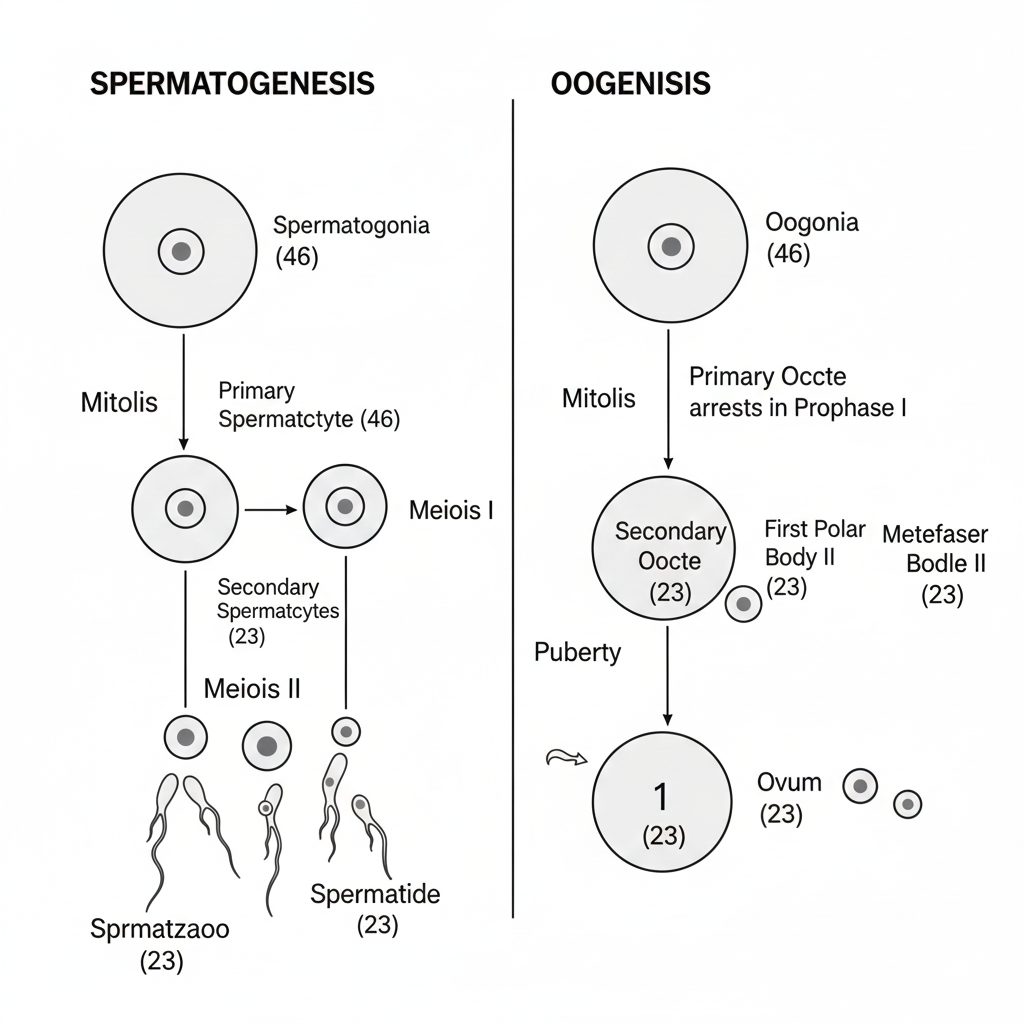
Spermatogenesis kicks off only at puberty. Inside the seminiferous tubules, diploid spermatogonia ($2n = 46$) multiply and some become primary spermatocytes. These undergo the first meiotic division to form two equal haploid secondary spermatocytes ($n = 23$), which then divide again to produce four spermatids. But a spermatid is like a stationary rickshaw—it needs a makeover to move! This transformation into spermatozoa (sperms) is called spermiogenesis.
NEET Checkpoint:
How many sperms are formed from one primary spermatocyte?
(a) 1
(b) 2
(c) 4
(d) 8
✅ Answer: (c) 4 — Meiosis is the "magic" that quadruples the count while halving the chromosomes!.
Now, oogenesis is a different ball game. It starts during embryonic development. Imagine a factory that makes all its raw material before it even opens! No more oogonia are added after birth. At puberty, a primary oocyte completes its first meiotic division, but it's unequal, creating a huge secondary oocyte and a tiny first polar body.
Relatable Example: Think of spermatogenesis like a cricket academy where every trainee becomes a player. Oogenesis is like a high-stakes selection where only one "star" player (the ovum) gets all the resources (cytoplasm), and the rest are just support staff (polar bodies).
NEET Checkpoint:
When is oogenesis initiated in human females?
(a) At puberty
(b) During childhood
(c) During foetal development
(d) After birth
✅ Answer: During foetal development — Unlike boys who start at puberty, girls are born with their "stock" ready!.
Hormones like GnRH, LH, and FSH run the show. LH stimulates Leydig cells to secrete androgens, while FSH helps Sertoli cells in spermiogenesis.
Figure below:
A clear schematic diagram comparing spermatogenesis and oogenesis, showing the chromosome numbers (46 and 23) and the unequal cytokinesis in the female path.
NEET Checkpoint:
Which hormone acts on Sertoli cells?
(a) LH
(b) GnRH
(c) FSH
(d) Estrogen
✅ Answer: (c) FSH — Remember "S" for Sertoli and "FSH"!.
Practice Question:
1. The process of releasing sperms from the seminiferous tubules is:
(a) Spermiogenesis
(b) Spermiation
(c) Insemination
(d) Gametogenesis
✅ Answer: (b) Spermiation. Don't confuse it with spermiogenesis, which is just the "makeover" phase!.
Key Takeaway
- Spermatogenesis: Continuous from puberty; 1 primary spermatocyte $\rightarrow$ 4 sperms.
- Oogenesis: Starts before birth; 1 primary oocyte $\rightarrow$ 1 ovum + polar bodies.
- Hormones: GnRH, LH, FSH, and Androgens are the "coaches".
11. The Menstrual Cycle and Hormonal Regulation
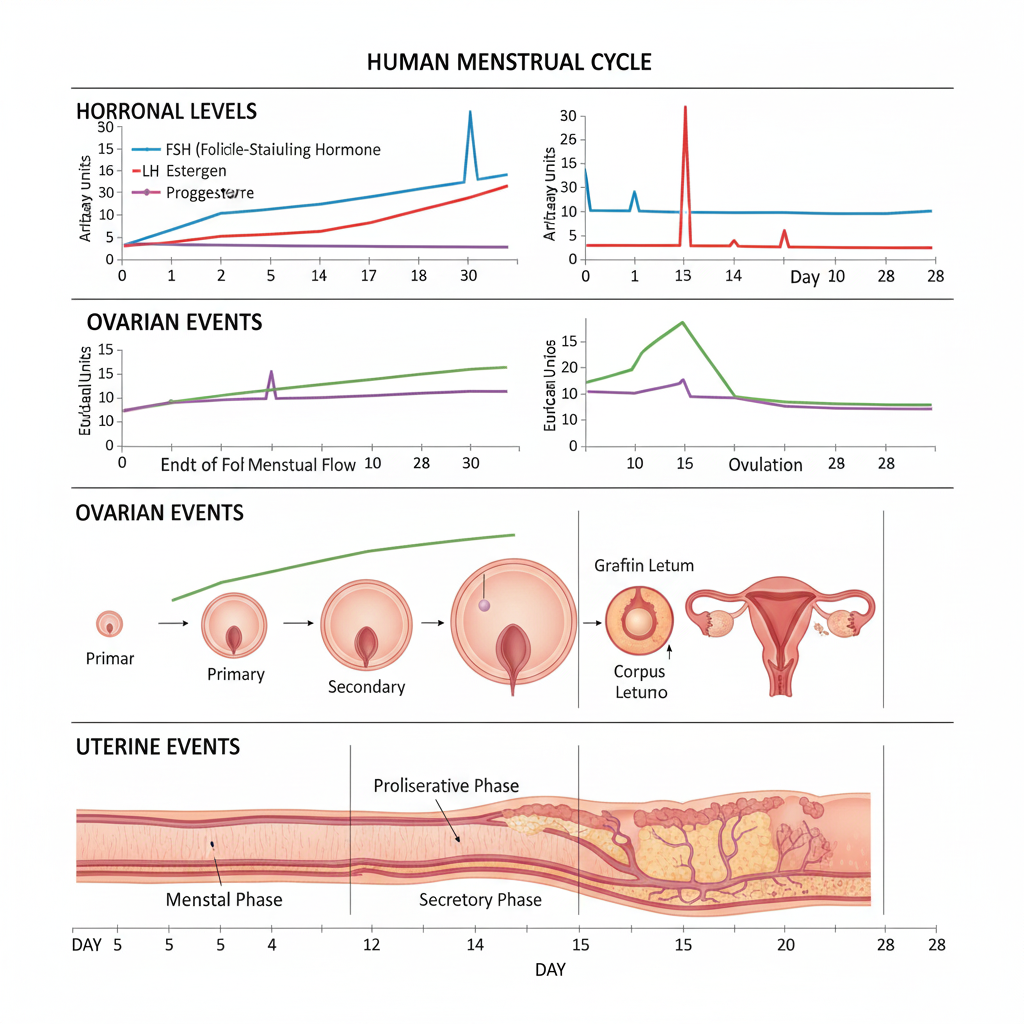
Listen up, junior! Understanding the menstrual cycle isn't just for the boards; it’s a "hot topic" for NEET. This cycle is the reproductive rhythm in female primates, repeating every $28/29$ days. Think of it like a monthly prepaid mobile recharge—if the "data" (fertilisation) isn't used, the plan expires (menstruation), and a new cycle begins!
The cycle has four main acts:
1. Menstrual Phase ($1-5$ days): The endometrial lining breaks down because that unfertilised ovum didn't find a match.
2. Follicular Phase: Pituitary hormones ($LH$ and $FSH$) nudge primary follicles to become Graafian follicles, while the uterus repairs its lining.
3. Ovulatory Phase (Day $14$): Here is the climax! A massive $LH$ surge causes the Graafian follicle to burst, releasing the ovum.
4. Luteal Phase: The empty follicle transforms into the corpus luteum, which pumps out progesterone to keep the "bed" (endometrium) ready for a baby.
NEET Checkpoint:
What is the first menstruation at puberty called?
(a) Menopause
(b) Ovulation
(c) Menarche
(d) Estrous
✅ Answer: (c) Menarche — It marks the start of the reproductive phase.
Figure below:
A detailed chart of the menstrual cycle showing levels of FSH, LH, Estrogen, and Progesterone over 28 days, alongside ovarian and uterine changes.
NEET Checkpoint:
Which hormone surge induces ovulation?
(a) Follicle-stimulating hormone (FSH)
(b) Estrogen
(c) Progesterone
(c) Luteinizing hormone (LH)
✅ Answer: (d) $LH$ surge — This rapid secretion happens right in the middle of the cycle.
NEET Checkpoint:
Why is progesterone essential in the luteal phase?
(a) It stimulates follicular growth
(b) It induces ovulation
(c) It maintains the endometrium for implantation
(d) It triggers menstruation
✅ Answer: (c) To maintain the endometrium — Necessary for implantation.
Practice Questions:
1. If fertilisation doesn't occur, the corpus luteum:
(a) Grows bigger
(b) Secretes more $LH$
(c) Degenerates
(d) Becomes an ovum
✅ Answer: (c) — Its degeneration leads to the breakdown of the endometrium.
2. Menopause in human females usually occurs around:
(a) $12$ years
(b) $50$ years
(c) $28$ years
(d) $70$ years
✅ Answer: (b) — This marks the end of the cyclic menstruation phase.
Key Takeaway
- Cycle Length: $\approx 28/29$ days.
- Ovulation: Day $14$ ($LH$ surge).
- Corpus Luteum: Secretes Progesterone.
- End: Menopause.
12. Human Fertilisation, Implantation, and Embryo Development
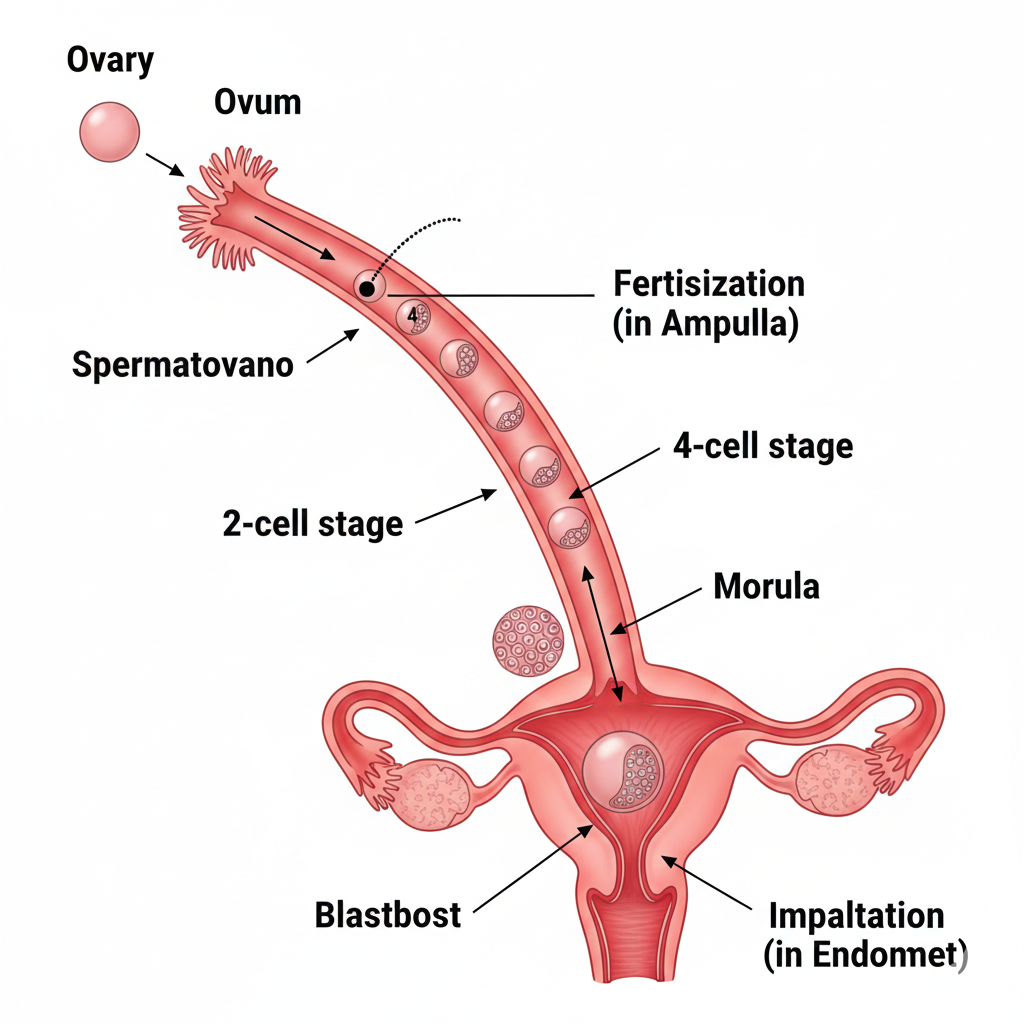
Listen up, junior! Fertilisation is basically a high-stakes race to the ampullary region of the fallopian tube. Both the ovum and sperm must reach this "meeting point" simultaneously for the magic to happen. Think of it like a perfectly timed catch in a cricket match—if the fielder and the ball aren't at the same spot at the same time, it’s a "drop" and no pregnancy occurs!
NEET Checkpoint:
Fertilisation occurs in which part of the fallopian tube?
(a) Isthmus
(b) Ampulla
(c) Infundibulum
(d) Fimbriae
✅ Answer: (b) Ampulla — This is the specific "rendezvous" spot where the sperm meets the egg!
When a sperm touches the zona pellucida layer of the ovum, it triggers a "security lockdown" in the membrane to block other sperms. This ensures only one lucky sperm gets in. The acrosome acts like a master key, releasing enzymes that help the sperm sneak through the zona pellucida and plasma membrane. This entry induces the secondary oocyte to complete its second meiotic division, forming a haploid ovum and a second polar body. The nuclei then fuse to form a diploid zygote.
NEET Checkpoint:
What prevents polyspermy (entry of multiple sperms) during fertilisation?
(a) Acrosome enzymes
(b) Changes in the zona pellucida
(c) The first polar body
(d) The corona radiata
✅ Answer: (b) Changes in the zona pellucida — Once one sperm touches it, the membrane blocks all others!
Now, clear up this funda: as the zygote moves toward the uterus, it undergoes cleavage (rapid mitotic divisions). It goes from $2, 4, 8,$ to $16$ daughter cells called blastomeres. The embryo with $8-16$ blastomeres is called a morula. This morula keeps dividing and transforms into a blastocyst. Imagine the blastocyst is like a local train looking for a station; the outer trophoblast layer acts like the anchor that attaches to the endometrium of the uterus. Meanwhile, the inner cell mass is the actual future rockstar—it differentiates to become the embryo.
NEET Checkpoint:
The $8-16$ celled embryo stage is known as:
(a) Zygote
(b) Blastocyst
(c) Morula
(d) Gastrula
✅ Answer: (c) Morula — It is named after its resemblance to a little mulberry!
Figure below:
A clear diagram showing the transport of the ovum and fertilisation in the ampulla, followed by the cleavage stages (2-cell, 4-cell, 8-cell), the morula, and finally the blastocyst embedding itself into the uterine endometrium during implantation.
Practice Questions:
1. The layer of the blastocyst that attaches to the maternal endometrium is:
(a) Inner cell mass
(b) Trophoblast
(c) Ectoderm
(d) Mesoderm
Explanation: The trophoblast is the outer layer responsible for attachment, while the inner cell mass becomes the embryo.
2. The second meiotic division of the secondary oocyte is completed:
(a) Before ovulation
(b) At the time of copulation
(c) During fertilisation
(d) After implantation
Explanation: The entry of the sperm into the ovum induces the completion of the second meiotic division.
Key Takeaway: The Fertilisation & Implantation Flow
- Location: Ampullary region.
- Zygote ($2n$): Formed by fusion of haploid gametes.
- Cleavage: $2 \rightarrow 4 \rightarrow 8 \rightarrow 16$ blastomeres.
- Morula: $8-16$ cells.
- Blastocyst: Implants in the endometrium via the trophoblast.
13. Pregnancy, Parturition, and Lactation
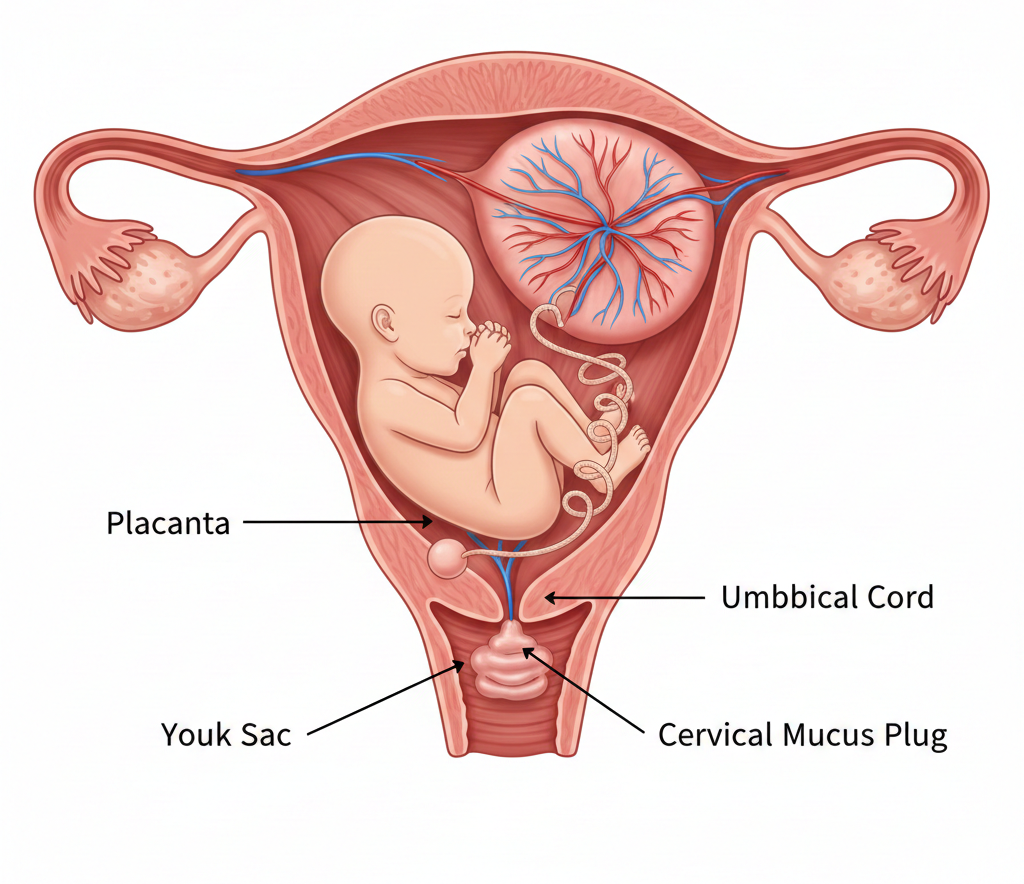
Ready for the grand finale of human reproduction? Once the blastocyst settles into the uterine wall, the placenta takes over—think of it as a high-speed broadband and 5-star tiffin service combined, connecting the mother and foetus via the umbilical cord. It’s a structural and functional unit that isn't just for food; it’s an endocrine factory producing hormones like $hCG$, $hPL$, estrogens, and progestogens.
NEET Checkpoint:
Which hormones are produced only during pregnancy?
(a) Estrogen
(b) Progesterone
(c) $hCG$, $hPL$, and Relaxin
(d) Thyroxine
✅ Answer: (c) $hCG$, $hPL$, and Relaxin — Relaxin comes from the ovary, while the others are placental specials produced only during this time!
The real action happens after nine months, the gestation period. Parturition (childbirth) is like the last over of a nail-biting T20 match—total climax! The fully grown foetus and placenta send the first signals, triggering the foetal ejection reflex. This "neuroendocrine" funda kicks the maternal pituitary to release oxytocin, which causes stronger uterine contractions to push the baby out.
Figure below:
A clear diagram showing the human foetus within the uterus, labelling the placenta, umbilical cord, yolk sac, and the plug of mucus in the cervix as seen in the sources.
NEET Checkpoint:
What triggers the release of oxytocin during birth?
9a Stretching of the cervix and uterus
(b) Foetal movements only
(c) High progesterone levels
(d) Drop in estrogen levels
✅ Answer: (a) Stretching of the cervix and uterus — It's a signal originating from the fully developed foetus and the placenta.
After birth, the mother's mammary glands start lactation. The first milk, colostrum, is liquid gold for the newborn because it is packed with antibodies absolutely essential for developing resistance.
NEET Checkpoint:
Why is colostrum vital for a newborn?
(a) It is rich in fats for energy
(b) It replaces solid food
(c) It provides antibodies and boosts immunity
(d) It stimulates growth hormone release
✅ Answer: (c) It contains essential antibodies — This provides the baby with natural resistance against diseases!
Practice Question:
Signals for parturition originate from:
(a) Placenta only
(b) Fully developed foetus only
(c) Both a and b
(d) Pituitary only
✅ Answer: (c) Both a and b — The 'team effort' between the baby and placenta starts the foetal ejection reflex.
Key Takeaway
- Placenta: Acts as a nutrient link and endocrine tissue ($hCG$, $hPL$).
- Parturition: Induced by a neuroendocrine mechanism involving oxytocin.
- Colostrum: Initial milk containing vital antibodies.
14. Reproductive Health, Birth Control, and MTP
Listen up, junior! Let’s clear up the funda of reproductive health. It’s not just about "working parts"—the WHO says it’s a total well-being package involving physical, emotional, behavioural, and social aspects. Basically, it’s about having a society where people have healthy interactions and informed choices.
Think of India’s population growth like a crowded Mumbai local train; it’s moving fast! To handle this, the government pushed "Hum Do Hamare Do". We use contraceptive methods to manage this load:
- Natural: Avoiding the "fertile period" (Day $10$ to $17$ of the cycle) or using lactational amenorrhea, which works for max $6$ months post-delivery.
- Barrier: Condoms (like 'Nirodh') are great because they also protect against STIs.
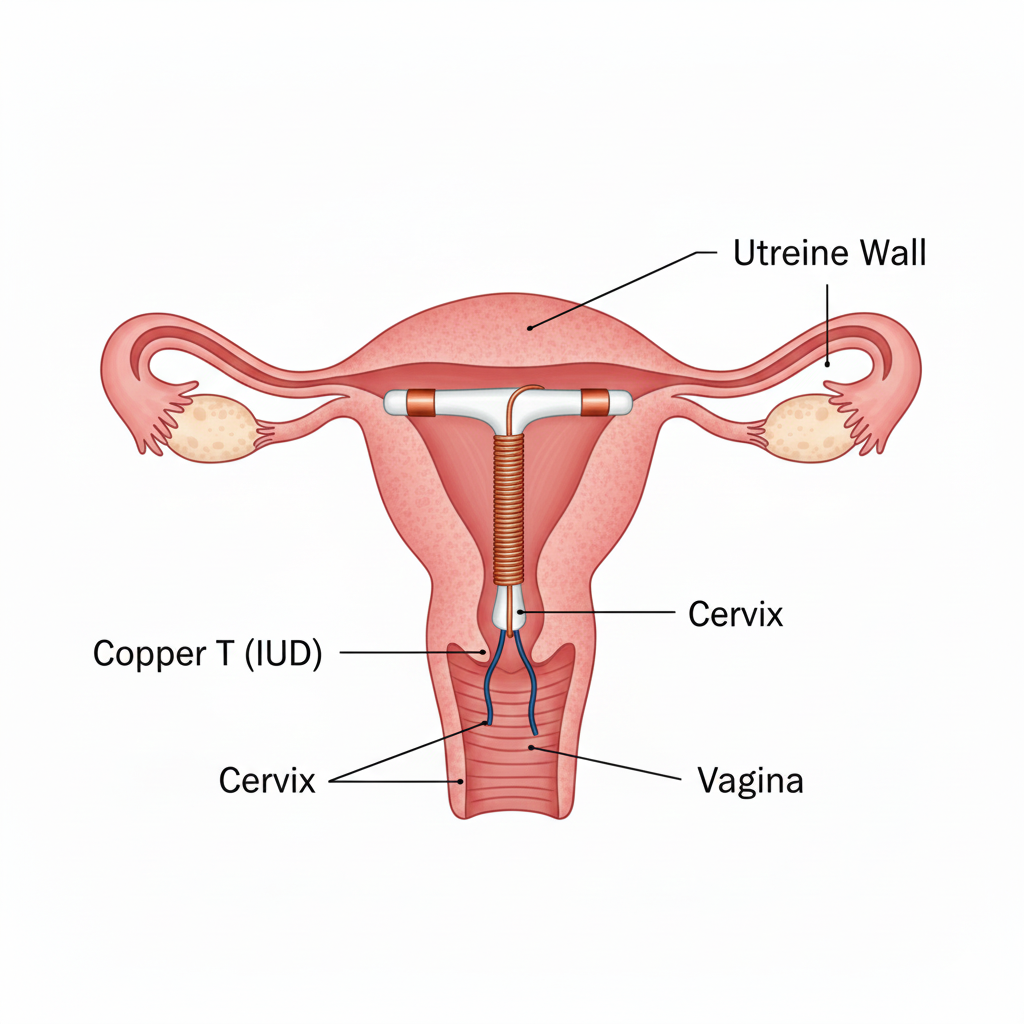
- IUDs: These are super popular in India. Copper T ($CuT$) releases $Cu$ ions to kill sperm motility.
- Oral Pills: Saheli is a special "once-a-week" non-steroidal pill developed by CDRI, Lucknow.
- Surgical: These are "terminal" methods. Vasectomy for the boys (cutting the $vas\ deferens$) and tubectomy for the girls (cutting fallopian tubes).
NEET Checkpoint:
Which IUD is hormone-releasing?
(a) Lippes loop
(b) Multiload 375
(c) LNG-20 (d) Cu7
✅ Answer: (c) LNG-20 — Don't get confused, yaar! $Cu$-releasing ones have 'Cu' or 'Multiload' in the name.
Medical Termination of Pregnancy (MTP) is voluntary abortion, legalised in India in 1971. It's safest during the first trimester (up to $12$ weeks).
NEET Checkpoint:
MTP is considered relatively safe up to how many weeks?
(a) 8 weeks
(b) 12 weeks
(c) 20 weeks
(d) 24 weeks
✅ Answer: (b) 12 weeks — That's the first trimester. After this, it gets much riskier!
NEET Checkpoint:
What is the mechanism of $Cu$ ions in IUDs?
(a) Inhibit ovulation
(b) Block entry of sperm
(c) Suppress sperm motility
(d) Make uterus unsuitable for implantation
✅ Answer: (c) Suppress sperm motility — They basically act like a "speed breaker" for sperms!
Figure below:
A clear diagram showing a Copper T (IUD) inserted within the uterine cavity, highlighting the T-shape and the copper wire winding.
Key Takeaway
- Reproductive Health: Total well-being (Physical + Emotional + Behavioural + Social).
- Contraception: IUDs ($CuT$) and Pills (Saheli) are major Indian methods.
- MTP: Legal since 1971; safe only up to $12$ weeks.
15. STDs, Amniocentesis, and Assisted Reproductive Technology (ART)
Listen up, junior! Reproductive health isn't just about biology; it’s about making sure society doesn't mess up the "funda" of life. Take amniocentesis, for example. It is a clever technique where medical pros take a bit of amniotic fluid to check the foetus for genetic "glitches" like Down syndrome, haemophilia, or sickle-cell anaemia. However, it’s often misused for sex determination, which has led to a statutory ban in India to stop female foeticide. Arre, science is for helping, not for discrimination!
NEET Checkpoint:
Which of these can be detected via amniocentesis?
(a) Sex of the baby
(b) Down syndrome
(c) Haemophilia
(d) All of these
✅ Answer: (d) All of these — Though it's legally meant only for genetic disorders like (b) and (c).
Now, let’s talk STIs (Sexually Transmitted Infections). Diseases like gonorrhoea, syphilis, and HIV/AIDS are major threats. Most are curable if caught early, but the "Big Three"—HIV, Hepatitis-B, and Genital Herpes—are not completely curable. Prevention is better than cure, so always use condoms and avoid multiple partners. Think of it like keeping your mobile's antivirus updated—better safe than sorry!
NEET Checkpoint:
Which STI is NOT completely curable?
(a) Gonorrhoea
(b) Syphilis
(c) Genital herpes
(d) Chlamydia
✅ Answer: (c) Genital herpes — Along with HIV and Hepatitis-B, these stay with the patient.
When couples face infertility—the inability to conceive after two years of unprotected "co-habitation"—ART comes to the rescue. It’s like a super-sub in a cricket match coming in to hit the winning six! IVF (In Vitro Fertilisation) involves fertilising the egg in a lab. From there, we have ZIFT, where the zygote (up to $8$ blastomeres) is moved to the fallopian tube, while GIFT involves transferring a donor's ovum. If the sperm count is low, Intra Cytoplasmic Sperm Injection (ICSI) or Artificial Insemination (AI) are used.
NEET Checkpoint:
What is the transfer of an embryo with more than $8$ blastomeres called?
(a) ZIFT (Zygote intrafallopian transfer)
(b) IUT (Intra Uterine Transfer)
(c) GIFT (Gamete intrafallopian transfer)
(d) IVF
✅ Answer: (b) IUT (Intra Uterine Transfer) — These go straight to the uterus, unlike ZIFT.
Relatable Indian Example :
Imagine trying to get a seat on a crowded Mumbai local train. If you can't board naturally, a "Special Assistant" (like ART) gives you a push to ensure you reach your destination (parenthood) successfully!
Practice Questions:
1. In which technique is a sperm directly injected into the ovum?
(a) GIFT
(b) ZIFT
(c) ICSI
(d) IUI
✅ Answer: (c) ICSI — It stands for Intra Cytoplasmic Sperm Injection, a high-precision lab procedure.
2. What is the fertile period in a $28$-day menstrual cycle?
(a) Day $1-5$
(b) Day $10-17$
(c) Day $20-28$
(d) Day $14$ only
✅ Answer: (b) Day $10-17$ — This is when ovulation is most likely, and chances of fertilisation are highest.
Key Takeaway
- Amniocentesis: For genetic testing (Down syndrome); banned for sex determination.
- STIs: HIV, Hepatitis-B, and Herpes are incurable; use condoms for prevention.
- ART: Includes IVF (Test tube baby), ZIFT (zygote to tube), GIFT (ovum transfer), and ICSI (direct sperm injection).