1. Introduction to Plant Physiology
Namaste, future doctors! Ready to decode the "internal wiring" of plants? While ecology looks at the big picture of organisms and environments, Plant Physiology dives deep into the cellular and molecular "machinery". Think of a plant as the ultimate atmanirbhar (self-reliant) entrepreneur. They don't need a grocery app; they are the kitchen for the entire planet!.
Autotrophic nutrition is the star of this unit. Through photosynthesis, green plants perform a "physico-chemical" magic trick, using light energy to drive the synthesis of organic compounds. This isn't just for their own "pet puja" (stomach filling)—it is the primary source of food for every living form on Earth and the reason we have $O_2$ to breathe. Don't stress, yaaar; once you clear this funda, the rest of the unit is a breeze!
NEET Checkpoint:
Why is photosynthesis considered the basis of life on Earth?
(a) It produces sunlight
(b) It consumes oxygen
(c) It provides food and oxygen for all living organisms
(d) It occurs only in animals
✅ Answer: (c) It is the primary source of all food and is responsible for releasing oxygen.
But making food is only half the battle. Respiration is the process where plants break down complex molecules to release energy, trapping it in the form of ATP—the cell's energy currency. Finally, Plant Growth and Development (which is simply the sum of growth and differentiation) use that energy to build an orderly body of roots, leaves, and flowers. It’s a highly coordinated sequence, just like a perfectly timed cricket run-chase!
NEET Checkpoint:
What two processes together constitute "Development"?
(a) Growth and reproduction
(b) Growth and differentiation
(c) Metabolism and respiration
(d) Cell division and ageing
✅ Answer: (b) Growth and Differentiation — It's the total change a plant goes through from seed to death.
NEET Checkpoint:
Is photosynthesis a physical or chemical process?
(a) Physical
(b) Chemical
(c) Physico-chemical
(d) Neither
✅ Answer: (c) Physico-chemical — It uses physical light energy to create chemical organic compounds.
Example: Imagine a solar-powered rickshaw in Delhi. Photosynthesis is the solar panel catching light to charge the battery ($ATP$). Respiration is the motor using that battery to move, and Growth is the rickshaw owner eventually buying a second vehicle to expand his business!
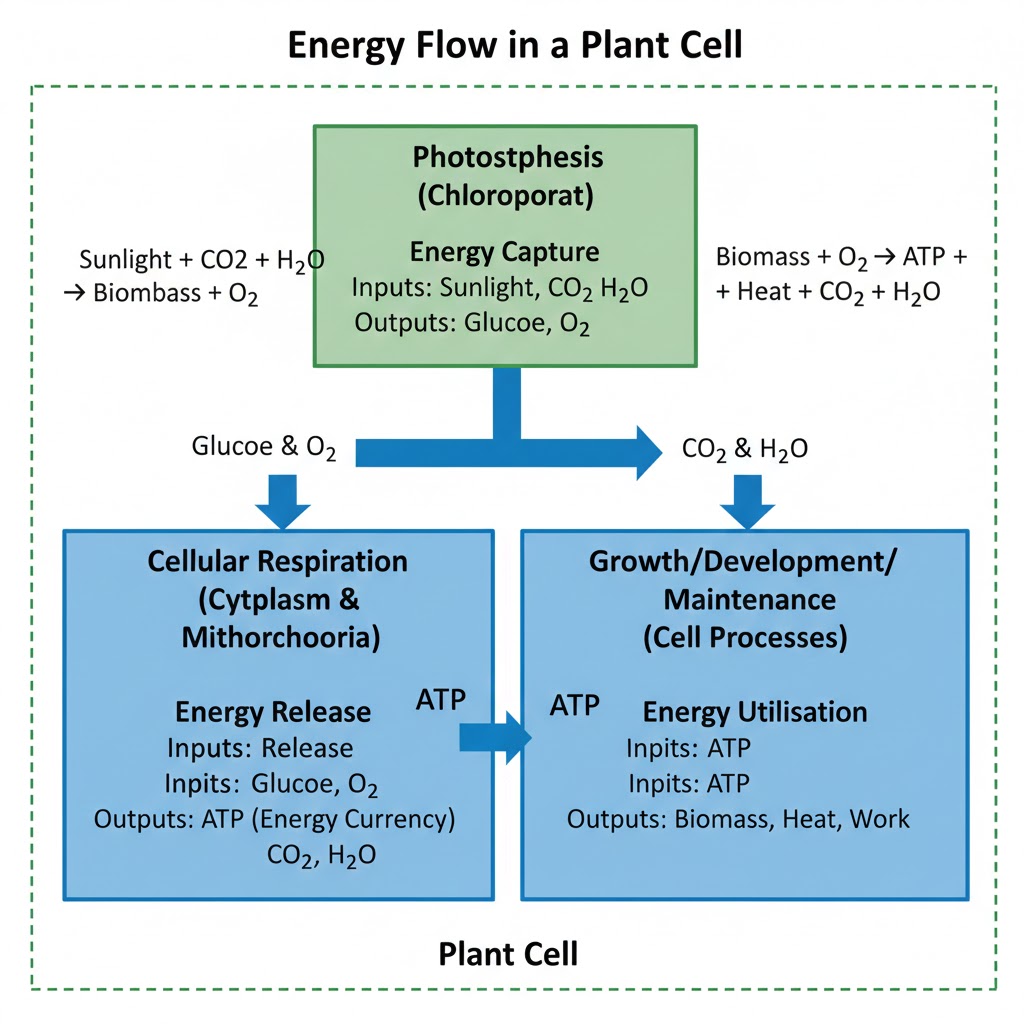
Figure below:
A clear flowchart illustrating the connection between Photosynthesis (energy capture), Respiration (energy release), and Growth/Development (energy utilisation) in a plant cell.
Practice Questions:
- Which of the following is an internal factor regulating plant physiological processes?
(a) Sunlight
(b) Temperature
(c) Genetic predisposition
(d) Water availability
✅ Answer: (c) — Internal (plant) factors are dependent on genetic predisposition and the growth of the plant.
2. The breaking of $C-C$ bonds of complex compounds through oxidation within cells is called:
(a) Photosynthesis
(b) Respiration
(c) Differentiation
(d) Imbibition
✅ Answer: (b) — This process releases considerable energy trapped as $ATP$.
Key Takeaway
- Plant Physiology: Focuses on molecular and cellular level processes.
- Photosynthesis: Autotrophic nutrition using light to make food and $O_2$.
- Development: Sum of Growth (irreversible increase in size) and Differentiation.
2. Photosynthetic Machinery: Sites and Pigments
Listen up, junior! Before we dive into the reactions, we need to understand the "kitchen" where the magic happens. Plants are the ultimate autotrophs, synthesising their own food through a physico-chemical process called photosynthesis. Think of the plant as a high-end Dhaba where sunlight is the fuel and the leaf is the head chef!
Inside the green leaves (and other green parts), the mesophyll cells are packed with chloroplasts. These organelles have a brilliant division of labour. The membranous system—consisting of grana and stroma lamellae—acts like the "power plant," trapping light to synthesise $ATP$ and $NADPH$ (the light reactions). Meanwhile, the matrix stroma is where the enzymatic "baking" happens, fixing $CO_{2}$ into sugar (the dark reactions). Arre, don't get it twisted: dark reactions don't need darkness; they just depend on the products of the light reactions!
NEET Checkpoint:
Where is the actual site for sugar synthesis in the chloroplast?
(a) Thylakoid membrane
(b) Stroma
(c) Granum
(d) Outer membrane
✅ Answer: (b) The Stroma — This is where the enzymatic "dark reactions" take place to form starch.
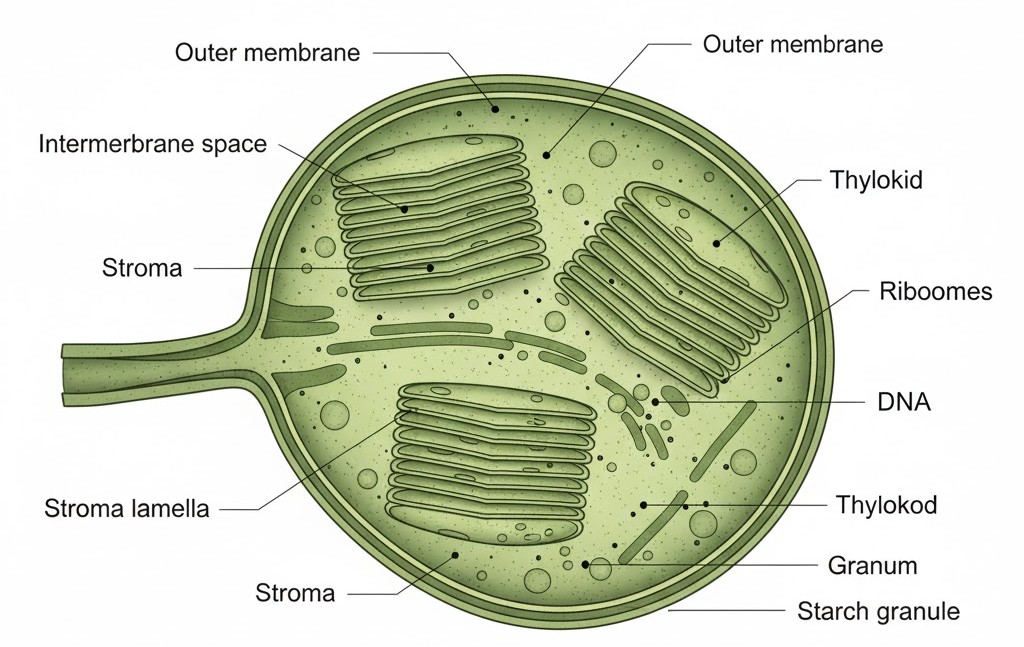
Figure below:
A detailed diagram of a chloroplast section showing the double membrane, stacks of thylakoids forming grana, connecting stroma lamellae, and the fluid matrix stroma.
Now, about the colours! If you use paper chromatography, you’ll find that leaf colour isn't just one "green". It’s a team effort by four pigments:
1. Chlorophyll a: (Bright or blue-green) – The chief pigment.
2. Chlorophyll b: (Yellow-green).
3. Xanthophylls: (Yellow).
4. Carotenoids: (Yellow to yellow-orange).
Chlorophyll a is like the star batsman (the reaction centre). The others are accessory pigments; they act like a support squad, absorbing a wider range of wavelengths and passing the energy to Chlorophyll a. Most importantly, they act as "sunscreen," protecting the chief pigment from photo-oxidation.
NEET Checkpoint:
Which pigments are called accessory pigments?
(a) Chlorophyll a
(b) Chlorophyll b, xanthophylls, and carotenoids
(c) Anthocyanins
(d) Phycobilins
✅ Answer: (b) Chlorophyll b, xanthophylls, and carotenoids — They assist in energy transfer and protection.
NEET Checkpoint:
At which wavelengths does maximum photosynthesis occur?
(a) Blue and Red regions
(b) Green regions
(c) Yellow regions
(d) Infrared regions
✅ Answer: (a) Blue and Red regions — This is where Chlorophyll a shows maximum absorption.
Relatable Funda: Imagine a cricket stadium. The floodlights (accessory pigments) catch light from all angles and focus it on the pitch (Chlorophyll a) so the game can continue efficiently!
Practice Questions:
1. A chromatographic separation of leaf pigments shows that Chlorophyll b appears as:
(a) Blue-green
(b) Yellow-orange
(c) Yellow-green
(d) Bright green
✅ Answer: (c) — According to the sources, Chl b is yellow-green in the chromatogram.
2. The "Dark Reactions" are so-called because:
(a) They occur only at night.
(b) They are inhibited by light.
(c) They are not directly light-driven but use light reaction products.
(d) They occur in the thylakoid lumen.
✅ Answer: (c) — They depend on $ATP$ and $NADPH$ produced during the light-driven phase.
Key Takeaway
- Sites: Light reactions in Grana (membranes); Dark reactions in Stroma (matrix).
- Chief Pigment: Chlorophyll a (absorbs max in Blue/Red).
- Accessory Pigments: Chl b, xanthophylls, carotenoids (energy transfer + protection).
3. Photochemical Phase: Light Reactions & Electron Transport
Listen up, junior! Let’s clear up this light reaction funda. Think of the photochemical phase as the plant’s way of "minting" energy currency using sunlight. This happens in two main teams: Photosystem I (PS I) and Photosystem II (PS II).
Each photosystem has a Light Harvesting Complex (LHC), which is like a stadium full of hundreds of pigment "fans" (antennae) that funnel energy to one star player—the reaction centre (a single chlorophyll $a$ molecule). In PS I, the star player is P700 (absorbs $700\text{ nm}$), while in PS II, it’s P680 (absorbs $680\text{ nm}$).
NEET Checkpoint:
Which molecule forms the reaction centre in both photosystems?
(a) Chlorophyll $b$
(b) Carotenoids
(c) Chlorophyll $a$
(d) Xanthophylls
✅ Answer: (c) Chlorophyll $a$ — It’s the captain of the ship, yaar! All other pigments just assist by absorbing different wavelengths.
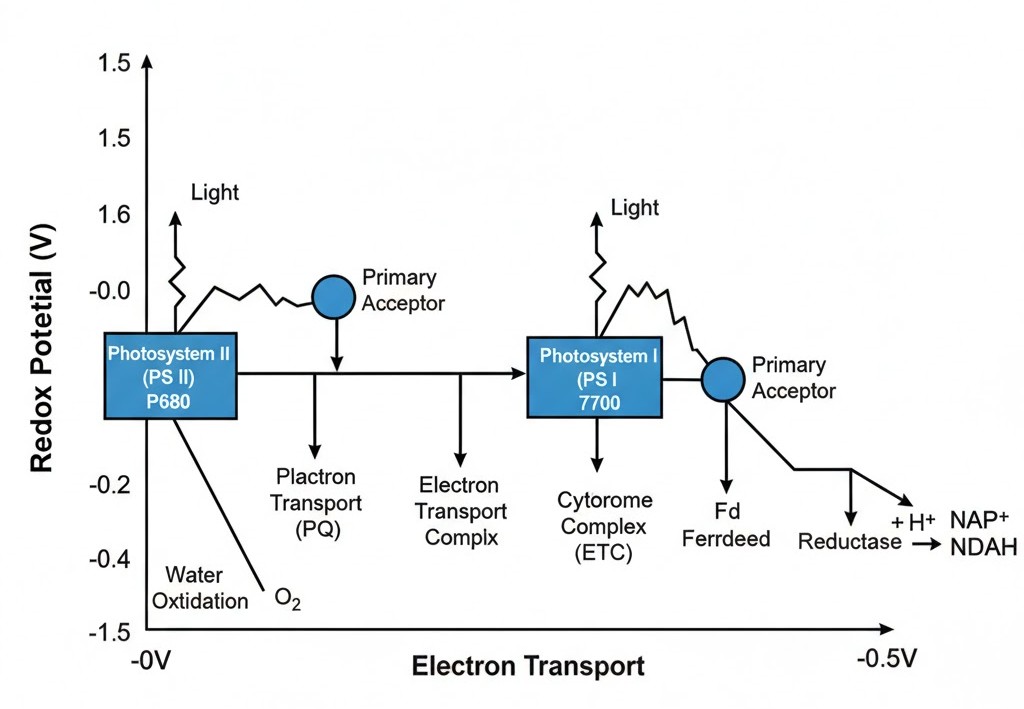
When PS II gets excited, it kicks electrons "uphill" to an acceptor, which then pass "downhill" through the Electron Transport System (cytochromes) to PS I. This whole relay—from PS II to PS I and finally to $NADP^{+}$—is called the Z-scheme because of its shape on a redox potential scale.
Relatable Example: Imagine a Mumbai local train relay. PS II is the starting station, and the electron is a passenger being pushed through the "ETS" crowd to reach the $NADP^{+}$ terminal to become $NADPH + H^{+}$.
To keep the train moving, PS II needs a constant supply of electrons. It gets these by breaking water—the photolysis of water:
This happens on the inner side of the thylakoid membrane, releasing oxygen into the atmosphere (thank a plant for your next breath!).
NEET Checkpoint:
Where is the water splitting complex physically located?
(a) Stroma
(b) Outer membrane
(c) Inner side of thylakoid membrane
(d) Lumen
✅ Answer: (c) Inner side of thylakoid membrane — This is where the magic (and protons) happen!
When both photosystems work in series, it's called non-cyclic photophosphorylation, and it produces both ATP and NADPH.
NEET Checkpoint:
The Z-scheme is named so because:
(a) It happens in the Z-membrane
(b) It looks like a 'Z' on a redox potential scale
(c) It was found by Dr. Z
(d) It's a zigzag path in the stroma
✅ Answer: (b) It looks like a 'Z' on a redox potential scale — Only when all carriers are placed in sequence, though!
Figure below:
A clear diagram showing the Z-scheme of light reactions, featuring PS II (P680), the electron transport chain, PS I (P700), and the reduction of NADP+ to NADPH on a redox potential scale.
Practice Question:
1. In non-cyclic photophosphorylation, the final electron acceptor is:
(a) $H_{2}O$
(b) $O_{2}$
(c) $NADP^{+}$
(d) $ATP$
Explanation: In the Z-scheme, electrons move from PS II through PS I and are finally used to reduce $NADP^{+}$ to $NADPH + H^{+}$.
Key Takeaway:
- PS II (P680) starts the flow; PS I (P700) finishes it.
- Water splitting provides electrons and happens at PS II.
- Non-cyclic flow = Both ATP and NADPH synthesized.
4. Cyclic Photophosphorylation & Chemiosmotic Hypothesis
Listen up, junior! While the Z-scheme is the "main hero," the plant sometimes plays it cool with Cyclic Photophosphorylation. This happens in the stroma lamellae, which lack PS II and NADP reductase. Since the electrons have nowhere to go to make $NADPH$, they just cycle back to PS I, synthesising only $ATP$. Think of it like a circular bus route—it never reaches a final depot but keeps the engine running!
NEET Checkpoint:
Cyclic photophosphorylation occurs when light of wavelength _____ is available.
(a) $< 680 \text{ nm}$
(b) $> 680 \text{ nm}$
(c) $400 \text{ nm}$
(d) $900 \text{ nm}$
✅ Answer: (b) $> 680 \text{ nm}$ — At these wavelengths, only PS I is excited to keep the cycle going.
Now for the big "funda": the Chemiosmotic Hypothesis. It’s all about creating a proton ($H^+$) gradient across the thylakoid membrane. Protons get packed into the lumen like a crowd at a Mumbai local station! This happens because:
1. Water splitting occurs on the inner side, dumping $H^+$ into the lumen.
2. H-carriers pull $H^+$ from the stroma while moving electrons.
3. NADP reductase on the stroma side "steals" $H^+$ to reduce $NADP^+$, making the stroma concentration even lower.
NEET Checkpoint:
Protons in the thylakoid lumen cause a:
(a) pH increase
(b) pH decrease
(c) No change
(d) Temperature rise
✅ Answer: (b) pH decrease — High $H^+$ concentration means the lumen becomes more acidic (lower pH).
To escape, protons rush through the $CF_0$ channel of ATP synthase. This flow triggers a conformational change in the $CF_1$ headpiece, which then "mints" $ATP$ from $ADP$. Arre, it's basically a water turbine for the cell!
Figure below:
A detailed diagram of a thylakoid membrane showing the $H^+$ accumulation in the lumen, the water-splitting complex, the $CF_0$ transmembrane channel, and the $CF_1$ headpiece synthesising ATP in the stroma.

NEET Checkpoint:
Which part of ATP synthase is embedded in the membrane?
(a) $CF_1$
(b) $CF_0$
(c) Cytochrome
(d) PS I
✅ Answer: (b) $CF_0$ — $CF_0$ is the integral membrane part that forms the channel.
Practice Question:
Chemiosmosis requires which four components?
(a) $CO_2$, Water, Light, PS I
(b) Membrane, Proton pump, Gradient, ATP synthase
(c) PS II, $NADPH$, Stroma, $F_o$
(d) Glucose, $ATP$, $O_2$, Cyt b
✅ Answer: (b) — According to the sources, these four are the essential ingredients for the chemiosmotic "recipe"!
Key Takeaway
Formula Summary
Cyclic Flow: PS I only $\rightarrow$ Only $ATP$ synthesised.
Chemiosmosis: $H^+$ Gradient breakdown $\rightarrow$ Energy for $ATP$ Synthesis.
ATP Synthase: $CF_0$ (Channel) + $CF_1$ (Conformational change/Catalysis).
5. Biosynthetic Phase: The C3 Pathway (Calvin Cycle)
Listen up, junior! Don't let the term "dark reaction" confuse you; it doesn't mean it happens at night. This biosynthetic phase occurs in the stroma and uses the energy ($ATP$ and $NADPH$) made during the light reactions to fix $CO_{2}$ into sugars. Even though it's not directly light-driven, it stops if the light-reaction "battery" runs out. Think of it like a Pani Puri stall: the Light Reaction is the prep work (making the pani), and the Calvin Cycle is the vendor assembling the final snack using that prep.
NEET Checkpoint:
Where do the biosynthetic reactions of photosynthesis occur?
(a) Thylakoid membranes
(b) Grana
(c) Stroma of the chloroplast
(d) Outer membrane of chloroplast
✅ Answer: (c) Stroma of the chloroplast— This is the matrix of the chloroplast where enzymes synthesise sugar.
Melvin Calvin used radioactive $^{14}C$ in algal studies to discover that the first stable product is a 3-carbon acid called 3-phosphoglyceric acid (PGA). This is why we call it the $C_{3}$ pathway. The primary acceptor of $CO_{2}$ isn't a 2-carbon molecule as scientists first thought, but a 5-carbon ketose sugar called ribulose bisphosphate (RuBP).
NEET Checkpoint:
What is the first stable product of the Calvin Cycle?
(a) Glucose
(b) Fructose
(c) 3-Phosphoglyceric acid (3-PGA)
(d) Glyceraldehyde-3-phosphate (G3P)
✅ Answer: (c) 3-phosphoglyceric acid ($PGA$) — It's a 3-carbon organic acid.
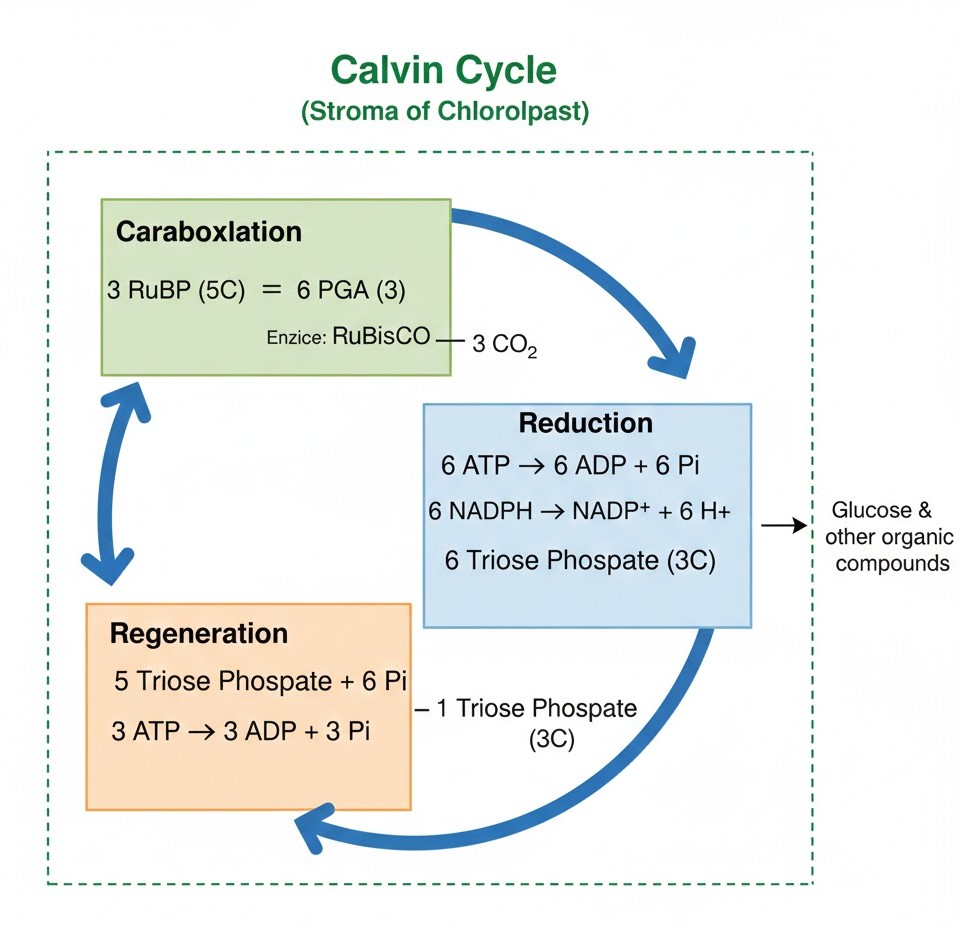
The cycle has three main stages:
1. Carboxylation: $CO_{2}$ is fixed to $RuBP$ by the famous enzyme RuBisCO, forming two molecules of $PGA$.
2. Reduction: A series of steps using $2$ molecules of $ATP$ and $2$ of $NADPH$ per $CO_{2}$ to form glucose.
3. Regeneration: To keep the cycle running, $RuBP$ must be regenerated, which costs $1$ $ATP$.
NEET Checkpoint:
How much energy is required to fix one molecule of $CO_{2}$?
(a) 1 ATP
(b) 2 ATP
(c) 3 ATP
(d) 3 ATP and 2 NADPH
✅ Answer: $3$ $ATP$ and $2$ $NADPH$ — $2$ $ATP$ for reduction and $1$ for regeneration.
Figure below:
A clear diagram of the Calvin Cycle showing the three stages: Carboxylation (RuBP to PGA), Reduction (PGA to Triose phosphate/Glucose), and Regeneration (Triose phosphate back to RuBP), with ATP and NADPH inputs clearly labelled at their respective steps.
Practice Question:
To produce one molecule of glucose, the Calvin cycle must run:
(a) 1 time
(b) 3 times
(c) 6 times
(d) 12 times
✅ Answer: (c) 6 times — Since glucose has 6 carbons, 6 turns are needed to fix 6 $CO_{2}$ molecules.
Key Takeaway
Energy Bill for 1 Glucose ($C_{6}H_{12}O_{6}$):
* Input: $6$ $CO_{2}$ + $18$ $ATP$ + $12$ $NADPH$.
* Output: $1$ Glucose + $18$ $ADP$ + $12$ $NADP$.
6. The $C_{4}$ Pathway: The Hatch and Slack Masterclass
Hey junior! Ready to see how some plants are literally built different? While $C_{3}$ plants often struggle with efficiency, $C_{4}$ plants (like maize and sorghum) are adapted to dry tropical regions and have a "pro" setup to maximize productivity. They use the Hatch and Slack Pathway, which is a slick cyclic process to fix carbon without the waste.
The secret is their Kranz anatomy ("Kranz" means wreath). They have large bundle sheath cells arranged like a wreath around their vascular bundles. These cells have thick walls impervious to gases and are packed with chloroplasts to get the job done.
NEET Checkpoint:
In $C_{4}$ plants, where does the Calvin cycle actually take place?
(a) Mesophyll cells
(b) Bundle sheath cells
(c) Epidermal cells
(d) Guard cells
✅ Answer: (b) Bundle sheath cells — Unlike $C_{3}$ plants, the main sugar-making magic happens in these specialized interior cells.
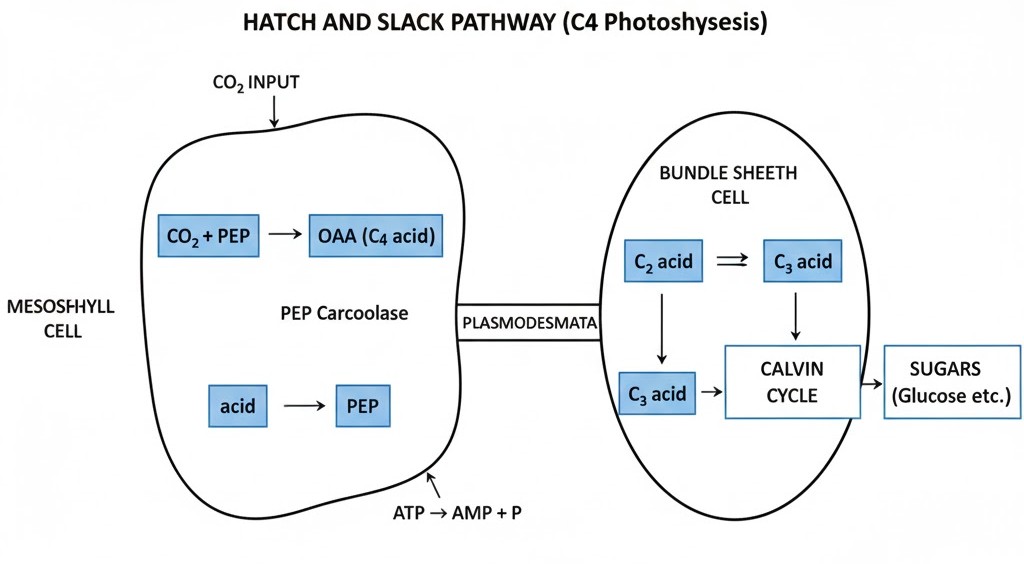
Here’s the funda: in the mesophyll cells, the primary $CO_{2}$ acceptor is Phosphoenol pyruvate ($PEP$), a $3$-carbon molecule. The enzyme $PEPcase$ (which mesophyll cells have instead of $RuBisCO$) fixes $CO_{2}$ to form Oxaloacetic acid ($OAA$).
Relatable Example: It’s like a busy pani-puri stall. Instead of the main chef ($RuBisCO$) getting confused by the crowd, a smart helper ($PEPcase$) grabs the $CO_{2}$ and carries it through a VIP entrance (the bundle sheath) to ensure the chef stays focused on making the perfect puris!
This $OAA$ transforms into $C_{4}$ acids like malic acid and is transported to the bundle sheath cells. There, it breaks down to release $CO_{2}$ and a $3$-carbon molecule. This high concentration of $CO_{2}$ ensures $RuBisCO$ works at full power for the Calvin cycle, preventing the wasteful process of photorespiration.
Figure below:
A clear diagram of the Hatch and Slack Pathway showing a Mesophyll cell and a Bundle Sheath cell connected by plasmodesmata. Show CO2 entering the mesophyll to form a C4 acid (OAA), its transport to the bundle sheath to release CO2 for the Calvin cycle, and the return of a C3 acid to regenerate PEP.
NEET Checkpoint:
Which enzyme is notably absent from the mesophyll cells of $C_{4}$ plants?
(a) $PEPcase$
(b) $RuBisCO$
(c) Hexokinase
(d) Carbonic anhydrase
✅ Answer: (b) $RuBisCO$ — By keeping $RuBisCO$ tucked away in the bundle sheath, the plant ensures it only meets $CO_{2}$, not $O_{2}$.
NEET Checkpoint:
What is the first stable product of the $C_{4}$ pathway?
(a) $PGA$
(b) $RuBP$
(c) $OAA$
(d) Malic acid
✅ Answer: (c) $OAA$ — This $4$-carbon acid is why we call it the $C_{4}$ pathway!.
Practice Question:
$C_{4}$ plants show greater biomass productivity than $C_{3}$ plants because:
(a) They have more stomata
(b) They lack photorespiration
(c) They use $RuBisCO$ in mesophyll
(d) They prefer cold climates
✅ Answer: (b) is correct. Because they increase $CO_{2}$ concentration around $RuBisCO$, they avoid energy loss, leading to higher yields.
Key Takeaway
- Primary Acceptor: $PEP$ ($3C$) in Mesophyll cells.
- Primary Product: $OAA$ ($4C$).
- Anatomy: Kranz anatomy with specialized bundle sheath cells.
- Result: High $CO_{2}$ at the enzyme site means no photorespiration and high productivity.
7. Photorespiration: The "Wasteful" Funda
Listen up, junior! Ever had a friend who tries to do two things at once and messes both up? That’s RuBisCO for you!. Even though it is the most abundant enzyme in the world, it has a bit of a dual personality: it acts as both a carboxylase and an oxygenase.
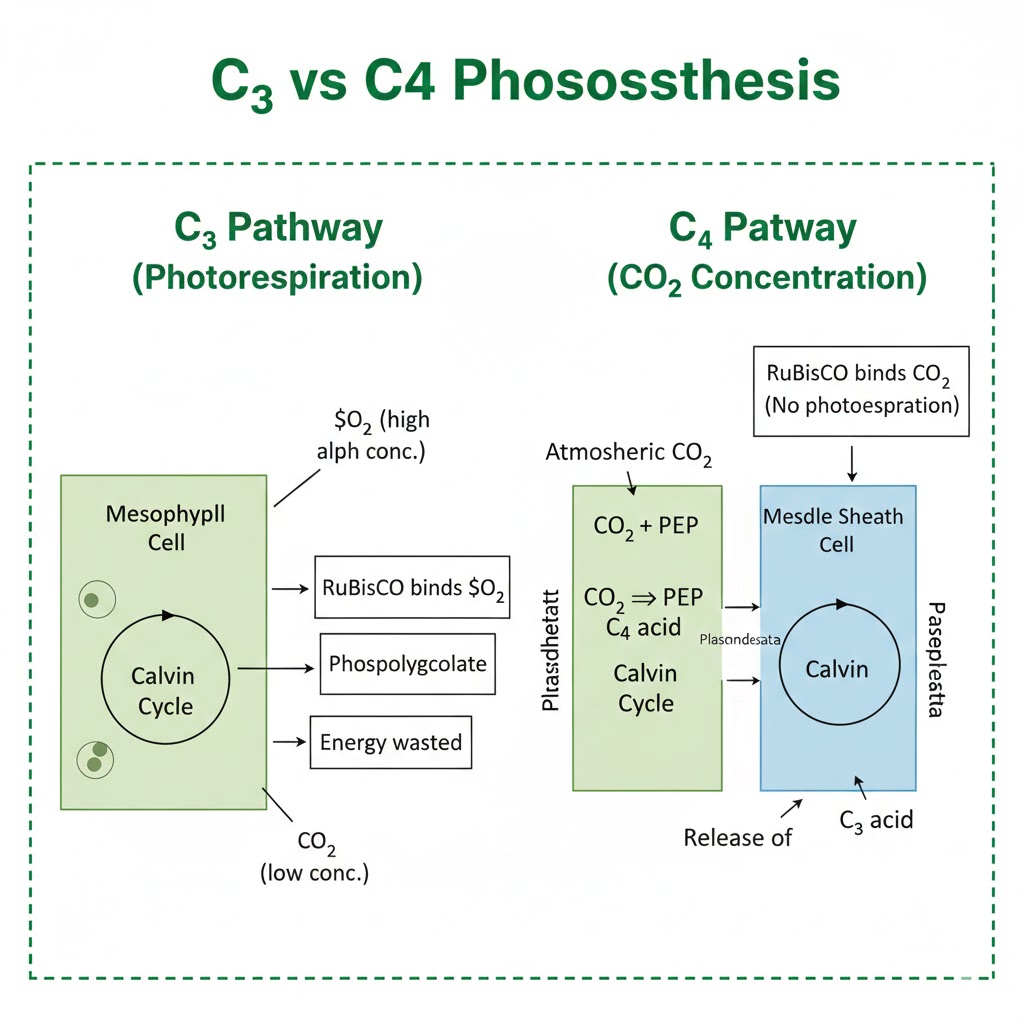
In $C_{3}$ plants, if the relative concentration of $O_{2}$ rises, RuBisCO starts binding with $O_{2}$ instead of $CO_{2}$. This competitive binding is a total mood-kill for productivity. Instead of making two molecules of PGA, RuBP binds with $O_{2}$ to form just one molecule of phosphoglycerate and one molecule of phosphoglycolate ($2$-carbon). This "photorespiration" is a wasteful process because it produces no sugar and no ATP; instead, it consumes ATP and releases $CO_{2}$.
NEET Checkpoint:
Why is photorespiration considered wasteful?
(a) It makes too much starch
(b) It consumes ATP and releases $CO_{2}$
(c) It only happens at night
(d) It produces $O_{2}$
✅ Answer: (b) — Arre, it’s a double loss! No food is created, and the plant spends energy for nothing.
So, why are $C_{4}$ plants the real MVPs in tropical heat? They have a clever trick to lack photorespiration. They use a mechanism that pumps and increases the intracellular concentration of $CO_{2}$ at the RuBisCO site in the bundle sheath cells. By keeping $CO_{2}$ levels high, they ensure RuBisCO functions only as a carboxylase, completely ignoring the $O_{2}$. This is why $C_{4}$ plants have greater productivity and better yields than $C_{3}$ plants in sunny, tropical conditions.
Relatable Example: Imagine a busy Pani Puri stall. If the vendor tries to serve "Pani Puri" ($CO_{2}$) and "Water Balloons" ($O_{2}$) at the same counter, it’s a mess! $C_{3}$ plants are like that messy stall. But $C_{4}$ plants have a "VIP Room" (the bundle sheath) where they only pump in the Puri lovers, so the chef (RuBisCO) can cook in peace without distractions!.
Figure below:
A comparison diagram showing the $C_{3}$ pathway where RuBisCO binds $O_{2}$ to form phosphoglycolate versus the $C_{4}$ pathway where $CO_{2}$ is concentrated in the bundle sheath cells to avoid photorespiration.
NEET Checkpoint:
In $C_{4}$ plants, where is the $CO_{2}$ concentration increased?
(a) Mesophyll cells
(b) Bundle sheath cells
(c) Stomata
(d) Thylakoid lumen
✅ Answer: (b) Bundle sheath cells — This ensures RuBisCO acts as a carboxylase.
NEET Checkpoint:
What is the first 2-carbon product of photorespiration?
(a) Glycolate
(b) Glycine
(c) Phosphoglycolate
(d) Serine
✅ Answer: (c) Phosphoglycolate — It’s formed when RuBP binds with $O_{2}$.
Practice Questions:
1. RuBisCO has a much greater affinity for $CO_{2}$ when:
(a) $O_{2}$ is $100\%$
(b) $CO_{2}:O_{2}$ is nearly equal
(c) It is dark
(d) No ATP is available
✅ Answer: (b) — The binding is competitive, but it prefers $CO_{2}$ when the ratio is balanced.
2. $C_{4}$ plants outperform $C_{3}$ plants in the tropics because they:
(a) Have no RuBisCO
(b) Tolerate higher temperatures and lack photorespiration
(c) Only use the Calvin cycle
(d) Use less light
✅ Answer: (b) — Their special anatomy and $CO_{2}$ pump make them super-efficient in the heat.
Key Takeaway
Photorespiration is a wasteful process in $C_{3}$ plants where RuBisCO binds $O_{2}$ to form phosphoglycolate, consuming ATP. $C_{4}$ plants avoid this by concentrating $CO_{2}$ in bundle sheath cells, leading to higher productivity and better heat tolerance.
8. Factors Affecting Photosynthesis
Listen up, junior! You can give a plant all the love in the world, but if even one ingredient is missing, the whole system slows down. This is Blackman’s Law of Limiting Factors (1905). It states that if a process is affected by multiple factors, the rate is determined by the one nearest its minimal value. Think of it like making pani puri: even if you have a thousand puris, if the tikka paani runs out, the business stops!.
NEET Checkpoint:
According to Blackman's Law, what determines the rate of a chemical process?
(a) Only temperature
(b) Only substrate concentration
(c) The slowest step
(d) The fastest step
✅ Answer: (c) The slowest step — It’s the "bottleneck" that controls the speed!
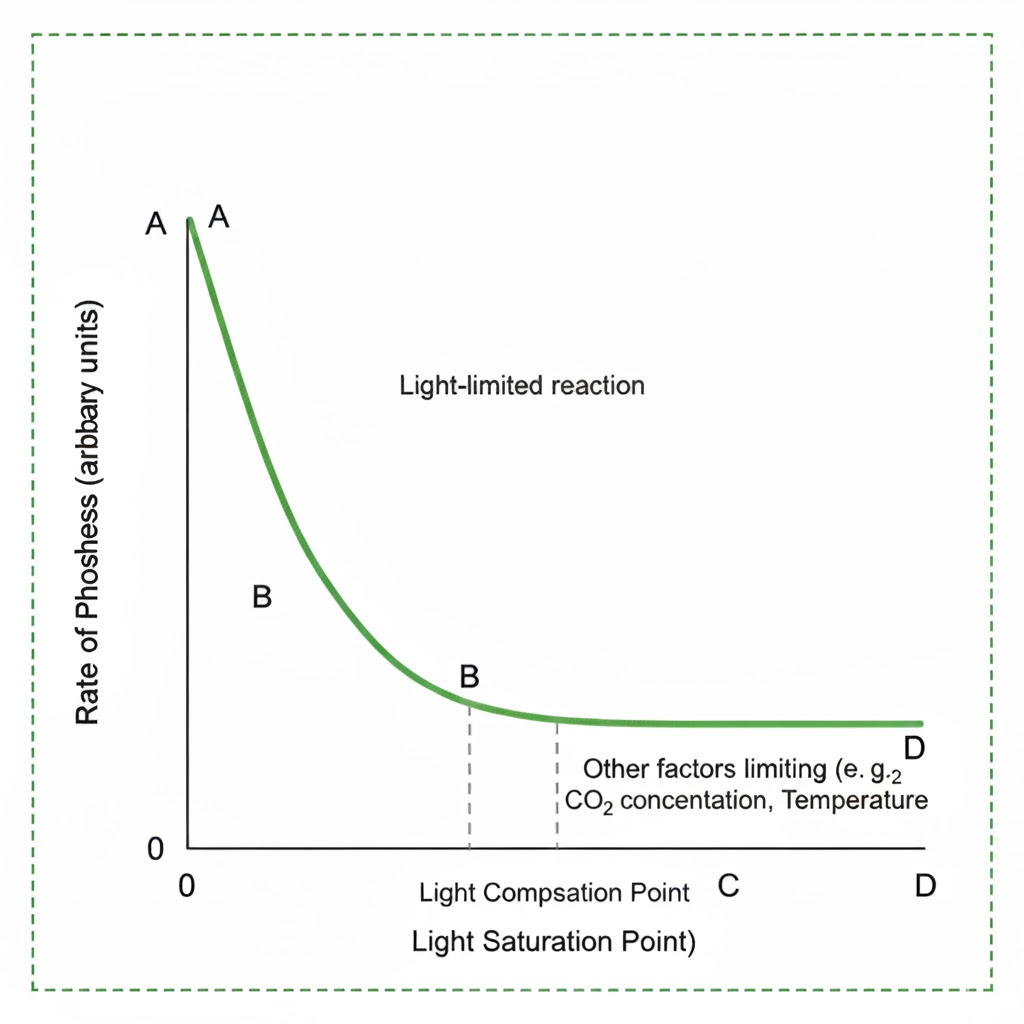
Light is usually not the villain here; most plants hit saturation at just $10\%$ of full sunlight. However, too much light can actually cause the breakdown of chlorophyll. On the flip side, $CO_2$ concentration is the major limiting factor since its atmospheric level is a tiny $0.03-0.04\%$. Interestingly, $C_4$ plants are efficient and saturate at $360~\mu lL^{-1}$, while $C_3$ plants keep pushing until beyond $450~\mu lL^{-1}$. This is why $C_3$ crops like tomatoes and bell peppers are often grown in $CO_2$-enriched greenhouses to boost yield!.
NEET Checkpoint:
Which group of plants shows saturation at higher $CO_2$ levels?
(a) C₃ plants
(b) C₄ plants
(c) CAM plants
(d) Algae
✅ Answer: (a) $C_3$ plants — They saturate beyond $450~\mu lL^{-1}$, whereas $C_4$ plants saturate earlier at $360~\mu lL^{-1}$.
Temperature mostly affects the enzymatic dark reactions, with tropical plants having a higher optimum temperature. Finally, water acts like a "mood spoiler." Water stress causes stomatal closure (cutting off $CO_2$ supply) and leaf wilting, which reduces the surface area available for metabolic activity.
NEET Checkpoint:
How does water stress indirectly reduce photosynthesis?
(a) By reducing chlorophyll content
(b) By closing stomata and wilting leaves
(c) By increasing light absorption
(d) By increasing oxygen production
✅ Answer: (b) By closing stomata and wilting leaves — This reduces $CO_2$ availability and surface area.
Figure below:
A line graph from Figure 11.10 showing the rate of photosynthesis on the y-axis and light intensity on the x-axis, with a linear rise at low intensity (A), a transition (B), and a plateau at saturation (C/D).
Practice Question:
At low light intensities, what is the relationship between incident light and $CO_2$ fixation rates?
(a) Sigmoid
(b) Linear
(c) Parabolic
(d) Exponential
✅ Answer: (b) Linear — At low intensities, as light increases, the rate increases proportionally.
Key Takeaway
- Blackman’s Law: The "minimal" factor rules the rate.
- $CO_2$ Saturation: $C_4 = 360~\mu lL^{-1}$; $C_3 > 450~\mu lL^{-1}$.
- Light Saturation: Occurs at $10\%$ of full sunlight.
- Water Stress: Causes stomatal closure and wilting.
9. Respiration: Gaseous Exchange and Cellular Mechanism
Listen up, junior! You might think "breathing" is only for us humans, but plants are doing it too—just without the drama of lungs or a nose. Let’s clear up this funda: cellular respiration is the mechanism of breaking C-C bonds of complex compounds through oxidation within cells to release energy. This energy isn't just wasted as heat; it’s trapped as chemical energy in ATP, which we call the "energy currency" of the cell. Think of ATP as the cash in your wallet; the cell "spends" it whenever it needs to get work done!
NEET Checkpoint:
Which molecule acts as the "energy currency" of the cell?
(a) Glucose
(b) $NADH$
(c) $ATP$
(d) Pyruvic acid
✅ Answer: (c) $ATP$ — It's the immediate source of energy for cellular work.
Now, what are we burning? Usually, it's carbohydrates, but plants are versatile—they can also use fats, proteins, and even organic acids as respiratory substrates. Unlike us, plants don't have specialized respiratory organs. They use stomata and lenticels (those tiny openings in woody bark) for gas exchange. It’s like a pani puri stall where every customer stands right at the counter; because most plant cells are close to the surface, they don't need a complex "delivery" system for gases.
NEET Checkpoint:
In woody stems, gas exchange occurs through:
(a) Stomata
(b) Roots
(c) Lenticels
(d) Guard cells
✅ Answer: (c) Lenticels — These allow oxygen to reach the living cells beneath the bark.
NEET Checkpoint:
Why do plants get along without respiratory organs?
(a) High energy demand
(b) Low gas exchange needs
(c) Thick bark
(d) Lack of $O_2$
✅ Answer: (b) Low gas exchange needs — Roots, stems, and leaves respire much slower than animals do.
The overall combustion of glucose looks like this:
Don't stress, yaar—even a massive Banyan tree handles its breathing better than we handle exam stress!
Practice Question:
Which of the following can act as a respiratory substrate?
(a) Carbohydrates only
(b) Fats and proteins
(c) Organic acids
(d) All of these
✅ Answer: (d) All of these — While glucose is preferred, others can be used under certain conditions.
Key Takeaway
- Cellular Respiration: Breaking C-C bonds to release energy.
- ATP: The cell's energy currency.
- Gaseous Exchange: Managed by stomata and lenticels.
- Substrates: Carbohydrates, fats, proteins, and organic acids.
10. Glycolysis & Fermentation (Anaerobic Respiration)
Listen up, junior! Whether you are a tiny yeast or a gym freak doing heavy squats, the first step of respiration is always the same. Let’s clear up this funda: Glycolysis is the universal "starter pack" for energy, occurring right in the cytoplasm.
It’s often called the EMP Pathway, named after the trio Embden, Meyerhof, and Parnas who mapped it out. Think of it as a "partial breakdown" mission: one 6-carbon Glucose molecule is chopped into two 3-carbon molecules of Pyruvic acid. It’s like ordering a full pizza but only getting to eat the crust—you get some energy, but the "good stuff" is still locked away!
NEET Checkpoint:
Which enzyme converts Glucose to Glucose-6-phosphate?
(a) Invertase
(b) Hexokinase
(c) Dehydrogenase
(d) Mutase
✅ Answer: (b) Hexokinase — This is the first step where the cell spends an ATP to "trap" the glucose.
During this 10-step metabolic marathon, the cell actually spends $2$ ATP but produces $4$ ATP directly. So, your net gain is $2$ ATP and $2$ NADH + $H^+$.
Now, if $O_2$ is "out of stock," cells switch to Fermentation. Yeast turns pyruvic acid into ethanol and $CO_2$, while your tired muscles produce lactic acid. But honestly, fermentation is a bit of a scam, yaar. It releases less than $7\%$ of the energy in glucose and produces hazardous waste like alcohol or acid. In fact, yeast "poisons" itself to death once the alcohol concentration hits $13\%$. Talk about a party gone wrong!
NEET Checkpoint:
What is the net gain of ATP when one molecule of glucose is fermented to alcohol?
(a) 1 ATP
(b) 2 ATP
(c) 4 ATP
(d) 36 ATP
✅ Answer: (b) $2$ ATP — Since no extra ATP is made during the fermentation steps, we only count the net gain from glycolysis.
Figure below:
A flow chart showing Glycolysis in the cytoplasm leading to either Lactic acid or Ethanol + CO2 under anaerobic conditions, highlighting the reuse of NAD+.
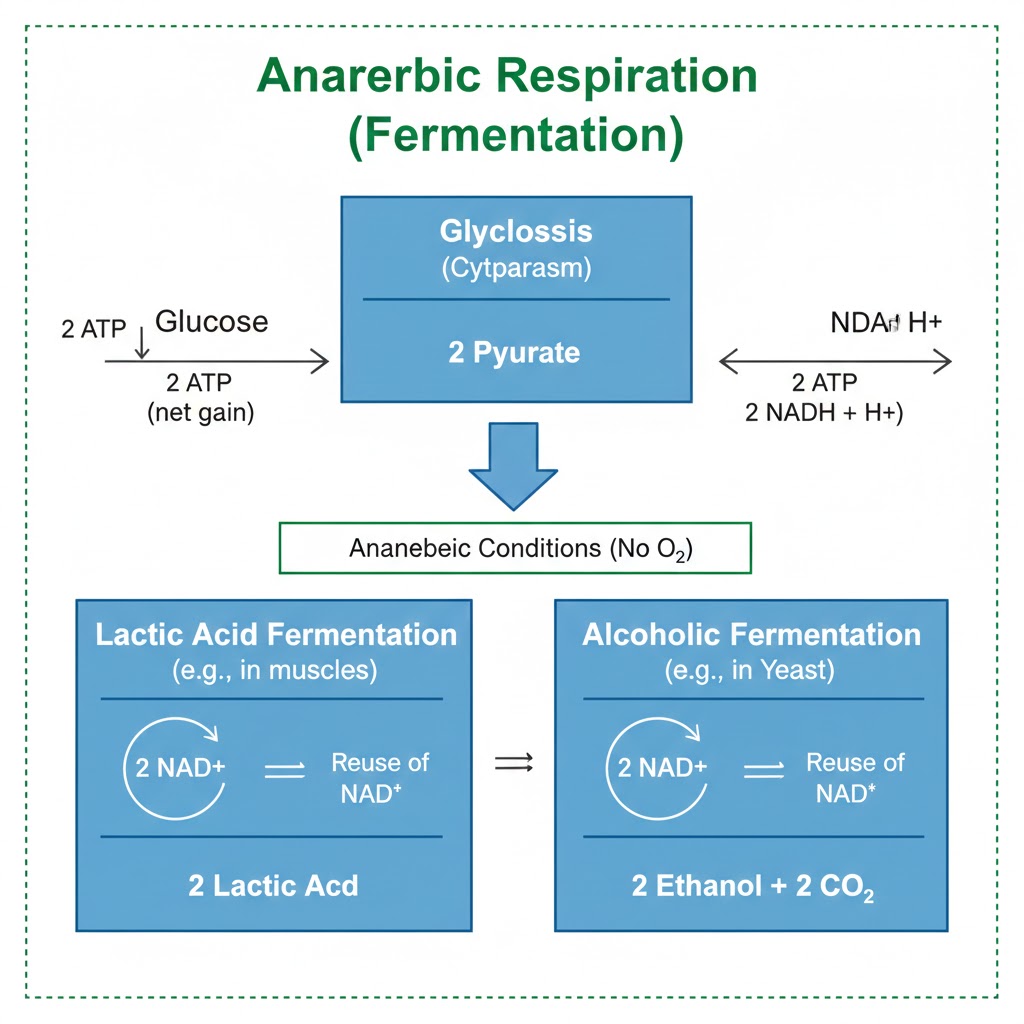
NEET Checkpoint:
In lactic acid fermentation, what is the reducing agent that gets reoxidised?
✅ Answer: NADH + $H^+$ — It gives its electrons to pyruvic acid to become NAD+ again, so glycolysis can keep running.
Practice Questions:
- Which of these is NOT a product of anaerobic respiration in yeast?
(a) Ethanol
(b) $CO_2$
(c) Lactic Acid
(d) Energy
✅ Answer: (c) Lactic Acid — Yeast produces ethanol; lactic acid is for bacteria and your muscles.
2. Glycolysis is the only process of respiration in:
(a) Aerobic organisms
(b) Anaerobic organisms
(c) Both
(d) Mitochondria
✅ Answer: (b) Anaerobic organisms — They don't have the machinery for the fancy stuff like the Krebs' cycle.
Key Takeaway
Formula Summary
* Glycolysis Net Yield: $2 \text{ Pyruvic acid} + 2 \text{ ATP} + 2 \text{ NADH} + H^+$.
* Fermentation Energy: $< 7\%$ of glucose energy.
* Alcohol Death Limit: $13\%$ concentration for yeast.
11. Aerobic Respiration: TCA Cycle & ETS
Arre, welcome to the heart of the powerhouse! Once pyruvate (the hero of glycolysis) enters the mitochondrial matrix, it undergoes oxidative decarboxylation to become Acetyl CoA. Think of this as the "link reaction"—the entry ticket to the TCA (Krebs) Cycle. Here, Acetyl CoA joins Oxaloacetic Acid (OAA) to form Citric Acid. The cycle then releases $CO_{2}$ and charges up our energy carriers: $NADH$ and $FADH_{2}$.
Now, the real 'paisa vasool' moment is the Electron Transport System (ETS) on the inner mitochondrial membrane. It is like a busy Mumbai local train platform; electrons are passed through complexes I to IV like passengers, pumping protons into the intermembrane space to create a gradient. Finally, ATP Synthase (Complex V) acts as the exit gate, using this proton energy to manufacture ATP—a process called oxidative phosphorylation.
NEET Checkpoint:
Where exactly does the TCA cycle occur?
(a) Cytoplasm
(b) Mitochondrial matrix
(c) Outer mitochondrial membrane
(d) Chloroplast stroma
✅ Answer: (b) Mitochondrial matrix — Don't confuse it with the inner membrane, which is reserved for the ETS!
Figure below:
A diagram of the Citric Acid Cycle showing the conversion of Pyruvate to Acetyl CoA and the cyclic transformation of Citric Acid back to OAA.
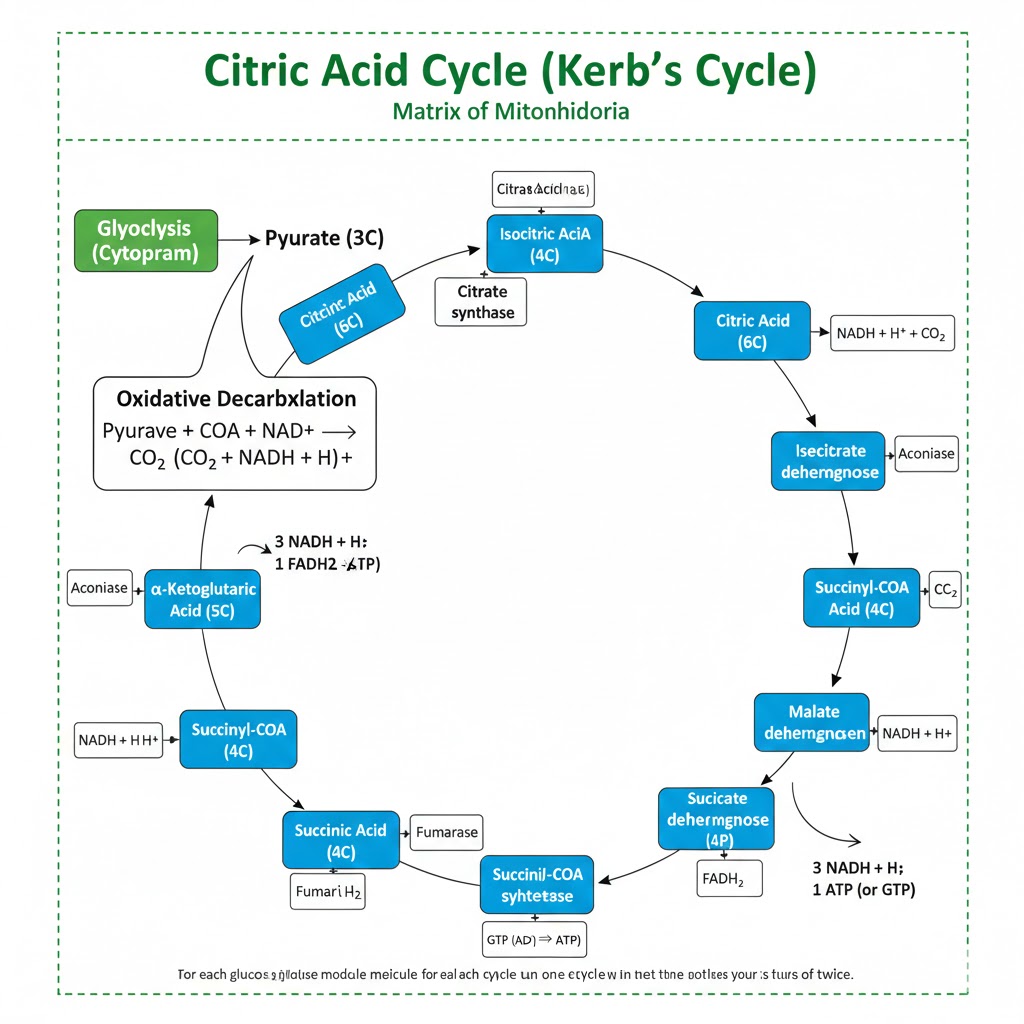
NEET Checkpoint:
How many molecules of $ATP$ are produced from one molecule of $NADH$?
(a) 1 ATP
(b) 2 ATP
(c) 3 ATP
(d) 4 ATP
✅ Answer: (c) 3 $ATP$ — Remember, $1 NADH$ yields $3 ATP$ while $1 FADH_{2}$ gives only $2 ATP$.
NEET Checkpoint:
Who is the final hydrogen acceptor in the ETS?
(a) NAD⁺
(b) FAD
(c) Oxygen (O₂)
(d) Water (H₂O)
✅ Answer: (c) Oxygen — It drives the whole system by removing hydrogen to form $H_{2}O$.
Practice Question:
Which complex in the ETS is known as Cytochrome c oxidase?
(a) Complex I
(b) Complex II
(c) Complex III
(d) Complex IV
✅ Answer: (d) — Complex IV contains cytochromes $a$ and $a_{3}$ plus two copper centres.
Key Takeaway:
- TCA Cycle: Matrix-based; produces $CO_{2}$, $ATP$ (via $GTP$), $NADH$, and $FADH_{2}$.
- ETS/Oxidative Phosphorylation: Inner membrane; uses $O_{2}$ as the final acceptor to produce $H_{2}O$ and the bulk of your $ATP$.
12. Energy Relations, Amphibolic Pathways, & RQ
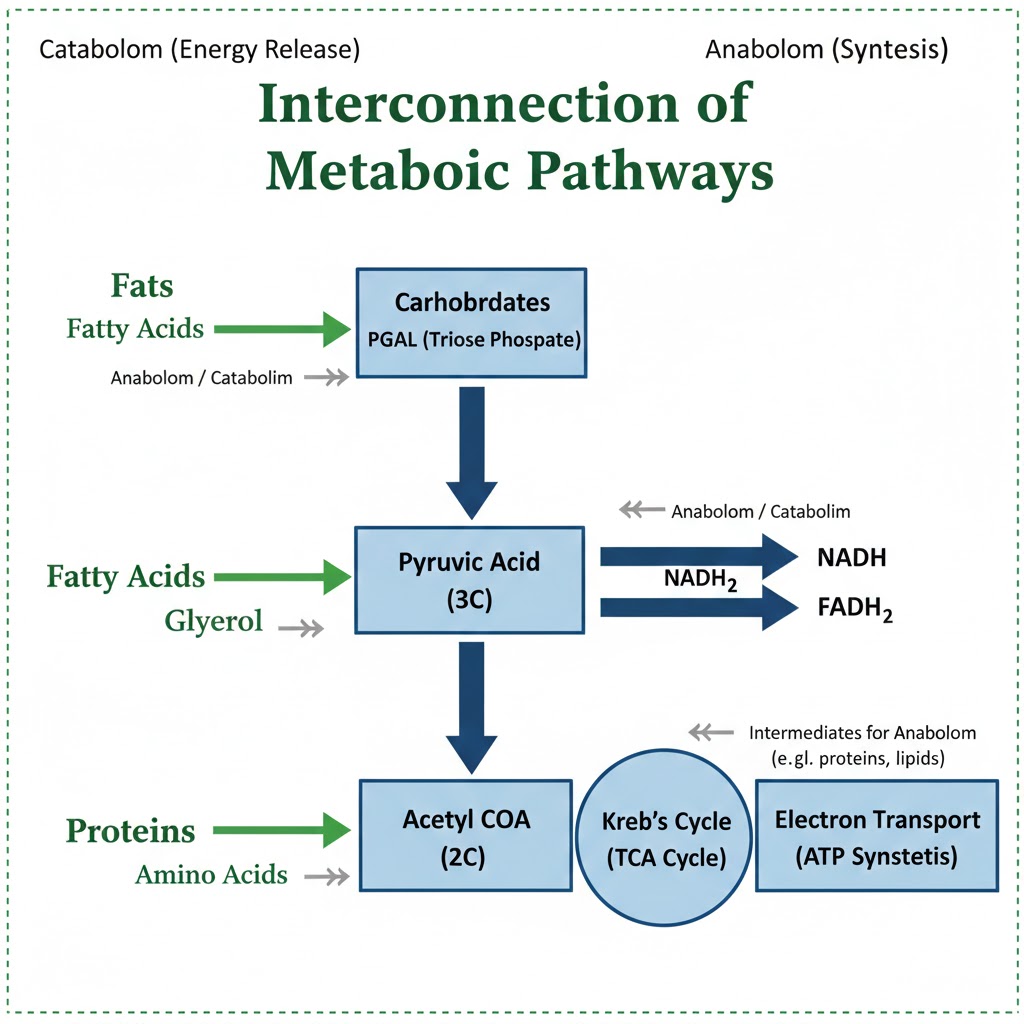
Listen up, juniors! If you think respiration is just about "burning" food, you’ve got only half the funda clear. Our cells are actually smart managers. We call the respiratory pathway amphibolic because it handles both catabolism (breaking down substrates) and anabolism (withdrawing intermediates to build new molecules). For example, when the cell needs to synthesise fatty acids, it simply pulls Acetyl CoA out of the cycle. It’s like a local halwai who both makes fresh jalebis and uses the same syrup for other sweets!
NEET Checkpoint:
Why is respiration considered an amphibolic pathway?
(a) It occurs in both plants and animals
(b) It produces both ATP and heat
(c) It involves both catabolic and anabolic reactions
(d) It uses both oxygen and carbon dioxide
✅ Answer: (c) Because it involves both catabolism (breakdown) and anabolism (synthesis).
Now, let's talk about the "salary" of the cell: ATP. On paper, the theoretical net gain is a cool $38$ ATP per glucose molecule. But don't get too excited, yaar—this is based on assumptions like "everything happens in a perfect sequence" and "no intermediates are stolen". In a messy living system, these assumptions rarely hold 100%, but it shows how efficient our "internal engines" are compared to fermentation, which only nets $2$ ATP.
NEET Checkpoint:
What is the theoretical net gain of ATP during aerobic respiration of one glucose molecule?
(a) 18 ATP
(b) 24 ATP
(c) 30 ATP
(d) 38 ATP
✅ Answer: (d) $38$ ATP — Though this remains a theoretical exercise based on specific assumptions.
Finally, we have the Respiratory Quotient (RQ). Think of this as the "efficiency ratio" of your fuel:
For carbohydrates, the $RQ$ is a perfect $1.0$ because the volume of $CO_{2}$ and $O_{2}$ is equal. However, fats (like tripalmitin) are "oxygen-hungry," giving an $RQ$ of $0.7$, while proteins hover around $0.9$.
NEET Checkpoint:
Which substrate has an $RQ$ of $0.7$?
(a) Carbohydrates
(b) Proteins
(c) Fats
(d) Alcohol
✅ Answer: (c) Fats — For example, tripalmitin requires much more $O_{2}$ for its oxidation.
Figure below:
A flow chart showing how fats, carbohydrates, and proteins enter the respiratory pathway at different stages like PGAL, Pyruvic acid, and Acetyl CoA, with reversible arrows indicating anabolism.
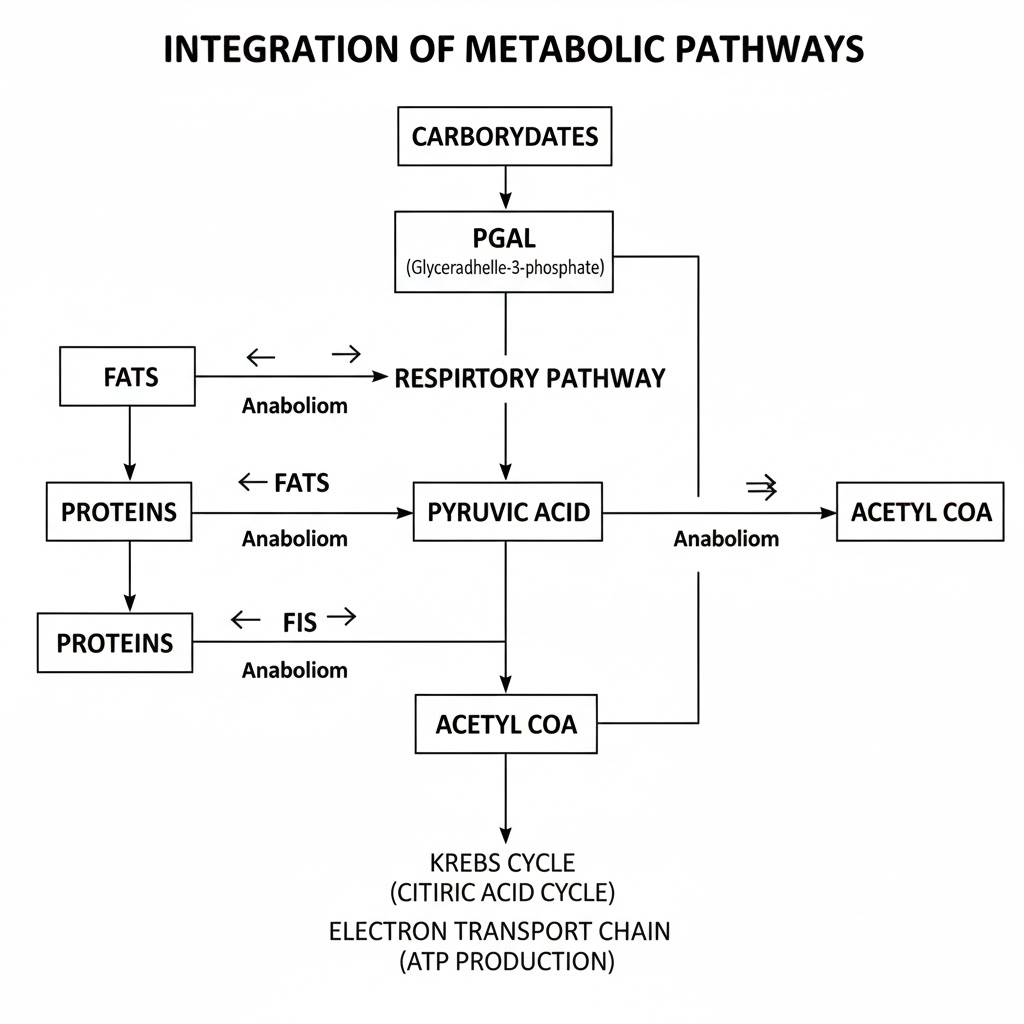
Practice Questions:
1. Which of the following values represents the RQ of Tripalmitin?
(a) $1.0$
(b) $0.9$
(c) $0.7$
(d) $0.5$
✅ Answer: (c) $0.7$ — Fats like tripalmitin have an $RQ$ less than one because they consume more $O_{2}$ than they release $CO_{2}$.
2. Statement: Pure proteins or fats are never used as respiratory substrates in living organisms.
(a) True
(b) False
✅ Answer: (a) True — In reality, respiratory substrates are often a mix.
Key Takeaway
Formula Summary
- Net ATP Gain (Theoretical): $38$ ATP per glucose.
- RQ Formula: $RQ = \frac{CO_{2} \text{ evolved}}{O_{2} \text{ consumed}}$.
- RQ Values: Carbs = $1.0$, Proteins $\approx 0.9$, Fats = $0.7$.
13. Plant Growth: Germination, Phases, and Rates
Let's clear up the funda of how a tiny seed turns into a massive tree. It all starts with seed germination, the very first step of plant growth. Think of it like a cricketer waking up for early morning practice; if conditions aren't favourable, the seed just stays in "rest" mode.
Growth itself is an irreversible, permanent increase in size. In plants, it's "open-ended" because of meristems that divide forever.
NEET Checkpoint:
Which of the following is the first step in plant growth?
(a) Elongation
(b) Seed germination
(c) Maturation
(d) Differentiation
✅ Answer: (b) — Simple logic, yaar! Growth begins when the seed wakes up.
The Three Phases of Growth
Imagine a queue at a popular pani puri stall:
1. Meristematic Phase: The "busy zone" at the root and shoot tips. Cells are rich in protoplasm with large nuclei and thin, cellulosic walls.
2. Elongation Phase: Cells start stretching! You'll see increased vacuolation and new cell wall deposition here.
3. Maturation Phase: The cells reach their "final form" with thickened walls and protoplasmic changes.
NEET Checkpoint:
In which phase do cells show increased vacuolation and enlargement?
(a) Lag phase
(b) Log phase
(c) Phase of elongation
(d) Stationary phase
✅ Answer: (c) Phase of Elongation — This is where the actual stretching happens, just like a scooter accelerating on an empty road!
Growth Rates: Arithmetic vs. Geometric
Growth can be expressed mathematically in two ways:
* Arithmetic Growth: Only one daughter cell divides while the other matures. It’s like a batsman scoring exactly 4 runs every over—constant and steady!
The formula is:
.
* Geometric Growth: Both daughter cells keep dividing. This is like a viral meme—it starts slow (lag phase), then goes crazy (exponential phase), and finally slows down when "nutrients" (or internet data) run out (stationary phase). This creates the famous Sigmoid (S-curve), typical for most living organisms in nature.
The formula is:
Figure below:
A clear diagram showing the Sigmoid growth curve with labels for Lag phase, Exponential phase, and Stationary phase as shown in Figure 13.6 of the NCERT text.
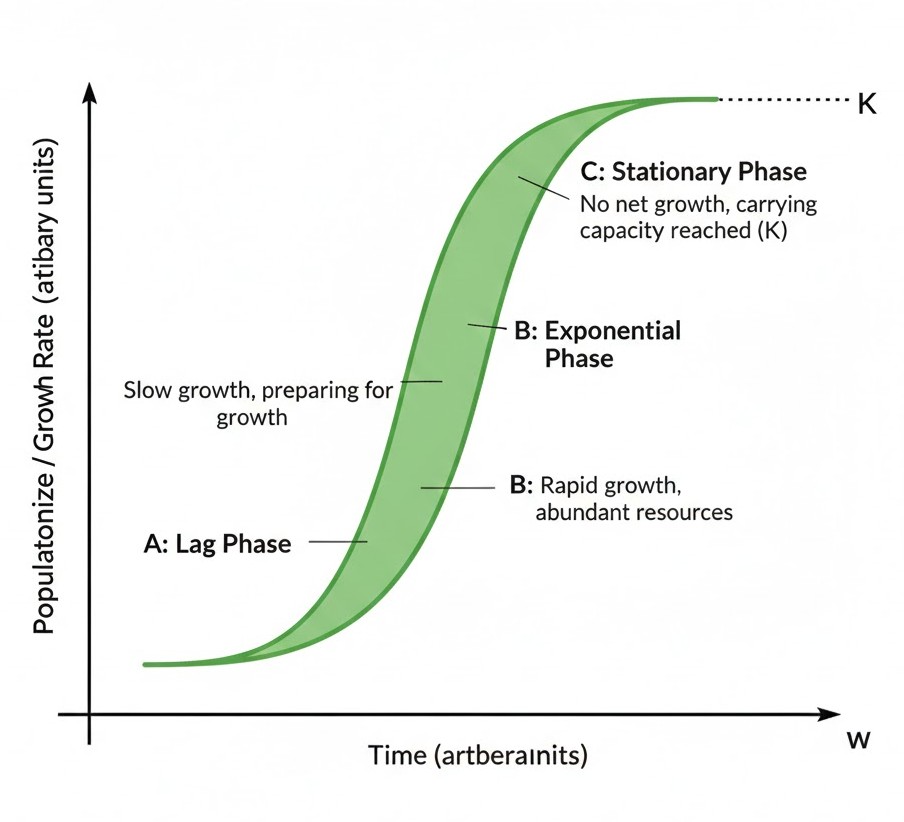
Essential Conditions
Plants aren't superheroes; they need their "supplements": Water (for turgidity and enzymes), Oxygen (for energy), Nutrients (for protoplasm), and an optimum temperature.
NEET Checkpoint:
What does '$r$' represent in the geometric growth formula?
(a) Population size
(b) Time interval
(c) Relative growth rate
(d) Carrying capacity
✅ Answer: (c) Relative growth rate — It is also called the efficiency index, measuring the plant's ability to produce new material.
Practice Questions:
1. A sigmoid curve is characteristic of:
(a) Arithmetic growth
(b) Plants in natural environments
(c) Only root tips
(d) Constant growth rate
✅ Answer: (b) — Nature doesn't do constant linear growth; it follows the S-curve.
2. Which parameter is used to measure growth in a watermelon?
(a) Cell number
(b) Increase in size of a cell
(c) Length
(d) Surface area
✅ Answer: (b) — A watermelon cell can increase in size by up to $3,50,000$ times!
Key Takeaway
Formula Summary
* Arithmetic Growth:$$L_{t} = L_{0} + rt$$
* Geometric Growth:$$W_{1} = W_{0}e^{rt}$$
* Conditions: Water, $O_{2}$, Nutrients, and Temp.
14. Development: Differentiation and Plasticity
Arre junior, let's clear up this development funda! In plants, cells don't just stay the same; they undergo a total makeover called differentiation. Think of it like a student finally choosing a career—they specialise. For example, a cell loses its protoplasm and gets strong, lignocellulosic walls to become a tracheary element for carrying water.
But plants have a "reverse" button! Dedifferentiation is when a mature cell (like parenchyma) says, "I want to be a student again," and regains the power to divide to form the cork cambium. It’s like a retired Chacha suddenly joining a coding bootcamp to start a new career! When those new cells eventually settle into a "job" again, we call it redifferentiation.
NEET Checkpoint:
The formation of interfascicular cambium from fully differentiated parenchyma is?
(a) Differentiation
(b) Activation
(c) Dedifferentiation
(d) Redifferentiation
✅ Answer: (c) Dedifferentiation — This is the process where mature cells regain the capacity to divide.
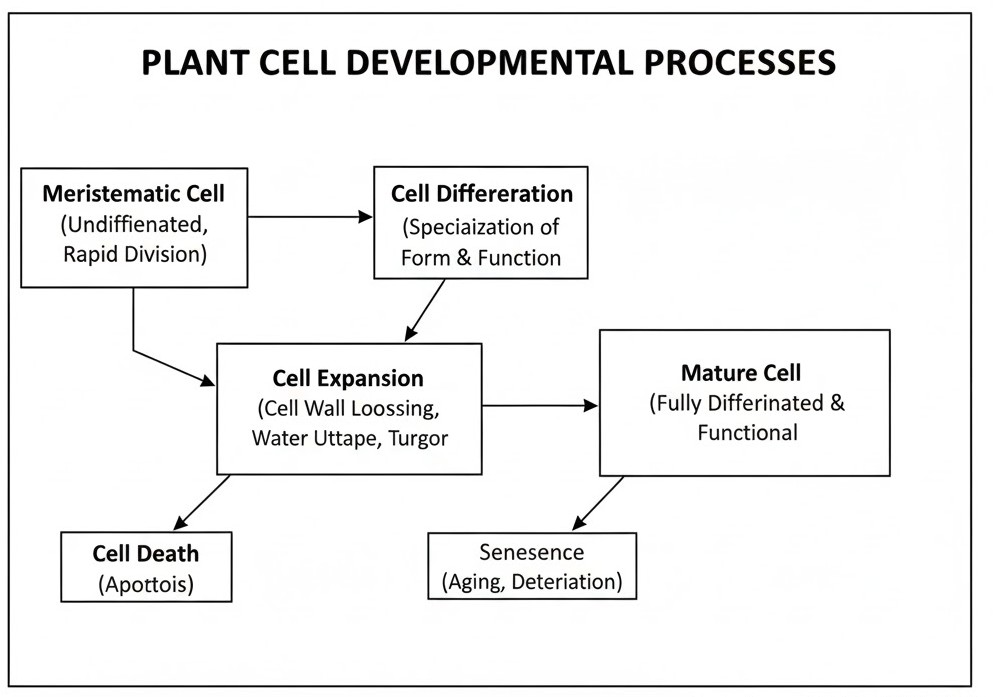
The life of a plant cell follows a strict sequence: Meristematic cell $\rightarrow$ Plasmatic growth $\rightarrow$ Differentiation $\rightarrow$ Expansion $\rightarrow$ Maturation $\rightarrow$ Mature cell $\rightarrow$ Senescence $\rightarrow$ Death.
NEET Checkpoint:
In the developmental sequence, what follows maturation?
(a) Differentiation
(b) Growth
(c) Mature cell
(d) Dedifferentiation
✅ Answer: (c) Mature cell — After maturation, the cell reaches its final functional state before eventually hitting senescence.
Plants are also super flexible—a property called plasticity. They can grow different types of leaves (heterophylly) based on their age (like in cotton and larkspur) or even their environment (like buttercup, which looks different in air vs water). This is all controlled by intrinsic factors (your genes and PGRs) and extrinsic factors (like light and temperature).
Figure below:
A clear flow diagram showing the sequence of developmental processes in a plant cell: from meristematic cell through plasmatic growth, differentiation, expansion, and maturation, leading to a mature cell, followed by senescence and death.
NEET Checkpoint:
Heterophylly in larkspur is an example of?
(a) Mutation
(b) Adaptation
(c) Plasticity
(d) Variation
✅ Answer: (c) Plasticity — Specifically, it's the ability to form different structures in response to different phases of life.
Practice Questions:
Which of the following is an extrinsic factor controlling plant development?
(a) Genetic
(b) Plant Growth Regulators
(c) Light
(d) Intracellular factors
✅ Answer: (c) Light — Light, temperature, and water are all extrinsic (environmental) controls.
Key Takeaway
Development = Growth + Differentiation. It is a highly ordered process influenced by internal "blueprints" (genes/PGRs) and external "weather" (light/water).
15. Plant Growth Regulators (PGRs)
Listen up, junior! Plant Growth Regulators (PGRs) are the tiny chemical "remote controls" that decide how a plant behaves, and they come in diverse chemical flavours. We have indole compounds like IAA, adenine derivatives like kinetin, carotenoids like ABA, terpenes like $GA_{3}$, and even gases like ethylene ($C_{2}H_{4}$). These are broadly split into "Promoters" and "Inhibitors" based on their job descriptions.
NEET Checkpoint:
Which PGR is chemically an adenine derivative?
(a) IAA
(b) $GA_{3}$
(c) Kinetin
(d) ABA
✅ Answer: (c) Kinetin — Simple chemistry, yaar! It was first isolated from autoclaved herring sperm DNA.
The Growth Promoters include Auxins, Gibberellins, and Cytokinins. Auxins are famous for apical dominance, where the top bud acts like a strict captain, stopping side branches from growing. Gibberellins are the growth boosters that cause bolting (sudden stem elongation) in rosette plants like cabbage, while Cytokinins are the cell-division experts that keep leaves from getting old too fast.
On the flip side, the Inhibitors are like the plant’s safety brakes. Abscisic Acid (ABA) is the ultimate stress hormone; it closes stomata when the plant is thirsty and promotes seed dormancy so they don't germinate at the wrong time. Then there's Ethylene ($C_{2}H_{4}$), the only gaseous PGR, which is a master at fruit ripening.
NEET Checkpoint:
If you remove the shoot tip (decapitation), what usually happens?
(a) Plant dies
(b) Lateral buds grow
(c) Stem stops elongating
(d) Leaves fall off
✅ Answer: (b) Lateral buds grow — Removing the "captain" (apex) breaks apical dominance.
Think of a crowded Mumbai local train. Auxin is like the person standing right at the door (the apex); as long as he’s there, no one else can move in or out easily—that’s apical dominance for you! But once you "decapitate" the crowd by moving that person, everyone else starts flowing into the side seats.
Figure below:
A clear diagram showing a plant with its apical bud intact showing suppressed lateral buds, and another version where the tip is removed, leading to lateral branch growth.
NEET Checkpoint:
Which PGR acts as an antagonist to Gibberellins regarding seed dormancy?
(a) Auxin
(b) Ethylene
(c) Cytokinin
(d) ABA
✅ Answer: (d) ABA — These two are like rivals in a match; ABA promotes dormancy while GAs try to break it.
These PGRs rarely work alone; they show an interplay of synergistic (working together) or antagonistic (working against each other) interactions to manage plant development.
Practice Questions:
- Which PGR would a farmer spray to increase the length of grape stalks?
(a) ABA
(b) Cytokinin
(c) Gibberellin
(d) Ethylene
✅ Answer: (c) Gibberellin — GAs are used to increase the length of axis in grapes.
- The "respiratory climactic" is a rise in respiration rate associated with which PGR?
(a) Auxin
(b) Ethylene
(c) ABA
(d) Kinetin
✅ Answer: (b) Ethylene — This happens during the ripening of fruits.
Key Takeaway: PGR Quick-Funda
- Promoters: Auxin (Apical Dominance), $GA_{3}$ (Bolting/Terpene), Cytokinin (Cell Division).
- Inhibitors: ABA (Stress/Dormancy), Ethylene (Ripening/Gas).
- Chemistry: IAA (Indole), Kinetin (Adenine), ABA (Carotenoid), $GA_{3}$ (Terpene).