1. Introduction to Heredity and the Mendelian Era
This crucial branch of biology deals with two super important concepts: inheritance and variation of characters from parents to offspring. Inheritance is how traits are passed down—the very foundation of heredity. Variation, on the other hand, is the degree by which progeny differ from their parents, explaining why even siblings aren't exact replicas, yaar.
Humans were actually pretty smart, even thousands of years ago (from roughly 8000–1000 B.C.), using variations present in wild populations to selectively breed organisms with desirable characters. Think about our prized Sahiwal cows in Punjab—that breeding knowledge existed long before the science did!.
NEET Checkpoint:
Genetics deals scientifically with:
(a) Reproduction and growth
(b) Metabolism and respiration
(c) Inheritance and variation
(d) Ecology and environment
✅ Answer: (c) Inheritance and variation — This subject focuses on how traits are passed down and the differences between generations.
The scientific breakthrough came in the mid-nineteenth century thanks to Gregor Mendel. He conducted hybridisation experiments on garden peas for seven years (from $1856$ to $1863$) and proposed the laws of inheritance. His biggest genius move? He was the first to apply statistical analysis and mathematical logic to solve biological problems. Now, that’s a power move!
Here’s the trick: Mendel's data was highly credible because he used a large sampling size and tested his inferences on successive generations. He focused only on characters manifested as two opposing traits (like a simple switch), such as tall or dwarf plants, or yellow or green seeds. He rigorously studied seven pairs of such contrasting characteristics.
Imagine trying to select the best student for NEET coaching. Instead of just picking the one who looks smart (phenotype), Mendel insisted on checking the past seven years of results and applying rigorous probability checks (statistical analysis) to predict the outcome! This is why his work set the basic framework for all inheritance rules.
NEET Checkpoint:
Mendel's experimental credibility was enhanced primarily by:
(a) Use of a powerful microscope
(b) Application of statistical analysis and large sampling size
(c) Discovery of the DNA structure
(d) Cross-breeding different animal species
✅ Answer: (b) Application of statistical analysis and large sampling size — He was the first to apply mathematical logic and used a large sample size for reliable data.
NEET Checkpoint:
How many pairs of contrasting traits did Mendel study in pea plants?
(a) $3$
(b) $5$
(c) $7$
(d) $9$
✅ Answer: (c) $7$ — Mendel studied seven pairs of contrasting characters in the pea plant.
Practice Questions:
- Which statement accurately describes Mendel's approach?
(a) He only studied traits with blending inheritance.
(b) He studied characters that showed two opposing traits (e.g., violet or white).
(c) He conducted experiments for a total of $10$ years.
(d) He avoided using mathematical logic for interpretation.
✅ Explanation: Mendel specifically investigated characters expressed as two opposing traits (contrasting traits). He also famously applied mathematical logic to biology.
2. The fundamental concept of heredity is based on:
(a) Respiration
(b) Photosynthesis
(c) Inheritance
(d) Metabolism
✅ Explanation: Inheritance is defined as the process by which characters are passed from parent to progeny, and it forms the basis of heredity.
Key Takeaway
Genetics is the study of inheritance and variation. Gregor Mendel pioneered this field by applying statistical analysis and a large sampling size to study seven pairs of contrasting traits in pea plants (1856–1863).
2. Inheritance of One Gene: Law of Dominance and Segregation
Hey future doctors, let's talk about the OG of genetics: Gregor Mendel and his monohybrid cross! This simple experiment holds the funda for understanding inheritance, so pay attention, yaar.
Mendel started by crossing pure tall pea plants ($TT$) with pure dwarf pea plants ($tt$). He was studying the inheritance of just one gene (height). What was the result in the first filial generation, or $F_1$ generation? All the $F_1$ progeny plants were tall, exactly resembling only one of the parents; the dwarf trait was nowhere to be seen.
When Mendel self-pollinated these tall $F_1$ plants, he got a surprise in the $F_2$ generation: the dwarf character reappeared! The tall and dwarf traits were identical to their original parental types and showed absolutely no blending. In the $F_2$ generation, $3/4^{th}$ of the plants were tall, and $1/4^{th}$ were dwarf. This gives us the famous phenotypic ratio of 3:1 (tall: dwarf).
NEET Checkpoint:
What generation shows the reappearance of the recessive trait in a monohybrid cross?
(a) $P$
(b) $F_1$
(c) $F_2$
(d) $F_3$
✅ Answer: (c) $F_2$ — The recessive trait, hidden in $F_1$, gets expressed when it becomes homozygous in $F_2$.
Mendel proposed that something was being passed down stably, which he called 'factors'; we now know these are genes. Genes are the units of inheritance that carry the information to express a particular trait. Alleles are the slightly different forms of the same gene that code for a pair of contrasting traits (like tallness or dwarfness, $T$ or $t$).
This brings us to the Law of Dominance, Mendel's First Law. It states that characters are controlled by discrete factors that occur in pairs. In a dissimilar pair of factors (a heterozygote, like $Tt$), one member, the dominant factor ($T$), masks the expression of the other, the recessive factor ($t$). This explains why the $F_1$ plants (genotype $Tt$) are tall like the $TT$ parent.
Imagine two classmates running for class representative. One is super loud and outgoing (dominant), and the other is brilliant but shy (recessive). In the presence of the loud student, the shy one's voice isn't heard much, just like the recessive allele is masked in the $F_1$ generation!
NEET Checkpoint:
If the genotype of a plant is $Tt$, which term describes the pair of alleles?
(a) Homozygous
(b) Recessive
(c) Heterozygous
(d) Phenotypic
✅ Answer: (c) Heterozygous — Since the alleles ($T$ and $t$) are dissimilar, the plant is heterozygous.
Now, the Law of Segregation (Mendel's Second Law) is crucial. It explains why the dwarf trait pops up again in $F_2$. This law is based on the principle that alleles do not blend. During gamete formation, the alleles of a pair separate or segregate from each other. Consequently, every gamete receives only one factor. For a heterozygous plant ($Tt$), half the gametes get $T$, and half get $t$, with 50 per cent chance for each.
Figure below:
A clear diagram showing the monohybrid cross between TT and tt, leading to $F_1$ (Tt) and then selfing to $F_2$ (TT, Tt, tt) with a 3:1 phenotypic ratio and 1:2:1 genotypic ratio, potentially using a Punnett Square.
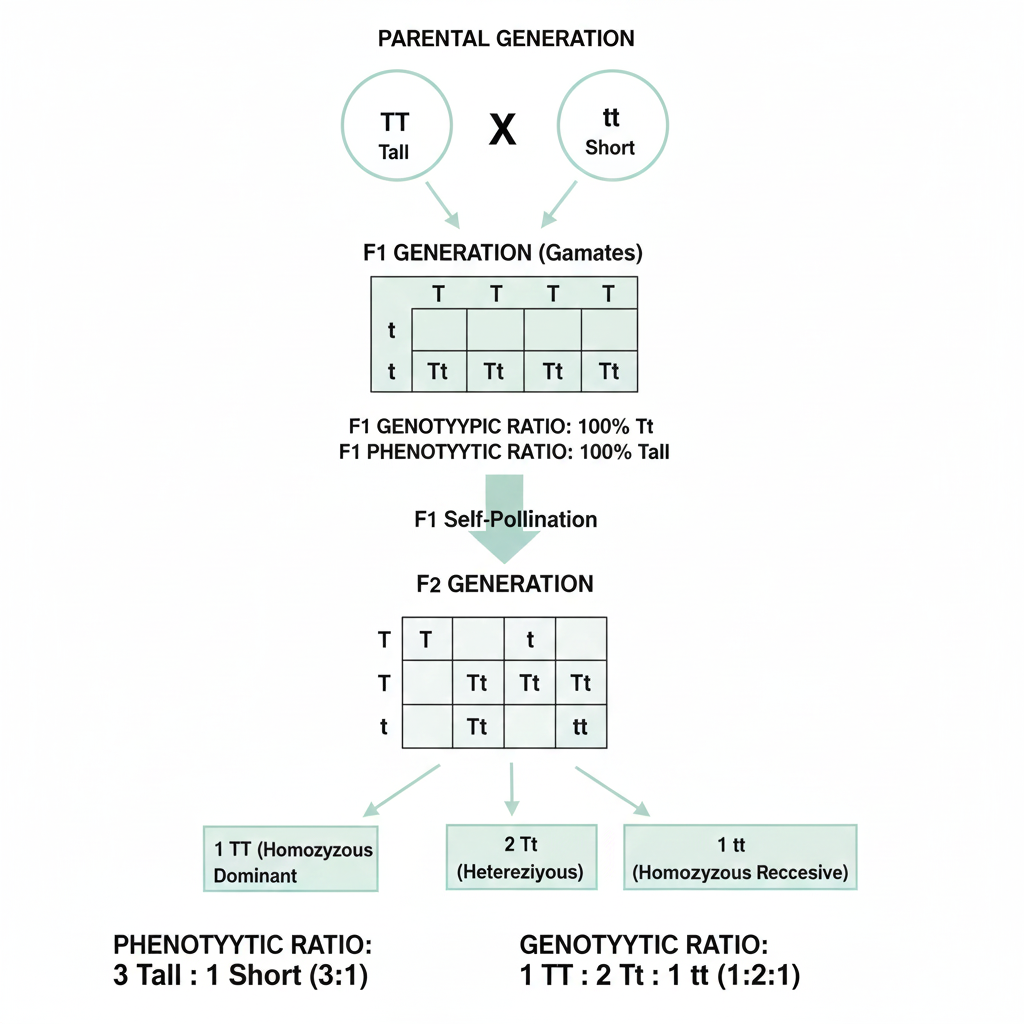
This mechanism ensures that even if a recessive trait is masked in $F_1$, the recessive allele ($t$) is passed on separately, ready to express itself if paired with another recessive allele in $F_2$ ($tt$).
NEET Checkpoint:
The process by which parental alleles separate so a gamete gets only one factor is known as the Law of:
(a) Purity of Gametes
(b) Dominance
(c) Segregation
(d) Blending
✅ Answer: (c) Segregation — This law dictates the separation of alleles during gamete formation.
Practice Questions:
- In Mendel's monohybrid cross, the alleles for height in the $F_1$ heterozygote ($Tt$) were observed to be phenotypically identical to the homozygous dominant parent ($TT$). This observation led directly to the proposal of:
(a) The Law of Segregation
(b) The Law of Independent Assortment
(c) The Law of Dominance
(d) Incomplete Dominance
✅ Answer: (c) The Law of Dominance — The finding that the $F_1$ heterozygote ($Tt$) plant looked exactly like the $TT$ plant led Mendel to propose that $T$ dominates $t$.
2. If a true-breeding tall pea plant ($TT$) is crossed with a true-breeding dwarf pea plant ($tt$), what proportion of the resulting $F_2$ generation will have the genotype $Tt$?
(a) $1/4$
(b) $1/2$
(c) $3/4$
(d) All of them
✅ Answer: (b) $1/2$ — In the $F_2$ generation of a monohybrid cross, the genotypic ratio is $1TT: 2Tt: 1tt$, meaning $1/2$ (or 2 out of 4 combinations) are heterozygous $Tt$.
Now that you've mastered how a single character is inherited, wait till you see how it connects with multiple characters in the Law of Independent Assortment!
Key Takeaway
| Concept | Definition/Ratio |
|---|---|
| Monohybrid Cross | Cross involving one character; $F_2$ phenotypic ratio is 3:1 (e.g., Tall:Dwarf). |
| Law of Dominance | Explains that in a dissimilar pair of factors, the dominant factor masks the recessive one. |
| Law of Segregation | Alleles separate during gamete formation so each gamete gets only one factor. |
| Alleles | Slightly different forms of the same gene. |
3. Genotypic Analysis, Phenotypes, and the Test Cross
When we talk about inheritance, we need to be super clear about two key terms: phenotype and genotype. The phenotype is the descriptive, observable characteristic—like saying a pea plant is 'tall' or 'dwarf'. Simple! The genotype is the actual allelic pair that controls that trait, like $TT$, $Tt$, or $tt$. If a plant is true breeding, its allelic pair is identical, meaning it is homozygous ($TT$ or $tt$). If it's a hybrid plant, the alleles are dissimilar, making it heterozygous ($Tt$). Don't stress, this funda is easier than it looks!
To calculate the probability of all possible offspring genotypes in a cross, we use the Punnett Square. This graphical representation was developed by a British geneticist, Reginald C. Punnett. For a typical monohybrid cross, the $F_2$ generation gives a distinct output.
NEET Checkpoint:
Who developed the graphical method to calculate offspring genotype probability?
(a) Mendel
(b) Watson
(c) Punnett
(d) Khorana
✅ Answer: (c) Punnett — Arre! Reginald C. Punnett invented this handy square!
In a monohybrid cross, you get a genotypic ratio of $1:2:1$ ($TT:Tt:tt$) and a phenotypic ratio of $3:1$ (tall:dwarf) in the $F_2$ generation. Now, here's the tricky part: externally, you cannot distinguish a plant with genotype $TT$ from one with $Tt$, because both show the dominant 'tall' phenotype.
Imagine you see a batsman in a local cricket match scoring boundaries like crazy (dominant phenotype). You don't know if he's a professional (homozygous $TT$) or just lucky today (heterozygous $Tt$). To find his true genotype (skill level), we use a Test Cross.
A Test Cross is defined as a cross between an organism showing a dominant phenotype (whose genotype is unknown) and the recessive parent. For example, crossing a tall plant (unknown genotype $T?$) with a dwarf plant ($tt$). By analyzing the progeny, you can easily determine the genotype of the test organism. If all progenies are tall, the organism was homozygous dominant ($TT$). If half are tall and half are dwarf, the organism was heterozygous ($Tt$). It’s the ultimate reality check!
NEET Checkpoint:
What are the components of the $F_2$ phenotypic ratio in a monohybrid cross?
(a) $1:2:1$
(b) $3:1$
(c) $9:3:3:1$
(d) $2:1:1$
✅ Answer: (b) $3:1$ — This is the phenotypic ratio of dominant to recessive traits in $F_2$.
NEET Checkpoint:
In a Test Cross, the organism with an unknown dominant phenotype is crossed with which parent?
(a) Homozygous dominant
(b) Recessive parent
(c) $F_1$ hybrid
(d) $F_2$ progeny
✅ Answer: (b) Recessive parent — This is necessary to expose the hidden recessive allele, if present.
Practice Questions:
- A true breeding pea plant for the tall character has the genotype:
(a) $Tt$
(b) $t t$
(c) $TT$
(d) $T$
✅ Explanation: True breeding lines show stable trait inheritance, meaning they are homozygous, and Tall is dominant, so the genotype must be $TT$.
2. What is the genotypic composition of the progeny from a monohybrid cross that can be mathematically condensed to the binomial expression $(1/2T+1/2t)^2$
(a) $1/4$ TT : $1/2$ Tt : $1/4$ tt
(b) $3/4$ Tall : $1/4$ Dwarf
(c) $1/2$ TT : $1/2$ tt
(d) $3:1$
✅ Explanation: The genotypic ratio $1/4 : 1/2 : 1/4$ of $TT: Tt: tt$ is mathematically condensable to the binomial expansion $(1/2T+1/2t)^2\$, which yields $1/4$ $TT$ $+ 1/2$ $Tt$ $+ 1/4$ $tt$.
Key Takeaway
Phenotype is descriptive (e.g., tall); Genotype is the allelic pair (e.g., $TT$). The $F_2$ genotypic ratio is $1:2:1$ and the phenotypic ratio is $3:1$. The Test Cross uses the recessive parent to reveal the unknown genotype of an organism exhibiting the dominant phenotype.
4. Deviations from Mendelism: Incomplete Dominance and Co-dominance
Mendel's laws were killer, but sometimes, biology throws a curveball, yaar. We're talking about situations where the 'dominant' allele isn't fully dominating its partner. Let's clear up this funda of incomplete dominance and co-dominance! Don't stress, these are super important for NEET.
Incomplete Dominance
In Incomplete Dominance, the $F_1$ generation exhibits a phenotype that is intermediate (in between) the two parental traits. Think of it like mixing two colours: red and white parents don't give you red or white offspring; they give you pink.
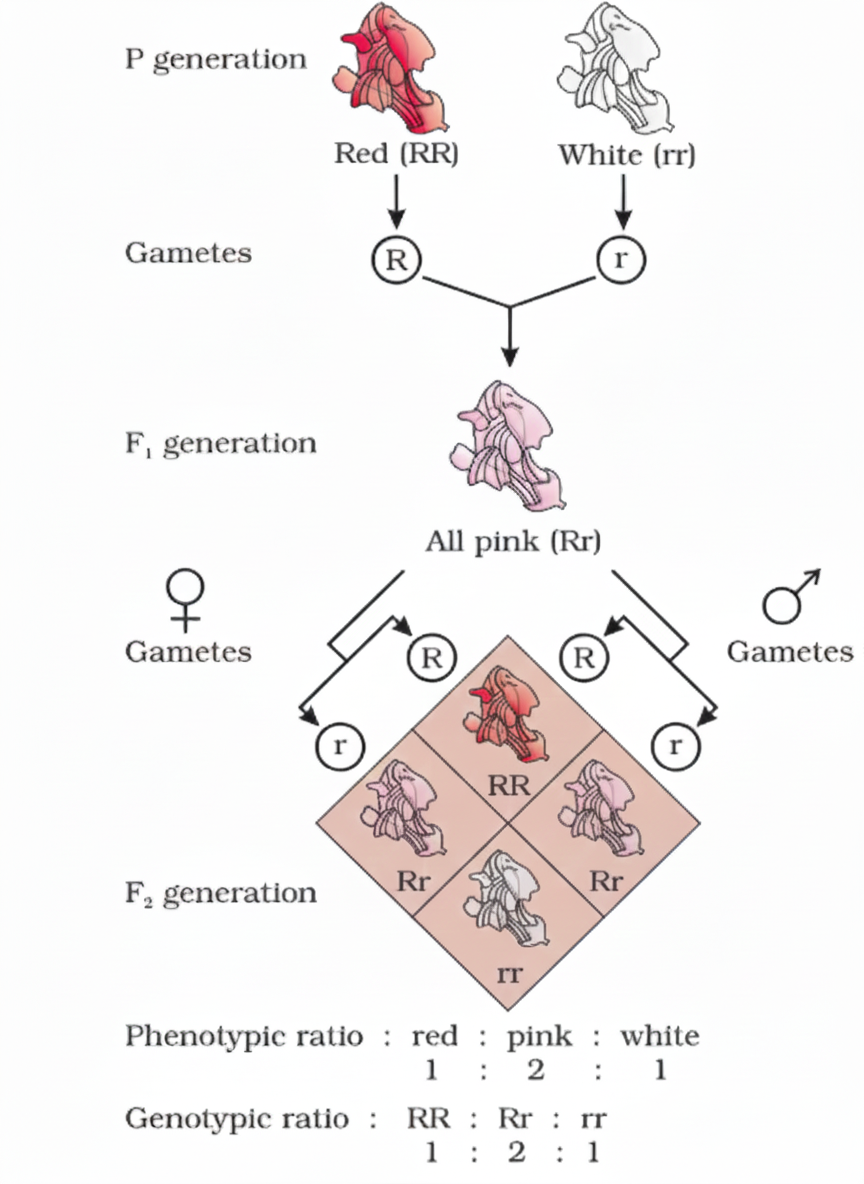
The classic example is flower colour in the dog flower (snapdragon or Antirrhinum sp.). When a true-breeding red-flowered plant ($RR$) is crossed with a true-breeding white-flowered plant ($rr$), the $F_1$ generation ($Rr$) is pink. This happens because the $R$ allele was not completely dominant over the $r$ allele.
Notice this: in a Mendelian cross, the phenotypic ratio is 3:1, right? Here’s the trick: in incomplete dominance, while the genotypic ratio ($RR : Rr : rr$) remains the same as Mendelian crosses, which is $1:2:1$, the phenotypic ratio also becomes $1:2:1$ (Red: Pink: White).
NEET Checkpoint:
In a cross showing incomplete dominance, the phenotypic ratio of the $F_2$ generation is:
(a) $3:1$
(b) $1:2:1$
(c) $9:3:3:1$
(d) $2:1$
✅ Answer: (b) $1:2:1$ — The genotypic ratio ($1:2:1$) equals the phenotypic ratio in incomplete dominance because the heterozygote ($Rr$) has a unique, intermediate phenotype.
Figure below:
A clear diagram showing the cross between red ($RR$) and white ($rr$) snapdragon flowers yielding pink ($Rr$) $F_1$ flowers, followed by the $F_2$ generation ratio of 1 Red: 2 Pink: 1 White.
Co-dominance and Multiple Alleles
Now, what if both parents decide to show off their traits fully? That’s Co-dominance! In this case, the $F_1$ generation resembles both parents, with both alleles expressing their traits simultaneously. It's like having two distinct cricket logos painted side-by-side on your helmet—both logos are visible, no blending happens.
The ABO blood grouping in humans is a classic example of co-dominance. The character is governed by the gene $I$, which has three alleles: $I^A$, $I^B$, and $i$.
Here’s the breakdown:
1. Alleles $I^A$ and $I^B$ are completely dominant over $i$. If the genotype is $I^A i$, the blood group is A.
2. But when $I^A$ and $I^B$ are present together (genotype $I^A I^B$), they both express their specific sugar types, resulting in the AB blood group. This simultaneous expression is co-dominance.
NEET Checkpoint:
The inheritance pattern where the $F_1$ progeny expresses the traits of both parents simultaneously is called:
(a) Dominance
(b) Multiple Alleles
(c) Incomplete Dominance
(d) Co-dominance
✅ Answer: (d) Co-dominance — Both alleles, like $I^A$ and $I^B$, express themselves fully and clearly.
Wait, there’s another funda here! ABO blood grouping also illustrates Multiple Alleles. Since more than two alleles ($I^A$, $I^B$, $i$) govern this single character (blood group), it falls under multiple alleles. Remember, though a population can have multiple alleles, any single diploid person only possesses two of these alleles.
NEET Checkpoint:
If an individual has the genotype $I^A I^B$, which biological concept explains why they exhibit the AB blood group?
(a) Multiple Allelism
(b) Complete Dominance
(c) Co-dominance
(d) Sex-linkage
✅ Answer: (c) Co-dominance — Both $I^A$ and $I^B$ express their respective sugars, a clear sign of co-dominance.
Practice Questions:
- Which of the following statements correctly describes the phenotypic outcome of incomplete dominance?
(a) The heterozygote expresses the dominant parental phenotype.
(b) The heterozygote resembles both parental phenotypes distinctly.
(c) The heterozygote exhibits a trait intermediate between the two parental traits.
(d) The $F_2$ phenotypic ratio is always $3:1$.
✅ Answer: (c) The heterozygote exhibits a trait intermediate between the two parental traits. — In incomplete dominance, the $F_1$ phenotype is in between the two parents, such as pink flower color in Snapdragon.
2. ABO blood grouping is an example of co-dominance and multiple allelism. The total number of alleles governing this single character is:
(a) Two
(b) Three
(c) Four
(d) Six
✅ Answer: (b) Three — The gene $I$ governing ABO blood groups has three alleles: $I^A$, $I^B$, and $i$.
Key Takeaway
Incomplete Dominance: $F_1$ is intermediate; Genotypic ratio ($1:2:1$) equals Phenotypic ratio ($1:2:1$).
Co-dominance: $F_1$ resembles both parents (e.g., $I^A I^B$ results in AB blood group).
Multiple Alleles: Occurs when more than two alleles ($I^A$, $I^B$, $i$) govern a single character.
5. Dihybrid Cross and the Law of Independent Assortment
We’ve seen how Mendel tackled one character (monohybrid cross), but the real test was figuring out what happens when you track two characters simultaneously! This is the Dihybrid Cross, and it gives us the famous Law of Independent Assortment.
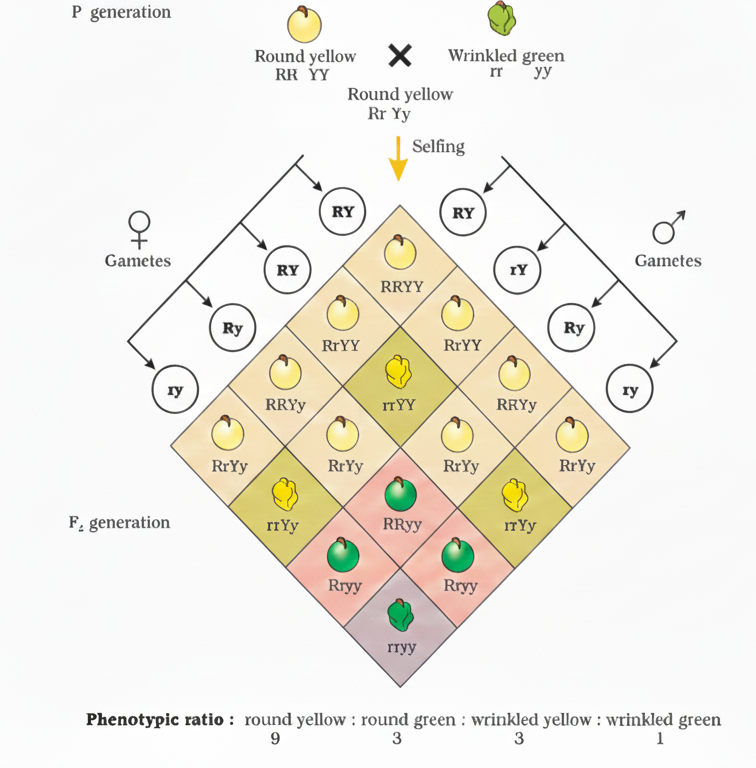
Mendel crossed pea plants that differed in two pairs of contrasting traits. For instance, he took a plant with round yellow seeds (genotype $RRYY$) and crossed it with a plant bearing wrinkled green seeds (genotype $rryy$).
The $F_{1}$ generation, the hybrid, had the genotype $RrYy$. Notice this: every single $F_{1}$ seed was round and yellow. Boss, iska matlab kya hai? It just confirms that $\text{Round} (R)$ is dominant over $\text{wrinkled} (r)$, and $\text{Yellow} (Y)$ is dominant over $\text{green} (y)$. Don't stress, yaar—it’s easier than it looks!.
NEET Checkpoint:
The F1 generation of a dihybrid cross ($RRYY \times rryy$) produces which phenotype?
(A) Wrinkled Green
(B) Round Yellow
(C) Round Green
(D) Wrinkled Yellow
✅ Answer: (B) Round Yellow — Since $R$ (Round) is dominant over $r$ (wrinkled) and $Y$ (Yellow) is dominant over $y$ (green), only the dominant traits are expressed in the $RrYy$ hybrid.
The actual funda comes when the $F_{1}$ plants self-pollinate. The $F_{2}$ generation blew everyone away because it produced four distinct phenotypes: round, yellow; wrinkled, yellow; round, green; and wrinkled, green. The phenotypic ratio observed for these four combinations was the classic 9:3:3:1.
This precise ratio led Mendel to his second major generalisation: the Law of Independent Assortment.
The law states that when two pairs of traits are combined in a hybrid, the segregation of one pair of characters is independent of the other pair of characters. Think of it like deciding what to wear: choosing your shirt colour (Yellow or Green) is totally independent of choosing your jeans style (Round or Wrinkled fit). They assort separately during gamete formation! Because of this independent segregation, the $F_{1}$ hybrid ($RrYy$) produces four types of gametes ($RY, Ry, rY, ry$) in equal frequency ($1/4^{th}$ each).
NEET Checkpoint:
How many types of gametes does an $F_{1}$ dihybrid plant ($RrYy$) produce?
(A) One
(B) Two
(C) Four
(D) Eigh
✅ Answer: (C) Four ($RY, Ry, rY, ry$) — Due to independent assortment, the two pairs of genes segregate independently, yielding four equally probable gamete types.
NEET Checkpoint:
If a dihybrid cross yielded 90 Round Yellow seeds, how many Wrinkled Green seeds are expected?
(A) 5
(B) 30
(C) 20
(D) 10
✅ Answer: (D) 10 — The ratio is 9 (RY) : 3 (rY) : 3 (Rg) : 1 (rg). If 9 parts = 90 seeds, then 1 part (Wrinkled Green) = 10 seeds.
Figure below:
A clear diagram showing the 16-square Punnett square derived from crossing RrYy x RrYy gametes, resulting in the 9:3:3:1 phenotypic ratio.
Practice Questions:
Which phenomenon explains why the allele for seed shape ($R/r$) separates without regard to the allele for seed colour ($Y/y$)?
(a) Law of Segregation
(b) Law of Dominance
(c) Linkage
(d) Law of Independent Assortment
✅ Answer: (d) Law of Independent Assortment — This law directly addresses the independent segregation of two different pairs of characters when combined in a hybrid.
Key Takeaway
The Dihybrid Cross results in a phenotypic ratio of 9 Round, Yellow : 3 Wrinkled, Yellow : 3 Round, Green : 1 Wrinkled, Green. The core principle, the Law of Independent Assortment, states that the segregation of one trait pair is independent of the other trait pair when forming gametes. This independence is why the $F_{1}$ hybrid $RrYy$ produces four unique gametes, each at a frequency of $1/4$ or 25 per cent. Now that you've got this, wait till you see how this law doesn't always hold true due to linkage!.
6. The Chromosomal Theory and Gene Linkage
The synthesis of Mendelian principles with microscopic observations of cell division led directly to the Chromosomal Theory of Inheritance.
Around 1902, scientists like Walter Sutton and Theodore Boveri noted something super cool: the behaviour of chromosomes during meiosis exactly paralleled the behaviour of genes. Think of it like a perfectly coordinated cricket duo! They observed that both chromosomes and genes occur in pairs. Furthermore, during gamete formation, these pairs segregate such that only one of each pair is transmitted to a gamete. Sutton combined this knowledge of chromosome movement with Mendel’s rules to propose this revolutionary theory.
NEET Checkpoint:
The Chromosomal Theory of Inheritance was proposed by uniting Mendelian principles with the knowledge of:
(a) DNA structure
(b) Chromosome behaviour during meiosis
(c) Linkage mapping
(d) Protein synthesis.
✅ Answer: (b) Chromosome behaviour during meiosis — Sutton united chromosome segregation with Mendelian principles.
To verify this synthesis, Thomas Hunt Morgan stepped up and started experimenting with the humble fruit fly, Drosophila melanogaster. Drosophila was perfect for this study since it completes its life cycle in about two weeks and produces a massive number of progeny.
Morgan's experiments introduced a new twist called Linkage. Linkage is the physical association of genes situated on the same chromosome. Imagine you're riding a scooter (the chromosome) with your bag (one gene) and your helmet (another gene)—they are physically attached and travel together! When genes are linked, they do not assort independently, causing the $F_{2}$ dihybrid cross ratio to deviate very significantly from the expected $9:3:3:1$ ratio. The parental types show up far more frequently.
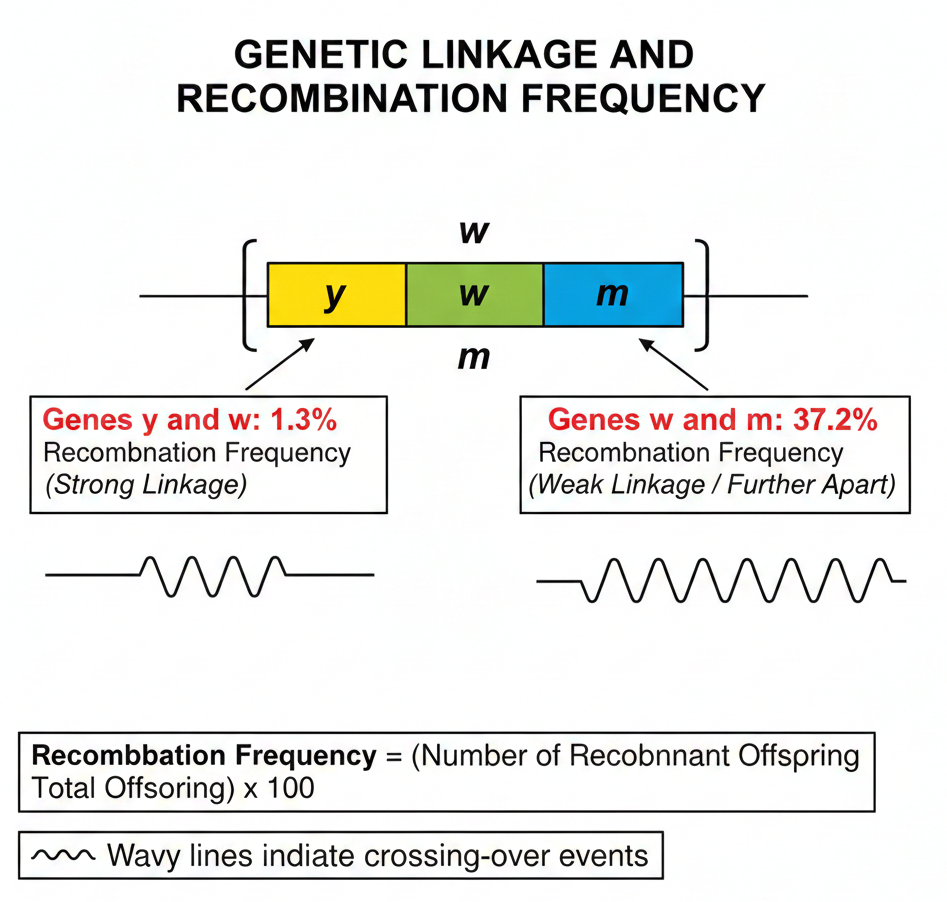
Recombination describes the generation of non-parental gene combinations. Morgan discovered that if genes are tightly linked (like yellow and white genes, showing only $1.3$ per cent recombination), they rarely separate. If they are loosely linked (like white and miniature wing genes, showing $37.2$ per cent recombination), they have a higher chance of shuffling.
NEET Checkpoint:
Linkage is characterized by:
(a) Independent segregation of genes
(b) The generation of non-parental combinations
(c) The physical association of genes on a chromosome
(d) Maintenance of the $9:3:3:1$ ratio
✅ Answer: (c) The physical association of genes on a chromosome — That’s the core definition coined by Morgan.
NEET Checkpoint:
What term is used to describe the generation of non-parental gene combinations?
(a) Segregation
(b) Dominance
(c) Linkage
(d) Recombination
✅ Answer: (d) Recombination — Recombination generates those non-parental types.
Figure below:
A clear diagram illustrating how two genes (y and w versus w and m) on the same chromosome show different levels of recombination (1.3% versus 37.2%), indicating the strength of linkage.
Practice Question:
If two genes are tightly linked on the same chromosome, what is expected in the progeny?
(a) High frequency of recombinant types.
(b) $9:3:3:1$ phenotypic ratio.
(c) High frequency of parental types.
(d) Independent assortment.
✅ Answer: (c) High frequency of parental types — Tightly linked genes mean low recombination, so the original parental combinations are passed on together much more often.
Now that you know the funda of genes physically sticking together, wait till you see how these ideas were used to actually map genes on the chromosome!
Key Takeaway
Chromosomal Theory of Inheritance arose from uniting Mendelian principles with the parallel behaviour of genes and chromosomes. Linkage is the physical association of genes on the same chromosome and significantly deviates the $F_{2}$ ratio from $9:3:3:1$. Recombination generates non-parental combinations.
7. Polygenic Inheritance and Pleiotropy
Polygenic Inheritance: The Gradient Funda
Hey future doctor! We've seen traits with clear-cut alternatives like Tall or Dwarf in Mendel's experiments. But look around—human height or human skin colour isn't a simple choice between two extremes, right? They are spread across a gradient. Notice this: such complex traits are generally known as polygenic traits because they are controlled by three or more genes.
And here's the trick: polygenic inheritance is also heavily influenced by the environment. Imagine getting super tanned in the summer sun! The phenotype you see is the result of the additive contribution of each allele. If three genes ($A, B, C$) control skin colour, a genotype of $AABBCC$ gives the darkest skin, while $aabbcc$ gives the lightest. Genotypes with three dominant and three recessive alleles will show an intermediate skin colour. It’s like calculating a final exam score where $A, B,$ and $C$ are three sections, and every correct allele adds a few marks!
NEET Checkpoint:
Which type of inheritance involves the additive effect of multiple alleles?
(a) Co-dominance
(b) Incomplete Dominance
(c) Polygenic Inheritance
(d) Pleiotropy
✅ Answer: (c) Polygenic Inheritance — Arre, remember the phenotype reflects the additive contribution of each allele.
Pleiotropy: The Multi-Talented Gene
Now, let’s flip the script. So far, we saw multiple genes affecting one trait. But what if a single gene decides to be extra and exhibits multiple phenotypic expressions? This is called Pleiotropy. This happens because that single gene often affects a basic metabolic pathway.
A classic example for your NEET prep is the disease Phenylketonuria. This human disease is a result of a single gene mutation that messes up the enzyme phenyl alanine hydroxylase. Because of this one faulty step, you get a combo offer of issues: mental retardation and a reduction in hair and skin pigmentation. See? One tiny gene, so much hungama!
Dominance Isn't Always the Boss
Finally, let's clear up a classic funda: Dominance is not an autonomous feature of a gene. It’s not an inherent superpower! It actually depends on the nature of the gene product and, critically, the particular phenotype that we choose to examine.
Think of it like this: If a single cricket batsman (the 'single gene') performs poorly, they might mess up the team's total run rate (Phenotype A) and also cause the coach to pull out his hair (Phenotype B). This multi-effect scenario is pleiotropy. Don't forget that sometimes the same alleles show incomplete dominance for one phenotype (like intermediate starch grain size in pea seeds) but complete dominance for another (like round seed shape). It all depends on which characteristic you are examining.
NEET Checkpoint:
Phenylketonuria is caused by a mutation in the gene coding for:
(a) Tyrosinase
(b) Phenyl alanine hydroxylase
(c) Beta-galactosidase
(d) Haemoglobin
✅ Answer: (b) Phenyl alanine hydroxylase — This single enzyme mutation leads to multiple symptoms like mental retardation and reduced hair/skin pigmentation.
NEET Checkpoint:
Polygenic inheritance is influenced by:
(a) Dominance
(b) Only multiple genes
(c) Environment
(d) Multiple alleles but no environmental effect
✅ Answer: (c) Environment — Besides multiple genes, the environment also plays a role in polygenic traits like height and skin colour.
Practice Questions:
- Which of the following conditions correctly describes the genetic basis of human skin colour?
(a) It is a monogenic trait controlled by dominant alleles.
(b) The phenotype reflects the additive contribution of each allele.
(c) It is controlled by two genes that show co-dominance.
(d) It is an example of a trait solely determined by the environment.
✅ Answer: (b) The phenotype reflects the additive contribution of each allele. — Skin colour is a polygenic trait where the effect of each allele is cumulative or additive.
2. Pleiotropy refers to a condition where:
(a) A single gene is expressed as two alternate traits.
(b) A single gene exhibits multiple phenotypic expressions.
(c) Three or more genes control one trait showing a gradient.
(d) The phenotype is determined solely by the environment.
✅ Answer: (b) A single gene exhibits multiple phenotypic expressions. — Pleiotropy is defined by a single gene product producing more than one effect.
Key Takeaway
Polygenic Inheritance involves multiple genes and environmental factors with an additive effect on the phenotype. Pleiotropy is the opposite, where one gene influences multiple phenotypes, as seen in Phenylketonuria. Remember that dominance isn't a fixed property; it depends on the phenotype you are checking.
8. Mechanisms of Sex Determination
Hey juniors! Ever wondered why some species have $XY$ chromosomes while others roll with $ZW$? The basic funda of sex determination is super cool because it tells us how organisms manage this crucial distinction. It all started way back in 1891 when Henking observed a specific nuclear structure in certain insects during spermatogenesis, which he called the X body. He noted that after sperm formation, 50 per cent of the sperm received this structure, while the other 50 per cent did not. Later investigations concluded that the X body was, in fact, the X-chromosome.
Now, let's look at the main types of chromosomal sex determination:
- XO Type: Found in organisms like the Grasshopper. Males are $XO$ (having only one X-chromosome), while females are $XX$.
- XY Type: This is what we see in humans and Drosophila. Males are heterogametic ($XY$), and females are homogametic ($XX$).
- ZW Type: Seen typically in birds. This is a case of female heterogamety. Males are $ZZ$ and females are $ZW$.
NEET Checkpoint:
Which mechanism of sex determination is represented by males having $XO$ and females having $XX$?
(a) Human XY
(b) Honey Bee Haplodiploidy
(c) Grasshopper XO
(d) Bird ZW
✅ Answer: (c) Grasshopper XO — Bhai, in XO type, males possess a single $X$ and no counterpart, hence the designation $XO$.
Let's dive into the human scenario. Humans have $23$ pairs of chromosomes, with $22$ being autosomes. Since males are $XY$, they produce two types of gametes: $50$ per cent carrying the $X$-chromosome and $50$ per cent carrying the $Y$-chromosome. Females produce only $X$ ova. This means the genetic makeup of the sperm determines the sex of the child. It is truly unfortunate, yaar, that in society, women are sometimes wrongly blamed for having female children when genetics shows the father’s contribution is the deciding factor.
Think of the human $XY$ system like a coin toss in cricket during fertilization. The coin (sperm) decides: $X$ for a female or $Y$ for a male. The probability is always 50 per cent for either gender in each pregnancy.
We also have the weird and wonderful world of Honey Bees! Their system is called haplodiploidy. If an egg is fertilised (union of sperm and egg), it develops into a female (worker or queen), which is diploid with $32$ chromosomes. If the egg is unfertilised, it develops by parthenogenesis into a male (drone), which is haploid with $16$ chromosomes. And that's cool, right? Because male drones produce sperm by mitosis, they literally do not have a father and cannot have sons, but they do have a grandfather and can have grandsons.
NEET Checkpoint:
In the haplodiploid sex determination system, a male honey bee (drone) is formed from:
(a) A diploid zygote
(b) An unfertilised egg
(c) A fertilised egg
(d) Union of two sperm
✅ Answer: (b) An unfertilised egg — Drones develop via parthenogenesis from unfertilised eggs, making them haploid ($16$ chromosomes).
Practice Questions:
1. In the $ZW$ type of sex determination, who produces two different types of gametes, leading to female heterogamety?
(a) Males ($ZZ$)
(b) Females ($ZW$)
(c) Both sexes
(d) Only autosomes
✅ Explanation: The correct option is (b). In birds (ZW type), the female is heterogametic because she produces gametes with either the $Z$ or $W$ chromosome.
2: If a human male produces $400$ sperm, approximately how many of them carry the $Y$ chromosome?
(a) 400
(b) 200
(c) 100
(d) 0
✅ Explanation: The answer is (b) $200$. Males produce two types of sperm ($X$ or $Y$) in equal proportion, meaning roughly $50$ per cent will carry the $Y$ chromosome.
Key Takeaway
| Mechanism | Example | Male Genotype | Female Genotype | Heterogametic Sex |
|---|---|---|---|---|
| XO | Grasshopper | $XO$ | $XX$ | Male |
| XY | Humans | $XY$ | $XX$ | Male |
| ZW | Birds | $ZZ$ | $ZW$ | Female |
| Haplodiploidy | Honey Bee | $16$ (Haploid) | $32$ (Diploid) | N/A (Based on fertilisation) |
9. DNA: The Structure and Packaging
Let’s dive into the funda that makes you, well, you: DNA (deoxyribonucleic acid). This beast is the genetic material in most organisms, acting like a massive blueprint. Structurally, DNA is a long polymer of deoxyribonucleotides. Don't stress, the basics are simple! A single nucleotide is built from three main components: a nitrogenous base, a pentose sugar (deoxyribose), and a phosphate group.
The OG structure—the Double Helix model—was proposed by James Watson and Francis Crick in 1953. This revolutionary model showed that DNA is made up of two polynucleotide chains. Here’s the trick: these chains run in opposite directions—they have anti-parallel polarity. So, if one chain goes $5^{\prime}\rightarrow3^{\prime}$, the other must run $3^{\prime}\rightarrow5^{\prime}$.
NEET Checkpoint:
If a DNA strand has the polarity $5^{\prime}\rightarrow3^{\prime}$, what is the polarity of its complementary strand?
(a) $5^{\prime}\rightarrow3^{\prime}$
(b) $3^{\prime}\rightarrow5^{\prime}$
(c) $3^{\prime}\rightarrow3^{\prime}$
✅ Answer: (b) $3^{\prime}\rightarrow5^{\prime}$ — They must be anti-parallel, simple as that!.
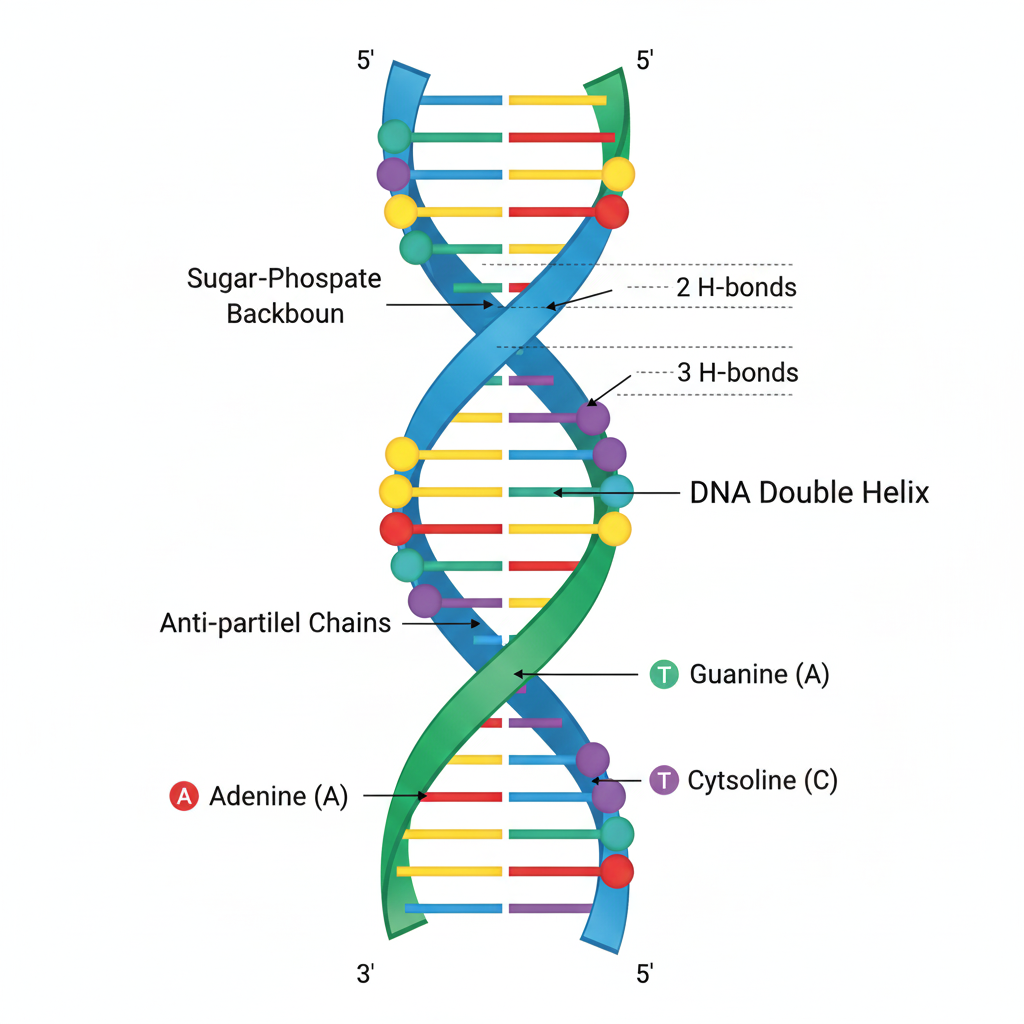
The bases are paired internally using hydrogen bonds (H-bonds), following Erwin Chargaff’s rules. Adenine (A) always pairs with Thymine (T) using two H-bonds, and Guanine (G) pairs with Cytosine (C) using three H-bonds. This specific pairing means a purine (A or G) is always opposite a pyrimidine (T or C), maintaining a uniform distance across the helix. The helix itself is coiled in a right-handed fashion, with approximately $10\ bp$ per turn, giving a pitch of $3.4\ nm$.
Imagine folding a $2.2\ metre$ saree into a tiny box! That’s exactly what a mammalian cell does to package its DNA (which is approximately $2.2\ metres$ long, calculated as $6.6\times10^9\ bp \times 0.34\times10^{-9}\ m/bp$). In eukaryotes, this complex packaging starts with histones. These are positively charged, basic proteins (rich in lysine and arginine, which carry positive charges). The negatively charged DNA wraps around a unit of eight histone molecules, called a histone octamer, to form a structure called a nucleosome.
A typical nucleosome wraps about $200\ bp$ of DNA. These nucleosomes form the repeating unit of chromatin, which looks like "beads-on-string" under an electron microscope.
Figure below:
A clear diagram showing the double-helix structure of DNA, labeling the sugar-phosphate backbone, the anti-parallel chains, and the base pairing (A=T with two H-bonds, G=C with three H-bonds.
Relatable Example: Think of the DNA as a very long kite string ($2.2\ metres$!). The histones are like tiny, positively charged spools that help you wind up that entire string tightly so it fits neatly into the kite box (the nucleus). If you didn't have those spools, that string would be scattered everywhere (or, as they say in the lab, 'scattered throughout the cell').
This chromatin is further packaged into chromatin fibers and eventually condenses into chromosomes.
NEET Checkpoint:
What charge does DNA typically carry, and what property of histones neutralizes this charge during nucleosome formation?
(a) Positive; Acidic nature
(b) Negative; Basic nature
(c) Neutral; Hydrophobic nature
✅ Answer: (b) Negative; Basic nature — DNA is negatively charged, and histones are positively charged basic proteins (due to lysine and arginine).
Finally, not all parts are equally packed. Loosely packed, light-staining regions are called euchromatin, and these are generally transcriptionally active. Densely packed, dark-staining regions are heterochromatin, which are generally inactive.
Practice Questions :
1. Which component stabilizes the DNA double helix structure in addition to hydrogen bonds?
(a) Phosphodiester linkages
(b) Stacking of one base pair over the other
(c) Deoxyribose sugar groups
(d) Non-histone chromosomal proteins
✅ Answer: (b) Stacking of one base pair over the other — The plane of one base pair stacks over the next, providing crucial stability.
2. How many base pairs are typically found wrapped around a single histone octamer to form a nucleosome?
(a) 10 bp
(b) 50 bp
(c) 100 bp
(d) 200 bp
✅ Answer: (d) 200 bp — A typical nucleosome contains $200\ bp$ of DNA helix.
Now that you know how the DNA is structured and packed away, let's figure out how scientists actually proved that this marvelous molecule is the true genetic material!
Key Takeaway
The DNA structure is a Double Helix of two anti-parallel strands ($5^{\prime}\rightarrow3^{\prime}$ and $3^{\prime}\rightarrow5^{\prime}$). Base pairing is specific: A=T (2 H-bonds) and G triple-bond C (3 H-bonds). In eukaryotes, negatively charged DNA wraps around positively charged histone octamers to form nucleosomes, the repeating units of chromatin. Chromatin is differentiated into active (euchromatin) and inactive (heterochromatin) regions.
10. The Search for the Genetic Material
This is one of those classic biology funda chapters where we figure out the ultimate question: What exactly holds the blueprints for life? For the longest time, people thought proteins were the real deal, but three killer experiments proved otherwise!
Our journey kicks off with Frederick Griffith in 1928, who studied Streptococcus pneumoniae, the bacteria causing pneumonia. He noticed a "miraculous transformation" in the bacteria. He worked with the virulent S strain (Smooth, kills mice) and the non-virulent R strain (Rough, mice live). The shocking bit? When he mixed heat-killed S bacteria with live R bacteria, the mice died, and he recovered living S bacteria! He concluded that some 'transforming principle' was transferred, enabling the R strain to synthesise a smooth polysaccharide coat and become virulent. This suggested the transfer of genetic material, though he didn't know what it was.
NEET Checkpoint:
Which treatment in Griffith's experiment suggested the presence of a 'transforming principle'?
(a) Injecting heat-killed S strain
(b) Injecting live R strain
(c) Injecting a mixture of heat-killed S and live R
(d) Injecting live S strain
✅ Answer: (c) Injecting a mixture of heat-killed S and live R — The mice died, showing the non-virulent R strain got transformed by something from the dead S strain.
Next up, the trio—Avery, MacLeod, and McCarty (1933–44)—did the biochemical detective work! They purified components (proteins, DNA, RNA) from the heat-killed S cells. They found that DNA alone caused R bacteria to become transformed into S cells. They used protein-digesting enzymes (proteases) and RNA-digesting enzymes (RNases), which had no effect on transformation. But, using DNase (DNA-digesting enzyme) inhibited transformation, leading them to conclude DNA was the hereditary material.
But wait, the definitive, Pukka proof came from Hershey and Chase in 1952, using viruses called bacteriophages. They famously used radioactivity to track molecules. They labelled DNA with radioactive phosphorus ($\mathbf{{}^{32}\text{P}}$) and the protein coats with radioactive sulfur ($\mathbf{{}^{35}\text{S}}$). Since DNA contains P but not S, and protein contains S but not P, this tagging was specific. When the phages infected bacteria, only the
(DNA) was detected inside the bacterial cells, while the
(protein) remained outside. This unequivocally proved: DNA, not protein, is the genetic material. Aha! No confusion now!
Relatable Indian Example: Imagine trying to prove who brought the cricket bat (genetic material) to the playground (the bacterial cell). If you paint the bat with non-washable green colour (${}^{32}\text{P}$) and the bag it came in with temporary red colour (${}^{35}\text{S}$), only the green colour enters the field of play, confirming the bat is the important item!
So, why DNA and not RNA? DNA is the better choice for storing information because it’s a chemically less reactive and structurally more stable molecule than RNA. RNA is labile and easily degradable because every nucleotide residue has a reactive $2^{\prime}-\text{OH}$ group in its ribose sugar. Plus, having Thymine instead of Uracil in DNA provides additional stability.
NEET Checkpoint:
Why is DNA chemically less reactive than RNA?
(a) It is double-stranded.
(b) It contains Thymine.
(c) It lacks the $2^{\prime}-\text{OH}$ group.
(d) It is acidic.
✅ Answer: (c) It lacks the $\mathbf{2^{\prime}-\text{OH}}$ group. — This hydroxyl group makes RNA chemically reactive and unstable, giving DNA the edge in stability.
Practice Questions:
- In Griffith’s experiment, if R strain is non-virulent, why did the mice die when injected with a mixture of heat-killed S and live R strains?
(a) The heat-killed S strain regenerated.
(b) The live R strain acquired a polysaccharide coat from the S strain DNA.
(c) The live R strain mutated spontaneously to S strain.
(d) The protein from the S strain transformed the R strain.
✅ Answer: (b) The live R strain acquired a polysaccharide coat from the S strain DNA. — The transforming principle (later shown to be DNA) was transferred from the heat-killed S strain to the R strain, enabling it to synthesise the virulent smooth coat.
2. Which component of the bacteriophage was detected primarily in the supernatant after the centrifugation step in the Hershey-Chase experiment using${}^{35}\text{S}$-labelled phages?
(a) DNA
(b) RNA
(c) Protein
(d) Sugar
✅ Answer: (c) Protein — Sulfur labels protein, and since protein does not enter the bacteria, it remained with the viral coats (phage ghosts) in the surrounding liquid (supernatant) after blending and centrifugation.
Key Takeaway
| Experiment | Significance |
|---|---|
| Griffith (1928) | Demonstrated the existence of a 'transforming principle' (genetic material transfer). |
| Avery et al. (1933–44) | Biochemically identified DNA as the transforming substance using DNase, RNase, and Protease. |
| Hershey & Chase (1952) | Unequivocally proved DNA is the genetic material using radioactive $\mathbf{{}^{32}\text{P}}$ (DNA) and $\mathbf{{}^{35}\text{S}}$ (Protein). |
| DNA vs. RNA | DNA is less reactive and more stable due to the absence of the $\mathbf{2^{\prime}-\text{OH}}$ group, making it ideal for genetic storage. |
11. DNA Replication and the RNA World
The whole mechanism of how genetic material copies itself was cracked by the legendary duo, Watson and Crick. They saw the complementary structure of the double helix and immediately proposed the Semiconservative DNA replication scheme. What's the simple idea? The two parental strands separate and each acts as a template to synthesise a new complementary strand. So, the new DNA molecule is literally half old (parental) and half new. Mind-blowing, right?
But wait, we need proof! Meselson and Stahl provided the unequivocal proof in 1958 using E. coli. They grew bacteria in heavy nitrogen, $N^{15}$ (the heavy isotope), and then shifted them to normal $N^{14}$ medium. They separated the resulting DNA molecules based on density using $CsCl$ density gradient centrifugation. After one generation (20 minutes in E. coli), they found hybrid DNA, confirming the semiconservative model. It’s like when you try to calculate the run rate for the next T20 match—you need the starting score and the required run rate to determine the hybrid target!
The core enzyme doing the heavy lifting is DNA-dependent DNA polymerase. Notice this—it's super-fast, polymerising at about 2000 bp per second in E. coli. However, this enzyme is a bit picky: it can only catalyse polymerisation in the $5^{\prime}\rightarrow3^{\prime}$ direction.
NEET Checkpoint:
What is the main template used by DNA polymerase?
(A) RNA
(B) DNA
(C) Protein
(D) Carbohydrate
✅ Answer: (B)DNA — The enzyme is specifically called DNA-dependent DNA polymerase.
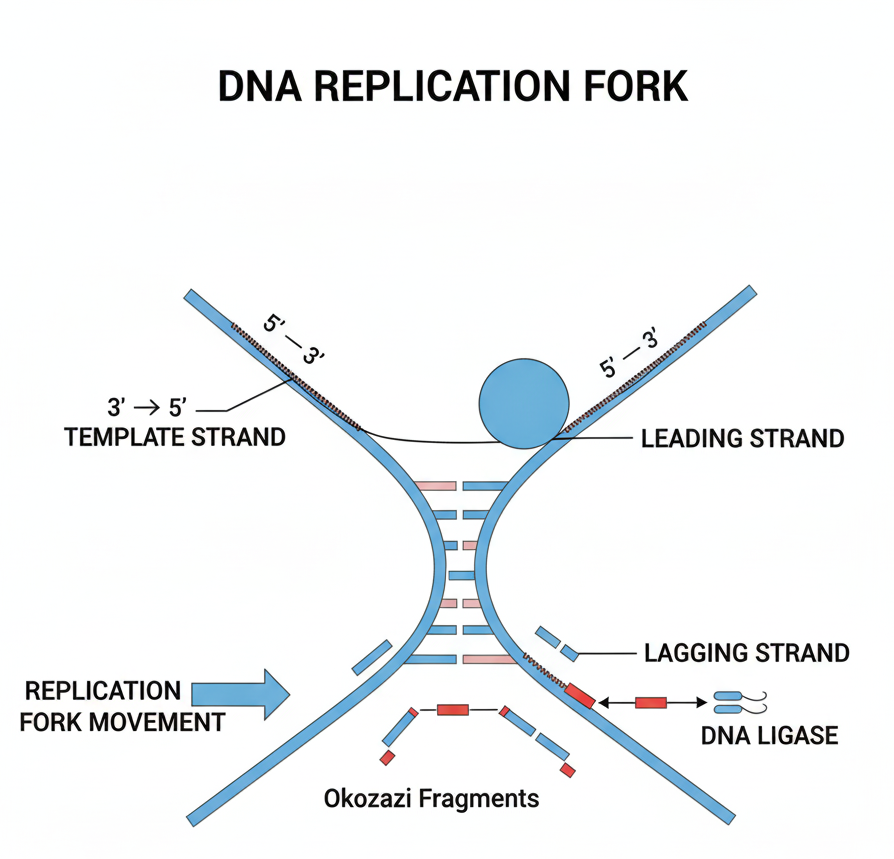
Replication happens within a small unzipping area called the replication fork. Because of the $5^{\prime}\rightarrow3^{\prime}$ rule, replication on one template strand (the $3^{\prime}\rightarrow5^{\prime}$ template) is continuous, but on the other template strand (the $5^{\prime}\rightarrow3^{\prime}$ template), it’s discontinuous. These discontinuous fragments are later sealed together by the enzyme DNA ligase.
Figure below:
A clear diagram showing the replication fork with the continuous strand (leading strand) and the discontinuous strand (lagging strand), clearly labelling the template strands as $3^{\prime}\rightarrow5^{\prime}$ and $5^{\prime}\rightarrow3^{\prime}$ polarity, and showing DNA ligase joining the fragments.
Now for a quick history lesson: the RNA World hypothesis suggests that RNA was the first genetic material. It acted both as a genetic material and as a catalyst for essential life processes like translation. And that's cool, right? But RNA’s 2'-OH group made it reactive and unstable. That's the funda behind why DNA took over—it evolved from RNA via chemical modifications that made it structurally more stable. DNA is the stable locker for genetic info, while RNA is the temporary messenger.
NEET Checkpoint:
What role does the $2^{\prime}-OH$ group play in RNA stability?
(A) It increases the thermal stability of RNA
(B) It protects RNA from enzymatic attack
(C) It makes RNA labile and easily degradable
(D) It helps RNA form a double helix like DNA
✅ Answer: (C) It makes RNA labile and easily degradable, hence chemically less stable than DNA.
NEET Checkpoint:
The discontinued fragments formed during replication are sealed by which enzyme?
(A) DNA helicase
(B) DNA polymerase
(C) RNA primase
(D) DNA ligase
✅ Answer: (D) DNA ligase — This enzyme joins the short pieces synthesized on the lagging strand.
Practice Question:
1. If E. coli (with $4.6 \times 10^6$ bp) completes replication in 18 minutes, what is the approximate polymerisation rate?
(a) $2000$ bp per second
(b) $4.6 \times 10^6$ bp per second
(c) $1800$ bp per second
(d) $9200$ bp per second
✅ Answer: (a) $2000$ bp per second — The sources state the average rate has to be approximately $2000$ bp per second to complete $4.6\times10^6$ bp in 18 minutes.
2. What characteristic of DNA's structure immediately suggested a copying mechanism?
(a) Its ability to mutate.
(b) The presence of deoxyribose sugar.
(c) The specific base pairing and complementarity.
(d) Its rich content of lysine and arginine.
✅ Answer: (c) The specific base pairing and complementarity — Watson and Crick noted that the specific pairing they postulated immediately suggested a possible copying mechanism.
Key Takeaway
DNA Replication is semiconservative (proved by Meselson & Stahl using $N^{15}$ and $CsCl$ centrifugation). It uses DNA-dependent DNA polymerase working strictly $5^{\prime}\rightarrow3^{\prime}$, leading to continuous and discontinuous synthesis at the replication fork. The RNA World theory says RNA was the first genetic catalyst, but DNA evolved to store information due to its superior stability.
12. Transcription: Gene Expression and RNA Processing
Hey, future doctor! Let's clear up the funda of Transcription and RNA processing—it's super important, especially the eukaryotic panga (complexity!). Transcription is basically copying genetic information from one strand of the DNA into RNA. Notice this: unlike replication where the total DNA duplicates, here only a segment of DNA is copied into RNA, and only one DNA strand acts as the template. This process is governed by complementarity, but remember the key substitution: adenosine pairs with uracil instead of thymine in the new RNA strand.
The Transcription Unit Fanda
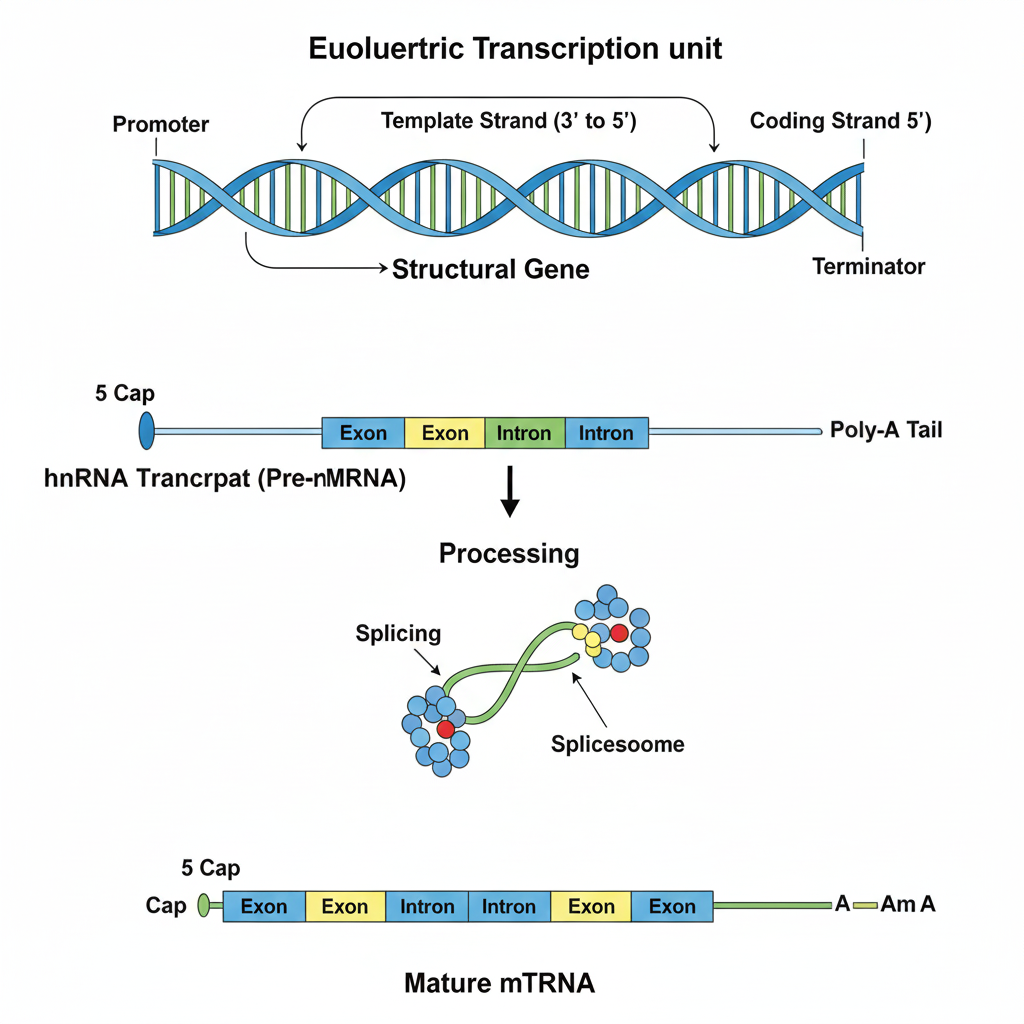
A transcription unit in DNA is defined by three main regions: a Promoter, the Structural gene, and a Terminator. The strand with the $3^{\prime}\rightarrow5^{\prime}$ polarity acts as the template strand. The opposite strand, which has $5^{\prime}\rightarrow3^{\prime}$ polarity, is called the coding strand—aur toh dekho, it doesn't actually code for anything but has the same sequence as the RNA (just T instead of U). The Promoter is located upstream ($5^{\prime}$-end of the coding strand) and provides the binding site for RNA polymerase, while the Terminator is downstream ($3^{\prime}$-end) and defines the end of transcription.
NEET Checkpoint:
Which enzyme transcribes all types of RNA (mRNA, tRNA, rRNA) in bacteria?
(a) RNA Polymerase II
(b) DNA Polymerase
(c) Single DNA-dependent RNA Polymerase
(d) Helicase
✅ Answer: (c) Single DNA-dependent RNA Polymerase — In bacteria, a single RNA polymerase handles the transcription of all three major RNA types.
In eukaryotes, life gets a little more complex, yaar. The structural genes are often split. This means the coding sequences, called exons (expressed sequences that appear in mature RNA), are interrupted by non-coding sequences, called introns (intervening sequences that do not appear in mature RNA). This split-gene arrangement is thought to represent an ancient feature of the genome.
Figure below:
A clear diagram showing the schematic structure of a transcription unit, including the promoter, terminator, structural gene, coding strand (5' to 3'), and template strand (3' to 5'). Also show the process of hnRNA processing in eukaryotes, illustrating capping, splicing (intron removal), and tailing.
The Processing Steps (The Eukaryotic Polish)
Because the primary transcript in eukaryotes, called heterogeneous nuclear RNA (hnRNA), is non-functional, it requires rigorous processing before it can be translated. This hnRNA is transcribed by RNA polymerase II.
- Capping: An unusual nucleotide, methyl guanosine triphosphate (mGppp), is added to the $5^{\prime}$-end of the hnRNA. Think of this as putting a security cap on a very important file before sending it off.
- Tailing (Polyadenylation): Adenylate residues (around 200–300) are added to the $3^{\prime}$-end in a template-independent manner. This is like adding extra packing material to protect the other end!
- Splicing: This is the critical editing step where the non-coding introns are removed, and the coding exons are joined together in a defined, specific order.
Once the hnRNA has undergone splicing, capping, and tailing, it becomes the fully processed mRNA (messenger RNA) that is finally transported out of the nucleus for protein synthesis (translation).
Relatable Indian Example: Imagine you are making a fantastic Biryani recipe (the final protein). Your raw transcript (hnRNA) is the whole cookbook page, including not just the ingredients (exons) but also the long, unnecessary advertisements and author notes (introns). You need to perform splicing to cut out the ads, capping to put a sticky note reminder on the top ($5^{\prime}$-end), and tailing to add a bookmark at the bottom ($3^{\prime}$-end) before you can actually use the clean recipe (mRNA).
NEET Checkpoint:
The addition of 200-300 adenylate residues at the $3^{\prime}$-end of hnRNA is called:
(a) Capping
(b) Splicing
(c) Polyadenylation
(d) Reverse Transcription
✅ Answer: (c) Polyadenylation — This process, also known as tailing, involves adding adenylate residues to the $3^{\prime}$-end of the hnRNA.
NEET Checkpoint:
In eukaryotes, which RNA polymerase transcribes the precursor of mRNA (hnRNA)?
(a) RNA Polymerase I
(b) RNA Polymerase II
(c) RNA Polymerase III
(d) DNA Polymerase
✅ Answer: (b) RNA Polymerase II — RNA Polymerase II is specifically responsible for transcribing hnRNA, the precursor to mRNA.
Practice Questions:
- Which feature complicates the definition of a gene in terms of a DNA segment in eukaryotes?
(a) Monocistronic structural genes
(b) The presence of a strong promoter
(c) Split-gene arrangement
(d) Template-dependent tailing
✅ Explanation: (c) Split-gene arrangement — The interruption of coding sequences (exons) by non-coding sequences (introns) in eukaryotes is known as the split-gene arrangement, making gene definition complex.
2. If a structural gene in eukaryotes is split, the sequences that are removed and do not appear in the mature RNA are called:
(a) Exons
(b) Promoters
(c) Introns
(d) Terminators
✅ Explanation: (c) Introns — Introns, or intervening sequences, are non-coding and are removed during the splicing process.
Key Takeaway:
Transcription copies DNA to RNA, using the $3^{\prime}\rightarrow5^{\prime}$ strand as the template. Eukaryotic genes are split (exons and introns), requiring hnRNA processing: Capping ($5^{\prime}$-mGppp addition), Tailing ($3^{\prime}$-adenylate addition), and Splicing (introns removed, exons joined). Now that you've mastered how RNA is made and edited, let's see how this mRNA acts as a template for protein synthesis in the next step: Translation!
13. Genetic Code, Translation, and Gene Regulation: Cracking the Code!
You know that DNA stores the instructions, but how does the cell actually read them to make proteins? That's the Genetic Code and Translation, yaar.
The Genetic Code and Adapter
The Genetic Code is the dictionary that converts the language of nucleotides into the language of amino acids. It's a triplet codon system, meaning three nitrogenous bases together form one codon that directs a single amino acid. With 4 bases, this gives us $4^3 = 64$ codons, generating many more codes than the 20 required amino acids.
Here’s the funda you must remember: the code is degenerate, meaning multiple codons can code for one single amino acid. It is also nearly universal—for instance, UUU codes for Phenylalanine (Phe) from bacteria to humans (with minor exceptions). Crucially, the code is read in a contiguous fashion with absolutely no punctuations. The codon AUG is super important because it has dual functions: it codes for Methionine (Met) and acts as the essential initiator codon that starts the whole process.
NEET Checkpoint:
How many codons function as stop/terminator codons?
(a) 1
(b) 2
(c) 3
(d) 4
✅ Answer: (c) 3 — UAA, UAG, and UGA are the three stop/terminator codons that do not code for any amino acid.
To read this code, we need an adapter! The tRNA (transfer RNA) molecule acts as this adapter. On one end, it has an amino acid acceptor end where it binds its specific amino acid, and on the other end, it has an anticodon loop that reads the mRNA codon via complementary base pairing.
Translation: The Protein Factory
Translation is simply the process of polymerisation of amino acids to form a polypeptide chain. This happens on the ribosome, which is essentially the cellular protein factory, composed of structural RNAs and proteins. The amino acids are joined together by peptide bonds.
Now, here is a cool ribozyme fact: the large subunit of the ribosome has a catalytic role! Specifically, the $23S$ rRNA in bacteria functions as an enzyme, a ribozyme, to catalyse the formation of the peptide bond. Translation starts when the ribosome binds to the start codon (AUG), recognised by the initiator tRNA.
NEET Checkpoint:
The main catalytic enzyme responsible for peptide bond formation in bacteria is:
(a) RNA Polymerase II
(b) $5S$ rRNA
(c) $23S$ rRNA
(d) Aminoacyl-tRNA synthetase
✅ Answer: (c) $23S$ rRNA — This ribosomal RNA molecule acts as a ribozyme (RNA enzyme) to catalyse the peptide bond during translation.
Gene Regulation and the Lac Operon
In prokaryotes (like our favourite E. coli), control over gene expression is primarily exerted at the transcriptional level, specifically regulating the rate of initiation. This regulation is managed by accessory proteins (like activators or repressors) binding to regulatory sequences near the promoter, often called the operator region.
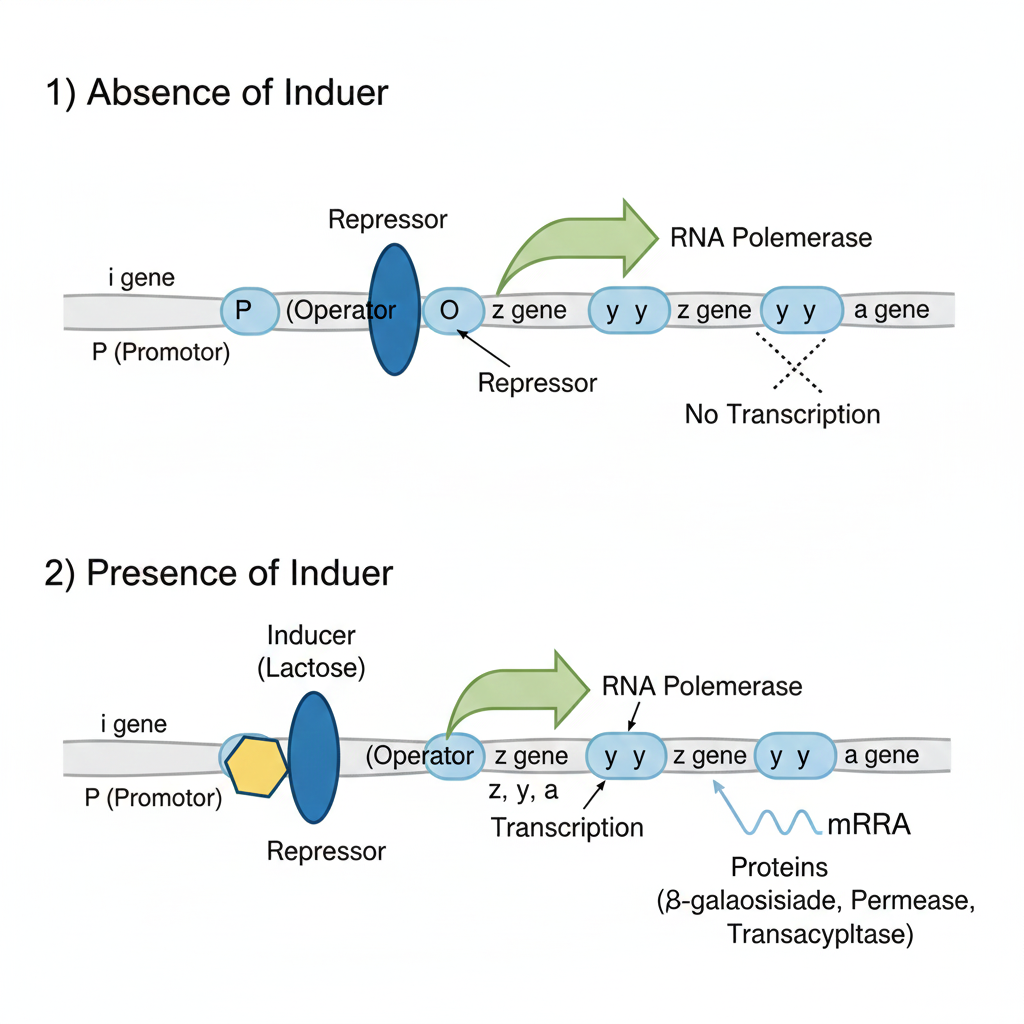
The Lac Operon is the perfect model to understand this transcriptional regulation, elucidated by Francois Jacob and Jacque Monod. The Lac Operon contains three structural genes ($z, y, a$) required for lactose metabolism, and one regulatory gene, the $i$ gene (inhibitor), which codes for the lac repressor.
Imagine this Lac Operon is a toll booth near a pani puri stall. The $i$ gene constitutively (all the time) produces the lac repressor, which binds tightly to the operator region and blocks the RNA polymerase, thus preventing transcription. This means the "toll booth" is closed by default.
NEET Checkpoint:
In the Lac Operon, the $i$ gene codes for the:
(a) Inducer
(b) Activator
(c) Permease
(d) Repressor
✅ Answer: (d) Repressor — The $i$ gene stands for inhibitor/repressor, which constitutively synthesises the repressor protein.
When the substrate lactose (or its metabolite, allolactose) is present, it acts as an inducer. This inducer binds to the repressor, inactivating it. Once inactivated, the repressor detaches from the operator, allowing RNA polymerase access to the promoter, and transcription begins, switching the operon "on". This regulatory system, involving the repressor blocking transcription, is called negative regulation.
Figure below:
A clear diagram showing the Lac Operon system, illustrating the arrangement of the $i$ gene, $P$ (promoter), $O$ (operator), and structural genes $z, y, a$. The diagram should show two states: 1) Repressor binding to the operator in the absence of an inducer, preventing transcription, and 2) Inducer binding to the repressor, inactivating it and allowing transcription.
Practice Questions:
- The catalytic role during peptide bond formation in the bacterial ribosome is performed by:
(a) $5S$ rRNA
(b) $23S$ rRNA
(c) $18S$ rRNA
(d) tRNA
✅ Answer: (b) $23S$ rRNA — The $23S$ rRNA is the ribozyme responsible for catalysing the peptide bond formation during translation in bacteria.
2. The binding of the lac repressor protein to the operator region in the Lac Operon is an example of which type of regulation?
(a) Positive regulation
(b) Constitutive expression
(c) Negative regulation
(d) Translational control
✅ Answer: (c) Negative regulation — Regulation of the lac operon by the repressor protein (which blocks transcription) is specifically referred to as negative regulation.
Key Takeaway
The flow of genetic information from mRNA to protein relies on the triplet Genetic Code and the tRNA adapter. The actual polymerisation (Translation) occurs on the ribosome, where the $23S$ rRNA acts as a ribozyme. In prokaryotes, like E. coli, gene expression is predominantly controlled at the transcriptional level using mechanisms like the Lac Operon, where the inducer (lactose/allolactose) inactivates the constitutively synthesised repressor.
14. Genomic Projects and Genetic Disorders
Hey future doctors! Let's dive into some mega molecular fundas—Genomic Projects and Genetic Disorders. Don't stress, yaar, this is easier than sequencing $3 \times 10^9$ base pairs!
The biggest project ever in biology was the Human Genome Project (HGP), a mega project launched in 1990 and completed in 2003. The main goal was to sequence the complete DNA sequence of human genome. Notice this key data: the human genome contains approximately $3164.7$ million bp.
Here's the trick: despite how different we all look, 99.9 per cent of nucleotide bases are exactly the same in all humans. Amazing, right? Scientists estimated the total number of genes at about 30,000. And here’s a mind-blower: less than 2 per cent of that huge genome actually codes for proteins.
NEET Checkpoint :
The Human Genome Project (HGP) was completed in which year?
(a) 1990
(b) 2000
(c) 2003
(d) 2006
✅ Answer: (c) 2003 — HGP was launched in 1990 and completed in 2003.
Now, if $99.9\%$ of DNA is identical, how do we catch culprits or confirm paternity? Enter DNA Fingerprinting. This is a quick way to compare individuals by identifying differences in specific regions of DNA sequence called repetitive DNA. These repetitive sequences show a high degree of polymorphism. Alec Jeffreys developed this technique, using Variable Number of Tandem Repeats (VNTR) as a probe. Think of it like a pani puri stall’s signature secret ingredient—everyone uses basic ingredients, but the specific pattern (the VNTR copy number) is unique to that individual (except identical twins!). DNA fingerprinting is super useful for forensic applications and paternity testing.
Genetic disorders are broadly grouped into two categories. Mendelian disorders are determined by alteration or mutation in a single gene. Examples include Haemophilia (a sex-linked recessive disease leading to non-stop bleeding from a simple cut), Sickle-cell anaemia (an autosomal recessive trait where a point mutation changes Glutamic acid to Valine), and Phenylketonuria (lack of an enzyme causing phenylalanine accumulation and mental retardation).
NEET Checkpoint :
What is the underlying cause of Mendelian disorders?
(a) Gain or loss of whole chromosomes
(b) Mutation in a single gene
(c) Polyploidy
(d) Loss of secondary sexual characters
✅ Answer: (b) Mutation in a single gene — Mendelian disorders are mainly determined by alteration or mutation in the single gene.
The other category, Chromosomal disorders, are caused by the absence or excess or abnormal arrangement of one or more chromosomes. Failure of chromatid segregation results in aneuploidy (gain or loss of chromosomes). If a whole set of chromosomes increases due to failed cytokinesis, it's called polyploidy (often seen in plants).
Common chromosomal examples include:
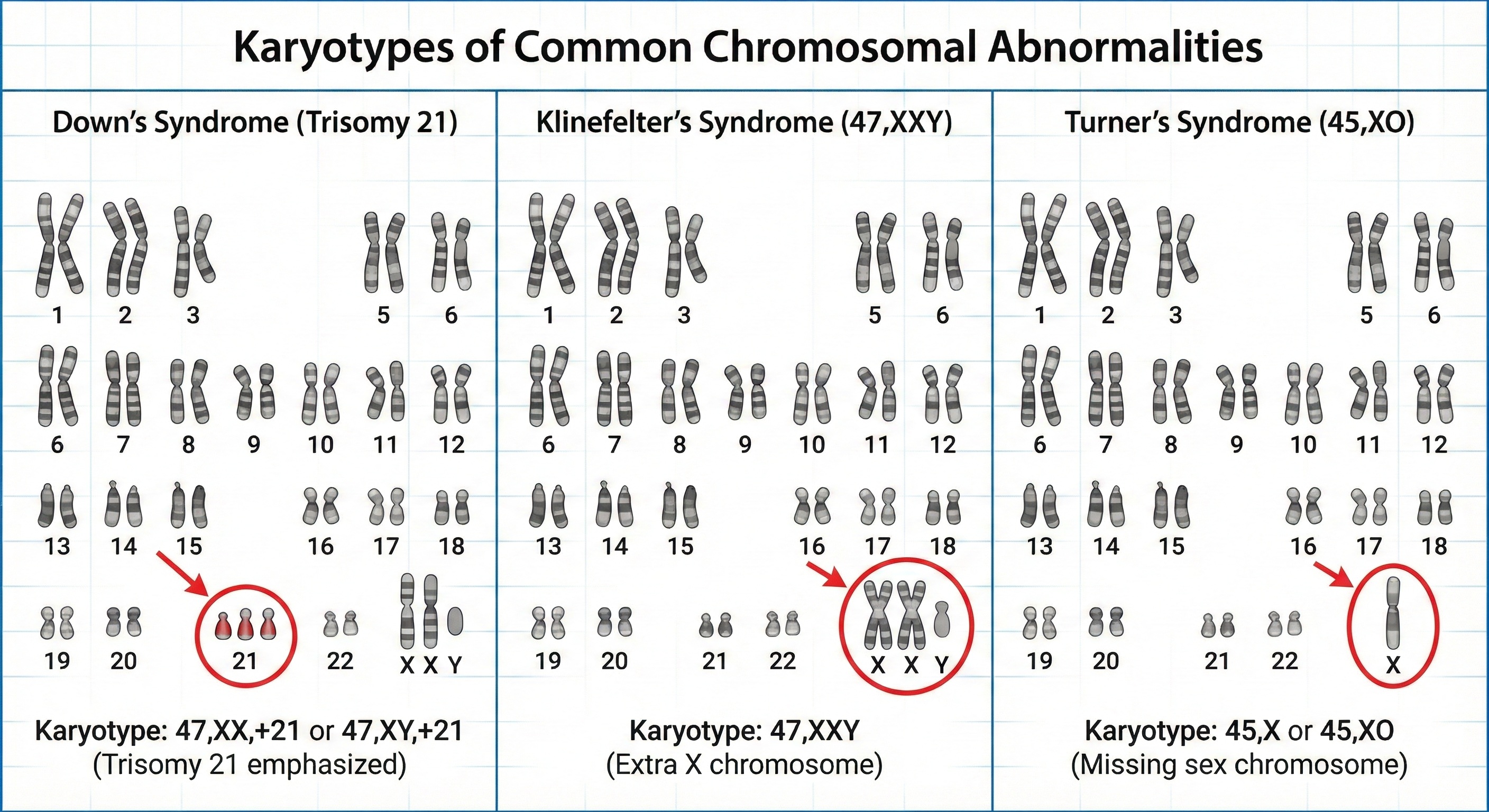
1. Down's Syndrome: Caused by an additional copy of chromosome 21 (trisomy of 21). The affected individual has physical and mental development retardation.
2. Klinefelter's Syndrome: Caused by an additional X-chromosome, leading to a karyotype of $47, XXY$. These sterile individuals show feminine development like Gynaecomastia alongside masculine development.
3. Turner's Syndrome: Caused by the absence of one X chromosome, resulting in a $45, XO$ karyotype. These females are typically sterile as ovaries are rudimentary.
Figure below:
A clear diagram showing the karyotypes associated with Down's Syndrome (Trisomy 21), Klinefelter's Syndrome ($47, XXY$), and Turner's Syndrome ($45, XO$), highlighting the chromosome abnormalities.
NEET Checkpoint :
Down's Syndrome results from the trisomy of which chromosome?
(a) Chromosome 1
(b) X chromosome
(c) Chromosome 16
(d) Chromosome 21
✅ Answer: (d) Chromosome 21 — The cause of Down’s syndrome is the presence of an additional copy of chromosome number 21.
Practice Questions:
- The genetic disorder characterized by the substitution of Glutamic acid by Valine at the sixth position of the beta globin chain is:
(a) Haemophilia
(b) $\beta$ Thalassemia
(c) Sickle-cell anaemia
(d) Klinefelter's Syndrome
✅ Answer: (c) Sickle-cell anaemia — This specific substitution is caused by a single base substitution (GAG to GUG) in the beta globin gene.
2. Which of the following karyotypes is associated with sterility in females due to rudimentary ovaries?
(a) $47, XXY$
(b) $46, XX$
(c) $45, XO$
(d) $47, +21$
✅ Answer: (c) $45, XO$ — This represents Turner's Syndrome, caused by the absence of one X chromosome, leading to sterile females with underdeveloped secondary sexual characters.
Key Takeaway
Genomic Projects (HGP) mapped our $3\times10^9$ bp code, revealing that nearly $99.9\%$ is common. DNA Fingerprinting uses polymorphic repetitive DNA (VNTR) for unique identification. Genetic Disorders stem from tiny changes (Mendelian, single-gene like Sickle-cell anaemia) or huge changes (Chromosomal, like Trisomy 21 in Down's Syndrome).
That wraps up the massive scale (HGP) and the individual hiccups (genetic disorders). Now that you know how our entire blueprint is mapped, wait till you see how genetic engineering uses this information for modern biotech wonders!.
15. Evolutionary Concepts, Evidence, and Human Evolution
Hey future docs! This chapter is like watching a cosmic movie—it’s the entire history of life forms on earth. To get the whole funda (fundamental concept), Evolutionary Biology even starts by studying the origin of the universe itself using the Big Bang theory.
Now, the main star of biological evolution is Charles Darwin. His core idea? Biological Evolution is driven by Natural Selection acting on heritable variations. Essentially, those individuals with characteristics that give them better fitness (which means better reproductive fitness, yaar) survive and leave more progeny. It’s survival of the fittest, where 'fitness' means reproductive success!
NEET Checkpoint:
What did Darwin define as 'fitness'?
(a) Physical strength
(b) Reproductive success
(c) Intelligence
(d) Longevity
✅ Answer: (b) Reproductive success — Darwin clearly stated that fitness refers ultimately and only to reproductive fitness.
Sometimes, a single ancestral stock evolves into many different species within a specific geographical area, radiating to different habitats. This amazing process is called Adaptive Radiation. Classic examples include Darwin's Finches in the Galapagos and the diverse Australian marsupials. Think of how one ancestral chai (tea) stall concept branched out in India: one became a high-tech coffee chain, one became a pani puri stall, and another stayed a classic roadside chai shop—all derived from a common 'food stall' ancestor, adapted to different consumer niches!
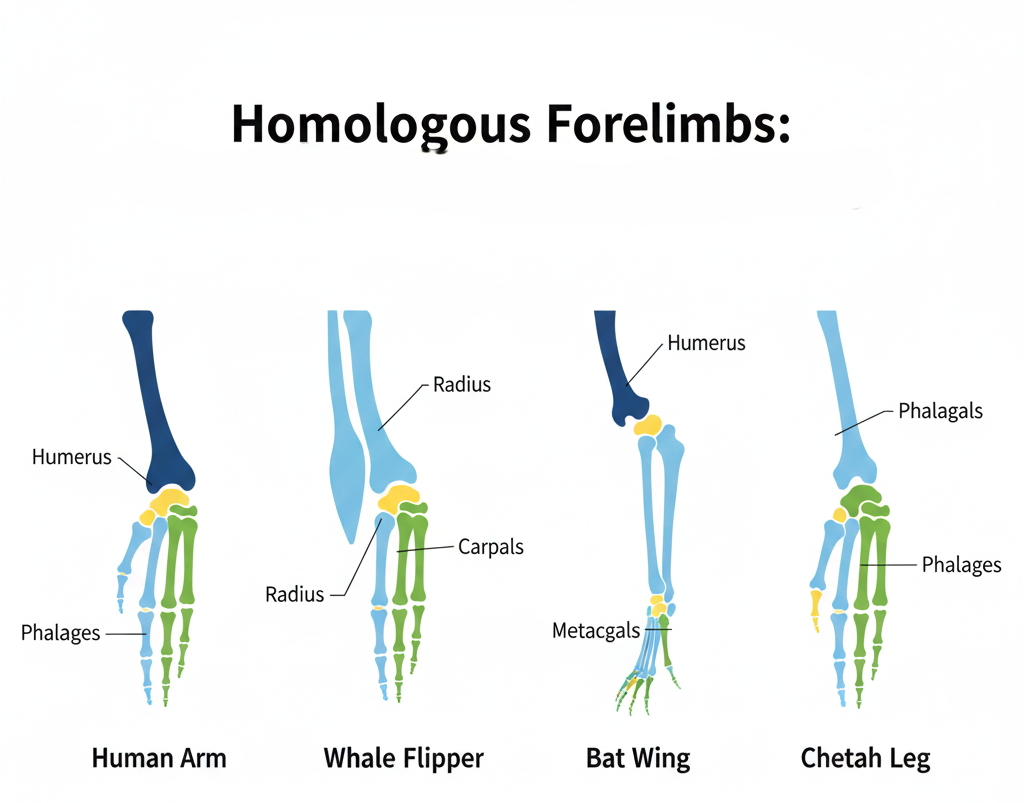
Evidence supports this whole evolutionary story. We rely on Paleontology (fossils) which shows life forms changing over geological time. We also look at Comparative Anatomy. Structures like the forelimbs of humans, whales, bats, and cheetah share the same basic bone pattern (humerus, radius, ulna, etc.). These are homologous organs, pointing towards divergent evolution and a common ancestry. On the flip side, analogy (like bird wings and butterfly wings) shows convergent evolution where different structures evolve for the same function. Even similarities in proteins and genes across diverse organisms (biochemical similarities) hint at shared ancestry.
Figure below:
A clear diagram showing the homologous structures of the forelimbs of a human, a whale, a bat, and a cheetah.
The Maths of Stability: Hardy-Weinberg
To check if evolution is happening, we use the Hardy-Weinberg Principle. This principle states that allele frequencies in a population remain stable (in genetic equilibrium) from generation to generation. The frequency relationship for two alleles, $A$ ($p$) and $a$ ($q$), is given by:
Here, $p^2$ is the frequency of $AA$, $q^2$ is the frequency of $aa$, and $2pq$ is the frequency of $Aa$ individuals. If the actual frequencies differ from this expected value, bhaiya, evolution is happening! This equilibrium is disturbed by five key factors: gene flow, genetic drift, mutation, genetic recombination, and natural selection.
NEET Checkpoint:
Which of the following is NOT a factor that affects Hardy-Weinberg equilibrium?
(a) Genetic drift
(b) Mutation
(c) Natural selection
(d) Random mating
✅ Answer: (d) Random mating — The principle assumes random mating; factors that disturb equilibrium are gene flow, genetic drift, mutation, recombination, and natural selection.
The Human Saga
The Evolution of Man is a fascinating chronological tracing. It started around 15 mya with primates like Dryopithecus (more ape-like) and Ramapithecus (more man-like).
- About 2 mya, Homo habilis emerged (the first human-like being or hominid). Their brain capacity was quite small, between $650\text{cc}$ to $800\text{cc}$.
- Next came Homo erectus about 1.5 mya, sporting a larger brain around $900\text{cc}$. They probably ate meat.
- Then, the Neanderthal man appeared, living between 1,00,000–40,000 years back. They had a large cranial capacity of $1400\text{cc}$, used hides, and even buried their dead.
- Finally, modern Homo sapiens arose during the ice age (75,000–10,000 years ago).
NEET Checkpoint:
What was the approximate cranial capacity of Homo erectus?
(a) $650\text{cc}$
(b) $900\text{cc}$
(c) $1400\text{cc}$
(d) $3-4\text{mya}$
✅ Answer: (b) $900\text{cc}$ — Homo erectus had a large brain capacity around $900\text{cc}$.
Practice Questions:
- Homologous structures are the result of:
(a) Convergent evolution
(b) Chemical evolution
(c) Divergent evolution
(d) Genetic drift
✅ Answer: (c) Divergent evolution — Homology, such as the forelimbs of mammals, indicates the same structure developed along different directions due to adaptations, which is divergent evolution.
2. Which hominid species was existing approximately 15 million years ago?
(a) Homo habilis
(b) Neanderthal man
(c) Dryopithecus and Ramapithecus
(d) Homo erectus
✅ Answer: (c) Dryopithecus and Ramapithecus — Primates called Dryopithecus and Ramapithecus were existing about 15 mya.
Key Takeaway
Evolutionary Biology traces life's history from the Big Bang to biodiversity. Natural Selection acts on variations to select reproductively fit individuals. Evidence comes from fossils, comparative anatomy (homology shows common ancestry/divergence, analogy shows convergence), and biochemistry. Hardy-Weinberg equilibrium is maintained unless disturbed by factors like mutation or genetic drift. Human evolution proceeds from Dryopithecus (15 mya) through Homo habilis ($650-800\text{cc}$) and Homo erectus ($900\text{cc}$) to modern Homo sapiens.