
1. Introduction to Ecology and Levels of Organisation
Hey there, junior! Ready to dive into the fascinating world of Ecology? Don't stress, yaar—it's actually the "big picture" of biology. While other chapters focus on tiny cells, ecology is the thread that weaves everything into a holistic perspective. Simply put, it's the study of how organisms interact with each other and their physical (abiotic) environment.
NEET Checkpoint:
Who is known as the Father of Ecology in India?
(a) Salim Ali
(b) Ramdeo Misra
(c) M. S. Swaminathan
(d) Sunderlal Bahuguna
✅ Answer: (b) Ramdeo Misra — He established ecology teaching and research at Banaras Hindu University.
In this unit, we focus on four specific levels of biological organisation: organisms, populations, communities, and biomes. Let’s clear up this funda with a relatable example: Imagine a single street dog in your colony (Organism). All the street dogs in that area form a Population. Now, add the local cats, birds, and even the humans interacting there, and you’ve got a Community. Scale that up to a massive regional unit like a tropical rainforest or a desert, and you're looking at a Biome.
NEET Checkpoint:
At what level of biological organisation does natural selection operate to evolve traits?
(a) Cell
(b) Individual
(c) Population
(d) Ecosystem
✅ Answer: (c) Population — While individuals cope with the environment, evolution happens to populations.
Throughout this journey, we’ll learn to calculate birth rates (like a player’s strike rate!) and distinguish between exponential and logistic growth. We will also explore how energy flows through ecosystems and why we must protect our biodiversity using in situ (on-site) and ex situ (off-site) methods.
NEET Checkpoint:
Which of these is a level of organisation studied in ecology?
(a) Macromolecules
(b) Tissues
(c) Biomes
(d) Organs
✅ Answer: (c) Biomes — Ecology primarily focuses on organisms, populations, communities, and biomes.
Practice Question:
Ecology is the study of interactions between:
(a) Only animals and plants
(b) Organisms and their abiotic environment
(c) Cells and tissues
(d) Only human beings and nature
✅ Answer: (b) — Ecology focuses on interactions among organisms and between organisms and their physical environment.
Key Takeaway
Ecology Hierarchy: Organism $\rightarrow$ Population $\rightarrow$ Community $\rightarrow$ Biome.
2. Population Attributes: Birth and Death Rates
Hey junior! Ready to crack the code of populations? In nature, finding a "loner" is actually quite rare. Most organisms prefer hanging out in groups within a well-defined geographical area, sharing (or competing for) resources—just like us fighting for the last samosa in the college canteen! This functional group is what we call a population.
NEET Checkpoint:
Does a population strictly require sexual reproduction to be defined as such?
(a) Yes, only sexually reproducing groups form populations
(b) No, populations can exist with asexual reproduction
(c) Only animals form populations
(d) Only plants form populations
✅ Answer: (b) No — Even groups resulting from asexual reproduction, like bacteria in a petri dish, are considered populations in ecological studies.
Now, let's clear up this funda: an individual is born or dies, but a population has birth rates and death rates. We express these as per capita rates, meaning "per individual." Imagine a local bus with $50$ passengers; if $5$ more hop on, the "birth rate" of that bus population is $5/50 = 0.1$ per passenger.
NEET Checkpoint:
If an organism is "female," is this a population attribute?
(a) Yes, sex is a population attribute
(b) No, sex is an individual attribute
(c) Yes, it applies to all members of a species
(d) Only in sexually reproducing species
✅ Answer: (b) No — Being male or female is an individual's trait; a population has a sex ratio (e.g., $60\%$ females).
Let's do some NCERT-style math. If a pond has $20$ lotus plants and $8$ new ones are added in a year, the birth rate is:
Similarly, if $4$ fruitflies in a lab population of $40$ die in a week, the death rate is:
Why does this matter? Because natural selection operates at the population level to evolve traits. This makes population ecology the vital bridge linking ecology to population genetics and evolution.
Figure below:
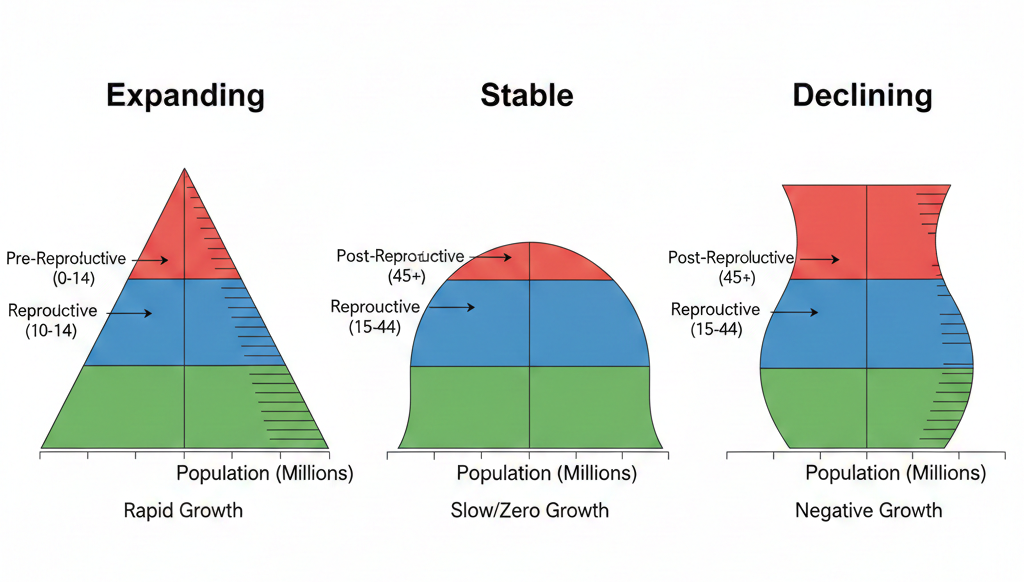
A clear diagram showing the three types of age pyramids for human populations: Expanding (triangular), Stable (bell-shaped), and Declining (urn-shaped), with distinct levels for pre-reproductive, reproductive, and post-reproductive age groups.
NEET Checkpoint:
Where does natural selection operate to evolve desired traits?
(a) Gene
(b) Individual
(c) Species
(d) Population
✅ Answer: (d) Population level — While individuals cope with the environment, evolution happens at the population level.
Practice Questions:
1. In a laboratory, $4$ individuals in a population of $40$ fruitflies died in a week. The death rate is:
(a) $4$
(b) $0.4$
(c) $0.1$
(d) $40$
✅ Answer: (c) $0.1$ — Calculated as $\text{change in numbers} / \text{initial members} = 4/40$.
2. Population ecology links ecology with:
(a) Only Genetics
(b) Only Evolution
(c) Both Population Genetics and Evolution
(d) Individual Physiology
✅ Answer: (c) — It is an important area because it links these three fields together.
Key Takeaway: Population Rate Formulas
- Birth Rate: $\frac{\text{Number of births}}{\text{Initial population size}}$
- Death Rate: $\frac{\text{Number of deaths}}{\text{Initial population size}}$
- Crucial point: Individuals have births/deaths; Populations have rates.
3. Population Attributes: Sex Ratio and Age Distribution
Hey junior! Let’s clear up a major funda: a population has "swag" that a single individual just doesn't have. While an individual is either male or female, a population boasts a sex ratio (e.g., 60% of the population are females and 40% males).
NEET Checkpoint:
Can an individual have a birth rate?
(a) Yes, every individual has a birth rate
(b) No, birth rate is a population attribute
(c) Yes, only in humans
(d) Yes, only in animals
✅ Answer: (b) No — Individuals have births or deaths; only populations have birth and death rates.
Next, we look at Age Distribution. If we plot the percentage of individuals in different age groups, we get age pyramids. For humans, these show the distribution of males and females. The shape tells us the population's status:
* Expanding: A broad base with many pre-reproductive individuals (it's growing!).
* Stable: The pre-reproductive and reproductive age groups are almost equal.
* Declining: A narrow base with fewer young ones.
Think of a Pani Puri stall. If 80% of the crowd are school kids, that’s an Expanding pyramid of customers! But if it’s just a few uncles at a park, it might be Declining.
Finally, we have Population Density ($N$). While counting "heads" is common, sometimes it’s meaningless. If you have one massive Banyan tree and 200 tiny carrot grass plants, saying the Banyan has "low density" is unfair because its biomass and role are enormous! Sometimes we even measure $N$ indirectly, like using pug marks to count tigers in a reserve.
NEET Checkpoint:
When is biomass a better measure of density than total number?
(a) When all organisms are of equal size
(b) When population size is very small
(c) When organisms vary greatly in size
(d) When counting individuals is easy
✅ Answer: (c) When a single large organism (like a Banyan tree) has a huge impact compared to many small ones.
NEET Checkpoint:
How is the tiger census in national parks often conducted?
(a) Direct counting of tigers
(b) Aerial photography
(c) Pugmark (footprint) method
(d) Counting prey animals
✅ Answer: Based on pug marks and fecal pellets — These are indirect ways to estimate $N$.
Practice Question:
If 8 new lotus plants are added to a pond of 20, what is the birth rate?
(a) 0.8
(b) 0.4
(c) 8
(d) 28
✅ Answer: (b) — Birth rate = $8/20 = 0.4$ offspring per lotus per year.
Key Takeaway
- Sex Ratio: Characteristic of a population, not an individual.
- Age Pyramids: Reflect growth status (Expanding, Stable, or Declining).
- Density ($N$): Can be measured by numbers, biomass, or relative measures like fish per trap.
4. Population Growth: The Exponential Model
Hey junior! Let’s talk about how populations actually grow. It isn't a static number; it’s more like a busy Mumbai local train—people are constantly jumping in and hopping out! The density, designated as $N$, changes based on four basic processes.
Natality ($B$) and Immigration ($I$) are the "plus" squad, increasing the population. On the flip side, Mortality ($D$) and Emigration ($E$) are the "minus" squad, dragging the numbers down. We track this with a simple funda:
NEET Checkpoint:
If $(B+I) > (D+E)$, what happens to the population density?
(a) Population density decreases
(b) Population density remains constant
(c) Population density increases
(d) Population becomes extinct
✅ Answer: (c) It increases — Simple math, yaar! More people are entering the habitat than leaving it.
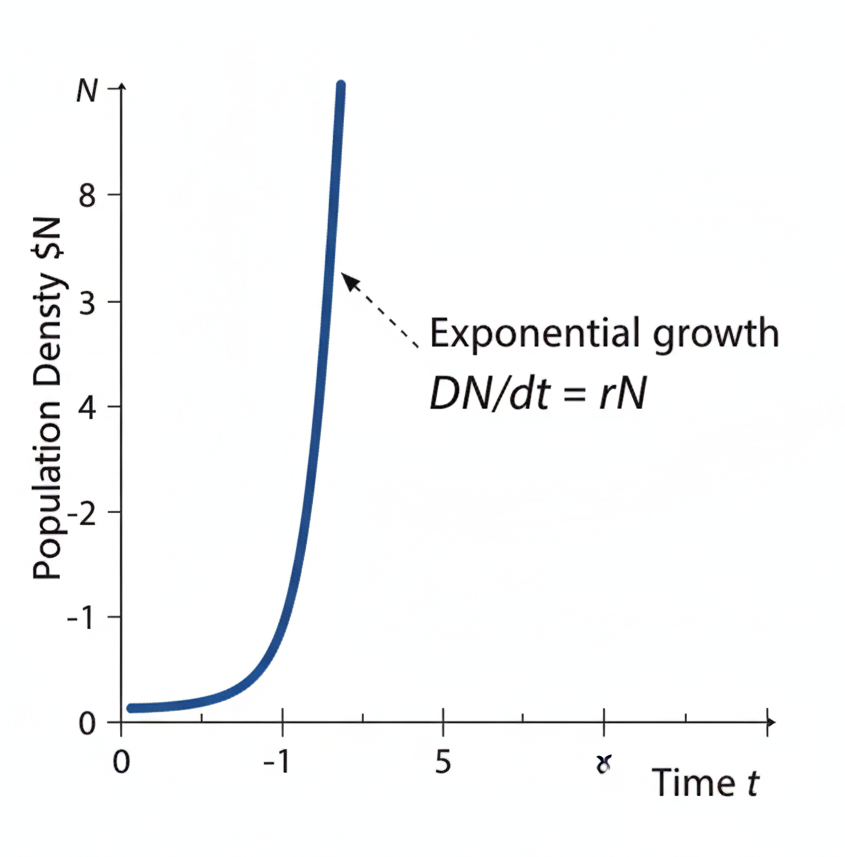
Now, imagine a Pani Puri stall with an infinite supply of puris and potatoes (unlimited resources). In this ideal world, every species realizes its full "innate potential" to grow, a concept Darwin noted. This results in Exponential Growth, creating a distinct J-shaped curve when you plot density over time.
The "secret sauce" here is $r$, the intrinsic rate of natural increase. It’s calculated as the per capita birth rate ($b$) minus the per capita death rate ($d$).
NEET Checkpoint:
What was the $r$ value for the human population in India in 1981?
(a) $0.0196$
(b) $0.0205$
(c) $2.71$
(d) $0.175$
✅ Answer: (b) $0.0205$ — This parameter helps us assess the impact of any biotic or abiotic factor on growth.
Figure below:
A graph plotting population density $N$ on the y-axis against time $t$ on the x-axis, showing a steep J-shaped curve labeled 'Exponential growth' with the equation $dN/dt = rN$.
Even a slow-growing animal like an elephant could reach mind-boggling numbers if resources stayed unlimited! To find the density at any time, we use the integral form:
NEET Checkpoint:
What does '$e$' represent in the exponential growth equation?
(a) Growth rate of population
(b) Time period of growth
(c) Base of natural logarithms
(d) Carrying capacity
✅ Answer: (c) The base of natural logarithms ($2.71828$) — Don't let the math scare you; it's just a constant!
Practice Question:
Which of the following is true for a population showing a J-shaped growth curve?
(a) Resources are limiting
(b) Resources are unlimited
(c) The population has reached carrying capacity
(d) It represents a stable population
✅ Answer: (b) Resources are unlimited — Exponential growth only happens when there's nothing to stop the species from multiplying!
Key Takeaway
Formula Summary
- Density Change: $N_{t+1} = N_t + [(B + I) - (D + E)]$
- Intrinsic Rate ($r$): $r = b - d$
- Exponential Growth (Differential): $dN/dt = rN$
- Exponential Growth (Integral): $N_t = N_0 e^{rt}$
5. Population Growth: Logistic Model
Arre, listen up! While exponential growth sounds like a dream where everyone gets unlimited biryani, the real world is a bit more "grounded". In nature, resources like food and space aren't infinite—eventually, the party has to slow down. Let's clear up this logistic growth funda!
In reality, a habitat has a limit to how many individuals it can support. We call this limit nature's Carrying Capacity ($K$). Think of it like a local shared auto-rickshaw; it can only carry a fixed number of passengers before the driver says, "Bas, jagah nahi hai!".
NEET Checkpoint:
What does $K$ represent in the logistic growth model?
(a) Intrinsic rate
(b) Carrying capacity
(c) Mortality
(d) Natality
✅ Answer: (b) Carrying capacity — It's the maximum sustainable population size for a species in its habitat.
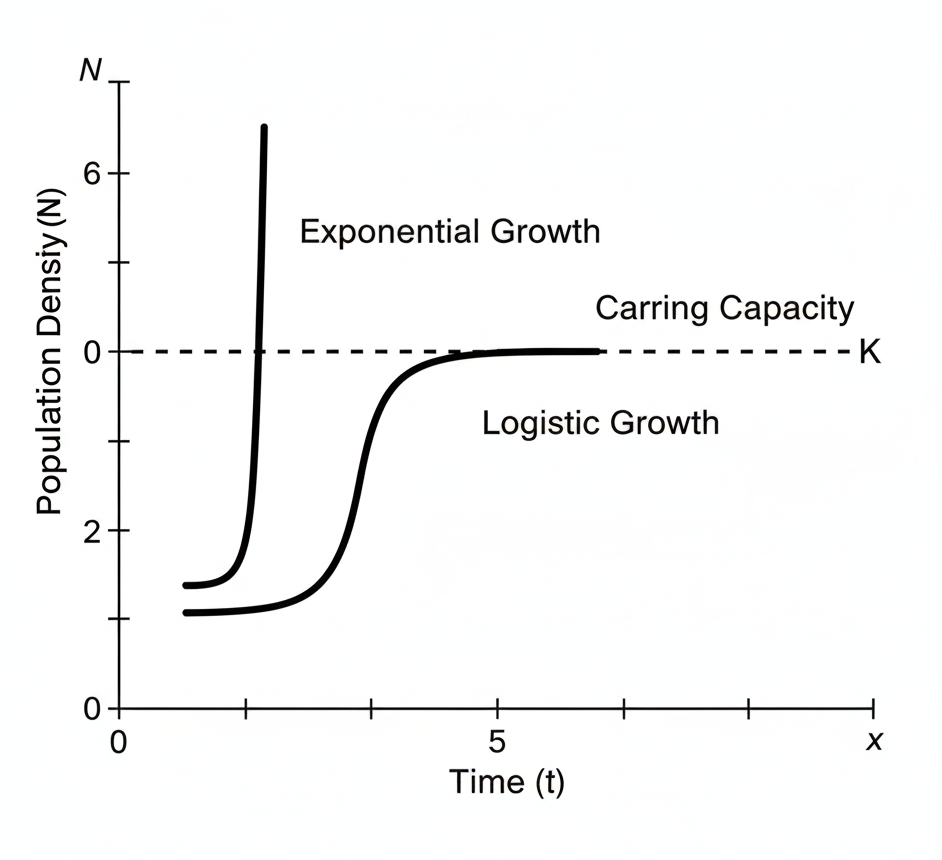
The Verhulst-Pearl Logistic Growth model shows that a population goes through specific stages:
1. Lag phase: Starting slow.
2. Acceleration: Picking up speed.
3. Deceleration: Slowing down as resources get tight.
4. Asymptote: Finally levelling off when the population density ($N$) reaches $K$.
This results in a beautiful Sigmoid (S-shaped) curve. Here’s the formula you need to mug up:
Where $N$ is population density at time $t$, $r$ is the intrinsic rate of natural increase, and $K$ is carrying capacity.
NEET Checkpoint:
Which curve is considered more realistic for animal populations?
(a) J-shaped
(b) Linear
(c) Sigmoid
(d) Circular
✅ Answer: (c) Sigmoid — Because resources are finite and become limiting sooner or later.
Figure below:
A clear graph plotting population density (N) against time (t), showing a J-shaped curve for exponential growth and a Sigmoid S-shaped curve for logistic growth, with a dashed horizontal line labeled 'K' (Carrying Capacity) where the sigmoid curve plateaus.
NEET Checkpoint:
In the logistic equation, what happens when $N$ equals $K$?
(a) Population explodes
(b) Growth rate becomes zero
(c) $r$ increases
(d) Deaths stop
✅ Answer: (b) Growth rate becomes zero— When $N = K$, the term $(K-N)$ becomes zero, meaning the population has reached its asymptote.
Practice Questions:
If a population is showing a sigmoid growth curve, it implies:
(a) Resources are unlimited
(b) The population is in a lab culture only
(c) Resources for growth are finite
(d) There is no competition
✅ Answer: (c) — Logistic growth is the realistic model because resources are limited in nature.
Key Takeaway
Formula Summary
Verhulst-Pearl Logistic Growth Equation:$$\frac{dN}{dt} = rN \left( \frac{K - N}{K} \right)$$
* Lag $\rightarrow$ Acceleration $\rightarrow$ Deceleration $\rightarrow$ Asymptote.
* Sigmoid Curve = Realistic growth.
* $K$ = Carrying Capacity (Nature's limit).
6. Population Interactions: Predation and Competition
Hey there, future doc! Let's clear up the funda of how species interact. It’s not just about "living and letting live"—nature is a high-stakes game of survival!.
Predation: The Energy Rickshaw
Think of predation as nature’s way of transferring energy fixed by plants to higher levels; predators are the "conduits". It’s not just tigers and deer; even a sparrow eating a seed is a predator!. Predators also act as regulators—like a strict invigilator keeping a classroom from descending into chaos, they keep prey populations in check to maintain ecosystem stability. For example, when the starfish Pisaster was removed from its habitat, over 10 species of invertebrates went extinct because they started fighting amongst themselves!.
NEET Checkpoint:
Why was the moth introduced in Australia in the 1920s?
(a) To increase pollination of crops
(b) To control mosquito population
(c) To serve as a food source for birds
(d) To control prickly pear cactus
✅ Answer: (d) To control the invasive Prickly pear cactus that had spread across millions of hectares.
Prey Defenses: Staying Safe
Prey aren't just sitting ducks! They've evolved cool tricks:
* Morphological: Thorns on Acacia or Cactus.
* Chemical: The Monarch butterfly is distasteful because it eats poisonous weeds as a caterpillar. Calotropis produces deadly cardiac glycosides so cattle won't touch it.
* Camouflage: Insects and frogs change colour to hide in plain sight—like a student trying to blend into the canteen walls to avoid a surprise test!.
NEET Checkpoint:
What makes the Monarch butterfly distasteful to predators?
(a) Bright wing colour
(b) Bitter taste produced by glands
(c) Toxic cardiac glycosides from milkweed
(d) Hard exoskeleton
✅ Answer: (c) A special chemical acquired during its caterpillar stage by feeding on a poisonous weed.
Competition: The Battle for Fitness
In ecology, competition is defined as a process where the fitness of one species—measured by its intrinsic rate of increase ($r$)—is significantly lower because of another species. It’s like two different tuition centres in the same lane competing for the same batch of students; if one is too efficient, the other's success rate ($r$) drops!.
Gause's Competitive Exclusion Principle says two species competing for the same limited resources cannot co-exist indefinitely; the inferior one gets eliminated. However, smart species use Resource Partitioning to co-exist by choosing different feeding times or patterns—just like friends sharing a single cricket bat by taking turns!.
NEET Checkpoint:
Who showed that five species of warblers could co-exist on one tree?
(a) Robert MacArthur
(b) Charles Darwin
(c) G. F. Gause
(d) E. P. Odum
✅ Answer: (a) MacArthur, by demonstrating they had different foraging activities (Resource Partitioning).
Practice Question:
The Abingdon tortoise became extinct in the Galapagos Islands because:
(a) Predators ate them all.
(b) Goats were more efficient browsers (Competition).
(c) A disease spread through the island.
(d) They reached their carrying capacity ($K$).
✅ Answer: (b) The goats had greater browsing efficiency, leading to the tortoise's extinction.
Key Takeaway
- Predation: Moves energy and regulates prey.
- Defenses: Thorns, camouflage, and chemicals (like cardiac glycosides).
- Competition: Reduces fitness ($r$). Gause = Exclusion; MacArthur = Co-existence via Resource Partitioning.
7. Population Interactions: Parasitism, Mutualism, and Others
Hey junior! Ready to dive into the "social media" of nature? In the wild, nobody stays in isolation. Species are constantly "interacting," and it's all about the $+/-$ vibe. Let’s clear up this funda!
Parasitism ($+/-$) is the ultimate "free-loader" strategy. One species (parasite) gets free meals and lodging at the expense of the host. Ectoparasites like lice on humans or Cuscuta on hedge plants stay on the outside, while endoparasites like the liver fluke live inside the host's organs. Then there's the genius "scammer"—brood parasitism. The Cuckoo (Koel) lays its eggs in a Crow's nest, letting the poor crow do all the parenting!.
NEET Checkpoint:
Name a parasitic plant that lacks chlorophyll.
(a) Loranthus
(b) Viscum
(c) Cuscuta
(d) Nepenthes
✅ Answer: (c) Cuscuta — It evolved to lose leaves and chlorophyll to derive nutrition entirely from its host.
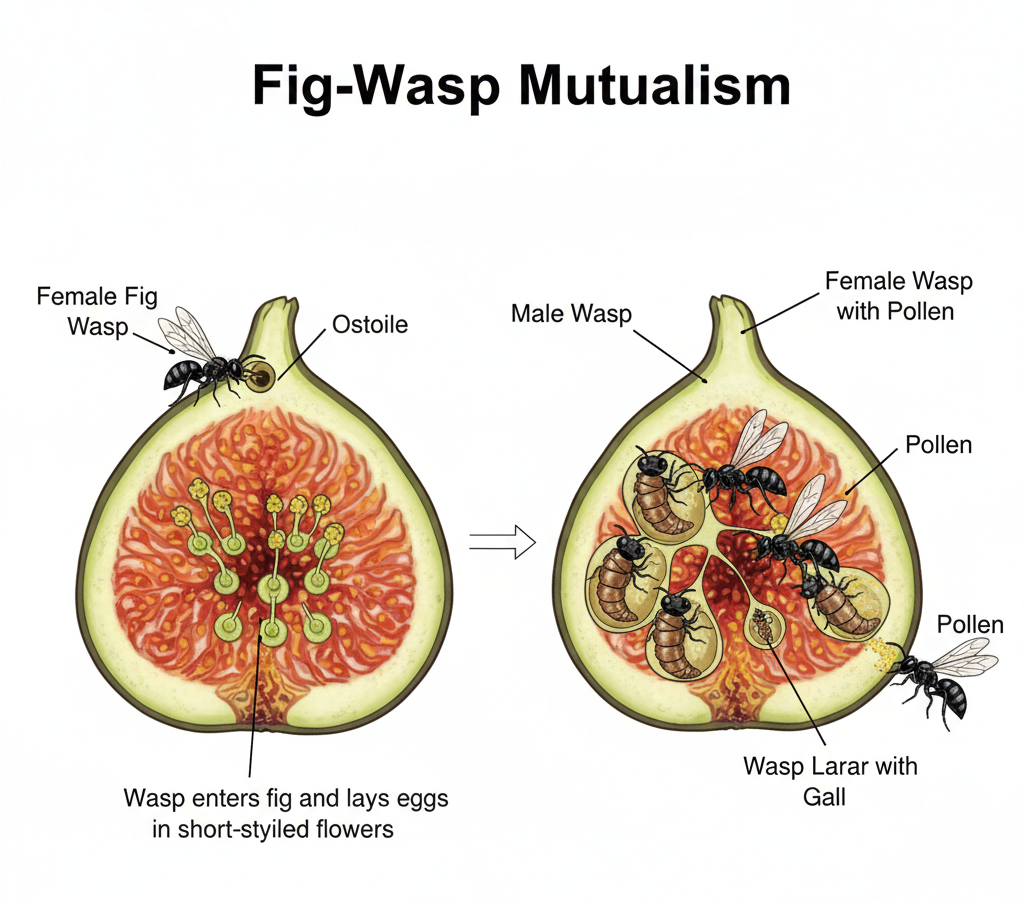
Mutualism ($+/+$) is a win-win partnership. Lichens (fungus + algae) and Mycorrhizae (fungi + roots) are the OGs here. The Fig-Wasp interaction is so tight that they've co-evolved; the wasp pollinates the fig, and the fig provides a "nursery" for the wasp's larvae.
Relatable Indian Example: Imagine you and your friend at a pani puri stall. You hold the plates while they pay—both of you leave happy! That's pure mutualism.
NEET Checkpoint:
What does the fig tree offer the wasp in return for pollination?
(a) Nectar for adult wasps
(b) Shelter and food for the wasp’s larvae
(c) Protection from predators outside the tree
(d) Water and minerals from the soil
✅ Answer: (b) Safe egg-laying sites and developing seeds as food for wasp larvae.
Commensalism ($+/0$) is when one species is happy, and the other is just neutral. Like an orchid growing on a mango tree or cattle egrets catching insects stirred up by moving cows. Amensalism ($-/0$), on the other hand, is the tragic one where one is harmed while the other remains unaffected.
NEET Checkpoint:
Why isn't a female mosquito considered a parasite?
(a) It kills the host after feeding
(b) It feeds on blood only once in its lifetime
(c) It does not live on or inside the host permanently
(d) It provides benefits to the host
✅ Answer: (b) Because it only takes blood for reproduction (egg-laying), not for "meals and lodging".
Figure below:
A clear diagram showing the mutualistic interaction between a fig fruit and a wasp, illustrating the wasp laying eggs inside the inflorescence.
Practice Question:
The Mediterranean orchid Ophrys attracts male bees through 'sexual deceit'. This is an example of:
(a) Commensalism
(b) Amensalism
(c) Mutualism
(d) Parasitism
✅ Answer: (c) Mutualism — It’s a plant-pollinator relationship where the bee helps in pollination, even if it's being "tricked" into pseudocopulation!
Key Takeaway
- Mutualism: $+/+$ (Both happy)
- Competition: $-/-$ (Both lose)
- Predation/Parasitism: $+/-$ (One happy, one sad)
- Commensalism: $+/0$ (One happy, one chill)
- Amensalism: $-/0$ (One sad, one chill)
8. Ecosystem: Structure, Patterns, and Components
Hey there, future doctor! Let's clear up the funda of the ecosystem. Think of it as nature's own functional unit where living organisms (biotic) are constantly interacting with each other and their physical environment (abiotic). Whether it’s a tiny pond or a massive forest, it’s all one big, interconnected web.
NEET Checkpoint:
Which of the following is considered a man-made ecosystem?
(a) Estuary
(b) Grassland
(c) Crop field
(d) Wetland
✅ Answer: (c) Crop field — Unlike forests, humans create and manage these for food.
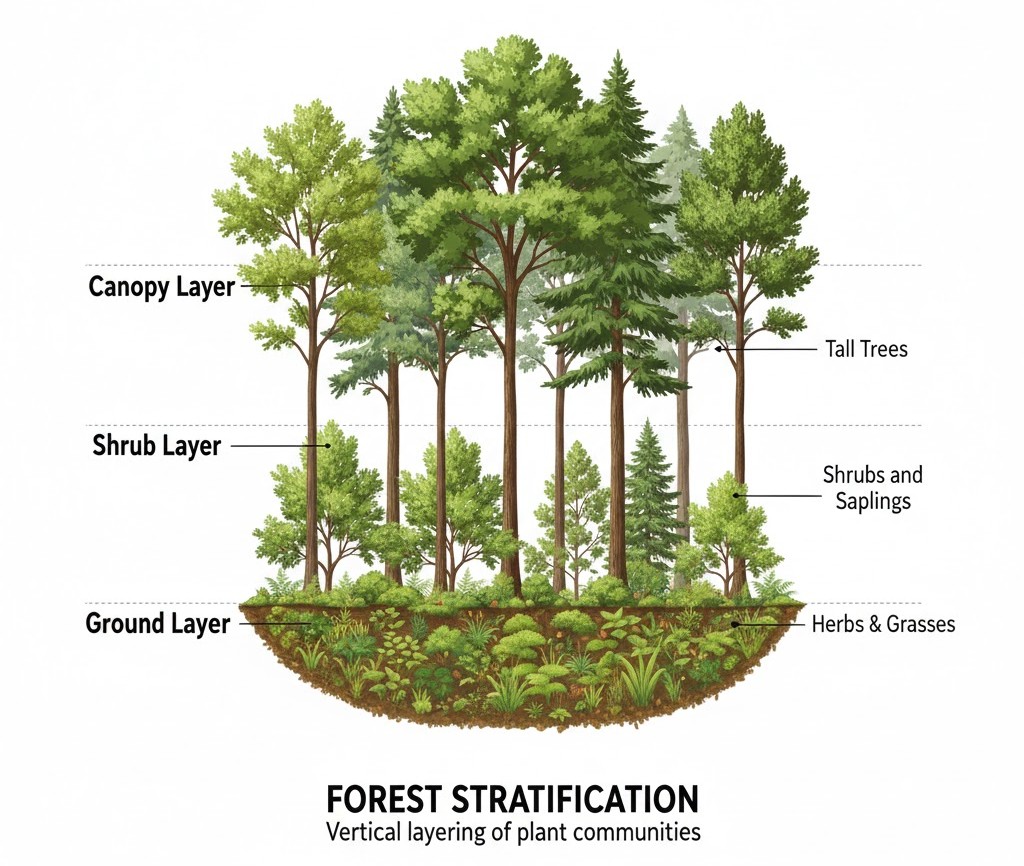
Ecosystems generally fall into two buckets: Terrestrial (like forests and grasslands) and Aquatic (like ponds and lakes). If you look at a forest, you’ll notice a "seating arrangement" called stratification. This is the vertical distribution of species; for example, tall trees take the top "balcony" seats, shrubs take the middle, and herbs/grasses stay at the bottom floor. It's just like how people are arranged in a multi-storey apartment in Mumbai!
NEET Checkpoint:
In a forest ecosystem, shrubs occupy which vertical strata?
(a) Top
(b) Second
(c) Bottom
(d) Surface
✅ Answer: (b) Second — Trees are the "toppers" here, while shrubs occupy the middle layer.
To keep the "nature show" running, there are four basic functional components you must remember for the exam: Productivity, Decomposition, Energy flow, and Nutrient cycling. Without these, the system would stop working faster than a scooter out of petrol!
NEET Checkpoint:
Which of the following is a structural, rather than functional, feature of an ecosystem?
(a) Energy flow
(b) Nutrient cycling
(c) Stratification
(d) Productivity
✅ Answer: (c) Stratification — This refers to the physical "pattern" or structure, while the others are "processes".
Figure below:
A clear diagram showing forest stratification with three distinct layers: tall trees at the canopy level, shrubs in the middle layer, and herbs/grasses at the ground level.
Practice Questions:
Identification and enumeration of plant and animal species of an ecosystem gives its:
(a) Stratification
(b) Productivity
(c) Species composition
(d) Energy flow
✅ Answer: (c) Knowing "who lives where" is called species composition.
Key Takeaway
Ecosystem: Functional unit of biotic-abiotic interaction.
Structure: Stratification (vertical layers).
Function: Productivity, Decomposition, Energy flow, and Nutrient cycling.
9. Ecosystem Productivity: GPP and NPP
Let’s talk about how ecosystems "earn" their energy, yaar! Think of Primary Production as the total amount of biomass or organic matter that plants cook up per unit area over a specific time via photosynthesis. When we talk about the rate of this production, we call it Productivity, usually measured in units like $gm^{-2}yr^{-1}$ so we can compare different spots on Earth.
NEET Checkpoint:
What is the unit used to compare the productivity of different ecosystems?
(a) $gm^{-2}$
(b) $kcal \cdot m^{-2}$
(c) $gm^{-2}yr^{-1}$
(d) $kg$
✅ Answer: (c) — Remember, productivity is a rate, so we must include time ($yr^{-1}$) in the denominator!
Now, here’s the real funda: Gross Primary Productivity (GPP) is the total rate at which organic matter is produced. But plants aren't just making food for others; they need to breathe too! They use a significant chunk of GPP for their own respiration ($R$). What is left over for the rest of the world is the Net Primary Productivity (NPP).
Check out this crucial formula:
Relatable Example: Imagine a Pani Puri stall in Mumbai. GPP is the total cash the vendor collects in a day. Respiration ($R$) is the money he spends on puris, spicy water, and coal. NPP is his actual profit—the money he takes home to feed his family (the heterotrophs like us!).
NEET Checkpoint:
Which of these represents the biomass available for heterotrophs?
(a) GPP
(b) NPP
(c) Secondary productivity
(d) $R$
✅ Answer: (b) — NPP is the actual "food" available for herbivores and decomposers.
Why do some places have more "profit" than others? It depends on the plant species, nutrient availability, and environmental factors like sunlight. Interestingly, while oceans cover 70% of Earth, their NPP is only 55 billion tons, compared to the total biosphere's 170 billion tons.
NEET Checkpoint:
What is the annual net primary productivity of the whole biosphere?
(a) 55 billion tons
(b) 170 billion tons
(c) 115 billion tons
(d) 710 billion tons
✅ Answer: (b) — Despite the massive oceans, land contributes much more to the total 170 billion tons!
Practice Question:
Secondary productivity is defined as the rate of formation of new organic matter by:
(a) Producers
(b) Parasites
(c) Consumers
(d) Decomposers
✅ Answer: (c) — Consumers (heterotrophs) build their own biomass, which we call secondary productivity.
Key Takeaway
Formula Summary
- Net Primary Productivity:$$NPP = GPP - R$$
- Biosphere NPP: $\approx 170$ billion tons (dry weight).
10. Decomposition: Processes and Products
Hey future doctors! Ready to clear up a major "dirty" funda? Let’s talk about decomposition, nature’s ultimate recycling system. Without it, we’d be buried under piles of dead stuff. Not a great look, right?
Decomposition is the breakdown of complex organic matter into inorganic substances like $CO_{2}$, $H_{2}O$, and nutrients. The raw material for this is detritus—dead leaves, bark, flowers, and even animal waste (yes, fecal matter!).
NEET Checkpoint:
What constitutes the raw material for decomposition?
(a) Living biomass
(b) Detritus
(c) Humus
(d) Inorganic salts
✅ Answer: (b) Detritus — It includes all dead organic remains and fecal matter.
The Five Steps of the "Kachrewala" System
Just like your local pani puri stall has a process to dispose of used leaf plates, nature has five simultaneous steps:
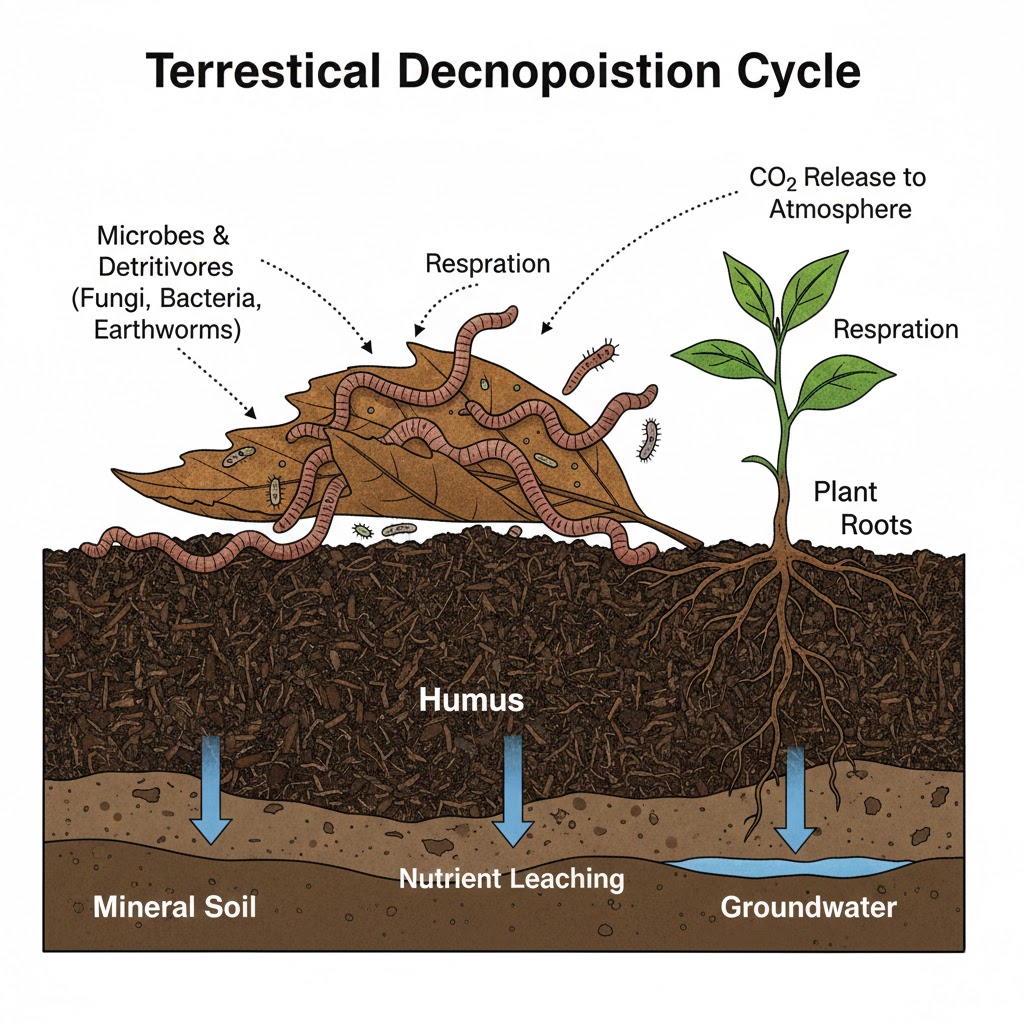
1. Fragmentation: Detritivores like the earthworm (the farmer’s "friend") break detritus into smaller bits.
2. Leaching: Water-soluble inorganic nutrients seep down into the soil like tea from a tea bag, precipitating as unavailable salts.
3. Catabolism: Bacterial and fungal enzymes degrade detritus into simpler inorganic stuff.
4. Humification: Leads to the accumulation of humus—a dark, amorphous substance that’s super resistant to microbes and acts as a nutrient reservoir.
5. Mineralisation: Microbes further degrade humus to release inorganic nutrients.
NEET Checkpoint:
Which step involves the seepage of water-soluble nutrients into soil horizons?
(a) Weathering
(b) Leaching
(c) Humification
(d) Mineralisation
✅ Answer: (b) Leaching — Inorganic nutrients go down and get precipitated as salts.
What Controls the Speed?
Decomposition is largely an oxygen-requiring process. It's like trying to start a scooter; you need the right conditions:
* Chemical Quality: If the detritus is rich in lignin and chitin, it's like trying to digest a tough piece of wood—it’s slow!. If it’s rich in nitrogen and sugars, it’s quick.
* Climatic Factors: Temperature and moisture are key. Warm and moist environments are like a fast-forward button for decomposition, while low temperatures and low oxygen (anaerobiosis) slow it down to a crawl.
Figure below:
A clear diagram showing the decomposition cycle of a terrestrial ecosystem, featuring a fallen leaf being consumed by earthworms and microbes, leading to humus formation and nutrient leaching into the soil.
NEET Checkpoint:
Decomposition is quicker if the detritus is rich in:
(a) Lignin
(b) Chitin
(c) Nitrogen
(d) Cellulose
✅ Answer: (c) Nitrogen — Water-soluble substances like sugars and nitrogen favour fast decomposition.
Practice Question:
Which of the following inhibits decomposition?
(a) High temperature
(b) Moisture
(c) Anaerobiosis
(d) High $O_{2}$ levels
✅ Answer: (c) — Low temperature and anaerobiosis (lack of oxygen) inhibit decomposition, leading to organic matter build-up.
Key Takeaway: The 5-Step Formula
- Process: Detritus $\rightarrow$ Fragmentation $\rightarrow$ Leaching $\rightarrow$ Catabolism $\rightarrow$ Humification $\rightarrow$ Mineralisation.
- Favoured by: Warmth, moisture, and $O_{2}$.
- Slowed by: Lignin, chitin, and cold.
11. Energy Flow and Trophic Levels
Hey there, future doctors! Ready to track where the "power" actually goes in nature? Except for those mysterious deep-sea hydrothermal vents, the Sun is the ultimate boss and the only source of energy for all ecosystems. But here’s the catch: plants are picky eaters! They only capture $2-10\%$ of the Photosynthetically Active Radiation (PAR), and that tiny bit sustains the whole world.
Notice this: energy flow is a strictly unidirectional street—from the sun to producers, then to consumers. No U-turns allowed! Think of it like a one-way rickshaw ride through a crowded bazaar; you can only go forward.
NEET Checkpoint:
What percentage of incident solar radiation is PAR?
(a) $100\%$
(b) $50\%$
(c) $10\%$
(d) $2-10\%$
✅ Answer: (b) $50\%$ — Only half of the sunlight hitting Earth is actually "usable" for photosynthesis.
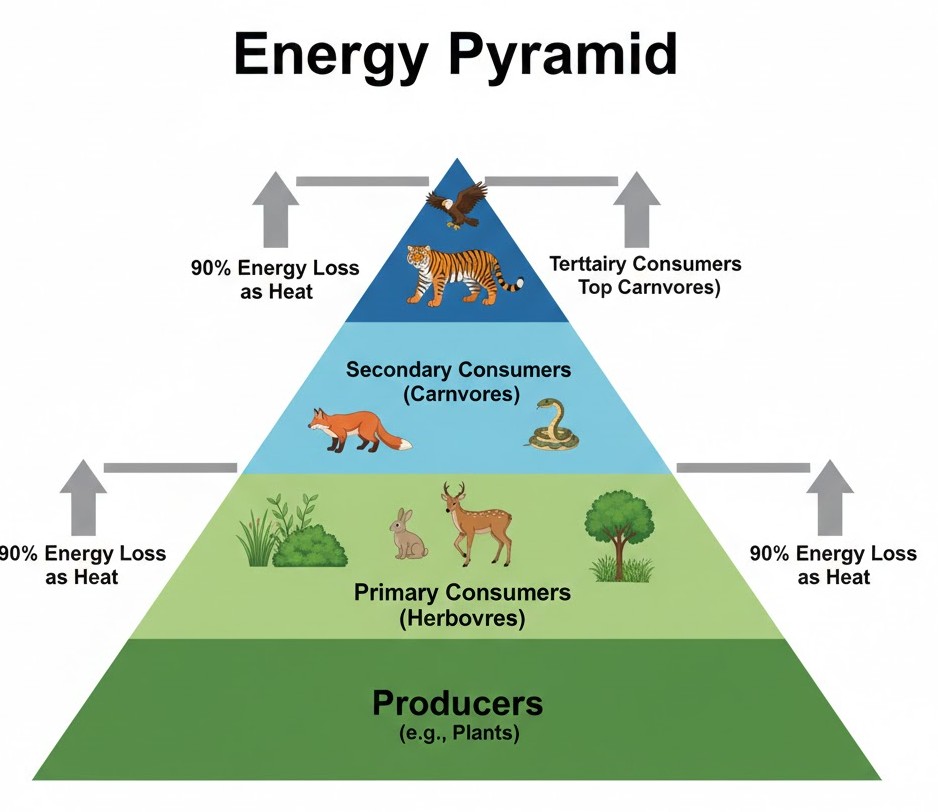
We classify organisms into Trophic Levels based on their snacks. Producers (plants) are at the first level, while top carnivores like lions sit at the fourth. But don't get too excited about being at the top; the $10$ per cent law states that only $10\%$ of energy reaches the next level. It’s like buying a ₹1000 concert ticket but only getting ₹100 worth of entertainment—the rest is lost as heat!
There are two main "delivery routes" for energy:
1. Grazing Food Chain (GFC): The classic Grass $\rightarrow$ Goat $\rightarrow$ Man sequence. In our oceans, this is the main highway for energy.
2. Detritus Food Chain (DFC): This starts with dead organic matter (detritus) and involves "saprotrophs" like fungi and bacteria. In terrestrial ecosystems, this is actually the bigger conduit for energy flow.
Relatable Example: Imagine a grand Indian wedding. The GFC is the main buffet where guests eat fresh food. The DFC is the hardworking cleanup crew that breaks down the leftovers to keep the venue clean!
NEET Checkpoint:
Which food chain is the major conduit for energy in aquatic ecosystems?
(a) DFC
(b) GFC
(c) Both equally
(d) Neither
✅ Answer: (b) GFC — In water bodies, the grazing chain is the primary path.
At any given time, each level has a "bank balance" of living material called the Standing Crop. We measure this as biomass (mass of living organisms) or numbers.
Here's the trick: Always use dry weight for biomass because it’s more accurate than fresh weight, which changes with water content.
Figure below:
A clear pyramid diagram showing four trophic levels: Producers at the broad base, followed by Primary Consumers, Secondary Consumers, and Tertiary Consumers at the narrow apex, with arrows indicating 90% energy loss as heat at each step.
NEET Checkpoint:
Why is dry weight preferred for measuring standing crop?
(a) It is heavier
(b) It is easier to count
(c) It is more accurate
(d) It includes water weight
✅ Answer: (c) It is more accurate — Fresh weight fluctuates too much, while dry weight gives the real organic matter.
Practice Questions:
- he Detritus Food Chain (DFC) begins with:
(a) Living plants
(b) Primary consumers
(c) Dead organic matter
(d) Solar energy
Explanation: By definition, DFC starts with dead remains (detritus) and uses decomposers to move energy.
2. If a producer has $10,000\text{ J}$ of energy, how much is available to the secondary consumer?
(a) $1,000\text{ J}$
(b) $100\text{ J}$
(c) $10\text{ J}$
(d) $1\text{ J}$
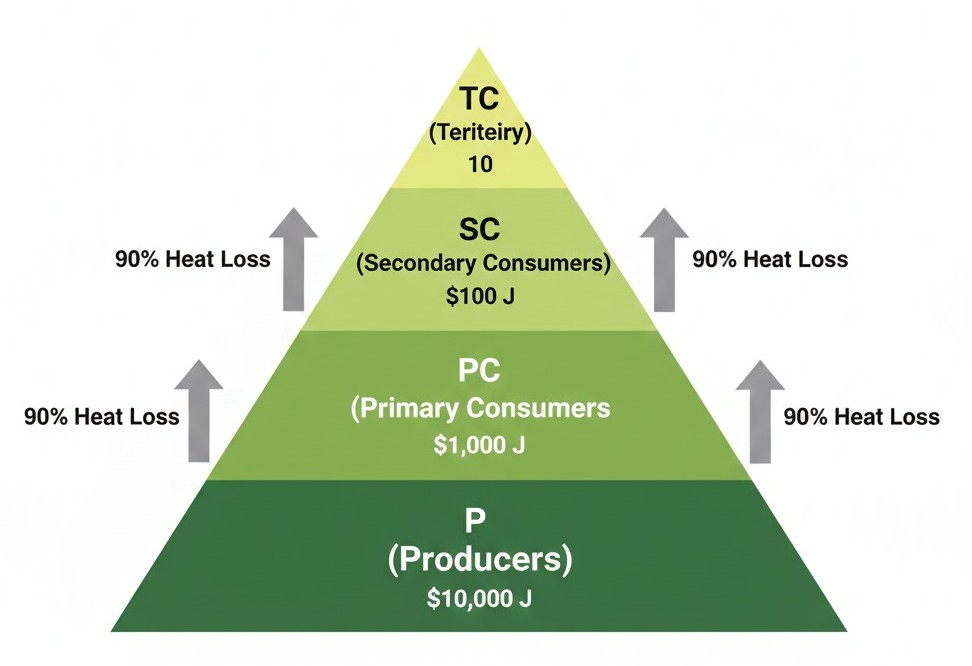
Explanation: Following the $10\%$ law: $10,000 \rightarrow 1,000$ (Primary) $\rightarrow 100$ (Secondary).
Key Takeaway
- Energy Flow: Always unidirectional (Sun $\rightarrow$ Producer $\rightarrow$ Consumer).
- $10\%$ Law: Only $10\%$ energy transfers to the next trophic level.
- Standing Crop: Measured as biomass (dry weight is best) or numbers.
- GFC vs DFC: GFC dominates aquatic; DFC dominates terrestrial energy flow.
12. Ecological Pyramids
Let’s talk about the "food architecture" of nature! Ecological pyramids are diagrams that show the relationship between different trophic levels in terms of number, biomass, or energy. The base always represents the producers, while the narrow top (apex) is for the tertiary consumers.
NEET Checkpoint:
In an ecological pyramid, what does the base represent?
(a) Top carnivores
(b) Primary consumers
(c) Decomposers
(d) Producers
✅ Answer: (d) The producers or the first trophic level — Think of them as the foundation of a building; without them, the whole thing crashes!
Here’s the breakdown:
1. Pyramid of Numbers: This counts the individuals at each level. Usually, it's upright (like in a grassland), but if you count insects on one big tree, it gets a bit wonky!
2. Pyramid of Biomass: This represents the standing crop (mass of living material). In terrestrial systems, it's typically upright, but in the sea, it’s a total "twist"! The biomass of fishes far exceeds the tiny phytoplankton, making the pyramid inverted.
3. Pyramid of Energy: This is the most loyal pyramid—it is always upright. Why? Because energy is lost as heat at every step, following the $10\%$ law.
NEET Checkpoint:
Which ecological pyramid can never be inverted?
(a) Pyramid of numbers
(b) Pyramid of biomass
(c) Pyramid of energy
(d) Pyramid of organisms
✅ Answer: (c) The Pyramid of Energy — Energy flow is unidirectional and some is always lost as heat at each level.
Relatable Example: Imagine a local Pani Puri stall. One bhaiya (producer) can feed fifty hungry students (consumers). That’s an upright pyramid of numbers for you!
Figure below:
A clear four-tiered upright pyramid of energy. The base 'P' (Producers) shows $10,000\ J$, the next level 'PC' (Primary Consumers) shows $1,000\ J$, 'SC' (Secondary Consumers) shows $100\ J$, and the apex 'TC' (Tertiary Consumers) shows $10\ J$, with heat loss arrows at each step.
Limitations: Even nature's diagrams have "glitches." These pyramids ignore saprophytes (even though they are vital cleaners!) and assume nature only uses simple food chains, ignoring the complex food webs we see in reality.
NEET Checkpoint:
Which group of organisms is excluded from ecological pyramids?
(a) Producers
(b) Consumers
(c) Saprophytes
(d) Herbivores
✅ Answer: (c) Saprophytes — Even though they play a vital role, they aren't given a spot in the pyramid structure.
Practice Question:
The pyramid of biomass in a sea ecosystem is:
(a) Always upright
(b) Inverted
(c) Spindle-shaped
(d) Horizontal
✅ Answer: (b) Inverted — Arre, remember the fish! A small standing crop of phytoplankton supports a much larger biomass of fish.
Key Takeaway
- Pyramid of Numbers/Biomass: Can be upright or inverted (especially in aquatic systems).
- Pyramid of Energy: ALWAYS upright ($10\%$ law).
- Gaps: No saprophytes and no food webs allowed.
13. Biodiversity: Concept and Patterns
Arre, imagine an alien from a distant galaxy lands in India! The first thing that would baffle him is the mind-blowing variety of life we have. Sociobiologist Edward Wilson popularised the term Biodiversity to describe this heterogeneity at all levels of biological organisation.
Think of it like a Pani Puri stall: the 'snack' is the same species, but the different fillings (spicy, sweet, or hing water) represent Genetic diversity. In nature, this is like the 50,000 strains of rice or 1,000 varieties of mango found in India. Then there is Species diversity, like the Western Ghats having more amphibians than the Eastern Ghats. Finally, Ecological diversity is why India has deserts and mangroves while a country like Norway is quite plain in comparison.
NEET Checkpoint:
Who popularised the term 'Biodiversity'?
(a) Charles Darwin
(b) Edward Wilson
(c) Alexander von Humboldt
(d) Rachel Carson
✅ Answer: Edward Wilson — He used it to describe diversity at all levels of biological organisation.
How many species are there? While some guess 20–50 million, Robert May gave a scientific estimate of 7 million. India is a mega-diversity country, holding 8.1% of global species diversity despite having only 2.4% of the world's land area.
NEET Checkpoint:
What is Robert May’s global species estimate?
(a) About 1 million species
(b) About 5 million species
(c) About 7 million species
(d) About 10 million species
✅ Answer: (c) 7 million — This is considered a conservative and scientifically sound figure.
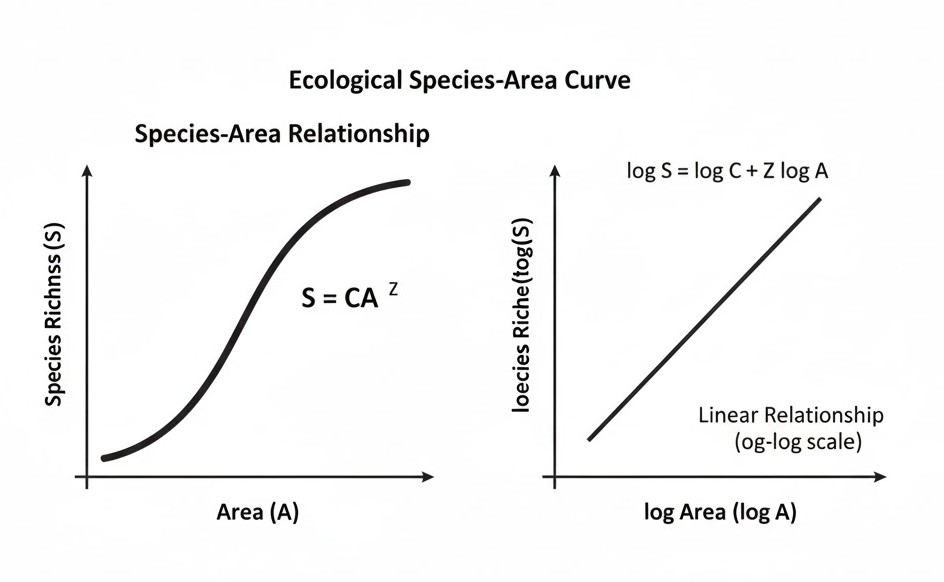
Patterns matter, yaar! Generally, species richness increases as we move towards the equator (latitudinal gradient). Also, the great German naturalist Alexander von Humboldt observed the Species-Area relationship. He found that within a region, species richness increases with area, but only up to a limit, forming a rectangular hyperbola.
NEET Checkpoint:
What is the value of $Z$ (regression coefficient) for small areas?
(a) 0.01 – 0.05
(b) 0.06 – 0.1
(c) 0.2 – 0.3
(d) 0.1 – 0.2
✅ Answer: (d) 0.1 to 0.2 — This range stays similar regardless of whether you're looking at birds in California or plants in Britain.
The relationship on a logarithmic scale is a straight line:
Where $S$ is species richness, $A$ is area, $Z$ is the slope, and $C$ is the Y-intercept.
Figure below:
A graph showing the Species-Area relationship with Area on the x-axis and Species Richness on the y-axis. It should feature a curved line representing the rectangular hyperbola $S = CA^Z$ and a straight line representing the linear relationship on a log-log scale $log S = log C + Z log A$.4
Practice Questions:
1. Which of the following is the correct equation for the species-area relationship on a log scale?
(a) $log S = log C + A log Z$
(b) $log S = log C + Z log A$
(c) $S = C + A^Z$
(d) $log A = log C + Z log S$
✅ Answer: (b) — This linear equation helps ecologists calculate the slope $Z$.
2. India is one of the how many 'mega-diversity' countries of the world?
(a) 5
(b) 10
(c) 12
(d) 15
✅ Answer: (c) 12 — India’s 8.1% share of global species diversity earns it this prestigious spot.
Key Takeaway
Formula Summary
- Species-Area Equation: $S = CA^Z$
- Logarithmic Form: $log S = log C + Z log A$
- Global Estimate: Robert May = 7 million species
- Z-value (Continents): 0.6 to 1.2 (steeper slope)
14. Importance and Loss of Biodiversity
Listen up, future doctors! Ever wondered if losing a few ant species actually matters? Spoiler alert: it definitely does! Ecologist David Tilman showed through outdoor experiments that plots with more species have higher productivity and less year-to-year variation. Think of it like a stable cricket team; if you have a deep batting line-up, one or two wickets won't cause a collapse, but a thin team is always at risk! Paul Ehrlich explained this using the Rivet Popper Hypothesis, comparing an ecosystem to an airplane where every species is a 'rivet'. If passengers (humans) keep popping rivets to take home, the plane eventually becomes dangerously weak.
NEET Checkpoint:
Who proposed the 'Rivet Popper' analogy?
(a) David Tilman
(b) Paul Ehrlich
(c) Robert May
(d) Edward Wilson
✅ Answer: (b) Paul Ehrlich — He "popped" the idea that every species counts for ecosystem safety!.
Sadly, we are currently witnessing the 'Sixth Extinction', with rates $100$ to $1000$ times faster than pre-human times. The IUCN Red List has already documented the end for legends like the Dodo (Mauritius) and Steller’s Sea Cow (Russia).
NEET Checkpoint:
The current species extinction rate is how many times faster than pre-human times?
(a) $10-50$
(b) $100-1000$
(c) $1000-5000$
(d) $2-5$
✅ Answer: (b) $100-1000$ — This is why biodiversity conservation is an international emergency, yaar!.
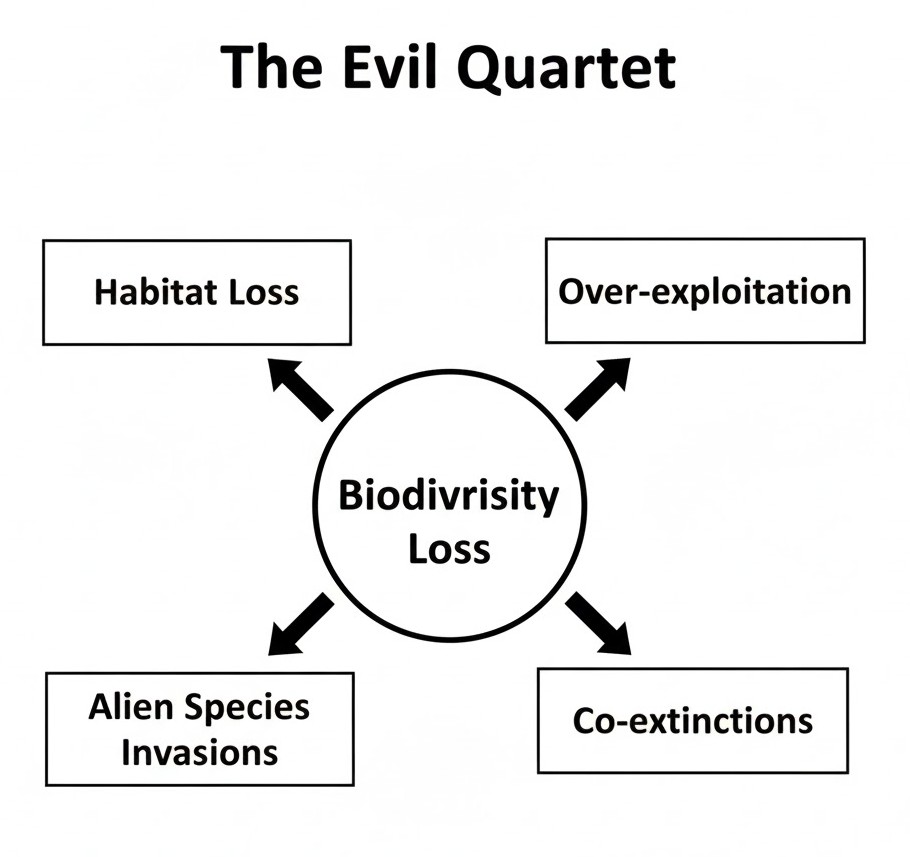
The 'Evil Quartet' describes the four major villains causing this loss:
1. Habitat Loss/Fragmentation: The most important cause! Like clearing the 'Lungs of the planet' (Amazon rain forest) for soya beans.
2. Over-exploitation: When 'need' turns to 'greed'.
3. Alien Species Invasions: Think of Nile perch in Lake Victoria or our local headache, Carrot grass (Parthenium).
4. Co-extinctions: If a host fish dies, its unique parasites go 'tata, bye-bye' too.
NEET Checkpoint:
Which invasive species is threatening indigenous catfishes in Indian rivers?
(a) Lantana
(b) Water hyacinth
(c) Clarias gariepinus
(d) Cichlid fish
✅ Answer: (c) Clarias gariepinus — This African catfish was introduced illegally for aquaculture.
Figure beow:
A flow chart titled 'The Evil Quartet' showing four boxes: Habitat Loss, Over-exploitation, Alien Species Invasions, and Co-extinctions, all pointing to a central circle labelled 'Biodiversity Loss'.
Practice Question:
Which of the following is considered the most important cause driving animals and plants to extinction?
(a) Alien species invasion
(b) Co-extinction
(c) Habitat loss and fragmentation
(d) Over-exploitation
✅ Answer: (c) Habitat loss and fragmentation — The sources state this is the "most important cause".
Key Takeaway
Importance: High diversity leads to stable productivity and resilience (Rivet Popper Hypothesis).
Loss: Driven by the Evil Quartet. Current extinction rates are $100$ to $1000$ times higher than natural background rates.
15. Biodiversity Conservation Strategies
Hey junior! Don't stress, yaara—saving the planet's biodiversity is easier to understand than your tuition's complex timetable!. Let’s clear up this conservation funda.
Conservation comes in two main "flavours": In situ (on-site) and Ex situ (off-site). In situ is like protecting a whole cricket stadium just to save the pitch. It means protecting the entire ecosystem to save a single species. India has legally protected its wealth through $14$ Biosphere Reserves, $90$ National Parks, and $448$ Wildlife Sanctuaries. We also have Sacred Groves (like in the Khasi Hills of Meghalaya or Aravalli Hills in Rajasthan), where tracts of forest are protected due to cultural traditions.
NEET Checkpoint:
How many biodiversity hotspots cover India?
(a) 2
(b) 3
(c) 4
(d) 5
✅ Answer: $4$ — Western Ghats-Sri Lanka, Indo-Burma, and Himalaya.
Then there are Biodiversity Hotspots—$34$ regions globally with crazy high species richness and endemism (species found nowhere else). If a species is facing a "Red Alert" extinction risk, we use Ex situ methods. This is the "Safe House" approach where we move them to Zoological Parks, Botanical Gardens, or use cryopreservation to freeze gametes at very low temperatures.
NEET Checkpoint:
Where was the $1992$ Earth Summit held?
(a) Stockholm
(b) Rio de Janeiro
(c) Kyoto
(d) Paris
✅ Answer: (b) Rio de Janeiro — It called for conservation and sustainable use of biodiversity.
Relatable Example: Imagine your grandmother's secret pickle recipe. In situ conservation is keeping the whole ancestral kitchen and mango orchard intact. Ex situ is taking the seeds and storing them in a high-tech seed bank or a locker!.
NEET Checkpoint:
What is "endemism"?
(a) Species found everywhere
(b) Species restricted to a particular area
(c) Species that are extinct
(d) Species that migrate seasonally
✅ Answer: (b) Species confined to a specific region and not found anywhere else.
Practice Question:
Which of the following is an example of ex situ conservation?
(a) National Park
(b) Sacred Grove
(c) Seed Bank
(d) Biosphere Reserve
✅ Answer: (c) Seed Bank — It involves protecting the species outside its natural habitat.
Key Takeaway
- In situ (On-site): Biosphere Reserves ($14$), National Parks ($90$), Sanctuaries ($448$), and Sacred Groves.
- Ex situ (Off-site): Zoos, Botanical Gardens, Seed Banks, and Cryopreservation.
- Global Efforts: Earth Summit ($1992$) and World Summit ($2002$).