
1. Introduction: Defining Life and Diversity
Welcome to the grand world of Biology, juniors! Think of it as the ultimate gossip session about life forms and living processes. Before we dive deep, let’s tackle the technical question: "What is living?" as opposed to non-living. While philosophers worry about the "purpose" of life, we scientists focus on the mechanics—like the difference between a galloping horse and a cold mountain.
Early humans were the first taxonomists, but they didn't have fancy textbooks. Their classification was purely "jugaad" based on survival: "Can I eat this? Can I wear it? Can I build a house with it?" Thus, the earliest systems were based on basic uses like food, clothing, and shelter.
NEET Checkpoint:
What was the basis for the earliest systems of classification?
(a) Genetic makeup
(b) Evolutionary relationships
(c) External morphology
(d) Cellular structure
✅ Answer: (c) The uses of various organisms (food, shelter, clothing) — Survival was the only priority for early man!
Today, we deal with biodiversity—roughly $1.7-1.8$ million described species. To avoid confusion (like calling a "bulb" a light source or an onion!), we use Nomenclature and Identification to give every organism one standard name.
NEET Checkpoint:
What is the estimated number of species known and described on Earth?
(a) About 0.5 million
(b) About 1.0 million
(c) About 1.7–1.8 million
(d) About 5 million
✅ Answer: (c) $1.7-1.8$ million — That’s a lot of names to keep track of, yaar!
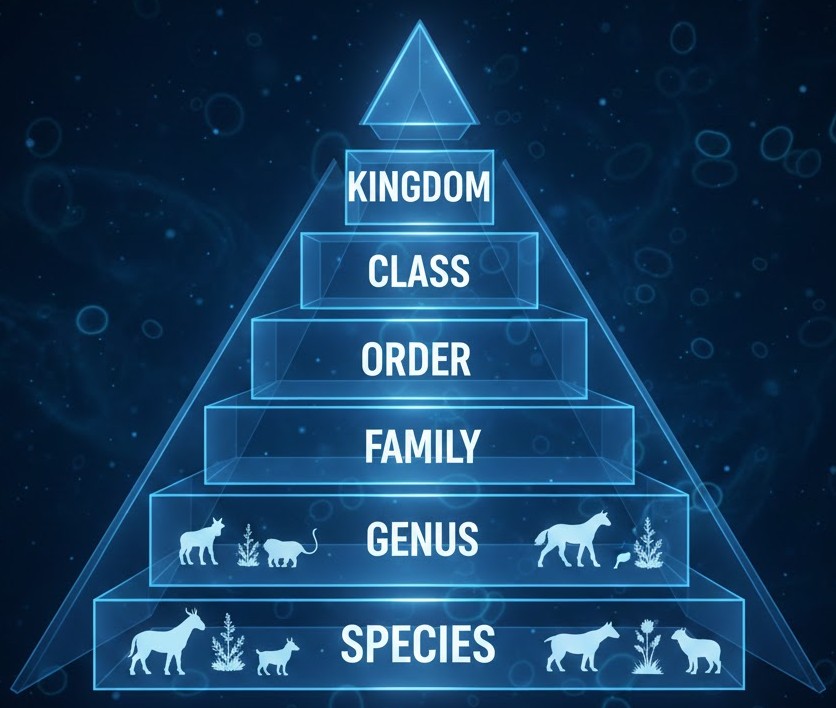
Think of Classification like a cricket tournament: you have the whole league (Kingdom), the specific team (Genus), and the individual player (Species). The scientific term for these "boxes" or categories is taxa, which can represent levels as different as 'Animals' and 'Dogs'.
NEET Checkpoint:
In the five-kingdom system, which kingdom includes all prokaryotic organisms?
(a) Kingdom Monera
(b) Fungi
(c) Protista
(d) Plantae
✅ Answer: (a) Kingdom Monera — These are the only ones without a nuclear membrane!
Figure below:
A vertical hierarchical pyramid showing the taxonomic arrangement in ascending order from Species at the base to Kingdom at the top, as described in the sources.
Practice Questions:
1. The term 'Taxa' can represent:
(a) Only the species level
(b) Only the kingdom level
(c) Categories at very different levels
(d) Only morphological aggregates
✅ Answer: (c) — Taxa is a scientific term for categories at any level of the hierarchy.
2. Who proposed the Five Kingdom Classification in $1969$?
(a) Carolus Linnaeus
(b) R.H. Whittaker
(c) Ernst Mayr
(d) Aristotle
✅ Answer: (b) — Whittaker based his system on cell structure, nutrition, and reproduction.
Key Takeaway
- Biology: Science of life forms and processes.
- Biodiversity: Total species count is $1.7-1.8$ million.
- Earliest Classification: Based on human uses (food, clothing, shelter).
- Taxa: Scientific term for categories at different hierarchical levels.
2. Biodiversity and the Need for Classification
Listen up, junior! If you think keeping track of your tuition friends is hard, imagine managing the 1.7–1.8 million species that we’ve already identified on this planet. This massive variety and number of organisms is what we call Biodiversity. As we explore new forests or even re-examine old ones, this guest list just keeps growing!
NEET Checkpoint:
What is the estimated number of species currently known and described?
(a) 0.5 million
(b) 1 million
(c) 1.7–1.8 million
(d) 5 million
✅ Answer: (c) $1.7-1.8$ million — That’s a lot of names to remember, yaar!.
Now, here’s the problem: in India, we might call a mango 'Aam', but someone in another country has a totally different local name for it. This creates massive confusion! To fix this, scientists decided we need to standardise the naming of organisms so that a specific being is known by the same name everywhere in the world. This "official" naming process is called Nomenclature.
But wait! Before you can name someone, you have to know exactly who they are and describe them correctly. This prerequisite is called Identification. It’s like how you can’t give a nickname to a "new guy" in your cricket team until you’ve identified which position he plays!
To keep things organized, biologists use international codes:
* ICBN (International Code for Botanical Nomenclature) for our green friends, the plants.
* ICZN (International Code for Zoological Nomenclature) for the animal kingdom.
NEET Checkpoint:
What is the essential prerequisite for nomenclature?
(a) Identification
(b) Classification
(c) Characterization
(d) Description
✅ Answer: Identification — You must describe the organism correctly first!
NEET Checkpoint:
Which code would a scientist use to name a newly discovered species of tiger?
(a) International Code of Nomenclature for Algae, Fungi, and Plants (ICN)
(b) International Code of Zoological Nomenclature (ICZN)
(c) International Code of Nomenclature of Bacteria (ICNB)
(d) International Code of Virus Classification and Nomenclature (ICVCN)
✅ Answer: (b) ICZN — International Code for Zoological Nomenclature handles the animal names.
Practice Questions:
1. Why is nomenclature necessary in biology?
(a) To give organisms fancy titles
(b) To ensure an organism has one universal name
(c) To count the number of species
(d) To study local languages
✅ Answer: (b) — It ensures that people in any part of the world arrive at the same name for an organism.
2. The full form of ICBN is:
(a) Indian Code for Biological Nomenclature
(b) International Code for Botanical Nomenclature
(c) International Council for Biological Names
(d) Indian Control of Botanical Nature.
✅ Answer: (b) — Remember, 'B' stands for Botanical (Plants)!
Key Takeaway
- Biodiversity: $1.7-1.8$ million known species.
- Nomenclature: Global standardisation of names.
- Identification: Describing an organism before naming it.
- ICBN: Plants | ICZN: Animals.
3. Binomial Nomenclature and Systematics
Listen up, junior! If you call a mango 'Aam' and your friend in New York calls it 'Mango', how will scientists talk without getting confused? That’s why Carolus Linnaeus introduced the Binomial Nomenclature system. It’s a simple two-word format: the Generic name followed by the specific epithet. Think of it like a formal ID card for every living thing!
Here are the strict rules you need to memorise for NEET:
1. Latin is King: Names are always in Latin, regardless of where the organism is from.
2. Print vs. Hand: In books, they are in italics. When you're scribbling in your biology practical file, you must underline them separately to show their Latin roots.
3. The Case Study: The Genus always starts with a Capital letter, but the specific epithet is always small (e.g., Mangifera indica).
Now, Systematics is the bigger brother of taxonomy. It’s not just about naming; it involves the study of diversities and, most importantly, the evolutionary relationships between organisms. Linnaeus even titled his famous publication Systema Naturae.
Relatable Indian Example: It’s just like our local Pani Puri stalls. Whether you call it Gol Gappa in Delhi, Puchka in Kolkata, or Gupchup in Odisha, the "scientific" recipe remains that same tangy water we all love! Standardisation is key, yaar.
NEET Checkpoint:
Which of the following is a rule of binomial nomenclature?
(a) Names are in Greek
(b) Handwritten names are bolded
(c) Both words are separately underlined when handwritten
(d) Both words start with capital letters
✅ Answer: (c) — This indicates their Latin origin when you can't print in italics.
NEET Checkpoint:
Systematics takes into account:
(a) Only external features
(b) Evolutionary relationships
(c) Only local names
(d) Habitat only
✅ Answer: (b) — It looks at how organisms are related vertically and horizontally through time.
NEET Checkpoint:
In the name Mangifera indica Linn., 'Linn.' indicates:
(a) The language
(b) The place of origin
(c) The author who first described it
(d) The family name
✅ Answer: (c) — It stands for Linnaeus, the legend himself!
Practice Question:
Which of the following is the correctly written scientific name for Mango?
(a) Mangifera Indica
(b) Mangifera indica
(c) Mangifera indica
(d) Mangifera Indica
✅ Answer: (c) — It follows all the rules: Italics for print, Capital for Genus, and small for specific epithet.
Key Takeaway
- Binomial Nomenclature: Generic name + specific epithet (e.g., Homo sapiens).
- Format: Latin origin; Italics in print, underline if handwritten.
- Systematics: Taxonomy + evolutionary relationships.
4. Taxonomic Hierarchy and Categories
Listen up, junior! Classification isn't just a one-off task; it’s a hierarchy of steps where every single step represents a specific rank or category. We call these taxonomic categories, and when you stack them all together, they form the taxonomic hierarchy. Each rank is technically called a taxon (plural: taxa), and believe it or not, these are distinct biological entities, not just some random morphological aggregates we've made up!
NEET Checkpoint:
What is the basic unit of classification?
(a) Species
(b) Genus
(c) Taxon
(d) Kingdom
✅ Answer: (c) Taxon — Arre, remember that every rank in the hierarchy, from the smallest to the biggest, represents a unit of classification called a taxon.
Think of it like the "funda" of your home address. To find you, I need your name (Species), your family's surname (Genus), your apartment building (Family), your street (Order), your locality (Class), your state (Phylum/Division), and finally, India (Kingdom)! [Relatable Example].
NEET Checkpoint:
Which of the following represents the correct ascending order?
(a) Kingdom → Phylum → Order
(b) Species → Genus → Family
(c) Class → Order → Family
(d) Phylum → Division → Kingdom
✅ Answer: (b) Species → Genus → Family — Keep it simple, yaar! We are going from the lowest to higher categories.
Here is the trick for the exam: as you climb higher from Species to Kingdom, the number of common characteristics goes on decreasing. Members of a species share loads of similarities, but members of the same kingdom? Not so much!
NEET Checkpoint:
As we go from species to kingdom in a taxonomic hierarchy, the number of common characteristics:
(a) Will decrease
(b) Will increase
(c) Remain same
(d) May increase or decrease
✅ Answer: (a) Will decrease — Logic is simple: the higher you go, the broader the group and the fewer the shared traits.
Practice Question:
In which of the following categories will it be most difficult to determine the relationship to other taxa at the same level?
(a) Genus
(b) Species
(c) Kingdom
(d) Family
✅ Answer: (c) Kingdom — Correct! Higher the category, the more complex the classification becomes.
Key Takeaway
- Hierarchy: Species $\rightarrow$ Genus $\rightarrow$ Family $\rightarrow$ Order $\rightarrow$ Class $\rightarrow$ Phylum/Division $\rightarrow$ Kingdom.
- Rule of Thumb: Lower the taxa, more the shared characteristics; higher the category, fewer the common traits.
5. Concept of Species and Higher Taxa
Listen up, junior! Ever wonder why a tiger is more like your neighborhood billo (cat) than a stray dog? It's all about the taxonomic hierarchy, a ladder where each step is a rank or taxon. Let’s clear this funda once and for all.
At the very bottom, we have the Species, a group of individuals with fundamental similarities. Think of it like a specific dish at a dhaba—every plate of Paneer Butter Masala is the same "species." As we move up to Genus, we find aggregates of closely related species. For example, the genus Solanum includes both potato and brinjal.
NEET Checkpoint:
Which is the lowest category in the taxonomic hierarchy?
(a) Family
(b) Genus
(c) Species
(d) Order
✅ Answer: (c) Species — It is the basic unit of classification with maximum similarities.
Moving higher, Family groups related genera with even fewer similarities. For example, the Felidae family includes both the genus Panthera (lions/tigers) and the genus Felis (cats). It's like how different cricket teams (genera) belong to the same League (family). As we climb to Order, Class, and Phylum, the number of common characters goes on decreasing. Finally, we reach the Kingdom, the highest category, like Animalia or Plantae.
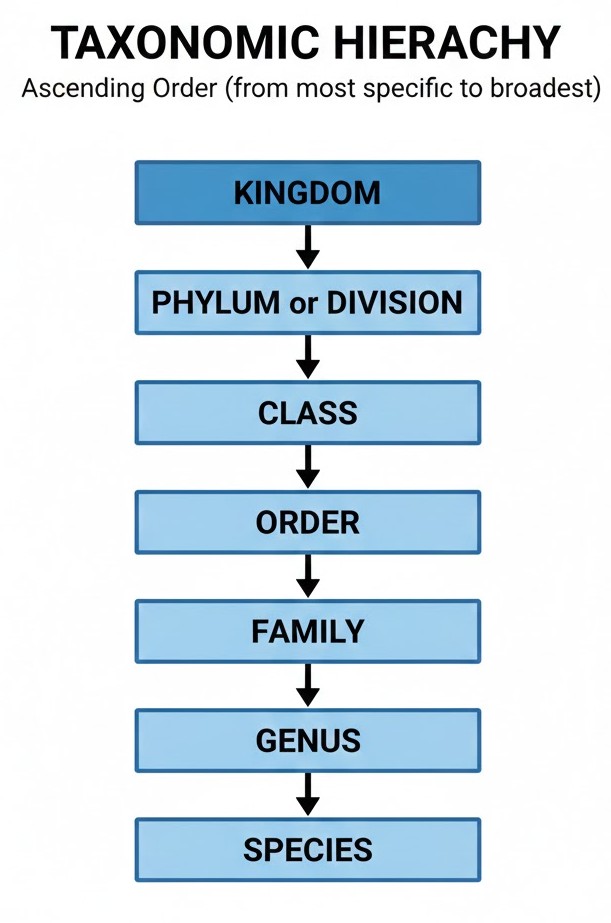
Figure below:
A vertical flow chart showing the taxonomic hierarchy in ascending order: Species -> Genus -> Family -> Order -> Class -> Phylum/Division -> Kingdom.
NEET Checkpoint:
As we go from species to kingdom, what happens to the number of common characteristics?
(a) Increases
(b) Decreases
(c) Remains the same
(d) Becomes zero
✅ Answer: (b) They decreases — Higher the category, lower the shared traits.
NEET Checkpoint:
To which family do cats and leopards both belong?
(a) Canidae
(b) Ursidae
(c) Felidae
(d) Hyaenidae
✅ Answer: (c) Felidae — This family includes both the genus Felis and Panthera.
Don't stress, yaar—just remember that lower the taxa, the more characteristics the members share!.
Practice Questions:
- Potato and Brinjal belong to the same genus, which is:
(a) Panthera
(b) Felis
(c) Solanum
(d) Mangifera
✅ Answer: (c) — According to the sources, both belong to the genus Solanum.
2. Which of the following represents the correct ascending order?
(a) Genus < Family < Order < Class
(b) Class < Order < Family < Genus
(c) Species < Order < Family < Kingdom
(d) Kingdom < Phylum < Class < Order
✅ Answer: (a) — The hierarchy goes Species → Genus → Family → Order → Class → Phylum → Kingdom.
Key Takeaway: The Taxonomic Ladder
$$\text{Species (Lowest)} \rightarrow \text{Genus} \rightarrow \text{Family} \rightarrow \text{Order} \rightarrow \text{Class} \rightarrow \text{Phylum/Division} \rightarrow \text{Kingdom (Highest)}$$
Note: Common characteristics $\downarrow$ as Category $\uparrow$.
6. The Five Kingdom Classification System
Arre, listen up! Back in the day, Carolus Linnaeus kept things simple with his Two Kingdom system, just dividing the world into Plantae and Animalia. But honestly, it was a bit of a mess, yaar. It didn't distinguish between prokaryotes and eukaryotes, or even between a mushroom and a mango tree! It was like trying to organize a massive Indian wedding with only two guest lists: "Relatives" and "Everyone Else." Total chaos!
In $1969$, R.H. Whittaker saved the day by proposing the Five Kingdom Classification. He added much-needed "shelves" to the system: Monera, Protista, Fungi, Plantae, and Animalia.
NEET Checkpoint:
Who proposed the Five Kingdom system and in which year?
(a) Linnaeus, 1758
(b) R.H. Whittaker, 1969
(c) Carl Woese, 1977
(d) Ernst Haeckel, 1866
✅ Answer: (b) R.H. Whittaker in $1969$ — Pukka memory work, this year is a favourite for examiners!
Whittaker didn't just guess; he used five specific criteria:
1. Cell structure (Prokaryotic vs. Eukaryotic).
2. Body organisation (Unicellular vs. Multicellular).
3. Mode of nutrition (The biggest game-changer!).
4. Reproduction.
5. Phylogenetic relationships (Basically, who is whose ancestor).
Think of it like sorting snacks at a local kirana store. You don't just put "Salty" and "Sweet." You look at the brand (cell type), the packet size (organisation), and whether it's diet-friendly or fried (nutrition).
NEET Checkpoint:
Which kingdom was created to house all prokaryotic organisms?
(a) Protista
(b) Fungi
(c) Monera
(d) Plantae
✅ Answer: (c) Kingdom Monera — Bacteria finally got their own room!
Here is the funda: Fungi got their own kingdom because, unlike plants, they have chitin in their cell walls and aren't fans of photosynthesis—they are heterotrophic.
Figure below:
A colorful comparative table showing the five kingdoms (Monera, Protista, Fungi, Plantae, Animalia) across the top and characteristics like Cell Type, Cell Wall, and Mode of Nutrition down the side.
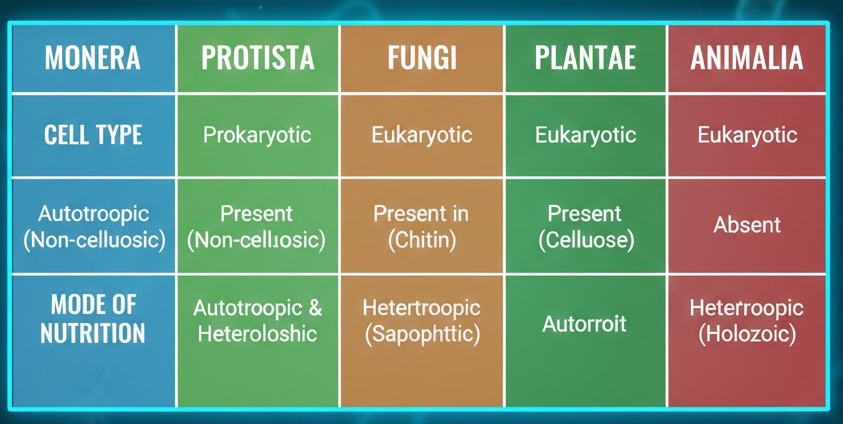
Quick Characteristics Breakdown:
- Monera: Prokaryotic, non-cellulosic wall, and can be autotrophic or heterotrophic.
- Protista: Eukaryotic, unicellular (the "misfit" bin that links everything else).
- Fungi: Eukaryotic, chitinous wall, heterotrophic (saprophytic/parasitic).
- Plantae: Eukaryotic, cellulosic wall, autotrophic (photosynthetic).
- Animalia: Eukaryotic, no cell wall, holozoic nutrition.
NEET Checkpoint:
What is the cell wall of Fungi made of?
(a) Cellulose
(b) Pectin
(c) Chitin
(d) Lignin
✅ Answer: (c) Chitin — Remember, plants have cellulose, but fungi are different!
Practice Questions:
1. Whittaker's system does NOT use which of the following as a main criterion?
(a) Cell structure
(b) Mode of nutrition
(c) Habitat
(d) Phylogenetic relationships
✅ Answer: (c)Habitat — While habitat is important, it wasn't one of his five main scientific criteria.
2. Why was the Two Kingdom system found inadequate?
(a) It was too old
(b) It didn't distinguish between eukaryotes and prokaryotes
(c) It included viruses
(d) It was only for plants
✅ Answer: (b) — It put bacteria (prokaryotes) and sunflowers (eukaryotes) in the same bucket!
Key Takeaway
Whittaker's Five Kingdom system ($1969$) moved us from gross morphology to deeper scientific traits like cell type and evolutionary history, giving organisms like bacteria (Monera) and unicellular eukaryotes (Protista) their own identity.
7. Kingdom Monera: The Bacteria
Welcome back, future doc! Today we’re diving into Kingdom Monera, where bacteria are the absolute bosses. They are the sole members and the most abundant micro-organisms on Earth. You’ll find them everywhere—from a handful of soil to extreme places like hot springs and deep oceans where even a Mumbai local train would feel empty by comparison.
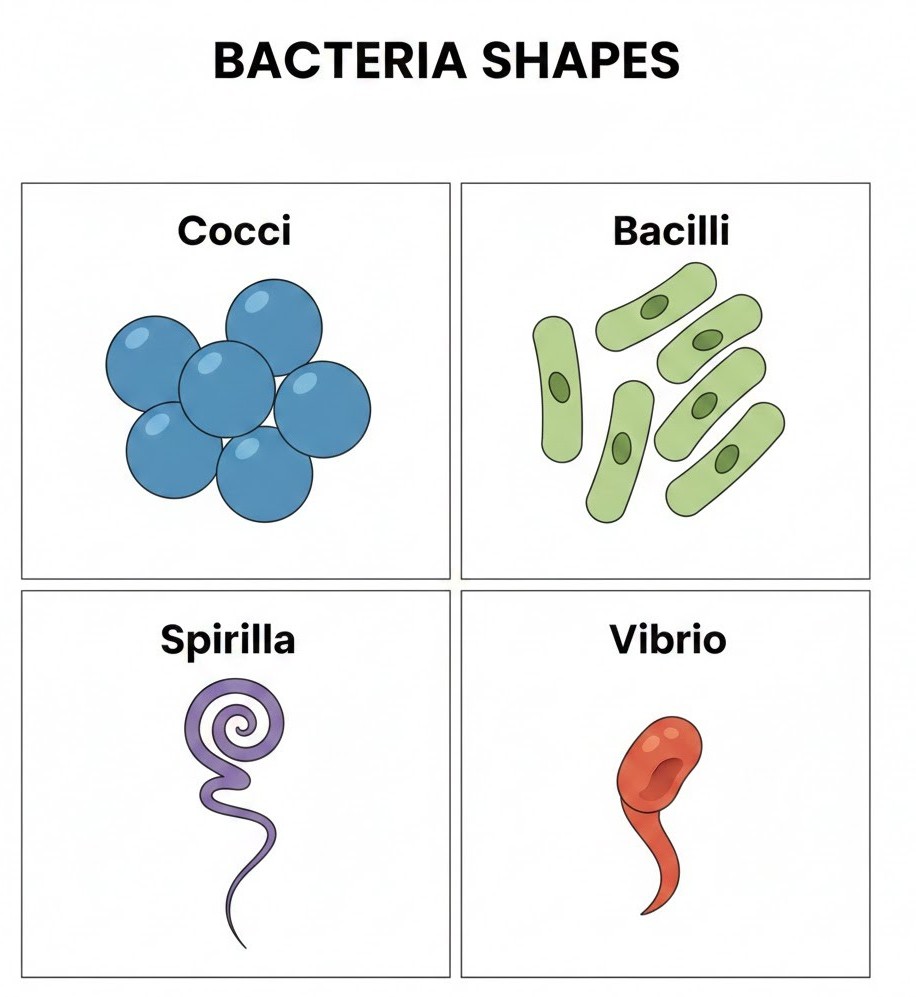
Let's clear the funda on their shapes first. Think of them like different types of sweets: spherical Coccus (like a laddu), rod-shaped Bacillus, comma-shaped Vibrium, and spiral Spirillum.
NEET Checkpoint:
Which of the following is a comma-shaped bacterium?
(a) Coccus
(b) Spirillum
(c) Vibrium
(d) Bacillus
✅ Answer: (c) Vibrium — Remember, Vibrio is comma-shaped, just like the punctuation mark you use in English class!
Now, meet the Archaebacteria. These are the "Khatron Ke Khiladi" of the bacterial world because they survive in harsh habitats like extreme salty areas (halophiles) and hot springs (thermoacidophiles). Their secret weapon? A unique cell wall structure that acts like a specialized shield.
NEET Checkpoint:
Methanogens are found in the gut of which animals?
(a) Lions
(b) Ruminants like cows
(c) Humans
(d) Fish
✅ Answer: (b) Ruminants like cows — These bacteria produce methane (biogas) from dung.
Then we have Eubacteria, the 'true bacteria'. This group includes Cyanobacteria (blue-green algae), which have chlorophyll $a$ just like green plants. Some, like Nostoc, have specialized cells called heterocysts to fix atmospheric $N_2$. Don't forget Mycoplasma—the rebels with no cell wall and the smallest living cells known.
Figure below:
A clear diagram showing the four shapes of bacteria: spherical Cocci, rod-shaped Bacilli with spores, spiral-shaped Spirilla with flagellum, and comma-shaped Vibrio.
NEET Checkpoint:
Which organism is known as the smallest living cell and lacks a cell wall?
(a) Nostoc
(b) Mycoplasma
(c) Bacillus
(d) Cyanobacteria
✅ Answer: (b) Mycoplasma — They are the tiny ninjas of the microbial world and can survive even without oxygen!
Practice Questions:
1. Which pigment is common to both Cyanobacteria and green plants?
(a) Chlorophyll $b$
(b) Chlorophyll $c$
(c) Chlorophyll $a$
(d) Xanthophyll
✅ Answer: (c) — The source states Cyanobacteria have chlorophyll $a$ similar to green plants.
2. Heterotrophic bacteria are most significant for which human activity?
(a) Fixing $CO_2$
(b) Making curd from milk
(c) Living in hot springs
(d) Producing methane
✅ Answer: (b) — Most heterotrophic bacteria are decomposers and help in making curd and antibiotics.
Key Takeaway: Kingdom Monera
- Sole Members: Bacteria.
- Shapes: Coccus (sphere), Bacillus (rod), Vibrio (comma), Spirillum (spiral).
- Archaebacteria: Specialized cell walls for extreme habitats (e.g., methanogens).
- Eubacteria: Rigid cell walls; includes photosynthetic Cyanobacteria and Mycoplasma (no cell wall).
8. Kingdom Protista: Single-Celled Eukaryotes
If an organism is a single-celled eukaryote, it gets a permanent room here. These guys are primarily aquatic and act as a crucial link between plants, animals, and fungi. Think of Protista as the common friend in a WhatsApp group who connects all the different cliques. Because they are eukaryotes, they have a well-defined nucleus and membrane-bound organelles—upgrading from the "basic" setup of Monera.
NEET Checkpoint:
Which kingdom serves as a link between plants, animals, and fungi?
(a) Monera
(b) Fungi
(c) Plantae
(d) Kingdom Protista
✅ Answer: (d) Kingdom Protista — It shares boundaries with all three higher kingdoms.
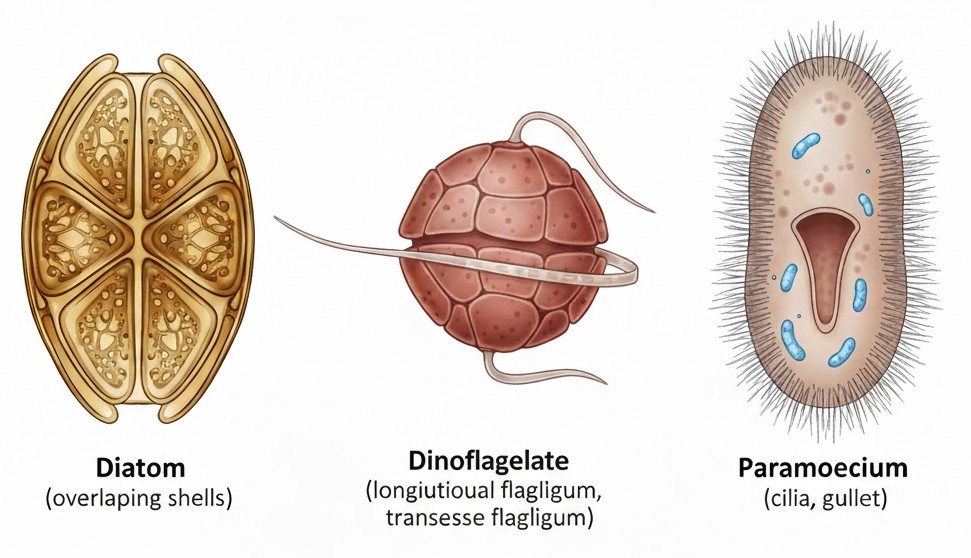
First, let's talk about Chrysophytes. This group includes diatoms and golden algae (desmids). Diatoms are the "jewels of the sea" with cell walls embedded with silica, making them indestructible. These walls fit together like a soap box—or like those classic two-part steel tiffin boxes we take to school. When they die, they leave behind huge deposits called diatomaceous earth. Since it's gritty, we use it for polishing and filtering oils.
NEET Checkpoint:
What is the "soap box" wall of a diatom made of?
(a) Cellulose
(b) Silica
(c) Chitin
(d) Pectin
✅ Answer: (b) Silica — This makes the walls indestructible and leads to the formation of diatomaceous earth.
Next up are the Dinoflagellates. Most are marine and photosynthetic, showing off colours like yellow, green, or red. They have stiff cellulose plates on their outside. Some, like Gonyaulax, multiply so rapidly they cause "red tides". It’s like the ocean is blushing, but it's actually dangerous because they release toxins that can kill even fish!
Then we have Protozoans, the "primitive relatives" of animals. They are heterotrophs—either predators or parasites. There are four main types:
1. Amoeboid: Use pseudopodia (false feet) to catch prey, just like Amoeba.
2. Flagellated: Have flagella; Trypanosoma belongs here and causes sleeping sickness.
3. Ciliated: Use thousands of cilia to move. Think of a Mumbai local train crowd—the coordinated movement of the cilia steers food right into their gullet. Example: Paramoecium.
4. Sporozoans: These have an infectious spore-like stage, like Plasmodium, the famous malarial parasite.
Figure below:
A clear diagram showing the 'soap-box' overlapping shells of a Diatom, a Dinoflagellate with its two flagella (one longitudinal and one transverse), and a Paramoecium showing its rows of cilia and the gullet cavity.
NEET Checkpoint:
Which protozoan causes malaria in humans?
(a) Trypanosoma
(b) Entamoeba
(c) Plasmodium
(d) Giardia
✅ Answer: (c) Plasmodium — It is a sporozoan with an infectious stage in its life cycle.
Practice Questions:
1. Diatoms are the chief 'producers' in the:
(a) Deserts
(b) Oceans
(c) Soil
(d) Mountains
✅ Answer: (b) Oceans — They are the primary photosynthetic engines in marine environments.
2. The protein-rich layer that makes Euglenoids flexible is called:
(a) Pellicle
(b) Cuticle
(c) Slime layer
(d) Capsule
✅ Answer: (a) Pellicle — Unlike other protists with rigid walls, this layer gives them flexibility.
Key Takeaway
- Protista: Single-celled eukaryotes; primarily aquatic.
- Diatoms: Silica walls (soap box); Diatomaceous earth.
- Dinoflagellates: Gonyaulax causes red tides.
- Protozoans: Four groups (Amoeboid, Flagellated, Ciliated, Sporozoans).
9. Kingdom Fungi: Heterotrophic Multicellulars
Listen up, junior! If you’ve ever seen fuzzy growth on a forgotten piece of bread or enjoyed a mushroom stir-fry, you’ve met the members of Kingdom Fungi. These guys are a unique group of heterotrophic organisms that show massive diversity in where they live and how they look. They are cosmopolitan, meaning they are everywhere—air, water, soil, and even on plants and animals. Most are multicellular filaments called hyphae, which weave together to form a network known as mycelium. Arre, just remember the golden rule: their cell walls are made of chitin and polysaccharides, not cellulose!
NEET Checkpoint:
Which of the following is a unicellular fungus?
(a) Mucor
(b) Yeast
(c) Agaricus
(d) Puccinia
✅ Answer: (b) Yeast — Always watch out for this exception, yaar! Most fungi are multicellular, but yeast is the lonely single-celled rebel used for bread and beer.
Here’s the breakdown of the "Big Three" classes you need to master:
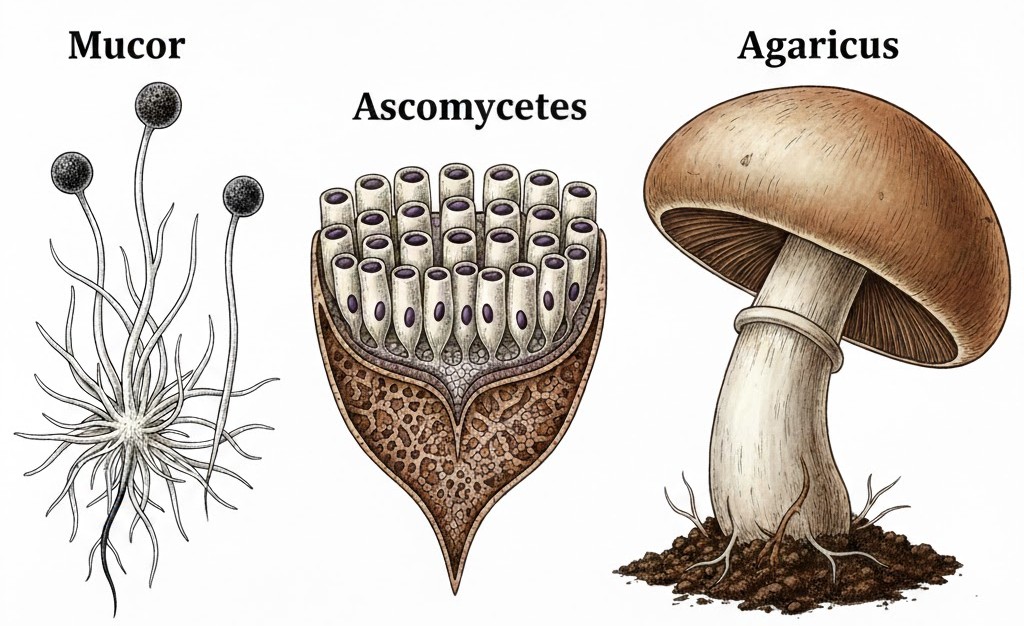
- Phycomycetes: These guys love damp places. Their mycelium is aseptate and coenocytic (like a long, continuous tube of cytoplasm). Examples include Mucor and Rhizopus (the famous bread mould).
- Ascomycetes: Known as sac-fungi, they have branched, septate mycelium. Penicillium and Aspergillus are the heavyweights here.
- Basidiomycetes: These are your classic mushrooms and bracket fungi. Examples: Agaricus and the rust-causing Puccinia.
NEET Checkpoint:
The dikaryotic phase ($n + n$) is commonly seen in which groups?
(a) Algae and Bryophytes
(b) Zygomycota and Ascomycota
(c) Ascomycota and Basidiomycetes
(d) Bryophytes and Pteridophytes
✅ Answer: (c) Ascomycetes and Basidiomycetes — In these groups, the nuclei don't fuse immediately after the cells meet. It’s a "wait and watch" strategy!.
Imagine you leave your pav for Vada Pav in a humid corner for three days—that white, hairy stuff growing on it is Rhizopus! It’s just like how a damp cricket kit bag smells funky if you don't sun-dry it; fungi love that "warm and humid" vibe.
Figure below:
A clear diagram showing the structure of different fungi: the simple branched filaments of Mucor, the microscopic sac-like structures of Ascomycetes, and the large fruiting body of an Agaricus mushroom.
Practice Question:
Aseptate and coenocytic mycelium is a characteristic feature of:
(a) Ascomycetes
(b) Basidiomycetes
(c) Phycomycetes
(d) Deuteromycetes
✅ Answer: (c) Phycomycetes — Remember, "A" for Aseptate and "P" for Phyco. They don't have those "septae" or cross-walls.
Key Takeaway: Fungal Fundamentals
- Cell Wall: Chitin + Polysaccharides.
- Phycomycetes: Aseptate/Coenocytic (e.g., Mucor).
- Ascomycetes: Sac-fungi (e.g., Aspergillus).
- Basidiomycetes: Mushrooms/Rust (e.g., Agaricus, Puccinia).
10. Acellular Organisms and Symbionts
Listen up, future doctors! Whittaker was a genius, but his Five Kingdom system totally ghosted some very important players because they aren't made of cells. We’re talking about Viruses, Viroids, Prions, and Lichens. Don't stress, yaar—it’s easier than it looks!
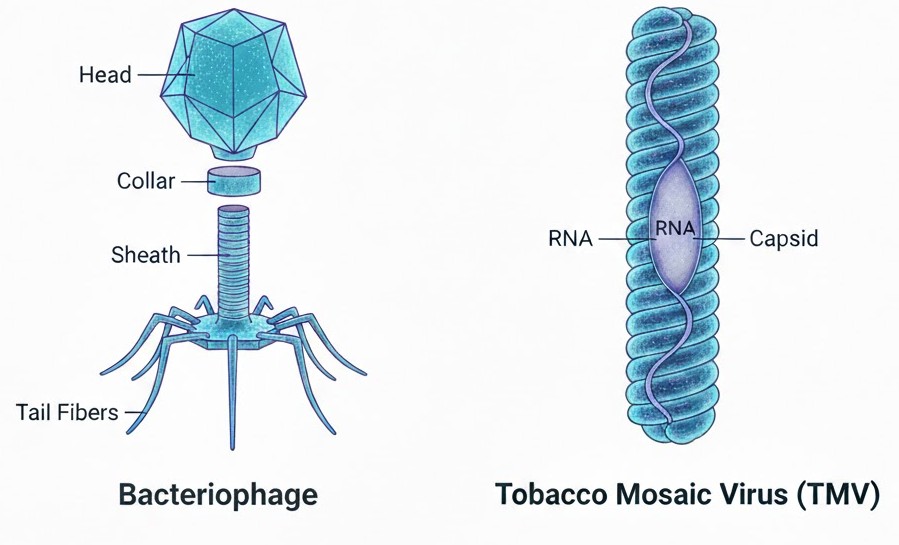
Viruses are like that uninvited guest who has no home of their own (non-cellular) but takes over your kitchen to cook once they break in. Outside a host, they are just inert crystalline structures, but once inside, they hijack the machinery to replicate. A virus is a nucleoprotein, meaning it has a protein coat called a capsid (made of capsomeres) protecting its genetic material. Here’s the trick: a virus contains either $DNA$ or $RNA$, but never both. Generally, plant viruses have $ssRNA$, while bacteriophages (virus-eating bacteria) usually have $dsDNA$.
NEET Checkpoint:
Which genetic material is usually found in bacteriophages?
(a) $dsDNA$
(b) RNA
(c) Both DNA and RNA
(d) Protein only
✅ Answer: (a) $dsDNA$ — Remember, these "bacteria eaters" prefer the double-stranded stuff!
Then we have Viroids, discovered by T.O. Diener in 1971. Think of them as viruses on a budget—they are just free RNA without any protein coat. They cause potato spindle tuber disease and have low molecular weight $RNA$. Prions are even weirder; they are just abnormally folded infectious proteins that cause neurological drama like "Mad Cow Disease" (BSE).
NEET Checkpoint:
Who discovered viroids and what disease do they cause?
(a) Stanley – Tobacco Mosaic Disease
(b) T.O. Diener – Potato Spindle Tuber Disease
(c) Wendell Stanley – Influenza
(d) Hershey & Chase – Bacteriophage infection
✅ Answer: (b) T.O. Diener; Potato spindle tuber disease — It's all about that naked $RNA$, buddy!
Finally, let’s talk about Lichens. This is the ultimate "Bestie" partnership between Algae (phycobiont) and Fungi (mycobiont). The algae cooks the food (autotrophic), and the fungi provides the "flat" and absorbs water (heterotrophic). They are so close you’d never guess they are two different organisms!
Indian Example: Think of Lichens like a Pani Puri stall. The Algae is the one making the spicy paani (food), and the Fungi provides the crispy puri (shelter) for the water to sit in. One can't do the job without the other!
Figure below:
A clear diagram showing the structure of a Bacteriophage with its head, collar, sheath, and tail fibres, and a Tobacco Mosaic Virus (TMV) showing the RNA and capsid.
NEET Checkpoint:
Why are lichens called "pollution indicators"?
(a) They grow only in polluted areas
(b) They do not grow in polluted areas
(c) They absorb heavy metals from water
(d) They produce oxygen rapidly
✅ Answer: (b) They do not grow in polluted areas — If the air is bad, they pack their bags and leave!
Practice Questions:
- A virus that infects a plant most likely contains:
(a) $dsDNA$
(b) $ssDNA$
(c) $ssRNA$
(d) $dsRNA$
✅ Answer: (c) $ssRNA$ — Most plant-infecting viruses stick to single-stranded $RNA$.
2. Which of the following lacks a protein coat?
(a) Virus
(b) Viroid
(c) Prion
(d) Bacteria
✅ Answer: (b) Viroid — These are "naked" infectious $RNA$ molecules.
Key Takeaway
- Viruses: $DNA$ or $RNA$ + Protein coat (capsid).
- Viroids: Free $RNA$ only; no protein coat.
- Prions: Abnormally folded infectious proteins.
- Lichens: Algae (food) + Fungi (shelter); pollution indicators.
11. Kingdom Plantae I: Algae
Listen up, junior! Before you get lost in the forest of higher plants, let's look at the Algae—the "OG" autotrophs. These guys are chlorophyll-bearing, simple, and thalloid, meaning they don't have fancy roots or stems. They are largely aquatic, living their best lives in both fresh and marine water.
Think of the green, slippery "slime" you see on the stones of a local temple pond (ghat) or the "green carpet" on a damp wall during the monsoon—that's algae for you! They are so diverse that some even hitch a ride on a sloth bear. Don't be fooled by their simplicity; they carry out at least half of the total $CO_2$ fixation on Earth!
NEET Checkpoint:
Where are pyrenoids located in green algae?
(a) Cytoplasm
(b) Nucleus
(c) Chloroplast
(d) Mitochondria
✅ Answer: (c) In the chloroplasts — They contain protein besides starch.
Let's break down the three main "clubs" of Algae:
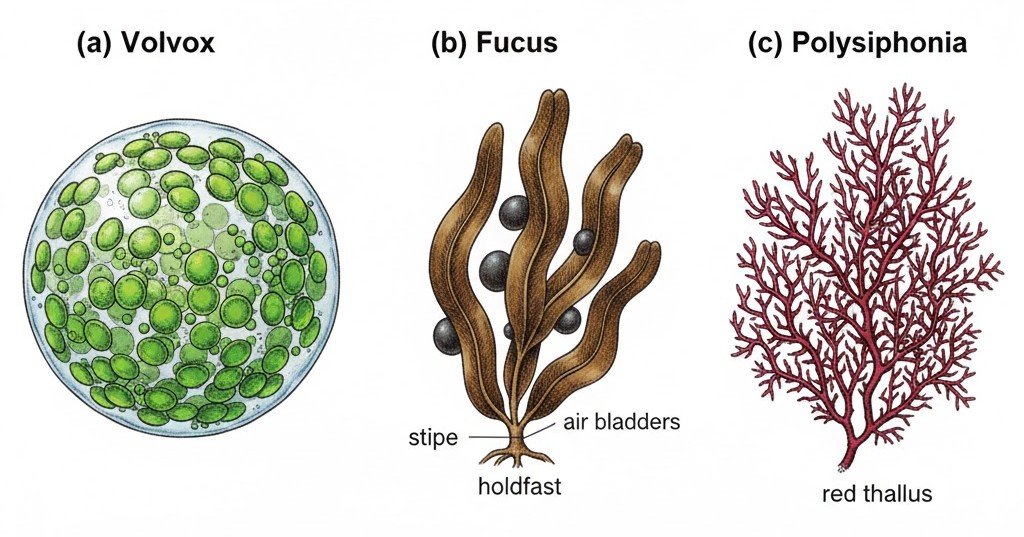
- Chlorophyceae (Green Algae): These are grass-green because of chlorophyll $a$ and $b$. They store food in pyrenoids.
- Examples: Volvox (colonial) and Ulothrix (filamentous).
- Phaeophyceae (Brown Algae): Mostly marine, these can grow into massive kelps reaching $100 \text{ metres}$. They have a pigment called fucoxanthin that gives them that brown shade. Their body has a holdfast for attachment, a stipe (stalk), and a frond (leaf-like organ).
- Examples: Laminaria and Fucus.
- Rhodophyceae (Red Algae): They love the warmer areas of the ocean. Their red colour comes from a pigment called $r$-phycoerythrin. They store food as floridean starch, which is structurally similar to amylopectin and glycogen.
- Examples: Porphyra and Polysiphonia.
NEET Checkpoint:
Name a unicellular alga used as a food supplement by space travellers.
(a) Spirogyra
(b) Chara
(c) Chlorella
(d) Ulothrix
✅ Answer: (c) Chlorella — It is very rich in proteins.
NEET Checkpoint:
What is the major storage food in Brown Algae?
(a) Starch
(b) Glycogen
(c) Mannitol and Laminarin
(d) Fructose
✅ Answer: (c) Laminarin or Mannitol — These are complex carbohydrates.
Figure below:
A clear diagram showing the three types of algae: (a) Volvox as a spherical colony of daughter and parent cells, (b) Fucus showing the holdfast, stipe, midrib, and air bladders, and (c) Polysiphonia showing its complex branched red thallus.
Practice Question:
Which of the following is a marine brown alga used as food?
(a) Spirogyra
(b) Volvox
(c) Sargassum
(d) Gelidium
✅ Answer: (c) Sargassum — Along with Porphyra and Laminaria, it is among the 70 species of marine algae used as food.
Key Takeaway
- Chlorophyceae: Chlorophyll $a, b$; Stored as Starch; Cell wall of Cellulose.
- Phaeophyceae: Chlorophyll $a, c$, Fucoxanthin; Stored as Mannitol/Laminarin; Cell wall of Cellulose and Algin.
- Rhodophyceae: Chlorophyll $a, d$, $r$-phycoerythrin; Stored as Floridean starch; No flagella.
12. Kingdom Plantae II: Bryophytes and Pteridophytes
Hey junior! Ready to level up our plant knowledge? Today we’re meeting the "Amphibians" and the first "Vascular" champions of the green world. Don't stress, yaar—it's easier than it looks!
The Bryophyte "Amphibians"
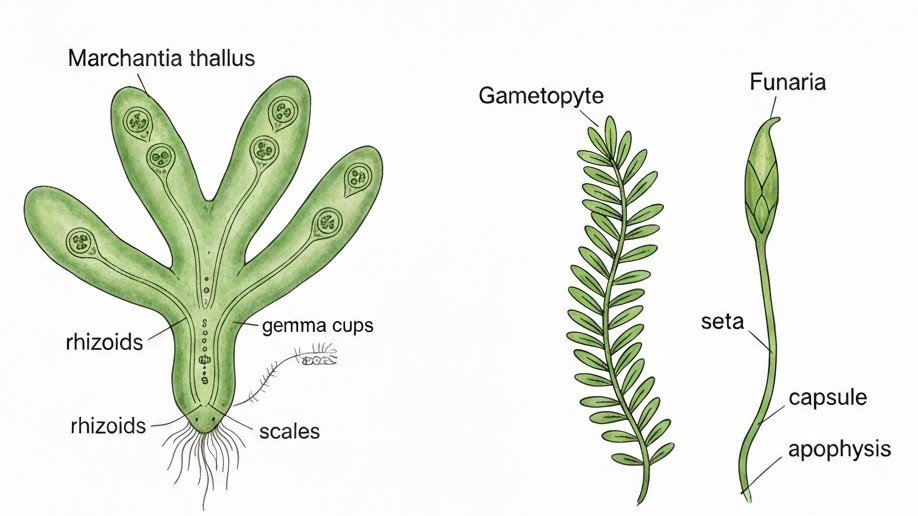
Bryophytes (mosses and liverworts) are famously called the amphibians of the plant kingdom. Why? Because while they live on soil, they are totally dependent on water for sexual reproduction—their male gametes (antherozoids) need to swim to reach the egg. They lack true roots, stems, or leaves, instead using rhizoids to stay attached to the ground.
NEET Checkpoint:
What is the dominant phase in the Bryophyte life cycle?
(a) Sporophyte
(b) Gametophyte
✅ Answer: (b) Gametophyte — Arre! The main plant body is haploid ($n$) and produces gametes!
Relatable Example: Think of Bryophytes like a local rickshaw. It’s simple and gets the job done in narrow, damp lanes (shaded hills), but it can't go long distances without its "fuel" (water) to complete its journey.
Figure below:
A clear diagram showing the thallus of Marchantia with gemma cups and rhizoids, and a diagram of Funaria showing the gametophyte and sporophyte stages.
The Pteridophyte Pioneers
Next up are the Pteridophytes (horsetails and ferns). These are the first terrestrial plants to possess vascular tissues—the xylem and phloem. Unlike Bryophytes, their main plant body is a sporophyte ($2n$) with true roots, stems, and leaves. Some, like Selaginella, have tiny leaves called microphylls, while ferns have large macrophylls.
NEET Checkpoint:
Which of these is a heterosporous pteridophyte?
(a) Equisetum
(b) Dryopteris
(c) Selaginella
(d) Pteris
✅ Answer: (c) Selaginella — Correct! Selaginella and Salvinia produce two kinds of spores: macro and micro.
Relatable Example: If Bryophytes are manual hand-pumps, Pteridophytes are like the first buildings with proper society plumbing (vascular bundles) to move water and food around.
NEET Checkpoint:
Where does fertilization occur in Pteridophytes?
(a) In the sporangium
(b) In the archegonium
(c) On the surface of the leaf
(d) In the antheridium
✅ Answer: (b) In the archegonium, after water carries the antherozoids to the egg.
Practice Question:
In Pteridophytes, the inconspicuous, small, multicellular, free-living, mostly photosynthetic thalloid gametophyte is called:
(a) Protonema
(b) Prothallus
(c) Gemma cup
(d) Sporophyll
✅ Answer: (b) Prothallus — This stage needs cool, damp, shady places to grow.
Key Takeaway
- Bryophytes: Main body is Gametophyte ($n$); examples: Marchantia, Funaria.
- Pteridophytes: Main body is Sporophyte ($2n$); first with vascular tissue; examples: Selaginella, Equisetum.
13. Kingdom Plantae III: Gymnosperms and Angiosperms
Hey everyone! Ready to wrap up the plant kingdom? We are moving from the "hidden" seeds of pteridophytes to the "naked" and "covered" ones. Don’t stress, yaar—it’s all about the packaging!
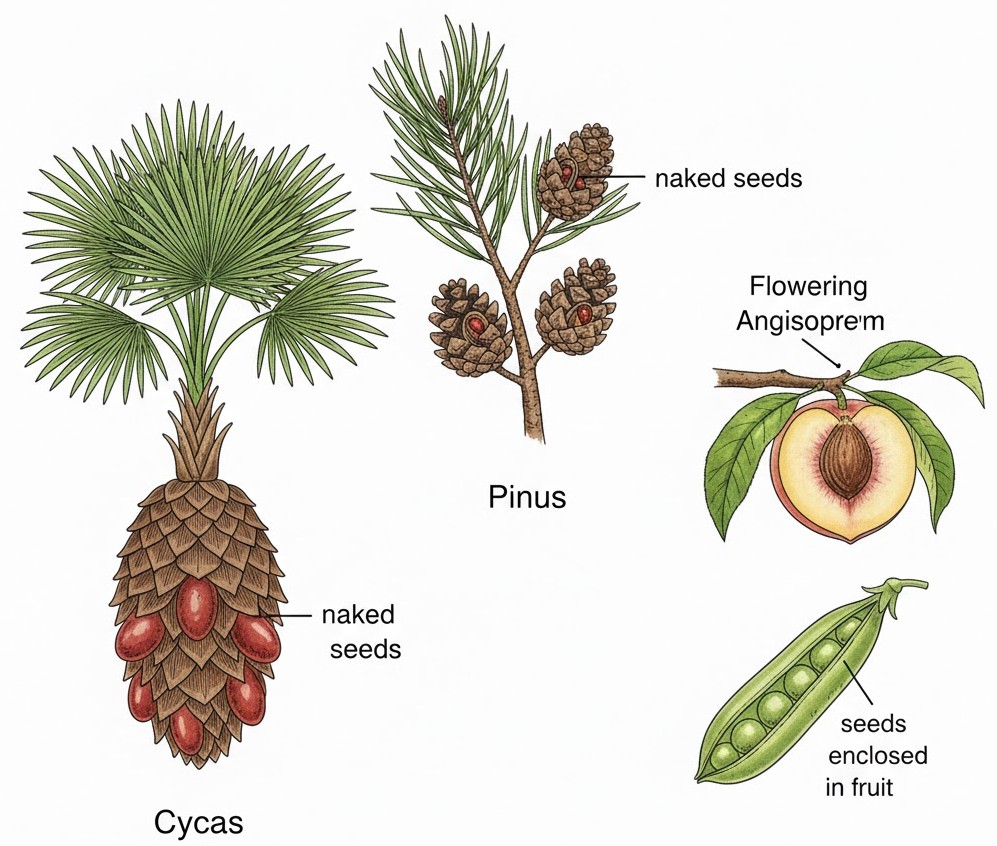
Gymnosperms literally mean "naked seeds" ($gymnos$: naked) because their ovules aren't enclosed by an ovary wall. Imagine a roadside stall selling open peanuts versus fancy vacuum-packed ones in a supermarket; gymnosperms are that open stall. They include shrubs and the massive Sequoia, which is one of the tallest tree species.
NEET Checkpoint:
Which gymnosperm has a fungal association called mycorrhiza?
(a) Cycas
(b) Pinus
(c) Cedrus
(d) Sequoia
✅ Answer: (b) Pinus — Fungal friends helping out with nutrients!.
These plants are tough! In conifers, needle-like leaves, thick cuticles, and sunken stomata help reduce water loss. Their roots are also specialized; while Pinus has mycorrhiza, Cycas has coralloid roots associated with $N_{2}$-fixing cyanobacteria.
NEET Checkpoint:
What is the highly reduced male gametophyte in gymnosperms called?
(a) Ovule
(b) Endosperm
(c) Pollen grain
(d) Microsporophyll
✅ Answer: (c) Pollen grain — It’s confined to only a limited number of cells.
Now, Angiosperms are the celebrities—the flowering plants! Unlike their naked cousins, their seeds are safely enclosed in fruits. They range from the tiny Wolffia to the towering Eucalyptus (over $100$ metres!). They are divided into two classes: Dicotyledons and Monocotyledons.
NEET Checkpoint:
Seeds are enclosed in fruits in:
(a) Gymnosperms
(b) Algae
(c) Pteridophytes
(d) Angiosperms
✅ Answer: (d) Angiosperms — That's the main "funda" of flowering plants!.
Figure below:
A clear diagram showing the structure of Cycas, Pinus, and a flowering Angiosperm, highlighting the difference between naked seeds and seeds enclosed in fruits.
Practice Question:
In gymnosperms, the stems are unbranched in:
(a) Pinus
(b) Cedrus
(c) Cycas
(d) Eucalyptus
✅ Answer: (c) Cycas — Remember, Pinus and Cedrus have branched stems!.
Takeaway
- Gymnosperms: Naked seeds, tap roots (Pinus: mycorrhiza, Cycas: coralloid roots), include Sequoia.
- Angiosperms: Flowering plants, seeds in fruits, divided into Dicots and Monocots.
14. Animal Kingdom: The Fundas of Classification
Hey junior! Don't get overwhelmed by the million-plus species out there. To make our lives easy, we classify animals based on some "common fundas" like how their cells are arranged or if they have a body cavity. Let's clear these concepts before you dive into the phyla!
Levels of Organisation: It starts simple. Sponges just have loose cell aggregates—the cellular level. As complexity grows, we see tissue level (coelenterates), organ level (Platyhelminthes), and finally organ-system level (Annelids to Chordates). Think of it like a cricket team: cellular level is like a bunch of random kids in a park, while an organ system is like the Indian Cricket Team, where every department (batting, bowling, fielding) has a specialized role!
NEET Checkpoint:
Which phylum first exhibits organ-level organisation?
(a) Porifera
(b) Cnidaria
(c) Platyhelminthes
(d) Annelida
✅ Answer: (c) Platyhelminthes — This is where tissues finally group together to form specialized organs.
Symmetry: Most sponges are asymmetrical. If any plane through the centre divides an animal into identical halves, it's radial symmetry. Imagine a round Pani Puri; any way you cut it through the middle, it’s the same! Bilateral symmetry (like in Annelids) means only one specific plane gives you a left and right half—just like a cricket bat.
NEET Checkpoint:
Give an example of an animal with radial symmetry.
(a) Earthworm
(b) Starfish
(c) Cockroach
(d) Frog
✅ Answer: (c) Starfish - Coelenterates, Ctenophores, or adult Echinoderms.
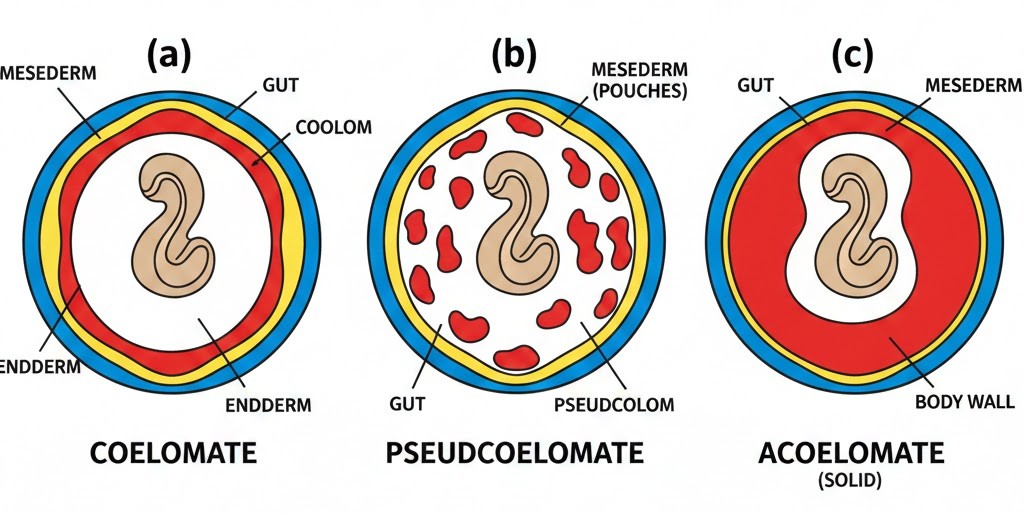
Germ Layers & Coelom: Diploblastic animals have two layers: ectoderm and endoderm, with a sandwich-filling called mesoglea. Triploblastic animals add a third layer, the mesoderm. The coelom is a cavity lined by this mesoderm. If you have it, you're a coelomate (like us!); if you have scattered pouches, you're a pseudocoelomate (Aschelminthes); and if you have no cavity, you're an acoelomate (Platyhelminthes).
Figure below:
A clear diagrammatic sectional view showing the three body plans: (a) Coelomate with a cavity lined by mesoderm, (b) Pseudocoelomate with mesoderm as scattered pouches, and (c) Acoelomate with no cavity between the gut and body wall.
NEET Checkpoint:
What is the unique feature of the cavity in Aschelminthes?
(a) It is absent
(b) It is a pseudocoelom
(c) It is a true coelom
(d) It is filled with blood
✅ Answer: (b) Pseudocoelom — The mesoderm is present only as scattered pouches between the ectoderm and endoderm.
Practice Question:
An animal with bilateral symmetry, triploblastic organisation, and a true coelom would belong to:
(a) Coelenterata
(b) Aschelminthes
(c) Annelida
(d) Platyhelminthes
✅ Answer: (c) Annelida — They possess organ-system level organisation, bilateral symmetry, and a true coelom lined by mesoderm.
Key Takeaway: Basis of Classification
- Levels: Cellular $\rightarrow$ Tissue $\rightarrow$ Organ $\rightarrow$ Organ System.
- Symmetry: Radial (circular) vs. Bilateral (left/right).
- Layers: Diploblastic (2) vs. Triploblastic (3).
- Coelom: Acoelomate (None), Pseudocoelomate (Pouches), Coelomate (True).
15. Animal Classification: Non-Chordates and Chordates
Hey junior! Don't let this huge list of animals scare you—it’s actually a total paisa vasool topic if you get the basic funda right. Think of animal classification as sorting your playlist; we just need the right folders!
First up, the Non-Chordates. These are the legends that don't have a notochord. We’ve got Porifera (sponges) who are basically living water filters with choanocytes, and Cnidaria (like jellyfish) who carry stinging cells called cnidoblasts for some serious "don't touch me" energy. Then there’s Arthropoda, the biggest group in the kingdom—think of them as the "jointed leg" gang with a tough chitinous armor. Mollusca are the softies, usually hiding in a hard calcareous shell like a Pila (apple snail).
NEET Checkpoint:
Which of the following possesses a water transport system with ostia and an osculum?
(a) Cnidaria
(b) Porifera
(c) Mollusca
(d) Arthropoda
✅ Answer: (b) Porifera — Arre, remember the water enters through tiny ostia and exits the osculum!
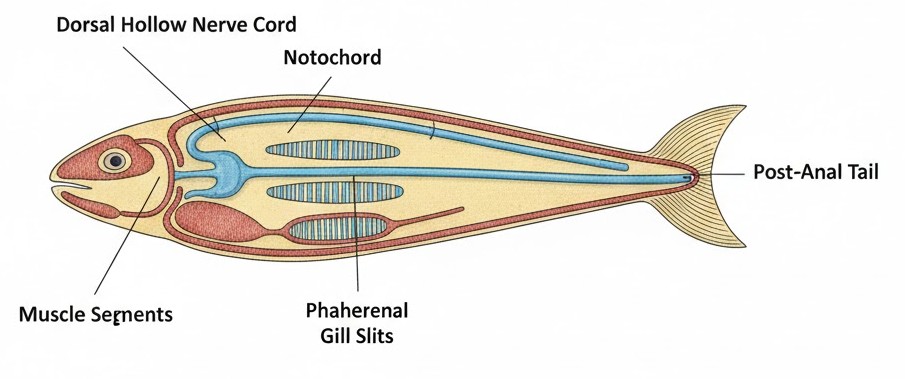
Now, welcome to the Chordata club! To get a membership here, you need three things: a notochord, a dorsal hollow nerve cord, and pharyngeal gill slits. It’s like the "Triple Crown" of biology!
Vertebrata is a special sub-group where the notochord is replaced by a vertebral column. We have classes like the jawless Cyclostomata, the cartilaginous Chondrichthyes (sharks), and the bony Osteichthyes. Then the land-stars: Amphibia (dual life), Reptilia (creeping scales), Aves (birds with pneumatic bones), and finally, Mammalia.
NEET Checkpoint:
A 4-chambered heart is found in which of these reptiles?
(a) Chameleon
(b) Naja
(c) Crocodiles
(d) Chelone
✅ Answer: (c) Crocodiles — Most reptiles have 3 chambers, but crocodiles are the VIP exception!
Mammals are the real GOATs (sometimes literally!). Our "trademark" features are mammary glands to nourish the young and having hair on our skin. It’s like being born with a built-in sweater and a milk bar!
NEET Checkpoint:
Which is a unique characteristic of mammals?
(a) Homeothermy
(b) 4-chambered heart
(c) Mammary glands
(d) Direct development
✅ Answer: (c) Mammary glands — While birds also have 4-chambered hearts and are homeothermic, only mammals have milk-producing glands!
Relatable Example: Think of a Mollusc like a student hiding inside a hoodie (the shell) to avoid the teacher's gaze—soft on the inside, protected on the outside!
Figure below:
A clear diagram showing the fundamental features of Phylum Chordata, including the dorsal hollow nerve cord, notochord, pharyngeal gill slits, and post-anal tail.
Practice Questions:
1. Pneumatic (air-filled) bones are a characteristic of:
(a) Mammalia
(b) Reptilia
(c) Aves
(d) Amphibia
✅ Answer: (c) Aves — These hollow bones are a cool modification to help them fly light!
2. The largest phylum of Animalia is:
(a) Mollusca
(b) Chordata
(c) Arthropoda
(d) Annelida
✅ Answer: (c) Arthropoda — Over two-thirds of all named species on Earth are arthropods, mostly insects!
Key Takeaway
- Non-Chordates: No notochord; includes Porifera, Cnidaria, Arthropoda, and Mollusca.
- Chordates: Must have notochord, dorsal hollow nerve cord, and gill slits.
- Vertebrates: Notochord becomes a backbone; includes fishes, amphibians, reptiles, birds, and mammals.
- Mammals: Defined by mammary glands and body hair.